3D Bioprinting for Organ Regeneration Market Size, Share | CAGR 16.8%
Global 3D Bioprinting for Organ Regeneration Market Size, Share & Analysis Report By Organ Type (Heart, Liver, Kidney, Lung, Skin, Bone, Ear, Eye, Others), Technology (Extrusion-Based, Laser-Assisted, Inkjet, Stereolithography, Magnetic Levitation, Laser-Based, Others), Material (Bioinks, Polymers, Hydrogels, Ceramics, Metals, Biomaterials, Others), Application, End User, Region & Key Players – Trends & Forecast 2025–2034
The 3D Bioprinting for Organ Regeneration Market is projected to reach approximately USD 14.6 billion by 2034, rising from USD 3.2 billion in 2024, growing at a CAGR of 16.8% during the forecast period from 2025 to 2034. This strong growth trajectory is driven by rapid advances in bioprinting technologies, stem cell research, and the rising demand for personalized regenerative therapies. Increasing investments in organ tissue engineering and collaboration between biotech firms and healthcare institutions are creating new pathways for life-saving innovations. As 3D bioprinting moves closer to clinical applications, the market is expected to revolutionize transplant medicine and precision healthcare worldwide.
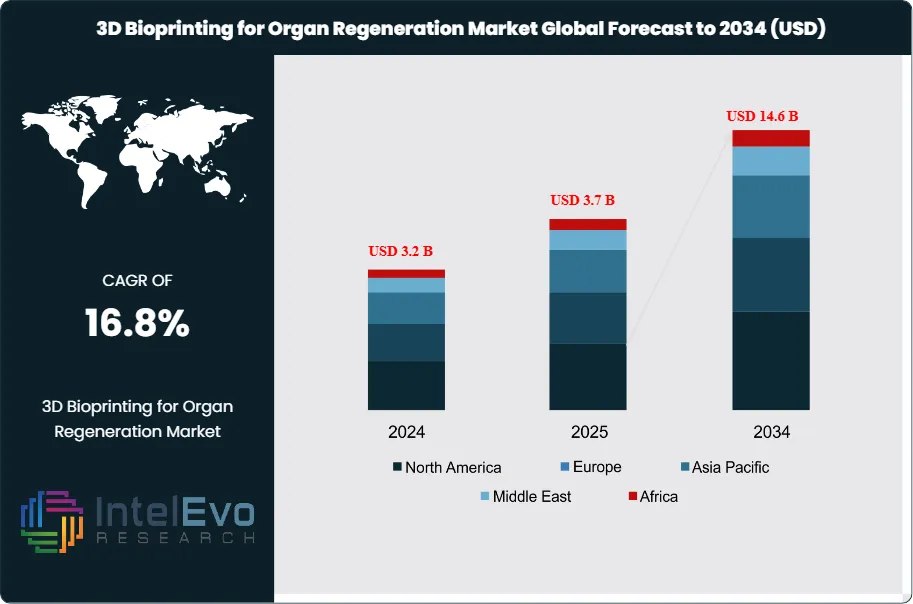
This growth is driven by advancements in bioprinting technologies, rising demand for organ transplantation, and increasing investments in regenerative medicine. Furthermore, supportive government initiatives and collaborations between biotech firms and research institutions are expected to accelerate market adoption over the coming decade.
The 3D Bioprinting for Organ Regeneration Market is the next step in the development of functional tissues and organs using advanced 3D printing technologies. It involves bioinks material, which is composed of living cells along with biomaterials layered to form complex biological structures. These bioprinted tissues may become the solution to some of the world's significant problems such as scarcity of donor organs, rejection of organs, and high costs of transplantation. Third, 3D bioprinting is applied in research, drug testing and regenerative medicine, to replace the services of this element in the healthcare industry.
The market is classified by organ type, technology, material, application, and end-users. The highest-demand organs in bioprinting include the heart, liver, kidney, and skin due to transplants and their complex biological mechanisms. Technologies involve extrusion-based, laser-assisted, and inkjet printing in enabling precise tissue creation. In terms of materials, a bioink, which contains living cells, forms an essential component of bioprinting functional tissues. Applications involve transplantation, disease modeling, drug testing, and medical training.
North America holds the highest position in the market, largely because of advanced healthcare infrastructure, high R&D expenditures, and companies that are strong stakeholders in the value chain, such as Organovo and CELLINK. The region is also fueled by the organ shortage and use of regenerative medicine technology. The Asia-Pacific region is expanding rapidly due to increased investment in the healthcare sector, amicable government policies, and a high population with increasing demands for healthcare. China, Japan, and South Korea, individually, lead the way in investing in bioprinting technologies to improve healthcare-related outcomes and meet the health needs of their citizens in organ transplants.
Key Takeaways
Market Growth: The 3D bioprinting for organ regeneration market is expected to reach USD 14.6 billion by 2034, growing at a robust CAGR of 16.8%, indicating strong market expansion.
Organ Type Dominance: The liver and heart dominate due to the high demand for transplants and the complexity of their biological functions. Liver tissue is particularly important for drug toxicity testing, while the heart is a critical area of focus for conditions such as cardiovascular disease. Companies like Organovo and BIOLIFE4D are leading the charge in developing liver and heart tissues, making these the most prioritized organ types in bioprinting.
Technology Preference: Extrusion-based bioprinting is the most widely used technology due to its versatility and ability to print complex structures at high resolutions. It allows for precise layering of bioinks and cells, making it suitable for creating functional tissues. Additionally, it’s cost-effective and scalable, making it the go-to technology for both research and clinical applications.
Material Dominance: Bioinks, made from living cells, are essential for creating functional tissues that mimic human organs. The success of 3D bioprinting largely depends on the compatibility and functionality of these bioinks, which provide the foundation for tissue growth and regeneration. With ongoing innovations in bioink formulations, this segment remains critical for the overall success of organ regeneration.
Application Dominance: Transplantation dominates as the primary application due to the increasing global demand for organ transplants and the shortage of donors. Bioprinting aims to address this gap by creating functional organs that can eventually be transplanted into patients. Although still in development, transplantation offers the most direct and impactful use case for 3D bioprinting technologies.
End-user Preference: Research institutes and laboratories dominate this segment as 3D bioprinting is still largely in the experimental and development phase. These organizations are driving innovation through research into tissue engineering, disease modeling, and drug testing, which are critical precursors to clinical applications in hospitals and pharmaceutical companies.
Driver: Innovations like extrusion-based printing, laser-assisted methods, and stereolithography enhance bioprinting by enabling precise cell deposition and improved bioinks, facilitating complex tissue modeling for research and clinical applications.
Restraint: The high costs of bioprinters, bioinks, and specialized expertise hinder 3D bioprinting adoption, especially in smaller institutions and developing regions, limiting access to organ regeneration technologies and delaying clinical use.
Opportunity: 3D bioprinting enables the creation of patient-specific tissues and organs, reducing immune rejection risks. This personalization leads to tailored treatments, drug testing, and breakthroughs in regenerative medicine and targeted therapies.
Trend: AI and machine learning enhance 3D bioprinting by optimizing processes, analyzing data on cell behavior and tissue growth, enabling real-time adjustments, predicting tissue responses, and improving organ regeneration and personalized medicine.
Regional Analysis: North America and Asia-Pacific are projected to be the regions with the highest market share and growth potential for 3D bioprinting for organ regeneration, driven by advanced healthcare, significant R&D investment, supportive regulations, and rising organ transplant demands, and driving adoption of bioprinting solutions.
Organ Type Analysis:
The liver and heart are the most critical parts in 3D bioprinting, because of their high demand rates in transplantation and due to their complexity in the biological process. Liver tissue is found to be crucial in the testing of drug toxicity, where researchers will be able to assess the potential effects that drugs would have on human-like systems. The heart is at the center of cardiovascular disease, which contributes largely to death rates across the globe. A few companies, like Organovo and BIOLIFE4D, are very enthusiastically working towards the direction of bioprinting liver and heart tissues, giving preference to these organs for research and clinical applications and focusing on meeting the need for organ transplant at the earliest.
Technology Analysis:
Extrusion-based 3D bioprinting is the most popular technology being used mainly because of its flexibility and its potential to create complex structures with excellent resolution. This technique allows the bioinks and the living cells to be deposited at different exact depths, hence allowing the creation of functional tissues that closely resemble the natures. Its cost-effectiveness and scalability are extremely important in both applied research and clinical setups. In addition, extrusion-based bioprinting can be modified to use various types of materials to give rise to many tissue types. Its being on the cutting edge of technology grants this to be the first choice for researchers and practitioners working on advancing the regeneration of organs.
Material Analysis:
Biological materials, which consist of living cells in the main composition, are responsible for the effectiveness of 3D bioprinting as well as functional tissues with features comparable to human organs. In total, it is the performance and compatibility of these bioinks that determine bioprinting efficiency because they establish an environment in which tissue growth and regeneration are possible. Advances in bioink formulation incorporate improved biocompatibility and designed properties for enhanced functionality. Such formulations are one among the key success factors for efforts into organ regeneration. Bioinks are getting more complex with research; it continues to consolidate their importance in the bioprinting landscape.
Application Analysis:
The most relevant application of 3D bioprinting is organ transplantation because of the overall increased global need for transplantation and the on-going organ donor shortage. Possibly, 3D bioprinting could solve this problem by creating organs that could function, and eventually, be implanted in patients and serve as a cure for such life-threatening conditions. Although still in its development phase, the actual usage case is to develop functional organs through bioprinting. Scientists are actively studying techniques to make bioprinted organs functional and compatible, thus widening what may ultimately be possible with organ transplants.
End-user Analysis:
Research centers and laboratories take the maximum portion of the 3D bioprinting market, simply because the technology is in its experimental stage and has been devised for development. These organizations spur further innovations through significant opportunities in research work related to tissue engineering, disease models, and drug testing. Their findings represent crucial precursors to eventual clinical applications, and therefore serve to empower hospitals and pharmaceutical corporations in their use of bioprinting technologies. Bioprinted tissues and organs will lead to advanced research on organ regeneration, personalized medicine, and therapeutic solutions for the future. They shall pave the way for the future of patient care in many medical disciplines.
Region Analysis:
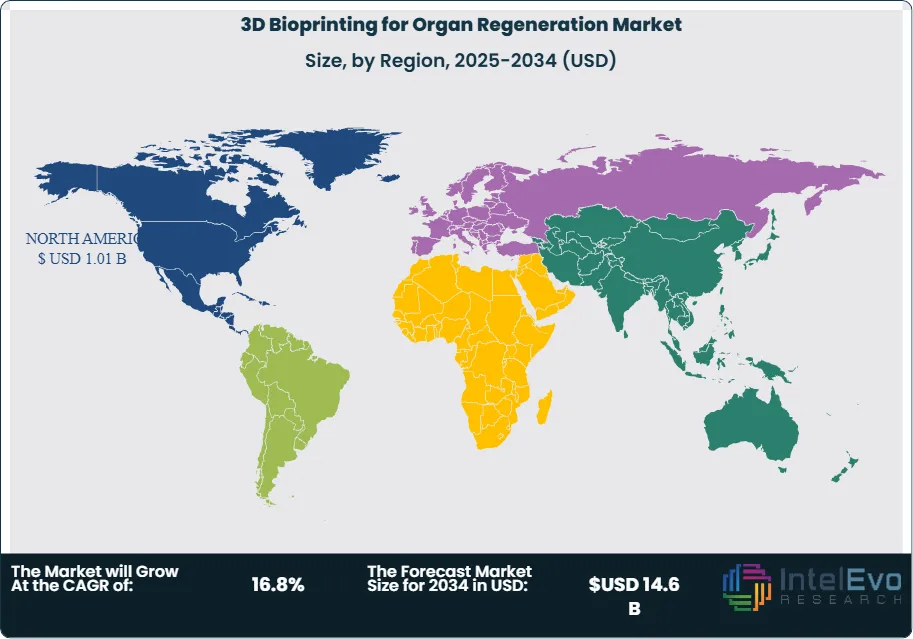
North America Leads With 35% Market Share In 3D bioprinting for organ regeneration market. North America leads the market due to the region's advanced healthcare infrastructure, substantial investment in research and development, and the presence of key market players like Organovo and CELLINK. The U.S. also has well-established regulatory frameworks supporting innovation in biotechnology and organ regeneration. Additionally, North America’s robust funding ecosystem, driven by both public institutions (like the NIH) and private investments, accelerates 3D bioprinting advancements. This region's demand is further fueled by the rising number of organ transplants and the shortage of organ donors, prompting increased adoption of 3D bioprinting solutions.
Asia-Pacific is witnessing the fastest growth, driven by increasing healthcare investments, growing awareness about regenerative medicine, and rapid technological adoption in countries like China, Japan, and South Korea. These nations are heavily investing in biotechnology research, supported by government initiatives to enhance healthcare outcomes. Additionally, the region benefits from a growing population, increasing prevalence of chronic diseases, and a rise in research collaborations between academic institutions and biotech firms, fostering innovation in 3D bioprinting technologies. The expanding biotech industry and supportive regulatory environment further propel growth in this region.
By Organ Type (Heart, Liver, Kidney, Lung, Skin, Bone, Ear, Eye, Others), Technology (Extrusion-Based 3D Printing, Laser-Assisted Printing, Inkjet Printing, Stereolithography, Magnetic Levitation, Laser Based, Others), Material (Biological Materials (Bioinks), Synthetic Polymers, Hydrogels, Ceramics, Metals, Biomaterials, Others), Application (Transplantation, Research & Drug Testing, Disease Modeling, Regenerative Medicine, Medical Training & Education, Others), End User (Hospitals & Clinics, Research Institutes & Laboratories, Pharmaceutical Companies, Academic Institutions, Others), Region
Research Methodology
Primary Research- 100 Interviews of Stakeholders
Secondary Research
Desk Research
Regional scope
North America (United States, Canada, Mexico)
Latin America (Brazil, Argentina, Columbia)
East Asia And Pacific (China, Japan, South Korea, Australia, Cambodia, Fiji, Indonesia)
Sea And South Asia (India, Singapore, Thailand, Taiwan, Malaysia)
Eastern Europe (Poland, Russia, Czech Republic, Romania)
Western Europe (Germany, U.K., France, Spain, Itlay)
Middle East & Africa (GCC Countries, Egypt, Nigeria, South Africa, Israel)
Customization for segments, region/country-level will be provided. Moreover, additional customization can be done based on the requirements.
Pricing and Purchase Options
Avail customized purchase options to meet your exact research needs. We have three licenses to opt for: Single User License, Multi-User License (Up to 5 Users), Corporate Use License (Unlimited User and Printable PDF).
TABLE OF CONTENTS
1.EXECUTIVE SUMMARY
1.1. MARKET SNAPSHOT
1.2. KEY FINDINGS & INSIGHTS
1.3. ANALYST RECOMMENDATIONS
1.4. FUTURE OUTLOOK
2. RESEARCH METHODOLOGY
2.1. MARKET DEFINITION & SCOPE
2.2. RESEARCH OBJECTIVES: PRIMARY & SECONDARY DATA SOURCES
2.3. DATA COLLECTION SOURCES
2.3.1. COVERAGE OF 100+ PRIMARY RESEARCH/CONSULTATION CALLS WITH INDUSTRY STAKEHOLDERS
FIGURE 17 NORTH AMERICA 3D BIOPRINTING FOR ORGAN REGENERATION CURRENT AND FUTURE TYPE ANALYSIS, 2025–2034, (USD MILLION)
FIGURE 18 NORTH AMERICA 3D BIOPRINTING FOR ORGAN REGENERATION CURRENT AND FUTURE APPLICATION ANALYSIS, 2025–2034, (USD MILLION)
FIGURE 19 MARKET SHARE BY COUNTRY
FIGURE 20 LATIN AMERICA 3D BIOPRINTING FOR ORGAN REGENERATION CURRENT AND FUTURE TYPE ANALYSIS, 2025–2034, (USD MILLION)
FIGURE 21 LATIN AMERICA 3D BIOPRINTING FOR ORGAN REGENERATION CURRENT AND FUTURE APPLICATION ANALYSIS, 2025–2034, (USD MILLION)
FIGURE 22 MARKET SHARE BY COUNTRY
FIGURE 23 EASTERN EUROPE 3D BIOPRINTING FOR ORGAN REGENERATION CURRENT AND FUTURE TYPE ANALYSIS, 2025–2034, (USD MILLION)
FIGURE 24 EASTERN EUROPE 3D BIOPRINTING FOR ORGAN REGENERATION CURRENT AND FUTURE APPLICATION ANALYSIS, 2025–2034, (USD MILLION)
FIGURE 25 MARKET SHARE BY COUNTRY
FIGURE 26 WESTERN EUROPE 3D BIOPRINTING FOR ORGAN REGENERATION CURRENT AND FUTURE TYPE ANALYSIS, 2025–2034, (USD MILLION)
FIGURE 27 WESTERN EUROPE 3D BIOPRINTING FOR ORGAN REGENERATION CURRENT AND FUTURE APPLICATION ANALYSIS, 2025–2034, (USD MILLION)
FIGURE 28 MARKET SHARE BY COUNTRY
FIGURE 29 EAST ASIA AND PACIFIC 3D BIOPRINTING FOR ORGAN REGENERATION CURRENT AND FUTURE TYPE ANALYSIS, 2025–2034, (USD MILLION)
FIGURE 30 EAST ASIA AND PACIFIC 3D BIOPRINTING FOR ORGAN REGENERATION CURRENT AND FUTURE APPLICATION ANALYSIS, 2025–2034, (USD MILLION)
FIGURE 31 MARKET SHARE BY COUNTRY
FIGURE 32 SEA AND SOUTH ASIA 3D BIOPRINTING FOR ORGAN REGENERATION CURRENT AND FUTURE TYPE ANALYSIS, 2025–2034, (USD MILLION)
FIGURE 33 SEA AND SOUTH ASIA 3D BIOPRINTING FOR ORGAN REGENERATION CURRENT AND FUTURE APPLICATION ANALYSIS, 2025–2034, (USD MILLION)
FIGURE 34 MARKET SHARE BY COUNTRY
FIGURE 35 MIDDLE EAST AND AFRICA 3D BIOPRINTING FOR ORGAN REGENERATION CURRENT AND FUTURE TYPE ANALYSIS, 2025–2034, (USD MILLION)
FIGURE 36 MIDDLE EAST AND AFRICA 3D BIOPRINTING FOR ORGAN REGENERATION CURRENT AND FUTURE APPLICATION ANALYSIS, 2025–2034, (USD MILLION)
FIGURE 37 NORTH AMERICA 3D BIOPRINTING FOR ORGAN REGENERATION CURRENT AND FUTURE MARKET VOLUME SHARE REGIONAL ANALYSIS, 2025–2034, (USD MILLION)
FIGURE 38 U.S. 3D BIOPRINTING FOR ORGAN REGENERATION CURRENT AND FUTURE TYPE ANALYSIS, 2025–2034, (USD MILLION)
FIGURE 39 U.S. 3D BIOPRINTING FOR ORGAN REGENERATION CURRENT AND FUTURE APPLICATION ANALYSIS, 2025–2034, (USD MILLION)
FIGURE 40 CANADA 3D BIOPRINTING FOR ORGAN REGENERATION CURRENT AND FUTURE TYPE ANALYSIS, 2025–2034, (USD MILLION)
FIGURE 41 CANADA 3D BIOPRINTING FOR ORGAN REGENERATION CURRENT AND FUTURE APPLICATION ANALYSIS, 2025–2034, (USD MILLION)
FIGURE 42 LATIN AMERICA 3D BIOPRINTING FOR ORGAN REGENERATION CURRENT AND FUTURE MARKET VOLUME SHARE REGIONAL ANALYSIS, 2025–2034, (USD MILLION)
FIGURE 43 MEXICO 3D BIOPRINTING FOR ORGAN REGENERATION CURRENT AND FUTURE TYPE ANALYSIS, 2025–2034, (USD MILLION)
FIGURE 44 MEXICO 3D BIOPRINTING FOR ORGAN REGENERATION CURRENT AND FUTURE APPLICATION ANALYSIS, 2025–2034, (USD MILLION)
FIGURE 45 BRAZIL 3D BIOPRINTING FOR ORGAN REGENERATION CURRENT AND FUTURE TYPE ANALYSIS, 2025–2034, (USD MILLION)
FIGURE 46 BRAZIL 3D BIOPRINTING FOR ORGAN REGENERATION CURRENT AND FUTURE APPLICATION ANALYSIS, 2025–2034, (USD MILLION)
FIGURE 47 ARGENTINA 3D BIOPRINTING FOR ORGAN REGENERATION CURRENT AND FUTURE TYPE ANALYSIS, 2025–2034, (USD MILLION)
FIGURE 48 ARGENTINA 3D BIOPRINTING FOR ORGAN REGENERATION CURRENT AND FUTURE APPLICATION ANALYSIS, 2025–2034, (USD MILLION)
FIGURE 49 COLUMBIA 3D BIOPRINTING FOR ORGAN REGENERATION CURRENT AND FUTURE TYPE ANALYSIS, 2025–2034, (USD MILLION)
FIGURE 50 COLUMBIA 3D BIOPRINTING FOR ORGAN REGENERATION CURRENT AND FUTURE APPLICATION ANALYSIS, 2025–2034, (USD MILLION)
FIGURE 51 REST OF LATIN AMERICA 3D BIOPRINTING FOR ORGAN REGENERATION CURRENT AND FUTURE TYPE ANALYSIS, 2025–2034, (USD MILLION)
FIGURE 52 REST OF LATIN AMERICA 3D BIOPRINTING FOR ORGAN REGENERATION CURRENT AND FUTURE APPLICATION ANALYSIS, 2025–2034, (USD MILLION)
FIGURE 53 EASTERN EUROPE 3D BIOPRINTING FOR ORGAN REGENERATION CURRENT AND FUTURE MARKET VOLUME SHARE REGIONAL ANALYSIS, 2025–2034, (USD MILLION)
FIGURE 54 POLAND 3D BIOPRINTING FOR ORGAN REGENERATION CURRENT AND FUTURE TYPE ANALYSIS, 2025–2034, (USD MILLION)
FIGURE 55 POLAND 3D BIOPRINTING FOR ORGAN REGENERATION CURRENT AND FUTURE APPLICATION ANALYSIS, 2025–2034, (USD MILLION)
FIGURE 56 RUSSIA 3D BIOPRINTING FOR ORGAN REGENERATION CURRENT AND FUTURE TYPE ANALYSIS, 2025–2034, (USD MILLION)
FIGURE 57 RUSSIA 3D BIOPRINTING FOR ORGAN REGENERATION CURRENT AND FUTURE APPLICATION ANALYSIS, 2025–2034, (USD MILLION)
FIGURE 58 CZECH REPUBLIC 3D BIOPRINTING FOR ORGAN REGENERATION CURRENT AND FUTURE TYPE ANALYSIS, 2025–2034, (USD MILLION)
FIGURE 59 CZECH REPUBLIC 3D BIOPRINTING FOR ORGAN REGENERATION CURRENT AND FUTURE APPLICATION ANALYSIS, 2025–2034, (USD MILLION)
FIGURE 60 ROMANIA 3D BIOPRINTING FOR ORGAN REGENERATION CURRENT AND FUTURE TYPE ANALYSIS, 2025–2034, (USD MILLION)
FIGURE 61 ROMANIA 3D BIOPRINTING FOR ORGAN REGENERATION CURRENT AND FUTURE APPLICATION ANALYSIS, 2025–2034, (USD MILLION)
FIGURE 62 REST OF EASTERN EUROPE 3D BIOPRINTING FOR ORGAN REGENERATION CURRENT AND FUTURE TYPE ANALYSIS, 2025–2034, (USD MILLION)
FIGURE 63 REST OF EASTERN EUROPE 3D BIOPRINTING FOR ORGAN REGENERATION CURRENT AND FUTURE APPLICATION ANALYSIS, 2025–2034, (USD MILLION)
FIGURE 64 WESTERN EUROPE 3D BIOPRINTING FOR ORGAN REGENERATION CURRENT AND FUTURE MARKET VOLUME SHARE REGIONAL ANALYSIS, 2025–2034, (USD MILLION)
FIGURE 65 GERMANY 3D BIOPRINTING FOR ORGAN REGENERATION CURRENT AND FUTURE TYPE ANALYSIS, 2025–2034, (USD MILLION)
FIGURE 66 GERMANY 3D BIOPRINTING FOR ORGAN REGENERATION CURRENT AND FUTURE APPLICATION ANALYSIS, 2025–2034, (USD MILLION)
FIGURE 67 FRANCE 3D BIOPRINTING FOR ORGAN REGENERATION CURRENT AND FUTURE TYPE ANALYSIS, 2025–2034, (USD MILLION)
FIGURE 68 FRANCE 3D BIOPRINTING FOR ORGAN REGENERATION CURRENT AND FUTURE APPLICATION ANALYSIS, 2025–2034, (USD MILLION)
FIGURE 69 UK 3D BIOPRINTING FOR ORGAN REGENERATION CURRENT AND FUTURE TYPE ANALYSIS, 2025–2034, (USD MILLION)
FIGURE 70 UK 3D BIOPRINTING FOR ORGAN REGENERATION CURRENT AND FUTURE APPLICATION ANALYSIS, 2025–2034, (USD MILLION)
FIGURE 71 SPAIN 3D BIOPRINTING FOR ORGAN REGENERATION CURRENT AND FUTURE TYPE ANALYSIS, 2025–2034, (USD MILLION)
FIGURE 72 SPAIN 3D BIOPRINTING FOR ORGAN REGENERATION CURRENT AND FUTURE APPLICATION ANALYSIS, 2025–2034, (USD MILLION)
FIGURE 73 ITALY 3D BIOPRINTING FOR ORGAN REGENERATION CURRENT AND FUTURE TYPE ANALYSIS, 2025–2034, (USD MILLION)
FIGURE 74 ITALY 3D BIOPRINTING FOR ORGAN REGENERATION CURRENT AND FUTURE APPLICATION ANALYSIS, 2025–2034, (USD MILLION)
FIGURE 75 REST OF WESTERN EUROPE 3D BIOPRINTING FOR ORGAN REGENERATION CURRENT AND FUTURE TYPE ANALYSIS, 2025–2034, (USD MILLION)
FIGURE 76 REST OF WESTERN EUROPE 3D BIOPRINTING FOR ORGAN REGENERATION CURRENT AND FUTURE APPLICATION ANALYSIS, 2025–2034, (USD MILLION)
FIGURE 77 EAST ASIA AND PACIFIC 3D BIOPRINTING FOR ORGAN REGENERATION CURRENT AND FUTURE MARKET VOLUME SHARE REGIONAL ANALYSIS, 2025–2034, (USD MILLION)
FIGURE 78 CHINA 3D BIOPRINTING FOR ORGAN REGENERATION CURRENT AND FUTURE TYPE ANALYSIS, 2025–2034, (USD MILLION)
FIGURE 79 CHINA 3D BIOPRINTING FOR ORGAN REGENERATION CURRENT AND FUTURE APPLICATION ANALYSIS, 2025–2034, (USD MILLION)
FIGURE 80 JAPAN 3D BIOPRINTING FOR ORGAN REGENERATION CURRENT AND FUTURE TYPE ANALYSIS, 2025–2034, (USD MILLION)
FIGURE 81 JAPAN 3D BIOPRINTING FOR ORGAN REGENERATION CURRENT AND FUTURE APPLICATION ANALYSIS, 2025–2034, (USD MILLION)
FIGURE 82 AUSTRALIA 3D BIOPRINTING FOR ORGAN REGENERATION CURRENT AND FUTURE TYPE ANALYSIS, 2025–2034, (USD MILLION)
FIGURE 83 AUSTRALIA 3D BIOPRINTING FOR ORGAN REGENERATION CURRENT AND FUTURE APPLICATION ANALYSIS, 2025–2034, (USD MILLION)
FIGURE 84 CAMBODIA 3D BIOPRINTING FOR ORGAN REGENERATION CURRENT AND FUTURE TYPE ANALYSIS, 2025–2034, (USD MILLION)
FIGURE 85 CAMBODIA 3D BIOPRINTING FOR ORGAN REGENERATION CURRENT AND FUTURE APPLICATION ANALYSIS, 2025–2034, (USD MILLION)
FIGURE 86 FIJI 3D BIOPRINTING FOR ORGAN REGENERATION CURRENT AND FUTURE TYPE ANALYSIS, 2025–2034, (USD MILLION)
FIGURE 87 FIJI 3D BIOPRINTING FOR ORGAN REGENERATION CURRENT AND FUTURE APPLICATION ANALYSIS, 2025–2034, (USD MILLION)
FIGURE 88 INDONESIA 3D BIOPRINTING FOR ORGAN REGENERATION CURRENT AND FUTURE TYPE ANALYSIS, 2025–2034, (USD MILLION)
FIGURE 89 INDONESIA 3D BIOPRINTING FOR ORGAN REGENERATION CURRENT AND FUTURE APPLICATION ANALYSIS, 2025–2034, (USD MILLION)
FIGURE 90 SOUTH KOREA 3D BIOPRINTING FOR ORGAN REGENERATION CURRENT AND FUTURE TYPE ANALYSIS, 2025–2034, (USD MILLION)
FIGURE 91 SOUTH KOREA 3D BIOPRINTING FOR ORGAN REGENERATION CURRENT AND FUTURE APPLICATION ANALYSIS, 2025–2034, (USD MILLION)
FIGURE 92 REST OF EAST ASIA AND PACIFIC 3D BIOPRINTING FOR ORGAN REGENERATION CURRENT AND FUTURE TYPE ANALYSIS, 2025–2034, (USD MILLION)
FIGURE 93 REST OF EAST ASIA AND PACIFIC 3D BIOPRINTING FOR ORGAN REGENERATION CURRENT AND FUTURE APPLICATION ANALYSIS, 2025–2034, (USD MILLION)
FIGURE 94 SEA AND SOUTH ASIA 3D BIOPRINTING FOR ORGAN REGENERATION CURRENT AND FUTURE MARKET VOLUME SHARE REGIONAL ANALYSIS, 2025–2034, (USD MILLION)
FIGURE 95 BANGLADESH 3D BIOPRINTING FOR ORGAN REGENERATION CURRENT AND FUTURE TYPE ANALYSIS, 2025–2034, (USD MILLION)
FIGURE 96 BANGLADESH 3D BIOPRINTING FOR ORGAN REGENERATION CURRENT AND FUTURE APPLICATION ANALYSIS, 2025–2034, (USD MILLION)
FIGURE 97 NEW ZEALAND 3D BIOPRINTING FOR ORGAN REGENERATION CURRENT AND FUTURE TYPE ANALYSIS, 2025–2034, (USD MILLION)
FIGURE 98 NEW ZEALAND 3D BIOPRINTING FOR ORGAN REGENERATION CURRENT AND FUTURE APPLICATION ANALYSIS, 2025–2034, (USD MILLION)
FIGURE 99 INDIA 3D BIOPRINTING FOR ORGAN REGENERATION CURRENT AND FUTURE TYPE ANALYSIS, 2025–2034, (USD MILLION)
FIGURE 100 INDIA 3D BIOPRINTING FOR ORGAN REGENERATION CURRENT AND FUTURE APPLICATION ANALYSIS, 2025–2034, (USD MILLION)
FIGURE 101 SINGAPORE 3D BIOPRINTING FOR ORGAN REGENERATION CURRENT AND FUTURE TYPE ANALYSIS, 2025–2034, (USD MILLION)
FIGURE 102 SINGAPORE 3D BIOPRINTING FOR ORGAN REGENERATION CURRENT AND FUTURE APPLICATION ANALYSIS, 2025–2034, (USD MILLION)
FIGURE 103 THAILAND 3D BIOPRINTING FOR ORGAN REGENERATION CURRENT AND FUTURE TYPE ANALYSIS, 2025–2034, (USD MILLION)
FIGURE 104 THAILAND 3D BIOPRINTING FOR ORGAN REGENERATION CURRENT AND FUTURE APPLICATION ANALYSIS, 2025–2034, (USD MILLION)
FIGURE 105 TAIWAN 3D BIOPRINTING FOR ORGAN REGENERATION CURRENT AND FUTURE TYPE ANALYSIS, 2025–2034, (USD MILLION)
FIGURE 106 TAIWAN 3D BIOPRINTING FOR ORGAN REGENERATION CURRENT AND FUTURE APPLICATION ANALYSIS, 2025–2034, (USD MILLION)
FIGURE 107 MALAYSIA 3D BIOPRINTING FOR ORGAN REGENERATION CURRENT AND FUTURE TYPE ANALYSIS, 2025–2034, (USD MILLION)
FIGURE 108 MALAYSIA 3D BIOPRINTING FOR ORGAN REGENERATION CURRENT AND FUTURE APPLICATION ANALYSIS, 2025–2034, (USD MILLION)
FIGURE 109 REST OF SEA AND SOUTH ASIA 3D BIOPRINTING FOR ORGAN REGENERATION CURRENT AND FUTURE TYPE ANALYSIS, 2025–2034, (USD MILLION)
FIGURE 110 REST OF SEA AND SOUTH ASIA 3D BIOPRINTING FOR ORGAN REGENERATION CURRENT AND FUTURE APPLICATION ANALYSIS, 2025–2034, (USD MILLION)
FIGURE 111 MIDDLE EAST AND AFRICA 3D BIOPRINTING FOR ORGAN REGENERATION CURRENT AND FUTURE MARKET VOLUME SHARE REGIONAL ANALYSIS, 2025–2034, (USD MILLION)
FIGURE 112 GCC COUNTRIES 3D BIOPRINTING FOR ORGAN REGENERATION CURRENT AND FUTURE TYPE ANALYSIS, 2025–2034, (USD MILLION)
FIGURE 113 GCC COUNTRIES 3D BIOPRINTING FOR ORGAN REGENERATION CURRENT AND FUTURE APPLICATION ANALYSIS, 2025–2034, (USD MILLION)
FIGURE 114 SAUDI ARABIA 3D BIOPRINTING FOR ORGAN REGENERATION CURRENT AND FUTURE TYPE ANALYSIS, 2025–2034, (USD MILLION)
FIGURE 115 SAUDI ARABIA 3D BIOPRINTING FOR ORGAN REGENERATION CURRENT AND FUTURE APPLICATION ANALYSIS, 2025–2034, (USD MILLION)
FIGURE 116 UAE 3D BIOPRINTING FOR ORGAN REGENERATION CURRENT AND FUTURE TYPE ANALYSIS, 2025–2034, (USD MILLION)
FIGURE 117 UAE 3D BIOPRINTING FOR ORGAN REGENERATION CURRENT AND FUTURE APPLICATION ANALYSIS, 2025–2034, (USD MILLION)
FIGURE 118 BAHRAIN 3D BIOPRINTING FOR ORGAN REGENERATION CURRENT AND FUTURE TYPE ANALYSIS, 2025–2034, (USD MILLION)
FIGURE 119 BAHRAIN 3D BIOPRINTING FOR ORGAN REGENERATION CURRENT AND FUTURE APPLICATION ANALYSIS, 2025–2034, (USD MILLION)
FIGURE 120 KUWAIT 3D BIOPRINTING FOR ORGAN REGENERATION CURRENT AND FUTURE TYPE ANALYSIS, 2025–2034, (USD MILLION)
FIGURE 121 KUWAIT 3D BIOPRINTING FOR ORGAN REGENERATION CURRENT AND FUTURE APPLICATION ANALYSIS, 2025–2034, (USD MILLION)
FIGURE 122 OMAN 3D BIOPRINTING FOR ORGAN REGENERATION CURRENT AND FUTURE TYPE ANALYSIS, 2025–2034, (USD MILLION)
FIGURE 123 OMAN 3D BIOPRINTING FOR ORGAN REGENERATION CURRENT AND FUTURE APPLICATION ANALYSIS, 2025–2034, (USD MILLION)
FIGURE 124 QATAR 3D BIOPRINTING FOR ORGAN REGENERATION CURRENT AND FUTURE TYPE ANALYSIS, 2025–2034, (USD MILLION)
FIGURE 125 QATAR 3D BIOPRINTING FOR ORGAN REGENERATION CURRENT AND FUTURE APPLICATION ANALYSIS, 2025–2034, (USD MILLION)
FIGURE 126 EGYPT 3D BIOPRINTING FOR ORGAN REGENERATION CURRENT AND FUTURE TYPE ANALYSIS, 2025–2034, (USD MILLION)
FIGURE 127 EGYPT 3D BIOPRINTING FOR ORGAN REGENERATION CURRENT AND FUTURE APPLICATION ANALYSIS, 2025–2034, (USD MILLION)
FIGURE 128 NIGERIA 3D BIOPRINTING FOR ORGAN REGENERATION CURRENT AND FUTURE TYPE ANALYSIS, 2025–2034, (USD MILLION)
FIGURE 129 NIGERIA 3D BIOPRINTING FOR ORGAN REGENERATION CURRENT AND FUTURE APPLICATION ANALYSIS, 2025–2034, (USD MILLION)
FIGURE 130 SOUTH AFRICA 3D BIOPRINTING FOR ORGAN REGENERATION CURRENT AND FUTURE TYPE ANALYSIS, 2025–2034, (USD MILLION)
FIGURE 131 SOUTH AFRICA 3D BIOPRINTING FOR ORGAN REGENERATION CURRENT AND FUTURE APPLICATION ANALYSIS, 2025–2034, (USD MILLION)
FIGURE 132 ISRAEL 3D BIOPRINTING FOR ORGAN REGENERATION CURRENT AND FUTURE TYPE ANALYSIS, 2025–2034, (USD MILLION)
FIGURE 133 ISRAEL 3D BIOPRINTING FOR ORGAN REGENERATION CURRENT AND FUTURE APPLICATION ANALYSIS, 2025–2034, (USD MILLION)
FIGURE 134 REST OF MEA 3D BIOPRINTING FOR ORGAN REGENERATION CURRENT AND FUTURE TYPE ANALYSIS, 2025–2034, (USD MILLION)
FIGURE 135 REST OF MEA 3D BIOPRINTING FOR ORGAN REGENERATION CURRENT AND FUTURE APPLICATION ANALYSIS, 2025–2034, (USD MILLION)
FIGURE 136 U. S. MARKET SHARE ANALYSIS BY TYPE (2024)
FIGURE 137 U. S. MARKET SHARE ANALYSIS BY APPLICATION (2024)
FIGURE 138 CANADA MARKET SHARE ANALYSIS BY TYPE (2024)
FIGURE 139 CANADA MARKET SHARE ANALYSIS BY APPLICATION (2024)
FIGURE 140 MEXICO MARKET SHARE ANALYSIS BY TYPE (2024)
FIGURE 141 MEXICO MARKET SHARE ANALYSIS BY APPLICATION (2024)
FIGURE 142 CHINA MARKET SHARE ANALYSIS BY TYPE (2024)
FIGURE 143 CHINA MARKET SHARE ANALYSIS BY APPLICATION (2024)
FIGURE 144 JAPAN MARKET SHARE ANALYSIS BY TYPE (2024)
FIGURE 145 JAPAN MARKET SHARE ANALYSIS BY APPLICATION (2024)
FIGURE 146 INDIA MARKET SHARE ANALYSIS BY TYPE (2024)
FIGURE 147 INDIA MARKET SHARE ANALYSIS BY APPLICATION (2024)
FIGURE 148 SOUTH KOREA MARKET SHARE ANALYSIS BY TYPE (2024)
FIGURE 149 SOUTH KOREA MARKET SHARE ANALYSIS BY APPLICATION (2024)
FIGURE 150 SAUDI ARABIA MARKET SHARE ANALYSIS BY TYPE (2024)
FIGURE 151 SAUDI ARABIA MARKET SHARE ANALYSIS BY APPLICATION (2024)
FIGURE 152 UAE MARKET SHARE ANALYSIS BY TYPE (2024)
FIGURE 153 UAE MARKET SHARE ANALYSIS BY APPLICATION (2024)
FIGURE 154 EGYPT MARKET SHARE ANALYSIS BY TYPE (2024)
FIGURE 155 EGYPT MARKET SHARE ANALYSIS BY APPLICATION (2024)
FIGURE 156 NIGERIA MARKET SHARE ANALYSIS BY TYPE (2024)
FIGURE 157 NIGERIA MARKET SHARE ANALYSIS BY APPLICATION (2024)
FIGURE 158 SOUTH AFRICA MARKET SHARE ANALYSIS BY TYPE (2024)
FIGURE 159 SOUTH AFRICA MARKET SHARE ANALYSIS BY APPLICATION (2024)
FIGURE 160 GERMANY MARKET SHARE ANALYSIS BY TYPE (2024)
FIGURE 161 GERMANY MARKET SHARE ANALYSIS BY APPLICATION (2024)
FIGURE 162 FRANCE MARKET SHARE ANALYSIS BY TYPE (2024)
FIGURE 163 FRANCE MARKET SHARE ANALYSIS BY APPLICATION (2024)
FIGURE 164 UK MARKET SHARE ANALYSIS BY TYPE (2024)
FIGURE 165 UK MARKET SHARE ANALYSIS BY APPLICATION (2024)
FIGURE 166 SPAIN MARKET SHARE ANALYSIS BY TYPE (2024)
FIGURE 167 SPAIN MARKET SHARE ANALYSIS BY APPLICATION (2024)
FIGURE 168 ITALY MARKET SHARE ANALYSIS BY TYPE (2024)
FIGURE 169 ITALY MARKET SHARE ANALYSIS BY APPLICATION (2024)
FIGURE 170 BRAZIL MARKET SHARE ANALYSIS BY TYPE (2024)
FIGURE 171 BRAZIL MARKET SHARE ANALYSIS BY APPLICATION (2024)
FIGURE 172 ARGENTINA MARKET SHARE ANALYSIS BY TYPE (2024)
FIGURE 173 ARGENTINA MARKET SHARE ANALYSIS BY APPLICATION (2024)
FIGURE 174 COLUMBIA MARKET SHARE ANALYSIS BY TYPE (2024)
FIGURE 175 COLUMBIA MARKET SHARE ANALYSIS BY APPLICATION (2024)
FIGURE 176 GLOBAL 3D BIOPRINTING FOR ORGAN REGENERATION CURRENT AND FUTURE MARKET KEY COUNTRY LEVEL ANALYSIS, 2024–2034, (USD MILLION)
FIGURE 177 FINANCIAL OVERVIEW:
Key Players Analysis:
Organovo Holdings, Inc.: Organovo is a forerunner in 3D bioprinting technology. The company focuses on developing functional human tissues for medical research and therapeutic applications. It has recently been in the spotlight for printing liver and kidney tissue.
CELLINK: CELLINK specializes in bioinks and bioprinters for research and therapeutic applications. It provides a comprehensive platform for bioprinting tissues, organs, and 3D cell cultures, and has a broad market presence in research institutions and universities.
Aspect Biosystems: Aspect Biosystems is known for its microfluidic 3D bioprinting technology, which is designed to create living tissues for medical research, drug development, and therapeutic purposes. Their focus is on printing tissues that mimic human organs.
BIOLIFE4D: BIOLIFE4D focuses on bioprinting human heart tissue, with the ultimate goal of creating a fully functioning 3D-printed human heart for transplantation. It has made headlines for its advancements in cardiac tissue printing.
Cyfuse Biomedical: Cyfuse Biomedical is known for its scaffold-free 3D bioprinting technology, specifically focusing on cell-based tissue regeneration. Its Regenova® bioprinter uses a unique method of assembling spheroids to create complex tissue structures.
Advanced Solutions, Inc.: Advanced Solutions focuses on bioprinting systems that cater to medical research and regenerative medicine. The company offers a comprehensive line of bioprinters, including the BioAssemblyBot®, which has applications in tissue engineering.
Market Key Players
Stratasys Ltd.
Materialise N.V.
BIOLIFE4D
Organovo Holding, Inc.
CELLINK
Aspect Biosystems
Cyfuse Biomedical
TeVido Biodevices
Advanced Solutions, Inc.
TRS – Tissue Regeneration Systems
Nscrypt, Inc
EnvisionTEC
MedPrin
Nano3D Sciences
Rokit
Cellbricks
REGEMAT 3D
Allevi
Poietis
T&R BIOFAB
Other Prominent Players
Driver:
Growing Demand for Organ Transplants
The increasing shortage of organ donors is a key driver in the 3D bioprinting for organ regeneration market. The global requirement for organ transplantation far outweighs the supply, and most of the patient population with end-stage organ failure cannot be transplanted within a relevant time frame, leading to some inevitable deaths. 3D bioprinting offers hope in this regard as it can create functional tissues and potentially full organs for patients that reduce their dependency on donors. Further, bioprinting decreases the probability of organ rejection as tissues can be printed from cells derived from a patient's body. As an increasing number of individuals gain awareness of what is possible, funding for research and investment in bioprinting technologies are gaining speed, hence accelerating the market.
Advancements in Bioprinting Technology
Improving 3D bioprinting technologies, such as extrusion-based bioprinting, laser-assisted printing, and stereolithography propel the market. These technologies allow for the precise and accurate deposition of cells, bioinks, and materials in order to create functional tissues. Advances in bioinks (biocompatible materials) allow for a better representation of human tissue structure and function, leading to improved research and clinical opportunities. Higher resolutions, greater speeds, and scalability allow for printing more complex and multi-layered tissues. It is for this reason that scientists can nowadays create model diseases, test drugs and even 3D-print transplantable functional organs which accelerates the market growth.
Increased Investment in Regenerative Medicine
Increased public and private investments in regenerative medicine are one of the major drivers for the 3D bioprinting market. Governments, healthcare centers, and venture capital firms recognize the impact of bioprinting for the unmet needs in medicine, especially organ regeneration. For example, agencies of national health and foundations in the North America, Europe, and Asia-Pacific regions are actively conducting research with a focus specifically on developing tissue engineering and bioprinting technologies. Besides that, pharmaceutical and biotech companies have been collaborating with bioprinting companies in producing tissues to be used in drug testing and disease modeling, providing an alternative to animal testing. Investment is generating fast-paced R&D and commercialization, driving the market forward.
Restrain:
High Cost of Bioprinting Technology
One of the key restraints in the 3D bioprinting for organ regeneration market is the high cost associated with the technology. The machinery involved here, including the bioprinters, bioinks, and biomaterials, are highly expensive and not easily accessible to a smaller research institution or a hospital. In addition, the maintenance and operating of bioprinters coupled with the relatively high technical requirement for the process add to the overall cost. The complexity of bioprinting full organs also places a requirement on very high investments in R&D for this to become a reality, and this degrades the prospect of applying bioprinting widely in clinical medicine. Hence, the initial capital investment required for this technology serves as a barrier in its accessibility and adoption, especially in developing regions where healthcare budgets may be constrained.
Regulatory and Ethical Challenges
Regulatory and ethical concerns pose significant challenges to the development and commercialization of 3D bioprinting technologies for organ regeneration. The mechanisms to print the functional human tissue and organ require approval from several regulatory bodies, such as the FDA (Food and Drug Administration) in America or the EMA (European Medicines Agency) in Europe. Approvals for such a technology may be slow due to the novelty and complexity, where there are very few precedents trying to assess the safety and efficacy of bioprinted organs. Ethical issues, like implications of creating synthetic human tissues and organs, pose serious societal considerations, which may hinder adoption at a slightly faster pace. All these hurdles are significant barriers for rapid growth of the market.
Opportunities:
Emerging Applications in Personalized Medicine
One of the major opportunities in the 3D bioprinting market of organ regeneration lies in personalized medicine. For example, using the patient's cells, 3D bioprinting has the possibility to produce custom solutions tailor-made for an individual patient and reduce the risk of immune rejection and open it further to a more effective treatment. Personalized bioprinting also facilitates patient-specific drug testing and disease modeling, to be used in giving more accurate therapies. Bioprinting thus has more potential breakthroughs in organ replacement and targeted therapies that are badly needed for the treatment of patients. Increasingly, the shift towards personalization in healthcare will popularize bioprinting as an investment-worthy and research-worthy field.
Collaborations with Pharmaceutical Companies
There are more chances for growth in increasing collaborations between bioprinting firms and pharmaceutical companies. Bioprinted tissues are becoming valuable assets used as drug-testing, running assessments on toxicity, and facilitating disease modeling. These provide the ethical alternative to traditional animal testing processes. Such collaborations can enable searching for new drugs faster and reduce drug development costs for the pharmaceutical companies. Additionally, partnerships can enhance the bioprinting company’s credibility and increase funding for research and development. As regulatory authorities continue to give utmost importance to further minimizing animal testing, the pharmaceutical firm would very likely continue its alliance with the 3D bioprinting companies, driving the market's growth and the advancement of bioprinting technology for wider application in medicine.
Trends:
Integration of AI and Machine Learning in 3D Bioprinting
The integration of artificial intelligence (AI) and machine learning (ML) into 3D bioprinting is an emerging trend, transforming the industry. Data produced in volumes of cell behavior, tissue growth patterns, as well as material properties, can be analyzed by AI algorithms to optimize the bioprinting process. The adjustment during printing can thus be made real-time, and as such, the overall result of the tissue constructs becomes more accurate and functional. Machine learning models also help in predicting how tissues will react under the conditions of different environments, hence speeding up the research and development process. As AI and ML technologies further unfold, it is likely that the errors would be less; more efficiency would occur; and efficiency, scalability, and bioprinted organs improvement will be driven towards new innovation for organ regeneration and personalized medicine.
Recent Development
In March 2021, CELLINK expanded its portfolio by acquiring MatTek Corporation, a leader in in vitro human tissue model development. This acquisition strengthens CELLINK’s position in the bioprinting and life sciences market by adding MatTek's advanced tissue engineering capabilities, which are used for drug testing, toxicology, and disease modeling.
In August 2021, BICO Group (formerly CELLINK) continued its aggressive expansion by acquiring Advanced BioMatrix, a U.S.-based company specializing in 3D research applications for regenerative medicine and biofabrication. Advanced BioMatrix focuses on collagen and other biological materials crucial for tissue regeneration. This acquisition strengthens BICO’s material portfolio, particularly for bioinks used in 3D bioprinting, accelerating its ability to produce functional tissues and organs.
In 2020, Organovo Holdings, Inc. merged with Viscient Biosciences, a biotechnology company focused on leveraging 3D bioprinted tissues for drug discovery and development. The merger aims to create synergies between Organovo’s bioprinting technologies and Viscient’s focus on using human tissues to advance drug development.