

- Home
- Industries
 Aerospace And Defence
 Agriculture
 Automotive And Transportation
 Banking And Finance
 Business
 Chemicals And Materials
 Consumer And Retail
 Electronics And Semiconductors
 Food And Beverages
 Machinery & Equipments
 Manufacturing And Construction
 Medical Devices
 Others
 Pharmaceuticals And Healthcare
 Power And Energy
 Sports
 Technology
- Services
- News Room
- About us
- Contact Us
-
Global 3D Printing Metal Powder Market Size, Share & Forecast | CAGR 13.0%
Global 3D Printing Metal Powder Market Size, Share, Growth Analysis By Material Type (Titanium & Titanium Alloys, Nickel-Based Superalloys, Stainless Steel, Aluminum Alloys, Cobalt-Chrome Alloys), By Atomization Technology (Gas Atomization, Plasma Atomization, PREP), By End-Use Industry (Aerospace & Defense, Medical & Dental, Automotive, Industrial & Energy, Tooling & Mold Making), Industry Trends, Competitive Landscape & Forecast 2026-2034

Report Overview
| Market Size (2025) | Forecast Value (2034) | CAGR (2026–2034) | Largest Region (2025) |
| USD 4.60 Billion | USD 13.80 Billion | 13.0% | North America, 36.4% |
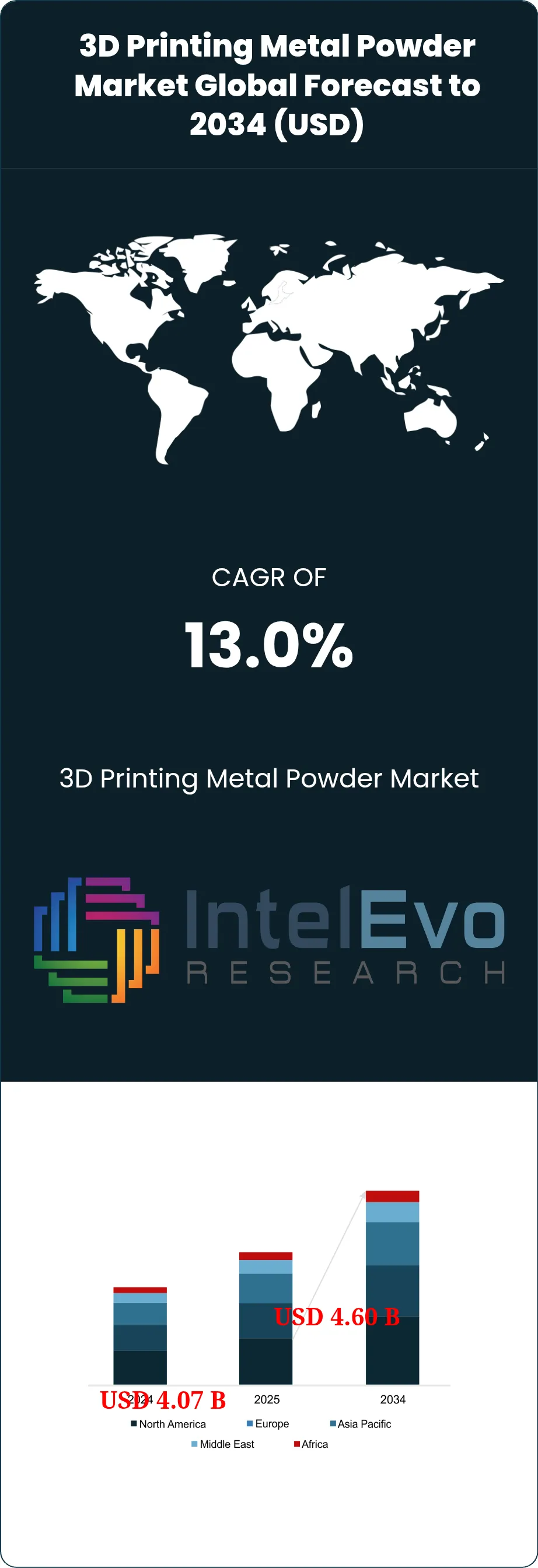
The 3D Printing Metal Powder Market was valued at approximately USD 4.07 Billion in 2024 and reached USD 4.60 Billion in 2025. The market is projected to grow to USD 13.80 Billion by 2034, expanding at a CAGR of 13.0% during the forecast period from 2026 to 2034. This represents an absolute dollar opportunity of USD 9.20 Billion over the analysis period, reflecting the accelerating industrial adoption of metal additive manufacturing across aerospace, medical, automotive, and defense sectors worldwide.
Get More Information about this report -
Request Free Sample ReportMetal powder feedstock quality is the single most critical variable determining part performance in all major metal additive manufacturing processes, including laser powder bed fusion, directed energy deposition, binder jetting, and electron beam melting. The 3D printing metal powder market covers atomized powder products across titanium alloys, nickel-based superalloys, stainless steels, aluminum alloys, and cobalt-chrome grades, each engineered to precise particle size distributions, oxygen content specifications, and flowability requirements for specific AM process compatibility. Industry analysis indicates that titanium alloys command the largest material segment at 34.2% of 2025 global revenue, driven by the dual demand pull from aerospace structural components and orthopedic implants where Ti-6Al-4V and Ti-6Al-4V ELI grades are the primary build materials.
Regulatory and qualification frameworks are reshaping supply dynamics across the 3D printing metal powder market. The AS9100 aerospace quality management standard, ASTM International additive manufacturing standards (F42 committee), and FDA 510(k) and PMA requirements for metal implants have raised powder traceability, certification, and specification requirements to levels that favor vertically integrated producers capable of controlling the full atomization-to-qualification chain. The U.S. Department of Defense's accelerating use of AM for F-35 and next-generation platform components, combined with the FAA's expanding airworthiness certification framework for AM aerospace parts, is creating sustained institutional demand for qualified metal powder supply.
From a geographic standpoint, North America leads with 36.4% of 2025 global revenue, underpinned by U.S. defense procurement, Boeing and Lockheed Martin supply chain adoption, and the domestic titanium atomization capacity of AP&C and Carpenter Technology. Europe holds 27.2% of 2025 market share, driven by Airbus, Rolls-Royce, and Safran additive manufacturing programs and the strong AM powder production base in Sweden, Germany, and France. Asia Pacific is the fastest-growing region at 26.8% of 2025 share, with China's national AM industrial development plan and Japan's automotive AM adoption serving as primary catalysts. The 3D printing metal powder market remains moderately fragmented, with the top four producers collectively holding approximately 47% of 2025 global revenue.

Key Takeaways
- Market Growth: The global 3D printing metal powder market was valued at USD 4.60 Billion in 2025 and is projected to reach USD 13.80 Billion by 2034, at a CAGR of 13.0% for 2026–2034.
- Segment Dominance: Titanium and titanium alloys hold the largest material type share at 34.2% of 2025 market revenue, driven by aerospace structural part production and orthopedic implant manufacturing where Ti-6Al-4V dominates L-PBF build materials.
- Segment Dominance: Aerospace and defense is the leading end-use industry at 32.1% of 2025 market share, sustained by active qualification programs at Boeing, Airbus, Lockheed Martin, and GE Aviation for flight-critical AM components.
- Driver: Surging adoption of laser powder bed fusion across aerospace OEM supply chains is the primary growth driver; qualified L-PBF metal part production volumes across U.S. and European defense and commercial aerospace programs grew 41% year-over-year in 2024, creating directly proportional demand for certified metal powder feedstock.
- Restraint: High powder production costs and stringent qualification requirements constrain market expansion; aerospace-grade titanium and nickel superalloy powders cost between USD 200 and USD 600 per kilogram, limiting adoption in cost-sensitive industrial segments and extending ROI timelines for smaller AM operators.
- Opportunity: Binder jetting at industrial scale represents an estimated USD 1.4 Billion incremental powder demand opportunity by 2030, as stainless steel and copper alloy powders optimized for binder jet sintering expand into automotive, consumer electronics, and hydraulics component production.
- Trend: Closed-loop powder recycling and recertification programs are gaining commercial traction; leading powder producers including Oerlikon and Sandvik report that 28% of their aerospace OEM customers now operate formal powder reuse protocols, reducing effective powder consumption per kilogram of printed metal by up to 35%.
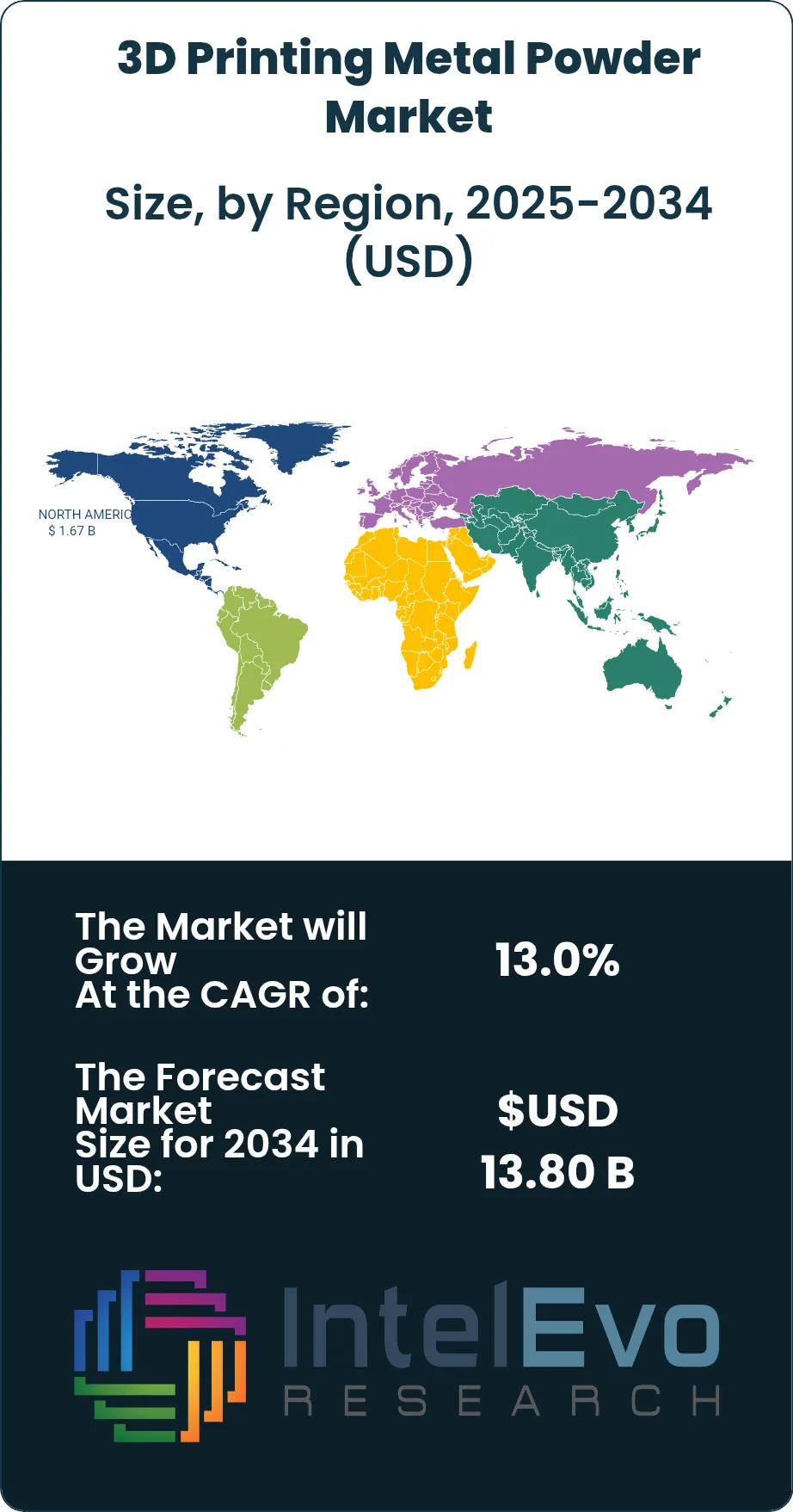
- Regional Analysis: North America leads the 3D printing metal powder market with 36.4% of 2025 global revenue, equivalent to approximately USD 1.67 Billion, anchored by U.S. defense AM programs, major aerospace OEM adoption, and domestic plasma atomization capacity.
Competitive Landscape Overview
The 3D printing metal powder market is moderately fragmented, with the top four producers — Höganäs AB, Carpenter Technology, Sandvik AB, and GE Additive (Colibrium Additive) — collectively holding approximately 47% of 2025 global revenue. Competition is quality-driven rather than price-driven, with producers differentiating on powder purity, particle size distribution consistency, flowability, and process-specific qualification history. M&A and capacity expansion activity intensified between 2023 and 2025, including Carpenter Technology's integration of LPW Technology's powder management capabilities and Sandvik's USD 65 Million Osprey facility expansion. New Chinese entrants are applying pricing pressure in the stainless steel and aluminum powder segments, while established Western producers defend premium positions in titanium and nickel superalloy grades through OEM qualification lock-in.
Competitive Landscape Matrix
| Company | HQ | Position | Key Product | Geo Strength | Recent Strategic Move |
| Höganäs AB | Sweden | Leader | Höganäs AM Powders (Ti, Ni, SS grades) | Europe | Opened new dedicated AM powder atomization plant in Halmstad with 3,000 tonnes/year capacity (Jan 2025) |
| Carpenter Technology | USA | Leader | CarTech Integrated Metals (titanium & nickel superalloys) | North America | Launched CarTech HyperForm Ti-6Al-4V ELI powder with certified particle size D50 of 28 µm for L-PBF (Mar 2025) |
| Sandvik AB | Sweden | Challenger | Osprey Metal Powders (Additive Manufacturing Portfolio) | Europe | Expanded Osprey powder production to 5,000 tonnes/year at Neath facility; added 17-4 PH and IN718 grades (Feb 2025) |
| GE Additive (Colibrium Additive) | USA | Challenger | AP&C Titanium & Nickel Powders (Plasma Atomization) | North America | Rebranded GE Additive business unit as Colibrium Additive; secured U.S. Air Force AM powder qualification contract (Apr 2025) |
| Oerlikon AM | Switzerland | Niche Player | Oerlikon Metco AM Powders (cobalt-chrome, IN625, SS316L) | Europe | Launched EcoAM powder recycling program targeting zero-waste powder bed fusion operations (Jun 2025) |
| Rio Tinto Metal Powders | Canada | Niche Player | QMP Iron & Stainless Steel Atomized Powders | North America | Expanded QMP facility in Sorel-Tracy to add water-atomized stainless steel capacity for binder jetting applications (Sep 2025) |
| Praxair Surface Technologies (Linde) | USA | Niche Player | Praxair ST Superalloy & Titanium Powders | North America | Commissioned new PREP (Plasma Rotating Electrode Process) unit targeting LPBF aerospace powders (Jan 2026) |
| LPW Technology (Carpenter Additive) | UK | Niche Player | PowderSolve Supply Chain Management Platform | Europe | Integrated PowderSolve with SAP for end-to-end metal powder traceability across aerospace OEM supply chains (May 2025) |
| Aubert & Duval | France | Niche Player | Premium Nickel & Titanium AM Powders (aerospace grade) | Europe | Received Safran qualification for AM-grade René 65 nickel superalloy powder for turbine component production (Mar 2025) |
| Tekna Plasma Systems | Canada | Niche Player | Tekna Titanium & Tantalum Plasma-Atomized Powders | North America | Commissioned third plasma atomization production line at Sherbrooke facility; capacity reached 400 tonnes/year (Aug 2025) |
By Material Type
Titanium and titanium alloys represent the largest material segment in the 3D printing metal powder market, commanding 34.2% of 2025 global revenue, equivalent to approximately USD 1.57 Billion. Ti-6Al-4V is the dominant grade, accounting for more than 75% of all titanium AM powder consumed across aerospace structural brackets, medical implants, and motorsport components. The material's combination of high specific strength, corrosion resistance, and biocompatibility makes it uniquely suited to applications where AM's geometric freedom justifies the high powder cost, typically USD 250 to USD 350 per kilogram for standard grade and USD 380 to USD 500 per kilogram for ELI grade. The aerospace sector's expanding use of topology-optimized titanium brackets — which reduce component weight by 40% to 60% versus machined equivalents — is the primary demand engine. ASTM F2924 and AMS 4999 specifications govern titanium powder requirements for aerospace AM, creating a quality threshold that sustains premium pricing and rewards producers with established aerospace qualification histories.
Nickel-based superalloys hold 28.6% of 2025 market share, concentrated in high-temperature gas turbine components including combustor liners, turbine blades, and heat exchangers manufactured via L-PBF and DED processes. IN718 and IN625 are the most widely qualified grades, with Haynes 282, René 65, and CMSX-4 representing emerging single-crystal and directionally solidified variants gaining traction in next-generation engine programs. Stainless steel powders account for 18.4% of 2025 market revenue and serve the broadest industrial application base, from medical surgical instruments and food processing equipment to automotive injection molds and hydraulic manifolds. 316L and 17-4 PH grades dominate by volume. Aluminum alloys hold 11.3% of 2025 share, with AlSi10Mg and Al6061 the primary grades. Cobalt-chrome alloys capture the remaining 7.5%, concentrated in dental prosthetics, orthopedic implants, and turbine wear components.
By Atomization Technology
Gas atomization is the dominant production technology for 3D printing metal powder, holding 48.7% of 2025 global market revenue. The process uses a high-pressure inert gas stream — typically argon or nitrogen — to break a molten metal stream into fine spherical droplets that solidify in a controlled chamber. Gas atomization delivers high throughput at lower unit cost than plasma-based methods and is the primary production route for stainless steel, aluminum, and many nickel superalloy powders. The particle size distributions achievable through gas atomization — typically D10 of 15 µm to 20 µm and D90 of 45 µm to 63 µm for L-PBF grades — are well matched to the requirements of standard industrial AM machines. Plasma atomization, which uses a plasma torch to melt and atomize wire or rod feedstock in a completely inert environment, commands 31.2% of 2025 market share and dominates the premium titanium and refractory metal powder segments. Plasma-atomized powders exhibit superior sphericity, lower oxygen content (typically below 1,200 ppm for titanium), and higher apparent density than gas-atomized equivalents, making them the preferred specification for flight-critical aerospace and medical implant applications. Plasma Rotating Electrode Process powders hold the remaining 14.6% of market share and are used for the most demanding aerospace superalloy applications where maximum purity and zero contamination from ceramic or metallic crucibles is required.
By End-Use Industry
Aerospace and defense is the largest end-use industry in the 3D printing metal powder market, generating 32.1% of 2025 global revenue, approximately USD 1.48 Billion. The sector's adoption of AM for flight-critical and flight-support components has moved decisively beyond prototyping into serial production; Boeing, Airbus, GE Aviation, Pratt & Whitney, and Safran collectively maintain more than 300 qualified AM part designs in active production as of 2025, each requiring certified powder supply under AS9100 and process-specific approval documentation. U.S. Department of Defense programs including the F-35 Joint Strike Fighter, the B-21 Raider bomber, and next-generation rotary-wing platforms have become significant institutional drivers of aerospace-grade titanium and nickel superalloy powder demand. The medical and dental segment holds 24.8% of 2025 market share, consuming titanium ELI and cobalt-chrome powders primarily for orthopedic implants — spinal cages, acetabular cups, and femoral stems — and dental frameworks. FDA 510(k) clearance and EU MDR compliance for AM implant components has been achieved by more than 40 medical device manufacturers as of 2025. Automotive and motorsport accounts for 19.6% of 2025 revenue, driven by Formula 1, MotoGP, and hypercar manufacturers adopting AM titanium and aluminum components for weight-critical applications. Industrial and energy applications hold 14.2%, and tooling and mold making captures the remaining 9.3% of 2025 market share.
Regional Analysis
North America
North America leads the global 3D printing metal powder market with 36.4% of 2025 revenue, equivalent to approximately USD 1.67 Billion. The United States is the dominant national market, driven by the world's largest aerospace and defense industrial base, active U.S. Department of Defense AM procurement programs, and the domestic titanium powder production capacity of AP&C (Colibrium Additive), Carpenter Technology, and Praxair Surface Technologies (Linde). The U.S. Air Force's Additive Manufacturing with Airworthiness and Qualification strategy, which targets 50% reduction in AM part qualification timelines by 2028, is directly stimulating demand for pre-qualified metal powder feedstocks with established process property datasets. Boeing's commercial aircraft programs — particularly the 787 and 777X — incorporate more than 60 AM titanium components per aircraft, creating a recurring powder consumption baseline tied to production rate. Canada contributes through Tekna Plasma Systems and Rio Tinto's QMP operation in Sorel-Tracy, which together supply a significant portion of North American plasma-atomized titanium and water-atomized stainless steel powder respectively. Mexico's growing aerospace manufacturing cluster in Chihuahua, Baja California, and Sonora is beginning to generate demand for certified AM metal powder as Tier-1 suppliers establish AM production capability to serve U.S. OEM supply chains.
Europe
Europe holds 27.2% of 2025 global 3D printing metal powder market revenue, approximately USD 1.25 Billion. The region benefits from a dense concentration of AM powder producers — including Höganäs, Sandvik Osprey, Oerlikon Metco, and Aubert & Duval — and major end-user aerospace programs at Airbus, Rolls-Royce, Safran, and MTU Aero Engines. Germany is the continent's most significant industrial AM market, where Fraunhofer Institute programs and automotive OEM AM adoption — BMW, Volkswagen, and Porsche all operate production AM metal programs — drive demand for stainless steel and aluminum powders. Sweden is the European production leader, housing both Höganäs and Sandvik's primary powder atomization facilities, which together represent the largest AM metal powder production capacity on the continent. The United Kingdom contributes through Rolls-Royce's AM turbine component programs, BAE Systems' defense AM initiatives, and the National Manufacturing Institute Scotland's additive manufacturing capability. France's Aubert & Duval, which achieved Safran qualification for AM-grade nickel superalloy powder in March 2025, is a key supplier to the European aerospace sector. The EU's Clean Aviation Joint Undertaking, which is funding AM technology development for next-generation aircraft programs, is a sustained institutional demand driver for European metal powder suppliers.
Asia Pacific
Asia Pacific accounts for 26.8% of 2025 global 3D printing metal powder market revenue, approximately USD 1.23 Billion, and is the fastest-growing major region with a projected regional CAGR exceeding 16% through 2034. China is the dominant national market and the fastest-growing single country in the world for AM metal powder consumption, driven by the State Council's Made in China 2025 initiative and subsequent national additive manufacturing development plans that have directed multi-billion RMB investments into AM industrial capacity. Chinese producers including Falcontech, Avimetal Powder, and Vision Aerospace are building significant domestic titanium and nickel superalloy powder atomization capacity, targeting both domestic aerospace demand and eventual export qualification for Western markets. Japan is a technically sophisticated market where automotive manufacturers — Toyota, Honda, and suppliers — deploy AM for production tooling and select vehicle components, while aerospace OEM Mitsubishi Heavy Industries operates qualified AM programs requiring certified titanium and nickel superalloy powders. South Korea's additive manufacturing sector, centered on Samsung Electronics' advanced manufacturing programs and Korea Aerospace Industries' defense component production, represents a significant and growing market for gas-atomized aluminum and stainless steel powders. India's nascent but rapidly expanding AM sector, supported by DRDO defense research and the government's Production-Linked Incentive schemes for advanced manufacturing, is establishing an early-stage metal powder demand base primarily in stainless steel and titanium.
Latin America
Latin America represents 5.4% of 2025 global 3D printing metal powder market revenue, approximately USD 248 Million. Brazil is the region's dominant market, anchored by Embraer's additive manufacturing programs for commercial and defense aircraft components, which represent the most technically advanced AM metal applications in the region. Embraer has publicly committed to incorporating AM into its E-Jet E2 production programs, creating demand for certified titanium and aluminum AM powder from qualified international suppliers. Brazil's BNDES development bank has allocated funding for domestic AM capacity development, though titanium powder production remains dependent on imports. Mexico's growing aerospace manufacturing sector in the northwest corridor contributes emerging demand from Tier-1 suppliers serving Boeing and Airbus supply chains. Chile's mining sector is exploring AM for wear-resistant component production, creating demand for hardened steel and cobalt-chrome powders in an industrial context distinct from the aerospace-dominated markets of Brazil and Mexico. Regional growth is moderated by limited domestic powder production, currency volatility, and dependence on imported feedstocks, all of which inflate effective powder costs relative to North American and European competitors.
Middle East & Africa
The Middle East and Africa region accounts for 4.2% of 2025 global 3D printing metal powder market revenue, approximately USD 193 Million. The UAE is the most active AM market in the region, driven by substantial government investment in advanced manufacturing through initiatives including the UAE National Strategy for Advanced Technology and the Dubai 3D Printing Strategy, which originally targeted 25% of new building construction using 3D printing by 2030 and has expanded to include metal AM for industrial and defense applications. Strata Manufacturing, a wholly-owned subsidiary of Mubadala Investment Company, operates AM metal component production for Airbus supply chain programs in Abu Dhabi, creating certified titanium and aluminum powder demand. Saudi Arabia's Vision 2030 diversification program is funding AM capabilities across ARAMCO's industrial operations and SAMI (Saudi Arabian Military Industries), creating emerging government and defense powder demand. South Africa has the most established industrial AM infrastructure on the African continent, with the Council for Scientific and Industrial Research operating metal AM programs and domestic companies including Aeroswift — which operates one of the world's largest L-PBF machines for titanium aerospace components — creating specialized large-format titanium powder demand.
Get More Information about this report -
Request Free Sample ReportMarket Key Segments
By Material Type
- Titanium & Titanium Alloys
- Nickel-Based Superalloys
- Stainless Steel
- Aluminum Alloys
- Cobalt-Chrome Alloys
By Atomization Technology
- Gas Atomization
- Plasma Atomization
- Plasma Rotating Electrode Process (PREP)
By End-Use Industry
- Aerospace & Defense
- Medical & Dental
- Automotive & Motorsport
- Industrial & Energy
- Tooling & Mold Making
By Region
- North America
- Latin America
- East Asia And Pacific
- Sea And South Asia
- Eastern Europe
- Western Europe
- Middle East & Africa
| Report Attribute | Details |
| Market size (2025) | USD 4.60 B |
| Forecast Revenue (2034) | USD 13.80 B |
| CAGR (2025-2034) | 13.0% |
| Historical data | 2021-2024 |
| Base Year For Estimation | 2025 |
| Forecast Period | 2026-2034 |
| Report coverage | Revenue Forecast, Competitive Landscape, Market Dynamics, Growth Factors, Trends and Recent Developments |
| Segments covered | By Material Type, (Titanium & Titanium Alloys, Nickel-Based Superalloys, Stainless Steel, Aluminum Alloys, Cobalt-Chrome Alloys), By Atomization Technology, (Gas Atomization, Plasma Atomization, Plasma Rotating Electrode Process (PREP)), By End-Use Industry, (Aerospace & Defense, Medical & Dental, Automotive & Motorsport, Industrial & Energy, Tooling & Mold Making) |
| Research Methodology |
|
| Regional scope |
|
| Competitive Landscape | HÖGANÄS AB, CARPENTER TECHNOLOGY (CARPENTER ADDITIVE), SANDVIK AB (OSPREY METAL POWDERS), GE ADDITIVE / COLIBRIUM ADDITIVE (AP&C), OERLIKON AM (OERLIKON METCO), RIO TINTO METAL POWDERS (QMP), PRAXAIR SURFACE TECHNOLOGIES (LINDE), LPW TECHNOLOGY (CARPENTER ADDITIVE), AUBERT & DUVAL, TEKNA PLASMA SYSTEMS, FALCONTECH CO. LTD, AVIMETAL POWDER METALLURGY TECHNOLOGY, VISION AEROSPACE POWDER, VTECH POWDER (TITOMIC), AEROJET ROCKETDYNE (AM MATERIALS), GKN ADDITIVE (HOEGANAES), ELEMENTUM 3D, HERAEUS ADDITIVE MANUFACTURING, Others |
| Customization Scope | Customization for segments, region/country-level will be provided. Moreover, additional customization can be done based on the requirements. |
| Pricing and Purchase Options | Avail customized purchase options to meet your exact research needs. We have three licenses to opt for: Single User License, Multi-User License (Up to 5 Users), Corporate Use License (Unlimited User and Printable PDF). |


Frequently Asked Questions
How big is the 3D Printing Metal Powder Market?
The Global 3D Printing Metal Powder Market was valued at USD 4.07 Billion in 2024 and is projected to reach USD 13.80 Billion by 2034, growing at a CAGR of 13.0% from 2026 to 2034, driven by rising adoption of additive manufacturing across aerospace, automotive, healthcare, and industrial applications.
Who are the major players in the 3D Printing Metal Powder Market?
HÖGANÄS AB, CARPENTER TECHNOLOGY (CARPENTER ADDITIVE), SANDVIK AB (OSPREY METAL POWDERS), GE ADDITIVE / COLIBRIUM ADDITIVE (AP&C), OERLIKON AM (OERLIKON METCO), RIO TINTO METAL POWDERS (QMP), PRAXAIR SURFACE TECHNOLOGIES (LINDE), LPW TECHNOLOGY (CARPENTER ADDITIVE), AUBERT & DUVAL, TEKNA PLASMA SYSTEMS, FALCONTECH CO. LTD, AVIMETAL POWDER METALLURGY TECHNOLOGY, VISION AEROSPACE POWDER, VTECH POWDER (TITOMIC), AEROJET ROCKETDYNE (AM MATERIALS), GKN ADDITIVE (HOEGANAES), ELEMENTUM 3D, HERAEUS ADDITIVE MANUFACTURING, Others
Which segments covered the 3D Printing Metal Powder Market?
By Material Type, (Titanium & Titanium Alloys, Nickel-Based Superalloys, Stainless Steel, Aluminum Alloys, Cobalt-Chrome Alloys), By Atomization Technology, (Gas Atomization, Plasma Atomization, Plasma Rotating Electrode Process (PREP)), By End-Use Industry, (Aerospace & Defense, Medical & Dental, Automotive & Motorsport, Industrial & Energy, Tooling & Mold Making)
How can this market research report help my business make strategic decisions?
Our market research reports provide actionable intelligence, including verified market size data, CAGR projections, competitive benchmarking, and segment-level opportunity analysis. These insights support strategic planning, investment decisions, product development, and market entry strategies for enterprises and startups alike.
How frequently is the data updated?
We continuously monitor industry developments and update our reports to reflect regulatory changes, technological advancements, and macroeconomic shifts. Updated editions ensure you receive the latest market intelligence.

Select Licence Type
Connect with our sales team

3D Printing Metal Powder Market
Published Date : 08 May 2026 | Formats :Why IntelEvoResearch
100%
Customer
Satisfaction
24x7+
Availability - we are always
there when you need us
200+
Fortune 50 Companies trust
IntelEvoResearch
80%
of our reports are exclusive
and first in the industry
100%
more data
and analysis
1000+
reports published
till date