
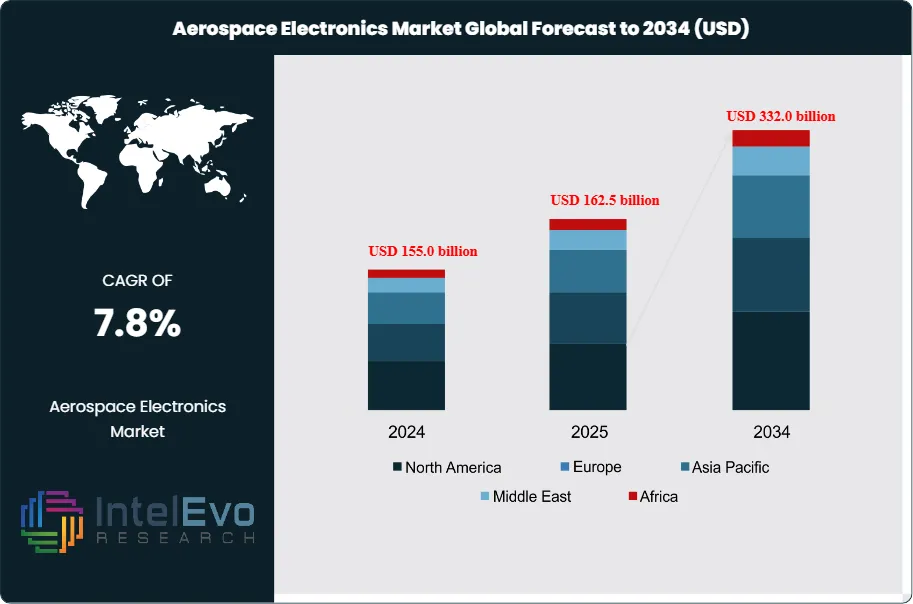
The Aerospace Electronics Market is valued at approximately USD 162.5 billion in 2025 and is projected to reach around USD 332.0 billion by 2034, expanding at a compound annual growth rate (CAGR) of about 7.8% during the forecast period from 2026 to 2034. This growth is driven by rising aircraft production, increasing defense modernization programs, and rapid adoption of advanced avionics, flight control systems, and next-generation navigation technologies. Additionally, the integration of AI-enabled electronics, lightweight components, and enhanced cybersecurity solutions is reshaping aerospace platforms, positioning the market for sustained long-term expansion across commercial, military, and space applications.
Demand draws on sustained growth in commercial air travel, fleet renewal in mature markets, and rising defense outlays, while supply reflects continuous innovation in avionics architectures, sensors, and secure communications. Core systems support communication, navigation, flight control, surveillance, and health monitoring across crewed aircraft, satellites, spacecraft, and unmanned platforms, making electronics a critical lever for safety, fuel efficiency, and mission performance.
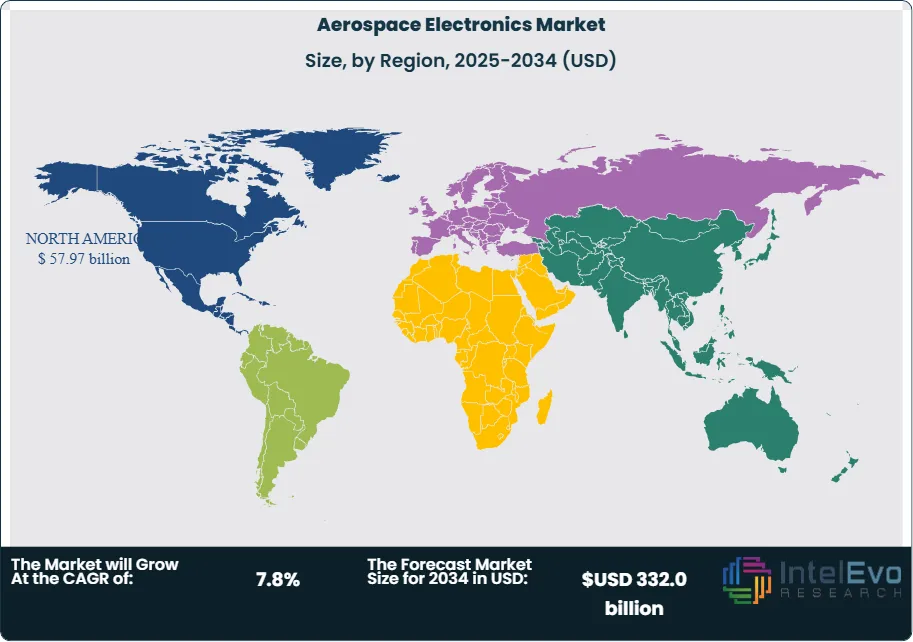
North America remains the largest regional contributor, accounting for about 37% of global revenue, underpinned by strong OEM and Tier-1 ecosystems and defense procurement. Europe maintains a solid share on the back of wide-body programs and space initiatives, while Asia Pacific is the fastest-expanding demand pool as China, India, and Southeast Asian economies scale up fleet size, MRO capacity, and indigenous aerospace programs. Emerging markets in the Middle East and Latin America increase investment in next-generation air traffic management and regional connectivity, creating additional demand for advanced avionics.
Technology change reshapes competitive dynamics. Increased use of artificial intelligence, automation, and real-time data processing enables predictive maintenance, adaptive flight management, and enhanced situational awareness. Integration of IoT connectivity, high-performance computing, and open architectures drives content growth per aircraft and shortens upgrade cycles. At the same time, cybersecurity requirements intensify as more platforms connect to ground networks and cloud-based analytics, raising compliance and certification costs.
Regulation acts as both catalyst and constraint. Tighter safety and emissions standards accelerate replacement of legacy systems with digital, software-defined solutions, while certification regimes extend development timelines and elevate technical risk. Governments support domestic aerospace electronics manufacturing through targeted incentives, infrastructure investment, and higher local-content mandates, particularly in large importing nations. For example, billion-dollar programs for aerospace parks, indigenous procurement targets of around 60% in defense electronics, and rising R&D allocations in key economies reinforce long-term demand visibility.
Competitive intensity stays high as global primes, specialized avionics firms, and digital technology providers contest share in platforms, subsystems, and software. Strategic partnerships around AI-enabled navigation, autonomous operations, and secure communications expand, with ecosystem collaboration central to meeting cost, performance, and regulatory expectations across the aerospace value chain.
Market Growth: The aerospace electronics market stands at estimated: USD 162.5 billion in 2025, up from 155.0 billion USD, 2024, and is projected to approach estimated: 332.0 billion USD, 2034, reflecting a 7.8% CAGR over 2026-2034.
Segment Dominance: Avionics systems lead the component segment with a 38.5% share, 2023, supported by demand that generates estimated: 60.0 billion USD, 2024 in integrated communication, navigation, and flight-control electronics.
Segment Dominance: Commercial aviation dominates end-use with a 59.1% share, 2023, and likely exceeds estimated: 65.0% share, 2024 as airlines invest in cockpit upgrades, connectivity, and passenger-safety systems.
Driver: Fleet renewal and avionics modernization drive demand, with airlines and defense programs together accounting for estimated: 70.0% of total aerospace electronics spend, 2024 and underpinning the 7.0% CAGR over 2024-2034.
Restraint: High development, integration, and certification costs restrain faster rollout, with compliance and testing often consuming estimated: 15.0% of program budgets, 2024 and delaying platform entry into service.
Opportunity: Unmanned platforms, satellite constellations, and new regional fleets create incremental electronics demand estimated: 35.0 billion USD, 2034, particularly in advanced flight-control, sensing, and secure communication systems.
Trend: Suppliers increasingly embed AI, automation, and real-time analytics, and software-defined avionics could lift electronics content per aircraft by estimated: 20.0% growth, 2030 relative to 2024 systems.
Regional Analysis: North America leads with a 37.4% share, 2023 and 54.19 billion USD, 2023 in aerospace electronics revenue, and is likely to retain more than estimated: 35.0% global share, 2034 as domestic OEMs and defense agencies sustain high investment over 2024-2034.
By Component
Avionics systems continue to represent the largest share of aerospace electronics in 2025, building on their earlier 38.5 percent share in 2023. The segment maintains a central role in flight control, navigation, and cockpit automation. Demand increases as airlines and defense operators focus on flight accuracy, fuel efficiency, and compliance with updated global safety policies. Real-time system diagnostics, enhanced flight management tools, and improved autopilot functions reinforce the segment’s importance across both new aircraft programs and fleet upgrades.
Adoption accelerates as aviation authorities strengthen requirements for communication integrity, collision-avoidance capabilities, and situational awareness. Operators invest in modern cockpit systems to support high-traffic air corridors and to reduce pilot workload during complex operations. The integration of digital communication suites and advanced sensors also sharpens the competitive edge for manufacturers able to meet these requirements.
Avionics systems continue to evolve with the rise of connected aircraft. AI-supported monitoring, IoT-enabled data exchange, and predictive maintenance tools are now embedded in many new installations. This shift increases reliability and reduces downtime, which appeals to commercial airlines and defense operators managing high-utilization fleets. These changes reinforce the leadership position of avionics in the broader component landscape.
By End-Use
The commercial aviation segment holds the largest share in 2025, following its earlier 59.1 percent share in 2023. Global passenger traffic returns to pre-pandemic growth rates, and airlines expand networks across Asia Pacific, the Middle East, and parts of Africa. This expansion fuels demand for advanced electronics that improve operational efficiency, flight scheduling, and cabin systems. In-flight entertainment upgrades and enhanced connectivity further support investment decisions for commercial operators.
Fleet modernization remains a core priority. Airlines replace older aircraft with models designed for lower emissions and improved fuel efficiency. These aircraft integrate higher levels of electronic content, including upgraded communication suites and enhanced flight-control systems. The need to reduce maintenance cycles and improve dispatch reliability also strengthens adoption of new electronics across the commercial fleet.
Military demand remains strong as governments invest in advanced avionics for improved situational awareness and mission-readiness. Modernization programs for fighter jets, transport aircraft, and UAVs continue through 2025, contributing a steady share to the overall market. Communication security, navigation precision, and electronic warfare capabilities drive procurement decisions in this segment.
By Region
North America continues to lead the aerospace electronics market in 2025 after previously accounting for 37.4 percent of global revenue and USD 54.19 billion in 2023. The region benefits from mature aircraft production clusters, strong defense spending, and active R&D pipelines. The United States remains the anchor market, supported by strategic investment in advanced flight systems, space programs, autonomous platforms, and next-generation communication infrastructure.
Europe maintains a significant role, supported by large civil aircraft programs and continued investment in sustainable aviation technologies. Regulatory requirements for emissions reduction and enhanced flight monitoring drive adoption of new systems across the region. Asia Pacific shows the fastest expansion as airlines in China, India, and Southeast Asia increase fleet sizes to support rising middle-class travel. Government initiatives encouraging domestic aerospace development also strengthen regional manufacturing activity.
Latin America and the Middle East & Africa show steady but smaller contributions. Growth in these regions comes from regional airline expansion and targeted defense upgrades. As operators modernize fleets and strengthen airspace management capabilities, demand for flight-control systems, communication electronics, and navigation solutions continues to rise.
Component (Avionics Systems, Communication Systems, Radar and Navigation Systems, In-flight Entertainment Systems, Other Components), End-Use (Commercial, Military)
Research Methodology
Primary Research- 100 Interviews of Stakeholders
Secondary Research
Desk Research
Regional scope
North America (United States, Canada, Mexico)
Latin America (Brazil, Argentina, Columbia)
East Asia And Pacific (China, Japan, South Korea, Australia, Cambodia, Fiji, Indonesia)
Sea And South Asia (India, Singapore, Thailand, Taiwan, Malaysia)
Eastern Europe (Poland, Russia, Czech Republic, Romania)
Western Europe (Germany, U.K., France, Spain, Itlay)
Middle East & Africa (GCC Countries, Egypt, Nigeria, South Africa, Israel)
Competitive Landscape
Panasonic Holdings Corporation, Safran SA, BAE Systems plc, Thales Group, Teledyne Technologies Incorporated, Honeywell International Inc., The Boeing Company, Airbus SE, RTX Corporation, L3Harris Technologies, Inc., Northrop Grumman Corporation, General Electric Company, Other Key Players
Customization Scope
Customization for segments, region/country-level will be provided. Moreover, additional customization can be done based on the requirements.
Pricing and Purchase Options
Avail customized purchase options to meet your exact research needs. We have three licenses to opt for: Single User License, Multi-User License (Up to 5 Users), Corporate Use License (Unlimited User and Printable PDF).
TABLE OF CONTENTS
1. EXECUTIVE SUMMARY
1.1. MARKET SNAPSHOT
1.2. KEY FINDINGS & INSIGHTS
1.3. ANALYST RECOMMENDATIONS
1.4. FUTURE OUTLOOK
2. RESEARCH METHODOLOGY
2.1. MARKET DEFINITION & SCOPE
2.2. RESEARCH OBJECTIVES: PRIMARY & SECONDARY DATA SOURCES
2.3. DATA COLLECTION SOURCES
2.3.1. COVERAGE OF 100+ PRIMARY RESEARCH/CONSULTATION CALLS WITH INDUSTRY STAKEHOLDERS
FIGURE 17 NORTH AMERICA AEROSPACE ELECTRONICS CURRENT AND FUTURE TYPE ANALYSIS, 2025–2034, (USD MILLION)
FIGURE 18 NORTH AMERICA AEROSPACE ELECTRONICS CURRENT AND FUTURE END USER ANALYSIS, 2025–2034, (USD MILLION)
FIGURE 19 MARKET SHARE BY COUNTRY
FIGURE 20 LATIN AMERICA AEROSPACE ELECTRONICS CURRENT AND FUTURE TYPE ANALYSIS, 2025–2034, (USD MILLION)
FIGURE 21 LATIN AMERICA AEROSPACE ELECTRONICS CURRENT AND FUTURE END USER ANALYSIS, 2025–2034, (USD MILLION)
FIGURE 22 MARKET SHARE BY COUNTRY
FIGURE 23 EASTERN EUROPE AEROSPACE ELECTRONICS CURRENT AND FUTURE TYPE ANALYSIS, 2025–2034, (USD MILLION)
FIGURE 24 EASTERN EUROPE AEROSPACE ELECTRONICS CURRENT AND FUTURE END USER ANALYSIS, 2025–2034, (USD MILLION)
FIGURE 25 MARKET SHARE BY COUNTRY
FIGURE 26 WESTERN EUROPE AEROSPACE ELECTRONICS CURRENT AND FUTURE TYPE ANALYSIS, 2025–2034, (USD MILLION)
FIGURE 27 WESTERN EUROPE AEROSPACE ELECTRONICS CURRENT AND FUTURE END USER ANALYSIS, 2025–2034, (USD MILLION)
FIGURE 28 MARKET SHARE BY COUNTRY
FIGURE 29 EAST ASIA AND PACIFIC AEROSPACE ELECTRONICS CURRENT AND FUTURE TYPE ANALYSIS, 2025–2034, (USD MILLION)
FIGURE 30 EAST ASIA AND PACIFIC AEROSPACE ELECTRONICS CURRENT AND FUTURE END USER ANALYSIS, 2025–2034, (USD MILLION)
FIGURE 31 MARKET SHARE BY COUNTRY
FIGURE 32 SEA AND SOUTH ASIA AEROSPACE ELECTRONICS CURRENT AND FUTURE TYPE ANALYSIS, 2025–2034, (USD MILLION)
FIGURE 33 SEA AND SOUTH ASIA AEROSPACE ELECTRONICS CURRENT AND FUTURE END USER ANALYSIS, 2025–2034, (USD MILLION)
FIGURE 34 MARKET SHARE BY COUNTRY
FIGURE 35 MIDDLE EAST AND AFRICA AEROSPACE ELECTRONICS CURRENT AND FUTURE TYPE ANALYSIS, 2025–2034, (USD MILLION)
FIGURE 36 MIDDLE EAST AND AFRICA AEROSPACE ELECTRONICS CURRENT AND FUTURE END USER ANALYSIS, 2025–2034, (USD MILLION)
FIGURE 37 NORTH AMERICA AEROSPACE ELECTRONICS CURRENT AND FUTURE MARKET VOLUME SHARE REGIONAL ANALYSIS, 2025–2034, (USD MILLION)
FIGURE 38 U.S. AEROSPACE ELECTRONICS CURRENT AND FUTURE TYPE ANALYSIS, 2025–2034, (USD MILLION)
FIGURE 39 U.S. AEROSPACE ELECTRONICS CURRENT AND FUTURE END USER ANALYSIS, 2025–2034, (USD MILLION)
FIGURE 40 CANADA AEROSPACE ELECTRONICS CURRENT AND FUTURE TYPE ANALYSIS, 2025–2034, (USD MILLION)
FIGURE 41 CANADA AEROSPACE ELECTRONICS CURRENT AND FUTURE END USER ANALYSIS, 2025–2034, (USD MILLION)
FIGURE 42 LATIN AMERICA AEROSPACE ELECTRONICS CURRENT AND FUTURE MARKET VOLUME SHARE REGIONAL ANALYSIS, 2025–2034, (USD MILLION)
FIGURE 43 MEXICO AEROSPACE ELECTRONICS CURRENT AND FUTURE TYPE ANALYSIS, 2025–2034, (USD MILLION)
FIGURE 44 MEXICO AEROSPACE ELECTRONICS CURRENT AND FUTURE END USER ANALYSIS, 2025–2034, (USD MILLION)
FIGURE 45 BRAZIL AEROSPACE ELECTRONICS CURRENT AND FUTURE TYPE ANALYSIS, 2025–2034, (USD MILLION)
FIGURE 46 BRAZIL AEROSPACE ELECTRONICS CURRENT AND FUTURE END USER ANALYSIS, 2025–2034, (USD MILLION)
FIGURE 47 ARGENTINA AEROSPACE ELECTRONICS CURRENT AND FUTURE TYPE ANALYSIS, 2025–2034, (USD MILLION)
FIGURE 48 ARGENTINA AEROSPACE ELECTRONICS CURRENT AND FUTURE END USER ANALYSIS, 2025–2034, (USD MILLION)
FIGURE 49 COLUMBIA AEROSPACE ELECTRONICS CURRENT AND FUTURE TYPE ANALYSIS, 2025–2034, (USD MILLION)
FIGURE 50 COLUMBIA AEROSPACE ELECTRONICS CURRENT AND FUTURE END USER ANALYSIS, 2025–2034, (USD MILLION)
FIGURE 51 REST OF LATIN AMERICA AEROSPACE ELECTRONICS CURRENT AND FUTURE TYPE ANALYSIS, 2025–2034, (USD MILLION)
FIGURE 52 REST OF LATIN AMERICA AEROSPACE ELECTRONICS CURRENT AND FUTURE END USER ANALYSIS, 2025–2034, (USD MILLION)
FIGURE 53 EASTERN EUROPE AEROSPACE ELECTRONICS CURRENT AND FUTURE MARKET VOLUME SHARE REGIONAL ANALYSIS, 2025–2034, (USD MILLION)
FIGURE 54 POLAND AEROSPACE ELECTRONICS CURRENT AND FUTURE TYPE ANALYSIS, 2025–2034, (USD MILLION)
FIGURE 55 POLAND AEROSPACE ELECTRONICS CURRENT AND FUTURE END USER ANALYSIS, 2025–2034, (USD MILLION)
FIGURE 56 RUSSIA AEROSPACE ELECTRONICS CURRENT AND FUTURE TYPE ANALYSIS, 2025–2034, (USD MILLION)
FIGURE 57 RUSSIA AEROSPACE ELECTRONICS CURRENT AND FUTURE END USER ANALYSIS, 2025–2034, (USD MILLION)
FIGURE 58 CZECH REPUBLIC AEROSPACE ELECTRONICS CURRENT AND FUTURE TYPE ANALYSIS, 2025–2034, (USD MILLION)
FIGURE 59 CZECH REPUBLIC AEROSPACE ELECTRONICS CURRENT AND FUTURE END USER ANALYSIS, 2025–2034, (USD MILLION)
FIGURE 60 ROMANIA AEROSPACE ELECTRONICS CURRENT AND FUTURE TYPE ANALYSIS, 2025–2034, (USD MILLION)
FIGURE 61 ROMANIA AEROSPACE ELECTRONICS CURRENT AND FUTURE END USER ANALYSIS, 2025–2034, (USD MILLION)
FIGURE 62 REST OF EASTERN EUROPE AEROSPACE ELECTRONICS CURRENT AND FUTURE TYPE ANALYSIS, 2025–2034, (USD MILLION)
FIGURE 63 REST OF EASTERN EUROPE AEROSPACE ELECTRONICS CURRENT AND FUTURE END USER ANALYSIS, 2025–2034, (USD MILLION)
FIGURE 64 WESTERN EUROPE AEROSPACE ELECTRONICS CURRENT AND FUTURE MARKET VOLUME SHARE REGIONAL ANALYSIS, 2025–2034, (USD MILLION)
FIGURE 65 GERMANY AEROSPACE ELECTRONICS CURRENT AND FUTURE TYPE ANALYSIS, 2025–2034, (USD MILLION)
FIGURE 66 GERMANY AEROSPACE ELECTRONICS CURRENT AND FUTURE END USER ANALYSIS, 2025–2034, (USD MILLION)
FIGURE 67 FRANCE AEROSPACE ELECTRONICS CURRENT AND FUTURE TYPE ANALYSIS, 2025–2034, (USD MILLION)
FIGURE 68 FRANCE AEROSPACE ELECTRONICS CURRENT AND FUTURE END USER ANALYSIS, 2025–2034, (USD MILLION)
FIGURE 69 UK AEROSPACE ELECTRONICS CURRENT AND FUTURE TYPE ANALYSIS, 2025–2034, (USD MILLION)
FIGURE 70 UK AEROSPACE ELECTRONICS CURRENT AND FUTURE END USER ANALYSIS, 2025–2034, (USD MILLION)
FIGURE 71 SPAIN AEROSPACE ELECTRONICS CURRENT AND FUTURE TYPE ANALYSIS, 2025–2034, (USD MILLION)
FIGURE 72 SPAIN AEROSPACE ELECTRONICS CURRENT AND FUTURE END USER ANALYSIS, 2025–2034, (USD MILLION)
FIGURE 73 ITALY AEROSPACE ELECTRONICS CURRENT AND FUTURE TYPE ANALYSIS, 2025–2034, (USD MILLION)
FIGURE 74 ITALY AEROSPACE ELECTRONICS CURRENT AND FUTURE END USER ANALYSIS, 2025–2034, (USD MILLION)
FIGURE 75 REST OF WESTERN EUROPE AEROSPACE ELECTRONICS CURRENT AND FUTURE TYPE ANALYSIS, 2025–2034, (USD MILLION)
FIGURE 76 REST OF WESTERN EUROPE AEROSPACE ELECTRONICS CURRENT AND FUTURE END USER ANALYSIS, 2025–2034, (USD MILLION)
FIGURE 77 EAST ASIA AND PACIFIC AEROSPACE ELECTRONICS CURRENT AND FUTURE MARKET VOLUME SHARE REGIONAL ANALYSIS, 2025–2034, (USD MILLION)
FIGURE 78 CHINA AEROSPACE ELECTRONICS CURRENT AND FUTURE TYPE ANALYSIS, 2025–2034, (USD MILLION)
FIGURE 79 CHINA AEROSPACE ELECTRONICS CURRENT AND FUTURE END USER ANALYSIS, 2025–2034, (USD MILLION)
FIGURE 80 JAPAN AEROSPACE ELECTRONICS CURRENT AND FUTURE TYPE ANALYSIS, 2025–2034, (USD MILLION)
FIGURE 81 JAPAN AEROSPACE ELECTRONICS CURRENT AND FUTURE END USER ANALYSIS, 2025–2034, (USD MILLION)
FIGURE 82 AUSTRALIA AEROSPACE ELECTRONICS CURRENT AND FUTURE TYPE ANALYSIS, 2025–2034, (USD MILLION)
FIGURE 83 AUSTRALIA AEROSPACE ELECTRONICS CURRENT AND FUTURE END USER ANALYSIS, 2025–2034, (USD MILLION)
FIGURE 84 CAMBODIA AEROSPACE ELECTRONICS CURRENT AND FUTURE TYPE ANALYSIS, 2025–2034, (USD MILLION)
FIGURE 85 CAMBODIA AEROSPACE ELECTRONICS CURRENT AND FUTURE END USER ANALYSIS, 2025–2034, (USD MILLION)
FIGURE 86 FIJI AEROSPACE ELECTRONICS CURRENT AND FUTURE TYPE ANALYSIS, 2025–2034, (USD MILLION)
FIGURE 87 FIJI AEROSPACE ELECTRONICS CURRENT AND FUTURE END USER ANALYSIS, 2025–2034, (USD MILLION)
FIGURE 88 INDONESIA AEROSPACE ELECTRONICS CURRENT AND FUTURE TYPE ANALYSIS, 2025–2034, (USD MILLION)
FIGURE 89 INDONESIA AEROSPACE ELECTRONICS CURRENT AND FUTURE END USER ANALYSIS, 2025–2034, (USD MILLION)
FIGURE 90 SOUTH KOREA AEROSPACE ELECTRONICS CURRENT AND FUTURE TYPE ANALYSIS, 2025–2034, (USD MILLION)
FIGURE 91 SOUTH KOREA AEROSPACE ELECTRONICS CURRENT AND FUTURE END USER ANALYSIS, 2025–2034, (USD MILLION)
FIGURE 92 REST OF EAST ASIA AND PACIFIC AEROSPACE ELECTRONICS CURRENT AND FUTURE TYPE ANALYSIS, 2025–2034, (USD MILLION)
FIGURE 93 REST OF EAST ASIA AND PACIFIC AEROSPACE ELECTRONICS CURRENT AND FUTURE END USER ANALYSIS, 2025–2034, (USD MILLION)
FIGURE 94 SEA AND SOUTH ASIA AEROSPACE ELECTRONICS CURRENT AND FUTURE MARKET VOLUME SHARE REGIONAL ANALYSIS, 2025–2034, (USD MILLION)
FIGURE 95 BANGLADESH AEROSPACE ELECTRONICS CURRENT AND FUTURE TYPE ANALYSIS, 2025–2034, (USD MILLION)
FIGURE 96 BANGLADESH AEROSPACE ELECTRONICS CURRENT AND FUTURE END USER ANALYSIS, 2025–2034, (USD MILLION)
FIGURE 97 NEW ZEALAND AEROSPACE ELECTRONICS CURRENT AND FUTURE TYPE ANALYSIS, 2025–2034, (USD MILLION)
FIGURE 98 NEW ZEALAND AEROSPACE ELECTRONICS CURRENT AND FUTURE END USER ANALYSIS, 2025–2034, (USD MILLION)
FIGURE 99 INDIA AEROSPACE ELECTRONICS CURRENT AND FUTURE TYPE ANALYSIS, 2025–2034, (USD MILLION)
FIGURE 100 INDIA AEROSPACE ELECTRONICS CURRENT AND FUTURE END USER ANALYSIS, 2025–2034, (USD MILLION)
FIGURE 101 SINGAPORE AEROSPACE ELECTRONICS CURRENT AND FUTURE TYPE ANALYSIS, 2025–2034, (USD MILLION)
FIGURE 102 SINGAPORE AEROSPACE ELECTRONICS CURRENT AND FUTURE END USER ANALYSIS, 2025–2034, (USD MILLION)
FIGURE 103 THAILAND AEROSPACE ELECTRONICS CURRENT AND FUTURE TYPE ANALYSIS, 2025–2034, (USD MILLION)
FIGURE 104 THAILAND AEROSPACE ELECTRONICS CURRENT AND FUTURE END USER ANALYSIS, 2025–2034, (USD MILLION)
FIGURE 105 TAIWAN AEROSPACE ELECTRONICS CURRENT AND FUTURE TYPE ANALYSIS, 2025–2034, (USD MILLION)
FIGURE 106 TAIWAN AEROSPACE ELECTRONICS CURRENT AND FUTURE END USER ANALYSIS, 2025–2034, (USD MILLION)
FIGURE 107 MALAYSIA AEROSPACE ELECTRONICS CURRENT AND FUTURE TYPE ANALYSIS, 2025–2034, (USD MILLION)
FIGURE 108 MALAYSIA AEROSPACE ELECTRONICS CURRENT AND FUTURE END USER ANALYSIS, 2025–2034, (USD MILLION)
FIGURE 109 REST OF SEA AND SOUTH ASIA AEROSPACE ELECTRONICS CURRENT AND FUTURE TYPE ANALYSIS, 2025–2034, (USD MILLION)
FIGURE 110 REST OF SEA AND SOUTH ASIA AEROSPACE ELECTRONICS CURRENT AND FUTURE END USER ANALYSIS, 2025–2034, (USD MILLION)
FIGURE 111 MIDDLE EAST AND AFRICA AEROSPACE ELECTRONICS CURRENT AND FUTURE MARKET VOLUME SHARE REGIONAL ANALYSIS, 2025–2034, (USD MILLION)
FIGURE 112 GCC COUNTRIES AEROSPACE ELECTRONICS CURRENT AND FUTURE TYPE ANALYSIS, 2025–2034, (USD MILLION)
FIGURE 113 GCC COUNTRIES AEROSPACE ELECTRONICS CURRENT AND FUTURE END USER ANALYSIS, 2025–2034, (USD MILLION)
FIGURE 114 SAUDI ARABIA AEROSPACE ELECTRONICS CURRENT AND FUTURE TYPE ANALYSIS, 2025–2034, (USD MILLION)
FIGURE 115 SAUDI ARABIA AEROSPACE ELECTRONICS CURRENT AND FUTURE END USER ANALYSIS, 2025–2034, (USD MILLION)
FIGURE 116 UAE AEROSPACE ELECTRONICS CURRENT AND FUTURE TYPE ANALYSIS, 2025–2034, (USD MILLION)
FIGURE 117 UAE AEROSPACE ELECTRONICS CURRENT AND FUTURE END USER ANALYSIS, 2025–2034, (USD MILLION)
FIGURE 118 BAHRAIN AEROSPACE ELECTRONICS CURRENT AND FUTURE TYPE ANALYSIS, 2025–2034, (USD MILLION)
FIGURE 119 BAHRAIN AEROSPACE ELECTRONICS CURRENT AND FUTURE END USER ANALYSIS, 2025–2034, (USD MILLION)
FIGURE 120 KUWAIT AEROSPACE ELECTRONICS CURRENT AND FUTURE TYPE ANALYSIS, 2025–2034, (USD MILLION)
FIGURE 121 KUWAIT AEROSPACE ELECTRONICS CURRENT AND FUTURE END USER ANALYSIS, 2025–2034, (USD MILLION)
FIGURE 122 OMAN AEROSPACE ELECTRONICS CURRENT AND FUTURE TYPE ANALYSIS, 2025–2034, (USD MILLION)
FIGURE 123 OMAN AEROSPACE ELECTRONICS CURRENT AND FUTURE END USER ANALYSIS, 2025–2034, (USD MILLION)
FIGURE 124 QATAR AEROSPACE ELECTRONICS CURRENT AND FUTURE TYPE ANALYSIS, 2025–2034, (USD MILLION)
FIGURE 125 QATAR AEROSPACE ELECTRONICS CURRENT AND FUTURE END USER ANALYSIS, 2025–2034, (USD MILLION)
FIGURE 126 EGYPT AEROSPACE ELECTRONICS CURRENT AND FUTURE TYPE ANALYSIS, 2025–2034, (USD MILLION)
FIGURE 127 EGYPT AEROSPACE ELECTRONICS CURRENT AND FUTURE END USER ANALYSIS, 2025–2034, (USD MILLION)
FIGURE 128 NIGERIA AEROSPACE ELECTRONICS CURRENT AND FUTURE TYPE ANALYSIS, 2025–2034, (USD MILLION)
FIGURE 129 NIGERIA AEROSPACE ELECTRONICS CURRENT AND FUTURE END USER ANALYSIS, 2025–2034, (USD MILLION)
FIGURE 130 SOUTH AFRICA AEROSPACE ELECTRONICS CURRENT AND FUTURE TYPE ANALYSIS, 2025–2034, (USD MILLION)
FIGURE 131 SOUTH AFRICA AEROSPACE ELECTRONICS CURRENT AND FUTURE END USER ANALYSIS, 2025–2034, (USD MILLION)
FIGURE 132 ISRAEL AEROSPACE ELECTRONICS CURRENT AND FUTURE TYPE ANALYSIS, 2025–2034, (USD MILLION)
FIGURE 133 ISRAEL AEROSPACE ELECTRONICS CURRENT AND FUTURE END USER ANALYSIS, 2025–2034, (USD MILLION)
FIGURE 134 REST OF MEA AEROSPACE ELECTRONICS CURRENT AND FUTURE TYPE ANALYSIS, 2025–2034, (USD MILLION)
FIGURE 135 REST OF MEA AEROSPACE ELECTRONICS CURRENT AND FUTURE END USER ANALYSIS, 2025–2034, (USD MILLION)
FIGURE 136 U. S. MARKET SHARE ANALYSIS BY TYPE (2024)
FIGURE 137 U. S. MARKET SHARE ANALYSIS BY END USER (2024)
FIGURE 138 CANADA MARKET SHARE ANALYSIS BY TYPE (2024)
FIGURE 139 CANADA MARKET SHARE ANALYSIS BY END USER (2024)
FIGURE 140 MEXICO MARKET SHARE ANALYSIS BY TYPE (2024)
FIGURE 141 MEXICO MARKET SHARE ANALYSIS BY END USER (2024)
FIGURE 142 CHINA MARKET SHARE ANALYSIS BY TYPE (2024)
FIGURE 143 CHINA MARKET SHARE ANALYSIS BY END USER (2024)
FIGURE 144 JAPAN MARKET SHARE ANALYSIS BY TYPE (2024)
FIGURE 145 JAPAN MARKET SHARE ANALYSIS BY END USER (2024)
FIGURE 146 INDIA MARKET SHARE ANALYSIS BY TYPE (2024)
FIGURE 147 INDIA MARKET SHARE ANALYSIS BY END USER (2024)
FIGURE 148 SOUTH KOREA MARKET SHARE ANALYSIS BY TYPE (2024)
FIGURE 149 SOUTH KOREA MARKET SHARE ANALYSIS BY END USER (2024)
FIGURE 150 SAUDI ARABIA MARKET SHARE ANALYSIS BY TYPE (2024)
FIGURE 151 SAUDI ARABIA MARKET SHARE ANALYSIS BY END USER (2024)
FIGURE 152 UAE MARKET SHARE ANALYSIS BY TYPE (2024)
FIGURE 153 UAE MARKET SHARE ANALYSIS BY END USER (2024)
FIGURE 154 EGYPT MARKET SHARE ANALYSIS BY TYPE (2024)
FIGURE 155 EGYPT MARKET SHARE ANALYSIS BY END USER (2024)
FIGURE 156 NIGERIA MARKET SHARE ANALYSIS BY TYPE (2024)
FIGURE 157 NIGERIA MARKET SHARE ANALYSIS BY END USER (2024)
FIGURE 158 SOUTH AFRICA MARKET SHARE ANALYSIS BY TYPE (2024)
FIGURE 159 SOUTH AFRICA MARKET SHARE ANALYSIS BY END USER (2024)
FIGURE 160 GERMANY MARKET SHARE ANALYSIS BY TYPE (2024)
FIGURE 161 GERMANY MARKET SHARE ANALYSIS BY END USER (2024)
FIGURE 162 FRANCE MARKET SHARE ANALYSIS BY TYPE (2024)
FIGURE 163 FRANCE MARKET SHARE ANALYSIS BY END USER (2024)
FIGURE 164 UK MARKET SHARE ANALYSIS BY TYPE (2024)
FIGURE 165 UK MARKET SHARE ANALYSIS BY END USER (2024)
FIGURE 166 SPAIN MARKET SHARE ANALYSIS BY TYPE (2024)
FIGURE 167 SPAIN MARKET SHARE ANALYSIS BY END USER (2024)
FIGURE 168 ITALY MARKET SHARE ANALYSIS BY TYPE (2024)
FIGURE 169 ITALY MARKET SHARE ANALYSIS BY END USER (2024)
FIGURE 170 BRAZIL MARKET SHARE ANALYSIS BY TYPE (2024)
FIGURE 171 BRAZIL MARKET SHARE ANALYSIS BY END USER (2024)
FIGURE 172 ARGENTINA MARKET SHARE ANALYSIS BY TYPE (2024)
FIGURE 173 ARGENTINA MARKET SHARE ANALYSIS BY END USER (2024)
FIGURE 174 COLUMBIA MARKET SHARE ANALYSIS BY TYPE (2024)
FIGURE 175 COLUMBIA MARKET SHARE ANALYSIS BY END USER (2024)
FIGURE 176 GLOBAL AEROSPACE ELECTRONICS CURRENT AND FUTURE MARKET KEY COUNTRY LEVEL ANALYSIS, 2024–2034, (USD MILLION)
FIGURE 177 FINANCIAL OVERVIEW:
Key Player Analysis
Thales Group: Thales Group operates as a market leader in aerospace electronics with a strong presence across avionics, secure communication systems, and flight management solutions. The company benefits from long-term partnerships with global aircraft manufacturers and maintains a broad customer base in both civil and defense aviation. In 2025, Thales expands its integrated avionics platforms with AI-supported monitoring tools and upgraded navigation systems. These capabilities strengthen its position in large commercial aircraft programs and regional jet platforms. The company reports steady annual growth across its aerospace segment, supported by rising adoption of modular avionics architectures.
Thales continues to invest in digital flight systems and cybersecurity capabilities as operators seek real-time analytics and stronger data protection. Recent collaboration agreements with satellite service providers improve Thales’ connectivity offering, which strengthens its appeal across international airlines. The company also expands production capacity in Europe and Asia to meet rising demand for avionics upgrades. Its strength lies in combining certified safety systems with advanced software packages that support predictive maintenance and improved operational performance.
BAE Systems plc: BAE Systems positions itself as a key defense-focused supplier with a strong footprint in mission avionics, electronic warfare systems, and secure communication platforms. Its presence in major military aircraft programs provides long-term revenue visibility. The company increases R&D spending in 2025 to advance electronic protection systems and AI-enabled situational awareness tools. These systems address rising demand for automation, faster decision cycles, and enhanced flight safety in contested airspace. Defense electronics revenues show steady year-over-year growth as governments expand procurement budgets.
BAE Systems strengthens its market position through targeted acquisitions and joint development programs with global air forces. The company continues to diversify into civilian aerospace applications with modular avionics suitable for transport aircraft and unmanned platforms. Its differentiator is deep integration capability across mission systems, allowing customers to deploy unified electronic architectures across multiple aircraft types. Regional strength in North America and Europe supports consistent project pipelines.
RTX Corporation: RTX Corporation operates as one of the largest aerospace electronics suppliers with strong positions in avionics, radar systems, communication technologies, and power electronics. The company benefits from its integrated structure across Collins Aerospace and Raytheon units, which enables a full-suite offering for commercial and defense customers. In 2025, RTX accelerates development of AI-supported avionics and autonomous flight-enabling technologies. A recent partnership program focuses on refining navigation accuracy and improving aircraft safety performance through enhanced computing systems.
RTX continues to expand its global manufacturing footprint, with investments in North America and Asia to support rising demand for upgraded cockpit systems and advanced radar solutions. The company highlights consistent mid-single-digit growth in avionics sales as airlines modernize fleets and defense operators upgrade mission platforms. Its strength lies in combining hardware depth with advanced software capabilities, giving operators integrated solutions across communication, sensing, and flight-control domains. RTX remains one of the most influential players shaping the future electronics landscape in commercial and military aviation.
Market Key Players
Panasonic Holdings Corporation
Safran SA
BAE Systems plc
Thales Group
Teledyne Technologies Incorporated
Honeywell International Inc.
The Boeing Company
Airbus SE
RTX Corporation
L3Harris Technologies, Inc.
Northrop Grumman Corporation
General Electric Company
Other Key Players
Driver
Rising Aircraft Procurement and Fleet Modernization
The aerospace electronics market is gaining traction in 2025 as airlines and defense operators increase their purchase of aircraft with more electronic features. Growing global passenger traffic and a rebound in business aviation speed up the replacement of old fleets. Operators focus on modern avionics, digital flight control systems, and improved navigation solutions to boost operational efficiency and meet changing safety standards.
Adoption of Smart Avionics and Connected Systems
There is significant growth in integrated avionics, secure communication suites, and IoT-enabled monitoring systems across new aircraft platforms. AI-supported flight systems improve situational awareness and performance prediction, while connected electronics decrease maintenance downtime. These benefits make investments in avionics a key factor for long-term market growth.
Restraint
High Development and Certification Costs
Development and certification costs are a significant barrier as aerospace electronics systems become more complex. Long testing and validation cycles often increase total program costs by over 20 percent. These financial challenges slow down innovation and raise the risks involved in developing new products.
Regulatory Complexity and Supplier Limitations
Smaller suppliers struggle to meet the increasing compliance and documentation demands set by global aviation authorities. Lengthy approval processes delay the launch of new electronics, and strict standards limit supplier variety. Consequently, entry barriers to the market remain high and slow system upgrades.
Opportunity
Expanding Defense and Government Programs
Government and defense projects offer strong growth opportunities from 2025 onward. Increased spending on surveillance aircraft, transport platforms, and unmanned systems boosts demand for advanced avionics, encrypted communications, and essential electronics. Continued growth in defense budgets supports long-term purchasing cycles.
Civil Aviation and Sustainability Investments
Civil aviation agencies are investing in research programs aimed at safer airspace management and reducing emissions. These efforts create opportunities for electronic systems that enhance fuel efficiency, optimize flight paths, and improve traffic management. These programs can also address both commercial and military needs with adaptable solutions.
Trend
Digitalization and Predictive Technologies
Digital integration shapes aerospace electronics trends in 2025. Operators quickly adopt real-time monitoring, predictive maintenance, and automated flight functions to enhance reliability and reduce costs. Data-driven avionics platforms increasingly support proactive decision-making in flight operations.
Electrification and Autonomous Flight Development
The move toward more electric aircraft increases the demand for lightweight power electronics and advanced control units. At the same time, the development of autonomous flight is advancing through testing navigation algorithms, high-precision sensors, and reliable computing platforms. Companies with strong software and data-focused skills gain a competitive advantage as automation and connectivity become the norm.
Recent Developments
Dec 2024 – RTX Corporation: RTX announced a multi-year avionics upgrade program for a major North American airline group, valued at over USD 600 million, covering flight management, surveillance, and secure communication suites across more than 250 aircraft. The deal strengthens RTX’s position in retrofit electronics and locks in long-term service revenue in the commercial segment.
Feb 2025 – Thales Group: Thales launched a new AI-enabled avionics platform for single-aisle and regional jets, designed to support real-time health monitoring and trajectory optimization, with initial deployments expected on aircraft representing around 12 percent of global narrow-body deliveries in 2026. This move reinforces Thales’ role in higher-margin digital cockpit systems and deepens its integration with major airframe programs.
Apr 2025 – BAE Systems plc: BAE Systems completed the acquisition of a European mission-systems specialist in a transaction reported at approximately USD 900 million, adding advanced electronic warfare and sensor-integration capabilities to its aerospace portfolio. The acquisition broadens BAE’s offering for combat and patrol aircraft and enhances its competitiveness in upcoming defense modernization tenders.
Jul 2025 – Honeywell International Inc.: Honeywell announced a new line of more electric aircraft power and control electronics targeted at narrow-body and business jets, with projected annual revenue potential of USD 300 million by 2028 based on current OEM commitments. The launch supports Honeywell’s strategy to capture demand from airlines and manufacturers seeking lower emissions and higher electrical system efficiency.
Sep 2025 – Collins Aerospace (an RTX business): Collins revealed a strategic partnership with a leading Asia Pacific carrier group to deploy a connected avionics and data-analytics suite across a fleet of more than 180 aircraft, with a contract value estimated at over USD 250 million over ten years. The agreement expands Collins’ installed base in a fast-growing region and strengthens its role in data-driven flight operations and maintenance services.
