
Agentic AI in Law Enforcement & Surveillance Market Size 2025–2034 | CAGR 39.1%
Global Agentic AI in Law Enforcement & Surveillance Market Size, Share & Growth Analysis By Offering (Security & Surveillance AI, Law Enforcement Software Solutions, Services), By Technology (Computer Vision, Machine Learning, Deep Learning, NLP), By Deployment Model (Cloud-Based, On-Premises), By Enterprise Size (SMEs, Large Enterprises), By Region & Key Players – Industry Overview, Regulatory Landscape, Market Dynamics, Competitive Strategies, Emerging Trends & Forecast 2026–2034
The Agentic AI in Law Enforcement & Surveillance Market is estimated to reach approximately USD 3.4 billion in 2025 and is projected to surge to around USD 79.6 billion by 2034, registering a very strong compound annual growth rate (CAGR) of about 39.1% during the forecast period from 2026 to 2034. This exceptional growth is driven by rising adoption of autonomous and semi-autonomous AI systems for real-time threat detection, predictive policing, facial recognition, and large-scale video analytics. Law enforcement agencies and public safety organizations increasingly deploy agentic AI to reduce response times, automate surveillance workflows, and enhance situational awareness across smart cities and critical infrastructure.
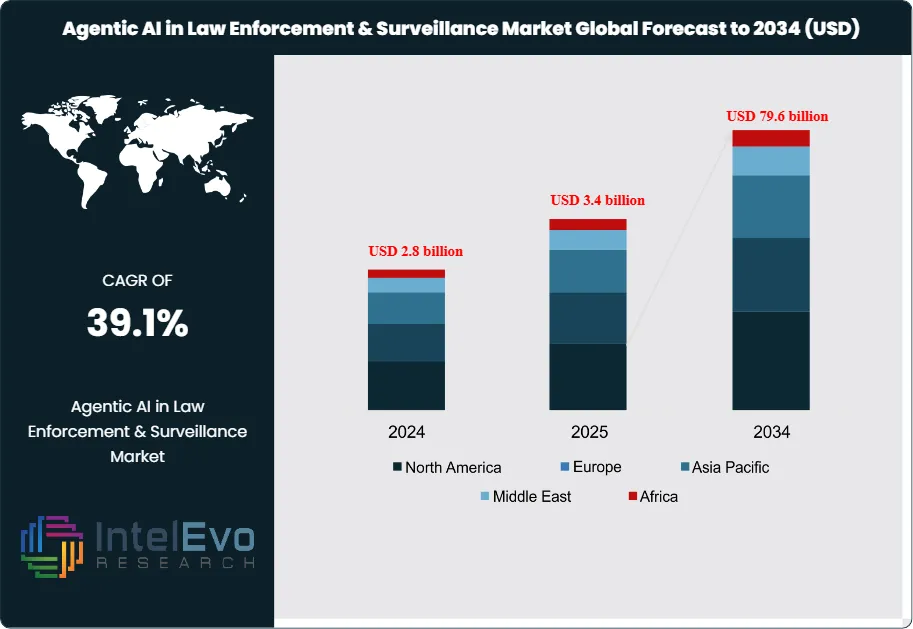
Additionally, growing investments in AI-enabled border security, counterterrorism, and urban monitoring solutions are accelerating global adoption, positioning agentic AI as a transformative force in next-generation security and surveillance ecosystems. Growth reflects rapid uptake across policing, border management, and critical infrastructure as agencies seek better awareness, faster response, and leaner staffing.
Agentic AI describes systems that interpret complex environments, select actions, and execute tasks with constrained human oversight. In law enforcement and surveillance, these capabilities support facial and object recognition, anomalous behavior detection, and predictive risk scoring across video and sensor feeds. A Deloitte analysis indicates that such smart technologies can reduce crime by 30–40% and cut emergency response times by 20–35%, reinforcing the investment case.
Demand-side momentum stems from rising urbanization, sophisticated criminal activity, and heightened expectations for public safety. Governments embed AI-based monitoring into smart city programs and national security strategies, often backed by digital infrastructure budgets. On the supply side, advances in machine learning, computer vision, and edge computing improve detection accuracy, lower false positives, and enable near real-time analysis. Vendors differentiate through scalable platforms that integrate with command centers, patrol vehicles, and body-worn devices.
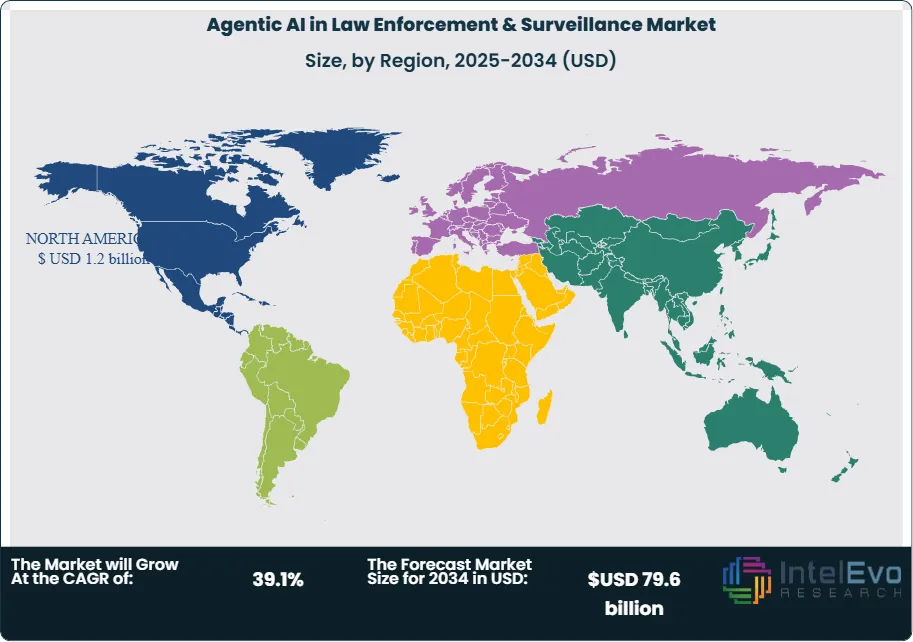
Regional adoption remains uneven. North America accounted for more than 44.5% of global revenue in 2024, or about USD 1.2 billion, supported by federal and municipal procurement and an active ecosystem of AI software and cloud providers. Europe advances under strict data protection frameworks and the EU Artificial Intelligence Act, which favor transparent and auditable systems. Asia-Pacific, the Middle East, and parts of Latin America emerge as investment hotspots as governments fund AI-enabled border surveillance and large urban video networks.
Risk and regulation now shape deployment strategies. Agencies face scrutiny over privacy, bias, and civil liberties, while interconnected assets increase cyber exposure. According to DigitalDefynd, 95% of organizations prioritize strong data safeguards to comply with evolving rules and limit breach impact. Providers respond with privacy-by-design architectures, secure data pipelines, and governance functions that log decisions and support oversight. As ethical norms, technical standards, and procurement criteria consolidate, agentic AI is set to move from pilot projects to core infrastructure within modern public safety systems.
Market Growth: The market grows from USD 3.4 billion in 2025 to USD 79.6 billion by 2034, delivering a 39.1% CAGR, 2026-2034. This expansion reflects sustained deployment of agentic AI across law enforcement and surveillance operations over 2024-2034.
Segment Dominance: Solution offerings dominate with an 82.8% revenue share, 2024, underscoring preference for full-stack platforms over standalone services. On-premises deployments hold 66.2% share, 2024, as agencies prioritize control over sensitive data and infrastructure.
Segment Dominance: NLP capabilities secure a 30.5% share of the market, 2024, as agencies apply voice analysis, chatbots, and text intelligence in operations. Large enterprises account for 70.3% of total spending, 2024, reflecting their capacity to fund advanced AI-driven surveillance and risk systems.
Driver: Accelerating AI adoption in security drives demand as the overall market posts a 38.7% CAGR, 2024-2034. The United States market alone grows from 0.996 billion USD, 2024 at a 36.2% CAGR, 2024-2034, highlighting strong institutional investment.
Restraint: Strict compliance and privacy obligations slow rollout, with agencies diverting an estimated: 20.0% of implementation budgets to governance and audits, 2024. This compliance burden lengthens deployment cycles and delays some share of planned projects over 2024-2034.
Opportunity: Vendors can unlock new revenue by targeting mid-sized agencies and cloud-ready workloads, an addressable pool estimated: 3.0 billion USD, 2034. Converting even an estimated: 25.0% of current on-premises workloads, 2024 to hybrid models, 2034 would materially expand recurring revenue.
Trend: Agencies increasingly integrate NLP, which holds 30.5% segment share, 2024, and could rise to an estimated: 45.0% share, 2034 as conversational and analytics tools mature. Hybrid architectures that blend the 66.2% on-premises base, 2024 with secure cloud analytics gain traction through 2024-2034.
Regional Analysis: North America leads with 44.5% of global revenue, 2024, equivalent to 1.2 billion USD, 2024, supported by U.S. spending of 0.996 billion USD, 2024. Emerging programs in Asia-Pacific are set to reach an estimated: 30.0% global share, 2034, positioning the region as the next major growth engine over 2024-2034.
By Offering
The market continues to shift toward integrated AI offerings in 2025. Solution-based deployments account for more than four fifths of total revenue, reflecting strong reliance on AI tools that support surveillance, identity verification, threat screening, and tactical decision support. Security and surveillance AI platforms, including facial recognition, video analytics, and automated threat detection, remain the core investment area for public agencies. These tools process large volumes of visual and operational data at high speed, enabling officers to act on verified information rather than manual interpretation.
Law enforcement software solutions also expand quickly. Crime analytics, digital evidence management, and predictive activity mapping allow agencies to consolidate disparate databases and identify risk patterns with greater accuracy. The market sees steady demand for digital records systems as agencies move toward standardized evidence workflows and real-time operational dashboards. Services such as implementation, integration, training, and continuous support form a growing secondary revenue stream. Agencies depend on these services to manage deployment risks and ensure compliance with internal security protocols.
Adoption increases as agencies face growing data volumes and operational pressure. You see stronger investment in software customizations that align with local legal requirements and internal governance needs. Vendors respond with modular architectures that support phased adoption and structured upgrades across policing networks.
By Technology
Natural language processing holds a sizable position in 2025, supported by the need to interpret audio, communication logs, and written records. NLP systems classify speech, extract keywords, and generate structured summaries from unstructured sources. Agencies use these tools to automate transcription, accelerate case documentation, and detect sentiment patterns that may indicate risk. Computer vision and deep learning strengthen automated detection functions, especially as camera networks expand across urban areas.
Machine learning models support forecasting and trend identification across crime datasets. These models help analysts identify hotspots, anticipate emerging behaviors, and test intervention strategies. Reinforcement learning and neural network frameworks remain in early deployment stages but gain visibility as agencies test autonomous monitoring scenarios.
The continuous flow of surveillance, sensor, and communication data pushes agencies to adopt more sophisticated AI techniques. You see growing interest in hybrid models that combine NLP and computer vision outputs for broader situational interpretation.
By Deployment Model
On-premises deployments remain dominant in 2025. Agencies continue to favor full control over sensitive data repositories, especially for facial recognition outputs, criminal records, and intelligence files. Localized infrastructure aligns with strict data governance rules and supports integration with legacy systems that require high security thresholds. Many agencies consider on-premises solutions essential when handling confidential investigations or classified intelligence.
Cloud-based deployments grow at a steady rate as modernization programs push departments toward more flexible computing resources. Cloud environments help agencies scale analytical workloads and maintain system performance during peak operational demands. Hybrid deployments are now common in larger jurisdictions, where non-sensitive workloads move to cloud environments while core evidence systems remain on premises.
Despite growing cloud capabilities, operational risk and compliance hurdles slow adoption in certain markets. You see agencies conducting multi-year transition planning to avoid disruption of mission-critical processes.
By Enterprise Size
Large enterprises continue to represent the leading customer segment. These organizations control broader jurisdictions, larger staff counts, and wider surveillance networks that generate substantial data streams. They invest in complex AI ecosystems that unify crime analytics, mobility systems, automated monitoring, and evidence repositories. Their financial capacity supports long planning cycles, multi-site deployment, and specialized personnel training.
Small and medium-sized agencies gradually increase AI adoption, supported by lower-cost analytics modules and cloud-based subscription models. Their adoption path focuses on targeted applications such as video analytics or records automation. Vendors respond by offering smaller packages that reduce integration complexity and shorten implementation timelines.
The market sees rising demand from regional clusters of SMEs that share infrastructure and coordinate technology procurement across districts. These models help smaller agencies reach performance levels previously restricted to large institutions.
By Region
North America maintains its lead in 2025, supported by high spending on public safety modernization and mature digital infrastructure. U.S. agencies deploy advanced surveillance, identity systems, and automated analytics across urban environments. Canada increases adoption of AI-assisted monitoring tools to support border security and emergency response operations. The region benefits from a strong vendor base and continuous pilot programs that test new applications at scale.
Europe advances at a steady pace. Strict privacy rules shape procurement decisions, pushing agencies toward transparent audit systems and compliant data architectures. Investment grows across Western Europe, while Eastern Europe accelerates deployments in border control and mobility security.
Asia Pacific records the fastest expansion. Rapid urbanization, extensive camera networks, and government security initiatives underpin demand. Markets such as China, Japan, South Korea, and Australia scale AI platforms to support city-wide surveillance and operational analytics. Latin America and the Middle East increase adoption with a focus on crime pattern detection, perimeter security, and crowd monitoring in high-density zones. Both regions turn to AI to address rising security risks and build centralized monitoring hubs.
By Offering (Solution, Law Enforcement Software Solutions, Services), By Technology (Natural Language Processing (NLP), Computer Vision, Machine Learning, Deep Learning, Others (Reinforcement Learning, Neural Networks, etc.)), By Deployment Model (Cloud-based, On-premises), By Enterprise Size (Small and Medium Enterprises (SMEs), Large Enterprises)
Research Methodology
Primary Research- 100 Interviews of Stakeholders
Secondary Research
Desk Research
Regional scope
North America (United States, Canada, Mexico)
Latin America (Brazil, Argentina, Columbia)
East Asia And Pacific (China, Japan, South Korea, Australia, Cambodia, Fiji, Indonesia)
Sea And South Asia (India, Singapore, Thailand, Taiwan, Malaysia)
Eastern Europe (Poland, Russia, Czech Republic, Romania)
Western Europe (Germany, U.K., France, Spain, Itlay)
Middle East & Africa (GCC Countries, Egypt, Nigeria, South Africa, Israel)
Competitive Landscape
Cognitiv, Microsoft Corporation, Genetec Inc., OpenAI, Clearview AI, Inc., International Business Machines Corporation (IBM), Motorola Solutions, Inc., Nvidia Corporation, Amazon Web Services Inc. (AWS), IntelliVision, Palantir Technologies Inc., C3.ai Inc., Google LLC, NEC Corporation, Veritone Inc., Others
Customization Scope
Customization for segments, region/country-level will be provided. Moreover, additional customization can be done based on the requirements.
Pricing and Purchase Options
Avail customized purchase options to meet your exact research needs. We have three licenses to opt for: Single User License, Multi-User License (Up to 5 Users), Corporate Use License (Unlimited User and Printable PDF).
TABLE OF CONTENTS
1. EXECUTIVE SUMMARY
1.1. MARKET SNAPSHOT
1.2. KEY FINDINGS & INSIGHTS
1.3. ANALYST RECOMMENDATIONS
1.4. FUTURE OUTLOOK
2. RESEARCH METHODOLOGY
2.1. MARKET DEFINITION & SCOPE
2.2. RESEARCH OBJECTIVES: PRIMARY & SECONDARY DATA SOURCES
2.3. DATA COLLECTION SOURCES
2.3.1. COVERAGE OF 100+ PRIMARY RESEARCH/CONSULTATION CALLS WITH INDUSTRY STAKEHOLDERS
FIGURE 17 NORTH AMERICA AGENTIC AI IN LAW ENFORCEMENT & SURVEILLANCE CURRENT AND FUTURE TYPE ANALYSIS, 2025–2034, (USD MILLION)
FIGURE 18 NORTH AMERICA AGENTIC AI IN LAW ENFORCEMENT & SURVEILLANCE CURRENT AND FUTURE END USER ANALYSIS, 2025–2034, (USD MILLION)
FIGURE 19 MARKET SHARE BY COUNTRY
FIGURE 20 LATIN AMERICA AGENTIC AI IN LAW ENFORCEMENT & SURVEILLANCE CURRENT AND FUTURE TYPE ANALYSIS, 2025–2034, (USD MILLION)
FIGURE 21 LATIN AMERICA AGENTIC AI IN LAW ENFORCEMENT & SURVEILLANCE CURRENT AND FUTURE END USER ANALYSIS, 2025–2034, (USD MILLION)
FIGURE 22 MARKET SHARE BY COUNTRY
FIGURE 23 EASTERN EUROPE AGENTIC AI IN LAW ENFORCEMENT & SURVEILLANCE CURRENT AND FUTURE TYPE ANALYSIS, 2025–2034, (USD MILLION)
FIGURE 24 EASTERN EUROPE AGENTIC AI IN LAW ENFORCEMENT & SURVEILLANCE CURRENT AND FUTURE END USER ANALYSIS, 2025–2034, (USD MILLION)
FIGURE 25 MARKET SHARE BY COUNTRY
FIGURE 26 WESTERN EUROPE AGENTIC AI IN LAW ENFORCEMENT & SURVEILLANCE CURRENT AND FUTURE TYPE ANALYSIS, 2025–2034, (USD MILLION)
FIGURE 27 WESTERN EUROPE AGENTIC AI IN LAW ENFORCEMENT & SURVEILLANCE CURRENT AND FUTURE END USER ANALYSIS, 2025–2034, (USD MILLION)
FIGURE 28 MARKET SHARE BY COUNTRY
FIGURE 29 EAST ASIA AND PACIFIC AGENTIC AI IN LAW ENFORCEMENT & SURVEILLANCE CURRENT AND FUTURE TYPE ANALYSIS, 2025–2034, (USD MILLION)
FIGURE 30 EAST ASIA AND PACIFIC AGENTIC AI IN LAW ENFORCEMENT & SURVEILLANCE CURRENT AND FUTURE END USER ANALYSIS, 2025–2034, (USD MILLION)
FIGURE 31 MARKET SHARE BY COUNTRY
FIGURE 32 SEA AND SOUTH ASIA AGENTIC AI IN LAW ENFORCEMENT & SURVEILLANCE CURRENT AND FUTURE TYPE ANALYSIS, 2025–2034, (USD MILLION)
FIGURE 33 SEA AND SOUTH ASIA AGENTIC AI IN LAW ENFORCEMENT & SURVEILLANCE CURRENT AND FUTURE END USER ANALYSIS, 2025–2034, (USD MILLION)
FIGURE 34 MARKET SHARE BY COUNTRY
FIGURE 35 MIDDLE EAST AND AFRICA AGENTIC AI IN LAW ENFORCEMENT & SURVEILLANCE CURRENT AND FUTURE TYPE ANALYSIS, 2025–2034, (USD MILLION)
FIGURE 36 MIDDLE EAST AND AFRICA AGENTIC AI IN LAW ENFORCEMENT & SURVEILLANCE CURRENT AND FUTURE END USER ANALYSIS, 2025–2034, (USD MILLION)
FIGURE 37 NORTH AMERICA AGENTIC AI IN LAW ENFORCEMENT & SURVEILLANCE CURRENT AND FUTURE MARKET VOLUME SHARE REGIONAL ANALYSIS, 2025–2034, (USD MILLION)
FIGURE 38 U.S. AGENTIC AI IN LAW ENFORCEMENT & SURVEILLANCE CURRENT AND FUTURE TYPE ANALYSIS, 2025–2034, (USD MILLION)
FIGURE 39 U.S. AGENTIC AI IN LAW ENFORCEMENT & SURVEILLANCE CURRENT AND FUTURE END USER ANALYSIS, 2025–2034, (USD MILLION)
FIGURE 40 CANADA AGENTIC AI IN LAW ENFORCEMENT & SURVEILLANCE CURRENT AND FUTURE TYPE ANALYSIS, 2025–2034, (USD MILLION)
FIGURE 41 CANADA AGENTIC AI IN LAW ENFORCEMENT & SURVEILLANCE CURRENT AND FUTURE END USER ANALYSIS, 2025–2034, (USD MILLION)
FIGURE 42 LATIN AMERICA AGENTIC AI IN LAW ENFORCEMENT & SURVEILLANCE CURRENT AND FUTURE MARKET VOLUME SHARE REGIONAL ANALYSIS, 2025–2034, (USD MILLION)
FIGURE 43 MEXICO AGENTIC AI IN LAW ENFORCEMENT & SURVEILLANCE CURRENT AND FUTURE TYPE ANALYSIS, 2025–2034, (USD MILLION)
FIGURE 44 MEXICO AGENTIC AI IN LAW ENFORCEMENT & SURVEILLANCE CURRENT AND FUTURE END USER ANALYSIS, 2025–2034, (USD MILLION)
FIGURE 45 BRAZIL AGENTIC AI IN LAW ENFORCEMENT & SURVEILLANCE CURRENT AND FUTURE TYPE ANALYSIS, 2025–2034, (USD MILLION)
FIGURE 46 BRAZIL AGENTIC AI IN LAW ENFORCEMENT & SURVEILLANCE CURRENT AND FUTURE END USER ANALYSIS, 2025–2034, (USD MILLION)
FIGURE 47 ARGENTINA AGENTIC AI IN LAW ENFORCEMENT & SURVEILLANCE CURRENT AND FUTURE TYPE ANALYSIS, 2025–2034, (USD MILLION)
FIGURE 48 ARGENTINA AGENTIC AI IN LAW ENFORCEMENT & SURVEILLANCE CURRENT AND FUTURE END USER ANALYSIS, 2025–2034, (USD MILLION)
FIGURE 49 COLUMBIA AGENTIC AI IN LAW ENFORCEMENT & SURVEILLANCE CURRENT AND FUTURE TYPE ANALYSIS, 2025–2034, (USD MILLION)
FIGURE 50 COLUMBIA AGENTIC AI IN LAW ENFORCEMENT & SURVEILLANCE CURRENT AND FUTURE END USER ANALYSIS, 2025–2034, (USD MILLION)
FIGURE 51 REST OF LATIN AMERICA AGENTIC AI IN LAW ENFORCEMENT & SURVEILLANCE CURRENT AND FUTURE TYPE ANALYSIS, 2025–2034, (USD MILLION)
FIGURE 52 REST OF LATIN AMERICA AGENTIC AI IN LAW ENFORCEMENT & SURVEILLANCE CURRENT AND FUTURE END USER ANALYSIS, 2025–2034, (USD MILLION)
FIGURE 53 EASTERN EUROPE AGENTIC AI IN LAW ENFORCEMENT & SURVEILLANCE CURRENT AND FUTURE MARKET VOLUME SHARE REGIONAL ANALYSIS, 2025–2034, (USD MILLION)
FIGURE 54 POLAND AGENTIC AI IN LAW ENFORCEMENT & SURVEILLANCE CURRENT AND FUTURE TYPE ANALYSIS, 2025–2034, (USD MILLION)
FIGURE 55 POLAND AGENTIC AI IN LAW ENFORCEMENT & SURVEILLANCE CURRENT AND FUTURE END USER ANALYSIS, 2025–2034, (USD MILLION)
FIGURE 56 RUSSIA AGENTIC AI IN LAW ENFORCEMENT & SURVEILLANCE CURRENT AND FUTURE TYPE ANALYSIS, 2025–2034, (USD MILLION)
FIGURE 57 RUSSIA AGENTIC AI IN LAW ENFORCEMENT & SURVEILLANCE CURRENT AND FUTURE END USER ANALYSIS, 2025–2034, (USD MILLION)
FIGURE 58 CZECH REPUBLIC AGENTIC AI IN LAW ENFORCEMENT & SURVEILLANCE CURRENT AND FUTURE TYPE ANALYSIS, 2025–2034, (USD MILLION)
FIGURE 59 CZECH REPUBLIC AGENTIC AI IN LAW ENFORCEMENT & SURVEILLANCE CURRENT AND FUTURE END USER ANALYSIS, 2025–2034, (USD MILLION)
FIGURE 60 ROMANIA AGENTIC AI IN LAW ENFORCEMENT & SURVEILLANCE CURRENT AND FUTURE TYPE ANALYSIS, 2025–2034, (USD MILLION)
FIGURE 61 ROMANIA AGENTIC AI IN LAW ENFORCEMENT & SURVEILLANCE CURRENT AND FUTURE END USER ANALYSIS, 2025–2034, (USD MILLION)
FIGURE 62 REST OF EASTERN EUROPE AGENTIC AI IN LAW ENFORCEMENT & SURVEILLANCE CURRENT AND FUTURE TYPE ANALYSIS, 2025–2034, (USD MILLION)
FIGURE 63 REST OF EASTERN EUROPE AGENTIC AI IN LAW ENFORCEMENT & SURVEILLANCE CURRENT AND FUTURE END USER ANALYSIS, 2025–2034, (USD MILLION)
FIGURE 64 WESTERN EUROPE AGENTIC AI IN LAW ENFORCEMENT & SURVEILLANCE CURRENT AND FUTURE MARKET VOLUME SHARE REGIONAL ANALYSIS, 2025–2034, (USD MILLION)
FIGURE 65 GERMANY AGENTIC AI IN LAW ENFORCEMENT & SURVEILLANCE CURRENT AND FUTURE TYPE ANALYSIS, 2025–2034, (USD MILLION)
FIGURE 66 GERMANY AGENTIC AI IN LAW ENFORCEMENT & SURVEILLANCE CURRENT AND FUTURE END USER ANALYSIS, 2025–2034, (USD MILLION)
FIGURE 67 FRANCE AGENTIC AI IN LAW ENFORCEMENT & SURVEILLANCE CURRENT AND FUTURE TYPE ANALYSIS, 2025–2034, (USD MILLION)
FIGURE 68 FRANCE AGENTIC AI IN LAW ENFORCEMENT & SURVEILLANCE CURRENT AND FUTURE END USER ANALYSIS, 2025–2034, (USD MILLION)
FIGURE 69 UK AGENTIC AI IN LAW ENFORCEMENT & SURVEILLANCE CURRENT AND FUTURE TYPE ANALYSIS, 2025–2034, (USD MILLION)
FIGURE 70 UK AGENTIC AI IN LAW ENFORCEMENT & SURVEILLANCE CURRENT AND FUTURE END USER ANALYSIS, 2025–2034, (USD MILLION)
FIGURE 71 SPAIN AGENTIC AI IN LAW ENFORCEMENT & SURVEILLANCE CURRENT AND FUTURE TYPE ANALYSIS, 2025–2034, (USD MILLION)
FIGURE 72 SPAIN AGENTIC AI IN LAW ENFORCEMENT & SURVEILLANCE CURRENT AND FUTURE END USER ANALYSIS, 2025–2034, (USD MILLION)
FIGURE 73 ITALY AGENTIC AI IN LAW ENFORCEMENT & SURVEILLANCE CURRENT AND FUTURE TYPE ANALYSIS, 2025–2034, (USD MILLION)
FIGURE 74 ITALY AGENTIC AI IN LAW ENFORCEMENT & SURVEILLANCE CURRENT AND FUTURE END USER ANALYSIS, 2025–2034, (USD MILLION)
FIGURE 75 REST OF WESTERN EUROPE AGENTIC AI IN LAW ENFORCEMENT & SURVEILLANCE CURRENT AND FUTURE TYPE ANALYSIS, 2025–2034, (USD MILLION)
FIGURE 76 REST OF WESTERN EUROPE AGENTIC AI IN LAW ENFORCEMENT & SURVEILLANCE CURRENT AND FUTURE END USER ANALYSIS, 2025–2034, (USD MILLION)
FIGURE 77 EAST ASIA AND PACIFIC AGENTIC AI IN LAW ENFORCEMENT & SURVEILLANCE CURRENT AND FUTURE MARKET VOLUME SHARE REGIONAL ANALYSIS, 2025–2034, (USD MILLION)
FIGURE 78 CHINA AGENTIC AI IN LAW ENFORCEMENT & SURVEILLANCE CURRENT AND FUTURE TYPE ANALYSIS, 2025–2034, (USD MILLION)
FIGURE 79 CHINA AGENTIC AI IN LAW ENFORCEMENT & SURVEILLANCE CURRENT AND FUTURE END USER ANALYSIS, 2025–2034, (USD MILLION)
FIGURE 80 JAPAN AGENTIC AI IN LAW ENFORCEMENT & SURVEILLANCE CURRENT AND FUTURE TYPE ANALYSIS, 2025–2034, (USD MILLION)
FIGURE 81 JAPAN AGENTIC AI IN LAW ENFORCEMENT & SURVEILLANCE CURRENT AND FUTURE END USER ANALYSIS, 2025–2034, (USD MILLION)
FIGURE 82 AUSTRALIA AGENTIC AI IN LAW ENFORCEMENT & SURVEILLANCE CURRENT AND FUTURE TYPE ANALYSIS, 2025–2034, (USD MILLION)
FIGURE 83 AUSTRALIA AGENTIC AI IN LAW ENFORCEMENT & SURVEILLANCE CURRENT AND FUTURE END USER ANALYSIS, 2025–2034, (USD MILLION)
FIGURE 84 CAMBODIA AGENTIC AI IN LAW ENFORCEMENT & SURVEILLANCE CURRENT AND FUTURE TYPE ANALYSIS, 2025–2034, (USD MILLION)
FIGURE 85 CAMBODIA AGENTIC AI IN LAW ENFORCEMENT & SURVEILLANCE CURRENT AND FUTURE END USER ANALYSIS, 2025–2034, (USD MILLION)
FIGURE 86 FIJI AGENTIC AI IN LAW ENFORCEMENT & SURVEILLANCE CURRENT AND FUTURE TYPE ANALYSIS, 2025–2034, (USD MILLION)
FIGURE 87 FIJI AGENTIC AI IN LAW ENFORCEMENT & SURVEILLANCE CURRENT AND FUTURE END USER ANALYSIS, 2025–2034, (USD MILLION)
FIGURE 88 INDONESIA AGENTIC AI IN LAW ENFORCEMENT & SURVEILLANCE CURRENT AND FUTURE TYPE ANALYSIS, 2025–2034, (USD MILLION)
FIGURE 89 INDONESIA AGENTIC AI IN LAW ENFORCEMENT & SURVEILLANCE CURRENT AND FUTURE END USER ANALYSIS, 2025–2034, (USD MILLION)
FIGURE 90 SOUTH KOREA AGENTIC AI IN LAW ENFORCEMENT & SURVEILLANCE CURRENT AND FUTURE TYPE ANALYSIS, 2025–2034, (USD MILLION)
FIGURE 91 SOUTH KOREA AGENTIC AI IN LAW ENFORCEMENT & SURVEILLANCE CURRENT AND FUTURE END USER ANALYSIS, 2025–2034, (USD MILLION)
FIGURE 92 REST OF EAST ASIA AND PACIFIC AGENTIC AI IN LAW ENFORCEMENT & SURVEILLANCE CURRENT AND FUTURE TYPE ANALYSIS, 2025–2034, (USD MILLION)
FIGURE 93 REST OF EAST ASIA AND PACIFIC AGENTIC AI IN LAW ENFORCEMENT & SURVEILLANCE CURRENT AND FUTURE END USER ANALYSIS, 2025–2034, (USD MILLION)
FIGURE 94 SEA AND SOUTH ASIA AGENTIC AI IN LAW ENFORCEMENT & SURVEILLANCE CURRENT AND FUTURE MARKET VOLUME SHARE REGIONAL ANALYSIS, 2025–2034, (USD MILLION)
FIGURE 95 BANGLADESH AGENTIC AI IN LAW ENFORCEMENT & SURVEILLANCE CURRENT AND FUTURE TYPE ANALYSIS, 2025–2034, (USD MILLION)
FIGURE 96 BANGLADESH AGENTIC AI IN LAW ENFORCEMENT & SURVEILLANCE CURRENT AND FUTURE END USER ANALYSIS, 2025–2034, (USD MILLION)
FIGURE 97 NEW ZEALAND AGENTIC AI IN LAW ENFORCEMENT & SURVEILLANCE CURRENT AND FUTURE TYPE ANALYSIS, 2025–2034, (USD MILLION)
FIGURE 98 NEW ZEALAND AGENTIC AI IN LAW ENFORCEMENT & SURVEILLANCE CURRENT AND FUTURE END USER ANALYSIS, 2025–2034, (USD MILLION)
FIGURE 99 INDIA AGENTIC AI IN LAW ENFORCEMENT & SURVEILLANCE CURRENT AND FUTURE TYPE ANALYSIS, 2025–2034, (USD MILLION)
FIGURE 100 INDIA AGENTIC AI IN LAW ENFORCEMENT & SURVEILLANCE CURRENT AND FUTURE END USER ANALYSIS, 2025–2034, (USD MILLION)
FIGURE 101 SINGAPORE AGENTIC AI IN LAW ENFORCEMENT & SURVEILLANCE CURRENT AND FUTURE TYPE ANALYSIS, 2025–2034, (USD MILLION)
FIGURE 102 SINGAPORE AGENTIC AI IN LAW ENFORCEMENT & SURVEILLANCE CURRENT AND FUTURE END USER ANALYSIS, 2025–2034, (USD MILLION)
FIGURE 103 THAILAND AGENTIC AI IN LAW ENFORCEMENT & SURVEILLANCE CURRENT AND FUTURE TYPE ANALYSIS, 2025–2034, (USD MILLION)
FIGURE 104 THAILAND AGENTIC AI IN LAW ENFORCEMENT & SURVEILLANCE CURRENT AND FUTURE END USER ANALYSIS, 2025–2034, (USD MILLION)
FIGURE 105 TAIWAN AGENTIC AI IN LAW ENFORCEMENT & SURVEILLANCE CURRENT AND FUTURE TYPE ANALYSIS, 2025–2034, (USD MILLION)
FIGURE 106 TAIWAN AGENTIC AI IN LAW ENFORCEMENT & SURVEILLANCE CURRENT AND FUTURE END USER ANALYSIS, 2025–2034, (USD MILLION)
FIGURE 107 MALAYSIA AGENTIC AI IN LAW ENFORCEMENT & SURVEILLANCE CURRENT AND FUTURE TYPE ANALYSIS, 2025–2034, (USD MILLION)
FIGURE 108 MALAYSIA AGENTIC AI IN LAW ENFORCEMENT & SURVEILLANCE CURRENT AND FUTURE END USER ANALYSIS, 2025–2034, (USD MILLION)
FIGURE 109 REST OF SEA AND SOUTH ASIA AGENTIC AI IN LAW ENFORCEMENT & SURVEILLANCE CURRENT AND FUTURE TYPE ANALYSIS, 2025–2034, (USD MILLION)
FIGURE 110 REST OF SEA AND SOUTH ASIA AGENTIC AI IN LAW ENFORCEMENT & SURVEILLANCE CURRENT AND FUTURE END USER ANALYSIS, 2025–2034, (USD MILLION)
FIGURE 111 MIDDLE EAST AND AFRICA AGENTIC AI IN LAW ENFORCEMENT & SURVEILLANCE CURRENT AND FUTURE MARKET VOLUME SHARE REGIONAL ANALYSIS, 2025–2034, (USD MILLION)
FIGURE 112 GCC COUNTRIES AGENTIC AI IN LAW ENFORCEMENT & SURVEILLANCE CURRENT AND FUTURE TYPE ANALYSIS, 2025–2034, (USD MILLION)
FIGURE 113 GCC COUNTRIES AGENTIC AI IN LAW ENFORCEMENT & SURVEILLANCE CURRENT AND FUTURE END USER ANALYSIS, 2025–2034, (USD MILLION)
FIGURE 114 SAUDI ARABIA AGENTIC AI IN LAW ENFORCEMENT & SURVEILLANCE CURRENT AND FUTURE TYPE ANALYSIS, 2025–2034, (USD MILLION)
FIGURE 115 SAUDI ARABIA AGENTIC AI IN LAW ENFORCEMENT & SURVEILLANCE CURRENT AND FUTURE END USER ANALYSIS, 2025–2034, (USD MILLION)
FIGURE 116 UAE AGENTIC AI IN LAW ENFORCEMENT & SURVEILLANCE CURRENT AND FUTURE TYPE ANALYSIS, 2025–2034, (USD MILLION)
FIGURE 117 UAE AGENTIC AI IN LAW ENFORCEMENT & SURVEILLANCE CURRENT AND FUTURE END USER ANALYSIS, 2025–2034, (USD MILLION)
FIGURE 118 BAHRAIN AGENTIC AI IN LAW ENFORCEMENT & SURVEILLANCE CURRENT AND FUTURE TYPE ANALYSIS, 2025–2034, (USD MILLION)
FIGURE 119 BAHRAIN AGENTIC AI IN LAW ENFORCEMENT & SURVEILLANCE CURRENT AND FUTURE END USER ANALYSIS, 2025–2034, (USD MILLION)
FIGURE 120 KUWAIT AGENTIC AI IN LAW ENFORCEMENT & SURVEILLANCE CURRENT AND FUTURE TYPE ANALYSIS, 2025–2034, (USD MILLION)
FIGURE 121 KUWAIT AGENTIC AI IN LAW ENFORCEMENT & SURVEILLANCE CURRENT AND FUTURE END USER ANALYSIS, 2025–2034, (USD MILLION)
FIGURE 122 OMAN AGENTIC AI IN LAW ENFORCEMENT & SURVEILLANCE CURRENT AND FUTURE TYPE ANALYSIS, 2025–2034, (USD MILLION)
FIGURE 123 OMAN AGENTIC AI IN LAW ENFORCEMENT & SURVEILLANCE CURRENT AND FUTURE END USER ANALYSIS, 2025–2034, (USD MILLION)
FIGURE 124 QATAR AGENTIC AI IN LAW ENFORCEMENT & SURVEILLANCE CURRENT AND FUTURE TYPE ANALYSIS, 2025–2034, (USD MILLION)
FIGURE 125 QATAR AGENTIC AI IN LAW ENFORCEMENT & SURVEILLANCE CURRENT AND FUTURE END USER ANALYSIS, 2025–2034, (USD MILLION)
FIGURE 126 EGYPT AGENTIC AI IN LAW ENFORCEMENT & SURVEILLANCE CURRENT AND FUTURE TYPE ANALYSIS, 2025–2034, (USD MILLION)
FIGURE 127 EGYPT AGENTIC AI IN LAW ENFORCEMENT & SURVEILLANCE CURRENT AND FUTURE END USER ANALYSIS, 2025–2034, (USD MILLION)
FIGURE 128 NIGERIA AGENTIC AI IN LAW ENFORCEMENT & SURVEILLANCE CURRENT AND FUTURE TYPE ANALYSIS, 2025–2034, (USD MILLION)
FIGURE 129 NIGERIA AGENTIC AI IN LAW ENFORCEMENT & SURVEILLANCE CURRENT AND FUTURE END USER ANALYSIS, 2025–2034, (USD MILLION)
FIGURE 130 SOUTH AFRICA AGENTIC AI IN LAW ENFORCEMENT & SURVEILLANCE CURRENT AND FUTURE TYPE ANALYSIS, 2025–2034, (USD MILLION)
FIGURE 131 SOUTH AFRICA AGENTIC AI IN LAW ENFORCEMENT & SURVEILLANCE CURRENT AND FUTURE END USER ANALYSIS, 2025–2034, (USD MILLION)
FIGURE 132 ISRAEL AGENTIC AI IN LAW ENFORCEMENT & SURVEILLANCE CURRENT AND FUTURE TYPE ANALYSIS, 2025–2034, (USD MILLION)
FIGURE 133 ISRAEL AGENTIC AI IN LAW ENFORCEMENT & SURVEILLANCE CURRENT AND FUTURE END USER ANALYSIS, 2025–2034, (USD MILLION)
FIGURE 134 REST OF MEA AGENTIC AI IN LAW ENFORCEMENT & SURVEILLANCE CURRENT AND FUTURE TYPE ANALYSIS, 2025–2034, (USD MILLION)
FIGURE 135 REST OF MEA AGENTIC AI IN LAW ENFORCEMENT & SURVEILLANCE CURRENT AND FUTURE END USER ANALYSIS, 2025–2034, (USD MILLION)
FIGURE 136 U. S. MARKET SHARE ANALYSIS BY TYPE (2024)
FIGURE 137 U. S. MARKET SHARE ANALYSIS BY END USER (2024)
FIGURE 138 CANADA MARKET SHARE ANALYSIS BY TYPE (2024)
FIGURE 139 CANADA MARKET SHARE ANALYSIS BY END USER (2024)
FIGURE 140 MEXICO MARKET SHARE ANALYSIS BY TYPE (2024)
FIGURE 141 MEXICO MARKET SHARE ANALYSIS BY END USER (2024)
FIGURE 142 CHINA MARKET SHARE ANALYSIS BY TYPE (2024)
FIGURE 143 CHINA MARKET SHARE ANALYSIS BY END USER (2024)
FIGURE 144 JAPAN MARKET SHARE ANALYSIS BY TYPE (2024)
FIGURE 145 JAPAN MARKET SHARE ANALYSIS BY END USER (2024)
FIGURE 146 INDIA MARKET SHARE ANALYSIS BY TYPE (2024)
FIGURE 147 INDIA MARKET SHARE ANALYSIS BY END USER (2024)
FIGURE 148 SOUTH KOREA MARKET SHARE ANALYSIS BY TYPE (2024)
FIGURE 149 SOUTH KOREA MARKET SHARE ANALYSIS BY END USER (2024)
FIGURE 150 SAUDI ARABIA MARKET SHARE ANALYSIS BY TYPE (2024)
FIGURE 151 SAUDI ARABIA MARKET SHARE ANALYSIS BY END USER (2024)
FIGURE 152 UAE MARKET SHARE ANALYSIS BY TYPE (2024)
FIGURE 153 UAE MARKET SHARE ANALYSIS BY END USER (2024)
FIGURE 154 EGYPT MARKET SHARE ANALYSIS BY TYPE (2024)
FIGURE 155 EGYPT MARKET SHARE ANALYSIS BY END USER (2024)
FIGURE 156 NIGERIA MARKET SHARE ANALYSIS BY TYPE (2024)
FIGURE 157 NIGERIA MARKET SHARE ANALYSIS BY END USER (2024)
FIGURE 158 SOUTH AFRICA MARKET SHARE ANALYSIS BY TYPE (2024)
FIGURE 159 SOUTH AFRICA MARKET SHARE ANALYSIS BY END USER (2024)
FIGURE 160 GERMANY MARKET SHARE ANALYSIS BY TYPE (2024)
FIGURE 161 GERMANY MARKET SHARE ANALYSIS BY END USER (2024)
FIGURE 162 FRANCE MARKET SHARE ANALYSIS BY TYPE (2024)
FIGURE 163 FRANCE MARKET SHARE ANALYSIS BY END USER (2024)
FIGURE 164 UK MARKET SHARE ANALYSIS BY TYPE (2024)
FIGURE 165 UK MARKET SHARE ANALYSIS BY END USER (2024)
FIGURE 166 SPAIN MARKET SHARE ANALYSIS BY TYPE (2024)
FIGURE 167 SPAIN MARKET SHARE ANALYSIS BY END USER (2024)
FIGURE 168 ITALY MARKET SHARE ANALYSIS BY TYPE (2024)
FIGURE 169 ITALY MARKET SHARE ANALYSIS BY END USER (2024)
FIGURE 170 BRAZIL MARKET SHARE ANALYSIS BY TYPE (2024)
FIGURE 171 BRAZIL MARKET SHARE ANALYSIS BY END USER (2024)
FIGURE 172 ARGENTINA MARKET SHARE ANALYSIS BY TYPE (2024)
FIGURE 173 ARGENTINA MARKET SHARE ANALYSIS BY END USER (2024)
FIGURE 174 COLUMBIA MARKET SHARE ANALYSIS BY TYPE (2024)
FIGURE 175 COLUMBIA MARKET SHARE ANALYSIS BY END USER (2024)
FIGURE 176 GLOBAL AGENTIC AI IN LAW ENFORCEMENT & SURVEILLANCE CURRENT AND FUTURE MARKET KEY COUNTRY LEVEL ANALYSIS, 2024–2034, (USD MILLION)
FIGURE 177 FINANCIAL OVERVIEW:
Key Player Analysis
OpenAI: OpenAI positions itself as a leading provider of advanced AI models that support law enforcement analytics and large-scale data interpretation. The company expands its commercial presence in 2025 through partnerships with government technology integrators that embed language models into command centers, evidence review systems, and operational dashboards. Its products assist agencies in summarizing case files, triaging citizen reports, and interpreting communication logs with greater speed. OpenAI invests heavily in safety controls and audit features to meet compliance requirements, which strengthens its acceptance in regulated environments. The firm reports strong adoption across North America and growing demand in Western Europe as agencies move toward automated documentation and multilingual intelligence workflows. Its differentiation stems from model performance, rapid iteration cycles, and a partner ecosystem that adapts the technology to specific policing needs.
Veritone Inc.: Veritone operates as a key challenger with a strong focus on AI-driven media processing and structured analytics for public safety. Its aiWARE platform centralizes audio, video, and text data, enabling agencies to run real-time searches and automated tagging across large evidence archives. The company expands its market reach in 2025 by integrating new facial verification modules and by enhancing transcription accuracy for field recordings. Veritone also secures agreements with municipal police departments that seek to automate body-camera review workloads, an area that accounts for rising data volumes. Reported customer deployments show time savings of more than 30 percent in evidence preparation tasks. The company differentiates itself through specialized public safety workflows and strong integration support, which appeal to agencies with limited technical resources.
C3.ai Inc.: C3.ai positions itself as a major enterprise AI platform provider with a growing footprint in law enforcement and national security. The company offers predictive analytics, threat detection models, and cross-jurisdiction intelligence tools built on its unified data architecture. In 2025, C3.ai expands partnerships with federal and regional agencies to deploy solutions that identify crime patterns and support strategic resource allocation. Its applications run on modular cloud and hybrid environments, which align with large agencies managing diverse legacy systems. The firm reports steady revenue growth from the public sector segment and invests in expanding machine learning libraries tailored to policing workflows. C3.ai stands out due to its ability to manage complex data ecosystems and deliver models that scale across multiple departments and operational centers.
Market Key Players
Cognitiv
Microsoft Corporation
Genetec Inc.
OpenAI
Clearview AI, Inc.
International Business Machines Corporation (IBM)
Motorola Solutions, Inc.
Nvidia Corporation
Amazon Web Services Inc. (AWS)
IntelliVision
Palantir Technologies Inc.
C3.ai Inc.
Google LLC
NEC Corporation
Veritone Inc.
Others
Driver
Rising Data Volumes Accelerate AI Adoption in Policing
In 2025, law enforcement agencies face growing data volumes and increased expectations for faster response times. This situation drives more use of machine learning, computer vision, and automated analytics across surveillance networks. AI systems now process live video feeds, detect anomalies, and match identities at speeds much faster than manual reviews. This significantly improves situational awareness and response effectiveness.
Predictive policing tools improve operational outcomes by analyzing past crime patterns and directing patrols to high-risk areas. Agencies using automated video analytics report a reduction of over 40 percent in monitoring workloads while increasing detection accuracy. As AI becomes part of daily field operations, agencies make more accurate deployment decisions and achieve greater consistency in enforcement activities.
Restraint
Privacy and Civil Rights Scrutiny Slows AI Deployment
Privacy and civil rights concerns remain a significant barrier to adoption in 2025, especially regarding facial recognition and predictive analytics. Regulators across North America and Europe now require strict audit trails, human reviews, and explicit consent mechanisms. These requirements make implementation more complex and extend deployment timelines.
Data Security Risks Elevate Compliance and Trust Challenges
As agencies store larger amounts of sensitive surveillance and identity data, the risks associated with data management grow. A single breach can damage public trust and delay procurement or deployment for long periods. Agencies must carefully balance operational benefits against legal risks, reputational damage, and community expectations, making compliance crucial in AI adoption decisions.
Opportunity
Advanced AI Technologies Expand Intelligence Capabilities
Rapid advances in machine learning, natural language processing, and sensor fusion create new chances to improve law enforcement intelligence capabilities. Vendors increasingly offer platforms that integrate structured and unstructured data to support investigations, emergency response, and threat assessments across complex operational environments.
High-Growth Market Rewards Early Technology Adoption
The global market for AI-enabled law enforcement systems is expected to grow by more than 30 percent annually through 2034. This creates significant opportunities for innovation and partnership. These tools are especially valuable in tackling cybercrime, trafficking networks, and coordinated fraud, where manual investigations remain slow and resource-heavy. Early adopters gain lasting advantages in case resolution efficiency and operational effectiveness.
Trend
Real-Time Analytics Become the New Policing Standard
By 2025, real-time analytics increasingly define standard operating models across major jurisdictions. Agencies move toward cloud-supported workflows that allow for continuous video ingestion, sensor integration, and remote access. This reduces reliance on on-premise hardware and improves system scalability.
Cloud and Modular Systems Drive Broader Adoption
Predictive mapping and automated alerting tools become popular among mid-sized agencies that previously lacked advanced infrastructure. Declining costs, modular software deployments, and continuous updates support wider adoption, making AI a key part of modern, data-driven public safety strategies.
Recent Developments
Dec 2024 – Cognyte Software Ltd.: Cognyte hosted its Intelligence Summit 2024 to showcase AI-powered analytics for security, intelligence, and public safety customers, highlighting new capabilities for threat detection and investigation support. This event strengthened Cognyte’s position as a specialist provider of intelligence-driven AI tools for law enforcement and national security agencies worldwide.
Mar 2025 – Thomson Reuters: Thomson Reuters announced a key milestone in its AI strategy with deeper integrations of its CoCounsel platform and emphasized CLEAR, its investigation software for law enforcement, compliance, risk, and fraud investigators. This move reinforces the company’s role as an information and analytics supplier that links AI-enabled research with operational investigation workflows in police and regulatory environments.
Apr 2025 – Motorola Solutions: Motorola Solutions launched the SVX device integrating a remote speaker microphone, body camera, and an Assist AI feature that surfaces real-time data such as license plates and driver information, building on a public safety footprint where more than 60% of U.S. 911 calls already use its systems. This launch expands Motorola’s end-to-end command center and field-officer stack and deepens its influence over how AI is embedded in incident response.
May 2025 – Presight: Presight introduced its AI-Policing Suite at the World Police Summit 2025, combining generative AI, AI agents, and computer vision to support command centers, investigations, and urban safety, alongside a broader expansion of UAE-made AI products and a new regional office in Astana. This launch positions Presight as a regional hub player for AI-enabled policing solutions across the Middle East, Central Asia, and emerging smart-city programs.
Nov 2025 – Veritone Inc.: Veritone reported Q3 2025 revenue of USD 29.1 million, up more than 32% year on year, with software products and services growing 55% and over 200% year on year excluding its hiring solution, on top of continued promotion of its law-enforcement-focused AI tools at industry forums such as IACP 2025. This momentum underlines Veritone’s shift toward higher-growth subscription and software revenue tied to digital evidence management and investigation support for public safety agencies.
Dec 2025 – Axon Enterprise: Axon began a live pilot of AI-enabled body cameras with facial recognition in Edmonton, Canada, using a watch list of more than 7,000 high-risk individuals and applying the technology under restricted field conditions. This trial signals Axon’s intent to extend its hardware and cloud portfolio into agentic facial-recognition workflows, while also triggering regulatory and civil-liberty scrutiny that will shape commercial deployment models in North America.
