AI-based Emotional Recognition Software Market to Reach $552.4M by 2034 | CAGR 4.9%
Global AI-based Emotional Recognition Software market Size, Share, Analysis Report By Component (Software, Services), By Technology (Facial Expression Recognition, Speech and Voice Recognition, Text Analysis, Multimodal Recognition, Machine Learning, Deep Learning), By Deployment Mode (On-Premises, Cloud-Based), By End-User (BFSI, Healthcare, Retail & E-commerce, IT & Telecom, Government, Education, Media & Entertainment, Automotive, Consumer Electronics), Region and Key Players - Industry Segment Overview, Market Dynamics, Competitive Strategies, Trends and Forecast 2025-2034
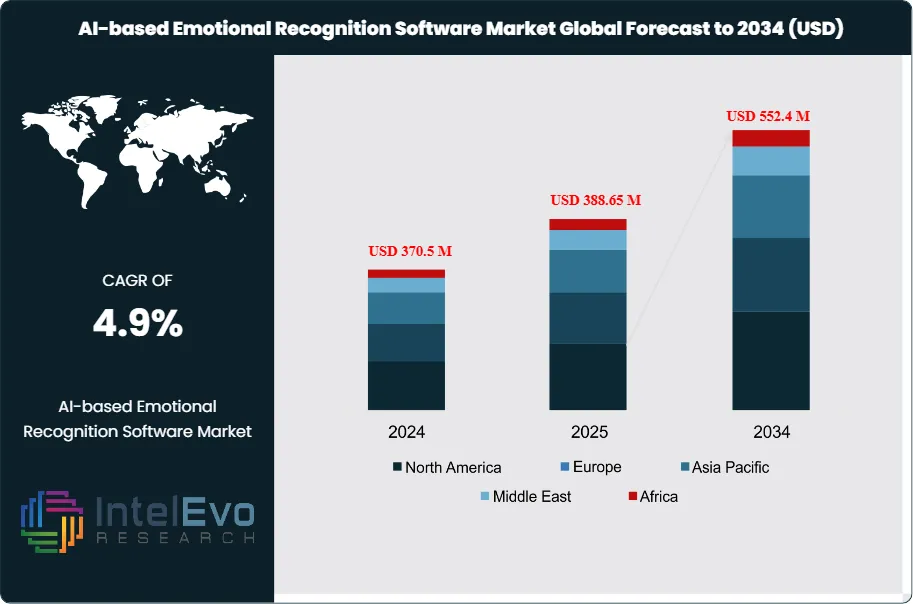
The AI-based Emotional Recognition Software Market size is projected to reach approximately USD 552.4 million by 2034, up from USD 370.5 million in 2024, growing at a CAGR of 4.9% during the forecast period from 2024 to 2034. The growth is driven by increasing adoption of AI in customer experience management, healthcare, and security applications. Rising demand for real-time sentiment analysis, enhanced human-computer interaction, and workforce productivity monitoring is fueling market expansion. Integration with IoT, smart devices, and advanced analytics platforms is expected to further accelerate innovation and adoption globally.
The AI-based Emotional Recognition Software Market is experiencing rapid growth, driven by the increasing adoption of artificial intelligence (AI) in sectors such as healthcare, marketing, customer service, and security. This software uses advanced algorithms to analyze facial expressions, voice tone, text, and other behavioral cues to determine emotions, helping organizations improve customer engagement, optimize marketing strategies, and enhance security measures. In the healthcare sector, AI-based emotional recognition aids in diagnosing mental health conditions, monitoring patient moods, and providing personalized treatment options. In marketing and customer service, it enables real-time emotion analysis, leading to more targeted campaigns and enhanced customer satisfaction.
The market's growth is fueled by advancements in AI and machine learning (ML) technologies, which have improved the accuracy of emotion detection across various modalities, including facial, vocal, and text-based analysis. The increasing integration of emotional recognition in consumer electronics, such as smart devices and gaming consoles, is also expanding its market scope. However, privacy concerns, data security issues, and regulatory challenges pose significant barriers to the widespread adoption of this technology, particularly in regions with stringent data protection laws.
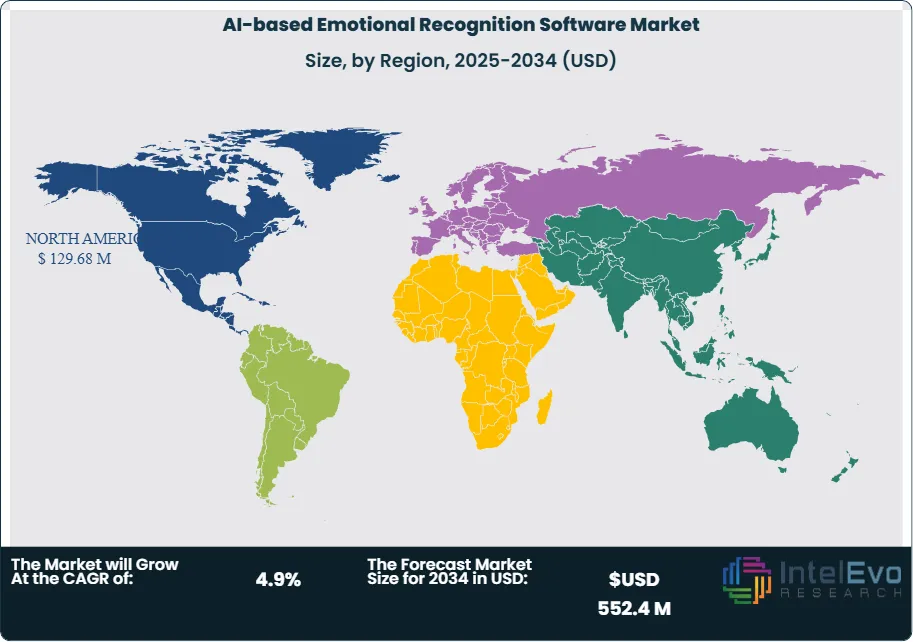
Geographically, North America leads the market due to the presence of leading tech companies and strong demand from the healthcare and marketing sectors. Europe follows closely, driven by advancements in AI and strict data privacy regulations. The Asia Pacific region is expected to witness the highest growth rate, fueled by rapid technological advancements, expanding consumer electronics industries, and increasing demand for AI solutions across various sectors.
Key players in the market include Affectiva, Kairos, and Microsoft, all of whom are investing heavily in R&D to enhance their emotion recognition capabilities and expand their product offerings. Despite challenges such as ethical concerns and potential misuse of the technology, the AI-based emotional recognition software market is expected to continue its upward trajectory. With the growing focus on human-centered AI and applications across sectors like automotive, education, and gaming, the demand for AI-based emotional recognition solutions is set to rise, ensuring its relevance in the future of AI-driven technologies.
The COVID-19 pandemic had both positive and negative impacts on the market. While some industries saw a temporary slowdown, others, like healthcare and online retail, increased their reliance on emotional recognition software to better understand and support remote interactions, accelerating the market's growth potential in a post-pandemic world.
Key Takeaways
Market Growth: The AI-based Emotional Recognition Software market is expected to reach USD 552.4 million by 2034, growing at a robust CAGR of 4.9%, indicating strong market expansion.
Component Dominance: Software dominates the AI-based Emotional Recognition Software Market as it forms the core of the technology, driving demand across industries like healthcare, marketing, and security. Software solutions for facial recognition, speech, and text analysis are widely integrated into systems to enhance emotional analysis capabilities.
Technology Dominance: Facial Expression Recognition holds dominance in this market segment due to its widespread use in customer service, marketing, and security applications. Its ability to capture and analyze real-time emotional responses visually makes it an essential tool for businesses aiming to improve user experiences
Deployment Mode Dominances: Cloud-Based Deployment dominates, offering scalability, cost-effectiveness, and ease of integration across industries. The growing need for remote accessibility and large-scale emotion data processing drives businesses to adopt cloud-based solutions over on-premises alternatives, especially in sectors like healthcare and retail.
End-use Industry Preference: Retail & E-commerce dominates the end-user segment, leveraging emotional recognition technology for targeted marketing and personalized shopping experiences. Analyzing customer sentiment helps retailers enhance customer engagement, improve product recommendations, and boost sales, making this sector a key adopter of the technology.
Driver: The increasing demand for personalized customer experiences in sectors like retail, healthcare, and entertainment is driving the adoption of AI-based emotional recognition software, as businesses seek to analyze real-time emotions to enhance customer engagement and improve service delivery.
Restraint: Privacy concerns and stringent data protection regulations hinder the widespread adoption of emotional recognition software, as the technology involves sensitive biometric data collection, raising ethical issues and potential misuse, especially in regions with strict data privacy laws like Europe.
Opportunity: The integration of emotional recognition in smart devices and wearables presents a significant opportunity, as consumers and industries increasingly adopt AI-based technologies for health monitoring, gaming, and immersive experiences, opening new growth avenues across healthcare, consumer electronics, and entertainment sectors.
Trend: The rise of multimodal emotional recognition—analyzing emotions through multiple channels like facial expressions, voice, and text simultaneously—has become a major trend. This approach improves accuracy, offering richer insights, especially in applications like mental health monitoring and customer experience management.
Regional Analysis: North America dominates the market due to the presence of major tech companies and early adoption across industries like healthcare and retail.
Component Analysis:
Software leads the AI-based Emotional Recognition Software Market, primarily due to its essential role in emotion detection. Advanced AI algorithms integrated into software solutions allow real-time emotional analysis through various modalities like facial, speech, and text recognition. As businesses seek to improve customer interactions, the demand for sophisticated software tools grows across industries, including healthcare, retail, and marketing. The flexibility of software solutions to integrate into existing systems further strengthens its dominance over the services segment.
Technology Analysis:
Facial Expression Recognition is the dominant technology within the AI-based emotional recognition market due to its widespread application in customer service, marketing, and security. Its visual approach to emotion detection offers a more intuitive and accurate method for understanding user emotions. This technology has gained traction across sectors like retail and automotive, where real-time emotion monitoring is key for enhancing user experience and improving decision-making processes. Its wide applicability makes it a leading emotional recognition technology.
Deployment Analysis:
Cloud-Based Deployment dominates due to its scalability, cost-effectiveness, and ability to manage large-scale data processing across industries. Cloud-based solutions allow businesses to analyze emotions remotely in real-time, making it ideal for sectors like healthcare, where patient monitoring is crucial, and retail, where customer behavior analysis boosts engagement. Moreover, cloud technology supports faster deployment and continuous updates, enhancing the overall performance of AI-based emotional recognition systems compared to on-premises alternatives.
Application Analysis:
Customer Service & Experience Management leads the application segment, as emotional recognition tools are increasingly used to personalize and enhance customer interactions. Call centers and automated service systems benefit from real-time emotion analysis, enabling companies to tailor responses based on customers’ emotional states. This application significantly improves satisfaction rates and loyalty, particularly in competitive sectors like retail, hospitality, and financial services, where customer experience is pivotal. Businesses are prioritizing emotional recognition to optimize engagement and service.
End-User Analysis:
Retail & E-commerce dominates as emotional recognition software is extensively used to analyze consumer sentiment for targeted marketing and personalized shopping experiences. By leveraging emotional data, retailers can enhance customer engagement, improve product recommendations, and optimize sales strategies. E-commerce platforms also benefit from understanding consumer emotions, helping to build more effective user interfaces and customer service channels. As a result, the retail and e-commerce sectors continue to be the largest end-users of AI-based emotional recognition technology.
Region Analysis:
North America Leads With 35% Market Share In AI-based Emotional Recognition Software market: North America leads the market, driven by strong demand from sectors like healthcare, retail, and marketing, as well as the presence of major tech companies focused on AI advancements. The U.S., in particular, has seen high adoption due to its well-developed technology infrastructure and significant investments in artificial intelligence for customer experience enhancement, healthcare monitoring, and security systems.
Asia-Pacific is expected to witness the highest growth, fueled by rapid technological advancements, increased adoption of AI in consumer electronics, and expanding applications in healthcare and education sectors. Countries like China, Japan, and India are key contributors, driven by growing investments in AI and machine learning technologies across various industries, including gaming and automotive.
By Component:(Software (Facial Recognition Software, Speech Recognition Software, Text Recognition Software), Services (Professional Services, Managed Services)), By Technology (Facial Expression Recognition, Speech and Voice Recognition, Text Analysis (Sentiment Analysis), Multimodal Recognition, Machine Learning (ML) and Deep Learning (DL), Physiological Signal Recognition), By Deployment Mode (On-Premises, Cloud-Based), By End-User (BFSI (Banking, Financial Services, and Insurance), Healthcare, Retail & E-commerce, IT & Telecom, Government, Education, Media & Entertainment, Automotive, Consumer Electronics), By Application (Healthcare & Telemedicine, Customer Experience Management, Security & Surveillance, Human-Computer Interaction, Marketing & Advertising, Education & Training)
Research Methodology
Primary Research- 100 Interviews of Stakeholders
Secondary Research
Desk Research
Regional scope
North America (United States, Canada, Mexico)
Latin America (Brazil, Argentina, Columbia)
East Asia And Pacific (China, Japan, South Korea, Australia, Cambodia, Fiji, Indonesia)
Sea And South Asia (India, Singapore, Thailand, Taiwan, Malaysia)
Eastern Europe (Poland, Russia, Czech Republic, Romania)
Western Europe (Germany, U.K., France, Spain, Itlay)
Middle East & Africa (GCC Countries, Egypt, Nigeria, South Africa, Israel)
Competitive Landscape
Microsoft Corporation, IBM Corporation, Affectiva, Realeyes, Noldus Information Technology, Emotion Research Lab, Cognitec Systems, Sightcorp, Beyond Verbal, Emotient (Acquired by Apple), Face++, Xilinx Inc., AffectNet, Zebra Medical Vision, SentiSight
Customization Scope
Customization for segments, region/country-level will be provided. Moreover, additional customization can be done based on the requirements.
Pricing and Purchase Options
Avail customized purchase options to meet your exact research needs. We have three licenses to opt for: Single User License, Multi-User License (Up to 5 Users), Corporate Use License (Unlimited User and Printable PDF).
TABLE OF CONTENTS
1. EXECUTIVE SUMMARY
1.1. MARKET SNAPSHOT
1.2. KEY FINDINGS & INSIGHTS
1.3. ANALYST RECOMMENDATIONS
1.4. FUTURE OUTLOOK
2. RESEARCH METHODOLOGY
2.1. MARKET DEFINITION & SCOPE
2.2. RESEARCH OBJECTIVES: PRIMARY & SECONDARY DATA SOURCES
2.3. DATA COLLECTION SOURCES
2.3.1. COVERAGE OF 100+ PRIMARY RESEARCH/CONSULTATION CALLS WITH INDUSTRY STAKEHOLDERS
FIGURE 17 NORTH AMERICA AI-BASED EMOTIONAL RECOGNITION SOFTWARE CURRENT AND FUTURE TYPE ANALYSIS, 2025–2034, (USD MILLION)
FIGURE 18 NORTH AMERICA AI-BASED EMOTIONAL RECOGNITION SOFTWARE CURRENT AND FUTURE END USER ANALYSIS, 2025–2034, (USD MILLION)
FIGURE 19 MARKET SHARE BY COUNTRY
FIGURE 20 LATIN AMERICA AI-BASED EMOTIONAL RECOGNITION SOFTWARE CURRENT AND FUTURE TYPE ANALYSIS, 2025–2034, (USD MILLION)
FIGURE 21 LATIN AMERICA AI-BASED EMOTIONAL RECOGNITION SOFTWARE CURRENT AND FUTURE END USER ANALYSIS, 2025–2034, (USD MILLION)
FIGURE 22 MARKET SHARE BY COUNTRY
FIGURE 23 EASTERN EUROPE AI-BASED EMOTIONAL RECOGNITION SOFTWARE CURRENT AND FUTURE TYPE ANALYSIS, 2025–2034, (USD MILLION)
FIGURE 24 EASTERN EUROPE AI-BASED EMOTIONAL RECOGNITION SOFTWARE CURRENT AND FUTURE END USER ANALYSIS, 2025–2034, (USD MILLION)
FIGURE 25 MARKET SHARE BY COUNTRY
FIGURE 26 WESTERN EUROPE AI-BASED EMOTIONAL RECOGNITION SOFTWARE CURRENT AND FUTURE TYPE ANALYSIS, 2025–2034, (USD MILLION)
FIGURE 27 WESTERN EUROPE AI-BASED EMOTIONAL RECOGNITION SOFTWARE CURRENT AND FUTURE END USER ANALYSIS, 2025–2034, (USD MILLION)
FIGURE 28 MARKET SHARE BY COUNTRY
FIGURE 29 EAST ASIA AND PACIFIC AI-BASED EMOTIONAL RECOGNITION SOFTWARE CURRENT AND FUTURE TYPE ANALYSIS, 2025–2034, (USD MILLION)
FIGURE 30 EAST ASIA AND PACIFIC AI-BASED EMOTIONAL RECOGNITION SOFTWARE CURRENT AND FUTURE END USER ANALYSIS, 2025–2034, (USD MILLION)
FIGURE 31 MARKET SHARE BY COUNTRY
FIGURE 32 SEA AND SOUTH ASIA AI-BASED EMOTIONAL RECOGNITION SOFTWARE CURRENT AND FUTURE TYPE ANALYSIS, 2025–2034, (USD MILLION)
FIGURE 33 SEA AND SOUTH ASIA AI-BASED EMOTIONAL RECOGNITION SOFTWARE CURRENT AND FUTURE END USER ANALYSIS, 2025–2034, (USD MILLION)
FIGURE 34 MARKET SHARE BY COUNTRY
FIGURE 35 MIDDLE EAST AND AFRICA AI-BASED EMOTIONAL RECOGNITION SOFTWARE CURRENT AND FUTURE TYPE ANALYSIS, 2025–2034, (USD MILLION)
FIGURE 36 MIDDLE EAST AND AFRICA AI-BASED EMOTIONAL RECOGNITION SOFTWARE CURRENT AND FUTURE END USER ANALYSIS, 2025–2034, (USD MILLION)
FIGURE 37 NORTH AMERICA AI-BASED EMOTIONAL RECOGNITION SOFTWARE CURRENT AND FUTURE MARKET VOLUME SHARE REGIONAL ANALYSIS, 2025–2034, (USD MILLION)
FIGURE 38 U.S. AI-BASED EMOTIONAL RECOGNITION SOFTWARE CURRENT AND FUTURE TYPE ANALYSIS, 2025–2034, (USD MILLION)
FIGURE 39 U.S. AI-BASED EMOTIONAL RECOGNITION SOFTWARE CURRENT AND FUTURE END USER ANALYSIS, 2025–2034, (USD MILLION)
FIGURE 40 CANADA AI-BASED EMOTIONAL RECOGNITION SOFTWARE CURRENT AND FUTURE TYPE ANALYSIS, 2025–2034, (USD MILLION)
FIGURE 41 CANADA AI-BASED EMOTIONAL RECOGNITION SOFTWARE CURRENT AND FUTURE END USER ANALYSIS, 2025–2034, (USD MILLION)
FIGURE 42 LATIN AMERICA AI-BASED EMOTIONAL RECOGNITION SOFTWARE CURRENT AND FUTURE MARKET VOLUME SHARE REGIONAL ANALYSIS, 2025–2034, (USD MILLION)
FIGURE 43 MEXICO AI-BASED EMOTIONAL RECOGNITION SOFTWARE CURRENT AND FUTURE TYPE ANALYSIS, 2025–2034, (USD MILLION)
FIGURE 44 MEXICO AI-BASED EMOTIONAL RECOGNITION SOFTWARE CURRENT AND FUTURE END USER ANALYSIS, 2025–2034, (USD MILLION)
FIGURE 45 BRAZIL AI-BASED EMOTIONAL RECOGNITION SOFTWARE CURRENT AND FUTURE TYPE ANALYSIS, 2025–2034, (USD MILLION)
FIGURE 46 BRAZIL AI-BASED EMOTIONAL RECOGNITION SOFTWARE CURRENT AND FUTURE END USER ANALYSIS, 2025–2034, (USD MILLION)
FIGURE 47 ARGENTINA AI-BASED EMOTIONAL RECOGNITION SOFTWARE CURRENT AND FUTURE TYPE ANALYSIS, 2025–2034, (USD MILLION)
FIGURE 48 ARGENTINA AI-BASED EMOTIONAL RECOGNITION SOFTWARE CURRENT AND FUTURE END USER ANALYSIS, 2025–2034, (USD MILLION)
FIGURE 49 COLUMBIA AI-BASED EMOTIONAL RECOGNITION SOFTWARE CURRENT AND FUTURE TYPE ANALYSIS, 2025–2034, (USD MILLION)
FIGURE 50 COLUMBIA AI-BASED EMOTIONAL RECOGNITION SOFTWARE CURRENT AND FUTURE END USER ANALYSIS, 2025–2034, (USD MILLION)
FIGURE 51 REST OF LATIN AMERICA AI-BASED EMOTIONAL RECOGNITION SOFTWARE CURRENT AND FUTURE TYPE ANALYSIS, 2025–2034, (USD MILLION)
FIGURE 52 REST OF LATIN AMERICA AI-BASED EMOTIONAL RECOGNITION SOFTWARE CURRENT AND FUTURE END USER ANALYSIS, 2025–2034, (USD MILLION)
FIGURE 53 EASTERN EUROPE AI-BASED EMOTIONAL RECOGNITION SOFTWARE CURRENT AND FUTURE MARKET VOLUME SHARE REGIONAL ANALYSIS, 2025–2034, (USD MILLION)
FIGURE 54 POLAND AI-BASED EMOTIONAL RECOGNITION SOFTWARE CURRENT AND FUTURE TYPE ANALYSIS, 2025–2034, (USD MILLION)
FIGURE 55 POLAND AI-BASED EMOTIONAL RECOGNITION SOFTWARE CURRENT AND FUTURE END USER ANALYSIS, 2025–2034, (USD MILLION)
FIGURE 56 RUSSIA AI-BASED EMOTIONAL RECOGNITION SOFTWARE CURRENT AND FUTURE TYPE ANALYSIS, 2025–2034, (USD MILLION)
FIGURE 57 RUSSIA AI-BASED EMOTIONAL RECOGNITION SOFTWARE CURRENT AND FUTURE END USER ANALYSIS, 2025–2034, (USD MILLION)
FIGURE 58 CZECH REPUBLIC AI-BASED EMOTIONAL RECOGNITION SOFTWARE CURRENT AND FUTURE TYPE ANALYSIS, 2025–2034, (USD MILLION)
FIGURE 59 CZECH REPUBLIC AI-BASED EMOTIONAL RECOGNITION SOFTWARE CURRENT AND FUTURE END USER ANALYSIS, 2025–2034, (USD MILLION)
FIGURE 60 ROMANIA AI-BASED EMOTIONAL RECOGNITION SOFTWARE CURRENT AND FUTURE TYPE ANALYSIS, 2025–2034, (USD MILLION)
FIGURE 61 ROMANIA AI-BASED EMOTIONAL RECOGNITION SOFTWARE CURRENT AND FUTURE END USER ANALYSIS, 2025–2034, (USD MILLION)
FIGURE 62 REST OF EASTERN EUROPE AI-BASED EMOTIONAL RECOGNITION SOFTWARE CURRENT AND FUTURE TYPE ANALYSIS, 2025–2034, (USD MILLION)
FIGURE 63 REST OF EASTERN EUROPE AI-BASED EMOTIONAL RECOGNITION SOFTWARE CURRENT AND FUTURE END USER ANALYSIS, 2025–2034, (USD MILLION)
FIGURE 64 WESTERN EUROPE AI-BASED EMOTIONAL RECOGNITION SOFTWARE CURRENT AND FUTURE MARKET VOLUME SHARE REGIONAL ANALYSIS, 2025–2034, (USD MILLION)
FIGURE 65 GERMANY AI-BASED EMOTIONAL RECOGNITION SOFTWARE CURRENT AND FUTURE TYPE ANALYSIS, 2025–2034, (USD MILLION)
FIGURE 66 GERMANY AI-BASED EMOTIONAL RECOGNITION SOFTWARE CURRENT AND FUTURE END USER ANALYSIS, 2025–2034, (USD MILLION)
FIGURE 67 FRANCE AI-BASED EMOTIONAL RECOGNITION SOFTWARE CURRENT AND FUTURE TYPE ANALYSIS, 2025–2034, (USD MILLION)
FIGURE 68 FRANCE AI-BASED EMOTIONAL RECOGNITION SOFTWARE CURRENT AND FUTURE END USER ANALYSIS, 2025–2034, (USD MILLION)
FIGURE 69 UK AI-BASED EMOTIONAL RECOGNITION SOFTWARE CURRENT AND FUTURE TYPE ANALYSIS, 2025–2034, (USD MILLION)
FIGURE 70 UK AI-BASED EMOTIONAL RECOGNITION SOFTWARE CURRENT AND FUTURE END USER ANALYSIS, 2025–2034, (USD MILLION)
FIGURE 71 SPAIN AI-BASED EMOTIONAL RECOGNITION SOFTWARE CURRENT AND FUTURE TYPE ANALYSIS, 2025–2034, (USD MILLION)
FIGURE 72 SPAIN AI-BASED EMOTIONAL RECOGNITION SOFTWARE CURRENT AND FUTURE END USER ANALYSIS, 2025–2034, (USD MILLION)
FIGURE 73 ITALY AI-BASED EMOTIONAL RECOGNITION SOFTWARE CURRENT AND FUTURE TYPE ANALYSIS, 2025–2034, (USD MILLION)
FIGURE 74 ITALY AI-BASED EMOTIONAL RECOGNITION SOFTWARE CURRENT AND FUTURE END USER ANALYSIS, 2025–2034, (USD MILLION)
FIGURE 75 REST OF WESTERN EUROPE AI-BASED EMOTIONAL RECOGNITION SOFTWARE CURRENT AND FUTURE TYPE ANALYSIS, 2025–2034, (USD MILLION)
FIGURE 76 REST OF WESTERN EUROPE AI-BASED EMOTIONAL RECOGNITION SOFTWARE CURRENT AND FUTURE END USER ANALYSIS, 2025–2034, (USD MILLION)
FIGURE 77 EAST ASIA AND PACIFIC AI-BASED EMOTIONAL RECOGNITION SOFTWARE CURRENT AND FUTURE MARKET VOLUME SHARE REGIONAL ANALYSIS, 2025–2034, (USD MILLION)
FIGURE 78 CHINA AI-BASED EMOTIONAL RECOGNITION SOFTWARE CURRENT AND FUTURE TYPE ANALYSIS, 2025–2034, (USD MILLION)
FIGURE 79 CHINA AI-BASED EMOTIONAL RECOGNITION SOFTWARE CURRENT AND FUTURE END USER ANALYSIS, 2025–2034, (USD MILLION)
FIGURE 80 JAPAN AI-BASED EMOTIONAL RECOGNITION SOFTWARE CURRENT AND FUTURE TYPE ANALYSIS, 2025–2034, (USD MILLION)
FIGURE 81 JAPAN AI-BASED EMOTIONAL RECOGNITION SOFTWARE CURRENT AND FUTURE END USER ANALYSIS, 2025–2034, (USD MILLION)
FIGURE 82 AUSTRALIA AI-BASED EMOTIONAL RECOGNITION SOFTWARE CURRENT AND FUTURE TYPE ANALYSIS, 2025–2034, (USD MILLION)
FIGURE 83 AUSTRALIA AI-BASED EMOTIONAL RECOGNITION SOFTWARE CURRENT AND FUTURE END USER ANALYSIS, 2025–2034, (USD MILLION)
FIGURE 84 CAMBODIA AI-BASED EMOTIONAL RECOGNITION SOFTWARE CURRENT AND FUTURE TYPE ANALYSIS, 2025–2034, (USD MILLION)
FIGURE 85 CAMBODIA AI-BASED EMOTIONAL RECOGNITION SOFTWARE CURRENT AND FUTURE END USER ANALYSIS, 2025–2034, (USD MILLION)
FIGURE 86 FIJI AI-BASED EMOTIONAL RECOGNITION SOFTWARE CURRENT AND FUTURE TYPE ANALYSIS, 2025–2034, (USD MILLION)
FIGURE 87 FIJI AI-BASED EMOTIONAL RECOGNITION SOFTWARE CURRENT AND FUTURE END USER ANALYSIS, 2025–2034, (USD MILLION)
FIGURE 88 INDONESIA AI-BASED EMOTIONAL RECOGNITION SOFTWARE CURRENT AND FUTURE TYPE ANALYSIS, 2025–2034, (USD MILLION)
FIGURE 89 INDONESIA AI-BASED EMOTIONAL RECOGNITION SOFTWARE CURRENT AND FUTURE END USER ANALYSIS, 2025–2034, (USD MILLION)
FIGURE 90 SOUTH KOREA AI-BASED EMOTIONAL RECOGNITION SOFTWARE CURRENT AND FUTURE TYPE ANALYSIS, 2025–2034, (USD MILLION)
FIGURE 91 SOUTH KOREA AI-BASED EMOTIONAL RECOGNITION SOFTWARE CURRENT AND FUTURE END USER ANALYSIS, 2025–2034, (USD MILLION)
FIGURE 92 REST OF EAST ASIA AND PACIFIC AI-BASED EMOTIONAL RECOGNITION SOFTWARE CURRENT AND FUTURE TYPE ANALYSIS, 2025–2034, (USD MILLION)
FIGURE 93 REST OF EAST ASIA AND PACIFIC AI-BASED EMOTIONAL RECOGNITION SOFTWARE CURRENT AND FUTURE END USER ANALYSIS, 2025–2034, (USD MILLION)
FIGURE 94 SEA AND SOUTH ASIA AI-BASED EMOTIONAL RECOGNITION SOFTWARE CURRENT AND FUTURE MARKET VOLUME SHARE REGIONAL ANALYSIS, 2025–2034, (USD MILLION)
FIGURE 95 BANGLADESH AI-BASED EMOTIONAL RECOGNITION SOFTWARE CURRENT AND FUTURE TYPE ANALYSIS, 2025–2034, (USD MILLION)
FIGURE 96 BANGLADESH AI-BASED EMOTIONAL RECOGNITION SOFTWARE CURRENT AND FUTURE END USER ANALYSIS, 2025–2034, (USD MILLION)
FIGURE 97 NEW ZEALAND AI-BASED EMOTIONAL RECOGNITION SOFTWARE CURRENT AND FUTURE TYPE ANALYSIS, 2025–2034, (USD MILLION)
FIGURE 98 NEW ZEALAND AI-BASED EMOTIONAL RECOGNITION SOFTWARE CURRENT AND FUTURE END USER ANALYSIS, 2025–2034, (USD MILLION)
FIGURE 99 INDIA AI-BASED EMOTIONAL RECOGNITION SOFTWARE CURRENT AND FUTURE TYPE ANALYSIS, 2025–2034, (USD MILLION)
FIGURE 100 INDIA AI-BASED EMOTIONAL RECOGNITION SOFTWARE CURRENT AND FUTURE END USER ANALYSIS, 2025–2034, (USD MILLION)
FIGURE 101 SINGAPORE AI-BASED EMOTIONAL RECOGNITION SOFTWARE CURRENT AND FUTURE TYPE ANALYSIS, 2025–2034, (USD MILLION)
FIGURE 102 SINGAPORE AI-BASED EMOTIONAL RECOGNITION SOFTWARE CURRENT AND FUTURE END USER ANALYSIS, 2025–2034, (USD MILLION)
FIGURE 103 THAILAND AI-BASED EMOTIONAL RECOGNITION SOFTWARE CURRENT AND FUTURE TYPE ANALYSIS, 2025–2034, (USD MILLION)
FIGURE 104 THAILAND AI-BASED EMOTIONAL RECOGNITION SOFTWARE CURRENT AND FUTURE END USER ANALYSIS, 2025–2034, (USD MILLION)
FIGURE 105 TAIWAN AI-BASED EMOTIONAL RECOGNITION SOFTWARE CURRENT AND FUTURE TYPE ANALYSIS, 2025–2034, (USD MILLION)
FIGURE 106 TAIWAN AI-BASED EMOTIONAL RECOGNITION SOFTWARE CURRENT AND FUTURE END USER ANALYSIS, 2025–2034, (USD MILLION)
FIGURE 107 MALAYSIA AI-BASED EMOTIONAL RECOGNITION SOFTWARE CURRENT AND FUTURE TYPE ANALYSIS, 2025–2034, (USD MILLION)
FIGURE 108 MALAYSIA AI-BASED EMOTIONAL RECOGNITION SOFTWARE CURRENT AND FUTURE END USER ANALYSIS, 2025–2034, (USD MILLION)
FIGURE 109 REST OF SEA AND SOUTH ASIA AI-BASED EMOTIONAL RECOGNITION SOFTWARE CURRENT AND FUTURE TYPE ANALYSIS, 2025–2034, (USD MILLION)
FIGURE 110 REST OF SEA AND SOUTH ASIA AI-BASED EMOTIONAL RECOGNITION SOFTWARE CURRENT AND FUTURE END USER ANALYSIS, 2025–2034, (USD MILLION)
FIGURE 111 MIDDLE EAST AND AFRICA AI-BASED EMOTIONAL RECOGNITION SOFTWARE CURRENT AND FUTURE MARKET VOLUME SHARE REGIONAL ANALYSIS, 2025–2034, (USD MILLION)
FIGURE 112 GCC COUNTRIES AI-BASED EMOTIONAL RECOGNITION SOFTWARE CURRENT AND FUTURE TYPE ANALYSIS, 2025–2034, (USD MILLION)
FIGURE 113 GCC COUNTRIES AI-BASED EMOTIONAL RECOGNITION SOFTWARE CURRENT AND FUTURE END USER ANALYSIS, 2025–2034, (USD MILLION)
FIGURE 114 SAUDI ARABIA AI-BASED EMOTIONAL RECOGNITION SOFTWARE CURRENT AND FUTURE TYPE ANALYSIS, 2025–2034, (USD MILLION)
FIGURE 115 SAUDI ARABIA AI-BASED EMOTIONAL RECOGNITION SOFTWARE CURRENT AND FUTURE END USER ANALYSIS, 2025–2034, (USD MILLION)
FIGURE 116 UAE AI-BASED EMOTIONAL RECOGNITION SOFTWARE CURRENT AND FUTURE TYPE ANALYSIS, 2025–2034, (USD MILLION)
FIGURE 117 UAE AI-BASED EMOTIONAL RECOGNITION SOFTWARE CURRENT AND FUTURE END USER ANALYSIS, 2025–2034, (USD MILLION)
FIGURE 118 BAHRAIN AI-BASED EMOTIONAL RECOGNITION SOFTWARE CURRENT AND FUTURE TYPE ANALYSIS, 2025–2034, (USD MILLION)
FIGURE 119 BAHRAIN AI-BASED EMOTIONAL RECOGNITION SOFTWARE CURRENT AND FUTURE END USER ANALYSIS, 2025–2034, (USD MILLION)
FIGURE 120 KUWAIT AI-BASED EMOTIONAL RECOGNITION SOFTWARE CURRENT AND FUTURE TYPE ANALYSIS, 2025–2034, (USD MILLION)
FIGURE 121 KUWAIT AI-BASED EMOTIONAL RECOGNITION SOFTWARE CURRENT AND FUTURE END USER ANALYSIS, 2025–2034, (USD MILLION)
FIGURE 122 OMAN AI-BASED EMOTIONAL RECOGNITION SOFTWARE CURRENT AND FUTURE TYPE ANALYSIS, 2025–2034, (USD MILLION)
FIGURE 123 OMAN AI-BASED EMOTIONAL RECOGNITION SOFTWARE CURRENT AND FUTURE END USER ANALYSIS, 2025–2034, (USD MILLION)
FIGURE 124 QATAR AI-BASED EMOTIONAL RECOGNITION SOFTWARE CURRENT AND FUTURE TYPE ANALYSIS, 2025–2034, (USD MILLION)
FIGURE 125 QATAR AI-BASED EMOTIONAL RECOGNITION SOFTWARE CURRENT AND FUTURE END USER ANALYSIS, 2025–2034, (USD MILLION)
FIGURE 126 EGYPT AI-BASED EMOTIONAL RECOGNITION SOFTWARE CURRENT AND FUTURE TYPE ANALYSIS, 2025–2034, (USD MILLION)
FIGURE 127 EGYPT AI-BASED EMOTIONAL RECOGNITION SOFTWARE CURRENT AND FUTURE END USER ANALYSIS, 2025–2034, (USD MILLION)
FIGURE 128 NIGERIA AI-BASED EMOTIONAL RECOGNITION SOFTWARE CURRENT AND FUTURE TYPE ANALYSIS, 2025–2034, (USD MILLION)
FIGURE 129 NIGERIA AI-BASED EMOTIONAL RECOGNITION SOFTWARE CURRENT AND FUTURE END USER ANALYSIS, 2025–2034, (USD MILLION)
FIGURE 130 SOUTH AFRICA AI-BASED EMOTIONAL RECOGNITION SOFTWARE CURRENT AND FUTURE TYPE ANALYSIS, 2025–2034, (USD MILLION)
FIGURE 131 SOUTH AFRICA AI-BASED EMOTIONAL RECOGNITION SOFTWARE CURRENT AND FUTURE END USER ANALYSIS, 2025–2034, (USD MILLION)
FIGURE 132 ISRAEL AI-BASED EMOTIONAL RECOGNITION SOFTWARE CURRENT AND FUTURE TYPE ANALYSIS, 2025–2034, (USD MILLION)
FIGURE 133 ISRAEL AI-BASED EMOTIONAL RECOGNITION SOFTWARE CURRENT AND FUTURE END USER ANALYSIS, 2025–2034, (USD MILLION)
FIGURE 134 REST OF MEA AI-BASED EMOTIONAL RECOGNITION SOFTWARE CURRENT AND FUTURE TYPE ANALYSIS, 2025–2034, (USD MILLION)
FIGURE 135 REST OF MEA AI-BASED EMOTIONAL RECOGNITION SOFTWARE CURRENT AND FUTURE END USER ANALYSIS, 2025–2034, (USD MILLION)
FIGURE 136 U. S. MARKET SHARE ANALYSIS BY TYPE (2024)
FIGURE 137 U. S. MARKET SHARE ANALYSIS BY END USER (2024)
FIGURE 138 CANADA MARKET SHARE ANALYSIS BY TYPE (2024)
FIGURE 139 CANADA MARKET SHARE ANALYSIS BY END USER (2024)
FIGURE 140 MEXICO MARKET SHARE ANALYSIS BY TYPE (2024)
FIGURE 141 MEXICO MARKET SHARE ANALYSIS BY END USER (2024)
FIGURE 142 CHINA MARKET SHARE ANALYSIS BY TYPE (2024)
FIGURE 143 CHINA MARKET SHARE ANALYSIS BY END USER (2024)
FIGURE 144 JAPAN MARKET SHARE ANALYSIS BY TYPE (2024)
FIGURE 145 JAPAN MARKET SHARE ANALYSIS BY END USER (2024)
FIGURE 146 INDIA MARKET SHARE ANALYSIS BY TYPE (2024)
FIGURE 147 INDIA MARKET SHARE ANALYSIS BY END USER (2024)
FIGURE 148 SOUTH KOREA MARKET SHARE ANALYSIS BY TYPE (2024)
FIGURE 149 SOUTH KOREA MARKET SHARE ANALYSIS BY END USER (2024)
FIGURE 150 SAUDI ARABIA MARKET SHARE ANALYSIS BY TYPE (2024)
FIGURE 151 SAUDI ARABIA MARKET SHARE ANALYSIS BY END USER (2024)
FIGURE 152 UAE MARKET SHARE ANALYSIS BY TYPE (2024)
FIGURE 153 UAE MARKET SHARE ANALYSIS BY END USER (2024)
FIGURE 154 EGYPT MARKET SHARE ANALYSIS BY TYPE (2024)
FIGURE 155 EGYPT MARKET SHARE ANALYSIS BY END USER (2024)
FIGURE 156 NIGERIA MARKET SHARE ANALYSIS BY TYPE (2024)
FIGURE 157 NIGERIA MARKET SHARE ANALYSIS BY END USER (2024)
FIGURE 158 SOUTH AFRICA MARKET SHARE ANALYSIS BY TYPE (2024)
FIGURE 159 SOUTH AFRICA MARKET SHARE ANALYSIS BY END USER (2024)
FIGURE 160 GERMANY MARKET SHARE ANALYSIS BY TYPE (2024)
FIGURE 161 GERMANY MARKET SHARE ANALYSIS BY END USER (2024)
FIGURE 162 FRANCE MARKET SHARE ANALYSIS BY TYPE (2024)
FIGURE 163 FRANCE MARKET SHARE ANALYSIS BY END USER (2024)
FIGURE 164 UK MARKET SHARE ANALYSIS BY TYPE (2024)
FIGURE 165 UK MARKET SHARE ANALYSIS BY END USER (2024)
FIGURE 166 SPAIN MARKET SHARE ANALYSIS BY TYPE (2024)
FIGURE 167 SPAIN MARKET SHARE ANALYSIS BY END USER (2024)
FIGURE 168 ITALY MARKET SHARE ANALYSIS BY TYPE (2024)
FIGURE 169 ITALY MARKET SHARE ANALYSIS BY END USER (2024)
FIGURE 170 BRAZIL MARKET SHARE ANALYSIS BY TYPE (2024)
FIGURE 171 BRAZIL MARKET SHARE ANALYSIS BY END USER (2024)
FIGURE 172 ARGENTINA MARKET SHARE ANALYSIS BY TYPE (2024)
FIGURE 173 ARGENTINA MARKET SHARE ANALYSIS BY END USER (2024)
FIGURE 174 COLUMBIA MARKET SHARE ANALYSIS BY TYPE (2024)
FIGURE 175 COLUMBIA MARKET SHARE ANALYSIS BY END USER (2024)
FIGURE 176 GLOBAL AI-BASED EMOTIONAL RECOGNITION SOFTWARE CURRENT AND FUTURE MARKET KEY COUNTRY LEVEL ANALYSIS, 2024–2034, (USD MILLION)
FIGURE 177 FINANCIAL OVERVIEW:
Key Players Analysis:
Microsoft Corporation: Microsoft offers advanced AI solutions, including emotional recognition software through its Azure Cognitive Services. The technology enables businesses to analyze customer sentiments across various channels. Microsoft’s strong focus on research and development ensures continuous improvement and integration of cutting-edge AI capabilities, enhancing its market position and offering competitive solutions for diverse industries.
IBM Corporation: IBM provides robust emotional recognition capabilities through its Watson AI platform, enabling organizations to extract insights from unstructured data. Its solutions cater to sectors such as healthcare and retail, focusing on enhancing customer experiences. IBM’s long-standing expertise in AI and analytics solidifies its leadership in the emotional recognition software market.
Affectiva: Affectiva specializes in emotion AI technology, offering software that analyzes facial expressions and emotions from video and audio. Its solutions are widely used in the automotive, advertising, and market research sectors. Affectiva’s innovative approach and partnerships with leading companies help drive adoption and recognition of emotional intelligence technology across various applications.
Realeyes: Realeyes is a pioneer in AI-driven emotional recognition technology, utilizing facial coding to analyze audience reactions to video content. Their platform provides insights for marketers and brands, enhancing advertising effectiveness. By leveraging computer vision and machine learning, Realeyes helps companies understand consumer emotions, thereby improving engagement and conversion rates.
Noldus Information Technology: Noldus offers a comprehensive suite of products for behavioral research, including emotional recognition software. Their solutions are widely used in academic research and corporate training environments, helping organizations understand emotional responses. With a focus on innovation and usability, Noldus continues to develop tools that support emotional analysis in various settings.
Emotion Research Lab: Emotion Research Lab focuses on providing AI-driven emotional recognition solutions for media and advertising industries. Their technology analyzes facial expressions to gauge viewer reactions, allowing brands to optimize content and campaigns effectively. With an emphasis on real-time analytics, the company helps clients maximize engagement and achieve better marketing outcomes.
Cognitec Systems: Cognitec specializes in facial recognition technology, including emotional analysis capabilities. Their FaceVACS software suite provides tools for emotion detection in various applications, such as security, marketing, and entertainment. With a strong commitment to research and innovation, Cognitec continues to enhance its offerings, positioning itself as a leader in the emotional recognition sector.
Sightcorp: Sightcorp offers AI-powered emotion detection solutions that analyze human emotions from visual data. Their products cater to sectors like retail and advertising, providing insights into customer engagement. By focusing on user-friendly technology, Sightcorp enables businesses to leverage emotional analytics effectively, driving improved customer experiences and marketing strategies.
Beyond Verbal: Beyond Verbal specializes in voice analysis technology that interprets human emotions based on vocal intonations. Their software can be integrated into various applications, including healthcare, customer service, and telecommunication. By focusing on the emotional aspect of speech, Beyond Verbal enhances user interactions and provides valuable insights into emotional well-being.
Emotient (Acquired by Apple): Emotient, now part of Apple, specializes in facial expression recognition technology. Their software analyzes human emotions in real-time, allowing businesses to gain insights into customer sentiments. With Apple's resources and focus on innovation, Emotient's technology is poised to enhance various applications, particularly in customer engagement and user experience.
Market Key Players
Microsoft Corporation
IBM Corporation
Affectiva
Realeyes
Noldus Information Technology
Emotion Research Lab
Cognitec Systems
Sightcorp
Beyond Verbal
Emotient (Acquired by Apple)
Face++
Xilinx Inc.
AffectNet
Zebra Medical Vision
Kairos
Cogito Corp.
CrowdEmotion
iMotions
Humanyze
SentiSight
Driver:
Increasing Demand for Personalized Customer Experience
The need for personalized interactions in customer service and marketing has driven the adoption of AI-based emotional recognition software. Companies can analyze customer emotions in real time and adjust their approach to increase satisfaction and loyalty. For example, retailers can use emotional data to provide tailored recommendations, while call centers can enhance service by adjusting responses based on emotional cues. This personalization improves customer engagement and boosts overall business performance, making it a key driver of market growth.
Advancements in AI and Machine Learning Technologies
The continuous improvement of AI and machine learning algorithms has significantly enhanced the accuracy of emotional recognition software. These advancements enable businesses to capture more subtle emotional cues across different channels, including facial recognition, voice analysis, and text-based sentiment analysis. Such technological progress supports the expansion of the software across sectors like healthcare, marketing, and education, driving widespread adoption.
Growing Use in Healthcare and Mental Health Monitoring
Emotional recognition technology is increasingly being integrated into healthcare, especially in mental health monitoring. AI tools can detect emotional patterns in patients and provide insights into mental well-being, enabling healthcare providers to offer more personalized and effective treatment options. This technology can also assist in detecting early signs of mental health issues, promoting early intervention and improving patient outcomes, which is propelling its growth in the healthcare sector.
Restrain:
Privacy Concerns and Ethical Issues
AI-based emotional recognition software often collects and analyzes sensitive personal data, such as facial expressions and voice patterns, raising significant privacy concerns. Misuse of this data or inadequate safeguards could lead to ethical violations or even regulatory penalties. The unauthorized collection of biometric data, in particular, has led to heightened scrutiny, especially in regions with stringent data protection laws like the European Union’s GDPR. These privacy concerns could hinder the broader adoption of the technology.
Data Security Challenges
Alongside privacy concerns, data security remains a major challenge for the emotional recognition software market. As the software often deals with large volumes of sensitive data, ensuring the security of this information is critical. Data breaches or cyberattacks could compromise personal emotional data, damaging trust between businesses and consumers. This risk requires companies to invest heavily in data protection technologies, which can increase operational costs and slow down market growth.
High Implementation Costs for Businesses
Although AI-based emotional recognition software offers substantial benefits, the initial costs of implementation, including software, hardware, and integration into existing systems, are high. Small and medium-sized enterprises (SMEs), in particular, may struggle to adopt this technology due to limited budgets. Furthermore, the need for continuous updates, maintenance, and skilled personnel to manage these systems increases overall costs, potentially deterring businesses from adopting the technology.
Opportunities:
Expansion in Smart Devices and Consumer Electronics:
The increasing integration of emotional recognition technology into smart devices and wearables presents significant growth opportunities. Devices like smartphones, smartwatches, and home assistants can leverage AI to monitor user emotions, offering more personalized experiences. For instance, wearables can track emotional well-being, while smart home systems can adjust environments (like lighting or music) based on user emotions. This growing intersection between AI and consumer electronics is expected to drive future market expansion.
Growing Adoption in the Education Sector:
Emotional recognition software has enormous potential in the education sector, where it can help assess student engagement, motivation, and emotional well-being. Educational institutions can use this technology to personalize learning experiences, ensuring that students receive tailored support based on their emotional states. Additionally, AI-based emotional recognition can assist teachers in understanding classroom dynamics, providing timely interventions for students who may be struggling. This opportunity is poised to expand as educational institutions increasingly adopt AI tools.
Opportunities in Mental Health and Well-being Solutions:
As the world becomes more focused on mental health, emotional recognition software presents an opportunity for healthcare providers to better monitor patients' emotional well-being. The technology can be integrated into telemedicine, online therapy, or wearable health devices to track patients' emotional changes over time. By detecting early signs of stress, anxiety, or depression, this software allows for early intervention, improving mental health outcomes. This represents a growing market as awareness of mental health issues increases globally.
Recent Development
In February 2022, NEC enhanced its strategic partnership with SAP to boost its corporate transformation (CX) and jointly explore new business opportunities. By leveraging the latest SAP solutions, NEC aims to foster data-driven management, adapt swiftly to changes in the business landscape, and optimize employee performance based on prior reforms achieved with SAP technologies.
In February 2022, IBM acquired Neudesic, a prominent US cloud services consultancy focused on the Microsoft Azure platform and multi-cloud expertise. This acquisition will significantly broaden IBM's hybrid multi-cloud service offerings and further its strategy in hybrid cloud and AI technologies.
In November 2021, Kyndryl and Microsoft announced a significant global strategic partnership aimed at combining their leading capabilities to serve enterprise customers. This collaboration marks Kyndryl's first major deal following its transition to an independent public company, promising additional multi-billion-dollar revenue opportunities for both firms.
In November 2021, Tobii revealed that Microsoft had integrated support for the Tobii Eye Tracker 5 and Tobii Horizon in Flight Simulator. The Tobii Eye Tracker 5, designed for PC gamers, converts players' eye and head movements into actionable data, enhancing game control, analytics, and streaming capabilities. This integration allows users of Flight Simulator to immerse themselves fully in the cockpit experience, enhancing their piloting command.
In August 2021, Apple acquired Primephonic, a distinguished classical music streaming service known for its exceptional listening experience. The platform offers optimized search and browsing for classical music, high-quality audio, curated expert recommendations, and comprehensive contextual information on various compositions and recordings.
Frequently Asked Questions
How big is the AI-based Emotional Recognition Software Market?
Explore the AI-based Emotional Recognition Software Market, projected to hit USD 552.4 million by 2034 at a CAGR of 4.9%. Growth is driven by AI adoption in customer experience, healthcare, security, and workforce productivity, with rising demand for real-time sentiment analysis and smart device integration.
Who are the major players in the AI-based Emotional Recognition Software Market?
Microsoft Corporation, IBM Corporation, Affectiva, Realeyes, Noldus Information Technology, Emotion Research Lab, Cognitec Systems, Sightcorp, Beyond Verbal, Emotient (Acquired by Apple), Face++, Xilinx Inc., AffectNet, Zebra Medical Vision, SentiSight
Which segments covered the AI-based Emotional Recognition Software Market?
By Component:(Software (Facial Recognition Software, Speech Recognition Software, Text Recognition Software), Services (Professional Services, Managed Services)), By Technology (Facial Expression Recognition, Speech and Voice Recognition, Text Analysis (Sentiment Analysis), Multimodal Recognition, Machine Learning (ML) and Deep Learning (DL), Physiological Signal Recognition), By Deployment Mode (On-Premises, Cloud-Based), By End-User (BFSI (Banking, Financial Services, and Insurance), Healthcare, Retail & E-commerce, IT & Telecom, Government, Education, Media & Entertainment, Automotive, Consumer Electronics), By Application (Healthcare & Telemedicine, Customer Experience Management, Security & Surveillance, Human-Computer Interaction, Marketing & Advertising, Education & Training)
How can this market research report help my business make strategic decisions?
Our market research reports provide actionable intelligence, including verified market size data, CAGR projections, competitive benchmarking, and segment-level opportunity analysis. These insights support strategic planning, investment decisions, product development, and market entry strategies for enterprises and startups alike.
How frequently is the data updated?
We continuously monitor industry developments and update our reports to reflect regulatory changes, technological advancements, and macroeconomic shifts. Updated editions ensure you receive the latest market intelligence.


 Aerospace And Defence
 Agriculture
 Automotive And Transportation
 Banking And Finance
 Business
 Chemicals And Materials
 Consumer And Retail
 Electronics And Semiconductors
 Food And Beverages
 Machinery & Equipments
 Manufacturing And Construction
 Medical Devices
 Others
 Pharmaceuticals And Healthcare
 Power And Energy
 Sports
 Technology