

- Home
- Industries
 Aerospace And Defence
 Agriculture
 Automotive And Transportation
 Banking And Finance
 Business
 Chemicals And Materials
 Consumer And Retail
 Electronics And Semiconductors
 Food And Beverages
 Machinery & Equipments
 Manufacturing And Construction
 Medical Devices
 Others
 Pharmaceuticals And Healthcare
 Power And Energy
 Sports
 Technology
- Services
- News Room
- About us
- Contact Us
-
Global AI-Based Quality Inspection Market Forecast 2034 | CAGR 19.2%
Global AI-Based Quality Inspection Market Size, Share, Growth & Industry Analysis By Component (Hardware – Cameras, Sensors, PC-Based Systems; Software – Deep Learning Platforms, Model Management; Services – Integration, Consulting, Maintenance), By Technology (Machine Vision, Deep Learning), By Application (Surface Defect Detection, Dimensional Metrology, Assembly Verification, Code & Print Inspection), By Vertical (Automotive, Electronics, Food & Beverage, Pharma, Aerospace, Metal) Industry Trends & Forecast 2026–2034

Report Overview
| Market Size (2025) | Forecast Value (2034) | CAGR (2026–2034) | Largest Region (2025) |
| USD 3.20 Billion | USD 15.50 Billion | 19.2% | Asia Pacific, 38.5% |
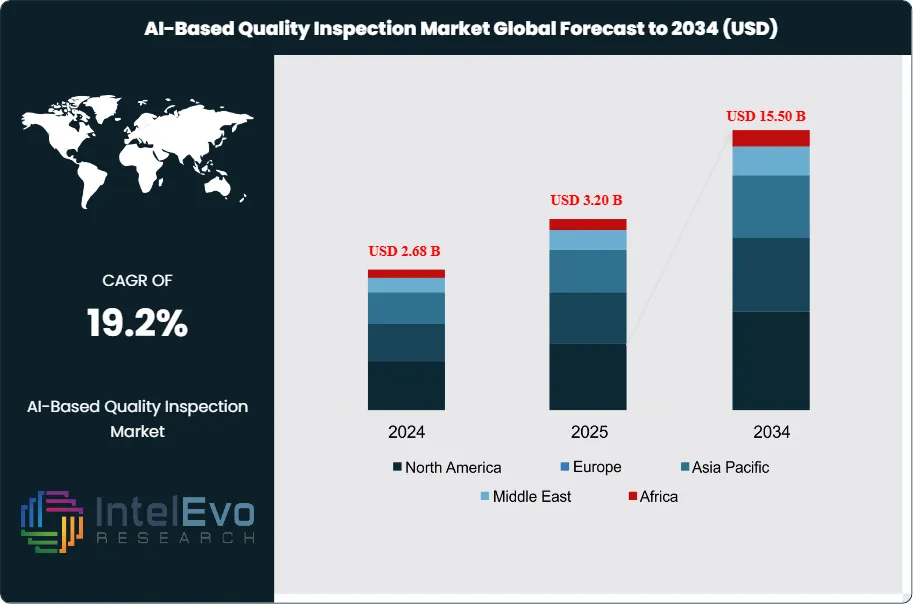
The AI-Based Quality Inspection Market was valued at approximately USD 2.68 Billion in 2024 and reached USD 3.20 Billion in 2025. The market is projected to grow to USD 15.50 Billion by 2034, expanding at a CAGR of 19.2% during the forecast period from 2026 to 2034. This represents an absolute dollar opportunity of USD 12.30 Billion over the analysis period. The industrial sector is currently transitioning from traditional rule-based machine vision to deep learning-powered systems capable of identifying complex, non-linear defects in real-time. Industry analysis indicates that the integration of artificial intelligence into production lines has moved beyond experimental phases into large-scale deployments across high-volume manufacturing environments. Current market assessment shows that demand is primarily driven by the need for sub-millimeter precision and the reduction of pseudo-scrap rates that often plague legacy inspection systems.
Get More Information about this report -
Request Free Sample ReportMarket patterns suggest that supply-chain evaluation and demand-side metrics are heavily influenced by the semiconductor and automotive verticals. Regulatory influences, including the tightening of safety standards in the pharmaceutical and food processing sectors, have mandated more rigorous, auditable quality logs that AI systems provide through automated data capture. Technology effects, specifically the rise of edge computing and high-speed CMOS sensors, allow for inference at the device level; this reduces latency to milliseconds. This speed is critical for high-speed assembly lines where even a minor delay in defect detection results in significant financial losses. Current evaluation indicates that the adoption of generative AI for synthetic data creation is solving the data scarcity problem; this allows manufacturers to train models on rare defect types without waiting for physical failures to occur.
Risk factors for the AI-Based Quality Inspection Market include the high initial capital expenditure for hardware retrofitting and the shortage of specialized AI talent within traditional manufacturing plants. However, emerging investment hotspots in Southeast Asia and Central Europe are attracting significant capital as manufacturers diversify their production bases. Industry analysis confirms that AI-based quality inspection is becoming a cornerstone of Industry 4.0, facilitating a shift toward autonomous lights-out factories. Trade data and regulatory filings suggest that companies implementing these systems report an average 25.0% increase in throughput and a 40.0% reduction in inspection-related labor costs. Regional highlights show that while North America remains a leader in software innovation, Asia Pacific maintains the highest volume of installations due to its massive electronics manufacturing infrastructure.

Key Takeaways
- Market Growth: The AI-Based Quality Inspection Market size is projected to grow from USD 3.20 Billion in 2025 to USD 15.50 Billion by 2034, maintaining a consistent CAGR of 19.2%.
- Segment Dominance: The Software and Platforms segment held the largest market share at 46.2% in 2025, valued at USD 1.48 Billion, driven by the shift toward cloud-native neural network training.
- Segment Dominance: By vertical, the Consumer Electronics industry led the market in 2025 with a 31.4% share, as manufacturers prioritize the detection of microscopic scratches in high-end devices.
- Driver: Demand for high-speed production and zero-defect manufacturing is driving a 22.0% annual increase in deep learning model deployments within automotive assembly lines.
- Restraint: High integration costs and the technical debt of legacy manufacturing hardware act as a deterrent, potentially slowing adoption in the SME segment by 12.5% through 2028.
- Opportunity: The integration of 5G-enabled edge AI represents a USD 3.80 Billion untapped opportunity for real-time, decentralized inspection across geographically distributed production sites.
- Trend: Use of synthetic data for model training is a dominant trend, with 50.0% of new AI inspection projects in 2025 utilizing generative models to simulate defect patterns.
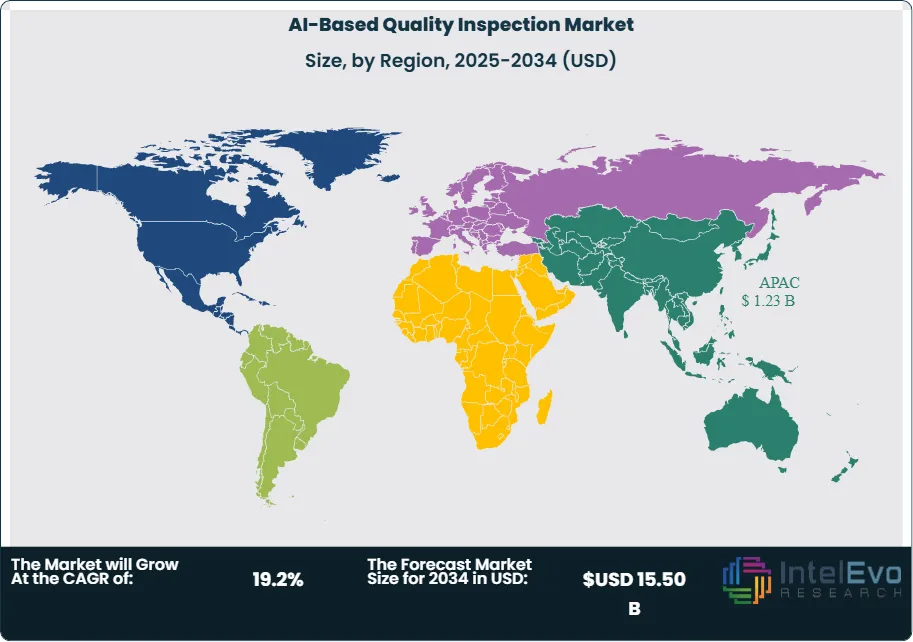
- Regional Analysis: Asia Pacific is the leading region with a 38.5% share in 2025, contributing USD 1.23 Billion in revenue due to massive investments in smart factory initiatives in China.
Competitive Landscape Overview
The competitive environment for the Global AI-Based Quality Inspection Market is moderately consolidated, with the top four participants commanding approximately 42.5% of the total revenue in 2025. Competition is increasingly technology-driven rather than price-driven, as manufacturers demand explainable AI that provides root-cause analysis for identified defects. Current market assessment shows a shift from general-purpose machine vision to vertical-specific neural networks tailored for materials like carbon fiber or clear glass. Recent competitive intensity has been characterized by strategic pivots toward low-code or no-code AI platforms. These platforms enable plant floor engineers to train models without deep data science expertise. Strategic M&A activity is focused on established hardware providers acquiring niche AI software startups to offer end-to-end integrated solutions.
Competitive Landscape Matrix
| Company Name | Headquarters | Market Position | Key Product/Solution | Geographic Strength | Recent Strategic Move |
| KEYENCE CORPORATION | Japan | Leader | AI-Enabled Vision Series | Global | Released automated surface defect classifier in Jan 2026 |
| COGNEX CORPORATION | USA | Leader | VisionPro Deep Learning | North America | Acquired specialized edge-inference startup in late 2025 |
| BASLER AG | Germany | Challenger | pylon AI Software | Europe | Expanded integrated camera-AI modules for food safety 2025 |
| OMRON CORPORATION | Japan | Leader | Sysmac AI Controller | Asia Pacific | Partnered with major automotive groups for powertrain AI 2025 |
| ISRA VISION | Germany | Challenger | Dual-Stereo AI Sensors | Europe | Launched high-speed glass defect detector in Dec 2025 |
| NVIDIA CORPORATION | USA | Challenger | NVIDIA Metropolis | Global | Integrated synthetic data generation into Omniverse for 2025 |
| TELEDYNE FLIR | USA | Niche Player | AI-Infrared Inspection | Global | Focused on thermal defect detection for electronics Jan 2026 |
| LANDING AI | USA | Challenger | LandingLens Platform | North America | Raised Series C funding to expand Small Data AI capabilities |
| ADLINK TECHNOLOGY | Taiwan | Niche Player | Edge AI Vision Systems | Asia Pacific | Deployed autonomous mobile robot inspection fleets in 2025 |
| MATROX IMAGING | Canada | Niche Player | MIL X Deep Learning | Global | Released specialized medical device inspection library 2025 |
By Component
Based on supply-chain evaluation, the AI-Based Quality Inspection Market is divided into Hardware, Software, and Services. The software segment dominated the market in 2025 with a revenue value of USD 1.48 Billion, representing 46.2% of the market share. This dominance is attributed to the transition from hard-coded algorithms to flexible neural networks. Manufacturers are increasingly investing in platforms that allow for continuous model improvement through active learning. Current market assessment shows that software licenses, particularly SaaS models for centralized model management, are providing recurring revenue streams for vendors. The demand for software that can run on heterogeneous hardware—integrating data from multiple camera types—is a primary growth factor. These platforms allow manufacturers to aggregate quality data across different production lines, providing a holistic view of factory performance.
The hardware segment, including high-speed cameras, smart sensors, and AI-accelerated industrial PCs, accounted for 38.5% of the share in 2025, worth USD 1.23 Billion. The shift toward higher frame rates and 3D imaging is driving sales of specialized CMOS sensors. Industry analysis indicates that hardware is becoming increasingly smart, with embedded NPUs allowing for on-camera inference. This reduces the need for expensive external server racks and simplifies the installation process. The services segment, comprising 15.3% of the market, is growing at a significant rate as manufacturers require external expertise for initial data labeling, model fine-tuning, and system integration within legacy factory environments. Consulting services are particularly valued by organizations looking to develop long-term digital transformation roadmaps.
By Technology
The technology segmentation of the AI-Based Quality Inspection Market categorizes the industry into Machine Vision and Deep Learning. Deep learning is the fastest-growing technology, holding a 58.0% share in 2025, valued at USD 1.86 Billion. Unlike traditional machine vision, deep learning excels at identifying cosmetic defects, such as irregular scratches or color variations, which are difficult to define with geometric rules. Industry analysis confirms that deep learning models are more robust to changes in lighting and product orientation; this reduces the need for expensive, highly controlled environments. Trade data suggests that for complex assembly tasks, deep learning systems achieve a 15.0% higher accuracy rate than standard vision systems. This technology is becoming essential for industries where aesthetic perfection is a key selling point, such as luxury goods and consumer electronics.
Machine vision remains a critical component for high-speed metrology and alignment tasks where speed and repeatability are paramount. It accounted for 42.0% of the market in 2025. Current evaluation indicates a trend toward hybrid systems, where traditional machine vision handles high-speed measurements while a deep learning layer performs final defect classification. This hybrid approach allows manufacturers to leverage the precision of rule-based systems with the adaptability of artificial intelligence. As sensor technology advances, the distinction between these technologies is blurring, with many vendors offering unified platforms that switch between rule-based and neural-based processing depending on the specific inspection task.
By Vertical
Vertical segmentation of the AI-Based Quality Inspection Market includes Surface Inspection, Dimensional Inspection, Assembly Verification, and Print & Code Inspection. Surface inspection led the market in 2025 with a 35.4% share, worth USD 1.13 Billion. This is primarily driven by the automotive and metal fabrication industries, where detecting microscopic cracks or corrosion is vital for safety. Deep learning algorithms are particularly adept at distinguishing between actual defects and harmless surface textures, which previously triggered false positives. This accuracy reduces unnecessary waste and improves the overall sustainability of the manufacturing process.
Dimensional inspection followed with a 24.5% share, while assembly verification accounted for 22.1%. Assembly verification is seeing rapid adoption in the medical device and aerospace sectors, where the presence and orientation of every individual component must be verified with absolute certainty. The use of 3D AI-vision for verifying complex PCB assemblies is a significant driver in this segment. Code and print inspection represented 18.0% of the market, with growth fueled by the pharmaceutical industry’s requirement for serialized tracking and legible safety labels. As global supply chains become more complex, the demand for high-speed, AI-driven label verification is expected to surge to prevent costly product recalls.
Regional Analysis
Asia Pacific
Asia Pacific is the dominant region in the Global AI-Based Quality Inspection Market, capturing a 38.5% share with a revenue value of USD 1.23 Billion in 2025. China is the primary engine of growth, supported by national initiatives which subsidize the adoption of advanced automation. Japan and South Korea are also major contributors, particularly in the semiconductor and electronics sectors where AI inspection is essential for 3nm and 5nm chip production. Current market assessment shows that the region's massive manufacturing base provides the high volumes necessary to justify the initial CAPEX of AI systems. Supply-chain evaluation indicates that Asia Pacific also hosts the majority of high-speed camera and sensor manufacturers, providing a local ecosystem that reduces integration costs. The rapid expansion of electric vehicle manufacturing in China and Southeast Asia is providing a new high-growth vertical for AI-based inspection tools.
North America
North America held a 28.2% market share in 2025, valued at USD 0.90 Billion. The region is characterized by high software innovation and a strong focus on the aerospace and defense vertical. The United States leads the region, with significant venture capital investment flowing into AI startups that specialize in synthetic data and low-code inspection platforms. Industry analysis suggests that North American manufacturers are prioritizing explainable AI to comply with strict regulatory requirements in the medical and aerospace sectors. The presence of major tech firms ensures that the region remains at the forefront of hardware-software co-optimization. Trade data indicates a 20.0% annual increase in AI-based inspection spending among U.S. automotive manufacturers as they transition to electric vehicle production. The region is also a pioneer in the use of cloud-based training for factory-floor models.
Europe
Europe accounted for a 24.1% market share in 2025, worth USD 0.77 Billion. The market is centered on Germany, France, and Italy, with a heavy emphasis on high-precision automotive and machinery manufacturing. European manufacturers are leading the adoption of AI for green quality control, utilizing algorithms to reduce material waste by detecting defects earlier in the production process. Regulatory influences, specifically the EU AI Act, are shaping the market by mandating transparency in automated decision-making. Current evaluation indicates that Germany remains the hub for high-end optical components and smart sensors. The UK and Nordic countries are emerging as significant players in AI software for food safety and agricultural quality inspection. The focus on high-mix, low-volume production in Europe is driving the demand for AI models that can be rapidly retrained for new product variants.
Latin America and Middle East & Africa
Latin America represented 5.2% of the AI-Based Quality Inspection Market in 2025, with growth concentrated in the automotive hubs of Mexico and Brazil. The Middle East & Africa held a 4.0% share, primarily driven by investments in high-tech energy infrastructure and electronics assembly in Israel and the UAE. While currently smaller in share, these regions are expected to grow as global manufacturers continue to regionalize their supply chains to mitigate geopolitical risks. Investment in smart city infrastructure and localized electronics assembly in the Gulf region is providing long-term growth prospects for inspection technology.
Get More Information about this report -
Request Free Sample ReportMarket Key Segments
By Component
- Hardware (Cameras, Sensors, PC-based Systems)
- Software (Deep Learning Platforms, Model Management)
- Services (Integration, Consulting, Maintenance)
By Technology
- Machine Vision
- Deep Learning
By Application
- Surface Defect Detection
- Dimensional Metrology
- Assembly Verification
- Code and Print Inspection
By Vertical
- Automotive and Transportation
- Consumer Electronics and Semiconductors
- Food and Beverage
- Pharmaceuticals and Medical Devices
- Aerospace and Defense
- Metal and Machinery
Regional Analysis and Coverage
- North America
- Latin America
- East Asia And Pacific
- Sea And South Asia
- Eastern Europe
- Western Europe
- Middle East & Africa
| Report Attribute | Details |
| Market size (2025) | USD 3.20 B |
| Forecast Revenue (2034) | USD 15.50 B |
| CAGR (2025-2034) | 19.2% |
| Historical data | 2021-2024 |
| Base Year For Estimation | 2025 |
| Forecast Period | 2026-2034 |
| Report coverage | Revenue Forecast, Competitive Landscape, Market Dynamics, Growth Factors, Trends and Recent Developments |
| Segments covered | By Component, (Hardware (Cameras, Sensors, PC-based Systems), Software (Deep Learning Platforms, Model Management), Services (Integration, Consulting, Maintenance)), By Technology, (Machine Vision, Deep Learning), By Application, (Surface Defect Detection, Dimensional Metrology, Assembly Verification, Code and Print Inspection), By Vertical, (Automotive and Transportation, Consumer Electronics and Semiconductors, Food and Beverage, Pharmaceuticals and Medical Devices, Aerospace and Defense, Metal and Machinery) |
| Research Methodology |
|
| Regional scope |
|
| Competitive Landscape | KEYENCE CORPORATION, COGNEX CORPORATION, BASLER AG, OMRON CORPORATION, ISRA VISION, NVIDIA CORPORATION, TELEDYNE FLIR, LANDING AI, ADLINK TECHNOLOGY, MATROX IMAGING, NATIONAL INSTRUMENTS, PANASONIC CONNECT, SICK AG, BAUMER GROUP, FANUC CORPORATION, Others |
| Customization Scope | Customization for segments, region/country-level will be provided. Moreover, additional customization can be done based on the requirements. |
| Pricing and Purchase Options | Avail customized purchase options to meet your exact research needs. We have three licenses to opt for: Single User License, Multi-User License (Up to 5 Users), Corporate Use License (Unlimited User and Printable PDF). |


Frequently Asked Questions
How big is the AI-Based Quality Inspection Market?
Global AI-based quality inspection market valued at USD 2.68B in 2024, reaching USD 15.5B by 2034, growing at a CAGR of 19.2% from 2026–2034.
Who are the major players in the AI-Based Quality Inspection Market?
KEYENCE CORPORATION, COGNEX CORPORATION, BASLER AG, OMRON CORPORATION, ISRA VISION, NVIDIA CORPORATION, TELEDYNE FLIR, LANDING AI, ADLINK TECHNOLOGY, MATROX IMAGING, NATIONAL INSTRUMENTS, PANASONIC CONNECT, SICK AG, BAUMER GROUP, FANUC CORPORATION, Others
Which segments covered the AI-Based Quality Inspection Market?
By Component, (Hardware (Cameras, Sensors, PC-based Systems), Software (Deep Learning Platforms, Model Management), Services (Integration, Consulting, Maintenance)), By Technology, (Machine Vision, Deep Learning), By Application, (Surface Defect Detection, Dimensional Metrology, Assembly Verification, Code and Print Inspection), By Vertical, (Automotive and Transportation, Consumer Electronics and Semiconductors, Food and Beverage, Pharmaceuticals and Medical Devices, Aerospace and Defense, Metal and Machinery)
How can this market research report help my business make strategic decisions?
Our market research reports provide actionable intelligence, including verified market size data, CAGR projections, competitive benchmarking, and segment-level opportunity analysis. These insights support strategic planning, investment decisions, product development, and market entry strategies for enterprises and startups alike.
How frequently is the data updated?
We continuously monitor industry developments and update our reports to reflect regulatory changes, technological advancements, and macroeconomic shifts. Updated editions ensure you receive the latest market intelligence.

Select Licence Type
Connect with our sales team

AI-Based Quality Inspection Market
Published Date : 09 Apr 2026 | Formats :Why IntelEvoResearch
100%
Customer
Satisfaction
24x7+
Availability - we are always
there when you need us
200+
Fortune 50 Companies trust
IntelEvoResearch
80%
of our reports are exclusive
and first in the industry
100%
more data
and analysis
1000+
reports published
till date
