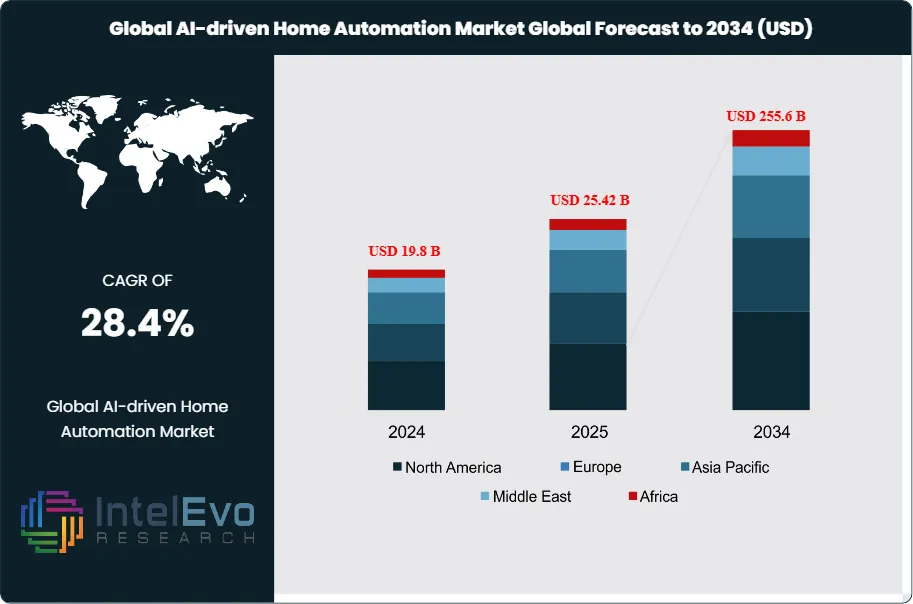
The AI-driven Home Automation Market size is expected to be worth around USD 19.8 billion in 2024 and is projected to reach approximately USD 255.6 billion by 2034, growing at a CAGR of 28.4% during the forecast period from 2025 to 2034. The market’s rapid expansion is driven by the integration of AI-powered smart devices, IoT-based home control systems, and the rising trend of energy-efficient smart homes. Increasing consumer preference for convenience, security, and sustainability continues to fuel investment and innovation in this sector.
Rising adoption of smart devices, voice assistants, and IoT-enabled systems is fueling this growth, alongside increasing consumer demand for energy efficiency, security, and convenience. Furthermore, advancements in AI and seamless integration across home ecosystems are expected to accelerate widespread adoption globally.
The AI-driven home automation market refers to smart systems integrated with artificial intelligence (AI) that enable automated control of home devices such as lighting, security systems, appliances, and climate control. These systems use AI technologies like machine learning (ML) and natural language processing (NLP) to learn from user habits, improving functionality over time. Currently, the market is expanding rapidly due to the rising demand for convenience, energy efficiency, and enhanced security in residential settings. The hardware segment, including sensors and controllers, holds a significant market share as essential components in AI-powered home setups. Major factors contributing to the market's dominance include innovations in smart devices, improved interoperability, and increased consumer demand for seamless automation.
The growth dynamics of the AI-driven home automation market are robust, with a projected CAGR of 27.8% from 2024 to 2034. Several factors drive this growth, including advancements in AI technologies, the increasing adoption of smart home devices, and the rising focus on energy management. Machine learning, for instance, enables home systems to adapt to user behaviors, while voice assistants offer intuitive control, making automation more accessible. The growing use of the Internet of Things (IoT) also plays a pivotal role by connecting multiple devices within the home environment, providing users with centralized control. Additionally, falling hardware prices and improvements in wireless communication standards, such as Wi-Fi 6 and 5G, are further accelerating market expansion.
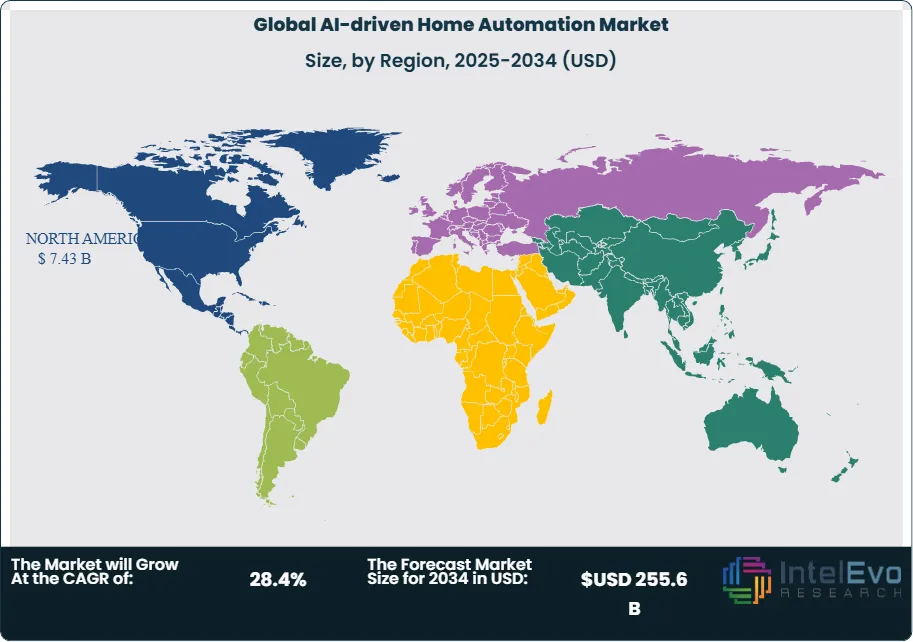
In terms of regional analysis, North America leads the AI-driven home automation market, primarily due to early technological adoption, high consumer demand for smart homes, and significant investment in R&D. Europe follows closely, with growing awareness of energy-efficient systems and smart technology integration in households. The Asia-Pacific region is expected to witness the fastest growth, driven by rising disposable incomes, urbanization, and increasing demand for connected devices. Countries like China, India, and Japan are showing significant market potential due to rapid technological advancements and expanding smart city initiatives.
The COVID-19 pandemic had a mixed impact on the AI-driven home automation market. Initially, supply chain disruptions affected the availability of hardware components, causing short-term setbacks. However, the pandemic also accelerated the demand for home automation as people spent more time indoors, increasing their focus on convenience, security, and energy efficiency. The rise of remote work further boosted the adoption of smart home technologies, as consumers sought to optimize their home environments for better comfort and functionality. This shift in consumer behavior has continued to fuel market growth post-pandemic.
Key Takeaways
Market Growth: The AI-driven home automation market is expected to reach USD 255.6 billion by 2034, growing at a robust CAGR of 28.4% from 2024, indicating strong market expansion driven by rising demand for smart devices and AI integration.
Component Analysis: The hardware segment holds the largest share in the AI-driven home automation market, with critical devices like sensors, controllers, and smart appliances forming the backbone of home automation systems.
Technology Analysis: Machine learning (ML) and natural language processing (NLP) are key technologies, enabling systems to adapt to user behavior and offering voice-activated controls, which drive efficiency and convenience in smart home setups.
Driver: The rising adoption of IoT-enabled devices, advancements in AI technologies, and growing consumer awareness about energy efficiency and home security are major drivers propelling the market forward.
Restraint: High initial installation costs and concerns around data privacy and cybersecurity may limit the broader adoption of AI-driven home automation systems, particularly in price-sensitive markets.
Opportunity: The increasing adoption of 5G technology and smart city initiatives presents significant growth opportunities, enabling faster and more reliable connectivity for home automation systems, especially in developing regions.
Trend: Integration of AI with voice assistants (e.g., Amazon Alexa, Google Assistant) is a growing trend, making home automation more user-friendly and accessible.
Regional Analysis: North America leads the market due to high technological adoption, with Asia-Pacific projected to grow the fastest due to urbanization and rising disposable incomes.
Component Analysis
The component segment is divided into hardware, software, and services. The hardware segment dominates the market, driven by the increasing demand for sensors, smart devices, and controllers that form the foundation of AI-powered home automation systems. Sensors and cameras are widely used for security and monitoring purposes, while smart thermostats and lighting systems optimize energy efficiency. The software segment includes AI algorithms and automation platforms that manage device operations, while services involve installation, integration, and maintenance, which play a vital role in ensuring seamless functionality.
Technology Analysis
AI-driven home automation technology is primarily composed of machine learning (ML), natural language processing (NLP), computer vision, and other emerging technologies. ML helps systems learn user preferences and optimize device performance over time, offering a personalized experience. NLP enables voice-activated assistants like Amazon Alexa or Google Assistant, which simplify user interaction with devices. Computer vision technology is crucial for advanced surveillance systems that detect and respond to motion, offering improved home security. These AI technologies contribute significantly to the growing popularity of smart home systems by enhancing convenience and control for users.
Application Analysis
AI-driven home automation finds various applications, including security and surveillance, smart lighting, voice assistants, smart appliances, and energy management. Security and surveillance systems use AI for real-time monitoring and advanced threat detection, offering users a greater sense of safety. Smart lighting and appliances help optimize energy consumption, contributing to cost savings and environmental sustainability. Voice assistants allow users to control their home devices via simple voice commands, enhancing user experience. Energy management applications, which include automated heating and cooling systems, enable consumers to monitor and regulate energy usage efficiently.
End User Analysis
The end-user segment is categorized into residential, commercial, and industrial sectors. The residential sector holds the largest market share due to increasing consumer demand for smart homes. People are opting for AI-powered solutions to automate tasks, reduce energy consumption, and enhance home security. The commercial sector, including offices and hospitality businesses, is also adopting automation to improve energy efficiency and manage building systems effectively. Meanwhile, industrial users are leveraging AI-driven automation for energy management and surveillance, ensuring smoother operations and cost reductions in large-scale facilities.
Region Analysis:
North America Leads With the Highest Market Share in AI-driven Home Automation Market. North America currently dominates the AI-driven home automation market, accounting for the largest market share. This dominance is driven by the early adoption of smart home technologies, high consumer awareness, and a strong demand for AI-powered systems that offer convenience, security, and energy efficiency. The presence of key market players like Google, Amazon, and Apple also contributes to the region’s leadership, as these companies continually innovate and invest in home automation technologies. Additionally, strong internet infrastructure, the proliferation of IoT devices, and the widespread availability of advanced AI technologies further support market growth in North America.
The Asia-Pacific region is expected to witness the fastest growth in the AI-driven home automation market, primarily due to rapid urbanization, rising disposable incomes, and increasing awareness of smart technologies. Countries like China, India, and Japan are leading this growth, driven by government initiatives promoting smart cities and the growing adoption of connected devices. The expanding middle-class population and demand for energy-efficient solutions also play a critical role. Additionally, improvements in 5G infrastructure and investments in AI and IoT by both public and private sectors are creating lucrative opportunities for market expansion in this region.
by Product Type (Smart Lighting, Smart Security & Access Control, Smart Thermostats & Climate Control, Smart Entertainment Systems, Smart Appliances, Others), by Component (Hardware, Software, Services), by Technology (AI & Machine Learning, Natural Language Processing (NLP), Computer Vision, Voice Recognition & Virtual Assistants, Others), by Connectivity (Wi-Fi, Bluetooth, ZigBee, Z-Wave, Others), by End User (Residential Homes, Luxury Villas & Apartments, Senior Living & Assisted Homes, Others)
Research Methodology
Primary Research- 100 Interviews of Stakeholders
Secondary Research
Desk Research
Regional scope
North America (United States, Canada, Mexico)
Latin America (Brazil, Argentina, Columbia)
East Asia And Pacific (China, Japan, South Korea, Australia, Cambodia, Fiji, Indonesia)
Sea And South Asia (India, Singapore, Thailand, Taiwan, Malaysia)
Eastern Europe (Poland, Russia, Czech Republic, Romania)
Western Europe (Germany, U.K., France, Spain, Itlay)
Middle East & Africa (GCC Countries, Egypt, Nigeria, South Africa, Israel)
Competitive Landscape
Amazon.com Inc, Google LLC, Apple Inc, Samsung Electronics Co Ltd, Honeywell International Inc, ABB Ltd, Johnson Controls International plc, Siemens AG, Schneider Electric SE, Legrand SA, Crestron Electronics Inc, Control4 Corporation, Lutron Electronics Co Inc, Bosch Smart Home GmbH, ADT Inc, Comcast Corporation, Vivint Inc, Sony Corporation, Xiaomi Corporation, Alarm.com Holdings Inc
Customization Scope
Customization for segments, region/country-level will be provided. Moreover, additional customization can be done based on the requirements.
Pricing and Purchase Options
Avail customized purchase options to meet your exact research needs. We have three licenses to opt for: Single User License, Multi-User License (Up to 5 Users), Corporate Use License (Unlimited User and Printable PDF).
TABLE OF CONTENTS
1. EXECUTIVE SUMMARY
1.1. MARKET SNAPSHOT
1.2. KEY FINDINGS & INSIGHTS
1.3. ANALYST RECOMMENDATIONS
1.4. FUTURE OUTLOOK
2. RESEARCH METHODOLOGY
2.1. MARKET DEFINITION & SCOPE
2.2. RESEARCH OBJECTIVES: PRIMARY & SECONDARY DATA SOURCES
2.3. DATA COLLECTION SOURCES
2.3.1. COVERAGE OF 100+ PRIMARY RESEARCH/CONSULTATION CALLS WITH INDUSTRY STAKEHOLDERS
FIGURE 17 NORTH AMERICA AI-DRIVEN HOME AUTOMATION CURRENT AND FUTURE TYPE ANALYSIS, 2025–2034, (USD MILLION)
FIGURE 18 NORTH AMERICA AI-DRIVEN HOME AUTOMATION CURRENT AND FUTURE END USER ANALYSIS, 2025–2034, (USD MILLION)
FIGURE 19 MARKET SHARE BY COUNTRY
FIGURE 20 LATIN AMERICA AI-DRIVEN HOME AUTOMATION CURRENT AND FUTURE TYPE ANALYSIS, 2025–2034, (USD MILLION)
FIGURE 21 LATIN AMERICA AI-DRIVEN HOME AUTOMATION CURRENT AND FUTURE END USER ANALYSIS, 2025–2034, (USD MILLION)
FIGURE 22 MARKET SHARE BY COUNTRY
FIGURE 23 EASTERN EUROPE AI-DRIVEN HOME AUTOMATION CURRENT AND FUTURE TYPE ANALYSIS, 2025–2034, (USD MILLION)
FIGURE 24 EASTERN EUROPE AI-DRIVEN HOME AUTOMATION CURRENT AND FUTURE END USER ANALYSIS, 2025–2034, (USD MILLION)
FIGURE 25 MARKET SHARE BY COUNTRY
FIGURE 26 WESTERN EUROPE AI-DRIVEN HOME AUTOMATION CURRENT AND FUTURE TYPE ANALYSIS, 2025–2034, (USD MILLION)
FIGURE 27 WESTERN EUROPE AI-DRIVEN HOME AUTOMATION CURRENT AND FUTURE END USER ANALYSIS, 2025–2034, (USD MILLION)
FIGURE 28 MARKET SHARE BY COUNTRY
FIGURE 29 EAST ASIA AND PACIFIC AI-DRIVEN HOME AUTOMATION CURRENT AND FUTURE TYPE ANALYSIS, 2025–2034, (USD MILLION)
FIGURE 30 EAST ASIA AND PACIFIC AI-DRIVEN HOME AUTOMATION CURRENT AND FUTURE END USER ANALYSIS, 2025–2034, (USD MILLION)
FIGURE 31 MARKET SHARE BY COUNTRY
FIGURE 32 SEA AND SOUTH ASIA AI-DRIVEN HOME AUTOMATION CURRENT AND FUTURE TYPE ANALYSIS, 2025–2034, (USD MILLION)
FIGURE 33 SEA AND SOUTH ASIA AI-DRIVEN HOME AUTOMATION CURRENT AND FUTURE END USER ANALYSIS, 2025–2034, (USD MILLION)
FIGURE 34 MARKET SHARE BY COUNTRY
FIGURE 35 MIDDLE EAST AND AFRICA AI-DRIVEN HOME AUTOMATION CURRENT AND FUTURE TYPE ANALYSIS, 2025–2034, (USD MILLION)
FIGURE 36 MIDDLE EAST AND AFRICA AI-DRIVEN HOME AUTOMATION CURRENT AND FUTURE END USER ANALYSIS, 2025–2034, (USD MILLION)
FIGURE 37 NORTH AMERICA AI-DRIVEN HOME AUTOMATION CURRENT AND FUTURE MARKET VOLUME SHARE REGIONAL ANALYSIS, 2025–2034, (USD MILLION)
FIGURE 38 U.S. AI-DRIVEN HOME AUTOMATION CURRENT AND FUTURE TYPE ANALYSIS, 2025–2034, (USD MILLION)
FIGURE 39 U.S. AI-DRIVEN HOME AUTOMATION CURRENT AND FUTURE END USER ANALYSIS, 2025–2034, (USD MILLION)
FIGURE 40 CANADA AI-DRIVEN HOME AUTOMATION CURRENT AND FUTURE TYPE ANALYSIS, 2025–2034, (USD MILLION)
FIGURE 41 CANADA AI-DRIVEN HOME AUTOMATION CURRENT AND FUTURE END USER ANALYSIS, 2025–2034, (USD MILLION)
FIGURE 42 LATIN AMERICA AI-DRIVEN HOME AUTOMATION CURRENT AND FUTURE MARKET VOLUME SHARE REGIONAL ANALYSIS, 2025–2034, (USD MILLION)
FIGURE 43 MEXICO AI-DRIVEN HOME AUTOMATION CURRENT AND FUTURE TYPE ANALYSIS, 2025–2034, (USD MILLION)
FIGURE 44 MEXICO AI-DRIVEN HOME AUTOMATION CURRENT AND FUTURE END USER ANALYSIS, 2025–2034, (USD MILLION)
FIGURE 45 BRAZIL AI-DRIVEN HOME AUTOMATION CURRENT AND FUTURE TYPE ANALYSIS, 2025–2034, (USD MILLION)
FIGURE 46 BRAZIL AI-DRIVEN HOME AUTOMATION CURRENT AND FUTURE END USER ANALYSIS, 2025–2034, (USD MILLION)
FIGURE 47 ARGENTINA AI-DRIVEN HOME AUTOMATION CURRENT AND FUTURE TYPE ANALYSIS, 2025–2034, (USD MILLION)
FIGURE 48 ARGENTINA AI-DRIVEN HOME AUTOMATION CURRENT AND FUTURE END USER ANALYSIS, 2025–2034, (USD MILLION)
FIGURE 49 COLUMBIA AI-DRIVEN HOME AUTOMATION CURRENT AND FUTURE TYPE ANALYSIS, 2025–2034, (USD MILLION)
FIGURE 50 COLUMBIA AI-DRIVEN HOME AUTOMATION CURRENT AND FUTURE END USER ANALYSIS, 2025–2034, (USD MILLION)
FIGURE 51 REST OF LATIN AMERICA AI-DRIVEN HOME AUTOMATION CURRENT AND FUTURE TYPE ANALYSIS, 2025–2034, (USD MILLION)
FIGURE 52 REST OF LATIN AMERICA AI-DRIVEN HOME AUTOMATION CURRENT AND FUTURE END USER ANALYSIS, 2025–2034, (USD MILLION)
FIGURE 53 EASTERN EUROPE AI-DRIVEN HOME AUTOMATION CURRENT AND FUTURE MARKET VOLUME SHARE REGIONAL ANALYSIS, 2025–2034, (USD MILLION)
FIGURE 54 POLAND AI-DRIVEN HOME AUTOMATION CURRENT AND FUTURE TYPE ANALYSIS, 2025–2034, (USD MILLION)
FIGURE 55 POLAND AI-DRIVEN HOME AUTOMATION CURRENT AND FUTURE END USER ANALYSIS, 2025–2034, (USD MILLION)
FIGURE 56 RUSSIA AI-DRIVEN HOME AUTOMATION CURRENT AND FUTURE TYPE ANALYSIS, 2025–2034, (USD MILLION)
FIGURE 57 RUSSIA AI-DRIVEN HOME AUTOMATION CURRENT AND FUTURE END USER ANALYSIS, 2025–2034, (USD MILLION)
FIGURE 58 CZECH REPUBLIC AI-DRIVEN HOME AUTOMATION CURRENT AND FUTURE TYPE ANALYSIS, 2025–2034, (USD MILLION)
FIGURE 59 CZECH REPUBLIC AI-DRIVEN HOME AUTOMATION CURRENT AND FUTURE END USER ANALYSIS, 2025–2034, (USD MILLION)
FIGURE 60 ROMANIA AI-DRIVEN HOME AUTOMATION CURRENT AND FUTURE TYPE ANALYSIS, 2025–2034, (USD MILLION)
FIGURE 61 ROMANIA AI-DRIVEN HOME AUTOMATION CURRENT AND FUTURE END USER ANALYSIS, 2025–2034, (USD MILLION)
FIGURE 62 REST OF EASTERN EUROPE AI-DRIVEN HOME AUTOMATION CURRENT AND FUTURE TYPE ANALYSIS, 2025–2034, (USD MILLION)
FIGURE 63 REST OF EASTERN EUROPE AI-DRIVEN HOME AUTOMATION CURRENT AND FUTURE END USER ANALYSIS, 2025–2034, (USD MILLION)
FIGURE 64 WESTERN EUROPE AI-DRIVEN HOME AUTOMATION CURRENT AND FUTURE MARKET VOLUME SHARE REGIONAL ANALYSIS, 2025–2034, (USD MILLION)
FIGURE 65 GERMANY AI-DRIVEN HOME AUTOMATION CURRENT AND FUTURE TYPE ANALYSIS, 2025–2034, (USD MILLION)
FIGURE 66 GERMANY AI-DRIVEN HOME AUTOMATION CURRENT AND FUTURE END USER ANALYSIS, 2025–2034, (USD MILLION)
FIGURE 67 FRANCE AI-DRIVEN HOME AUTOMATION CURRENT AND FUTURE TYPE ANALYSIS, 2025–2034, (USD MILLION)
FIGURE 68 FRANCE AI-DRIVEN HOME AUTOMATION CURRENT AND FUTURE END USER ANALYSIS, 2025–2034, (USD MILLION)
FIGURE 69 UK AI-DRIVEN HOME AUTOMATION CURRENT AND FUTURE TYPE ANALYSIS, 2025–2034, (USD MILLION)
FIGURE 70 UK AI-DRIVEN HOME AUTOMATION CURRENT AND FUTURE END USER ANALYSIS, 2025–2034, (USD MILLION)
FIGURE 71 SPAIN AI-DRIVEN HOME AUTOMATION CURRENT AND FUTURE TYPE ANALYSIS, 2025–2034, (USD MILLION)
FIGURE 72 SPAIN AI-DRIVEN HOME AUTOMATION CURRENT AND FUTURE END USER ANALYSIS, 2025–2034, (USD MILLION)
FIGURE 73 ITALY AI-DRIVEN HOME AUTOMATION CURRENT AND FUTURE TYPE ANALYSIS, 2025–2034, (USD MILLION)
FIGURE 74 ITALY AI-DRIVEN HOME AUTOMATION CURRENT AND FUTURE END USER ANALYSIS, 2025–2034, (USD MILLION)
FIGURE 75 REST OF WESTERN EUROPE AI-DRIVEN HOME AUTOMATION CURRENT AND FUTURE TYPE ANALYSIS, 2025–2034, (USD MILLION)
FIGURE 76 REST OF WESTERN EUROPE AI-DRIVEN HOME AUTOMATION CURRENT AND FUTURE END USER ANALYSIS, 2025–2034, (USD MILLION)
FIGURE 77 EAST ASIA AND PACIFIC AI-DRIVEN HOME AUTOMATION CURRENT AND FUTURE MARKET VOLUME SHARE REGIONAL ANALYSIS, 2025–2034, (USD MILLION)
FIGURE 78 CHINA AI-DRIVEN HOME AUTOMATION CURRENT AND FUTURE TYPE ANALYSIS, 2025–2034, (USD MILLION)
FIGURE 79 CHINA AI-DRIVEN HOME AUTOMATION CURRENT AND FUTURE END USER ANALYSIS, 2025–2034, (USD MILLION)
FIGURE 80 JAPAN AI-DRIVEN HOME AUTOMATION CURRENT AND FUTURE TYPE ANALYSIS, 2025–2034, (USD MILLION)
FIGURE 81 JAPAN AI-DRIVEN HOME AUTOMATION CURRENT AND FUTURE END USER ANALYSIS, 2025–2034, (USD MILLION)
FIGURE 82 AUSTRALIA AI-DRIVEN HOME AUTOMATION CURRENT AND FUTURE TYPE ANALYSIS, 2025–2034, (USD MILLION)
FIGURE 83 AUSTRALIA AI-DRIVEN HOME AUTOMATION CURRENT AND FUTURE END USER ANALYSIS, 2025–2034, (USD MILLION)
FIGURE 84 CAMBODIA AI-DRIVEN HOME AUTOMATION CURRENT AND FUTURE TYPE ANALYSIS, 2025–2034, (USD MILLION)
FIGURE 85 CAMBODIA AI-DRIVEN HOME AUTOMATION CURRENT AND FUTURE END USER ANALYSIS, 2025–2034, (USD MILLION)
FIGURE 86 FIJI AI-DRIVEN HOME AUTOMATION CURRENT AND FUTURE TYPE ANALYSIS, 2025–2034, (USD MILLION)
FIGURE 87 FIJI AI-DRIVEN HOME AUTOMATION CURRENT AND FUTURE END USER ANALYSIS, 2025–2034, (USD MILLION)
FIGURE 88 INDONESIA AI-DRIVEN HOME AUTOMATION CURRENT AND FUTURE TYPE ANALYSIS, 2025–2034, (USD MILLION)
FIGURE 89 INDONESIA AI-DRIVEN HOME AUTOMATION CURRENT AND FUTURE END USER ANALYSIS, 2025–2034, (USD MILLION)
FIGURE 90 SOUTH KOREA AI-DRIVEN HOME AUTOMATION CURRENT AND FUTURE TYPE ANALYSIS, 2025–2034, (USD MILLION)
FIGURE 91 SOUTH KOREA AI-DRIVEN HOME AUTOMATION CURRENT AND FUTURE END USER ANALYSIS, 2025–2034, (USD MILLION)
FIGURE 92 REST OF EAST ASIA AND PACIFIC AI-DRIVEN HOME AUTOMATION CURRENT AND FUTURE TYPE ANALYSIS, 2025–2034, (USD MILLION)
FIGURE 93 REST OF EAST ASIA AND PACIFIC AI-DRIVEN HOME AUTOMATION CURRENT AND FUTURE END USER ANALYSIS, 2025–2034, (USD MILLION)
FIGURE 94 SEA AND SOUTH ASIA AI-DRIVEN HOME AUTOMATION CURRENT AND FUTURE MARKET VOLUME SHARE REGIONAL ANALYSIS, 2025–2034, (USD MILLION)
FIGURE 95 BANGLADESH AI-DRIVEN HOME AUTOMATION CURRENT AND FUTURE TYPE ANALYSIS, 2025–2034, (USD MILLION)
FIGURE 96 BANGLADESH AI-DRIVEN HOME AUTOMATION CURRENT AND FUTURE END USER ANALYSIS, 2025–2034, (USD MILLION)
FIGURE 97 NEW ZEALAND AI-DRIVEN HOME AUTOMATION CURRENT AND FUTURE TYPE ANALYSIS, 2025–2034, (USD MILLION)
FIGURE 98 NEW ZEALAND AI-DRIVEN HOME AUTOMATION CURRENT AND FUTURE END USER ANALYSIS, 2025–2034, (USD MILLION)
FIGURE 99 INDIA AI-DRIVEN HOME AUTOMATION CURRENT AND FUTURE TYPE ANALYSIS, 2025–2034, (USD MILLION)
FIGURE 100 INDIA AI-DRIVEN HOME AUTOMATION CURRENT AND FUTURE END USER ANALYSIS, 2025–2034, (USD MILLION)
FIGURE 101 SINGAPORE AI-DRIVEN HOME AUTOMATION CURRENT AND FUTURE TYPE ANALYSIS, 2025–2034, (USD MILLION)
FIGURE 102 SINGAPORE AI-DRIVEN HOME AUTOMATION CURRENT AND FUTURE END USER ANALYSIS, 2025–2034, (USD MILLION)
FIGURE 103 THAILAND AI-DRIVEN HOME AUTOMATION CURRENT AND FUTURE TYPE ANALYSIS, 2025–2034, (USD MILLION)
FIGURE 104 THAILAND AI-DRIVEN HOME AUTOMATION CURRENT AND FUTURE END USER ANALYSIS, 2025–2034, (USD MILLION)
FIGURE 105 TAIWAN AI-DRIVEN HOME AUTOMATION CURRENT AND FUTURE TYPE ANALYSIS, 2025–2034, (USD MILLION)
FIGURE 106 TAIWAN AI-DRIVEN HOME AUTOMATION CURRENT AND FUTURE END USER ANALYSIS, 2025–2034, (USD MILLION)
FIGURE 107 MALAYSIA AI-DRIVEN HOME AUTOMATION CURRENT AND FUTURE TYPE ANALYSIS, 2025–2034, (USD MILLION)
FIGURE 108 MALAYSIA AI-DRIVEN HOME AUTOMATION CURRENT AND FUTURE END USER ANALYSIS, 2025–2034, (USD MILLION)
FIGURE 109 REST OF SEA AND SOUTH ASIA AI-DRIVEN HOME AUTOMATION CURRENT AND FUTURE TYPE ANALYSIS, 2025–2034, (USD MILLION)
FIGURE 110 REST OF SEA AND SOUTH ASIA AI-DRIVEN HOME AUTOMATION CURRENT AND FUTURE END USER ANALYSIS, 2025–2034, (USD MILLION)
FIGURE 111 MIDDLE EAST AND AFRICA AI-DRIVEN HOME AUTOMATION CURRENT AND FUTURE MARKET VOLUME SHARE REGIONAL ANALYSIS, 2025–2034, (USD MILLION)
FIGURE 112 GCC COUNTRIES AI-DRIVEN HOME AUTOMATION CURRENT AND FUTURE TYPE ANALYSIS, 2025–2034, (USD MILLION)
FIGURE 113 GCC COUNTRIES AI-DRIVEN HOME AUTOMATION CURRENT AND FUTURE END USER ANALYSIS, 2025–2034, (USD MILLION)
FIGURE 114 SAUDI ARABIA AI-DRIVEN HOME AUTOMATION CURRENT AND FUTURE TYPE ANALYSIS, 2025–2034, (USD MILLION)
FIGURE 115 SAUDI ARABIA AI-DRIVEN HOME AUTOMATION CURRENT AND FUTURE END USER ANALYSIS, 2025–2034, (USD MILLION)
FIGURE 116 UAE AI-DRIVEN HOME AUTOMATION CURRENT AND FUTURE TYPE ANALYSIS, 2025–2034, (USD MILLION)
FIGURE 117 UAE AI-DRIVEN HOME AUTOMATION CURRENT AND FUTURE END USER ANALYSIS, 2025–2034, (USD MILLION)
FIGURE 118 BAHRAIN AI-DRIVEN HOME AUTOMATION CURRENT AND FUTURE TYPE ANALYSIS, 2025–2034, (USD MILLION)
FIGURE 119 BAHRAIN AI-DRIVEN HOME AUTOMATION CURRENT AND FUTURE END USER ANALYSIS, 2025–2034, (USD MILLION)
FIGURE 120 KUWAIT AI-DRIVEN HOME AUTOMATION CURRENT AND FUTURE TYPE ANALYSIS, 2025–2034, (USD MILLION)
FIGURE 121 KUWAIT AI-DRIVEN HOME AUTOMATION CURRENT AND FUTURE END USER ANALYSIS, 2025–2034, (USD MILLION)
FIGURE 122 OMAN AI-DRIVEN HOME AUTOMATION CURRENT AND FUTURE TYPE ANALYSIS, 2025–2034, (USD MILLION)
FIGURE 123 OMAN AI-DRIVEN HOME AUTOMATION CURRENT AND FUTURE END USER ANALYSIS, 2025–2034, (USD MILLION)
FIGURE 124 QATAR AI-DRIVEN HOME AUTOMATION CURRENT AND FUTURE TYPE ANALYSIS, 2025–2034, (USD MILLION)
FIGURE 125 QATAR AI-DRIVEN HOME AUTOMATION CURRENT AND FUTURE END USER ANALYSIS, 2025–2034, (USD MILLION)
FIGURE 126 EGYPT AI-DRIVEN HOME AUTOMATION CURRENT AND FUTURE TYPE ANALYSIS, 2025–2034, (USD MILLION)
FIGURE 127 EGYPT AI-DRIVEN HOME AUTOMATION CURRENT AND FUTURE END USER ANALYSIS, 2025–2034, (USD MILLION)
FIGURE 128 NIGERIA AI-DRIVEN HOME AUTOMATION CURRENT AND FUTURE TYPE ANALYSIS, 2025–2034, (USD MILLION)
FIGURE 129 NIGERIA AI-DRIVEN HOME AUTOMATION CURRENT AND FUTURE END USER ANALYSIS, 2025–2034, (USD MILLION)
FIGURE 130 SOUTH AFRICA AI-DRIVEN HOME AUTOMATION CURRENT AND FUTURE TYPE ANALYSIS, 2025–2034, (USD MILLION)
FIGURE 131 SOUTH AFRICA AI-DRIVEN HOME AUTOMATION CURRENT AND FUTURE END USER ANALYSIS, 2025–2034, (USD MILLION)
FIGURE 132 ISRAEL AI-DRIVEN HOME AUTOMATION CURRENT AND FUTURE TYPE ANALYSIS, 2025–2034, (USD MILLION)
FIGURE 133 ISRAEL AI-DRIVEN HOME AUTOMATION CURRENT AND FUTURE END USER ANALYSIS, 2025–2034, (USD MILLION)
FIGURE 134 REST OF MEA AI-DRIVEN HOME AUTOMATION CURRENT AND FUTURE TYPE ANALYSIS, 2025–2034, (USD MILLION)
FIGURE 135 REST OF MEA AI-DRIVEN HOME AUTOMATION CURRENT AND FUTURE END USER ANALYSIS, 2025–2034, (USD MILLION)
FIGURE 136 U. S. MARKET SHARE ANALYSIS BY TYPE (2024)
FIGURE 137 U. S. MARKET SHARE ANALYSIS BY END USER (2024)
FIGURE 138 CANADA MARKET SHARE ANALYSIS BY TYPE (2024)
FIGURE 139 CANADA MARKET SHARE ANALYSIS BY END USER (2024)
FIGURE 140 MEXICO MARKET SHARE ANALYSIS BY TYPE (2024)
FIGURE 141 MEXICO MARKET SHARE ANALYSIS BY END USER (2024)
FIGURE 142 CHINA MARKET SHARE ANALYSIS BY TYPE (2024)
FIGURE 143 CHINA MARKET SHARE ANALYSIS BY END USER (2024)
FIGURE 144 JAPAN MARKET SHARE ANALYSIS BY TYPE (2024)
FIGURE 145 JAPAN MARKET SHARE ANALYSIS BY END USER (2024)
FIGURE 146 INDIA MARKET SHARE ANALYSIS BY TYPE (2024)
FIGURE 147 INDIA MARKET SHARE ANALYSIS BY END USER (2024)
FIGURE 148 SOUTH KOREA MARKET SHARE ANALYSIS BY TYPE (2024)
FIGURE 149 SOUTH KOREA MARKET SHARE ANALYSIS BY END USER (2024)
FIGURE 150 SAUDI ARABIA MARKET SHARE ANALYSIS BY TYPE (2024)
FIGURE 151 SAUDI ARABIA MARKET SHARE ANALYSIS BY END USER (2024)
FIGURE 152 UAE MARKET SHARE ANALYSIS BY TYPE (2024)
FIGURE 153 UAE MARKET SHARE ANALYSIS BY END USER (2024)
FIGURE 154 EGYPT MARKET SHARE ANALYSIS BY TYPE (2024)
FIGURE 155 EGYPT MARKET SHARE ANALYSIS BY END USER (2024)
FIGURE 156 NIGERIA MARKET SHARE ANALYSIS BY TYPE (2024)
FIGURE 157 NIGERIA MARKET SHARE ANALYSIS BY END USER (2024)
FIGURE 158 SOUTH AFRICA MARKET SHARE ANALYSIS BY TYPE (2024)
FIGURE 159 SOUTH AFRICA MARKET SHARE ANALYSIS BY END USER (2024)
FIGURE 160 GERMANY MARKET SHARE ANALYSIS BY TYPE (2024)
FIGURE 161 GERMANY MARKET SHARE ANALYSIS BY END USER (2024)
FIGURE 162 FRANCE MARKET SHARE ANALYSIS BY TYPE (2024)
FIGURE 163 FRANCE MARKET SHARE ANALYSIS BY END USER (2024)
FIGURE 164 UK MARKET SHARE ANALYSIS BY TYPE (2024)
FIGURE 165 UK MARKET SHARE ANALYSIS BY END USER (2024)
FIGURE 166 SPAIN MARKET SHARE ANALYSIS BY TYPE (2024)
FIGURE 167 SPAIN MARKET SHARE ANALYSIS BY END USER (2024)
FIGURE 168 ITALY MARKET SHARE ANALYSIS BY TYPE (2024)
FIGURE 169 ITALY MARKET SHARE ANALYSIS BY END USER (2024)
FIGURE 170 BRAZIL MARKET SHARE ANALYSIS BY TYPE (2024)
FIGURE 171 BRAZIL MARKET SHARE ANALYSIS BY END USER (2024)
FIGURE 172 ARGENTINA MARKET SHARE ANALYSIS BY TYPE (2024)
FIGURE 173 ARGENTINA MARKET SHARE ANALYSIS BY END USER (2024)
FIGURE 174 COLUMBIA MARKET SHARE ANALYSIS BY TYPE (2024)
FIGURE 175 COLUMBIA MARKET SHARE ANALYSIS BY END USER (2024)
FIGURE 176 GLOBAL AI-DRIVEN HOME AUTOMATION CURRENT AND FUTURE MARKET KEY COUNTRY LEVEL ANALYSIS, 2024–2034, (USD MILLION)
FIGURE 177 FINANCIAL OVERVIEW:
Key Players Analysis:
Amazon.com, Inc.: Amazon is a global leader in e-commerce and cloud computing, headquartered in Seattle, USA. Its AI-driven home automation products include the Amazon Echo smart speaker and the Alexa voice assistant. Amazon’s strategy focuses on integrating smart home devices through its platform, promoting compatibility and innovation in smart living solutions, driving customer loyalty.
Google LLC: Based in Mountain View, California, Google is renowned for its search engine and software solutions. Its Google Nest product line includes smart speakers, displays, and security systems. Google's strategy emphasizes data-driven insights, user-friendly interfaces, and seamless integration of AI in everyday tasks, enhancing the overall smart home ecosystem.
Apple Inc.: Headquartered in Cupertino, California, Apple is a technology giant known for its consumer electronics. Its HomeKit platform facilitates smart home device integration, providing seamless connectivity for users. Apple's strategy centers on privacy, user experience, and high-quality design, creating a cohesive ecosystem of products that work harmoniously together.
Samsung Electronics Co., Ltd.: Based in Suwon, South Korea, Samsung offers a range of smart home products, including SmartThings, a comprehensive home automation platform. Samsung's strategy focuses on innovation, investing in R&D to enhance smart device connectivity and interoperability, and promoting sustainability in technology, appealing to environmentally conscious consumers.
Honeywell International Inc.: Honeywell, headquartered in Charlotte, North Carolina, specializes in diversified technology and manufacturing. Its product offerings include smart thermostats, security systems, and home monitoring solutions. Honeywell’s strategy emphasizes IoT connectivity and data analytics, enhancing energy efficiency and security, thereby addressing modern consumer needs for smart home technologies.
ABB Ltd.: Based in Zurich, Switzerland, ABB is a global leader in electrification and automation technologies. Its smart home products focus on energy management and automation solutions. ABB’s strategy revolves around sustainability and digitalization, providing innovative solutions to optimize energy consumption and enhance home automation capabilities for consumers.
Johnson Controls International plc: Headquartered in Cork, Ireland, Johnson Controls specializes in building efficiency and automation solutions. Its offerings include smart HVAC systems and integrated security solutions. The company’s strategy is centered on digital transformation, focusing on developing smart building technologies that enhance comfort, security, and operational efficiency in residential and commercial properties.
Siemens AG: Based in Munich, Germany, Siemens is a global powerhouse in automation and digitalization. Its smart home solutions include building management systems and energy-efficient appliances. Siemens’ strategy prioritizes innovation and sustainability, leveraging digital technologies to create integrated solutions that enhance the efficiency and comfort of smart homes.
Schneider Electric SE: Schneider Electric, headquartered in Rueil-Malmaison, France, is known for energy management and automation solutions. Its products include smart home devices that integrate energy monitoring and control systems. The company’s strategy focuses on sustainability and digital innovation, helping consumers reduce energy consumption and enhance the efficiency of their homes.
Legrand SA: Based in Limoges, France, Legrand specializes in electrical and digital building infrastructures. Its product range includes smart home solutions for lighting control and energy management. Legrand’s strategy emphasizes innovation and customer-centric solutions, aiming to provide seamless and energy-efficient smart home experiences that cater to the evolving needs of consumers.
Market Key Players
Amazon.com, Inc.
Google LLC
Apple Inc.
Samsung Electronics Co., Ltd.
Honeywell International Inc.
ABB Ltd.
Johnson Controls International plc
Siemens AG
Schneider Electric SE
Legrand SA
Crestron Electronics, Inc.
Control4 Corporation (SnapAV)
Lutron Electronics Co., Inc.
Bosch Smart Home GmbH
ADT Inc.
Comcast Corporation
Vivint, Inc.
Sony Corporation
Xiaomi Corporation
Alarm.com Holdings, Inc.
Driver:
Growing Consumer Demand for Smart Homes
Increasing consumer demand for convenience, energy efficiency, and enhanced security is a key driver for the AI-driven home automation market. Homeowners are adopting AI-enabled systems that simplify daily tasks, such as adjusting lighting, managing appliances, and monitoring security through voice commands and smartphone apps. The rising integration of IoT devices and advanced sensors allows for seamless connectivity between devices, enhancing the user experience. This trend is further fueled by the growing awareness of energy-saving benefits, as smart home systems can automate energy consumption, reduce waste, and lower utility bills, making them appealing to environmentally-conscious consumers.
Technological Advancements in AI and IoT
Rapid advancements in artificial intelligence (AI), machine learning, and the Internet of Things (IoT) are driving the AI-driven home automation market. AI's ability to analyze vast amounts of data and learn from user behavior allows home automation systems to offer personalized services and improve user experience. IoT enables the interconnection of various smart devices, allowing homeowners to control and monitor systems remotely. Innovations in voice recognition, natural language processing, and AI-powered security systems further enhance the functionality of smart homes. These technological breakthroughs are making home automation more accessible and efficient for everyday use.
Rising Urbanization and Smart City Initiatives
The rise of urbanization and smart city projects globally is contributing to the growth of the AI-driven home automation market. As cities expand, governments and developers are investing in smart infrastructure, including homes equipped with AI-powered automation systems. These initiatives focus on improving energy efficiency, reducing environmental impact, and enhancing the quality of life for residents. Smart homes equipped with automated lighting, heating, and security systems play a crucial role in these projects. Countries like China and India are rapidly adopting such technologies, driving market growth in emerging economies.
Restrain:
High Initial Costs of Installation
Despite the benefits, the high initial cost of installing AI-driven home automation systems remains a significant barrier to market growth. The expense of purchasing smart devices, sensors, controllers, and related hardware, coupled with the cost of installation and integration, may deter middle-income consumers. Moreover, ongoing maintenance and potential technical support further increase long-term costs. For price-sensitive markets, the affordability of these systems is a major concern, limiting widespread adoption, especially in developing countries where disposable incomes may not yet support such investments.
Data Privacy and Security Concerns
Data privacy and cybersecurity are critical issues hampering the widespread adoption of AI-driven home automation systems. As these systems are interconnected through IoT devices and cloud platforms, they are vulnerable to cyberattacks, hacking, and unauthorized access. Home automation systems collect and store large amounts of personal data, including user behavior and preferences, which could be exploited if security protocols are inadequate. This creates concerns among consumers about the potential misuse of sensitive information. Regulatory requirements for data protection and cybersecurity measures can also impose additional costs on manufacturers, slowing down market growth.
Opportunities:
Integration of 5G Technology
The rollout of 5G networks presents a significant opportunity for the AI-driven home automation market. 5G’s faster data speeds, low latency, and improved connectivity enable seamless interaction between smart home devices, making real-time automation more efficient. This enhanced connectivity allows homeowners to control devices more reliably and securely, from energy management to security systems. The increased bandwidth of 5G also supports the integration of more complex AI algorithms, improving the functionality of home automation systems. As 5G infrastructure expands globally, it will drive further innovation and adoption of AI-powered smart home technologies.
Growing Demand in Emerging Markets
The increasing adoption of smart technologies in emerging markets, particularly in Asia-Pacific, presents significant growth opportunities for the AI-driven home automation market. Countries like China, India, and Southeast Asian nations are witnessing rapid urbanization, with a growing middle class that is becoming more tech-savvy. The demand for energy-efficient solutions, security systems, and convenience is driving the adoption of AI-driven home automation systems in residential spaces. Additionally, government initiatives promoting smart cities and investment in IoT infrastructure are creating a favorable environment for the market to expand in these regions.
Trends:
Increasing Adoption of Voice-Controlled AI Assistants
A major trend in the AI-driven home automation market is the growing integration of voice-controlled AI assistants, such as Amazon’s Alexa, Google Assistant, and Apple’s Siri. These systems allow homeowners to manage various smart devices using voice commands, enhancing convenience and accessibility. Voice assistants are being integrated into a wide range of home devices, including lighting, HVAC systems, security systems, and appliances, offering seamless automation. The growing adoption of voice-activated technology is being driven by advancements in natural language processing (NLP) and increasing consumer comfort with hands-free device management.
Recent Development
In September 2024: Nuro Technologies announced a new partnership with Geriatrix Systems to enhance smart home automation solutions. This collaboration aims to integrate advanced AI-driven features into Geriatrix's existing smart devices, significantly improving user experience by offering more personalized and efficient home automation solutions. The integration is set to roll out in early 2025, showcasing both companies' commitment to advancing the smart home industry.
In July 2024: In a notable industry move, major players in the smart home market, including Amazon and Google, announced a collaborative effort to develop a standardized communication protocol for smart devices. This initiative aims to ensure compatibility and interoperability among different manufacturers' devices, making it easier for consumers to integrate various products into a cohesive smart home system. The collaboration is expected to accelerate the adoption of smart home technologies.
Frequently Asked Questions
How big is the Global AI-driven Home Automation Market?
AI-driven home automation market size is expected to reach around USD 255.6 billion by 2034, up from approximately USD 19.8 billion in 2024, CAGR of 28.4%
Who are the major players in the Global AI-driven Home Automation Market?
Amazon.com Inc, Google LLC, Apple Inc, Samsung Electronics Co Ltd, Honeywell International Inc, ABB Ltd, Johnson Controls International plc, Siemens AG, Schneider Electric SE, Legrand SA, Crestron Electronics Inc, Control4 Corporation, Lutron Electronics Co Inc, Bosch Smart Home GmbH, ADT Inc, Comcast Corporation, Vivint Inc, Sony Corporation, Xiaomi Corporation, Alarm.com Holdings Inc
Which segments covered the Global AI-driven Home Automation Market?
by Product Type (Smart Lighting, Smart Security & Access Control, Smart Thermostats & Climate Control, Smart Entertainment Systems, Smart Appliances, Others), by Component (Hardware, Software, Services), by Technology (AI & Machine Learning, Natural Language Processing (NLP), Computer Vision, Voice Recognition & Virtual Assistants, Others), by Connectivity (Wi-Fi, Bluetooth, ZigBee, Z-Wave, Others), by End User (Residential Homes, Luxury Villas & Apartments, Senior Living & Assisted Homes, Others)
How can this market research report help my business make strategic decisions?
Our market research reports provide actionable intelligence, including verified market size data, CAGR projections, competitive benchmarking, and segment-level opportunity analysis. These insights support strategic planning, investment decisions, product development, and market entry strategies for enterprises and startups alike.
How frequently is the data updated?
We continuously monitor industry developments and update our reports to reflect regulatory changes, technological advancements, and macroeconomic shifts. Updated editions ensure you receive the latest market intelligence.


 Aerospace And Defence
 Agriculture
 Automotive And Transportation
 Banking And Finance
 Business
 Chemicals And Materials
 Consumer And Retail
 Electronics And Semiconductors
 Food And Beverages
 Machinery & Equipments
 Manufacturing And Construction
 Medical Devices
 Others
 Pharmaceuticals And Healthcare
 Power And Energy
 Sports
 Technology