
Global AI-driven Robo-Advisory Market Size, Share, Analysis Report By Type (Pure Robo Advisors, Hybrid Robo Advisors), Provider (Fintech Robo Advisors, Banks, Traditional Wealth Managers, Others), Service Type (Direct Plan-based/Goal-based Advisory, Comprehensive Wealth Advisory), End User (Retail Investors, High Net Worth Individuals), Region and Key Players - Industry Segment Overview, Market Dynamics, Competitive Strategies, Trends and Forecast 2025-2034
The AI-driven Robo-Advisory Market size is projected to reach approximately USD 76.4 Billion by 2034, up from USD 4.8 Billion in 2024, growing at a CAGR of 30.5% during the forecast period from 2025 to 2034. This exponential growth is driven by the rising adoption of artificial intelligence in wealth management, offering investors real-time portfolio optimization, personalized financial planning, and data-driven insights. Financial institutions are rapidly integrating AI-based algorithms, predictive analytics, and natural language interfaces to enhance client engagement and decision-making accuracy. As digital transformation accelerates across the global financial landscape, AI-driven robo-advisors are redefining the future of investment management, making intelligent, accessible, and affordable advisory services mainstream.
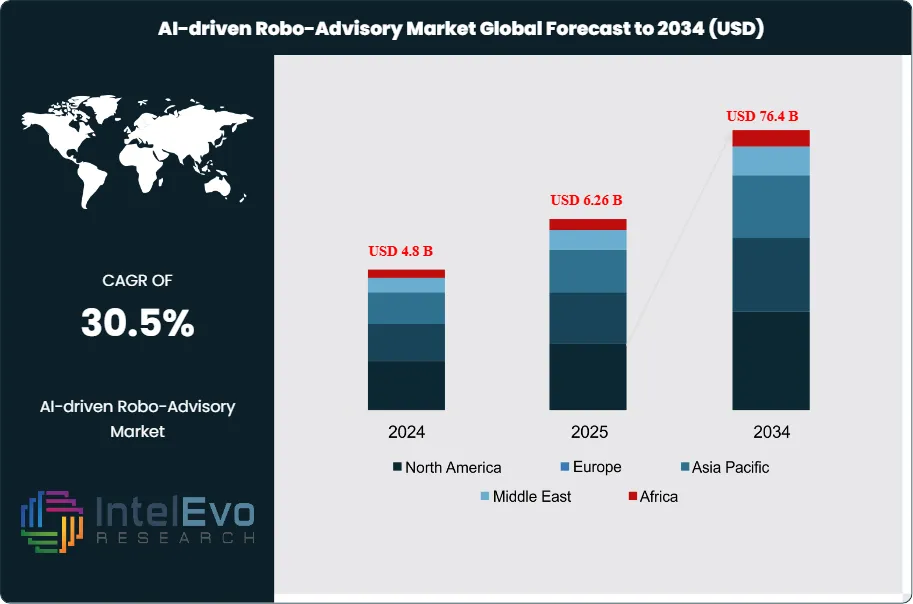
The rapid growth of this market is fueled by rising demand for low-cost, automated financial planning and investment solutions. Increasing smartphone penetration, digital banking adoption, and AI advancements are further accelerating market expansion across developed and emerging economies.
The AI-driven Robo-Advisory Market refers to automated platforms that provide financial advice or investment management with minimal human intervention. These systems use algorithms and data-driven models, often incorporating AI and machine learning, to offer personalized financial recommendations to users based on their risk tolerance, goals, and preferences. Robo-advisors are typically accessible via online platforms or mobile applications, providing investors with portfolio management at a low cost. The current market, valued at approximately USD 4.13 billion in 2024, is growing rapidly as more consumers and institutions shift towards digital solutions for financial management. The market dynamics are driven by an increasing reliance on technology in the financial sector, offering cost-effective, real-time, and secure advisory services.
The market's growth is fueled by several key factors. One of the primary drivers is the increasing adoption of AI and machine learning, which enhance the decision-making process by automating data analysis and providing accurate financial recommendations. Additionally, there is a rising demand for affordable financial advisory services, especially among retail investors who seek low-cost investment options. The scalability of robo-advisors also attracts high-net-worth individuals and institutional clients, further driving demand. The shift towards digital investment platforms, where human errors are minimized, adds to the market's attractiveness. Another significant growth driver is the development of hybrid models combining AI with human advisors, offering more personalized services while maintaining cost efficiency.
From a regional perspective, North America currently dominates the AI-driven robo-advisory market, owing to high adoption rates of advanced technologies and the presence of major financial institutions. Europe follows closely, with strong regulatory support for fintech innovations and growing demand for automated financial services. The Asia-Pacific region is expected to witness the fastest growth during the forecast period, driven by the rising middle class, increased smartphone penetration, and growing interest in investment platforms. Countries like China, Japan, and India are emerging as key markets for robo-advisory services, particularly as financial literacy and tech adoption increase across the region.
The COVID-19 pandemic accelerated the adoption of robo-advisory services. As traditional financial services faced disruptions, investors turned to digital platforms for remote and automated financial advice. The pandemic also highlighted the importance of cost-efficient, flexible, and easily accessible investment solutions, pushing robo-advisors into mainstream finance. However, some challenges emerged, such as market volatility, which affected algorithmic performance, but the overall impact was positive for the market as it showcased the reliability of digital investment services in times of crisis.
Key Takeaways
Market Growth: The AI-driven robo-advisory market is expected to reach USD 76.4 billion by 2034, growing at a CAGR of 30.5% from 2024 to 2034, indicating substantial market expansion as more individuals and institutions turn to digital financial solutions.
Type Segment Analysis: The hybrid robo-advisor segment dominates the market due to its combination of AI-driven algorithms and human financial advisors. This blend provides personalized advice, catering to both cost-conscious retail investors and high-net-worth individuals looking for more customized solutions.
Provider Segment Analysis: Fintech robo-advisors lead the market, driven by their ability to innovate rapidly and offer low-cost, scalable financial solutions. These providers are particularly appealing to tech-savvy consumers and younger investors seeking digital-first platforms.
Driver: The increasing adoption of AI and machine learning to provide cost-efficient, real-time financial advice is a key growth driver. Rising demand for accessible and affordable financial advisory services, especially among retail investors, also propels market expansion.
Restraint: Regulatory concerns and market volatility pose significant challenges to the AI-driven robo-advisory market. Strict financial regulations and unpredictable market conditions can impact algorithm performance and investor trust, limiting adoption.
Opportunity: Growing awareness and adoption of robo-advisors in emerging markets, particularly in the Asia-Pacific region, offer lucrative opportunities. Expanding financial literacy and digital penetration are key factors driving this opportunity.
Trend: Hybrid robo-advisors are gaining popularity as they combine AI with human expertise, offering enhanced personalized services.
Regional Analysis: North America leads the market, while Asia-Pacific is expected to experience the fastest growth due to rising fintech adoption and expanding middle-class investment preferences.
Type Segment Analysis:
The AI-driven robo-advisory market is divided into two primary types: Pure Robo Advisors and Hybrid Robo Advisors. Pure robo advisors operate exclusively through algorithms and AI, providing users with low-cost, automated portfolio management without human intervention. These are more appealing to cost-conscious investors, particularly millennials and tech-savvy individuals. Hybrid robo-advisors combine automated financial management with human guidance, offering a more personalized experience. This model is popular among high-net-worth individuals and those seeking a blend of affordability and human expertise. The hybrid model is expected to grow faster due to its balance of technology and personalized advice, offering investors a sense of security and trust while keeping costs lower than traditional advisory services.
Provider Segment Analysis:
The provider segment in the AI-driven robo-advisory market includes Fintech Robo Advisors, Banks, Traditional Wealth Managers, and Others. Fintech companies dominate this segment, leading the charge in innovation and offering cost-effective solutions to a wide range of investors. They appeal to younger, tech-savvy customers who prefer fully digital services. Banks are also integrating robo-advisory services into their offerings, leveraging their established customer base and trust to compete with fintech platforms. Traditional wealth managers are adopting hybrid models to offer more personalized services at a lower cost. The involvement of major financial institutions is helping to legitimize robo-advisory platforms, pushing more investors to adopt these services.
Service Type Segment Analysis:
The service type segment is categorized into Direct Plan-based/Goal-based Advisory and Comprehensive Wealth Advisory. Direct plan-based or goal-based advisory focuses on achieving specific investment objectives such as retirement planning, college funds, or purchasing a home. These services appeal to investors with clear, short-to-medium-term goals who seek low-cost, straightforward solutions. Comprehensive wealth advisory, on the other hand, provides more holistic financial management, including estate planning, tax strategy, and broader asset management. This service caters to high-net-worth individuals or clients with complex financial needs. As AI and machine learning evolve, both service types are expected to grow, with more platforms offering a mix of goal-based and comprehensive solutions.
End User Segment Analysis:
The end user segment is divided into Retail Investors and High Net Worth Individuals (HNWIs). Retail investors, particularly millennials and Gen Z, have been early adopters of AI-driven robo-advisory platforms. They are attracted to the low-cost, automated nature of these services, which allow them to begin investing with smaller sums of money. On the other hand, high-net-worth individuals have started adopting hybrid robo-advisors, blending automated portfolio management with human financial advisors for a more personalized experience. These individuals often require more comprehensive financial management, including estate planning and tax optimization, which hybrid models can cater to effectively. This dual-market appeal is driving widespread adoption of robo-advisory services.
Region Analysis:
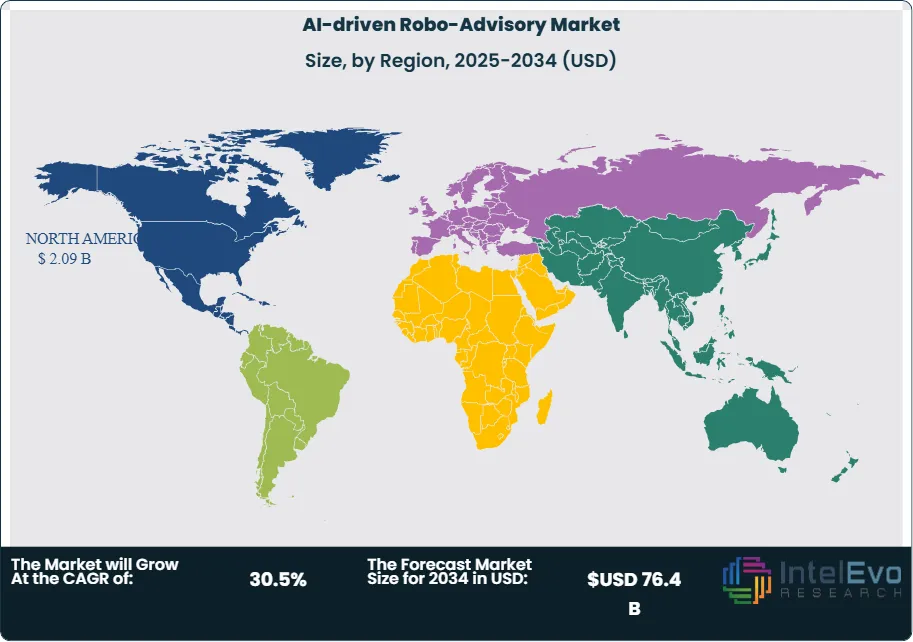
North America Leads with 35% Market Share in AI-driven Robo-Advisory Market: North America holds the largest market share in the AI-driven robo-advisory market, accounting for approximately 35% of the total market. This dominance is largely attributed to the high level of financial literacy, a well-established fintech ecosystem, and the early adoption of digital investment platforms by consumers. The presence of numerous leading robo-advisory firms, such as Betterment and Wealthfront, has also played a critical role in shaping market dynamics. Furthermore, regulatory frameworks in the U.S. have been favorable, encouraging innovation and integration of technology in financial services. High disposable incomes and the growing inclination among millennials toward automated investment solutions further bolster the region's market share, positioning North America as a pioneer in this financial technology evolution.
In contrast, the Asia-Pacific region is poised to be the fastest-growing market for AI-driven robo-advisory services, fueled by a rapidly expanding middle class and increasing digital adoption. Countries like China and India are witnessing a significant rise in fintech investments and technological advancements, which are reshaping traditional investment practices. The region's young, tech-savvy population is driving demand for cost-effective financial advisory services, particularly among millennials. Additionally, governments are promoting financial inclusion and digital literacy, creating an enabling environment for robo-advisory growth. Meanwhile, Europe is also growing steadily, supported by a strong regulatory framework and increasing consumer awareness of investment options. Latin America and the Middle East and Africa, though smaller markets, are gradually embracing robo-advisory services, driven by rising smartphone penetration and evolving financial needs.
By Type (Pure Robo-Advisors, Hybrid Robo-Advisors), By Service Type (Portfolio Management, Retirement Planning, Tax Optimization, Wealth Management, Others), By Provider (Fintech Robo Advisors, Banks, Traditional Wealth Managers, Others), By End User (Retail Investors, High-Net-Worth Individuals (HNWIs), Institutions)
Research Methodology
Primary Research- 100 Interviews of Stakeholders
Secondary Research
Desk Research
Regional scope
North America (United States, Canada, Mexico)
Latin America (Brazil, Argentina, Columbia)
East Asia And Pacific (China, Japan, South Korea, Australia, Cambodia, Fiji, Indonesia)
Sea And South Asia (India, Singapore, Thailand, Taiwan, Malaysia)
Eastern Europe (Poland, Russia, Czech Republic, Romania)
Western Europe (Germany, U.K., France, Spain, Itlay)
Middle East & Africa (GCC Countries, Egypt, Nigeria, South Africa, Israel)
Customization for segments, region/country-level will be provided. Moreover, additional customization can be done based on the requirements.
Pricing and Purchase Options
Avail customized purchase options to meet your exact research needs. We have three licenses to opt for: Single User License, Multi-User License (Up to 5 Users), Corporate Use License (Unlimited User and Printable PDF).
TABLE OF CONTENTS
1. EXECUTIVE SUMMARY
1.1. MARKET SNAPSHOT
1.2. KEY FINDINGS & INSIGHTS
1.3. ANALYST RECOMMENDATIONS
1.4. FUTURE OUTLOOK
2. RESEARCH METHODOLOGY
2.1. MARKET DEFINITION & SCOPE
2.2. RESEARCH OBJECTIVES: PRIMARY & SECONDARY DATA SOURCES
2.3. DATA COLLECTION SOURCES
2.3.1. COVERAGE OF 100+ PRIMARY RESEARCH/CONSULTATION CALLS WITH INDUSTRY STAKEHOLDERS
FIGURE 17 NORTH AMERICA AI-DRIVEN ROBO-ADVISORY CURRENT AND FUTURE TYPE ANALYSIS, 2025–2034, (USD MILLION)
FIGURE 18 NORTH AMERICA AI-DRIVEN ROBO-ADVISORY CURRENT AND FUTURE END USER ANALYSIS, 2025–2034, (USD MILLION)
FIGURE 19 MARKET SHARE BY COUNTRY
FIGURE 20 LATIN AMERICA AI-DRIVEN ROBO-ADVISORY CURRENT AND FUTURE TYPE ANALYSIS, 2025–2034, (USD MILLION)
FIGURE 21 LATIN AMERICA AI-DRIVEN ROBO-ADVISORY CURRENT AND FUTURE END USER ANALYSIS, 2025–2034, (USD MILLION)
FIGURE 22 MARKET SHARE BY COUNTRY
FIGURE 23 EASTERN EUROPE AI-DRIVEN ROBO-ADVISORY CURRENT AND FUTURE TYPE ANALYSIS, 2025–2034, (USD MILLION)
FIGURE 24 EASTERN EUROPE AI-DRIVEN ROBO-ADVISORY CURRENT AND FUTURE END USER ANALYSIS, 2025–2034, (USD MILLION)
FIGURE 25 MARKET SHARE BY COUNTRY
FIGURE 26 WESTERN EUROPE AI-DRIVEN ROBO-ADVISORY CURRENT AND FUTURE TYPE ANALYSIS, 2025–2034, (USD MILLION)
FIGURE 27 WESTERN EUROPE AI-DRIVEN ROBO-ADVISORY CURRENT AND FUTURE END USER ANALYSIS, 2025–2034, (USD MILLION)
FIGURE 28 MARKET SHARE BY COUNTRY
FIGURE 29 EAST ASIA AND PACIFIC AI-DRIVEN ROBO-ADVISORY CURRENT AND FUTURE TYPE ANALYSIS, 2025–2034, (USD MILLION)
FIGURE 30 EAST ASIA AND PACIFIC AI-DRIVEN ROBO-ADVISORY CURRENT AND FUTURE END USER ANALYSIS, 2025–2034, (USD MILLION)
FIGURE 31 MARKET SHARE BY COUNTRY
FIGURE 32 SEA AND SOUTH ASIA AI-DRIVEN ROBO-ADVISORY CURRENT AND FUTURE TYPE ANALYSIS, 2025–2034, (USD MILLION)
FIGURE 33 SEA AND SOUTH ASIA AI-DRIVEN ROBO-ADVISORY CURRENT AND FUTURE END USER ANALYSIS, 2025–2034, (USD MILLION)
FIGURE 34 MARKET SHARE BY COUNTRY
FIGURE 35 MIDDLE EAST AND AFRICA AI-DRIVEN ROBO-ADVISORY CURRENT AND FUTURE TYPE ANALYSIS, 2025–2034, (USD MILLION)
FIGURE 36 MIDDLE EAST AND AFRICA AI-DRIVEN ROBO-ADVISORY CURRENT AND FUTURE END USER ANALYSIS, 2025–2034, (USD MILLION)
FIGURE 37 NORTH AMERICA AI-DRIVEN ROBO-ADVISORY CURRENT AND FUTURE MARKET VOLUME SHARE REGIONAL ANALYSIS, 2025–2034, (USD MILLION)
FIGURE 38 U.S. AI-DRIVEN ROBO-ADVISORY CURRENT AND FUTURE TYPE ANALYSIS, 2025–2034, (USD MILLION)
FIGURE 39 U.S. AI-DRIVEN ROBO-ADVISORY CURRENT AND FUTURE END USER ANALYSIS, 2025–2034, (USD MILLION)
FIGURE 40 CANADA AI-DRIVEN ROBO-ADVISORY CURRENT AND FUTURE TYPE ANALYSIS, 2025–2034, (USD MILLION)
FIGURE 41 CANADA AI-DRIVEN ROBO-ADVISORY CURRENT AND FUTURE END USER ANALYSIS, 2025–2034, (USD MILLION)
FIGURE 42 LATIN AMERICA AI-DRIVEN ROBO-ADVISORY CURRENT AND FUTURE MARKET VOLUME SHARE REGIONAL ANALYSIS, 2025–2034, (USD MILLION)
FIGURE 43 MEXICO AI-DRIVEN ROBO-ADVISORY CURRENT AND FUTURE TYPE ANALYSIS, 2025–2034, (USD MILLION)
FIGURE 44 MEXICO AI-DRIVEN ROBO-ADVISORY CURRENT AND FUTURE END USER ANALYSIS, 2025–2034, (USD MILLION)
FIGURE 45 BRAZIL AI-DRIVEN ROBO-ADVISORY CURRENT AND FUTURE TYPE ANALYSIS, 2025–2034, (USD MILLION)
FIGURE 46 BRAZIL AI-DRIVEN ROBO-ADVISORY CURRENT AND FUTURE END USER ANALYSIS, 2025–2034, (USD MILLION)
FIGURE 47 ARGENTINA AI-DRIVEN ROBO-ADVISORY CURRENT AND FUTURE TYPE ANALYSIS, 2025–2034, (USD MILLION)
FIGURE 48 ARGENTINA AI-DRIVEN ROBO-ADVISORY CURRENT AND FUTURE END USER ANALYSIS, 2025–2034, (USD MILLION)
FIGURE 49 COLUMBIA AI-DRIVEN ROBO-ADVISORY CURRENT AND FUTURE TYPE ANALYSIS, 2025–2034, (USD MILLION)
FIGURE 50 COLUMBIA AI-DRIVEN ROBO-ADVISORY CURRENT AND FUTURE END USER ANALYSIS, 2025–2034, (USD MILLION)
FIGURE 51 REST OF LATIN AMERICA AI-DRIVEN ROBO-ADVISORY CURRENT AND FUTURE TYPE ANALYSIS, 2025–2034, (USD MILLION)
FIGURE 52 REST OF LATIN AMERICA AI-DRIVEN ROBO-ADVISORY CURRENT AND FUTURE END USER ANALYSIS, 2025–2034, (USD MILLION)
FIGURE 53 EASTERN EUROPE AI-DRIVEN ROBO-ADVISORY CURRENT AND FUTURE MARKET VOLUME SHARE REGIONAL ANALYSIS, 2025–2034, (USD MILLION)
FIGURE 54 POLAND AI-DRIVEN ROBO-ADVISORY CURRENT AND FUTURE TYPE ANALYSIS, 2025–2034, (USD MILLION)
FIGURE 55 POLAND AI-DRIVEN ROBO-ADVISORY CURRENT AND FUTURE END USER ANALYSIS, 2025–2034, (USD MILLION)
FIGURE 56 RUSSIA AI-DRIVEN ROBO-ADVISORY CURRENT AND FUTURE TYPE ANALYSIS, 2025–2034, (USD MILLION)
FIGURE 57 RUSSIA AI-DRIVEN ROBO-ADVISORY CURRENT AND FUTURE END USER ANALYSIS, 2025–2034, (USD MILLION)
FIGURE 58 CZECH REPUBLIC AI-DRIVEN ROBO-ADVISORY CURRENT AND FUTURE TYPE ANALYSIS, 2025–2034, (USD MILLION)
FIGURE 59 CZECH REPUBLIC AI-DRIVEN ROBO-ADVISORY CURRENT AND FUTURE END USER ANALYSIS, 2025–2034, (USD MILLION)
FIGURE 60 ROMANIA AI-DRIVEN ROBO-ADVISORY CURRENT AND FUTURE TYPE ANALYSIS, 2025–2034, (USD MILLION)
FIGURE 61 ROMANIA AI-DRIVEN ROBO-ADVISORY CURRENT AND FUTURE END USER ANALYSIS, 2025–2034, (USD MILLION)
FIGURE 62 REST OF EASTERN EUROPE AI-DRIVEN ROBO-ADVISORY CURRENT AND FUTURE TYPE ANALYSIS, 2025–2034, (USD MILLION)
FIGURE 63 REST OF EASTERN EUROPE AI-DRIVEN ROBO-ADVISORY CURRENT AND FUTURE END USER ANALYSIS, 2025–2034, (USD MILLION)
FIGURE 64 WESTERN EUROPE AI-DRIVEN ROBO-ADVISORY CURRENT AND FUTURE MARKET VOLUME SHARE REGIONAL ANALYSIS, 2025–2034, (USD MILLION)
FIGURE 65 GERMANY AI-DRIVEN ROBO-ADVISORY CURRENT AND FUTURE TYPE ANALYSIS, 2025–2034, (USD MILLION)
FIGURE 66 GERMANY AI-DRIVEN ROBO-ADVISORY CURRENT AND FUTURE END USER ANALYSIS, 2025–2034, (USD MILLION)
FIGURE 67 FRANCE AI-DRIVEN ROBO-ADVISORY CURRENT AND FUTURE TYPE ANALYSIS, 2025–2034, (USD MILLION)
FIGURE 68 FRANCE AI-DRIVEN ROBO-ADVISORY CURRENT AND FUTURE END USER ANALYSIS, 2025–2034, (USD MILLION)
FIGURE 69 UK AI-DRIVEN ROBO-ADVISORY CURRENT AND FUTURE TYPE ANALYSIS, 2025–2034, (USD MILLION)
FIGURE 70 UK AI-DRIVEN ROBO-ADVISORY CURRENT AND FUTURE END USER ANALYSIS, 2025–2034, (USD MILLION)
FIGURE 71 SPAIN AI-DRIVEN ROBO-ADVISORY CURRENT AND FUTURE TYPE ANALYSIS, 2025–2034, (USD MILLION)
FIGURE 72 SPAIN AI-DRIVEN ROBO-ADVISORY CURRENT AND FUTURE END USER ANALYSIS, 2025–2034, (USD MILLION)
FIGURE 73 ITALY AI-DRIVEN ROBO-ADVISORY CURRENT AND FUTURE TYPE ANALYSIS, 2025–2034, (USD MILLION)
FIGURE 74 ITALY AI-DRIVEN ROBO-ADVISORY CURRENT AND FUTURE END USER ANALYSIS, 2025–2034, (USD MILLION)
FIGURE 75 REST OF WESTERN EUROPE AI-DRIVEN ROBO-ADVISORY CURRENT AND FUTURE TYPE ANALYSIS, 2025–2034, (USD MILLION)
FIGURE 76 REST OF WESTERN EUROPE AI-DRIVEN ROBO-ADVISORY CURRENT AND FUTURE END USER ANALYSIS, 2025–2034, (USD MILLION)
FIGURE 77 EAST ASIA AND PACIFIC AI-DRIVEN ROBO-ADVISORY CURRENT AND FUTURE MARKET VOLUME SHARE REGIONAL ANALYSIS, 2025–2034, (USD MILLION)
FIGURE 78 CHINA AI-DRIVEN ROBO-ADVISORY CURRENT AND FUTURE TYPE ANALYSIS, 2025–2034, (USD MILLION)
FIGURE 79 CHINA AI-DRIVEN ROBO-ADVISORY CURRENT AND FUTURE END USER ANALYSIS, 2025–2034, (USD MILLION)
FIGURE 80 JAPAN AI-DRIVEN ROBO-ADVISORY CURRENT AND FUTURE TYPE ANALYSIS, 2025–2034, (USD MILLION)
FIGURE 81 JAPAN AI-DRIVEN ROBO-ADVISORY CURRENT AND FUTURE END USER ANALYSIS, 2025–2034, (USD MILLION)
FIGURE 82 AUSTRALIA AI-DRIVEN ROBO-ADVISORY CURRENT AND FUTURE TYPE ANALYSIS, 2025–2034, (USD MILLION)
FIGURE 83 AUSTRALIA AI-DRIVEN ROBO-ADVISORY CURRENT AND FUTURE END USER ANALYSIS, 2025–2034, (USD MILLION)
FIGURE 84 CAMBODIA AI-DRIVEN ROBO-ADVISORY CURRENT AND FUTURE TYPE ANALYSIS, 2025–2034, (USD MILLION)
FIGURE 85 CAMBODIA AI-DRIVEN ROBO-ADVISORY CURRENT AND FUTURE END USER ANALYSIS, 2025–2034, (USD MILLION)
FIGURE 86 FIJI AI-DRIVEN ROBO-ADVISORY CURRENT AND FUTURE TYPE ANALYSIS, 2025–2034, (USD MILLION)
FIGURE 87 FIJI AI-DRIVEN ROBO-ADVISORY CURRENT AND FUTURE END USER ANALYSIS, 2025–2034, (USD MILLION)
FIGURE 88 INDONESIA AI-DRIVEN ROBO-ADVISORY CURRENT AND FUTURE TYPE ANALYSIS, 2025–2034, (USD MILLION)
FIGURE 89 INDONESIA AI-DRIVEN ROBO-ADVISORY CURRENT AND FUTURE END USER ANALYSIS, 2025–2034, (USD MILLION)
FIGURE 90 SOUTH KOREA AI-DRIVEN ROBO-ADVISORY CURRENT AND FUTURE TYPE ANALYSIS, 2025–2034, (USD MILLION)
FIGURE 91 SOUTH KOREA AI-DRIVEN ROBO-ADVISORY CURRENT AND FUTURE END USER ANALYSIS, 2025–2034, (USD MILLION)
FIGURE 92 REST OF EAST ASIA AND PACIFIC AI-DRIVEN ROBO-ADVISORY CURRENT AND FUTURE TYPE ANALYSIS, 2025–2034, (USD MILLION)
FIGURE 93 REST OF EAST ASIA AND PACIFIC AI-DRIVEN ROBO-ADVISORY CURRENT AND FUTURE END USER ANALYSIS, 2025–2034, (USD MILLION)
FIGURE 94 SEA AND SOUTH ASIA AI-DRIVEN ROBO-ADVISORY CURRENT AND FUTURE MARKET VOLUME SHARE REGIONAL ANALYSIS, 2025–2034, (USD MILLION)
FIGURE 95 BANGLADESH AI-DRIVEN ROBO-ADVISORY CURRENT AND FUTURE TYPE ANALYSIS, 2025–2034, (USD MILLION)
FIGURE 96 BANGLADESH AI-DRIVEN ROBO-ADVISORY CURRENT AND FUTURE END USER ANALYSIS, 2025–2034, (USD MILLION)
FIGURE 97 NEW ZEALAND AI-DRIVEN ROBO-ADVISORY CURRENT AND FUTURE TYPE ANALYSIS, 2025–2034, (USD MILLION)
FIGURE 98 NEW ZEALAND AI-DRIVEN ROBO-ADVISORY CURRENT AND FUTURE END USER ANALYSIS, 2025–2034, (USD MILLION)
FIGURE 99 INDIA AI-DRIVEN ROBO-ADVISORY CURRENT AND FUTURE TYPE ANALYSIS, 2025–2034, (USD MILLION)
FIGURE 100 INDIA AI-DRIVEN ROBO-ADVISORY CURRENT AND FUTURE END USER ANALYSIS, 2025–2034, (USD MILLION)
FIGURE 101 SINGAPORE AI-DRIVEN ROBO-ADVISORY CURRENT AND FUTURE TYPE ANALYSIS, 2025–2034, (USD MILLION)
FIGURE 102 SINGAPORE AI-DRIVEN ROBO-ADVISORY CURRENT AND FUTURE END USER ANALYSIS, 2025–2034, (USD MILLION)
FIGURE 103 THAILAND AI-DRIVEN ROBO-ADVISORY CURRENT AND FUTURE TYPE ANALYSIS, 2025–2034, (USD MILLION)
FIGURE 104 THAILAND AI-DRIVEN ROBO-ADVISORY CURRENT AND FUTURE END USER ANALYSIS, 2025–2034, (USD MILLION)
FIGURE 105 TAIWAN AI-DRIVEN ROBO-ADVISORY CURRENT AND FUTURE TYPE ANALYSIS, 2025–2034, (USD MILLION)
FIGURE 106 TAIWAN AI-DRIVEN ROBO-ADVISORY CURRENT AND FUTURE END USER ANALYSIS, 2025–2034, (USD MILLION)
FIGURE 107 MALAYSIA AI-DRIVEN ROBO-ADVISORY CURRENT AND FUTURE TYPE ANALYSIS, 2025–2034, (USD MILLION)
FIGURE 108 MALAYSIA AI-DRIVEN ROBO-ADVISORY CURRENT AND FUTURE END USER ANALYSIS, 2025–2034, (USD MILLION)
FIGURE 109 REST OF SEA AND SOUTH ASIA AI-DRIVEN ROBO-ADVISORY CURRENT AND FUTURE TYPE ANALYSIS, 2025–2034, (USD MILLION)
FIGURE 110 REST OF SEA AND SOUTH ASIA AI-DRIVEN ROBO-ADVISORY CURRENT AND FUTURE END USER ANALYSIS, 2025–2034, (USD MILLION)
FIGURE 111 MIDDLE EAST AND AFRICA AI-DRIVEN ROBO-ADVISORY CURRENT AND FUTURE MARKET VOLUME SHARE REGIONAL ANALYSIS, 2025–2034, (USD MILLION)
FIGURE 112 GCC COUNTRIES AI-DRIVEN ROBO-ADVISORY CURRENT AND FUTURE TYPE ANALYSIS, 2025–2034, (USD MILLION)
FIGURE 113 GCC COUNTRIES AI-DRIVEN ROBO-ADVISORY CURRENT AND FUTURE END USER ANALYSIS, 2025–2034, (USD MILLION)
FIGURE 114 SAUDI ARABIA AI-DRIVEN ROBO-ADVISORY CURRENT AND FUTURE TYPE ANALYSIS, 2025–2034, (USD MILLION)
FIGURE 115 SAUDI ARABIA AI-DRIVEN ROBO-ADVISORY CURRENT AND FUTURE END USER ANALYSIS, 2025–2034, (USD MILLION)
FIGURE 116 UAE AI-DRIVEN ROBO-ADVISORY CURRENT AND FUTURE TYPE ANALYSIS, 2025–2034, (USD MILLION)
FIGURE 117 UAE AI-DRIVEN ROBO-ADVISORY CURRENT AND FUTURE END USER ANALYSIS, 2025–2034, (USD MILLION)
FIGURE 118 BAHRAIN AI-DRIVEN ROBO-ADVISORY CURRENT AND FUTURE TYPE ANALYSIS, 2025–2034, (USD MILLION)
FIGURE 119 BAHRAIN AI-DRIVEN ROBO-ADVISORY CURRENT AND FUTURE END USER ANALYSIS, 2025–2034, (USD MILLION)
FIGURE 120 KUWAIT AI-DRIVEN ROBO-ADVISORY CURRENT AND FUTURE TYPE ANALYSIS, 2025–2034, (USD MILLION)
FIGURE 121 KUWAIT AI-DRIVEN ROBO-ADVISORY CURRENT AND FUTURE END USER ANALYSIS, 2025–2034, (USD MILLION)
FIGURE 122 OMAN AI-DRIVEN ROBO-ADVISORY CURRENT AND FUTURE TYPE ANALYSIS, 2025–2034, (USD MILLION)
FIGURE 123 OMAN AI-DRIVEN ROBO-ADVISORY CURRENT AND FUTURE END USER ANALYSIS, 2025–2034, (USD MILLION)
FIGURE 124 QATAR AI-DRIVEN ROBO-ADVISORY CURRENT AND FUTURE TYPE ANALYSIS, 2025–2034, (USD MILLION)
FIGURE 125 QATAR AI-DRIVEN ROBO-ADVISORY CURRENT AND FUTURE END USER ANALYSIS, 2025–2034, (USD MILLION)
FIGURE 126 EGYPT AI-DRIVEN ROBO-ADVISORY CURRENT AND FUTURE TYPE ANALYSIS, 2025–2034, (USD MILLION)
FIGURE 127 EGYPT AI-DRIVEN ROBO-ADVISORY CURRENT AND FUTURE END USER ANALYSIS, 2025–2034, (USD MILLION)
FIGURE 128 NIGERIA AI-DRIVEN ROBO-ADVISORY CURRENT AND FUTURE TYPE ANALYSIS, 2025–2034, (USD MILLION)
FIGURE 129 NIGERIA AI-DRIVEN ROBO-ADVISORY CURRENT AND FUTURE END USER ANALYSIS, 2025–2034, (USD MILLION)
FIGURE 130 SOUTH AFRICA AI-DRIVEN ROBO-ADVISORY CURRENT AND FUTURE TYPE ANALYSIS, 2025–2034, (USD MILLION)
FIGURE 131 SOUTH AFRICA AI-DRIVEN ROBO-ADVISORY CURRENT AND FUTURE END USER ANALYSIS, 2025–2034, (USD MILLION)
FIGURE 132 ISRAEL AI-DRIVEN ROBO-ADVISORY CURRENT AND FUTURE TYPE ANALYSIS, 2025–2034, (USD MILLION)
FIGURE 133 ISRAEL AI-DRIVEN ROBO-ADVISORY CURRENT AND FUTURE END USER ANALYSIS, 2025–2034, (USD MILLION)
FIGURE 134 REST OF MEA AI-DRIVEN ROBO-ADVISORY CURRENT AND FUTURE TYPE ANALYSIS, 2025–2034, (USD MILLION)
FIGURE 135 REST OF MEA AI-DRIVEN ROBO-ADVISORY CURRENT AND FUTURE END USER ANALYSIS, 2025–2034, (USD MILLION)
FIGURE 136 U. S. MARKET SHARE ANALYSIS BY TYPE (2024)
FIGURE 137 U. S. MARKET SHARE ANALYSIS BY END USER (2024)
FIGURE 138 CANADA MARKET SHARE ANALYSIS BY TYPE (2024)
FIGURE 139 CANADA MARKET SHARE ANALYSIS BY END USER (2024)
FIGURE 140 MEXICO MARKET SHARE ANALYSIS BY TYPE (2024)
FIGURE 141 MEXICO MARKET SHARE ANALYSIS BY END USER (2024)
FIGURE 142 CHINA MARKET SHARE ANALYSIS BY TYPE (2024)
FIGURE 143 CHINA MARKET SHARE ANALYSIS BY END USER (2024)
FIGURE 144 JAPAN MARKET SHARE ANALYSIS BY TYPE (2024)
FIGURE 145 JAPAN MARKET SHARE ANALYSIS BY END USER (2024)
FIGURE 146 INDIA MARKET SHARE ANALYSIS BY TYPE (2024)
FIGURE 147 INDIA MARKET SHARE ANALYSIS BY END USER (2024)
FIGURE 148 SOUTH KOREA MARKET SHARE ANALYSIS BY TYPE (2024)
FIGURE 149 SOUTH KOREA MARKET SHARE ANALYSIS BY END USER (2024)
FIGURE 150 SAUDI ARABIA MARKET SHARE ANALYSIS BY TYPE (2024)
FIGURE 151 SAUDI ARABIA MARKET SHARE ANALYSIS BY END USER (2024)
FIGURE 152 UAE MARKET SHARE ANALYSIS BY TYPE (2024)
FIGURE 153 UAE MARKET SHARE ANALYSIS BY END USER (2024)
FIGURE 154 EGYPT MARKET SHARE ANALYSIS BY TYPE (2024)
FIGURE 155 EGYPT MARKET SHARE ANALYSIS BY END USER (2024)
FIGURE 156 NIGERIA MARKET SHARE ANALYSIS BY TYPE (2024)
FIGURE 157 NIGERIA MARKET SHARE ANALYSIS BY END USER (2024)
FIGURE 158 SOUTH AFRICA MARKET SHARE ANALYSIS BY TYPE (2024)
FIGURE 159 SOUTH AFRICA MARKET SHARE ANALYSIS BY END USER (2024)
FIGURE 160 GERMANY MARKET SHARE ANALYSIS BY TYPE (2024)
FIGURE 161 GERMANY MARKET SHARE ANALYSIS BY END USER (2024)
FIGURE 162 FRANCE MARKET SHARE ANALYSIS BY TYPE (2024)
FIGURE 163 FRANCE MARKET SHARE ANALYSIS BY END USER (2024)
FIGURE 164 UK MARKET SHARE ANALYSIS BY TYPE (2024)
FIGURE 165 UK MARKET SHARE ANALYSIS BY END USER (2024)
FIGURE 166 SPAIN MARKET SHARE ANALYSIS BY TYPE (2024)
FIGURE 167 SPAIN MARKET SHARE ANALYSIS BY END USER (2024)
FIGURE 168 ITALY MARKET SHARE ANALYSIS BY TYPE (2024)
FIGURE 169 ITALY MARKET SHARE ANALYSIS BY END USER (2024)
FIGURE 170 BRAZIL MARKET SHARE ANALYSIS BY TYPE (2024)
FIGURE 171 BRAZIL MARKET SHARE ANALYSIS BY END USER (2024)
FIGURE 172 ARGENTINA MARKET SHARE ANALYSIS BY TYPE (2024)
FIGURE 173 ARGENTINA MARKET SHARE ANALYSIS BY END USER (2024)
FIGURE 174 COLUMBIA MARKET SHARE ANALYSIS BY TYPE (2024)
FIGURE 175 COLUMBIA MARKET SHARE ANALYSIS BY END USER (2024)
FIGURE 176 GLOBAL AI-DRIVEN ROBO-ADVISORY CURRENT AND FUTURE MARKET KEY COUNTRY LEVEL ANALYSIS, 2024–2034, (USD MILLION)
FIGURE 177 FINANCIAL OVERVIEW:
Key Players Analysis:
Betterment: Betterment is a leading robo-advisor that offers personalized investment management services and financial planning tools. Headquartered in New York City, it uses algorithms to provide automated portfolio management with a focus on low-cost, tax-efficient strategies. Betterment's strategy centers on expanding its offerings, including retirement planning and social impact investing, to attract a diverse client base.
Wealthfront: Wealthfront is known for its automated investment services, focusing on technology-driven financial planning and management. Based in California, it provides users with features like tax-loss harvesting and financial planning tools. Wealthfront's business strategy emphasizes user experience and accessibility, aiming to attract younger investors through innovative products and a low-fee structure.
Schwab Intelligent Portfolios: Charles Schwab's robo-advisory service offers a range of investment portfolios tailored to individual risk tolerances and goals. Schwab Intelligent Portfolios is available across the United States and provides automated rebalancing and tax optimization. The company's strategy involves integrating traditional brokerage services with its robo-advisory platform to cater to a broad audience, including existing Schwab customers.
Vanguard Personal Advisor Services: Vanguard is a renowned investment management firm that offers a hybrid robo-advisory service combining automated management with access to human advisors. Headquartered in Pennsylvania, it provides tailored investment strategies and financial planning. Vanguard's strategy leverages its reputation for low-cost index funds to attract clients looking for comprehensive investment management services.
Fidelity Go: Fidelity Go is a digital investment platform designed for easy access to financial management, targeting millennials and novice investors. Based in Boston, Massachusetts, it offers a straightforward mobile app for investment management and financial planning. Fidelity's strategy emphasizes innovation and education, positioning itself as a leader in technology-driven investment solutions.
Personal Capital: Personal Capital combines digital financial tools with personalized financial advisory services. Located in California, it offers wealth management and retirement planning solutions, utilizing AI for portfolio analysis. The company's strategy focuses on providing comprehensive financial insights while maintaining a personal touch, catering to higher-net-worth individuals seeking holistic financial management.
Ellevest: Ellevest is a robo-advisor tailored specifically for women, offering personalized investment strategies and financial planning services. Based in New York, it addresses gender-specific financial goals and challenges. Ellevest's strategy involves creating an inclusive financial environment that empowers women through education, tailored investments, and accessible financial planning tools.
Acorns: Acorns is an investment app that helps users save and invest spare change automatically. Based in California, it offers features like recurring investments and retirement accounts. Acorns' business strategy focuses on accessibility and gamification, appealing to young, first-time investors by simplifying the investment process and providing educational resources.
M1 Finance: M1 Finance offers a customizable robo-advisory platform that allows users to create personalized portfolios with automatic rebalancing. Headquartered in Illinois, it provides investment management, borrowing, and banking services. M1's strategy emphasizes user control and customization, allowing clients to tailor their investment strategies while enjoying the benefits of automation.
Wealthsimple: Wealthsimple is a Canadian robo-advisor that offers automated investment management and financial planning services. With a strong presence in Canada, the U.S., and the U.K., Wealthsimple focuses on low fees and socially responsible investing. Its business strategy emphasizes simplicity, transparency, and accessibility, attracting a diverse clientele through its user-friendly platform.
Market Key Players
Betterment
Wealthfront
Schwab Intelligent Portfolios
Vanguard Personal Advisor Services
Fidelity Go
Personal Capital
Ellevest
Acorns
M1 Finance
SoFi Invest
Blooom
Nutmeg
Stash
Wealthsimple
Facet Wealth
Robo-Wealth
Ally Invest
Zacks Investment Management
Squirrelinvestor
Bambu
Driver:
Affordable, Digital, and Efficient Investment Driving Robo-Advisory Adoption
The growing need for affordable and efficient investment options drives the demand for AI-driven robo-advisory services. Many individuals, especially millennials and Gen Z, seek low-cost alternatives to traditional financial advisory services. Robo-advisors leverage advanced algorithms to manage investments at a fraction of the cost, making them appealing to cost-conscious investors. Furthermore, the proliferation of mobile technology and accessible digital platforms facilitates investment management, allowing users to track their portfolios in real-time. This trend reflects a broader shift towards digital finance, where consumers prioritize value and efficiency. As financial literacy improves, more people are expected to adopt these solutions, contributing to the market's expansion and increasing competition among service providers.
Advancements in Technology and AI
Technological innovations, particularly in artificial intelligence and machine learning, are pivotal in shaping the robo-advisory market. Enhanced algorithms enable these platforms to provide personalized investment advice based on individual financial goals and risk profiles. AI-driven analytics also facilitate real-time portfolio adjustments and risk assessments, improving overall investment performance. As technology continues to evolve, robo-advisors can offer more sophisticated features, including tax optimization strategies and retirement planning tools. This technological advancement not only attracts new users but also enhances the experience for existing clients, fostering loyalty and increasing the market share of established platforms. Consequently, technology is a significant driver of growth and innovation within the industry.
Shift Toward Digital Financial Services
The ongoing shift towards digital financial services has accelerated the adoption of AI-driven robo-advisory platforms. With consumers increasingly seeking convenience and efficiency, robo-advisors offer seamless, on-the-go investment management through mobile applications and online interfaces. This trend is particularly evident in the wake of the COVID-19 pandemic, which has heightened reliance on digital solutions across various sectors, including finance. As traditional financial institutions adapt to changing consumer preferences, they are incorporating robo-advisory services into their offerings to retain customers and enhance service delivery. This market evolution reflects a broader societal trend towards digitalization, where consumers expect immediate access to services and information, driving further growth in the robo-advisory market.
Restraints
Regulatory Challenges
The AI-driven robo-advisory market faces significant regulatory challenges that can hinder its growth. Governments and regulatory bodies worldwide impose stringent regulations to ensure consumer protection, transparency, and fair practices in financial services. Compliance with these regulations can be complex and costly for robo-advisors, especially startups lacking the resources of established financial institutions. Additionally, varying regulations across different regions create barriers to entry and complicate international expansion for many providers. This uncertainty can deter potential investors and slow market adoption as firms navigate the regulatory landscape. Consequently, the evolving regulatory environment poses a significant restraint on the growth and scalability of robo-advisory services.
Market Volatility and Economic Uncertainty
Market volatility and economic uncertainty can negatively impact the AI-driven robo-advisory market. During periods of economic instability, investors may become more risk-averse, leading to a decline in new investments and reduced assets under management for robo-advisors. Furthermore, unpredictable market conditions can challenge the effectiveness of algorithm-driven investment strategies, as they may not adequately account for sudden shifts in the market landscape. This volatility can erode consumer confidence in automated solutions, causing potential clients to revert to traditional financial advisors who offer personalized guidance during turbulent times. As a result, economic fluctuations can significantly affect the growth trajectory of the robo-advisory market.
Opportunities
Emerging Markets Adoption
Emerging markets present a significant opportunity for growth in the AI-driven robo-advisory market. As the middle class expands in regions such as Asia-Pacific and Latin America, there is a growing demand for accessible investment solutions among new investors. Many individuals in these markets seek financial literacy and investment opportunities but lack access to traditional financial advisory services. Robo-advisors can fill this gap by offering low-cost, user-friendly platforms that cater to diverse financial needs. Additionally, advancements in mobile technology and internet penetration facilitate access to digital financial services, driving adoption. By targeting these emerging markets, robo-advisors can tap into a vast pool of potential clients and expand their reach.
Integration of ESG and Impact Investing
The rising popularity of Environmental, Social, and Governance (ESG) investing and impact investing presents another opportunity for the robo-advisory market. As more investors seek to align their portfolios with their values and contribute to social causes, robo-advisors can develop specialized services focused on sustainable investment options. By integrating ESG factors into their algorithms and offering tailored portfolios, these platforms can attract socially conscious investors who may not have previously engaged with traditional investment options. This focus on ethical investing can differentiate robo-advisors in a crowded market and foster loyalty among clients. As awareness of sustainability issues grows, the demand for such investment options is expected to increase significantly.
Trend
Rise of Hybrid Robo-Advisory Models
A notable trend in the AI-driven robo-advisory market is the rise of hybrid models that combine algorithm-driven advice with human expertise. This approach addresses the concerns of investors seeking a personalized touch while still enjoying the cost benefits of automated services. Hybrid robo-advisors offer clients tailored investment strategies, along with direct access to human financial advisors for more complex financial issues. This blend caters to a wider audience, appealing to both tech-savvy younger investors and those who prefer human interaction. As financial needs become more intricate and diverse, the hybrid model is expected to gain traction, positioning itself as a viable alternative in the evolving landscape of financial advisory services.
Recent Development
In August 2024: A consortium of private equity firms has partnered to establish a $1 billion fund aimed at investing in technology-driven startups. This collaborative effort underscores a growing trend among investment firms to pool resources to capitalize on innovative companies in the technology sector, further expanding their portfolios in the alternative investment space.
In July 2024: Fundrise, an online real estate investment platform, announced a significant partnership with a leading property management firm. This collaboration is expected to enhance Fundrise's ability to manage and optimize its real estate investments, improving returns for investors while expanding its property portfolio across key markets.
