

- Home
- Industries
 Aerospace And Defence
 Agriculture
 Automotive And Transportation
 Banking And Finance
 Business
 Chemicals And Materials
 Consumer And Retail
 Electronics And Semiconductors
 Food And Beverages
 Machinery & Equipments
 Manufacturing And Construction
 Medical Devices
 Others
 Pharmaceuticals And Healthcare
 Power And Energy
 Sports
 Technology
- Services
- News Room
- About us
- Contact Us
-
AI in EdTech Market Size, Share & Growth Forecast | 38.8% CAGR
Global AI in EdTech Market Size, Share & Analysis By Deployment (Cloud, On-Premise), By Application (Content Creation, Personalized Learning, Assessment and Testing, Other Applications), By End-User (Schools, Colleges and Universities, Corporate Training Centers, Government and Non-profit Organizations) Industry Insights, Investment Trends, Competitive Strategies & Forecast 2025–2034

Report Overview
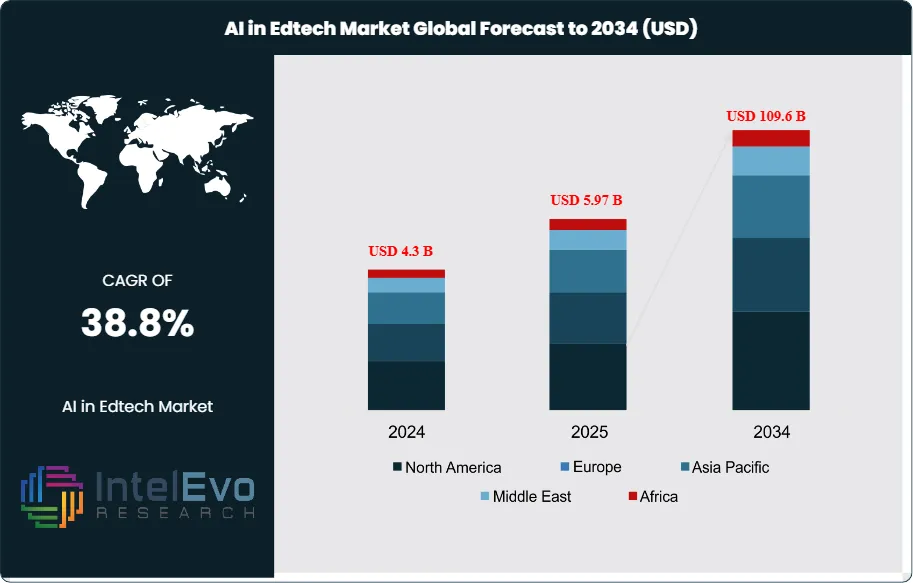
The AI in EdTech Market is projected to grow from USD 4.3 Billion in 2024 to approximately USD 109.6 Billion by 2034, expanding at a CAGR of around 38.8% during 2025–2034. The rapid integration of artificial intelligence into education is revolutionizing personalized learning, student assessment, and digital content delivery. AI-powered tools such as adaptive learning platforms, smart tutoring systems, and predictive analytics are transforming classroom and remote education experiences. As institutions embrace data-driven teaching models and immersive learning environments, AI continues to redefine global education accessibility and effectiveness. This rapid expansion underscores the transformative role of artificial intelligence technologies—including machine learning, natural language processing (NLP), and advanced data analytics—in reshaping the education sector.
Get More Information about this report -
Request Free Sample ReportAI is increasingly recognized as a catalyst for creating personalized, adaptive learning ecosystems that respond to the diverse needs of students and educators alike. By leveraging vast datasets on student performance, behavior, and engagement, AI-powered platforms can generate tailored learning paths, real-time feedback, and skill-specific recommendations. This capability enables students to progress at their own pace, focus on areas of weakness, and receive customized support, ultimately driving stronger academic outcomes. Educators also benefit from reduced administrative workloads and improved insights into student progress, allowing them to focus more effectively on pedagogy.
The market’s momentum is supported by rising investments from both Edtech startups and global technology leaders that are actively developing AI-enabled platforms and tools. Strategic collaborations between educational institutions and technology providers are accelerating the deployment of smart learning solutions, from virtual classrooms and automated grading systems to AI-driven tutoring platforms and learning management systems (LMS). These innovations are reshaping not only traditional classrooms but also remote and hybrid education models, making learning more accessible and scalable.
Regionally, emerging markets such as India are drawing attention, reflecting both the opportunities and challenges within the sector. According to industry reports, India’s Edtech sector secured USD 278 million in funding during the first nine months of 2024, a slight increase from the previous year. However, the market remains highly concentrated, with unicorn PhysicsWallah contributing USD 210 million of that total. Excluding this outlier, overall funding activity in the region showed a marked decline, highlighting uneven growth across players. Despite this, the surge in third-quarter funding—up 357% year-on-year—demonstrates investor confidence in the long-term potential of AI-driven learning solutions.
Overall, as educational institutions worldwide continue to embrace digital transformation, the integration of AI into Edtech is set to redefine how knowledge is delivered, assessed, and experienced, positioning the sector as a cornerstone of the future global education landscape.

Key Takeaways
- Market Growth: The global AI in Edtech market is projected to grow from USD 4.3 Billion in 2024 to USD 109.6 Billion by 2034, registering a strong CAGR of 38.8%, fueled by rising demand for adaptive learning systems, automation in administration, and AI-powered personalized education.
- Technology: The cloud-based delivery model dominated in 2023 with over 72% share, driven by its scalability, cost efficiency, and ability to support remote and hybrid learning environments.
- Application: Personalized learning platforms accounted for more than 43% of the market in 2023, as AI-driven adaptive tools gained traction in tailoring curricula, assignments, and feedback to individual student needs.
- End-User: Corporate training centers captured over 45% market share in 2023, reflecting the growing adoption of AI in reskilling, workforce development, and continuous learning programs across industries.
- Driver: Increasing reliance on AI for automated administrative functions—with more than 50% of schools and universities already leveraging AI tools—is accelerating adoption and improving institutional efficiency.
- Restraint: Limited digital penetration in education remains a barrier, with only ~4% of the global USD 6.6 trillion education market digitized, constraining scalability despite rising Edtech innovation.
- Opportunity: The integration of AR and VR in education presents a major growth avenue, with the market expected to reach USD 75 billion by 2033 at a 20.26% CAGR, offering immersive and interactive learning experiences.
- Trend: Student engagement in online Edtech courses and lectures is rapidly increasing, with the AI-driven education market alone expected to achieve USD 22 billion by 2029, underscoring the shift toward digital-first learning ecosystems.
- Regional Analysis: North America led the market in 2023 with over 37% share, supported by strong Edtech investments, widespread AI adoption, and established technology infrastructure, while Asia-Pacific is emerging as the fastest-growing region due to large student populations and rising funding in countries like India and China.
Deployment Analysis
As of 2025, cloud-based platforms dominate the AI in Edtech landscape, accounting for more than 72% of total adoption. This dominance reflects the inherent advantages of cloud delivery, including scalability, cost efficiency, and flexibility, which make advanced AI-driven tools accessible to institutions of all sizes. Unlike on-premises deployments, which demand significant upfront investment in infrastructure, cloud-based solutions lower entry barriers and allow institutions to quickly integrate AI capabilities into their existing systems.
The rapid shift toward online and hybrid learning further solidifies the role of cloud technologies. Cloud-enabled Edtech platforms facilitate seamless access to virtual classrooms, AI-powered learning paths, and advanced data analytics from any location, empowering educators with real-time insights while delivering a consistent and adaptive learning experience to students. The ability to expand or contract resources based on demand ensures that cloud-based AI remains the preferred choice for both small institutions and large universities.
Looking ahead, the continued rise of generative AI models and advanced analytics will further entrench the cloud’s leadership, enabling institutions to deploy increasingly sophisticated tools without incurring prohibitive costs. By offering flexibility and innovation at scale, the cloud is expected to remain the backbone of AI adoption in education for the foreseeable future.
Application Analysis
Personalized learning solutions lead the application landscape, capturing over 43% of market share in 2025. These platforms leverage machine learning algorithms to analyze student behavior, academic progress, and preferences, then adapt instructional materials to fit individual needs. The ability to create tailored learning journeys enhances student engagement, improves retention rates, and ensures more effective outcomes compared to traditional methods.
The adoption of personalized AI-driven learning has accelerated due to the global push toward digital-first education and the need to serve diverse learners at scale. From K–12 classrooms to university courses and professional training, personalization has emerged as a key differentiator, ensuring inclusivity and adaptability in education delivery. Institutions worldwide are prioritizing adaptive learning systems that move beyond “one-size-fits-all” instruction to foster more effective, individualized experiences.
As AI capabilities evolve, personalization is expected to grow even deeper—integrating emotional recognition, predictive analytics, and real-time feedback. This shift will further reinforce personalized learning as the cornerstone application of AI in Edtech.
End-User Analysis
In 2025, corporate training centers remain the largest end-user group, representing more than 45% of market share. Businesses are increasingly embedding AI-powered learning systems into employee training and development initiatives to keep pace with rapidly changing skills requirements. AI-driven platforms enable highly adaptive and modular training programs that adjust to an employee’s pace and competency level, driving greater efficiency and engagement.
Corporate adoption is also propelled by the need to remain competitive in dynamic markets. Through AI, companies gain analytics-driven insights into workforce performance, enabling them to identify skills gaps, design targeted upskilling programs, and improve overall organizational agility. By aligning training with both individual development and corporate strategy, AI in Edtech has become a critical tool for sustaining workforce productivity and resilience.
This segment’s strength reflects the convergence of technology and workforce transformation, with corporations increasingly treating continuous learning as a strategic necessity rather than a one-off investment.
Regional Analysis
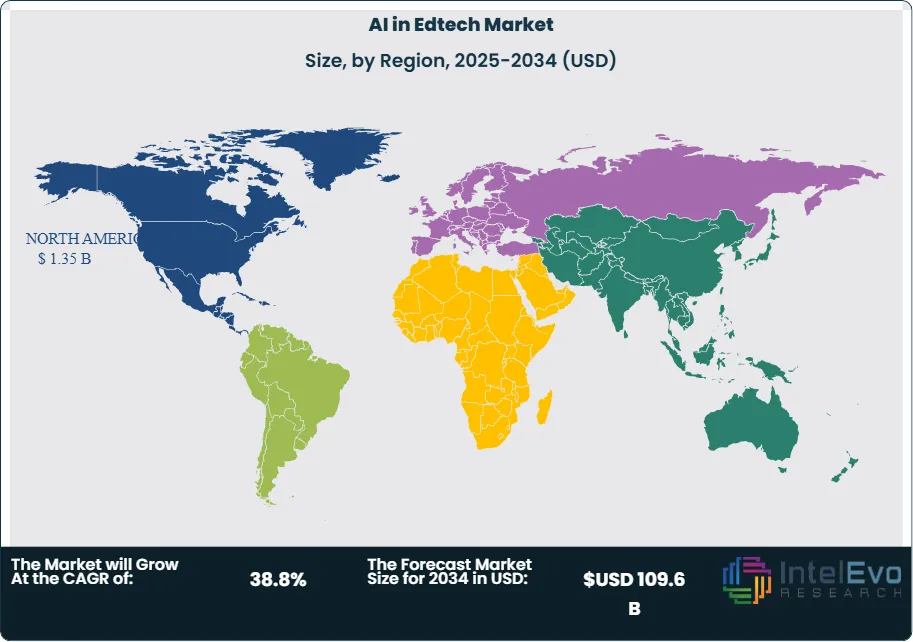
North America continues to lead the AI in Edtech market, holding more than 37% of global share in 2025 and generating an estimated USD 1.35 billion in revenues. This leadership stems from the region’s strong technology ecosystem, deep R&D investments, and widespread adoption of digital tools across educational institutions. The presence of global tech leaders and specialized AI startups has accelerated innovation, with partnerships between universities, schools, and private sector players fostering advanced digital learning ecosystems.
The region’s focus on personalized, data-driven learning models aligns well with AI’s capabilities, while government-backed STEM education initiatives further boost adoption. Moreover, the growing demand for skills-based education and professional retraining has reinforced AI’s role in addressing both academic and vocational learning needs.
While North America remains the global frontrunner, Asia-Pacific is emerging as the fastest-growing region, fueled by expanding student populations, government-backed Edtech initiatives, and rising venture capital investment in countries such as India and China. Together, these dynamics highlight a global market that is both consolidated in leadership and rapidly expanding into new growth frontiers.
Get More Information about this report -
Request Free Sample ReportKey Market Segments
By Deployment
- Cloud
- On-Premise
By Application
- Content Creation
- Personalized Learning
- Assessment and Testing
- Other Applications
By End-User
- Schools
- Colleges and Universities
- Corporate Training Centers
- Government and Non-profit Organizations
Regions
- North America
- Latin America
- East Asia And Pacific
- Sea And South Asia
- Eastern Europe
- Western Europe
- Middle East & Africa
| Report Attribute | Details |
| Market size (2024) | USD 4.3 B |
| Forecast Revenue (2034) | USD 109.6 B |
| CAGR (2024-2034) | 38.8% |
| Historical data | 2020-2023 |
| Base Year For Estimation | 2024 |
| Forecast Period | 2025-2034 |
| Report coverage | Revenue Forecast, Competitive Landscape, Market Dynamics, Growth Factors, Trends and Recent Developments |
| Segments covered | By Deployment (Cloud, On-Premise), By Application (Content Creation, Personalized Learning, Assessment and Testing, Other Applications), By End-User (Schools, Colleges and Universities, Corporate Training Centers, Government and Non-profit Organizations) |
| Research Methodology |
|
| Regional scope |
|
| Competitive Landscape | Google, Microsoft, Magic Edtech, Amazon, Century, Querium, Cognii, Inc., John Wiley & Sons Inc., Carnegie Learning, ALEKS, Squirrel AI, Other Key Players |
| Customization Scope | Customization for segments, region/country-level will be provided. Moreover, additional customization can be done based on the requirements. |
| Pricing and Purchase Options | Avail customized purchase options to meet your exact research needs. We have three licenses to opt for: Single User License, Multi-User License (Up to 5 Users), Corporate Use License (Unlimited User and Printable PDF). |


Frequently Asked Questions
How big is the AI in Edtech Market?
The AI in EdTech Market is projected to grow from USD 4.3 Billion in 2024 to USD 109.6 Billion by 2034, at a CAGR of 38.8%. AI-powered adaptive learning, smart tutoring systems, and data-driven teaching models are transforming global education through personalized and accessible digital learning solutions.
Who are the major players in the AI in Edtech Market?
Google, Microsoft, Magic Edtech, Amazon, Century, Querium, Cognii, Inc., John Wiley & Sons Inc., Carnegie Learning, ALEKS, Squirrel AI, Other Key Players
Which segments covered the AI in Edtech Market?
By Deployment (Cloud, On-Premise), By Application (Content Creation, Personalized Learning, Assessment and Testing, Other Applications), By End-User (Schools, Colleges and Universities, Corporate Training Centers, Government and Non-profit Organizations)
How can this market research report help my business make strategic decisions?
Our market research reports provide actionable intelligence, including verified market size data, CAGR projections, competitive benchmarking, and segment-level opportunity analysis. These insights support strategic planning, investment decisions, product development, and market entry strategies for enterprises and startups alike.
How frequently is the data updated?
We continuously monitor industry developments and update our reports to reflect regulatory changes, technological advancements, and macroeconomic shifts. Updated editions ensure you receive the latest market intelligence.

Select Licence Type
Connect with our sales team

Why IntelEvoResearch
100%
Customer
Satisfaction
24x7+
Availability - we are always
there when you need us
200+
Fortune 50 Companies trust
IntelEvoResearch
80%
of our reports are exclusive
and first in the industry
100%
more data
and analysis
1000+
reports published
till date
