
AI in Sampler Market Size, Share & Growth Forecast | 9.2% CAGR
Global AI in Sampler Market Size, Share & Analysis By Product Type (Portable, Desktop, Others), By Technique (Impact Air Sampler, Surface Air Sampler, Impinge Air Sampler, Real-Time Samplers, Compressed Air Sample, Others), By Application (Research and Academic Institutes, Pharmaceutical, Hospitals, Food and Beverages, Others), By Distribution Channel (Direct Sales, Indirect Sales) Industry Overview, Market Dynamics, Automation Trends, Competitive Landscape & Forecast 2025–2034
The Air Sampler Market is projected to grow from USD 265.4 Million in 2024 to approximately USD 614.7 Million by 2034, expanding at a CAGR of around 9.2% during 2025–2034. Rising global concerns over air quality and workplace safety are driving strong adoption of advanced air sampling devices across healthcare, pharmaceuticals, and environmental monitoring sectors. Stringent regulatory standards for pollution control and contamination assessment are further propelling product innovation and market expansion.
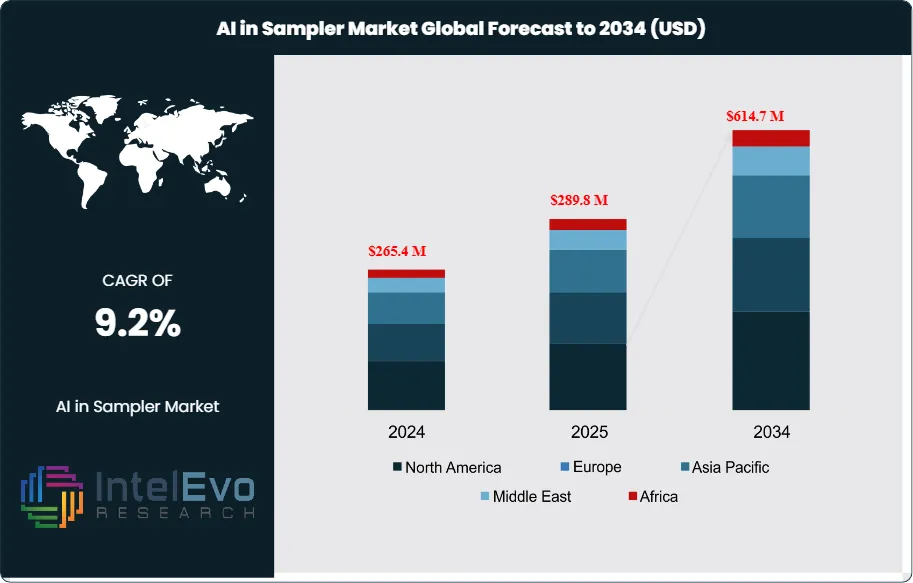
With increasing focus on smart, portable, and automated air sampling solutions, manufacturers are aligning with sustainability and digital monitoring trends worldwide. This driven by stricter air quality regulations and heightened focus on environmental and occupational health, offering strategic opportunities for equipment manufacturers, healthcare providers, and industrial operators.
Air sampling technologies are essential for assessing airborne pollutants, contaminants, and gases, making them indispensable tools in safeguarding public health, ensuring workplace safety, and enabling regulatory compliance. The market has evolved significantly as governments, industries, and environmental bodies increase investments in monitoring infrastructure to address rising concerns about pollution, climate change, and workplace exposure risks.
Product diversity remains a defining feature of the market. Active samplers, which mechanically draw air through filters, are widely adopted for their precision in environmental monitoring, while passive samplers, which capture particles through natural diffusion, provide cost-effective solutions for long-term exposure studies. High-volume samplers are extensively used in environmental applications for detecting trace pollutants at low concentrations, whereas compact, personal samplers are gaining traction in occupational health to monitor worker exposure to hazardous particulates.
Growth in this market is underpinned by a combination of regulatory pressure and increasing awareness of air quality’s direct impact on health outcomes. Industries such as pharmaceuticals, healthcare, construction, and manufacturing are expanding the use of advanced air samplers to comply with stringent standards and minimize liability associated with unsafe air conditions. However, the high cost of advanced devices and calibration requirements present adoption challenges, particularly in cost-sensitive regions.
Technological innovation continues to reshape the competitive landscape. Modern air samplers are increasingly equipped with digital interfaces, wireless connectivity, and enhanced sensitivity, enabling real-time monitoring and integration with broader environmental data systems. These advancements not only improve the accuracy of pollutant detection but also support predictive modeling and faster regulatory reporting.
Regionally, North America and Europe represent mature markets due to strict environmental frameworks and occupational health laws, while Asia-Pacific is emerging as a high-growth region, driven by rapid industrialization, urban pollution, and government-led air quality initiatives. Looking ahead, the market’s trajectory will be shaped by the convergence of stricter regulation, technological sophistication, and growing global demand for air quality solutions that balance efficiency, compliance, and cost-effectiveness.
Market Growth: The global Air Sampler Market, valued at USD 265.4 Million in 2024, is projected to reach USD 614.7 Million by 2034, expanding at a CAGR of 9.2%. Growth is driven by rising regulatory scrutiny on air quality, increasing environmental awareness, and heightened demand for workplace safety monitoring.
Product Type: Portable air samplers represented more than 69.1% of global revenues in 2023, supported by their mobility, ease of deployment, and suitability for both occupational and environmental applications. Their adoption continues to rise in healthcare and construction sectors where on-site monitoring is critical.
Technique: Impact air samplers accounted for over 36.5% of the market in 2023, favored for their accuracy in capturing biological and particulate matter. Their reliability in pharmaceutical cleanrooms and food safety testing reinforces their leadership.
Application: Research and academic institutes generated 35.5% of global demand in 2023, reflecting extensive use of air samplers in environmental monitoring, epidemiological studies, and laboratory-based air quality assessments.
Distribution Channel: Indirect sales channels held a dominant 70.2% market share in 2023, with distributors providing broad access and technical support across diverse geographies.
Driver: Stricter international air quality standards and occupational health regulations are compelling organizations to invest in advanced air sampling technologies for compliance and risk mitigation.
Restraint: High acquisition and maintenance costs of advanced air sampling devices limit adoption in cost-sensitive markets, particularly among small enterprises and government agencies in developing regions.
Opportunity: Asia-Pacific presents significant growth opportunities, with rapid industrialization, urban pollution challenges, and expanding pharmaceutical and healthcare industries driving accelerated adoption of air samplers.
Trend: Integration of digital features such as real-time monitoring, IoT connectivity, and cloud-based analytics is reshaping product development, enabling faster decision-making and predictive air quality assessments.
Regional Analysis: Asia-Pacific led the market with a 36.7% share in 2023, fueled by healthcare and pharmaceutical demand, while North America and Europe remain strong due to established regulatory frameworks. Emerging economies in Latin America and the Middle East are expected to adopt air sampling solutions more actively in response to rising urban pollution levels.
Product Analysis
As of 2025, portable air samplers continue to dominate the market, accounting for more than two-thirds of global revenues. Their versatility, ease of deployment, and ability to provide on-site measurements make them indispensable across diverse settings, ranging from industrial plants to outdoor monitoring stations. Their growing role in occupational safety assessments and rapid environmental testing further underpins demand.
Desktop air samplers, while less mobile, maintain a critical role in laboratories, cleanrooms, and controlled manufacturing facilities. These systems are valued for their precision in continuous monitoring, ensuring compliance with stringent air quality standards in highly sensitive environments such as pharmaceuticals and biotechnology.
Other product categories, including high-volume samplers and bioaerosol-specific devices, address niche requirements such as environmental research and infection control in healthcare. Although smaller in share, these specialized systems remain strategically important for sectors with unique monitoring challenges.
Technique Analysis
Impact air samplers remain the leading technique in 2025, capturing over one-third of market share. Their effectiveness in detecting a wide spectrum of airborne particles ensures widespread use in environmental surveillance and workplace safety programs.
Surface air samplers are increasingly adopted in industries with strict sterility demands, such as pharmaceuticals and food production, where they play a crucial role in contamination prevention. Similarly, impinge air samplers, which capture particles in liquid media, remain highly relevant in R&D applications requiring detailed chemical or biological analysis.
Real-time samplers are gaining momentum as urban pollution and industrial emissions drive demand for instantaneous data. These devices enable quick decision-making by providing continuous feedback on air quality. In parallel, compressed air samplers are becoming standard in industrial facilities, where clean compressed air is essential for ensuring equipment longevity and maintaining product quality.
Application Analysis
Research and academic institutions continue to represent the largest end-user segment, contributing over one-third of market revenues in 2025. Their reliance on air sampling technologies for advanced studies in environmental science, epidemiology, and occupational health underscores their strategic importance.
The pharmaceutical sector remains a critical driver of demand, as air samplers are essential in sterile manufacturing environments. Strict global regulatory requirements around contamination control are accelerating adoption across production lines. Hospitals also rely heavily on these technologies to monitor airborne pathogens, reinforcing infection control protocols and ensuring safer patient care environments.
In the food and beverage sector, air samplers safeguard product integrity by detecting airborne contaminants that could compromise safety or shelf life. With stricter global food safety standards, this segment is experiencing steady growth, as producers increasingly view air monitoring as an integral part of quality assurance.
Distribution Channel Analysis
In 2025, indirect sales channels remain dominant, accounting for more than 70% of global distribution. Established networks of distributors and resellers provide manufacturers with broad market access, particularly in regions where direct manufacturer presence is limited. This approach has proven effective in scaling availability and servicing demand across both developed and emerging markets.
Direct sales, while smaller in share, remain highly strategic. Large enterprises and specialized industries often prefer direct engagement with manufacturers to secure customized solutions, ongoing technical support, and faster response times. For companies producing high-performance or niche devices, direct sales continue to serve as a channel for differentiation and client retention.
Regional Analysis
Asia-Pacific leads the global air sampler market with a share exceeding one-third, supported by rapid industrialization, heightened environmental concerns, and expanding pharmaceutical manufacturing capacity. Countries such as China, India, Japan, and South Korea are central to this growth, as rising investments in healthcare infrastructure and stricter air quality regulations accelerate adoption. The region is projected to surpass USD 90 million in value by the close of the forecast period.
North America remains a mature yet steadily growing market, characterized by robust healthcare infrastructure, strong regulatory enforcement, and early adoption of advanced sampling technologies. Demand is particularly high in pharmaceutical manufacturing, cleanroom applications, and occupational safety programs. Europe, meanwhile, continues to prioritize air quality monitoring in line with its stringent environmental and workplace health standards, sustaining a strong position in the global landscape.
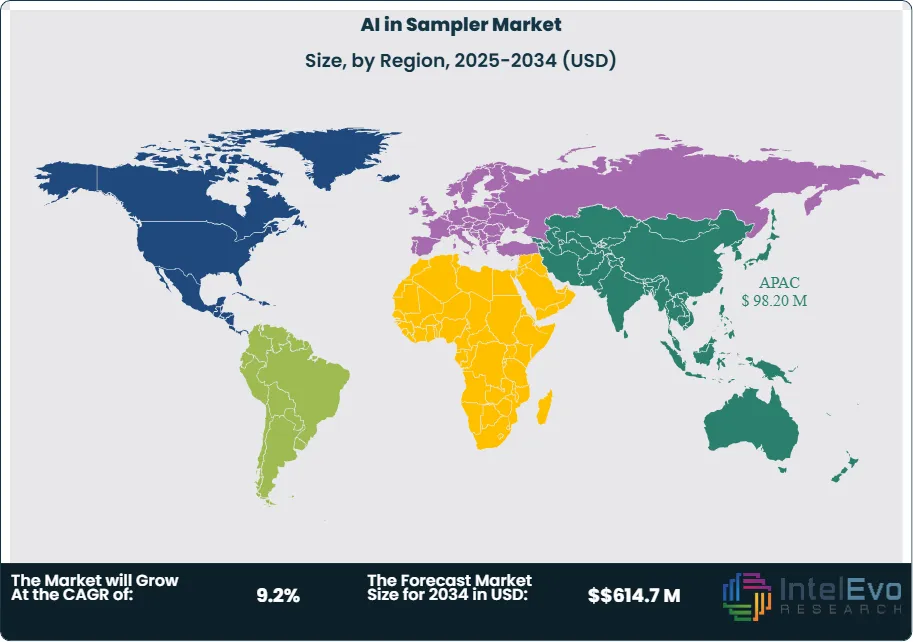
By Product Type (Portable, Desktop, Others), By Technique (Impact Air Sampler, Surface Air Sampler, Impinge Air Sampler, Real-Time Samplers, Compressed Air Sample, Others), By Application (Research and Academic Institutes, Pharmaceutical, Hospitals, Food and Beverages, Others), By Distribution Channel (Direct Sales, Indirect Sales)
Research Methodology
Primary Research- 100 Interviews of Stakeholders
Secondary Research
Desk Research
Regional scope
North America (United States, Canada, Mexico)
Latin America (Brazil, Argentina, Columbia)
East Asia And Pacific (China, Japan, South Korea, Australia, Cambodia, Fiji, Indonesia)
Sea And South Asia (India, Singapore, Thailand, Taiwan, Malaysia)
Eastern Europe (Poland, Russia, Czech Republic, Romania)
Western Europe (Germany, U.K., France, Spain, Itlay)
Middle East & Africa (GCC Countries, Egypt, Nigeria, South Africa, Israel)
Customization for segments, region/country-level will be provided. Moreover, additional customization can be done based on the requirements.
Pricing and Purchase Options
Avail customized purchase options to meet your exact research needs. We have three licenses to opt for: Single User License, Multi-User License (Up to 5 Users), Corporate Use License (Unlimited User and Printable PDF).
TABLE OF CONTENTS
1. EXECUTIVE SUMMARY
1.1. MARKET SNAPSHOT
1.2. KEY FINDINGS & INSIGHTS
1.3. ANALYST RECOMMENDATIONS
1.4. FUTURE OUTLOOK
2. RESEARCH METHODOLOGY
2.1. MARKET DEFINITION & SCOPE
2.2. RESEARCH OBJECTIVES: PRIMARY & SECONDARY DATA SOURCES
2.3. DATA COLLECTION SOURCES
2.3.1. COVERAGE OF 100+ PRIMARY RESEARCH/CONSULTATION CALLS WITH INDUSTRY STAKEHOLDERS
FIGURE 17 NORTH AMERICA AI IN SAMPLER CURRENT AND FUTURE TYPE ANALYSIS, 2025–2034, (USD MILLION)
FIGURE 18 NORTH AMERICA AI IN SAMPLER CURRENT AND FUTURE END USER ANALYSIS, 2025–2034, (USD MILLION)
FIGURE 19 MARKET SHARE BY COUNTRY
FIGURE 20 LATIN AMERICA AI IN SAMPLER CURRENT AND FUTURE TYPE ANALYSIS, 2025–2034, (USD MILLION)
FIGURE 21 LATIN AMERICA AI IN SAMPLER CURRENT AND FUTURE END USER ANALYSIS, 2025–2034, (USD MILLION)
FIGURE 22 MARKET SHARE BY COUNTRY
FIGURE 23 EASTERN EUROPE AI IN SAMPLER CURRENT AND FUTURE TYPE ANALYSIS, 2025–2034, (USD MILLION)
FIGURE 24 EASTERN EUROPE AI IN SAMPLER CURRENT AND FUTURE END USER ANALYSIS, 2025–2034, (USD MILLION)
FIGURE 25 MARKET SHARE BY COUNTRY
FIGURE 26 WESTERN EUROPE AI IN SAMPLER CURRENT AND FUTURE TYPE ANALYSIS, 2025–2034, (USD MILLION)
FIGURE 27 WESTERN EUROPE AI IN SAMPLER CURRENT AND FUTURE END USER ANALYSIS, 2025–2034, (USD MILLION)
FIGURE 28 MARKET SHARE BY COUNTRY
FIGURE 29 EAST ASIA AND PACIFIC AI IN SAMPLER CURRENT AND FUTURE TYPE ANALYSIS, 2025–2034, (USD MILLION)
FIGURE 30 EAST ASIA AND PACIFIC AI IN SAMPLER CURRENT AND FUTURE END USER ANALYSIS, 2025–2034, (USD MILLION)
FIGURE 31 MARKET SHARE BY COUNTRY
FIGURE 32 SEA AND SOUTH ASIA AI IN SAMPLER CURRENT AND FUTURE TYPE ANALYSIS, 2025–2034, (USD MILLION)
FIGURE 33 SEA AND SOUTH ASIA AI IN SAMPLER CURRENT AND FUTURE END USER ANALYSIS, 2025–2034, (USD MILLION)
FIGURE 34 MARKET SHARE BY COUNTRY
FIGURE 35 MIDDLE EAST AND AFRICA AI IN SAMPLER CURRENT AND FUTURE TYPE ANALYSIS, 2025–2034, (USD MILLION)
FIGURE 36 MIDDLE EAST AND AFRICA AI IN SAMPLER CURRENT AND FUTURE END USER ANALYSIS, 2025–2034, (USD MILLION)
FIGURE 37 NORTH AMERICA AI IN SAMPLER CURRENT AND FUTURE MARKET VOLUME SHARE REGIONAL ANALYSIS, 2025–2034, (USD MILLION)
FIGURE 38 U.S. AI IN SAMPLER CURRENT AND FUTURE TYPE ANALYSIS, 2025–2034, (USD MILLION)
FIGURE 39 U.S. AI IN SAMPLER CURRENT AND FUTURE END USER ANALYSIS, 2025–2034, (USD MILLION)
FIGURE 40 CANADA AI IN SAMPLER CURRENT AND FUTURE TYPE ANALYSIS, 2025–2034, (USD MILLION)
FIGURE 41 CANADA AI IN SAMPLER CURRENT AND FUTURE END USER ANALYSIS, 2025–2034, (USD MILLION)
FIGURE 42 LATIN AMERICA AI IN SAMPLER CURRENT AND FUTURE MARKET VOLUME SHARE REGIONAL ANALYSIS, 2025–2034, (USD MILLION)
FIGURE 43 MEXICO AI IN SAMPLER CURRENT AND FUTURE TYPE ANALYSIS, 2025–2034, (USD MILLION)
FIGURE 44 MEXICO AI IN SAMPLER CURRENT AND FUTURE END USER ANALYSIS, 2025–2034, (USD MILLION)
FIGURE 45 BRAZIL AI IN SAMPLER CURRENT AND FUTURE TYPE ANALYSIS, 2025–2034, (USD MILLION)
FIGURE 46 BRAZIL AI IN SAMPLER CURRENT AND FUTURE END USER ANALYSIS, 2025–2034, (USD MILLION)
FIGURE 47 ARGENTINA AI IN SAMPLER CURRENT AND FUTURE TYPE ANALYSIS, 2025–2034, (USD MILLION)
FIGURE 48 ARGENTINA AI IN SAMPLER CURRENT AND FUTURE END USER ANALYSIS, 2025–2034, (USD MILLION)
FIGURE 49 COLUMBIA AI IN SAMPLER CURRENT AND FUTURE TYPE ANALYSIS, 2025–2034, (USD MILLION)
FIGURE 50 COLUMBIA AI IN SAMPLER CURRENT AND FUTURE END USER ANALYSIS, 2025–2034, (USD MILLION)
FIGURE 51 REST OF LATIN AMERICA AI IN SAMPLER CURRENT AND FUTURE TYPE ANALYSIS, 2025–2034, (USD MILLION)
FIGURE 52 REST OF LATIN AMERICA AI IN SAMPLER CURRENT AND FUTURE END USER ANALYSIS, 2025–2034, (USD MILLION)
FIGURE 53 EASTERN EUROPE AI IN SAMPLER CURRENT AND FUTURE MARKET VOLUME SHARE REGIONAL ANALYSIS, 2025–2034, (USD MILLION)
FIGURE 54 POLAND AI IN SAMPLER CURRENT AND FUTURE TYPE ANALYSIS, 2025–2034, (USD MILLION)
FIGURE 55 POLAND AI IN SAMPLER CURRENT AND FUTURE END USER ANALYSIS, 2025–2034, (USD MILLION)
FIGURE 56 RUSSIA AI IN SAMPLER CURRENT AND FUTURE TYPE ANALYSIS, 2025–2034, (USD MILLION)
FIGURE 57 RUSSIA AI IN SAMPLER CURRENT AND FUTURE END USER ANALYSIS, 2025–2034, (USD MILLION)
FIGURE 58 CZECH REPUBLIC AI IN SAMPLER CURRENT AND FUTURE TYPE ANALYSIS, 2025–2034, (USD MILLION)
FIGURE 59 CZECH REPUBLIC AI IN SAMPLER CURRENT AND FUTURE END USER ANALYSIS, 2025–2034, (USD MILLION)
FIGURE 60 ROMANIA AI IN SAMPLER CURRENT AND FUTURE TYPE ANALYSIS, 2025–2034, (USD MILLION)
FIGURE 61 ROMANIA AI IN SAMPLER CURRENT AND FUTURE END USER ANALYSIS, 2025–2034, (USD MILLION)
FIGURE 62 REST OF EASTERN EUROPE AI IN SAMPLER CURRENT AND FUTURE TYPE ANALYSIS, 2025–2034, (USD MILLION)
FIGURE 63 REST OF EASTERN EUROPE AI IN SAMPLER CURRENT AND FUTURE END USER ANALYSIS, 2025–2034, (USD MILLION)
FIGURE 64 WESTERN EUROPE AI IN SAMPLER CURRENT AND FUTURE MARKET VOLUME SHARE REGIONAL ANALYSIS, 2025–2034, (USD MILLION)
FIGURE 65 GERMANY AI IN SAMPLER CURRENT AND FUTURE TYPE ANALYSIS, 2025–2034, (USD MILLION)
FIGURE 66 GERMANY AI IN SAMPLER CURRENT AND FUTURE END USER ANALYSIS, 2025–2034, (USD MILLION)
FIGURE 67 FRANCE AI IN SAMPLER CURRENT AND FUTURE TYPE ANALYSIS, 2025–2034, (USD MILLION)
FIGURE 68 FRANCE AI IN SAMPLER CURRENT AND FUTURE END USER ANALYSIS, 2025–2034, (USD MILLION)
FIGURE 69 UK AI IN SAMPLER CURRENT AND FUTURE TYPE ANALYSIS, 2025–2034, (USD MILLION)
FIGURE 70 UK AI IN SAMPLER CURRENT AND FUTURE END USER ANALYSIS, 2025–2034, (USD MILLION)
FIGURE 71 SPAIN AI IN SAMPLER CURRENT AND FUTURE TYPE ANALYSIS, 2025–2034, (USD MILLION)
FIGURE 72 SPAIN AI IN SAMPLER CURRENT AND FUTURE END USER ANALYSIS, 2025–2034, (USD MILLION)
FIGURE 73 ITALY AI IN SAMPLER CURRENT AND FUTURE TYPE ANALYSIS, 2025–2034, (USD MILLION)
FIGURE 74 ITALY AI IN SAMPLER CURRENT AND FUTURE END USER ANALYSIS, 2025–2034, (USD MILLION)
FIGURE 75 REST OF WESTERN EUROPE AI IN SAMPLER CURRENT AND FUTURE TYPE ANALYSIS, 2025–2034, (USD MILLION)
FIGURE 76 REST OF WESTERN EUROPE AI IN SAMPLER CURRENT AND FUTURE END USER ANALYSIS, 2025–2034, (USD MILLION)
FIGURE 77 EAST ASIA AND PACIFIC AI IN SAMPLER CURRENT AND FUTURE MARKET VOLUME SHARE REGIONAL ANALYSIS, 2025–2034, (USD MILLION)
FIGURE 78 CHINA AI IN SAMPLER CURRENT AND FUTURE TYPE ANALYSIS, 2025–2034, (USD MILLION)
FIGURE 79 CHINA AI IN SAMPLER CURRENT AND FUTURE END USER ANALYSIS, 2025–2034, (USD MILLION)
FIGURE 80 JAPAN AI IN SAMPLER CURRENT AND FUTURE TYPE ANALYSIS, 2025–2034, (USD MILLION)
FIGURE 81 JAPAN AI IN SAMPLER CURRENT AND FUTURE END USER ANALYSIS, 2025–2034, (USD MILLION)
FIGURE 82 AUSTRALIA AI IN SAMPLER CURRENT AND FUTURE TYPE ANALYSIS, 2025–2034, (USD MILLION)
FIGURE 83 AUSTRALIA AI IN SAMPLER CURRENT AND FUTURE END USER ANALYSIS, 2025–2034, (USD MILLION)
FIGURE 84 CAMBODIA AI IN SAMPLER CURRENT AND FUTURE TYPE ANALYSIS, 2025–2034, (USD MILLION)
FIGURE 85 CAMBODIA AI IN SAMPLER CURRENT AND FUTURE END USER ANALYSIS, 2025–2034, (USD MILLION)
FIGURE 86 FIJI AI IN SAMPLER CURRENT AND FUTURE TYPE ANALYSIS, 2025–2034, (USD MILLION)
FIGURE 87 FIJI AI IN SAMPLER CURRENT AND FUTURE END USER ANALYSIS, 2025–2034, (USD MILLION)
FIGURE 88 INDONESIA AI IN SAMPLER CURRENT AND FUTURE TYPE ANALYSIS, 2025–2034, (USD MILLION)
FIGURE 89 INDONESIA AI IN SAMPLER CURRENT AND FUTURE END USER ANALYSIS, 2025–2034, (USD MILLION)
FIGURE 90 SOUTH KOREA AI IN SAMPLER CURRENT AND FUTURE TYPE ANALYSIS, 2025–2034, (USD MILLION)
FIGURE 91 SOUTH KOREA AI IN SAMPLER CURRENT AND FUTURE END USER ANALYSIS, 2025–2034, (USD MILLION)
FIGURE 92 REST OF EAST ASIA AND PACIFIC AI IN SAMPLER CURRENT AND FUTURE TYPE ANALYSIS, 2025–2034, (USD MILLION)
FIGURE 93 REST OF EAST ASIA AND PACIFIC AI IN SAMPLER CURRENT AND FUTURE END USER ANALYSIS, 2025–2034, (USD MILLION)
FIGURE 94 SEA AND SOUTH ASIA AI IN SAMPLER CURRENT AND FUTURE MARKET VOLUME SHARE REGIONAL ANALYSIS, 2025–2034, (USD MILLION)
FIGURE 95 BANGLADESH AI IN SAMPLER CURRENT AND FUTURE TYPE ANALYSIS, 2025–2034, (USD MILLION)
FIGURE 96 BANGLADESH AI IN SAMPLER CURRENT AND FUTURE END USER ANALYSIS, 2025–2034, (USD MILLION)
FIGURE 97 NEW ZEALAND AI IN SAMPLER CURRENT AND FUTURE TYPE ANALYSIS, 2025–2034, (USD MILLION)
FIGURE 98 NEW ZEALAND AI IN SAMPLER CURRENT AND FUTURE END USER ANALYSIS, 2025–2034, (USD MILLION)
FIGURE 99 INDIA AI IN SAMPLER CURRENT AND FUTURE TYPE ANALYSIS, 2025–2034, (USD MILLION)
FIGURE 100 INDIA AI IN SAMPLER CURRENT AND FUTURE END USER ANALYSIS, 2025–2034, (USD MILLION)
FIGURE 101 SINGAPORE AI IN SAMPLER CURRENT AND FUTURE TYPE ANALYSIS, 2025–2034, (USD MILLION)
FIGURE 102 SINGAPORE AI IN SAMPLER CURRENT AND FUTURE END USER ANALYSIS, 2025–2034, (USD MILLION)
FIGURE 103 THAILAND AI IN SAMPLER CURRENT AND FUTURE TYPE ANALYSIS, 2025–2034, (USD MILLION)
FIGURE 104 THAILAND AI IN SAMPLER CURRENT AND FUTURE END USER ANALYSIS, 2025–2034, (USD MILLION)
FIGURE 105 TAIWAN AI IN SAMPLER CURRENT AND FUTURE TYPE ANALYSIS, 2025–2034, (USD MILLION)
FIGURE 106 TAIWAN AI IN SAMPLER CURRENT AND FUTURE END USER ANALYSIS, 2025–2034, (USD MILLION)
FIGURE 107 MALAYSIA AI IN SAMPLER CURRENT AND FUTURE TYPE ANALYSIS, 2025–2034, (USD MILLION)
FIGURE 108 MALAYSIA AI IN SAMPLER CURRENT AND FUTURE END USER ANALYSIS, 2025–2034, (USD MILLION)
FIGURE 109 REST OF SEA AND SOUTH ASIA AI IN SAMPLER CURRENT AND FUTURE TYPE ANALYSIS, 2025–2034, (USD MILLION)
FIGURE 110 REST OF SEA AND SOUTH ASIA AI IN SAMPLER CURRENT AND FUTURE END USER ANALYSIS, 2025–2034, (USD MILLION)
FIGURE 111 MIDDLE EAST AND AFRICA AI IN SAMPLER CURRENT AND FUTURE MARKET VOLUME SHARE REGIONAL ANALYSIS, 2025–2034, (USD MILLION)
FIGURE 112 GCC COUNTRIES AI IN SAMPLER CURRENT AND FUTURE TYPE ANALYSIS, 2025–2034, (USD MILLION)
FIGURE 113 GCC COUNTRIES AI IN SAMPLER CURRENT AND FUTURE END USER ANALYSIS, 2025–2034, (USD MILLION)
FIGURE 114 SAUDI ARABIA AI IN SAMPLER CURRENT AND FUTURE TYPE ANALYSIS, 2025–2034, (USD MILLION)
FIGURE 115 SAUDI ARABIA AI IN SAMPLER CURRENT AND FUTURE END USER ANALYSIS, 2025–2034, (USD MILLION)
FIGURE 116 UAE AI IN SAMPLER CURRENT AND FUTURE TYPE ANALYSIS, 2025–2034, (USD MILLION)
FIGURE 117 UAE AI IN SAMPLER CURRENT AND FUTURE END USER ANALYSIS, 2025–2034, (USD MILLION)
FIGURE 118 BAHRAIN AI IN SAMPLER CURRENT AND FUTURE TYPE ANALYSIS, 2025–2034, (USD MILLION)
FIGURE 119 BAHRAIN AI IN SAMPLER CURRENT AND FUTURE END USER ANALYSIS, 2025–2034, (USD MILLION)
FIGURE 120 KUWAIT AI IN SAMPLER CURRENT AND FUTURE TYPE ANALYSIS, 2025–2034, (USD MILLION)
FIGURE 121 KUWAIT AI IN SAMPLER CURRENT AND FUTURE END USER ANALYSIS, 2025–2034, (USD MILLION)
FIGURE 122 OMAN AI IN SAMPLER CURRENT AND FUTURE TYPE ANALYSIS, 2025–2034, (USD MILLION)
FIGURE 123 OMAN AI IN SAMPLER CURRENT AND FUTURE END USER ANALYSIS, 2025–2034, (USD MILLION)
FIGURE 124 QATAR AI IN SAMPLER CURRENT AND FUTURE TYPE ANALYSIS, 2025–2034, (USD MILLION)
FIGURE 125 QATAR AI IN SAMPLER CURRENT AND FUTURE END USER ANALYSIS, 2025–2034, (USD MILLION)
FIGURE 126 EGYPT AI IN SAMPLER CURRENT AND FUTURE TYPE ANALYSIS, 2025–2034, (USD MILLION)
FIGURE 127 EGYPT AI IN SAMPLER CURRENT AND FUTURE END USER ANALYSIS, 2025–2034, (USD MILLION)
FIGURE 128 NIGERIA AI IN SAMPLER CURRENT AND FUTURE TYPE ANALYSIS, 2025–2034, (USD MILLION)
FIGURE 129 NIGERIA AI IN SAMPLER CURRENT AND FUTURE END USER ANALYSIS, 2025–2034, (USD MILLION)
FIGURE 130 SOUTH AFRICA AI IN SAMPLER CURRENT AND FUTURE TYPE ANALYSIS, 2025–2034, (USD MILLION)
FIGURE 131 SOUTH AFRICA AI IN SAMPLER CURRENT AND FUTURE END USER ANALYSIS, 2025–2034, (USD MILLION)
FIGURE 132 ISRAEL AI IN SAMPLER CURRENT AND FUTURE TYPE ANALYSIS, 2025–2034, (USD MILLION)
FIGURE 133 ISRAEL AI IN SAMPLER CURRENT AND FUTURE END USER ANALYSIS, 2025–2034, (USD MILLION)
FIGURE 134 REST OF MEA AI IN SAMPLER CURRENT AND FUTURE TYPE ANALYSIS, 2025–2034, (USD MILLION)
FIGURE 135 REST OF MEA AI IN SAMPLER CURRENT AND FUTURE END USER ANALYSIS, 2025–2034, (USD MILLION)
FIGURE 136 U. S. MARKET SHARE ANALYSIS BY TYPE (2024)
FIGURE 137 U. S. MARKET SHARE ANALYSIS BY END USER (2024)
FIGURE 138 CANADA MARKET SHARE ANALYSIS BY TYPE (2024)
FIGURE 139 CANADA MARKET SHARE ANALYSIS BY END USER (2024)
FIGURE 140 MEXICO MARKET SHARE ANALYSIS BY TYPE (2024)
FIGURE 141 MEXICO MARKET SHARE ANALYSIS BY END USER (2024)
FIGURE 142 CHINA MARKET SHARE ANALYSIS BY TYPE (2024)
FIGURE 143 CHINA MARKET SHARE ANALYSIS BY END USER (2024)
FIGURE 144 JAPAN MARKET SHARE ANALYSIS BY TYPE (2024)
FIGURE 145 JAPAN MARKET SHARE ANALYSIS BY END USER (2024)
FIGURE 146 INDIA MARKET SHARE ANALYSIS BY TYPE (2024)
FIGURE 147 INDIA MARKET SHARE ANALYSIS BY END USER (2024)
FIGURE 148 SOUTH KOREA MARKET SHARE ANALYSIS BY TYPE (2024)
FIGURE 149 SOUTH KOREA MARKET SHARE ANALYSIS BY END USER (2024)
FIGURE 150 SAUDI ARABIA MARKET SHARE ANALYSIS BY TYPE (2024)
FIGURE 151 SAUDI ARABIA MARKET SHARE ANALYSIS BY END USER (2024)
FIGURE 152 UAE MARKET SHARE ANALYSIS BY TYPE (2024)
FIGURE 153 UAE MARKET SHARE ANALYSIS BY END USER (2024)
FIGURE 154 EGYPT MARKET SHARE ANALYSIS BY TYPE (2024)
FIGURE 155 EGYPT MARKET SHARE ANALYSIS BY END USER (2024)
FIGURE 156 NIGERIA MARKET SHARE ANALYSIS BY TYPE (2024)
FIGURE 157 NIGERIA MARKET SHARE ANALYSIS BY END USER (2024)
FIGURE 158 SOUTH AFRICA MARKET SHARE ANALYSIS BY TYPE (2024)
FIGURE 159 SOUTH AFRICA MARKET SHARE ANALYSIS BY END USER (2024)
FIGURE 160 GERMANY MARKET SHARE ANALYSIS BY TYPE (2024)
FIGURE 161 GERMANY MARKET SHARE ANALYSIS BY END USER (2024)
FIGURE 162 FRANCE MARKET SHARE ANALYSIS BY TYPE (2024)
FIGURE 163 FRANCE MARKET SHARE ANALYSIS BY END USER (2024)
FIGURE 164 UK MARKET SHARE ANALYSIS BY TYPE (2024)
FIGURE 165 UK MARKET SHARE ANALYSIS BY END USER (2024)
FIGURE 166 SPAIN MARKET SHARE ANALYSIS BY TYPE (2024)
FIGURE 167 SPAIN MARKET SHARE ANALYSIS BY END USER (2024)
FIGURE 168 ITALY MARKET SHARE ANALYSIS BY TYPE (2024)
FIGURE 169 ITALY MARKET SHARE ANALYSIS BY END USER (2024)
FIGURE 170 BRAZIL MARKET SHARE ANALYSIS BY TYPE (2024)
FIGURE 171 BRAZIL MARKET SHARE ANALYSIS BY END USER (2024)
FIGURE 172 ARGENTINA MARKET SHARE ANALYSIS BY TYPE (2024)
FIGURE 173 ARGENTINA MARKET SHARE ANALYSIS BY END USER (2024)
FIGURE 174 COLUMBIA MARKET SHARE ANALYSIS BY TYPE (2024)
FIGURE 175 COLUMBIA MARKET SHARE ANALYSIS BY END USER (2024)
FIGURE 176 GLOBAL AI IN SAMPLER CURRENT AND FUTURE MARKET KEY COUNTRY LEVEL ANALYSIS, 2024–2034, (USD MILLION)
FIGURE 177 FINANCIAL OVERVIEW:
Key Player Analysis
Aquqria srl: Aquqria srl has positioned itself as a niche innovator in the air sampler market by integrating advanced digital features into compact, portable devices. In 2025, the company is increasingly leveraging AI-based analytics to enhance detection accuracy, particularly in monitoring biological contaminants in healthcare and pharmaceutical environments. Its strategic focus on mobility and user-friendly design allows it to serve both laboratory and field applications, aligning with rising demand for agile and connected monitoring solutions. By investing in IoT-enabled interfaces, Aquqria is differentiating itself as a supplier of smart, real-time air quality monitoring systems suitable for both industrial compliance and environmental research.
Beijing Jiance: Beijing Jiance has emerged as a leading player in Asia-Pacific, driven by China’s intensified regulatory enforcement around air quality and workplace safety. The company has strategically adopted AI-driven data processing to expand its product line from traditional samplers to intelligent monitoring networks capable of supporting smart city initiatives. By offering cost-efficient yet technologically robust solutions, it has captured a strong foothold in both public health monitoring and industrial safety applications. Its competitive strength lies in scaling AI-enabled systems for large deployments, making it a preferred partner for government-led environmental programs and urban air quality projects.
Bertin Technologies: Bertin Technologies is recognized as a global leader in high-performance bioaerosol and environmental monitoring systems, with strong applications in defense, healthcare, and research sectors. As of 2025, the company has enhanced its product portfolio with AI-enabled predictive analytics, enabling earlier detection of hazardous biological and chemical particles. This capability is especially relevant in pharmaceutical cleanrooms and biosafety laboratories, where sterility is mission-critical. Bertin’s integration of advanced sensors with digital twin environments and cloud-based platforms allows institutions to simulate contamination risks and improve decision-making, reinforcing its role as a premium provider in high-stakes monitoring markets.
bioMérieux: bioMérieux, traditionally dominant in microbiological testing, has increasingly positioned itself as a disruptor in the AI air sampler space by integrating microbiology expertise with machine learning. Its 2025 offerings emphasize automated detection of airborne pathogens, supporting hospitals, pharmaceutical manufacturers, and food processors in meeting stringent sterility requirements. By combining advanced air sampling with AI-enabled diagnostics, bioMérieux is creating end-to-end solutions that shorten detection times and improve accuracy. This convergence of biology and digital intelligence strengthens its market leadership in infection prevention, aligning with global priorities around public health resilience and industrial contamination control.
Market Key Players
Particle Measuring Systems
Sartorius
Aquqria srl
MBV AG
Emtek
Bertin Technologies
Tianjin Hengao
Sarstedt
LightHouse
Multitech Enviro Analytical
bioMerieux
IUL
Orum International
VWR
Beijing Jiance
SIBATA
Qingdao Junray
Climet Instruments
Driver
Stricter Air Quality Regulations Fuel Global Adoption
As of 2025, tightening global air quality regulations remain the primary catalyst for market growth. Governments and regulatory bodies are mandating stricter monitoring of airborne contaminants, particularly in industrial hubs and urban environments where pollution is a growing public health concern. This regulatory push is driving organizations in pharmaceuticals, food processing, and manufacturing to invest heavily in high-precision air samplers to maintain compliance and safeguard product integrity. Advanced systems equipped with real-time monitoring capabilities are now viewed not only as compliance tools but also as strategic assets for protecting workforce health, enhancing environmental stewardship, and strengthening corporate sustainability agendas.
Restraint
High Equipment Costs Limit Adoption in Emerging Markets
The high cost of advanced air sampling technologies continues to act as a significant barrier in 2025. Sophisticated devices with enhanced sensors, digital interfaces, and automated analytics require considerable capital investment, which many small enterprises and institutions in developing markets find prohibitive. Beyond acquisition costs, ongoing expenses such as calibration, component replacement, and technical training further add to the financial burden. This limits adoption in cost-sensitive sectors and regions where regulatory enforcement is less stringent, slowing the diffusion of next-generation solutions despite their long-term benefits.
Opportunity
Expanding Demand Across Industrializing Economies and Smart Cities
Emerging economies represent a major opportunity for market expansion. Rapid industrialization in Asia-Pacific, Latin America, and parts of Africa has intensified demand for air quality monitoring to address pollution-related health issues and to align with new regulatory standards. At the same time, large-scale smart city initiatives are creating pathways for the integration of IoT-enabled air samplers into urban infrastructure, offering real-time data for pollution management. For global manufacturers, tailoring cost-efficient, easy-to-maintain devices for these regions presents both a growth avenue and a chance to shape future air quality frameworks in rapidly developing economies.
Trend
Integration of IoT and Analytics Transforming Air Quality Monitoring
A defining trend in 2025 is the convergence of air sampling technologies with IoT and advanced analytics. Connected air samplers are increasingly deployed in networks that feed continuous, real-time data into centralized platforms, enabling predictive modeling and faster decision-making. This evolution is transforming air quality management from reactive to proactive, with applications ranging from instant alerts in industrial facilities to dynamic traffic and pollution control in urban centers. At the same time, manufacturers are developing smarter, energy-efficient samplers that integrate seamlessly with cloud platforms, offering scalability and lower operating costs. However, this shift also brings new challenges around cybersecurity and the need for skilled operators capable of managing more complex digital ecosystems.
Recent Developments
January 2025 – Bertin Technologies: Bertin introduced an upgraded version of its Coriolis bioaerosol sampler integrated with AI-driven data analytics for faster detection of airborne pathogens in pharmaceutical and hospital environments. This strengthens Bertin’s positioning as a leader in high-precision bioaerosol monitoring.
February 2025 – bioMérieux: bioMérieux announced a partnership with a European hospital consortium to deploy AI-enabled air sampling and microbial identification systems across clinical settings. The move expands the company’s influence in healthcare-driven contamination control solutions.
March 2025 – Beijing Jiance: Beijing Jiance launched a city-wide pilot project in Shanghai, deploying IoT-enabled air sampling networks to support smart city air quality management initiatives. This project highlights the company’s ability to scale intelligent monitoring solutions for urban applications.
December 2024 – Aquqria srl: Aquqria rolled out a new line of portable, cloud-connected air samplers designed for environmental research institutions, featuring real-time remote monitoring capabilities. The launch enhances its competitiveness in the academic and environmental monitoring segments.
January 2025 – Thermo Fisher Scientific (Other Key Player): Thermo Fisher expanded its environmental monitoring portfolio with the acquisition of a European air sampling technology startup, aiming to integrate advanced sensors with its laboratory testing workflows. This acquisition broadens its market presence and strengthens end-to-end contamination detection solutions.
