

- Home
- Industries
 Aerospace And Defence
 Agriculture
 Automotive And Transportation
 Banking And Finance
 Business
 Chemicals And Materials
 Consumer And Retail
 Electronics And Semiconductors
 Food And Beverages
 Machinery & Equipments
 Manufacturing And Construction
 Medical Devices
 Others
 Pharmaceuticals And Healthcare
 Power And Energy
 Sports
 Technology
- Services
- News Room
- About us
- Contact Us
-
AI in Workforce Management Market Size & Forecast 2024–2034 | 22.0% CAGR
Global AI in Workforce Management Market Size, Share, Analysis By Component (Solutions, Services), By Deployment Mode (Cloud-Based Platforms, On-Premise Systems), By Organization Size (Small and Medium-Sized Enterprises, Large Enterprises), By Industry Vertical (IT & Telecommunications, BFSI, Healthcare, Manufacturing, Retail & E-commerce, Government & Public Sector), Industry Region & Key Players – Market Dynamics, Innovation Trends, Competitive Strategies & Forecast 2025–2034

Report Overview
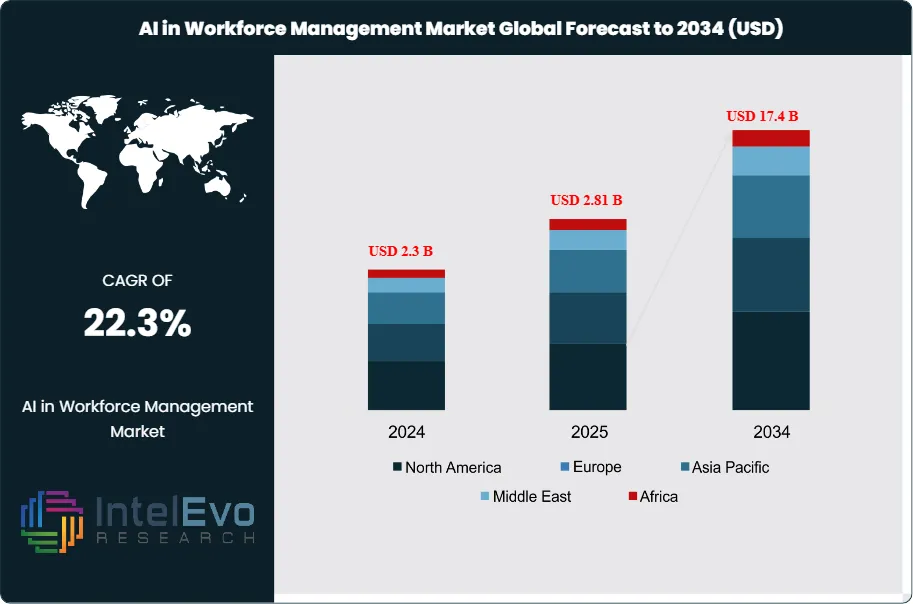
The AI in Workforce Management Market was valued at USD 2.3 Billion in 2024 and is projected to reach approximately USD 17.4 Billion by 2034. The market is estimated to grow to around USD 2.81 Billion in 2025. Based on projected expansion from 2026 onward, the industry is expected to register a compound annual growth rate (CAGR) of approximately 22.3% during 2026–2034.
Get More Information about this report -
Request Free Sample ReportAI in workforce management applies machine learning, analytics, and automation to recruiting, workforce planning, scheduling, skills matching, and employee support. Demand is rising as employers face skill shortages, wage pressure, and volatile staffing needs in hybrid and distributed work models. Adoption has moved into daily HR operations. The inputs indicate that 75% of companies use AI-driven tools for talent acquisition, and AI-enabled hiring systems can reduce recruitment timelines by about 40%. This direction also aligns with broader enterprise intent, with 67% of global companies prioritizing AI to improve operational efficiency.
On the supply side, cloud HR suites and specialist vendors embed predictive labor-demand forecasting, skills graphs, and natural-language assistants into HRIS, payroll, and time-and-attendance stacks. These capabilities increase value, but they raise requirements for governed data pipelines, clean master data, and secure identity controls. Buyers are therefore allocating budget to data engineering, API integration, and model monitoring to manage drift and to validate outcomes such as fill rates, absenteeism reduction, and schedule stability. Competitive intensity is increasing as vendors position around industry workflows and pre-built connectors to shorten implementation cycles.
Technology effects extend beyond classic HR analytics. Generative AI improves self-service through chat-based policy guidance and case management, while automation reduces manual scheduling, exception handling, and compliance reporting. This supports measurable productivity impact. The summary inputs note that 72% of business leaders associate extensive AI integration with productivity gains. In decision workflows, 65% of managers report higher trust in AI-powered systems than in human counterparts, reinforcing a shift toward data-centric operational control.
Regulatory and governance forces shape procurement and product design. Privacy obligations, cross-border data transfer controls, and emerging AI governance frameworks are pushing organizations toward auditable decision support, bias testing, and documented human oversight in hiring and promotion workflows. Material risks include bias and disparate impact, cybersecurity exposure of sensitive employee data, and change-management failure that can erode workforce trust.
North America remains the largest revenue pool, holding about 36% share, or roughly USD 0.85 billion in 2024. Western Europe is expanding as compliance expectations tighten and digital HR adoption deepens. Asia-Pacific is an emerging investment hotspot, led by India, Southeast Asia, and Australia, where large workforces and rapid digitalization increase the addressable base. Workforce-level use is broadening: a 2024 survey reports 75% of workers use AI at work, with marketing (37%) and technology (35%) among the most active adopters.

Key Takeaways
- Market Growth: AI in workforce management grows from USD 2.3 Billion in 2024 to 14.2 billion USD, 2033 at 22.3%, 2024. It tracks to estimated: 17.4 billion USD, 2034 at 22.3%, 2026-2034.
- Segment Dominance: Solutions lead the component mix at 68.9%, 2023, and vendors scale packaged capabilities to accelerate adoption. The segment reaches estimated: 1.6 billion USD, 2024.
- Segment Dominance: Cloud-based deployments dominate at 70.4%, 2023, as enterprises standardize on scalable delivery models. The segment reaches estimated: 1.6 billion USD, 2024.
- Driver: Large enterprises drive demand at 67.0%, 2023, as they automate high-volume HR workflows. This buyer group reaches estimated: 1.5 billion USD, 2024.
- Restraint: Data privacy, bias risk, and governance requirements increase compliance burden and slow rollout timelines to estimated: 9.0 months, 2024. These constraints drive estimated: 12.0% budget uplift, 2024 for security and model oversight.
- Opportunity: IT and telecommunications anchor early wins at 24.5%, 2023, and expand use cases across scheduling, skills matching, and talent mobility. This vertical scales to estimated: 0.6 billion USD, 2024.
- Trend: Enterprises shift spend toward cloud-first AI platforms and embedded automation, sustaining 22.3%, 2024-2034. Adoption expands to estimated: 75.0% of workers using AI at work, 2024.
- Regional Analysis: North America leads with 36.8%, 2023 and generates 0.69 billion USD, 2023. The region grows to estimated: 0.9 billion USD, 2024.
By Component
AI-based solutions continue to account for the majority of revenue within workforce management platforms as organizations prioritize automation and advanced analytics. As of 2025, solution offerings represent an estimated 69 percent of total market revenue, reflecting sustained demand for software that supports workforce planning, scheduling, performance tracking, and talent analytics. Enterprises increasingly prefer integrated platforms that combine machine learning, predictive modeling, and natural language interfaces to manage complex labor requirements at scale.
Growth in this segment is driven by the need to reduce administrative workload and improve forecasting accuracy. AI-enabled solutions analyze historical and real-time workforce data to predict staffing gaps, absenteeism risks, and productivity trends. This capability has become critical as enterprises manage hybrid workforces and fluctuating labor demand. Vendors such as SAP, Oracle, and UKG continue to expand solution capabilities, reinforcing the dominance of software-led offerings over advisory or managed services.
By Deployment Mode
Cloud-based deployment remains the preferred model for AI-driven workforce management systems. In 2025, cloud platforms account for more than 70 percent of total deployments, supported by lower upfront costs, faster implementation cycles, and centralized data access. Organizations increasingly rely on cloud infrastructure to process large workforce datasets and deploy AI models without maintaining internal hardware.
Remote access and system interoperability further strengthen cloud adoption. Workforce managers use cloud platforms to monitor schedules, productivity, and compliance across multiple locations in real time. Integration with payroll, ERP, and collaboration tools supports unified workforce oversight. Ongoing security investments and compliance certifications have also reduced earlier concerns around data protection, making cloud-based deployment the default choice for new implementations.
By Organization Size
Large enterprises remain the primary adopters of AI in workforce management, representing approximately 67 percent of market demand in 2025. Their complex operational structures, large employee bases, and multi-regional footprints create strong demand for predictive workforce planning and automated scheduling systems. AI enables these organizations to align labor supply with project timelines and regulatory requirements.
Investment capacity further reinforces adoption among large enterprises. These organizations integrate AI workforce tools with existing HRIS and analytics platforms to improve resource utilization and compliance monitoring. While small and medium-sized enterprises are increasing adoption, particularly through cloud-based subscriptions, large enterprises continue to set the pace due to scale-related efficiency gains.
By Industry Vertical
The IT and telecommunications sector leads industry adoption, accounting for roughly 25 percent of market revenue in 2025. These companies manage highly skilled, distributed workforces and rely on AI to coordinate project-based staffing, shift management, and performance monitoring. Rapid technology cycles and talent competition further increase reliance on data-driven workforce planning.
Other sectors are expanding adoption at a steady rate. Healthcare organizations apply AI workforce tools to manage shift-intensive staffing and compliance requirements. Retail and e-commerce firms use AI to align staffing with demand fluctuations, while government entities adopt these platforms to improve transparency and workforce accountability.
By Region
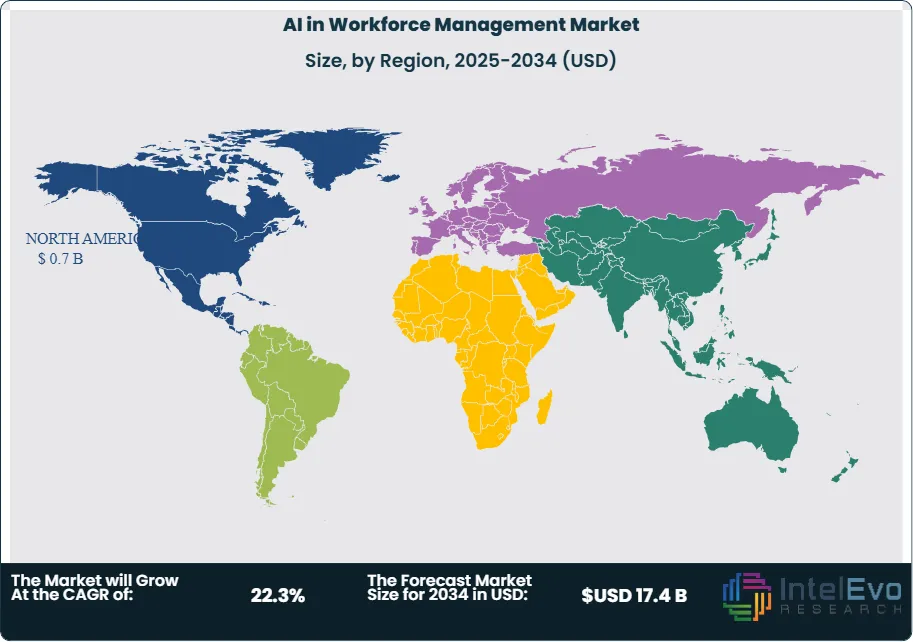
North America remains the largest regional market, representing close to 37 percent of global revenue and generating approximately 0.7 billion USD in annual sales as of 2025. Strong digital infrastructure, high enterprise technology spending, and early AI adoption underpin regional leadership. The United States remains the primary contributor due to widespread deployment across IT, healthcare, and financial services.
Europe follows with steady growth driven by labor compliance requirements and digital workforce initiatives. Asia Pacific shows the fastest expansion rate, supported by large labor pools, rapid cloud adoption, and rising enterprise automation in India, China, and Southeast Asia. Latin America and the Middle East and Africa remain smaller markets but present long-term growth potential as digital workforce platforms gain acceptance.
Get More Information about this report -
Request Free Sample ReportMarket Key Segments
Component
- Solution
- Services
Deployment Mode
- Cloud-Based
- On-Premise
Organization Size
- Small and Medium-Sized Enterprises (SMEs)
- Large Enterprises
Industry Vertical
- IT and Telecommunications
- BFSI
- Healthcare
- Manufacturing
- Retail and E-commerce
- Government and Public Sector
- Other Industry Verticals
Regions
- North America
- Latin America
- East Asia And Pacific
- Sea And South Asia
- Eastern Europe
- Western Europe
- Middle East & Africa
| Report Attribute | Details |
| Market size (2025) | USD 2.81 B |
| Forecast Revenue (2034) | USD 17.4 B |
| CAGR (2025-2034) | 22.3% |
| Historical data | 2021-2024 |
| Base Year For Estimation | 2025 |
| Forecast Period | 2026-2034 |
| Report coverage | Revenue Forecast, Competitive Landscape, Market Dynamics, Growth Factors, Trends and Recent Developments |
| Segments covered | Component (Solution, Services), Deployment Mode (Cloud-Based, On-Premise), Organization Size (Small and Medium-Sized Enterprises (SMEs), Large Enterprises), Industry Vertical (IT and Telecommunications, BFSI, Healthcare, Manufacturing, Retail and E-commerce, Government and Public Sector, Other Industry Verticals) |
| Research Methodology |
|
| Regional scope |
|
| Competitive Landscape | Verint Systems Inc., SAP SE, Dayforce, Inc., IBM Corporation, Cornerstone OnDemand, Inc., NICE, Oracle Corporation, Zebra Technologies, UKG Inc., ADP, Inc., Infor, Workday, Inc., Other Key Players |
| Customization Scope | Customization for segments, region/country-level will be provided. Moreover, additional customization can be done based on the requirements. |
| Pricing and Purchase Options | Avail customized purchase options to meet your exact research needs. We have three licenses to opt for: Single User License, Multi-User License (Up to 5 Users), Corporate Use License (Unlimited User and Printable PDF). |


Frequently Asked Questions
How big is the AI in Workforce Management Market?
Global AI in Workforce Management Market valued at USD 2.3B in 2024, projected to reach USD 17.4B by 2034, growing at 22.0% CAGR from 2026–2034 with rising AI adoption.
Who are the major players in the AI in Workforce Management Market?
Verint Systems Inc., SAP SE, Dayforce, Inc., IBM Corporation, Cornerstone OnDemand, Inc., NICE, Oracle Corporation, Zebra Technologies, UKG Inc., ADP, Inc., Infor, Workday, Inc., Other Key Players
Which segments covered the AI in Workforce Management Market?
Component (Solution, Services), Deployment Mode (Cloud-Based, On-Premise), Organization Size (Small and Medium-Sized Enterprises (SMEs), Large Enterprises), Industry Vertical (IT and Telecommunications, BFSI, Healthcare, Manufacturing, Retail and E-commerce, Government and Public Sector, Other Industry Verticals)
How can this market research report help my business make strategic decisions?
Our market research reports provide actionable intelligence, including verified market size data, CAGR projections, competitive benchmarking, and segment-level opportunity analysis. These insights support strategic planning, investment decisions, product development, and market entry strategies for enterprises and startups alike.
How frequently is the data updated?
We continuously monitor industry developments and update our reports to reflect regulatory changes, technological advancements, and macroeconomic shifts. Updated editions ensure you receive the latest market intelligence.

Select Licence Type
Connect with our sales team

AI in Workforce Management Market
Published Date : 04 Mar 2026 | Formats :Why IntelEvoResearch
100%
Customer
Satisfaction
24x7+
Availability - we are always
there when you need us
200+
Fortune 50 Companies trust
IntelEvoResearch
80%
of our reports are exclusive
and first in the industry
100%
more data
and analysis
1000+
reports published
till date
