

- Home
- Industries
 Aerospace And Defence
 Agriculture
 Automotive And Transportation
 Banking And Finance
 Business
 Chemicals And Materials
 Consumer And Retail
 Electronics And Semiconductors
 Food And Beverages
 Machinery & Equipments
 Manufacturing And Construction
 Medical Devices
 Others
 Pharmaceuticals And Healthcare
 Power And Energy
 Sports
 Technology
- Services
- News Room
- About us
- Contact Us
-
Global AI-Powered Drug Repurposing Market Size, Share | CAGR 23.1%
Global AI-Powered Drug Repurposing Market Size, Share, Growth Analysis By Technology (Machine Learning & Deep Learning, NLP, Graph Neural Networks, Generative AI, Reinforcement Learning, Knowledge Graph Mining), By Application (Target Identification, Biomarker Discovery, Clinical Trial Design, Adverse Effect Prediction), By Therapeutic Area, By End-User, Industry Trends & Forecast 2026-2034

Report Overview
| Market Size (2025) | Forecast Value (2034) | CAGR (2026-2034) | Largest Region (2025) |
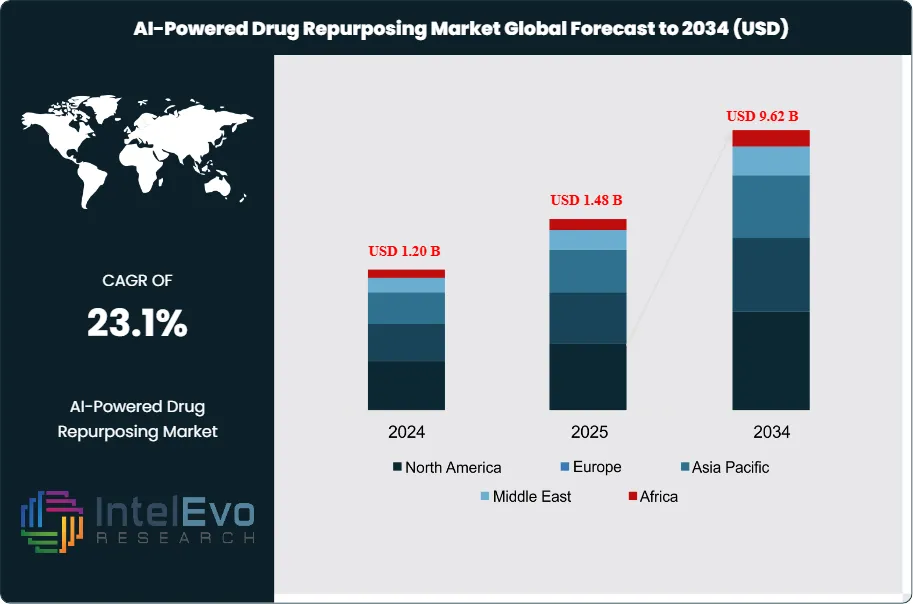
| USD 1.48 Billion | USD 9.62 Billion | 23.1% | North America, 46.8% |
The AI-Powered Drug Repurposing Market was valued at approximately USD 1.20 Billion in 2024 and reached USD 1.48 Billion in 2025. The market is projected to grow to USD 9.62 Billion by 2034, expanding at a CAGR of 23.1% during the forecast period from 2026 to 2034. This represents an absolute dollar opportunity of USD 8.14 Billion over the analysis period, fueled by converging pressures of pharmaceutical patent cliffs, escalating de novo drug development costs, and the demonstrated capability of artificial intelligence to generate clinically actionable repurposing hypotheses from biomedical datasets at speeds and scales that far exceed conventional computational and experimental approaches.
Get More Information about this report -
Request Free Sample ReportDrug repurposing, also termed drug repositioning, redirects approved or clinically tested compounds toward new therapeutic indications for which they were not originally developed. AI-powered drug repurposing extends this concept through the application of machine learning, deep learning, graph neural networks (GNNs), natural language processing (NLP), and generative AI models to mine structured and unstructured biomedical data sources including genomic databases, electronic health records (EHRs), proteomics repositories, clinical trial registries, and the published biomedical literature. The speed and cost advantages are compelling: conventional de novo drug development from target identification to approval takes 12-15 years and costs an average of USD 2.6 Billion per approved drug per Tufts Center for the Study of Drug Development estimates; AI-powered repurposing programs with known compounds have demonstrated timelines of 3-6 years to clinical data with 50-70% lower preclinical development costs, given established safety, pharmacokinetic, and manufacturing profiles.
The AI-powered drug repurposing market is defined by the convergence of pharmaceutical R&D productivity pressure and AI capability maturation. Large-scale foundation models trained on biomedical literature are now capable of identifying mechanistic connections across disease-gene-protein-compound networks that were previously detectable only through manual expert review. BenevolentAI's knowledge graph platform integrates over 1 Billion biomedical facts and has generated six active clinical programs through AI-driven target identification and repurposing signal extraction. Insilico Medicine's ISM8207 Crohn's disease program reached Phase I dosing in March 2025 within 22 months of computational hypothesis generation, establishing a new clinical translation speed record for AI-driven repurposing.
Regulatory momentum is specifically supporting AI drug repurposing. The FDA's Real-World Evidence Framework under the 21st Century Cures Act provides a pathway for incorporating real-world data from EHRs and patient registries into repurposing New Drug Applications (NDAs), reducing the clinical evidence burden for compounds with established safety profiles. The FDA's Complex Innovative Trial Designs (CID) pilot program allows basket and umbrella trial designs that test repurposed compounds across multiple indications simultaneously, compressing the clinical validation timeline by 30-40%. The EU EMA's progressive authorization framework similarly provides accelerated pathways for repurposed drugs addressing unmet medical needs. These regulatory structures create a favorable approval landscape that enhances the commercial risk-return profile of AI-identified repurposing programs.
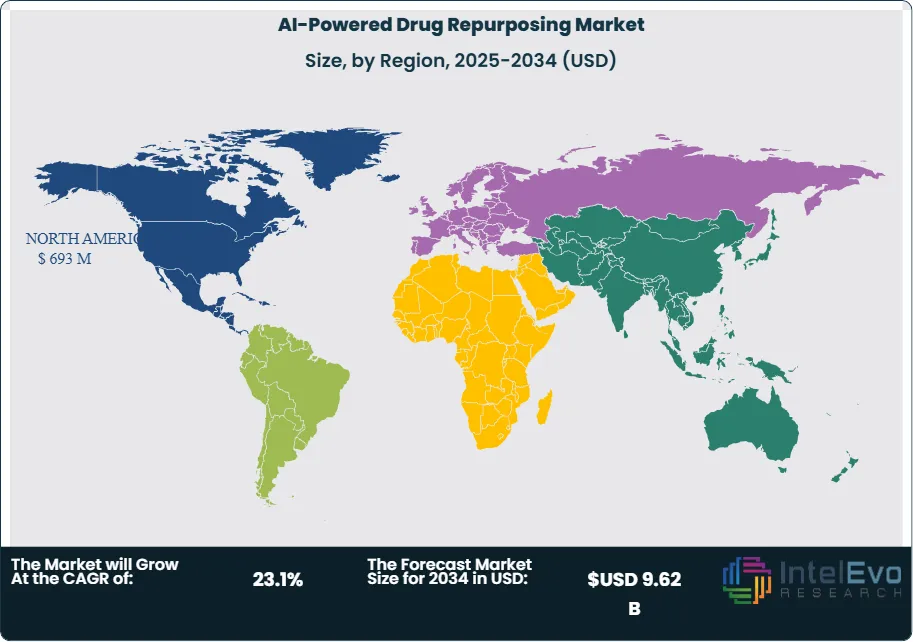
North America leads the AI-powered drug repurposing market at 46.8% share (USD 693 Million) in 2025, supported by the world's highest concentration of AI drug discovery companies, leading pharmaceutical R&D spenders, and NIH funding for computational biology infrastructure exceeding USD 1.8 Billion annually. Europe holds 28.4% (USD 420 Million), anchored by BenevolentAI, Exscientia, Healx, and Iktos within a regulatory environment increasingly supportive of AI-driven drug development submissions. Asia Pacific at 18.6% (USD 275 Million) is the fastest-growing region, led by Insilico Medicine's clinical pipeline generation from Hong Kong and expanding AI drug discovery investment in China, Japan, and India.

Key Takeaways
- Market Growth: The AI-powered drug repurposing market was valued at USD 1.48 Billion in 2025 and is projected to reach USD 9.62 Billion by 2034, expanding at a CAGR of 23.1% across the 2026-2034 forecast period.
- Segment Dominance: Graph neural networks (GNNs) and knowledge graph platforms lead the By Technology segment with 34.5% market share in 2025, valued at USD 511 Million, reflecting their superior capability to model complex multi-relational biomedical networks connecting disease biology, target proteins, and compound mechanisms of action.
- Segment Dominance: Oncology leads the By Therapeutic Area segment with 38.2% market share in 2025, representing USD 566 Million in revenue, driven by extensive genomic biomarker datasets, precision medicine infrastructure, and the highest concentration of FDA Breakthrough Therapy and Accelerated Approval pathway utilization.
- Driver: The global pharmaceutical patent cliff, with over USD 250 Billion in branded drug revenues facing loss of exclusivity between 2025 and 2030, is the primary commercial driver, compelling large-cap pharma companies to invest in AI repurposing as the fastest pathway to pipeline replenishment.
- Restraint: Data fragmentation and interoperability barriers across pharmaceutical, clinical, and genomic databases, with over 60% of biomedical data residing in proprietary or incompatible formats, constrain AI model training quality and limit the reproducibility of repurposing predictions across organizational boundaries.
- Opportunity: Rare and orphan disease repurposing represents the highest near-term commercial opportunity, with FDA Orphan Drug Designation conferring 7-year market exclusivity and 50% clinical trial tax credits, creating favorable economics for AI-identified repurposing programs in the 7,000+ rare diseases lacking approved treatments.
- Trend: Foundation models and large language models (LLMs) fine-tuned on biomedical literature are the dominant AI architecture trend, with 42% of new AI repurposing platform launches in 2025 incorporating transformer-based pre-trained models, up from 8% in 2021, enabling cross-domain hypothesis generation beyond structured database mining.
- Regional Analysis: North America leads all regions with a 46.8% share in 2025, representing USD 693 Million in revenue, supported by the highest concentration of AI drug discovery companies, USD 1.8 Billion in annual NIH computational biology funding, and FDA regulatory frameworks specifically designed to accommodate AI-derived drug repurposing evidence.
Competitive Landscape Overview
The AI-powered drug repurposing market exhibits a highly fragmented competitive structure in 2025, with the top four participants — BenevolentAI, Insilico Medicine, Exscientia, and IBM Research — collectively accounting for approximately 38% of market revenue. Competition is technology-driven, differentiated by AI architecture depth, proprietary biomedical dataset access, clinical pipeline validation, and the ability to execute integrated discovery-to-IND programs. The market is bifurcated between pure-play AI drug discovery companies that own their repurposing pipelines (BenevolentAI, Insilico, Recursion) and platform licensing models that charge pharma partners for access to AI repurposing tools (IBM Watson, Atomwise, Schrodinger). M&A activity is intensifying, with Recursion's acquisition of Cyclica in 2024 representing the largest AI drug discovery consolidation transaction, and three additional acquisitions exceeding USD 200 Million completed by mid-2025.
Competitive Landscape Matrix
| Company | HQ | Position | Key AI Platform | Geo Strength | Recent Strategic Move (2024-2026) |
| BenevolentAI | UK | Leader | BenevolentAI Platform (KG + GNN) | Europe / Global | Entered Phase II clinical trial for BEN-8744 (PDE10A inhibitor repurposed for UC) following AI-driven target identification (Q1 2025); pipeline now spans 6 active programs. |
| Insilico Medicine | Hong Kong | Leader | Chemistry42 / Biology42 | Asia Pacific / Global | Received IND clearance for ISM8207, an AI-repurposed TNIK inhibitor for Crohn's disease, initiating Phase I dosing (Mar 2025) within 22 months of computational target identification. |
| Exscientia plc | UK | Leader | Centaur Chemist AI Platform | Europe / North America | Secured USD 600M collaboration with Sanofi for AI-driven drug design and repurposing across 15 oncology and immunology targets (2024), the largest single AI drug discovery partnership. |
| IBM Research (Watson Health) | USA | Leader | IBM Watson for Drug Discovery | North America / Global | Launched Watson Genomics for Repurposing module with multi-omics graph neural network, cutting target hypothesis generation time from 18 months to under 6 weeks (Jun 2025). |
| Atomwise Inc. | USA | Challenger | AtomNet Deep Learning Platform | North America | Expanded AIMS academic partnership program to 78 universities globally (2025) generating 420 new repurposing lead compounds screened for rare and neglected diseases. |
| Recursion Pharmaceuticals | USA | Challenger | Recursion OS (phenomics + ML) | North America | Initiated Phase II trial of REC-4881 (binimetinib repurposed for FAP) after AI phenomics platform identified repurposing signal from 22 Petabytes of cellular imaging data (Sep 2025). |
| Iktos | France | Challenger | Makya Generative Chemistry | Europe | Signed EUR 55M collaboration with Servier for AI-guided repurposing across cardiovascular and oncology portfolios covering 12 preclinical programs (Jan 2026). |
| Cyclica Inc. (acq. Recursion) | Canada | Niche Player | Ligand Express Polypharmacology | North America | Integrated Ligand Express proteome-wide binding profiling into Recursion OS (2024), expanding polypharmacology-driven repurposing screen coverage to 8,500 human protein targets. |
| Healx Ltd. | UK | Niche Player | Healnet AI Rare Disease Platform | Europe | Completed Series C raise of GBP 28M (Sep 2025) to advance three AI-repurposed rare disease candidates into Phase II trials, covering Fragile X, CDKL5, and Angelman syndromes. |
| Lantern Pharma | USA | Niche Player | RADR AI Oncology Repurposing | North America | Enrolled first patient in LP-300 Phase II trial (AI-repurposed in NSCLC for never-smokers) under FDA orphan drug designation, with primary endpoint readout expected Q3 2026. |
By Technology:
Graph neural networks and knowledge graph platforms lead the AI-powered drug repurposing market with 34.5% share, valued at USD 511 Million in 2025. GNNs are uniquely suited to biomedical repurposing because they model heterogeneous networks of drugs, targets, diseases, pathways, and clinical phenotypes as nodes and edges, enabling the model to propagate signals across multi-hop biological relationships invisible to sequence-based models. BenevolentAI's knowledge graph integrates over 1 Billion biomedical facts from 32 data sources, and its GNN-based hypothesis generation engine has produced 6 clinical candidates from repurposing signals. Machine learning and deep learning platforms hold 28.0% share at USD 414 Million, serving applications from binding affinity prediction to adverse effect modeling. Natural language processing (NLP) accounts for 18.5% at USD 274 Million, used to extract repurposing signals from the 35+ million biomedical publications indexed in PubMed and clinical trial databases. Generative AI and foundation models represent 12.5% at USD 185 Million, the fastest-growing technology sub-segment at an estimated CAGR of 38.2%, as transformer-based LLMs fine-tuned on biomedical text enable cross-domain hypothesis generation that structured database mining cannot achieve. Reinforcement learning holds 6.5% at USD 96 Million.
By Deployment Mode:
Cloud-based SaaS platforms dominate the AI-powered drug repurposing market at 68.5% share, valued at USD 1.01 Billion in 2025. Cloud deployment enables pharmaceutical companies to access AI repurposing platforms without capital-intensive on-premise infrastructure investment, with pay-per-use pricing models reducing financial commitment for initial platform evaluation. AWS, Microsoft Azure, and Google Cloud Life Sciences provide the computational infrastructure on which most AI repurposing platforms operate. On-premise and private cloud deployment holds 22.0% at USD 326 Million, preferred by large pharmaceutical companies with proprietary compound libraries and clinical datasets that cannot be transferred to shared cloud environments under data governance policies. Hybrid deployment accounts for 9.5% at USD 141 Million, serving companies with mixed data classification requirements.
By Application:
Target identification and validation leads at 32.5% share, valued at USD 481 Million in 2025. AI-driven target identification mines genomic, proteomic, and phenomic data to identify protein targets whose modulation would address disease pathology, then screens approved compounds for activity against these targets. Lead optimization holds 22.0% at USD 326 Million, where AI models predict structure-activity relationships for repurposed compound analogs to improve potency and selectivity. Biomarker discovery accounts for 16.5% at USD 244 Million, using AI to identify patient stratification biomarkers that predict repurposing responders. Clinical trial design represents 12.0% at USD 178 Million, where AI models analyze prior trial data to optimize adaptive trial designs for repurposed compounds. Adverse effect prediction holds 10.5% at USD 155 Million. Polypharmacology screening accounts for 6.5% at USD 96 Million.
By Therapeutic Area:
Oncology commands 38.2% of the AI-powered drug repurposing market at USD 566 Million in 2025. The combination of deep genomic profiling, molecular subtype characterization, and extensive published pharmacogenomics data in oncology provides the richest biomedical network for AI repurposing signal extraction. Rare and orphan diseases hold 22.5% at USD 333 Million, the segment with the highest regulatory incentive concentration. CNS and neurological disorders account for 14.0% at USD 207 Million, driven by the high attrition rates in de novo CNS drug development that make repurposing particularly attractive. Infectious diseases represent 10.5% at USD 155 Million, a segment energized by COVID-19 pandemic-era investment in AI-accelerated pathogen response. Autoimmune and inflammatory conditions hold 8.0% at USD 118 Million. Cardiovascular represents 4.5% at USD 67 Million. Metabolic disorders account for 2.3% at USD 34 Million.
By End-User:
Pharmaceutical companies are the dominant end-user at 48.5% of the AI-powered drug repurposing market, valued at USD 718 Million in 2025. Large-cap pharma companies including Pfizer, AstraZeneca, Sanofi, and GSK have each established multi-year AI repurposing collaborations valued at USD 100-600 Million, reflecting executive-level conviction that AI repurposing is necessary for pipeline productivity. Biotechnology firms hold 28.0% at USD 414 Million, with pure-play AI drug discovery biotechs owning pipelines alongside their platform assets. Academic and research institutes account for 12.5% at USD 185 Million, accessing AI repurposing tools through platform partnership programs like Atomwise's AIMS initiative. CROs and CDMOs represent 8.0% at USD 118 Million. Government and public health agencies hold 3.0% at USD 44 Million.
Regional Analysis
North America
North America leads the global AI-powered drug repurposing market with a 46.8% share in 2025, valued at USD 693 Million. The United States accounts for 94% of North American revenue at USD 651 Million, anchored by a uniquely concentrated ecosystem of AI drug discovery companies (Recursion, Atomwise, IBM Watson, Lantern Pharma, Schrodinger), pharmaceutical R&D spenders representing 45% of global pharmaceutical R&D investment, and NIH funding for computational biology and AI research exceeding USD 1.8 Billion annually. The FDA's Center for Drug Evaluation and Research (CDER) established the Emerging Technology Program specifically to engage sponsors developing AI-assisted drug submissions, providing pre-submission scientific feedback that reduces regulatory uncertainty for AI-derived repurposing data packages. The 21st Century Cures Act's real-world evidence provisions, allowing EHR and patient registry data in NDA repurposing submissions, provide a US-specific pathway that further strengthens the commercial repurposing environment. Canada contributes 5% of North American revenue at USD 35 Million, with Cyclica (now Recursion), the Vector Institute, and University of Toronto's AI drug discovery programs generating active commercialization pipelines. North America is forecast to grow at 22.4% CAGR to reach USD 4.14 Billion by 2034.
Europe
Europe accounts for 28.4% of the AI-powered drug repurposing market in 2025, valued at USD 420 Million. The United Kingdom leads European demand at 38% of regional revenue (USD 160 Million), home to BenevolentAI, Exscientia, Healx, and Nanome, supported by Innovate UK's AI in Health and Care Award program that allocated GBP 140 Million to AI healthcare innovation between 2019 and 2024. Germany holds 18% at USD 76 Million, with Bayer, Merck KGaA, and Boehringer Ingelheim each operating dedicated AI drug repurposing programs. France accounts for 15% at USD 63 Million, anchored by Iktos and Sanofi's internal AI platform. Switzerland represents 14% at USD 59 Million, driven by Roche and Novartis, both of which have established AI repurposing centers in Basel. The EMA's reflection paper on AI and machine learning in drug development, published in 2023, established the regulatory framework for AI-assisted drug applications in the EU, removing a key uncertainty barrier. Europe is forecast to grow at 22.8% CAGR to reach USD 2.90 Billion by 2034.
Asia Pacific
Asia Pacific represents 18.6% of the AI-powered drug repurposing market in 2025, valued at USD 275 Million, and is the fastest-growing region at a projected CAGR of 25.2% through 2034, reaching USD 2.18 Billion. China accounts for 38% of regional revenue at USD 105 Million, with Insilico Medicine (headquartered in Hong Kong), XtalPi, and DP Technology operating AI drug discovery platforms with growing repurposing program portfolios. China's NMPA introduced a priority review designation for AI-assisted drug applications in 2023, reducing standard review timelines by 40% and creating domestic regulatory incentives. Japan holds 28% at USD 77 Million, with Fujitsu's AI drug discovery program, NTT DATA's biomedical AI investments, and Eisai and Takeda integrating AI repurposing into their internal R&D pipelines. India represents 18% at USD 50 Million, with TCS Life Sciences, Wipro's healthcare AI practice, and academic AI drug discovery programs at IIT-Delhi and IISc growing commercial repurposing service capabilities. South Korea contributes 12% at USD 33 Million, with LG Chem's life science division and Hanmi Pharmaceutical deploying AI repurposing platforms.
Latin America
Latin America holds 3.8% of the AI-powered drug repurposing market in 2025, valued at USD 56 Million. Brazil represents 55% of regional revenue at USD 31 Million, driven by Fiocruz's computational biology programs, FAPESP-funded AI drug discovery research at USP and UNICAMP, and multinational pharma subsidiaries using global AI repurposing platforms for local pipeline development. Mexico accounts for 28% at USD 16 Million. Argentina represents 12% at USD 7 Million. The region is primarily a consumer of AI repurposing platforms and services developed elsewhere, with domestic AI drug discovery company formation constrained by funding availability and regulatory infrastructure for AI-assisted drug submissions. The Inter-American Development Bank's USD 200 Million digital health innovation fund is beginning to catalyze domestic AI pharmaceutical capability. Latin America is forecast to grow at 20.4% CAGR to reach USD 320 Million by 2034.
Middle East and Africa
Middle East and Africa accounts for 2.4% of the AI-powered drug repurposing market in 2025, valued at USD 36 Million. Saudi Arabia leads at 42% of regional revenue (USD 15 Million), driven by King Abdullah University of Science and Technology (KAUST) AI in Health programs and Vision 2030 investments in pharmaceutical manufacturing and drug discovery. The UAE holds 30% at USD 11 Million, with the Dubai Health Authority's AI healthcare strategy and Mohamed Bin Zayed University of Artificial Intelligence (MBZUAI) generating early-stage AI drug discovery capabilities. South Africa represents 20% at USD 7 Million, with the South African Medical Research Council's computational biology unit and University of Pretoria AI health programs forming the domestic research base. The region is in early-stage market development, with adoption concentrated in academic research and multinational pharma regional operations accessing global AI repurposing platforms. MEA is forecast to grow at 22.6% CAGR to reach USD 237 Million by 2034.
Get More Information about this report -
Request Free Sample ReportMarket Key Segments
By Technology
- Machine Learning & Deep Learning
- Natural Language Processing (NLP)
- Graph Neural Networks (GNN)
- Generative AI & Foundation Models
- Reinforcement Learning
- Knowledge Graph Mining
By Deployment Mode
- Cloud-Based SaaS Platforms
- On-Premise / Private Cloud
- Hybrid Deployment
By Application
- Target Identification & Validation
- Lead Optimization
- Biomarker Discovery
- Clinical Trial Design
- Adverse Effect Prediction
- Polypharmacology Screening
By Therapeutic Area
- Oncology
- Rare & Orphan Diseases
- CNS & Neurological Disorders
- Infectious Diseases
- Autoimmune & Inflammatory
- Cardiovascular
- Metabolic Disorders
By End-User
- Pharmaceutical Companies
- Biotechnology Firms
- Academic & Research Institutes
- CROs & CDMOs
- Government & Public Health Agencies
By Regional Coverage
- North America
- Latin America
- East Asia And Pacific
- Sea And South Asia
- Eastern Europe
- Western Europe
- Middle East & Africa
| Report Attribute | Details |
| Market size (2025) | USD 1.48 B |
| Forecast Revenue (2034) | USD 9.62 B |
| CAGR (2025-2034) | 23.1% |
| Historical data | 2021-2024 |
| Base Year For Estimation | 2025 |
| Forecast Period | 2026-2034 |
| Report coverage | Revenue Forecast, Competitive Landscape, Market Dynamics, Growth Factors, Trends and Recent Developments |
| Segments covered | By Technology, (Machine Learning & Deep Learning, Natural Language Processing (NLP), Graph Neural Networks (GNN), Generative AI & Foundation Models, Reinforcement Learning, Knowledge Graph Mining), By Deployment Mode, (Cloud-Based SaaS Platforms, On-Premise / Private Cloud, Hybrid Deployment), By Application, (Target Identification & Validation, Lead Optimization, Biomarker Discovery, Clinical Trial Design, Adverse Effect Prediction, Polypharmacology Screening), By Therapeutic Area, (Oncology, Rare & Orphan Diseases, CNS & Neurological Disorders, Infectious Diseases, Autoimmune & Inflammatory, Cardiovascular, Metabolic Disorders), By End-User, (Pharmaceutical Companies, Biotechnology Firms, Academic & Research Institutes, CROs & CDMOs, Government & Public Health Agencies) |
| Research Methodology |
|
| Regional scope |
|
| Competitive Landscape | BENEVOLENTAI, IBM RESEARCH (WATSON), IKTOS, CYCLICA (RECURSION), NUMERATE INC., INSILICO MEDICINE, ATOMWISE INC., HEALX LTD., ARIA PHARMACEUTICALS, SCHRODINGER INC., EXSCIENTIA PLC, RECURSION PHARMACEUTICALS, LANTERN PHARMA, NUVATION BIO, OTHERS |
| Customization Scope | Customization for segments, region/country-level will be provided. Moreover, additional customization can be done based on the requirements. |
| Pricing and Purchase Options | Avail customized purchase options to meet your exact research needs. We have three licenses to opt for: Single User License, Multi-User License (Up to 5 Users), Corporate Use License (Unlimited User and Printable PDF). |


Frequently Asked Questions
How big is the AI-Powered Drug Repurposing Market?
The Global AI-Powered Drug Repurposing Market was valued at USD 1.20 Billion in 2024 and is projected to reach USD 9.62 Billion by 2034, growing at a CAGR of 23.1% from 2026 to 2034, driven by increasing adoption of artificial intelligence in drug discovery, rising demand for cost-effective therapeutic development, expanding pharmaceutical R&D investments, and growing focus on accelerating treatment discovery for oncology, rare diseases, and infectious diseases.
Who are the major players in the AI-Powered Drug Repurposing Market?
BENEVOLENTAI, IBM RESEARCH (WATSON), IKTOS, CYCLICA (RECURSION), NUMERATE INC., INSILICO MEDICINE, ATOMWISE INC., HEALX LTD., ARIA PHARMACEUTICALS, SCHRODINGER INC., EXSCIENTIA PLC, RECURSION PHARMACEUTICALS, LANTERN PHARMA, NUVATION BIO, OTHERS
Which segments covered the AI-Powered Drug Repurposing Market?
By Technology, (Machine Learning & Deep Learning, Natural Language Processing (NLP), Graph Neural Networks (GNN), Generative AI & Foundation Models, Reinforcement Learning, Knowledge Graph Mining), By Deployment Mode, (Cloud-Based SaaS Platforms, On-Premise / Private Cloud, Hybrid Deployment), By Application, (Target Identification & Validation, Lead Optimization, Biomarker Discovery, Clinical Trial Design, Adverse Effect Prediction, Polypharmacology Screening), By Therapeutic Area, (Oncology, Rare & Orphan Diseases, CNS & Neurological Disorders, Infectious Diseases, Autoimmune & Inflammatory, Cardiovascular, Metabolic Disorders), By End-User, (Pharmaceutical Companies, Biotechnology Firms, Academic & Research Institutes, CROs & CDMOs, Government & Public Health Agencies)
How can this market research report help my business make strategic decisions?
Our market research reports provide actionable intelligence, including verified market size data, CAGR projections, competitive benchmarking, and segment-level opportunity analysis. These insights support strategic planning, investment decisions, product development, and market entry strategies for enterprises and startups alike.
How frequently is the data updated?
We continuously monitor industry developments and update our reports to reflect regulatory changes, technological advancements, and macroeconomic shifts. Updated editions ensure you receive the latest market intelligence.

Select Licence Type
Connect with our sales team

AI-Powered Drug Repurposing Market
Published Date : 19 May 2026 | Formats :Why IntelEvoResearch
100%
Customer
Satisfaction
24x7+
Availability - we are always
there when you need us
200+
Fortune 50 Companies trust
IntelEvoResearch
80%
of our reports are exclusive
and first in the industry
100%
more data
and analysis
1000+
reports published
till date