

- Home
- Industries
 Aerospace And Defence
 Agriculture
 Automotive And Transportation
 Banking And Finance
 Business
 Chemicals And Materials
 Consumer And Retail
 Electronics And Semiconductors
 Food And Beverages
 Machinery & Equipments
 Manufacturing And Construction
 Medical Devices
 Others
 Pharmaceuticals And Healthcare
 Power And Energy
 Sports
 Technology
- Services
- News Room
- About us
- Contact Us
-
Global AI-Powered Home Fitness Equipment Market Size | CAGR 12.7%
Global AI-Powered Home Fitness Equipment Market Size, Share, Analysis By Product Type (Smart Treadmills, Connected Exercise Bikes, AI-Powered Rowing Machines, Smart Strength Training Equipment, Interactive Fitness Mirrors, Multi-Function Home Gyms), By AI Technology (Machine Learning-Based Performance Analytics, Computer Vision & Motion Tracking, Virtual AI Coaching, Predictive Fitness Analytics, Generative AI Workout Personalization), By Distribution Channel (Online Retail & E-Commerce Platforms, Brand-Owned Stores, Specialty Fitness Equipment Stores, Consumer Electronics Retailers, Direct-to-Consumer Sales), By End-User and Connectivity Industry Region & Key Players-Industry Segment Overview, Market Dynamics, Competitive Strategies, Trends & Forecast 2026-2034

Report Overview
| Market Size (2025) | Forecast Value (2034) | CAGR (2026-2034) | Largest Region (2025) |
|---|---|---|---|
| USD 4.85 Billion | USD 14.20 Billion | 12.7% | North America, 37.2% |
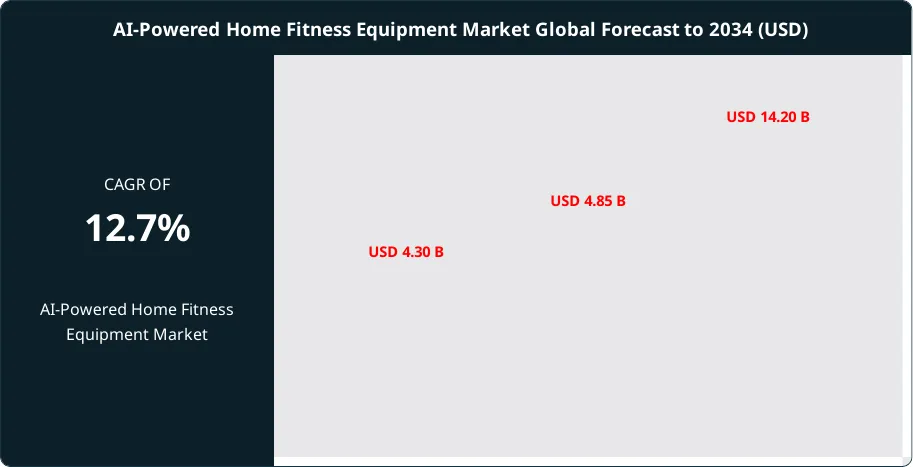
The AI-Powered Home Fitness Equipment Market was valued at approximately USD 4.30 Billion in 2024 and reached USD 4.85 Billion in 2025. The market is projected to grow to USD 14.20 Billion by 2034, expanding at a CAGR of 12.7% during the forecast period from 2026 to 2034. The market growth is driven by increasing consumer demand for personalized fitness experiences, connected workout ecosystems, and AI-driven health and wellness solutions. The integration of artificial intelligence, real-time performance analytics, virtual coaching, computer vision, and adaptive workout recommendations is transforming traditional home fitness equipment into intelligent and highly interactive fitness platforms. This represents an absolute dollar opportunity of USD 9.35 Billion over the analysis period.
Get More Information about this report -
Request Free Sample ReportGrowth in the AI-powered home fitness equipment market is anchored in three structural shifts. First, the category pivoted in 2025 from cardio-only hardware to cross-training devices with embedded AI coaching, evidenced by Peloton's launch of Peloton IQ and the Cross Training Series on October 1, 2025, unifying cardio, strength, yoga, and meditation in a single piece of equipment. Second, demand for strength training expanded materially, with Peloton reporting that 2 million of its connected fitness subscribers were actively strength training by the end of Q4 FY25 and Tonal Systems extending AI-driven weight adjustments across its platform. Third, wearable integration became foundational, with Peloton IQ ingesting data from Apple Health, Garmin Connect, and Google Fitbit natively, echoed by Technogym's Live/ON content stack.
The regulatory environment for AI-powered home fitness equipment is shaped by three frameworks. The US Food and Drug Administration regulates connected fitness devices that cross into digital therapeutics or blood-pressure monitoring, distinct from pure fitness hardware. The EU AI Act's general-purpose AI provisions entered force on August 2, 2025, applying transparency obligations to AI coaching modules deployed across Technogym, iFIT, and Peloton hardware sold in the 27-member EU. Consumer-device safety standards apply under the US Consumer Product Safety Commission's 16 CFR Part 1500, the EU Machinery Regulation (EU) 2023/1230, and the IEC 60335 family covering motorized home fitness equipment.
Demand is broadening across income tiers. Peloton reported Q1 FY26 revenue of USD 551 Million for the quarter ended September 30, 2025, with Adjusted EBITDA of USD 118 Million, and Q2 FY26 revenue of USD 657 Million for the quarter ended December 31, 2025. Technogym posted H1 2025 consolidated revenue growth of 14.1% year-over-year to approximately EUR 458.8 Million. iFIT Health & Fitness holds approximately 13.4% of the broader home fitness equipment market with its NordicTrack, ProForm, and iFIT brands, selling approximately 5.2 million units annually. New entrants include Aroleap in India, Beyond Power, and amp Fitness, which launched an AI-powered home gym in January 2025.
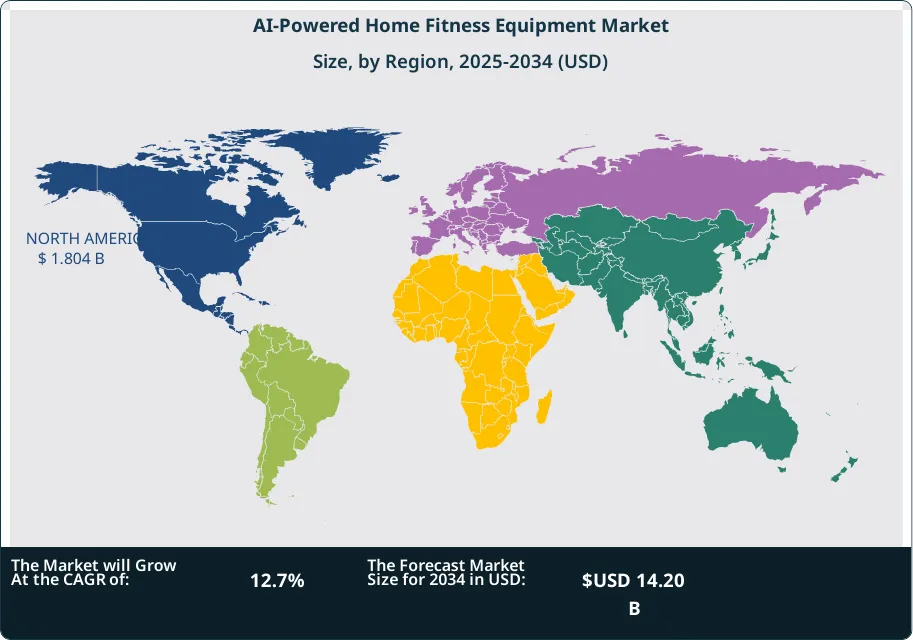
North America held the largest AI-powered home fitness equipment market share at 37.2% in 2025, anchored by Peloton in New York, iFIT in Utah, Tonal Systems in San Francisco, Hydrow in Boston, and Ergatta in New York. Europe followed at 27.5%, anchored by Technogym in Cesena, Italy, JTX Fitness in the United Kingdom, and emerging smart-home integrations in Germany. Asia Pacific represented 26.8%, led by China and growing adoption across India, Japan, and South Korea. The American College of Sports Medicine's November 2025 Worldwide Survey of Fitness Trends for 2026 identified Wearable Technology as the leading global trend, reinforcing the strategic importance of AI-powered home fitness equipment integrations with Apple Health, Fitbit, Garmin, and WHOOP.
Market Definition & Scope
The AI-powered home fitness equipment market is defined as the global commercial activity in residential fitness hardware that integrates artificial intelligence, computer vision, machine learning, or adaptive sensor systems to deliver personalized workout coaching, real-time form feedback, or dynamic resistance adjustment. The market encompasses AI-enabled smart bikes such as Peloton Cross Training Bike+, AI strength systems such as Tonal, connected rowers such as Hydrow Wave and Ergatta, AI treadmills such as NordicTrack and Peloton Tread+, and multi-modality cross-training platforms launched in 2025.
Included in the scope are connected hardware revenues, the AI coaching and subscription content revenues tied to those devices, software-enabled accessory sales, and one-time installation fees. Explicitly excluded are commercial gym equipment without residential positioning, non-connected mechanical hardware, home fitness apps and wearables without equipment, and pure content platforms without hardware. The AI-powered home fitness equipment market is a subset of the broader USD 13.19 Billion fitness equipment market and the USD 6.22 Billion interactive fitness market, accounting for approximately 37% of connected residential fitness spend in 2025.

Key Takeaways
- Market Growth: The AI-powered home fitness equipment market expands from USD 4.85 Billion in 2025 to USD 14.20 Billion by 2034, a CAGR of 12.7% over the forecast period.
- Segment Dominance by Product Type: Cardiovascular AI equipment led in 2025 with 54.8% share, driven by Peloton Bike, Bike+, Tread, and Tread+ plus NordicTrack connected treadmills and Hydrow rowers.
- Segment Dominance by Technology: Computer vision and AI coaching held 44.6% of 2025 revenue, reflecting Peloton IQ's Movement-Tracking Camera, Tonal's AI weight adjustments, and iFIT's adaptive coaching engine.
- Driver: Peloton reported that 2 million connected fitness subscribers were actively strength training by end of Q4 FY25, accelerating category expansion beyond pure cardio form factors.
- Restraint: High upfront hardware prices paired with mandatory recurring subscriptions limit addressable market, with Peloton Tread+ priced at USD 6,695 and Bike+ at USD 2,695 base MSRP.
- Opportunity: Commercial-residential hybrid deployment opened in April 2026 with Peloton's Connected Fitness Series launch for heavy-use gym locations, extending the addressable market.
- Trend: AI coaching with wearable integration expanded in 2025, with Peloton IQ natively pulling from Apple Health, Garmin Connect, and Google Fitbit across the entire installed base.
- Regional: North America led the AI-powered home fitness equipment market with 37.2% share and approximately USD 1.804 Billion in revenue in 2025, followed by Europe at 27.5%.
Key Insights Summary
- Peloton launched Peloton IQ and the Cross Training Series on October 1, 2025, refreshing the entire product portfolio with the Cross Training Bike at USD 1,695, Bike+ at USD 2,695, Tread at USD 3,295, Tread+ at USD 6,695, and Row+ at USD 3,495, and introducing Movement-Tracking Camera, Rep Tracking, Form Feedback, Workout Generator, Self-Paced Strength, and Hands-Free 'Ok Peloton' voice control.
- Peloton reported Q1 FY26 revenue of USD 551 Million on November 6, 2025 for the quarter ended September 30, 2025, with GAAP Net Income of USD 14 Million, Adjusted EBITDA of USD 118 Million, 2.732 million Ending Paid Connected Fitness Subscriptions, and raised full-year FY26 Adjusted EBITDA guidance.
- Peloton reported Q2 FY26 revenue of USD 657 Million on February 5, 2026 for the quarter ended December 31, 2025, with 2.661 million Ending Paid Connected Fitness Subscriptions, Total Gross Margin of 50.5% (up 320 basis points year-over-year), and better-than-expected Average Net Monthly Paid Connected Fitness Subscription Churn after the October 1 All-Access Membership price increase.
- Peloton completed an innovative menopause study with 267 women in conjunction with Respin Health, finding that 84% of participants experienced overall symptom improvement through a tailored 60-day program combining curated Cardio and Strength workouts, online coaching, and community support.
- Technogym S.p.A. posted H1 2025 consolidated revenue growth of 14.1% year-over-year to approximately EUR 458.8 Million, confirming sustained global demand for high-end digitally integrated wellness solutions and extending Technogym's leadership in the AI-powered home fitness equipment premium tier.
- iFIT Health & Fitness holds approximately 13.4% of the global home fitness and gym equipment market, selling more than 5.2 million units annually across NordicTrack, ProForm, and iFIT brands, with approximately 68% of its product portfolio including Bluetooth connectivity, digital coaching, and interactive screen technology per Industry Research.
- Amp Fitness introduced an AI-powered home gym machine in January 2025 that analyzes performance data in real-time to tailor resistance and workout routines using AI algorithms, and supports HIIT, Pilates, and strength training in a compact space-saving system targeting fitness enthusiasts.
Competitive Landscape Overview
The AI-powered home fitness equipment market is moderately concentrated, with the top four companies, Peloton Interactive, iFIT Health & Fitness, Technogym, and Tonal Systems, accounting for an estimated 48.3% of combined 2025 revenue based on public disclosures and retail sell-through estimates. Competition is AI-depth and cross-training-modality led rather than price-led, because Peloton IQ's Movement-Tracking Camera, Tonal's AI-driven weight adjustments, and Technogym's Live/ON coaching differentiate retention economics more than hardware sticker price.
Competitive dynamics shifted materially in late 2025 and early 2026 as Peloton relaunched its entire hardware portfolio with AI-native coaching on October 1, 2025, accelerated into commercial venues via the Connected Fitness Series for gyms announced in April 2026, and introduced the Club Peloton loyalty program in October 2025. Technogym grew H1 2025 revenue by 14.1% year-over-year to EUR 458.8 Million, iFIT acquired Reform RX for VR workouts to integrate immersive strength content, and new AI-first entrants including Aroleap and amp Fitness compressed differentiation timelines. Hydrow launched its compact Hydrow Wave Rower, and Tonal shipped a quieter, AI-enhanced strength trainer through 2025.
Competitive Landscape Matrix:
| Company | Headquarters | Position | Key Product | Geographic Strength | Recent Strategic Move |
|---|---|---|---|---|---|
| Peloton Interactive, Inc. (NASDAQ: PTON) | United States | Leader | Peloton Cross Training Series (Bike, Bike+, Tread, Tread+, Row+); Peloton IQ AI | North America, Europe | Launched Peloton IQ AI coaching system and Cross Training Series on October 1, 2025 |
| iFIT Health & Fitness, Inc. (Icon Health & Fitness) | United States | Leader | NordicTrack; ProForm; iFIT connected platform; Freestride Trainer | North America, Europe | Acquired Reform RX for VR workouts; holds roughly 13.4% of global home fitness equipment share |
| Technogym S.p.A. (BIT: TGYM) | Italy | Leader | Technogym Bench; Technogym Run; Live/ON demand AI coach | Europe, North America, APAC | Grew consolidated revenue 14.1% year-over-year to approximately EUR 458.8 Million in H1 2025 |
| Tonal Systems, Inc. | United States | Leader | Tonal digital strength trainer; Tonal 2 | North America | Released updated strength trainer with quieter operation and AI-driven weight adjustments through 2025 |
| Hydrow, Inc. | United States | Challenger | Hydrow Rower; Hydrow Wave | North America, Europe | Launched the compact Hydrow Wave Rower for smaller-footprint living spaces through 2024-2025 |
| Ergatta, Inc. | United States | Challenger | Ergatta Rower; Ergatta Lite | North America | Expanded game-based AI rowing experience across DTC and specialty retail channels through 2025 |
| Echelon Fitness Multimedia, LLC | United States | Challenger | Echelon Connect Bike; Stride; Row | North America | Scaled Echelon Premier subscription content library with AI coaching features through 2025 |
| Aroleap Fitness Private Limited | India | Niche Player | Aroleap X AI-powered home gym | India, Asia Pacific | Scaled direct-to-consumer AI strength platform in India through 2025 |
| Beyond Power Inc. | United States | Niche Player | Beyond Power V1 portable smart gym | North America | Expanded portable AI resistance platform to compact-gym segment through 2025 |
| Johnson Health Tech Co., Ltd. | Taiwan | Niche Player | Matrix; Horizon; Vision Fitness connected lines | Asia Pacific, North America | Holds approximately 10.8% of global home fitness equipment market share per Industry Research |
Segmentation Analysis
The AI-powered home fitness equipment market segments by product type, AI technology, distribution channel, end-user, and connectivity. Each segmentation type maps to distinct buyer intents and AI-powered home fitness equipment procurement checklists, with AI technology depth driving pricing benchmarks and end-user composition splitting residential from commercial-adjacent demand.
By Product Type
Cardiovascular AI equipment led the AI-powered home fitness equipment market at 54.8% share in 2025, approximately USD 2.66 Billion, anchored by Peloton Bike, Bike+, Tread, Tread+, NordicTrack and ProForm treadmills, Hydrow and Ergatta rowers, and Technogym cardio lines. Strength AI equipment held 34.5%, approximately USD 1.67 Billion, led by Tonal, Tonal 2, Peloton Row+ and strength content, Aroleap X, Beyond Power V1, and amp Fitness's AI-powered home gym. Hybrid cross-training platforms held the remaining 10.7%, anchored by Peloton's Cross Training Series launched October 1, 2025, which unifies cardio, strength, yoga, and meditation in a single piece of equipment per Peloton's positioning.
By AI Technology
Computer vision and AI coaching held the largest AI-powered home fitness equipment segment share at 44.6% in 2025, approximately USD 2.16 Billion, powered by Peloton IQ's Movement-Tracking Camera providing rep tracking, form feedback, and suggested weights on Bike+, Tread+, and Row+. Machine learning coaching held 31.2%, approximately USD 1.51 Billion, covering Peloton IQ Workout Generator, Tonal's AI weight adjustments, Hydrow's adaptive coach programming, and iFIT's personalization engine. IoT sensors and adaptive resistance held 16.5%, spanning Peloton auto-resistance on Bike+, Tonal's digital weight control, and NordicTrack incline automation.
Virtual reality, augmented reality, and immersive virtual environments held 7.7% of the 2025 AI-powered home fitness equipment market, approximately USD 373 Million. This sub-segment is anchored by iFIT's Reform RX acquisition to integrate VR workouts, Zwift integrations, Peloton Lanebreak game mode, and emerging mixed-reality boxing and training platforms for Meta Quest. The AI-powered home fitness equipment compliance checklist for computer vision includes the US Federal Trade Commission Health Products Compliance Guidance updated in December 2022, and GDPR Article 22 automated decision-making obligations for AI coaching services sold in the EU.
By Distribution Channel
Online direct-to-consumer channels led the AI-powered home fitness equipment market at 62.5% in 2025, approximately USD 3.03 Billion, with OnePeloton.com, NordicTrack.com, iFIT.com, Tonal.com, Hydrow.com, and Technogym.com as principal sales routes. Specialty retail held 24.2%, approximately USD 1.17 Billion, including Dick's Sporting Goods, Fitness Gallery, and regional specialty chains. Big-box retail through Best Buy, Amazon, and Costco held 10.3%, and emerging commercial-hybrid channels, including gym operators and commercial property managers, held 3.0% in 2025, expanding in 2026 following Peloton's Connected Fitness Series launch for heavy-use gym locations announced in April 2026.
By End-User
Residential consumers represented the largest AI-powered home fitness equipment end-user share at 85.3% in 2025, approximately USD 4.14 Billion, reflecting the category's core D2C positioning across Peloton, iFIT, Tonal, and Technogym. Commercial and enterprise applications held 11.2%, approximately USD 543 Million, covering corporate wellness contracts, hotel fitness rooms, multifamily residential buildings, and the emerging Peloton Commercial Fitness Series for gyms launched in April 2026. Rehabilitation and clinical settings held 2.4%, covering physiotherapy integration with Technogym's medical line and AI-guided rehab at Hydrow and Tonal. Athlete and sports-team deployments held 1.1%, anchored in training-facility procurement at college programs and professional teams.
By Connectivity
Wi-Fi-native connected AI fitness equipment held 81.6% of 2025 AI-powered home fitness equipment revenue, approximately USD 3.96 Billion, matching consumer expectations for OTA software updates, cloud-synced metrics, and content streaming across 4K swivel screens. Bluetooth-primary devices held 14.8%, concentrated among mid-tier entrants and accessories. Hybrid Wi-Fi plus cellular devices held 3.6%, covering premium lines that embed LTE connectivity for uninterrupted content access. The fastest-growing connectivity sub-segment is AI-native voice control, which Peloton IQ pioneered for the home fitness category via its 'Ok Peloton' hands-free command on Bike+, Tread+, and Row+ launched October 1, 2025.
Regional Analysis
The AI-powered home fitness equipment market is geographically led by North America, Europe, and Asia Pacific, together accounting for 91.5% of 2025 revenue. Regional dynamics differ across pricing benchmarks, regulatory frameworks, and the supplier ecosystem, with North America leading on premium D2C pricing, Europe leading on commercial-wellness integration, and Asia Pacific leading on growth rate.
North America
North America held 37.2% of the AI-powered home fitness equipment market in 2025, approximately USD 1.804 Billion. The United States dominates with Peloton Interactive headquartered in New York on NASDAQ as PTON, iFIT Health & Fitness headquartered in Logan, Utah, Tonal Systems in San Francisco, Hydrow in Boston, Ergatta in New York, and NordicTrack and ProForm as iFIT sub-brands. Canada contributes through imports of the US premium lines and domestic secondary-market channels. Peloton's US MSRP of USD 1,695 for the Cross Training Bike and USD 6,695 for Cross Training Tread+ anchors premium pricing benchmarks. The US Consumer Product Safety Commission oversees mechanical safety under 16 CFR Part 1500 and the Consumer Technology Association 2025 reporting noted that more than 65% of US adults using fitness wearables monitor health metrics beyond activity tracking.
Europe
Europe accounted for 27.5% of the AI-powered home fitness equipment market in 2025, approximately USD 1.334 Billion. Italy leads through Technogym S.p.A. (BIT: TGYM) headquartered in Cesena, which reported H1 2025 consolidated revenue of EUR 458.8 Million, up 14.1% year-over-year. The United Kingdom contributes through JTX Fitness, Dynamic Contract Services, and UK Peloton distribution. Germany and France represent high-value residential markets with strong Technogym and Peloton penetration. The EU AI Act's general-purpose AI provisions entered force on August 2, 2025, the EU Machinery Regulation (EU) 2023/1230 applies to motorized home fitness equipment sold into the 27 member states, and the EU Digital Services Act governs content-distribution aspects of connected AI coaching.
Asia Pacific
Asia Pacific held 26.8% of the AI-powered home fitness equipment market in 2025, approximately USD 1.300 Billion, and recorded the fastest regional growth. China leads through Keep.ai, Xiaomi-linked fitness hardware partners, and domestic OEM manufacturing for global brands. India is the fastest-growing country at an estimated 15.8% CAGR through 2034, driven by Aroleap Fitness and Melrose Brands' Flexnest. Japan leads on premium demand with strong Peloton and Technogym penetration. South Korea and Taiwan host Johnson Health Tech's manufacturing operations, which hold approximately 10.8% of global home fitness equipment share. Country-level CAGRs per Future Market Insights show China at 6.9% and India at 6.4% for the broader smart home gym segment, with AI-powered home fitness equipment growing faster due to AI-upgrade cycles.
Latin America
Latin America held 4.8% of the AI-powered home fitness equipment market in 2025, approximately USD 233 Million. Brazil leads through Sao Paulo and Rio de Janeiro consumer adoption of Peloton and iFIT brands, followed by Mexico with growing Tonal and Hydrow D2C penetration. Pricing benchmarks trail North America by approximately 15% to 25% due to import duties and currency dynamics. Brazil's Instituto Nacional de Metrologia (INMETRO) oversees electrical safety certification for motorized fitness equipment, and Mexico's Norma Oficial Mexicana sets analogous standards. Argentinian and Colombian demand remain smaller but growing.
Middle East & Africa
Middle East & Africa accounted for 3.7% of the AI-powered home fitness equipment market in 2025, approximately USD 180 Million. The United Arab Emirates and Saudi Arabia lead regional adoption, supported by Saudi Arabia's Vision 2030 healthy-lifestyle goals and the UAE's premium residential real-estate pipeline integrating Technogym, Peloton, and Tonal installations. Egypt contributes through Cairo's expanding wellness and rehabilitation-equipment demand, with country revenue of approximately USD 85 Million in 2025 per Industry Research. South Africa leads sub-Saharan adoption through Johannesburg and Cape Town residential channels. The Emirates Authority for Standardization and Metrology (ESMA) and the Saudi Standards, Metrology and Quality Organization align product standards with EU Machinery Regulation requirements.
Country Analysis
Four national AI-powered home fitness equipment markets, the United States, China, Germany, and the United Kingdom, collectively accounted for approximately 56.4% of 2025 revenue. These countries concentrate vendor headquarters, premium pricing benchmarks, and the regulatory frameworks that govern AI coaching features.
United States
The United States represented approximately USD 1.65 Billion in 2025 AI-powered home fitness equipment revenue, with a country CAGR estimated at 12.4% through 2034. Peloton Interactive (NASDAQ: PTON) in New York, iFIT Health & Fitness in Logan, Utah, Tonal Systems in San Francisco, Hydrow in Boston, and Ergatta in New York anchor national supplier leadership. The FDA oversees digital-therapeutic-adjacent claims, and OSHA sets workplace safety standards that apply to commercial-adjacent residential equipment. Peloton's Q2 FY26 revenue of USD 657 Million for the quarter ended December 31, 2025, the iFIT NordicTrack installed base, and Tonal's premium strength positioning collectively define US pricing benchmarks. The American College of Sports Medicine's 2026 Worldwide Survey of Fitness Trends ranked Wearable Technology the leading global trend, reinforcing AI-powered home fitness equipment wearable integrations.
China
China represented approximately USD 534 Million in 2025 AI-powered home fitness equipment revenue, with a country CAGR estimated at 14.8% through 2034. Domestic Keep.ai, Xiaomi-linked fitness hardware partners, and OEM manufacturing for global brands anchor national positioning. China's Ministry of Industry and Information Technology sets electronics-safety and connectivity standards, and the Cyberspace Administration of China oversees cross-border data transfer for AI coaching services. Tmall and JD.com are the principal e-commerce channels for premium D2C AI fitness equipment. Future Market Insights estimated the broader smart home gym China CAGR at 6.9% through 2035, with AI-native subcategories growing faster as consumers upgrade legacy non-AI equipment.
Germany
Germany represented approximately USD 293 Million in 2025 AI-powered home fitness equipment revenue, with a country CAGR estimated at 11.2% through 2034. German buyers emphasize high-quality durable equipment integrated with smart-home systems, and Technogym, Peloton, and iFIT NordicTrack hold strong market positions. The Bundesamt für Sicherheit in der Informationstechnik (BSI) governs data-handling standards for connected AI fitness devices, and the Digital-Gesetz Gesundheitsanwendungen framework for digital health applications influences app-integrated fitness coaching. Germany's country CAGR of 5.9% for the broader smart home gym segment per Future Market Insights reflects a mature market where the AI-powered upgrade cycle drives growth.
United Kingdom
The United Kingdom represented approximately USD 267 Million in 2025 AI-powered home fitness equipment revenue, with a country CAGR estimated at 10.8% through 2034. UK buyers adopted interactive workout solutions and AI app connectivity faster than Continental Europe, with Peloton, Tonal, Hydrow, and Technogym as the premium incumbents and JTX Fitness as the domestic mid-tier player. The UK Medicines and Healthcare products Regulatory Agency (MHRA) governs digital-therapeutic-adjacent claims, and the Information Commissioner's Office (ICO) oversees UK GDPR compliance for AI-coaching data. UK country CAGR of 4.8% for the broader smart home gym segment per Future Market Insights reflects a premium residential market with AI-powered home fitness equipment as the faster-growing subcategory.
Get More Information about this report -
Request Free Sample ReportKey Market Segment
By Product Type
- Smart Treadmills
- Connected Exercise Bikes
- AI-Powered Rowing Machines
- Smart Strength Training Equipment
- Interactive Fitness Mirrors
- Multi-Function Home Gyms
By AI Technology
- Machine Learning-Based Performance Analytics
- Computer Vision and Motion Tracking
- Virtual AI Coaching & Personal Training
- Predictive Fitness and Health Analytics
- Generative AI Workout Personalization
By Distribution Channel
- Online Retail & E-Commerce Platforms
- Brand-Owned Stores
- Specialty Fitness Equipment Stores
- Consumer Electronics Retailers
- Direct-to-Consumer (DTC) Sales
By End-User
- Individual Consumers
- Fitness Enthusiasts & Athletes
- Residential Users
- Personal Trainers & Coaches
- Corporate Wellness Programs
By Connectivity
- Wi-Fi Enabled Devices
- Bluetooth-Connected Devices
- IoT-Integrated Smart Fitness Equipment
- Cloud-Connected Fitness Platforms
- Multi-Device Connected Ecosystems
By Regional Coverage
- North America
- Latin America
- East Asia And Pacific
- Sea And South Asia
- Eastern Europe
- Western Europe
- Middle East & Africa
| Report Attribute | Details |
| Market size (2025) | USD 4.85 B |
| Forecast Revenue (2034) | USD 14.20 B |
| CAGR (2025-2034) | 12.7% |
| Historical data | 2021-2024 |
| Base Year For Estimation | 2025 |
| Forecast Period | 2026-2034 |
| Report coverage | Revenue Forecast, Competitive Landscape, Market Dynamics, Growth Factors, Trends and Recent Developments |
| Segments covered | By Product Type, (Smart Treadmills, Connected Exercise Bikes, AI-Powered Rowing Machines, Smart Strength Training Equipment, Interactive Fitness Mirrors, Multi-Function Home Gyms), By AI Technology, (Machine Learning-Based Performance Analytics, Computer Vision and Motion Tracking, Virtual AI Coaching & Personal Training, Predictive Fitness and Health Analytics, Generative AI Workout Personalization), By Distribution Channel, (Online Retail & E-Commerce Platforms, Brand-Owned Stores, Specialty Fitness Equipment Stores, Consumer Electronics Retailers, Direct-to-Consumer (DTC) Sales), By End-User, (Individual Consumers, Fitness Enthusiasts & Athletes, Residential Users, Personal Trainers & Coaches, Corporate Wellness Programs), By Connectivity, (Wi-Fi Enabled Devices, Bluetooth-Connected Devices, IoT-Integrated Smart Fitness Equipment, Cloud-Connected Fitness Platforms, Multi-Device Connected Ecosystems), |
| Research Methodology |
|
| Regional scope |
|
| Competitive Landscape | PELOTON INTERACTIVE, INC. (NASDAQ: PTON), IFIT HEALTH & FITNESS, INC. (ICON HEALTH & FITNESS), TECHNOGYM S.P.A. (BIT: TGYM), TONAL SYSTEMS, INC., HYDROW, INC., ERGATTA, INC., ECHELON FITNESS MULTIMEDIA, LLC, AROLEAP FITNESS PRIVATE LIMITED, BEYOND POWER INC., JOHNSON HEALTH TECH CO., LTD., LIFE FITNESS (KPS CAPITAL PARTNERS), PRECOR, INC., CORE HEALTH & FITNESS LLC, AMP FITNESS, AOPEN INC., INNODIGYM, MELROSE BRANDS PVT LTD. (FLEXNEST), JTX FITNESS LIMITED, KEEP.AI (BEIJING CALORIE TECHNOLOGY CO., LTD.), ZWIFT, INC., Others |
| Customization Scope | Customization for segments, region/country-level will be provided. Moreover, additional customization can be done based on the requirements. |
| Pricing and Purchase Options | Avail customized purchase options to meet your exact research needs. We have three licenses to opt for: Single User License, Multi-User License (Up to 5 Users), Corporate Use License (Unlimited User and Printable PDF). |


Frequently Asked Questions
How big is the AI-Powered Home Fitness Equipment Market?
The Global AI-Powered Home Fitness Equipment Market was valued at USD 4.30 Billion in 2024 and is projected to reach USD 14.20 Billion by 2034, growing at a CAGR of 12.7% from 2026 to 2034. Growth is driven by increasing demand for connected fitness solutions, AI-powered virtual coaching, smart treadmills, exercise bikes, strength training systems, real-time performance analytics, personalized workout programs, digital fitness subscriptions, and smart home wellness technologies worldwide.
Who are the major players in the AI-Powered Home Fitness Equipment Market?
PELOTON INTERACTIVE, INC. (NASDAQ: PTON), IFIT HEALTH & FITNESS, INC. (ICON HEALTH & FITNESS), TECHNOGYM S.P.A. (BIT: TGYM), TONAL SYSTEMS, INC., HYDROW, INC., ERGATTA, INC., ECHELON FITNESS MULTIMEDIA, LLC, AROLEAP FITNESS PRIVATE LIMITED, BEYOND POWER INC., JOHNSON HEALTH TECH CO., LTD., LIFE FITNESS (KPS CAPITAL PARTNERS), PRECOR, INC., CORE HEALTH & FITNESS LLC, AMP FITNESS, AOPEN INC., INNODIGYM, MELROSE BRANDS PVT LTD. (FLEXNEST), JTX FITNESS LIMITED, KEEP.AI (BEIJING CALORIE TECHNOLOGY CO., LTD.), ZWIFT, INC., Others
Which segments covered the AI-Powered Home Fitness Equipment Market?
By Product Type, (Smart Treadmills, Connected Exercise Bikes, AI-Powered Rowing Machines, Smart Strength Training Equipment, Interactive Fitness Mirrors, Multi-Function Home Gyms), By AI Technology, (Machine Learning-Based Performance Analytics, Computer Vision and Motion Tracking, Virtual AI Coaching & Personal Training, Predictive Fitness and Health Analytics, Generative AI Workout Personalization), By Distribution Channel, (Online Retail & E-Commerce Platforms, Brand-Owned Stores, Specialty Fitness Equipment Stores, Consumer Electronics Retailers, Direct-to-Consumer (DTC) Sales), By End-User, (Individual Consumers, Fitness Enthusiasts & Athletes, Residential Users, Personal Trainers & Coaches, Corporate Wellness Programs), By Connectivity, (Wi-Fi Enabled Devices, Bluetooth-Connected Devices, IoT-Integrated Smart Fitness Equipment, Cloud-Connected Fitness Platforms, Multi-Device Connected Ecosystems),
How can this market research report help my business make strategic decisions?
Our market research reports provide actionable intelligence, including verified market size data, CAGR projections, competitive benchmarking, and segment-level opportunity analysis. These insights support strategic planning, investment decisions, product development, and market entry strategies for enterprises and startups alike.
How frequently is the data updated?
We continuously monitor industry developments and update our reports to reflect regulatory changes, technological advancements, and macroeconomic shifts. Updated editions ensure you receive the latest market intelligence.

Select Licence Type
Connect with our sales team

AI-Powered Home Fitness Equipment Market
Published Date : 02 Jun 2026 | Formats :Why IntelEvoResearch
100%
Customer
Satisfaction
24x7+
Availability - we are always
there when you need us
200+
Fortune 50 Companies trust
IntelEvoResearch
80%
of our reports are exclusive
and first in the industry
100%
more data
and analysis
1000+
reports published
till date