

- Home
- Industries
 Aerospace And Defence
 Agriculture
 Automotive And Transportation
 Banking And Finance
 Business
 Chemicals And Materials
 Consumer And Retail
 Electronics And Semiconductors
 Food And Beverages
 Machinery & Equipments
 Manufacturing And Construction
 Medical Devices
 Others
 Pharmaceuticals And Healthcare
 Power And Energy
 Sports
 Technology
- Services
- News Room
- About us
- Contact Us
-
AI-Powered Predictive Maintenance for Oil and Gas Size | CAGR 9.4%
Global AI-Powered Predictive Maintenance for Oil and Gas Market Size, Share, Growth & Industry Analysis By Offering (Solutions, Services), By Deployment (Cloud, On-Premise, Hybrid), By Operation (Upstream, Midstream, Downstream), By Application (Rotating Equipment & Compressors, Process Units & Refining Assets, Pipelines & Storage, Drilling & Well Equipment) Industry Trends, Competitive Landscape, Regional Insights, Market Dynamics & Forecast 2026–2034

Report Overview
| Market Size (2025) | Forecast Value (2034) | CAGR (2026–2034) | Largest Region (2025) |
| USD 0.79 Billion | USD 1.77 Billion | 9.4% | North America, 34.6% |
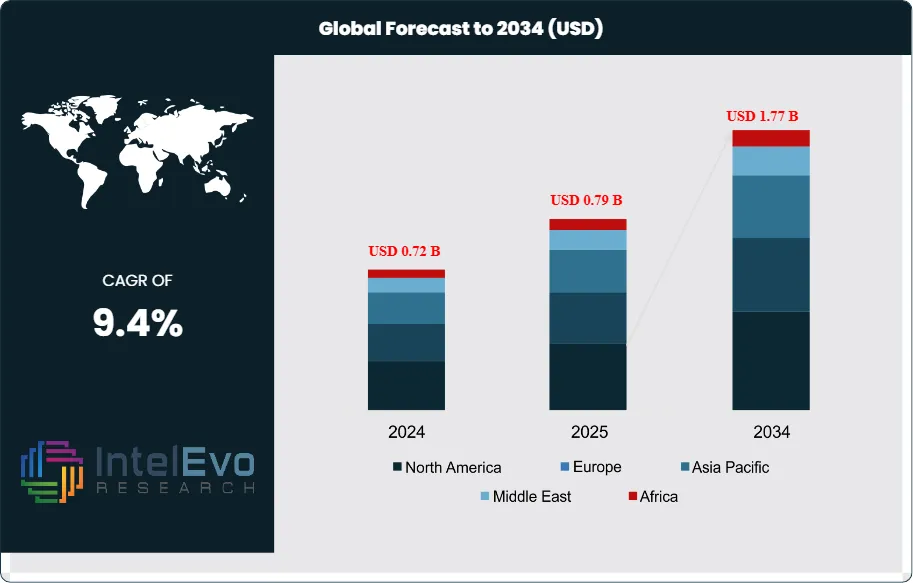
The AI-Powered Predictive Maintenance for Oil and Gas Market was valued at approximately USD 0.72 Billion in 2024 and reached USD 0.79 Billion in 2025. The market is projected to grow to USD 1.77 Billion by 2034, expanding at a CAGR of 9.4% during the forecast period from 2026 to 2034. This represents an absolute dollar opportunity of USD 0.98 Billion over the analysis period. The 2025 base estimate aligns with the wider AI and ML in oil and gas market at USD 2.70 Billion, where predictive maintenance held the largest application share at 29.2% in 2025.
Get More Information about this report -
Request Free Sample ReportThe AI-Powered Predictive Maintenance for Oil and Gas Market is moving from pilot projects to field deployment because operators now face a tighter mix of cost pressure, uptime risk, methane compliance, and aging equipment. ADNOC and Microsoft reported that 87% of surveyed organizations increased spending on AI and digital infrastructure, while 73% are already deploying AI across operations. Honeywell’s 2025 energy survey found that 85% of U.S. respondents are already using or piloting AI, and 81% expect AI to become critical within five years. These figures show that predictive maintenance has shifted from a discretionary digital spend to an operating requirement in upstream wells, compressor stations, LNG trains, refineries, and pipeline networks.
Demand is strongest where rotating equipment failures, corrosion events, and unplanned shutdowns create direct production losses. Saudi Aramco states that digital solutions, including AI-driven maintenance and leak detection, helped deliver a 15% increase in oil production and a 100% improvement in troubleshooting response times. ADNOC’s predictive maintenance program is expected to deliver maintenance savings of up to 20%, which supports broader adoption among national oil companies and large independents. Reuters also reported at CERAWeek 2025 that AI is speeding up drilling and making previously marginal resources more economic, which strengthens the business case for asset-health analytics across the oil and gas chain.
Supply conditions favor vendors with sector data models, industrial historians, digital twin capability, and deep installed bases in control systems and field services. Regulation also supports market expansion. PHMSA issued its final gas pipeline leak detection and repair rule on January 17, 2025. OSHA continues to require process safety management for high-hazard operations. The EU AI Act entered into force on August 1, 2024, adding governance obligations for industrial AI deployments in Europe. In parallel, EPA actions on methane emissions continue to push operators toward earlier fault detection and tighter inspection routines. North America remains the largest regional market in 2025, but the Middle East and Asia Pacific are increasing capital allocation as ADNOC, Aramco, Chevron India, and Indian refiners expand AI-linked operating programs.

Key Takeaways
- Market Growth: The AI-Powered Predictive Maintenance for Oil and Gas Market stood at USD 0.79 Billion in 2025 and is projected to reach USD 1.77 Billion by 2034. The market is set to expand at a CAGR of 9.4% from 2026 to 2034.
- Segment Dominance: By offering, solutions led with 68.4% of revenue in 2025, equal to about USD 0.54 Billion, as operators favored software-led condition monitoring, failure prediction, and alert orchestration over stand-alone consulting.
- Segment Dominance: By application, rotating equipment and compressors held the top share at 34.8% in 2025, or roughly USD 0.28 Billion, because failures in pumps, compressors, turbines, and motors create immediate uptime and safety risk.
- Driver: Rising enterprise deployment is the main growth engine. ADNOC and Microsoft found 73% of energy firms deploying AI across operations, while Honeywell found 85% already using or piloting AI.
- Restraint: Data quality, cybersecurity, and talent shortages remain the main drag on adoption. ADNOC and Microsoft identified cybersecurity and data quality as the top concerns, while 39% cited talent access as a barrier.
- Opportunity: Methane and leak-detection compliance is widening the addressable market. PHMSA’s January 2025 final rule tightened leak-detection and repair requirements, while EPA continued methane-rule actions in December 2024.
- Trend: Agentic AI and digital twins are moving into maintenance workflows. One in five energy companies now deploy agentic AI, and SLB reported more than 150 AI-enabled applications across its technologies in 2026.
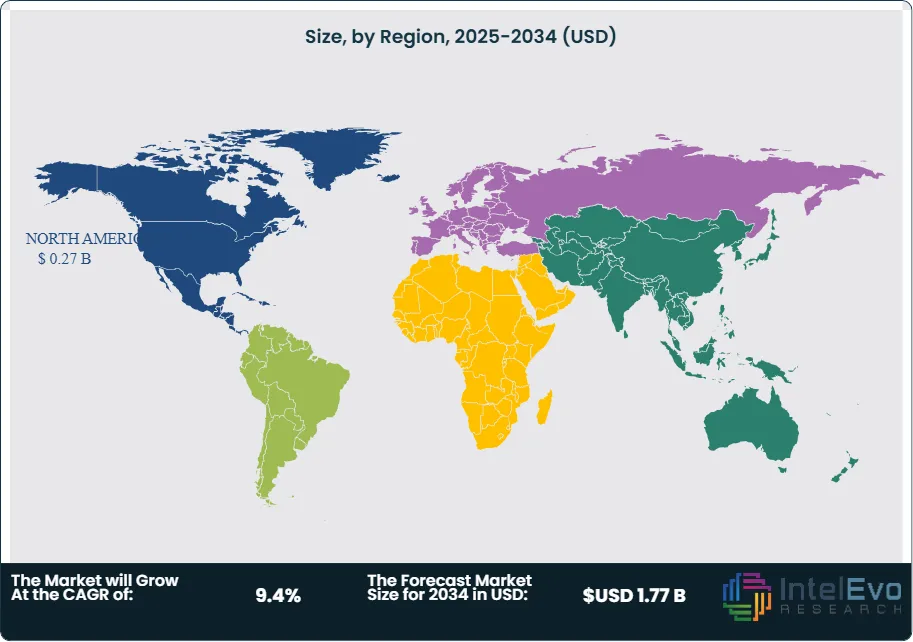
- Regional Analysis: North America led with 34.6% of global revenue in 2025, equal to about USD 0.27 Billion, supported by dense upstream activity, strong software availability, and tighter compliance spending.
Competitive Landscape Overview
The AI-Powered Predictive Maintenance for Oil and Gas Market is moderately consolidated. Analyst modeling indicates the top four suppliers controlled about 46.5% of global revenue in 2025. Competition is technology-led and installed-base-led, with vendors competing on domain models, historian depth, control-system connectivity, and long-cycle oil and gas relationships. Competitive pressure rose through 2025 as Emerson agreed to buy the remaining AspenTech stake for USD 7.2 Billion, C3 AI and Baker Hughes renewed their alliance through June 2028, and SLB with ADNOC launched AiPSO across eight fields.
| Company | HQ | Position | Key Offering | Geo Strength | Recent Move |
|---|---|---|---|---|---|
| SLB | United States | Leader | Lumi data and AI platform | North America, Middle East | Launched AiPSO with ADNOC across eight fields in Nov 2025. |
| Baker Hughes | United States | Leader | Cordant industrial software | North America, Middle East | Renewed and expanded alliance with C3 AI through June 2028 in May 2025. |
| AspenTech | United States | Leader | Aspen Mtell / AspenTech Subsurface Intelligence | North America, Europe | Emerson introduced AspenTech Subsurface Intelligence, a cloud-native AI environment, in Sep 2025. |
| Honeywell | United States | Leader | Honeywell Forge APM | Europe, Middle East | Expanded Honeywell Forge APM use with Aker BP in Apr 2025 for early fault detection and risk-based maintenance. |
| Siemens | Germany | Challenger | Senseye Predictive Maintenance | Europe | Unveiled Digital Twin Composer and expanded industrial AI tools at CES 2026. |
| IBM | United States | Challenger | Maximo Application Suite | North America | Added AI agents to Maximo in Jul 2025 to support condition-based maintenance. |
| AVEVA | United Kingdom | Challenger | AVEVA PI System and APM | Asia Pacific, Middle East | Signed an AI-led digitalisation MoU with HMEL in India’s refining sector in Feb 2025. |
| C3 AI | United States | Niche Player | C3 AI Reliability | North America | Renewed and expanded its Baker Hughes partnership in May 2025 with a focus on reducing downtime and lifting operational visibility. |
| AIQ | United Arab Emirates | Niche Player | FORESIGHT | Middle East | Deployed FORESIGHT across 100+ Al Dhafra wells in Nov 2025. |
By Offering
The AI-Powered Predictive Maintenance for Oil and Gas Market by offering is led by solutions, which accounted for 68.4% of 2025 revenue, or about USD 0.54 Billion. Operators prefer integrated software stacks that combine asset models, anomaly detection, historian data, inspection records, and workflow triggers into a single operating layer. That buying pattern matches the wider AI and ML in oil and gas market, where software held 47.1% in 2025. Services made up the remaining 31.6%, or USD 0.25 Billion, and remain important in brownfield plants where data pipelines, model tuning, and change management still require vendor support. Over the forecast period, services will keep a meaningful share because oil and gas operators continue to struggle with fragmented data estates, cyber controls, and workforce gaps. Even so, recurring software revenue expands faster because maintenance teams want standard dashboards, alarm ranking, and fleet-level asset scoring rather than project-by-project analytics.
By Deployment
The AI-Powered Predictive Maintenance for Oil and Gas Market by deployment shows cloud at 46.8% in 2025, equal to USD 0.37 Billion, followed by on-premise at 34.6% and hybrid at 18.6%. Cloud wins where operators want rapid rollout across wells, gathering systems, and multiple plants with lower upfront infrastructure costs. AspenTech’s 2025 launch of AspenTech Subsurface Intelligence as a cloud-native environment and Siemens’ SaaS-based Senseye reinforce this direction. On-premise systems remain strong in refineries, LNG plants, and national oil company sites where latency, sovereignty, or cyber rules limit external hosting. Hybrid is smaller today, but it is gaining ground in offshore and pipeline use cases where edge analytics must stay local while enterprise dashboards run centrally. Over the next nine years, hybrid architectures will rise fastest because they fit the operating reality of remote assets, intermittent connectivity, and stricter governance over industrial data flows.
By Operation
The AI-Powered Predictive Maintenance for Oil and Gas Market by operation is led by upstream with 48.6% of 2025 revenue, or USD 0.38 Billion. The upstream lead is consistent with the broader AI and ML oil and gas market, where upstream held 45.8% in 2025. Failure prediction for electric submersible pumps, artificial lift, separators, gas compression, and wellsite power systems creates the clearest payback because downtime directly cuts production. Downstream followed at 30.4%, or USD 0.24 Billion, supported by high-value rotating assets, turnaround planning, and process safety demands in refineries and petrochemical plants. Midstream held 21.0%, or USD 0.17 Billion, but the segment has a strong forward path as PHMSA tightens leak detection and repair expectations for gas systems. Midstream buyers increasingly seek predictive models for compressors, valves, storage integrity, and right-of-way monitoring because the cost of a leak or outage now includes methane exposure, emergency response, and regulatory reporting.
By Application
The AI-Powered Predictive Maintenance for Oil and Gas Market by application is led by rotating equipment and compressors at 34.8% of 2025 revenue, or USD 0.28 Billion. Pumps, turbines, motors, and compressors remain the first target because they generate dense condition data and account for a large share of plant downtime. Process units and refining assets followed with 26.6%, or USD 0.21 Billion, where maintenance models support furnaces, heat exchangers, reactors, and critical control loops. Pipelines and storage accounted for 21.5%, or USD 0.17 Billion, with momentum lifted by leak-detection rules, fiber sensing, and pressure-anomaly analytics. Drilling and well equipment represented 17.1%, or USD 0.14 Billion, but this segment will record strong adoption through 2034 as AI tools move deeper into drilling systems, completions support, and artificial lift monitoring. The application mix confirms that buyers still start with the assets that generate the fastest uptime savings, then widen deployment across adjacent systems.
Regional Analysis
North America
The AI-Powered Predictive Maintenance for Oil and Gas Market in North America accounted for 34.6% of global revenue in 2025, or about USD 0.27 Billion. The United States drives the region through shale, offshore Gulf activity, LNG expansion, and a deep installed base of industrial software and oilfield service vendors. Canada adds strength in pipelines, oil sands, and gas processing. Mexico contributes from refining upgrades and transmission networks, though adoption remains more selective. PHMSA’s final leak-detection rule and OSHA process safety requirements support spending on earlier fault detection, especially in midstream and downstream assets. North America also benefits from the presence of SLB, Baker Hughes, Honeywell, IBM, and C3 AI, which shortens deployment cycles and improves access to sector-trained implementation teams.
Europe
The AI-Powered Predictive Maintenance for Oil and Gas Market in Europe represented 22.1% of global revenue in 2025, or USD 0.17 Billion. The United Kingdom and Norway anchor offshore demand in the North Sea, where reliability, remote monitoring, and personnel exposure reduction matter more than in many onshore assets. Germany remains a software and industrial automation center, while France contributes through refining and integrated energy company spending. The EU AI Act adds governance requirements that slow some deployments but also increase demand for auditable, domain-specific systems rather than generic AI tools. Honeywell’s work with Aker BP in the North Sea and Siemens’ expansion of Senseye and digital twin tools show how European buyers prefer tightly governed industrial AI with strong engineering traceability.
Asia Pacific
The AI-Powered Predictive Maintenance for Oil and Gas Market in Asia Pacific held 18.8% of global revenue in 2025, or USD 0.15 Billion. China, India, Japan, and Australia form the core demand base. India is rising fastest because refining, petrochemicals, and gas infrastructure are expanding alongside a deep software labor pool. AVEVA’s February 2025 agreement with HMEL came as India’s refining capacity outlook increased from 250 MMTPA to 450 MMTPA by 2030, which raises the need for AI-linked reliability tools. Chevron’s 312,000-square-foot Bengaluru ENGINE center, backed by a planned USD 1.0 Billion multi-year investment, shows why India is also becoming a delivery hub for oil and gas digital work. China and Australia add demand through large LNG, offshore, and gas-processing projects, while Japan remains more selective but strong in asset integrity and process control.
Latin America
The AI-Powered Predictive Maintenance for Oil and Gas Market in Latin America accounted for 8.1% of global revenue in 2025, or USD 0.06 Billion. Brazil is the regional anchor because deepwater FPSOs and subsea systems create high-value use cases for anomaly detection and maintenance planning. Mexico follows with midstream, refining, and gas infrastructure needs, while Argentina adds future demand from shale and pipeline buildout. Adoption remains uneven because some operators still face budget constraints, patchy data architecture, and weaker internal digital teams. Even so, the region is gaining from wider cloud acceptance and from vendor efforts to package predictive maintenance as part of broader asset-performance programs rather than as stand-alone AI projects. Latin America remains a smaller current market, but offshore uptime economics make it one of the more attractive medium-term expansion zones.
Middle East & Africa
The AI-Powered Predictive Maintenance for Oil and Gas Market in Middle East & Africa represented 16.4% of global revenue in 2025, or USD 0.13 Billion. Saudi Arabia and the UAE account for most regional spending, supported by national oil company budgets, large brownfield asset bases, and top-down digital mandates. Aramco reports that AI-linked digital solutions helped produce a 15% increase in oil production and doubled troubleshooting response speed. ADNOC’s predictive maintenance program targets maintenance savings of up to 20%, and its 2025 programs with SLB and AIQ widened deployment across fields and wells. South Africa is much smaller, with activity centered on refining and terminal assets rather than large upstream programs. The region’s growth rate through 2034 will stay above the global average because national operators can move from central mandates to full-field deployment faster than many private peers.
Get More Information about this report -
Request Free Sample ReportMarket Key Segments
By Offering
- Solutions
- Services
By Deployment
- Cloud
- On-Premise
- Hybrid
By Operation
- Upstream
- Midstream
- Downstream
By Application
- Rotating Equipment and Compressors
- Process Units and Refining Assets
- Pipelines and Storage
- Drilling and Well Equipment
Regional Analysis and Coverage
- North America
- Latin America
- East Asia And Pacific
- Sea And South Asia
- Eastern Europe
- Western Europe
- Middle East & Africa
| Report Attribute | Details |
| Market size (2025) | USD 0.79 B |
| Forecast Revenue (2034) | USD 1.77 B |
| CAGR (2025-2034) | 9.4% |
| Historical data | 2021-2024 |
| Base Year For Estimation | 2025 |
| Forecast Period | 2026-2034 |
| Report coverage | Revenue Forecast, Competitive Landscape, Market Dynamics, Growth Factors, Trends and Recent Developments |
| Segments covered | By Offering, (Solutions, Services), By Deployment, (Cloud, On-Premise, Hybrid), By Operation, (Upstream, Midstream, Downstream), By Application, (Rotating Equipment and Compressors, Process Units and Refining Assets, Pipelines and Storage, Drilling and Well Equipment) |
| Research Methodology |
|
| Regional scope |
|
| Competitive Landscape | SLB, BAKER HUGHES, ASPENTECH, HONEYWELL, SIEMENS, IBM, C3 AI, AVEVA, AIQ, ABB, EMERSON, SAP, HALLIBURTON, PALANTIR, Others |
| Customization Scope | Customization for segments, region/country-level will be provided. Moreover, additional customization can be done based on the requirements. |
| Pricing and Purchase Options | Avail customized purchase options to meet your exact research needs. We have three licenses to opt for: Single User License, Multi-User License (Up to 5 Users), Corporate Use License (Unlimited User and Printable PDF). |


Frequently Asked Questions
How big is the ?
AI predictive maintenance for oil & gas market valued at USD 0.72B in 2024, reaching USD 1.77B by 2034, growing at a CAGR of 9.4% from 2026–2034.
Who are the major players in the ?
SLB, BAKER HUGHES, ASPENTECH, HONEYWELL, SIEMENS, IBM, C3 AI, AVEVA, AIQ, ABB, EMERSON, SAP, HALLIBURTON, PALANTIR, Others
Which segments covered the ?
By Offering, (Solutions, Services), By Deployment, (Cloud, On-Premise, Hybrid), By Operation, (Upstream, Midstream, Downstream), By Application, (Rotating Equipment and Compressors, Process Units and Refining Assets, Pipelines and Storage, Drilling and Well Equipment)
How can this market research report help my business make strategic decisions?
Our market research reports provide actionable intelligence, including verified market size data, CAGR projections, competitive benchmarking, and segment-level opportunity analysis. These insights support strategic planning, investment decisions, product development, and market entry strategies for enterprises and startups alike.
How frequently is the data updated?
We continuously monitor industry developments and update our reports to reflect regulatory changes, technological advancements, and macroeconomic shifts. Updated editions ensure you receive the latest market intelligence.

Select Licence Type
Connect with our sales team

AI-Powered Predictive Maintenance for Oil and Gas Market
Published Date : 30 Mar 2026 | Formats :Why IntelEvoResearch
100%
Customer
Satisfaction
24x7+
Availability - we are always
there when you need us
200+
Fortune 50 Companies trust
IntelEvoResearch
80%
of our reports are exclusive
and first in the industry
100%
more data
and analysis
1000+
reports published
till date
