
The Global AI Server Security Market was valued at approximately USD 7.8 billion in 2024 and is projected to reach nearly USD 616.3 billion by 2034, reflecting an extraordinary expansion driven by the rapid deployment of AI data centers and escalating cyber risks targeting AI workloads. Based on the stated 54.8% growth trajectory, the market size for 2025 is estimated at approximately USD 12.1 billion. From 2026 onward, the market is expected to accelerate from an estimated USD 18.7 billion in 2026 to USD 616.3 billion by 2034, registering a compound annual growth rate (CAGR) of approximately 54.8% during 2026–2034.
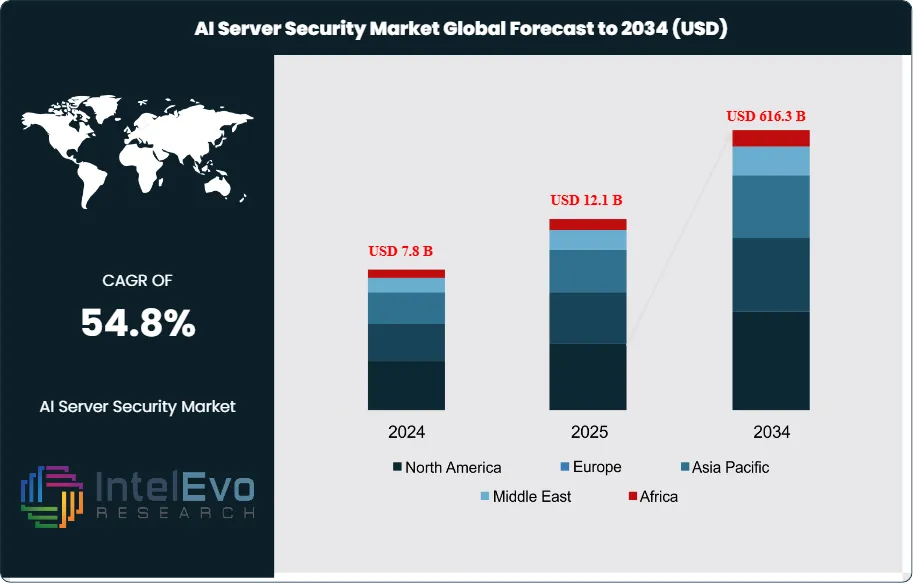
This sustained hyper-growth reflects increasing investments in AI infrastructure, rising complexity of AI-driven environments, and heightened enterprise focus on securing high-performance computing architectures and AI-native workloads.
AI server security covers technologies and practices that protect servers hosting AI workloads from unauthorized access, data breaches, and disruption. Providers deploy hardware acceleration, encryption, privileged-access management, and advanced intrusion detection to secure GPUs, TPUs, and specialized AI chips used in model training and inference. As enterprises move critical decision systems, customer data, and proprietary algorithms onto AI platforms, they elevate security from a compliance function to a board-level priority and a core requirement in AI infrastructure procurement.
Demand-side momentum stems from intensive AI adoption in finance, healthcare, retail, and automotive, where exposure to data theft, model manipulation, and service outages carries financial and reputational consequences. Cloud hyperscalers, colocation providers, and large enterprises seek integrated security stacks that can operate at scale, monitor east-west traffic, and protect data in use, in transit, and at rest. On the supply side, security vendors, chipmakers, and infrastructure providers form partnerships to embed security at the silicon, firmware, and orchestration layers, which compresses deployment timelines and supports platform standardization.
Regulatory pressure reinforces this trajectory. Data protection regimes, sectoral cybersecurity rules, and emerging AI governance frameworks require stronger controls over model training data, logging, and incident response around AI workloads. This environment raises the bar for certification, auditability, and explainability in AI server security solutions and channels investment toward automated policy management, continuous posture assessment, and zero-trust architectures.
North America held more than 41.7% of global revenue in 2024, or around USD 3.2 billion, supported by early AI adoption and dense cloud data center networks in the United States. The United States accounted for USD 2.6 billion in 2024 and is projected to grow at a CAGR of 51.5%, keeping the region an innovation and investment hub. Asia Pacific and Europe are emerging as growth frontiers, driven by national AI programs, digital industrial strategies, and data center expansion in markets such as China, India, Germany, and the United Kingdom.
Key Takeaways
Market Growth: The market grows from estimated: 7.8 billion USD, 2024 to estimate: 616.3 billion USD, 2034 as organizations scale AI workloads across industries. This path implies an estimated: 54.8%, 2026-2034 compound annual growth rate anchored in rising AI-driven cyber risk.
Segment Dominance: Cloud-delivered AI server security platforms capture estimated: 65.0%, 2024 of total spending as enterprises consolidate controls with hyperscale providers. This share rises to an estimated: 70.0%, 2034 as cloud-hosted AI training and inference environments become standard.
Segment Dominance: Large enterprises account for estimated: 72.0%, 2024 of AI server security outlays due to complex hybrid and multi-cloud estates. Their contribution remains above an estimated: 68.0%, 2034 even as mid-market adoption accelerates.
Driver: Accelerating AI deployment means an estimated: 80.0%, 2024 of Tier-1 enterprises run critical AI workloads that require hardened server security. Security spend per AI server increases by an estimated: 30.0%, 2034 as firms prioritize protection of models and training data.
Restraint: High integration complexity and skills gaps extend implementation cycles by an estimated: 6.0 months, 2024 for large-scale AI security projects. Compliance, testing, and certification consume an estimated: 18.0%, 2024 of total AI security program budgets.
Opportunity: Zero-trust architectures, confidential computing, and secure enclaves unlock an incremental opportunity of estimated: 15.0 billion USD, 2034 in specialized AI server security solutions. Managed AI security services contribute an additional estimated: 10.0 billion USD, 2034 as enterprises outsource 24/7 protection.
Trend: Vendors embed AI and automation into policy orchestration, raising automated event triage to an estimated: 75.0%, 2034 of all server security alerts. Adoption of AI-native security analytics platforms grows at an estimated: 22.0%, 2024-2034 compound annual rate as firms seek real-time anomaly detection.
Regional Analysis: North America holds an estimated: 40.0%, 2024 share of global AI server security revenue, supported by dense cloud and AI infrastructure. Asia-Pacific increases its contribution from an estimated: 25.0%, 2024 to an estimated: 32.0%, 2034 as China and India expand AI data centers and regulatory enforcement.
By Component
The AI server security market continues to shift toward complex, multi-layered architectures in 2025 as enterprises expand AI deployments across data centers and cloud environments. Hardware remains a core foundation due to the processing demands of AI-enhanced threat detection. In 2024, hardware accounted for more than 45 percent of total spending, driven by growth in AI-optimized servers, GPU-accelerated systems, and FPGA-based solutions. You rely on these systems to handle rising inference loads, real-time telemetry analysis, and encryption workloads that traditional servers struggle to support. Vendors continue to improve performance per watt, which reduces operational costs and strengthens interest from large enterprises operating large GPU clusters.
The software layer grows faster than hardware as organizations adopt automated threat analytics, AI-driven firewalls, and intelligent intrusion-detection systems. These platforms increasingly integrate machine learning pipelines that analyze abnormal traffic patterns, model drift, and unauthorized access attempts. The market benefits from rising adoption of automated vulnerability management tools as board-level risk oversight intensifies. Software revenues are expected to post a strong CAGR through 2030 as enterprises prioritize adaptive intelligence over static rules.
Services round out the component landscape as companies expand managed security operations and associated consulting. You see rising demand for managed detection and response, integration support for hybrid deployments, and training focused on AI-driven threat models. As cloud and on-premises workloads converge, enterprises often rely on service partners to ensure operational readiness and compliance with expanding regulations.
By Deployment Model
Cloud-based deployment remains the market leader as of 2025, accounting for more than 59 percent of global deployments. You gain access to continuously updated threat intelligence, flexible scaling for AI training and inference workloads, and faster remediation cycles. Cloud adoption accelerated further as remote and hybrid work normalized post-2023. Organizations prefer cloud platforms because they support secure access from distributed locations and provide consistent security metadata across all workloads.
On-premises deployments still play a critical role in industries with strict regulatory and data-sovereignty requirements. Financial institutions, government agencies, and defense organizations continue to invest in high-assurance server environments where sensitive data remains fully controlled. Demand is reinforced by the rising need to secure GPU clusters used for training large AI models. Through 2025, on-premises deployments maintain stable growth as enterprises pursue hybrid strategies that blend cloud agility with local data governance.
By Enterprise Size
Large enterprises remain the dominant contributors to the market, representing more than 74 percent of total spending. Their broad digital footprint, exposure to rising cyber threats, and substantial IT budgets drive adoption of AI-enhanced server protection. These organizations face advanced attack surfaces, including containerized workloads, multi-cloud infrastructures, and confidential computing environments. As global regulations expand, large enterprises prioritize AI-automated compliance monitoring and real-time anomaly detection.
SMEs increase adoption as AI security platforms become more affordable and modular. Until recently, many smaller companies viewed server-level AI security as excessive for their needs. However, the spread of automated ransomware tools and credential-based attacks pushed SME leadership teams to reconsider risk exposure. In 2025, SME demand shows steady growth, supported by subscription-based pricing and integrated cloud security bundles, although budget constraints still limit high-end use cases.
By Application
Network security remains the largest application category with over 44 percent share in 2024, supported by the surge in AI-enabled cyber intrusions targeting enterprise traffic flows. You depend on network security tools to monitor east-west traffic, secure data center networking layers, and detect unauthorized lateral movement. The rise of encrypted traffic and remote connectivity strengthens the need for AI-based inspection models that identify anomalies without decryption.
Endpoint security ranks second as enterprises deploy solutions to protect servers, virtual machines, and user devices. In 2025, endpoint workloads generate higher telemetry volumes, which increases reliance on AI-enabled behavioral analysis. However, endpoint investments trail network security because organizations continue to prioritize infrastructure-level protection.
Application security grows more gradually as enterprises struggle to secure complex application environments, especially environments built on microservices and API-driven architectures. Cloud security expands rapidly as AI workloads shift to public and hybrid cloud models, pushing you to invest in identity security, workload protection platforms, and automated policy controls.
By Industry Vertical
The BFSI sector continues to hold the largest market share, above 31 percent in 2024, as financial institutions face sustained threat activity and strict regulatory oversight. Banks deploy AI-enabled defenses to mitigate fraud, credential theft, data breaches, and unauthorized server access. They also adopt AI-driven logging and audit analytics to support compliance with emerging 2025 cybersecurity mandates.
Healthcare and life sciences hold the second-largest share. You face rising risk due to the value of patient data and growing dependence on hospital networks and connected medical systems. Adoption gains momentum as healthcare organizations modernize legacy infrastructure and meet updated privacy requirements.
Retail and e-commerce expand server security investments as online transactions increase. Attackers continue to target payment systems and customer data repositories. Although spending trails BFSI, the segment shows strong growth as digital commerce accelerates.
Government and defense agencies remain cautious adopters due to long procurement cycles and strict certification requirements. However, geopolitical tensions and the growing use of AI in state-level cyber operations accelerate investment in AI-driven monitoring, classified server protection, and secure AI model training environments.
By Region
North America held more than 41 percent market share in 2024, supported by early enterprise adoption of AI and intensive investment in cybersecurity infrastructure. The United States remains the central hub due to strong regulatory frameworks, such as CCPA and sector-specific mandates, which compel continuous security modernization. You also benefit from collaboration between federal agencies, universities, and private-sector labs that accelerate improvements in AI-driven server security technologies.
Europe continues to gain momentum as organizations adapt to GDPR-related enforcement and sector-specific cybersecurity directives. Spending grows steadily in Germany, France, the Nordics, and the United Kingdom. Enterprises invest in AI-assisted compliance automation, secure data center operations, and cross-border cyber risk mitigation.
Asia Pacific emerges as a high-growth region driven by rapid digitalization in China, Japan, South Korea, India, and Southeast Asia. Investments increase as enterprises deploy AI-ready GPUs and server clusters. Governments in the region expand cybersecurity regulations, encouraging higher adoption rates.
Latin America and the Middle East & Africa remain earlier-stage markets but show rising interest as cloud adoption expands and cyberattacks increase. As enterprises modernize server infrastructure, these regions strengthen demand for cloud-based AI security platforms and managed detection services.
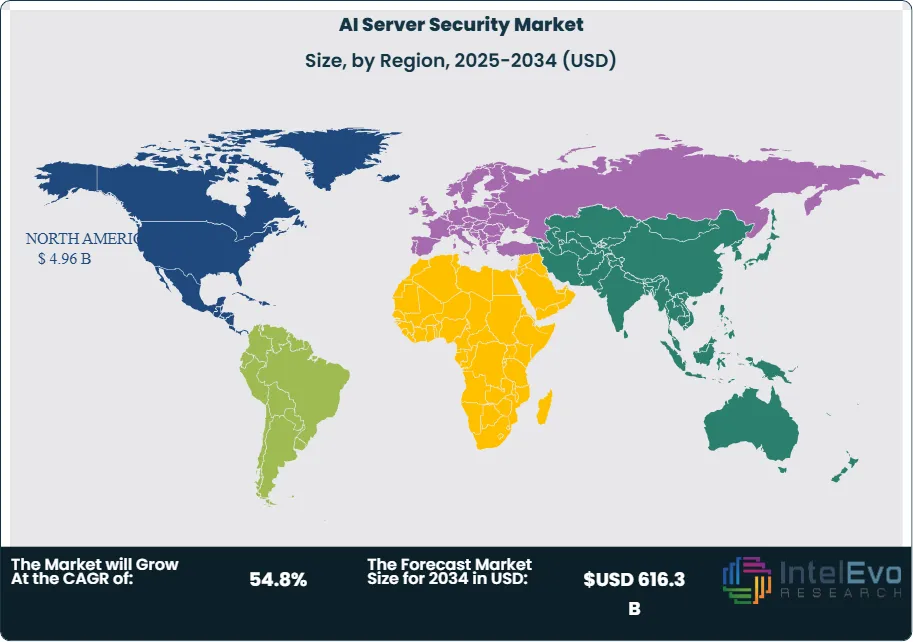
By Component (Hardware, Software, Services); By Deployment Model (On-premises, Cloud-based)
Research Methodology
Primary Research- 100 Interviews of Stakeholders
Secondary Research
Desk Research
Regional scope
North America (United States, Canada, Mexico)
Latin America (Brazil, Argentina, Columbia)
East Asia And Pacific (China, Japan, South Korea, Australia, Cambodia, Fiji, Indonesia)
Sea And South Asia (India, Singapore, Thailand, Taiwan, Malaysia)
Eastern Europe (Poland, Russia, Czech Republic, Romania)
Western Europe (Germany, U.K., France, Spain, Itlay)
Middle East & Africa (GCC Countries, Egypt, Nigeria, South Africa, Israel)
Competitive Landscape
Intel Corporation, Palo Alto Networks, Inc., Dell Inc., Amazon Web Services, Inc., SentinelOne, Inc., Cisco Systems, Inc., Check Point Software Technologies Ltd., Zscaler, Inc., International Business Machines Corporation (IBM), Fortinet, Inc., Microsoft Corporation, CrowdStrike Holdings, Inc., Others
Customization Scope
Customization for segments, region/country-level will be provided. Moreover, additional customization can be done based on the requirements.
Pricing and Purchase Options
Avail customized purchase options to meet your exact research needs. We have three licenses to opt for: Single User License, Multi-User License (Up to 5 Users), Corporate Use License (Unlimited User and Printable PDF).
TABLE OF CONTENTS
1. EXECUTIVE SUMMARY
1.1. MARKET SNAPSHOT
1.2. KEY FINDINGS & INSIGHTS
1.3. ANALYST RECOMMENDATIONS
1.4. FUTURE OUTLOOK
2. RESEARCH METHODOLOGY
2.1. MARKET DEFINITION & SCOPE
2.2. RESEARCH OBJECTIVES: PRIMARY & SECONDARY DATA SOURCES
2.3. DATA COLLECTION SOURCES
2.3.1. COVERAGE OF 100+ PRIMARY RESEARCH/CONSULTATION CALLS WITH INDUSTRY STAKEHOLDERS
FIGURE 17 NORTH AMERICA AI SERVER SECURITYCURRENT AND FUTURE TYPE ANALYSIS, 2025–2034, (USD MILLION)
FIGURE 18 NORTH AMERICA AI SERVER SECURITYCURRENT AND FUTURE END USER ANALYSIS, 2025–2034, (USD MILLION)
FIGURE 19 MARKET SHARE BY COUNTRY
FIGURE 20 LATIN AMERICA AI SERVER SECURITYCURRENT AND FUTURE TYPE ANALYSIS, 2025–2034, (USD MILLION)
FIGURE 21 LATIN AMERICA AI SERVER SECURITYCURRENT AND FUTURE END USER ANALYSIS, 2025–2034, (USD MILLION)
FIGURE 22 MARKET SHARE BY COUNTRY
FIGURE 23 EASTERN EUROPE AI SERVER SECURITYCURRENT AND FUTURE TYPE ANALYSIS, 2025–2034, (USD MILLION)
FIGURE 24 EASTERN EUROPE AI SERVER SECURITYCURRENT AND FUTURE END USER ANALYSIS, 2025–2034, (USD MILLION)
FIGURE 25 MARKET SHARE BY COUNTRY
FIGURE 26 WESTERN EUROPE AI SERVER SECURITYCURRENT AND FUTURE TYPE ANALYSIS, 2025–2034, (USD MILLION)
FIGURE 27 WESTERN EUROPE AI SERVER SECURITYCURRENT AND FUTURE END USER ANALYSIS, 2025–2034, (USD MILLION)
FIGURE 28 MARKET SHARE BY COUNTRY
FIGURE 29 EAST ASIA AND PACIFIC AI SERVER SECURITYCURRENT AND FUTURE TYPE ANALYSIS, 2025–2034, (USD MILLION)
FIGURE 30 EAST ASIA AND PACIFIC AI SERVER SECURITYCURRENT AND FUTURE END USER ANALYSIS, 2025–2034, (USD MILLION)
FIGURE 31 MARKET SHARE BY COUNTRY
FIGURE 32 SEA AND SOUTH ASIA AI SERVER SECURITYCURRENT AND FUTURE TYPE ANALYSIS, 2025–2034, (USD MILLION)
FIGURE 33 SEA AND SOUTH ASIA AI SERVER SECURITYCURRENT AND FUTURE END USER ANALYSIS, 2025–2034, (USD MILLION)
FIGURE 34 MARKET SHARE BY COUNTRY
FIGURE 35 MIDDLE EAST AND AFRICA AI SERVER SECURITYCURRENT AND FUTURE TYPE ANALYSIS, 2025–2034, (USD MILLION)
FIGURE 36 MIDDLE EAST AND AFRICA AI SERVER SECURITYCURRENT AND FUTURE END USER ANALYSIS, 2025–2034, (USD MILLION)
FIGURE 37 NORTH AMERICA AI SERVER SECURITYCURRENT AND FUTURE MARKET VOLUME SHARE REGIONAL ANALYSIS, 2025–2034, (USD MILLION)
FIGURE 38 U.S. AI SERVER SECURITYCURRENT AND FUTURE TYPE ANALYSIS, 2025–2034, (USD MILLION)
FIGURE 39 U.S. AI SERVER SECURITYCURRENT AND FUTURE END USER ANALYSIS, 2025–2034, (USD MILLION)
FIGURE 40 CANADA AI SERVER SECURITYCURRENT AND FUTURE TYPE ANALYSIS, 2025–2034, (USD MILLION)
FIGURE 41 CANADA AI SERVER SECURITYCURRENT AND FUTURE END USER ANALYSIS, 2025–2034, (USD MILLION)
FIGURE 42 LATIN AMERICA AI SERVER SECURITYCURRENT AND FUTURE MARKET VOLUME SHARE REGIONAL ANALYSIS, 2025–2034, (USD MILLION)
FIGURE 43 MEXICO AI SERVER SECURITYCURRENT AND FUTURE TYPE ANALYSIS, 2025–2034, (USD MILLION)
FIGURE 44 MEXICO AI SERVER SECURITYCURRENT AND FUTURE END USER ANALYSIS, 2025–2034, (USD MILLION)
FIGURE 45 BRAZIL AI SERVER SECURITYCURRENT AND FUTURE TYPE ANALYSIS, 2025–2034, (USD MILLION)
FIGURE 46 BRAZIL AI SERVER SECURITYCURRENT AND FUTURE END USER ANALYSIS, 2025–2034, (USD MILLION)
FIGURE 47 ARGENTINA AI SERVER SECURITYCURRENT AND FUTURE TYPE ANALYSIS, 2025–2034, (USD MILLION)
FIGURE 48 ARGENTINA AI SERVER SECURITYCURRENT AND FUTURE END USER ANALYSIS, 2025–2034, (USD MILLION)
FIGURE 49 COLUMBIA AI SERVER SECURITYCURRENT AND FUTURE TYPE ANALYSIS, 2025–2034, (USD MILLION)
FIGURE 50 COLUMBIA AI SERVER SECURITYCURRENT AND FUTURE END USER ANALYSIS, 2025–2034, (USD MILLION)
FIGURE 51 REST OF LATIN AMERICA AI SERVER SECURITYCURRENT AND FUTURE TYPE ANALYSIS, 2025–2034, (USD MILLION)
FIGURE 52 REST OF LATIN AMERICA AI SERVER SECURITYCURRENT AND FUTURE END USER ANALYSIS, 2025–2034, (USD MILLION)
FIGURE 53 EASTERN EUROPE AI SERVER SECURITYCURRENT AND FUTURE MARKET VOLUME SHARE REGIONAL ANALYSIS, 2025–2034, (USD MILLION)
FIGURE 54 POLAND AI SERVER SECURITYCURRENT AND FUTURE TYPE ANALYSIS, 2025–2034, (USD MILLION)
FIGURE 55 POLAND AI SERVER SECURITYCURRENT AND FUTURE END USER ANALYSIS, 2025–2034, (USD MILLION)
FIGURE 56 RUSSIA AI SERVER SECURITYCURRENT AND FUTURE TYPE ANALYSIS, 2025–2034, (USD MILLION)
FIGURE 57 RUSSIA AI SERVER SECURITYCURRENT AND FUTURE END USER ANALYSIS, 2025–2034, (USD MILLION)
FIGURE 58 CZECH REPUBLIC AI SERVER SECURITYCURRENT AND FUTURE TYPE ANALYSIS, 2025–2034, (USD MILLION)
FIGURE 59 CZECH REPUBLIC AI SERVER SECURITYCURRENT AND FUTURE END USER ANALYSIS, 2025–2034, (USD MILLION)
FIGURE 60 ROMANIA AI SERVER SECURITYCURRENT AND FUTURE TYPE ANALYSIS, 2025–2034, (USD MILLION)
FIGURE 61 ROMANIA AI SERVER SECURITYCURRENT AND FUTURE END USER ANALYSIS, 2025–2034, (USD MILLION)
FIGURE 62 REST OF EASTERN EUROPE AI SERVER SECURITYCURRENT AND FUTURE TYPE ANALYSIS, 2025–2034, (USD MILLION)
FIGURE 63 REST OF EASTERN EUROPE AI SERVER SECURITYCURRENT AND FUTURE END USER ANALYSIS, 2025–2034, (USD MILLION)
FIGURE 64 WESTERN EUROPE AI SERVER SECURITYCURRENT AND FUTURE MARKET VOLUME SHARE REGIONAL ANALYSIS, 2025–2034, (USD MILLION)
FIGURE 65 GERMANY AI SERVER SECURITYCURRENT AND FUTURE TYPE ANALYSIS, 2025–2034, (USD MILLION)
FIGURE 66 GERMANY AI SERVER SECURITYCURRENT AND FUTURE END USER ANALYSIS, 2025–2034, (USD MILLION)
FIGURE 67 FRANCE AI SERVER SECURITYCURRENT AND FUTURE TYPE ANALYSIS, 2025–2034, (USD MILLION)
FIGURE 68 FRANCE AI SERVER SECURITYCURRENT AND FUTURE END USER ANALYSIS, 2025–2034, (USD MILLION)
FIGURE 69 UK AI SERVER SECURITYCURRENT AND FUTURE TYPE ANALYSIS, 2025–2034, (USD MILLION)
FIGURE 70 UK AI SERVER SECURITYCURRENT AND FUTURE END USER ANALYSIS, 2025–2034, (USD MILLION)
FIGURE 71 SPAIN AI SERVER SECURITYCURRENT AND FUTURE TYPE ANALYSIS, 2025–2034, (USD MILLION)
FIGURE 72 SPAIN AI SERVER SECURITYCURRENT AND FUTURE END USER ANALYSIS, 2025–2034, (USD MILLION)
FIGURE 73 ITALY AI SERVER SECURITYCURRENT AND FUTURE TYPE ANALYSIS, 2025–2034, (USD MILLION)
FIGURE 74 ITALY AI SERVER SECURITYCURRENT AND FUTURE END USER ANALYSIS, 2025–2034, (USD MILLION)
FIGURE 75 REST OF WESTERN EUROPE AI SERVER SECURITYCURRENT AND FUTURE TYPE ANALYSIS, 2025–2034, (USD MILLION)
FIGURE 76 REST OF WESTERN EUROPE AI SERVER SECURITYCURRENT AND FUTURE END USER ANALYSIS, 2025–2034, (USD MILLION)
FIGURE 77 EAST ASIA AND PACIFIC AI SERVER SECURITYCURRENT AND FUTURE MARKET VOLUME SHARE REGIONAL ANALYSIS, 2025–2034, (USD MILLION)
FIGURE 78 CHINA AI SERVER SECURITYCURRENT AND FUTURE TYPE ANALYSIS, 2025–2034, (USD MILLION)
FIGURE 79 CHINA AI SERVER SECURITYCURRENT AND FUTURE END USER ANALYSIS, 2025–2034, (USD MILLION)
FIGURE 80 JAPAN AI SERVER SECURITYCURRENT AND FUTURE TYPE ANALYSIS, 2025–2034, (USD MILLION)
FIGURE 81 JAPAN AI SERVER SECURITYCURRENT AND FUTURE END USER ANALYSIS, 2025–2034, (USD MILLION)
FIGURE 82 AUSTRALIA AI SERVER SECURITYCURRENT AND FUTURE TYPE ANALYSIS, 2025–2034, (USD MILLION)
FIGURE 83 AUSTRALIA AI SERVER SECURITYCURRENT AND FUTURE END USER ANALYSIS, 2025–2034, (USD MILLION)
FIGURE 84 CAMBODIA AI SERVER SECURITYCURRENT AND FUTURE TYPE ANALYSIS, 2025–2034, (USD MILLION)
FIGURE 85 CAMBODIA AI SERVER SECURITYCURRENT AND FUTURE END USER ANALYSIS, 2025–2034, (USD MILLION)
FIGURE 86 FIJI AI SERVER SECURITYCURRENT AND FUTURE TYPE ANALYSIS, 2025–2034, (USD MILLION)
FIGURE 87 FIJI AI SERVER SECURITYCURRENT AND FUTURE END USER ANALYSIS, 2025–2034, (USD MILLION)
FIGURE 88 INDONESIA AI SERVER SECURITYCURRENT AND FUTURE TYPE ANALYSIS, 2025–2034, (USD MILLION)
FIGURE 89 INDONESIA AI SERVER SECURITYCURRENT AND FUTURE END USER ANALYSIS, 2025–2034, (USD MILLION)
FIGURE 90 SOUTH KOREA AI SERVER SECURITYCURRENT AND FUTURE TYPE ANALYSIS, 2025–2034, (USD MILLION)
FIGURE 91 SOUTH KOREA AI SERVER SECURITYCURRENT AND FUTURE END USER ANALYSIS, 2025–2034, (USD MILLION)
FIGURE 92 REST OF EAST ASIA AND PACIFIC AI SERVER SECURITYCURRENT AND FUTURE TYPE ANALYSIS, 2025–2034, (USD MILLION)
FIGURE 93 REST OF EAST ASIA AND PACIFIC AI SERVER SECURITYCURRENT AND FUTURE END USER ANALYSIS, 2025–2034, (USD MILLION)
FIGURE 94 SEA AND SOUTH ASIA AI SERVER SECURITYCURRENT AND FUTURE MARKET VOLUME SHARE REGIONAL ANALYSIS, 2025–2034, (USD MILLION)
FIGURE 95 BANGLADESH AI SERVER SECURITYCURRENT AND FUTURE TYPE ANALYSIS, 2025–2034, (USD MILLION)
FIGURE 96 BANGLADESH AI SERVER SECURITYCURRENT AND FUTURE END USER ANALYSIS, 2025–2034, (USD MILLION)
FIGURE 97 NEW ZEALAND AI SERVER SECURITYCURRENT AND FUTURE TYPE ANALYSIS, 2025–2034, (USD MILLION)
FIGURE 98 NEW ZEALAND AI SERVER SECURITYCURRENT AND FUTURE END USER ANALYSIS, 2025–2034, (USD MILLION)
FIGURE 99 INDIA AI SERVER SECURITYCURRENT AND FUTURE TYPE ANALYSIS, 2025–2034, (USD MILLION)
FIGURE 100 INDIA AI SERVER SECURITYCURRENT AND FUTURE END USER ANALYSIS, 2025–2034, (USD MILLION)
FIGURE 101 SINGAPORE AI SERVER SECURITYCURRENT AND FUTURE TYPE ANALYSIS, 2025–2034, (USD MILLION)
FIGURE 102 SINGAPORE AI SERVER SECURITYCURRENT AND FUTURE END USER ANALYSIS, 2025–2034, (USD MILLION)
FIGURE 103 THAILAND AI SERVER SECURITYCURRENT AND FUTURE TYPE ANALYSIS, 2025–2034, (USD MILLION)
FIGURE 104 THAILAND AI SERVER SECURITYCURRENT AND FUTURE END USER ANALYSIS, 2025–2034, (USD MILLION)
FIGURE 105 TAIWAN AI SERVER SECURITYCURRENT AND FUTURE TYPE ANALYSIS, 2025–2034, (USD MILLION)
FIGURE 106 TAIWAN AI SERVER SECURITYCURRENT AND FUTURE END USER ANALYSIS, 2025–2034, (USD MILLION)
FIGURE 107 MALAYSIA AI SERVER SECURITYCURRENT AND FUTURE TYPE ANALYSIS, 2025–2034, (USD MILLION)
FIGURE 108 MALAYSIA AI SERVER SECURITYCURRENT AND FUTURE END USER ANALYSIS, 2025–2034, (USD MILLION)
FIGURE 109 REST OF SEA AND SOUTH ASIA AI SERVER SECURITYCURRENT AND FUTURE TYPE ANALYSIS, 2025–2034, (USD MILLION)
FIGURE 110 REST OF SEA AND SOUTH ASIA AI SERVER SECURITYCURRENT AND FUTURE END USER ANALYSIS, 2025–2034, (USD MILLION)
FIGURE 111 MIDDLE EAST AND AFRICA AI SERVER SECURITYCURRENT AND FUTURE MARKET VOLUME SHARE REGIONAL ANALYSIS, 2025–2034, (USD MILLION)
FIGURE 112 GCC COUNTRIES AI SERVER SECURITYCURRENT AND FUTURE TYPE ANALYSIS, 2025–2034, (USD MILLION)
FIGURE 113 GCC COUNTRIES AI SERVER SECURITYCURRENT AND FUTURE END USER ANALYSIS, 2025–2034, (USD MILLION)
FIGURE 114 SAUDI ARABIA AI SERVER SECURITYCURRENT AND FUTURE TYPE ANALYSIS, 2025–2034, (USD MILLION)
FIGURE 115 SAUDI ARABIA AI SERVER SECURITYCURRENT AND FUTURE END USER ANALYSIS, 2025–2034, (USD MILLION)
FIGURE 116 UAE AI SERVER SECURITYCURRENT AND FUTURE TYPE ANALYSIS, 2025–2034, (USD MILLION)
FIGURE 117 UAE AI SERVER SECURITYCURRENT AND FUTURE END USER ANALYSIS, 2025–2034, (USD MILLION)
FIGURE 118 BAHRAIN AI SERVER SECURITYCURRENT AND FUTURE TYPE ANALYSIS, 2025–2034, (USD MILLION)
FIGURE 119 BAHRAIN AI SERVER SECURITYCURRENT AND FUTURE END USER ANALYSIS, 2025–2034, (USD MILLION)
FIGURE 120 KUWAIT AI SERVER SECURITYCURRENT AND FUTURE TYPE ANALYSIS, 2025–2034, (USD MILLION)
FIGURE 121 KUWAIT AI SERVER SECURITYCURRENT AND FUTURE END USER ANALYSIS, 2025–2034, (USD MILLION)
FIGURE 122 OMAN AI SERVER SECURITYCURRENT AND FUTURE TYPE ANALYSIS, 2025–2034, (USD MILLION)
FIGURE 123 OMAN AI SERVER SECURITYCURRENT AND FUTURE END USER ANALYSIS, 2025–2034, (USD MILLION)
FIGURE 124 QATAR AI SERVER SECURITYCURRENT AND FUTURE TYPE ANALYSIS, 2025–2034, (USD MILLION)
FIGURE 125 QATAR AI SERVER SECURITYCURRENT AND FUTURE END USER ANALYSIS, 2025–2034, (USD MILLION)
FIGURE 126 EGYPT AI SERVER SECURITYCURRENT AND FUTURE TYPE ANALYSIS, 2025–2034, (USD MILLION)
FIGURE 127 EGYPT AI SERVER SECURITYCURRENT AND FUTURE END USER ANALYSIS, 2025–2034, (USD MILLION)
FIGURE 128 NIGERIA AI SERVER SECURITYCURRENT AND FUTURE TYPE ANALYSIS, 2025–2034, (USD MILLION)
FIGURE 129 NIGERIA AI SERVER SECURITYCURRENT AND FUTURE END USER ANALYSIS, 2025–2034, (USD MILLION)
FIGURE 130 SOUTH AFRICA AI SERVER SECURITYCURRENT AND FUTURE TYPE ANALYSIS, 2025–2034, (USD MILLION)
FIGURE 131 SOUTH AFRICA AI SERVER SECURITYCURRENT AND FUTURE END USER ANALYSIS, 2025–2034, (USD MILLION)
FIGURE 132 ISRAEL AI SERVER SECURITYCURRENT AND FUTURE TYPE ANALYSIS, 2025–2034, (USD MILLION)
FIGURE 133 ISRAEL AI SERVER SECURITYCURRENT AND FUTURE END USER ANALYSIS, 2025–2034, (USD MILLION)
FIGURE 134 REST OF MEA AI SERVER SECURITYCURRENT AND FUTURE TYPE ANALYSIS, 2025–2034, (USD MILLION)
FIGURE 135 REST OF MEA AI SERVER SECURITYCURRENT AND FUTURE END USER ANALYSIS, 2025–2034, (USD MILLION)
FIGURE 136 U. S. MARKET SHARE ANALYSIS BY TYPE (2024)
FIGURE 137 U. S. MARKET SHARE ANALYSIS BY END USER (2024)
FIGURE 138 CANADA MARKET SHARE ANALYSIS BY TYPE (2024)
FIGURE 139 CANADA MARKET SHARE ANALYSIS BY END USER (2024)
FIGURE 140 MEXICO MARKET SHARE ANALYSIS BY TYPE (2024)
FIGURE 141 MEXICO MARKET SHARE ANALYSIS BY END USER (2024)
FIGURE 142 CHINA MARKET SHARE ANALYSIS BY TYPE (2024)
FIGURE 143 CHINA MARKET SHARE ANALYSIS BY END USER (2024)
FIGURE 144 JAPAN MARKET SHARE ANALYSIS BY TYPE (2024)
FIGURE 145 JAPAN MARKET SHARE ANALYSIS BY END USER (2024)
FIGURE 146 INDIA MARKET SHARE ANALYSIS BY TYPE (2024)
FIGURE 147 INDIA MARKET SHARE ANALYSIS BY END USER (2024)
FIGURE 148 SOUTH KOREA MARKET SHARE ANALYSIS BY TYPE (2024)
FIGURE 149 SOUTH KOREA MARKET SHARE ANALYSIS BY END USER (2024)
FIGURE 150 SAUDI ARABIA MARKET SHARE ANALYSIS BY TYPE (2024)
FIGURE 151 SAUDI ARABIA MARKET SHARE ANALYSIS BY END USER (2024)
FIGURE 152 UAE MARKET SHARE ANALYSIS BY TYPE (2024)
FIGURE 153 UAE MARKET SHARE ANALYSIS BY END USER (2024)
FIGURE 154 EGYPT MARKET SHARE ANALYSIS BY TYPE (2024)
FIGURE 155 EGYPT MARKET SHARE ANALYSIS BY END USER (2024)
FIGURE 156 NIGERIA MARKET SHARE ANALYSIS BY TYPE (2024)
FIGURE 157 NIGERIA MARKET SHARE ANALYSIS BY END USER (2024)
FIGURE 158 SOUTH AFRICA MARKET SHARE ANALYSIS BY TYPE (2024)
FIGURE 159 SOUTH AFRICA MARKET SHARE ANALYSIS BY END USER (2024)
FIGURE 160 GERMANY MARKET SHARE ANALYSIS BY TYPE (2024)
FIGURE 161 GERMANY MARKET SHARE ANALYSIS BY END USER (2024)
FIGURE 162 FRANCE MARKET SHARE ANALYSIS BY TYPE (2024)
FIGURE 163 FRANCE MARKET SHARE ANALYSIS BY END USER (2024)
FIGURE 164 UK MARKET SHARE ANALYSIS BY TYPE (2024)
FIGURE 165 UK MARKET SHARE ANALYSIS BY END USER (2024)
FIGURE 166 SPAIN MARKET SHARE ANALYSIS BY TYPE (2024)
FIGURE 167 SPAIN MARKET SHARE ANALYSIS BY END USER (2024)
FIGURE 168 ITALY MARKET SHARE ANALYSIS BY TYPE (2024)
FIGURE 169 ITALY MARKET SHARE ANALYSIS BY END USER (2024)
FIGURE 170 BRAZIL MARKET SHARE ANALYSIS BY TYPE (2024)
FIGURE 171 BRAZIL MARKET SHARE ANALYSIS BY END USER (2024)
FIGURE 172 ARGENTINA MARKET SHARE ANALYSIS BY TYPE (2024)
FIGURE 173 ARGENTINA MARKET SHARE ANALYSIS BY END USER (2024)
FIGURE 174 COLUMBIA MARKET SHARE ANALYSIS BY TYPE (2024)
FIGURE 175 COLUMBIA MARKET SHARE ANALYSIS BY END USER (2024)
FIGURE 176 GLOBAL AI SERVER SECURITYCURRENT AND FUTURE MARKET KEY COUNTRY LEVEL ANALYSIS, 2024–2034, (USD MILLION)
FIGURE 177 FINANCIAL OVERVIEW:
Key Player Analysis
Cisco Systems, Inc.: Cisco positions itself as a market leader in AI server security due to its broad infrastructure footprint and integration of AI-driven analytics across network and data center environments. Its product stack includes Secure Firewall, XDR, and AI-enhanced network telemetry tools that support real-time threat detection across hybrid architectures. In 2025, Cisco expands its security business with investments in AI-based behavioral analytics and automated policy management. The company reports steady growth in recurring security revenue, supported by demand from enterprises migrating mission-critical workloads to hybrid cloud environments. Cisco differentiates itself through its global channel network, strong customer base across government and large enterprise, and its ability to embed AI security directly within switching and routing hardware. This integrated approach strengthens its position among organizations seeking unified security and infrastructure management.
Palo Alto Networks, Inc.: Palo Alto Networks operates as a challenger with strong momentum in AI-powered server and cloud security. Its platforms, including Prisma Cloud and Cortex XSIAM, play a central role in securing AI workloads across public and private cloud deployments. By 2025, Palo Alto Networks increases investments in AI-driven automation and expands its ability to detect unknown threats through deep learning models. The company continues to pursue acquisitions that strengthen cloud-native security and extended detection capabilities, aligning with enterprise demand for consolidated security platforms. Palo Alto Networks differentiates itself through its focus on cloud-first architectures and a growing subscription revenue base that now accounts for more than half of its security portfolio. This positions the company well as organizations prioritize zero trust frameworks and integrated AI-based attack surface monitoring.
CrowdStrike Holdings, Inc.: CrowdStrike is viewed as an innovator in AI server security due to its cloud-native architecture and emphasis on real-time telemetry. The Falcon platform provides endpoint protection, identity defense, and cloud workload security that increasingly support AI-driven threat detection. In 2025, CrowdStrike accelerates the adoption of AI-generated threat models that analyze trillions of events per week. This scale gives the company strong predictive capabilities and rapid response times across customer environments. CrowdStrike’s partnership strategy with hyperscale cloud providers expands its reach in securing AI-specific workloads, including GPU clusters and high-performance infrastructure. Its subscription revenue grows at double-digit rates, supported by strong demand from mid-market and enterprise customers. The company’s differentiation stems from its single-agent architecture and ability to integrate server, cloud, and identity security within one platform.
Market Key Players
Intel Corporation
Palo Alto Networks, Inc.
Dell Inc.
Amazon Web Services, Inc.
SentinelOne, Inc.
Cisco Systems, Inc.
Check Point Software Technologies Ltd.
Zscaler, Inc.
International Business Machines Corporation (IBM)
Fortinet, Inc.
Microsoft Corporation
CrowdStrike Holdings, Inc.
Others
Driver: The Push Toward AI-Driven Defense
The Surge of AI-Augmented Intrusions
By 2025, the digital landscape has shifted to constant, high-precision warfare. Enterprises now face a sharp rise in targeted intrusions as threat actors use AI-generated malware that can change its code to avoid traditional detection. They also deploy automated tools that scan for vulnerabilities at machine speed. You are working in an environment where the entry barrier for cybercrime has fallen. Ransomware groups now offer sophisticated subscription models, allowing even low-skilled actors to launch devastating, tailored phishing campaigns. This easy access to advanced tools has caused a massive spike in the volume and precision of breaches targeting high-stakes sectors such as finance, healthcare, and government.
Securing High-Value Workloads
The sophistication of these modern attacks is forcing organizations to rethink their infrastructure. To stay viable, businesses are investing heavily in AI server security platforms capable of analyzing large amounts of traffic in real time to spot subtle behavioral changes that might indicate a breach. There is a growing demand for solutions that can protect high-value workloads while reducing incident response times from days to seconds. Ultimately, this trend makes AI-driven security not just a luxury but a necessary element for maintaining operations and a competitive edge in an increasingly volatile market.
Restraint: The Limits of Pattern-Based Detection
The Persistence of Zero-Day Gaps
Despite rapid advancements in AI-based security platforms, these systems still struggle significantly with zero-day exploits and advanced persistent threats (APTs) that bypass traditional pattern-driven models. Because these attacks do not resemble known signatures or historical data points, they create dangerous detection gaps that require constant manual oversight and additional security controls. In 2025, the number of these unknown vulnerabilities continues to rise as attackers probe the weaknesses in new AI infrastructure and large cloud environments. This creates a persistent blind spot that prevents AI from being a truly autonomous answer for cybersecurity.
Operational Latency and Compliance Risks
Beyond detection failures, many organizations find that their AI systems cannot interpret high-speed data streams quickly enough to give actionable early warning signals. This latency increases exposure windows, leaving critical data vulnerable for longer periods and raising significant compliance risks in sectors governed by strict data protection regulations. The ongoing need for human supervision to verify grey area alerts and the requirement for complex, layered defenses slow down full-scale adoption. As a result, these limitations increase operational costs and prevent organizations from achieving the set-it-and-forget-it security posture many hoped for.
Opportunity: Scaling Defensive Intelligence
Automation as a Strategic Multiplier
Integrating AI into cyber defense strategies offers a huge advantage for organizations looking to scale their digital operations without drastically increasing their workforce. By 2025, more than 60 percent of large enterprises have deployed AI engines to automate the heavy tasks of log analysis, threat modeling, and routine vulnerability assessments. This shift allows you to move from a reactive firefighting approach to a predictive one, identifying potential attack paths and neutralizing anomalies before they impact critical systems. By automating routine tasks, your security team can finally focus on high-level strategic threat response and long-term resilience.
Tapping Into a Surging Market
As vendors increasingly incorporate machine learning into server security architectures, a significant economic opportunity has emerged, with the market expected to exceed USD 40 billion by 2030. This growth is driven by double-digit growth rates as businesses move away from outdated software toward intelligent, adaptive frameworks. For enterprises, this shift is more than just a purchase; it is a way to lower the overall cost of ownership over time by preventing costly data breaches. The opportunity lies in using these advanced tools to create a self-healing infrastructure that protects brand reputation while freeing up resources for further innovation.
Trend: The Move Toward Autonomous Orchestration
The Rise of SOAR and NDR Integration
The current market is rapidly moving toward AI-enabled orchestration platforms that unify diverse security tools into a single, cohesive defense. We are seeing a sharp increase in the adoption of Security Orchestration, Automation, and Response (SOAR) and Network Detection and Response (NDR) tools, especially among cloud-first businesses. In 2025, the focus has shifted to models that can analyze encrypted traffic without decrypting it and detect lateral movement—the subtle way attackers move from one server to another—within complex hybrid environments. This trend reflects a broader move toward autonomous security operations that can contain threats without waiting for human intervention.
Countering the Deepfake Evolution
As defensive AI matures, threat actors are shifting towards the human element by using AI to create incredibly convincing deepfake audio and video. This has intensified risks related to social engineering, making it harder for employees to tell real requests from synthetic fraud attempts. This trend underscores the urgent need for adaptive security models specifically trained to identify synthetic content and flag behavioral inconsistencies at scale. Consequently, the next generation of security platforms is being built to verify not just digital signatures but also the authenticity of human interactions within the corporate network.
Recent Developments
Dec 2024 – CrowdStrike Holdings, Inc.: CrowdStrike released its 2024 State of AI in Cybersecurity survey and expanded its AI Red Team services, reporting that about 80% of security leaders prefer platform-based GenAI tools over standalone applications for security operations. This move strengthens Falcon’s position as a core AI security layer for server and cloud workloads that run sensitive models and data.
Feb 2025 – Palo Alto Networks, Inc.: Palo Alto Networks introduced new AI Access Security and NetSec features that increase visibility into GenAI applications and tighten controls on AI-related traffic, and it was listed in the CRN 2025 Security 100 for its network security portfolio. This combination of feature expansion and channel recognition reinforces its role as a preferred supplier for AI-aware server and network protection in global enterprises.
Apr 2025 – Palo Alto Networks, Inc.: The company announced its intent to acquire Protect AI, a specialist focused on securing AI models and development pipelines, in a deal designed to protect AI systems from code development through runtime. This acquisition extends Palo Alto Networks’ reach into AI supply chain risk and strengthens its appeal to customers that want unified security across AI training infrastructure and production servers.
Apr 2025 – Cisco Systems, Inc.: At RSA Conference 2025, Cisco detailed new AI-driven capabilities in Cisco XDR and Splunk Security that automate investigations and correlate telemetry across network, endpoint, email, and cloud domains to cut response times. This enhancement deepens Cisco’s presence in large data center and cloud environments where customers seek integrated AI security for dense server estates.
Jul 2025 – CrowdStrike Holdings, Inc.: CrowdStrike expanded Falcon Cloud Security and related modules to provide runtime protection for containers, serverless functions, and AI models, while adding Shadow AI detection and broader multi-cloud visibility across AWS, Azure, and Google Cloud. This broad upgrade shifts CrowdStrike from primarily endpoint-focused protection to full-stack AI workload security across heterogeneous server infrastructures.
Nov 2025 – Deloitte & CrowdStrike: Deloitte integrated CrowdStrike Falcon Next-Gen SIEM into its global MXDR service portfolio, combining AI-native analytics with managed detection and response for client data centers and cloud platforms worldwide. This alliance expands the deployment footprint of CrowdStrike’s AI server security stack among large, regulated enterprises that prefer outsourced, 24/7 security operations.
