
The Autopilot Deployment Tools Market was valued at USD 4.0 B in 2024 and is projected to reach approximately USD 4.5 B in 2025. The market is further expected to expand to nearly USD 12.9 B by 2034, registering a compound annual growth rate (CAGR) of about 12.4% during the forecast period from 2026 to 2034. Growth in the market is driven by the increasing adoption of automated device provisioning, cloud-based IT management platforms, and zero-touch deployment solutions across enterprise environments. Autopilot deployment tools enable organizations to streamline device configuration, reduce manual IT workload, and improve operational efficiency in remote and hybrid work models.
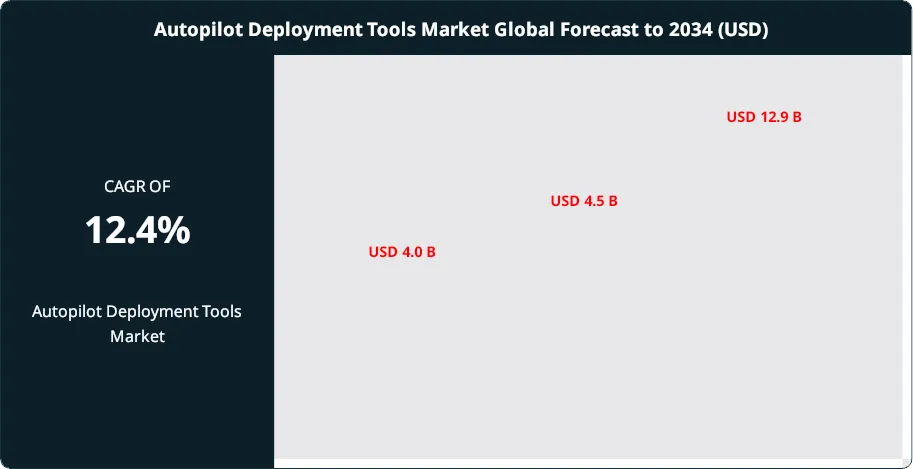
Autopilot Deployment Tools Market Global Forecast to 2034 (USD)
CAGR OF
12.4%
Autopilot Deployment Tools Market
USD 4.0 BUSD 4.5 BUSD 12.9 B
Get more details on this report -
Additionally, the rapid expansion of digital transformation initiatives, endpoint management solutions, and enterprise mobility management (EMM) platforms is expected to accelerate demand for autopilot deployment tools, particularly among large enterprises and managed service providers.
The market covers software and orchestration layers that deploy, test, monitor, and update automated control stacks across road vehicles and aircraft. Buyers use these platforms to shorten release cycles, harden safety cases, and maintain traceability across model versions, sensor configurations, and operational design domains.
Demand rises as OEMs and airlines push automation to reduce incident rates, fuel burn, and downtime. Utilization signals support this shift. About 70% of drivers activate an ADAS feature most or all of the time, which expands the installed base that must be calibrated and updated at scale. In aviation, autopilot accounts for roughly 90% of flight time, which increases reliance on repeatable validation, configuration control, and post-deployment monitoring. On the supply side, the vendor set spans automotive middleware specialists, avionics and simulation providers, and hyperscale cloud players. Subscription pricing and usage-based testing in the cloud lift recurring revenue share to an estimated 55% by 2034, up from roughly 35% in 2024, as fleets demand continuous delivery and remote compliance reporting.
Regulation shapes procurement and product design. Automotive programs align with functional safety and cybersecurity requirements, while aviation deployments face stringent certification and software assurance expectations. These constraints raise switching costs and favor vendors that embed audit trails, requirements coverage, and safety evidence automation. Public funding and smart-mobility programs also influence timing, especially where road infrastructure digitization accelerates connected testing and over-the-air rollouts.
Technology change remains the main multiplier. AI-assisted scenario generation, synthetic data, and automated regression testing increase coverage per engineering hour and reduce validation backlogs. At the same time, the market carries material risks. Liability exposure, adversarial attacks, data sovereignty limits, and certification delays can slow deployments and force rework. Regional dynamics remain balanced. North America holds an estimated 35% of 2024 revenue due to early autonomy programs, Europe accounts for about 28% driven by safety-led regulation, and Asia-Pacific approaches 30% on manufacturing scale and rapid pilot activity. Investment hotspots include China, India, the UAE, and Singapore, where fleet digitization and test corridors expand tool adoption.
Key Takeaways
Market Growth: Market revenue rises from 4.5 B USD, 2025 to 14.4 B USD, 2035 at a 12.4% CAGR, 2026–2035. Market size reaches estimated: 4.0 B USD, 2024 and estimated: 12.9 B USD, 2034 to align to 2024-2034.
Segment Dominance: Software leads by component at 53.9%, 2025, reflecting the highest monetization in orchestration, testing, and lifecycle management layers. Software revenue equals estimated: 2.4 B USD, 2025 based on 4.5 B USD, 2025 total.
Segment Dominance: Cloud leads by deployment mode at 43.6%, 2025, driven by scalable validation, remote monitoring, and continuous updates. Cloud revenue equals estimated: 2.0 B USD, 2025 based on 4.5 B USD, 2025 total.
Driver: Commercial operators scale automation to reduce incidents and operating cost, sustaining 59.7%, 2025 end-user share. Commercial spend equals estimated: 2.7 B USD, 2025 based on 4.5 B USD, 2025 total.
Restraint: Certification, safety assurance, and cybersecurity requirements increase time-to-deploy and raise compliance cost to estimated: 8.0% of project budget, 2025. Regulatory friction delays rollouts by estimated: 6.0 months, 2025 in tightly governed aviation and automotive programs.
Opportunity: Automotive remains the largest application at 38.0%, 2025 and expands tool demand across ADAS-to-autonomy deployment pipelines. Automotive revenue equals estimated: 1.7 B USD, 2025 based on 4.5 B USD, 2025 total.
Trend: Vendors embed AI-driven scenario generation and automated regression to raise test coverage and release velocity, supporting estimated: 55.0% recurring revenue mix, 2034. Toolchains shift toward continuous delivery with estimated: 30.0% faster validation cycles, 2025.
Regional Analysis: North America leads with 37.8% share valued at 1.7 B USD, 2025, anchored by early autonomy programs and mature cloud infrastructure. North America reaches estimated: 4.9 B USD, 2034 if the 37.8% share holds against 12.9 B USD, 2034 global.
By Component
Software remains the central revenue contributor within the autopilot deployment tools market as of 2025, accounting for approximately 53.9% of total market value. Software platforms manage perception models, control logic, simulation environments, and lifecycle updates required for autonomous systems. Their importance continues to rise as vehicle platforms rely on continuous software validation, over-the-air updates, and real-time monitoring to meet safety and compliance requirements across automotive, aerospace, and industrial domains.
Hardware forms the physical foundation of autopilot systems through sensors, compute modules, actuators, and communication units. LiDAR, radar, high-resolution cameras, and embedded processors enable real-time environment sensing and execution of autonomous commands. Ongoing advances in sensor accuracy and processor efficiency support higher autonomy levels while reducing system latency and energy consumption, particularly in automotive and unmanned aerial platforms.
Services represent a growing support layer that includes system integration, testing, certification support, training, and post-deployment maintenance. As regulatory scrutiny intensifies, enterprises increasingly depend on specialized service providers to ensure compliance and system reliability. Service revenues continue to expand as organizations seek long-term operational assurance rather than one-time deployment support.
By Deployment Mode
Cloud-based deployment leads the market with an estimated 43.6% share in 2025, driven by centralized data processing, remote access, and elastic compute capacity. Cloud environments enable large-scale simulation, fleet-wide software updates, and continuous performance tracking. These capabilities are essential as autonomous systems generate high volumes of sensor data that require frequent analysis and validation.
On-premises deployment maintains relevance among users with strict data governance, national security constraints, or ultra-low latency requirements. Aerospace and defense operators favor local infrastructure to retain full operational control and avoid reliance on external networks. This model supports predictable performance in mission-critical scenarios.
Hybrid deployment continues to gain traction as organizations balance security with flexibility. Sensitive datasets remain on local servers, while computationally intensive analytics and model training move to the cloud. This approach reduces infrastructure risk while supporting phased adoption of automation technologies.
By Application
Automotive represents the largest application segment with a 38.0% share in 2025, supported by widespread ADAS deployment and increasing autonomy features in passenger and commercial vehicles. Automakers invest heavily in deployment tools to manage frequent software releases, validate safety functions, and support regional compliance.
Aerospace applications rely on autopilot deployment tools to manage flight control systems, navigation accuracy, and redundancy validation. Autopilot systems operate during nearly 90% of flight time, reinforcing demand for dependable deployment and monitoring frameworks.
Maritime, drones and UAVs, and industrial automation collectively show strong expansion. Autonomous vessels improve route efficiency, UAVs support logistics and surveillance, and autonomous robots enhance warehouse and factory operations. These segments increasingly adopt standardized deployment tools to manage diverse operating environments.
By End-User
Commercial users dominate with a 59.7% share in 2025, reflecting adoption across logistics, mobility services, manufacturing, and agriculture. These users prioritize deployment efficiency, uptime, and cost control to support large autonomous fleets.
Defense users adopt autopilot systems for unmanned platforms and tactical vehicles, emphasizing system reliability, encryption, and operational resilience. Deployment tools in this segment focus on controlled environments and mission readiness.
Other users include government agencies and research institutions applying autonomous systems in emergency response and environmental monitoring, where reliability and accountability remain critical.
By Region
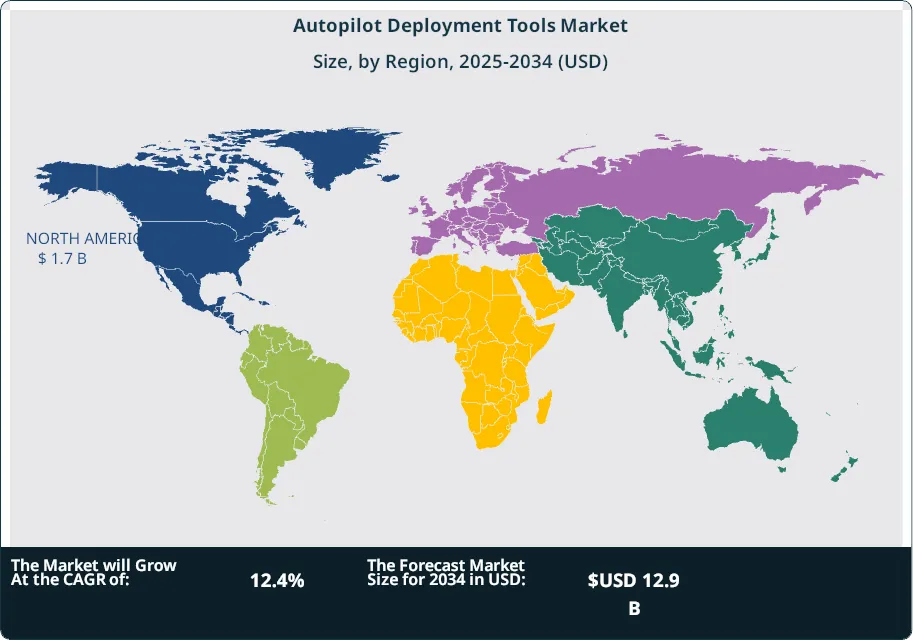
North America leads the market with a 37.8% share, valued at approximately USD 1.7 B in 2025. The United States anchors demand through strong automotive, aerospace, and defense investment, supported by mature cloud infrastructure and early autonomy programs.
Europe follows with steady adoption driven by strict safety standards and public mobility programs in Germany, France, and the United Kingdom. Compliance-focused deployment tools remain a key purchasing criterion.
Asia Pacific shows the fastest growth trajectory, supported by automotive manufacturing scale, smart city investments, and public funding in China, Japan, South Korea, and India. Latin America and the Middle East and Africa remain smaller but expanding markets, led by pilot projects, infrastructure modernization, and targeted autonomous transport initiatives.
Customization for segments, region/country-level will be provided. Moreover, additional customization can be done based on the requirements.
Pricing and Purchase Options
Avail customized purchase options to meet your exact research needs. We have three licenses to opt for: Single User License, Multi-User License (Up to 5 Users), Corporate Use License (Unlimited User and Printable PDF).
TABLE OF CONTENTS
1. EXECUTIVE SUMMARY
1.1. MARKET SNAPSHOT
1.2. KEY FINDINGS & INSIGHTS
1.3. ANALYST RECOMMENDATIONS
1.4. FUTURE OUTLOOK
2. RESEARCH METHODOLOGY
2.1. MARKET DEFINITION & SCOPE
2.2. RESEARCH OBJECTIVES: PRIMARY & SECONDARY DATA SOURCES
2.3. DATA COLLECTION SOURCES
2.3.1. COVERAGE OF 100+ PRIMARY RESEARCH/CONSULTATION CALLS WITH INDUSTRY STAKEHOLDERS
FIGURE 17 NORTH AMERICA AUTOPILOT DEPLOYMENT TOOLS CURRENT AND FUTURE TYPE ANALYSIS, 2025–2034, (USD MILLION)
FIGURE 18 NORTH AMERICA AUTOPILOT DEPLOYMENT TOOLS CURRENT AND FUTURE END USER ANALYSIS, 2025–2034, (USD MILLION)
FIGURE 19 MARKET SHARE BY COUNTRY
FIGURE 20 LATIN AMERICA AUTOPILOT DEPLOYMENT TOOLS CURRENT AND FUTURE TYPE ANALYSIS, 2025–2034, (USD MILLION)
FIGURE 21 LATIN AMERICA AUTOPILOT DEPLOYMENT TOOLS CURRENT AND FUTURE END USER ANALYSIS, 2025–2034, (USD MILLION)
FIGURE 22 MARKET SHARE BY COUNTRY
FIGURE 23 EASTERN EUROPE AUTOPILOT DEPLOYMENT TOOLS CURRENT AND FUTURE TYPE ANALYSIS, 2025–2034, (USD MILLION)
FIGURE 24 EASTERN EUROPE AUTOPILOT DEPLOYMENT TOOLS CURRENT AND FUTURE END USER ANALYSIS, 2025–2034, (USD MILLION)
FIGURE 25 MARKET SHARE BY COUNTRY
FIGURE 26 WESTERN EUROPE AUTOPILOT DEPLOYMENT TOOLS CURRENT AND FUTURE TYPE ANALYSIS, 2025–2034, (USD MILLION)
FIGURE 27 WESTERN EUROPE AUTOPILOT DEPLOYMENT TOOLS CURRENT AND FUTURE END USER ANALYSIS, 2025–2034, (USD MILLION)
FIGURE 28 MARKET SHARE BY COUNTRY
FIGURE 29 EAST ASIA AND PACIFIC AUTOPILOT DEPLOYMENT TOOLS CURRENT AND FUTURE TYPE ANALYSIS, 2025–2034, (USD MILLION)
FIGURE 30 EAST ASIA AND PACIFIC AUTOPILOT DEPLOYMENT TOOLS CURRENT AND FUTURE END USER ANALYSIS, 2025–2034, (USD MILLION)
FIGURE 31 MARKET SHARE BY COUNTRY
FIGURE 32 SEA AND SOUTH ASIA AUTOPILOT DEPLOYMENT TOOLS CURRENT AND FUTURE TYPE ANALYSIS, 2025–2034, (USD MILLION)
FIGURE 33 SEA AND SOUTH ASIA AUTOPILOT DEPLOYMENT TOOLS CURRENT AND FUTURE END USER ANALYSIS, 2025–2034, (USD MILLION)
FIGURE 34 MARKET SHARE BY COUNTRY
FIGURE 35 MIDDLE EAST AND AFRICA AUTOPILOT DEPLOYMENT TOOLS CURRENT AND FUTURE TYPE ANALYSIS, 2025–2034, (USD MILLION)
FIGURE 36 MIDDLE EAST AND AFRICA AUTOPILOT DEPLOYMENT TOOLS CURRENT AND FUTURE END USER ANALYSIS, 2025–2034, (USD MILLION)
FIGURE 37 NORTH AMERICA AUTOPILOT DEPLOYMENT TOOLS CURRENT AND FUTURE MARKET VOLUME SHARE REGIONAL ANALYSIS, 2025–2034, (USD MILLION)
FIGURE 38 U.S. AUTOPILOT DEPLOYMENT TOOLS CURRENT AND FUTURE TYPE ANALYSIS, 2025–2034, (USD MILLION)
FIGURE 39 U.S. AUTOPILOT DEPLOYMENT TOOLS CURRENT AND FUTURE END USER ANALYSIS, 2025–2034, (USD MILLION)
FIGURE 40 CANADA AUTOPILOT DEPLOYMENT TOOLS CURRENT AND FUTURE TYPE ANALYSIS, 2025–2034, (USD MILLION)
FIGURE 41 CANADA AUTOPILOT DEPLOYMENT TOOLS CURRENT AND FUTURE END USER ANALYSIS, 2025–2034, (USD MILLION)
FIGURE 42 LATIN AMERICA AUTOPILOT DEPLOYMENT TOOLS CURRENT AND FUTURE MARKET VOLUME SHARE REGIONAL ANALYSIS, 2025–2034, (USD MILLION)
FIGURE 43 MEXICO AUTOPILOT DEPLOYMENT TOOLS CURRENT AND FUTURE TYPE ANALYSIS, 2025–2034, (USD MILLION)
FIGURE 44 MEXICO AUTOPILOT DEPLOYMENT TOOLS CURRENT AND FUTURE END USER ANALYSIS, 2025–2034, (USD MILLION)
FIGURE 45 BRAZIL AUTOPILOT DEPLOYMENT TOOLS CURRENT AND FUTURE TYPE ANALYSIS, 2025–2034, (USD MILLION)
FIGURE 46 BRAZIL AUTOPILOT DEPLOYMENT TOOLS CURRENT AND FUTURE END USER ANALYSIS, 2025–2034, (USD MILLION)
FIGURE 47 ARGENTINA AUTOPILOT DEPLOYMENT TOOLS CURRENT AND FUTURE TYPE ANALYSIS, 2025–2034, (USD MILLION)
FIGURE 48 ARGENTINA AUTOPILOT DEPLOYMENT TOOLS CURRENT AND FUTURE END USER ANALYSIS, 2025–2034, (USD MILLION)
FIGURE 49 COLUMBIA AUTOPILOT DEPLOYMENT TOOLS CURRENT AND FUTURE TYPE ANALYSIS, 2025–2034, (USD MILLION)
FIGURE 50 COLUMBIA AUTOPILOT DEPLOYMENT TOOLS CURRENT AND FUTURE END USER ANALYSIS, 2025–2034, (USD MILLION)
FIGURE 51 REST OF LATIN AMERICA AUTOPILOT DEPLOYMENT TOOLS CURRENT AND FUTURE TYPE ANALYSIS, 2025–2034, (USD MILLION)
FIGURE 52 REST OF LATIN AMERICA AUTOPILOT DEPLOYMENT TOOLS CURRENT AND FUTURE END USER ANALYSIS, 2025–2034, (USD MILLION)
FIGURE 53 EASTERN EUROPE AUTOPILOT DEPLOYMENT TOOLS CURRENT AND FUTURE MARKET VOLUME SHARE REGIONAL ANALYSIS, 2025–2034, (USD MILLION)
FIGURE 54 POLAND AUTOPILOT DEPLOYMENT TOOLS CURRENT AND FUTURE TYPE ANALYSIS, 2025–2034, (USD MILLION)
FIGURE 55 POLAND AUTOPILOT DEPLOYMENT TOOLS CURRENT AND FUTURE END USER ANALYSIS, 2025–2034, (USD MILLION)
FIGURE 56 RUSSIA AUTOPILOT DEPLOYMENT TOOLS CURRENT AND FUTURE TYPE ANALYSIS, 2025–2034, (USD MILLION)
FIGURE 57 RUSSIA AUTOPILOT DEPLOYMENT TOOLS CURRENT AND FUTURE END USER ANALYSIS, 2025–2034, (USD MILLION)
FIGURE 58 CZECH REPUBLIC AUTOPILOT DEPLOYMENT TOOLS CURRENT AND FUTURE TYPE ANALYSIS, 2025–2034, (USD MILLION)
FIGURE 59 CZECH REPUBLIC AUTOPILOT DEPLOYMENT TOOLS CURRENT AND FUTURE END USER ANALYSIS, 2025–2034, (USD MILLION)
FIGURE 60 ROMANIA AUTOPILOT DEPLOYMENT TOOLS CURRENT AND FUTURE TYPE ANALYSIS, 2025–2034, (USD MILLION)
FIGURE 61 ROMANIA AUTOPILOT DEPLOYMENT TOOLS CURRENT AND FUTURE END USER ANALYSIS, 2025–2034, (USD MILLION)
FIGURE 62 REST OF EASTERN EUROPE AUTOPILOT DEPLOYMENT TOOLS CURRENT AND FUTURE TYPE ANALYSIS, 2025–2034, (USD MILLION)
FIGURE 63 REST OF EASTERN EUROPE AUTOPILOT DEPLOYMENT TOOLS CURRENT AND FUTURE END USER ANALYSIS, 2025–2034, (USD MILLION)
FIGURE 64 WESTERN EUROPE AUTOPILOT DEPLOYMENT TOOLS CURRENT AND FUTURE MARKET VOLUME SHARE REGIONAL ANALYSIS, 2025–2034, (USD MILLION)
FIGURE 65 GERMANY AUTOPILOT DEPLOYMENT TOOLS CURRENT AND FUTURE TYPE ANALYSIS, 2025–2034, (USD MILLION)
FIGURE 66 GERMANY AUTOPILOT DEPLOYMENT TOOLS CURRENT AND FUTURE END USER ANALYSIS, 2025–2034, (USD MILLION)
FIGURE 67 FRANCE AUTOPILOT DEPLOYMENT TOOLS CURRENT AND FUTURE TYPE ANALYSIS, 2025–2034, (USD MILLION)
FIGURE 68 FRANCE AUTOPILOT DEPLOYMENT TOOLS CURRENT AND FUTURE END USER ANALYSIS, 2025–2034, (USD MILLION)
FIGURE 69 UK AUTOPILOT DEPLOYMENT TOOLS CURRENT AND FUTURE TYPE ANALYSIS, 2025–2034, (USD MILLION)
FIGURE 70 UK AUTOPILOT DEPLOYMENT TOOLS CURRENT AND FUTURE END USER ANALYSIS, 2025–2034, (USD MILLION)
FIGURE 71 SPAIN AUTOPILOT DEPLOYMENT TOOLS CURRENT AND FUTURE TYPE ANALYSIS, 2025–2034, (USD MILLION)
FIGURE 72 SPAIN AUTOPILOT DEPLOYMENT TOOLS CURRENT AND FUTURE END USER ANALYSIS, 2025–2034, (USD MILLION)
FIGURE 73 ITALY AUTOPILOT DEPLOYMENT TOOLS CURRENT AND FUTURE TYPE ANALYSIS, 2025–2034, (USD MILLION)
FIGURE 74 ITALY AUTOPILOT DEPLOYMENT TOOLS CURRENT AND FUTURE END USER ANALYSIS, 2025–2034, (USD MILLION)
FIGURE 75 REST OF WESTERN EUROPE AUTOPILOT DEPLOYMENT TOOLS CURRENT AND FUTURE TYPE ANALYSIS, 2025–2034, (USD MILLION)
FIGURE 76 REST OF WESTERN EUROPE AUTOPILOT DEPLOYMENT TOOLS CURRENT AND FUTURE END USER ANALYSIS, 2025–2034, (USD MILLION)
FIGURE 77 EAST ASIA AND PACIFIC AUTOPILOT DEPLOYMENT TOOLS CURRENT AND FUTURE MARKET VOLUME SHARE REGIONAL ANALYSIS, 2025–2034, (USD MILLION)
FIGURE 78 CHINA AUTOPILOT DEPLOYMENT TOOLS CURRENT AND FUTURE TYPE ANALYSIS, 2025–2034, (USD MILLION)
FIGURE 79 CHINA AUTOPILOT DEPLOYMENT TOOLS CURRENT AND FUTURE END USER ANALYSIS, 2025–2034, (USD MILLION)
FIGURE 80 JAPAN AUTOPILOT DEPLOYMENT TOOLS CURRENT AND FUTURE TYPE ANALYSIS, 2025–2034, (USD MILLION)
FIGURE 81 JAPAN AUTOPILOT DEPLOYMENT TOOLS CURRENT AND FUTURE END USER ANALYSIS, 2025–2034, (USD MILLION)
FIGURE 82 AUSTRALIA AUTOPILOT DEPLOYMENT TOOLS CURRENT AND FUTURE TYPE ANALYSIS, 2025–2034, (USD MILLION)
FIGURE 83 AUSTRALIA AUTOPILOT DEPLOYMENT TOOLS CURRENT AND FUTURE END USER ANALYSIS, 2025–2034, (USD MILLION)
FIGURE 84 CAMBODIA AUTOPILOT DEPLOYMENT TOOLS CURRENT AND FUTURE TYPE ANALYSIS, 2025–2034, (USD MILLION)
FIGURE 85 CAMBODIA AUTOPILOT DEPLOYMENT TOOLS CURRENT AND FUTURE END USER ANALYSIS, 2025–2034, (USD MILLION)
FIGURE 86 FIJI AUTOPILOT DEPLOYMENT TOOLS CURRENT AND FUTURE TYPE ANALYSIS, 2025–2034, (USD MILLION)
FIGURE 87 FIJI AUTOPILOT DEPLOYMENT TOOLS CURRENT AND FUTURE END USER ANALYSIS, 2025–2034, (USD MILLION)
FIGURE 88 INDONESIA AUTOPILOT DEPLOYMENT TOOLS CURRENT AND FUTURE TYPE ANALYSIS, 2025–2034, (USD MILLION)
FIGURE 89 INDONESIA AUTOPILOT DEPLOYMENT TOOLS CURRENT AND FUTURE END USER ANALYSIS, 2025–2034, (USD MILLION)
FIGURE 90 SOUTH KOREA AUTOPILOT DEPLOYMENT TOOLS CURRENT AND FUTURE TYPE ANALYSIS, 2025–2034, (USD MILLION)
FIGURE 91 SOUTH KOREA AUTOPILOT DEPLOYMENT TOOLS CURRENT AND FUTURE END USER ANALYSIS, 2025–2034, (USD MILLION)
FIGURE 92 REST OF EAST ASIA AND PACIFIC AUTOPILOT DEPLOYMENT TOOLS CURRENT AND FUTURE TYPE ANALYSIS, 2025–2034, (USD MILLION)
FIGURE 93 REST OF EAST ASIA AND PACIFIC AUTOPILOT DEPLOYMENT TOOLS CURRENT AND FUTURE END USER ANALYSIS, 2025–2034, (USD MILLION)
FIGURE 94 SEA AND SOUTH ASIA AUTOPILOT DEPLOYMENT TOOLS CURRENT AND FUTURE MARKET VOLUME SHARE REGIONAL ANALYSIS, 2025–2034, (USD MILLION)
FIGURE 95 BANGLADESH AUTOPILOT DEPLOYMENT TOOLS CURRENT AND FUTURE TYPE ANALYSIS, 2025–2034, (USD MILLION)
FIGURE 96 BANGLADESH AUTOPILOT DEPLOYMENT TOOLS CURRENT AND FUTURE END USER ANALYSIS, 2025–2034, (USD MILLION)
FIGURE 97 NEW ZEALAND AUTOPILOT DEPLOYMENT TOOLS CURRENT AND FUTURE TYPE ANALYSIS, 2025–2034, (USD MILLION)
FIGURE 98 NEW ZEALAND AUTOPILOT DEPLOYMENT TOOLS CURRENT AND FUTURE END USER ANALYSIS, 2025–2034, (USD MILLION)
FIGURE 99 INDIA AUTOPILOT DEPLOYMENT TOOLS CURRENT AND FUTURE TYPE ANALYSIS, 2025–2034, (USD MILLION)
FIGURE 100 INDIA AUTOPILOT DEPLOYMENT TOOLS CURRENT AND FUTURE END USER ANALYSIS, 2025–2034, (USD MILLION)
FIGURE 101 SINGAPORE AUTOPILOT DEPLOYMENT TOOLS CURRENT AND FUTURE TYPE ANALYSIS, 2025–2034, (USD MILLION)
FIGURE 102 SINGAPORE AUTOPILOT DEPLOYMENT TOOLS CURRENT AND FUTURE END USER ANALYSIS, 2025–2034, (USD MILLION)
FIGURE 103 THAILAND AUTOPILOT DEPLOYMENT TOOLS CURRENT AND FUTURE TYPE ANALYSIS, 2025–2034, (USD MILLION)
FIGURE 104 THAILAND AUTOPILOT DEPLOYMENT TOOLS CURRENT AND FUTURE END USER ANALYSIS, 2025–2034, (USD MILLION)
FIGURE 105 TAIWAN AUTOPILOT DEPLOYMENT TOOLS CURRENT AND FUTURE TYPE ANALYSIS, 2025–2034, (USD MILLION)
FIGURE 106 TAIWAN AUTOPILOT DEPLOYMENT TOOLS CURRENT AND FUTURE END USER ANALYSIS, 2025–2034, (USD MILLION)
FIGURE 107 MALAYSIA AUTOPILOT DEPLOYMENT TOOLS CURRENT AND FUTURE TYPE ANALYSIS, 2025–2034, (USD MILLION)
FIGURE 108 MALAYSIA AUTOPILOT DEPLOYMENT TOOLS CURRENT AND FUTURE END USER ANALYSIS, 2025–2034, (USD MILLION)
FIGURE 109 REST OF SEA AND SOUTH ASIA AUTOPILOT DEPLOYMENT TOOLS CURRENT AND FUTURE TYPE ANALYSIS, 2025–2034, (USD MILLION)
FIGURE 110 REST OF SEA AND SOUTH ASIA AUTOPILOT DEPLOYMENT TOOLS CURRENT AND FUTURE END USER ANALYSIS, 2025–2034, (USD MILLION)
FIGURE 111 MIDDLE EAST AND AFRICA AUTOPILOT DEPLOYMENT TOOLS CURRENT AND FUTURE MARKET VOLUME SHARE REGIONAL ANALYSIS, 2025–2034, (USD MILLION)
FIGURE 112 GCC COUNTRIES AUTOPILOT DEPLOYMENT TOOLS CURRENT AND FUTURE TYPE ANALYSIS, 2025–2034, (USD MILLION)
FIGURE 113 GCC COUNTRIES AUTOPILOT DEPLOYMENT TOOLS CURRENT AND FUTURE END USER ANALYSIS, 2025–2034, (USD MILLION)
FIGURE 114 SAUDI ARABIA AUTOPILOT DEPLOYMENT TOOLS CURRENT AND FUTURE TYPE ANALYSIS, 2025–2034, (USD MILLION)
FIGURE 115 SAUDI ARABIA AUTOPILOT DEPLOYMENT TOOLS CURRENT AND FUTURE END USER ANALYSIS, 2025–2034, (USD MILLION)
FIGURE 116 UAE AUTOPILOT DEPLOYMENT TOOLS CURRENT AND FUTURE TYPE ANALYSIS, 2025–2034, (USD MILLION)
FIGURE 117 UAE AUTOPILOT DEPLOYMENT TOOLS CURRENT AND FUTURE END USER ANALYSIS, 2025–2034, (USD MILLION)
FIGURE 118 BAHRAIN AUTOPILOT DEPLOYMENT TOOLS CURRENT AND FUTURE TYPE ANALYSIS, 2025–2034, (USD MILLION)
FIGURE 119 BAHRAIN AUTOPILOT DEPLOYMENT TOOLS CURRENT AND FUTURE END USER ANALYSIS, 2025–2034, (USD MILLION)
FIGURE 120 KUWAIT AUTOPILOT DEPLOYMENT TOOLS CURRENT AND FUTURE TYPE ANALYSIS, 2025–2034, (USD MILLION)
FIGURE 121 KUWAIT AUTOPILOT DEPLOYMENT TOOLS CURRENT AND FUTURE END USER ANALYSIS, 2025–2034, (USD MILLION)
FIGURE 122 OMAN AUTOPILOT DEPLOYMENT TOOLS CURRENT AND FUTURE TYPE ANALYSIS, 2025–2034, (USD MILLION)
FIGURE 123 OMAN AUTOPILOT DEPLOYMENT TOOLS CURRENT AND FUTURE END USER ANALYSIS, 2025–2034, (USD MILLION)
FIGURE 124 QATAR AUTOPILOT DEPLOYMENT TOOLS CURRENT AND FUTURE TYPE ANALYSIS, 2025–2034, (USD MILLION)
FIGURE 125 QATAR AUTOPILOT DEPLOYMENT TOOLS CURRENT AND FUTURE END USER ANALYSIS, 2025–2034, (USD MILLION)
FIGURE 126 EGYPT AUTOPILOT DEPLOYMENT TOOLS CURRENT AND FUTURE TYPE ANALYSIS, 2025–2034, (USD MILLION)
FIGURE 127 EGYPT AUTOPILOT DEPLOYMENT TOOLS CURRENT AND FUTURE END USER ANALYSIS, 2025–2034, (USD MILLION)
FIGURE 128 NIGERIA AUTOPILOT DEPLOYMENT TOOLS CURRENT AND FUTURE TYPE ANALYSIS, 2025–2034, (USD MILLION)
FIGURE 129 NIGERIA AUTOPILOT DEPLOYMENT TOOLS CURRENT AND FUTURE END USER ANALYSIS, 2025–2034, (USD MILLION)
FIGURE 130 SOUTH AFRICA AUTOPILOT DEPLOYMENT TOOLS CURRENT AND FUTURE TYPE ANALYSIS, 2025–2034, (USD MILLION)
FIGURE 131 SOUTH AFRICA AUTOPILOT DEPLOYMENT TOOLS CURRENT AND FUTURE END USER ANALYSIS, 2025–2034, (USD MILLION)
FIGURE 132 ISRAEL AUTOPILOT DEPLOYMENT TOOLS CURRENT AND FUTURE TYPE ANALYSIS, 2025–2034, (USD MILLION)
FIGURE 133 ISRAEL AUTOPILOT DEPLOYMENT TOOLS CURRENT AND FUTURE END USER ANALYSIS, 2025–2034, (USD MILLION)
FIGURE 134 REST OF MEA AUTOPILOT DEPLOYMENT TOOLS CURRENT AND FUTURE TYPE ANALYSIS, 2025–2034, (USD MILLION)
FIGURE 135 REST OF MEA AUTOPILOT DEPLOYMENT TOOLS CURRENT AND FUTURE END USER ANALYSIS, 2025–2034, (USD MILLION)
FIGURE 136 U. S. MARKET SHARE ANALYSIS BY TYPE (2025)
FIGURE 137 U. S. MARKET SHARE ANALYSIS BY END USER (2025)
FIGURE 138 CANADA MARKET SHARE ANALYSIS BY TYPE (2025)
FIGURE 139 CANADA MARKET SHARE ANALYSIS BY END USER (2025)
FIGURE 140 MEXICO MARKET SHARE ANALYSIS BY TYPE (2025)
FIGURE 141 MEXICO MARKET SHARE ANALYSIS BY END USER (2025)
FIGURE 142 CHINA MARKET SHARE ANALYSIS BY TYPE (2025)
FIGURE 143 CHINA MARKET SHARE ANALYSIS BY END USER (2025)
FIGURE 144 JAPAN MARKET SHARE ANALYSIS BY TYPE (2025)
FIGURE 145 JAPAN MARKET SHARE ANALYSIS BY END USER (2025)
FIGURE 146 INDIA MARKET SHARE ANALYSIS BY TYPE (2025)
FIGURE 147 INDIA MARKET SHARE ANALYSIS BY END USER (2025)
FIGURE 148 SOUTH KOREA MARKET SHARE ANALYSIS BY TYPE (2025)
FIGURE 149 SOUTH KOREA MARKET SHARE ANALYSIS BY END USER (2025)
FIGURE 150 SAUDI ARABIA MARKET SHARE ANALYSIS BY TYPE (2025)
FIGURE 151 SAUDI ARABIA MARKET SHARE ANALYSIS BY END USER (2025)
FIGURE 152 UAE MARKET SHARE ANALYSIS BY TYPE (2025)
FIGURE 153 UAE MARKET SHARE ANALYSIS BY END USER (2025)
FIGURE 154 EGYPT MARKET SHARE ANALYSIS BY TYPE (2025)
FIGURE 155 EGYPT MARKET SHARE ANALYSIS BY END USER (2025)
FIGURE 156 NIGERIA MARKET SHARE ANALYSIS BY TYPE (2025)
FIGURE 157 NIGERIA MARKET SHARE ANALYSIS BY END USER (2025)
FIGURE 158 SOUTH AFRICA MARKET SHARE ANALYSIS BY TYPE (2025)
FIGURE 159 SOUTH AFRICA MARKET SHARE ANALYSIS BY END USER (2025)
FIGURE 160 GERMANY MARKET SHARE ANALYSIS BY TYPE (2025)
FIGURE 161 GERMANY MARKET SHARE ANALYSIS BY END USER (2025)
FIGURE 162 FRANCE MARKET SHARE ANALYSIS BY TYPE (2025)
FIGURE 163 FRANCE MARKET SHARE ANALYSIS BY END USER (2025)
FIGURE 164 UK MARKET SHARE ANALYSIS BY TYPE (2025)
FIGURE 165 UK MARKET SHARE ANALYSIS BY END USER (2025)
FIGURE 166 SPAIN MARKET SHARE ANALYSIS BY TYPE (2025)
FIGURE 167 SPAIN MARKET SHARE ANALYSIS BY END USER (2025)
FIGURE 168 ITALY MARKET SHARE ANALYSIS BY TYPE (2025)
FIGURE 169 ITALY MARKET SHARE ANALYSIS BY END USER (2025)
FIGURE 170 BRAZIL MARKET SHARE ANALYSIS BY TYPE (2025)
FIGURE 171 BRAZIL MARKET SHARE ANALYSIS BY END USER (2025)
FIGURE 172 ARGENTINA MARKET SHARE ANALYSIS BY TYPE (2025)
FIGURE 173 ARGENTINA MARKET SHARE ANALYSIS BY END USER (2025)
FIGURE 174 COLUMBIA MARKET SHARE ANALYSIS BY TYPE (2025)
FIGURE 175 COLUMBIA MARKET SHARE ANALYSIS BY END USER (2025)
FIGURE 176 GLOBAL AUTOPILOT DEPLOYMENT TOOLS CURRENT AND FUTURE MARKET KEY COUNTRY LEVEL ANALYSIS, 2025–2034, (USD MILLION)
FIGURE 177 FINANCIAL OVERVIEW:
Key Player Analysis
General Motors: General Motors positions itself as a market leader in autopilot deployment tools within the automotive segment, supported by deep integration between vehicle platforms and software control systems. Through its autonomous and advanced driver assistance programs, GM deploys proprietary software stacks that manage perception, control, validation, and over-the-air updates across passenger and commercial vehicles. As of 2025, GM reports that over 70% of its new vehicle models ship with embedded ADAS capabilities, creating a large internal demand for deployment, monitoring, and compliance tools tied to fleet-scale operations.
Strategically, GM continues to invest heavily in software-defined vehicles, allocating an estimated USD 2 B annually to autonomous and vehicle intelligence development. Its deployment tools emphasize real-time diagnostics, continuous validation, and regulatory traceability across North America and selected international markets. GM differentiates through vertical integration, direct access to vehicle data, and a large installed base that allows rapid iteration and system learning. This scale supports faster rollout cycles and tighter safety governance compared with suppliers that rely on third-party vehicle platforms.
Apple Inc.: Apple operates as a challenger and technology-centric player in the autopilot deployment tools landscape, with strength in software architecture, edge processing, and system integration. While Apple does not commercialize vehicles at scale, its work on autonomous systems centers on operating systems, sensor processing frameworks, and deployment orchestration designed for high-reliability environments. In 2025, Apple continues to channel multi-B-dollar R&D budgets toward autonomy-related software, with a focus on secure deployment, real-time decision processing, and hardware-software co-design.
Apple’s strategic approach prioritizes closed-loop control, strong data protection, and seamless update mechanisms across connected devices. Its deployment capabilities emphasize low-latency edge execution combined with centralized oversight. Differentiation stems from custom silicon, tightly controlled software environments, and a strong record in managing large-scale software updates across global user bases. These strengths position Apple as a credible long-term participant in autopilot deployment infrastructure, particularly where security, reliability, and user experience standards remain high.
Bosch Group: Bosch Group functions as a leading systems supplier and platform provider in the autopilot deployment tools market, serving automotive, industrial automation, and mobility clients worldwide. Bosch offers a broad portfolio that includes sensors, control units, middleware, and deployment software that supports validation, calibration, and lifecycle management. By 2025, Bosch-derived driver assistance and automated driving components ship in tens of millions of vehicles annually, reinforcing its role as a backbone supplier for autopilot deployment.
Bosch continues to expand its software and services footprint, with digital mobility solutions growing at an estimated high-single-digit annual rate. Strategic initiatives focus on cloud-connected deployment environments, standardized testing frameworks, and regional engineering centers in Europe, Asia Pacific, and North America. Bosch differentiates through its cross-domain expertise, long-standing OEM relationships, and ability to integrate hardware and software within regulated environments. This positioning allows Bosch to address complex deployment requirements across both commercial and industrial end users.
Market Key Players
Bosch Group
Aurora Innovation, Inc.
Mobileye
Tesla, Inc.
NVIDIA Corporation
Aptiv PLC
Apple Inc.
Waymo LLC
General Motors
Uber Technologies, Inc.
Driver:
Increasing Use of Digital Twins and Over-the-Air Updates
As of 2025, rapid deployment of autonomous functions across commercial fleets stands as the primary growth driver for autopilot deployment tools. Logistics providers, urban transit agencies, and mobility platforms expand pilot and production programs to lower incident rates and operating expense. Industry benchmarks indicate that ADAS features are active in over 70% of vehicle miles driven, while commercial aviation relies on automated control for nearly 90% of flight time. This installed base requires robust deployment, validation, and monitoring tools to manage frequent software updates, compliance checks, and fleet-wide configuration control at scale.
Expanding Deployment of Autonomous Systems Across Fleets
Advances in artificial intelligence and machine learning further reinforce demand. Perception accuracy and decision reliability improve as models train on larger datasets and real-world feedback loops. OEMs and tier suppliers increase R&D allocation toward autonomous software stacks, with spending growth tracking a low-teens CAGR through 2030. Regulatory alignment also supports adoption. Safety frameworks for assisted and automated driving mature across North America, Europe, and parts of Asia, lowering barriers for deployment tools that embed audit trails and performance reporting.
Restraint:
Advancements in AI and Regulatory Support for Automation
High upfront integration costs continue to limit adoption, particularly for operators managing legacy vehicle platforms. Retrofitting older architectures often requires new sensors, compute units, and rewired control systems, raising per-vehicle deployment expense by an estimated 20% to 30% in 2025. Smaller manufacturers and regional fleet operators face budget constraints that delay tool adoption or restrict deployments to pilot programs rather than full rollouts.
High Integration Costs for Legacy Vehicle Platforms
Data protection and cybersecurity obligations add further pressure. Autopilot systems collect continuous streams of location, behavior, and operational data, triggering strict compliance requirements under regional privacy and security laws. Companies must maintain encryption, monitoring, and audit processes across markets, which can add estimated annual operating costs of 5% to 8% of software spend. These factors extend deployment timelines and increase risk for cross-border expansion.
Opportunity:
Rising Data Security and Cybersecurity Compliance Requirements
Cloud-based deployment platforms present a clear expansion path over the next decade. Remote management, centralized analytics, and continuous delivery reduce dependence on physical service visits and lower lifecycle costs. Cloud deployment already accounts for more than 40% of new installations in 2025 and is projected to approach 55% by 2034 as connectivity improves across vehicle classes.
Growing Adoption of Cloud-Based Deployment Platforms
Partnerships between OEMs, avionics providers, and software firms also unlock growth. Joint programs shorten development cycles and align hardware and software roadmaps. At the same time, emerging markets investing in smart mobility and industrial automation create new demand pools. Asia Pacific alone is expected to contribute over 30% of incremental market revenue by 2030 as urbanization and fleet modernization accelerate.
Trend:
Strategic Partnerships in Autonomous Technology Ecosystems
Edge computing integration is reshaping system architecture in 2025 and beyond. Local data processing reduces latency and supports rapid response in safety-critical scenarios, especially for urban driving and unmanned systems. Adoption of edge-enabled deployment tools grows at an estimated mid-teens annual rate as compute costs decline.
Integration of Edge Computing in Autopilot Systems
Digital twins and over-the-air updates also gain traction. Virtual testing environments allow manufacturers to validate thousands of scenarios before field release, cutting development time by an estimated 25%. OTA updates ensure continuous improvement without service downtime, while advanced sensor fusion improves environmental awareness across automotive, aviation, and industrial platforms. These trends collectively increase reliance on sophisticated deployment tools as automation programs scale.
Recent Developments
Dec 2024 – Ansys (with Kontrol, TÜV SÜD, and Microsoft): Ansys and partners launched a “virtual homologation toolchain” on Microsoft Azure to support simulation-led certification for automotive safety and compliance, positioning validated simulation as admissible evidence and enabling scenario coverage at the 10^8 km order of magnitude.
Jan 2025 – Aurora (with Continental and NVIDIA): Aurora expanded its commercial autonomy program by selecting a standardized “driverless-ready” hardware stack across a planned truck platform, aligning the on-vehicle compute and sensor architecture to shorten integration cycles ahead of scaled freight operations
Mar 2025 – NVIDIA: NVIDIA introduced NVIDIA Halos, a full-stack safety system spanning training, simulation, validation, and deployment workflows; the company positioned it with disclosed scale indicators such as 15,000+ engineering years invested in safety, 1,000+ AV-safety patents, and 30+ safety and cybersecurity certificates.
May 2025 – Foretellix (with NVIDIA Omniverse Blueprint and Cosmos): Foretellix integrated its Foretify data automation toolchain with NVIDIA simulation assets and stated it can improve safety-validation efficiency by ~10x within a defined operational design domain through large-scale synthetic data generation and evaluation workflows.
Jul 2025 – Ansys (now part of Synopsys): Ansys released 2025 R2, adding an in-product AI assistant and expanding built-in AI functions across seven products, while highlighting workflow automation and quantified performance improvements such as 17x faster results for specific antenna simulation workloads relevant to radar and vehicle connectivity stacks.
Oct 2025 – NVIDIA and Uber: NVIDIA and Uber announced an autonomy partnership to scale a global autonomous fleet starting in 2027, targeting 100,000 vehicles supported by a joint “AI data factory” concept, with ecosystem references that include Level 4 platform alignment and multi-OEM participation.
Frequently Asked Questions
How big is the Autopilot Deployment Tools Market?
Global Autopilot Deployment Tools Market was valued at USD 4.0 billion in 2024 and is projected to reach USD 12.9 billion by 2034, growing at a CAGR of 12.4%. Explore key trends, drivers, and enterprise IT automation growth.
Who are the major players in the Autopilot Deployment Tools Market?
Which segments covered the Autopilot Deployment Tools Market?
By Component (Software, Hardware, Services), By Deployment Mode (Cloud, On-Premises, Hybrid), By Application (Automotive, Aerospace, Maritime, Drones & UAVs, Industrial Automation, Others, By End-User, Commercial, Defense, Others)
How can this market research report help my business make strategic decisions?
Our market research reports provide actionable intelligence, including verified market size data, CAGR projections, competitive benchmarking, and segment-level opportunity analysis. These insights support strategic planning, investment decisions, product development, and market entry strategies for enterprises and startups alike.
How frequently is the data updated?
We continuously monitor industry developments and update our reports to reflect regulatory changes, technological advancements, and macroeconomic shifts. Updated editions ensure you receive the latest market intelligence.
