
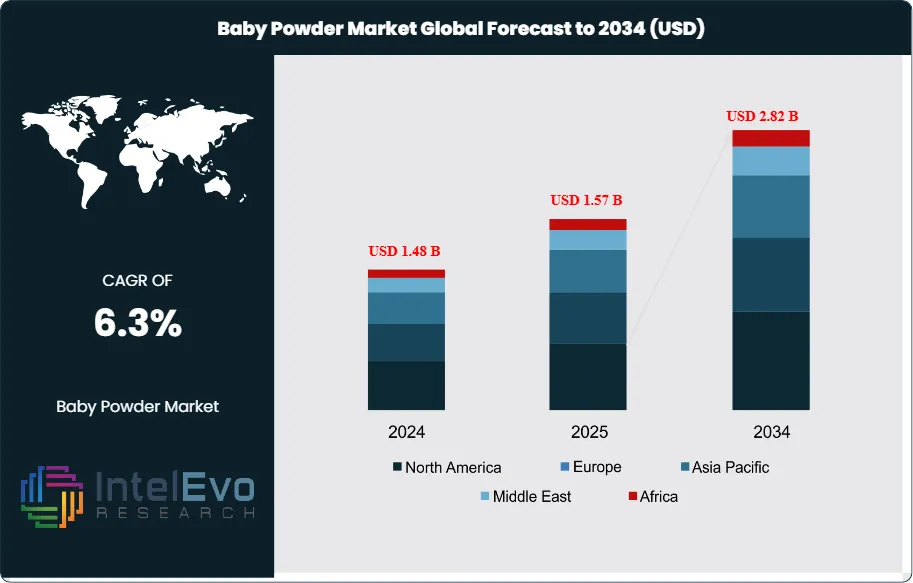
The Baby Powder market was valued at around USD 1.48 Billion in 2024 and is expected to reach nearly USD 2.82 Billion by 2034, growing at a CAGR of approximately 6.3% during 2025–2034. The rising shift toward talc-free, organic, and dermatologist-tested baby powders continues to reshape consumer behavior globally. Growing awareness of infant hygiene, premiumization, and strong demand across Asia-Pacific are further accelerating industry momentum. The market is entering a high-opportunity decade, driven by safety, sustainability, and smart digital marketing.
Over the past decade, the market has undergone a steady evolution, shaped by shifting consumer preferences, regulatory oversight, and rising disposable incomes in emerging economies. While baby powder has traditionally been a household staple for infant skincare, recent years have seen a transition toward safer, hypoallergenic, and organic formulations, which are expected to drive future growth.
Demand for baby powder remains firmly rooted in its core function—absorbing moisture and preventing rashes—yet its role is expanding into adult personal care and niche household applications. Rising awareness of infant hygiene, coupled with higher birth rates across Asia-Pacific and Africa, continues to bolster sales. In particular, countries with growing middle-class populations, such as India, Indonesia, and Nigeria, are expected to serve as investment hotspots for multinational players. By contrast, demand in mature markets such as North America and Western Europe is increasingly defined by concerns around product safety and sustainability, spurring greater interest in talc-free and eco-friendly alternatives.
The industry is also being reshaped by technological innovation. Companies are investing in advanced formulations that prioritize natural ingredients such as cornstarch and botanical extracts, aligning with consumer demand for non-toxic, dermatologically tested solutions. Digitalization and e-commerce have further amplified market access, with subscription-based models and targeted marketing campaigns enabling brands to engage more effectively with young parents and caregivers.
However, the sector faces notable challenges. Heightened regulatory scrutiny, particularly regarding talc-based powders, has forced companies to adapt quickly. The high-profile USD 700 million settlement by Johnson & Johnson in 2024 underscores the increasing legal and reputational risks associated with traditional formulations. At the same time, sustainability considerations—ranging from ethical sourcing to recyclable packaging—are emerging as critical differentiators in brand competitiveness.
Overall, the baby powder market presents a dual narrative of risk and opportunity. Established markets are pushing toward safer, more sustainable solutions, while emerging regions offer robust volume growth. Strategic investments in innovation, transparency, and distribution expansion will be central to unlocking long-term value in this evolving global segment.
Market Growth: The global baby powder market was valued at USD 1.48 Billion in 2024 and is projected to reach USD 2.82 Billion by 2034, expanding at a CAGR of 6.1% during 2025–2034. Growth is primarily fueled by rising awareness of infant hygiene, premiumization of baby care products, and expanding consumer bases in emerging economies.
Product Type: Talc-free baby powder accounted for more than 65% of global revenue in 2024, reflecting a clear shift toward cornstarch-based and organic formulations amid growing health and safety concerns over talc.
Distribution Channel: Offline retail, including supermarkets, pharmacies, and specialty stores, captured over 69% of market share in 2024 due to consumer trust in physical outlets and immediate product availability, though e-commerce is registering faster growth at double-digit rates.
Driver: Increasing birth rates in developing economies such as India, Indonesia, and Nigeria, combined with rising disposable incomes, are expanding the customer base, with Asia-Pacific alone contributing nearly half of global demand.
Restraint: Regulatory scrutiny and litigation risks linked to talc-based powders remain a significant market barrier, exemplified by Johnson & Johnson’s USD 700 million settlement in 2024, which continues to shape consumer perceptions and compliance costs.
Opportunity: Organic and hypoallergenic baby powders represent a high-growth niche, expected to grow at over 8% CAGR through 2033, supported by rising demand from health-conscious parents and the premium baby care segment.
Trend: Sustainability and ethical sourcing are becoming critical purchase drivers, with brands increasingly adopting recyclable packaging and plant-based formulations to meet evolving consumer and regulatory expectations.
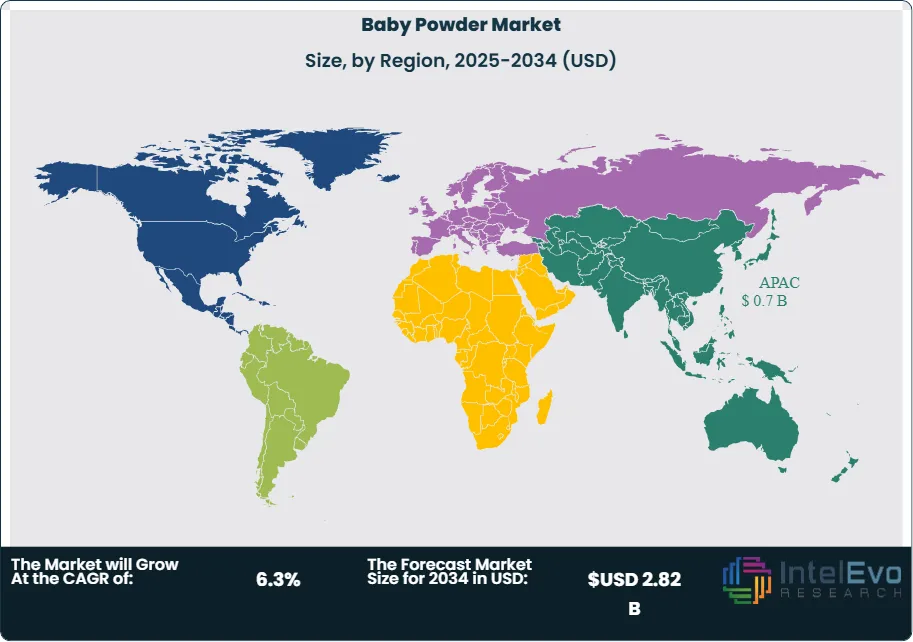
Regional Analysis: Asia-Pacific dominated the market with a 47% share in 2024, driven by high birth rates and rising middle-class populations, while North America and Europe are witnessing slower but steady growth, shaped by premium product adoption and stricter regulatory oversight.
Product Analysis (Talc-based, Talc-free)
By 2025, talc-free baby powder has established itself as the leading product category, capturing more than two-thirds of global market share. This dominance reflects a decisive consumer shift toward safer, natural, and hypoallergenic formulations, often derived from cornstarch and plant-based ingredients. Heightened awareness of potential health risks linked to talc, combined with regulatory scrutiny and ongoing litigation, has accelerated this transition. Parents, particularly in developed markets, increasingly view talc-free products as the safer choice, aligning with broader trends in clean-label and sustainable personal care.
Talc-based baby powder, which accounted for less than 35% of sales in 2024, continues to lose ground as safety concerns weigh on consumer confidence. Although the segment remains relevant in cost-sensitive markets, where affordability and product availability play a larger role, its long-term prospects are constrained. Manufacturers are responding by reformulating existing lines, introducing hybrid or fortified powders, and emphasizing safety certifications to retain market presence. Nonetheless, the structural shift toward talc-free alternatives is expected to accelerate, especially in North America and Europe.
Distribution Channel Analysis (Online, Offline)
As of 2025, offline retail channels continue to dominate the baby powder market, representing close to 70% of global revenue. Supermarkets, hypermarkets, and pharmacies remain the preferred purchasing venues, particularly for parents who prioritize immediate product access, in-person quality assurance, and promotional deals. The presence of established retail networks in both urban and semi-urban regions reinforces this segment’s strength, while in-store marketing campaigns and bundled baby-care packages further drive offline sales.
However, online distribution is emerging as the fastest-growing channel, projected to expand at a CAGR above 9% through 2033. E-commerce platforms and direct-to-consumer (DTC) models are reshaping purchase behaviors, driven by rising internet penetration, smartphone usage, and the convenience of doorstep delivery. Increasingly, parents are leveraging online platforms for product comparisons, subscription-based supply, and access to niche organic and hypoallergenic brands not widely available offline. This digital momentum is expected to gradually erode offline share, particularly in Asia-Pacific and North America.
Regional Analysis
Asia-Pacific continues to be the largest and fastest-growing regional market, commanding nearly half of global revenue in 2025, valued at over USD 0.7 billion. The region’s dominance is underpinned by high birth rates in India, Indonesia, and the Philippines, alongside rising disposable incomes and rapid urbanization. Consumers in Asia-Pacific are also showing a growing preference for organic and talc-free powders, signaling opportunities for premium product penetration.
North America maintains a strong market position, supported by high consumer awareness, stringent safety regulations, and a strong preference for premium, hypoallergenic formulations. Europe follows closely, where the demand for natural and eco-friendly baby powders is intensifying, driven by sustainability-focused consumer behavior and stricter ingredient disclosure norms.
In contrast, Latin America and the Middle East & Africa represent emerging opportunities. Latin America is experiencing growth from an expanding middle class and Western lifestyle adoption, while MEA markets are benefiting from improving healthcare infrastructure, retail expansion, and rising awareness of infant hygiene. These regions, though smaller in current share, are projected to outpace mature markets in growth rates through 2034.
By Product (Talc-based, Talc-free), By Distribution Channel (Online, Offline)
Research Methodology
Primary Research- 100 Interviews of Stakeholders
Secondary Research
Desk Research
Regional scope
North America (United States, Canada, Mexico)
Latin America (Brazil, Argentina, Columbia)
East Asia And Pacific (China, Japan, South Korea, Australia, Cambodia, Fiji, Indonesia)
Sea And South Asia (India, Singapore, Thailand, Taiwan, Malaysia)
Eastern Europe (Poland, Russia, Czech Republic, Romania)
Western Europe (Germany, U.K., France, Spain, Itlay)
Middle East & Africa (GCC Countries, Egypt, Nigeria, South Africa, Israel)
Competitive Landscape
Kimberly-Clark, Baby Forest, Prestige Consumer Healthcare, Johnson & Johnson, GLUKi Organics, Pigeon, California Baby, Procter & Gamble, Himalaya Wellness, Church & Dwight, Clorox, Cooney Medical
Customization Scope
Customization for segments, region/country-level will be provided. Moreover, additional customization can be done based on the requirements.
Pricing and Purchase Options
Avail customized purchase options to meet your exact research needs. We have three licenses to opt for: Single User License, Multi-User License (Up to 5 Users), Corporate Use License (Unlimited User and Printable PDF).
TABLE OF CONTENTS
1. EXECUTIVE SUMMARY
1.1. MARKET SNAPSHOT
1.2. KEY FINDINGS & INSIGHTS
1.3. ANALYST RECOMMENDATIONS
1.4. FUTURE OUTLOOK
2. RESEARCH METHODOLOGY
2.1. MARKET DEFINITION & SCOPE
2.2. RESEARCH OBJECTIVES: PRIMARY & SECONDARY DATA SOURCES
2.3. DATA COLLECTION SOURCES
2.3.1. COVERAGE OF 100+ PRIMARY RESEARCH/CONSULTATION CALLS WITH INDUSTRY STAKEHOLDERS
FIGURE 17 NORTH AMERICA BABY POWDER CURRENT AND FUTURE TYPE ANALYSIS, 2025–2034, (USD MILLION)
FIGURE 18 NORTH AMERICA BABY POWDER CURRENT AND FUTURE END USER ANALYSIS, 2025–2034, (USD MILLION)
FIGURE 19 MARKET SHARE BY COUNTRY
FIGURE 20 LATIN AMERICA BABY POWDER CURRENT AND FUTURE TYPE ANALYSIS, 2025–2034, (USD MILLION)
FIGURE 21 LATIN AMERICA BABY POWDER CURRENT AND FUTURE END USER ANALYSIS, 2025–2034, (USD MILLION)
FIGURE 22 MARKET SHARE BY COUNTRY
FIGURE 23 EASTERN EUROPE BABY POWDER CURRENT AND FUTURE TYPE ANALYSIS, 2025–2034, (USD MILLION)
FIGURE 24 EASTERN EUROPE BABY POWDER CURRENT AND FUTURE END USER ANALYSIS, 2025–2034, (USD MILLION)
FIGURE 25 MARKET SHARE BY COUNTRY
FIGURE 26 WESTERN EUROPE BABY POWDER CURRENT AND FUTURE TYPE ANALYSIS, 2025–2034, (USD MILLION)
FIGURE 27 WESTERN EUROPE BABY POWDER CURRENT AND FUTURE END USER ANALYSIS, 2025–2034, (USD MILLION)
FIGURE 28 MARKET SHARE BY COUNTRY
FIGURE 29 EAST ASIA AND PACIFIC BABY POWDER CURRENT AND FUTURE TYPE ANALYSIS, 2025–2034, (USD MILLION)
FIGURE 30 EAST ASIA AND PACIFIC BABY POWDER CURRENT AND FUTURE END USER ANALYSIS, 2025–2034, (USD MILLION)
FIGURE 31 MARKET SHARE BY COUNTRY
FIGURE 32 SEA AND SOUTH ASIA BABY POWDER CURRENT AND FUTURE TYPE ANALYSIS, 2025–2034, (USD MILLION)
FIGURE 33 SEA AND SOUTH ASIA BABY POWDER CURRENT AND FUTURE END USER ANALYSIS, 2025–2034, (USD MILLION)
FIGURE 34 MARKET SHARE BY COUNTRY
FIGURE 35 MIDDLE EAST AND AFRICA BABY POWDER CURRENT AND FUTURE TYPE ANALYSIS, 2025–2034, (USD MILLION)
FIGURE 36 MIDDLE EAST AND AFRICA BABY POWDER CURRENT AND FUTURE END USER ANALYSIS, 2025–2034, (USD MILLION)
FIGURE 37 NORTH AMERICA BABY POWDER CURRENT AND FUTURE MARKET VOLUME SHARE REGIONAL ANALYSIS, 2025–2034, (USD MILLION)
FIGURE 38 U.S. BABY POWDER CURRENT AND FUTURE TYPE ANALYSIS, 2025–2034, (USD MILLION)
FIGURE 39 U.S. BABY POWDER CURRENT AND FUTURE END USER ANALYSIS, 2025–2034, (USD MILLION)
FIGURE 40 CANADA BABY POWDER CURRENT AND FUTURE TYPE ANALYSIS, 2025–2034, (USD MILLION)
FIGURE 41 CANADA BABY POWDER CURRENT AND FUTURE END USER ANALYSIS, 2025–2034, (USD MILLION)
FIGURE 42 LATIN AMERICA BABY POWDER CURRENT AND FUTURE MARKET VOLUME SHARE REGIONAL ANALYSIS, 2025–2034, (USD MILLION)
FIGURE 43 MEXICO BABY POWDER CURRENT AND FUTURE TYPE ANALYSIS, 2025–2034, (USD MILLION)
FIGURE 44 MEXICO BABY POWDER CURRENT AND FUTURE END USER ANALYSIS, 2025–2034, (USD MILLION)
FIGURE 45 BRAZIL BABY POWDER CURRENT AND FUTURE TYPE ANALYSIS, 2025–2034, (USD MILLION)
FIGURE 46 BRAZIL BABY POWDER CURRENT AND FUTURE END USER ANALYSIS, 2025–2034, (USD MILLION)
FIGURE 47 ARGENTINA BABY POWDER CURRENT AND FUTURE TYPE ANALYSIS, 2025–2034, (USD MILLION)
FIGURE 48 ARGENTINA BABY POWDER CURRENT AND FUTURE END USER ANALYSIS, 2025–2034, (USD MILLION)
FIGURE 49 COLUMBIA BABY POWDER CURRENT AND FUTURE TYPE ANALYSIS, 2025–2034, (USD MILLION)
FIGURE 50 COLUMBIA BABY POWDER CURRENT AND FUTURE END USER ANALYSIS, 2025–2034, (USD MILLION)
FIGURE 51 REST OF LATIN AMERICA BABY POWDER CURRENT AND FUTURE TYPE ANALYSIS, 2025–2034, (USD MILLION)
FIGURE 52 REST OF LATIN AMERICA BABY POWDER CURRENT AND FUTURE END USER ANALYSIS, 2025–2034, (USD MILLION)
FIGURE 53 EASTERN EUROPE BABY POWDER CURRENT AND FUTURE MARKET VOLUME SHARE REGIONAL ANALYSIS, 2025–2034, (USD MILLION)
FIGURE 54 POLAND BABY POWDER CURRENT AND FUTURE TYPE ANALYSIS, 2025–2034, (USD MILLION)
FIGURE 55 POLAND BABY POWDER CURRENT AND FUTURE END USER ANALYSIS, 2025–2034, (USD MILLION)
FIGURE 56 RUSSIA BABY POWDER CURRENT AND FUTURE TYPE ANALYSIS, 2025–2034, (USD MILLION)
FIGURE 57 RUSSIA BABY POWDER CURRENT AND FUTURE END USER ANALYSIS, 2025–2034, (USD MILLION)
FIGURE 58 CZECH REPUBLIC BABY POWDER CURRENT AND FUTURE TYPE ANALYSIS, 2025–2034, (USD MILLION)
FIGURE 59 CZECH REPUBLIC BABY POWDER CURRENT AND FUTURE END USER ANALYSIS, 2025–2034, (USD MILLION)
FIGURE 60 ROMANIA BABY POWDER CURRENT AND FUTURE TYPE ANALYSIS, 2025–2034, (USD MILLION)
FIGURE 61 ROMANIA BABY POWDER CURRENT AND FUTURE END USER ANALYSIS, 2025–2034, (USD MILLION)
FIGURE 62 REST OF EASTERN EUROPE BABY POWDER CURRENT AND FUTURE TYPE ANALYSIS, 2025–2034, (USD MILLION)
FIGURE 63 REST OF EASTERN EUROPE BABY POWDER CURRENT AND FUTURE END USER ANALYSIS, 2025–2034, (USD MILLION)
FIGURE 64 WESTERN EUROPE BABY POWDER CURRENT AND FUTURE MARKET VOLUME SHARE REGIONAL ANALYSIS, 2025–2034, (USD MILLION)
FIGURE 65 GERMANY BABY POWDER CURRENT AND FUTURE TYPE ANALYSIS, 2025–2034, (USD MILLION)
FIGURE 66 GERMANY BABY POWDER CURRENT AND FUTURE END USER ANALYSIS, 2025–2034, (USD MILLION)
FIGURE 67 FRANCE BABY POWDER CURRENT AND FUTURE TYPE ANALYSIS, 2025–2034, (USD MILLION)
FIGURE 68 FRANCE BABY POWDER CURRENT AND FUTURE END USER ANALYSIS, 2025–2034, (USD MILLION)
FIGURE 69 UK BABY POWDER CURRENT AND FUTURE TYPE ANALYSIS, 2025–2034, (USD MILLION)
FIGURE 70 UK BABY POWDER CURRENT AND FUTURE END USER ANALYSIS, 2025–2034, (USD MILLION)
FIGURE 71 SPAIN BABY POWDER CURRENT AND FUTURE TYPE ANALYSIS, 2025–2034, (USD MILLION)
FIGURE 72 SPAIN BABY POWDER CURRENT AND FUTURE END USER ANALYSIS, 2025–2034, (USD MILLION)
FIGURE 73 ITALY BABY POWDER CURRENT AND FUTURE TYPE ANALYSIS, 2025–2034, (USD MILLION)
FIGURE 74 ITALY BABY POWDER CURRENT AND FUTURE END USER ANALYSIS, 2025–2034, (USD MILLION)
FIGURE 75 REST OF WESTERN EUROPE BABY POWDER CURRENT AND FUTURE TYPE ANALYSIS, 2025–2034, (USD MILLION)
FIGURE 76 REST OF WESTERN EUROPE BABY POWDER CURRENT AND FUTURE END USER ANALYSIS, 2025–2034, (USD MILLION)
FIGURE 77 EAST ASIA AND PACIFIC BABY POWDER CURRENT AND FUTURE MARKET VOLUME SHARE REGIONAL ANALYSIS, 2025–2034, (USD MILLION)
FIGURE 78 CHINA BABY POWDER CURRENT AND FUTURE TYPE ANALYSIS, 2025–2034, (USD MILLION)
FIGURE 79 CHINA BABY POWDER CURRENT AND FUTURE END USER ANALYSIS, 2025–2034, (USD MILLION)
FIGURE 80 JAPAN BABY POWDER CURRENT AND FUTURE TYPE ANALYSIS, 2025–2034, (USD MILLION)
FIGURE 81 JAPAN BABY POWDER CURRENT AND FUTURE END USER ANALYSIS, 2025–2034, (USD MILLION)
FIGURE 82 AUSTRALIA BABY POWDER CURRENT AND FUTURE TYPE ANALYSIS, 2025–2034, (USD MILLION)
FIGURE 83 AUSTRALIA BABY POWDER CURRENT AND FUTURE END USER ANALYSIS, 2025–2034, (USD MILLION)
FIGURE 84 CAMBODIA BABY POWDER CURRENT AND FUTURE TYPE ANALYSIS, 2025–2034, (USD MILLION)
FIGURE 85 CAMBODIA BABY POWDER CURRENT AND FUTURE END USER ANALYSIS, 2025–2034, (USD MILLION)
FIGURE 86 FIJI BABY POWDER CURRENT AND FUTURE TYPE ANALYSIS, 2025–2034, (USD MILLION)
FIGURE 87 FIJI BABY POWDER CURRENT AND FUTURE END USER ANALYSIS, 2025–2034, (USD MILLION)
FIGURE 88 INDONESIA BABY POWDER CURRENT AND FUTURE TYPE ANALYSIS, 2025–2034, (USD MILLION)
FIGURE 89 INDONESIA BABY POWDER CURRENT AND FUTURE END USER ANALYSIS, 2025–2034, (USD MILLION)
FIGURE 90 SOUTH KOREA BABY POWDER CURRENT AND FUTURE TYPE ANALYSIS, 2025–2034, (USD MILLION)
FIGURE 91 SOUTH KOREA BABY POWDER CURRENT AND FUTURE END USER ANALYSIS, 2025–2034, (USD MILLION)
FIGURE 92 REST OF EAST ASIA AND PACIFIC BABY POWDER CURRENT AND FUTURE TYPE ANALYSIS, 2025–2034, (USD MILLION)
FIGURE 93 REST OF EAST ASIA AND PACIFIC BABY POWDER CURRENT AND FUTURE END USER ANALYSIS, 2025–2034, (USD MILLION)
FIGURE 94 SEA AND SOUTH ASIA BABY POWDER CURRENT AND FUTURE MARKET VOLUME SHARE REGIONAL ANALYSIS, 2025–2034, (USD MILLION)
FIGURE 95 BANGLADESH BABY POWDER CURRENT AND FUTURE TYPE ANALYSIS, 2025–2034, (USD MILLION)
FIGURE 96 BANGLADESH BABY POWDER CURRENT AND FUTURE END USER ANALYSIS, 2025–2034, (USD MILLION)
FIGURE 97 NEW ZEALAND BABY POWDER CURRENT AND FUTURE TYPE ANALYSIS, 2025–2034, (USD MILLION)
FIGURE 98 NEW ZEALAND BABY POWDER CURRENT AND FUTURE END USER ANALYSIS, 2025–2034, (USD MILLION)
FIGURE 99 INDIA BABY POWDER CURRENT AND FUTURE TYPE ANALYSIS, 2025–2034, (USD MILLION)
FIGURE 100 INDIA BABY POWDER CURRENT AND FUTURE END USER ANALYSIS, 2025–2034, (USD MILLION)
FIGURE 101 SINGAPORE BABY POWDER CURRENT AND FUTURE TYPE ANALYSIS, 2025–2034, (USD MILLION)
FIGURE 102 SINGAPORE BABY POWDER CURRENT AND FUTURE END USER ANALYSIS, 2025–2034, (USD MILLION)
FIGURE 103 THAILAND BABY POWDER CURRENT AND FUTURE TYPE ANALYSIS, 2025–2034, (USD MILLION)
FIGURE 104 THAILAND BABY POWDER CURRENT AND FUTURE END USER ANALYSIS, 2025–2034, (USD MILLION)
FIGURE 105 TAIWAN BABY POWDER CURRENT AND FUTURE TYPE ANALYSIS, 2025–2034, (USD MILLION)
FIGURE 106 TAIWAN BABY POWDER CURRENT AND FUTURE END USER ANALYSIS, 2025–2034, (USD MILLION)
FIGURE 107 MALAYSIA BABY POWDER CURRENT AND FUTURE TYPE ANALYSIS, 2025–2034, (USD MILLION)
FIGURE 108 MALAYSIA BABY POWDER CURRENT AND FUTURE END USER ANALYSIS, 2025–2034, (USD MILLION)
FIGURE 109 REST OF SEA AND SOUTH ASIA BABY POWDER CURRENT AND FUTURE TYPE ANALYSIS, 2025–2034, (USD MILLION)
FIGURE 110 REST OF SEA AND SOUTH ASIA BABY POWDER CURRENT AND FUTURE END USER ANALYSIS, 2025–2034, (USD MILLION)
FIGURE 111 MIDDLE EAST AND AFRICA BABY POWDER CURRENT AND FUTURE MARKET VOLUME SHARE REGIONAL ANALYSIS, 2025–2034, (USD MILLION)
FIGURE 112 GCC COUNTRIES BABY POWDER CURRENT AND FUTURE TYPE ANALYSIS, 2025–2034, (USD MILLION)
FIGURE 113 GCC COUNTRIES BABY POWDER CURRENT AND FUTURE END USER ANALYSIS, 2025–2034, (USD MILLION)
FIGURE 114 SAUDI ARABIA BABY POWDER CURRENT AND FUTURE TYPE ANALYSIS, 2025–2034, (USD MILLION)
FIGURE 115 SAUDI ARABIA BABY POWDER CURRENT AND FUTURE END USER ANALYSIS, 2025–2034, (USD MILLION)
FIGURE 116 UAE BABY POWDER CURRENT AND FUTURE TYPE ANALYSIS, 2025–2034, (USD MILLION)
FIGURE 117 UAE BABY POWDER CURRENT AND FUTURE END USER ANALYSIS, 2025–2034, (USD MILLION)
FIGURE 118 BAHRAIN BABY POWDER CURRENT AND FUTURE TYPE ANALYSIS, 2025–2034, (USD MILLION)
FIGURE 119 BAHRAIN BABY POWDER CURRENT AND FUTURE END USER ANALYSIS, 2025–2034, (USD MILLION)
FIGURE 120 KUWAIT BABY POWDER CURRENT AND FUTURE TYPE ANALYSIS, 2025–2034, (USD MILLION)
FIGURE 121 KUWAIT BABY POWDER CURRENT AND FUTURE END USER ANALYSIS, 2025–2034, (USD MILLION)
FIGURE 122 OMAN BABY POWDER CURRENT AND FUTURE TYPE ANALYSIS, 2025–2034, (USD MILLION)
FIGURE 123 OMAN BABY POWDER CURRENT AND FUTURE END USER ANALYSIS, 2025–2034, (USD MILLION)
FIGURE 124 QATAR BABY POWDER CURRENT AND FUTURE TYPE ANALYSIS, 2025–2034, (USD MILLION)
FIGURE 125 QATAR BABY POWDER CURRENT AND FUTURE END USER ANALYSIS, 2025–2034, (USD MILLION)
FIGURE 126 EGYPT BABY POWDER CURRENT AND FUTURE TYPE ANALYSIS, 2025–2034, (USD MILLION)
FIGURE 127 EGYPT BABY POWDER CURRENT AND FUTURE END USER ANALYSIS, 2025–2034, (USD MILLION)
FIGURE 128 NIGERIA BABY POWDER CURRENT AND FUTURE TYPE ANALYSIS, 2025–2034, (USD MILLION)
FIGURE 129 NIGERIA BABY POWDER CURRENT AND FUTURE END USER ANALYSIS, 2025–2034, (USD MILLION)
FIGURE 130 SOUTH AFRICA BABY POWDER CURRENT AND FUTURE TYPE ANALYSIS, 2025–2034, (USD MILLION)
FIGURE 131 SOUTH AFRICA BABY POWDER CURRENT AND FUTURE END USER ANALYSIS, 2025–2034, (USD MILLION)
FIGURE 132 ISRAEL BABY POWDER CURRENT AND FUTURE TYPE ANALYSIS, 2025–2034, (USD MILLION)
FIGURE 133 ISRAEL BABY POWDER CURRENT AND FUTURE END USER ANALYSIS, 2025–2034, (USD MILLION)
FIGURE 134 REST OF MEA BABY POWDER CURRENT AND FUTURE TYPE ANALYSIS, 2025–2034, (USD MILLION)
FIGURE 135 REST OF MEA BABY POWDER CURRENT AND FUTURE END USER ANALYSIS, 2025–2034, (USD MILLION)
FIGURE 136 U. S. MARKET SHARE ANALYSIS BY TYPE (2024)
FIGURE 137 U. S. MARKET SHARE ANALYSIS BY END USER (2024)
FIGURE 138 CANADA MARKET SHARE ANALYSIS BY TYPE (2024)
FIGURE 139 CANADA MARKET SHARE ANALYSIS BY END USER (2024)
FIGURE 140 MEXICO MARKET SHARE ANALYSIS BY TYPE (2024)
FIGURE 141 MEXICO MARKET SHARE ANALYSIS BY END USER (2024)
FIGURE 142 CHINA MARKET SHARE ANALYSIS BY TYPE (2024)
FIGURE 143 CHINA MARKET SHARE ANALYSIS BY END USER (2024)
FIGURE 144 JAPAN MARKET SHARE ANALYSIS BY TYPE (2024)
FIGURE 145 JAPAN MARKET SHARE ANALYSIS BY END USER (2024)
FIGURE 146 INDIA MARKET SHARE ANALYSIS BY TYPE (2024)
FIGURE 147 INDIA MARKET SHARE ANALYSIS BY END USER (2024)
FIGURE 148 SOUTH KOREA MARKET SHARE ANALYSIS BY TYPE (2024)
FIGURE 149 SOUTH KOREA MARKET SHARE ANALYSIS BY END USER (2024)
FIGURE 150 SAUDI ARABIA MARKET SHARE ANALYSIS BY TYPE (2024)
FIGURE 151 SAUDI ARABIA MARKET SHARE ANALYSIS BY END USER (2024)
FIGURE 152 UAE MARKET SHARE ANALYSIS BY TYPE (2024)
FIGURE 153 UAE MARKET SHARE ANALYSIS BY END USER (2024)
FIGURE 154 EGYPT MARKET SHARE ANALYSIS BY TYPE (2024)
FIGURE 155 EGYPT MARKET SHARE ANALYSIS BY END USER (2024)
FIGURE 156 NIGERIA MARKET SHARE ANALYSIS BY TYPE (2024)
FIGURE 157 NIGERIA MARKET SHARE ANALYSIS BY END USER (2024)
FIGURE 158 SOUTH AFRICA MARKET SHARE ANALYSIS BY TYPE (2024)
FIGURE 159 SOUTH AFRICA MARKET SHARE ANALYSIS BY END USER (2024)
FIGURE 160 GERMANY MARKET SHARE ANALYSIS BY TYPE (2024)
FIGURE 161 GERMANY MARKET SHARE ANALYSIS BY END USER (2024)
FIGURE 162 FRANCE MARKET SHARE ANALYSIS BY TYPE (2024)
FIGURE 163 FRANCE MARKET SHARE ANALYSIS BY END USER (2024)
FIGURE 164 UK MARKET SHARE ANALYSIS BY TYPE (2024)
FIGURE 165 UK MARKET SHARE ANALYSIS BY END USER (2024)
FIGURE 166 SPAIN MARKET SHARE ANALYSIS BY TYPE (2024)
FIGURE 167 SPAIN MARKET SHARE ANALYSIS BY END USER (2024)
FIGURE 168 ITALY MARKET SHARE ANALYSIS BY TYPE (2024)
FIGURE 169 ITALY MARKET SHARE ANALYSIS BY END USER (2024)
FIGURE 170 BRAZIL MARKET SHARE ANALYSIS BY TYPE (2024)
FIGURE 171 BRAZIL MARKET SHARE ANALYSIS BY END USER (2024)
FIGURE 172 ARGENTINA MARKET SHARE ANALYSIS BY TYPE (2024)
FIGURE 173 ARGENTINA MARKET SHARE ANALYSIS BY END USER (2024)
FIGURE 174 COLUMBIA MARKET SHARE ANALYSIS BY TYPE (2024)
FIGURE 175 COLUMBIA MARKET SHARE ANALYSIS BY END USER (2024)
FIGURE 176 GLOBAL BABY POWDER CURRENT AND FUTURE MARKET KEY COUNTRY LEVEL ANALYSIS, 2024–2034, (USD MILLION)
FIGURE 177 FINANCIAL OVERVIEW:
Key Player Analysis
Johnson & Johnson: Johnson & Johnson is a major player in the global baby powder market. The company quickly shifted to talc-free and cornstarch-based products due to legal issues and regulatory challenges. It is investing in skin testing, ingredient tracking, and clear labeling to regain consumer trust. Its strong distribution network and brand history help maintain its market presence, particularly in North America and Asia-Pacific.
Procter & Gamble (P&G): Procter & Gamble has a strong presence in the global baby care market. The company benefits from its well-known brands, solid research capabilities, and strong retail partnerships. It emphasizes gentle, premium, and clinically tested products made for sensitive baby skin. P&G is focused on growing in high-demand areas like India and Southeast Asia, which boosts its market position and encourages product adoption.
Kimberly-Clark: Kimberly-Clark uses its strong brand recognition and deep knowledge of infant care to stay competitive in the baby powder market. The company works on safe, hypoallergenic, and naturally derived products that match changing consumer preferences. Supported by a wide retail network and strong customer loyalty, Kimberly-Clark continues to innovate in eco-friendly packaging and baby hygiene solutions worldwide.
Church & Dwight (ARM & HAMMER): Church & Dwight is increasing its share of the baby powder market with affordable, talc-free, cornstarch-based products that attract budget-conscious parents. The company is rapidly expanding in Latin America, forming new retail partnerships and boosting distribution. Its focus on affordability, dermatologist-tested safety, and wide offline retail access enhances its position in emerging markets.
Pigeon Corporation: Pigeon Corporation is a top mother-and-baby care brand in Asia, known for its dermatologist-tested, talc-free baby powders that cater to sensitive skin. The company enjoys strong brand loyalty in Japan and Southeast Asia, backed by a growing e-commerce subscription service. Pigeon’s ongoing investments in premium, plant-based products and digital marketing put it in a strong position in fast-growing urban markets in Asia.
Market Key Players
Kimberly-Clark
Baby Forest
Prestige Consumer Healthcare
Johnson & Johnson
GLUKi Organics
Pigeon
California Baby
Procter & Gamble
Himalaya Wellness
Church & Dwight
Clorox
Cooney Medical
Drivers
Key Market Drivers Fueling Baby Powder Demand
The baby powder market is mainly driven by increasing birth rates in developing countries like India, Indonesia, Nigeria, and the Philippines. Rising disposable incomes and better access to baby care products also play a role. Growing awareness of infant hygiene and skincare has built consumer trust in baby powder as a daily essential. At the same time, the shift toward premium, hypoallergenic, and talc-free formulas is leading parents to choose safer, more natural options. Expanded retail networks and the growth of e-commerce in emerging markets increase product availability and brand visibility for various consumer groups.
Restraints
Regulatory and Safety Challenges Restricting Market Growth
Despite strong demand, the market faces challenges due to increased regulatory scrutiny and litigation risks related to talc-based powders. High-profile cases, including Johnson & Johnson’s $700 million settlement in 2024, have raised consumer concerns about product safety and long-term health risks. This situation has forced manufacturers to rethink their formulas and invest significantly in compliance, dermatological testing, and safety certifications. Additionally, pricing pressures in cost-sensitive markets and stricter ingredient disclosure rules in North America and Europe further complicate market growth. These issues raise operational costs and hinder the use of traditional talc-based baby powders.
Opportunities
Emerging Opportunities in Natural and Talc-Free Baby Powders
The rising demand for organic, hypoallergenic, and plant-based baby powders creates a significant opportunity, especially as health-conscious parents prefer clean-label products. Talc-free formulas made from cornstarch and botanical extracts are expected to see growth above 8% CAGR through 2033, driven by premiumization trends and increased trust in natural ingredients. Emerging markets in Asia-Pacific, Africa, and Latin America show strong volume growth as middle-class populations rise and awareness of infant hygiene grows. Moreover, brands focusing on sustainable packaging, dermatological innovation, and digital-first distribution strategies can capture a significant share of future market demand.
Trends
Sustainability and Digitalization Shaping Market Trends
Sustainability and safety-focused innovation are defining the key trends in the baby powder industry. Consumers increasingly value eco-friendly packaging, ethical ingredient sourcing, and plant-based formulations, pushing manufacturers to use recyclable materials and clear labeling. The shift to talc-free products is speeding up due to rising litigation and regulatory pressures. Digitalization is reshaping market dynamics, with e-commerce, subscription models, and targeted online marketing widening product access. Premium baby care brands that offer dermatologist-tested, clinically validated, and non-toxic formulations are gaining traction, especially in developed markets with higher safety expectations.
Recent Developments
Dec 2024 – Clorox (Burt’s Bees Baby): Announced a packaging upgrade for its talc-free Baby Dusting Powder, targeting 100% recyclable or reusable packaging by 2025 and expanding post-consumer resin content across baby SKUs. Strategic impact: Strengthens premium positioning with retailers that are tightening ESG scorecards and differentiates on sustainability in the fast-growing natural segment.
Feb 2025 – Johnson & Johnson: Introduced a post-talc portfolio acceleration plan, earmarking over USD 75 million for cornstarch-based product innovation, dermatological testing, and package traceability (QR-enabled batch data) across priority markets in North America and APAC. Strategic impact: Reinforces the company’s shift to talc-free solutions and rebuilds trust via transparency and safety evidence.
Apr 2025 – Johnson & Johnson: A U.S. bankruptcy court rejected the company’s proposed multibillion-dollar talc settlement, pushing proceedings back to traditional litigation and prompting a reassessment of risk reserves and market messaging. Strategic impact: Elevates legal overhang in the near term, pressuring brand communications while indirectly accelerating market migration to talc-free powders.
Jul 2025 – Church & Dwight (ARM & HAMMER): Launched a LATAM expansion initiative for its cornstarch-based baby powder, adding two regional co-manufacturing partners and securing ~12,000 additional points of distribution across grocery and pharmacy chains. Strategic impact: Leverages value pricing and scale to capture share from local incumbents as offline channels remain dominant in the region.
Sep 2025 – Pigeon Corporation: Rolled out a dermatologist-tested, talc-free dusting powder in Japan and selected ASEAN markets, supported by an e-commerce subscription model targeting 20–25% repeat purchase rates within 6 months. Strategic impact: Enhances Pigeon’s mother-and-baby portfolio stickiness and builds recurring revenue in digitally savvy APAC urban centers.
