

- Home
- Industries
 Aerospace And Defence
 Agriculture
 Automotive And Transportation
 Banking And Finance
 Business
 Chemicals And Materials
 Consumer And Retail
 Electronics And Semiconductors
 Food And Beverages
 Machinery & Equipments
 Manufacturing And Construction
 Medical Devices
 Others
 Pharmaceuticals And Healthcare
 Power And Energy
 Sports
 Technology
- Services
- News Room
- About us
- Contact Us
-
Global Base Editing Therapy Market Size, Share & Forecast | CAGR of 19.0%
Global Base Editing Therapy Market Size, Share & Analysis Report By Editor Type (Cytosine Base Editors, Adenine Base Editors, Dual Base Editors), By Delivery Technology (Viral Vectors, LNPs, Electroporation), By Therapeutic Area (Oncology, Hematological, Genetic, Neurological Disorders), By Therapy Approach (Ex Vivo, In Vivo): Regional Segment Overview, Market Dynamics, Competitive Strategies, Key Players, Trends & Forecast 2026–2034

Report Overview
| Market Size (2025) | Forecast Value (2034) | CAGR (2026-2034) | Largest Region (2025) |
| USD 0.50 Billion | USD 2.40 Billion | 19.0% | North America, 49.0% |
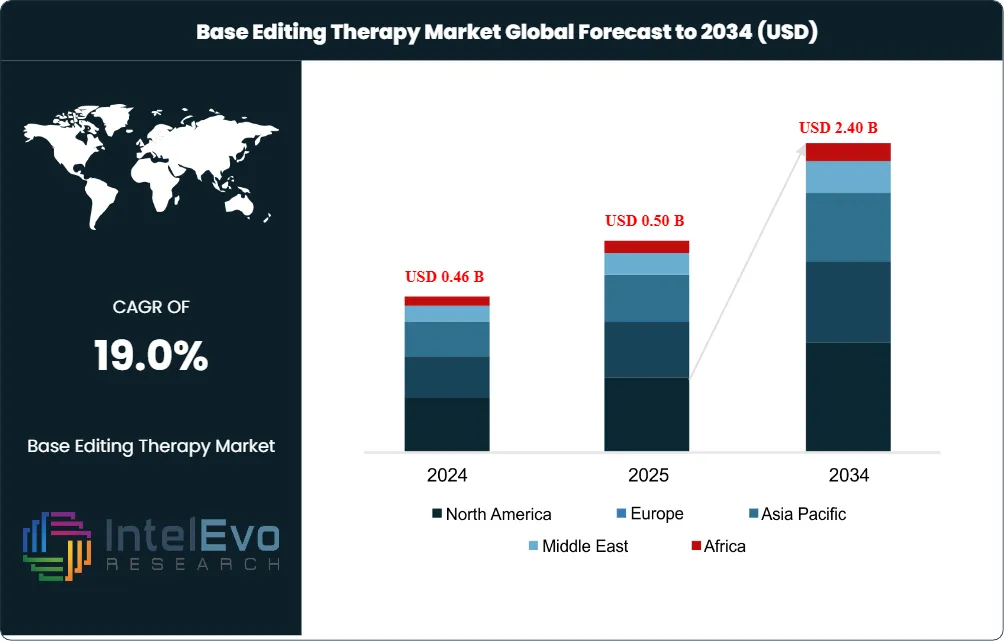
The Base Editing Therapy Market was valued at USD 0.46 Billion in 2024 and reached USD 0.50 Billion in 2025. The market is projected to reach USD 2.40 Billion by 2034, expanding at a CAGR of 19.0% during the forecast period from 2026 to 2034. This represents an absolute dollar opportunity of USD 1.90 Billion across the analysis horizon, with the category transitioning from preclinical and Phase 1/2 development toward registrational programs and pre-launch revenue capture.
Get More Information about this report -
Request Free Sample ReportThree forces converged on the category in 2025. First, clinical proof of concept materialized for in vivo base editing: on March 10, 2025, Beam Therapeutics reported that BEAM-302 achieved the first clinical genetic correction of a disease-causing mutation by base editing, with single doses producing therapeutically effective alpha-1 antitrypsin (AAT) protein levels in the 60 mg cohort. Second, cardiovascular efficacy emerged: on April 14, 2025, Verve Therapeutics reported that VERVE-102 achieved a mean LDL-C reduction of 53% and a maximum reduction of 69% in the 0.6 mg/kg cohort. Third, big pharma committed capital at scale: Eli Lilly closed its USD 1.3 Billion buyout of Verve in Q3 2025.
Capital flows reset the competitive landscape. Beam Therapeutics monetized its Orbital Therapeutics stake when Bristol Myers Squibb acquired Orbital for USD 1.5 Billion in October 2025, converting Beam's roughly 17% holding into USD 255.1 million by December 8, 2025. ElevateBio extended its Life Edit base editing platform through a March 2025 collaboration with Amazon Web Services applying generative AI to discovery workflows.
Regulatory anchoring widened during the year. On March 27, 2025, the FDA cleared the Investigational New Drug application for BEAM-302 in AATD, complementing prior authorizations from the United Kingdom, New Zealand, Australia, the Netherlands, and Ireland. The U.S. FDA cleared Verve to study VERVE-102 in U.S. sites by Q2 2025. The infant CPS1 deficiency case at the Children's Hospital of Philadelphia, reported in the New England Journal of Medicine in May 2025, demonstrated that a personalized base editing therapy can be designed and dosed within seven months of patient identification.
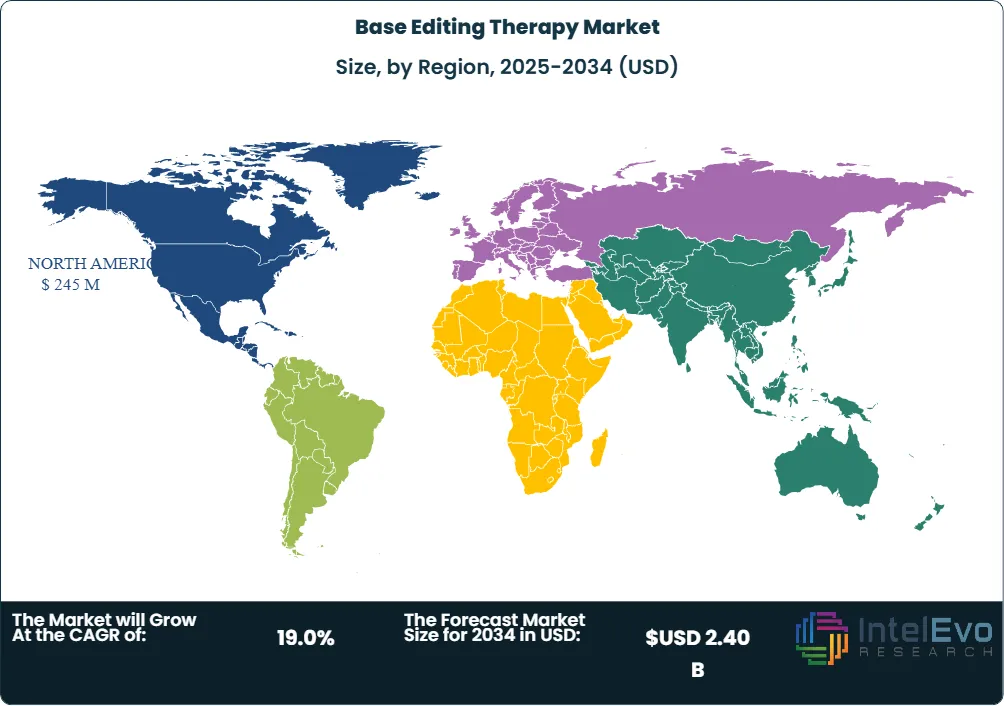
Geographic distribution remains heavily concentrated. North America accounted for 49.0% of 2025 revenue at USD 245 million, anchored by the Cambridge, Massachusetts cluster of Beam, Verve (now Lilly), Editas, and Sangamo. Europe captured 22.4% at USD 112 million, supported by EMA review of base editing IND applications. Asia Pacific, expanding at 21.8% expected CAGR through 2034, captured 21.6% of 2025 revenue.
Market Definition & Scope
The base editing therapy market is defined as the segment of pharmaceutical and clinical-stage development covering medicines that introduce single-base substitutions into DNA or RNA without inducing double-stranded DNA breaks. The market encompasses adenine base editors (ABE) for A-to-G conversions, cytosine base editors (CBE) for C-to-T conversions, RNA base editors recruiting endogenous ADAR enzymes via oligonucleotide guides, and engineered CRISPR-Cas systems including base-editing variants delivered via lipid nanoparticles, GalNAc-LNPs, viral vectors, or non-viral platforms.
In scope are net product revenues, milestone payments, technology licensing fees, and R&D collaborations where a base editing asset is the underlying deliverable. Out of scope are conventional CRISPR-Cas9 nuclease therapies that induce double-stranded breaks (such as Casgevy), prime editing therapies, gene replacement therapies, antisense oligonucleotides, and research-grade base editing reagents sold for laboratory use only. The parent market is the broader gene editing therapeutics industry.

Key Takeaways
- Market Growth: Sized at USD 0.50 Billion in 2025 and projected to reach USD 2.40 Billion by 2034 at a 19.0% CAGR, the fastest-growing segment within precision gene editing.
- Segment Dominance (By Editor Type): Adenine base editors (ABE) captured 64.2% of 2025 revenue, anchored by BEAM-302 (A-to-G correction of the PiZ mutation in AATD) and VERVE-102 (A-to-G inactivation of PCSK9).
- Segment Dominance (By Therapeutic Area): Hemoglobinopathies held 32.6% share in 2025, dominated by ex vivo base-edited autologous stem cell programs led by Beam Therapeutics's risto-cel (BEAM-101) for sickle cell disease.
- Driver: The 80/20 advantage of base editing over conventional CRISPR (avoiding double-stranded DNA breaks) supports adoption across cardiovascular, hepatic, and rare-disease indications where off-target safety is critical.
- Restraint: Lipid nanoparticle delivery limitations confine in vivo base editing largely to liver and hepatocyte targets, with VERVE-101's 2024 Phase 1 hold over LNP-related liver enzyme elevations illustrating the safety constraint.
- Opportunity: USD 1.90 Billion of absolute dollar opportunity exists between 2025 and 2034, with cardiovascular indications driving the largest sub-segment expansion following Eli Lilly's USD 1.3 Billion Verve Therapeutics buyout.
- Trend: GalNAc-LNP delivery has displaced first-generation lipid nanoparticles, with VERVE-102 and CRISPR Therapeutics's CTX320 anchoring the next wave of in vivo programs.
- Regional: North America held the largest share at 49.0%, equivalent to USD 245 million in 2025.
Key Insights Summary
- On March 10, 2025, Beam Therapeutics reported that BEAM-302 achieved the first clinical correction of a disease-causing mutation by base editing, with single doses producing therapeutically effective AAT protein levels in the 60 mg cohort.
- On April 14, 2025, Verve Therapeutics reported VERVE-102 reduced LDL-C by a mean of 53% and a maximum of 69% in the 0.6 mg/kg cohort of the Heart-2 Phase 1b trial across 14 participants.
- On March 25, 2026, Beam Therapeutics selected the 60 mg dose of BEAM-302 as the optimal biological dose to advance into registrational development for AATD with potential accelerated approval.
- By August 5, 2025, Beam Therapeutics had dosed 30 patients in the BEACON Phase 1/2 trial of BEAM-101 (now risto-cel), supporting BLA preparation for severe sickle cell disease.
- On June 17, 2025, Eli Lilly announced its USD 1.3 Billion acquisition of Verve Therapeutics at USD 10.50 per share upfront plus a USD 3.00 contingent value right, securing the lead PCSK9, ANGPTL3, and Lp(a) base editing programs.
- In May 2025, the New England Journal of Medicine reported the first bespoke base editing therapy delivered to an infant with CPS1 deficiency, designed and manufactured within seven months of patient identification.
- In October 2025, Bristol Myers Squibb agreed to acquire Orbital Therapeutics for USD 1.5 Billion in cash, with Beam Therapeutics converting its approximately 17% Orbital stake into USD 255.1 million by December 8, 2025.
Competitive Landscape Overview
The base editing therapy market is highly concentrated. Combined revenue share of the top four players (Beam Therapeutics, Eli Lilly via Verve, CRISPR Therapeutics, and ElevateBio) reached approximately 71.4% of 2025 market value when measured by combined R&D investment, milestone economics, and clinical-stage program valuations. Beam Therapeutics anchors the leader position with two clinical-stage programs (risto-cel for SCD, BEAM-302 for AATD), a third in development (BEAM-301 for glycogen storage disease 1a), and the ESCAPE platform for nongenotoxic conditioning.
Three competitive dynamics defined 2025. First, big pharma decisively entered the category through M&A, with Eli Lilly's USD 1.3 Billion Verve acquisition and Bristol Myers Squibb's USD 1.5 Billion Orbital Therapeutics deal closing within months of each other. Second, in vivo cardiovascular base editing reached clinical proof of concept across two independent platforms (VERVE-102 for PCSK9, CTX320 in vivo Lp(a) editing in early enrollment). Third, foundational platforms expanded their licensing footprint, with ElevateBio collaborating with Amazon Web Services on AI-enabled CRISPR therapeutics development in March 2025.
Competitive Landscape Matrix
| Company | HQ | Position | Lead Product/Pipeline | Geographic Strength | Recent Strategic Move (trailing 18 months) |
| Beam Therapeutics, Inc. | USA | Leader | risto-cel (BEAM-101), BEAM-302, BEAM-301 | North America, Europe | Selected the 60 mg dose of BEAM-302 for registrational development on March 25, 2026; converted USD 255.1M from the Orbital sale by December 8, 2025. |
| Eli Lilly and Company | USA | Leader | VERVE-102, VERVE-201, VERVE-301 | Global | Wrapped up the USD 1.3B Verve Therapeutics buyout in Q3 2025 (announced June 17, 2025) at USD 10.50 per share plus a USD 3.00 CVR per share. |
| CRISPR Therapeutics AG | Switzerland | Leader | CTX320 (in vivo Lp(a)), CTX112 | North America, Europe | Disclosed early Phase 1 data for in vivo Lp(a) base editing in 2025; partnered with Sirius for downstream commercial development. |
| ElevateBio LLC (Life Edit Therapeutics) | USA | Leader | Life Edit base editing platform, partnered programs | North America | Joined forces with Amazon Web Services in March 2025 to apply generative AI to base editing discovery workflows. |
| AstraZeneca plc / Revvity, Inc. | UK / USA | Challenger | Pin-point base editing platform | Global | Continued progressing the Pin-point cell therapy platform licensed from Revvity for cancer and immune-mediated diseases since May 2023. |
| Korro Bio, Inc. | USA | Challenger | OPERA platform RNA editing programs | North America | Advanced the OPERA RNA editing platform during 2025 with multiple preclinical programs in metabolic and rare diseases. |
| Wave Life Sciences Ltd. | Singapore/USA | Challenger | WVE-006 (RNA editing AIMer for AATD) | North America, Europe | Reported initial dose-dependent serum activity data from the RestorAATion-2 trial of WVE-006 in alpha-1 antitrypsin deficiency during 2025. |
| Tessera Therapeutics, Inc. | USA | Niche Player | Gene Writing platform | North America | Continued advancing the Gene Writing platform across hemoglobinopathies and metabolic disease through 2025. |
| Beacon Genomics / Bio Palette Co., Ltd. | Japan | Niche Player | Target-AID base editing platform | Asia Pacific | Continued licensing the Target-AID adenine base editor technology platform to academic and corporate partners during 2025. |
Segmentation Analysis
The base editing therapy market segments across four dimensions: by editor type, by delivery technology, by therapeutic area, and by therapy approach. Each axis carries distinct technical and commercial dynamics.
By Editor Type
By editor type, adenine base editors (ABE) dominated 2025 with 64.2% of revenue, anchored by Beam Therapeutics's BEAM-302 (an A-to-G adenine base editor correcting the PiZ mutation in AATD) and Verve Therapeutics's VERVE-102 (an A-to-G adenine base editor introducing a premature stop codon to inactivate PCSK9). The ABE segment grew 24% year on year. Cytosine base editors (CBE) captured 22.8% of 2025 revenue, anchored by Beam's risto-cel program for sickle cell disease, where C-to-T edits in HBG1/2 promoter regions inhibit BCL11A binding and increase fetal hemoglobin production.
RNA base editors held 8.4% of 2025 revenue, anchored by Wave Life Sciences's WVE-006 ADAR-recruiting AIMer for AATD, Korro Bio's OPERA platform programs, and Shape Therapeutics's RNA editing pipeline. RNA editing is expected to grow at 23.6% CAGR through 2034, the fastest sub-segment by editor type. Other editor types including engineered Cas variants and combined approaches accounted for 4.6% of 2025 revenue.
By Delivery Technology
By delivery technology, GalNAc-LNP delivery captured 38.4% of 2025 revenue, displacing first-generation lipid nanoparticles. VERVE-102 uses a proprietary GalNAc-LNP designed to access hepatocytes via either the LDL receptor (LDLR) or the asialoglycoprotein receptor (ASGPR). Conventional LNPs held 28.7%, anchored by BEAM-302's liver-targeting LNP formulation for AATD. Both delivery formats benefit from improved manufacturing capacity at Lonza, Catalent, and emerging GMP suppliers.
Ex vivo lentiviral and electroporation delivery captured 24.6% of 2025 revenue, anchored by Beam's BEAM-101/risto-cel program where autologous CD34+ hematopoietic stem cells are base-edited ex vivo before reinfusion. Adeno-associated virus (AAV) and other viral delivery platforms held 5.4% of 2025 revenue and serve niche applications including CNS targets. Other delivery technologies including peptide conjugates and electroporation-only approaches accounted for 2.9% of 2025 revenue.
By Therapeutic Area
By therapeutic area, hemoglobinopathies captured 32.6% of 2025 revenue, anchored by Beam's risto-cel program for sickle cell disease. Approximately eight million people worldwide live with sickle cell disease. Cardiovascular and metabolic indications held 28.4% of 2025 revenue and grow at 24.6% expected CAGR through 2034, the fastest sub-segment by therapeutic area, driven by VERVE-102, VERVE-201, VERVE-301, and CRISPR Therapeutics's CTX320 for in vivo Lp(a) editing.
Hepatic and metabolic genetic diseases held 18.4% of 2025 revenue, anchored by BEAM-302 for AATD and Wave Life Sciences's WVE-006. Oncology represented 12.6% of 2025 revenue, anchored by AstraZeneca's Pin-point platform programs. Other therapeutic areas including ophthalmology, neurology, and infectious disease accounted for 8.0% of 2025 revenue.
By Therapy Approach
In vivo base editing therapies captured 54.2% of 2025 revenue and grow at 22.8% expected CAGR through 2034, the fastest therapy-approach sub-segment. The category covers BEAM-302, VERVE-102, VERVE-201, VERVE-301, CTX320, WVE-006, and the Pin-point cell therapy platform. In vivo programs benefit from one-time dosing economics and broader scalability than ex vivo cell therapies.
Ex vivo base editing therapies held 41.4% of 2025 revenue, dominated by BEAM-101/risto-cel for sickle cell disease. Ex vivo programs require autologous CD34+ cell collection, base editing in laboratory settings, and reinfusion following myeloablative conditioning. Other therapy approaches including combined ex vivo and in vivo programs accounted for 4.4% of 2025 revenue.
Regional Analysis
The base editing therapy market spans five regions, with North America leading at 49.0% revenue share, equivalent to USD 245 million in 2025.
North America
North America held 49.0% of 2025 revenue at USD 245 million, anchored by U.S. clinical-stage programs and a vendor cluster spanning Cambridge, Massachusetts (Beam, Verve, Editas, Sangamo, ElevateBio) and the Bay Area (Tessera, Korro). The FDA cleared the BEAM-302 IND on March 27, 2025, and authorized U.S. study sites for VERVE-102 by Q2 2025. The Children's Hospital of Philadelphia delivered the first bespoke base editing therapy to an infant with CPS1 deficiency in May 2024, with the case published in NEJM in May 2025.
Europe
Europe captured 22.4% of 2025 revenue at USD 112 million. The UK leads regional clinical trial activity, hosting Heart-2 Phase 1b sites for VERVE-102 and BEAM-302 sites under MHRA authorization. The European Medicines Agency reviewed multiple base editing IND applications during 2024-2025. The Netherlands and Ireland authorized BEAM-302 trial sites during 2025, broadening the continental clinical footprint. Switzerland anchors regional CRISPR Therapeutics operations.
Asia Pacific
Asia Pacific held 21.6% of 2025 revenue at USD 108 million and is the fastest-growing region at 21.8% expected CAGR through 2034. Japan hosts Bio Palette Co., Ltd. (the developer of the Target-AID adenine base editor) and University of Kobe foundational research. Australia and New Zealand authorized BEAM-302 and VERVE-102 trial sites during 2025. China's National Medical Products Administration reviewed multiple base editing IND submissions during 2024-2025.
Latin America
Latin America held 4.2% of 2025 revenue at USD 21 million. Brazil leads regional spending, with ANVISA reviewing base editing IND applications during 2024-2025. Mexico's CONAHCYT supports CRISPR-base editing research at UNAM. The region remains import-dependent for clinical-stage base editing programs.
Middle East & Africa
Middle East and Africa held 2.8% of 2025 revenue at USD 14 million. Israel anchors regional clinical trial activity, hosting Heart-2 Phase 1b sites for VERVE-102. Saudi Arabia's Vision 2030 supports biopharmaceutical R&D, and the UAE's M42 has expanded biotechnology investment through 2024-2025.
Country Analysis
United States
The U.S. base editing therapy market reached approximately USD 220 million in 2025 and is projected to grow at a country-specific CAGR of 18.4% through 2034. The U.S. leads on three measures: clinical-stage program count, capital deployment, and regulatory clarity. The FDA cleared the BEAM-302 IND for AATD on March 27, 2025; cleared U.S. clinical sites for VERVE-102 by Q2 2025; and authorized the bespoke pediatric base editing therapy at the Children's Hospital of Philadelphia in 2024. Eli Lilly's USD 1.3 Billion Verve buyout (closed Q3 2025) anchored U.S. cardiovascular base editing capacity.
United Kingdom
The U.K. base editing therapy market reached approximately USD 48 million in 2025 with a country-specific CAGR of 19.4% through 2034. The Medicines and Healthcare Products Regulatory Agency authorized BEAM-302 clinical trial sites and Heart-2 sites for VERVE-102 during 2024-2025, making the UK one of two non-U.S. countries with both leading base editing programs in active enrollment. UK Research and Innovation directed GBP 100 million to AI-life-sciences programs through its Engineering Biology Mission Fund in 2024.
Japan
Japan's base editing therapy market reached approximately USD 32 million in 2025 with a country-specific CAGR of 21.6% through 2034. Bio Palette Co., Ltd. (a University of Kobe spinout) anchors the domestic ecosystem with its Target-AID adenine base editor technology platform. PMDA Sakigake designation accelerates review for first-in-class therapies. Sumitomo Pharma and other Japanese pharmaceutical companies support research collaborations with U.S. and European base editing developers.
Australia
Australia's base editing therapy market reached approximately USD 18 million in 2025 with a country-specific CAGR of 20.8% through 2034. The Therapeutic Goods Administration authorized BEAM-302 and VERVE-102 trial sites during 2024-2025. Australia's role as a Phase 1b enrollment country reflects its established clinical trial infrastructure and harmonized ethical review processes.
Get More Information about this report -
Request Free Sample ReportKey Market Segment
By Editor Type
- Cytosine Base Editors (CBEs)
- Adenine Base Editors (ABEs)
- Dual Base Editors
- Others
By Delivery Technology
- Viral Vectors
- Lipid Nanoparticles (LNPs)
- Electroporation
- Others
By Therapeutic Area
- Oncology
- Hematological Disorders
- Genetic Disorders
- Neurological Disorders
- Cardiovascular Diseases
- Others
By Therapy Approach
- Ex Vivo Base Editing
- In Vivo Base Editing
By Regional Coverage
- North America
- Latin America
- East Asia And Pacific
- Sea And South Asia
- Eastern Europe
- Western Europe
- Middle East & Africa
| Report Attribute | Details |
| Market size (2025) | USD 0.50 B |
| Forecast Revenue (2034) | USD 2.40 B |
| CAGR (2025-2034) | 19.0% |
| Historical data | 2021-2025 |
| Base Year For Estimation | 2025 |
| Forecast Period | 2026-2034 |
| Report coverage | Revenue Forecast, Competitive Landscape, Market Dynamics, Growth Factors, Trends and Recent Developments |
| Segments covered | By Editor Type, (Cytosine Base Editors (CBEs), Adenine Base Editors (ABEs), Dual Base Editors, Others), By Delivery Technology, (Viral Vectors, Lipid Nanoparticles (LNPs), Electroporation, Others), By Therapeutic Area, (Oncology, Hematological Disorders, Genetic Disorders, Neurological Disorders, Cardiovascular Diseases, Others), By Therapy Approach, (Ex Vivo Base Editing, In Vivo Base Editing), |
| Research Methodology |
|
| Regional scope |
|
| Competitive Landscape | BEAM THERAPEUTICS, INC., ELI LILLY AND COMPANY (VERVE THERAPEUTICS), CRISPR THERAPEUTICS AG, ELEVATEBIO LLC (LIFE EDIT THERAPEUTICS), ASTRAZENECA PLC, REVVITY, INC. (PIN-POINT PLATFORM), KORRO BIO, INC., WAVE LIFE SCIENCES LTD., TESSERA THERAPEUTICS, INC., BIO PALETTE CO., LTD., SHAPE THERAPEUTICS, INC., EDITAS MEDICINE, INC., INTELLIA THERAPEUTICS, INC., PROQR THERAPEUTICS N.V., MAMMOTH BIOSCIENCES, INC., ORBITAL THERAPEUTICS (BMS SUBSIDIARY), VERVE THERAPEUTICS (LILLY SUBSIDIARY), BRISTOL MYERS SQUIBB COMPANY, MODERNA, INC., Others |
| Customization Scope | Customization for segments, region/country-level will be provided. Moreover, additional customization can be done based on the requirements. |
| Pricing and Purchase Options | Avail customized purchase options to meet your exact research needs. We have three licenses to opt for: Single User License, Multi-User License (Up to 5 Users), Corporate Use License (Unlimited User and Printable PDF). |


Frequently Asked Questions
How big is the Base Editing Therapy Market?
The Global Base Editing Therapy Market was valued at USD 0.46 Billion in 2024 and is projected to reach USD 2.40 Billion by 2034, growing at a CAGR of 19.0% during the forecast period 2026–2034.
Who are the major players in the Base Editing Therapy Market?
BEAM THERAPEUTICS, INC., ELI LILLY AND COMPANY (VERVE THERAPEUTICS), CRISPR THERAPEUTICS AG, ELEVATEBIO LLC (LIFE EDIT THERAPEUTICS), ASTRAZENECA PLC, REVVITY, INC. (PIN-POINT PLATFORM), KORRO BIO, INC., WAVE LIFE SCIENCES LTD., TESSERA THERAPEUTICS, INC., BIO PALETTE CO., LTD., SHAPE THERAPEUTICS, INC., EDITAS MEDICINE, INC., INTELLIA THERAPEUTICS, INC., PROQR THERAPEUTICS N.V., MAMMOTH BIOSCIENCES, INC., ORBITAL THERAPEUTICS (BMS SUBSIDIARY), VERVE THERAPEUTICS (LILLY SUBSIDIARY), BRISTOL MYERS SQUIBB COMPANY, MODERNA, INC., Others
Which segments covered the Base Editing Therapy Market?
By Editor Type, (Cytosine Base Editors (CBEs), Adenine Base Editors (ABEs), Dual Base Editors, Others), By Delivery Technology, (Viral Vectors, Lipid Nanoparticles (LNPs), Electroporation, Others), By Therapeutic Area, (Oncology, Hematological Disorders, Genetic Disorders, Neurological Disorders, Cardiovascular Diseases, Others), By Therapy Approach, (Ex Vivo Base Editing, In Vivo Base Editing),
How can this market research report help my business make strategic decisions?
Our market research reports provide actionable intelligence, including verified market size data, CAGR projections, competitive benchmarking, and segment-level opportunity analysis. These insights support strategic planning, investment decisions, product development, and market entry strategies for enterprises and startups alike.
How frequently is the data updated?
We continuously monitor industry developments and update our reports to reflect regulatory changes, technological advancements, and macroeconomic shifts. Updated editions ensure you receive the latest market intelligence.

Select Licence Type
Connect with our sales team

Why IntelEvoResearch
100%
Customer
Satisfaction
24x7+
Availability - we are always
there when you need us
200+
Fortune 50 Companies trust
IntelEvoResearch
80%
of our reports are exclusive
and first in the industry
100%
more data
and analysis
1000+
reports published
till date