

- Home
- Industries
 Aerospace And Defence
 Agriculture
 Automotive And Transportation
 Banking And Finance
 Business
 Chemicals And Materials
 Consumer And Retail
 Electronics And Semiconductors
 Food And Beverages
 Machinery & Equipments
 Manufacturing And Construction
 Medical Devices
 Others
 Pharmaceuticals And Healthcare
 Power And Energy
 Sports
 Technology
- Services
- News Room
- About us
- Contact Us
-
Global Bee Monitoring Technology Market Size, Share | CAGR 23.7%
Global Bee Monitoring Technology Market Size, Share, Growth Analysis By Component (Hardware, Software, Services), By Technology (IoT-Based Monitoring, RFID & Computer Vision, Acoustic Analysis, Autonomous Robotic Hive Systems), By Application (Hive Monitoring, Pest Detection, Bee Activity Monitoring, Environmental Stress Monitoring), By End-User, Industry Trends & Forecast 2026-2034

Report Overview
| Market Size (2025) | Forecast Value (2034) | CAGR (2026-2034) | Largest Region (2025) |
|---|---|---|---|
| USD 228.85 Million | USD 1,551.92 Million | 23.7% | North America, 38.0% |
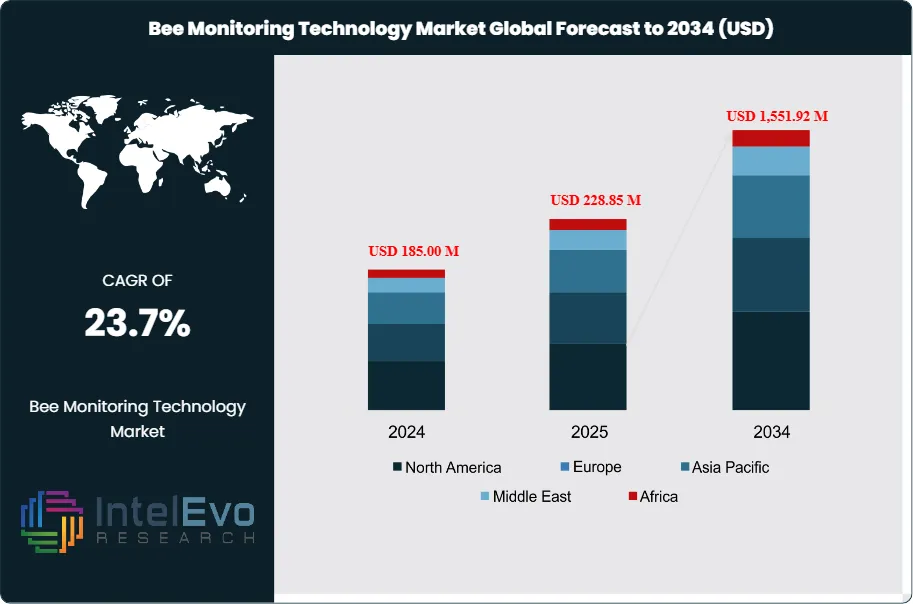
The Bee Monitoring Technology Market was valued at approximately USD 185.00 Million in 2024 and reached USD 228.85 Million in 2025. The market is projected to grow to USD 1,551.92 Million by 2034, expanding at a CAGR of 23.7% during the forecast period from 2026 to 2034. This represents an absolute dollar opportunity of USD 1,323.07 Million over the analysis period. The Bee Monitoring Technology Market covers the commercial space for IoT sensors, wireless networks, computer vision cameras, acoustic analyzers, robotics platforms, and cloud software that enable real-time monitoring of honey bee colony health, hive environmental conditions, pollination activity, and bee behavior across commercial apiaries, research institutions, and hobbyist beekeeping operations.
Get More Information about this report -
Request Free Sample ReportDemand growth is anchored in three structural shifts. First, the United States Department of Agriculture (USDA) and Bee Informed Partnership surveys documented U.S. beekeeper colony losses of 38% between 2015 and 2016, with average annual losses of 30-40% continuing through 2024, driving urgent demand for technology-enabled colony management. Second, the commercial pollination industry generates approximately USD 20 billion in annual value-add to U.S. agriculture per USDA estimates, with California's almond industry alone spending USD 400 million annually on bee rentals. Third, the Food and Agriculture Organization (FAO) estimates that approximately one-third of global food production depends on bee pollination, creating food security imperatives that justify government and private investment in colony health monitoring.
Technology adoption accelerated sharply through 2024-2025. BeeHero raised USD 64 million across five funding rounds through 2025, including a December 2022 Series B, and now serves over 20,000 hives representing approximately 1 billion bees under commercial pollination contracts, reporting a 20% increase in hive productivity and 25% reduction in colony loss for users. ApisProtect monitors over 10 million honey bees across 200+ sensor units with 20 beekeeper partners across the United States, Ireland, the United Kingdom, and South Africa, reporting up to 30% reduction in colony losses. Beewise Technologies launched the BeeHome autonomous robotic beehive integrating advanced robotics, AI, and IoT technology for hands-off colony care. In 2024-2025 academic research advanced BeeViz intelligent monitoring systems combining time series forecasting and anomaly detection for precision beekeeping.
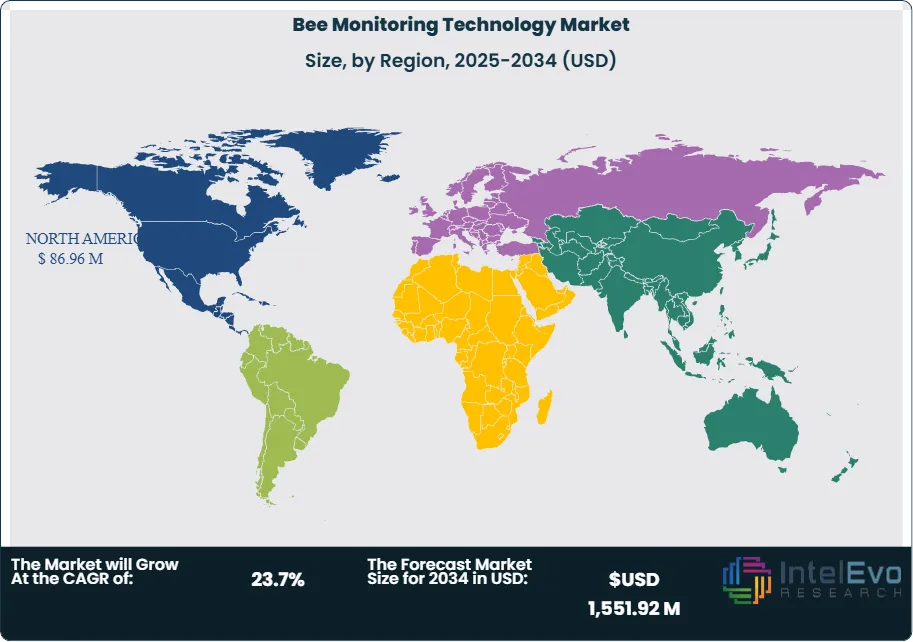
North America held approximately 38.0% of global Bee Monitoring Technology Market revenue in 2025, equivalent to USD 86.96 Million, anchored by the United States commercial pollination industry, California almond contracts, and domestic vendors BeeHero, The Bee Corp, OS Beehives, HiveTracks, and Solutionbee. Europe captured approximately 32% share at USD 73.23 Million, led by ApisProtect, 3Bee, Pollenity, and Arnia under European Union Horizon 2020 HIVEOPOLIS and subsequent Horizon Europe biodiversity research programs. Asia Pacific held 18% share at approximately USD 41.19 Million and is projected to grow fastest at approximately 26% CAGR through 2034, driven by Chinese, Japanese, and Australian commercial beekeeping expansion.
Forward visibility through 2034 rests on three catalysts. First, pollination-as-a-service contracts are expanding beyond California almonds into apples, blueberries, cherries, and avocados, with BeeHero's precision pollination model validating the bees-per-tree rather than bees-per-acre approach. Second, European Union carbon credit and biodiversity compliance frameworks under the EU Pollinators Initiative and Corporate Sustainability Reporting Directive (CSRD) are expanding commercial demand for quantified pollinator monitoring. Third, artificial intelligence and computer vision advances including multi-bee tracking algorithms and the BeeViz forecasting platform published in Nature Scientific Reports in 2026 enable predictive disease detection and colony collapse prevention. These forces together support the 23.7% forecast CAGR in the Bee Monitoring Technology Market through 2034.
Market Definition & Scope
The Bee Monitoring Technology Market is defined as the commercial space for integrated hardware, software, sensors, and services that measure, analyze, and track the health, behavior, environmental conditions, and pollination activity of honey bee colonies. The market encompasses four core technology categories: in-hive IoT sensors (temperature, humidity, CO2, weight, acoustic), bee activity monitoring (infrared imaging, computer vision entry-exit counters, RFID tracking), autonomous hive systems (robotic pest management, automated feeding, environmental regulation), and cloud analytics platforms (machine learning alerts, mobile apps, pollination verification).
This analysis includes hardware components (sensors, gateways, cameras, scales), software platforms (cloud analytics, mobile apps, data visualization), autonomous robotic hives, and services (contract pollination verification, managed beekeeping services, data subscriptions). The scope explicitly excludes traditional non-connected beekeeping equipment (basic wooden hives, manual extractors, protective suits), chemical treatments for Varroa mites and other pests, bee breeding equipment without digital monitoring, and general agricultural IoT platforms without bee-specific modules. The parent beekeeping equipment market reached approximately USD 2.22 Billion in 2025 per Global Growth Insights, with the Bee Monitoring Technology Market representing the high-growth digital subset at approximately 10% of the parent category in 2025, expanding toward 30%+ by 2034.

Key Takeaways
- Market Growth: The Bee Monitoring Technology Market grew from USD 228.85 Million in 2025 to a projected USD 1,551.92 Million in 2034, expanding at a 23.7% CAGR.
- Segment Dominance (By Technology): IoT-based monitoring systems captured approximately 54% revenue share in 2025, anchored by multi-sensor deployments measuring temperature, humidity, weight, sound, and movement within beehives.
- Segment Dominance (By End-User): Commercial beekeepers held approximately 62% revenue share in 2025, reflecting concentrated demand from pollination service providers and honey production operations at multi-hive scale.
- Driver: BeeHero reports a 20% increase in hive productivity and 25% reduction in colony loss for users, while ApisProtect reports up to 30% reduction in colony losses through IoT monitoring and AI alerts.
- Restraint: Sensor hardware cost averaging USD 150 to USD 400 per hive unit constrains smallholder adoption in emerging markets, with cellular data subscription costs adding USD 5-15 monthly per hive.
- Opportunity: California's almond industry alone spends approximately USD 400 million annually on bee rentals, creating a captive commercial buyer base for precision pollination platforms including BeeHero and The Bee Corp.
- Trend: Autonomous robotic hive systems including Beewise BeeHome integrate robotics, AI, and IoT for hands-off colony care, automated pest management, and remote hive operation without manual inspections.
- Regional: North America held approximately 38% revenue share in 2025 at USD 86.96 Million per Marketintelo analysis, anchored by United States commercial pollination industry demand.
Key Insights Summary
- BeeHero has raised USD 64 million across five funding rounds through 2025 and serves over 20,000 hives representing approximately 1 billion bees under commercial pollination contracts across almonds, apples, and blueberries.
- ApisProtect monitors over 10 million honey bees across 200+ sensor units with 20 beekeeper partners across the United States, Ireland, the United Kingdom, and South Africa, reporting up to 30% reduction in colony losses.
- Beewise Technologies operates the BeeHome autonomous robotic beehive integrating advanced robotics, AI, and IoT technology for hands-off colony care, automated pest management, and remote operation.
- California's almond industry alone spends approximately USD 400 million annually on commercial bee rentals, creating a captive market for precision pollination platforms providing hive grading and pollination verification services.
- U.S. beekeepers lose 30-40% of colonies annually per Bee Informed Partnership surveys, driving commercial and research demand for technology-enabled early warning systems for pests, diseases, and environmental stress.
- Approximately one-third of global food production depends on bee pollination per FAO estimates, with bee-pollinated crops generating approximately USD 235 billion to USD 577 billion in global annual value per IPBES 2016 assessment.
- The BeeViz intelligent monitoring system combining time series forecasting and anomaly detection was published in Nature Scientific Reports in 2026, advancing AI-powered predictive beekeeping capability for commercial deployment.
Competitive Landscape Overview
The Bee Monitoring Technology Market is fragmented with over 30 publicly known vendors and the top four companies including BeeHero, ApisProtect, Beewise, and 3Bee collectively holding an estimated 42 to 48% of global revenue in 2025. Competition is structured across three tiers: venture-backed integrated platforms led by BeeHero, ApisProtect, and Beewise targeting commercial beekeepers and pollination service contracts; European specialist vendors including 3Bee, Pollenity, and Arnia combining hardware with biodiversity research partnerships; and niche hobbyist and mid-market players including OS Beehives, HiveTracks, and Solutionbee serving smaller commercial operators and research institutions.
The competitive environment shifted sharply through 2024-2025 toward AI integration and autonomous hive systems. Beewise's BeeHome autonomous robotic beehive represents the most significant architectural innovation, combining real-time sensing with automated interventions including feeding, ventilation, and pest management. BeeHero's precision pollination-as-a-service model uses machine learning to optimize bees-per-tree rather than bees-per-acre, demonstrating 20% productivity improvements. ApisProtect integrates Slack-based alerts for beekeeper teams managing distributed operations. Academic research from universities including University of California Davis, Cornell, and University of Minnesota continues publishing intelligent beehive monitoring systems based on IoT and computer vision algorithms through 2024-2025. Investor sentiment remains strong with Rabo Food & Agri Innovation Fund, UpWest, iAngels, Plug-N-Play, J Ventures, and General Mills backing the category.
Competitive Landscape Matrix
| Company | HQ | Position | Key Platform | Geographic Strength | Recent Strategic Move |
|---|---|---|---|---|---|
| BeeHero, Inc. | Del Rey, CA, USA | Leader | Precision pollination; in-hive sensors; machine learning platform | North America, Global | Serves 20,000+ hives and approximately 1 billion bees in commercial pollination contracts through 2025 |
| ApisProtect Ltd. | Cork, Ireland | Leader | IoT beehive sensors; cloud analytics; AI alerts | Europe, North America | Continued expansion of AI training with 20+ beekeeper partners across US, Ireland, UK, and South Africa |
| Beewise Technologies Ltd. | Oakland, CA, USA / Beit Haemek, Israel | Leader (Autonomous) | BeeHome autonomous robotic beehive | North America, Israel | Continued BeeHome 4 rollout with AI-driven autonomous colony care and pest management through 2025 |
| 3Bee S.r.l. | Fino Mornasco, Italy | Challenger | Hive-Tech monitoring device; biodiversity tracking | Europe | Continued European biodiversity monitoring and carbon credit program expansion 2025 |
| Pollenity (Bee Smart Technologies) | Sofia, Bulgaria | Challenger | Beebot sensor; under-hive scales; EU-backed HIVEOPOLIS platform | Europe | Continued EU Horizon 2020 HIVEOPOLIS project participation with six European universities through 2025 |
| The Bee Corp | Indianapolis, IN, USA | Challenger | Verifli infrared bee colony grading; pollination verification | United States | Continued Verifli deployment for almond, blueberry, and cherry pollination contracts in California 2025 |
| OS Beehives, LLC | Boulder, CO, USA | Niche (Hobbyist) | BuzzBox smart beehive sensor; open-source hardware | Global (hobbyist) | Continued BuzzBox platform development with open-source hardware and community-driven app ecosystem 2025 |
| Arnia Ltd. | London, United Kingdom | Niche | Arnia hive monitoring hardware and software | Europe | Continued European commercial beekeeper deployment with temperature, humidity, weight, and acoustic sensors 2025 |
| HiveTracks, Inc. | Boone, NC, USA | Niche (Software) | HiveTracks beekeeping management software | North America, Global | Continued expansion of software-first beekeeping management platform for hobbyist and commercial operators 2025 |
| Solutionbee LLC | Hillsborough, NC, USA | Niche (Scales) | HiveScale remote hive monitoring; Bluetooth weight tracking | North America | Continued HiveScale remote monitoring deployment across North American commercial beekeepers 2025 |
Segmentation Analysis
The Bee Monitoring Technology Market segments across component, technology, application, end-user, and distribution channel. Procurement leaders at commercial beekeeping operations and pollination service providers building a bee monitoring technology procurement checklist should benchmark vendors on battery life and solar power options, cellular or LoRa connectivity coverage in rural deployment areas, AI-powered predictive alert accuracy, integration with pollination contract verification workflows, and per-hive total cost of ownership across each segmentation dimension.
By Component
Hardware led the Bee Monitoring Technology Market with approximately 62% revenue share in 2025, equivalent to USD 141.89 Million. Hardware includes in-hive sensors (temperature, humidity, CO2, weight), infrared cameras (The Bee Corp Verifli), acoustic sensors for bee activity monitoring, entry-exit bee counters using computer vision, RFID tag readers for individual bee tracking, solar panels for off-grid power, and cellular or LoRa gateways for data transmission. Software captured 25% share at USD 57.21 Million, including cloud analytics platforms, mobile apps, machine learning alert engines, and pollination verification reports. Services held 13% at USD 29.75 Million, including data subscription services, managed beekeeping platforms, and pollination contract verification services.
By Technology
IoT-based systems led the Bee Monitoring Technology Market with approximately 54% revenue share in 2025, reflecting the dominant deployment of connected sensor networks that transmit real-time hive data to cloud analytics platforms. Wireless sensor networks captured 22% share, covering LoRa, Zigbee, and cellular connectivity for multi-hive apiary deployments. RFID and computer vision-based technologies held 14%, including The Bee Corp's Verifli infrared colony grading system that measures hive temperature to grade colony strength without opening the hive, and entry-exit bee counting systems using RGB and thermal cameras. Acoustic analysis held 6% share, providing early swarm detection and queen presence verification. Autonomous robotic systems including Beewise BeeHome captured the remaining 4%.
By Application
Temperature and humidity monitoring led the Bee Monitoring Technology Market with approximately 32% revenue share in 2025, anchored by multi-sensor in-hive deployments tracking core hive health indicators. Hive weight monitoring captured 24% share, providing honey production tracking, feeding schedule optimization, and swarm detection through sudden weight changes. Bee activity monitoring held 21% share, including entry-exit counting, flight activity analysis through ML algorithms, and foraging behavior tracking for pollination efficiency verification. Pest and disease detection captured 16% share, providing early warning for Varroa destructor mite infestations, American foulbrood, and Nosema ceranae through acoustic and visual analysis. Environmental stressor monitoring captured the remaining 7%, including pesticide exposure detection and climate adaptation research.
By End-User
Commercial beekeepers led the Bee Monitoring Technology Market at approximately 62% revenue share in 2025, equivalent to USD 141.89 Million. Commercial operators managing hundreds to thousands of hives for pollination contracts and honey production represent the largest buyer segment, with California pollination service providers, Florida citrus pollinators, and Midwest soybean pollination operators anchoring demand. Research institutes captured 19% share at USD 43.48 Million, including USDA ARS bee labs, European Horizon Europe HIVEOPOLIS consortium partners, and university agriculture departments. Small-scale and hobbyist beekeepers held 14% share, served by OS Beehives BuzzBox, HiveTracks software, and Pollenity Beebot entry-level systems. Agricultural growers captured 5% share through direct procurement of pollination-as-a-service contracts. Bee monitoring technology ROI calculation models typically weight colony loss reduction (USD 150-300 value per colony saved), honey production uplift, and pollination service contract premiums as primary contributors.
Regional Analysis
The Bee Monitoring Technology Market divides across North America, Europe, Asia Pacific, Latin America, and Middle East & Africa, with North America leading in 2025 and Asia Pacific growing fastest through 2034.
North America
North America held 38.0% of global Bee Monitoring Technology Market revenue in 2025, equivalent to USD 86.96 Million. The United States accounted for 88% of regional revenue, Canada 10%, and Mexico 2%. The USDA Agricultural Research Service operates the Bee Research Laboratory in Beltsville, Maryland, and the Carl Hayden Bee Research Center in Tucson, Arizona. The USDA National Honey Bee Colony Loss Survey, conducted by the Bee Informed Partnership, documents annual colony losses driving technology adoption. California's almond industry, the largest single pollination market globally at approximately USD 400 million in annual bee rentals, anchors commercial deployment. Major U.S. players include BeeHero, The Bee Corp, OS Beehives, HiveTracks, Solutionbee, and Beewise's U.S. operations. Canadian and Mexican demand is driven by blueberry and avocado pollination contracts.
Europe
Europe held 32.0% share in 2025 at approximately USD 73.23 Million, with Germany, Italy, France, the United Kingdom, Ireland, and Bulgaria leading adoption. The European Union HIVEOPOLIS project funded through Horizon 2020 with EUR 7 million supports six European universities' collaborative research on smart beehive systems. The EU Pollinators Initiative, launched in 2018 and expanded under the 2023 revised framework, drives policy-led monitoring adoption. The Corporate Sustainability Reporting Directive (CSRD) creates biodiversity disclosure incentives for corporate buyers. Germany's Julius Kuhn-Institute, France's INRAE, and Italy's CREA lead research infrastructure. Major European vendors include ApisProtect (Ireland), 3Bee (Italy), Pollenity (Bulgaria), and Arnia (United Kingdom). Carbon credit programs for pollinator conservation provide emerging revenue streams.
Asia Pacific
Asia Pacific captured 18.0% share in 2025 at approximately USD 41.19 Million and is projected to grow fastest at 26% CAGR through 2034. China leads regional adoption with approximately 9 million bee colonies, the largest national beekeeping industry globally, supported by the Chinese Academy of Agricultural Sciences (CAAS) Institute of Apicultural Research. Japan's National Agriculture and Food Research Organization (NARO) operates bee health surveillance programs. South Korea's Rural Development Administration (RDA) supports smart apiculture under the Agricultural ICT Convergence Project. Australia's Plan Bee and the Australian Honey Bee Industry Council coordinate Varroa destructor response monitoring following the June 2022 Varroa mite incursion in New South Wales. India's National Bee Board supports precision beekeeping expansion under the National Beekeeping and Honey Mission launched in 2020.
Latin America
Latin America held 7.0% share in 2025 at approximately USD 16.02 Million, led by Argentina, Brazil, Mexico, and Uruguay. Argentina ranks as the world's second-largest honey exporter with approximately 3.5 million colonies, supported by BeeFlow's AI-driven bee immunity enhancement technology. Brazil's Embrapa operates the National Bee Research Center. Mexico's Yucatan Peninsula supports significant commercial honey production. Regional growth is driven by export-oriented honey producers serving European and U.S. markets and pollination services for soybean, sunflower, and fruit production. Currency volatility and limited rural connectivity infrastructure constrain faster adoption, though satellite IoT services increasingly address coverage gaps.
Middle East & Africa
The Middle East & Africa region held 5.0% share in 2025 at approximately USD 11.44 Million. South Africa leads regional technology adoption, with ApisProtect's validation partnership monitoring African bee colonies alongside Stellenbosch University research. The United Arab Emirates Ministry of Climate Change and Environment supports urban beekeeping under sustainability initiatives. Israel's Agricultural Research Organization (Volcani Institute) operates world-class bee research alongside Beewise's domestic R&D. Egypt and Morocco support traditional apiculture modernization. Kenya's Africa Bee Conservation trust, partnering with the FAO, drives pollinator protection across East Africa. Regional growth is constrained by fragmentation and limited smallholder purchasing power, though export-oriented honey producers in Ethiopia, Tanzania, and Zambia increasingly adopt monitoring technology.
Country Analysis
The Bee Monitoring Technology Market concentrates in four national markets that together contribute more than 60% of 2025 global revenue: the United States, Germany, China, and the United Kingdom.
United States
The United States generated approximately USD 76.52 Million in Bee Monitoring Technology Market revenue in 2025, with a country CAGR of 24.0% through 2034. The USDA Agricultural Research Service operates two primary bee research laboratories in Beltsville, Maryland, and Tucson, Arizona, alongside partnerships with land grant universities. The USDA National Agricultural Statistics Service tracks approximately 2.7 million managed honey bee colonies nationally. California's almond industry anchors demand with approximately USD 400 million in annual pollination contracts requiring technology-verified hive strength. The USDA Pollinator Protection Plan and EPA-led neonicotinoid restrictions drive research-grade monitoring demand. Major U.S. buyers include commercial pollinators Adee Honey Farms, Ackley Honey Farms, Wild Bill's Honey Farm, and Steward Seed Company. Domestic vendors BeeHero, The Bee Corp, OS Beehives, HiveTracks, and Solutionbee compete alongside European imports.
Germany
Germany contributed approximately USD 22.88 Million in Bee Monitoring Technology Market revenue in 2025, with a country CAGR of 22.5% through 2034. Germany operates approximately 1 million managed bee colonies supported by over 150,000 beekeepers, predominantly hobbyist, with commercial operations concentrated in Bavaria, Saxony, and Lower Saxony. The Julius Kuhn-Institute (JKI) Institute for Bee Protection coordinates national bee research. The German Beekeepers' Association (DIB) supports technology adoption education. Federal Ministry of Food and Agriculture (BMEL) funding under the National Beekeeping Program supports research-grade deployments. Domestic vendors include Hivesense and BeeBotics alongside broader European platforms. Major German commercial buyers include Bluhendes Osterreich and NABU (Nature and Biodiversity Conservation Union) research operations.
China
China contributed approximately USD 18.31 Million in Bee Monitoring Technology Market revenue in 2025, with a country CAGR of 27.5% through 2034, the fastest among major markets. China operates approximately 9 million managed bee colonies, the world's largest national beekeeping industry, producing approximately 30% of global honey output. The Chinese Academy of Agricultural Sciences (CAAS) Institute of Apicultural Research in Beijing leads national research. The Ministry of Agriculture and Rural Affairs supports technology adoption under the Agricultural Big Data Plan. Domestic vendors including Shanghai-based BeeIoT and Shenzhen-based SmartApiary serve provincial commercial beekeepers. Major Chinese buyers include state-backed Apiculture Research Institute commercial operations and private beekeeping cooperatives in Yunnan, Sichuan, and Shaanxi provinces. China's expanding apple, cherry, and blueberry pollination demand drives commercial technology adoption.
United Kingdom
The United Kingdom generated approximately USD 12.58 Million in Bee Monitoring Technology Market revenue in 2025, with a country CAGR of 23.0% through 2034. The UK operates approximately 270,000 managed bee colonies supported by over 40,000 beekeepers per British Beekeepers Association (BBKA) data. The Department for Environment, Food and Rural Affairs (DEFRA) National Bee Unit coordinates national bee health surveillance. Rothamsted Research operates the Bee Health Research Laboratory. Major UK players include Arnia (commercial hardware), AgriSound (bioacoustic monitoring), and ApisProtect UK operations. The UK Pollinator Action Plan 2024-2034 drives sustained public investment. Major commercial buyers include Worcestershire honey producers, Hartley's Honey (acquired by Premier Foods), and Scottish heather honey cooperatives. Brexit-driven domestic agricultural policy under the Environmental Land Management scheme supports pollinator-friendly farming incentives.
Get More Information about this report -
Request Free Sample ReportMarket Segmentation
By Component
- Hardware
- In-Hive Sensors (Temperature, Humidity, CO2, Weight)
- Infrared Cameras and Computer Vision Systems
- Acoustic Sensors
- RFID Tracking Systems
- Solar Panels and Connectivity Gateways
- Software
- Cloud Analytics Platforms
- Mobile Applications
- Machine Learning Alert Engines
- Pollination Verification Software
- Services
- Data Subscription Services
- Managed Beekeeping Services
- Pollination Verification Services
By Technology
- IoT-Based Monitoring Systems
- Wireless Sensor Networks (LoRa, Zigbee, Cellular)
- RFID and Computer Vision-Based Monitoring
- Acoustic Analysis Systems
- Autonomous Robotic Hive Systems
By Application
- Temperature and Humidity Monitoring
- Hive Weight Monitoring
- Bee Activity Monitoring
- Pest and Disease Detection
- Environmental Stressor Monitoring
By End-User
- Commercial Beekeepers
- Research Institutes and Universities
- Small-Scale and Hobbyist Beekeepers
- Agricultural Growers and Pollination Service Providers
By Connectivity
- Cellular-Based Monitoring Systems
- LoRa-Based Monitoring Systems
- Zigbee and Short-Range Wireless Systems
- Hybrid Connectivity Solutions
By Deployment Mode
- Cloud-Based Platforms
- On-Premise Monitoring Systems
- Hybrid Deployment Models
By Regional Coverage
- North America
- Latin America
- East Asia And Pacific
- Sea And South Asia
- Eastern Europe
- Western Europe
- Middle East & Africa
| Report Attribute | Details |
| Market size (2025) | USD 228.85 M |
| Forecast Revenue (2034) | USD 1,551.92 M |
| CAGR (2025-2034) | 23.7% |
| Historical data | 2021-2024 |
| Base Year For Estimation | 2025 |
| Forecast Period | 2026-2034 |
| Report coverage | Revenue Forecast, Competitive Landscape, Market Dynamics, Growth Factors, Trends and Recent Developments |
| Segments covered | By Component, (Hardware, Software, Services), By Technology, (IoT-Based Monitoring Systems, Wireless Sensor Networks (LoRa, Zigbee, Cellular), RFID and Computer Vision-Based Monitoring, Acoustic Analysis Systems, Autonomous Robotic Hive Systems), By Application, (Temperature and Humidity Monitoring, Hive Weight Monitoring, Bee Activity Monitoring, Pest and Disease Detection, Environmental Stressor Monitoring), By End-User, (Commercial Beekeepers, Research Institutes and Universities, Small-Scale and Hobbyist Beekeepers, Agricultural Growers and Pollination Service Providers), By Connectivity, (Cellular-Based Monitoring Systems, LoRa-Based Monitoring Systems, Zigbee and Short-Range Wireless Systems, Hybrid Connectivity Solutions), By Deployment Mode, (Cloud-Based Platforms, On-Premise Monitoring Systems, Hybrid Deployment Models) |
| Research Methodology |
|
| Regional scope |
|
| Competitive Landscape | BEEHERO, INC., APISPROTECT LTD., BEEWISE TECHNOLOGIES LTD., 3BEE S.R.L., POLLENITY (BEE SMART TECHNOLOGIES), THE BEE CORP, OS BEEHIVES, LLC, ARNIA LTD., HIVETRACKS, INC., SOLUTIONBEE LLC, BEE HIVE MONITORING, BEESAGE, GOBUZZR, HYPER HYVE, PROHIVER, TEAM TWEAK, INTERNET OF BEES, APIAGO, HIVEGENIE, AGRISOUND LTD., BEEFLOW, Others |
| Customization Scope | Customization for segments, region/country-level will be provided. Moreover, additional customization can be done based on the requirements. |
| Pricing and Purchase Options | Avail customized purchase options to meet your exact research needs. We have three licenses to opt for: Single User License, Multi-User License (Up to 5 Users), Corporate Use License (Unlimited User and Printable PDF). |


Frequently Asked Questions
How big is the Bee Monitoring Technology Market?
The Global Bee Monitoring Technology Market was valued at USD 185.00 Million in 2024 and is projected to reach USD 1,551.92 Million by 2034, growing at a CAGR of 23.7% from 2026 to 2034, driven by rising adoption of precision apiculture technologies, increasing concerns over declining bee populations, growing demand for IoT-enabled hive monitoring systems, and advancements in AI-powered bee health analytics and sustainable agriculture solutions worldwide.
Who are the major players in the Bee Monitoring Technology Market?
BEEHERO, INC., APISPROTECT LTD., BEEWISE TECHNOLOGIES LTD., 3BEE S.R.L., POLLENITY (BEE SMART TECHNOLOGIES), THE BEE CORP, OS BEEHIVES, LLC, ARNIA LTD., HIVETRACKS, INC., SOLUTIONBEE LLC, BEE HIVE MONITORING, BEESAGE, GOBUZZR, HYPER HYVE, PROHIVER, TEAM TWEAK, INTERNET OF BEES, APIAGO, HIVEGENIE, AGRISOUND LTD., BEEFLOW, Others
Which segments covered the Bee Monitoring Technology Market?
By Component, (Hardware, Software, Services), By Technology, (IoT-Based Monitoring Systems, Wireless Sensor Networks (LoRa, Zigbee, Cellular), RFID and Computer Vision-Based Monitoring, Acoustic Analysis Systems, Autonomous Robotic Hive Systems), By Application, (Temperature and Humidity Monitoring, Hive Weight Monitoring, Bee Activity Monitoring, Pest and Disease Detection, Environmental Stressor Monitoring), By End-User, (Commercial Beekeepers, Research Institutes and Universities, Small-Scale and Hobbyist Beekeepers, Agricultural Growers and Pollination Service Providers), By Connectivity, (Cellular-Based Monitoring Systems, LoRa-Based Monitoring Systems, Zigbee and Short-Range Wireless Systems, Hybrid Connectivity Solutions), By Deployment Mode, (Cloud-Based Platforms, On-Premise Monitoring Systems, Hybrid Deployment Models)
How can this market research report help my business make strategic decisions?
Our market research reports provide actionable intelligence, including verified market size data, CAGR projections, competitive benchmarking, and segment-level opportunity analysis. These insights support strategic planning, investment decisions, product development, and market entry strategies for enterprises and startups alike.
How frequently is the data updated?
We continuously monitor industry developments and update our reports to reflect regulatory changes, technological advancements, and macroeconomic shifts. Updated editions ensure you receive the latest market intelligence.

Select Licence Type
Connect with our sales team

Bee Monitoring Technology Market
Published Date : 25 May 2026 | Formats :Why IntelEvoResearch
100%
Customer
Satisfaction
24x7+
Availability - we are always
there when you need us
200+
Fortune 50 Companies trust
IntelEvoResearch
80%
of our reports are exclusive
and first in the industry
100%
more data
and analysis
1000+
reports published
till date