
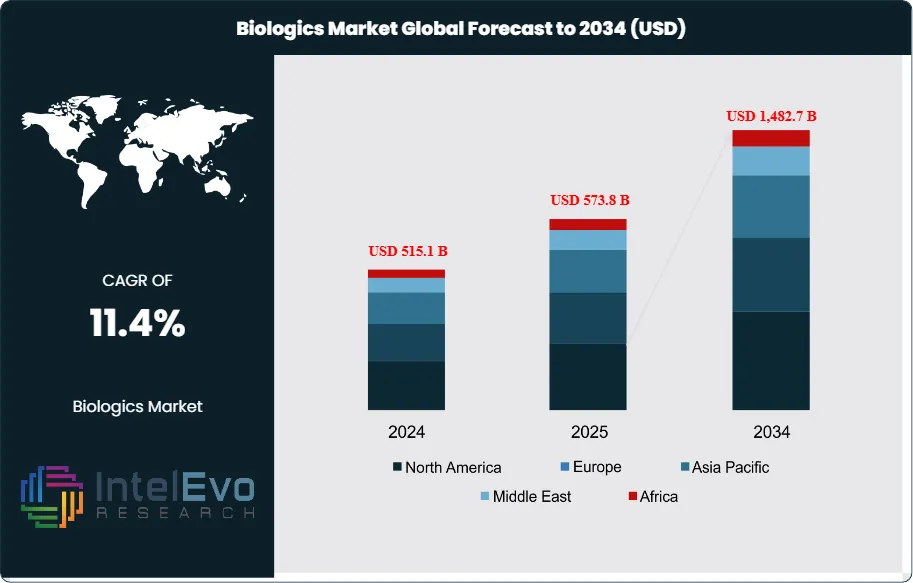
The Biologics market was estimated at USD 515.1 billion in 2024 and is expected to expand to roughly USD 1,482.7 billion by 2034, reflecting an annual growth rate of 11.4% over 2025–2034. This strong outlook reflects a shift in healthcare priorities, as biologics move from a niche category into a central component of treatment strategies. The expansion is being fueled by innovation in therapeutic platforms, supportive regulatory practices, and the pressing need for new options in chronic and complex diseases.
A major factor shaping demand is the rising burden of conditions such as cancer, autoimmune disorders, and neurodegenerative diseases. According to the American Cancer Society’s 2025 Cancer Facts & Figures report, the United States alone is projected to see more than 2 million new cancer cases in 2025. Likewise, the Alzheimer’s Association estimates that by 2025, about 7.2 million Americans aged 65 and older could be living with Alzheimer’s disease. These figures illustrate both the growing pressure on healthcare systems and the unique opportunity for biologics to address gaps where conventional drugs provide limited benefit.
The sector’s rapid growth is also tied to technological breakthroughs. The deployment of mRNA-based vaccines, exemplified by Pfizer’s Comirnaty during the COVID-19 pandemic, not only redefined vaccine development but also sparked renewed investment into programs targeting influenza, RSV, and other infectious diseases. Progress in monoclonal antibodies, advanced gene therapies, and companion diagnostics is pushing medicine toward highly tailored solutions that align with a patient’s genetic makeup. At the same time, AI-driven drug discovery and advanced analytics are helping shorten development timelines and improve success rates, reinforcing biologics as a preferred option for next-generation therapies.
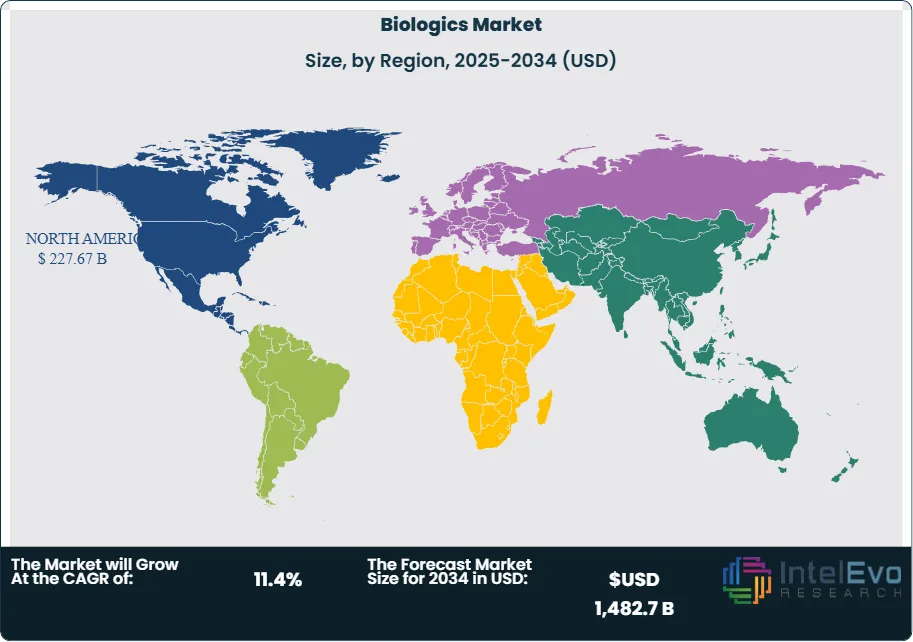
From a geographical perspective, North America retained its leadership position in 2024, generating around USD 225.2 billion and representing 43.8% of global sales. Its dominance is linked to established research ecosystems, extensive investment capacity, and an agile regulatory environment. The FDA’s Center for Biologics Evaluation and Research (CBER) has further accelerated access by offering priority pathways for promising biologics, particularly in the fields of cell and gene therapy.
Europe continues to advance steadily, supported by strong clinical infrastructure and well-defined policies that promote the responsible introduction of biologics and biosimilars. Unlike North America’s faster regulatory accelerators, Europe emphasizes rigorous evaluation while still facilitating adoption.
The Asia-Pacific region has emerged as the fastest-expanding market. Rising healthcare expenditures, a surge in domestic and international clinical trials, and large, diverse patient populations have created favorable conditions for biologics uptake. Governments in markets such as China, India, and South Korea are also implementing initiatives to strengthen biopharmaceutical R&D and manufacturing capacity, positioning the region as a critical hub for future growth.
Together, these developments demonstrate how biologics are reshaping global healthcare. They are redefining therapeutic standards, altering investment priorities, and influencing how regulators, providers, and manufacturers think about treatment delivery for the next decade.
Market Growth: The global biologics market was valued at USD 515.1 billion in 2024 and is projected to reach USD 1,482.7 billion by 2034, expanding at a CAGR of 11.4%. Growth is fueled by rising prevalence of chronic diseases, rapid innovation in targeted therapies, and accelerated regulatory approvals.
Product Type: Monoclonal antibodies remain the leading product category, capturing 47.6% of the market share in 2023. Their dominance stems from widespread use in oncology and immunology, supported by a steady pipeline of FDA and EMA approvals.
Manufacturing: Outsourced manufacturing accounted for 63.2% of market revenue in 2023, reflecting biopharma companies’ reliance on contract manufacturing organizations (CMOs) to reduce costs, scale production, and accelerate time-to-market.
Application: Oncology leads the application segment with a 45.5% revenue share, driven by the rising global cancer burden and the success of biologics in immuno-oncology therapies, which are increasingly replacing conventional chemotherapy.
Source: Microbial-derived biologics held a 38.4% share in 2023, benefiting from cost efficiency, scalability, and their critical role in vaccine and recombinant protein production.
Driver: Increasing incidence of cancer, autoimmune, and neurological diseases is a primary growth driver; for example, over 2 million new cancer cases are projected in the U.S. in 2025, underscoring the urgent demand for advanced biologics.
Restraint: High development costs and manufacturing complexities remain a key restraint, with average biologic R&D expenditures surpassing USD 2 billion per product and lengthy clinical timelines limiting smaller players’ entry.
Opportunity: Asia-Pacific is emerging as the fastest-growing regional market, forecast to expand at a double-digit CAGR through 2034, supported by expanding healthcare infrastructure, clinical trials, and increasing patient access to biologics in China and India.
Trend: mRNA platforms and gene therapies are reshaping the industry, with successful launches such as Pfizer-BioNTech’s Comirnaty and FDA fast-tracks for cell and gene therapies setting new benchmarks for biologics innovation.
Regional Analysis: North America led the market with a 43.8% share in 2023, valued at USD 225.2 billion, supported by advanced healthcare infrastructure and strong regulatory frameworks. Europe follows with emphasis on biosimilars adoption, while Asia-Pacific represents the most attractive growth hotspot for future investments.
Type Analysis
High-performance concrete (HPC) continues to represent the most influential category within the global advanced concrete market as of 2025, driven by its superior strength, durability, and resilience under extreme environmental conditions. This type is extensively deployed in large-scale infrastructure projects, including high-rise buildings, bridges, and transportation networks, where long-term performance and reduced maintenance costs are critical. With governments worldwide investing heavily in resilient infrastructure—such as the U.S. Bipartisan Infrastructure Law, which allocates over USD 1 trillion for transportation and construction—demand for HPC is projected to accelerate at a CAGR exceeding 7% through 2032.
Self-consolidating concrete (SCC) is emerging as a high-growth subsegment, valued for its ease of placement, labor cost savings, and ability to reduce formwork defects. SCC adoption is particularly strong in urban construction, where time efficiency and structural precision are crucial. Industry estimates suggest SCC usage in residential and commercial construction projects has grown by more than 15% globally since 2020, and this trend is expected to intensify as contractors seek sustainable, cost-efficient materials. Other specialized concrete types, including fiber-reinforced and lightweight concrete, are gaining momentum in niche applications such as precast components and energy-efficient buildings, collectively broadening the segment’s market potential.
Application Analysis
Pavers dominate application areas, supported by expanding infrastructure development in both developed and emerging economies. With urbanization accelerating—particularly in Asia and Latin America—governments are prioritizing roads, sidewalks, and pedestrian zones, creating robust demand for advanced concrete pavers. For instance, India’s Smart Cities Mission, covering more than 100 cities, is heavily reliant on durable paver materials to modernize urban infrastructure, contributing significantly to market growth.
Retaining walls represent another critical application, particularly in regions prone to soil erosion, flooding, and urban land-use expansion. Rising climate resilience initiatives are encouraging the adoption of durable concrete solutions that ensure long-term stability. According to World Bank estimates, global infrastructure resilience investments need to rise by at least 3–4% annually through 2030, directly boosting demand for high-performance retaining wall materials. Other applications, such as precast blocks, landscaping elements, and modular systems, are also gaining traction, particularly in high-density urban areas seeking sustainable and aesthetic construction solutions.
End-Use Analysis
Residential construction remains a cornerstone of the advanced concrete market, supported by rising housing demand, rapid urbanization, and growing adoption of sustainable building materials. In 2025, global residential building activity accounts for the largest share of demand, particularly in Asia-Pacific and North America, where new housing starts and renovations are driving material adoption. The integration of energy-efficient concrete solutions in green housing projects is further strengthening growth prospects.
The commercial building segment—including office complexes, retail centers, and institutional facilities—is witnessing significant expansion, fueled by investments in smart cities, tourism infrastructure, and education hubs. This segment increasingly favors self-consolidating and fiber-reinforced concrete, owing to their adaptability for complex designs and faster project delivery. Industrial applications, while representing a smaller share, are gaining importance in logistics hubs, manufacturing plants, and renewable energy facilities, where durable and high-performance materials are required to withstand heavy loads and harsh conditions.
Regional Analysis
North America remains a leading market, supported by robust infrastructure investments, stringent building codes, and widespread adoption of advanced construction technologies. The U.S. continues to drive regional demand with large-scale transportation, energy, and urban development projects, while Canada’s infrastructure modernization programs are accelerating use of sustainable concrete materials.
Europe holds a significant share, with demand driven by stringent sustainability regulations and the European Green Deal, which mandates reduced carbon emissions in construction. Countries such as Germany, France, and the UK are adopting advanced concrete solutions for both retrofitting historic structures and building energy-efficient smart cities.
Asia-Pacific, however, represents the fastest-growing region, expected to record double-digit growth through 2032. Rapid urbanization, industrial expansion, and megaprojects in China, India, and Southeast Asia are fueling unprecedented demand for high-performance and self-consolidating concrete. For example, China’s Belt and Road Initiative continues to drive cross-border infrastructure projects requiring large volumes of durable materials.
Latin America and the Middle East & Africa are emerging as secondary growth hubs. In Latin America, urban renewal and affordable housing projects are stimulating adoption, while in the Middle East, large-scale projects such as Saudi Arabia’s NEOM are creating substantial opportunities for advanced concrete types tailored to extreme climatic conditions.
By Product Type (Monoclonal Antibodies, (MABs by Application, MABs by Type), Vaccines, Recombinant Proteins, Antisense & RNAi Therapeutics, Others), By Manufacturing (Outsourced, In-house), By Application (Oncology, Immunology, Infectiuos Disease, Cardiovascular Disorders, Others), By Source (Microbial, Mammalian, Others)
Research Methodology
Primary Research- 100 Interviews of Stakeholders
Secondary Research
Desk Research
Regional scope
North America (United States, Canada, Mexico)
Latin America (Brazil, Argentina, Columbia)
East Asia And Pacific (China, Japan, South Korea, Australia, Cambodia, Fiji, Indonesia)
Sea And South Asia (India, Singapore, Thailand, Taiwan, Malaysia)
Eastern Europe (Poland, Russia, Czech Republic, Romania)
Western Europe (Germany, U.K., France, Spain, Itlay)
Middle East & Africa (GCC Countries, Egypt, Nigeria, South Africa, Israel)
Competitive Landscape
Amgen Inc, Hoffmann La-Roche Ltd, Eli Lilly and Company, Samsung Biologics, Johnson & Johnson Services, Inc, AbbVie Inc, Celltrion Healthcare Co., Ltd, Bristol-Myers Squibb Company, Sanofi, Novo Nordisk A/S
Customization Scope
Customization for segments, region/country-level will be provided. Moreover, additional customization can be done based on the requirements.
Pricing and Purchase Options
Avail customized purchase options to meet your exact research needs. We have three licenses to opt for: Single User License, Multi-User License (Up to 5 Users), Corporate Use License (Unlimited User and Printable PDF).
TABLE OF CONTENTS
1. EXECUTIVE SUMMARY
1.1. MARKET SNAPSHOT
1.2. KEY FINDINGS & INSIGHTS
1.3. ANALYST RECOMMENDATIONS
1.4. FUTURE OUTLOOK
2. RESEARCH METHODOLOGY
2.1. MARKET DEFINITION & SCOPE
2.2. RESEARCH OBJECTIVES: PRIMARY & SECONDARY DATA SOURCES
2.3. DATA COLLECTION SOURCES
2.3.1. COVERAGE OF 100+ PRIMARY RESEARCH/CONSULTATION CALLS WITH INDUSTRY STAKEHOLDERS
FIGURE 17 NORTH AMERICA BIOLOGICS CURRENT AND FUTURE TYPE ANALYSIS, 2025–2034, (USD MILLION)
FIGURE 18 NORTH AMERICA BIOLOGICS CURRENT AND FUTURE END USER ANALYSIS, 2025–2034, (USD MILLION)
FIGURE 19 MARKET SHARE BY COUNTRY
FIGURE 20 LATIN AMERICA BIOLOGICS CURRENT AND FUTURE TYPE ANALYSIS, 2025–2034, (USD MILLION)
FIGURE 21 LATIN AMERICA BIOLOGICS CURRENT AND FUTURE END USER ANALYSIS, 2025–2034, (USD MILLION)
FIGURE 22 MARKET SHARE BY COUNTRY
FIGURE 23 EASTERN EUROPE BIOLOGICS CURRENT AND FUTURE TYPE ANALYSIS, 2025–2034, (USD MILLION)
FIGURE 24 EASTERN EUROPE BIOLOGICS CURRENT AND FUTURE END USER ANALYSIS, 2025–2034, (USD MILLION)
FIGURE 25 MARKET SHARE BY COUNTRY
FIGURE 26 WESTERN EUROPE BIOLOGICS CURRENT AND FUTURE TYPE ANALYSIS, 2025–2034, (USD MILLION)
FIGURE 27 WESTERN EUROPE BIOLOGICS CURRENT AND FUTURE END USER ANALYSIS, 2025–2034, (USD MILLION)
FIGURE 28 MARKET SHARE BY COUNTRY
FIGURE 29 EAST ASIA AND PACIFIC BIOLOGICS CURRENT AND FUTURE TYPE ANALYSIS, 2025–2034, (USD MILLION)
FIGURE 30 EAST ASIA AND PACIFIC BIOLOGICS CURRENT AND FUTURE END USER ANALYSIS, 2025–2034, (USD MILLION)
FIGURE 31 MARKET SHARE BY COUNTRY
FIGURE 32 SEA AND SOUTH ASIA BIOLOGICS CURRENT AND FUTURE TYPE ANALYSIS, 2025–2034, (USD MILLION)
FIGURE 33 SEA AND SOUTH ASIA BIOLOGICS CURRENT AND FUTURE END USER ANALYSIS, 2025–2034, (USD MILLION)
FIGURE 34 MARKET SHARE BY COUNTRY
FIGURE 35 MIDDLE EAST AND AFRICA BIOLOGICS CURRENT AND FUTURE TYPE ANALYSIS, 2025–2034, (USD MILLION)
FIGURE 36 MIDDLE EAST AND AFRICA BIOLOGICS CURRENT AND FUTURE END USER ANALYSIS, 2025–2034, (USD MILLION)
FIGURE 37 NORTH AMERICA BIOLOGICS CURRENT AND FUTURE MARKET VOLUME SHARE REGIONAL ANALYSIS, 2025–2034, (USD MILLION)
FIGURE 38 U.S. BIOLOGICS CURRENT AND FUTURE TYPE ANALYSIS, 2025–2034, (USD MILLION)
FIGURE 39 U.S. BIOLOGICS CURRENT AND FUTURE END USER ANALYSIS, 2025–2034, (USD MILLION)
FIGURE 40 CANADA BIOLOGICS CURRENT AND FUTURE TYPE ANALYSIS, 2025–2034, (USD MILLION)
FIGURE 41 CANADA BIOLOGICS CURRENT AND FUTURE END USER ANALYSIS, 2025–2034, (USD MILLION)
FIGURE 42 LATIN AMERICA BIOLOGICS CURRENT AND FUTURE MARKET VOLUME SHARE REGIONAL ANALYSIS, 2025–2034, (USD MILLION)
FIGURE 43 MEXICO BIOLOGICS CURRENT AND FUTURE TYPE ANALYSIS, 2025–2034, (USD MILLION)
FIGURE 44 MEXICO BIOLOGICS CURRENT AND FUTURE END USER ANALYSIS, 2025–2034, (USD MILLION)
FIGURE 45 BRAZIL BIOLOGICS CURRENT AND FUTURE TYPE ANALYSIS, 2025–2034, (USD MILLION)
FIGURE 46 BRAZIL BIOLOGICS CURRENT AND FUTURE END USER ANALYSIS, 2025–2034, (USD MILLION)
FIGURE 47 ARGENTINA BIOLOGICS CURRENT AND FUTURE TYPE ANALYSIS, 2025–2034, (USD MILLION)
FIGURE 48 ARGENTINA BIOLOGICS CURRENT AND FUTURE END USER ANALYSIS, 2025–2034, (USD MILLION)
FIGURE 49 COLUMBIA BIOLOGICS CURRENT AND FUTURE TYPE ANALYSIS, 2025–2034, (USD MILLION)
FIGURE 50 COLUMBIA BIOLOGICS CURRENT AND FUTURE END USER ANALYSIS, 2025–2034, (USD MILLION)
FIGURE 51 REST OF LATIN AMERICA BIOLOGICS CURRENT AND FUTURE TYPE ANALYSIS, 2025–2034, (USD MILLION)
FIGURE 52 REST OF LATIN AMERICA BIOLOGICS CURRENT AND FUTURE END USER ANALYSIS, 2025–2034, (USD MILLION)
FIGURE 53 EASTERN EUROPE BIOLOGICS CURRENT AND FUTURE MARKET VOLUME SHARE REGIONAL ANALYSIS, 2025–2034, (USD MILLION)
FIGURE 54 POLAND BIOLOGICS CURRENT AND FUTURE TYPE ANALYSIS, 2025–2034, (USD MILLION)
FIGURE 55 POLAND BIOLOGICS CURRENT AND FUTURE END USER ANALYSIS, 2025–2034, (USD MILLION)
FIGURE 56 RUSSIA BIOLOGICS CURRENT AND FUTURE TYPE ANALYSIS, 2025–2034, (USD MILLION)
FIGURE 57 RUSSIA BIOLOGICS CURRENT AND FUTURE END USER ANALYSIS, 2025–2034, (USD MILLION)
FIGURE 58 CZECH REPUBLIC BIOLOGICS CURRENT AND FUTURE TYPE ANALYSIS, 2025–2034, (USD MILLION)
FIGURE 59 CZECH REPUBLIC BIOLOGICS CURRENT AND FUTURE END USER ANALYSIS, 2025–2034, (USD MILLION)
FIGURE 60 ROMANIA BIOLOGICS CURRENT AND FUTURE TYPE ANALYSIS, 2025–2034, (USD MILLION)
FIGURE 61 ROMANIA BIOLOGICS CURRENT AND FUTURE END USER ANALYSIS, 2025–2034, (USD MILLION)
FIGURE 62 REST OF EASTERN EUROPE BIOLOGICS CURRENT AND FUTURE TYPE ANALYSIS, 2025–2034, (USD MILLION)
FIGURE 63 REST OF EASTERN EUROPE BIOLOGICS CURRENT AND FUTURE END USER ANALYSIS, 2025–2034, (USD MILLION)
FIGURE 64 WESTERN EUROPE BIOLOGICS CURRENT AND FUTURE MARKET VOLUME SHARE REGIONAL ANALYSIS, 2025–2034, (USD MILLION)
FIGURE 65 GERMANY BIOLOGICS CURRENT AND FUTURE TYPE ANALYSIS, 2025–2034, (USD MILLION)
FIGURE 66 GERMANY BIOLOGICS CURRENT AND FUTURE END USER ANALYSIS, 2025–2034, (USD MILLION)
FIGURE 67 FRANCE BIOLOGICS CURRENT AND FUTURE TYPE ANALYSIS, 2025–2034, (USD MILLION)
FIGURE 68 FRANCE BIOLOGICS CURRENT AND FUTURE END USER ANALYSIS, 2025–2034, (USD MILLION)
FIGURE 69 UK BIOLOGICS CURRENT AND FUTURE TYPE ANALYSIS, 2025–2034, (USD MILLION)
FIGURE 70 UK BIOLOGICS CURRENT AND FUTURE END USER ANALYSIS, 2025–2034, (USD MILLION)
FIGURE 71 SPAIN BIOLOGICS CURRENT AND FUTURE TYPE ANALYSIS, 2025–2034, (USD MILLION)
FIGURE 72 SPAIN BIOLOGICS CURRENT AND FUTURE END USER ANALYSIS, 2025–2034, (USD MILLION)
FIGURE 73 ITALY BIOLOGICS CURRENT AND FUTURE TYPE ANALYSIS, 2025–2034, (USD MILLION)
FIGURE 74 ITALY BIOLOGICS CURRENT AND FUTURE END USER ANALYSIS, 2025–2034, (USD MILLION)
FIGURE 75 REST OF WESTERN EUROPE BIOLOGICS CURRENT AND FUTURE TYPE ANALYSIS, 2025–2034, (USD MILLION)
FIGURE 76 REST OF WESTERN EUROPE BIOLOGICS CURRENT AND FUTURE END USER ANALYSIS, 2025–2034, (USD MILLION)
FIGURE 77 EAST ASIA AND PACIFIC BIOLOGICS CURRENT AND FUTURE MARKET VOLUME SHARE REGIONAL ANALYSIS, 2025–2034, (USD MILLION)
FIGURE 78 CHINA BIOLOGICS CURRENT AND FUTURE TYPE ANALYSIS, 2025–2034, (USD MILLION)
FIGURE 79 CHINA BIOLOGICS CURRENT AND FUTURE END USER ANALYSIS, 2025–2034, (USD MILLION)
FIGURE 80 JAPAN BIOLOGICS CURRENT AND FUTURE TYPE ANALYSIS, 2025–2034, (USD MILLION)
FIGURE 81 JAPAN BIOLOGICS CURRENT AND FUTURE END USER ANALYSIS, 2025–2034, (USD MILLION)
FIGURE 82 AUSTRALIA BIOLOGICS CURRENT AND FUTURE TYPE ANALYSIS, 2025–2034, (USD MILLION)
FIGURE 83 AUSTRALIA BIOLOGICS CURRENT AND FUTURE END USER ANALYSIS, 2025–2034, (USD MILLION)
FIGURE 84 CAMBODIA BIOLOGICS CURRENT AND FUTURE TYPE ANALYSIS, 2025–2034, (USD MILLION)
FIGURE 85 CAMBODIA BIOLOGICS CURRENT AND FUTURE END USER ANALYSIS, 2025–2034, (USD MILLION)
FIGURE 86 FIJI BIOLOGICS CURRENT AND FUTURE TYPE ANALYSIS, 2025–2034, (USD MILLION)
FIGURE 87 FIJI BIOLOGICS CURRENT AND FUTURE END USER ANALYSIS, 2025–2034, (USD MILLION)
FIGURE 88 INDONESIA BIOLOGICS CURRENT AND FUTURE TYPE ANALYSIS, 2025–2034, (USD MILLION)
FIGURE 89 INDONESIA BIOLOGICS CURRENT AND FUTURE END USER ANALYSIS, 2025–2034, (USD MILLION)
FIGURE 90 SOUTH KOREA BIOLOGICS CURRENT AND FUTURE TYPE ANALYSIS, 2025–2034, (USD MILLION)
FIGURE 91 SOUTH KOREA BIOLOGICS CURRENT AND FUTURE END USER ANALYSIS, 2025–2034, (USD MILLION)
FIGURE 92 REST OF EAST ASIA AND PACIFIC BIOLOGICS CURRENT AND FUTURE TYPE ANALYSIS, 2025–2034, (USD MILLION)
FIGURE 93 REST OF EAST ASIA AND PACIFIC BIOLOGICS CURRENT AND FUTURE END USER ANALYSIS, 2025–2034, (USD MILLION)
FIGURE 94 SEA AND SOUTH ASIA BIOLOGICS CURRENT AND FUTURE MARKET VOLUME SHARE REGIONAL ANALYSIS, 2025–2034, (USD MILLION)
FIGURE 95 BANGLADESH BIOLOGICS CURRENT AND FUTURE TYPE ANALYSIS, 2025–2034, (USD MILLION)
FIGURE 96 BANGLADESH BIOLOGICS CURRENT AND FUTURE END USER ANALYSIS, 2025–2034, (USD MILLION)
FIGURE 97 NEW ZEALAND BIOLOGICS CURRENT AND FUTURE TYPE ANALYSIS, 2025–2034, (USD MILLION)
FIGURE 98 NEW ZEALAND BIOLOGICS CURRENT AND FUTURE END USER ANALYSIS, 2025–2034, (USD MILLION)
FIGURE 99 INDIA BIOLOGICS CURRENT AND FUTURE TYPE ANALYSIS, 2025–2034, (USD MILLION)
FIGURE 100 INDIA BIOLOGICS CURRENT AND FUTURE END USER ANALYSIS, 2025–2034, (USD MILLION)
FIGURE 101 SINGAPORE BIOLOGICS CURRENT AND FUTURE TYPE ANALYSIS, 2025–2034, (USD MILLION)
FIGURE 102 SINGAPORE BIOLOGICS CURRENT AND FUTURE END USER ANALYSIS, 2025–2034, (USD MILLION)
FIGURE 103 THAILAND BIOLOGICS CURRENT AND FUTURE TYPE ANALYSIS, 2025–2034, (USD MILLION)
FIGURE 104 THAILAND BIOLOGICS CURRENT AND FUTURE END USER ANALYSIS, 2025–2034, (USD MILLION)
FIGURE 105 TAIWAN BIOLOGICS CURRENT AND FUTURE TYPE ANALYSIS, 2025–2034, (USD MILLION)
FIGURE 106 TAIWAN BIOLOGICS CURRENT AND FUTURE END USER ANALYSIS, 2025–2034, (USD MILLION)
FIGURE 107 MALAYSIA BIOLOGICS CURRENT AND FUTURE TYPE ANALYSIS, 2025–2034, (USD MILLION)
FIGURE 108 MALAYSIA BIOLOGICS CURRENT AND FUTURE END USER ANALYSIS, 2025–2034, (USD MILLION)
FIGURE 109 REST OF SEA AND SOUTH ASIA BIOLOGICS CURRENT AND FUTURE TYPE ANALYSIS, 2025–2034, (USD MILLION)
FIGURE 110 REST OF SEA AND SOUTH ASIA BIOLOGICS CURRENT AND FUTURE END USER ANALYSIS, 2025–2034, (USD MILLION)
FIGURE 111 MIDDLE EAST AND AFRICA BIOLOGICS CURRENT AND FUTURE MARKET VOLUME SHARE REGIONAL ANALYSIS, 2025–2034, (USD MILLION)
FIGURE 112 GCC COUNTRIES BIOLOGICS CURRENT AND FUTURE TYPE ANALYSIS, 2025–2034, (USD MILLION)
FIGURE 113 GCC COUNTRIES BIOLOGICS CURRENT AND FUTURE END USER ANALYSIS, 2025–2034, (USD MILLION)
FIGURE 114 SAUDI ARABIA BIOLOGICS CURRENT AND FUTURE TYPE ANALYSIS, 2025–2034, (USD MILLION)
FIGURE 115 SAUDI ARABIA BIOLOGICS CURRENT AND FUTURE END USER ANALYSIS, 2025–2034, (USD MILLION)
FIGURE 116 UAE BIOLOGICS CURRENT AND FUTURE TYPE ANALYSIS, 2025–2034, (USD MILLION)
FIGURE 117 UAE BIOLOGICS CURRENT AND FUTURE END USER ANALYSIS, 2025–2034, (USD MILLION)
FIGURE 118 BAHRAIN BIOLOGICS CURRENT AND FUTURE TYPE ANALYSIS, 2025–2034, (USD MILLION)
FIGURE 119 BAHRAIN BIOLOGICS CURRENT AND FUTURE END USER ANALYSIS, 2025–2034, (USD MILLION)
FIGURE 120 KUWAIT BIOLOGICS CURRENT AND FUTURE TYPE ANALYSIS, 2025–2034, (USD MILLION)
FIGURE 121 KUWAIT BIOLOGICS CURRENT AND FUTURE END USER ANALYSIS, 2025–2034, (USD MILLION)
FIGURE 122 OMAN BIOLOGICS CURRENT AND FUTURE TYPE ANALYSIS, 2025–2034, (USD MILLION)
FIGURE 123 OMAN BIOLOGICS CURRENT AND FUTURE END USER ANALYSIS, 2025–2034, (USD MILLION)
FIGURE 124 QATAR BIOLOGICS CURRENT AND FUTURE TYPE ANALYSIS, 2025–2034, (USD MILLION)
FIGURE 125 QATAR BIOLOGICS CURRENT AND FUTURE END USER ANALYSIS, 2025–2034, (USD MILLION)
FIGURE 126 EGYPT BIOLOGICS CURRENT AND FUTURE TYPE ANALYSIS, 2025–2034, (USD MILLION)
FIGURE 127 EGYPT BIOLOGICS CURRENT AND FUTURE END USER ANALYSIS, 2025–2034, (USD MILLION)
FIGURE 128 NIGERIA BIOLOGICS CURRENT AND FUTURE TYPE ANALYSIS, 2025–2034, (USD MILLION)
FIGURE 129 NIGERIA BIOLOGICS CURRENT AND FUTURE END USER ANALYSIS, 2025–2034, (USD MILLION)
FIGURE 130 SOUTH AFRICA BIOLOGICS CURRENT AND FUTURE TYPE ANALYSIS, 2025–2034, (USD MILLION)
FIGURE 131 SOUTH AFRICA BIOLOGICS CURRENT AND FUTURE END USER ANALYSIS, 2025–2034, (USD MILLION)
FIGURE 132 ISRAEL BIOLOGICS CURRENT AND FUTURE TYPE ANALYSIS, 2025–2034, (USD MILLION)
FIGURE 133 ISRAEL BIOLOGICS CURRENT AND FUTURE END USER ANALYSIS, 2025–2034, (USD MILLION)
FIGURE 134 REST OF MEA BIOLOGICS CURRENT AND FUTURE TYPE ANALYSIS, 2025–2034, (USD MILLION)
FIGURE 135 REST OF MEA BIOLOGICS CURRENT AND FUTURE END USER ANALYSIS, 2025–2034, (USD MILLION)
FIGURE 136 U. S. MARKET SHARE ANALYSIS BY TYPE (2024)
FIGURE 137 U. S. MARKET SHARE ANALYSIS BY END USER (2024)
FIGURE 138 CANADA MARKET SHARE ANALYSIS BY TYPE (2024)
FIGURE 139 CANADA MARKET SHARE ANALYSIS BY END USER (2024)
FIGURE 140 MEXICO MARKET SHARE ANALYSIS BY TYPE (2024)
FIGURE 141 MEXICO MARKET SHARE ANALYSIS BY END USER (2024)
FIGURE 142 CHINA MARKET SHARE ANALYSIS BY TYPE (2024)
FIGURE 143 CHINA MARKET SHARE ANALYSIS BY END USER (2024)
FIGURE 144 JAPAN MARKET SHARE ANALYSIS BY TYPE (2024)
FIGURE 145 JAPAN MARKET SHARE ANALYSIS BY END USER (2024)
FIGURE 146 INDIA MARKET SHARE ANALYSIS BY TYPE (2024)
FIGURE 147 INDIA MARKET SHARE ANALYSIS BY END USER (2024)
FIGURE 148 SOUTH KOREA MARKET SHARE ANALYSIS BY TYPE (2024)
FIGURE 149 SOUTH KOREA MARKET SHARE ANALYSIS BY END USER (2024)
FIGURE 150 SAUDI ARABIA MARKET SHARE ANALYSIS BY TYPE (2024)
FIGURE 151 SAUDI ARABIA MARKET SHARE ANALYSIS BY END USER (2024)
FIGURE 152 UAE MARKET SHARE ANALYSIS BY TYPE (2024)
FIGURE 153 UAE MARKET SHARE ANALYSIS BY END USER (2024)
FIGURE 154 EGYPT MARKET SHARE ANALYSIS BY TYPE (2024)
FIGURE 155 EGYPT MARKET SHARE ANALYSIS BY END USER (2024)
FIGURE 156 NIGERIA MARKET SHARE ANALYSIS BY TYPE (2024)
FIGURE 157 NIGERIA MARKET SHARE ANALYSIS BY END USER (2024)
FIGURE 158 SOUTH AFRICA MARKET SHARE ANALYSIS BY TYPE (2024)
FIGURE 159 SOUTH AFRICA MARKET SHARE ANALYSIS BY END USER (2024)
FIGURE 160 GERMANY MARKET SHARE ANALYSIS BY TYPE (2024)
FIGURE 161 GERMANY MARKET SHARE ANALYSIS BY END USER (2024)
FIGURE 162 FRANCE MARKET SHARE ANALYSIS BY TYPE (2024)
FIGURE 163 FRANCE MARKET SHARE ANALYSIS BY END USER (2024)
FIGURE 164 UK MARKET SHARE ANALYSIS BY TYPE (2024)
FIGURE 165 UK MARKET SHARE ANALYSIS BY END USER (2024)
FIGURE 166 SPAIN MARKET SHARE ANALYSIS BY TYPE (2024)
FIGURE 167 SPAIN MARKET SHARE ANALYSIS BY END USER (2024)
FIGURE 168 ITALY MARKET SHARE ANALYSIS BY TYPE (2024)
FIGURE 169 ITALY MARKET SHARE ANALYSIS BY END USER (2024)
FIGURE 170 BRAZIL MARKET SHARE ANALYSIS BY TYPE (2024)
FIGURE 171 BRAZIL MARKET SHARE ANALYSIS BY END USER (2024)
FIGURE 172 ARGENTINA MARKET SHARE ANALYSIS BY TYPE (2024)
FIGURE 173 ARGENTINA MARKET SHARE ANALYSIS BY END USER (2024)
FIGURE 174 COLUMBIA MARKET SHARE ANALYSIS BY TYPE (2024)
FIGURE 175 COLUMBIA MARKET SHARE ANALYSIS BY END USER (2024)
FIGURE 176 GLOBAL BIOLOGICS CURRENT AND FUTURE MARKET KEY COUNTRY LEVEL ANALYSIS, 2024–2034, (USD MILLION)
FIGURE 177 FINANCIAL OVERVIEW:
Key Player Analysis
Hoffmann-La Roche Ltd: Roche remains a global market leader in the biologics segment, leveraging its strong oncology and immunology portfolio to maintain dominance. Flagship biologics such as Avastin, Herceptin, and Actemra continue to generate significant revenue, while the company invests heavily in next-generation therapies, including bispecific antibodies and antibody-drug conjugates (ADCs). In 2024, biologics represented more than 60% of Roche’s total pharmaceutical sales, underscoring its strategic reliance on this segment.
The company differentiates itself through its integrated diagnostics-pharma model, enabling precision medicine approaches that combine targeted biologics with companion diagnostics. Recent partnerships in AI-driven drug discovery and clinical trial digitalization are further strengthening Roche’s pipeline efficiency. As biosimilar competition increases, Roche is pivoting toward high-value innovative biologics and personalized treatments, reinforcing its leadership position in oncology and rare diseases.
Celltrion Healthcare Co., Ltd: Celltrion is positioned as a disruptor and biosimilars leader, capitalizing on the global shift toward cost-efficient biologic alternatives. Its portfolio, which includes biosimilars of blockbuster drugs such as Remsima (infliximab) and Truxima (rituximab), has achieved rapid adoption in Europe and Asia, with expanding traction in North America following FDA approvals. By 2025, biosimilars account for a significant share of the company’s revenue, reflecting the growing payer and provider demand for affordability.
Strategically, Celltrion has invested in global expansion, including building large-scale biomanufacturing facilities in South Korea and the U.S. The company’s focus on developing subcutaneous formulations of traditionally intravenous therapies offers a unique differentiator, improving patient convenience and healthcare delivery efficiency. Its agility in scaling production and competitive pricing make it a strong challenger to established biologics incumbents.
Bristol-Myers Squibb Company (BMS): BMS stands as a top-tier innovator in the biologics market, anchored by its leadership in immuno-oncology. Opdivo (nivolumab) and Yervoy (ipilimumab) remain cornerstones of its portfolio, with expanding indications across multiple cancers driving sustained revenue growth. In 2024, BMS reported biologics contributing more than 70% of its oncology sales, supported by strong clinical data and accelerated regulatory approvals.
The company’s differentiator lies in its deep immunotherapy pipeline, including next-generation immune checkpoint inhibitors and cell therapies. Its acquisition of Celgene continues to pay dividends, strengthening its position in hematology and CAR-T therapies such as Breyanzi and Abecma. BMS is also integrating AI and real-world data analytics to optimize trial design and accelerate time-to-market. With a strong foothold in oncology and hematology, BMS is positioned to sustain double-digit growth in biologics through 2030.
Johnson & Johnson (J&J): Johnson & Johnson holds a diversified leadership position in biologics, spanning immunology, oncology, and infectious diseases. Its biologics portfolio includes Stelara (ustekinumab), Darzalex (daratumumab), and Remicade biosimilars, which collectively contribute billions in annual revenue. Stelara alone generated over USD 10 billion in global sales in 2024, highlighting the company’s strength in immunology.
Strategically, J&J is investing in next-generation antibody platforms and gene therapies, while expanding its presence in Asia-Pacific through local partnerships and manufacturing agreements. The company is also integrating sustainability into biologics manufacturing, targeting carbon-neutral operations by 2030. Its wide-reaching distribution networks and strong payer relationships provide competitive resilience against biosimilar erosion. J&J’s combination of scale, therapeutic breadth, and innovation capacity positions it as a long-term leader in the biologics market.
Market Key Players
Amgen Inc
Hoffmann La-Roche Ltd
Eli Lilly and Company
Samsung Biologics
Johnson & Johnson Services, Inc
AbbVie Inc
Celltrion Healthcare Co., Ltd
Bristol-Myers Squibb Company
Sanofi
Novo Nordisk A/S
Driver:
Rising Chronic Disease Burden Accelerates Demand for Advanced Biologics
As of 2025, the biologics market is being propelled by the accelerating prevalence of chronic and complex diseases such as cancer, autoimmune disorders, and neurodegenerative conditions. The American Cancer Society projects over 2 million new cancer diagnoses in the U.S. in 2025, while the Alzheimer’s Association estimates 7.2 million Americans aged 65 and older will be living with Alzheimer’s. These rising figures are fueling demand for therapies that surpass the limitations of conventional drugs. Biologics, including monoclonal antibodies, gene therapies, and mRNA-based treatments, provide targeted interventions with higher efficacy and fewer systemic side effects. For biopharma companies, this creates a strategic growth avenue, with oncology and immunology leading the way as the largest revenue-generating applications, together accounting for more than 60% of total biologics sales.
Restraint:
High R&D Costs and Pricing Barriers Restrict Market Accessibility
Despite strong growth momentum, the market faces a critical barrier in the form of escalating R&D and manufacturing costs. Developing a new biologic therapy often requires over USD 1 billion in capital investment and can take more than a decade to reach commercialization. The complexity of working with living-cell systems, combined with stringent regulatory requirements, amplifies both costs and timelines. Furthermore, treatment affordability is a persistent issue: U.S. biologics prices remain 300–400% higher than in most European markets, straining payer systems and restricting patient access. For smaller firms, these barriers limit entry into the market, concentrating opportunities among large, resource-rich pharmaceutical companies and potentially slowing innovation from new entrants.
Opportunity:
Biosimilars Surge Creates Major Growth Opportunities Across Therapeutic Areas
The rapid expansion of the biosimilars market is opening a transformative growth window for the biologics industry. As patents on blockbuster drugs expire—such as Humira and Keytruda—biosimilars are entering the market with pricing that is, on average, 30–40% lower than reference biologics. By 2030, biosimilars are expected to generate more than USD 100 billion in annual savings for global healthcare systems, according to industry forecasts. This cost advantage is driving strong adoption across oncology, rheumatology, and diabetes care. For investors and manufacturers, biosimilars represent both a competitive threat and a strategic opportunity: while originator companies face revenue erosion, those investing in biosimilar portfolios or partnerships are well-positioned to capture significant market share, especially in emerging economies with growing biologics demand but constrained healthcare budgets.
Trend:
Personalized Medicine and Next-Gen Biologics Redefine Industry Innovation
The industry’s most disruptive shift in 2025 is the acceleration of personalized medicine and next-generation biologics platforms. With the cost of genomic sequencing dropping below USD 200, precision diagnostics are enabling treatments tailored to patients’ genetic and molecular profiles. Regulatory bodies are reinforcing this shift: in 2024, the FDA approved seven new cell and gene therapies, including the first cellular therapy for a solid tumor. Antibody-drug conjugates and bispecific antibodies are also gaining traction, offering novel solutions for previously untreatable cancers. These innovations are redefining competitive dynamics by rewarding companies with advanced R&D capabilities and strong companion diagnostic ecosystems. Looking ahead, the convergence of biologics with AI-driven drug discovery and digital health platforms will further accelerate the transition from broad-spectrum therapies to bespoke treatments, reshaping patient outcomes and market strategies.
Recent Developments
Dec 2024 – AbbVie Inc: AbbVie announced the acquisition of a mid-sized biotech specializing in autoimmune biologics in a deal valued at approximately USD 4.2 billion. This move broadens AbbVie’s immunology pipeline and mitigates revenue erosion from Humira’s biosimilar competition.
Feb 2025 – Samsung Biologics: The company unveiled the expansion of its Plant 5 facility in South Korea, boosting annual manufacturing capacity to 400,000 liters. This expansion positions Samsung Biologics as the world’s largest CDMO, strengthening its ability to capture rising global outsourcing demand.
Apr 2025 – Hoffmann-La Roche Ltd: Roche received FDA approval for its next-generation bispecific antibody targeting hematologic malignancies, projected to generate over USD 1 billion in annual sales by 2028. The approval cements Roche’s leadership in oncology and enhances its high-value biologics portfolio.
Jul 2025 – Novo Nordisk A/S: Novo Nordisk announced a USD 2.5 billion investment to expand biologics production facilities in Denmark, with a focus on GLP-1 biologics for obesity and diabetes care. This strategic move supports scaling for surging global demand, particularly in the U.S. and Asia-Pacific.
Sep 2025 – Bristol-Myers Squibb Company: BMS entered into a strategic partnership with a leading AI-driven drug discovery firm to accelerate biologics R&D, particularly in immuno-oncology. This collaboration enhances BMS’s innovation pipeline and shortens development timelines, improving competitiveness in high-growth therapeutic areas.
