
Global Blockchain Technology in BFSI Market Size, Share & Analysis By Type (Public, Private, Consortium), By Deployment Mode (Cloud, On-Premise), By Enterprise Size (SMEs, Large Enterprises), Digital Finance Transformation, Investment Trends & Forecast 2025–2034
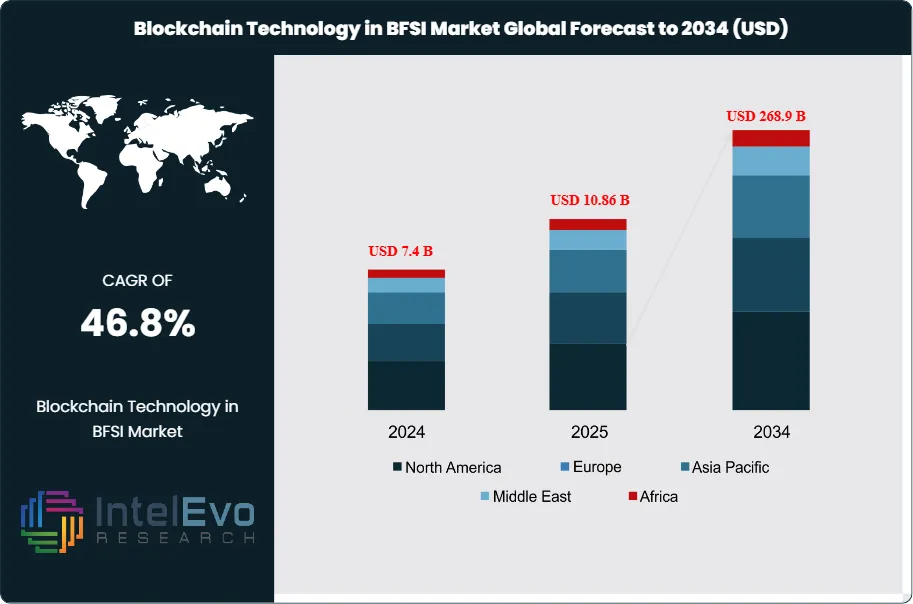
The Blockchain Technology in BFSI Market is projected to grow from USD 7.4 Billion in 2024 to approximately USD 268.9 Billion by 2034, expanding at a CAGR of around 46.8% during 2025–2034. Rising demand for secure, transparent, and real-time financial transactions is accelerating blockchain adoption across banking, insurance, and fintech sectors. AI-integrated smart contracts, decentralized identity systems, and cross-border payment automation are reshaping the next generation of financial infrastructure. As financial institutions rapidly digitize operations, blockchain is emerging as a foundational technology powering trust, resilience, and future-ready BFSI ecosystems. This exponential growth trajectory reflects the transformative role of blockchain in reshaping banking, financial services, and insurance operations, underpinned by its ability to enhance security, transparency, and operational efficiency. What began as the foundational technology for cryptocurrencies has rapidly evolved into a core enabler of applications such as smart contracts, fraud prevention, digital identity management, and cross-border payments.
Historical trends indicate that blockchain adoption in BFSI gained traction as institutions sought to reduce manual errors, strengthen compliance frameworks, and streamline costly, paper-intensive processes. In recent years, the shift has accelerated as banks and insurers recognized blockchain’s potential to reduce infrastructure costs by up to 30%, translating into projected annual savings exceeding USD 27 billion by 2030. Investment banks alone could save nearly USD 12 billion annually through blockchain-enabled efficiencies, according to industry estimates. Furthermore, real-time data visibility and immutable transaction records have positioned blockchain as a cornerstone of future-ready financial ecosystems.
The market’s expansion is fueled by multiple demand- and supply-side dynamics. On the demand side, rising volumes of digital transactions, growing concerns around cyber threats, and the push for faster settlements are compelling institutions to adopt distributed ledger technologies. On the supply side, regulatory environments in key regions are becoming more favorable, with governments and central banks piloting digital currencies and frameworks to facilitate blockchain adoption. However, challenges remain, including interoperability issues, evolving compliance requirements, and the high initial cost of system integration.
Technological innovation is a key accelerator, with blockchain increasingly integrated with artificial intelligence, cloud platforms, and automation to enable scalable solutions. Use cases now extend beyond payments to trade finance, KYC/AML compliance, and insurance claim management. Notably, blockchain has been shown to cut error rates by 50% and reduce average transaction costs by as much as 99%, underscoring its disruptive potential.
Regionally, North America and Europe remain frontrunners, with more than 90% of banks in these regions actively exploring blockchain initiatives. Meanwhile, Asia-Pacific is emerging as a strategic hotspot, driven by rapid fintech adoption, supportive government policies, and rising cross-border trade activity. Global spending on blockchain solutions is projected to surpass USD 15.9 billion in 2024, with sustained growth anticipated as institutional adoption deepens, making blockchain a pivotal investment area in BFSI.
Market Growth: The global blockchain technology in BFSI market was valued at USD 7.4 Billion in 2024 and is projected to reach USD 268.9 Billion by 2034, expanding at a robust CAGR of 46.8% during 2025–2034. Growth is underpinned by the rising demand for secure, transparent, and cost-efficient financial processes.
Blockchain Type: Private Blockchains led the BFSI market in 2024, accounting for over 54.2% of total share, as financial institutions prioritize controlled, permissioned networks to meet compliance and data security requirements.
Deployment Mode: The cloud-based segment captured 56.6% of the market in 2024, reflecting growing reliance on scalable, cost-efficient blockchain platforms integrated with digital banking and fintech ecosystems.
End User: Small and Medium-sized Enterprises (SMEs) represented 57.8% of adoption in 2024, driven by the need to streamline cross-border payments, trade finance, and identity verification with minimal infrastructure investment.
Driver: Cost savings remain a key growth catalyst, with blockchain projected to reduce banking infrastructure expenses by 30%, equating to potential annual savings exceeding USD 27 billion by 2030.
Restraint: High implementation costs and interoperability challenges pose significant barriers, particularly for smaller institutions, slowing large-scale blockchain integration across fragmented financial systems.
Opportunity: Asia-Pacific presents a strong growth opportunity, with rapid fintech adoption and supportive government initiatives projected to drive the region’s BFSI blockchain market at one of the fastest CAGRs globally.
Trend: Adoption momentum is accelerating, with 40% of the world’s top 50 banks planning blockchain integration and nearly 50% of financial firms exploring the technology to enhance transparency and efficiency.
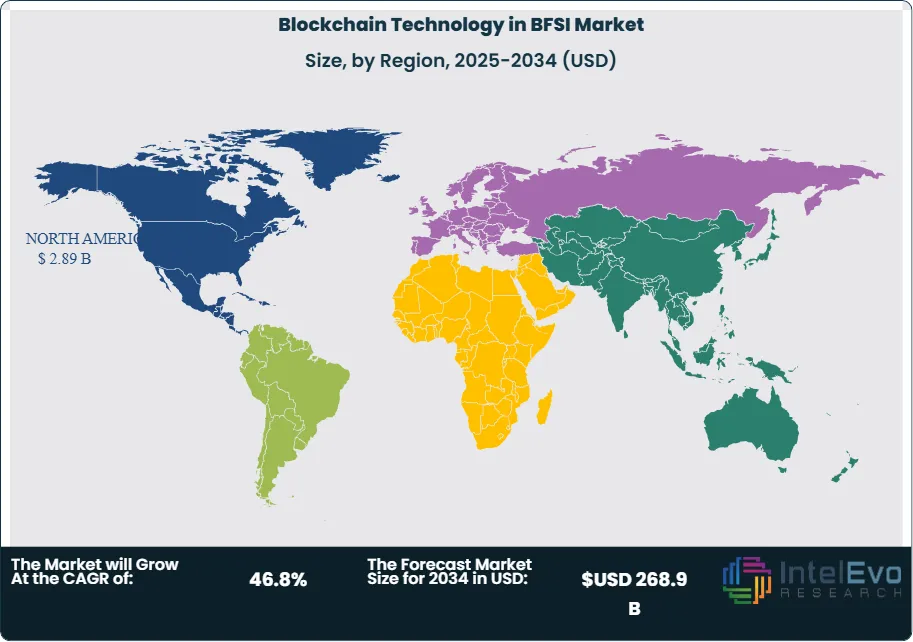
Regional Analysis: North America dominated the market with a 38.5% share in 2024, supported by strong regulatory frameworks and high investment from U.S. and Canadian banks. Meanwhile, Europe shows deep adoption, with nearly 90% of regional banks piloting blockchain solutions, while Asia-Pacific is emerging as the next investment hotspot.
Type Analysis
Private blockchains continue to hold the largest share of adoption in the BFSI blockchain market, maintaining more than half of the market share as of 2024 and projected to strengthen further through 2030. Their dominance is rooted in superior data privacy, permissioned access, and compliance-driven design, which align with the security-sensitive requirements of banking and insurance institutions. Unlike public blockchains, which often face bottlenecks due to broad consensus mechanisms, private networks enable higher transaction throughput and faster processing, a critical factor for real-time settlement and high-frequency financial operations.
In addition to scalability, private blockchains offer enhanced auditability and regulatory alignment, enabling institutions to meet stringent standards across regions such as North America and Europe. Leading banks and insurance providers are leveraging these networks for applications such as cross-border payments, fraud detection, and secure transmission of policyholder data. With financial firms increasingly prioritizing operational efficiency and customer trust, private blockchains are expected to remain the dominant type, even as consortium blockchains gradually gain traction for interbank collaborations.
Deployment Mode Analysis
Cloud-based blockchain deployments have emerged as the preferred mode for BFSI institutions, accounting for more than 57% of the market share in 2024 and anticipated to expand further. Their leadership is attributed to lower upfront infrastructure costs, scalability, and ease of integration with digital banking ecosystems. For small and medium-sized financial enterprises, the cloud model reduces barriers to entry by eliminating the need for extensive IT infrastructure, accelerating blockchain adoption across diverse geographies.
The inherent flexibility of cloud platforms allows financial organizations to integrate blockchain seamlessly with existing applications such as digital wallets, payment gateways, and insurance claim management systems. Additionally, cloud deployment enhances resilience through redundancy and advanced disaster recovery capabilities, ensuring uninterrupted operations in case of security breaches or system failures. As the sector prioritizes agility and innovation, cloud-based solutions are expected to solidify their dominance, while on-premise models remain relevant for institutions requiring maximum control over sensitive data.
Enterprise Size Analysis
Small and medium-sized enterprises (SMEs) are emerging as the most dynamic adopters of blockchain in the BFSI sector, capturing nearly 58% of the market in 2024. Their agility in implementing new technologies, combined with the need to minimize costs and increase transparency, positions blockchain as an ideal fit. SMEs are particularly leveraging blockchain for cross-border payments, identity verification, and trade financing—processes that often involve high fees and slow settlement when conducted through traditional channels.
Blockchain also provides SMEs access to new financing avenues through tokenization and smart contracts, allowing them to tap into innovative funding models outside conventional banking systems. The ability to establish immutable audit trails and ensure secure transactions further enhances customer trust, enabling smaller institutions to compete more effectively against established incumbents. As blockchain solutions become more modular and affordable, SME adoption is projected to accelerate, shaping this segment into a long-term growth driver for the global BFSI blockchain market.
Regional Analysis
North America remains the leading regional market, capturing nearly 39% of global blockchain in BFSI revenue in 2024, underpinned by a concentration of financial hubs, strong venture funding, and progressive regulatory frameworks. The U.S. in particular is spearheading adoption through initiatives by Wall Street banks, fintech startups, and technology leaders, supported by government pilot projects in digital currencies and blockchain-based identity verification. The region’s emphasis on cybersecurity and fraud prevention further drives blockchain adoption across banks, insurers, and asset management firms.
Europe follows closely, with nearly 90% of major banks experimenting with blockchain applications in payments and compliance. The region’s regulatory clarity, particularly under the European Union’s Markets in Crypto-Assets (MiCA) framework, is accelerating integration. Meanwhile, Asia-Pacific is emerging as the fastest-growing regional market, fueled by large-scale fintech adoption in China and India, proactive government programs in Singapore, and the rapid digitization of cross-border trade. Latin America and the Middle East & Africa are in earlier stages of adoption but present high-potential opportunities as blockchain is increasingly leveraged to address financial inclusion and remittance challenges.
Would you like me to expand this into a comparative data table (e.g., Type, Deployment, Enterprise Size, Region with 2024 market shares and 2030 projections) to make it more executive-friendly?
By Type (Public, Private, Consortium), By Deployment Mode (Cloud, On-Premise), By Enterprise Size (SMEs, Large Enterprises)
Research Methodology
Primary Research- 100 Interviews of Stakeholders
Secondary Research
Desk Research
Regional scope
North America (United States, Canada, Mexico)
Latin America (Brazil, Argentina, Columbia)
East Asia And Pacific (China, Japan, South Korea, Australia, Cambodia, Fiji, Indonesia)
Sea And South Asia (India, Singapore, Thailand, Taiwan, Malaysia)
Eastern Europe (Poland, Russia, Czech Republic, Romania)
Western Europe (Germany, U.K., France, Spain, Itlay)
Middle East & Africa (GCC Countries, Egypt, Nigeria, South Africa, Israel)
Competitive Landscape
JP Morgan, Oracle, Accenture, Bitfury Group Limited, Infosys Limited, Amazon Web Services, SAP, Auxesis Group, IBM, Microsoft
Customization Scope
Customization for segments, region/country-level will be provided. Moreover, additional customization can be done based on the requirements.
Pricing and Purchase Options
Avail customized purchase options to meet your exact research needs. We have three licenses to opt for: Single User License, Multi-User License (Up to 5 Users), Corporate Use License (Unlimited User and Printable PDF).
TABLE OF CONTENTS
1. EXECUTIVE SUMMARY
1.1. MARKET SNAPSHOT
1.2. KEY FINDINGS & INSIGHTS
1.3. ANALYST RECOMMENDATIONS
1.4. FUTURE OUTLOOK
2. RESEARCH METHODOLOGY
2.1. MARKET DEFINITION & SCOPE
2.2. RESEARCH OBJECTIVES: PRIMARY & SECONDARY DATA SOURCES
2.3. DATA COLLECTION SOURCES
2.3.1. COVERAGE OF 100+ PRIMARY RESEARCH/CONSULTATION CALLS WITH INDUSTRY STAKEHOLDERS
FIGURE 17 NORTH AMERICA BLOCKCHAIN TECHNOLOGY IN BFSI CURRENT AND FUTURE TYPE ANALYSIS, 2025–2034, (USD MILLION)
FIGURE 18 NORTH AMERICA BLOCKCHAIN TECHNOLOGY IN BFSI CURRENT AND FUTURE END USER ANALYSIS, 2025–2034, (USD MILLION)
FIGURE 19 MARKET SHARE BY COUNTRY
FIGURE 20 LATIN AMERICA BLOCKCHAIN TECHNOLOGY IN BFSI CURRENT AND FUTURE TYPE ANALYSIS, 2025–2034, (USD MILLION)
FIGURE 21 LATIN AMERICA BLOCKCHAIN TECHNOLOGY IN BFSI CURRENT AND FUTURE END USER ANALYSIS, 2025–2034, (USD MILLION)
FIGURE 22 MARKET SHARE BY COUNTRY
FIGURE 23 EASTERN EUROPE BLOCKCHAIN TECHNOLOGY IN BFSI CURRENT AND FUTURE TYPE ANALYSIS, 2025–2034, (USD MILLION)
FIGURE 24 EASTERN EUROPE BLOCKCHAIN TECHNOLOGY IN BFSI CURRENT AND FUTURE END USER ANALYSIS, 2025–2034, (USD MILLION)
FIGURE 25 MARKET SHARE BY COUNTRY
FIGURE 26 WESTERN EUROPE BLOCKCHAIN TECHNOLOGY IN BFSI CURRENT AND FUTURE TYPE ANALYSIS, 2025–2034, (USD MILLION)
FIGURE 27 WESTERN EUROPE BLOCKCHAIN TECHNOLOGY IN BFSI CURRENT AND FUTURE END USER ANALYSIS, 2025–2034, (USD MILLION)
FIGURE 28 MARKET SHARE BY COUNTRY
FIGURE 29 EAST ASIA AND PACIFIC BLOCKCHAIN TECHNOLOGY IN BFSI CURRENT AND FUTURE TYPE ANALYSIS, 2025–2034, (USD MILLION)
FIGURE 30 EAST ASIA AND PACIFIC BLOCKCHAIN TECHNOLOGY IN BFSI CURRENT AND FUTURE END USER ANALYSIS, 2025–2034, (USD MILLION)
FIGURE 31 MARKET SHARE BY COUNTRY
FIGURE 32 SEA AND SOUTH ASIA BLOCKCHAIN TECHNOLOGY IN BFSI CURRENT AND FUTURE TYPE ANALYSIS, 2025–2034, (USD MILLION)
FIGURE 33 SEA AND SOUTH ASIA BLOCKCHAIN TECHNOLOGY IN BFSI CURRENT AND FUTURE END USER ANALYSIS, 2025–2034, (USD MILLION)
FIGURE 34 MARKET SHARE BY COUNTRY
FIGURE 35 MIDDLE EAST AND AFRICA BLOCKCHAIN TECHNOLOGY IN BFSI CURRENT AND FUTURE TYPE ANALYSIS, 2025–2034, (USD MILLION)
FIGURE 36 MIDDLE EAST AND AFRICA BLOCKCHAIN TECHNOLOGY IN BFSI CURRENT AND FUTURE END USER ANALYSIS, 2025–2034, (USD MILLION)
FIGURE 37 NORTH AMERICA BLOCKCHAIN TECHNOLOGY IN BFSI CURRENT AND FUTURE MARKET VOLUME SHARE REGIONAL ANALYSIS, 2025–2034, (USD MILLION)
FIGURE 38 U.S. BLOCKCHAIN TECHNOLOGY IN BFSI CURRENT AND FUTURE TYPE ANALYSIS, 2025–2034, (USD MILLION)
FIGURE 39 U.S. BLOCKCHAIN TECHNOLOGY IN BFSI CURRENT AND FUTURE END USER ANALYSIS, 2025–2034, (USD MILLION)
FIGURE 40 CANADA BLOCKCHAIN TECHNOLOGY IN BFSI CURRENT AND FUTURE TYPE ANALYSIS, 2025–2034, (USD MILLION)
FIGURE 41 CANADA BLOCKCHAIN TECHNOLOGY IN BFSI CURRENT AND FUTURE END USER ANALYSIS, 2025–2034, (USD MILLION)
FIGURE 42 LATIN AMERICA BLOCKCHAIN TECHNOLOGY IN BFSI CURRENT AND FUTURE MARKET VOLUME SHARE REGIONAL ANALYSIS, 2025–2034, (USD MILLION)
FIGURE 43 MEXICO BLOCKCHAIN TECHNOLOGY IN BFSI CURRENT AND FUTURE TYPE ANALYSIS, 2025–2034, (USD MILLION)
FIGURE 44 MEXICO BLOCKCHAIN TECHNOLOGY IN BFSI CURRENT AND FUTURE END USER ANALYSIS, 2025–2034, (USD MILLION)
FIGURE 45 BRAZIL BLOCKCHAIN TECHNOLOGY IN BFSI CURRENT AND FUTURE TYPE ANALYSIS, 2025–2034, (USD MILLION)
FIGURE 46 BRAZIL BLOCKCHAIN TECHNOLOGY IN BFSI CURRENT AND FUTURE END USER ANALYSIS, 2025–2034, (USD MILLION)
FIGURE 47 ARGENTINA BLOCKCHAIN TECHNOLOGY IN BFSI CURRENT AND FUTURE TYPE ANALYSIS, 2025–2034, (USD MILLION)
FIGURE 48 ARGENTINA BLOCKCHAIN TECHNOLOGY IN BFSI CURRENT AND FUTURE END USER ANALYSIS, 2025–2034, (USD MILLION)
FIGURE 49 COLUMBIA BLOCKCHAIN TECHNOLOGY IN BFSI CURRENT AND FUTURE TYPE ANALYSIS, 2025–2034, (USD MILLION)
FIGURE 50 COLUMBIA BLOCKCHAIN TECHNOLOGY IN BFSI CURRENT AND FUTURE END USER ANALYSIS, 2025–2034, (USD MILLION)
FIGURE 51 REST OF LATIN AMERICA BLOCKCHAIN TECHNOLOGY IN BFSI CURRENT AND FUTURE TYPE ANALYSIS, 2025–2034, (USD MILLION)
FIGURE 52 REST OF LATIN AMERICA BLOCKCHAIN TECHNOLOGY IN BFSI CURRENT AND FUTURE END USER ANALYSIS, 2025–2034, (USD MILLION)
FIGURE 53 EASTERN EUROPE BLOCKCHAIN TECHNOLOGY IN BFSI CURRENT AND FUTURE MARKET VOLUME SHARE REGIONAL ANALYSIS, 2025–2034, (USD MILLION)
FIGURE 54 POLAND BLOCKCHAIN TECHNOLOGY IN BFSI CURRENT AND FUTURE TYPE ANALYSIS, 2025–2034, (USD MILLION)
FIGURE 55 POLAND BLOCKCHAIN TECHNOLOGY IN BFSI CURRENT AND FUTURE END USER ANALYSIS, 2025–2034, (USD MILLION)
FIGURE 56 RUSSIA BLOCKCHAIN TECHNOLOGY IN BFSI CURRENT AND FUTURE TYPE ANALYSIS, 2025–2034, (USD MILLION)
FIGURE 57 RUSSIA BLOCKCHAIN TECHNOLOGY IN BFSI CURRENT AND FUTURE END USER ANALYSIS, 2025–2034, (USD MILLION)
FIGURE 58 CZECH REPUBLIC BLOCKCHAIN TECHNOLOGY IN BFSI CURRENT AND FUTURE TYPE ANALYSIS, 2025–2034, (USD MILLION)
FIGURE 59 CZECH REPUBLIC BLOCKCHAIN TECHNOLOGY IN BFSI CURRENT AND FUTURE END USER ANALYSIS, 2025–2034, (USD MILLION)
FIGURE 60 ROMANIA BLOCKCHAIN TECHNOLOGY IN BFSI CURRENT AND FUTURE TYPE ANALYSIS, 2025–2034, (USD MILLION)
FIGURE 61 ROMANIA BLOCKCHAIN TECHNOLOGY IN BFSI CURRENT AND FUTURE END USER ANALYSIS, 2025–2034, (USD MILLION)
FIGURE 62 REST OF EASTERN EUROPE BLOCKCHAIN TECHNOLOGY IN BFSI CURRENT AND FUTURE TYPE ANALYSIS, 2025–2034, (USD MILLION)
FIGURE 63 REST OF EASTERN EUROPE BLOCKCHAIN TECHNOLOGY IN BFSI CURRENT AND FUTURE END USER ANALYSIS, 2025–2034, (USD MILLION)
FIGURE 64 WESTERN EUROPE BLOCKCHAIN TECHNOLOGY IN BFSI CURRENT AND FUTURE MARKET VOLUME SHARE REGIONAL ANALYSIS, 2025–2034, (USD MILLION)
FIGURE 65 GERMANY BLOCKCHAIN TECHNOLOGY IN BFSI CURRENT AND FUTURE TYPE ANALYSIS, 2025–2034, (USD MILLION)
FIGURE 66 GERMANY BLOCKCHAIN TECHNOLOGY IN BFSI CURRENT AND FUTURE END USER ANALYSIS, 2025–2034, (USD MILLION)
FIGURE 67 FRANCE BLOCKCHAIN TECHNOLOGY IN BFSI CURRENT AND FUTURE TYPE ANALYSIS, 2025–2034, (USD MILLION)
FIGURE 68 FRANCE BLOCKCHAIN TECHNOLOGY IN BFSI CURRENT AND FUTURE END USER ANALYSIS, 2025–2034, (USD MILLION)
FIGURE 69 UK BLOCKCHAIN TECHNOLOGY IN BFSI CURRENT AND FUTURE TYPE ANALYSIS, 2025–2034, (USD MILLION)
FIGURE 70 UK BLOCKCHAIN TECHNOLOGY IN BFSI CURRENT AND FUTURE END USER ANALYSIS, 2025–2034, (USD MILLION)
FIGURE 71 SPAIN BLOCKCHAIN TECHNOLOGY IN BFSI CURRENT AND FUTURE TYPE ANALYSIS, 2025–2034, (USD MILLION)
FIGURE 72 SPAIN BLOCKCHAIN TECHNOLOGY IN BFSI CURRENT AND FUTURE END USER ANALYSIS, 2025–2034, (USD MILLION)
FIGURE 73 ITALY BLOCKCHAIN TECHNOLOGY IN BFSI CURRENT AND FUTURE TYPE ANALYSIS, 2025–2034, (USD MILLION)
FIGURE 74 ITALY BLOCKCHAIN TECHNOLOGY IN BFSI CURRENT AND FUTURE END USER ANALYSIS, 2025–2034, (USD MILLION)
FIGURE 75 REST OF WESTERN EUROPE BLOCKCHAIN TECHNOLOGY IN BFSI CURRENT AND FUTURE TYPE ANALYSIS, 2025–2034, (USD MILLION)
FIGURE 76 REST OF WESTERN EUROPE BLOCKCHAIN TECHNOLOGY IN BFSI CURRENT AND FUTURE END USER ANALYSIS, 2025–2034, (USD MILLION)
FIGURE 77 EAST ASIA AND PACIFIC BLOCKCHAIN TECHNOLOGY IN BFSI CURRENT AND FUTURE MARKET VOLUME SHARE REGIONAL ANALYSIS, 2025–2034, (USD MILLION)
FIGURE 78 CHINA BLOCKCHAIN TECHNOLOGY IN BFSI CURRENT AND FUTURE TYPE ANALYSIS, 2025–2034, (USD MILLION)
FIGURE 79 CHINA BLOCKCHAIN TECHNOLOGY IN BFSI CURRENT AND FUTURE END USER ANALYSIS, 2025–2034, (USD MILLION)
FIGURE 80 JAPAN BLOCKCHAIN TECHNOLOGY IN BFSI CURRENT AND FUTURE TYPE ANALYSIS, 2025–2034, (USD MILLION)
FIGURE 81 JAPAN BLOCKCHAIN TECHNOLOGY IN BFSI CURRENT AND FUTURE END USER ANALYSIS, 2025–2034, (USD MILLION)
FIGURE 82 AUSTRALIA BLOCKCHAIN TECHNOLOGY IN BFSI CURRENT AND FUTURE TYPE ANALYSIS, 2025–2034, (USD MILLION)
FIGURE 83 AUSTRALIA BLOCKCHAIN TECHNOLOGY IN BFSI CURRENT AND FUTURE END USER ANALYSIS, 2025–2034, (USD MILLION)
FIGURE 84 CAMBODIA BLOCKCHAIN TECHNOLOGY IN BFSI CURRENT AND FUTURE TYPE ANALYSIS, 2025–2034, (USD MILLION)
FIGURE 85 CAMBODIA BLOCKCHAIN TECHNOLOGY IN BFSI CURRENT AND FUTURE END USER ANALYSIS, 2025–2034, (USD MILLION)
FIGURE 86 FIJI BLOCKCHAIN TECHNOLOGY IN BFSI CURRENT AND FUTURE TYPE ANALYSIS, 2025–2034, (USD MILLION)
FIGURE 87 FIJI BLOCKCHAIN TECHNOLOGY IN BFSI CURRENT AND FUTURE END USER ANALYSIS, 2025–2034, (USD MILLION)
FIGURE 88 INDONESIA BLOCKCHAIN TECHNOLOGY IN BFSI CURRENT AND FUTURE TYPE ANALYSIS, 2025–2034, (USD MILLION)
FIGURE 89 INDONESIA BLOCKCHAIN TECHNOLOGY IN BFSI CURRENT AND FUTURE END USER ANALYSIS, 2025–2034, (USD MILLION)
FIGURE 90 SOUTH KOREA BLOCKCHAIN TECHNOLOGY IN BFSI CURRENT AND FUTURE TYPE ANALYSIS, 2025–2034, (USD MILLION)
FIGURE 91 SOUTH KOREA BLOCKCHAIN TECHNOLOGY IN BFSI CURRENT AND FUTURE END USER ANALYSIS, 2025–2034, (USD MILLION)
FIGURE 92 REST OF EAST ASIA AND PACIFIC BLOCKCHAIN TECHNOLOGY IN BFSI CURRENT AND FUTURE TYPE ANALYSIS, 2025–2034, (USD MILLION)
FIGURE 93 REST OF EAST ASIA AND PACIFIC BLOCKCHAIN TECHNOLOGY IN BFSI CURRENT AND FUTURE END USER ANALYSIS, 2025–2034, (USD MILLION)
FIGURE 94 SEA AND SOUTH ASIA BLOCKCHAIN TECHNOLOGY IN BFSI CURRENT AND FUTURE MARKET VOLUME SHARE REGIONAL ANALYSIS, 2025–2034, (USD MILLION)
FIGURE 95 BANGLADESH BLOCKCHAIN TECHNOLOGY IN BFSI CURRENT AND FUTURE TYPE ANALYSIS, 2025–2034, (USD MILLION)
FIGURE 96 BANGLADESH BLOCKCHAIN TECHNOLOGY IN BFSI CURRENT AND FUTURE END USER ANALYSIS, 2025–2034, (USD MILLION)
FIGURE 97 NEW ZEALAND BLOCKCHAIN TECHNOLOGY IN BFSI CURRENT AND FUTURE TYPE ANALYSIS, 2025–2034, (USD MILLION)
FIGURE 98 NEW ZEALAND BLOCKCHAIN TECHNOLOGY IN BFSI CURRENT AND FUTURE END USER ANALYSIS, 2025–2034, (USD MILLION)
FIGURE 99 INDIA BLOCKCHAIN TECHNOLOGY IN BFSI CURRENT AND FUTURE TYPE ANALYSIS, 2025–2034, (USD MILLION)
FIGURE 100 INDIA BLOCKCHAIN TECHNOLOGY IN BFSI CURRENT AND FUTURE END USER ANALYSIS, 2025–2034, (USD MILLION)
FIGURE 101 SINGAPORE BLOCKCHAIN TECHNOLOGY IN BFSI CURRENT AND FUTURE TYPE ANALYSIS, 2025–2034, (USD MILLION)
FIGURE 102 SINGAPORE BLOCKCHAIN TECHNOLOGY IN BFSI CURRENT AND FUTURE END USER ANALYSIS, 2025–2034, (USD MILLION)
FIGURE 103 THAILAND BLOCKCHAIN TECHNOLOGY IN BFSI CURRENT AND FUTURE TYPE ANALYSIS, 2025–2034, (USD MILLION)
FIGURE 104 THAILAND BLOCKCHAIN TECHNOLOGY IN BFSI CURRENT AND FUTURE END USER ANALYSIS, 2025–2034, (USD MILLION)
FIGURE 105 TAIWAN BLOCKCHAIN TECHNOLOGY IN BFSI CURRENT AND FUTURE TYPE ANALYSIS, 2025–2034, (USD MILLION)
FIGURE 106 TAIWAN BLOCKCHAIN TECHNOLOGY IN BFSI CURRENT AND FUTURE END USER ANALYSIS, 2025–2034, (USD MILLION)
FIGURE 107 MALAYSIA BLOCKCHAIN TECHNOLOGY IN BFSI CURRENT AND FUTURE TYPE ANALYSIS, 2025–2034, (USD MILLION)
FIGURE 108 MALAYSIA BLOCKCHAIN TECHNOLOGY IN BFSI CURRENT AND FUTURE END USER ANALYSIS, 2025–2034, (USD MILLION)
FIGURE 109 REST OF SEA AND SOUTH ASIA BLOCKCHAIN TECHNOLOGY IN BFSI CURRENT AND FUTURE TYPE ANALYSIS, 2025–2034, (USD MILLION)
FIGURE 110 REST OF SEA AND SOUTH ASIA BLOCKCHAIN TECHNOLOGY IN BFSI CURRENT AND FUTURE END USER ANALYSIS, 2025–2034, (USD MILLION)
FIGURE 111 MIDDLE EAST AND AFRICA BLOCKCHAIN TECHNOLOGY IN BFSI CURRENT AND FUTURE MARKET VOLUME SHARE REGIONAL ANALYSIS, 2025–2034, (USD MILLION)
FIGURE 112 GCC COUNTRIES BLOCKCHAIN TECHNOLOGY IN BFSI CURRENT AND FUTURE TYPE ANALYSIS, 2025–2034, (USD MILLION)
FIGURE 113 GCC COUNTRIES BLOCKCHAIN TECHNOLOGY IN BFSI CURRENT AND FUTURE END USER ANALYSIS, 2025–2034, (USD MILLION)
FIGURE 114 SAUDI ARABIA BLOCKCHAIN TECHNOLOGY IN BFSI CURRENT AND FUTURE TYPE ANALYSIS, 2025–2034, (USD MILLION)
FIGURE 115 SAUDI ARABIA BLOCKCHAIN TECHNOLOGY IN BFSI CURRENT AND FUTURE END USER ANALYSIS, 2025–2034, (USD MILLION)
FIGURE 116 UAE BLOCKCHAIN TECHNOLOGY IN BFSI CURRENT AND FUTURE TYPE ANALYSIS, 2025–2034, (USD MILLION)
FIGURE 117 UAE BLOCKCHAIN TECHNOLOGY IN BFSI CURRENT AND FUTURE END USER ANALYSIS, 2025–2034, (USD MILLION)
FIGURE 118 BAHRAIN BLOCKCHAIN TECHNOLOGY IN BFSI CURRENT AND FUTURE TYPE ANALYSIS, 2025–2034, (USD MILLION)
FIGURE 119 BAHRAIN BLOCKCHAIN TECHNOLOGY IN BFSI CURRENT AND FUTURE END USER ANALYSIS, 2025–2034, (USD MILLION)
FIGURE 120 KUWAIT BLOCKCHAIN TECHNOLOGY IN BFSI CURRENT AND FUTURE TYPE ANALYSIS, 2025–2034, (USD MILLION)
FIGURE 121 KUWAIT BLOCKCHAIN TECHNOLOGY IN BFSI CURRENT AND FUTURE END USER ANALYSIS, 2025–2034, (USD MILLION)
FIGURE 122 OMAN BLOCKCHAIN TECHNOLOGY IN BFSI CURRENT AND FUTURE TYPE ANALYSIS, 2025–2034, (USD MILLION)
FIGURE 123 OMAN BLOCKCHAIN TECHNOLOGY IN BFSI CURRENT AND FUTURE END USER ANALYSIS, 2025–2034, (USD MILLION)
FIGURE 124 QATAR BLOCKCHAIN TECHNOLOGY IN BFSI CURRENT AND FUTURE TYPE ANALYSIS, 2025–2034, (USD MILLION)
FIGURE 125 QATAR BLOCKCHAIN TECHNOLOGY IN BFSI CURRENT AND FUTURE END USER ANALYSIS, 2025–2034, (USD MILLION)
FIGURE 126 EGYPT BLOCKCHAIN TECHNOLOGY IN BFSI CURRENT AND FUTURE TYPE ANALYSIS, 2025–2034, (USD MILLION)
FIGURE 127 EGYPT BLOCKCHAIN TECHNOLOGY IN BFSI CURRENT AND FUTURE END USER ANALYSIS, 2025–2034, (USD MILLION)
FIGURE 128 NIGERIA BLOCKCHAIN TECHNOLOGY IN BFSI CURRENT AND FUTURE TYPE ANALYSIS, 2025–2034, (USD MILLION)
FIGURE 129 NIGERIA BLOCKCHAIN TECHNOLOGY IN BFSI CURRENT AND FUTURE END USER ANALYSIS, 2025–2034, (USD MILLION)
FIGURE 130 SOUTH AFRICA BLOCKCHAIN TECHNOLOGY IN BFSI CURRENT AND FUTURE TYPE ANALYSIS, 2025–2034, (USD MILLION)
FIGURE 131 SOUTH AFRICA BLOCKCHAIN TECHNOLOGY IN BFSI CURRENT AND FUTURE END USER ANALYSIS, 2025–2034, (USD MILLION)
FIGURE 132 ISRAEL BLOCKCHAIN TECHNOLOGY IN BFSI CURRENT AND FUTURE TYPE ANALYSIS, 2025–2034, (USD MILLION)
FIGURE 133 ISRAEL BLOCKCHAIN TECHNOLOGY IN BFSI CURRENT AND FUTURE END USER ANALYSIS, 2025–2034, (USD MILLION)
FIGURE 134 REST OF MEA BLOCKCHAIN TECHNOLOGY IN BFSI CURRENT AND FUTURE TYPE ANALYSIS, 2025–2034, (USD MILLION)
FIGURE 135 REST OF MEA BLOCKCHAIN TECHNOLOGY IN BFSI CURRENT AND FUTURE END USER ANALYSIS, 2025–2034, (USD MILLION)
FIGURE 136 U. S. MARKET SHARE ANALYSIS BY TYPE (2024)
FIGURE 137 U. S. MARKET SHARE ANALYSIS BY END USER (2024)
FIGURE 138 CANADA MARKET SHARE ANALYSIS BY TYPE (2024)
FIGURE 139 CANADA MARKET SHARE ANALYSIS BY END USER (2024)
FIGURE 140 MEXICO MARKET SHARE ANALYSIS BY TYPE (2024)
FIGURE 141 MEXICO MARKET SHARE ANALYSIS BY END USER (2024)
FIGURE 142 CHINA MARKET SHARE ANALYSIS BY TYPE (2024)
FIGURE 143 CHINA MARKET SHARE ANALYSIS BY END USER (2024)
FIGURE 144 JAPAN MARKET SHARE ANALYSIS BY TYPE (2024)
FIGURE 145 JAPAN MARKET SHARE ANALYSIS BY END USER (2024)
FIGURE 146 INDIA MARKET SHARE ANALYSIS BY TYPE (2024)
FIGURE 147 INDIA MARKET SHARE ANALYSIS BY END USER (2024)
FIGURE 148 SOUTH KOREA MARKET SHARE ANALYSIS BY TYPE (2024)
FIGURE 149 SOUTH KOREA MARKET SHARE ANALYSIS BY END USER (2024)
FIGURE 150 SAUDI ARABIA MARKET SHARE ANALYSIS BY TYPE (2024)
FIGURE 151 SAUDI ARABIA MARKET SHARE ANALYSIS BY END USER (2024)
FIGURE 152 UAE MARKET SHARE ANALYSIS BY TYPE (2024)
FIGURE 153 UAE MARKET SHARE ANALYSIS BY END USER (2024)
FIGURE 154 EGYPT MARKET SHARE ANALYSIS BY TYPE (2024)
FIGURE 155 EGYPT MARKET SHARE ANALYSIS BY END USER (2024)
FIGURE 156 NIGERIA MARKET SHARE ANALYSIS BY TYPE (2024)
FIGURE 157 NIGERIA MARKET SHARE ANALYSIS BY END USER (2024)
FIGURE 158 SOUTH AFRICA MARKET SHARE ANALYSIS BY TYPE (2024)
FIGURE 159 SOUTH AFRICA MARKET SHARE ANALYSIS BY END USER (2024)
FIGURE 160 GERMANY MARKET SHARE ANALYSIS BY TYPE (2024)
FIGURE 161 GERMANY MARKET SHARE ANALYSIS BY END USER (2024)
FIGURE 162 FRANCE MARKET SHARE ANALYSIS BY TYPE (2024)
FIGURE 163 FRANCE MARKET SHARE ANALYSIS BY END USER (2024)
FIGURE 164 UK MARKET SHARE ANALYSIS BY TYPE (2024)
FIGURE 165 UK MARKET SHARE ANALYSIS BY END USER (2024)
FIGURE 166 SPAIN MARKET SHARE ANALYSIS BY TYPE (2024)
FIGURE 167 SPAIN MARKET SHARE ANALYSIS BY END USER (2024)
FIGURE 168 ITALY MARKET SHARE ANALYSIS BY TYPE (2024)
FIGURE 169 ITALY MARKET SHARE ANALYSIS BY END USER (2024)
FIGURE 170 BRAZIL MARKET SHARE ANALYSIS BY TYPE (2024)
FIGURE 171 BRAZIL MARKET SHARE ANALYSIS BY END USER (2024)
FIGURE 172 ARGENTINA MARKET SHARE ANALYSIS BY TYPE (2024)
FIGURE 173 ARGENTINA MARKET SHARE ANALYSIS BY END USER (2024)
FIGURE 174 COLUMBIA MARKET SHARE ANALYSIS BY TYPE (2024)
FIGURE 175 COLUMBIA MARKET SHARE ANALYSIS BY END USER (2024)
FIGURE 176 GLOBAL BLOCKCHAIN TECHNOLOGY IN BFSI CURRENT AND FUTURE MARKET KEY COUNTRY LEVEL ANALYSIS, 2024–2034, (USD MILLION)
FIGURE 177 FINANCIAL OVERVIEW:
Key Player Analysis
IBM: IBM holds a leadership position in the blockchain technology in BFSI market, leveraging its IBM Blockchain Platform, built on Hyperledger Fabric, to drive enterprise-grade adoption. The company has been a pioneer in developing permissioned blockchain networks tailored to financial institutions, offering solutions for trade finance, cross-border payments, and regulatory compliance. In 2025, IBM continues to expand its footprint through collaborations with global banks and insurers, focusing on integrating blockchain with artificial intelligence (Watson AI) and quantum computing capabilities to enhance fraud detection and risk management. With a strong presence in North America and Europe, IBM differentiates itself through deep regulatory expertise and the ability to deliver scalable, secure, and hybrid cloud solutions. This positions the company as a trusted partner for financial institutions navigating both technological and compliance complexities.
Microsoft: Microsoft is positioned as a challenger and innovator in the BFSI blockchain market, with Azure Blockchain Services and Blockchain-as-a-Service (BaaS) offerings forming the backbone of its strategy. Its integration of blockchain with the broader Azure cloud ecosystem provides seamless scalability, analytics, and AI-powered insights, giving BFSI clients the ability to build secure, automated workflows. Microsoft has pursued strategic partnerships with fintech firms and banking consortia, enabling faster adoption of decentralized applications in payments and KYC/AML compliance. In 2025, the company is also embedding sustainability features into its blockchain platforms, supporting ESG reporting and green finance initiatives, a differentiator in markets where regulatory focus on climate disclosures is intensifying.
Amazon Web Services (AWS): AWS remains a dominant force in the blockchain-in-BFSI space, recognized for its strong cloud infrastructure and managed blockchain services. Its Amazon Managed Blockchain platform supports both Hyperledger Fabric and Ethereum, enabling banks and insurers to build flexible, interoperable solutions. With financial institutions increasingly adopting cloud-first strategies, AWS benefits from its global scale and robust security architecture, capturing a significant share of blockchain deployments in 2025. The company has emphasized integration with AI/ML services, enhancing fraud prevention and real-time transaction monitoring. AWS’s differentiator lies in its ability to deliver cost-effective, highly scalable blockchain environments, making it the preferred partner for both large banks and agile fintech players seeking rapid market entry.
Accenture: Accenture has established itself as a key innovator and systems integrator in the blockchain for BFSI market, bridging the gap between emerging blockchain technologies and large-scale institutional adoption. Known for its consulting-led approach, the firm partners with major financial institutions, central banks, and regulators to design and implement blockchain frameworks across payments, trade finance, and digital identity solutions. In 2025, Accenture is accelerating investments in blockchain-driven RegTech and cross-border payment systems, aligning with rising compliance and efficiency demands. Its differentiator lies in end-to-end delivery capabilities, combining advisory, technology integration, and managed services. With a strong global presence and expertise across multi-jurisdictional compliance, Accenture continues to be a strategic enabler for financial institutions seeking to modernize their operations with blockchain at scale.
Market Key Players
JP Morgan
Oracle
Accenture
Bitfury Group Limited
Infosys Limited
Amazon Web Services
SAP
Auxesis Group
IBM
Microsoft
Drivers
Key Market Drivers Accelerating Blockchain Adoption in BFSI
Growing demand for secure, transparent, and real-time financial transactions is a major driver of blockchain adoption in the BFSI industry. Banks and insurers are increasingly using blockchain to automate settlements, eliminate manual errors, and reduce operational costs by up to 30%. The integration of AI-enabled smart contracts and decentralized identity systems further accelerates digital transformation across global financial operations.
Blockchain’s ability to create immutable records and streamline compliance workflows strengthens its relevance for fraud prevention, KYC/AML verification, and cross-border payments. As cyber threats rise and digital banking expands, financial institutions are adopting blockchain to enhance trust, efficiency, and resilience. This shift positions distributed ledger technology as a foundational pillar of next-generation BFSI infrastructure.
Restraints
Major Restraints Hindering Large-Scale Blockchain Integration
Despite rapid growth, high implementation costs and system integration challenges remain major barriers to blockchain adoption. Financial institutions must invest heavily in new infrastructure, cybersecurity upgrades, and talent capable of managing distributed ledger systems—an obstacle that slows adoption for smaller banks and insurers with limited IT budgets.
Interoperability remains an additional bottleneck, as blockchain networks often struggle to communicate seamlessly across legacy systems and cross-jurisdictional platforms. Evolving regulatory requirements, such as GDPR and KYC/AML mandates, further complicate deployment. These constraints create uncertainty and increase project timelines, hindering the pace of large-scale blockchain integration across global BFSI ecosystems.
Opportunities
Emerging Opportunities Reshaping the Future of Blockchain in BFSI
The Asia-Pacific region presents significant growth opportunities as rapid fintech adoption, government-led digital currency pilots, and expanding cross-border trade drive blockchain demand. Emerging markets such as India, China, and Southeast Asia are accelerating deployment of blockchain for digital payments, identity management, and trade finance, creating vast potential for technology providers and BFSI innovators.
Blockchain is also unlocking new revenue streams through tokenization of assets, automated claims processing, and blockchain-as-a-service (BaaS) solutions. As institutions seek cost efficiency and regulatory transparency, demand for scalable, cloud-based blockchain platforms is rising sharply. Vendors offering interoperable, AI-integrated solutions stand to capture substantial market share as adoption broadens across SMEs and multinational banks.
A defining trend is the convergence of blockchain with AI, cloud computing, and automation, enabling highly scalable financial ecosystems. Over 40% of the world’s top banks are piloting blockchain for smart contracts, instant settlements, and decentralized identity verification, reshaping operational workflows and strengthening security across BFSI sectors.
Another major trend is the rapid shift toward consortium and hybrid blockchain networks, driven by the need for shared infrastructure and regulatory alignment. Financial institutions are increasingly collaborating on interbank blockchain platforms to streamline KYC, improve liquidity management, and reduce transaction costs by up to 99%. This collaborative momentum is accelerating blockchain’s transition from experimentation to enterprise-wide deployment.
Recent Developments
Dec 2024 – JP Morgan: JP Morgan expanded its Onyx blockchain platform to include a real-time settlement service for tokenized bonds, processing transactions valued at over USD 1.2 billion in its pilot phase. This move strengthens the bank’s leadership in institutional blockchain adoption and sets the stage for broader tokenized asset markets.
Feb 2025 – Accenture: Accenture announced a strategic partnership with the European Central Bank to co-develop blockchain-based frameworks for digital euro payment trials, expected to involve over 25 major banks across Europe. This initiative positions Accenture as a key systems integrator in the evolution of central bank digital currencies (CBDCs).
Apr 2025 – Microsoft: Microsoft launched an upgraded version of Azure Blockchain Services with embedded AI-driven fraud detection and regulatory reporting tools, targeting BFSI clients in North America and Asia-Pacific. The update enhances Microsoft’s competitiveness by integrating compliance automation into its cloud blockchain ecosystem.
Jul 2025 – Infosys Limited: Infosys rolled out a blockchain-powered cross-border remittance platform across Southeast Asia in partnership with three regional banks, with projected transaction volumes exceeding USD 5 billion annually. This development reinforces Infosys’ regional presence and accelerates blockchain adoption in emerging markets.
Sep 2025 – IBM: IBM unveiled a new hybrid blockchain-cloud solution tailored for insurance claim automation, enabling up to 40% faster settlement times in pilot deployments with U.S. insurers. The launch underscores IBM’s strategy of combining blockchain with AI and cloud to solidify its leadership in BFSI technology modernization.
