

- Home
- Industries
 Aerospace And Defence
 Agriculture
 Automotive And Transportation
 Banking And Finance
 Business
 Chemicals And Materials
 Consumer And Retail
 Electronics And Semiconductors
 Food And Beverages
 Machinery & Equipments
 Manufacturing And Construction
 Medical Devices
 Others
 Pharmaceuticals And Healthcare
 Power And Energy
 Sports
 Technology
- Services
- News Room
- About us
- Contact Us
-
Global Browser Isolation Technology Market Size, Share | CAGR 28.4%
Global Browser Isolation Technology Market Size, Share, Analysis By Type (Remote Browser Isolation, Client-Side Browser Isolation, Hybrid Browser Isolation, Document Isolation & Content Disarm and Reconstruction, Web Application Isolation), By Deployment Mode (Cloud-Based, On-Premise, Hybrid), By Enterprise Size (Large Enterprises, SMEs), By End-User (BFSI, Government & Defense, Healthcare, IT & Telecommunications, Retail & E-Commerce) Industry Trends, Cybersecurity Innovations & Forecast 2026-2034

Report Overview
| Market Size (2025) | Forecast Value (2034) | CAGR (2026-2034) | Largest Region (2025) |
|---|---|---|---|
| USD 1.04 Billion | USD 9.85 Billion | 28.4% | North America, 41.5% |
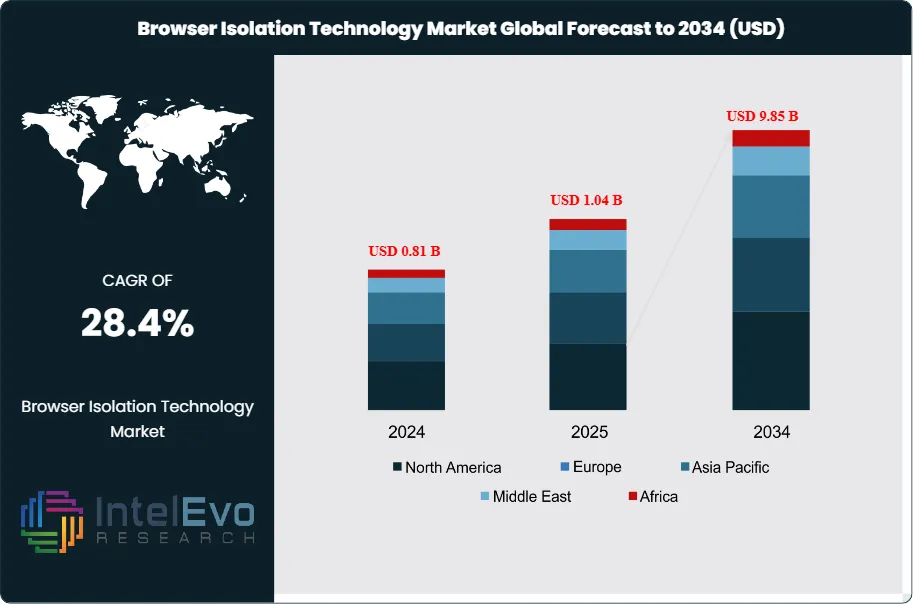
The Browser Isolation Technology Market was valued at approximately USD 0.81 Billion in 2024 and reached USD 1.04 Billion in 2025. The market is projected to grow to USD 9.85 Billion by 2034, expanding at a CAGR of 28.4% during the forecast period from 2026 to 2034. This represents an absolute dollar opportunity of USD 8.81 Billion over the analysis period. The Browser Isolation Technology Market covers the commercial space for cybersecurity platforms that execute web browsing sessions in a remote or isolated environment separate from the user endpoint, including remote browser isolation (RBI), local browser isolation, and secure enterprise browsers that replace or augment consumer-grade browsers with enterprise-managed security controls.
Get More Information about this report -
Request Free Sample ReportDemand growth is anchored in three structural shifts. First, browser-based phishing attacks increased 140% in 2024 compared to the previous year per Menlo Security's State of Browser Security Report, and zero-hour phishing attacks rose 130% year-over-year. Second, Forrester research cited by Menlo Security found workers spend over 75% of their workday inside web browsers, elevating browser attack surface above email and endpoint in enterprise risk scoring. Third, Gartner projects that by 2030 enterprise browsers will be the core platform for delivering workforce productivity and security software on managed and unmanaged devices for seamless hybrid work experience.
Capital deployment into the category accelerated sharply through 2024-2025. Palo Alto Networks completed the acquisition of Talon Cyber Security for approximately USD 625 million on 28 December 2023, integrating Talon Enterprise Browser with Prisma SASE. Menlo Security exceeded USD 100 million in annual recurring revenue (ARR) in October 2024 with USD 350 million in total contract value, USD 260 million in total funding, and 50% growth over 24 months. Island raised USD 250 million Series E on 26 March 2025 at a USD 4.8 billion valuation led by Coatue Management, bringing total external funding to approximately USD 730 million across the company's roughly five years since 2020 founding.
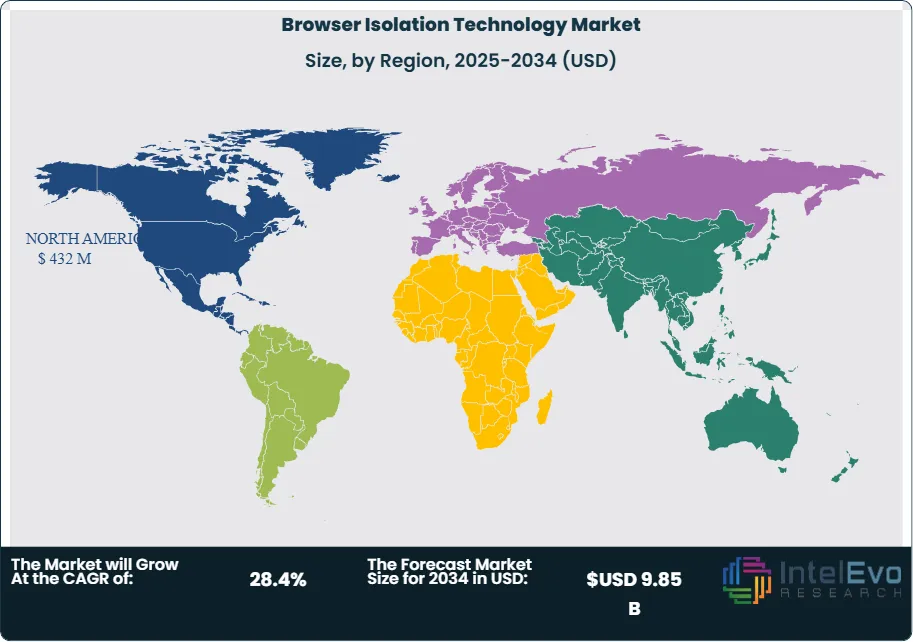
North America held 41.5% of global Browser Isolation Technology Market revenue in 2025, equivalent to USD 432 Million, anchored by Palo Alto Networks, Menlo Security, Island, Zscaler, and Cloudflare. Europe captured approximately 27% share, driven by GDPR enforcement, the EU Network and Information Security Directive 2 (NIS2) effective 17 October 2024, and the UK Cyber Security and Resilience Bill introduced in 2024-2025. Asia Pacific held 20% share in 2025 and is projected to grow fastest at approximately 32% CAGR through 2034, with Singapore, Japan, South Korea, and Australia leading adoption.
Forward visibility through 2034 rests on three catalysts. First, zero-trust architecture mandates including U.S. Executive Order 14028 and OMB Memorandum M-22-09 drive federal and regulated-industry browser isolation procurement ahead of fiscal year 2026 deadlines. Second, integration with Secure Access Service Edge (SASE) and Security Service Edge (SSE) platforms from Palo Alto Networks Prisma SASE, Zscaler Zero Trust Exchange, Cloudflare One, and Cisco Secure Access consolidates the buying process. Third, AI agent security and prompt-injection defense are emerging as primary use cases for enterprise browsers, with Menlo Security positioning its platform as architectural immunity for both human users and AI agents operating within web sessions. These forces together support the 28.4% forecast CAGR in the Browser Isolation Technology Market through 2034.
Market Definition & Scope
The Browser Isolation Technology Market is defined as the commercial space for cybersecurity platforms that execute web content in an isolated environment, preventing malicious code from reaching the user endpoint. The market encompasses three technical approaches: remote browser isolation (RBI) using Document Object Model (DOM) reconstruction, pixel pushing, and network vector rendering delivered from cloud-hosted virtual browsers; local browser isolation using sandbox and virtualization at the endpoint; and secure enterprise browsers based on modified Chromium or Edge that integrate security, DLP, and application access controls.
This analysis includes standalone RBI platform licenses, enterprise browser subscriptions, integrated RBI modules within SASE and SSE platforms, consulting and implementation services, and managed browser security services. The scope explicitly excludes consumer-grade browsers (Chrome, Safari, Edge, Firefox) without enterprise security overlays, general-purpose web application firewalls (WAF), CASB (Cloud Access Security Broker) services without browser-level execution isolation, and generic endpoint detection and response (EDR) without browser-specific modules. The parent browser security software market reached approximately USD 2.1 Billion in 2024 per Market Growth Reports, with the Browser Isolation Technology sub-segment representing approximately 50% of the parent category in 2025.

Key Takeaways
- Market Growth: The Browser Isolation Technology Market grew from USD 1.04 Billion in 2025 to a projected USD 9.85 Billion in 2034, expanding at a 28.4% CAGR.
- Segment Dominance (By Type): Cloud-based remote browser isolation held 63% revenue share in 2025, driven by DOM reconstruction approaches from Menlo Security, Cloudflare, Zscaler, and Palo Alto Networks Prisma SASE.
- Segment Dominance (By Enterprise Size): Large enterprises captured 67.7% revenue share in 2024 per Market Growth Reports, anchored by Fortune 500 and government deployments across financial services, healthcare, and defense.
- Driver: Browser-based phishing attacks increased 140% in 2024 versus 2023, and zero-hour phishing attacks rose 130% year-over-year per Menlo Security 2024 State of Browser Security Report.
- Restraint: Session latency above 120 milliseconds impacts productivity perception in 27% of users, with ~50% of users abandoning pages if initial load exceeds 3 seconds per industry benchmarks.
- Opportunity: AI agent and prompt-injection security represents the fastest-growing use case, with Menlo Security positioning architectural immunity for AI agents operating within browser sessions in 2025-2026.
- Trend: 58% of enterprises adopted Zero Trust browser enforcement through 2025, creating isolation demand growth in 61% of regulated sectors per Market Growth Reports.
- Regional: North America held 41.5% revenue share in 2025 at USD 432 Million, supported by Palo Alto Networks, Menlo Security, Island, Zscaler, and Cloudflare headquartered presence.
Key Insights Summary
- Island raised USD 250 million Series E on 26 March 2025 at a USD 4.8 billion valuation, bringing total external funding to approximately USD 730 million since the company's 2020 founding, led by Coatue Management.
- Palo Alto Networks completed the acquisition of Talon Cyber Security for approximately USD 625 million on 28 December 2023, integrating Talon Enterprise Browser with Prisma SASE to extend protection to managed and unmanaged devices.
- Menlo Security exceeded USD 100 million in annual recurring revenue (ARR) in October 2024 with USD 350 million in total contract value, serving over 1,000 global enterprises and 8 million users including 8 of the 10 largest financial institutions and 24 Global Fortune 500 companies.
- Menlo Security acquired Votiro in 2025 for AI-driven data security capabilities, expanding its Secure Enterprise Browser platform with expanded data and file protection through content disarm and reconstruction (CDR) technology.
- Browser-based phishing attacks increased 140% in 2024 versus 2023, and zero-hour phishing attacks rose 130% year-over-year per Menlo Security's 2024 State of Browser Security Report.
- Forrester research cited by Menlo Security found workers spend over 75% of their workday inside web browsers, elevating browser attack surface above email and endpoint in enterprise risk scoring.
- Gartner projects that by 2030 enterprise browsers will be the core platform for delivering workforce productivity and security software on managed and unmanaged devices for seamless hybrid work experience.
Competitive Landscape Overview
The Browser Isolation Technology Market is moderately concentrated at the platform tier and fragmented at the specialist tier. The top four companies including Palo Alto Networks, Menlo Security, Island, and Zscaler collectively hold an estimated 52 to 58% of global revenue in 2025. Competition is structured around two architectural approaches: cloud-rendered remote browser isolation led by Menlo Security, Cloudflare, Zscaler, and Palo Alto Networks Prisma SASE; and secure enterprise browser built on modified Chromium led by Island, Palo Alto Networks (post-Talon), Google Chrome Enterprise, and Microsoft Edge for Business.
Consolidation accelerated sharply through 2023-2025. Palo Alto Networks acquired Talon Cyber Security for approximately USD 625 million on 28 December 2023, and Menlo Security acquired Votiro in 2025 for content disarm and reconstruction capability. Google Chrome Enterprise and Microsoft Edge for Business entered the enterprise browser market directly, with default browser agent integration as of 2025 creating new risk vectors that pure-play vendors including Menlo Security address through AI agent security layers. LayerX Security, Surf Security, Seraphic Security, and Cyberinc compete at the specialist extension-based tier. Forrester and Gartner both elevated enterprise browser security to strategic categories in 2024-2025 research, validating buyer-side budget allocation.
Competitive Landscape Matrix
| Company | HQ | Position | Key Platform | Geographic Strength | Recent Strategic Move |
|---|---|---|---|---|---|
| Palo Alto Networks, Inc. | Santa Clara, CA, USA | Leader | Prisma SASE with Talon Enterprise Browser | Global | Acquired Talon Cyber Security for approximately USD 625 million in December 2023 |
| Menlo Security, Inc. | Mountain View, CA, USA | Leader | Menlo Secure Enterprise Browser; Secure Cloud Browser | Global | Acquired Votiro in 2025 for AI-driven data security; exceeded USD 100M ARR in October 2024 |
| Island Technology, Inc. | Dallas, TX, USA | Leader | Island Enterprise Browser (Chromium-based) | North America, EU | Raised USD 250M Series E on 26 March 2025 at USD 4.8B valuation led by Coatue Management |
| Zscaler, Inc. | San Jose, CA, USA | Leader | Zscaler Browser Isolation; Zero Trust Exchange | Global | Continued integration of Browser Isolation with Zero Trust Exchange platform 2025 |
| Cloudflare, Inc. | San Francisco, CA, USA | Leader | Cloudflare Browser Isolation; Zero Trust suite | Global | Expanded Browser Isolation for Zero Trust and Access for SaaS through 2025 |
| Cisco Systems, Inc. | San Jose, CA, USA | Challenger | Cisco Umbrella Remote Browser Isolation | Global | Continued Umbrella RBI integration with Secure Access SSE platform 2025 |
| Check Point Software Technologies Ltd. | Tel Aviv, Israel | Challenger | Harmony Browse; Harmony SASE | Global | Continued Harmony Browse local browser isolation plug-in development 2025 |
| Ericom Software Inc. (Cradlepoint) | Closter, NJ, USA | Challenger | Ericom Shield Remote Browser Isolation | North America, EU | Continued expansion as part of Cradlepoint cellular-wireless portfolio post-2023 acquisition |
| Authentic8, Inc. | Redwood City, CA, USA | Niche (Government) | Silo for Research; Silo for Safe Access | United States (federal) | Continued federal and intelligence-community Silo deployment through 2025 |
| LayerX Security, Inc. | Tel Aviv, Israel | Niche (Extension) | LayerX Browser Security Platform (extension-based) | North America, EU | Continued extension-based enterprise browser security platform expansion 2025 |
Segmentation Analysis
The Browser Isolation Technology Market segments across technology type, deployment mode, enterprise size, and end-user vertical. Procurement leaders building a browser isolation procurement checklist should benchmark vendors on DOM reconstruction fidelity, pixel-push latency, SASE integration depth, DLP policy coverage, agentless versus agent-based deployment options, and enterprise Chromium customization support across each segmentation dimension.
By Type
Document Object Model (DOM) reconstruction led the Browser Isolation Technology Market with 47% revenue share in 2025, equivalent to approximately USD 489 Million. DOM reconstruction vendors including Menlo Security, Cloudflare, and Zscaler render web content in a cloud-hosted browser and transmit a sanitized DOM tree to the user endpoint, preserving native browsing feel at the cost of variable compatibility. Pixel push held approximately 31% share, equivalent to USD 322 Million, dominated by Authentic8 Silo, Ericom Shield, and Cisco Umbrella RBI for use cases requiring maximum isolation from untrusted content. Network vector renderer technology captured 14% share, with Cloudflare's remote browser technology acquired from S2 Systems leading this sub-segment.
Secure enterprise browser, a distinct architectural category from traditional RBI, captured approximately 22% of the broader browser isolation spending when measured inclusive of Chromium-based enterprise browsers from Island, Palo Alto Networks (Talon), Google Chrome Enterprise, and Microsoft Edge for Business. Local browser isolation held 8% share through Check Point Harmony Browse and similar plug-in approaches. Cloud workload adoption reached 74% among large enterprises, increasing browser access dependency by 49% per Market Growth Reports, and API-driven isolation integration improved security orchestration efficiency by 43%.
By Deployment Mode
Cloud deployment led the Browser Isolation Technology Market with 67.7% revenue share in 2024 per Market Growth Reports, driven by hyperscaler-adjacent RBI services from Palo Alto Networks Prisma SASE, Zscaler Zero Trust Exchange, Cloudflare One, Cisco Secure Access, and Menlo Security Cloud. On-premise deployment captured approximately 24% share, typically in government, defense, and highly regulated financial services environments. Hybrid deployments held 8% share and are common among multinational buyers with data residency obligations across GDPR, China PIPL, and India DPDPA jurisdictions. Browser isolation implementation timelines typically range from 6 to 12 weeks for cloud deployments and 4 to 9 months for on-premise enterprise rollouts with policy migration from legacy secure web gateway (SWG) products.
By Enterprise Size
Large enterprises held 67.7% revenue share in 2024 per Market Growth Reports, reflecting the concentration of demand among Fortune 500, government agencies, and regulated-industry buyers with dedicated CISO organizations and eight-figure cybersecurity budgets. Small and medium enterprises (SMEs) held 32.3% share and are growing faster, driven by SMEs adopting managed security services which represent 29% of new demand per Market Growth Reports. Large-enterprise deployment contracts typically exceed USD 250,000 in annual subscription value with Fortune 100 deployments approaching USD 5 million annual run-rate. SME-targeted offerings from Ericom, Cloudflare Zero Trust, and Cloudflare Browser Isolation price from USD 7 per user per month, lowering the entry barrier relative to traditional secure web gateway economics.
By End-User
Banking, financial services, and insurance (BFSI) led end-user revenue share at 27% in 2025, equivalent to approximately USD 281 Million, anchored by Menlo Security's deployment across 8 of the 10 largest financial institutions globally. Government and defense captured 21% share under U.S. Executive Order 14028 zero-trust mandates, OMB M-22-09 fiscal year 2024 targets, and the UK Cyber Security and Resilience Bill. Healthcare held 15% share, driven by HIPAA Privacy Rule enforcement and the HITECH Act's cybersecurity performance goals of December 2024. Technology and telecommunications captured 14%, retail and e-commerce 8%, manufacturing 6%, and remaining verticals 9%. Browser isolation ROI calculation models typically weight phishing loss avoidance (USD 4.88 million average breach cost per IBM 2024 report) and data exfiltration prevention as the two largest contributors to business case justification.
Regional Analysis
The Browser Isolation Technology Market divides across North America, Europe, Asia Pacific, Latin America, and Middle East & Africa, with North America leading in 2025 and Asia Pacific growing fastest through 2034.
North America
North America held 41.5% of global Browser Isolation Technology Market revenue in 2025, equivalent to USD 432 Million. The United States accounted for approximately 88% of regional revenue, with Canada at 9% and Mexico at 3%. U.S. Executive Order 14028 of 12 May 2021 and OMB Memorandum M-22-09 established federal zero-trust requirements, with CISA Binding Operational Directive 25-01 further expanding federal browser security procurement through 2025. Palo Alto Networks, Menlo Security, Island, Zscaler, and Cloudflare are headquartered in the region. Canada's Canadian Centre for Cyber Security (CCCS) Cloud Security Risk Management framework drives complementary enterprise procurement. Mexico's National Cybersecurity Strategy of 2017 continues expansion under the National Digital Strategy 2024.
Europe
Europe held 27.0% share in 2025 at approximately USD 281 Million, with Germany, the United Kingdom, France, the Netherlands, and the Nordic countries leading adoption. The EU Network and Information Security Directive 2 (NIS2), effective 17 October 2024, extended cybersecurity obligations across 18 critical sectors and drove sharp browser isolation demand. The EU Cyber Resilience Act, published in the Official Journal on 20 November 2024 with primary provisions effective December 2027, adds product-level cybersecurity requirements. The UK Cyber Security and Resilience Bill announced in July 2024 strengthens the Network and Information Systems Regulations 2018. Germany's BSI IT-Grundschutz and France's ANSSI SecNumCloud qualification drive domestic procurement preferences.
Asia Pacific
Asia Pacific captured 20.0% share in 2025 at approximately USD 208 Million and is projected to grow fastest at 32% CAGR through 2034. Japan, Singapore, South Korea, and Australia lead regional adoption. Japan's METI Cybersecurity Management Guidelines for supply chain cybersecurity drive industrial adoption, and Singapore's Cyber Security Agency (CSA) Cybersecurity Code of Practice for Critical Information Infrastructure drives financial services and government procurement. Australia's Security of Critical Infrastructure Act 2018 and the Protective Security Policy Framework support federal and state government browser isolation investment. India's Digital Personal Data Protection Act 2023 provisions driving secure browsing compliance through 2026. China's Personal Information Protection Law (PIPL) creates demand for domestic vendor alternatives including Alibaba Cloud and Tencent Cloud.
Latin America
Latin America held 6.0% share in 2025 at approximately USD 62 Million, led by Brazil, Mexico, and Argentina. Brazil's LGPD enforcement by the Autoridade Nacional de Protecao de Dados (ANPD) drives enterprise procurement, with ANPD issuing updated sanctions guidance through 2025. Mexico's INAI oversight of federal privacy protection supports cross-border compliance demand. Argentina's Decree 746/2017 and Chile's Ley 21.096 establish the regulatory baseline for the region. Regional growth is constrained by foreign exchange volatility and budget pressure, though multinational subsidiaries in Sao Paulo, Mexico City, and Buenos Aires deploy corporate-standard browser isolation platforms tracking global headquarters security architecture.
Middle East & Africa
The Middle East & Africa region held 5.5% share in 2025 at approximately USD 57 Million. The United Arab Emirates' National Cybersecurity Strategy 2025 and Saudi Arabia's National Cybersecurity Authority (NCA) Essential Cybersecurity Controls drive Gulf-region procurement. Israel's Directorate of Cyber Protection (INCD) establishes national standards supporting domestic vendor development including Talon Cyber Security (acquired by Palo Alto Networks) and LayerX Security. South Africa's POPIA and Kenya's Data Protection Act 2019 provide sub-Saharan regulatory tailwinds. Regional PEC growth is driven by sovereign cloud initiatives in Saudi Arabia, UAE, and Qatar through 2025-2026.
Country Analysis
The Browser Isolation Technology Market concentrates in four national markets that together contribute more than 60% of 2025 global revenue: the United States, the United Kingdom, Germany, and Israel.
United States
The United States generated approximately USD 380 Million in Browser Isolation Technology Market revenue in 2025 and is projected to grow at a country CAGR of 27.8% through 2034. U.S. Executive Order 14028 of 12 May 2021 established zero-trust migration requirements, and OMB Memorandum M-22-09 set fiscal year 2024 agency targets. CISA Binding Operational Directive 25-01 published in December 2024 expanded federal secure configuration baseline requirements. The General Services Administration (GSA) Multiple Award Schedule covers browser isolation procurement, and FedRAMP High authorization is the federal baseline for cloud-delivered isolation services. Major U.S. buyers include the Department of Defense, Department of Homeland Security, IRS, JPMorgan Chase, Bank of America, Citigroup, UnitedHealth Group, and Meta.
United Kingdom
The United Kingdom contributed approximately USD 95 Million in Browser Isolation Technology Market revenue in 2025, growing at a country CAGR of 29.2% through 2034. The UK Cyber Security and Resilience Bill announced in July 2024 strengthens the Network and Information Systems Regulations 2018. The National Cyber Security Centre (NCSC) Cyber Assessment Framework drives public-sector procurement, and the Financial Conduct Authority (FCA) operational resilience rules effective 31 March 2025 extend critical third-party oversight. The UK Government's G-Cloud 14 framework covers cloud-delivered browser isolation. Major UK buyers include HSBC, Barclays, Lloyds Banking Group, HM Treasury, the Cabinet Office, and the BBC.
Germany
Germany accounted for approximately USD 75 Million in Browser Isolation Technology Market revenue in 2025, with a projected country CAGR of 28.5% through 2034. The Bundesamt fur Sicherheit in der Informationstechnik (BSI) IT-Grundschutz framework and NIS2 transposition through the NIS2 Umsetzungsgesetz drive enterprise procurement. The KRITIS (Kritische Infrastrukturen) framework covers critical infrastructure operators including energy, healthcare, and financial services. Germany's C5 (Cloud Computing Compliance Criteria Catalogue) supports public-sector cloud procurement. Major German buyers include Deutsche Bank, Allianz, Siemens, Volkswagen, Mercedes-Benz, and the Bundeswehr. Domestic vendor participation is modest, with most deployments leveraging global vendors including Palo Alto Networks, Zscaler, and Menlo Security.
Israel
Israel generated approximately USD 58 Million in Browser Isolation Technology Market revenue in 2025 and serves as a global center of gravity for browser isolation vendor innovation. Israeli-founded or Israel-based vendors including Talon Cyber Security (acquired by Palo Alto Networks for USD 625 million in December 2023), Island (with Tel Aviv operations and 200+ employees led by CTO Dan Amiga), LayerX Security, Surf Security, Seraphic Security, and Ericom (historically) represent an outsized share of global venture activity in the category. The Directorate of Cyber Protection (INCD) establishes national standards. Major Israeli buyers include Bank Hapoalim, Bank Leumi, and the Ministry of Defense. Israel's concentration of former military intelligence unit 8200 talent anchors the local cybersecurity ecosystem supporting continued category innovation through 2034.
Get More Information about this report -
Request Free Sample ReportKey Market Segment
By Type
- Remote Browser Isolation (RBI)
- Client-Side Browser Isolation
- Hybrid Browser Isolation
- Document Isolation & Content Disarm and Reconstruction (CDR)
- Web Application Isolation
By Deployment Mode
- Cloud-Based
- On-Premise
- Hybrid
By Enterprise Size
- Large Enterprises
- Small & Medium Enterprises (SMEs)
By End-User
- BFSI
- Government & Defense
- Healthcare & Life Sciences
- IT & Telecommunications
- Retail & E-Commerce
- Manufacturing
- Energy & Utilities
- Education
- Media & Entertainment
- Others (Transportation & Logistics, Legal Services, Professional Services)
By Regional Coverage
- North America
- Latin America
- East Asia And Pacific
- Sea And South Asia
- Eastern Europe
- Western Europe
- Middle East & Africa
| Report Attribute | Details |
| Market size (2025) | USD 1.04 B |
| Forecast Revenue (2034) | USD 9.85 B |
| CAGR (2025-2034) | 28.4% |
| Historical data | 2021-2024 |
| Base Year For Estimation | 2025 |
| Forecast Period | 2026-2034 |
| Report coverage | Revenue Forecast, Competitive Landscape, Market Dynamics, Growth Factors, Trends and Recent Developments |
| Segments covered | By Type, (Remote Browser Isolation (RBI), Client-Side Browser Isolation, Hybrid Browser Isolation, Document Isolation & Content Disarm and Reconstruction (CDR), Web Application Isolation), By Deployment Mode, (Cloud-Based, On-Premise, Hybrid), By Enterprise Size, (Large Enterprises, Small & Medium Enterprises (SMEs)), By End-User, (BFSI, Government & Defense, Healthcare & Life Sciences, IT & Telecommunications, Retail & E-Commerce, Manufacturing, Energy & Utilities, Education, Media & Entertainment, Others (Transportation & Logistics, Legal Services, Professional Services)) |
| Research Methodology |
|
| Regional scope |
|
| Competitive Landscape | PALO ALTO NETWORKS, INC., MENLO SECURITY, INC., ISLAND TECHNOLOGY, INC., ZSCALER, INC., CLOUDFLARE, INC., CISCO SYSTEMS, INC., CHECK POINT SOFTWARE TECHNOLOGIES LTD., ERICOM SOFTWARE INC. (CRADLEPOINT), AUTHENTIC8, INC., LAYERX SECURITY, INC., ALPHABET INC. (GOOGLE CHROME ENTERPRISE), MICROSOFT CORPORATION (EDGE FOR BUSINESS), FORTINET, INC., BROADCOM INC. (SYMANTEC), PROOFPOINT, INC., NETSKOPE, INC., SURF SECURITY, SERAPHIC SECURITY, CYBERINC, TUCLOUD FEDERAL, Others |
| Customization Scope | Customization for segments, region/country-level will be provided. Moreover, additional customization can be done based on the requirements. |
| Pricing and Purchase Options | Avail customized purchase options to meet your exact research needs. We have three licenses to opt for: Single User License, Multi-User License (Up to 5 Users), Corporate Use License (Unlimited User and Printable PDF). |


Frequently Asked Questions
How big is the Browser Isolation Technology Market?
The Global Browser Isolation Technology Market was valued at USD 0.81 Billion in 2024 and is projected to reach USD 9.85 Billion by 2034, growing at a CAGR of 28.4% from 2026 to 2034. Growth is driven by increasing cyber threats, rising adoption of zero-trust security architectures, remote browser isolation (RBI) solutions, cloud-based cybersecurity platforms, phishing and ransomware protection requirements, secure web access initiatives, and expanding demand for advanced enterprise security solutions across BFSI, healthcare, government, and IT sectors worldwide.
Who are the major players in the Browser Isolation Technology Market?
PALO ALTO NETWORKS, INC., MENLO SECURITY, INC., ISLAND TECHNOLOGY, INC., ZSCALER, INC., CLOUDFLARE, INC., CISCO SYSTEMS, INC., CHECK POINT SOFTWARE TECHNOLOGIES LTD., ERICOM SOFTWARE INC. (CRADLEPOINT), AUTHENTIC8, INC., LAYERX SECURITY, INC., ALPHABET INC. (GOOGLE CHROME ENTERPRISE), MICROSOFT CORPORATION (EDGE FOR BUSINESS), FORTINET, INC., BROADCOM INC. (SYMANTEC), PROOFPOINT, INC., NETSKOPE, INC., SURF SECURITY, SERAPHIC SECURITY, CYBERINC, TUCLOUD FEDERAL, Others
Which segments covered the Browser Isolation Technology Market?
By Type, (Remote Browser Isolation (RBI), Client-Side Browser Isolation, Hybrid Browser Isolation, Document Isolation & Content Disarm and Reconstruction (CDR), Web Application Isolation), By Deployment Mode, (Cloud-Based, On-Premise, Hybrid), By Enterprise Size, (Large Enterprises, Small & Medium Enterprises (SMEs)), By End-User, (BFSI, Government & Defense, Healthcare & Life Sciences, IT & Telecommunications, Retail & E-Commerce, Manufacturing, Energy & Utilities, Education, Media & Entertainment, Others (Transportation & Logistics, Legal Services, Professional Services))
How can this market research report help my business make strategic decisions?
Our market research reports provide actionable intelligence, including verified market size data, CAGR projections, competitive benchmarking, and segment-level opportunity analysis. These insights support strategic planning, investment decisions, product development, and market entry strategies for enterprises and startups alike.
How frequently is the data updated?
We continuously monitor industry developments and update our reports to reflect regulatory changes, technological advancements, and macroeconomic shifts. Updated editions ensure you receive the latest market intelligence.

Select Licence Type
Connect with our sales team

Browser Isolation Technology Market
Published Date : 05 Jun 2026 | Formats :Why IntelEvoResearch
100%
Customer
Satisfaction
24x7+
Availability - we are always
there when you need us
200+
Fortune 50 Companies trust
IntelEvoResearch
80%
of our reports are exclusive
and first in the industry
100%
more data
and analysis
1000+
reports published
till date