
The Global Cellular Agriculture (Lab-Grown Meat) Market size is projected to reach approximately USD 48,200 million by 2034, up from USD 7,300 million in 2024, growing at a CAGR of 22.8% during the forecast period from 2024 to 2034. This growth is fueled by rising consumer demand for sustainable and ethical protein alternatives, coupled with increasing investments in food technology innovations. Supportive government regulations, environmental concerns, and the push for carbon-neutral food production are positioning lab-grown meat as a game-changer in the global protein industry.
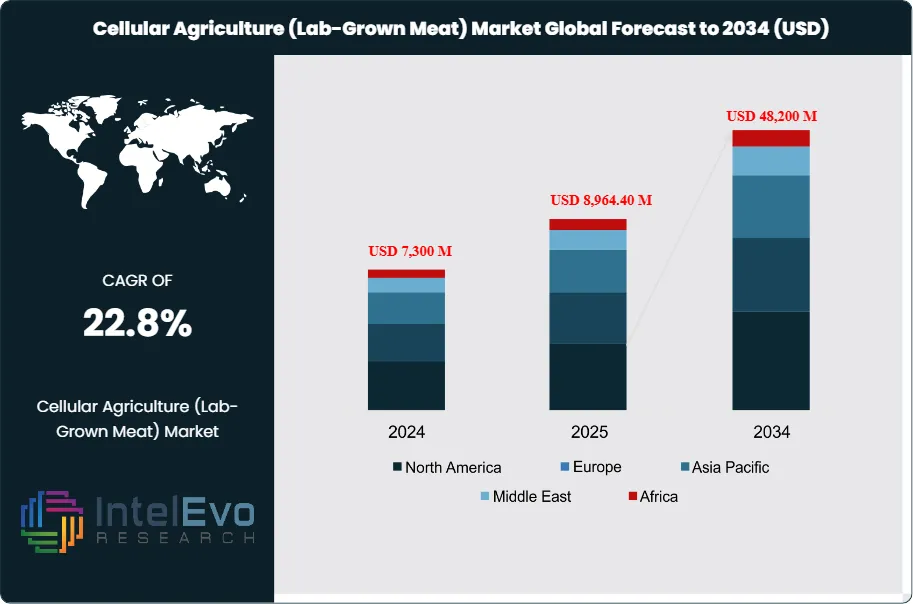
The Cellular Agriculture (Lab-Grown Meat) market represents a transformative shift in food production, involving the cultivation of animal cells in controlled environments to produce meat without raising or slaughtering animals. This innovative approach addresses significant environmental and ethical concerns associated with traditional livestock farming, including high greenhouse gas emissions, land use, and water consumption. The current market is rapidly evolving, fueled by advancements in biotechnology and changing consumer preferences. Increasing awareness of animal welfare and sustainability among consumers is driving the demand for lab-grown meat products, positioning them as a viable alternative to conventional meat.
The growth dynamics of the lab-grown meat market are underpinned by several key drivers. First, technological advancements in cellular biology and tissue engineering have led to improvements in the taste, texture, and nutritional profile of lab-grown meat, making it more appealing to consumers. Additionally, heightened concerns about food safety, health, and sustainability are encouraging shifts towards alternative protein sources. The market is further supported by favorable government policies and investments aimed at promoting food innovation.
Regionally, the lab-grown meat market exhibits varying growth patterns. North America currently leads the market, driven by significant investments from key players and a growing acceptance of alternative protein sources among consumers. The United States is at the forefront, with various startups and established companies advancing the commercialization of lab-grown meat. The Asia-Pacific region is also emerging as a critical player, particularly in countries like Singapore, which has become a pioneer in approving the sale of lab-grown meat. As consumer awareness about sustainability and food safety continues to rise, demand in Europe and Latin America is also expected to grow, contributing to the global expansion of the market.
The COVID-19 pandemic has had a notable impact on the lab-grown meat market, amplifying existing trends towards alternative protein sources. The pandemic highlighted vulnerabilities in traditional food supply chains, leading to increased consumer interest in sustainable and resilient food options. As people became more conscious of food safety and health, lab-grown meat gained traction as a reliable and ethically produced alternative. Additionally, disruptions in the livestock industry during the pandemic underscored the need for innovative food production methods, positioning lab-grown meat as a viable solution to ensure food security in future crises.
Key Takeaways
Market Growth: The cellular agriculture market is projected to reach USD $48,200 million by 2034, growing at a robust CAGR of 22.8%, indicating substantial market expansion driven by technological advancements and changing consumer preferences.
Product Type Dominance: Beef is anticipated to dominate the market share due to its high consumption rates and consumer familiarity. The demand for lab-grown beef is driven by its potential to offer sustainable alternatives to conventional beef production.
Technology Focus: Tissue engineering is leading the technological segment, enabling the development of lab-grown meat that closely mimics traditional meat in taste and texture. This innovation is crucial for gaining consumer acceptance and regulatory approval.
Driver: Increasing concerns regarding animal welfare and sustainability are driving the demand for lab-grown meat. Consumers are seeking alternatives that reduce environmental impact while providing ethical food choices.
Restraint: High production costs associated with lab-grown meat pose a significant challenge, potentially limiting its affordability and widespread adoption. Additionally, regulatory hurdles can delay market entry for new products.
Opportunity: The growing investment in food technology and innovation offers significant growth opportunities. Partnerships between startups and established food companies can enhance research and development, accelerating market growth.
Trend: The trend toward sustainable food production is influencing consumer preferences, with a notable shift toward plant-based and lab-grown alternatives as people seek healthier and more ethical food options.
Regional Analysis: North America is expected to lead the market, driven by innovation and consumer acceptance. The Asia-Pacific region is emerging as a significant player, particularly with regulatory support in countries like Singapore for lab-grown meat products.
Product Type
The product type segment of the cellular agriculture market is diversified, including beef, poultry, seafood, pork, and others. Beef is expected to dominate this segment due to its high consumption rates globally, coupled with increasing consumer demand for sustainable alternatives to conventional meat. Lab-grown poultry is also gaining traction, as it offers a familiar taste and is generally more accepted by consumers. Seafood products present a unique opportunity, given the environmental pressures on wild fish stocks. As consumers become more health-conscious and aware of the environmental impact of their food choices, the demand for lab-grown options across all product types is anticipated to grow significantly, reflecting a broader shift towards sustainable food sources.
Technology
The technology segment in the cellular agriculture market includes tissue engineering, cell culture technology, bio-printing, and others. Tissue engineering is the leading technology, involving the cultivation of animal cells in a nutrient-rich environment to produce muscle tissue that mimics traditional meat. This method is critical in developing lab-grown meat that meets consumer expectations for taste and texture. Cell culture technology, which allows for the scalable production of muscle cells, is also pivotal for market growth. Bio-printing, an emerging technology, involves 3D printing techniques to create complex tissue structures, thus holding significant potential for future innovations. As advancements in these technologies continue, the production processes will become more efficient and cost-effective, driving market acceptance and expansion.
Application
The application segment of the lab-grown meat market encompasses food products, nutritional supplements, and food service. The food products category is anticipated to hold the largest share, as consumers increasingly incorporate lab-grown meat into their diets. This segment includes ready-to-eat meals, burgers, and sausages, designed to appeal to various consumer preferences. Nutritional supplements that utilize lab-grown proteins are also emerging, particularly among health-conscious consumers looking for high-quality protein sources without the environmental impact of conventional meat production. The food service sector, including restaurants and catering services, is exploring lab-grown options to cater to evolving consumer demands. As more establishments embrace sustainable practices, the application segment is set to expand significantly.
End-User
The end-user segment in the cellular agriculture market is classified into retail, food and beverage industry, and restaurants. Retail is expected to capture a significant market share, driven by increasing consumer awareness of sustainable food practices and the availability of lab-grown meat products in grocery stores. The food and beverage industry is also a crucial player, with manufacturers looking to incorporate lab-grown ingredients into their offerings to meet consumer demand for healthier options. Restaurants are increasingly experimenting with lab-grown meat to attract a growing demographic of environmentally conscious diners. As acceptance of lab-grown products rises among consumers, all end-user segments will contribute to the overall growth of the market, shaping the future of meat consumption.
Region Analysis:
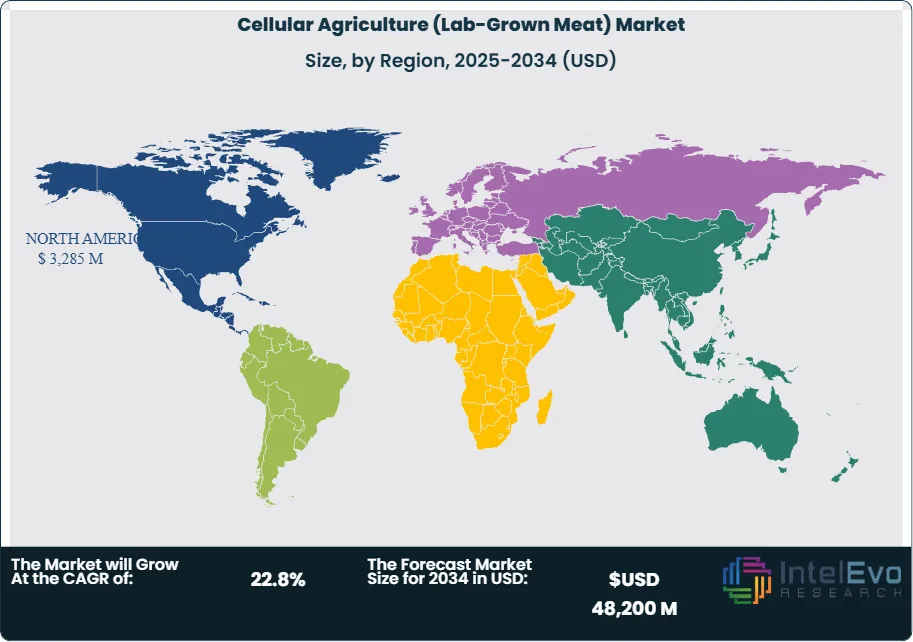
North America Leads with 45% Market Share in the Cellular Agriculture Market: North America holds a commanding share of approximately 45% in the cellular agriculture market, primarily driven by significant investments in research and development and a strong consumer inclination towards sustainable food options. The United States, in particular, is home to numerous startups and established firms pioneering lab-grown meat technologies, facilitating rapid innovation and product development. The region's robust infrastructure for food safety regulations further enhances the feasibility and acceptance of lab-grown products. Additionally, growing concerns about animal welfare and environmental sustainability resonate well with consumers, resulting in increased demand for lab-grown alternatives. Major companies in the U.S. are focusing on marketing strategies that emphasize the health benefits and ethical aspects of lab-grown meat, reinforcing the region's dominance in the global market.
The Asia-Pacific region is identified as the fastest-growing segment in the cellular agriculture market, driven by a rapidly urbanizing population and shifting dietary preferences towards protein-rich foods. Countries like Singapore are leading the charge, having established favorable regulatory frameworks that allow for the sale and distribution of lab-grown meat. This regulatory support, combined with rising disposable incomes and health-conscious consumers, is propelling growth in the region. Furthermore, the increasing focus on food security and sustainable practices in nations like China and India contributes to the region's expansion. While North America currently leads in market share, Asia-Pacific is projected to experience the highest CAGR, as more countries recognize the potential of lab-grown meat to meet their nutritional needs while addressing environmental challenges. Europe, Latin America, and the Middle East and Africa also show promise, with growing interest in sustainable food sources, albeit at a slower pace compared to Asia-Pacific.
By Meat Type:(Beef, Poultry, Pork, Seafood, Others), By Cell Type:(Stem Cells, Non-Stem Cells, By Production Technology, Cell Culture Media, Bioreactors & Scaffolding Systems, 3D Printing & Tissue Engineering, Others), By End-User:(Food & Beverage Industry, Retail & Supermarkets, Foodservice / Restaurants, Institutional Buyers, Others), By Application:(Food Products, Nutritional Supplements, Food Service)
Research Methodology
Primary Research- 100 Interviews of Stakeholders
Secondary Research
Desk Research
Regional scope
North America (United States, Canada, Mexico)
Latin America (Brazil, Argentina, Columbia)
East Asia And Pacific (China, Japan, South Korea, Australia, Cambodia, Fiji, Indonesia)
Sea And South Asia (India, Singapore, Thailand, Taiwan, Malaysia)
Eastern Europe (Poland, Russia, Czech Republic, Romania)
Western Europe (Germany, U.K., France, Spain, Itlay)
Middle East & Africa (GCC Countries, Egypt, Nigeria, South Africa, Israel)
Competitive Landscape
Memphis Meats, Mosa Meat, Just Inc., Future Meat Technologies, Aleph Farms, Eat Just Inc., Upside Foods, SuperMeat, Cellular Agriculture Society, Geltor, Wild Type, Finless Foods, New Age Meats, Shiru, Believer Meats, The Better Meat Co., Primeval Foods, ProVeg International, Redefine Meat, STEM (Science Technology Engineering Medicine)
Customization Scope
Customization for segments, region/country-level will be provided. Moreover, additional customization can be done based on the requirements.
Pricing and Purchase Options
Avail customized purchase options to meet your exact research needs. We have three licenses to opt for: Single User License, Multi-User License (Up to 5 Users), Corporate Use License (Unlimited User and Printable PDF).
TABLE OF CONTENTS
1. EXECUTIVE SUMMARY
1.1. MARKET SNAPSHOT
1.2. KEY FINDINGS & INSIGHTS
1.3. ANALYST RECOMMENDATIONS
1.4. FUTURE OUTLOOK
2. RESEARCH METHODOLOGY
2.1. MARKET DEFINITION & SCOPE
2.2. RESEARCH OBJECTIVES: PRIMARY & SECONDARY DATA SOURCES
2.3. DATA COLLECTION SOURCES
2.3.1. COVERAGE OF 100+ PRIMARY RESEARCH/CONSULTATION CALLS WITH INDUSTRY STAKEHOLDERS
FIGURE 17 NORTH AMERICA CELLULAR AGRICULTURE (LAB-GROWN MEAT) CURRENT AND FUTURE TYPE ANALYSIS, 2025–2034, (USD MILLION)
FIGURE 18 NORTH AMERICA CELLULAR AGRICULTURE (LAB-GROWN MEAT) CURRENT AND FUTURE END USER ANALYSIS, 2025–2034, (USD MILLION)
FIGURE 19 MARKET SHARE BY COUNTRY
FIGURE 20 LATIN AMERICA CELLULAR AGRICULTURE (LAB-GROWN MEAT) CURRENT AND FUTURE TYPE ANALYSIS, 2025–2034, (USD MILLION)
FIGURE 21 LATIN AMERICA CELLULAR AGRICULTURE (LAB-GROWN MEAT) CURRENT AND FUTURE END USER ANALYSIS, 2025–2034, (USD MILLION)
FIGURE 22 MARKET SHARE BY COUNTRY
FIGURE 23 EASTERN EUROPE CELLULAR AGRICULTURE (LAB-GROWN MEAT) CURRENT AND FUTURE TYPE ANALYSIS, 2025–2034, (USD MILLION)
FIGURE 24 EASTERN EUROPE CELLULAR AGRICULTURE (LAB-GROWN MEAT) CURRENT AND FUTURE END USER ANALYSIS, 2025–2034, (USD MILLION)
FIGURE 25 MARKET SHARE BY COUNTRY
FIGURE 26 WESTERN EUROPE CELLULAR AGRICULTURE (LAB-GROWN MEAT) CURRENT AND FUTURE TYPE ANALYSIS, 2025–2034, (USD MILLION)
FIGURE 27 WESTERN EUROPE CELLULAR AGRICULTURE (LAB-GROWN MEAT) CURRENT AND FUTURE END USER ANALYSIS, 2025–2034, (USD MILLION)
FIGURE 28 MARKET SHARE BY COUNTRY
FIGURE 29 EAST ASIA AND PACIFIC CELLULAR AGRICULTURE (LAB-GROWN MEAT) CURRENT AND FUTURE TYPE ANALYSIS, 2025–2034, (USD MILLION)
FIGURE 30 EAST ASIA AND PACIFIC CELLULAR AGRICULTURE (LAB-GROWN MEAT) CURRENT AND FUTURE END USER ANALYSIS, 2025–2034, (USD MILLION)
FIGURE 31 MARKET SHARE BY COUNTRY
FIGURE 32 SEA AND SOUTH ASIA CELLULAR AGRICULTURE (LAB-GROWN MEAT) CURRENT AND FUTURE TYPE ANALYSIS, 2025–2034, (USD MILLION)
FIGURE 33 SEA AND SOUTH ASIA CELLULAR AGRICULTURE (LAB-GROWN MEAT) CURRENT AND FUTURE END USER ANALYSIS, 2025–2034, (USD MILLION)
FIGURE 34 MARKET SHARE BY COUNTRY
FIGURE 35 MIDDLE EAST AND AFRICA CELLULAR AGRICULTURE (LAB-GROWN MEAT) CURRENT AND FUTURE TYPE ANALYSIS, 2025–2034, (USD MILLION)
FIGURE 36 MIDDLE EAST AND AFRICA CELLULAR AGRICULTURE (LAB-GROWN MEAT) CURRENT AND FUTURE END USER ANALYSIS, 2025–2034, (USD MILLION)
FIGURE 37 NORTH AMERICA CELLULAR AGRICULTURE (LAB-GROWN MEAT) CURRENT AND FUTURE MARKET VOLUME SHARE REGIONAL ANALYSIS, 2025–2034, (USD MILLION)
FIGURE 38 U.S. CELLULAR AGRICULTURE (LAB-GROWN MEAT) CURRENT AND FUTURE TYPE ANALYSIS, 2025–2034, (USD MILLION)
FIGURE 39 U.S. CELLULAR AGRICULTURE (LAB-GROWN MEAT) CURRENT AND FUTURE END USER ANALYSIS, 2025–2034, (USD MILLION)
FIGURE 40 CANADA CELLULAR AGRICULTURE (LAB-GROWN MEAT) CURRENT AND FUTURE TYPE ANALYSIS, 2025–2034, (USD MILLION)
FIGURE 41 CANADA CELLULAR AGRICULTURE (LAB-GROWN MEAT) CURRENT AND FUTURE END USER ANALYSIS, 2025–2034, (USD MILLION)
FIGURE 42 LATIN AMERICA CELLULAR AGRICULTURE (LAB-GROWN MEAT) CURRENT AND FUTURE MARKET VOLUME SHARE REGIONAL ANALYSIS, 2025–2034, (USD MILLION)
FIGURE 43 MEXICO CELLULAR AGRICULTURE (LAB-GROWN MEAT) CURRENT AND FUTURE TYPE ANALYSIS, 2025–2034, (USD MILLION)
FIGURE 44 MEXICO CELLULAR AGRICULTURE (LAB-GROWN MEAT) CURRENT AND FUTURE END USER ANALYSIS, 2025–2034, (USD MILLION)
FIGURE 45 BRAZIL CELLULAR AGRICULTURE (LAB-GROWN MEAT) CURRENT AND FUTURE TYPE ANALYSIS, 2025–2034, (USD MILLION)
FIGURE 46 BRAZIL CELLULAR AGRICULTURE (LAB-GROWN MEAT) CURRENT AND FUTURE END USER ANALYSIS, 2025–2034, (USD MILLION)
FIGURE 47 ARGENTINA CELLULAR AGRICULTURE (LAB-GROWN MEAT) CURRENT AND FUTURE TYPE ANALYSIS, 2025–2034, (USD MILLION)
FIGURE 48 ARGENTINA CELLULAR AGRICULTURE (LAB-GROWN MEAT) CURRENT AND FUTURE END USER ANALYSIS, 2025–2034, (USD MILLION)
FIGURE 49 COLUMBIA CELLULAR AGRICULTURE (LAB-GROWN MEAT) CURRENT AND FUTURE TYPE ANALYSIS, 2025–2034, (USD MILLION)
FIGURE 50 COLUMBIA CELLULAR AGRICULTURE (LAB-GROWN MEAT) CURRENT AND FUTURE END USER ANALYSIS, 2025–2034, (USD MILLION)
FIGURE 51 REST OF LATIN AMERICA CELLULAR AGRICULTURE (LAB-GROWN MEAT) CURRENT AND FUTURE TYPE ANALYSIS, 2025–2034, (USD MILLION)
FIGURE 52 REST OF LATIN AMERICA CELLULAR AGRICULTURE (LAB-GROWN MEAT) CURRENT AND FUTURE END USER ANALYSIS, 2025–2034, (USD MILLION)
FIGURE 53 EASTERN EUROPE CELLULAR AGRICULTURE (LAB-GROWN MEAT) CURRENT AND FUTURE MARKET VOLUME SHARE REGIONAL ANALYSIS, 2025–2034, (USD MILLION)
FIGURE 54 POLAND CELLULAR AGRICULTURE (LAB-GROWN MEAT) CURRENT AND FUTURE TYPE ANALYSIS, 2025–2034, (USD MILLION)
FIGURE 55 POLAND CELLULAR AGRICULTURE (LAB-GROWN MEAT) CURRENT AND FUTURE END USER ANALYSIS, 2025–2034, (USD MILLION)
FIGURE 56 RUSSIA CELLULAR AGRICULTURE (LAB-GROWN MEAT) CURRENT AND FUTURE TYPE ANALYSIS, 2025–2034, (USD MILLION)
FIGURE 57 RUSSIA CELLULAR AGRICULTURE (LAB-GROWN MEAT) CURRENT AND FUTURE END USER ANALYSIS, 2025–2034, (USD MILLION)
FIGURE 58 CZECH REPUBLIC CELLULAR AGRICULTURE (LAB-GROWN MEAT) CURRENT AND FUTURE TYPE ANALYSIS, 2025–2034, (USD MILLION)
FIGURE 59 CZECH REPUBLIC CELLULAR AGRICULTURE (LAB-GROWN MEAT) CURRENT AND FUTURE END USER ANALYSIS, 2025–2034, (USD MILLION)
FIGURE 60 ROMANIA CELLULAR AGRICULTURE (LAB-GROWN MEAT) CURRENT AND FUTURE TYPE ANALYSIS, 2025–2034, (USD MILLION)
FIGURE 61 ROMANIA CELLULAR AGRICULTURE (LAB-GROWN MEAT) CURRENT AND FUTURE END USER ANALYSIS, 2025–2034, (USD MILLION)
FIGURE 62 REST OF EASTERN EUROPE CELLULAR AGRICULTURE (LAB-GROWN MEAT) CURRENT AND FUTURE TYPE ANALYSIS, 2025–2034, (USD MILLION)
FIGURE 63 REST OF EASTERN EUROPE CELLULAR AGRICULTURE (LAB-GROWN MEAT) CURRENT AND FUTURE END USER ANALYSIS, 2025–2034, (USD MILLION)
FIGURE 64 WESTERN EUROPE CELLULAR AGRICULTURE (LAB-GROWN MEAT) CURRENT AND FUTURE MARKET VOLUME SHARE REGIONAL ANALYSIS, 2025–2034, (USD MILLION)
FIGURE 65 GERMANY CELLULAR AGRICULTURE (LAB-GROWN MEAT) CURRENT AND FUTURE TYPE ANALYSIS, 2025–2034, (USD MILLION)
FIGURE 66 GERMANY CELLULAR AGRICULTURE (LAB-GROWN MEAT) CURRENT AND FUTURE END USER ANALYSIS, 2025–2034, (USD MILLION)
FIGURE 67 FRANCE CELLULAR AGRICULTURE (LAB-GROWN MEAT) CURRENT AND FUTURE TYPE ANALYSIS, 2025–2034, (USD MILLION)
FIGURE 68 FRANCE CELLULAR AGRICULTURE (LAB-GROWN MEAT) CURRENT AND FUTURE END USER ANALYSIS, 2025–2034, (USD MILLION)
FIGURE 69 UK CELLULAR AGRICULTURE (LAB-GROWN MEAT) CURRENT AND FUTURE TYPE ANALYSIS, 2025–2034, (USD MILLION)
FIGURE 70 UK CELLULAR AGRICULTURE (LAB-GROWN MEAT) CURRENT AND FUTURE END USER ANALYSIS, 2025–2034, (USD MILLION)
FIGURE 71 SPAIN CELLULAR AGRICULTURE (LAB-GROWN MEAT) CURRENT AND FUTURE TYPE ANALYSIS, 2025–2034, (USD MILLION)
FIGURE 72 SPAIN CELLULAR AGRICULTURE (LAB-GROWN MEAT) CURRENT AND FUTURE END USER ANALYSIS, 2025–2034, (USD MILLION)
FIGURE 73 ITALY CELLULAR AGRICULTURE (LAB-GROWN MEAT) CURRENT AND FUTURE TYPE ANALYSIS, 2025–2034, (USD MILLION)
FIGURE 74 ITALY CELLULAR AGRICULTURE (LAB-GROWN MEAT) CURRENT AND FUTURE END USER ANALYSIS, 2025–2034, (USD MILLION)
FIGURE 75 REST OF WESTERN EUROPE CELLULAR AGRICULTURE (LAB-GROWN MEAT) CURRENT AND FUTURE TYPE ANALYSIS, 2025–2034, (USD MILLION)
FIGURE 76 REST OF WESTERN EUROPE CELLULAR AGRICULTURE (LAB-GROWN MEAT) CURRENT AND FUTURE END USER ANALYSIS, 2025–2034, (USD MILLION)
FIGURE 77 EAST ASIA AND PACIFIC CELLULAR AGRICULTURE (LAB-GROWN MEAT) CURRENT AND FUTURE MARKET VOLUME SHARE REGIONAL ANALYSIS, 2025–2034, (USD MILLION)
FIGURE 78 CHINA CELLULAR AGRICULTURE (LAB-GROWN MEAT) CURRENT AND FUTURE TYPE ANALYSIS, 2025–2034, (USD MILLION)
FIGURE 79 CHINA CELLULAR AGRICULTURE (LAB-GROWN MEAT) CURRENT AND FUTURE END USER ANALYSIS, 2025–2034, (USD MILLION)
FIGURE 80 JAPAN CELLULAR AGRICULTURE (LAB-GROWN MEAT) CURRENT AND FUTURE TYPE ANALYSIS, 2025–2034, (USD MILLION)
FIGURE 81 JAPAN CELLULAR AGRICULTURE (LAB-GROWN MEAT) CURRENT AND FUTURE END USER ANALYSIS, 2025–2034, (USD MILLION)
FIGURE 82 AUSTRALIA CELLULAR AGRICULTURE (LAB-GROWN MEAT) CURRENT AND FUTURE TYPE ANALYSIS, 2025–2034, (USD MILLION)
FIGURE 83 AUSTRALIA CELLULAR AGRICULTURE (LAB-GROWN MEAT) CURRENT AND FUTURE END USER ANALYSIS, 2025–2034, (USD MILLION)
FIGURE 84 CAMBODIA CELLULAR AGRICULTURE (LAB-GROWN MEAT) CURRENT AND FUTURE TYPE ANALYSIS, 2025–2034, (USD MILLION)
FIGURE 85 CAMBODIA CELLULAR AGRICULTURE (LAB-GROWN MEAT) CURRENT AND FUTURE END USER ANALYSIS, 2025–2034, (USD MILLION)
FIGURE 86 FIJI CELLULAR AGRICULTURE (LAB-GROWN MEAT) CURRENT AND FUTURE TYPE ANALYSIS, 2025–2034, (USD MILLION)
FIGURE 87 FIJI CELLULAR AGRICULTURE (LAB-GROWN MEAT) CURRENT AND FUTURE END USER ANALYSIS, 2025–2034, (USD MILLION)
FIGURE 88 INDONESIA CELLULAR AGRICULTURE (LAB-GROWN MEAT) CURRENT AND FUTURE TYPE ANALYSIS, 2025–2034, (USD MILLION)
FIGURE 89 INDONESIA CELLULAR AGRICULTURE (LAB-GROWN MEAT) CURRENT AND FUTURE END USER ANALYSIS, 2025–2034, (USD MILLION)
FIGURE 90 SOUTH KOREA CELLULAR AGRICULTURE (LAB-GROWN MEAT) CURRENT AND FUTURE TYPE ANALYSIS, 2025–2034, (USD MILLION)
FIGURE 91 SOUTH KOREA CELLULAR AGRICULTURE (LAB-GROWN MEAT) CURRENT AND FUTURE END USER ANALYSIS, 2025–2034, (USD MILLION)
FIGURE 92 REST OF EAST ASIA AND PACIFIC CELLULAR AGRICULTURE (LAB-GROWN MEAT) CURRENT AND FUTURE TYPE ANALYSIS, 2025–2034, (USD MILLION)
FIGURE 93 REST OF EAST ASIA AND PACIFIC CELLULAR AGRICULTURE (LAB-GROWN MEAT) CURRENT AND FUTURE END USER ANALYSIS, 2025–2034, (USD MILLION)
FIGURE 94 SEA AND SOUTH ASIA CELLULAR AGRICULTURE (LAB-GROWN MEAT) CURRENT AND FUTURE MARKET VOLUME SHARE REGIONAL ANALYSIS, 2025–2034, (USD MILLION)
FIGURE 95 BANGLADESH CELLULAR AGRICULTURE (LAB-GROWN MEAT) CURRENT AND FUTURE TYPE ANALYSIS, 2025–2034, (USD MILLION)
FIGURE 96 BANGLADESH CELLULAR AGRICULTURE (LAB-GROWN MEAT) CURRENT AND FUTURE END USER ANALYSIS, 2025–2034, (USD MILLION)
FIGURE 97 NEW ZEALAND CELLULAR AGRICULTURE (LAB-GROWN MEAT) CURRENT AND FUTURE TYPE ANALYSIS, 2025–2034, (USD MILLION)
FIGURE 98 NEW ZEALAND CELLULAR AGRICULTURE (LAB-GROWN MEAT) CURRENT AND FUTURE END USER ANALYSIS, 2025–2034, (USD MILLION)
FIGURE 99 INDIA CELLULAR AGRICULTURE (LAB-GROWN MEAT) CURRENT AND FUTURE TYPE ANALYSIS, 2025–2034, (USD MILLION)
FIGURE 100 INDIA CELLULAR AGRICULTURE (LAB-GROWN MEAT) CURRENT AND FUTURE END USER ANALYSIS, 2025–2034, (USD MILLION)
FIGURE 101 SINGAPORE CELLULAR AGRICULTURE (LAB-GROWN MEAT) CURRENT AND FUTURE TYPE ANALYSIS, 2025–2034, (USD MILLION)
FIGURE 102 SINGAPORE CELLULAR AGRICULTURE (LAB-GROWN MEAT) CURRENT AND FUTURE END USER ANALYSIS, 2025–2034, (USD MILLION)
FIGURE 103 THAILAND CELLULAR AGRICULTURE (LAB-GROWN MEAT) CURRENT AND FUTURE TYPE ANALYSIS, 2025–2034, (USD MILLION)
FIGURE 104 THAILAND CELLULAR AGRICULTURE (LAB-GROWN MEAT) CURRENT AND FUTURE END USER ANALYSIS, 2025–2034, (USD MILLION)
FIGURE 105 TAIWAN CELLULAR AGRICULTURE (LAB-GROWN MEAT) CURRENT AND FUTURE TYPE ANALYSIS, 2025–2034, (USD MILLION)
FIGURE 106 TAIWAN CELLULAR AGRICULTURE (LAB-GROWN MEAT) CURRENT AND FUTURE END USER ANALYSIS, 2025–2034, (USD MILLION)
FIGURE 107 MALAYSIA CELLULAR AGRICULTURE (LAB-GROWN MEAT) CURRENT AND FUTURE TYPE ANALYSIS, 2025–2034, (USD MILLION)
FIGURE 108 MALAYSIA CELLULAR AGRICULTURE (LAB-GROWN MEAT) CURRENT AND FUTURE END USER ANALYSIS, 2025–2034, (USD MILLION)
FIGURE 109 REST OF SEA AND SOUTH ASIA CELLULAR AGRICULTURE (LAB-GROWN MEAT) CURRENT AND FUTURE TYPE ANALYSIS, 2025–2034, (USD MILLION)
FIGURE 110 REST OF SEA AND SOUTH ASIA CELLULAR AGRICULTURE (LAB-GROWN MEAT) CURRENT AND FUTURE END USER ANALYSIS, 2025–2034, (USD MILLION)
FIGURE 111 MIDDLE EAST AND AFRICA CELLULAR AGRICULTURE (LAB-GROWN MEAT) CURRENT AND FUTURE MARKET VOLUME SHARE REGIONAL ANALYSIS, 2025–2034, (USD MILLION)
FIGURE 112 GCC COUNTRIES CELLULAR AGRICULTURE (LAB-GROWN MEAT) CURRENT AND FUTURE TYPE ANALYSIS, 2025–2034, (USD MILLION)
FIGURE 113 GCC COUNTRIES CELLULAR AGRICULTURE (LAB-GROWN MEAT) CURRENT AND FUTURE END USER ANALYSIS, 2025–2034, (USD MILLION)
FIGURE 114 SAUDI ARABIA CELLULAR AGRICULTURE (LAB-GROWN MEAT) CURRENT AND FUTURE TYPE ANALYSIS, 2025–2034, (USD MILLION)
FIGURE 115 SAUDI ARABIA CELLULAR AGRICULTURE (LAB-GROWN MEAT) CURRENT AND FUTURE END USER ANALYSIS, 2025–2034, (USD MILLION)
FIGURE 116 UAE CELLULAR AGRICULTURE (LAB-GROWN MEAT) CURRENT AND FUTURE TYPE ANALYSIS, 2025–2034, (USD MILLION)
FIGURE 117 UAE CELLULAR AGRICULTURE (LAB-GROWN MEAT) CURRENT AND FUTURE END USER ANALYSIS, 2025–2034, (USD MILLION)
FIGURE 118 BAHRAIN CELLULAR AGRICULTURE (LAB-GROWN MEAT) CURRENT AND FUTURE TYPE ANALYSIS, 2025–2034, (USD MILLION)
FIGURE 119 BAHRAIN CELLULAR AGRICULTURE (LAB-GROWN MEAT) CURRENT AND FUTURE END USER ANALYSIS, 2025–2034, (USD MILLION)
FIGURE 120 KUWAIT CELLULAR AGRICULTURE (LAB-GROWN MEAT) CURRENT AND FUTURE TYPE ANALYSIS, 2025–2034, (USD MILLION)
FIGURE 121 KUWAIT CELLULAR AGRICULTURE (LAB-GROWN MEAT) CURRENT AND FUTURE END USER ANALYSIS, 2025–2034, (USD MILLION)
FIGURE 122 OMAN CELLULAR AGRICULTURE (LAB-GROWN MEAT) CURRENT AND FUTURE TYPE ANALYSIS, 2025–2034, (USD MILLION)
FIGURE 123 OMAN CELLULAR AGRICULTURE (LAB-GROWN MEAT) CURRENT AND FUTURE END USER ANALYSIS, 2025–2034, (USD MILLION)
FIGURE 124 QATAR CELLULAR AGRICULTURE (LAB-GROWN MEAT) CURRENT AND FUTURE TYPE ANALYSIS, 2025–2034, (USD MILLION)
FIGURE 125 QATAR CELLULAR AGRICULTURE (LAB-GROWN MEAT) CURRENT AND FUTURE END USER ANALYSIS, 2025–2034, (USD MILLION)
FIGURE 126 EGYPT CELLULAR AGRICULTURE (LAB-GROWN MEAT) CURRENT AND FUTURE TYPE ANALYSIS, 2025–2034, (USD MILLION)
FIGURE 127 EGYPT CELLULAR AGRICULTURE (LAB-GROWN MEAT) CURRENT AND FUTURE END USER ANALYSIS, 2025–2034, (USD MILLION)
FIGURE 128 NIGERIA CELLULAR AGRICULTURE (LAB-GROWN MEAT) CURRENT AND FUTURE TYPE ANALYSIS, 2025–2034, (USD MILLION)
FIGURE 129 NIGERIA CELLULAR AGRICULTURE (LAB-GROWN MEAT) CURRENT AND FUTURE END USER ANALYSIS, 2025–2034, (USD MILLION)
FIGURE 130 SOUTH AFRICA CELLULAR AGRICULTURE (LAB-GROWN MEAT) CURRENT AND FUTURE TYPE ANALYSIS, 2025–2034, (USD MILLION)
FIGURE 131 SOUTH AFRICA CELLULAR AGRICULTURE (LAB-GROWN MEAT) CURRENT AND FUTURE END USER ANALYSIS, 2025–2034, (USD MILLION)
FIGURE 132 ISRAEL CELLULAR AGRICULTURE (LAB-GROWN MEAT) CURRENT AND FUTURE TYPE ANALYSIS, 2025–2034, (USD MILLION)
FIGURE 133 ISRAEL CELLULAR AGRICULTURE (LAB-GROWN MEAT) CURRENT AND FUTURE END USER ANALYSIS, 2025–2034, (USD MILLION)
FIGURE 134 REST OF MEA CELLULAR AGRICULTURE (LAB-GROWN MEAT) CURRENT AND FUTURE TYPE ANALYSIS, 2025–2034, (USD MILLION)
FIGURE 135 REST OF MEA CELLULAR AGRICULTURE (LAB-GROWN MEAT) CURRENT AND FUTURE END USER ANALYSIS, 2025–2034, (USD MILLION)
FIGURE 136 U. S. MARKET SHARE ANALYSIS BY TYPE (2024)
FIGURE 137 U. S. MARKET SHARE ANALYSIS BY END USER (2024)
FIGURE 138 CANADA MARKET SHARE ANALYSIS BY TYPE (2024)
FIGURE 139 CANADA MARKET SHARE ANALYSIS BY END USER (2024)
FIGURE 140 MEXICO MARKET SHARE ANALYSIS BY TYPE (2024)
FIGURE 141 MEXICO MARKET SHARE ANALYSIS BY END USER (2024)
FIGURE 142 CHINA MARKET SHARE ANALYSIS BY TYPE (2024)
FIGURE 143 CHINA MARKET SHARE ANALYSIS BY END USER (2024)
FIGURE 144 JAPAN MARKET SHARE ANALYSIS BY TYPE (2024)
FIGURE 145 JAPAN MARKET SHARE ANALYSIS BY END USER (2024)
FIGURE 146 INDIA MARKET SHARE ANALYSIS BY TYPE (2024)
FIGURE 147 INDIA MARKET SHARE ANALYSIS BY END USER (2024)
FIGURE 148 SOUTH KOREA MARKET SHARE ANALYSIS BY TYPE (2024)
FIGURE 149 SOUTH KOREA MARKET SHARE ANALYSIS BY END USER (2024)
FIGURE 150 SAUDI ARABIA MARKET SHARE ANALYSIS BY TYPE (2024)
FIGURE 151 SAUDI ARABIA MARKET SHARE ANALYSIS BY END USER (2024)
FIGURE 152 UAE MARKET SHARE ANALYSIS BY TYPE (2024)
FIGURE 153 UAE MARKET SHARE ANALYSIS BY END USER (2024)
FIGURE 154 EGYPT MARKET SHARE ANALYSIS BY TYPE (2024)
FIGURE 155 EGYPT MARKET SHARE ANALYSIS BY END USER (2024)
FIGURE 156 NIGERIA MARKET SHARE ANALYSIS BY TYPE (2024)
FIGURE 157 NIGERIA MARKET SHARE ANALYSIS BY END USER (2024)
FIGURE 158 SOUTH AFRICA MARKET SHARE ANALYSIS BY TYPE (2024)
FIGURE 159 SOUTH AFRICA MARKET SHARE ANALYSIS BY END USER (2024)
FIGURE 160 GERMANY MARKET SHARE ANALYSIS BY TYPE (2024)
FIGURE 161 GERMANY MARKET SHARE ANALYSIS BY END USER (2024)
FIGURE 162 FRANCE MARKET SHARE ANALYSIS BY TYPE (2024)
FIGURE 163 FRANCE MARKET SHARE ANALYSIS BY END USER (2024)
FIGURE 164 UK MARKET SHARE ANALYSIS BY TYPE (2024)
FIGURE 165 UK MARKET SHARE ANALYSIS BY END USER (2024)
FIGURE 166 SPAIN MARKET SHARE ANALYSIS BY TYPE (2024)
FIGURE 167 SPAIN MARKET SHARE ANALYSIS BY END USER (2024)
FIGURE 168 ITALY MARKET SHARE ANALYSIS BY TYPE (2024)
FIGURE 169 ITALY MARKET SHARE ANALYSIS BY END USER (2024)
FIGURE 170 BRAZIL MARKET SHARE ANALYSIS BY TYPE (2024)
FIGURE 171 BRAZIL MARKET SHARE ANALYSIS BY END USER (2024)
FIGURE 172 ARGENTINA MARKET SHARE ANALYSIS BY TYPE (2024)
FIGURE 173 ARGENTINA MARKET SHARE ANALYSIS BY END USER (2024)
FIGURE 174 COLUMBIA MARKET SHARE ANALYSIS BY TYPE (2024)
FIGURE 175 COLUMBIA MARKET SHARE ANALYSIS BY END USER (2024)
FIGURE 176 GLOBAL CELLULAR AGRICULTURE (LAB-GROWN MEAT) CURRENT AND FUTURE MARKET KEY COUNTRY LEVEL ANALYSIS, 2024–2034, (USD MILLION)
FIGURE 177 FINANCIAL OVERVIEW:
Key Players Analysis:
Memphis Meats: Based in San Francisco, Memphis Meats focuses on developing lab-grown beef, chicken, and duck. Their products aim to replicate the taste and texture of traditional meat while reducing environmental impact. Their strategy involves partnerships with food companies to accelerate commercialization and bring affordable products to market.
Mosa Meat: Founded in the Netherlands, Mosa Meat is known for producing the first lab-grown hamburger. Their mission is to provide sustainable meat alternatives without sacrificing taste. They emphasize a strong research and development approach, focusing on scaling production and reducing costs to make lab-grown meat accessible to consumers.
Just, Inc.: Headquartered in San Francisco, Just, Inc. offers a range of plant-based and lab-grown food products, including cultured chicken and mayonnaise. Their business strategy focuses on innovation and sustainability, aiming to create healthier food options. They also emphasize transparency in their sourcing and production processes to build consumer trust.
Future Meat Technologies: Operating from Israel, Future Meat Technologies specializes in cultured meat, offering products like lab-grown chicken and lamb. Their strategy revolves around using a unique bioprocessing method to lower production costs, making lab-grown meat more competitive with traditional options. They aim for mass production to meet growing consumer demand.
Aleph Farms: Aleph Farms, also based in Israel, focuses on cultivating lab-grown steaks. Their innovative approach combines cellular agriculture with advanced bioprinting technology to create complex meat structures. Their business model emphasizes sustainability and animal welfare, seeking to appeal to conscious consumers while forming partnerships with major food retailers.
Upside Foods: Upside Foods, located in California, specializes in lab-grown chicken products. Their mission is to produce delicious and sustainable meat without the environmental impact of traditional farming. They employ a strategy of continuous improvement in production processes and are actively engaging with regulatory bodies to facilitate market entry.
SuperMeat: SuperMeat operates in Israel, focusing on lab-grown chicken products. Their strategy includes developing a transparent supply chain and collaborating with chefs and restaurants to promote their offerings. SuperMeat aims to provide a sustainable alternative to conventional chicken while fostering consumer education about the benefits of cultured meat.
Finless Foods: Based in California, Finless Foods is dedicated to producing lab-grown seafood. Their flagship product, lab-grown bluefin tuna, targets the high-end seafood market. Their business strategy centers on addressing overfishing and environmental degradation while promoting sustainable seafood options that appeal to conscious consumers.
New Age Meats: New Age Meats, located in California, focuses on creating cultured pork products. Their strategy combines innovative technology with a strong commitment to sustainability. They aim to reduce the environmental impact of meat production while working on refining their product's taste and texture to match consumer preferences.
Redefine Meat: Based in Israel, Redefine Meat specializes in creating 3D-printed, plant-based alternatives to traditional meats. Their products mimic the texture and flavor of various meat types, appealing to flexitarians and meat lovers alike. Their strategy emphasizes collaboration with food service providers to expand their reach and enhance consumer awareness.
Market Key Players
Memphis Meats
Mosa Meat
Just, Inc.
Future Meat Technologies
Aleph Farms
Eat Just, Inc.
Upside Foods
SuperMeat
Cellular Agriculture Society
Geltor
Wild Type
Finless Foods
New Age Meats
Shiru
Believer Meats
The Better Meat Co.
Primeval Foods
ProVeg International
Redefine Meat
STEM (Science Technology Engineering Medicine)
Driver:
Growing Consumer Awareness of Sustainability
As consumers become increasingly aware of the environmental impacts associated with conventional meat production, the demand for sustainable alternatives like lab-grown meat has surged. Traditional meat farming contributes significantly to greenhouse gas emissions, deforestation, and water depletion. Lab-grown meat, on the other hand, presents a promising solution, offering a way to produce animal protein with a fraction of the environmental footprint. This shift in consumer behavior is influencing food companies to invest in cellular agriculture technologies, driving innovation and production. The emphasis on ethical consumption aligns with the values of younger demographics, who prioritize sustainability in their purchasing decisions. As a result, the cellular agriculture market is poised for robust growth as more consumers seek sustainable food sources that align with their environmental values.
Technological Advancements in Food Production
Technological advancements play a critical role in the growth of the cellular agriculture market. Innovations in cell culture technologies and tissue engineering have enabled the efficient production of lab-grown meat, mimicking the taste and texture of traditional meat products. Continuous research and development efforts are leading to improved methods for scaling production and reducing costs, making lab-grown meat more accessible to consumers. Moreover, advancements in bioprinting technologies are opening new avenues for creating complex meat structures that closely resemble conventional meat. These technological breakthroughs are not only enhancing the quality and variety of lab-grown meat products but also boosting consumer confidence in their safety and taste. As technology evolves, the market is expected to experience significant expansion, catering to the increasing demand for alternative proteins.
Rising Health Consciousness Among Consumers
The increasing health consciousness among consumers is significantly driving the growth of the cellular agriculture market. Lab-grown meat products often contain fewer contaminants and antibiotic residues compared to conventional meat, making them appealing to health-conscious consumers. As awareness of the links between diet and health continues to grow, many individuals are seeking alternative protein sources that align with their health goals. Additionally, lab-grown meat can be engineered to enhance nutritional profiles, such as being lower in fat or enriched with vitamins. This customization offers consumers the opportunity to enjoy healthier meat options without sacrificing taste. As the trend towards health-focused eating habits accelerates, the demand for lab-grown meat is expected to rise, further propelling market growth.
Restraints:
High Production Costs
One of the significant restraints facing the cellular agriculture market is the high production costs associated with lab-grown meat. The processes involved in culturing cells and producing meat alternatives are currently expensive and resource-intensive. Factors such as specialized equipment, nutrient media, and stringent quality control measures contribute to these elevated costs. Until these production methods can be scaled efficiently and cost-effectively, lab-grown meat may remain prohibitively expensive for many consumers. High retail prices could deter widespread adoption, limiting market growth and making it challenging to compete with conventional meat, which remains significantly cheaper. Efforts to streamline production processes and develop cost-effective technologies are essential for overcoming this barrier and making lab-grown meat more accessible to a broader audience.
Regulatory Challenges and Approval Processes
Regulatory challenges represent another significant restraint for the cellular agriculture market. The approval processes for lab-grown meat vary by region and can be complex, lengthy, and costly. Regulatory bodies must evaluate safety, labeling, and production methods, which can delay the entry of new products into the market. These challenges can hinder innovation and slow down the commercialization of lab-grown meat, creating uncertainty for producers and investors. Additionally, public perception and acceptance play a vital role in regulatory decisions, and any negative consumer sentiment could further complicate approval processes. To navigate these challenges effectively, stakeholders in the cellular agriculture sector must engage with regulators and educate consumers to foster acceptance and streamline the path to market.
Opportunities:
Expansion into Emerging Markets
The cellular agriculture market presents significant opportunities for expansion into emerging markets. As awareness of food security issues and sustainable practices grows in developing regions, there is an increasing demand for innovative food solutions. Countries in Asia-Pacific, Latin America, and Africa are experiencing rapid urbanization and rising incomes, creating a greater need for alternative protein sources. Lab-grown meat can help address nutritional gaps while reducing the environmental impact associated with traditional meat production. By leveraging local partnerships and adapting products to meet regional preferences, companies can tap into these emerging markets. This expansion not only offers lucrative growth potential but also aligns with global efforts to achieve food sustainability and security in the face of rising populations.
Investment in Research and Development
The ongoing investment in research and development (R&D) presents a tremendous opportunity for the cellular agriculture market. As technology evolves, R&D initiatives can lead to breakthroughs that lower production costs, enhance product quality, and improve scalability. Collaborations between universities, research institutions, and private companies can foster innovation, allowing for the development of new cell culture techniques and alternative protein sources. Additionally, increased funding from venture capitalists and government initiatives dedicated to sustainable food technologies can accelerate the commercialization of lab-grown meat products. By prioritizing R&D, stakeholders can stay ahead of market trends, meet evolving consumer demands, and establish a competitive edge in the growing cellular agriculture sector.
Trends:
Shift Towards Alternative Proteins
A prominent trend in the cellular agriculture market is the significant shift towards alternative proteins, driven by changing consumer preferences and a heightened awareness of environmental issues. Consumers are increasingly seeking out meat substitutes that offer health benefits, sustainability, and ethical sourcing. This trend is reflected in the growing popularity of plant-based and lab-grown meat options, as consumers aim to reduce their meat consumption for both health and environmental reasons. Food companies are responding by expanding their product lines to include a variety of alternative protein offerings, which appeal to flexitarians and those looking to make more sustainable dietary choices. As the trend continues, we can expect to see further innovation in the sector, making lab-grown meat a key player in the future of food.
Recent Development
In October 2024: In a significant move for the lab-grown meat industry, Vow Food announced a partnership with Aterian, a cell-based agricultural company, to expedite the commercialization of their cultivated meat products. This collaboration aims to leverage Aterian's expertise in sustainable food systems to enhance Vow Food's product offerings, which are expected to hit the market soon. The partnership underscores the growing momentum in the lab-grown meat sector, particularly in Australia and New Zealand, where regulatory approvals are advancing
In September 2024: Aleph Farms successfully launched its lab-grown steak product in select restaurants across Israel, marking a crucial milestone for the company and the broader lab-grown meat market. This introduction follows the recent regulatory approval for their cultivated beef, making Aleph Farms one of the first companies to commercially offer lab-grown meat in Israel. This move is part of a broader trend where countries like Singapore and the U.S. are increasingly embracing lab-grown meat as a sustainable alternative.
