
The Circular Saw Blade Market is valued at approximately USD 12.8 Billion in 2024 and is projected to reach nearly USD 22.1 Billion by 2034, expanding at a CAGR of about 6.1% during 2025–2034. Demand is accelerating as construction, woodworking, and metal fabrication industries adopt high-performance carbide, diamond-tipped, and precision-engineered blades for better accuracy and durability. Rising automation in manufacturing, along with rapid growth of home renovation and DIY activities, continues to strengthen global market momentum.
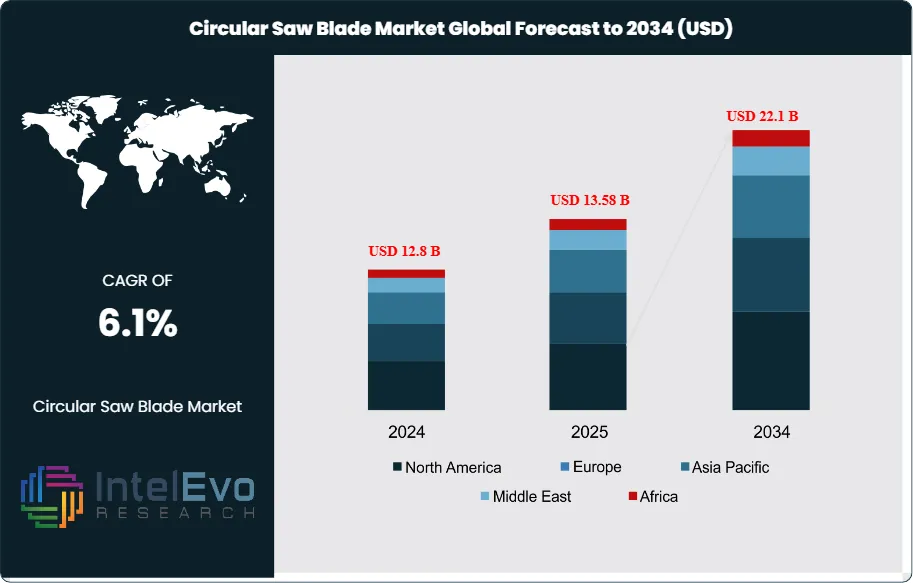
This steady expansion reflects the growing role of saw blades as indispensable tools in woodworking, metalworking, and construction industries worldwide. Historically, market demand has been tied closely to infrastructure development, housing starts, and industrial manufacturing trends, and the current decade is expected to witness further acceleration as global construction activity rebounds and precision cutting solutions become integral to advanced manufacturing.
A key growth driver is the rapid pace of innovation in material science and production processes. Carbide, diamond-tipped, and specialty alloy blades are increasingly adopted due to their superior durability, precision, and cost efficiency. Investments in robotics, automation, and data-driven manufacturing are also reshaping the competitive landscape. For instance, industry surveys indicate that more than 60% of manufacturers are integrating automation and analytics into blade production, significantly enhancing productivity and reducing operational downtime. These advances enable the creation of specialized blades for diverse applications, from high-speed industrial cutting to precision woodworking, thereby expanding addressable market segments.
On the demand side, the global push toward urbanization and industrialization, particularly in Asia-Pacific and parts of Latin America, continues to underpin market growth. The Asia-Pacific region accounts for the largest revenue share, supported by China and India’s large-scale construction pipelines and rising investments in smart manufacturing. Meanwhile, North America and Europe remain critical due to strong demand for advanced tooling in high-value manufacturing and stringent safety and quality standards. Emerging economies in Southeast Asia and the Middle East present new investment hotspots, driven by infrastructure development and increased adoption of modern woodworking and metal fabrication technologies.
Nonetheless, the market faces challenges, including raw material price volatility, supply chain disruptions, and the need for continuous adaptation to new environmental and regulatory requirements. Energy efficiency, recyclability of blade materials, and workplace safety standards are shaping purchasing decisions, compelling manufacturers to adopt sustainable production practices. Overall, the market’s forward trajectory will be defined by its ability to balance technological innovation with cost competitiveness, while capturing growth opportunities in high-potential emerging markets.
Key Takeaways
Market Growth: The global Circular Saw Blade market was valued at USD 12.8 Billion in 2024 and is projected to reach USD 22.1 Billion by 2034, expanding at a compound annual growth rate (CAGR) of 6.1%. This growth is primarily fueled by increasing demand from the construction, woodworking, and metal fabrication industries, alongside rapid technological advancements in blade manufacturing.
Product Type: Carbide saw blades lead the market with a substantial 55.2% revenue share in 2024. Their superior durability, precision cutting capability, and longer operational lifespan make them the preferred choice across industrial and professional-grade applications.
Application: Stone cutting applications account for the largest share at 41.2% in 2024, driven by high-volume demand from the construction and infrastructure sectors, particularly in emerging economies with large-scale urban development projects.
Driver: Technological investments are a major growth catalyst; for instance, 62% of woodworking machinery manufacturers are adopting robotics, 60% are leveraging data analytics, and 39% are integrating IoT solutions. These advancements significantly improve blade performance, reduce downtime, and enable production of specialized, high-precision tools.
Restraint: Price volatility in raw materials—especially tungsten carbide and steel—poses a challenge for manufacturers, impacting production costs and profit margins. Fluctuations in global metal supply chains further exacerbate this issue, particularly for export-dependent producers.
Opportunity: The Asia-Pacific region, led by China and India, presents robust growth potential with double-digit increases in construction expenditure and industrial manufacturing output. This region is expected to outpace global averages, making it a critical focus for market expansion and localized production investment.
Trend: The rising adoption of automated and smart manufacturing processes, including CNC-enabled blade sharpening systems and predictive maintenance tools, is reshaping competitive dynamics. Companies like Freud and Leitz are investing in digital production lines to meet evolving industry standards and customer demands.
Regional Analysis: North America dominates the global market with a 41.7% share in 2023, supported by high-end manufacturing infrastructure and early adoption of advanced technologies. Meanwhile, Asia-Pacific is the fastest-growing region, projected to register a CAGR above the global average, driven by rapid industrialization and infrastructure development.
Type Analysis
Carbide saw blades continue to hold a dominant position in the global circular saw blade market, accounting for approximately 55.2% of total revenue share as of 2025. Their extensive use across multiple end-use industries stems from their superior edge retention, high-temperature tolerance, and ability to cut through dense materials with minimal wear. These blades are particularly favored in the construction, woodworking, and metal fabrication sectors, where precision, efficiency, and durability are critical. The demand is further bolstered by increased automation in manufacturing, where carbide blades are compatible with CNC machines and robotic cutting systems.
Diamond saw blades represent the second most significant product segment, particularly for applications involving abrasive and mineral-based materials such as concrete, asphalt, ceramics, and stone. Their popularity is driven by their extended lifespan and cutting efficiency, especially in infrastructure projects and heavy-duty industrial settings. As infrastructure investments surge across Asia, the Middle East, and Latin America, the segment is expected to expand at a healthy pace, supported by rising demand in civil engineering and urban development.
The "Others" category—including high-speed steel (HSS) and abrasive blades—occupies a smaller but specialized share of the market. These blade types serve niche applications such as fine metal cutting, non-ferrous materials, and general-purpose industrial uses. Despite their lower market penetration, innovations in blade coating and design have enhanced their cutting performance and cost efficiency, ensuring continued relevance in specific industrial niches.
Application Analysis
Stone cutting applications continue to dominate the circular saw blade market, capturing approximately 41.2% of the application-based revenue share in 2025. This leadership reflects sustained global investment in commercial and residential construction, particularly in large-scale infrastructure projects that require cutting of granite, concrete, and other dense materials. The growth of prefabricated construction and increased architectural demand for stone finishes are further strengthening this segment.
Metal cutting is another major application area, driven by heightened demand in manufacturing-intensive sectors such as automotive, aerospace, and heavy machinery. With global industrial production showing signs of post-pandemic recovery and governments promoting localized manufacturing, the demand for metal-cutting blades is expected to grow steadily. Advancements in metallurgy and coating technologies are also enhancing the cutting speed and longevity of blades used for metals.
While wood cutting holds a comparatively smaller share, it remains an essential application within furniture production, residential carpentry, and panel fabrication. The increasing popularity of modular construction and DIY woodworking—especially in North America and Europe—continues to support demand in this segment. Additionally, the push toward sustainable building materials has prompted the use of engineered woods, which require specialized saw blades for precision cutting, contributing to segment resilience.
End-Use Analysis
In 2025, residential construction emerges as the leading end-use sector for circular saw blades, underpinned by ongoing housing demand, urban redevelopment, and increased home renovation activities. The segment benefits from the widespread use of circular saws in roofing, flooring, framing, and cabinetry. Particularly in North America and Asia Pacific, strong consumer spending on home improvement and government-backed affordable housing initiatives are key growth drivers.
The commercial building segment is also expanding, supported by sustained investment in offices, retail spaces, educational facilities, and healthcare infrastructure. As global economies prioritize modernization of public infrastructure and smart city development, circular saw blades are increasingly utilized for structural framing, HVAC installation, and interior fittings. Moreover, the rise in green building certifications is encouraging the use of precision-cut materials, increasing reliance on high-performance saw blades.
Industrial construction, including factories, warehouses, and utility structures, contributes steadily to market demand. The rise of automation, expansion of logistics hubs, and energy infrastructure projects—especially in Asia and the Middle East—are boosting blade usage in industrial fabrication and assembly operations. Circular saw blades used in this sector typically demand high endurance and compatibility with automated systems, driving innovation in blade design and materials.
Regional Analysis
North America remains the largest regional market for circular saw blades, commanding an estimated 41.7% share of global revenue in 2025. This is primarily due to mature construction and manufacturing industries in the U.S. and Canada, where there is consistent demand across wood, metal, and stone-cutting applications. Technological integration in production, including IoT-enabled equipment and advanced automation, further enhances product usage across end-use sectors.
Europe exhibits stable growth, with key markets such as Germany, France, and the UK investing in both industrial modernization and sustainable building initiatives. The region’s stringent safety and quality regulations favor high-grade circular saw blades, encouraging manufacturers to develop precision-engineered products. Demand from the furniture manufacturing sector, particularly in Italy and Poland, continues to sustain wood-cutting blade sales.
Asia Pacific represents the most dynamic and fastest-growing region, fueled by rapid industrialization, expanding urban infrastructure, and growing manufacturing output in countries like China, India, Japan, and South Korea. The region is expected to witness the highest CAGR over the forecast period, supported by government infrastructure projects, private sector construction investments, and a growing middle class driving residential construction and renovations.
Latin America and the Middle East & Africa are emerging markets showing steady potential. Infrastructure development plans such as Brazil’s public works programs and the UAE’s smart city initiatives are driving blade demand. However, economic uncertainties, import dependencies, and currency fluctuations pose near-term challenges. Despite these constraints, localized manufacturing and rising construction activity offer long-term growth opportunities in these regions.
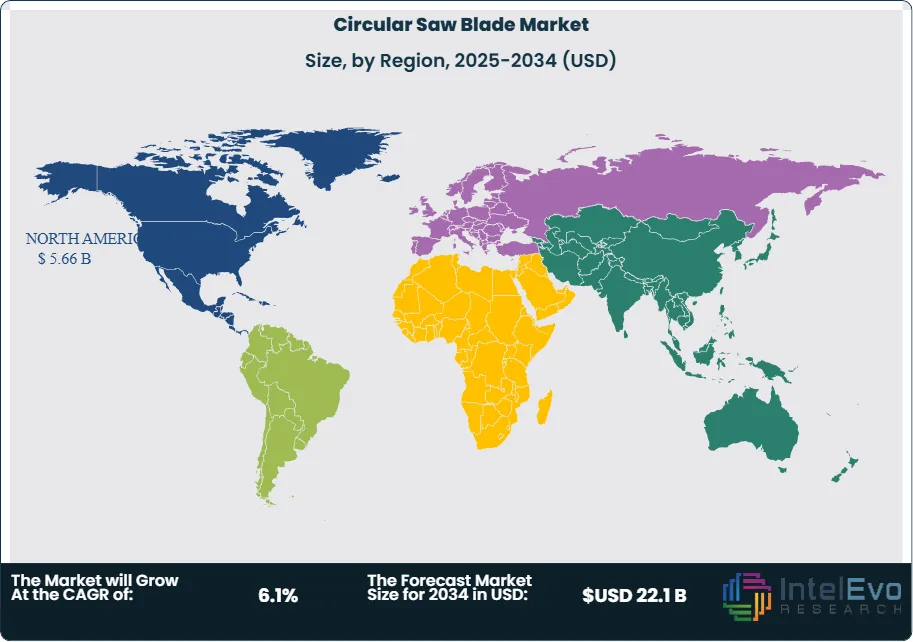
By Type (Carbide Saw Blades, Diamond Saw Blades, Others), By Application (Stone Cutting, Metal Materials Cutting, Wood Cutting)
Research Methodology
Primary Research- 100 Interviews of Stakeholders
Secondary Research
Desk Research
Regional scope
North America (United States, Canada, Mexico)
Latin America (Brazil, Argentina, Columbia)
East Asia And Pacific (China, Japan, South Korea, Australia, Cambodia, Fiji, Indonesia)
Sea And South Asia (India, Singapore, Thailand, Taiwan, Malaysia)
Eastern Europe (Poland, Russia, Czech Republic, Romania)
Western Europe (Germany, U.K., France, Spain, Itlay)
Middle East & Africa (GCC Countries, Egypt, Nigeria, South Africa, Israel)
Competitive Landscape
Robert Bosch GmbH, HUANGHE WHIRLWIND, Stanley Black and Decker, BOSUN, Freud SpA, General Saw, Hilti Corporation, STARK SpA, Lenox, Tenryu Saw Mfg. Co. Ltd., Tangshan Metallurgical Saw Blade, DEWALT
Customization Scope
Customization for segments, region/country-level will be provided. Moreover, additional customization can be done based on the requirements.
Pricing and Purchase Options
Avail customized purchase options to meet your exact research needs. We have three licenses to opt for: Single User License, Multi-User License (Up to 5 Users), Corporate Use License (Unlimited User and Printable PDF).
TABLE OF CONTENTS
1. EXECUTIVE SUMMARY
1.1. MARKET SNAPSHOT
1.2. KEY FINDINGS & INSIGHTS
1.3. ANALYST RECOMMENDATIONS
1.4. FUTURE OUTLOOK
2. RESEARCH METHODOLOGY
2.1. MARKET DEFINITION & SCOPE
2.2. RESEARCH OBJECTIVES: PRIMARY & SECONDARY DATA SOURCES
2.3. DATA COLLECTION SOURCES
2.3.1. COVERAGE OF 100+ PRIMARY RESEARCH/CONSULTATION CALLS WITH INDUSTRY STAKEHOLDERS
FIGURE 17 NORTH AMERICA CIRCULAR SAW BLADE CURRENT AND FUTURE TYPE ANALYSIS, 2025–2034, (USD MILLION)
FIGURE 18 NORTH AMERICA CIRCULAR SAW BLADE CURRENT AND FUTURE END USER ANALYSIS, 2025–2034, (USD MILLION)
FIGURE 19 MARKET SHARE BY COUNTRY
FIGURE 20 LATIN AMERICA CIRCULAR SAW BLADE CURRENT AND FUTURE TYPE ANALYSIS, 2025–2034, (USD MILLION)
FIGURE 21 LATIN AMERICA CIRCULAR SAW BLADE CURRENT AND FUTURE END USER ANALYSIS, 2025–2034, (USD MILLION)
FIGURE 22 MARKET SHARE BY COUNTRY
FIGURE 23 EASTERN EUROPE CIRCULAR SAW BLADE CURRENT AND FUTURE TYPE ANALYSIS, 2025–2034, (USD MILLION)
FIGURE 24 EASTERN EUROPE CIRCULAR SAW BLADE CURRENT AND FUTURE END USER ANALYSIS, 2025–2034, (USD MILLION)
FIGURE 25 MARKET SHARE BY COUNTRY
FIGURE 26 WESTERN EUROPE CIRCULAR SAW BLADE CURRENT AND FUTURE TYPE ANALYSIS, 2025–2034, (USD MILLION)
FIGURE 27 WESTERN EUROPE CIRCULAR SAW BLADE CURRENT AND FUTURE END USER ANALYSIS, 2025–2034, (USD MILLION)
FIGURE 28 MARKET SHARE BY COUNTRY
FIGURE 29 EAST ASIA AND PACIFIC CIRCULAR SAW BLADE CURRENT AND FUTURE TYPE ANALYSIS, 2025–2034, (USD MILLION)
FIGURE 30 EAST ASIA AND PACIFIC CIRCULAR SAW BLADE CURRENT AND FUTURE END USER ANALYSIS, 2025–2034, (USD MILLION)
FIGURE 31 MARKET SHARE BY COUNTRY
FIGURE 32 SEA AND SOUTH ASIA CIRCULAR SAW BLADE CURRENT AND FUTURE TYPE ANALYSIS, 2025–2034, (USD MILLION)
FIGURE 33 SEA AND SOUTH ASIA CIRCULAR SAW BLADE CURRENT AND FUTURE END USER ANALYSIS, 2025–2034, (USD MILLION)
FIGURE 34 MARKET SHARE BY COUNTRY
FIGURE 35 MIDDLE EAST AND AFRICA CIRCULAR SAW BLADE CURRENT AND FUTURE TYPE ANALYSIS, 2025–2034, (USD MILLION)
FIGURE 36 MIDDLE EAST AND AFRICA CIRCULAR SAW BLADE CURRENT AND FUTURE END USER ANALYSIS, 2025–2034, (USD MILLION)
FIGURE 37 NORTH AMERICA CIRCULAR SAW BLADE CURRENT AND FUTURE MARKET VOLUME SHARE REGIONAL ANALYSIS, 2025–2034, (USD MILLION)
FIGURE 38 U.S. CIRCULAR SAW BLADE CURRENT AND FUTURE TYPE ANALYSIS, 2025–2034, (USD MILLION)
FIGURE 39 U.S. CIRCULAR SAW BLADE CURRENT AND FUTURE END USER ANALYSIS, 2025–2034, (USD MILLION)
FIGURE 40 CANADA CIRCULAR SAW BLADE CURRENT AND FUTURE TYPE ANALYSIS, 2025–2034, (USD MILLION)
FIGURE 41 CANADA CIRCULAR SAW BLADE CURRENT AND FUTURE END USER ANALYSIS, 2025–2034, (USD MILLION)
FIGURE 42 LATIN AMERICA CIRCULAR SAW BLADE CURRENT AND FUTURE MARKET VOLUME SHARE REGIONAL ANALYSIS, 2025–2034, (USD MILLION)
FIGURE 43 MEXICO CIRCULAR SAW BLADE CURRENT AND FUTURE TYPE ANALYSIS, 2025–2034, (USD MILLION)
FIGURE 44 MEXICO CIRCULAR SAW BLADE CURRENT AND FUTURE END USER ANALYSIS, 2025–2034, (USD MILLION)
FIGURE 45 BRAZIL CIRCULAR SAW BLADE CURRENT AND FUTURE TYPE ANALYSIS, 2025–2034, (USD MILLION)
FIGURE 46 BRAZIL CIRCULAR SAW BLADE CURRENT AND FUTURE END USER ANALYSIS, 2025–2034, (USD MILLION)
FIGURE 47 ARGENTINA CIRCULAR SAW BLADE CURRENT AND FUTURE TYPE ANALYSIS, 2025–2034, (USD MILLION)
FIGURE 48 ARGENTINA CIRCULAR SAW BLADE CURRENT AND FUTURE END USER ANALYSIS, 2025–2034, (USD MILLION)
FIGURE 49 COLUMBIA CIRCULAR SAW BLADE CURRENT AND FUTURE TYPE ANALYSIS, 2025–2034, (USD MILLION)
FIGURE 50 COLUMBIA CIRCULAR SAW BLADE CURRENT AND FUTURE END USER ANALYSIS, 2025–2034, (USD MILLION)
FIGURE 51 REST OF LATIN AMERICA CIRCULAR SAW BLADE CURRENT AND FUTURE TYPE ANALYSIS, 2025–2034, (USD MILLION)
FIGURE 52 REST OF LATIN AMERICA CIRCULAR SAW BLADE CURRENT AND FUTURE END USER ANALYSIS, 2025–2034, (USD MILLION)
FIGURE 53 EASTERN EUROPE CIRCULAR SAW BLADE CURRENT AND FUTURE MARKET VOLUME SHARE REGIONAL ANALYSIS, 2025–2034, (USD MILLION)
FIGURE 54 POLAND CIRCULAR SAW BLADE CURRENT AND FUTURE TYPE ANALYSIS, 2025–2034, (USD MILLION)
FIGURE 55 POLAND CIRCULAR SAW BLADE CURRENT AND FUTURE END USER ANALYSIS, 2025–2034, (USD MILLION)
FIGURE 56 RUSSIA CIRCULAR SAW BLADE CURRENT AND FUTURE TYPE ANALYSIS, 2025–2034, (USD MILLION)
FIGURE 57 RUSSIA CIRCULAR SAW BLADE CURRENT AND FUTURE END USER ANALYSIS, 2025–2034, (USD MILLION)
FIGURE 58 CZECH REPUBLIC CIRCULAR SAW BLADE CURRENT AND FUTURE TYPE ANALYSIS, 2025–2034, (USD MILLION)
FIGURE 59 CZECH REPUBLIC CIRCULAR SAW BLADE CURRENT AND FUTURE END USER ANALYSIS, 2025–2034, (USD MILLION)
FIGURE 60 ROMANIA CIRCULAR SAW BLADE CURRENT AND FUTURE TYPE ANALYSIS, 2025–2034, (USD MILLION)
FIGURE 61 ROMANIA CIRCULAR SAW BLADE CURRENT AND FUTURE END USER ANALYSIS, 2025–2034, (USD MILLION)
FIGURE 62 REST OF EASTERN EUROPE CIRCULAR SAW BLADE CURRENT AND FUTURE TYPE ANALYSIS, 2025–2034, (USD MILLION)
FIGURE 63 REST OF EASTERN EUROPE CIRCULAR SAW BLADE CURRENT AND FUTURE END USER ANALYSIS, 2025–2034, (USD MILLION)
FIGURE 64 WESTERN EUROPE CIRCULAR SAW BLADE CURRENT AND FUTURE MARKET VOLUME SHARE REGIONAL ANALYSIS, 2025–2034, (USD MILLION)
FIGURE 65 GERMANY CIRCULAR SAW BLADE CURRENT AND FUTURE TYPE ANALYSIS, 2025–2034, (USD MILLION)
FIGURE 66 GERMANY CIRCULAR SAW BLADE CURRENT AND FUTURE END USER ANALYSIS, 2025–2034, (USD MILLION)
FIGURE 67 FRANCE CIRCULAR SAW BLADE CURRENT AND FUTURE TYPE ANALYSIS, 2025–2034, (USD MILLION)
FIGURE 68 FRANCE CIRCULAR SAW BLADE CURRENT AND FUTURE END USER ANALYSIS, 2025–2034, (USD MILLION)
FIGURE 69 UK CIRCULAR SAW BLADE CURRENT AND FUTURE TYPE ANALYSIS, 2025–2034, (USD MILLION)
FIGURE 70 UK CIRCULAR SAW BLADE CURRENT AND FUTURE END USER ANALYSIS, 2025–2034, (USD MILLION)
FIGURE 71 SPAIN CIRCULAR SAW BLADE CURRENT AND FUTURE TYPE ANALYSIS, 2025–2034, (USD MILLION)
FIGURE 72 SPAIN CIRCULAR SAW BLADE CURRENT AND FUTURE END USER ANALYSIS, 2025–2034, (USD MILLION)
FIGURE 73 ITALY CIRCULAR SAW BLADE CURRENT AND FUTURE TYPE ANALYSIS, 2025–2034, (USD MILLION)
FIGURE 74 ITALY CIRCULAR SAW BLADE CURRENT AND FUTURE END USER ANALYSIS, 2025–2034, (USD MILLION)
FIGURE 75 REST OF WESTERN EUROPE CIRCULAR SAW BLADE CURRENT AND FUTURE TYPE ANALYSIS, 2025–2034, (USD MILLION)
FIGURE 76 REST OF WESTERN EUROPE CIRCULAR SAW BLADE CURRENT AND FUTURE END USER ANALYSIS, 2025–2034, (USD MILLION)
FIGURE 77 EAST ASIA AND PACIFIC CIRCULAR SAW BLADE CURRENT AND FUTURE MARKET VOLUME SHARE REGIONAL ANALYSIS, 2025–2034, (USD MILLION)
FIGURE 78 CHINA CIRCULAR SAW BLADE CURRENT AND FUTURE TYPE ANALYSIS, 2025–2034, (USD MILLION)
FIGURE 79 CHINA CIRCULAR SAW BLADE CURRENT AND FUTURE END USER ANALYSIS, 2025–2034, (USD MILLION)
FIGURE 80 JAPAN CIRCULAR SAW BLADE CURRENT AND FUTURE TYPE ANALYSIS, 2025–2034, (USD MILLION)
FIGURE 81 JAPAN CIRCULAR SAW BLADE CURRENT AND FUTURE END USER ANALYSIS, 2025–2034, (USD MILLION)
FIGURE 82 AUSTRALIA CIRCULAR SAW BLADE CURRENT AND FUTURE TYPE ANALYSIS, 2025–2034, (USD MILLION)
FIGURE 83 AUSTRALIA CIRCULAR SAW BLADE CURRENT AND FUTURE END USER ANALYSIS, 2025–2034, (USD MILLION)
FIGURE 84 CAMBODIA CIRCULAR SAW BLADE CURRENT AND FUTURE TYPE ANALYSIS, 2025–2034, (USD MILLION)
FIGURE 85 CAMBODIA CIRCULAR SAW BLADE CURRENT AND FUTURE END USER ANALYSIS, 2025–2034, (USD MILLION)
FIGURE 86 FIJI CIRCULAR SAW BLADE CURRENT AND FUTURE TYPE ANALYSIS, 2025–2034, (USD MILLION)
FIGURE 87 FIJI CIRCULAR SAW BLADE CURRENT AND FUTURE END USER ANALYSIS, 2025–2034, (USD MILLION)
FIGURE 88 INDONESIA CIRCULAR SAW BLADE CURRENT AND FUTURE TYPE ANALYSIS, 2025–2034, (USD MILLION)
FIGURE 89 INDONESIA CIRCULAR SAW BLADE CURRENT AND FUTURE END USER ANALYSIS, 2025–2034, (USD MILLION)
FIGURE 90 SOUTH KOREA CIRCULAR SAW BLADE CURRENT AND FUTURE TYPE ANALYSIS, 2025–2034, (USD MILLION)
FIGURE 91 SOUTH KOREA CIRCULAR SAW BLADE CURRENT AND FUTURE END USER ANALYSIS, 2025–2034, (USD MILLION)
FIGURE 92 REST OF EAST ASIA AND PACIFIC CIRCULAR SAW BLADE CURRENT AND FUTURE TYPE ANALYSIS, 2025–2034, (USD MILLION)
FIGURE 93 REST OF EAST ASIA AND PACIFIC CIRCULAR SAW BLADE CURRENT AND FUTURE END USER ANALYSIS, 2025–2034, (USD MILLION)
FIGURE 94 SEA AND SOUTH ASIA CIRCULAR SAW BLADE CURRENT AND FUTURE MARKET VOLUME SHARE REGIONAL ANALYSIS, 2025–2034, (USD MILLION)
FIGURE 95 BANGLADESH CIRCULAR SAW BLADE CURRENT AND FUTURE TYPE ANALYSIS, 2025–2034, (USD MILLION)
FIGURE 96 BANGLADESH CIRCULAR SAW BLADE CURRENT AND FUTURE END USER ANALYSIS, 2025–2034, (USD MILLION)
FIGURE 97 NEW ZEALAND CIRCULAR SAW BLADE CURRENT AND FUTURE TYPE ANALYSIS, 2025–2034, (USD MILLION)
FIGURE 98 NEW ZEALAND CIRCULAR SAW BLADE CURRENT AND FUTURE END USER ANALYSIS, 2025–2034, (USD MILLION)
FIGURE 99 INDIA CIRCULAR SAW BLADE CURRENT AND FUTURE TYPE ANALYSIS, 2025–2034, (USD MILLION)
FIGURE 100 INDIA CIRCULAR SAW BLADE CURRENT AND FUTURE END USER ANALYSIS, 2025–2034, (USD MILLION)
FIGURE 101 SINGAPORE CIRCULAR SAW BLADE CURRENT AND FUTURE TYPE ANALYSIS, 2025–2034, (USD MILLION)
FIGURE 102 SINGAPORE CIRCULAR SAW BLADE CURRENT AND FUTURE END USER ANALYSIS, 2025–2034, (USD MILLION)
FIGURE 103 THAILAND CIRCULAR SAW BLADE CURRENT AND FUTURE TYPE ANALYSIS, 2025–2034, (USD MILLION)
FIGURE 104 THAILAND CIRCULAR SAW BLADE CURRENT AND FUTURE END USER ANALYSIS, 2025–2034, (USD MILLION)
FIGURE 105 TAIWAN CIRCULAR SAW BLADE CURRENT AND FUTURE TYPE ANALYSIS, 2025–2034, (USD MILLION)
FIGURE 106 TAIWAN CIRCULAR SAW BLADE CURRENT AND FUTURE END USER ANALYSIS, 2025–2034, (USD MILLION)
FIGURE 107 MALAYSIA CIRCULAR SAW BLADE CURRENT AND FUTURE TYPE ANALYSIS, 2025–2034, (USD MILLION)
FIGURE 108 MALAYSIA CIRCULAR SAW BLADE CURRENT AND FUTURE END USER ANALYSIS, 2025–2034, (USD MILLION)
FIGURE 109 REST OF SEA AND SOUTH ASIA CIRCULAR SAW BLADE CURRENT AND FUTURE TYPE ANALYSIS, 2025–2034, (USD MILLION)
FIGURE 110 REST OF SEA AND SOUTH ASIA CIRCULAR SAW BLADE CURRENT AND FUTURE END USER ANALYSIS, 2025–2034, (USD MILLION)
FIGURE 111 MIDDLE EAST AND AFRICA CIRCULAR SAW BLADE CURRENT AND FUTURE MARKET VOLUME SHARE REGIONAL ANALYSIS, 2025–2034, (USD MILLION)
FIGURE 112 GCC COUNTRIES CIRCULAR SAW BLADE CURRENT AND FUTURE TYPE ANALYSIS, 2025–2034, (USD MILLION)
FIGURE 113 GCC COUNTRIES CIRCULAR SAW BLADE CURRENT AND FUTURE END USER ANALYSIS, 2025–2034, (USD MILLION)
FIGURE 114 SAUDI ARABIA CIRCULAR SAW BLADE CURRENT AND FUTURE TYPE ANALYSIS, 2025–2034, (USD MILLION)
FIGURE 115 SAUDI ARABIA CIRCULAR SAW BLADE CURRENT AND FUTURE END USER ANALYSIS, 2025–2034, (USD MILLION)
FIGURE 116 UAE CIRCULAR SAW BLADE CURRENT AND FUTURE TYPE ANALYSIS, 2025–2034, (USD MILLION)
FIGURE 117 UAE CIRCULAR SAW BLADE CURRENT AND FUTURE END USER ANALYSIS, 2025–2034, (USD MILLION)
FIGURE 118 BAHRAIN CIRCULAR SAW BLADE CURRENT AND FUTURE TYPE ANALYSIS, 2025–2034, (USD MILLION)
FIGURE 119 BAHRAIN CIRCULAR SAW BLADE CURRENT AND FUTURE END USER ANALYSIS, 2025–2034, (USD MILLION)
FIGURE 120 KUWAIT CIRCULAR SAW BLADE CURRENT AND FUTURE TYPE ANALYSIS, 2025–2034, (USD MILLION)
FIGURE 121 KUWAIT CIRCULAR SAW BLADE CURRENT AND FUTURE END USER ANALYSIS, 2025–2034, (USD MILLION)
FIGURE 122 OMAN CIRCULAR SAW BLADE CURRENT AND FUTURE TYPE ANALYSIS, 2025–2034, (USD MILLION)
FIGURE 123 OMAN CIRCULAR SAW BLADE CURRENT AND FUTURE END USER ANALYSIS, 2025–2034, (USD MILLION)
FIGURE 124 QATAR CIRCULAR SAW BLADE CURRENT AND FUTURE TYPE ANALYSIS, 2025–2034, (USD MILLION)
FIGURE 125 QATAR CIRCULAR SAW BLADE CURRENT AND FUTURE END USER ANALYSIS, 2025–2034, (USD MILLION)
FIGURE 126 EGYPT CIRCULAR SAW BLADE CURRENT AND FUTURE TYPE ANALYSIS, 2025–2034, (USD MILLION)
FIGURE 127 EGYPT CIRCULAR SAW BLADE CURRENT AND FUTURE END USER ANALYSIS, 2025–2034, (USD MILLION)
FIGURE 128 NIGERIA CIRCULAR SAW BLADE CURRENT AND FUTURE TYPE ANALYSIS, 2025–2034, (USD MILLION)
FIGURE 129 NIGERIA CIRCULAR SAW BLADE CURRENT AND FUTURE END USER ANALYSIS, 2025–2034, (USD MILLION)
FIGURE 130 SOUTH AFRICA CIRCULAR SAW BLADE CURRENT AND FUTURE TYPE ANALYSIS, 2025–2034, (USD MILLION)
FIGURE 131 SOUTH AFRICA CIRCULAR SAW BLADE CURRENT AND FUTURE END USER ANALYSIS, 2025–2034, (USD MILLION)
FIGURE 132 ISRAEL CIRCULAR SAW BLADE CURRENT AND FUTURE TYPE ANALYSIS, 2025–2034, (USD MILLION)
FIGURE 133 ISRAEL CIRCULAR SAW BLADE CURRENT AND FUTURE END USER ANALYSIS, 2025–2034, (USD MILLION)
FIGURE 134 REST OF MEA CIRCULAR SAW BLADE CURRENT AND FUTURE TYPE ANALYSIS, 2025–2034, (USD MILLION)
FIGURE 135 REST OF MEA CIRCULAR SAW BLADE CURRENT AND FUTURE END USER ANALYSIS, 2025–2034, (USD MILLION)
FIGURE 136 U. S. MARKET SHARE ANALYSIS BY TYPE (2024)
FIGURE 137 U. S. MARKET SHARE ANALYSIS BY END USER (2024)
FIGURE 138 CANADA MARKET SHARE ANALYSIS BY TYPE (2024)
FIGURE 139 CANADA MARKET SHARE ANALYSIS BY END USER (2024)
FIGURE 140 MEXICO MARKET SHARE ANALYSIS BY TYPE (2024)
FIGURE 141 MEXICO MARKET SHARE ANALYSIS BY END USER (2024)
FIGURE 142 CHINA MARKET SHARE ANALYSIS BY TYPE (2024)
FIGURE 143 CHINA MARKET SHARE ANALYSIS BY END USER (2024)
FIGURE 144 JAPAN MARKET SHARE ANALYSIS BY TYPE (2024)
FIGURE 145 JAPAN MARKET SHARE ANALYSIS BY END USER (2024)
FIGURE 146 INDIA MARKET SHARE ANALYSIS BY TYPE (2024)
FIGURE 147 INDIA MARKET SHARE ANALYSIS BY END USER (2024)
FIGURE 148 SOUTH KOREA MARKET SHARE ANALYSIS BY TYPE (2024)
FIGURE 149 SOUTH KOREA MARKET SHARE ANALYSIS BY END USER (2024)
FIGURE 150 SAUDI ARABIA MARKET SHARE ANALYSIS BY TYPE (2024)
FIGURE 151 SAUDI ARABIA MARKET SHARE ANALYSIS BY END USER (2024)
FIGURE 152 UAE MARKET SHARE ANALYSIS BY TYPE (2024)
FIGURE 153 UAE MARKET SHARE ANALYSIS BY END USER (2024)
FIGURE 154 EGYPT MARKET SHARE ANALYSIS BY TYPE (2024)
FIGURE 155 EGYPT MARKET SHARE ANALYSIS BY END USER (2024)
FIGURE 156 NIGERIA MARKET SHARE ANALYSIS BY TYPE (2024)
FIGURE 157 NIGERIA MARKET SHARE ANALYSIS BY END USER (2024)
FIGURE 158 SOUTH AFRICA MARKET SHARE ANALYSIS BY TYPE (2024)
FIGURE 159 SOUTH AFRICA MARKET SHARE ANALYSIS BY END USER (2024)
FIGURE 160 GERMANY MARKET SHARE ANALYSIS BY TYPE (2024)
FIGURE 161 GERMANY MARKET SHARE ANALYSIS BY END USER (2024)
FIGURE 162 FRANCE MARKET SHARE ANALYSIS BY TYPE (2024)
FIGURE 163 FRANCE MARKET SHARE ANALYSIS BY END USER (2024)
FIGURE 164 UK MARKET SHARE ANALYSIS BY TYPE (2024)
FIGURE 165 UK MARKET SHARE ANALYSIS BY END USER (2024)
FIGURE 166 SPAIN MARKET SHARE ANALYSIS BY TYPE (2024)
FIGURE 167 SPAIN MARKET SHARE ANALYSIS BY END USER (2024)
FIGURE 168 ITALY MARKET SHARE ANALYSIS BY TYPE (2024)
FIGURE 169 ITALY MARKET SHARE ANALYSIS BY END USER (2024)
FIGURE 170 BRAZIL MARKET SHARE ANALYSIS BY TYPE (2024)
FIGURE 171 BRAZIL MARKET SHARE ANALYSIS BY END USER (2024)
FIGURE 172 ARGENTINA MARKET SHARE ANALYSIS BY TYPE (2024)
FIGURE 173 ARGENTINA MARKET SHARE ANALYSIS BY END USER (2024)
FIGURE 174 COLUMBIA MARKET SHARE ANALYSIS BY TYPE (2024)
FIGURE 175 COLUMBIA MARKET SHARE ANALYSIS BY END USER (2024)
FIGURE 176 GLOBAL CIRCULAR SAW BLADE CURRENT AND FUTURE MARKET KEY COUNTRY LEVEL ANALYSIS, 2024–2034, (USD MILLION)
FIGURE 177 FINANCIAL OVERVIEW:
Key Player Analysis
Freud SpA: Freud SpA maintains its position as a market leader in the global circular saw blade market, driven by its deep specialization in carbide-tipped cutting tools and its commitment to high-performance, precision-engineered products. As a subsidiary of Bosch Group, Freud benefits from advanced R&D capabilities and a global distribution network, enabling it to meet industrial-grade demands across woodworking, metal cutting, and composite material applications. The company’s strategic focus on innovative blade geometries and proprietary TiCo™ carbide formulations has positioned it as a preferred supplier among professional users and manufacturers requiring durability, clean cuts, and minimal vibration.
In 2025, Freud continues to expand its smart tooling initiatives, with integration of IoT-based diagnostics for wear monitoring and maintenance alerts—a move aligning with the broader industry shift toward predictive maintenance and factory automation. Its investments in eco-friendly manufacturing processes and recyclable packaging also strengthen its appeal in sustainability-conscious markets, particularly in Europe. With a strong foothold in both premium and mid-tier segments, Freud is expected to maintain stable double-digit growth across North America and Western Europe.
Robert Bosch GmbH: Robert Bosch GmbH operates as an industry innovator, leveraging its multi-sector engineering expertise to develop advanced circular saw blades optimized for precision, safety, and digital integration. Bosch’s product lineup covers a wide range of professional and consumer-grade saw blades, supported by its proprietary “Expert” blade series designed for high-speed and high-efficiency cutting in metal, masonry, and engineered wood. Bosch’s reputation for integrating smart technology and automation compatibility into its tools strengthens its value proposition in the industrial and professional trades.
In 2025, Bosch continues to lead in embedding sensor technology and adaptive cutting systems into its power tool ecosystem, creating a unified platform experience for users operating within automated workshops. Its aggressive R&D investments—totaling over €7 billion across all divisions in the last fiscal year—reflect a clear commitment to digital transformation. Bosch’s global manufacturing footprint and robust distribution partnerships give it a strategic edge in both mature and emerging markets, with notable expansion across Asia Pacific, particularly in India and Southeast Asia.
Stanley Black & Decker: Stanley Black & Decker is positioned as a challenger with a diversified brand portfolio targeting both professional contractors and DIY consumers. Through its flagship brands—DeWalt, Craftsman, and Irwin—the company offers a broad spectrum of circular saw blades catering to woodworking, construction, and general-purpose use. The company continues to grow its market share through aggressive product innovation, pricing competitiveness, and omnichannel retail strategies, particularly in North America.
In 2025, Stanley Black & Decker is accelerating its push into sustainable product development and smart jobsite solutions, launching saw blades with reduced material waste and longer lifespan, backed by ongoing investment in its “DEWALT Tool Connect” platform for real-time equipment monitoring. The company is also focusing on expanding its presence in Latin America and select parts of Asia, supported by local assembly units and a strategic shift toward localization. Its hybrid approach—balancing volume-driven sales with innovation—positions it well in price-sensitive and growing markets.
Tenryu Saw Mfg. Co. Ltd.: Tenryu Saw Mfg. Co. Ltd. is recognized as a high-precision niche player, with a strong presence in the Japanese and Southeast Asian industrial markets. Known for its custom-engineered circular saw blades used in high-performance applications such as aerospace, automotive manufacturing, and specialty metal processing, Tenryu’s strength lies in its deep technical expertise and commitment to product quality. Its blades are often favored in operations requiring ultra-fine tolerances and minimal material deformation.
In response to 2025 market demands, Tenryu is enhancing its digital manufacturing capabilities and investing in AI-driven blade design simulation tools, improving time-to-market and customization flexibility. The company is also exploring sustainable production techniques, including water-based coatings and recyclable packaging solutions, as part of its mid-term ESG strategy. While its global footprint remains smaller than multinational players, Tenryu’s technical precision, customer-specific solutions, and quality reputation position it as a valued supplier in high-specification and custom tooling markets.
Market Key Players
Robert Bosch GmbH
HUANGHE WHIRLWIND
Stanley Black and Decker
BOSUN
Freud SpA
General Saw
Hilti Corporation
STARK SpA
Lenox
Tenryu Saw Mfg. Co. Ltd.
Tangshan Metallurgical Saw Blade
DEWALT
Driver:
Automation Drives Demand for High-Precision Blades
As of 2025, the global circular saw blade market is being reshaped by rapid automation in manufacturing environments. With over 60% of woodworking and metalworking facilities integrating robotic systems and CNC machines, there is growing demand for cutting tools that can maintain high performance under continuous, precision-intensive operations. Circular saw blades designed for automated systems must deliver exacting tolerances, superior wear resistance, and minimal vibration—qualities most prevalent in advanced carbide and diamond-tipped products.
Industry 4.0 Compatibility Catalyzes Strategic R&D Investment
This shift toward automation is not just operational—it’s strategic. Manufacturers that align with Industry 4.0 standards are prioritizing tool compatibility with smart systems, driving investments in R&D for digitally optimized blades. As a result, automation is catalyzing a new wave of innovation and product differentiation, while simultaneously expanding the total addressable market for high-performance cutting tools.
Restraint:
Tightening Regulations Increase Compliance Costs and Complexity
One of the key limitations facing the circular saw blade market in 2025 is the tightening regulatory landscape around manufacturing processes. Compliance with safety, emissions, and sustainability standards—particularly in North America and the EU—has increased production complexity and raised costs for blade manufacturers. For example, regulations on hazardous material use in coatings and stricter workplace safety protocols have led to additional capital expenditures and reengineering of manufacturing lines.
Safety and Sustainability Standards Slow Innovation and Constrain Margins
While these regulations enhance product safety and environmental responsibility, they also create entry barriers for smaller players and slow the rollout of new products. The immediate impact is a constrained innovation cycle and margin pressure, especially in price-sensitive markets. Strategically, companies must now integrate compliance into their R&D and sourcing strategies, or risk losing competitiveness in regulated regions.
A major growth opportunity for the circular saw blade market lies in the expansion into emerging economies and the localization of product portfolios. With infrastructure spending accelerating across Southeast Asia, Latin America, and the Middle East, there is increasing demand for application-specific blades—particularly in stone and metal cutting—for roads, housing, and commercial structures. The market in these regions is projected to grow at a CAGR exceeding 6% through 2030, significantly outpacing the global average.
Localization and Diversification of Product Portfolios Capture New Margins
This creates strategic white space for manufacturers to localize production, offer climate- and material-adapted tools, and establish regional distribution networks. Furthermore, product diversification—such as blades tailored for engineered woods or high-density concrete—can enhance margins and meet the specialized demands of new markets. Market leaders that invest in tailored solutions and scalable distribution models are poised to capture the next wave of growth.
Trend:
Digitalization and Smart Tooling Integration Become Industry Standard
As of 2025, the circular saw blade market is undergoing a structural transformation through digitalization and smart tooling integration. The use of IoT-enabled blades and AI-driven production systems is no longer a future prospect—it is an emerging standard in high-throughput operations. Manufacturers are embedding sensors into sawing systems that monitor blade temperature, sharpness, and alignment in real time, allowing for predictive maintenance and enhanced process control.
IoT Sensors and AI Analytics Redefine Value and Enable Predictive Maintenance
This trend is particularly relevant in industries requiring consistent, high-precision output—such as aerospace, automotive, and modular construction. Digital twins and AI-based simulations are also being used in blade design to reduce prototyping costs and accelerate time-to-market. The companies that lead in digital transformation—those offering data-integrated blades and cloud-based performance analytics—are redefining value in an otherwise commoditized segment, capturing premium customers and long-term service contracts.
Recent Developments
Dec 2024 – Robert Bosch GmbH: Bosch launched its new Expert FiberCut series of circular saw blades, engineered specifically for composite materials and engineered wood. The product line integrates advanced anti-vibration slots and heat-dissipating coatings, targeting professional carpentry and prefab construction applications. This move strengthens Bosch’s foothold in the high-precision construction tools segment and aligns with growing demand in modular building systems.
Feb 2025 – Stanley Black & Decker: The company finalized a strategic partnership with Mexican distributor Grupo Ferresol, expanding its circular saw blade distribution network across Latin America. The agreement is expected to increase regional sales by over 20% in the next 12 months. This expansion reinforces Stanley Black & Decker’s push into high-growth emerging markets and diversifies its global revenue mix.
Apr 2025 – Freud SpA: Freud announced a USD 38 million investment in a new R&D and manufacturing facility in Northern Italy, dedicated to sustainable tooling solutions. The plant will focus on developing circular saw blades with recyclable materials and reduced carbon production processes. This initiative enhances Freud’s ESG positioning and supports its leadership in eco-conscious blade innovation.
Jul 2025 – Tenryu Saw Mfg. Co. Ltd.: Tenryu introduced a proprietary AI-powered blade customization platform that enables industrial clients to order application-specific saw blades with precision geometry and coating selection. The system has reduced prototyping time by up to 45%, according to initial pilot reports. The launch signals Tenryu’s commitment to digital transformation and strengthens its role as a custom solutions provider in the high-end market.
Sep 2025 – Makita Corporation: Makita entered the circular saw blade segment with its debut MaxEdge line, targeting professional and semi-professional users. The launch includes carbide-tipped and multi-material variants compatible with Makita’s existing power tool ecosystem. This marks a disruptive entry by a power tool leader, potentially intensifying competitive pressure on established blade manufacturers across Asia and Europe.
