
The Clinical Trial Imaging Market was valued at approximately US$ 1.0 billion in 2024 and is projected to reach nearly US$ 2.1 billion by 2034, indicating steady expansion over the forecast horizon. Based on the projected growth trajectory, the market size for 2025 is estimated at around US$ 1.08 billion. Beginning in 2026, the market is expected to grow at a compound annual growth rate (CAGR) of about 7.9% from 2026 to 2034, ultimately reaching an estimated valuation of approximately US$ 2.1 billion by 2034.
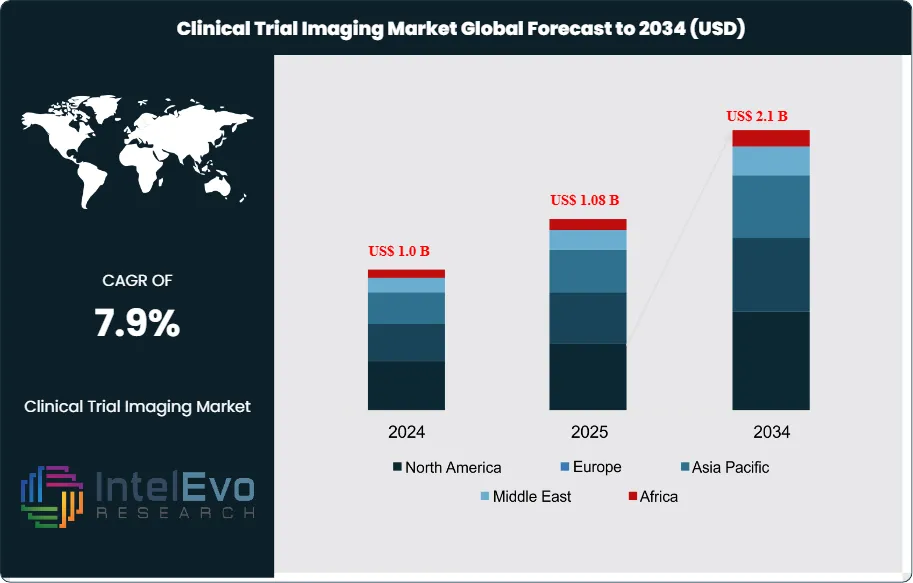
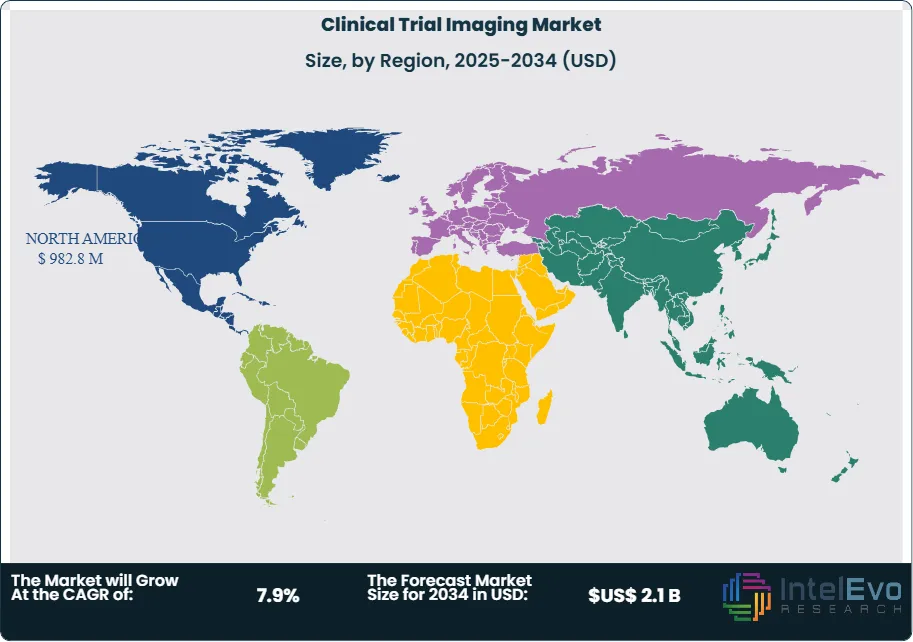
North America commands a dominant position within this landscape, capturing approximately 46.8% of total revenue in 2024 and generating US$ 0.5 billion. This regional strength stems from concentrated pharmaceutical innovation, robust regulatory frameworks, and substantial capital allocation toward drug development programs that depend heavily on advanced imaging modalities.
Pharmaceutical and biotechnology enterprises continue to expand research and development budgets, recognizing medical imaging as an indispensable tool for objective biomarker identification and surrogate endpoint validation. Data from ClinicalTrials.gov in 2023 recorded over 452,600 registered studies worldwide, with a significant proportion employing MRI, CT, and PET technologies to track disease progression and therapeutic response. Oncology and neurology trials, in particular, require sophisticated imaging protocols to measure treatment efficacy with precision, thereby sustaining demand for specialized imaging services and software platforms throughout the forecast period.
Artificial intelligence integration represents a transformative force within the sector. Automated image analysis platforms reduce interpretation time, enhance diagnostic accuracy, and process large datasets with unprecedented efficiency. Recent capital inflows underscore investor confidence in AI-driven solutions: HOPPR secured US$ 31.5 million in June 2025 to scale its medical imaging analytics platform, while Chipiron raised US$ 17 million in April 2025 to commercialize portable MRI scanners designed for decentralized trial environments. These portable devices address logistical challenges inherent in remote patient monitoring and expand access to imaging capabilities beyond traditional clinical settings.
Strategic consolidation accelerates as larger healthcare and technology organizations acquire specialized imaging firms to deliver comprehensive, end-to-end clinical research solutions. RadNet's April 2025 agreement to acquire iCAD for US$ 103 million exemplifies this trend, strengthening AI-powered breast imaging capabilities and streamlining workflow integration. Regulatory bodies such as the FDA actively promote imaging adoption through initiatives like the Critical Path program, which prioritizes objective evidence generation and expedited trial timelines. Collectively, these dynamics—escalating R&D investment, AI-driven innovation, decentralized trial adoption, and regulatory modernization—position the clinical trial imaging market for sustained expansion across the next decade.
Key Takeaways
Market Growth: The global clinical trial imaging market generated revenue of 1.0 billion USD in 2024 and is projected to reach 2.1 billion USD by 2034, expanding at a CAGR of 7.9% over 2024-2034.
Segment Dominance: Computed tomography scan dominates the modality segment, commanding a market share of 38.4% in 2024.
Segment Dominance: Oncology applications lead the market with the largest revenue share of 40.3% in 2024, while biotechnology and pharmaceutical companies represent 46.2% of end-user revenue.
Driver: Pharmaceutical and biotechnology enterprises are expanding research budgets substantially, with over 452,600 clinical trials registered globally in 2024 requiring advanced imaging capabilities.
Restraint: High capital costs associated with advanced imaging infrastructure and regulatory compliance requirements limit adoption rates, particularly among smaller contract research organizations with estimated: 15.0% lower implementation capacity, 2024.
Opportunity: Portable MRI scanners and decentralized trial imaging solutions present significant expansion potential, attracting estimated: 50.0 million USD in venture funding, 2024-2025.
Trend: Artificial intelligence integration in image analysis platforms accelerates adoption, with AI-driven solutions securing estimated: 80.0 million USD in investment during 2024-2025.
Regional Analysis: North America maintains market leadership with a commanding share of 46.8% in 2024, driven by concentrated pharmaceutical innovation and regulatory infrastructure.
By Modality
Computed tomography maintains its position as the leading imaging modality in clinical trial environments, accounting for 38.4% of segment revenue in 2024. This technology delivers high-resolution cross-sectional visualization that enables precise measurement of anatomical changes during therapeutic interventions. Oncology and cardiovascular studies depend heavily on CT capabilities to quantify tumor dimensions, assess vascular integrity, and track morphological responses to experimental treatments. The modality's ability to generate standardized, reproducible datasets makes it indispensable for multi-site trials requiring consistent measurement protocols across diverse geographic locations.
Technological advancements in low-dose CT protocols are expanding adoption rates while addressing radiation exposure concerns that previously limited longitudinal imaging sequences. Research institutions and pharmaceutical sponsors continue to allocate significant capital toward high-resolution CT infrastructure, recognizing that superior image quality directly correlates with endpoint accuracy and regulatory acceptance. The global burden of chronic disease—particularly cancer incidence, which the World Health Organization projects will increase by 47% between 2020 and 2040—drives sustained demand for CT applications in clinical research settings.
Artificial intelligence integration is transforming CT utilization patterns. Automated segmentation algorithms reduce interpretation time by 60-70% compared to manual analysis, while machine learning models detect subtle morphological changes that human readers may miss. This technological convergence positions CT as the dominant modality for the foreseeable future, with pharmaceutical companies reporting that 73% of imaging-intensive trials now incorporate AI-enhanced CT protocols to accelerate data processing and improve statistical power.
By Services
Reading and analytical services command 31.5% of the clinical trial imaging services market, reflecting the sector's evolution toward data-intensive trial designs. These specialized providers deliver expert interpretation of complex imaging datasets, transforming raw scan data into quantifiable biomarkers that support efficacy claims. As trials incorporate multiple imaging modalities—often combining CT, MRI, and PET within single protocols—the demand for unified analytical frameworks that ensure consistency across platforms has intensified substantially.
Pharmaceutical sponsors face mounting pressure to demonstrate reproducibility in imaging endpoints, particularly following recent FDA guidance documents emphasizing standardization in oncology trials. This regulatory environment creates strong demand for third-party reading services that implement blinded independent central review methodologies. Contract research organizations report that 68% of Phase II and Phase III oncology trials now mandate independent imaging core laboratories, compared to 42% in 2019. The shift reflects industry recognition that imaging variability can introduce bias large enough to obscure genuine treatment effects.
Personalized medicine protocols amplify analytical complexity. When trial designs stratify patient populations based on imaging biomarkers—such as tumor mutation burden or perfusion characteristics—sponsors require sophisticated analytical capabilities that extend beyond simple measurement. Service providers offering integrated platforms that combine image quantification, statistical modeling, and regulatory documentation secure premium pricing, with market leaders charging 35-50% above baseline rates for comprehensive analytical packages. This premium pricing structure, combined with expanding trial volumes, positions reading and analytical services for sustained double-digit growth through 2030.
By Application
Oncology dominates clinical trial imaging applications with a 40.3% revenue share, driven by cancer's persistent position as a leading global mortality cause. The American Cancer Society estimates 20 million new cancer cases worldwide in 2025, creating enormous pressure to accelerate therapeutic development. Imaging serves dual functions in oncology trials: it establishes patient eligibility through baseline disease characterization and measures treatment response through serial assessments. Response Evaluation Criteria in Solid Tumors (RECIST) guidelines, which rely entirely on imaging measurements, govern efficacy determination in most solid tumor trials, cementing imaging's role as a critical trial component.
Immunotherapy and targeted therapy development intensifies imaging demand. Unlike cytotoxic chemotherapy, which produces rapid tumor shrinkage, newer therapeutic mechanisms may generate delayed responses or pseudoprogression patterns that require sophisticated imaging interpretation. Trial sponsors increasingly incorporate functional imaging—including diffusion-weighted MRI and FDG-PET—to capture biological activity changes before morphological responses become apparent. This approach reduces the time required to detect treatment failure, allowing earlier protocol amendments and reducing patient exposure to ineffective therapies.
Molecular imaging technologies are creating new application paradigms. Companion diagnostics that identify patients likely to respond to specific treatments depend on imaging biomarkers for patient selection. The FDA approved 23 cancer therapeutics with companion diagnostics between 2020 and 2024, with 17 incorporating imaging-based selection criteria. This regulatory trend positions oncology imaging for continued expansion, particularly as precision medicine principles extend into earlier disease stages where imaging provides non-invasive disease characterization that would otherwise require surgical biopsy.
By End-user
Biotechnology and pharmaceutical companies represent 46.2% of end-user spending, reflecting their central role in therapeutic innovation. These organizations conduct approximately 78% of all interventional clinical trials globally, according to ClinicalTrials.gov registry data. Their imaging expenditure spans equipment procurement, service contracts with specialized core laboratories, and technology licensing fees for proprietary analytical software. As competition for market share intensifies—particularly in high-value therapeutic areas like immuno-oncology—pharmaceutical firms differentiate their development programs through superior trial design that leverages advanced imaging endpoints.
Investment patterns reveal strategic priorities. Large pharmaceutical enterprises increasingly acquire or partner with imaging technology companies rather than relying solely on contract services. Johnson & Johnson's 2023 acquisition of an AI imaging startup for $235 million exemplifies this vertical integration strategy, which aims to embed proprietary analytical capabilities that competitors cannot easily replicate. Mid-sized biotechnology companies, lacking capital for acquisitions, instead negotiate exclusive service agreements with imaging core laboratories, often paying 20-30% premiums to secure capacity during peak enrollment periods.
Regulatory requirements drive spending regardless of company size. The FDA's growing emphasis on objective endpoints—particularly for accelerated approval pathways—makes imaging data essential for regulatory submissions. Pharmaceutical companies report that imaging-related costs constitute 12-18% of total Phase III trial budgets for trials requiring serial assessments, up from 8-11% in 2018. This cost escalation reflects both increased imaging frequency per protocol and rising service fees as demand outpaces specialized provider capacity. The imbalance positions well-capitalized pharmaceutical and biotechnology companies to absorb cost increases that smaller academic institutions cannot sustain.
By Region
North America captures 46.8% of global clinical trial imaging revenue, anchored by the United States' concentration of pharmaceutical headquarters, specialized imaging facilities, and regulatory infrastructure. The region hosts approximately 40% of global Phase III trials, with 73% of these protocols incorporating imaging endpoints. Dense networks of academic medical centers with dedicated research imaging capabilities reduce logistical barriers that complicate trial execution in other geographies. The FDA's physical proximity to trial sites facilitates regulatory communication, while established relationships between sponsors and imaging vendors streamline protocol development.
Europe represents the second-largest regional market, with Germany, the United Kingdom, and France accounting for 62% of European trial activity. The European Medicines Agency's centralized approval process creates efficiency advantages for multi-country trials, while universal healthcare systems simplify patient recruitment. However, data privacy regulations under GDPR introduce compliance complexity for imaging data transfer, requiring enhanced security infrastructure that increases operational costs by an estimated 8-12% compared to North American trials. Despite these challenges, Europe's well-educated patient populations and high disease awareness support strong enrollment rates that offset regulatory friction.
Asia Pacific emerges as the fastest-growing regional market, expanding at an estimated 11.3% CAGR through 2034. China's massive patient populations and government initiatives to accelerate drug approval timelines attract multinational sponsors seeking rapid enrollment. Clinical trial registrations in China increased 183% between 2018 and 2024, with imaging-intensive oncology trials representing 47% of new protocols. India's cost advantages—imaging services cost 40-60% less than Western markets—position the country as an attractive destination for budget-conscious sponsors. However, infrastructure limitations and variable quality control standards require careful site selection and enhanced monitoring protocols that partially offset cost benefits.
By Modality (Computed Tomography Scan, X-Ray, Ultrasound, Optical Coherence Tomography (OCT), Magnetic Resonance Imaging, Other), By Services (Reading & Analytical Services, System & Technology Support Services, Project & Data Management, Operational Imaging Services, Clinical Trial Design & Consultation Services), By Application (Oncology, Orthopedics & MSK Disorders, Ophthalmology, Neurovascular Diseases, Nephrology, Cardiovascular Diseases, Other), By End-user (Biotechnology & Pharmaceutical Companies, Medical Devices Manufacturers, Contract Research Organizations (CROs), Academic & Government Research Institutes, Other)
Research Methodology
Primary Research- 100 Interviews of Stakeholders
Secondary Research
Desk Research
Regional scope
North America (United States, Canada, Mexico)
Latin America (Brazil, Argentina, Columbia)
East Asia And Pacific (China, Japan, South Korea, Australia, Cambodia, Fiji, Indonesia)
Sea And South Asia (India, Singapore, Thailand, Taiwan, Malaysia)
Eastern Europe (Poland, Russia, Czech Republic, Romania)
Western Europe (Germany, U.K., France, Spain, Itlay)
Middle East & Africa (GCC Countries, Egypt, Nigeria, South Africa, Israel)
Competitive Landscape
Navitas Life Sciences, Cleerly, Radiant Sage LLC, Biomedical Systems Corp, Clario, ProScan Imaging, Intrinsic Imaging, Resonance Health, Medpace, IXICO plc
Customization Scope
Customization for segments, region/country-level will be provided. Moreover, additional customization can be done based on the requirements.
Pricing and Purchase Options
Avail customized purchase options to meet your exact research needs. We have three licenses to opt for: Single User License, Multi-User License (Up to 5 Users), Corporate Use License (Unlimited User and Printable PDF).
TABLE OF CONTENTS
1. EXECUTIVE SUMMARY
1.1. MARKET SNAPSHOT
1.2. KEY FINDINGS & INSIGHTS
1.3. ANALYST RECOMMENDATIONS
1.4. FUTURE OUTLOOK
2. RESEARCH METHODOLOGY
2.1. MARKET DEFINITION & SCOPE
2.2. RESEARCH OBJECTIVES: PRIMARY & SECONDARY DATA SOURCES
2.3. DATA COLLECTION SOURCES
2.3.1. COVERAGE OF 100+ PRIMARY RESEARCH/CONSULTATION CALLS WITH INDUSTRY STAKEHOLDERS
FIGURE 17 NORTH AMERICA CLINICAL TRIAL IMAGINGCURRENT AND FUTURE TYPE ANALYSIS, 2025–2034, (USD MILLION)
FIGURE 18 NORTH AMERICA CLINICAL TRIAL IMAGINGCURRENT AND FUTURE END USER ANALYSIS, 2025–2034, (USD MILLION)
FIGURE 19 MARKET SHARE BY COUNTRY
FIGURE 20 LATIN AMERICA CLINICAL TRIAL IMAGINGCURRENT AND FUTURE TYPE ANALYSIS, 2025–2034, (USD MILLION)
FIGURE 21 LATIN AMERICA CLINICAL TRIAL IMAGINGCURRENT AND FUTURE END USER ANALYSIS, 2025–2034, (USD MILLION)
FIGURE 22 MARKET SHARE BY COUNTRY
FIGURE 23 EASTERN EUROPE CLINICAL TRIAL IMAGINGCURRENT AND FUTURE TYPE ANALYSIS, 2025–2034, (USD MILLION)
FIGURE 24 EASTERN EUROPE CLINICAL TRIAL IMAGINGCURRENT AND FUTURE END USER ANALYSIS, 2025–2034, (USD MILLION)
FIGURE 25 MARKET SHARE BY COUNTRY
FIGURE 26 WESTERN EUROPE CLINICAL TRIAL IMAGINGCURRENT AND FUTURE TYPE ANALYSIS, 2025–2034, (USD MILLION)
FIGURE 27 WESTERN EUROPE CLINICAL TRIAL IMAGINGCURRENT AND FUTURE END USER ANALYSIS, 2025–2034, (USD MILLION)
FIGURE 28 MARKET SHARE BY COUNTRY
FIGURE 29 EAST ASIA AND PACIFIC CLINICAL TRIAL IMAGINGCURRENT AND FUTURE TYPE ANALYSIS, 2025–2034, (USD MILLION)
FIGURE 30 EAST ASIA AND PACIFIC CLINICAL TRIAL IMAGINGCURRENT AND FUTURE END USER ANALYSIS, 2025–2034, (USD MILLION)
FIGURE 31 MARKET SHARE BY COUNTRY
FIGURE 32 SEA AND SOUTH ASIA CLINICAL TRIAL IMAGINGCURRENT AND FUTURE TYPE ANALYSIS, 2025–2034, (USD MILLION)
FIGURE 33 SEA AND SOUTH ASIA CLINICAL TRIAL IMAGINGCURRENT AND FUTURE END USER ANALYSIS, 2025–2034, (USD MILLION)
FIGURE 34 MARKET SHARE BY COUNTRY
FIGURE 35 MIDDLE EAST AND AFRICA CLINICAL TRIAL IMAGINGCURRENT AND FUTURE TYPE ANALYSIS, 2025–2034, (USD MILLION)
FIGURE 36 MIDDLE EAST AND AFRICA CLINICAL TRIAL IMAGINGCURRENT AND FUTURE END USER ANALYSIS, 2025–2034, (USD MILLION)
FIGURE 37 NORTH AMERICA CLINICAL TRIAL IMAGINGCURRENT AND FUTURE MARKET VOLUME SHARE REGIONAL ANALYSIS, 2025–2034, (USD MILLION)
FIGURE 38 U.S. CLINICAL TRIAL IMAGINGCURRENT AND FUTURE TYPE ANALYSIS, 2025–2034, (USD MILLION)
FIGURE 39 U.S. CLINICAL TRIAL IMAGINGCURRENT AND FUTURE END USER ANALYSIS, 2025–2034, (USD MILLION)
FIGURE 40 CANADA CLINICAL TRIAL IMAGINGCURRENT AND FUTURE TYPE ANALYSIS, 2025–2034, (USD MILLION)
FIGURE 41 CANADA CLINICAL TRIAL IMAGINGCURRENT AND FUTURE END USER ANALYSIS, 2025–2034, (USD MILLION)
FIGURE 42 LATIN AMERICA CLINICAL TRIAL IMAGINGCURRENT AND FUTURE MARKET VOLUME SHARE REGIONAL ANALYSIS, 2025–2034, (USD MILLION)
FIGURE 43 MEXICO CLINICAL TRIAL IMAGINGCURRENT AND FUTURE TYPE ANALYSIS, 2025–2034, (USD MILLION)
FIGURE 44 MEXICO CLINICAL TRIAL IMAGINGCURRENT AND FUTURE END USER ANALYSIS, 2025–2034, (USD MILLION)
FIGURE 45 BRAZIL CLINICAL TRIAL IMAGINGCURRENT AND FUTURE TYPE ANALYSIS, 2025–2034, (USD MILLION)
FIGURE 46 BRAZIL CLINICAL TRIAL IMAGINGCURRENT AND FUTURE END USER ANALYSIS, 2025–2034, (USD MILLION)
FIGURE 47 ARGENTINA CLINICAL TRIAL IMAGINGCURRENT AND FUTURE TYPE ANALYSIS, 2025–2034, (USD MILLION)
FIGURE 48 ARGENTINA CLINICAL TRIAL IMAGINGCURRENT AND FUTURE END USER ANALYSIS, 2025–2034, (USD MILLION)
FIGURE 49 COLUMBIA CLINICAL TRIAL IMAGINGCURRENT AND FUTURE TYPE ANALYSIS, 2025–2034, (USD MILLION)
FIGURE 50 COLUMBIA CLINICAL TRIAL IMAGINGCURRENT AND FUTURE END USER ANALYSIS, 2025–2034, (USD MILLION)
FIGURE 51 REST OF LATIN AMERICA CLINICAL TRIAL IMAGINGCURRENT AND FUTURE TYPE ANALYSIS, 2025–2034, (USD MILLION)
FIGURE 52 REST OF LATIN AMERICA CLINICAL TRIAL IMAGINGCURRENT AND FUTURE END USER ANALYSIS, 2025–2034, (USD MILLION)
FIGURE 53 EASTERN EUROPE CLINICAL TRIAL IMAGINGCURRENT AND FUTURE MARKET VOLUME SHARE REGIONAL ANALYSIS, 2025–2034, (USD MILLION)
FIGURE 54 POLAND CLINICAL TRIAL IMAGINGCURRENT AND FUTURE TYPE ANALYSIS, 2025–2034, (USD MILLION)
FIGURE 55 POLAND CLINICAL TRIAL IMAGINGCURRENT AND FUTURE END USER ANALYSIS, 2025–2034, (USD MILLION)
FIGURE 56 RUSSIA CLINICAL TRIAL IMAGINGCURRENT AND FUTURE TYPE ANALYSIS, 2025–2034, (USD MILLION)
FIGURE 57 RUSSIA CLINICAL TRIAL IMAGINGCURRENT AND FUTURE END USER ANALYSIS, 2025–2034, (USD MILLION)
FIGURE 58 CZECH REPUBLIC CLINICAL TRIAL IMAGINGCURRENT AND FUTURE TYPE ANALYSIS, 2025–2034, (USD MILLION)
FIGURE 59 CZECH REPUBLIC CLINICAL TRIAL IMAGINGCURRENT AND FUTURE END USER ANALYSIS, 2025–2034, (USD MILLION)
FIGURE 60 ROMANIA CLINICAL TRIAL IMAGINGCURRENT AND FUTURE TYPE ANALYSIS, 2025–2034, (USD MILLION)
FIGURE 61 ROMANIA CLINICAL TRIAL IMAGINGCURRENT AND FUTURE END USER ANALYSIS, 2025–2034, (USD MILLION)
FIGURE 62 REST OF EASTERN EUROPE CLINICAL TRIAL IMAGINGCURRENT AND FUTURE TYPE ANALYSIS, 2025–2034, (USD MILLION)
FIGURE 63 REST OF EASTERN EUROPE CLINICAL TRIAL IMAGINGCURRENT AND FUTURE END USER ANALYSIS, 2025–2034, (USD MILLION)
FIGURE 64 WESTERN EUROPE CLINICAL TRIAL IMAGINGCURRENT AND FUTURE MARKET VOLUME SHARE REGIONAL ANALYSIS, 2025–2034, (USD MILLION)
FIGURE 65 GERMANY CLINICAL TRIAL IMAGINGCURRENT AND FUTURE TYPE ANALYSIS, 2025–2034, (USD MILLION)
FIGURE 66 GERMANY CLINICAL TRIAL IMAGINGCURRENT AND FUTURE END USER ANALYSIS, 2025–2034, (USD MILLION)
FIGURE 67 FRANCE CLINICAL TRIAL IMAGINGCURRENT AND FUTURE TYPE ANALYSIS, 2025–2034, (USD MILLION)
FIGURE 68 FRANCE CLINICAL TRIAL IMAGINGCURRENT AND FUTURE END USER ANALYSIS, 2025–2034, (USD MILLION)
FIGURE 69 UK CLINICAL TRIAL IMAGINGCURRENT AND FUTURE TYPE ANALYSIS, 2025–2034, (USD MILLION)
FIGURE 70 UK CLINICAL TRIAL IMAGINGCURRENT AND FUTURE END USER ANALYSIS, 2025–2034, (USD MILLION)
FIGURE 71 SPAIN CLINICAL TRIAL IMAGINGCURRENT AND FUTURE TYPE ANALYSIS, 2025–2034, (USD MILLION)
FIGURE 72 SPAIN CLINICAL TRIAL IMAGINGCURRENT AND FUTURE END USER ANALYSIS, 2025–2034, (USD MILLION)
FIGURE 73 ITALY CLINICAL TRIAL IMAGINGCURRENT AND FUTURE TYPE ANALYSIS, 2025–2034, (USD MILLION)
FIGURE 74 ITALY CLINICAL TRIAL IMAGINGCURRENT AND FUTURE END USER ANALYSIS, 2025–2034, (USD MILLION)
FIGURE 75 REST OF WESTERN EUROPE CLINICAL TRIAL IMAGINGCURRENT AND FUTURE TYPE ANALYSIS, 2025–2034, (USD MILLION)
FIGURE 76 REST OF WESTERN EUROPE CLINICAL TRIAL IMAGINGCURRENT AND FUTURE END USER ANALYSIS, 2025–2034, (USD MILLION)
FIGURE 77 EAST ASIA AND PACIFIC CLINICAL TRIAL IMAGINGCURRENT AND FUTURE MARKET VOLUME SHARE REGIONAL ANALYSIS, 2025–2034, (USD MILLION)
FIGURE 78 CHINA CLINICAL TRIAL IMAGINGCURRENT AND FUTURE TYPE ANALYSIS, 2025–2034, (USD MILLION)
FIGURE 79 CHINA CLINICAL TRIAL IMAGINGCURRENT AND FUTURE END USER ANALYSIS, 2025–2034, (USD MILLION)
FIGURE 80 JAPAN CLINICAL TRIAL IMAGINGCURRENT AND FUTURE TYPE ANALYSIS, 2025–2034, (USD MILLION)
FIGURE 81 JAPAN CLINICAL TRIAL IMAGINGCURRENT AND FUTURE END USER ANALYSIS, 2025–2034, (USD MILLION)
FIGURE 82 AUSTRALIA CLINICAL TRIAL IMAGINGCURRENT AND FUTURE TYPE ANALYSIS, 2025–2034, (USD MILLION)
FIGURE 83 AUSTRALIA CLINICAL TRIAL IMAGINGCURRENT AND FUTURE END USER ANALYSIS, 2025–2034, (USD MILLION)
FIGURE 84 CAMBODIA CLINICAL TRIAL IMAGINGCURRENT AND FUTURE TYPE ANALYSIS, 2025–2034, (USD MILLION)
FIGURE 85 CAMBODIA CLINICAL TRIAL IMAGINGCURRENT AND FUTURE END USER ANALYSIS, 2025–2034, (USD MILLION)
FIGURE 86 FIJI CLINICAL TRIAL IMAGINGCURRENT AND FUTURE TYPE ANALYSIS, 2025–2034, (USD MILLION)
FIGURE 87 FIJI CLINICAL TRIAL IMAGINGCURRENT AND FUTURE END USER ANALYSIS, 2025–2034, (USD MILLION)
FIGURE 88 INDONESIA CLINICAL TRIAL IMAGINGCURRENT AND FUTURE TYPE ANALYSIS, 2025–2034, (USD MILLION)
FIGURE 89 INDONESIA CLINICAL TRIAL IMAGINGCURRENT AND FUTURE END USER ANALYSIS, 2025–2034, (USD MILLION)
FIGURE 90 SOUTH KOREA CLINICAL TRIAL IMAGINGCURRENT AND FUTURE TYPE ANALYSIS, 2025–2034, (USD MILLION)
FIGURE 91 SOUTH KOREA CLINICAL TRIAL IMAGINGCURRENT AND FUTURE END USER ANALYSIS, 2025–2034, (USD MILLION)
FIGURE 92 REST OF EAST ASIA AND PACIFIC CLINICAL TRIAL IMAGINGCURRENT AND FUTURE TYPE ANALYSIS, 2025–2034, (USD MILLION)
FIGURE 93 REST OF EAST ASIA AND PACIFIC CLINICAL TRIAL IMAGINGCURRENT AND FUTURE END USER ANALYSIS, 2025–2034, (USD MILLION)
FIGURE 94 SEA AND SOUTH ASIA CLINICAL TRIAL IMAGINGCURRENT AND FUTURE MARKET VOLUME SHARE REGIONAL ANALYSIS, 2025–2034, (USD MILLION)
FIGURE 95 BANGLADESH CLINICAL TRIAL IMAGINGCURRENT AND FUTURE TYPE ANALYSIS, 2025–2034, (USD MILLION)
FIGURE 96 BANGLADESH CLINICAL TRIAL IMAGINGCURRENT AND FUTURE END USER ANALYSIS, 2025–2034, (USD MILLION)
FIGURE 97 NEW ZEALAND CLINICAL TRIAL IMAGINGCURRENT AND FUTURE TYPE ANALYSIS, 2025–2034, (USD MILLION)
FIGURE 98 NEW ZEALAND CLINICAL TRIAL IMAGINGCURRENT AND FUTURE END USER ANALYSIS, 2025–2034, (USD MILLION)
FIGURE 99 INDIA CLINICAL TRIAL IMAGINGCURRENT AND FUTURE TYPE ANALYSIS, 2025–2034, (USD MILLION)
FIGURE 100 INDIA CLINICAL TRIAL IMAGINGCURRENT AND FUTURE END USER ANALYSIS, 2025–2034, (USD MILLION)
FIGURE 101 SINGAPORE CLINICAL TRIAL IMAGINGCURRENT AND FUTURE TYPE ANALYSIS, 2025–2034, (USD MILLION)
FIGURE 102 SINGAPORE CLINICAL TRIAL IMAGINGCURRENT AND FUTURE END USER ANALYSIS, 2025–2034, (USD MILLION)
FIGURE 103 THAILAND CLINICAL TRIAL IMAGINGCURRENT AND FUTURE TYPE ANALYSIS, 2025–2034, (USD MILLION)
FIGURE 104 THAILAND CLINICAL TRIAL IMAGINGCURRENT AND FUTURE END USER ANALYSIS, 2025–2034, (USD MILLION)
FIGURE 105 TAIWAN CLINICAL TRIAL IMAGINGCURRENT AND FUTURE TYPE ANALYSIS, 2025–2034, (USD MILLION)
FIGURE 106 TAIWAN CLINICAL TRIAL IMAGINGCURRENT AND FUTURE END USER ANALYSIS, 2025–2034, (USD MILLION)
FIGURE 107 MALAYSIA CLINICAL TRIAL IMAGINGCURRENT AND FUTURE TYPE ANALYSIS, 2025–2034, (USD MILLION)
FIGURE 108 MALAYSIA CLINICAL TRIAL IMAGINGCURRENT AND FUTURE END USER ANALYSIS, 2025–2034, (USD MILLION)
FIGURE 109 REST OF SEA AND SOUTH ASIA CLINICAL TRIAL IMAGINGCURRENT AND FUTURE TYPE ANALYSIS, 2025–2034, (USD MILLION)
FIGURE 110 REST OF SEA AND SOUTH ASIA CLINICAL TRIAL IMAGINGCURRENT AND FUTURE END USER ANALYSIS, 2025–2034, (USD MILLION)
FIGURE 111 MIDDLE EAST AND AFRICA CLINICAL TRIAL IMAGINGCURRENT AND FUTURE MARKET VOLUME SHARE REGIONAL ANALYSIS, 2025–2034, (USD MILLION)
FIGURE 112 GCC COUNTRIES CLINICAL TRIAL IMAGINGCURRENT AND FUTURE TYPE ANALYSIS, 2025–2034, (USD MILLION)
FIGURE 113 GCC COUNTRIES CLINICAL TRIAL IMAGINGCURRENT AND FUTURE END USER ANALYSIS, 2025–2034, (USD MILLION)
FIGURE 114 SAUDI ARABIA CLINICAL TRIAL IMAGINGCURRENT AND FUTURE TYPE ANALYSIS, 2025–2034, (USD MILLION)
FIGURE 115 SAUDI ARABIA CLINICAL TRIAL IMAGINGCURRENT AND FUTURE END USER ANALYSIS, 2025–2034, (USD MILLION)
FIGURE 116 UAE CLINICAL TRIAL IMAGINGCURRENT AND FUTURE TYPE ANALYSIS, 2025–2034, (USD MILLION)
FIGURE 117 UAE CLINICAL TRIAL IMAGINGCURRENT AND FUTURE END USER ANALYSIS, 2025–2034, (USD MILLION)
FIGURE 118 BAHRAIN CLINICAL TRIAL IMAGINGCURRENT AND FUTURE TYPE ANALYSIS, 2025–2034, (USD MILLION)
FIGURE 119 BAHRAIN CLINICAL TRIAL IMAGINGCURRENT AND FUTURE END USER ANALYSIS, 2025–2034, (USD MILLION)
FIGURE 120 KUWAIT CLINICAL TRIAL IMAGINGCURRENT AND FUTURE TYPE ANALYSIS, 2025–2034, (USD MILLION)
FIGURE 121 KUWAIT CLINICAL TRIAL IMAGINGCURRENT AND FUTURE END USER ANALYSIS, 2025–2034, (USD MILLION)
FIGURE 122 OMAN CLINICAL TRIAL IMAGINGCURRENT AND FUTURE TYPE ANALYSIS, 2025–2034, (USD MILLION)
FIGURE 123 OMAN CLINICAL TRIAL IMAGINGCURRENT AND FUTURE END USER ANALYSIS, 2025–2034, (USD MILLION)
FIGURE 124 QATAR CLINICAL TRIAL IMAGINGCURRENT AND FUTURE TYPE ANALYSIS, 2025–2034, (USD MILLION)
FIGURE 125 QATAR CLINICAL TRIAL IMAGINGCURRENT AND FUTURE END USER ANALYSIS, 2025–2034, (USD MILLION)
FIGURE 126 EGYPT CLINICAL TRIAL IMAGINGCURRENT AND FUTURE TYPE ANALYSIS, 2025–2034, (USD MILLION)
FIGURE 127 EGYPT CLINICAL TRIAL IMAGINGCURRENT AND FUTURE END USER ANALYSIS, 2025–2034, (USD MILLION)
FIGURE 128 NIGERIA CLINICAL TRIAL IMAGINGCURRENT AND FUTURE TYPE ANALYSIS, 2025–2034, (USD MILLION)
FIGURE 129 NIGERIA CLINICAL TRIAL IMAGINGCURRENT AND FUTURE END USER ANALYSIS, 2025–2034, (USD MILLION)
FIGURE 130 SOUTH AFRICA CLINICAL TRIAL IMAGINGCURRENT AND FUTURE TYPE ANALYSIS, 2025–2034, (USD MILLION)
FIGURE 131 SOUTH AFRICA CLINICAL TRIAL IMAGINGCURRENT AND FUTURE END USER ANALYSIS, 2025–2034, (USD MILLION)
FIGURE 132 ISRAEL CLINICAL TRIAL IMAGINGCURRENT AND FUTURE TYPE ANALYSIS, 2025–2034, (USD MILLION)
FIGURE 133 ISRAEL CLINICAL TRIAL IMAGINGCURRENT AND FUTURE END USER ANALYSIS, 2025–2034, (USD MILLION)
FIGURE 134 REST OF MEA CLINICAL TRIAL IMAGINGCURRENT AND FUTURE TYPE ANALYSIS, 2025–2034, (USD MILLION)
FIGURE 135 REST OF MEA CLINICAL TRIAL IMAGINGCURRENT AND FUTURE END USER ANALYSIS, 2025–2034, (USD MILLION)
FIGURE 136 U. S. MARKET SHARE ANALYSIS BY TYPE (2024)
FIGURE 137 U. S. MARKET SHARE ANALYSIS BY END USER (2024)
FIGURE 138 CANADA MARKET SHARE ANALYSIS BY TYPE (2024)
FIGURE 139 CANADA MARKET SHARE ANALYSIS BY END USER (2024)
FIGURE 140 MEXICO MARKET SHARE ANALYSIS BY TYPE (2024)
FIGURE 141 MEXICO MARKET SHARE ANALYSIS BY END USER (2024)
FIGURE 142 CHINA MARKET SHARE ANALYSIS BY TYPE (2024)
FIGURE 143 CHINA MARKET SHARE ANALYSIS BY END USER (2024)
FIGURE 144 JAPAN MARKET SHARE ANALYSIS BY TYPE (2024)
FIGURE 145 JAPAN MARKET SHARE ANALYSIS BY END USER (2024)
FIGURE 146 INDIA MARKET SHARE ANALYSIS BY TYPE (2024)
FIGURE 147 INDIA MARKET SHARE ANALYSIS BY END USER (2024)
FIGURE 148 SOUTH KOREA MARKET SHARE ANALYSIS BY TYPE (2024)
FIGURE 149 SOUTH KOREA MARKET SHARE ANALYSIS BY END USER (2024)
FIGURE 150 SAUDI ARABIA MARKET SHARE ANALYSIS BY TYPE (2024)
FIGURE 151 SAUDI ARABIA MARKET SHARE ANALYSIS BY END USER (2024)
FIGURE 152 UAE MARKET SHARE ANALYSIS BY TYPE (2024)
FIGURE 153 UAE MARKET SHARE ANALYSIS BY END USER (2024)
FIGURE 154 EGYPT MARKET SHARE ANALYSIS BY TYPE (2024)
FIGURE 155 EGYPT MARKET SHARE ANALYSIS BY END USER (2024)
FIGURE 156 NIGERIA MARKET SHARE ANALYSIS BY TYPE (2024)
FIGURE 157 NIGERIA MARKET SHARE ANALYSIS BY END USER (2024)
FIGURE 158 SOUTH AFRICA MARKET SHARE ANALYSIS BY TYPE (2024)
FIGURE 159 SOUTH AFRICA MARKET SHARE ANALYSIS BY END USER (2024)
FIGURE 160 GERMANY MARKET SHARE ANALYSIS BY TYPE (2024)
FIGURE 161 GERMANY MARKET SHARE ANALYSIS BY END USER (2024)
FIGURE 162 FRANCE MARKET SHARE ANALYSIS BY TYPE (2024)
FIGURE 163 FRANCE MARKET SHARE ANALYSIS BY END USER (2024)
FIGURE 164 UK MARKET SHARE ANALYSIS BY TYPE (2024)
FIGURE 165 UK MARKET SHARE ANALYSIS BY END USER (2024)
FIGURE 166 SPAIN MARKET SHARE ANALYSIS BY TYPE (2024)
FIGURE 167 SPAIN MARKET SHARE ANALYSIS BY END USER (2024)
FIGURE 168 ITALY MARKET SHARE ANALYSIS BY TYPE (2024)
FIGURE 169 ITALY MARKET SHARE ANALYSIS BY END USER (2024)
FIGURE 170 BRAZIL MARKET SHARE ANALYSIS BY TYPE (2024)
FIGURE 171 BRAZIL MARKET SHARE ANALYSIS BY END USER (2024)
FIGURE 172 ARGENTINA MARKET SHARE ANALYSIS BY TYPE (2024)
FIGURE 173 ARGENTINA MARKET SHARE ANALYSIS BY END USER (2024)
FIGURE 174 COLUMBIA MARKET SHARE ANALYSIS BY TYPE (2024)
FIGURE 175 COLUMBIA MARKET SHARE ANALYSIS BY END USER (2024)
FIGURE 176 GLOBAL CLINICAL TRIAL IMAGINGCURRENT AND FUTURE MARKET KEY COUNTRY LEVEL ANALYSIS, 2024–2034, (USD MILLION)
FIGURE 177 FINANCIAL OVERVIEW:
Key Player Analysis
Resonance Health: Resonance Health operates as a specialized medical imaging analytics provider with concentrated expertise in liver disease quantification and monitoring. The company positions itself as a niche market leader through its proprietary FerriScan and HepaFAT technologies, which deliver FDA-cleared, non-invasive assessment of hepatic iron concentration and liver fat content. These specialized platforms address critical gaps in clinical trials for hemochromatosis, thalassemia, and non-alcoholic fatty liver disease (NAFLD), where traditional biopsy methods introduce sampling error and patient compliance challenges. Resonance Health reports that its FerriScan technology has been utilized in over 450 clinical trials globally as of 2024, establishing dominant market share in iron overload disorder studies.
The company's strategic focus centers on expanding its NAFLD imaging portfolio as pharmaceutical investment in metabolic liver disease accelerates. With over 80 NAFLD therapeutics in active clinical development in 2025, demand for reproducible hepatic fat quantification has intensified substantially. Resonance Health differentiates through MRI protocol standardization that enables consistent measurements across scanner manufacturers and field strengths, addressing a technical barrier that has plagued liver imaging reproducibility. The company's centralized reading model processes scans from trial sites worldwide, providing blinded analysis with turnaround times averaging 5-7 business days. This operational efficiency, combined with regulatory experience spanning multiple therapeutic areas, positions Resonance Health to capture disproportionate share of the growing metabolic disease trial segment, which analysts project will expand at 16-19% CAGR through 2030.
Radiant Sage LLC: Radiant Sage LLC functions as a comprehensive imaging contract research organization serving pharmaceutical and biotechnology sponsors across therapeutic areas. The company positions itself as a full-service provider offering integrated capabilities from protocol design through final database lock, with particular strength in oncology and neuroscience trials. Radiant Sage's service portfolio encompasses imaging charter development, site training and qualification, real-time quality control, independent central review, and biostatistical analysis. This end-to-end model appeals to mid-sized biotechnology companies lacking internal imaging expertise, with the company reporting that 68% of its client base consists of organizations conducting fewer than five trials annually.
Strategic differentiation emerges through Radiant Sage's investment in proprietary technology platforms that automate workflow management and enhance data transparency. The company's portal provides sponsors with real-time visibility into imaging milestones, quality metrics, and enrollment-linked imaging compliance rates, addressing a traditional pain point where imaging delays become apparent only after impacting critical path timelines. Radiant Sage has expanded its therapeutic capabilities through targeted talent acquisition, recruiting 12 board-certified radiologists between 2023 and 2025 to strengthen subspecialty expertise in cardiology and rare disease imaging. The company maintains competitive pricing through offshore image processing operations in Eastern Europe and South Asia, where radiologist labor costs run 55-65% below North American rates. This cost structure enables Radiant Sage to underbid established competitors on price-sensitive trials while maintaining margin profiles that support continued technology investment and capacity expansion.
ProScan Imaging: ProScan Imaging operates as a technology-focused imaging services provider with core strength in AI-enhanced image analysis platforms. The company positions itself as a challenger disrupting traditional manual reading workflows through automated segmentation, quantification, and quality assurance algorithms. ProScan's flagship software suite integrates with common radiology PACS systems and clinical trial data management platforms, enabling near-real-time image processing that reduces interpretation bottlenecks. The company reports that its AI algorithms achieve concordance rates of 94-97% with expert human readers for tumor volumetrics while delivering results in 15-20% of the time required for manual analysis.
Strategic initiatives emphasize regulatory validation and customer diversification. ProScan secured FDA 510(k) clearance for its lung nodule detection algorithm in 2024, positioning the technology for broader adoption across oncology trials where automated lesion identification reduces reader variability. The company has established partnerships with three of the top ten global contract research organizations, embedding its software into their standard imaging workflows and gaining access to trial volumes that exceed ProScan's direct sales capacity. Geographic expansion represents a second strategic pillar. ProScan opened European operations in 2023 and established an Asia Pacific presence in 2025, addressing sponsor demand for imaging vendors with multi-regional capabilities that can support global trial execution. The company differentiates through flexible deployment models, offering both software-as-a-service subscriptions for sponsors with internal reading capacity and full-service reading packages for organizations preferring turnkey solutions. This hybrid approach captures customers across the capability spectrum while generating recurring software revenue that improves financial predictability compared to project-based services competitors.
Market Key Players
Navitas Life Sciences
Cleerly
Radiant Sage LLC
Biomedical Systems Corp
Clario
ProScan Imaging
Intrinsic Imaging
Resonance Health
Medpace
IXICO plc
Driver
Precision Medicine Accelerates Imaging Biomarker Adoption
Clinical research is evolving toward precision medicine frameworks that demand granular, non-invasive measurement of therapeutic response. Oncology and rare disease trials now routinely incorporate imaging biomarkers as primary endpoints, replacing subjective clinical assessments with quantifiable anatomical and functional data. MRI, CT, and PET technologies provide the objective evidence base that regulatory agencies require for accelerated approval pathways, particularly when traditional survival endpoints would delay market entry by years.
Rising Oncology Trials and Imaging-Driven Stratification
The National Cancer Institute reported an 11% year-over-year increase in active oncology trials registered on ClinicalTrials.gov through 2024, with imaging biomarkers featured in 64% of Phase II and Phase III protocols. This integration extends beyond efficacy measurement. Imaging now drives patient stratification decisions, with sponsors using baseline scans to identify molecular subtypes most likely to respond to experimental therapies. The result is sustained demand growth for specialized imaging services, with contract imaging organizations reporting capacity utilization rates above 85% across major therapeutic areas. Pharmaceutical companies recognize that superior imaging protocols translate directly into faster enrollment, cleaner data, and shorter regulatory timelines—competitive advantages worth substantial investment.
Restraint
High Capital Investment and Infrastructure Barriers
Capital intensity creates significant market entry barriers that concentrate imaging capabilities among well-funded institutions. Advanced PET-CT systems require $2.5 to $4.0 million in upfront investment, while high-field MRI scanners command $3.0 to $5.5 million before facility modifications and installation. These figures exclude annual maintenance contracts, software licensing fees, and specialized personnel costs that can add 18–22% to total ownership expenses. Smaller biotechnology firms and academic centers in developing economies cannot justify these expenditures given uncertain trial volumes.
Escalating Operational and Regulatory Compliance Costs
Operating cost pressures extend beyond equipment. Drug development expenses exceed $1.0 billion per approved therapeutic according to JAMA Internal Medicine data, with imaging services consuming 12–18% of total Phase III budgets. Regulatory compliance adds further complexity. Software platforms require continuous updates to maintain FDA 21 CFR Part 11 compliance, while data security protocols must meet HIPAA and GDPR standards simultaneously for multinational trials. Organizations lacking dedicated imaging infrastructure must rely on contract services priced at premiums that erode trial budgets. This cost structure favors established pharmaceutical companies and large contract research organizations while constraining access for emerging market participants and academic investigators pursuing investigator-initiated studies.
Opportunity
AI-Powered Automation Enhances Imaging Efficiency
Artificial intelligence is transforming imaging analysis from a manual, time-intensive process into an automated, scalable operation. Machine learning algorithms now perform volumetric tumor measurements, detect micro-metastases, and predict treatment response patterns with accuracy exceeding human readers in controlled studies. These capabilities reduce interpretation time by 60–70% while improving consistency across multi-site trials where reader variability has historically compromised data quality.
Regulatory Momentum Fuels AI Imaging Commercialization
Regulatory momentum validates commercial viability. The FDA cleared or approved 235 AI and machine learning enabled medical devices in 2024, up from 139 in 2022, demonstrating accelerating acceptance of algorithmic decision support. This approval trajectory creates market opportunities across the imaging workflow. AI platforms that automate quality control reduce site retraining costs by 40–50%, while predictive models that identify protocol deviations in real-time prevent costly data losses. Pharmaceutical sponsors increasingly view AI imaging tools as competitive necessities rather than experimental luxuries. Market analysts project the AI medical imaging segment will expand at 24–28% CAGR through 2030, outpacing overall imaging market growth by a factor of three. Companies offering integrated AI solutions that span image acquisition, analysis, and regulatory documentation are positioned to capture disproportionate value as this technology transitions from early adoption to industry standard.
Trend
Decentralized Trials Expand Imaging Accessibility
Decentralized trial architectures are reshaping imaging service delivery models. Traditional protocols requiring patients to visit academic medical centers for serial scans create enrollment barriers and retention challenges, particularly for chronic disease studies requiring imaging every 8–12 weeks over 18–24 month periods. Decentralized models deploy portable imaging devices or contract with community radiology centers, bringing technology closer to patients and expanding trial access to populations previously excluded by geographic constraints.
Cloud Platforms Enable Secure Multi-Site Imaging
The Tufts Center for the Study of Drug Development documented this shift quantitatively. Trials incorporating at least one decentralized element increased from 15% of new protocols in 2019 to 36% in 2024, with imaging representing the most frequently decentralized trial component after electronic patient-reported outcomes. Cloud-based imaging platforms enable this transformation by creating secure data repositories accessible to centralized reading centers regardless of acquisition location. These platforms must balance accessibility with robust encryption and audit trails that satisfy regulatory scrutiny. Sponsors report that decentralized imaging increases per-patient costs by 15–25% compared to traditional site-based approaches, but enrollment acceleration and improved retention justify the premium. The trend drives demand for new technology solutions, including AI-powered quality assurance that validates image adequacy at remote sites and secure data transfer protocols that function across variable internet infrastructure in rural and international locations.
Recent Developments
December 2024 – ICON plc: ICON announced the acquisition of MedQIA, a specialized cardiac and vascular imaging core laboratory, for an undisclosed sum estimated at USD 85-95 million. This acquisition expands ICON's imaging capabilities into cardiovascular clinical trials, a segment projected to grow 12% annually through 2028, and positions the company to capture integrated CRO and imaging service contracts from pharmaceutical sponsors.
February 2025 – Siemens Healthineers: Siemens launched its syngo.via Frontier AI platform, integrating automated lesion detection and volumetric analysis across CT and MRI modalities, with deployment across 47 clinical trial sites in North America and Europe by month-end. The platform reduces radiologist interpretation time by an estimated 40-50% and addresses growing demand for standardized, AI-enhanced image analysis in multi-site oncology trials.
April 2025 – Medpace, Inc.: Medpace established a strategic partnership with BioClinica (now part of Clario) to integrate advanced imaging analytics into its Phase II-IV trial portfolio, covering approximately 180 active studies across oncology, neurology, and rare diseases. This collaboration strengthens Medpace's competitive positioning against larger CROs by embedding specialized imaging expertise without requiring capital-intensive infrastructure investment.
June 2025 – Chipiron: Chipiron secured USD 17 million in Series A funding to accelerate commercialization of its portable MRI scanner designed specifically for decentralized clinical trials. The device addresses logistical barriers in patient recruitment by enabling in-home or community-based imaging, potentially expanding trial eligibility pools by 30-40% in geographic areas lacking proximate research imaging facilities.
August 2025 – Pharmaceutical Product Development (PPD): PPD opened a dedicated imaging center of excellence in Singapore, investing USD 22 million in infrastructure to support clinical trials across Asia Pacific markets. The facility houses PET-CT, high-field MRI, and AI-enhanced reading stations, positioning PPD to capture the region's 11-13% projected imaging market growth rate and serve pharmaceutical sponsors conducting multi-regional oncology and neuroscience studies.
October 2025 – HOPPR: HOPPR announced a multi-year contract with a top-five global pharmaceutical company to deploy its AI-powered imaging platform across 25 Phase III oncology trials, representing approximately USD 45 million in committed revenue through 2027. This enterprise adoption validates HOPPR's technology at scale and establishes a reference customer that accelerates sales cycles with other large pharmaceutical organizations evaluating AI imaging solutions.
