
The Common Mode L Section Filters Market size is expected to be worth around USD 1190.22 Million by 2034, from USD 600.28 Million in 2024, growing at a CAGR of 7.50% during the forecast period from 2024 to 2034. The Common Mode L Section Filters market represents a critical segment of the electronic components industry, focusing on electromagnetic interference (EMI) suppression solutions essential for modern electronic devices. These filters are specifically designed to attenuate common mode noise in electronic circuits, making them indispensable in applications ranging from consumer electronics to industrial automation systems. Key factors affecting market growth include the increasing adoption of electronic devices across various sectors, stringent electromagnetic compatibility (EMC) regulations, rising demand for miniaturized components, and the growing need for efficient power management solutions in modern electronics.
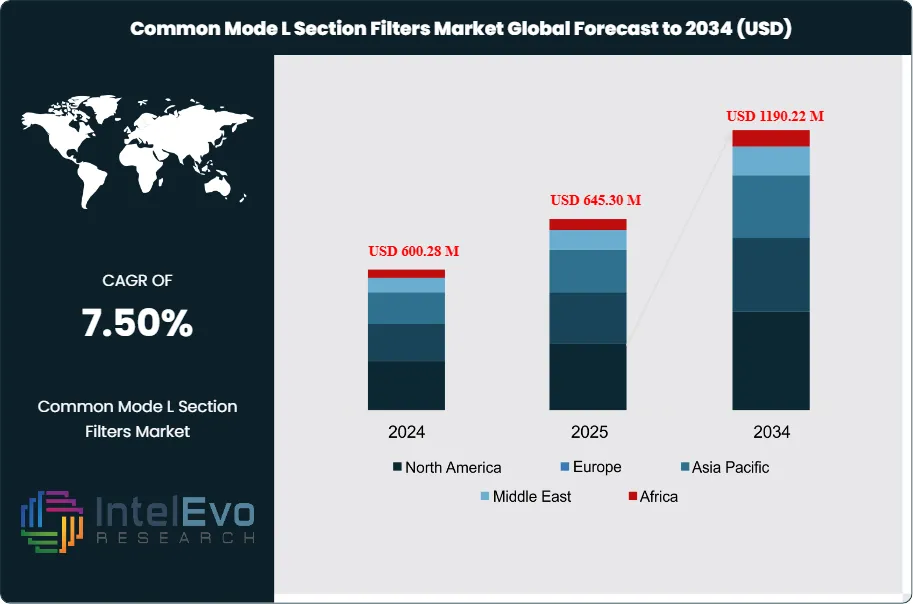
The market dynamics are significantly influenced by technological advancements in filter design, increasing frequency requirements in electronic applications, and the proliferation of wireless communication devices. Global revenue in the consumer electronics segment is projected to reach approximately $1 trillion by 2025, translating into a heightened need for effective EMI suppression solutions. Other influential factors include the automotive industry's transition toward electric vehicles, the expansion of 5G networks, healthcare device digitization, and the growing emphasis on energy-efficient electronic systems. The market is also driven by the increasing complexity of electronic circuits and the need for better signal integrity in high-speed digital applications.
Asia-Pacific dominated the market in 2024, the region's dominance is attributed to the presence of major electronics manufacturers, robust semiconductor industry, and increasing consumer electronics production. North America and Europe follow as significant markets due to their advanced automotive and industrial sectors, while emerging markets in Latin America and the Middle East show promising growth potential.
The COVID-19 pandemic initially disrupted the Common Mode L Section Filters market through supply chain interruptions and manufacturing facility closures. However, the market experienced a recovery as the pandemic accelerated digital transformation initiatives, increased demand for healthcare equipment, and boosted home electronics consumption. Remote work trends and digitalization efforts across industries created new opportunities for filter manufacturers, particularly in telecommunications and consumer electronics segments.
Regional conflicts and trade tensions between major economies have significantly impacted the Common Mode L Section Filters market through imposed tariffs and export restrictions. The ongoing trade disputes between the United States and China have led to increased component costs and supply chain relocations. These geopolitical tensions have prompted manufacturers to diversify their supply chains and establish regional production facilities to mitigate risks. Additionally, tariffs on electronic components have affected pricing strategies and market competitiveness, forcing companies to optimize their operational efficiency and explore alternative sourcing strategies.
Key Takeaways
Market Growth: The Common Mode L Section Filters Market is expected to reach USD 1190.22 Million by 2034, driven by rising applications in consumer electronics, telecommunications, and the automotive sector.
Type Dominance: Multi-Stage Filters are leading due to their superior EMI suppression capabilities, especially in high-end applications like industrial automation and advanced electronics.
Distribution Channel Dominance: Offline Distribution Channel dominates the market as OEMs and industrial buyers prefer direct purchase and long-term supplier relationships for customized components.
Application Dominance: Consumer Electronics stands as the most significant application area, fueled by the explosion in portable devices, smart appliances, and high-speed data communication needs.
End-User Dominance: Commercial End-User segment leads as businesses adopt sophisticated electronics for operations, data centers, and communication infrastructure.
Driver: The rise in EMI-related issues in high-frequency electronic environments is a critical driver, compelling companies to adopt reliable filtering solutions.
Restraint: High complexity in design integration and stringent international EMC standards increase product development costs and timelines.
Opportunity: Growing 5G infrastructure deployment and the rising penetration of electric vehicles provide new avenues for filter applications.
Trend: Miniaturization of electronic components and the rise of IoT-connected devices are shaping future product innovations.
Regional Analysis: Asia Pacific dominates due to strong electronics manufacturing base; North America and Europe also contribute significantly, while developing regions present future growth potential.
Type Analysis:
Multi-stage filters offer advanced EMI suppression by utilizing multiple inductors and capacitors in a single package, making them ideal for applications that require high reliability and stringent noise filtering. Their ability to filter a broader frequency spectrum enhances the electromagnetic compatibility of devices, which is crucial in automotive and industrial automation sectors. As smart factories and autonomous vehicles gain traction, the demand for robust EMI suppression systems continues to rise, propelling the multi-stage filter segment.
Distribution Channel Analysis:
Offline sales dominate the market as bulk procurement, custom configurations, and technical consultations are often preferred by industrial buyers. Distributors and sales agents offer personalized support, quality assurance, and technical expertise, which is essential in integrating these filters into complex systems. Offline channels also ensure better after-sales service and maintenance, making them indispensable for large-scale applications in commercial and industrial sectors.
Application Analysis:
Consumer Electronics Leads With nearly 35% Market Share In Common Mode L Section Filters Market. Consumer electronics is the largest application area due to the widespread use of mobile phones, laptops, gaming consoles, and smart home appliances. These devices require compact and efficient EMI filtering to ensure performance, safety, and regulatory compliance. The proliferation of high-speed data interfaces like USB 3.0, HDMI, and wireless technologies further boosts demand for common mode filters to maintain signal integrity and device reliability.
End-User Analysis:
Commercial entities, including IT firms, data centers, broadcasting companies, and corporate facilities, rely on uninterrupted electronic operations. These sectors extensively use EMI filters to reduce signal noise and enhance operational efficiency. As digital transformation accelerates, commercial end-users increasingly invest in reliable filtering systems to avoid data loss, interference, and equipment malfunction.
Region Analysis:
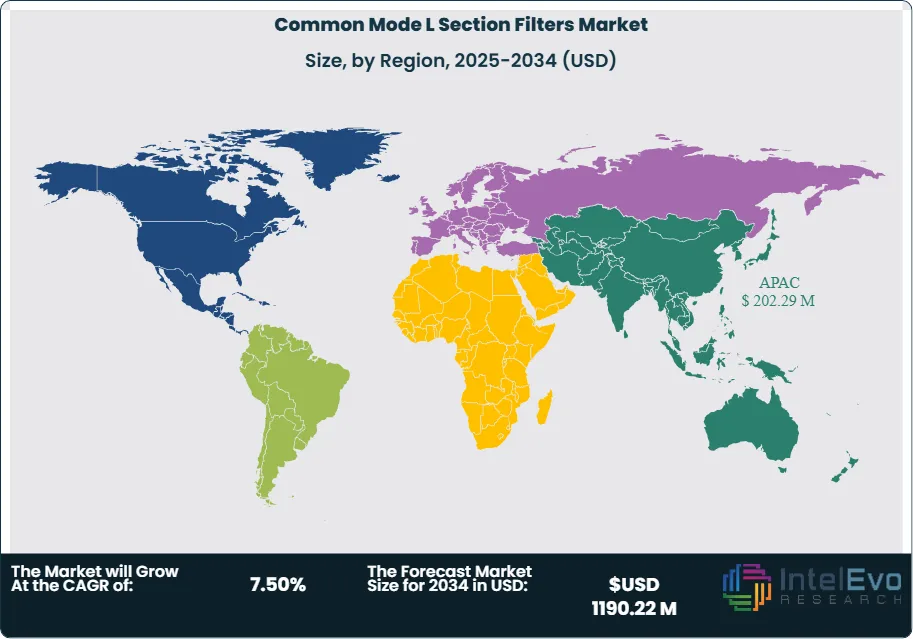
Asia-Pacific Leads With more than 30% Market Share In Common Mode L Section Filters Market. Asia-Pacific dominated the market in 2024, with a 33.7% share, generating USD 202.29 Million. The region's leadership stems from its position as the global electronics manufacturing hub, housing major semiconductor companies and consumer electronics manufacturers. Countries like China, Japan, South Korea, and Taiwan concentrate significant production capabilities, driving substantial demand for EMI suppression solutions. The region benefits from favorable government policies supporting electronics industry development, abundant skilled workforce, and established supply chains that facilitate efficient manufacturing operations.
North America represents the second-largest market, driven by advanced automotive and industrial sectors, along with significant telecommunications infrastructure investments. The region's focus on innovation and early adoption of emerging technologies creates demand for advanced filtering solutions. Europe follows as a significant market due to its strong automotive industry, industrial automation sector, and stringent EMC regulations that mandate effective EMI suppression solutions.
Emerging markets in Latin America and the Middle East show promising growth potential as these regions experience increasing electronics adoption and infrastructure development. The consumer electronics segment is expected to see the most significant growth in the future, driven by increasing smartphone penetration, smart home technology adoption, and the proliferation of connected devices across all regions.
Customization for segments, region/country-level will be provided. Moreover, additional customization can be done based on the requirements.
Pricing and Purchase Options
Avail customized purchase options to meet your exact research needs. We have three licenses to opt for: Single User License, Multi-User License (Up to 5 Users), Corporate Use License (Unlimited User and Printable PDF).
TABLE OF CONTENTS
1. EXECUTIVE SUMMARY
1.1. MARKET SNAPSHOT
1.2. KEY FINDINGS & INSIGHTS
1.3. ANALYST RECOMMENDATIONS
1.4. FUTURE OUTLOOK
2. RESEARCH METHODOLOGY
2.1. MARKET DEFINITION & SCOPE
2.2. RESEARCH OBJECTIVES: PRIMARY & SECONDARY DATA SOURCES
2.3. DATA COLLECTION SOURCES
2.3.1. COVERAGE OF 100+ PRIMARY RESEARCH/CONSULTATION CALLS WITH INDUSTRY STAKEHOLDERS
FIGURE 17 NORTH AMERICA COMMON MODE L SECTION FILTERS CURRENT AND FUTURE TYPE ANALYSIS, 2025–2034, (USD MILLION)
FIGURE 18 NORTH AMERICA COMMON MODE L SECTION FILTERS CURRENT AND FUTURE END USER ANALYSIS, 2025–2034, (USD MILLION)
FIGURE 19 MARKET SHARE BY COUNTRY
FIGURE 20 LATIN AMERICA COMMON MODE L SECTION FILTERS CURRENT AND FUTURE TYPE ANALYSIS, 2025–2034, (USD MILLION)
FIGURE 21 LATIN AMERICA COMMON MODE L SECTION FILTERS CURRENT AND FUTURE END USER ANALYSIS, 2025–2034, (USD MILLION)
FIGURE 22 MARKET SHARE BY COUNTRY
FIGURE 23 EASTERN EUROPE COMMON MODE L SECTION FILTERS CURRENT AND FUTURE TYPE ANALYSIS, 2025–2034, (USD MILLION)
FIGURE 24 EASTERN EUROPE COMMON MODE L SECTION FILTERS CURRENT AND FUTURE END USER ANALYSIS, 2025–2034, (USD MILLION)
FIGURE 25 MARKET SHARE BY COUNTRY
FIGURE 26 WESTERN EUROPE COMMON MODE L SECTION FILTERS CURRENT AND FUTURE TYPE ANALYSIS, 2025–2034, (USD MILLION)
FIGURE 27 WESTERN EUROPE COMMON MODE L SECTION FILTERS CURRENT AND FUTURE END USER ANALYSIS, 2025–2034, (USD MILLION)
FIGURE 28 MARKET SHARE BY COUNTRY
FIGURE 29 EAST ASIA AND PACIFIC COMMON MODE L SECTION FILTERS CURRENT AND FUTURE TYPE ANALYSIS, 2025–2034, (USD MILLION)
FIGURE 30 EAST ASIA AND PACIFIC COMMON MODE L SECTION FILTERS CURRENT AND FUTURE END USER ANALYSIS, 2025–2034, (USD MILLION)
FIGURE 31 MARKET SHARE BY COUNTRY
FIGURE 32 SEA AND SOUTH ASIA COMMON MODE L SECTION FILTERS CURRENT AND FUTURE TYPE ANALYSIS, 2025–2034, (USD MILLION)
FIGURE 33 SEA AND SOUTH ASIA COMMON MODE L SECTION FILTERS CURRENT AND FUTURE END USER ANALYSIS, 2025–2034, (USD MILLION)
FIGURE 34 MARKET SHARE BY COUNTRY
FIGURE 35 MIDDLE EAST AND AFRICA COMMON MODE L SECTION FILTERS CURRENT AND FUTURE TYPE ANALYSIS, 2025–2034, (USD MILLION)
FIGURE 36 MIDDLE EAST AND AFRICA COMMON MODE L SECTION FILTERS CURRENT AND FUTURE END USER ANALYSIS, 2025–2034, (USD MILLION)
FIGURE 37 NORTH AMERICA COMMON MODE L SECTION FILTERS CURRENT AND FUTURE MARKET VOLUME SHARE REGIONAL ANALYSIS, 2025–2034, (USD MILLION)
FIGURE 38 U.S. COMMON MODE L SECTION FILTERS CURRENT AND FUTURE TYPE ANALYSIS, 2025–2034, (USD MILLION)
FIGURE 39 U.S. COMMON MODE L SECTION FILTERS CURRENT AND FUTURE END USER ANALYSIS, 2025–2034, (USD MILLION)
FIGURE 40 CANADA COMMON MODE L SECTION FILTERS CURRENT AND FUTURE TYPE ANALYSIS, 2025–2034, (USD MILLION)
FIGURE 41 CANADA COMMON MODE L SECTION FILTERS CURRENT AND FUTURE END USER ANALYSIS, 2025–2034, (USD MILLION)
FIGURE 42 LATIN AMERICA COMMON MODE L SECTION FILTERS CURRENT AND FUTURE MARKET VOLUME SHARE REGIONAL ANALYSIS, 2025–2034, (USD MILLION)
FIGURE 43 MEXICO COMMON MODE L SECTION FILTERS CURRENT AND FUTURE TYPE ANALYSIS, 2025–2034, (USD MILLION)
FIGURE 44 MEXICO COMMON MODE L SECTION FILTERS CURRENT AND FUTURE END USER ANALYSIS, 2025–2034, (USD MILLION)
FIGURE 45 BRAZIL COMMON MODE L SECTION FILTERS CURRENT AND FUTURE TYPE ANALYSIS, 2025–2034, (USD MILLION)
FIGURE 46 BRAZIL COMMON MODE L SECTION FILTERS CURRENT AND FUTURE END USER ANALYSIS, 2025–2034, (USD MILLION)
FIGURE 47 ARGENTINA COMMON MODE L SECTION FILTERS CURRENT AND FUTURE TYPE ANALYSIS, 2025–2034, (USD MILLION)
FIGURE 48 ARGENTINA COMMON MODE L SECTION FILTERS CURRENT AND FUTURE END USER ANALYSIS, 2025–2034, (USD MILLION)
FIGURE 49 COLUMBIA COMMON MODE L SECTION FILTERS CURRENT AND FUTURE TYPE ANALYSIS, 2025–2034, (USD MILLION)
FIGURE 50 COLUMBIA COMMON MODE L SECTION FILTERS CURRENT AND FUTURE END USER ANALYSIS, 2025–2034, (USD MILLION)
FIGURE 51 REST OF LATIN AMERICA COMMON MODE L SECTION FILTERS CURRENT AND FUTURE TYPE ANALYSIS, 2025–2034, (USD MILLION)
FIGURE 52 REST OF LATIN AMERICA COMMON MODE L SECTION FILTERS CURRENT AND FUTURE END USER ANALYSIS, 2025–2034, (USD MILLION)
FIGURE 53 EASTERN EUROPE COMMON MODE L SECTION FILTERS CURRENT AND FUTURE MARKET VOLUME SHARE REGIONAL ANALYSIS, 2025–2034, (USD MILLION)
FIGURE 54 POLAND COMMON MODE L SECTION FILTERS CURRENT AND FUTURE TYPE ANALYSIS, 2025–2034, (USD MILLION)
FIGURE 55 POLAND COMMON MODE L SECTION FILTERS CURRENT AND FUTURE END USER ANALYSIS, 2025–2034, (USD MILLION)
FIGURE 56 RUSSIA COMMON MODE L SECTION FILTERS CURRENT AND FUTURE TYPE ANALYSIS, 2025–2034, (USD MILLION)
FIGURE 57 RUSSIA COMMON MODE L SECTION FILTERS CURRENT AND FUTURE END USER ANALYSIS, 2025–2034, (USD MILLION)
FIGURE 58 CZECH REPUBLIC COMMON MODE L SECTION FILTERS CURRENT AND FUTURE TYPE ANALYSIS, 2025–2034, (USD MILLION)
FIGURE 59 CZECH REPUBLIC COMMON MODE L SECTION FILTERS CURRENT AND FUTURE END USER ANALYSIS, 2025–2034, (USD MILLION)
FIGURE 60 ROMANIA COMMON MODE L SECTION FILTERS CURRENT AND FUTURE TYPE ANALYSIS, 2025–2034, (USD MILLION)
FIGURE 61 ROMANIA COMMON MODE L SECTION FILTERS CURRENT AND FUTURE END USER ANALYSIS, 2025–2034, (USD MILLION)
FIGURE 62 REST OF EASTERN EUROPE COMMON MODE L SECTION FILTERS CURRENT AND FUTURE TYPE ANALYSIS, 2025–2034, (USD MILLION)
FIGURE 63 REST OF EASTERN EUROPE COMMON MODE L SECTION FILTERS CURRENT AND FUTURE END USER ANALYSIS, 2025–2034, (USD MILLION)
FIGURE 64 WESTERN EUROPE COMMON MODE L SECTION FILTERS CURRENT AND FUTURE MARKET VOLUME SHARE REGIONAL ANALYSIS, 2025–2034, (USD MILLION)
FIGURE 65 GERMANY COMMON MODE L SECTION FILTERS CURRENT AND FUTURE TYPE ANALYSIS, 2025–2034, (USD MILLION)
FIGURE 66 GERMANY COMMON MODE L SECTION FILTERS CURRENT AND FUTURE END USER ANALYSIS, 2025–2034, (USD MILLION)
FIGURE 67 FRANCE COMMON MODE L SECTION FILTERS CURRENT AND FUTURE TYPE ANALYSIS, 2025–2034, (USD MILLION)
FIGURE 68 FRANCE COMMON MODE L SECTION FILTERS CURRENT AND FUTURE END USER ANALYSIS, 2025–2034, (USD MILLION)
FIGURE 69 UK COMMON MODE L SECTION FILTERS CURRENT AND FUTURE TYPE ANALYSIS, 2025–2034, (USD MILLION)
FIGURE 70 UK COMMON MODE L SECTION FILTERS CURRENT AND FUTURE END USER ANALYSIS, 2025–2034, (USD MILLION)
FIGURE 71 SPAIN COMMON MODE L SECTION FILTERS CURRENT AND FUTURE TYPE ANALYSIS, 2025–2034, (USD MILLION)
FIGURE 72 SPAIN COMMON MODE L SECTION FILTERS CURRENT AND FUTURE END USER ANALYSIS, 2025–2034, (USD MILLION)
FIGURE 73 ITALY COMMON MODE L SECTION FILTERS CURRENT AND FUTURE TYPE ANALYSIS, 2025–2034, (USD MILLION)
FIGURE 74 ITALY COMMON MODE L SECTION FILTERS CURRENT AND FUTURE END USER ANALYSIS, 2025–2034, (USD MILLION)
FIGURE 75 REST OF WESTERN EUROPE COMMON MODE L SECTION FILTERS CURRENT AND FUTURE TYPE ANALYSIS, 2025–2034, (USD MILLION)
FIGURE 76 REST OF WESTERN EUROPE COMMON MODE L SECTION FILTERS CURRENT AND FUTURE END USER ANALYSIS, 2025–2034, (USD MILLION)
FIGURE 77 EAST ASIA AND PACIFIC COMMON MODE L SECTION FILTERS CURRENT AND FUTURE MARKET VOLUME SHARE REGIONAL ANALYSIS, 2025–2034, (USD MILLION)
FIGURE 78 CHINA COMMON MODE L SECTION FILTERS CURRENT AND FUTURE TYPE ANALYSIS, 2025–2034, (USD MILLION)
FIGURE 79 CHINA COMMON MODE L SECTION FILTERS CURRENT AND FUTURE END USER ANALYSIS, 2025–2034, (USD MILLION)
FIGURE 80 JAPAN COMMON MODE L SECTION FILTERS CURRENT AND FUTURE TYPE ANALYSIS, 2025–2034, (USD MILLION)
FIGURE 81 JAPAN COMMON MODE L SECTION FILTERS CURRENT AND FUTURE END USER ANALYSIS, 2025–2034, (USD MILLION)
FIGURE 82 AUSTRALIA COMMON MODE L SECTION FILTERS CURRENT AND FUTURE TYPE ANALYSIS, 2025–2034, (USD MILLION)
FIGURE 83 AUSTRALIA COMMON MODE L SECTION FILTERS CURRENT AND FUTURE END USER ANALYSIS, 2025–2034, (USD MILLION)
FIGURE 84 CAMBODIA COMMON MODE L SECTION FILTERS CURRENT AND FUTURE TYPE ANALYSIS, 2025–2034, (USD MILLION)
FIGURE 85 CAMBODIA COMMON MODE L SECTION FILTERS CURRENT AND FUTURE END USER ANALYSIS, 2025–2034, (USD MILLION)
FIGURE 86 FIJI COMMON MODE L SECTION FILTERS CURRENT AND FUTURE TYPE ANALYSIS, 2025–2034, (USD MILLION)
FIGURE 87 FIJI COMMON MODE L SECTION FILTERS CURRENT AND FUTURE END USER ANALYSIS, 2025–2034, (USD MILLION)
FIGURE 88 INDONESIA COMMON MODE L SECTION FILTERS CURRENT AND FUTURE TYPE ANALYSIS, 2025–2034, (USD MILLION)
FIGURE 89 INDONESIA COMMON MODE L SECTION FILTERS CURRENT AND FUTURE END USER ANALYSIS, 2025–2034, (USD MILLION)
FIGURE 90 SOUTH KOREA COMMON MODE L SECTION FILTERS CURRENT AND FUTURE TYPE ANALYSIS, 2025–2034, (USD MILLION)
FIGURE 91 SOUTH KOREA COMMON MODE L SECTION FILTERS CURRENT AND FUTURE END USER ANALYSIS, 2025–2034, (USD MILLION)
FIGURE 92 REST OF EAST ASIA AND PACIFIC COMMON MODE L SECTION FILTERS CURRENT AND FUTURE TYPE ANALYSIS, 2025–2034, (USD MILLION)
FIGURE 93 REST OF EAST ASIA AND PACIFIC COMMON MODE L SECTION FILTERS CURRENT AND FUTURE END USER ANALYSIS, 2025–2034, (USD MILLION)
FIGURE 94 SEA AND SOUTH ASIA COMMON MODE L SECTION FILTERS CURRENT AND FUTURE MARKET VOLUME SHARE REGIONAL ANALYSIS, 2025–2034, (USD MILLION)
FIGURE 95 BANGLADESH COMMON MODE L SECTION FILTERS CURRENT AND FUTURE TYPE ANALYSIS, 2025–2034, (USD MILLION)
FIGURE 96 BANGLADESH COMMON MODE L SECTION FILTERS CURRENT AND FUTURE END USER ANALYSIS, 2025–2034, (USD MILLION)
FIGURE 97 NEW ZEALAND COMMON MODE L SECTION FILTERS CURRENT AND FUTURE TYPE ANALYSIS, 2025–2034, (USD MILLION)
FIGURE 98 NEW ZEALAND COMMON MODE L SECTION FILTERS CURRENT AND FUTURE END USER ANALYSIS, 2025–2034, (USD MILLION)
FIGURE 99 INDIA COMMON MODE L SECTION FILTERS CURRENT AND FUTURE TYPE ANALYSIS, 2025–2034, (USD MILLION)
FIGURE 100 INDIA COMMON MODE L SECTION FILTERS CURRENT AND FUTURE END USER ANALYSIS, 2025–2034, (USD MILLION)
FIGURE 101 SINGAPORE COMMON MODE L SECTION FILTERS CURRENT AND FUTURE TYPE ANALYSIS, 2025–2034, (USD MILLION)
FIGURE 102 SINGAPORE COMMON MODE L SECTION FILTERS CURRENT AND FUTURE END USER ANALYSIS, 2025–2034, (USD MILLION)
FIGURE 103 THAILAND COMMON MODE L SECTION FILTERS CURRENT AND FUTURE TYPE ANALYSIS, 2025–2034, (USD MILLION)
FIGURE 104 THAILAND COMMON MODE L SECTION FILTERS CURRENT AND FUTURE END USER ANALYSIS, 2025–2034, (USD MILLION)
FIGURE 105 TAIWAN COMMON MODE L SECTION FILTERS CURRENT AND FUTURE TYPE ANALYSIS, 2025–2034, (USD MILLION)
FIGURE 106 TAIWAN COMMON MODE L SECTION FILTERS CURRENT AND FUTURE END USER ANALYSIS, 2025–2034, (USD MILLION)
FIGURE 107 MALAYSIA COMMON MODE L SECTION FILTERS CURRENT AND FUTURE TYPE ANALYSIS, 2025–2034, (USD MILLION)
FIGURE 108 MALAYSIA COMMON MODE L SECTION FILTERS CURRENT AND FUTURE END USER ANALYSIS, 2025–2034, (USD MILLION)
FIGURE 109 REST OF SEA AND SOUTH ASIA COMMON MODE L SECTION FILTERS CURRENT AND FUTURE TYPE ANALYSIS, 2025–2034, (USD MILLION)
FIGURE 110 REST OF SEA AND SOUTH ASIA COMMON MODE L SECTION FILTERS CURRENT AND FUTURE END USER ANALYSIS, 2025–2034, (USD MILLION)
FIGURE 111 MIDDLE EAST AND AFRICA COMMON MODE L SECTION FILTERS CURRENT AND FUTURE MARKET VOLUME SHARE REGIONAL ANALYSIS, 2025–2034, (USD MILLION)
FIGURE 112 GCC COUNTRIES COMMON MODE L SECTION FILTERS CURRENT AND FUTURE TYPE ANALYSIS, 2025–2034, (USD MILLION)
FIGURE 113 GCC COUNTRIES COMMON MODE L SECTION FILTERS CURRENT AND FUTURE END USER ANALYSIS, 2025–2034, (USD MILLION)
FIGURE 114 SAUDI ARABIA COMMON MODE L SECTION FILTERS CURRENT AND FUTURE TYPE ANALYSIS, 2025–2034, (USD MILLION)
FIGURE 115 SAUDI ARABIA COMMON MODE L SECTION FILTERS CURRENT AND FUTURE END USER ANALYSIS, 2025–2034, (USD MILLION)
FIGURE 116 UAE COMMON MODE L SECTION FILTERS CURRENT AND FUTURE TYPE ANALYSIS, 2025–2034, (USD MILLION)
FIGURE 117 UAE COMMON MODE L SECTION FILTERS CURRENT AND FUTURE END USER ANALYSIS, 2025–2034, (USD MILLION)
FIGURE 118 BAHRAIN COMMON MODE L SECTION FILTERS CURRENT AND FUTURE TYPE ANALYSIS, 2025–2034, (USD MILLION)
FIGURE 119 BAHRAIN COMMON MODE L SECTION FILTERS CURRENT AND FUTURE END USER ANALYSIS, 2025–2034, (USD MILLION)
FIGURE 120 KUWAIT COMMON MODE L SECTION FILTERS CURRENT AND FUTURE TYPE ANALYSIS, 2025–2034, (USD MILLION)
FIGURE 121 KUWAIT COMMON MODE L SECTION FILTERS CURRENT AND FUTURE END USER ANALYSIS, 2025–2034, (USD MILLION)
FIGURE 122 OMAN COMMON MODE L SECTION FILTERS CURRENT AND FUTURE TYPE ANALYSIS, 2025–2034, (USD MILLION)
FIGURE 123 OMAN COMMON MODE L SECTION FILTERS CURRENT AND FUTURE END USER ANALYSIS, 2025–2034, (USD MILLION)
FIGURE 124 QATAR COMMON MODE L SECTION FILTERS CURRENT AND FUTURE TYPE ANALYSIS, 2025–2034, (USD MILLION)
FIGURE 125 QATAR COMMON MODE L SECTION FILTERS CURRENT AND FUTURE END USER ANALYSIS, 2025–2034, (USD MILLION)
FIGURE 126 EGYPT COMMON MODE L SECTION FILTERS CURRENT AND FUTURE TYPE ANALYSIS, 2025–2034, (USD MILLION)
FIGURE 127 EGYPT COMMON MODE L SECTION FILTERS CURRENT AND FUTURE END USER ANALYSIS, 2025–2034, (USD MILLION)
FIGURE 128 NIGERIA COMMON MODE L SECTION FILTERS CURRENT AND FUTURE TYPE ANALYSIS, 2025–2034, (USD MILLION)
FIGURE 129 NIGERIA COMMON MODE L SECTION FILTERS CURRENT AND FUTURE END USER ANALYSIS, 2025–2034, (USD MILLION)
FIGURE 130 SOUTH AFRICA COMMON MODE L SECTION FILTERS CURRENT AND FUTURE TYPE ANALYSIS, 2025–2034, (USD MILLION)
FIGURE 131 SOUTH AFRICA COMMON MODE L SECTION FILTERS CURRENT AND FUTURE END USER ANALYSIS, 2025–2034, (USD MILLION)
FIGURE 132 ISRAEL COMMON MODE L SECTION FILTERS CURRENT AND FUTURE TYPE ANALYSIS, 2025–2034, (USD MILLION)
FIGURE 133 ISRAEL COMMON MODE L SECTION FILTERS CURRENT AND FUTURE END USER ANALYSIS, 2025–2034, (USD MILLION)
FIGURE 134 REST OF MEA COMMON MODE L SECTION FILTERS CURRENT AND FUTURE TYPE ANALYSIS, 2025–2034, (USD MILLION)
FIGURE 135 REST OF MEA COMMON MODE L SECTION FILTERS CURRENT AND FUTURE END USER ANALYSIS, 2025–2034, (USD MILLION)
FIGURE 136 U. S. MARKET SHARE ANALYSIS BY TYPE (2024)
FIGURE 137 U. S. MARKET SHARE ANALYSIS BY END USER (2024)
FIGURE 138 CANADA MARKET SHARE ANALYSIS BY TYPE (2024)
FIGURE 139 CANADA MARKET SHARE ANALYSIS BY END USER (2024)
FIGURE 140 MEXICO MARKET SHARE ANALYSIS BY TYPE (2024)
FIGURE 141 MEXICO MARKET SHARE ANALYSIS BY END USER (2024)
FIGURE 142 CHINA MARKET SHARE ANALYSIS BY TYPE (2024)
FIGURE 143 CHINA MARKET SHARE ANALYSIS BY END USER (2024)
FIGURE 144 JAPAN MARKET SHARE ANALYSIS BY TYPE (2024)
FIGURE 145 JAPAN MARKET SHARE ANALYSIS BY END USER (2024)
FIGURE 146 INDIA MARKET SHARE ANALYSIS BY TYPE (2024)
FIGURE 147 INDIA MARKET SHARE ANALYSIS BY END USER (2024)
FIGURE 148 SOUTH KOREA MARKET SHARE ANALYSIS BY TYPE (2024)
FIGURE 149 SOUTH KOREA MARKET SHARE ANALYSIS BY END USER (2024)
FIGURE 150 SAUDI ARABIA MARKET SHARE ANALYSIS BY TYPE (2024)
FIGURE 151 SAUDI ARABIA MARKET SHARE ANALYSIS BY END USER (2024)
FIGURE 152 UAE MARKET SHARE ANALYSIS BY TYPE (2024)
FIGURE 153 UAE MARKET SHARE ANALYSIS BY END USER (2024)
FIGURE 154 EGYPT MARKET SHARE ANALYSIS BY TYPE (2024)
FIGURE 155 EGYPT MARKET SHARE ANALYSIS BY END USER (2024)
FIGURE 156 NIGERIA MARKET SHARE ANALYSIS BY TYPE (2024)
FIGURE 157 NIGERIA MARKET SHARE ANALYSIS BY END USER (2024)
FIGURE 158 SOUTH AFRICA MARKET SHARE ANALYSIS BY TYPE (2024)
FIGURE 159 SOUTH AFRICA MARKET SHARE ANALYSIS BY END USER (2024)
FIGURE 160 GERMANY MARKET SHARE ANALYSIS BY TYPE (2024)
FIGURE 161 GERMANY MARKET SHARE ANALYSIS BY END USER (2024)
FIGURE 162 FRANCE MARKET SHARE ANALYSIS BY TYPE (2024)
FIGURE 163 FRANCE MARKET SHARE ANALYSIS BY END USER (2024)
FIGURE 164 UK MARKET SHARE ANALYSIS BY TYPE (2024)
FIGURE 165 UK MARKET SHARE ANALYSIS BY END USER (2024)
FIGURE 166 SPAIN MARKET SHARE ANALYSIS BY TYPE (2024)
FIGURE 167 SPAIN MARKET SHARE ANALYSIS BY END USER (2024)
FIGURE 168 ITALY MARKET SHARE ANALYSIS BY TYPE (2024)
FIGURE 169 ITALY MARKET SHARE ANALYSIS BY END USER (2024)
FIGURE 170 BRAZIL MARKET SHARE ANALYSIS BY TYPE (2024)
FIGURE 171 BRAZIL MARKET SHARE ANALYSIS BY END USER (2024)
FIGURE 172 ARGENTINA MARKET SHARE ANALYSIS BY TYPE (2024)
FIGURE 173 ARGENTINA MARKET SHARE ANALYSIS BY END USER (2024)
FIGURE 174 COLUMBIA MARKET SHARE ANALYSIS BY TYPE (2024)
FIGURE 175 COLUMBIA MARKET SHARE ANALYSIS BY END USER (2024)
FIGURE 176 GLOBAL COMMON MODE L SECTION FILTERS CURRENT AND FUTURE MARKET KEY COUNTRY LEVEL ANALYSIS, 2024–2034, (USD MILLION)
FIGURE 177 FINANCIAL OVERVIEW:
Key Players Analysis:
TDK Corporation: TDK Corporation stands as a global giant in the electronic components industry, with a particularly strong presence in the common mode filter market. The company leverages its extensive experience in magnetic materials and ferrite technology to develop advanced EMI suppression solutions. TDK's comprehensive product portfolio includes a wide range of common mode filters suitable for various applications, from consumer electronics to industrial systems. The company's strong research and development capabilities, combined with its global manufacturing network, position it as a market leader capable of serving diverse customer needs across multiple regions.
Murata Manufacturing Co., Ltd.: Murata Manufacturing has a majority marketshare worldwide in ceramic filters, high-frequency parts, and sensors. The company's expertise in ceramic technology and passive components makes it a dominant force in the common mode filter market. Murata's extensive product lineup includes innovative filter solutions that address the needs of various applications, from smartphones to automotive electronics. The company's strong focus on research and development, combined with its advanced manufacturing capabilities, enables the continuous introduction of new products that meet evolving market requirements.
Pulse Electronics Corporation: Pulse Electronics Corporation represents a significant player in the common mode filter market, with particular strength in magnetic components and EMI suppression solutions. The company's expertise in inductor and transformer technology provides a strong foundation for developing advanced common mode filters. Pulse's focus on providing customized solutions for specific applications has enabled it to build strong relationships with customers across various industries, including telecommunications, automotive, and industrial electronics.
Vishay Intertechnology, Inc.: Vishay Intertechnology stands as a major player in the global electronic components market, with a strong presence in the common mode filter segment. The company's diverse product portfolio and extensive manufacturing capabilities enable it to serve a wide range of applications and customer requirements. Vishay's focus on providing cost-effective solutions without compromising quality has made it a preferred supplier for many manufacturers across various industries.
AVX Corporation: AVX Corporation represents a significant force in the passive components market, with substantial expertise in capacitor and filter technologies. The company's focus on providing high-quality electronic components for demanding applications has established it as a trusted supplier in the common mode filter market. AVX's commitment to innovation and technological advancement has resulted in the development of advanced filter solutions that meet the evolving needs of modern electronic systems.
Market Key Players
TDK Corporation
Pulse Electronics Corporation
Murata Manufacturing Co., Ltd.
TE Connectivity Ltd.
Schaffner Holding AG
AVX Corporation
Delta Electronics, Inc.
Vishay Intertechnology, Inc.
KEMET Corporation
CTS Corporation
EPCOS AG
Laird Technologies
Bourns, Inc.
Panasonic Corporation
Würth Elektronik Group
Taiyo Yuden Co., Ltd.
Yageo Corporation
Coilcraft, Inc.
Johanson Technology, Inc.
API Delevan, Inc.
Driver:
Rising Electromagnetic Interference in High-Speed Electronics:
The proliferation of high-speed electronic circuits in applications like 5G communication, data centers, and electric vehicles leads to increased electromagnetic interference. This interference can degrade signal integrity, reduce performance, and result in non-compliance with regulatory standards. Common Mode L Section Filters help in mitigating these issues by suppressing unwanted noise. With the growing integration of compact and multifunctional electronic systems, the demand for reliable EMI suppression solutions is expected to rise steadily, positioning these filters as a fundamental component in modern electronics design.
Expansion of Consumer Electronics and IoT Devices:
The rapid growth of the consumer electronics sector, driven by trends such as smart homes, wearable devices, and connected appliances, has increased the need for compact and efficient filtering solutions. Common mode filters ensure device safety, prevent data loss, and comply with international safety standards. As the Internet of Things (IoT) ecosystem expands, more devices will require robust EMI filtering to maintain system performance and network integrity, creating substantial demand for these filters.
Restrain:
High Design Complexity and Cost:
Integrating EMI filters into increasingly miniaturized and multifunctional devices poses significant design challenges. Designers must consider impedance matching, temperature stability, and compatibility with high-speed interfaces. Custom filter designs may increase manufacturing costs and prolong the product development cycle, deterring small and medium-sized manufacturers from adopting advanced filtering solutions.
Stringent Regulatory Compliance:
Meeting international electromagnetic compatibility (EMC) standards requires rigorous testing, documentation, and certification, which can be time-consuming and expensive. Frequent updates to regulations and differing standards across countries add further complexity. Companies must invest in compliance procedures, which may slow down time-to-market and restrict product flexibility.
Opportunities:
Deployment of 5G Infrastructure:
The global rollout of 5G networks presents significant opportunities for common mode filters, which are essential in ensuring signal clarity and device performance in high-frequency environments. 5G base stations, routers, and connected devices must adhere to stricter EMI guidelines, prompting telecom companies to invest in advanced filtering components. The surge in mobile data traffic and low-latency applications further boosts this demand.
Growth in Electric Vehicles and Automotive Electronics:
As electric vehicles (EVs) become mainstream, the need for EMI filters grows due to the dense concentration of power electronics and control systems in EV architecture. Common Mode L Section Filters play a crucial role in ensuring the safe and reliable operation of battery management systems, inverters, and on-board chargers. With automotive OEMs shifting toward electrification, this segment holds immense growth potential.
Trends:
Miniaturization and Integration of Components:
The trend toward miniaturized and multifunctional electronic devices has led to the development of compact EMI filters that can be integrated into printed circuit boards (PCBs). Manufacturers are focusing on space-saving designs that offer high filtering performance without compromising device size. This trend aligns with the demand for wearable technology, portable electronics, and next-gen mobile devices.
Sustainable and Lead-Free Filter Designs:
Environmental regulations and increasing awareness about sustainability are encouraging companies to adopt eco-friendly manufacturing practices. Lead-free soldering, RoHS-compliant materials, and recyclable packaging are gaining traction. Manufacturers are also exploring biodegradable materials and energy-efficient production processes to minimize environmental impact and comply with global green standards.
Recent Development
July 2025: A leading passive component manufacturer (e.g., Murata or TDK) launched a new series of ultra-compact common mode filters designed specifically for high-frequency 5G and automotive Ethernet applications, addressing the growing demand for miniaturization and high-performance EMI suppression.
June 2025: A major automotive electronics supplier (e.g., Bosch or Continental) announced a partnership with an EMI filter specialist to co-develop integrated common mode filtering solutions for next-generation electric vehicle power electronics, aiming to enhance system reliability and reduce design complexity.
April 2025: A prominent industrial automation company (e.g., Siemens or Rockwell Automation) integrated advanced common mode L section filters into its new line of motor drive systems, improving electromagnetic compatibility and ensuring robust operation in challenging industrial environments.
March 2025: A global semiconductor company (e.g., STMicroelectronics or Infineon) introduced new power management ICs with integrated common mode noise suppression capabilities, simplifying board design and reducing the need for external filtering components in various applications.
February 2025: An electronics component distributor (e.g., Digi-Key or Mouser) expanded its portfolio of common mode filters, adding a wider range of high-current and high-temperature options to meet the evolving demands of industrial power supply and renewable energy systems.
