
Global Cyclic Olefin Polymer Market Size, Share, Analysis Report By Type (Copolymers, Homopolymers), Process Type (Blow Molding, Extrusion, Injection Molding), End-user (Automotive, F&B, Chemicals, Packaging, Pharma, Electronics, Optical), Region and Key Players - Industry Segment Overview, Market Dynamics, Competitive Strategies, Trends and Forecast 2025-2034
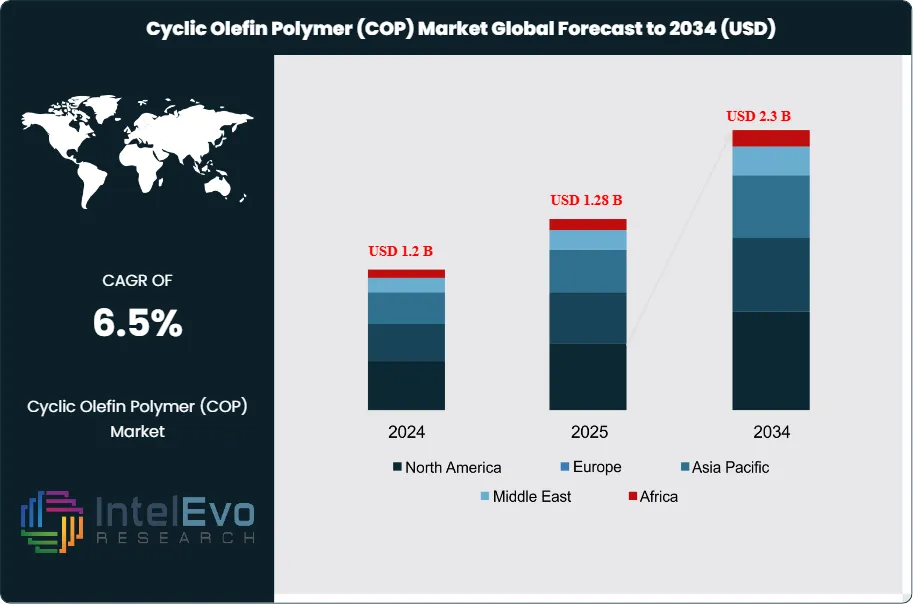
The Global Cyclic Olefin Polymer (COP) Market size is projected to reach approximately USD 2.3 billion by 2034, rising from USD 1.2 billion in 2024, growing at a CAGR of 6.5% during the forecast period from 2025 to 2034. The market growth is fueled by the increasing adoption of high-performance polymers in medical devices, optical components, and packaging applications due to their exceptional clarity, chemical resistance, and low moisture absorption. With industries shifting toward lightweight, recyclable materials, cyclic olefin polymers are emerging as the preferred alternative to traditional plastics across multiple sectors.
Cyclic olefin polymer (COP) is a type of high-performance thermoplastic made from a combination of cyclic and linear olefins. Known for its excellent optical clarity, low moisture absorption, and high chemical resistance, COP is widely used in precision applications across industries such as healthcare, electronics, and packaging. In the medical field, COP is often chosen for diagnostic devices, drug delivery systems, and pharmaceutical packaging because it is biologically inert and can be sterilized without losing integrity. In electronics, its superior insulating properties make it ideal for use in displays and optical components. COP also provides a great barrier against moisture and gases, which makes it suitable for food and pharmaceutical packaging. Its strength, transparency, and ability to be molded with high precision give it an edge over traditional plastics like glass or PVC in applications requiring purity, clarity, and dimensional stability.
The cyclic olefin polymer (COP) market is witnessing steady growth, driven primarily by rising demand in the medical, pharmaceutical, and electronics sectors. Known for its excellent transparency, chemical resistance, and moisture barrier properties, COP is increasingly used in drug delivery systems, diagnostic devices, and sterile medical packaging. The material’s ability to withstand sterilization processes without degrading makes it ideal for sensitive healthcare applications. In addition, its use in high-end optical films, lenses, and electronic displays is expanding due to its clarity and dimensional stability. The packaging industry also benefits from COP’s non-reactive nature and superior barrier performance, making it suitable for preserving the integrity of pharmaceuticals and perishable goods. Technological advancements in polymer processing are further enhancing its capabilities, enabling wider adoption across precision industries. Regionally, Asia-Pacific leads in demand, supported by strong electronics manufacturing and growing healthcare infrastructure, while North America and Europe continue to drive innovation. As industries increasingly seek high-performance, sustainable materials, COP is positioned for continued market expansion.
The cyclic olefin polymer (COP) market in North America is experiencing steady growth, primarily driven by rising demand in sectors like pharmaceuticals, healthcare, and high-performance packaging. COP materials are increasingly used in medical applications such as drug delivery systems, diagnostic tools, and labware, thanks to their excellent clarity, high purity, and resistance to chemicals and moisture. These characteristics make them ideal for maintaining product integrity and meeting stringent regulatory standards.
The COVID-19 pandemic had a mixed impact on the cyclic olefin polymer (COP) market. Initially, the market experienced disruptions due to supply chain interruptions, workforce shortages, and slowed manufacturing activities across industries. However, the demand for COP surged in certain segments, particularly in medical and pharmaceutical applications. The polymer’s clarity, chemical resistance, and biocompatibility made it ideal for use in diagnostics, vials, syringes, and other healthcare products—critical during the pandemic.
Key Takeaways:
Market Growth: The cyclic olefin polymer market is expected to reach USD 2.3 billion by 2034, growing at a robust CAGR of 6.5%, indicating strong market expansion.
Type Segment Dominance: The type segment is dominated by copolymers, accounting for over 58% of the market share. Copolymers are in high demand for their durability, clarity, and low moisture absorption, making them ideal for packaging that protects and preserves product quality.
Process Type Segment Insights: Injection molding is anticipated to hold the largest market share. Injection molding is gaining popularity in the COP market due to the material's excellent clarity, low moisture absorption, and strong chemical resistance. These properties make COP ideal for producing precise, complex components in sectors like optics, medical devices, and packaging.
Driver: The cyclic olefin polymer (COP) market is driven by rising demand in the medical and pharmaceutical sectors. COP’s excellent transparency, chemical resistance, and low moisture absorption make it ideal for drug packaging, syringes, and diagnostic devices—offering a safer, high-performance alternative to glass and conventional plastics.
Restraint: A key restraint for the cyclic olefin polymer (COP) market is its high production cost compared to conventional plastics. This makes COP less accessible for price-sensitive applications, limiting its adoption primarily to specialized or high-end uses such as medical and optical industries.
Opportunity: The cyclic olefin polymer (COP) market is seeing strong opportunity in medical and packaging applications due to its clarity, biocompatibility, and chemical resistance. Growing use in diagnostics, drug delivery, and optical components is driving demand, especially with the push for safer, high-performance materials.
Trend: The COP market is expanding globally, with manufacturers looking to tap into emerging markets in Asia-Pacific, Latin America, and the Middle East. Rapid industrialization and increasing consumer demand in these regions offer growth opportunities for COP manufacturers.
Regional Analysis: The North American cyclic olefin polymer (COP) market is growing due to rising demand in healthcare, diagnostics, and electronics. COP's clarity, chemical resistance, and biocompatibility make it ideal for medical packaging and optical applications. The region’s strong pharmaceutical and tech sectors, along with a focus on high-performance materials, are driving this growth despite higher costs.
Type Analysis:
The type segment is divided into copolymers and homopolymers. The copolymers segment dominated the market, with a market share of around 58% accounting for 0.6 billion 2024. Copolymers are witnessing strong demand due to their unique combination of properties such as high chemical resistance, low moisture absorption, and excellent clarity. These features make them particularly valuable in the packaging sector, where maintaining product freshness and protecting sensitive contents are top priorities. Their ability to enhance shelf life and ensure product stability has positioned copolymers as a preferred material choice across food, pharmaceutical, and consumer goods packaging applications.
Process Type Analysis:
The process type segment is divided into blow molding, extrusion, and injection molding. The injection molding segment dominated the market, with a market share of around 40% accounting for 0.4 billion 2024. Injection molding is a widely used manufacturing process that allows for the mass production of complex and highly detailed plastic parts with precision and consistency. In the context of Cyclic Olefin Polymers (COP), this method is becoming increasingly popular because COP possesses unique properties that align well with the technical demands of modern applications.
End-user Analysis:
The end-user segment is divided into automotive, F&B, chemicals, packaging, pharma, electronics, and optical. The pharma segment dominated the market, with a market share of around 21% accounting for 0.2 billion 2024. Cyclic olefin polymer (COP) has become a favored material in the pharmaceutical industry, particularly for drug delivery systems and packaging, thanks to its outstanding transparency, low extractables, and excellent chemical resistance. Its inert properties make it ideal for sensitive applications like pre-filled syringes, vials, and blister packs, where maintaining drug purity is essential. As regulatory standards tighten and the pharmaceutical sector continues to grow globally, the demand for high-quality, reliable packaging materials like COP is rising. Its ability to preserve the stability and safety of medications makes it a go-to solution for manufacturers aiming to meet stringent quality requirements.
Region Analysis:
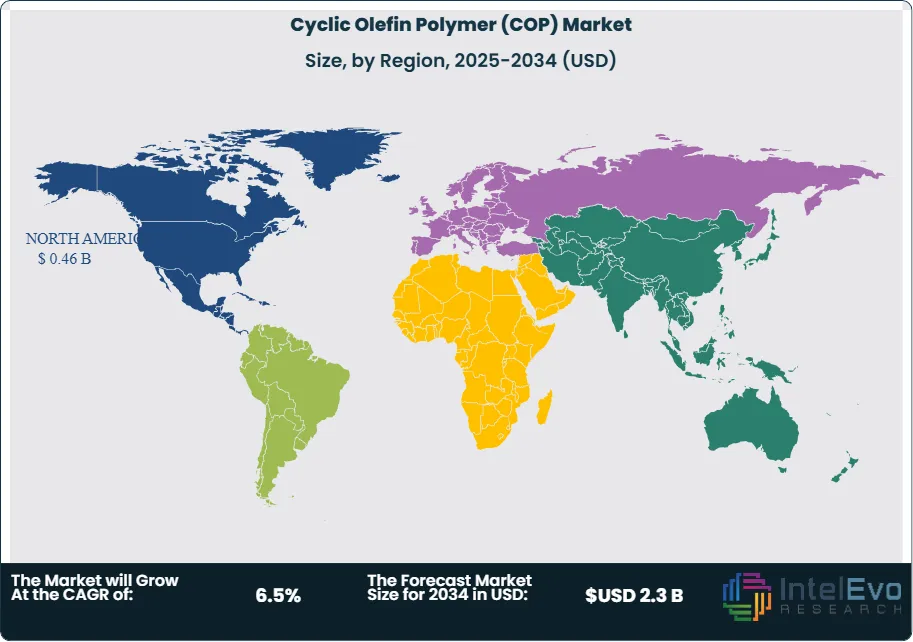
North America Leads With 38% Market Share in the Cyclic Olefin Polymer Market. The cyclic olefin polymer (COP) market in North America is witnessing significant growth, driven primarily by its expanding use in high-end applications such as healthcare, diagnostics, electronics, and premium packaging. COP is a unique class of polymer known for its excellent optical clarity, high chemical resistance, low moisture absorption, and superior dimensional stability. These attributes make it especially valuable in medical and pharmaceutical industries where material purity and performance are critical. The electronics and optics industries in North America are also adopting COP for its outstanding transparency, low birefringence, and heat resistance—ideal for use in camera lenses, optical films, and display components. As technological innovation progresses in consumer electronics and automotive displays, the demand for such materials continues to rise. Furthermore, the North American market benefits from a well-established pharmaceutical and medical device manufacturing base, advanced research facilities, and growing investments in healthcare infrastructure, particularly in the U.S. While the higher cost of COP compared to conventional polymers remains a barrier, its long-term advantages in performance and safety continue to drive its adoption across critical sectors.
Customization for segments, region/country-level will be provided. Moreover, additional customization can be done based on the requirements.
Pricing and Purchase Options
Avail customized purchase options to meet your exact research needs. We have three licenses to opt for: Single User License, Multi-User License (Up to 5 Users), Corporate Use License (Unlimited User and Printable PDF).
TABLE OF CONTENTS
1. EXECUTIVE SUMMARY
1.1. MARKET SNAPSHOT
1.2. KEY FINDINGS & INSIGHTS
1.3. ANALYST RECOMMENDATIONS
1.4. FUTURE OUTLOOK
2. RESEARCH METHODOLOGY
2.1. MARKET DEFINITION & SCOPE
2.2. RESEARCH OBJECTIVES: PRIMARY & SECONDARY DATA SOURCES
2.3. DATA COLLECTION SOURCES
2.3.1. COVERAGE OF 100+ PRIMARY RESEARCH/CONSULTATION CALLS WITH INDUSTRY STAKEHOLDERS
FIGURE 17 NORTH AMERICA CYCLIC OLEFIN POLYMER (COP) CURRENT AND FUTURE TYPE ANALYSIS, 2025–2034, (USD MILLION)
FIGURE 18 NORTH AMERICA CYCLIC OLEFIN POLYMER (COP) CURRENT AND FUTURE END USER ANALYSIS, 2025–2034, (USD MILLION)
FIGURE 19 MARKET SHARE BY COUNTRY
FIGURE 20 LATIN AMERICA CYCLIC OLEFIN POLYMER (COP) CURRENT AND FUTURE TYPE ANALYSIS, 2025–2034, (USD MILLION)
FIGURE 21 LATIN AMERICA CYCLIC OLEFIN POLYMER (COP) CURRENT AND FUTURE END USER ANALYSIS, 2025–2034, (USD MILLION)
FIGURE 22 MARKET SHARE BY COUNTRY
FIGURE 23 EASTERN EUROPE CYCLIC OLEFIN POLYMER (COP) CURRENT AND FUTURE TYPE ANALYSIS, 2025–2034, (USD MILLION)
FIGURE 24 EASTERN EUROPE CYCLIC OLEFIN POLYMER (COP) CURRENT AND FUTURE END USER ANALYSIS, 2025–2034, (USD MILLION)
FIGURE 25 MARKET SHARE BY COUNTRY
FIGURE 26 WESTERN EUROPE CYCLIC OLEFIN POLYMER (COP) CURRENT AND FUTURE TYPE ANALYSIS, 2025–2034, (USD MILLION)
FIGURE 27 WESTERN EUROPE CYCLIC OLEFIN POLYMER (COP) CURRENT AND FUTURE END USER ANALYSIS, 2025–2034, (USD MILLION)
FIGURE 28 MARKET SHARE BY COUNTRY
FIGURE 29 EAST ASIA AND PACIFIC CYCLIC OLEFIN POLYMER (COP) CURRENT AND FUTURE TYPE ANALYSIS, 2025–2034, (USD MILLION)
FIGURE 30 EAST ASIA AND PACIFIC CYCLIC OLEFIN POLYMER (COP) CURRENT AND FUTURE END USER ANALYSIS, 2025–2034, (USD MILLION)
FIGURE 31 MARKET SHARE BY COUNTRY
FIGURE 32 SEA AND SOUTH ASIA CYCLIC OLEFIN POLYMER (COP) CURRENT AND FUTURE TYPE ANALYSIS, 2025–2034, (USD MILLION)
FIGURE 33 SEA AND SOUTH ASIA CYCLIC OLEFIN POLYMER (COP) CURRENT AND FUTURE END USER ANALYSIS, 2025–2034, (USD MILLION)
FIGURE 34 MARKET SHARE BY COUNTRY
FIGURE 35 MIDDLE EAST AND AFRICA CYCLIC OLEFIN POLYMER (COP) CURRENT AND FUTURE TYPE ANALYSIS, 2025–2034, (USD MILLION)
FIGURE 36 MIDDLE EAST AND AFRICA CYCLIC OLEFIN POLYMER (COP) CURRENT AND FUTURE END USER ANALYSIS, 2025–2034, (USD MILLION)
FIGURE 37 NORTH AMERICA CYCLIC OLEFIN POLYMER (COP) CURRENT AND FUTURE MARKET VOLUME SHARE REGIONAL ANALYSIS, 2025–2034, (USD MILLION)
FIGURE 38 U.S. CYCLIC OLEFIN POLYMER (COP) CURRENT AND FUTURE TYPE ANALYSIS, 2025–2034, (USD MILLION)
FIGURE 39 U.S. CYCLIC OLEFIN POLYMER (COP) CURRENT AND FUTURE END USER ANALYSIS, 2025–2034, (USD MILLION)
FIGURE 40 CANADA CYCLIC OLEFIN POLYMER (COP) CURRENT AND FUTURE TYPE ANALYSIS, 2025–2034, (USD MILLION)
FIGURE 41 CANADA CYCLIC OLEFIN POLYMER (COP) CURRENT AND FUTURE END USER ANALYSIS, 2025–2034, (USD MILLION)
FIGURE 42 LATIN AMERICA CYCLIC OLEFIN POLYMER (COP) CURRENT AND FUTURE MARKET VOLUME SHARE REGIONAL ANALYSIS, 2025–2034, (USD MILLION)
FIGURE 43 MEXICO CYCLIC OLEFIN POLYMER (COP) CURRENT AND FUTURE TYPE ANALYSIS, 2025–2034, (USD MILLION)
FIGURE 44 MEXICO CYCLIC OLEFIN POLYMER (COP) CURRENT AND FUTURE END USER ANALYSIS, 2025–2034, (USD MILLION)
FIGURE 45 BRAZIL CYCLIC OLEFIN POLYMER (COP) CURRENT AND FUTURE TYPE ANALYSIS, 2025–2034, (USD MILLION)
FIGURE 46 BRAZIL CYCLIC OLEFIN POLYMER (COP) CURRENT AND FUTURE END USER ANALYSIS, 2025–2034, (USD MILLION)
FIGURE 47 ARGENTINA CYCLIC OLEFIN POLYMER (COP) CURRENT AND FUTURE TYPE ANALYSIS, 2025–2034, (USD MILLION)
FIGURE 48 ARGENTINA CYCLIC OLEFIN POLYMER (COP) CURRENT AND FUTURE END USER ANALYSIS, 2025–2034, (USD MILLION)
FIGURE 49 COLUMBIA CYCLIC OLEFIN POLYMER (COP) CURRENT AND FUTURE TYPE ANALYSIS, 2025–2034, (USD MILLION)
FIGURE 50 COLUMBIA CYCLIC OLEFIN POLYMER (COP) CURRENT AND FUTURE END USER ANALYSIS, 2025–2034, (USD MILLION)
FIGURE 51 REST OF LATIN AMERICA CYCLIC OLEFIN POLYMER (COP) CURRENT AND FUTURE TYPE ANALYSIS, 2025–2034, (USD MILLION)
FIGURE 52 REST OF LATIN AMERICA CYCLIC OLEFIN POLYMER (COP) CURRENT AND FUTURE END USER ANALYSIS, 2025–2034, (USD MILLION)
FIGURE 53 EASTERN EUROPE CYCLIC OLEFIN POLYMER (COP) CURRENT AND FUTURE MARKET VOLUME SHARE REGIONAL ANALYSIS, 2025–2034, (USD MILLION)
FIGURE 54 POLAND CYCLIC OLEFIN POLYMER (COP) CURRENT AND FUTURE TYPE ANALYSIS, 2025–2034, (USD MILLION)
FIGURE 55 POLAND CYCLIC OLEFIN POLYMER (COP) CURRENT AND FUTURE END USER ANALYSIS, 2025–2034, (USD MILLION)
FIGURE 56 RUSSIA CYCLIC OLEFIN POLYMER (COP) CURRENT AND FUTURE TYPE ANALYSIS, 2025–2034, (USD MILLION)
FIGURE 57 RUSSIA CYCLIC OLEFIN POLYMER (COP) CURRENT AND FUTURE END USER ANALYSIS, 2025–2034, (USD MILLION)
FIGURE 58 CZECH REPUBLIC CYCLIC OLEFIN POLYMER (COP) CURRENT AND FUTURE TYPE ANALYSIS, 2025–2034, (USD MILLION)
FIGURE 59 CZECH REPUBLIC CYCLIC OLEFIN POLYMER (COP) CURRENT AND FUTURE END USER ANALYSIS, 2025–2034, (USD MILLION)
FIGURE 60 ROMANIA CYCLIC OLEFIN POLYMER (COP) CURRENT AND FUTURE TYPE ANALYSIS, 2025–2034, (USD MILLION)
FIGURE 61 ROMANIA CYCLIC OLEFIN POLYMER (COP) CURRENT AND FUTURE END USER ANALYSIS, 2025–2034, (USD MILLION)
FIGURE 62 REST OF EASTERN EUROPE CYCLIC OLEFIN POLYMER (COP) CURRENT AND FUTURE TYPE ANALYSIS, 2025–2034, (USD MILLION)
FIGURE 63 REST OF EASTERN EUROPE CYCLIC OLEFIN POLYMER (COP) CURRENT AND FUTURE END USER ANALYSIS, 2025–2034, (USD MILLION)
FIGURE 64 WESTERN EUROPE CYCLIC OLEFIN POLYMER (COP) CURRENT AND FUTURE MARKET VOLUME SHARE REGIONAL ANALYSIS, 2025–2034, (USD MILLION)
FIGURE 65 GERMANY CYCLIC OLEFIN POLYMER (COP) CURRENT AND FUTURE TYPE ANALYSIS, 2025–2034, (USD MILLION)
FIGURE 66 GERMANY CYCLIC OLEFIN POLYMER (COP) CURRENT AND FUTURE END USER ANALYSIS, 2025–2034, (USD MILLION)
FIGURE 67 FRANCE CYCLIC OLEFIN POLYMER (COP) CURRENT AND FUTURE TYPE ANALYSIS, 2025–2034, (USD MILLION)
FIGURE 68 FRANCE CYCLIC OLEFIN POLYMER (COP) CURRENT AND FUTURE END USER ANALYSIS, 2025–2034, (USD MILLION)
FIGURE 69 UK CYCLIC OLEFIN POLYMER (COP) CURRENT AND FUTURE TYPE ANALYSIS, 2025–2034, (USD MILLION)
FIGURE 70 UK CYCLIC OLEFIN POLYMER (COP) CURRENT AND FUTURE END USER ANALYSIS, 2025–2034, (USD MILLION)
FIGURE 71 SPAIN CYCLIC OLEFIN POLYMER (COP) CURRENT AND FUTURE TYPE ANALYSIS, 2025–2034, (USD MILLION)
FIGURE 72 SPAIN CYCLIC OLEFIN POLYMER (COP) CURRENT AND FUTURE END USER ANALYSIS, 2025–2034, (USD MILLION)
FIGURE 73 ITALY CYCLIC OLEFIN POLYMER (COP) CURRENT AND FUTURE TYPE ANALYSIS, 2025–2034, (USD MILLION)
FIGURE 74 ITALY CYCLIC OLEFIN POLYMER (COP) CURRENT AND FUTURE END USER ANALYSIS, 2025–2034, (USD MILLION)
FIGURE 75 REST OF WESTERN EUROPE CYCLIC OLEFIN POLYMER (COP) CURRENT AND FUTURE TYPE ANALYSIS, 2025–2034, (USD MILLION)
FIGURE 76 REST OF WESTERN EUROPE CYCLIC OLEFIN POLYMER (COP) CURRENT AND FUTURE END USER ANALYSIS, 2025–2034, (USD MILLION)
FIGURE 77 EAST ASIA AND PACIFIC CYCLIC OLEFIN POLYMER (COP) CURRENT AND FUTURE MARKET VOLUME SHARE REGIONAL ANALYSIS, 2025–2034, (USD MILLION)
FIGURE 78 CHINA CYCLIC OLEFIN POLYMER (COP) CURRENT AND FUTURE TYPE ANALYSIS, 2025–2034, (USD MILLION)
FIGURE 79 CHINA CYCLIC OLEFIN POLYMER (COP) CURRENT AND FUTURE END USER ANALYSIS, 2025–2034, (USD MILLION)
FIGURE 80 JAPAN CYCLIC OLEFIN POLYMER (COP) CURRENT AND FUTURE TYPE ANALYSIS, 2025–2034, (USD MILLION)
FIGURE 81 JAPAN CYCLIC OLEFIN POLYMER (COP) CURRENT AND FUTURE END USER ANALYSIS, 2025–2034, (USD MILLION)
FIGURE 82 AUSTRALIA CYCLIC OLEFIN POLYMER (COP) CURRENT AND FUTURE TYPE ANALYSIS, 2025–2034, (USD MILLION)
FIGURE 83 AUSTRALIA CYCLIC OLEFIN POLYMER (COP) CURRENT AND FUTURE END USER ANALYSIS, 2025–2034, (USD MILLION)
FIGURE 84 CAMBODIA CYCLIC OLEFIN POLYMER (COP) CURRENT AND FUTURE TYPE ANALYSIS, 2025–2034, (USD MILLION)
FIGURE 85 CAMBODIA CYCLIC OLEFIN POLYMER (COP) CURRENT AND FUTURE END USER ANALYSIS, 2025–2034, (USD MILLION)
FIGURE 86 FIJI CYCLIC OLEFIN POLYMER (COP) CURRENT AND FUTURE TYPE ANALYSIS, 2025–2034, (USD MILLION)
FIGURE 87 FIJI CYCLIC OLEFIN POLYMER (COP) CURRENT AND FUTURE END USER ANALYSIS, 2025–2034, (USD MILLION)
FIGURE 88 INDONESIA CYCLIC OLEFIN POLYMER (COP) CURRENT AND FUTURE TYPE ANALYSIS, 2025–2034, (USD MILLION)
FIGURE 89 INDONESIA CYCLIC OLEFIN POLYMER (COP) CURRENT AND FUTURE END USER ANALYSIS, 2025–2034, (USD MILLION)
FIGURE 90 SOUTH KOREA CYCLIC OLEFIN POLYMER (COP) CURRENT AND FUTURE TYPE ANALYSIS, 2025–2034, (USD MILLION)
FIGURE 91 SOUTH KOREA CYCLIC OLEFIN POLYMER (COP) CURRENT AND FUTURE END USER ANALYSIS, 2025–2034, (USD MILLION)
FIGURE 92 REST OF EAST ASIA AND PACIFIC CYCLIC OLEFIN POLYMER (COP) CURRENT AND FUTURE TYPE ANALYSIS, 2025–2034, (USD MILLION)
FIGURE 93 REST OF EAST ASIA AND PACIFIC CYCLIC OLEFIN POLYMER (COP) CURRENT AND FUTURE END USER ANALYSIS, 2025–2034, (USD MILLION)
FIGURE 94 SEA AND SOUTH ASIA CYCLIC OLEFIN POLYMER (COP) CURRENT AND FUTURE MARKET VOLUME SHARE REGIONAL ANALYSIS, 2025–2034, (USD MILLION)
FIGURE 95 BANGLADESH CYCLIC OLEFIN POLYMER (COP) CURRENT AND FUTURE TYPE ANALYSIS, 2025–2034, (USD MILLION)
FIGURE 96 BANGLADESH CYCLIC OLEFIN POLYMER (COP) CURRENT AND FUTURE END USER ANALYSIS, 2025–2034, (USD MILLION)
FIGURE 97 NEW ZEALAND CYCLIC OLEFIN POLYMER (COP) CURRENT AND FUTURE TYPE ANALYSIS, 2025–2034, (USD MILLION)
FIGURE 98 NEW ZEALAND CYCLIC OLEFIN POLYMER (COP) CURRENT AND FUTURE END USER ANALYSIS, 2025–2034, (USD MILLION)
FIGURE 99 INDIA CYCLIC OLEFIN POLYMER (COP) CURRENT AND FUTURE TYPE ANALYSIS, 2025–2034, (USD MILLION)
FIGURE 100 INDIA CYCLIC OLEFIN POLYMER (COP) CURRENT AND FUTURE END USER ANALYSIS, 2025–2034, (USD MILLION)
FIGURE 101 SINGAPORE CYCLIC OLEFIN POLYMER (COP) CURRENT AND FUTURE TYPE ANALYSIS, 2025–2034, (USD MILLION)
FIGURE 102 SINGAPORE CYCLIC OLEFIN POLYMER (COP) CURRENT AND FUTURE END USER ANALYSIS, 2025–2034, (USD MILLION)
FIGURE 103 THAILAND CYCLIC OLEFIN POLYMER (COP) CURRENT AND FUTURE TYPE ANALYSIS, 2025–2034, (USD MILLION)
FIGURE 104 THAILAND CYCLIC OLEFIN POLYMER (COP) CURRENT AND FUTURE END USER ANALYSIS, 2025–2034, (USD MILLION)
FIGURE 105 TAIWAN CYCLIC OLEFIN POLYMER (COP) CURRENT AND FUTURE TYPE ANALYSIS, 2025–2034, (USD MILLION)
FIGURE 106 TAIWAN CYCLIC OLEFIN POLYMER (COP) CURRENT AND FUTURE END USER ANALYSIS, 2025–2034, (USD MILLION)
FIGURE 107 MALAYSIA CYCLIC OLEFIN POLYMER (COP) CURRENT AND FUTURE TYPE ANALYSIS, 2025–2034, (USD MILLION)
FIGURE 108 MALAYSIA CYCLIC OLEFIN POLYMER (COP) CURRENT AND FUTURE END USER ANALYSIS, 2025–2034, (USD MILLION)
FIGURE 109 REST OF SEA AND SOUTH ASIA CYCLIC OLEFIN POLYMER (COP) CURRENT AND FUTURE TYPE ANALYSIS, 2025–2034, (USD MILLION)
FIGURE 110 REST OF SEA AND SOUTH ASIA CYCLIC OLEFIN POLYMER (COP) CURRENT AND FUTURE END USER ANALYSIS, 2025–2034, (USD MILLION)
FIGURE 111 MIDDLE EAST AND AFRICA CYCLIC OLEFIN POLYMER (COP) CURRENT AND FUTURE MARKET VOLUME SHARE REGIONAL ANALYSIS, 2025–2034, (USD MILLION)
FIGURE 112 GCC COUNTRIES CYCLIC OLEFIN POLYMER (COP) CURRENT AND FUTURE TYPE ANALYSIS, 2025–2034, (USD MILLION)
FIGURE 113 GCC COUNTRIES CYCLIC OLEFIN POLYMER (COP) CURRENT AND FUTURE END USER ANALYSIS, 2025–2034, (USD MILLION)
FIGURE 114 SAUDI ARABIA CYCLIC OLEFIN POLYMER (COP) CURRENT AND FUTURE TYPE ANALYSIS, 2025–2034, (USD MILLION)
FIGURE 115 SAUDI ARABIA CYCLIC OLEFIN POLYMER (COP) CURRENT AND FUTURE END USER ANALYSIS, 2025–2034, (USD MILLION)
FIGURE 116 UAE CYCLIC OLEFIN POLYMER (COP) CURRENT AND FUTURE TYPE ANALYSIS, 2025–2034, (USD MILLION)
FIGURE 117 UAE CYCLIC OLEFIN POLYMER (COP) CURRENT AND FUTURE END USER ANALYSIS, 2025–2034, (USD MILLION)
FIGURE 118 BAHRAIN CYCLIC OLEFIN POLYMER (COP) CURRENT AND FUTURE TYPE ANALYSIS, 2025–2034, (USD MILLION)
FIGURE 119 BAHRAIN CYCLIC OLEFIN POLYMER (COP) CURRENT AND FUTURE END USER ANALYSIS, 2025–2034, (USD MILLION)
FIGURE 120 KUWAIT CYCLIC OLEFIN POLYMER (COP) CURRENT AND FUTURE TYPE ANALYSIS, 2025–2034, (USD MILLION)
FIGURE 121 KUWAIT CYCLIC OLEFIN POLYMER (COP) CURRENT AND FUTURE END USER ANALYSIS, 2025–2034, (USD MILLION)
FIGURE 122 OMAN CYCLIC OLEFIN POLYMER (COP) CURRENT AND FUTURE TYPE ANALYSIS, 2025–2034, (USD MILLION)
FIGURE 123 OMAN CYCLIC OLEFIN POLYMER (COP) CURRENT AND FUTURE END USER ANALYSIS, 2025–2034, (USD MILLION)
FIGURE 124 QATAR CYCLIC OLEFIN POLYMER (COP) CURRENT AND FUTURE TYPE ANALYSIS, 2025–2034, (USD MILLION)
FIGURE 125 QATAR CYCLIC OLEFIN POLYMER (COP) CURRENT AND FUTURE END USER ANALYSIS, 2025–2034, (USD MILLION)
FIGURE 126 EGYPT CYCLIC OLEFIN POLYMER (COP) CURRENT AND FUTURE TYPE ANALYSIS, 2025–2034, (USD MILLION)
FIGURE 127 EGYPT CYCLIC OLEFIN POLYMER (COP) CURRENT AND FUTURE END USER ANALYSIS, 2025–2034, (USD MILLION)
FIGURE 128 NIGERIA CYCLIC OLEFIN POLYMER (COP) CURRENT AND FUTURE TYPE ANALYSIS, 2025–2034, (USD MILLION)
FIGURE 129 NIGERIA CYCLIC OLEFIN POLYMER (COP) CURRENT AND FUTURE END USER ANALYSIS, 2025–2034, (USD MILLION)
FIGURE 130 SOUTH AFRICA CYCLIC OLEFIN POLYMER (COP) CURRENT AND FUTURE TYPE ANALYSIS, 2025–2034, (USD MILLION)
FIGURE 131 SOUTH AFRICA CYCLIC OLEFIN POLYMER (COP) CURRENT AND FUTURE END USER ANALYSIS, 2025–2034, (USD MILLION)
FIGURE 132 ISRAEL CYCLIC OLEFIN POLYMER (COP) CURRENT AND FUTURE TYPE ANALYSIS, 2025–2034, (USD MILLION)
FIGURE 133 ISRAEL CYCLIC OLEFIN POLYMER (COP) CURRENT AND FUTURE END USER ANALYSIS, 2025–2034, (USD MILLION)
FIGURE 134 REST OF MEA CYCLIC OLEFIN POLYMER (COP) CURRENT AND FUTURE TYPE ANALYSIS, 2025–2034, (USD MILLION)
FIGURE 135 REST OF MEA CYCLIC OLEFIN POLYMER (COP) CURRENT AND FUTURE END USER ANALYSIS, 2025–2034, (USD MILLION)
FIGURE 136 U. S. MARKET SHARE ANALYSIS BY TYPE (2024)
FIGURE 137 U. S. MARKET SHARE ANALYSIS BY END USER (2024)
FIGURE 138 CANADA MARKET SHARE ANALYSIS BY TYPE (2024)
FIGURE 139 CANADA MARKET SHARE ANALYSIS BY END USER (2024)
FIGURE 140 MEXICO MARKET SHARE ANALYSIS BY TYPE (2024)
FIGURE 141 MEXICO MARKET SHARE ANALYSIS BY END USER (2024)
FIGURE 142 CHINA MARKET SHARE ANALYSIS BY TYPE (2024)
FIGURE 143 CHINA MARKET SHARE ANALYSIS BY END USER (2024)
FIGURE 144 JAPAN MARKET SHARE ANALYSIS BY TYPE (2024)
FIGURE 145 JAPAN MARKET SHARE ANALYSIS BY END USER (2024)
FIGURE 146 INDIA MARKET SHARE ANALYSIS BY TYPE (2024)
FIGURE 147 INDIA MARKET SHARE ANALYSIS BY END USER (2024)
FIGURE 148 SOUTH KOREA MARKET SHARE ANALYSIS BY TYPE (2024)
FIGURE 149 SOUTH KOREA MARKET SHARE ANALYSIS BY END USER (2024)
FIGURE 150 SAUDI ARABIA MARKET SHARE ANALYSIS BY TYPE (2024)
FIGURE 151 SAUDI ARABIA MARKET SHARE ANALYSIS BY END USER (2024)
FIGURE 152 UAE MARKET SHARE ANALYSIS BY TYPE (2024)
FIGURE 153 UAE MARKET SHARE ANALYSIS BY END USER (2024)
FIGURE 154 EGYPT MARKET SHARE ANALYSIS BY TYPE (2024)
FIGURE 155 EGYPT MARKET SHARE ANALYSIS BY END USER (2024)
FIGURE 156 NIGERIA MARKET SHARE ANALYSIS BY TYPE (2024)
FIGURE 157 NIGERIA MARKET SHARE ANALYSIS BY END USER (2024)
FIGURE 158 SOUTH AFRICA MARKET SHARE ANALYSIS BY TYPE (2024)
FIGURE 159 SOUTH AFRICA MARKET SHARE ANALYSIS BY END USER (2024)
FIGURE 160 GERMANY MARKET SHARE ANALYSIS BY TYPE (2024)
FIGURE 161 GERMANY MARKET SHARE ANALYSIS BY END USER (2024)
FIGURE 162 FRANCE MARKET SHARE ANALYSIS BY TYPE (2024)
FIGURE 163 FRANCE MARKET SHARE ANALYSIS BY END USER (2024)
FIGURE 164 UK MARKET SHARE ANALYSIS BY TYPE (2024)
FIGURE 165 UK MARKET SHARE ANALYSIS BY END USER (2024)
FIGURE 166 SPAIN MARKET SHARE ANALYSIS BY TYPE (2024)
FIGURE 167 SPAIN MARKET SHARE ANALYSIS BY END USER (2024)
FIGURE 168 ITALY MARKET SHARE ANALYSIS BY TYPE (2024)
FIGURE 169 ITALY MARKET SHARE ANALYSIS BY END USER (2024)
FIGURE 170 BRAZIL MARKET SHARE ANALYSIS BY TYPE (2024)
FIGURE 171 BRAZIL MARKET SHARE ANALYSIS BY END USER (2024)
FIGURE 172 ARGENTINA MARKET SHARE ANALYSIS BY TYPE (2024)
FIGURE 173 ARGENTINA MARKET SHARE ANALYSIS BY END USER (2024)
FIGURE 174 COLUMBIA MARKET SHARE ANALYSIS BY TYPE (2024)
FIGURE 175 COLUMBIA MARKET SHARE ANALYSIS BY END USER (2024)
FIGURE 176 GLOBAL CYCLIC OLEFIN POLYMER (COP) CURRENT AND FUTURE MARKET KEY COUNTRY LEVEL ANALYSIS, 2024–2034, (USD MILLION)
FIGURE 177 FINANCIAL OVERVIEW:
Key Players Analysis:
Polysciences, Inc.: Polysciences, Inc. plays a significant role in the cyclic olefin polymer (COP) market by offering specialized materials tailored for demanding applications. Their COP products are well-regarded for their clarity, dimensional stability, and resistance to heat and moisture. These properties make them highly suitable for use in sectors like pharmaceuticals, diagnostics, and electronics.
MITSUI & CO., Ltd: Mitsui & Co., Ltd., through its collaboration with Mitsui Chemicals, plays a key role in the cyclic olefin polymer (COP) market, primarily through its development and promotion of the APEL™ product line. These specialty polymers stand out for their exceptional clarity, low moisture absorption, and chemical resistance. Unlike traditional materials, APEL™ combines optical purity with high dimensional stability, making it a strong choice for applications in medical devices, optical films, and electronic components.
Borealis Group: Borealis Group has made significant strides in the cyclic olefin polymer (COP) market with the introduction of Stelora, a new class of sustainable engineering polymers. Developed in collaboration with TOPAS Advanced Polymers, Stelora combines polypropylene (PP) with cyclic olefin copolymers (COCs) to create ethylene-propylene-norbornene (EPN), a material that offers enhanced strength, durability, and heat resistance .
Market Key Players
Borealis Group
MITSUI & CO., Ltd
Polysciences, Inc.
Lyondellbasell Industries Holdings B.V.
VELOX GmbH
Zeon Corporation
Topas Advanced Polymers, Inc.
JSR Corporation
Entec Polymers
Ravago Group
Dow Chemical Company
INEOS Group
Idemitsu Kosan
SCHOTT
Sumitomo Chemical
Sk Chemicals
Driver:
Rising demand in the medical and pharmaceutical sectors
The cyclic olefin polymer (COP) market is being driven largely by the rising demand in the medical and pharmaceutical sectors. COP materials are known for their outstanding properties—such as high transparency, low moisture absorption, chemical resistance, and dimensional stability. These features make them especially suitable for critical healthcare applications like pre-filled syringes, medical vials, blister packaging, and diagnostic devices. As global healthcare systems expand and evolve—especially with the rise in biologics, vaccines, and injectable drugs—there’s a greater need for advanced packaging materials that ensure the safety, purity, and shelf life of sensitive medical products. Traditional materials like glass and standard plastics have limitations, such as breakage or poor barrier performance. COP overcomes many of these issues, offering a lightweight, shatterproof alternative that maintains drug integrity. This increased reliance on safe and efficient medical packaging solutions, coupled with stringent regulatory standards and a focus on patient safety, is pushing pharmaceutical companies and healthcare providers to adopt COP, making it a key growth driver for the market.
Restrain:
High Production Costs
The main restraint in the cyclic olefin polymer (COP) market is its relatively high production cost, which arises from complex manufacturing processes and the use of expensive raw materials. Unlike traditional polymers like polyethylene or polypropylene, COP is engineered for high clarity, chemical resistance, and dimensional stability—qualities that require more advanced technology to produce. As a result, these materials are often priced higher, making them less viable for cost-sensitive applications or industries operating on tight budgets. This cost barrier restricts wider adoption, especially in developing regions or mass-market products, confining COP usage primarily to premium sectors like healthcare, pharmaceuticals, and high-precision optical components.
Opportunities:
Growing demand for high-performance packaging and medical-grade materials
A major opportunity in the cyclic olefin polymer (COP) market lies in the growing demand for high-performance packaging and medical-grade materials. With increasing emphasis on product safety, especially in pharmaceutical and diagnostic applications, COP’s superior barrier properties, optical clarity, and biocompatibility make it an ideal choice. The rising need for lightweight, break-resistant, and chemically inert containers—such as prefilled syringes, diagnostic vials, and blister packs—further boosts its appeal. Additionally, advancements in electronics and optical industries create new possibilities, as COP is used in components like lenses and display films. The shift toward sustainable and recyclable materials also positions COP as a favorable alternative due to its low extractables and excellent recyclability.
Trends:
Geographical Market Expansion
Geographical expansion is playing a crucial role in the growth of the cyclic olefin polymer (COP) market. Regions like Asia-Pacific, Latin America, and the Middle East are seeing increased interest due to rapid industrialization, growing healthcare infrastructure, and rising demand for advanced packaging and electronics. As manufacturers seek to broaden their global reach, these emerging markets offer substantial opportunities to tap into new customer bases and meet the rising need for high-performance materials like COP.
Recent Development:
In May 2023, Borealis launched Stelora™, a new line of engineered polymers designed to meet both performance and sustainability goals. This innovative material is the result of combining polypropylene (PP) with cyclic olefin copolymers (COCs), creating a high-purity, transparent polymer that brings together the strengths of both components. Stelora™ is engineered to perform in high-heat environments, making it a strong fit for applications in electric mobility and renewable energy technologies.
In June 2024, Zeon Corporation unveiled plans to establish a new production facility in Japan focused on cyclo olefin polymers (COP), reinforcing its commitment to expanding its specialty plastics business. This move is closely aligned with the company’s Medium-Term Business Plan, which prioritizes both strengthening current operations and pursuing new growth avenues. The upcoming plant is intended to meet the increasing global demand for COP, particularly in sectors such as medical devices, optical components, and advanced packaging. By boosting its production capacity, Zeon aims to solidify its leadership in high-performance polymers and continue delivering innovative solutions while supporting sustainable, long-term business growth.
