
Global Death Care Services Market Size, Share & Forecast 2025–2034 | 4.5% CAGR
Global Death Care Services Market Size, Share, Growth & Industry Analysis By Service Type (Funeral Services, Cremation Services, Burial Services, Memorial Services, Pre-Need Planning), By Arrangement Type (At-Need, Pre-Need), By Disposition (Burial, Cremation, Green/Natural Burial), By End-User (Funeral Homes, Crematories, Cemeteries, Online Memorial Platforms), By Region & Key Players – Industry Trends, Competitive Landscape, Investment Outlook & Forecast 2025–2034
The Death Care Services Market was valued at approximately USD 140.2 billion in 2024 and is projected to reach nearly USD 217.7 billion by 2034, reflecting steady expansion supported by demographic aging trends, rising funeral service costs, and increasing demand for personalized memorial solutions. Based on the established growth trajectory, the market size for 2025 is estimated at approximately USD 146.5 billion. From 2026 onward, the market is expected to expand at a compound annual growth rate (CAGR) of approximately 4.5% during 2026–2034, ultimately reaching around USD 217.7 billion by 2034.
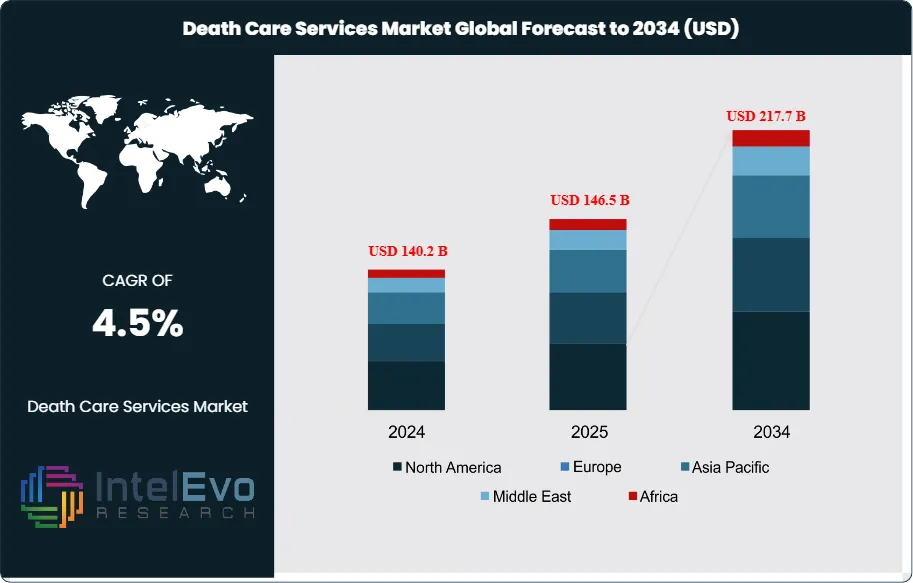
This growth is primarily driven by increasing mortality volumes in aging populations across North America, Europe, and parts of Asia Pacific. Additionally, changing consumer preferences toward pre-need funeral planning, eco-friendly burial options, and digital memorial services are reshaping the service portfolio of providers. Consolidation among funeral home operators and cemetery management companies is further strengthening pricing power and operational efficiency, supporting long-term revenue stability across the industry.
Death care services encompass the coordinated set of activities required after a death, including body preparation, transportation, visitation and ceremony management, cremation or interment, and administration of the final disposition. The sector also captures revenue from essential merchandise such as caskets, urns, and memorial products, alongside preneed planning and aftercare support. Demand remains structurally resilient because utilization tracks mortality trends rather than discretionary consumption, yet spending patterns continue to shift toward simpler formats and transparent pricing.
Consumer choice is moving decisively toward cremation and lower-total-cost arrangements. The NFDA cites a 61.9% cremation rate in 2024, with long-range projections reaching 82.1% by 2045, which strengthens volume visibility for cremation operators and suppliers of urns and memorialization services. Price sensitivity reinforces this pivot: a funeral with burial averaged USD 8,300 in 2023 versus USD 6,280 for cremation services. Environmental preference also reshapes product design and service mix. Interest in green options reached 68%, up from 55.7% in 2021, supporting differentiated offerings such as natural burial grounds, biodegradable containers, and lower-emission disposition methods where permitted.
Supply conditions reflect a fragmented provider base with ongoing consolidation. Large multi-location operators and metro-area funeral homes benefit from scale in facilities, fleet utilization, and procurement, while independents gain share in local, faith-based, and eco-focused niches. A reasonable global estimate places the top 10 providers at roughly 30–35% of revenue, leaving ample room for tuck-in acquisitions. Regulatory oversight influences operating models through consumer-protection rules on disclosures and pricing, licensing requirements, zoning constraints, and tightening environmental standards for crematoria emissions and waste handling. Key risks include energy and labor cost inflation, land scarcity for burial, compliance failures, and reputational exposure from service disruptions.
Digitalization is accelerating operational and commercial change. Online arrangement platforms, remote conferencing for services, and digital memorial ecosystems expand reach and improve conversion. AI-enabled scheduling, demand forecasting, and automated documentation reduce cycle times, while sensor-driven maintenance and workflow automation improve facility uptime. Regionally, North America remains the largest profit pool at an estimated 35–40% of 2024 revenue, while Asia-Pacific posts the fastest growth at a projected 5.5–6.5% CAGR, led by urbanizing corridors in India, Southeast Asia, and coastal China where cremation capacity and premium memorial parks attract capital. Europe advances in regulated green burial, and select Gulf and Latin American cities emerge as smaller but investable hubs tied to modern cemetery infrastructure and private crematoria development.
Key Takeaways
Market Growth: The market grows from 140.2 billion USD, 2024 to 217.7 billion USD, 2034 at 4.5% CAGR, 2024-2034.
Segment Dominance : Cremation Services lead the service type mix at 40.3%, 2024 as consumers shift away from traditional burial.
Segment Dominance: Individual Consumers account for 53.1%, 2024, keeping demand concentrated in personalized, direct-to-consumer offerings.
Driver: Providers capture demand for lower-cost disposition, supported by estimated: 6.3 thousand USD, 2024 average cremation spending in comparable markets.
Restraint: Operators face cost pressure from labor, energy, and compliance, reflected in estimated: 3.0% YoY operating cost inflation, 2024 in mature markets.
Opportunity: Firms scale preneed plans and value-added memorial products to lift revenue per case, targeting estimated: 1.2 thousand USD, 2024 incremental add-on spend per service.
Trend: Digital arrangements and automated back-office workflows accelerate adoption, with estimated: 35.0% of bookings initiated online, 2024 across large urban providers.
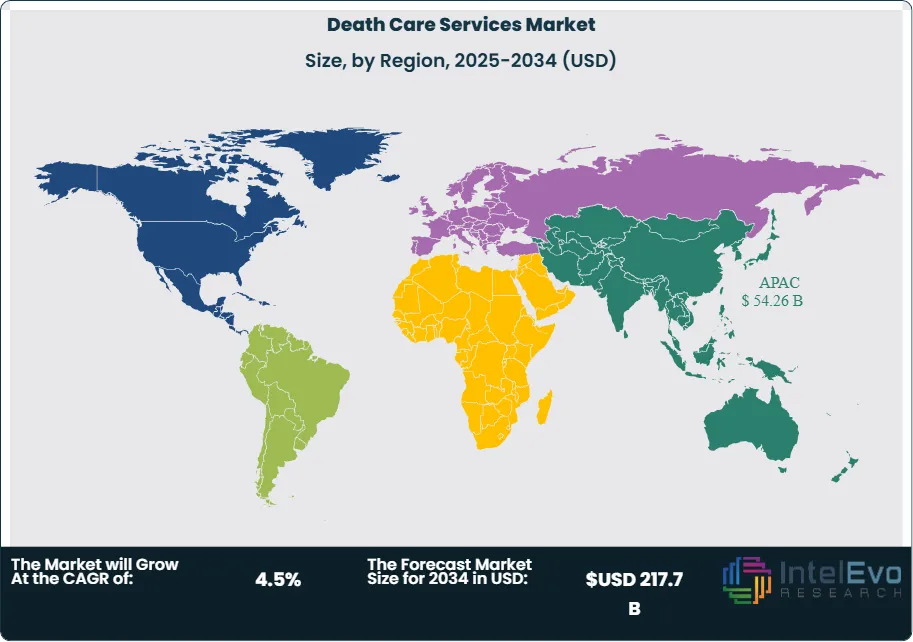
Regional Analysis: Asia Pacific leads at 38.7%, 2024, generating 54.26 billion USD, 2024, backed by population scale and modernization of death care infrastructure.
By Type
Cremation Services enter 2025 as the largest revenue line, holding 40.3% share in 2024. Cost discipline drives that position. NFDA pricing data puts the median funeral with burial at USD 8,300 in 2023, versus USD 6,280 for a funeral with cremation. Families also choose cremation for its logistics. It supports later ceremonies, ash scattering, and keepsake products without the time and land constraints of burial.
Funeral Services and Burial Services remain core, but they shift toward smaller, simpler packages. Younger households show higher price sensitivity and higher acceptance of direct cremation, which compresses merchandise revenue from caskets while increasing demand for urns and memorial add-ons. Embalming Services hold a smaller share because many cremation pathways bypass embalming unless viewing requirements or transport rules apply. Memorial Services expand as a standalone option, especially when families separate the disposition from the gathering.
Pre-Planning Services gain weight in the mix as providers push predictable cash flow and better capacity planning. Large operators continue to professionalize sales and aftercare programs. Service Corporation International reported USD 977 million in adjusted operating cash flow for 2024 and deployed USD 181 million to acquire 26 funeral homes and 6 cemeteries, signaling continued consolidation and disciplined capital allocation going into 2025.
By Application
Service demand increasingly splits between disposition-only transactions and experience-led memorialization. Direct cremation and streamlined burial packages win volume because they reduce total spend and shorten decision cycles. At the same time, families still pay for personalization. They shift budgets toward venues, catering, tribute media, and commemorative products when they avoid high-cost traditional bundles.
Digital channels now shape how families evaluate options. Many providers route first contact through websites and call centers, then confirm arrangements in person or by video. Automation reduces paperwork time in permits, death certificates, and scheduling. AI supports pricing consistency, staffing plans, and case load forecasting. These tools matter because service quality depends on on-time coordination across transport, preparation, and ceremony logistics.
Environmental considerations influence application choices beyond cremation. Interest in green options remains high. NFDA reports 61.4% of consumers show interest in exploring green funeral options in 2025, up from 55.7% in 2021. Regulatory pathways also widen the menu. Alkaline hydrolysis, also called water cremation, continues to expand across US states, which supports investment in alternative disposition capacity where rules and local acceptance align.
By End-Use
Individual Consumers drive the market because decisions sit with households at the point of need. This segment accounted for 53.1% share in 2024 and stays central through 2025 as families demand transparent pricing, fast coordination, and personalization. When you compare providers, you increasingly expect clear itemized packages, online price access, and simple scheduling.
Funeral Homes remain the operational backbone even when they do not appear as the primary payer. They control facilities, staff, fleet, and supplier relationships. They also carry compliance risk. In the United States, the FTC Funeral Rule sets disclosure expectations around price lists and consumer choice, and the agency has signaled active scrutiny of how providers share pricing information. That pressure rewards firms that standardize scripts, train staff, and keep digital price information consistent.
Religious Institutions influence ceremony format in faith-led communities, but they rarely control the full spend. Hospitals and healthcare providers also shape the flow through mortuary services, referrals, and documentation, especially in urban centers. Government and military channels add steady volume tied to benefits administration and protocol requirements, and they often demand strict process control and auditability.
By Region
Asia Pacific leads on scale. The region held 38.7% share in 2024, equal to USD 54.26 billion, supported by population size, aging demographics, and rapid urbanization. Demand varies sharply by country due to faith practices and land availability. Urban corridors in China, Japan, and Southeast Asia support higher utilization of cremation infrastructure and formal memorial parks, while parts of South Asia maintain strong burial traditions that sustain cemetery and funeral ceremony spending.
North America remains a high-margin market because of established preneed penetration, corporate consolidation, and mature cemetery operations. The US cremation rate reached 61.9% in 2024 and points higher over the next decade, which keeps investment focused on crematories, merchandise mix changes, and alternative disposition approvals. Europe shows steady demand with strong regulatory oversight and accelerating interest in natural burial and lower-emission practices, particularly in Western and Northern markets.
Latin America and the Middle East and Africa offer selective growth tied to urban middle-class expansion, insurance development, and private facility build-out. In these regions, you see opportunity where operators modernize cold storage, transport fleets, and compliant cremation capacity, while adapting service design to local religious requirements and municipal permitting constraints.
By Service Type (Funeral Services, Cremation Services, Burial Services, Memorial Services, Pre-Planning Services, Embalming Services), By End-User (Individual Consumers, Funeral Homes, Religious Institutions, Hospitals & Healthcare Providers, Government & Military)
Research Methodology
Primary Research- 100 Interviews of Stakeholders
Secondary Research
Desk Research
Regional scope
North America (United States, Canada, Mexico)
Latin America (Brazil, Argentina, Columbia)
East Asia And Pacific (China, Japan, South Korea, Australia, Cambodia, Fiji, Indonesia)
Sea And South Asia (India, Singapore, Thailand, Taiwan, Malaysia)
Eastern Europe (Poland, Russia, Czech Republic, Romania)
Western Europe (Germany, U.K., France, Spain, Itlay)
Middle East & Africa (GCC Countries, Egypt, Nigeria, South Africa, Israel)
Competitive Landscape
InvoCare, Matthews International Corporation, Kaashimukthi, Service Corporation International (SCI), Banyan Funeral Services, Arbor Memorial Services, FUJIFILM Holdings Corporation (Fujifilm Memorial Services), Sukhant Funeral, Carriage Services, Nirvana Funeral Services, Indian Funeral Services, Dignity Memorial, Last Journey, Anthyesti Funeral Services, StoneMor Inc., Amedisys Inc.
Customization Scope
Customization for segments, region/country-level will be provided. Moreover, additional customization can be done based on the requirements.
Pricing and Purchase Options
Avail customized purchase options to meet your exact research needs. We have three licenses to opt for: Single User License, Multi-User License (Up to 5 Users), Corporate Use License (Unlimited User and Printable PDF).
TABLE OF CONTENTS
1. EXECUTIVE SUMMARY
1.1. MARKET SNAPSHOT
1.2. KEY FINDINGS & INSIGHTS
1.3. ANALYST RECOMMENDATIONS
1.4. FUTURE OUTLOOK
2. RESEARCH METHODOLOGY
2.1. MARKET DEFINITION & SCOPE
2.2. RESEARCH OBJECTIVES: PRIMARY & SECONDARY DATA SOURCES
2.3. DATA COLLECTION SOURCES
2.3.1. COVERAGE OF 100+ PRIMARY RESEARCH/CONSULTATION CALLS WITH INDUSTRY STAKEHOLDERS
FIGURE 17 NORTH AMERICA DEATH CARE SERVICESCURRENT AND FUTURE TYPE ANALYSIS, 2025–2034, (USD MILLION)
FIGURE 18 NORTH AMERICA DEATH CARE SERVICESCURRENT AND FUTURE END USER ANALYSIS, 2025–2034, (USD MILLION)
FIGURE 19 MARKET SHARE BY COUNTRY
FIGURE 20 LATIN AMERICA DEATH CARE SERVICESCURRENT AND FUTURE TYPE ANALYSIS, 2025–2034, (USD MILLION)
FIGURE 21 LATIN AMERICA DEATH CARE SERVICESCURRENT AND FUTURE END USER ANALYSIS, 2025–2034, (USD MILLION)
FIGURE 22 MARKET SHARE BY COUNTRY
FIGURE 23 EASTERN EUROPE DEATH CARE SERVICESCURRENT AND FUTURE TYPE ANALYSIS, 2025–2034, (USD MILLION)
FIGURE 24 EASTERN EUROPE DEATH CARE SERVICESCURRENT AND FUTURE END USER ANALYSIS, 2025–2034, (USD MILLION)
FIGURE 25 MARKET SHARE BY COUNTRY
FIGURE 26 WESTERN EUROPE DEATH CARE SERVICESCURRENT AND FUTURE TYPE ANALYSIS, 2025–2034, (USD MILLION)
FIGURE 27 WESTERN EUROPE DEATH CARE SERVICESCURRENT AND FUTURE END USER ANALYSIS, 2025–2034, (USD MILLION)
FIGURE 28 MARKET SHARE BY COUNTRY
FIGURE 29 EAST ASIA AND PACIFIC DEATH CARE SERVICESCURRENT AND FUTURE TYPE ANALYSIS, 2025–2034, (USD MILLION)
FIGURE 30 EAST ASIA AND PACIFIC DEATH CARE SERVICESCURRENT AND FUTURE END USER ANALYSIS, 2025–2034, (USD MILLION)
FIGURE 31 MARKET SHARE BY COUNTRY
FIGURE 32 SEA AND SOUTH ASIA DEATH CARE SERVICESCURRENT AND FUTURE TYPE ANALYSIS, 2025–2034, (USD MILLION)
FIGURE 33 SEA AND SOUTH ASIA DEATH CARE SERVICESCURRENT AND FUTURE END USER ANALYSIS, 2025–2034, (USD MILLION)
FIGURE 34 MARKET SHARE BY COUNTRY
FIGURE 35 MIDDLE EAST AND AFRICA DEATH CARE SERVICESCURRENT AND FUTURE TYPE ANALYSIS, 2025–2034, (USD MILLION)
FIGURE 36 MIDDLE EAST AND AFRICA DEATH CARE SERVICESCURRENT AND FUTURE END USER ANALYSIS, 2025–2034, (USD MILLION)
FIGURE 37 NORTH AMERICA DEATH CARE SERVICESCURRENT AND FUTURE MARKET VOLUME SHARE REGIONAL ANALYSIS, 2025–2034, (USD MILLION)
FIGURE 38 U.S. DEATH CARE SERVICESCURRENT AND FUTURE TYPE ANALYSIS, 2025–2034, (USD MILLION)
FIGURE 39 U.S. DEATH CARE SERVICESCURRENT AND FUTURE END USER ANALYSIS, 2025–2034, (USD MILLION)
FIGURE 40 CANADA DEATH CARE SERVICESCURRENT AND FUTURE TYPE ANALYSIS, 2025–2034, (USD MILLION)
FIGURE 41 CANADA DEATH CARE SERVICESCURRENT AND FUTURE END USER ANALYSIS, 2025–2034, (USD MILLION)
FIGURE 42 LATIN AMERICA DEATH CARE SERVICESCURRENT AND FUTURE MARKET VOLUME SHARE REGIONAL ANALYSIS, 2025–2034, (USD MILLION)
FIGURE 43 MEXICO DEATH CARE SERVICESCURRENT AND FUTURE TYPE ANALYSIS, 2025–2034, (USD MILLION)
FIGURE 44 MEXICO DEATH CARE SERVICESCURRENT AND FUTURE END USER ANALYSIS, 2025–2034, (USD MILLION)
FIGURE 45 BRAZIL DEATH CARE SERVICESCURRENT AND FUTURE TYPE ANALYSIS, 2025–2034, (USD MILLION)
FIGURE 46 BRAZIL DEATH CARE SERVICESCURRENT AND FUTURE END USER ANALYSIS, 2025–2034, (USD MILLION)
FIGURE 47 ARGENTINA DEATH CARE SERVICESCURRENT AND FUTURE TYPE ANALYSIS, 2025–2034, (USD MILLION)
FIGURE 48 ARGENTINA DEATH CARE SERVICESCURRENT AND FUTURE END USER ANALYSIS, 2025–2034, (USD MILLION)
FIGURE 49 COLUMBIA DEATH CARE SERVICESCURRENT AND FUTURE TYPE ANALYSIS, 2025–2034, (USD MILLION)
FIGURE 50 COLUMBIA DEATH CARE SERVICESCURRENT AND FUTURE END USER ANALYSIS, 2025–2034, (USD MILLION)
FIGURE 51 REST OF LATIN AMERICA DEATH CARE SERVICESCURRENT AND FUTURE TYPE ANALYSIS, 2025–2034, (USD MILLION)
FIGURE 52 REST OF LATIN AMERICA DEATH CARE SERVICESCURRENT AND FUTURE END USER ANALYSIS, 2025–2034, (USD MILLION)
FIGURE 53 EASTERN EUROPE DEATH CARE SERVICESCURRENT AND FUTURE MARKET VOLUME SHARE REGIONAL ANALYSIS, 2025–2034, (USD MILLION)
FIGURE 54 POLAND DEATH CARE SERVICESCURRENT AND FUTURE TYPE ANALYSIS, 2025–2034, (USD MILLION)
FIGURE 55 POLAND DEATH CARE SERVICESCURRENT AND FUTURE END USER ANALYSIS, 2025–2034, (USD MILLION)
FIGURE 56 RUSSIA DEATH CARE SERVICESCURRENT AND FUTURE TYPE ANALYSIS, 2025–2034, (USD MILLION)
FIGURE 57 RUSSIA DEATH CARE SERVICESCURRENT AND FUTURE END USER ANALYSIS, 2025–2034, (USD MILLION)
FIGURE 58 CZECH REPUBLIC DEATH CARE SERVICESCURRENT AND FUTURE TYPE ANALYSIS, 2025–2034, (USD MILLION)
FIGURE 59 CZECH REPUBLIC DEATH CARE SERVICESCURRENT AND FUTURE END USER ANALYSIS, 2025–2034, (USD MILLION)
FIGURE 60 ROMANIA DEATH CARE SERVICESCURRENT AND FUTURE TYPE ANALYSIS, 2025–2034, (USD MILLION)
FIGURE 61 ROMANIA DEATH CARE SERVICESCURRENT AND FUTURE END USER ANALYSIS, 2025–2034, (USD MILLION)
FIGURE 62 REST OF EASTERN EUROPE DEATH CARE SERVICESCURRENT AND FUTURE TYPE ANALYSIS, 2025–2034, (USD MILLION)
FIGURE 63 REST OF EASTERN EUROPE DEATH CARE SERVICESCURRENT AND FUTURE END USER ANALYSIS, 2025–2034, (USD MILLION)
FIGURE 64 WESTERN EUROPE DEATH CARE SERVICESCURRENT AND FUTURE MARKET VOLUME SHARE REGIONAL ANALYSIS, 2025–2034, (USD MILLION)
FIGURE 65 GERMANY DEATH CARE SERVICESCURRENT AND FUTURE TYPE ANALYSIS, 2025–2034, (USD MILLION)
FIGURE 66 GERMANY DEATH CARE SERVICESCURRENT AND FUTURE END USER ANALYSIS, 2025–2034, (USD MILLION)
FIGURE 67 FRANCE DEATH CARE SERVICESCURRENT AND FUTURE TYPE ANALYSIS, 2025–2034, (USD MILLION)
FIGURE 68 FRANCE DEATH CARE SERVICESCURRENT AND FUTURE END USER ANALYSIS, 2025–2034, (USD MILLION)
FIGURE 69 UK DEATH CARE SERVICESCURRENT AND FUTURE TYPE ANALYSIS, 2025–2034, (USD MILLION)
FIGURE 70 UK DEATH CARE SERVICESCURRENT AND FUTURE END USER ANALYSIS, 2025–2034, (USD MILLION)
FIGURE 71 SPAIN DEATH CARE SERVICESCURRENT AND FUTURE TYPE ANALYSIS, 2025–2034, (USD MILLION)
FIGURE 72 SPAIN DEATH CARE SERVICESCURRENT AND FUTURE END USER ANALYSIS, 2025–2034, (USD MILLION)
FIGURE 73 ITALY DEATH CARE SERVICESCURRENT AND FUTURE TYPE ANALYSIS, 2025–2034, (USD MILLION)
FIGURE 74 ITALY DEATH CARE SERVICESCURRENT AND FUTURE END USER ANALYSIS, 2025–2034, (USD MILLION)
FIGURE 75 REST OF WESTERN EUROPE DEATH CARE SERVICESCURRENT AND FUTURE TYPE ANALYSIS, 2025–2034, (USD MILLION)
FIGURE 76 REST OF WESTERN EUROPE DEATH CARE SERVICESCURRENT AND FUTURE END USER ANALYSIS, 2025–2034, (USD MILLION)
FIGURE 77 EAST ASIA AND PACIFIC DEATH CARE SERVICESCURRENT AND FUTURE MARKET VOLUME SHARE REGIONAL ANALYSIS, 2025–2034, (USD MILLION)
FIGURE 78 CHINA DEATH CARE SERVICESCURRENT AND FUTURE TYPE ANALYSIS, 2025–2034, (USD MILLION)
FIGURE 79 CHINA DEATH CARE SERVICESCURRENT AND FUTURE END USER ANALYSIS, 2025–2034, (USD MILLION)
FIGURE 80 JAPAN DEATH CARE SERVICESCURRENT AND FUTURE TYPE ANALYSIS, 2025–2034, (USD MILLION)
FIGURE 81 JAPAN DEATH CARE SERVICESCURRENT AND FUTURE END USER ANALYSIS, 2025–2034, (USD MILLION)
FIGURE 82 AUSTRALIA DEATH CARE SERVICESCURRENT AND FUTURE TYPE ANALYSIS, 2025–2034, (USD MILLION)
FIGURE 83 AUSTRALIA DEATH CARE SERVICESCURRENT AND FUTURE END USER ANALYSIS, 2025–2034, (USD MILLION)
FIGURE 84 CAMBODIA DEATH CARE SERVICESCURRENT AND FUTURE TYPE ANALYSIS, 2025–2034, (USD MILLION)
FIGURE 85 CAMBODIA DEATH CARE SERVICESCURRENT AND FUTURE END USER ANALYSIS, 2025–2034, (USD MILLION)
FIGURE 86 FIJI DEATH CARE SERVICESCURRENT AND FUTURE TYPE ANALYSIS, 2025–2034, (USD MILLION)
FIGURE 87 FIJI DEATH CARE SERVICESCURRENT AND FUTURE END USER ANALYSIS, 2025–2034, (USD MILLION)
FIGURE 88 INDONESIA DEATH CARE SERVICESCURRENT AND FUTURE TYPE ANALYSIS, 2025–2034, (USD MILLION)
FIGURE 89 INDONESIA DEATH CARE SERVICESCURRENT AND FUTURE END USER ANALYSIS, 2025–2034, (USD MILLION)
FIGURE 90 SOUTH KOREA DEATH CARE SERVICESCURRENT AND FUTURE TYPE ANALYSIS, 2025–2034, (USD MILLION)
FIGURE 91 SOUTH KOREA DEATH CARE SERVICESCURRENT AND FUTURE END USER ANALYSIS, 2025–2034, (USD MILLION)
FIGURE 92 REST OF EAST ASIA AND PACIFIC DEATH CARE SERVICESCURRENT AND FUTURE TYPE ANALYSIS, 2025–2034, (USD MILLION)
FIGURE 93 REST OF EAST ASIA AND PACIFIC DEATH CARE SERVICESCURRENT AND FUTURE END USER ANALYSIS, 2025–2034, (USD MILLION)
FIGURE 94 SEA AND SOUTH ASIA DEATH CARE SERVICESCURRENT AND FUTURE MARKET VOLUME SHARE REGIONAL ANALYSIS, 2025–2034, (USD MILLION)
FIGURE 95 BANGLADESH DEATH CARE SERVICESCURRENT AND FUTURE TYPE ANALYSIS, 2025–2034, (USD MILLION)
FIGURE 96 BANGLADESH DEATH CARE SERVICESCURRENT AND FUTURE END USER ANALYSIS, 2025–2034, (USD MILLION)
FIGURE 97 NEW ZEALAND DEATH CARE SERVICESCURRENT AND FUTURE TYPE ANALYSIS, 2025–2034, (USD MILLION)
FIGURE 98 NEW ZEALAND DEATH CARE SERVICESCURRENT AND FUTURE END USER ANALYSIS, 2025–2034, (USD MILLION)
FIGURE 99 INDIA DEATH CARE SERVICESCURRENT AND FUTURE TYPE ANALYSIS, 2025–2034, (USD MILLION)
FIGURE 100 INDIA DEATH CARE SERVICESCURRENT AND FUTURE END USER ANALYSIS, 2025–2034, (USD MILLION)
FIGURE 101 SINGAPORE DEATH CARE SERVICESCURRENT AND FUTURE TYPE ANALYSIS, 2025–2034, (USD MILLION)
FIGURE 102 SINGAPORE DEATH CARE SERVICESCURRENT AND FUTURE END USER ANALYSIS, 2025–2034, (USD MILLION)
FIGURE 103 THAILAND DEATH CARE SERVICESCURRENT AND FUTURE TYPE ANALYSIS, 2025–2034, (USD MILLION)
FIGURE 104 THAILAND DEATH CARE SERVICESCURRENT AND FUTURE END USER ANALYSIS, 2025–2034, (USD MILLION)
FIGURE 105 TAIWAN DEATH CARE SERVICESCURRENT AND FUTURE TYPE ANALYSIS, 2025–2034, (USD MILLION)
FIGURE 106 TAIWAN DEATH CARE SERVICESCURRENT AND FUTURE END USER ANALYSIS, 2025–2034, (USD MILLION)
FIGURE 107 MALAYSIA DEATH CARE SERVICESCURRENT AND FUTURE TYPE ANALYSIS, 2025–2034, (USD MILLION)
FIGURE 108 MALAYSIA DEATH CARE SERVICESCURRENT AND FUTURE END USER ANALYSIS, 2025–2034, (USD MILLION)
FIGURE 109 REST OF SEA AND SOUTH ASIA DEATH CARE SERVICESCURRENT AND FUTURE TYPE ANALYSIS, 2025–2034, (USD MILLION)
FIGURE 110 REST OF SEA AND SOUTH ASIA DEATH CARE SERVICESCURRENT AND FUTURE END USER ANALYSIS, 2025–2034, (USD MILLION)
FIGURE 111 MIDDLE EAST AND AFRICA DEATH CARE SERVICESCURRENT AND FUTURE MARKET VOLUME SHARE REGIONAL ANALYSIS, 2025–2034, (USD MILLION)
FIGURE 112 GCC COUNTRIES DEATH CARE SERVICESCURRENT AND FUTURE TYPE ANALYSIS, 2025–2034, (USD MILLION)
FIGURE 113 GCC COUNTRIES DEATH CARE SERVICESCURRENT AND FUTURE END USER ANALYSIS, 2025–2034, (USD MILLION)
FIGURE 114 SAUDI ARABIA DEATH CARE SERVICESCURRENT AND FUTURE TYPE ANALYSIS, 2025–2034, (USD MILLION)
FIGURE 115 SAUDI ARABIA DEATH CARE SERVICESCURRENT AND FUTURE END USER ANALYSIS, 2025–2034, (USD MILLION)
FIGURE 116 UAE DEATH CARE SERVICESCURRENT AND FUTURE TYPE ANALYSIS, 2025–2034, (USD MILLION)
FIGURE 117 UAE DEATH CARE SERVICESCURRENT AND FUTURE END USER ANALYSIS, 2025–2034, (USD MILLION)
FIGURE 118 BAHRAIN DEATH CARE SERVICESCURRENT AND FUTURE TYPE ANALYSIS, 2025–2034, (USD MILLION)
FIGURE 119 BAHRAIN DEATH CARE SERVICESCURRENT AND FUTURE END USER ANALYSIS, 2025–2034, (USD MILLION)
FIGURE 120 KUWAIT DEATH CARE SERVICESCURRENT AND FUTURE TYPE ANALYSIS, 2025–2034, (USD MILLION)
FIGURE 121 KUWAIT DEATH CARE SERVICESCURRENT AND FUTURE END USER ANALYSIS, 2025–2034, (USD MILLION)
FIGURE 122 OMAN DEATH CARE SERVICESCURRENT AND FUTURE TYPE ANALYSIS, 2025–2034, (USD MILLION)
FIGURE 123 OMAN DEATH CARE SERVICESCURRENT AND FUTURE END USER ANALYSIS, 2025–2034, (USD MILLION)
FIGURE 124 QATAR DEATH CARE SERVICESCURRENT AND FUTURE TYPE ANALYSIS, 2025–2034, (USD MILLION)
FIGURE 125 QATAR DEATH CARE SERVICESCURRENT AND FUTURE END USER ANALYSIS, 2025–2034, (USD MILLION)
FIGURE 126 EGYPT DEATH CARE SERVICESCURRENT AND FUTURE TYPE ANALYSIS, 2025–2034, (USD MILLION)
FIGURE 127 EGYPT DEATH CARE SERVICESCURRENT AND FUTURE END USER ANALYSIS, 2025–2034, (USD MILLION)
FIGURE 128 NIGERIA DEATH CARE SERVICESCURRENT AND FUTURE TYPE ANALYSIS, 2025–2034, (USD MILLION)
FIGURE 129 NIGERIA DEATH CARE SERVICESCURRENT AND FUTURE END USER ANALYSIS, 2025–2034, (USD MILLION)
FIGURE 130 SOUTH AFRICA DEATH CARE SERVICESCURRENT AND FUTURE TYPE ANALYSIS, 2025–2034, (USD MILLION)
FIGURE 131 SOUTH AFRICA DEATH CARE SERVICESCURRENT AND FUTURE END USER ANALYSIS, 2025–2034, (USD MILLION)
FIGURE 132 ISRAEL DEATH CARE SERVICESCURRENT AND FUTURE TYPE ANALYSIS, 2025–2034, (USD MILLION)
FIGURE 133 ISRAEL DEATH CARE SERVICESCURRENT AND FUTURE END USER ANALYSIS, 2025–2034, (USD MILLION)
FIGURE 134 REST OF MEA DEATH CARE SERVICESCURRENT AND FUTURE TYPE ANALYSIS, 2025–2034, (USD MILLION)
FIGURE 135 REST OF MEA DEATH CARE SERVICESCURRENT AND FUTURE END USER ANALYSIS, 2025–2034, (USD MILLION)
FIGURE 136 U. S. MARKET SHARE ANALYSIS BY TYPE (2024)
FIGURE 137 U. S. MARKET SHARE ANALYSIS BY END USER (2024)
FIGURE 138 CANADA MARKET SHARE ANALYSIS BY TYPE (2024)
FIGURE 139 CANADA MARKET SHARE ANALYSIS BY END USER (2024)
FIGURE 140 MEXICO MARKET SHARE ANALYSIS BY TYPE (2024)
FIGURE 141 MEXICO MARKET SHARE ANALYSIS BY END USER (2024)
FIGURE 142 CHINA MARKET SHARE ANALYSIS BY TYPE (2024)
FIGURE 143 CHINA MARKET SHARE ANALYSIS BY END USER (2024)
FIGURE 144 JAPAN MARKET SHARE ANALYSIS BY TYPE (2024)
FIGURE 145 JAPAN MARKET SHARE ANALYSIS BY END USER (2024)
FIGURE 146 INDIA MARKET SHARE ANALYSIS BY TYPE (2024)
FIGURE 147 INDIA MARKET SHARE ANALYSIS BY END USER (2024)
FIGURE 148 SOUTH KOREA MARKET SHARE ANALYSIS BY TYPE (2024)
FIGURE 149 SOUTH KOREA MARKET SHARE ANALYSIS BY END USER (2024)
FIGURE 150 SAUDI ARABIA MARKET SHARE ANALYSIS BY TYPE (2024)
FIGURE 151 SAUDI ARABIA MARKET SHARE ANALYSIS BY END USER (2024)
FIGURE 152 UAE MARKET SHARE ANALYSIS BY TYPE (2024)
FIGURE 153 UAE MARKET SHARE ANALYSIS BY END USER (2024)
FIGURE 154 EGYPT MARKET SHARE ANALYSIS BY TYPE (2024)
FIGURE 155 EGYPT MARKET SHARE ANALYSIS BY END USER (2024)
FIGURE 156 NIGERIA MARKET SHARE ANALYSIS BY TYPE (2024)
FIGURE 157 NIGERIA MARKET SHARE ANALYSIS BY END USER (2024)
FIGURE 158 SOUTH AFRICA MARKET SHARE ANALYSIS BY TYPE (2024)
FIGURE 159 SOUTH AFRICA MARKET SHARE ANALYSIS BY END USER (2024)
FIGURE 160 GERMANY MARKET SHARE ANALYSIS BY TYPE (2024)
FIGURE 161 GERMANY MARKET SHARE ANALYSIS BY END USER (2024)
FIGURE 162 FRANCE MARKET SHARE ANALYSIS BY TYPE (2024)
FIGURE 163 FRANCE MARKET SHARE ANALYSIS BY END USER (2024)
FIGURE 164 UK MARKET SHARE ANALYSIS BY TYPE (2024)
FIGURE 165 UK MARKET SHARE ANALYSIS BY END USER (2024)
FIGURE 166 SPAIN MARKET SHARE ANALYSIS BY TYPE (2024)
FIGURE 167 SPAIN MARKET SHARE ANALYSIS BY END USER (2024)
FIGURE 168 ITALY MARKET SHARE ANALYSIS BY TYPE (2024)
FIGURE 169 ITALY MARKET SHARE ANALYSIS BY END USER (2024)
FIGURE 170 BRAZIL MARKET SHARE ANALYSIS BY TYPE (2024)
FIGURE 171 BRAZIL MARKET SHARE ANALYSIS BY END USER (2024)
FIGURE 172 ARGENTINA MARKET SHARE ANALYSIS BY TYPE (2024)
FIGURE 173 ARGENTINA MARKET SHARE ANALYSIS BY END USER (2024)
FIGURE 174 COLUMBIA MARKET SHARE ANALYSIS BY TYPE (2024)
FIGURE 175 COLUMBIA MARKET SHARE ANALYSIS BY END USER (2024)
FIGURE 176 GLOBAL DEATH CARE SERVICESCURRENT AND FUTURE MARKET KEY COUNTRY LEVEL ANALYSIS, 2024–2034, (USD MILLION)
FIGURE 177 FINANCIAL OVERVIEW:
Key Player Analysis
Dignity Memorial: Dignity Memorial, operated under Service Corporation International (SCI), holds a market leader position in North America due to unmatched scale and a broad brand portfolio. SCI reported 4.19 billion USD in revenue in 2024 and generated 977.0 million USD in adjusted operating cash flow, which underpins sustained reinvestment in field operations and brand reach.
SCI pairs Dignity Memorial with preneed and cemetery depth to protect mix as cremation rises. Its 2024 investor materials cite about 700,000 customers served, 2.6 billion USD in preneed sales, and about 16.0 billion USD in backlog of future revenue, which strengthens visibility versus smaller independents. The same materials position SCI at about 17% revenue share in the U.S. and Canada and highlight a footprint advantage supported by acquisitions of 26 funeral homes and 6 cemeteries during 2024. In 2025, this posture supports continued consolidation in metro markets and faster rollout of digital arrangement and automation tools across a standardized operating model.
Carriage Services: Carriage Services operates as a focused challenger with a strategy centered on margin discipline, preneed momentum, and selective portfolio reshaping. For full-year 2024, Carriage reported 404.2 million USD in total revenue, up 5.7% year over year, and 126.2 million USD in adjusted consolidated EBITDA, up 11.5%. Cemetery preneed sales increased 26.7% in 2024, reinforcing an annuity-like demand base that can offset volatility in at-need volumes.
In 2025, Carriage positions M&A and technology execution as its primary accelerants. The company guided 2025 revenue at 400.0–410.0 million USD and signaled planned divestitures of non-core assets, which indicates a bias toward higher-return properties and tighter field oversight. It also disclosed active acquisition efforts, including deals under contract tied to more than 15.0 million USD in acquired revenue, and it increased professional spend tied to a digital transformation program, signaling deeper investment in automation, workflow controls, and consumer-facing digital journeys.
StoneMor Inc.: StoneMor operates as a niche player with scale concentration in cemetery assets and a restructuring-oriented ownership model. The company became an indirect wholly owned subsidiary of Axar following a merger that closed in November 2022, and it no longer trades publicly. Its last public company description cited 302 cemeteries and 74 funeral homes across 23 states and Puerto Rico, which keeps it relevant in preneed cemetery property, memorialization, and at-need services tied to established grounds.
In the 2025 landscape, StoneMor’s strategic value sits in cash-generative cemetery portfolios, preneed contract management, and operational remediation under private ownership. This structure can support targeted capex in grounds development, trust administration, and merchandising productivity, while shifting the mix toward services that align with cremation growth, including niches, memorials, and installation services. For investors and partners, the core differentiator remains asset footprint and localized cemetery market density, which can support regional rollups or operator partnerships where compliance, service standards, and preneed sales infrastructure become decisive.
Market Key Players
InvoCare
Matthews International Corporation
Kaashimukthi
Service Corporation International (SCI)
Banyan Funeral Services
Arbor Memorial Services
FUJIFILM Holdings Corporation (Fujifilm Memorial Services)
Sukhant Funeral
Carriage Services
Nirvana Funeral Services
Indian Funeral Services
Dignity Memorial
Last Journey
Anthyesti Funeral Services
StoneMor Inc.
Amedisys Inc.
Driver:
Stable Demographics and Predictable Volume Growth
By 2025, demographic fundamentals keep demand stable across regions. The global market totals 140.2 billion USD, 2024 and tracks toward 217.7 billion USD, 2034, which implies 4.5% CAGR, 2024-2034. Aging populations expand the addressable base, and higher urban mortality volumes keep case throughput predictable for operators. This demand profile reduces cyclicality and supports steady capacity investment in funeral homes, crematories, and cemeteries.
Pre-Need Adoption and Service Customization
Consumer behavior also shifts the revenue mix. Pre-need planning gains wider acceptance because families want cost control and clearer instructions before a loss occurs. You see stronger attachment rates for pre-arranged packages where providers offer transparent itemized pricing and flexible funding options. Cultural and religious diversity also raises demand for customized rites, language support, and venue choices, which increases billable service complexity and pushes providers to broaden portfolios without expanding fixed assets at the same pace.
Restraint:
Land Scarcity and Burial Infrastructure Limits
Land and infrastructure constraints limit expansion in dense markets in 2025. Burial plot scarcity raises cemetery pricing and slows new development due to zoning and permitting timelines. This pressure forces operators to depend more on cremation capacity and memorial services, which can compress merchandise revenue where casket sales decline and families choose lower-cost packages.
Regulatory Costs and Informal Market Competition
Regulatory and informal competition add friction. Environmental compliance costs rise as jurisdictions tighten emissions standards for crematoria and enforce waste handling requirements, which increases capital expenditure per site. At the same time, unlicensed or semi-formal providers undercut pricing in some markets and pull demand from compliant operators. You absorb this impact through higher customer acquisition costs and the need for stronger verification, documentation, and service guarantees.
Opportunity:
Expansion of Green and Sustainable Funeral Options
Eco-focused disposition options move from niche to investable in 2025. Consumer interest in green funerals reached 68.0%, 2024, and that preference supports growth in natural burial grounds, biodegradable materials, and lower-emission processes where regulators permit them. You can target higher-margin add-ons through certified products, curated memorial spaces, and verified chain-of-custody services that reduce reputational risk.
Digital Memorialization and Online Arrangements
Digital memorialization also expands the profit pool. Online tribute pages, streaming services, and remote arrangement tools widen access for dispersed families and lift conversion from first contact to booked service. A conservative industry benchmark places online-initiated arrangements at estimated: 35.0% of cases, 2025, in large urban providers. This shift rewards firms that standardize pricing, automate documentation, and integrate payments, which improves throughput per director and supports multi-site rollouts.
Trend:
Rising Cremation Penetration and Product Mix Shift
Cremation continues to take share through 2025 as households prioritize lower total cost and simpler logistics. The cremation rate reached 61.9%, 2024, and a reasonable 2025 outlook places it at estimated: 63.5%, 2025, in markets that track NFDA-style adoption patterns. This move changes procurement demand from caskets to urns, keepsakes, and memorial products, and it increases utilization pressure on crematory capacity and transport networks.
Experience-Led Services and Celebration Formats
Service format also changes. “Celebration of life” events grow as families separate disposition from gathering and choose flexible venues, shorter timelines, and more personal content. Social platforms and digital condolence tools normalize public participation, and providers package streaming, tribute media, and moderated online guestbooks as standard line items. You compete more on experience design, speed, and transparency, while keeping compliance, identity checks, and documentation tight to protect brand trust.
Recent Developments
Dec 2024 – Park Lawn Corporation: Park Lawn acquired substantially all assets of the Fitzgerald Funeral Home & Crematory and Burke-Tubbs locations in Illinois, adding 4 stand-alone funeral homes, 2024. This expanded its operating footprint across multiple Illinois communities, 2024. This move strengthened regional density and improved route-to-market efficiency for at-need and preneed contracts, 2024.
Feb 2025 – Service Corporation International (Dignity Memorial): SCI reported full-year revenue of USD 4,186.4 million, 2024 and adjusted operating cash flow of USD 977.0 million, 2024. It deployed USD 181.0 million, 2024 to acquire 26 funeral homes and 6 cemeteries, 2024 and issued 2025 adjusted EPS guidance of USD 3.70–4.00 per share, 2025.
Apr 2025 – Service Corporation International (Dignity Memorial): SCI posted Q1 revenue of USD 1,074.2 million, 2025 with GAAP EPS of USD 0.98 per share, 2025 and adjusted EPS of USD 0.96 per share, 2025. It generated GAAP operating cash flow of USD 311.1 million, 2025 and reported comparable funeral services performed growth of 1.8%, 2025.
Jul 2025 – Service Corporation International (Dignity Memorial): SCI confirmed 2025 EPS guidance of USD 3.70–4.00 per share, 2025 and raised its net cash provided by operating activities outlook to USD 880–940 million, 2025. It also lifted net cash from operating activities excluding special items and cash taxes to USD 1,025–1,085 million, 2025. The upgraded cash view increased headroom for buybacks and targeted footprint expansion while maintaining guidance discipline, 2025.
