
The Global Decentralized Finance (DeFi) Ecosystem Market size is projected to reach approximately USD 1,245.7 million by 2034, up from USD 97.8 million in 2024, growing at a CAGR of 31.5% during the forecast period from 2024 to 2034. The surge is fueled by rising adoption of blockchain technologies, smart contracts, and peer-to-peer financial services that eliminate intermediaries. Growing institutional interest, enhanced security protocols, and expansion of DeFi applications into lending, insurance, and asset management are set to redefine the global financial landscape.
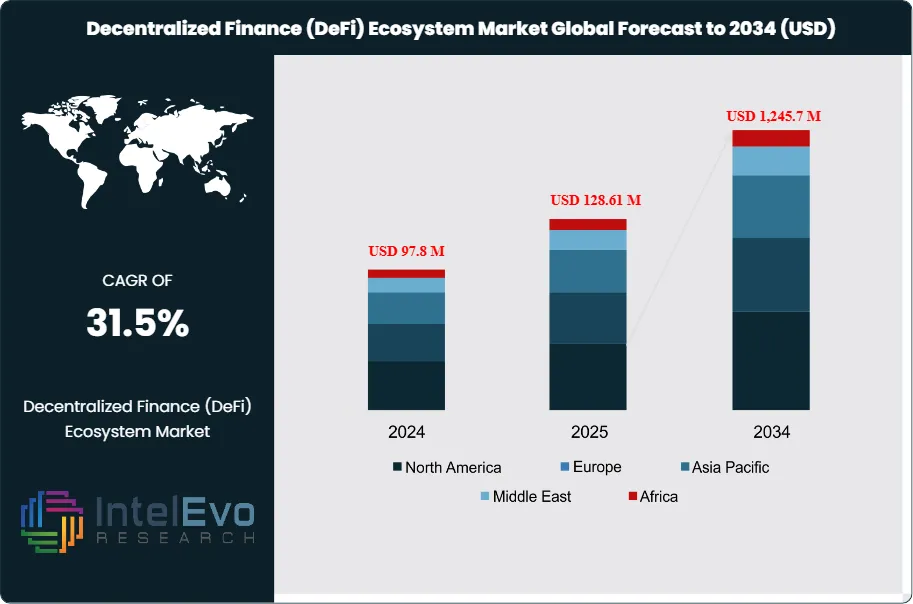
The DeFi Ecosystem Market is a global decentralized finance sector offering various blockchain-based financial services without reliance on traditional banks. Through the use of smart contracts on blockchain networks, specifically Ethereum, DeFi enables transparent and secure financial activities such as lending, borrowing, and cryptocurrency trading. At present, this market is seeing quick expansion due to the rising popularity of digital assets and a growing need for easier financial services. By 2024, the market is estimated to reach USD 97.8 million, with a forecasted increase to USD 1,245.7 million by 2034, driven by continuous technological progress and growing consumer knowledge.
Several important factors characterize the growth dynamics of the DeFi ecosystem. Increasing interest in digital assets is a key factor driving greater investment in decentralized financial platforms. DeFi's capability to cut out middlemen leads to reduced transaction expenses and improved effectiveness, allowing financial services to reach a wider range of people. Moreover, the appeal of automation and enhanced security features embedded in blockchain technology play a role in the market's growth. The creation of decentralized applications (dApps) enables users to participate in financial activities like trading and lending in a smooth manner, leading to a considerable increase in the market. Institutional enthusiasm for DeFi solutions is increasing, contributing to strong growth expected at a CAGR of 31.5%.
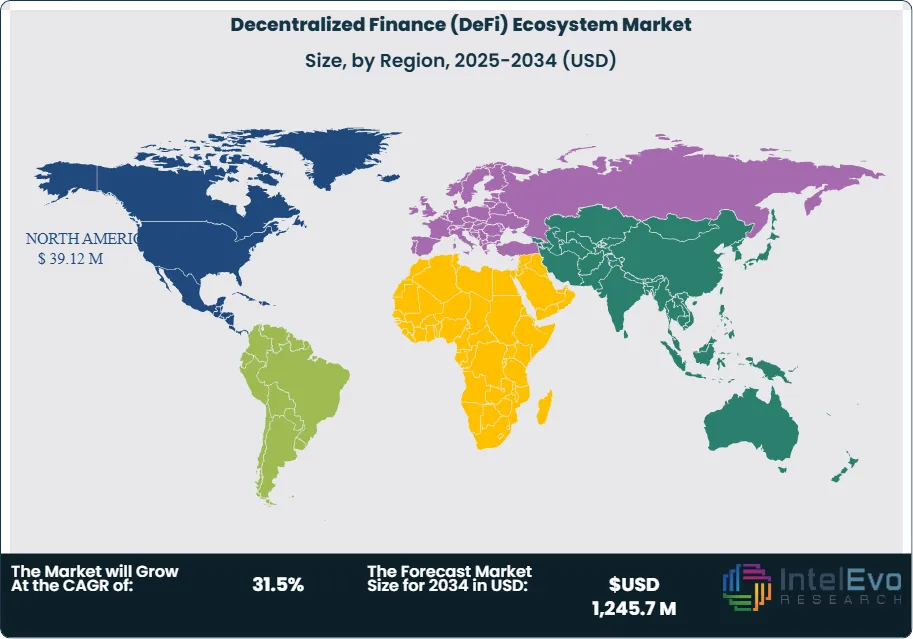
In terms of geographical areas, North America is set to lead the DeFi market, with estimates suggesting it will represent around 54% of market expansion by 2028. The United States is at the forefront of this movement because it was an early adopter of blockchain technologies and has a thriving startup landscape, especially in the fintech industry. The Asia-Pacific region is becoming a notable participant, supported by greater technology investments and crypto-friendly regulations. Singapore and China are positioning themselves as centers for DeFi innovation, attracting significant amounts of capital. In the meantime, Europe is seeing significant growth as regulations evolve to support decentralized platforms, improving market dynamics as a whole.
The DeFi ecosystem has been significantly affected by the COVID-19 pandemic in various ways. Although some areas were affected by economic uncertainties, the pandemic hastened the transition to digital financial services. The growing dependence on remote work and digital transactions prompted both individuals and institutions to consider DeFi as a feasible option to conventional financial services. The COVID-19 crisis highlighted the importance of financial inclusivity, as decentralized platforms offered specific solutions for marginalized groups. This shift has set up the DeFi market for substantial expansion after the pandemic, as customers are more interested in cutting-edge financial services that focus on security, efficiency, and ease of use.
Key Takeaways
Market Growth: The DeFi ecosystem market is expected to reach USD 1,245.7 million by 2034, growing at a robust CAGR of 31.5%, indicating strong market expansion.
Product Type Analysis: Decentralized exchanges (DEXs) are leading the product segment due to their increasing popularity, allowing users to trade cryptocurrencies directly without intermediaries. This trend emphasizes the demand for greater privacy and control over assets.
Application Analysis: The asset management application within DeFi is gaining traction, providing users with automated investment strategies and portfolio management. This growth is driven by the rising interest in passive income through yield farming and liquidity provision.
Driver: The primary driver for market growth is the increasing interest in digital assets and blockchain technology, which is fostering innovation in financial services. The desire for financial inclusivity and lower transaction costs also supports this trend.
Restraint: Regulatory uncertainties surrounding cryptocurrencies and DeFi platforms pose a significant restraint. These regulations may hinder market growth by creating compliance challenges for new and existing DeFi projects.
Opportunity: There are substantial opportunities in developing regions, particularly in Asia-Pacific, where the demand for DeFi solutions is increasing. Innovations in technology and financial services can lead to new markets and customer bases.
Trend: The integration of traditional financial services with DeFi platforms is a growing trend, enabling users to access decentralized services while maintaining a connection to conventional finance.
RegionalAnalysis: North America is projected to dominate the DeFi market, driven by early adoption and a favorable regulatory environment. Asia-Pacific is also expected to see significant growth due to rising investments in blockchain technologies and supportive government initiatives.
Component
The DeFi ecosystem is made up of several key elements that work together to drive its growth and adoption. Smart contracts are fundamental. They enable automated, transparent, and trustless transactions without the need for intermediaries. Decentralized applications (dApps) use these contracts to provide financial services like lending, trading, and insurance on blockchain networks. DeFi platforms act as marketplaces where users can access different decentralized financial services, including decentralized exchanges (DEXs) and yield farming protocols. The blockchain infrastructure supports all these layers, ensuring security, immutability, and scalability, which allows for global participation. Together, these elements are changing traditional financial systems into decentralized, user-focused ecosystems.
Application
The application segment highlights various uses of DeFi technologies across the financial landscape, including asset management, payments, trading, borrowing, and insurance. Asset management applications are gaining momentum as they offer automated investment strategies, enabling users to optimize returns while minimizing risks. Payments within the DeFi ecosystem facilitate quick and cost-effective transactions, bypassing traditional banking channels. Trading applications allow for seamless cryptocurrency transactions, providing users with real-time data and analytics to make informed decisions. Borrowing applications empower users to access funds without the need for credit checks, using their crypto holdings as collateral. Lastly, insurance applications offer protection against unforeseen events, such as hacks or contract failures, promoting user trust and expanding market participation.
End-User
The end-user segment consists of retail and institutional investors, both of which significantly influence the DeFi market dynamics. Retail investors are often drawn to DeFi due to its promise of high returns and accessibility, as it allows them to participate in financial services without requiring traditional banking relationships. They typically engage with DeFi applications for lending, borrowing, and trading, often seeking to diversify their investment portfolios. Institutional investors, on the other hand, bring substantial capital to the market and are increasingly recognizing the potential of DeFi for enhancing liquidity and generating returns. They are often more focused on yield generation through lending protocols and liquidity pools, pushing the market toward greater maturity and adoption across various sectors.
Region Analysis:
North America Leads with 45% Market Share in the DeFi Ecosystem Market: North America commands the largest share of the DeFi ecosystem market, accounting for approximately 45% of the total market. This dominance is primarily due to a well-established financial infrastructure, technological advancements, and a favorable regulatory environment that encourages innovation in blockchain technologies. Major players in the region, including numerous startups and established firms, are continually launching new decentralized applications, enhancing the competitive landscape. Additionally, the growing interest from institutional investors seeking alternative investment opportunities has further fueled market growth. The region's strong venture capital presence and high levels of cryptocurrency adoption among retail investors also contribute significantly to its leading position in the global DeFi market. Overall, North America's robust ecosystem provides a fertile ground for the sustained growth of decentralized finance solutions.
Asia-Pacific is quickly becoming the fastest-growing region in the DeFi ecosystem market, with a projected CAGR of around 40% over the next decade. This growth is driven by several factors, including increasing digitalization, a surge in smartphone usage, and a young, tech-savvy population that is eager to explore financial innovations. Countries such as China, Singapore, and India are leading the charge, supported by governments that are progressively embracing blockchain technologies and cryptocurrencies. Moreover, the rise of DeFi platforms that cater to local needs, such as decentralized lending and yield farming, is gaining traction. While Europe and Latin America are also witnessing growth, particularly with increased regulatory clarity in the EU, Asia-Pacific's unique combination of technological readiness and favorable demographics positions it as a pivotal player in the future of decentralized finance. Meanwhile, the Middle East and Africa are gradually entering the scene, with growing interest in blockchain solutions to enhance financial inclusion and efficiency.
Customization for segments, region/country-level will be provided. Moreover, additional customization can be done based on the requirements.
Pricing and Purchase Options
Avail customized purchase options to meet your exact research needs. We have three licenses to opt for: Single User License, Multi-User License (Up to 5 Users), Corporate Use License (Unlimited User and Printable PDF).
TABLE OF CONTENTS
1. EXECUTIVE SUMMARY
1.1. MARKET SNAPSHOT
1.2. KEY FINDINGS & INSIGHTS
1.3. ANALYST RECOMMENDATIONS
1.4. FUTURE OUTLOOK
2. RESEARCH METHODOLOGY
2.1. MARKET DEFINITION & SCOPE
2.2. RESEARCH OBJECTIVES: PRIMARY & SECONDARY DATA SOURCES
2.3. DATA COLLECTION SOURCES
2.3.1. COVERAGE OF 100+ PRIMARY RESEARCH/CONSULTATION CALLS WITH INDUSTRY STAKEHOLDERS
FIGURE 17 NORTH AMERICA DECENTRALIZED FINANCE (DEFI) ECOSYSTEM CURRENT AND FUTURE TYPE ANALYSIS, 2025–2034, (USD MILLION)
FIGURE 18 NORTH AMERICA DECENTRALIZED FINANCE (DEFI) ECOSYSTEM CURRENT AND FUTURE END USER ANALYSIS, 2025–2034, (USD MILLION)
FIGURE 19 MARKET SHARE BY COUNTRY
FIGURE 20 LATIN AMERICA DECENTRALIZED FINANCE (DEFI) ECOSYSTEM CURRENT AND FUTURE TYPE ANALYSIS, 2025–2034, (USD MILLION)
FIGURE 21 LATIN AMERICA DECENTRALIZED FINANCE (DEFI) ECOSYSTEM CURRENT AND FUTURE END USER ANALYSIS, 2025–2034, (USD MILLION)
FIGURE 22 MARKET SHARE BY COUNTRY
FIGURE 23 EASTERN EUROPE DECENTRALIZED FINANCE (DEFI) ECOSYSTEM CURRENT AND FUTURE TYPE ANALYSIS, 2025–2034, (USD MILLION)
FIGURE 24 EASTERN EUROPE DECENTRALIZED FINANCE (DEFI) ECOSYSTEM CURRENT AND FUTURE END USER ANALYSIS, 2025–2034, (USD MILLION)
FIGURE 25 MARKET SHARE BY COUNTRY
FIGURE 26 WESTERN EUROPE DECENTRALIZED FINANCE (DEFI) ECOSYSTEM CURRENT AND FUTURE TYPE ANALYSIS, 2025–2034, (USD MILLION)
FIGURE 27 WESTERN EUROPE DECENTRALIZED FINANCE (DEFI) ECOSYSTEM CURRENT AND FUTURE END USER ANALYSIS, 2025–2034, (USD MILLION)
FIGURE 28 MARKET SHARE BY COUNTRY
FIGURE 29 EAST ASIA AND PACIFIC DECENTRALIZED FINANCE (DEFI) ECOSYSTEM CURRENT AND FUTURE TYPE ANALYSIS, 2025–2034, (USD MILLION)
FIGURE 30 EAST ASIA AND PACIFIC DECENTRALIZED FINANCE (DEFI) ECOSYSTEM CURRENT AND FUTURE END USER ANALYSIS, 2025–2034, (USD MILLION)
FIGURE 31 MARKET SHARE BY COUNTRY
FIGURE 32 SEA AND SOUTH ASIA DECENTRALIZED FINANCE (DEFI) ECOSYSTEM CURRENT AND FUTURE TYPE ANALYSIS, 2025–2034, (USD MILLION)
FIGURE 33 SEA AND SOUTH ASIA DECENTRALIZED FINANCE (DEFI) ECOSYSTEM CURRENT AND FUTURE END USER ANALYSIS, 2025–2034, (USD MILLION)
FIGURE 34 MARKET SHARE BY COUNTRY
FIGURE 35 MIDDLE EAST AND AFRICA DECENTRALIZED FINANCE (DEFI) ECOSYSTEM CURRENT AND FUTURE TYPE ANALYSIS, 2025–2034, (USD MILLION)
FIGURE 36 MIDDLE EAST AND AFRICA DECENTRALIZED FINANCE (DEFI) ECOSYSTEM CURRENT AND FUTURE END USER ANALYSIS, 2025–2034, (USD MILLION)
FIGURE 37 NORTH AMERICA DECENTRALIZED FINANCE (DEFI) ECOSYSTEM CURRENT AND FUTURE MARKET VOLUME SHARE REGIONAL ANALYSIS, 2025–2034, (USD MILLION)
FIGURE 38 U.S. DECENTRALIZED FINANCE (DEFI) ECOSYSTEM CURRENT AND FUTURE TYPE ANALYSIS, 2025–2034, (USD MILLION)
FIGURE 39 U.S. DECENTRALIZED FINANCE (DEFI) ECOSYSTEM CURRENT AND FUTURE END USER ANALYSIS, 2025–2034, (USD MILLION)
FIGURE 40 CANADA DECENTRALIZED FINANCE (DEFI) ECOSYSTEM CURRENT AND FUTURE TYPE ANALYSIS, 2025–2034, (USD MILLION)
FIGURE 41 CANADA DECENTRALIZED FINANCE (DEFI) ECOSYSTEM CURRENT AND FUTURE END USER ANALYSIS, 2025–2034, (USD MILLION)
FIGURE 42 LATIN AMERICA DECENTRALIZED FINANCE (DEFI) ECOSYSTEM CURRENT AND FUTURE MARKET VOLUME SHARE REGIONAL ANALYSIS, 2025–2034, (USD MILLION)
FIGURE 43 MEXICO DECENTRALIZED FINANCE (DEFI) ECOSYSTEM CURRENT AND FUTURE TYPE ANALYSIS, 2025–2034, (USD MILLION)
FIGURE 44 MEXICO DECENTRALIZED FINANCE (DEFI) ECOSYSTEM CURRENT AND FUTURE END USER ANALYSIS, 2025–2034, (USD MILLION)
FIGURE 45 BRAZIL DECENTRALIZED FINANCE (DEFI) ECOSYSTEM CURRENT AND FUTURE TYPE ANALYSIS, 2025–2034, (USD MILLION)
FIGURE 46 BRAZIL DECENTRALIZED FINANCE (DEFI) ECOSYSTEM CURRENT AND FUTURE END USER ANALYSIS, 2025–2034, (USD MILLION)
FIGURE 47 ARGENTINA DECENTRALIZED FINANCE (DEFI) ECOSYSTEM CURRENT AND FUTURE TYPE ANALYSIS, 2025–2034, (USD MILLION)
FIGURE 48 ARGENTINA DECENTRALIZED FINANCE (DEFI) ECOSYSTEM CURRENT AND FUTURE END USER ANALYSIS, 2025–2034, (USD MILLION)
FIGURE 49 COLUMBIA DECENTRALIZED FINANCE (DEFI) ECOSYSTEM CURRENT AND FUTURE TYPE ANALYSIS, 2025–2034, (USD MILLION)
FIGURE 50 COLUMBIA DECENTRALIZED FINANCE (DEFI) ECOSYSTEM CURRENT AND FUTURE END USER ANALYSIS, 2025–2034, (USD MILLION)
FIGURE 51 REST OF LATIN AMERICA DECENTRALIZED FINANCE (DEFI) ECOSYSTEM CURRENT AND FUTURE TYPE ANALYSIS, 2025–2034, (USD MILLION)
FIGURE 52 REST OF LATIN AMERICA DECENTRALIZED FINANCE (DEFI) ECOSYSTEM CURRENT AND FUTURE END USER ANALYSIS, 2025–2034, (USD MILLION)
FIGURE 53 EASTERN EUROPE DECENTRALIZED FINANCE (DEFI) ECOSYSTEM CURRENT AND FUTURE MARKET VOLUME SHARE REGIONAL ANALYSIS, 2025–2034, (USD MILLION)
FIGURE 54 POLAND DECENTRALIZED FINANCE (DEFI) ECOSYSTEM CURRENT AND FUTURE TYPE ANALYSIS, 2025–2034, (USD MILLION)
FIGURE 55 POLAND DECENTRALIZED FINANCE (DEFI) ECOSYSTEM CURRENT AND FUTURE END USER ANALYSIS, 2025–2034, (USD MILLION)
FIGURE 56 RUSSIA DECENTRALIZED FINANCE (DEFI) ECOSYSTEM CURRENT AND FUTURE TYPE ANALYSIS, 2025–2034, (USD MILLION)
FIGURE 57 RUSSIA DECENTRALIZED FINANCE (DEFI) ECOSYSTEM CURRENT AND FUTURE END USER ANALYSIS, 2025–2034, (USD MILLION)
FIGURE 58 CZECH REPUBLIC DECENTRALIZED FINANCE (DEFI) ECOSYSTEM CURRENT AND FUTURE TYPE ANALYSIS, 2025–2034, (USD MILLION)
FIGURE 59 CZECH REPUBLIC DECENTRALIZED FINANCE (DEFI) ECOSYSTEM CURRENT AND FUTURE END USER ANALYSIS, 2025–2034, (USD MILLION)
FIGURE 60 ROMANIA DECENTRALIZED FINANCE (DEFI) ECOSYSTEM CURRENT AND FUTURE TYPE ANALYSIS, 2025–2034, (USD MILLION)
FIGURE 61 ROMANIA DECENTRALIZED FINANCE (DEFI) ECOSYSTEM CURRENT AND FUTURE END USER ANALYSIS, 2025–2034, (USD MILLION)
FIGURE 62 REST OF EASTERN EUROPE DECENTRALIZED FINANCE (DEFI) ECOSYSTEM CURRENT AND FUTURE TYPE ANALYSIS, 2025–2034, (USD MILLION)
FIGURE 63 REST OF EASTERN EUROPE DECENTRALIZED FINANCE (DEFI) ECOSYSTEM CURRENT AND FUTURE END USER ANALYSIS, 2025–2034, (USD MILLION)
FIGURE 64 WESTERN EUROPE DECENTRALIZED FINANCE (DEFI) ECOSYSTEM CURRENT AND FUTURE MARKET VOLUME SHARE REGIONAL ANALYSIS, 2025–2034, (USD MILLION)
FIGURE 65 GERMANY DECENTRALIZED FINANCE (DEFI) ECOSYSTEM CURRENT AND FUTURE TYPE ANALYSIS, 2025–2034, (USD MILLION)
FIGURE 66 GERMANY DECENTRALIZED FINANCE (DEFI) ECOSYSTEM CURRENT AND FUTURE END USER ANALYSIS, 2025–2034, (USD MILLION)
FIGURE 67 FRANCE DECENTRALIZED FINANCE (DEFI) ECOSYSTEM CURRENT AND FUTURE TYPE ANALYSIS, 2025–2034, (USD MILLION)
FIGURE 68 FRANCE DECENTRALIZED FINANCE (DEFI) ECOSYSTEM CURRENT AND FUTURE END USER ANALYSIS, 2025–2034, (USD MILLION)
FIGURE 69 UK DECENTRALIZED FINANCE (DEFI) ECOSYSTEM CURRENT AND FUTURE TYPE ANALYSIS, 2025–2034, (USD MILLION)
FIGURE 70 UK DECENTRALIZED FINANCE (DEFI) ECOSYSTEM CURRENT AND FUTURE END USER ANALYSIS, 2025–2034, (USD MILLION)
FIGURE 71 SPAIN DECENTRALIZED FINANCE (DEFI) ECOSYSTEM CURRENT AND FUTURE TYPE ANALYSIS, 2025–2034, (USD MILLION)
FIGURE 72 SPAIN DECENTRALIZED FINANCE (DEFI) ECOSYSTEM CURRENT AND FUTURE END USER ANALYSIS, 2025–2034, (USD MILLION)
FIGURE 73 ITALY DECENTRALIZED FINANCE (DEFI) ECOSYSTEM CURRENT AND FUTURE TYPE ANALYSIS, 2025–2034, (USD MILLION)
FIGURE 74 ITALY DECENTRALIZED FINANCE (DEFI) ECOSYSTEM CURRENT AND FUTURE END USER ANALYSIS, 2025–2034, (USD MILLION)
FIGURE 75 REST OF WESTERN EUROPE DECENTRALIZED FINANCE (DEFI) ECOSYSTEM CURRENT AND FUTURE TYPE ANALYSIS, 2025–2034, (USD MILLION)
FIGURE 76 REST OF WESTERN EUROPE DECENTRALIZED FINANCE (DEFI) ECOSYSTEM CURRENT AND FUTURE END USER ANALYSIS, 2025–2034, (USD MILLION)
FIGURE 77 EAST ASIA AND PACIFIC DECENTRALIZED FINANCE (DEFI) ECOSYSTEM CURRENT AND FUTURE MARKET VOLUME SHARE REGIONAL ANALYSIS, 2025–2034, (USD MILLION)
FIGURE 78 CHINA DECENTRALIZED FINANCE (DEFI) ECOSYSTEM CURRENT AND FUTURE TYPE ANALYSIS, 2025–2034, (USD MILLION)
FIGURE 79 CHINA DECENTRALIZED FINANCE (DEFI) ECOSYSTEM CURRENT AND FUTURE END USER ANALYSIS, 2025–2034, (USD MILLION)
FIGURE 80 JAPAN DECENTRALIZED FINANCE (DEFI) ECOSYSTEM CURRENT AND FUTURE TYPE ANALYSIS, 2025–2034, (USD MILLION)
FIGURE 81 JAPAN DECENTRALIZED FINANCE (DEFI) ECOSYSTEM CURRENT AND FUTURE END USER ANALYSIS, 2025–2034, (USD MILLION)
FIGURE 82 AUSTRALIA DECENTRALIZED FINANCE (DEFI) ECOSYSTEM CURRENT AND FUTURE TYPE ANALYSIS, 2025–2034, (USD MILLION)
FIGURE 83 AUSTRALIA DECENTRALIZED FINANCE (DEFI) ECOSYSTEM CURRENT AND FUTURE END USER ANALYSIS, 2025–2034, (USD MILLION)
FIGURE 84 CAMBODIA DECENTRALIZED FINANCE (DEFI) ECOSYSTEM CURRENT AND FUTURE TYPE ANALYSIS, 2025–2034, (USD MILLION)
FIGURE 85 CAMBODIA DECENTRALIZED FINANCE (DEFI) ECOSYSTEM CURRENT AND FUTURE END USER ANALYSIS, 2025–2034, (USD MILLION)
FIGURE 86 FIJI DECENTRALIZED FINANCE (DEFI) ECOSYSTEM CURRENT AND FUTURE TYPE ANALYSIS, 2025–2034, (USD MILLION)
FIGURE 87 FIJI DECENTRALIZED FINANCE (DEFI) ECOSYSTEM CURRENT AND FUTURE END USER ANALYSIS, 2025–2034, (USD MILLION)
FIGURE 88 INDONESIA DECENTRALIZED FINANCE (DEFI) ECOSYSTEM CURRENT AND FUTURE TYPE ANALYSIS, 2025–2034, (USD MILLION)
FIGURE 89 INDONESIA DECENTRALIZED FINANCE (DEFI) ECOSYSTEM CURRENT AND FUTURE END USER ANALYSIS, 2025–2034, (USD MILLION)
FIGURE 90 SOUTH KOREA DECENTRALIZED FINANCE (DEFI) ECOSYSTEM CURRENT AND FUTURE TYPE ANALYSIS, 2025–2034, (USD MILLION)
FIGURE 91 SOUTH KOREA DECENTRALIZED FINANCE (DEFI) ECOSYSTEM CURRENT AND FUTURE END USER ANALYSIS, 2025–2034, (USD MILLION)
FIGURE 92 REST OF EAST ASIA AND PACIFIC DECENTRALIZED FINANCE (DEFI) ECOSYSTEM CURRENT AND FUTURE TYPE ANALYSIS, 2025–2034, (USD MILLION)
FIGURE 93 REST OF EAST ASIA AND PACIFIC DECENTRALIZED FINANCE (DEFI) ECOSYSTEM CURRENT AND FUTURE END USER ANALYSIS, 2025–2034, (USD MILLION)
FIGURE 94 SEA AND SOUTH ASIA DECENTRALIZED FINANCE (DEFI) ECOSYSTEM CURRENT AND FUTURE MARKET VOLUME SHARE REGIONAL ANALYSIS, 2025–2034, (USD MILLION)
FIGURE 95 BANGLADESH DECENTRALIZED FINANCE (DEFI) ECOSYSTEM CURRENT AND FUTURE TYPE ANALYSIS, 2025–2034, (USD MILLION)
FIGURE 96 BANGLADESH DECENTRALIZED FINANCE (DEFI) ECOSYSTEM CURRENT AND FUTURE END USER ANALYSIS, 2025–2034, (USD MILLION)
FIGURE 97 NEW ZEALAND DECENTRALIZED FINANCE (DEFI) ECOSYSTEM CURRENT AND FUTURE TYPE ANALYSIS, 2025–2034, (USD MILLION)
FIGURE 98 NEW ZEALAND DECENTRALIZED FINANCE (DEFI) ECOSYSTEM CURRENT AND FUTURE END USER ANALYSIS, 2025–2034, (USD MILLION)
FIGURE 99 INDIA DECENTRALIZED FINANCE (DEFI) ECOSYSTEM CURRENT AND FUTURE TYPE ANALYSIS, 2025–2034, (USD MILLION)
FIGURE 100 INDIA DECENTRALIZED FINANCE (DEFI) ECOSYSTEM CURRENT AND FUTURE END USER ANALYSIS, 2025–2034, (USD MILLION)
FIGURE 101 SINGAPORE DECENTRALIZED FINANCE (DEFI) ECOSYSTEM CURRENT AND FUTURE TYPE ANALYSIS, 2025–2034, (USD MILLION)
FIGURE 102 SINGAPORE DECENTRALIZED FINANCE (DEFI) ECOSYSTEM CURRENT AND FUTURE END USER ANALYSIS, 2025–2034, (USD MILLION)
FIGURE 103 THAILAND DECENTRALIZED FINANCE (DEFI) ECOSYSTEM CURRENT AND FUTURE TYPE ANALYSIS, 2025–2034, (USD MILLION)
FIGURE 104 THAILAND DECENTRALIZED FINANCE (DEFI) ECOSYSTEM CURRENT AND FUTURE END USER ANALYSIS, 2025–2034, (USD MILLION)
FIGURE 105 TAIWAN DECENTRALIZED FINANCE (DEFI) ECOSYSTEM CURRENT AND FUTURE TYPE ANALYSIS, 2025–2034, (USD MILLION)
FIGURE 106 TAIWAN DECENTRALIZED FINANCE (DEFI) ECOSYSTEM CURRENT AND FUTURE END USER ANALYSIS, 2025–2034, (USD MILLION)
FIGURE 107 MALAYSIA DECENTRALIZED FINANCE (DEFI) ECOSYSTEM CURRENT AND FUTURE TYPE ANALYSIS, 2025–2034, (USD MILLION)
FIGURE 108 MALAYSIA DECENTRALIZED FINANCE (DEFI) ECOSYSTEM CURRENT AND FUTURE END USER ANALYSIS, 2025–2034, (USD MILLION)
FIGURE 109 REST OF SEA AND SOUTH ASIA DECENTRALIZED FINANCE (DEFI) ECOSYSTEM CURRENT AND FUTURE TYPE ANALYSIS, 2025–2034, (USD MILLION)
FIGURE 110 REST OF SEA AND SOUTH ASIA DECENTRALIZED FINANCE (DEFI) ECOSYSTEM CURRENT AND FUTURE END USER ANALYSIS, 2025–2034, (USD MILLION)
FIGURE 111 MIDDLE EAST AND AFRICA DECENTRALIZED FINANCE (DEFI) ECOSYSTEM CURRENT AND FUTURE MARKET VOLUME SHARE REGIONAL ANALYSIS, 2025–2034, (USD MILLION)
FIGURE 112 GCC COUNTRIES DECENTRALIZED FINANCE (DEFI) ECOSYSTEM CURRENT AND FUTURE TYPE ANALYSIS, 2025–2034, (USD MILLION)
FIGURE 113 GCC COUNTRIES DECENTRALIZED FINANCE (DEFI) ECOSYSTEM CURRENT AND FUTURE END USER ANALYSIS, 2025–2034, (USD MILLION)
FIGURE 114 SAUDI ARABIA DECENTRALIZED FINANCE (DEFI) ECOSYSTEM CURRENT AND FUTURE TYPE ANALYSIS, 2025–2034, (USD MILLION)
FIGURE 115 SAUDI ARABIA DECENTRALIZED FINANCE (DEFI) ECOSYSTEM CURRENT AND FUTURE END USER ANALYSIS, 2025–2034, (USD MILLION)
FIGURE 116 UAE DECENTRALIZED FINANCE (DEFI) ECOSYSTEM CURRENT AND FUTURE TYPE ANALYSIS, 2025–2034, (USD MILLION)
FIGURE 117 UAE DECENTRALIZED FINANCE (DEFI) ECOSYSTEM CURRENT AND FUTURE END USER ANALYSIS, 2025–2034, (USD MILLION)
FIGURE 118 BAHRAIN DECENTRALIZED FINANCE (DEFI) ECOSYSTEM CURRENT AND FUTURE TYPE ANALYSIS, 2025–2034, (USD MILLION)
FIGURE 119 BAHRAIN DECENTRALIZED FINANCE (DEFI) ECOSYSTEM CURRENT AND FUTURE END USER ANALYSIS, 2025–2034, (USD MILLION)
FIGURE 120 KUWAIT DECENTRALIZED FINANCE (DEFI) ECOSYSTEM CURRENT AND FUTURE TYPE ANALYSIS, 2025–2034, (USD MILLION)
FIGURE 121 KUWAIT DECENTRALIZED FINANCE (DEFI) ECOSYSTEM CURRENT AND FUTURE END USER ANALYSIS, 2025–2034, (USD MILLION)
FIGURE 122 OMAN DECENTRALIZED FINANCE (DEFI) ECOSYSTEM CURRENT AND FUTURE TYPE ANALYSIS, 2025–2034, (USD MILLION)
FIGURE 123 OMAN DECENTRALIZED FINANCE (DEFI) ECOSYSTEM CURRENT AND FUTURE END USER ANALYSIS, 2025–2034, (USD MILLION)
FIGURE 124 QATAR DECENTRALIZED FINANCE (DEFI) ECOSYSTEM CURRENT AND FUTURE TYPE ANALYSIS, 2025–2034, (USD MILLION)
FIGURE 125 QATAR DECENTRALIZED FINANCE (DEFI) ECOSYSTEM CURRENT AND FUTURE END USER ANALYSIS, 2025–2034, (USD MILLION)
FIGURE 126 EGYPT DECENTRALIZED FINANCE (DEFI) ECOSYSTEM CURRENT AND FUTURE TYPE ANALYSIS, 2025–2034, (USD MILLION)
FIGURE 127 EGYPT DECENTRALIZED FINANCE (DEFI) ECOSYSTEM CURRENT AND FUTURE END USER ANALYSIS, 2025–2034, (USD MILLION)
FIGURE 128 NIGERIA DECENTRALIZED FINANCE (DEFI) ECOSYSTEM CURRENT AND FUTURE TYPE ANALYSIS, 2025–2034, (USD MILLION)
FIGURE 129 NIGERIA DECENTRALIZED FINANCE (DEFI) ECOSYSTEM CURRENT AND FUTURE END USER ANALYSIS, 2025–2034, (USD MILLION)
FIGURE 130 SOUTH AFRICA DECENTRALIZED FINANCE (DEFI) ECOSYSTEM CURRENT AND FUTURE TYPE ANALYSIS, 2025–2034, (USD MILLION)
FIGURE 131 SOUTH AFRICA DECENTRALIZED FINANCE (DEFI) ECOSYSTEM CURRENT AND FUTURE END USER ANALYSIS, 2025–2034, (USD MILLION)
FIGURE 132 ISRAEL DECENTRALIZED FINANCE (DEFI) ECOSYSTEM CURRENT AND FUTURE TYPE ANALYSIS, 2025–2034, (USD MILLION)
FIGURE 133 ISRAEL DECENTRALIZED FINANCE (DEFI) ECOSYSTEM CURRENT AND FUTURE END USER ANALYSIS, 2025–2034, (USD MILLION)
FIGURE 134 REST OF MEA DECENTRALIZED FINANCE (DEFI) ECOSYSTEM CURRENT AND FUTURE TYPE ANALYSIS, 2025–2034, (USD MILLION)
FIGURE 135 REST OF MEA DECENTRALIZED FINANCE (DEFI) ECOSYSTEM CURRENT AND FUTURE END USER ANALYSIS, 2025–2034, (USD MILLION)
FIGURE 136 U. S. MARKET SHARE ANALYSIS BY TYPE (2024)
FIGURE 137 U. S. MARKET SHARE ANALYSIS BY END USER (2024)
FIGURE 138 CANADA MARKET SHARE ANALYSIS BY TYPE (2024)
FIGURE 139 CANADA MARKET SHARE ANALYSIS BY END USER (2024)
FIGURE 140 MEXICO MARKET SHARE ANALYSIS BY TYPE (2024)
FIGURE 141 MEXICO MARKET SHARE ANALYSIS BY END USER (2024)
FIGURE 142 CHINA MARKET SHARE ANALYSIS BY TYPE (2024)
FIGURE 143 CHINA MARKET SHARE ANALYSIS BY END USER (2024)
FIGURE 144 JAPAN MARKET SHARE ANALYSIS BY TYPE (2024)
FIGURE 145 JAPAN MARKET SHARE ANALYSIS BY END USER (2024)
FIGURE 146 INDIA MARKET SHARE ANALYSIS BY TYPE (2024)
FIGURE 147 INDIA MARKET SHARE ANALYSIS BY END USER (2024)
FIGURE 148 SOUTH KOREA MARKET SHARE ANALYSIS BY TYPE (2024)
FIGURE 149 SOUTH KOREA MARKET SHARE ANALYSIS BY END USER (2024)
FIGURE 150 SAUDI ARABIA MARKET SHARE ANALYSIS BY TYPE (2024)
FIGURE 151 SAUDI ARABIA MARKET SHARE ANALYSIS BY END USER (2024)
FIGURE 152 UAE MARKET SHARE ANALYSIS BY TYPE (2024)
FIGURE 153 UAE MARKET SHARE ANALYSIS BY END USER (2024)
FIGURE 154 EGYPT MARKET SHARE ANALYSIS BY TYPE (2024)
FIGURE 155 EGYPT MARKET SHARE ANALYSIS BY END USER (2024)
FIGURE 156 NIGERIA MARKET SHARE ANALYSIS BY TYPE (2024)
FIGURE 157 NIGERIA MARKET SHARE ANALYSIS BY END USER (2024)
FIGURE 158 SOUTH AFRICA MARKET SHARE ANALYSIS BY TYPE (2024)
FIGURE 159 SOUTH AFRICA MARKET SHARE ANALYSIS BY END USER (2024)
FIGURE 160 GERMANY MARKET SHARE ANALYSIS BY TYPE (2024)
FIGURE 161 GERMANY MARKET SHARE ANALYSIS BY END USER (2024)
FIGURE 162 FRANCE MARKET SHARE ANALYSIS BY TYPE (2024)
FIGURE 163 FRANCE MARKET SHARE ANALYSIS BY END USER (2024)
FIGURE 164 UK MARKET SHARE ANALYSIS BY TYPE (2024)
FIGURE 165 UK MARKET SHARE ANALYSIS BY END USER (2024)
FIGURE 166 SPAIN MARKET SHARE ANALYSIS BY TYPE (2024)
FIGURE 167 SPAIN MARKET SHARE ANALYSIS BY END USER (2024)
FIGURE 168 ITALY MARKET SHARE ANALYSIS BY TYPE (2024)
FIGURE 169 ITALY MARKET SHARE ANALYSIS BY END USER (2024)
FIGURE 170 BRAZIL MARKET SHARE ANALYSIS BY TYPE (2024)
FIGURE 171 BRAZIL MARKET SHARE ANALYSIS BY END USER (2024)
FIGURE 172 ARGENTINA MARKET SHARE ANALYSIS BY TYPE (2024)
FIGURE 173 ARGENTINA MARKET SHARE ANALYSIS BY END USER (2024)
FIGURE 174 COLUMBIA MARKET SHARE ANALYSIS BY TYPE (2024)
FIGURE 175 COLUMBIA MARKET SHARE ANALYSIS BY END USER (2024)
FIGURE 176 GLOBAL DECENTRALIZED FINANCE (DEFI) ECOSYSTEM CURRENT AND FUTURE MARKET KEY COUNTRY LEVEL ANALYSIS, 2024–2034, (USD MILLION)
FIGURE 177 FINANCIAL OVERVIEW:
Key Players Analysis:
Ethereum Foundation: The Ethereum Foundation is a non-profit organization supporting the development of the Ethereum blockchain. It focuses on enhancing the ecosystem by funding research, development, and community initiatives. Based in Switzerland, the foundation promotes the adoption of decentralized applications (dApps) and smart contracts, contributing to Ethereum's position as a leading DeFi platform.
Uniswap Labs: Uniswap Labs is the team behind Uniswap, a popular decentralized exchange (DEX) allowing users to trade cryptocurrencies without intermediaries. Located in the United States, Uniswap focuses on providing liquidity through automated market-making. Its strategy emphasizes community governance, enabling users to propose and vote on protocol changes, fostering a decentralized and user-driven ecosystem.
Aave: Aave is a decentralized lending protocol enabling users to borrow and lend cryptocurrencies without intermediaries. Based in London, Aave distinguishes itself through its innovative features, such as flash loans and interest rate switching. Its business strategy revolves around expanding its services to include more assets and integrating with various blockchain networks to enhance accessibility.
Compound Labs: Compound Labs operates the Compound protocol, a decentralized lending platform that allows users to earn interest on their cryptocurrency holdings. Headquartered in San Francisco, Compound's strategy focuses on user-driven governance and developing partnerships with other DeFi projects. The protocol employs smart contracts to automate the lending process, providing transparency and security for users.
MakerDAO: MakerDAO is the organization behind the Maker protocol, which enables the creation of the DAI stablecoin. Located in San Francisco, MakerDAO's strategy involves maintaining DAI's peg to the US dollar through over-collateralization and governance by MKR token holders. The platform is essential in DeFi, providing stability and liquidity to the ecosystem.
Curve Finance: Curve Finance is a decentralized exchange optimized for stablecoin trading, allowing users to swap stablecoins with minimal slippage. Based in the United States, Curve focuses on offering high liquidity and low fees. Its business strategy includes integrating with various DeFi projects and creating partnerships to enhance its platform's usability and efficiency.
SushiSwap: SushiSwap is a decentralized exchange and automated market-making platform that originated as a fork of Uniswap. Located in the United States, SushiSwap offers features like yield farming and staking. Its business strategy emphasizes community engagement and governance, allowing users to participate in decision-making while continuously expanding its product offerings.
PancakeSwap: PancakeSwap is a decentralized exchange built on the Binance Smart Chain, enabling users to swap BEP-20 tokens. Based in the Seychelles, PancakeSwap focuses on providing low transaction fees and fast processing times. Its strategy includes enhancing user experience through gamification and integrating various DeFi services, such as yield farming and lotteries.
Yearn.finance: Yearn.finance is a yield optimization platform that automates the process of earning interest on cryptocurrencies. Located in the United States, Yearn’s strategy revolves around offering users the best returns by automatically reallocating funds across various lending protocols. Its community-driven approach ensures continuous improvement and expansion of its services.
Balancer Labs: Balancer Labs operates the Balancer protocol, allowing users to create custom liquidity pools with multiple tokens and weights. Based in the United States, Balancer's strategy focuses on providing flexibility and efficiency for liquidity providers. By enabling users to set their parameters, Balancer aims to enhance capital efficiency and attract a diverse range of liquidity.
Market Key Players
Ethereum Foundation
Uniswap Labs
Aave
Compound Labs
MakerDAO
Curve Finance
SushiSwap
PancakeSwap
Yearn.finance
Balancer Labs
Bancor
Nexo
Synthetix
Harvest Finance
Alchemix
Badger DAO
Ren Protocol
dYdX
Celo
Moonbeam
Driver:
Increased Adoption of Blockchain Technology
The rapid adoption of blockchain technology is a significant driver for the decentralized finance (DeFi) ecosystem market. Blockchain provides a decentralized and transparent framework that enhances security and reduces transaction costs. As more individuals and institutions recognize the benefits of blockchain, the demand for DeFi solutions, which leverage this technology for financial services, continues to rise. This shift is particularly evident in industries such as banking, insurance, and asset management, where DeFi offers innovative alternatives to traditional systems. Furthermore, advancements in smart contract functionality and interoperability between different blockchain networks are making it easier for users to access DeFi services, fueling further adoption and growth.
Financial Inclusion
Financial inclusion is a critical driver of the DeFi ecosystem, as it offers unbanked and underbanked populations access to financial services previously unavailable to them. DeFi platforms provide essential services like lending, borrowing, and trading without requiring traditional banking infrastructure, which is particularly beneficial in developing regions. By leveraging mobile technology and blockchain, DeFi can reach individuals who lack access to banks or have limited financial literacy. This democratization of financial services not only empowers users but also stimulates economic growth in underserved communities. As awareness of DeFi increases, more individuals are expected to engage with these platforms, driving further market expansion and innovation.
Institutional Investment
The influx of institutional investment into the DeFi ecosystem is a significant growth driver, as it legitimizes the sector and attracts further capital. Major financial institutions are increasingly recognizing the potential of DeFi to enhance efficiency, reduce costs, and offer innovative financial products. This shift has been catalyzed by a growing acceptance of cryptocurrencies and blockchain technology within traditional finance. As institutional players enter the market, they bring significant resources, expertise, and a focus on compliance, which can help build trust among retail investors. Additionally, the establishment of regulated DeFi products will likely foster wider adoption and further investment from both institutional and retail sectors.
Restraints:
Regulatory Uncertainty
Regulatory uncertainty remains a substantial restraint for the decentralized finance (DeFi) ecosystem market. Governments worldwide are still grappling with how to regulate cryptocurrencies and DeFi platforms, which creates a challenging environment for businesses operating in this space. The lack of clear regulations can lead to compliance issues and potential legal challenges, making it difficult for DeFi projects to scale. This uncertainty can deter investment and innovation, as companies may be reluctant to invest heavily in a market where regulations could change rapidly. Furthermore, stringent regulatory measures could stifle the growth of DeFi, pushing projects to operate in less regulated jurisdictions or abandon traditional financial markets altogether.
Security Concerns
Security vulnerabilities are a significant concern within the DeFi ecosystem, posing a restraint to its growth. The decentralized nature of DeFi platforms makes them attractive targets for hackers, as evidenced by numerous high-profile exploits and hacks that have resulted in substantial financial losses. These security breaches can erode user trust and deter potential participants from engaging with DeFi solutions. Additionally, the complexity of smart contracts can introduce coding errors or vulnerabilities, further exacerbating security risks. As the market matures, addressing these security challenges will be crucial for building trust and ensuring the long-term viability of the DeFi ecosystem.
Opportunities:
Expansion into Emerging Markets
The DeFi ecosystem presents significant opportunities for expansion into emerging markets, where traditional financial services are often limited. By offering decentralized financial solutions, DeFi can help address the challenges of financial exclusion and provide access to essential services such as lending, saving, and investing. In regions like Africa and Southeast Asia, where mobile internet penetration is high but banking infrastructure is lacking, DeFi can offer innovative solutions that cater to local needs. Additionally, partnerships with local businesses and organizations can help accelerate adoption, creating a win-win situation for both DeFi projects and underserved populations seeking financial inclusion.
Integration with Traditional Finance
There is a substantial opportunity for DeFi to integrate with traditional financial systems, creating a hybrid financial ecosystem that combines the best of both worlds. As traditional financial institutions begin to explore blockchain technology and cryptocurrencies, they can leverage DeFi solutions to enhance their service offerings. This integration can lead to the development of innovative financial products that cater to a broader range of customers, providing opportunities for cross-industry collaboration. By bridging the gap between DeFi and traditional finance, companies can unlock new revenue streams, increase customer engagement, and drive overall market growth.
Trend:
Increasing Institutional
Interest One of the most notable trends in the DeFi ecosystem is the increasing interest from institutional investors. As traditional financial institutions recognize the potential of decentralized finance, they are beginning to allocate resources toward DeFi projects and partnerships. This trend is characterized by a growing acceptance of cryptocurrencies as legitimate assets and the development of regulated DeFi products that cater to institutional needs. Institutions are exploring DeFi for various purposes, including yield generation, liquidity provision, and diversification of portfolios. This trend not only validates the DeFi market but also enhances its credibility, paving the way for further adoption and innovation in the sector.
Recent Development
In October 2024: Aperture Finance announced a new initiative to simplify DeFi transactions by introducing an AI-powered intent-based architecture. This system allows users to specify desired outcomes for their transactions rather than detailing every aspect, thereby enhancing user experience and accessibility. This innovation aims to attract a broader audience by reducing the complexities typically associated with decentralized finance.
In September 2024: EigenLayer has made headlines by introducing a unique restaking model on Ethereum, allowing users to earn EigenPoints through staking, liquidity provision, and governance participation. This approach has already attracted over $15 billion in Total Value Locked (TVL). EigenPoints are crucial for users to qualify for the platform's native token airdrop, promoting community engagement and participation.
