

- Home
- Industries
 Aerospace And Defence
 Agriculture
 Automotive And Transportation
 Banking And Finance
 Business
 Chemicals And Materials
 Consumer And Retail
 Electronics And Semiconductors
 Food And Beverages
 Machinery & Equipments
 Manufacturing And Construction
 Medical Devices
 Others
 Pharmaceuticals And Healthcare
 Power And Energy
 Sports
 Technology
- Services
- News Room
- About us
- Contact Us
-
Decentralized Social Network Market to Reach $101.7 Bn by 2034
Global Decentralized Social Network Market Size, Share, Trends, Forecast Analysis Report By Platform Type (Peer-to-Peer, Blockchain-Based) ,By End-User (Enterprises, Individuals) By End-User (Women, Men & Unisex) Industry Region & Key Players-Industry Segment Overview, Market Dynamics, Competitive Strategies, Trends & Forecast 2025-2034

Report Overview
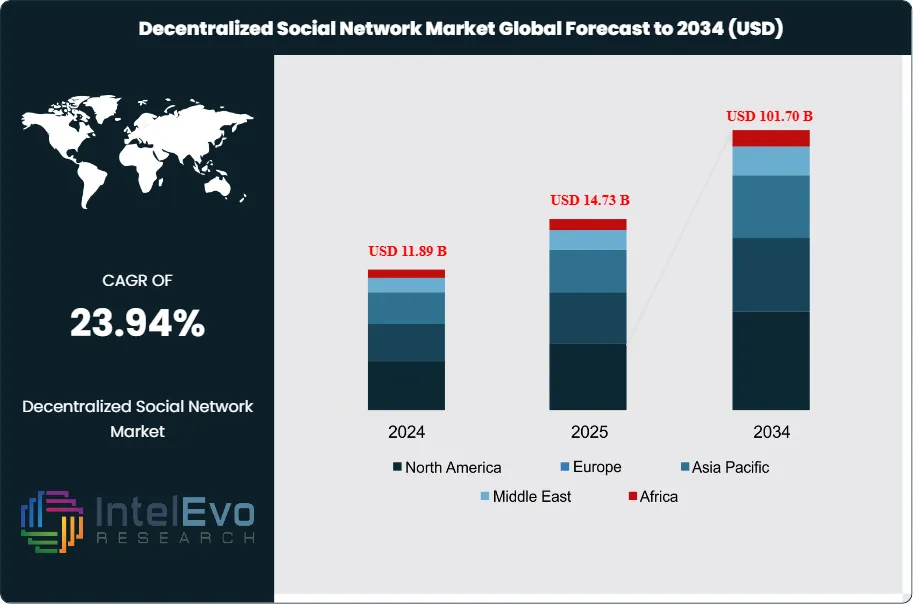
The Decentralized Social Network Market size is expected to be worth around USD 101.70 Billion by 2034, up from USD 11.89 Billion in 2024, growing at a CAGR of 23.94% during the forecast period from 2024 to 2034. This strong growth trajectory is driven by rising concerns over data privacy, increasing user resistance to centralized platform control, and the rapid adoption of blockchain-based social ecosystems. As Web3 adoption accelerates and creators seek transparent monetization models, decentralized social networks are emerging as a disruptive force reshaping the global social media landscape and attracting significant investor and developer attention worldwide.
Get More Information about this report -
Request Free Sample ReportThe decentralized social network market represents a paradigm shift in digital communication, where traditional centralized platforms give way to distributed architectures that prioritize user privacy, data ownership, and censorship resistance. This market encompasses peer-to-peer networks and blockchain-based platforms that enable users to maintain control over their data while facilitating social interactions without intermediary oversight. Key factors driving this market include growing concerns over data privacy breaches, increasing regulatory scrutiny of big tech companies, rising awareness of digital rights, and the proliferation of Web3 technologies. The market's growth is further accelerated by mounting distrust in traditional social media platforms following numerous data scandals, content moderation controversies, and monopolistic practices that have eroded user confidence.
The decentralized social network ecosystem is characterized by diverse technological approaches, ranging from blockchain-based solutions that leverage cryptocurrency incentives to peer-to-peer protocols that distribute content across user networks. Market dynamics are influenced by factors such as user adoption rates, technological maturity, regulatory frameworks, and the ability to provide seamless user experiences comparable to centralized alternatives. The increasing institutional adoption of blockchain technology, coupled with growing demand for alternative social media platforms, has created fertile ground for market expansion. Additionally, the rise of the creator economy and demand for monetization models that fairly compensate content creators have positioned decentralized platforms as attractive alternatives to traditional revenue-sharing models.
North America currently leads the decentralized social network market, driven by high technology adoption rates, robust venture capital funding, and a tech-savvy population increasingly concerned about privacy rights. The region benefits from strong regulatory frameworks that support innovation while protecting user rights, creating an environment conducive to the development and adoption of decentralized platforms.
The COVID-19 pandemic significantly accelerated the adoption of decentralized social networks as lockdowns increased digital communication reliance while simultaneously highlighting the risks of centralized platform dependency. Remote work arrangements exposed vulnerabilities in traditional social media platforms, leading users to seek alternatives that offered greater privacy and control over their digital interactions.
Regional conflicts between major economies and escalating trade tensions have created additional impetus for decentralized social network adoption, as governments and organizations seek communication platforms that are less susceptible to geopolitical pressures and regulatory interventions. The imposition of tariffs on technology goods has affected the hardware infrastructure costs for traditional centralized platforms, making decentralized alternatives more economically viable. Furthermore, concerns about data sovereignty and national security have prompted governments to explore decentralized solutions that reduce dependence on foreign-controlled platforms, creating regulatory support for domestic decentralized network development.

Key Takeaways
- Market Growth: The Decentralized Social Network Market is expected to reach USD 101.70 Billion by 2034, driven by rising demand for privacy, content ownership, and alternative monetization models.
- Platform Type Dominance: Blockchain-based platforms dominate the decentralized social network market due to their ability to provide transparent, immutable content records and integrated cryptocurrency reward systems. These platforms leverage token economies to incentivize user participation and content creation, creating sustainable growth models that traditional platforms cannot replicate.
- End-User Dominance: Individual users represent the primary market segment, driven by personal privacy concerns and desire for authentic social interactions without corporate interference. The segment benefits from intuitive user interfaces and gamified experiences that make decentralized platforms accessible to mainstream audiences.
- Driver: Growing data privacy concerns and increasing disillusionment with centralized networks are powerful drivers of adoption, as users seek more control over their digital identities.
- Restraint: Usability challenges and limited mainstream awareness hamper adoption, as decentralized networks often require technical expertise and have fragmented user bases.
- Opportunity: Emerging monetization models and token economies present opportunities for developers and creators to redefine social engagement and income streams.
- Trend: Federated interoperability and decentralized autonomous organizations (DAOs) are shaping the future of decentralized social networks, integrating community governance and cross-platform connectivity.
- Regional Analysis: North America leads due to strong technological infrastructure and early adoption, while Europe and Asia-Pacific show significant potential as regulatory and user behavior shifts drive adoption.
Platform Type Analysis:
Blockchain-Based Leads With more than 40% Market Share In Decentralized Social Network Market
The platform type segmentation reveals blockchain-based solutions as the dominant force in the decentralized social network market, accounting for the largest market share due to their comprehensive feature sets and economic incentive structures. Blockchain-based platforms leverage distributed ledger technology to create transparent, censorship-resistant social networks where users maintain ownership of their content and data. These platforms typically incorporate cryptocurrency reward mechanisms that compensate users for content creation, curation, and community participation, creating sustainable economic models that differentiate them from traditional advertising-based platforms.
Peer-to-peer platforms represent the second segment, focusing on direct user-to-user communication without intermediary servers. These platforms prioritize privacy and decentralization over monetization, appealing to users who value anonymity and resistance to surveillance. While peer-to-peer platforms offer superior privacy protection, they face challenges in content discovery, moderation, and user experience optimization that limit their mainstream adoption potential.
End-User Analysis:
Individual users constitute the dominant end-user segment in the decentralized social network market, driven by personal motivations including privacy protection, data ownership, and freedom from corporate content moderation policies. This segment encompasses early technology adopters, privacy advocates, content creators seeking alternative monetization models, and mainstream users disillusioned with traditional social media experiences. Individual users are attracted to decentralized platforms' promise of authentic social interactions, direct creator compensation, and resistance to algorithmic manipulation of content feeds.
Enterprise users represent a growing but smaller segment, primarily consisting of organizations seeking secure, private communication channels for internal collaboration and external customer engagement. Enterprise adoption is driven by compliance requirements, data sovereignty concerns, and the need for communication platforms that cannot be easily compromised or monitored by external entities. This segment shows particular growth potential as businesses increasingly recognize the strategic value of decentralized communication infrastructure.
Region Analysis:
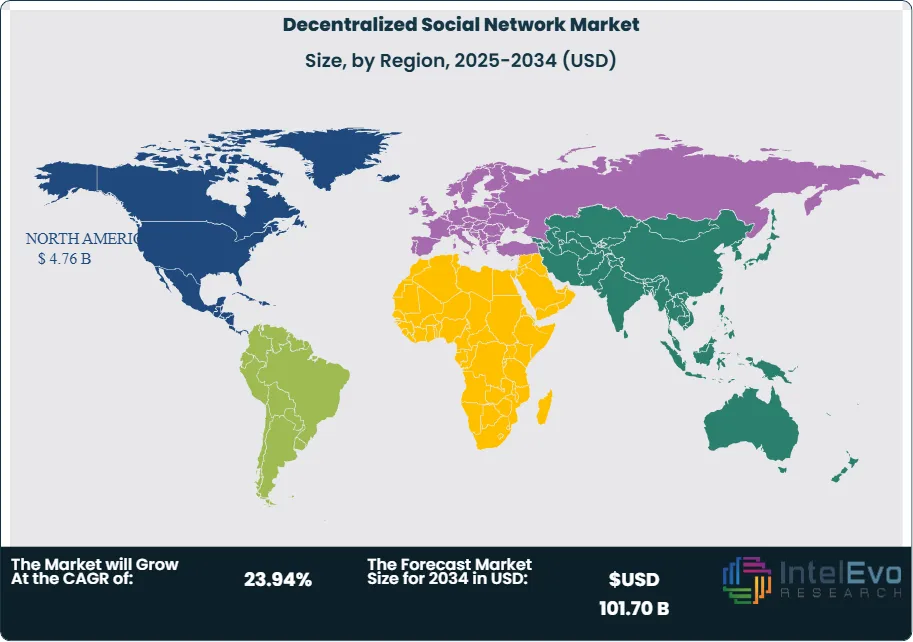
North America Leads With more than 40% Market Share In Decentralized Social Network Market
North America leads the global decentralized social network market, commanding the largest market share due to a combination of technological infrastructure, regulatory clarity, and cultural factors that favor innovation and privacy rights. The region benefits from substantial venture capital investment in blockchain and Web3 technologies, with Silicon Valley serving as a hub for decentralized platform development. The United States' strong intellectual property protections and established startup ecosystem create favorable conditions for decentralized social network companies to develop and scale their operations.
Europe represents the second-largest market, with growth driven primarily by the General Data Protection Regulation (GDPR) and similar privacy-focused legislation that has increased user awareness of data rights and platform accountability. The European Union's Digital Markets Act and Digital Services Act further support decentralized alternatives by imposing restrictions on dominant platform practices. The Asia-Pacific region shows significant growth potential, particularly in countries with large internet user bases and increasing concerns about digital surveillance and censorship.
Get More Information about this report -
Request Free Sample ReportKey Market Segment
Platform Type
- Peer-to-Peer
- Blockchain-Based
End-User
- Enterprises
- Individuals
Region:
- North America
- Latin America
- East Asia And Pacific
- Sea And South Asia
- Eastern Europe
- Western Europe
| Report Attribute | Details |
| Market size (2025) | USD 14.73 B |
| Forecast Revenue (2034) | USD 101.70 B |
| CAGR (2025-2034) | 23.94% |
| Historical data | 2018-2023 |
| Base Year For Estimation | 2024 |
| Forecast Period | 2025-2034 |
| Report coverage | Revenue Forecast, Competitive Landscape, Market Dynamics, Growth Factors, Trends and Recent Developments |
| Segments covered | Platform Type (Peer-to-Peer, Blockchain-Based) ,End-User (Enterprises, Individuals) |
| Research Methodology |
|
| Regional scope |
|
| Competitive Landscape | Mastodon, Uptrennd, Steemit, Minds, Indorse, Diaspora, SocialX, Hive, Sphinx Chat, Sapien, Peepeth, Aether, Memo, Scuttlebutt, Sola, BitTorrent-based Social Networks, BitClout, Akasha, DTube, Odysee (LBRY) |
| Customization Scope | Customization for segments, region/country-level will be provided. Moreover, additional customization can be done based on the requirements. |
| Pricing and Purchase Options | Avail customized purchase options to meet your exact research needs. We have three licenses to opt for: Single User License, Multi-User License (Up to 5 Users), Corporate Use License (Unlimited User and Printable PDF). |


Frequently Asked Questions
How big is the Decentralized Social Network Market?
The Global Decentralized Social Network Market is projected to grow from USD 11.89 Billion in 2024 to USD 101.70 Billion by 2034, at a CAGR of 23.94%. Explore insights.
Who are the major players in the Decentralized Social Network Market?
Mastodon, Uptrennd, Steemit, Minds, Indorse, Diaspora, SocialX, Hive, Sphinx Chat, Sapien, Peepeth, Aether, Memo, Scuttlebutt, Sola, BitTorrent-based Social Networks, BitClout, Akasha, DTube, Odysee (LBRY)
Which segments covered the Decentralized Social Network Market?
Platform Type (Peer-to-Peer, Blockchain-Based) ,End-User (Enterprises, Individuals)
How can this market research report help my business make strategic decisions?
Our market research reports provide actionable intelligence, including verified market size data, CAGR projections, competitive benchmarking, and segment-level opportunity analysis. These insights support strategic planning, investment decisions, product development, and market entry strategies for enterprises and startups alike.
How frequently is the data updated?
We continuously monitor industry developments and update our reports to reflect regulatory changes, technological advancements, and macroeconomic shifts. Updated editions ensure you receive the latest market intelligence.

Select Licence Type
Connect with our sales team

Decentralized Social Network Market
Published Date : 16 Jul 2025 | Formats :Why IntelEvoResearch
100%
Customer
Satisfaction
24x7+
Availability - we are always
there when you need us
200+
Fortune 50 Companies trust
IntelEvoResearch
80%
of our reports are exclusive
and first in the industry
100%
more data
and analysis
1000+
reports published
till date