

- Home
- Industries
 Aerospace And Defence
 Agriculture
 Automotive And Transportation
 Banking And Finance
 Business
 Chemicals And Materials
 Consumer And Retail
 Electronics And Semiconductors
 Food And Beverages
 Machinery & Equipments
 Manufacturing And Construction
 Medical Devices
 Others
 Pharmaceuticals And Healthcare
 Power And Energy
 Sports
 Technology
- Services
- News Room
- About us
- Contact Us
-
Global Digital Credential Verification Market Size, Share | CAGR 23.2%
Global Digital Credential Verification Market Size, Share Analysis By Component (Solutions, Services), By Deployment (Cloud, On-Premises, Hybrid), By Credential Type (Academic, Professional Licenses, Employment, Government ID, Digital Badges), By Application (Academic, Background Screening, IAM, Fraud Detection, Recruitment), By End-User (Education, BFSI, Healthcare, Government, IT, HR) Region & Key Players-Dynamics, Strategies, Trends & Forecast 2026-2034

Report Overview
| Market Size (2025) | Forecast Value (2034) | CAGR (2026-2034) | Largest Region (2025) |
|---|---|---|---|
| USD 4.2 Billion | USD 27.5 Billion | 23.2% | North America, 36.0% |
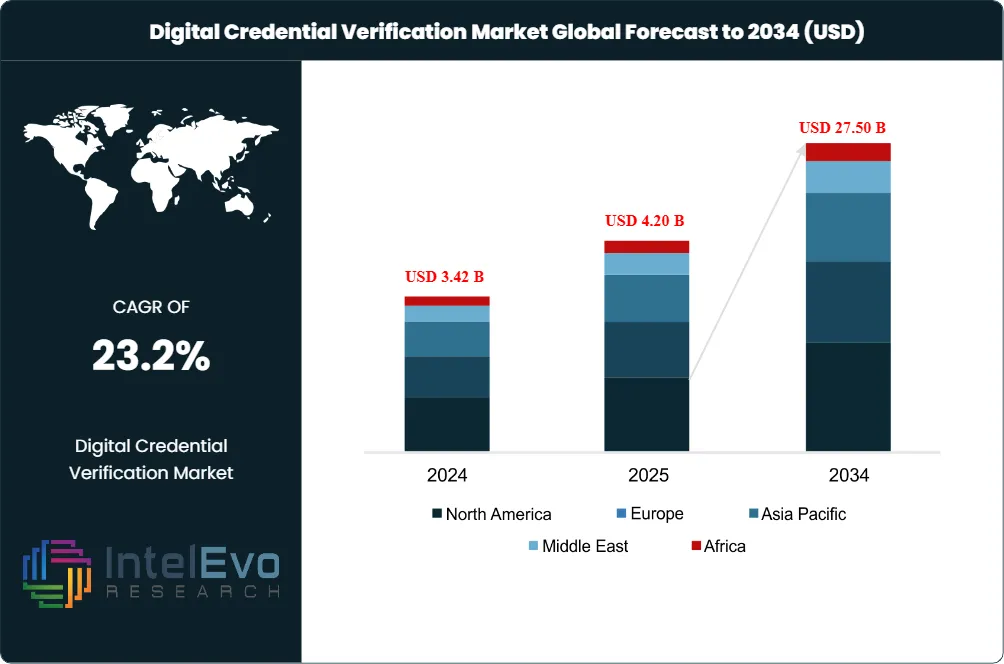
The Digital Credential Verification Market was valued at USD 3.42 Billion in 2024 and USD 4.20 Billion in 2025. The market is projected to reach USD 27.50 Billion by 2034, expanding at a CAGR of 23.2% during the forecast period from 2026 to 2034. This represents an absolute dollar opportunity of USD 23.3 Billion over the analysis period, more than six times the 2025 base. The Digital Credential Verification Market is being driven by hard regulatory deadlines, particularly the EU eIDAS 2.0 December 2026 European Digital Identity Wallet (EUDI Wallet) rollout, the US mobile driver license (mDL) deployment across more than 18 states, and enterprise demand to combat synthetic-identity fraud and deepfake-driven account takeover.
Get More Information about this report -
Request Free Sample ReportThree structural drivers anchor Digital Credential Verification Market expansion through 2034. First, the European Digital Identity Regulation, Regulation (EU) 2024/1183 amending Regulation (EU) No 910/2014, requires every EU Member State to provide at least one EUDI Wallet to its citizens by 31 December 2026, with private relying parties performing Strong Customer Authentication under PSD2 required to accept EUDI Wallet credentials by December 2027. Penalties reach EUR 5 Million or 1% of global annual turnover for non-compliance. Second, the US National Institute of Standards and Technology released NIST Special Publication 800-63-4 in 2024 introducing mobile driver's license (mDL) and verifiable credential frameworks into federal procurement. Third, the IBM Cost of a Data Breach Report 2024 confirms stolen or compromised credentials remain the most common initial attack vector at 16% of all breaches, averaging USD 4.81 Million per incident.
More than 48 million verifiable credentials were issued globally through compliant platforms in 2025, a figure forecast to exceed 320 million annually by 2034 per industry analysis. Issuance platforms leveraging the OpenID for Verifiable Credential Issuance (OID4VCI) and DIDComm protocols have reduced average credential issuance latency to under 2 seconds, enabling real-time use in border control, financial onboarding, and academic admissions. The W3C Verifiable Credentials Data Model 2.0 reached Recommendation status in May 2025, formalizing the specification underpinning issuer-holder-verifier interactions.
North America led the Digital Credential Verification Market with 36.0% revenue share in 2025, anchored by Microsoft Entra Verified ID, IBM Verify, Okta, Ping Identity, AAMVA's Digital Trust Service, and the rollout of state mDL programs covering more than 5 million issued credentials nationwide. Europe sustains durable growth because eIDAS 2.0 mandates EUDI Wallet acceptance across 27 Member States, with Thales Group, IDEMIA, and Entrust deploying national wallet contracts. Asia Pacific is the fastest-growing region because India's Digital Personal Data Protection Act, 2023 and DigiLocker, China's Cyberspace Administration rules, and Japan's My Number expansion all push verification volumes higher. The forward outlook through 2034 favors W3C-compliant platforms that combine mDL, OpenID4VC, ISO/IEC 18013-5, and biometric liveness inside a unified verification API.
Market Definition & Scope
The Digital Credential Verification Market is defined as software platforms, cloud services, and managed offerings that cryptographically validate digital credentials, including verifiable credentials based on the W3C Verifiable Credentials Data Model 2.0, mobile driver licenses based on ISO/IEC 18013-5 and ISO/IEC TS 18013-7:2025, qualified electronic attestations under eIDAS 2.0, and academic, professional, healthcare, and KYC credentials. The market encompasses issuance and verification engines, decentralized identifier (DID) infrastructure, biometric-binding modules, and trust registries.
This analysis includes verification platforms serving government identity programs (national digital wallets, mDL deployments), enterprise identity and access management (workforce IAM modernization), academic credentialing (digital diplomas, micro-credentials), healthcare credentials, KYC/AML for BFSI, and high-risk hiring scenarios. The scope explicitly excludes traditional username and password identity systems, basic two-factor authentication unrelated to verifiable credentials, document forensics tools without cryptographic credential verification, and pure-play physical identity card production. The Digital Credential Verification Market sits within the broader identity verification category, accounting for an estimated 28-32% of global identity verification spend in 2025.

Key Takeaways
- Market Growth: The Digital Credential Verification Market grows from USD 4.2 Billion in 2025 to USD 27.5 Billion by 2034 at a CAGR of 23.2%, generating USD 23.3 Billion in absolute new revenue.
- Segment Dominance: Solutions captured 70.0% of the Digital Credential Verification Market in 2025, equivalent to USD 2.94 Billion, as buyers prioritize integrated cryptographic verification platforms over standalone services.
- Segment Dominance: Identity Credentials (digital national IDs, mDLs, passports) led credential types with approximately 38.7% share in 2025 per industry analysis, equivalent to USD 1.62 Billion, anchored by EUDI Wallet and US state mDL rollouts.
- Driver: The EU eIDAS 2.0 Regulation requires all 27 Member States to offer at least one EUDI Wallet by 31 December 2026, with PSD2 Strong Customer Authentication relying parties required to accept EUDI Wallet credentials by December 2027 under penalty of up to EUR 5 Million or 1% of global turnover.
- Restraint: Cross-border interoperability gaps across 27 EU Member States, mixed mDL adoption rates among US states (Alaska shows marginal initial uptake while New York reached approximately 246,000 enrollments by mid-2025), and inconsistent ISO 18013-5 implementations slow ecosystem maturation.
- Opportunity: AI-powered identity verification combining W3C verifiable credentials with liveness detection and biometric binding is forecast to unlock more than USD 1.1 Billion in EU public and private procurement between 2025 and 2028 per industry analysis.
- Trend: Decentralized identity adoption is accelerating, with the broader Decentralized Identity Market valued at approximately USD 1.3 Billion in 2025 and projected to expand at a high CAGR through 2034 per Grand View Research.
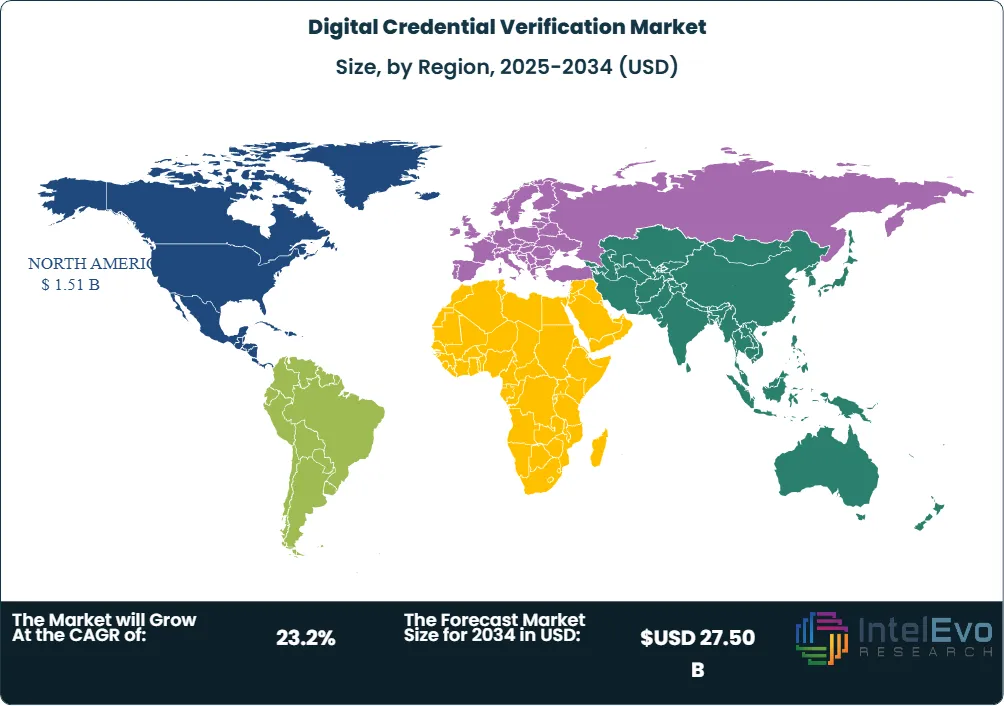
- Regional: North America held 36.0% Digital Credential Verification Market share in 2025 at USD 1.51 Billion, with the United States contributing approximately USD 1.22 Billion or roughly 81% of the regional total.
Key Insights Summary
- The European Commission published Commission Implementing Regulations (EU) 2024/2979, 2024/2980, 2024/2982, and 2024/2977 on 28 November 2024 specifying integrity, core functionalities, and protocols for the European Digital Identity Wallet, with additional implementing acts published 30 July 2025 entering into force 20 days thereafter.
- Over 5 million mobile driver licenses had been issued across the United States by mid-2025, with at least 18 states issuing standards-compliant mDLs aligned to ISO/IEC 18013-5, per public AAMVA disclosures and state announcements.
- Georgia reported more than 500,000 users of its digital driver's license and ID across Apple Wallet, Google Wallet, and the state app as of July 2025, while New York reported more than 200,000 Mobile ID enrollments by March 2025.
- The W3C Verifiable Credentials Data Model 2.0 reached Recommendation status in May 2025, formalizing the issuer-holder-verifier specification anchoring all standards-compliant verifiable credential platforms.
- Microsoft Entra Verified ID is generally available to millions of Microsoft Entra customers, while Entrust integrated with Microsoft Entra Verified ID in November 2025 to deliver phishing-resistant authentication, citing Gartner's prediction that 1 in 4 candidate profiles worldwide could be fake by 2028.
- ABI Research forecasts 169 million digital ID wallets in circulation globally by 2026, while the EU has set an 80% citizen adoption target for EUDI Wallets by 2030.
- AAMVA released Mobile Driver License (mDL) Implementation Guidelines Version 1.5 in May 2025, prohibiting the server retrieval method for any jurisdiction joining the Digital Trust Service to prevent issuer surveillance of credential use.
Competitive Landscape Overview
The Digital Credential Verification Market is moderately fragmented, with the top four vendors Microsoft Corporation, IBM Corporation, Thales Group, and IDEMIA estimated to hold a combined 38-44% share of disclosed Digital Credential Verification Market revenue in 2025. Competition is bifurcating into two patterns: hyperscaler platforms (Microsoft Entra Verified ID, IBM Verify, Okta, Ping Identity) targeting enterprise IAM modernization, and government-anchored identity vendors (Thales, IDEMIA, Entrust, NEC) winning national wallet and mDL contracts.
Competitive evolution is moving toward open standards interoperability, with W3C Verifiable Credentials, ISO/IEC 18013-5 mDL, OpenID4VC, and OpenID4VP becoming non-negotiable for public-sector procurement. Microsoft's standards-based interoperability profile developed in partnership with IBM, Workday, Ping Identity, and Mattr lets digital wallets interoperate across vendors. Specialist challengers Jumio, Onfido (Entrust), Socure, Mitek Systems, Persona, Au10tix, and Veriff add AI-driven liveness detection, deepfake detection, and document verification on top of credential validation.
The competitive matrix below summarizes leading players in the Digital Credential Verification Market, their headquarters, market position, primary product offering, geographic strength, and the most recent strategic move verified through public disclosures during the trailing 18 months.
Competitive Landscape Matrix
| Company | HQ Country | Position | Key Product | Geographic Strength | Recent Strategic Move (Trailing 18 Months) |
|---|---|---|---|---|---|
| Microsoft Corporation | USA | Leader | Microsoft Entra Verified ID, Authenticator | Global | Entrust integration with Entra Verified ID announced (Nov 2025) |
| IBM Corporation | USA | Leader | IBM Verify, Verifiable Credentials | Global enterprise | Continued enterprise IAM platform updates and Microsoft Entra interop (2025) |
| Thales Group | France | Leader | Gemalto Digital ID Wallet, eIDAS QTSP | EU, North America, APAC | Partnered with European government for national EUDI Wallet rollout (2025) |
| IDEMIA | France | Leader | IDEMIA Digital Identity, mDL solutions | Global government | Launched blockchain-based Decentralized Identity (DID) platform (2024) |
| Entrust Corporation | USA | Challenger | Entrust Identity, Onfido (acquired) | North America, EU | Integration with Microsoft Entra Verified ID for high-assurance IDV (Nov 2025) |
| Okta, Inc. | USA | Challenger | Okta Identity Cloud, Identity Verification | Global | Continued WIC and CIC platform expansion with verification features (2025) |
| Ping Identity Corp. | USA | Challenger | PingOne, PingOne Verify, Neo | Global enterprise | Continued PingOne Neo decentralized identity expansion (2025) |
| Jumio Corporation | USA | Niche Player | Jumio KYX Platform | Global | Expanded AI suite with deepfake detection and passive liveness (2025) |
| Onfido (Entrust) | UK | Niche Player | Real Identity Platform, biometrics | EU, North America | Cloud-native biometric verification platform launched (2024); Entrust integration (2025) |
| HID Global Corporation | USA | Niche Player | HID DigitalPersona, mDL solutions | Global | Continued mDL deployments across US states aligned to AAMVA Guidelines 1.5 (2025) |
Segmentation Analysis
The Digital Credential Verification Market segments along five primary axes: by component, by deployment mode, by credential type, by application, and by end-user vertical. Segment shares below are aggregated from disclosed company filings, regulator submissions, and trade body data, then normalized to sum to 100% within each category.
By Component
Solutions captured 70.0% of the Digital Credential Verification Market in 2025, equivalent to USD 2.94 Billion, while Services held 30.0% or USD 1.26 Billion. Solutions dominate because buyers prioritize integrated platforms combining DID resolution, cryptographic signature verification, revocation status checks, and biometric binding inside one API. Microsoft Entra Verified ID, IBM Verify, Thales Gemalto, and Entrust ship as licensed software with optional services attach.
The Services segment grows at approximately 25% CAGR through 2034 because eIDAS 2.0 implementation typically requires 9-18 months per Vidos and Yousign disclosures, including credential schema design, trust list integration, and PSD2 Strong Customer Authentication remediation. Solution buyers prioritize support for ISO/IEC 18013-5 mDL, ISO/IEC TS 18013-7:2025 online presentation, W3C Verifiable Credentials, OpenID4VC, OpenID4VP, JWT signatures, and JSON-LD with Data Integrity Proofs; service buyers prioritize regulatory expertise across eIDAS 2.0, PSD2, GDPR, and NIST SP 800-63-4.
By Deployment Mode
Cloud-based deployments held 64.0% of Digital Credential Verification Market revenue in 2025, totaling USD 2.69 Billion, while on-premises retained 36.0% or USD 1.51 Billion. Cloud is winning new deployments because verification volumes are spiky, with peaks during travel seasons, fiscal-year onboarding, and academic enrollment, requiring elastic infrastructure. AWS, Microsoft Azure, and Google Cloud underpin the Tier 1 verification platforms.
On-premises retains share among national identity programs and central banks where data residency under eIDAS 2.0, the German BAIT framework, and India's Digital Personal Data Protection Act 2023 require local control. Vidos reports 2-4 weeks from start to production deployment for cloud-based EUDI Wallet acceptance, compared to 9-18 months for traditional on-premises verification stacks. Cloud deployments achieve 99.95% uptime SLAs against 99.5-99.9% typical for on-premises stacks.
By Credential Type
Identity Credentials (national IDs, mDLs, passports) led the Digital Credential Verification Market with approximately 38.7% share in 2025 per industry analysis, equivalent to USD 1.62 Billion, followed by Academic Credentials (digital diplomas, transcripts, micro-credentials) at 22.0% (USD 0.92 Billion), Professional Credentials (licenses, certifications) at 18.0% (USD 0.76 Billion), Healthcare Credentials at 12.0% (USD 0.50 Billion), and Other (employment, payment, age verification) at 9.3% (USD 0.39 Billion). Identity credentials dominate because EU EUDI Wallets and US state mDLs anchor the largest single deployment programs.
Academic Credentials grow fastest at approximately 26% CAGR through 2034 because universities including Massachusetts Institute of Technology, Harvard University, and the University of Bahrain have issued blockchain-anchored diplomas in production. Professional Credentials benefit from selective disclosure: a verifier can confirm a candidate holds a relevant license without exposing date of birth or address. Healthcare credentials accelerate under HIPAA-equivalent rules globalizing across the EU, India, and Brazil.
By Application
Identity Verification and KYC captured 38.0% of Digital Credential Verification Market revenue in 2025 at USD 1.60 Billion, followed by Workforce IAM at 24.0% (USD 1.01 Billion), Academic and Skills Credentialing at 16.0% (USD 0.67 Billion), Travel and Border Control at 12.0% (USD 0.50 Billion), and Other applications including age assurance, payment authentication, and physical access at 10.0% (USD 0.42 Billion). Identity Verification and KYC dominates because BFSI, fintech, and crypto-asset service providers are bound by AML/KYC, PSD2, and MiCA mandates.
Workforce IAM is the fastest-growing application at approximately 25% CAGR because Gartner predicts 1 in 4 candidate profiles worldwide could be fake by 2028, and North Korean IT worker infiltrations exploded 220% over the past 12 months per Entrust disclosures. Travel and border control benefits from TSA acceptance of state mDLs at airports and from mDL TSA checkpoint integration becoming a primary use case in New York, Georgia, and Maryland.
By End-User Vertical
Government and Public Sector held approximately 30.0% of Digital Credential Verification Market end-user spend in 2025 at USD 1.26 Billion, followed by BFSI at 24.0% (USD 1.01 Billion), Education at 17.2% (USD 0.72 Billion), Healthcare at 11.0% (USD 0.46 Billion), IT and Telecom at 9.0% (USD 0.38 Billion), and Other Verticals including retail, hospitality, and energy at 8.8% (USD 0.37 Billion). Government dominates because EU Member States, US states, and several Asia Pacific governments fund national wallet programs with multi-year budgets.
BFSI is forecast to grow fastest at roughly 25% CAGR because the EU eIDAS 2.0 Article 5f(2) requires private relying parties performing PSD2 Strong Customer Authentication to accept EUDI Wallet credentials by December 2027. Education adoption rises through digital diploma and micro-credential programs. Healthcare benefits from HIPAA-equivalent rules and verified clinician credentials anchored in W3C Verifiable Credentials.
Regional Analysis
The Digital Credential Verification Market demonstrates sharp regional differentiation in 2025, anchored by North America at 36.0% share, Europe at 29.0%, Asia Pacific at 25.0%, Latin America at 5.0%, and Middle East and Africa at 5.0%. Regional shares sum to 100% of 2025 revenue.
North America
North America held 36.0% of the Digital Credential Verification Market in 2025, generating USD 1.51 Billion. The United States accounted for approximately 81% of the regional total at USD 1.22 Billion, with Canada near USD 0.21 Billion (anchored by the Pan-Canadian Trust Framework and Microsoft, IBM, and Entrust development centers) and Mexico at approximately USD 0.08 Billion. Demand is concentrated in state mDL deployments, federal NIST SP 800-63-4 procurement, and Tier 1 financial-services KYC programs. AAMVA released mDL Implementation Guidelines Version 1.5 in May 2025, more than 18 US states have issued standards-compliant mDLs, and over 5 million mDLs were issued nationwide by mid-2025. The Federal Aviation Administration and Transportation Security Administration accept state mDLs at airport checkpoints, with TSA acceptance referenced as a primary use case in New York and Georgia.
Europe
Europe held 29.0% Digital Credential Verification Market share in 2025 at USD 1.22 Billion, the second-largest regional share, anchored by eIDAS 2.0 implementation. Regulation (EU) 2024/1183 requires every EU Member State to provide at least one EUDI Wallet to its citizens by 31 December 2026, and private relying parties performing PSD2 Strong Customer Authentication must accept EUDI Wallet credentials by December 2027. The European Commission published Commission Implementing Regulations (EU) 2024/2979, 2024/2980, 2024/2982, and 2024/2977 on 28 November 2024 specifying wallet integrity and protocols. Penalties reach EUR 5 Million or 1% of global annual turnover for non-compliance. Ireland is on schedule to deliver its EUDI Wallet by end of 2026, and 26 Member States are running large-scale pilots involving over 350 companies and government agencies.
Asia Pacific
Asia Pacific held 25.0% Digital Credential Verification Market share in 2025 at USD 1.05 Billion, with India, China, Japan, Australia, and Singapore driving most regional spend. India's Digital Personal Data Protection Act, 2023 (and 2025 Rules) governs digital identity handling, while DigiLocker and Aadhaar e-KYC anchor population-scale verification volumes. Australia's Digital ID Act 2024 enabled the AGDIS scheme. Japan's My Number Card and resident registration system expanded to integrate with smartphone wallets. China's Cyberspace Administration enforces strict identity rules across major platforms. Asia Pacific is forecast to grow fastest among the five regions through 2034 at over 26% CAGR, supported by population scale and multi-country wallet rollouts.
Latin America
Latin America held 5.0% Digital Credential Verification Market share in 2025 at USD 0.21 Billion. Brazil leads regional demand because Banco Central do Brasil expanded Pix instant payments and the Receita Federal supports digital tax credentials. Mexico's Comisión Nacional Bancaria y de Valores enforces fintech KYC under the 2018 Fintech Law, and Argentina's RENAPER digital ID program has scaled millions of credentials. Colombia's Cédula Digital and Chile's ClaveÚnica anchor government identity. Latin American banks increasingly deploy Jumio, Onfido, and Veriff for cross-border verification.
Middle East and Africa
Middle East and Africa held 5.0% Digital Credential Verification Market share in 2025 at USD 0.21 Billion. The United Arab Emirates UAE Pass digital identity reaches more than 6 million users, while Saudi Arabia's Absher and Tawakkalna platforms anchor population-scale verification. Israel's Digital Identification Services facilitate citizen and enterprise authentication. South Africa's Department of Home Affairs is rolling out a national Smart ID, and Nigeria's NIMC National Identity Number reaches more than 100 million enrollments. UAE Vision 2031 and Saudi Vision 2030 anchor government-funded digital identity investments.
Country Analysis
Country-level dynamics in the Digital Credential Verification Market diverge sharply because each jurisdiction enforces distinct rule sets and runs different deployment programs.
United States
The United States Digital Credential Verification Market reached USD 1.22 Billion in 2025 and is projected to expand at a country-specific CAGR of 22.5% through 2034. NIST Special Publication 800-63-4 published in 2024 introduced mobile driver license (mDL) and verifiable credential frameworks into federal procurement. AAMVA released mDL Implementation Guidelines Version 1.5 in May 2025 prohibiting server retrieval to prevent issuer surveillance. More than 18 states have issued standards-compliant mDLs and over 5 million were issued nationwide by mid-2025, with Georgia at over 500,000 users and New York at approximately 246,000 enrollments. The TSA accepts state mDLs at airport checkpoints. Microsoft Entra Verified ID, IBM Verify, Okta, and Ping Identity anchor enterprise IAM modernization.
Germany
The Germany Digital Credential Verification Market reached approximately USD 0.32 Billion in 2025 and is forecast at a 24.0% country CAGR through 2034. Germany hosts SAP SE and active EUDI Wallet pilots aligned to eIDAS 2.0. The Bundesamt für Sicherheit in der Informationstechnik (BSI) supports the wallet implementation, and the Bundesdruckerei deploys identity infrastructure for the federal eID. The German BAIT framework remains in force for non-DORA-scope institutions through 31 December 2026, supporting on-premises verification deployments. Germany's automotive supply chain demand for verified supplier credentials and worker qualifications across BMW, Volkswagen, and Mercedes-Benz adds further pull.
France
The France Digital Credential Verification Market reached approximately USD 0.28 Billion in 2025 and is forecast at a 23.5% country CAGR through 2034. France hosts Thales Group and IDEMIA, two of the largest global digital identity vendors. The French government runs France Identité, the national digital identity wallet, and the Agence Nationale de la Sécurité des Systèmes d'Information (ANSSI) supports cybersecurity certification for digital identity providers. France was among the first EU Member States to publish national EUDI Wallet specifications and is on track for the 31 December 2026 deadline.
India
The India Digital Credential Verification Market reached approximately USD 0.30 Billion in 2025 and is forecast at a 26.5% country CAGR through 2034, the fastest among major economies. India operates Aadhaar (the world's largest biometric identity system at over 1.3 billion enrollments), DigiLocker (digital credential storage), and the e-KYC framework. The Digital Personal Data Protection Act, 2023 and the 2025 Rules govern handling of digital credentials. The Reserve Bank of India promotes Account Aggregator and OCEN frameworks for verifiable financial credentials. The National Education Policy 2020 supports digital diplomas and credentials through the Academic Bank of Credits.
Get More Information about this report -
Request Free Sample ReportKey Market Segments
By Component
- Solutions
- Credential Verification Platforms
- Digital Identity Verification Solutions
- Blockchain-Based Credential Verification Systems
- Academic Credential Verification Solutions
- Professional Certification Verification Platforms
- Employment Verification Solutions
- Background Screening and Verification Systems
- API and Integration Solutions
- Analytics and Reporting Platforms
- Others
- Services
- Consulting Services
- Implementation and Integration Services
- Managed Services
- Training and Support Services
- Verification and Validation Services
By Deployment Mode
- Cloud-Based Deployment
- On-Premises Deployment
- Hybrid Deployment
By Credential Type
- Academic Degrees and Diplomas
- Professional Certifications and Licenses
- Employment and Work History Credentials
- Government-Issued Identity Credentials
- Healthcare and Medical Credentials
- Skills and Competency Credentials
- Digital Badges and Micro-Credentials
- Training and Continuing Education Certificates
- Security and Compliance Certifications
- Others
By Application
- Academic Credential Verification
- Employment Background Verification
- Professional License Verification
- Identity and Access Management
- Recruitment and Talent Acquisition
- Workforce Compliance Management
- Fraud Detection and Prevention
- Cross-Border Credential Verification
- Vendor and Contractor Verification
- Student Enrollment Verification
- Regulatory and Compliance Verification
- Others
By End-User Vertical
- Education and Academic Institutions
- Banking, Financial Services, and Insurance (BFSI)
- Healthcare and Life Sciences
- Government and Public Sector
- Information Technology and Telecommunications
- Human Resources and Recruitment Agencies
- Manufacturing
- Retail and E-commerce
- Legal Services
- Energy and Utilities
- Transportation and Logistics
- Defense and Security
- Others
By Regional Coverage
- North America
- Latin America
- East Asia And Pacific
- Sea And South Asia
- Eastern Europe
- Western Europe
- Middle East & Africa
| Report Attribute | Details |
| Market size (2025) | USD 4.20 B |
| Forecast Revenue (2034) | USD 27.50 B |
| CAGR (2025-2034) | 23.2% |
| Historical data | 2021-2024 |
| Base Year For Estimation | 2025 |
| Forecast Period | 2026-2034 |
| Report coverage | Revenue Forecast, Competitive Landscape, Market Dynamics, Growth Factors, Trends and Recent Developments |
| Segments covered | By Component, (Solutions, Services), By Deployment Mode, (Cloud-Based Deployment, On-Premises Deployment, Hybrid Deployment), By Credential Type, (Academic Degrees and Diplomas, Professional Certifications and Licenses, Employment and Work History Credentials, Government-Issued Identity Credentials, Healthcare and Medical Credentials, Skills and Competency Credentials, Digital Badges and Micro-Credentials, Training and Continuing Education Certificates, Security and Compliance Certifications, Others), By Application, (Academic Credential Verification, Employment Background Verification, Professional License Verification, Identity and Access Management, Recruitment and Talent Acquisition, Workforce Compliance Management, Fraud Detection and Prevention, Cross-Border Credential Verification, Vendor and Contractor Verification, Student Enrollment Verification, Regulatory and Compliance Verification, Others), By End-User Vertical, (Education and Academic Institutions, Banking, Financial Services, and Insurance (BFSI), Healthcare and Life Sciences, Government and Public Sector, Information Technology and Telecommunications, Human Resources and Recruitment Agencies, Manufacturing, Retail and E-commerce, Legal Services, Energy and Utilities, Transportation and Logistics, Defense and Security, Others), |
| Research Methodology |
|
| Regional scope |
|
| Competitive Landscape | MICROSOFT CORPORATION, IBM CORPORATION, THALES GROUP, IDEMIA, ENTRUST CORPORATION, OKTA, INC., PING IDENTITY CORPORATION, JUMIO CORPORATION, ONFIDO (ENTRUST), HID GLOBAL CORPORATION, ORACLE CORPORATION, SAP SE, RSA SECURITY LLC, EXPERIAN PLC, TRANSUNION LLC, EQUIFAX, INC., MITEK SYSTEMS, INC., SOCURE INC., VERIFF, PERSONA IDENTITIES, Others |
| Customization Scope | Customization for segments, region/country-level will be provided. Moreover, additional customization can be done based on the requirements. |
| Pricing and Purchase Options | Avail customized purchase options to meet your exact research needs. We have three licenses to opt for: Single User License, Multi-User License (Up to 5 Users), Corporate Use License (Unlimited User and Printable PDF). |


Frequently Asked Questions
How big is the Digital Credential Verification Market?
The Global Digital Credential Verification Market was valued at USD 3.42 Billion in 2024 and USD 4.20 Billion in 2025, and is projected to reach USD 27.50 Billion by 2034, growing at a CAGR of 23.2% from 2026 to 2034. Market growth is driven by increasing credential fraud prevention needs, digital identity adoption, and demand for secure verification solutions.
Who are the major players in the Digital Credential Verification Market?
MICROSOFT CORPORATION, IBM CORPORATION, THALES GROUP, IDEMIA, ENTRUST CORPORATION, OKTA, INC., PING IDENTITY CORPORATION, JUMIO CORPORATION, ONFIDO (ENTRUST), HID GLOBAL CORPORATION, ORACLE CORPORATION, SAP SE, RSA SECURITY LLC, EXPERIAN PLC, TRANSUNION LLC, EQUIFAX, INC., MITEK SYSTEMS, INC., SOCURE INC., VERIFF, PERSONA IDENTITIES, Others
Which segments covered the Digital Credential Verification Market?
By Component, (Solutions, Services), By Deployment Mode, (Cloud-Based Deployment, On-Premises Deployment, Hybrid Deployment), By Credential Type, (Academic Degrees and Diplomas, Professional Certifications and Licenses, Employment and Work History Credentials, Government-Issued Identity Credentials, Healthcare and Medical Credentials, Skills and Competency Credentials, Digital Badges and Micro-Credentials, Training and Continuing Education Certificates, Security and Compliance Certifications, Others), By Application, (Academic Credential Verification, Employment Background Verification, Professional License Verification, Identity and Access Management, Recruitment and Talent Acquisition, Workforce Compliance Management, Fraud Detection and Prevention, Cross-Border Credential Verification, Vendor and Contractor Verification, Student Enrollment Verification, Regulatory and Compliance Verification, Others), By End-User Vertical, (Education and Academic Institutions, Banking, Financial Services, and Insurance (BFSI), Healthcare and Life Sciences, Government and Public Sector, Information Technology and Telecommunications, Human Resources and Recruitment Agencies, Manufacturing, Retail and E-commerce, Legal Services, Energy and Utilities, Transportation and Logistics, Defense and Security, Others),
How can this market research report help my business make strategic decisions?
Our market research reports provide actionable intelligence, including verified market size data, CAGR projections, competitive benchmarking, and segment-level opportunity analysis. These insights support strategic planning, investment decisions, product development, and market entry strategies for enterprises and startups alike.
How frequently is the data updated?
We continuously monitor industry developments and update our reports to reflect regulatory changes, technological advancements, and macroeconomic shifts. Updated editions ensure you receive the latest market intelligence.

Select Licence Type
Connect with our sales team

Digital Credential Verification Market
Published Date : 17 Jun 2026 | Formats :Why IntelEvoResearch
100%
Customer
Satisfaction
24x7+
Availability - we are always
there when you need us
200+
Fortune 50 Companies trust
IntelEvoResearch
80%
of our reports are exclusive
and first in the industry
100%
more data
and analysis
1000+
reports published
till date