

- Home
- Industries
 Aerospace And Defence
 Agriculture
 Automotive And Transportation
 Banking And Finance
 Business
 Chemicals And Materials
 Consumer And Retail
 Electronics And Semiconductors
 Food And Beverages
 Machinery & Equipments
 Manufacturing And Construction
 Medical Devices
 Others
 Pharmaceuticals And Healthcare
 Power And Energy
 Sports
 Technology
- Services
- News Room
- About us
- Contact Us
-
Global Digital Product Passport Market Size & Forecast | CAGR 33.3%
Global Digital Product Passport Market Size, Share, Growth By Component (Software, Services), By Deployment (Cloud, On-Premises), By Industry (Automotive, Electronics, Textiles), By Application (Traceability, Supply Chain Transparency, Compliance, Circular Economy), By Lifecycle Stage (Manufacturing, Distribution, Recycling) Region, Key Players – Dynamics, EU ESPR Regulations & Forecast 2026-2034

Report Overview
| Market Size (2025) | Forecast Value (2034) | CAGR (2026-2034) | Largest Region (2025) |
| USD 0.34 Billion | USD 4.50 Billion | 33.3% | Europe, 36.5% |
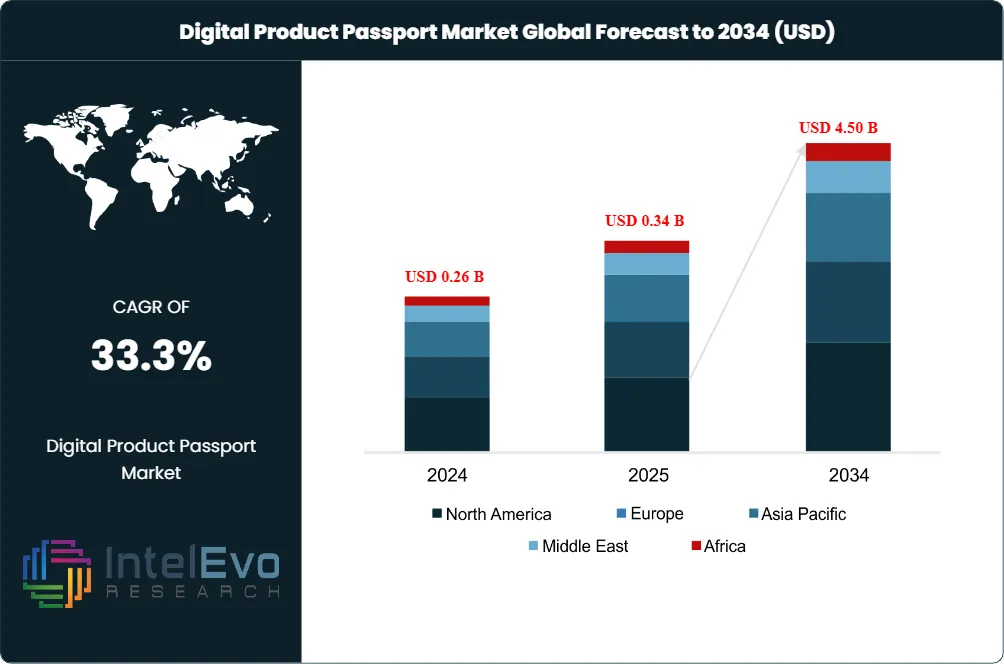
The Digital Product Passport Market was valued at USD 0.26 Billion in 2024 and is estimated to reach USD 0.34 Billion in 2025. The market is projected to reach USD 4.50 Billion by 2034, expanding at a CAGR of 33.3% during the forecast period (2026–2034). This represents an absolute dollar opportunity of USD 4.16 Billion across the analysis window. The market spans DPP software platforms, blockchain-based traceability registries, IoT-enabled data carriers, advisory and consulting services, and DPP service provider certifications across batteries, textiles, electronics, construction materials, furniture, tyres, and intermediate materials such as iron, steel, and aluminium.
Get More Information about this report -
Request Free Sample ReportDemand for digital product passport platforms sits squarely on EU regulatory enforcement. The Ecodesign for Sustainable Products Regulation (Regulation (EU) 2024/1781) entered into force on 18 July 2024, granting the European Commission authority to mandate DPPs across nearly all physical goods sold in the EU. The ESPR Working Plan 2025-2030 was adopted on 16 April 2025, identifying the first product wave: textiles, furniture, tyres, mattresses, aluminium, iron, and steel. The first mandatory DPP arrives 18 February 2027 under the EU Battery Regulation (EU 2023/1542) for electric vehicle and industrial batteries above 2 kWh, with the central DPP Registry scheduled to open on 19 July 2026.
Adoption is expanding beyond compliance through brand-led pilots. H&M initiated a textile DPP pilot during 2024 to convey garment origin, material composition, and care instructions; Decathlon and Zalando are running parallel trials for EU sustainability alignment. Victoria's Secret released its first DPP collection during February 2025 across the Signature Cotton T-shirt Bra and VSX Featherweight Max Sports Bra, accessible via QR code. Madaster opened a construction-and-manufacturing DPP platform during January 2025. Audi, Tesla, and Kia are running battery-passport pilots ahead of the February 2027 deadline.
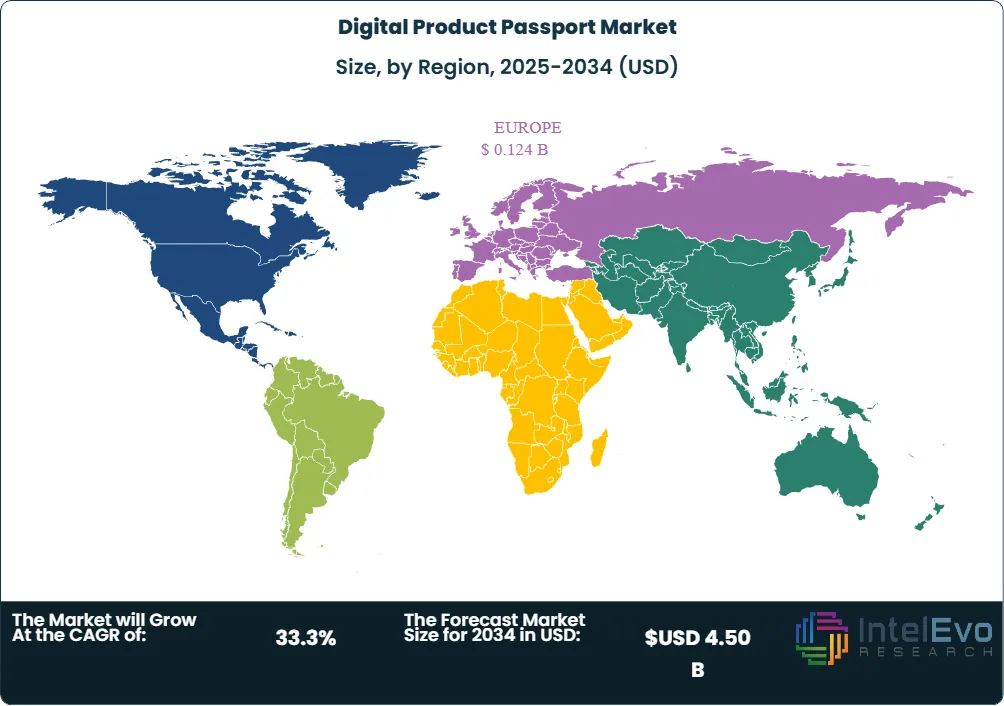
Europe led the digital product passport market with approximately 36.5% share in 2025, anchored by ESPR enforcement architecture and the highest concentration of DPP service providers. Germany generated USD 0.052 Billion in 2025 DPP revenue, supported by SAP, Siemens, Spherity, iPoint-systems, and Narravero. Asia Pacific captured 22.0% share but is the fastest-growing region at a projected 38.5% CAGR through 2034, propelled by China's Ministry of Industry and Information Technology pilot for electronics and textiles, Japan's METI funding for blockchain-based automotive and battery traceability, and India's Bureau of Indian Standards review of DPP frameworks. North America accounted for 28.5% share, driven by export-oriented manufacturers serving EU markets.
Forward to 2034, three structural shifts will define winners: the EU central DPP Registry launch on 19 July 2026 will trigger a 12-to-18-month enterprise platform-selection wave; CEN/CENELEC JTC 24 interoperability standards will tighten the moat for blockchain-based traceability solutions projected to capture 45.0% of platform revenue; and DPP obligations will broaden across textiles (Q2 2027 delegated act expected), iron and steel (delegated act adoption 2026), electronics (2028-2029), and construction products (2029-2030 under the separate Construction Products Regulation framework).
Market Definition & Scope
The digital product passport market is defined as software platforms, blockchain registries, IoT-enabled data carriers, advisory services, and certified DPP Service Provider solutions that capture, verify, store, and share product-level sustainability and lifecycle data through a unique product identifier accessible via electronic data carrier (typically QR code or NFC tag). The market spans the full DPP value chain: data ingestion from suppliers, validation, on-chain or cloud registry storage, regulator-and-consumer access portals, and end-of-life data updates.
This analysis includes platform software, hardware data carriers, integration services, advisory and consulting, and managed DPP service provider operations across batteries, textiles, electronics, construction materials, furniture, tyres, mattresses, aluminium, iron, steel, and adjacent ESPR product categories. Excluded from scope are general-purpose product information management (PIM) platforms without DPP regulatory alignment, conventional supply-chain visibility tools without product-level passport functionality, and pure carbon accounting platforms. The DPP market is a sub-segment of the broader USD 18.5 Billion supply chain transparency software market and represented approximately 1.8% of that parent market in 2025.

Key Takeaways
- Market Growth: The digital product passport market expanded from USD 0.34 Billion in 2025 toward a projected USD 4.50 Billion by 2034, registering a 33.3% CAGR.
- Segment Dominance (Component): Software platforms captured 58.0% of 2025 DPP revenue, ahead of services at 30.0% and hardware data carriers at 12.0%.
- Segment Dominance (Industry): Electronics and electricals represented 32.0% of 2025 DPP application revenue, ahead of batteries and automotive at 26.0% and textiles and apparel at 19.0%.
- Driver: EU Battery Regulation Article 77 imposes mandatory battery passports from 18 February 2027 for EV and industrial batteries above 2 kWh, anchoring USD 0.85 Billion in cumulative platform spend by 2027.
- Restraint: Multi-tier supplier data fragmentation across 500-to-5,000 direct suppliers per typical automotive or electronics OEM extends DPP build timelines to 12-to-18 months and inflates project costs by 35%.
- Opportunity: Textile DPP rollout (Q2 2027 delegated act expected, compliance approximately 18 months later) opens a USD 0.95 Billion incremental opportunity by 2034 across fashion brands.
- Trend: Blockchain-based traceability platforms are projected to capture 45.0% of DPP platform revenue in 2025, propelled by data-immutability and smart-contract compliance automation.
- Regional: Europe led the digital product passport market with 36.5% share and USD 0.124 Billion in 2025 revenue, anchored by the EU ESPR regulatory framework.
Key Insights Summary
- EU Ecodesign for Sustainable Products Regulation (EU 2024/1781) entered into force on 18 July 2024, granting the European Commission authority to mandate DPPs for nearly all physical goods sold in the EU.
- During April 2025, the European Commission adopted the ESPR Working Plan 2025-2030 and identified textiles, furniture, tyres, mattresses, aluminium, iron, and steel as the first product wave to receive delegated acts.
- Battery Passport requirements take effect on 18 February 2027 under EU Battery Regulation 2023/1542 for EV and industrial batteries above 2 kWh, with each passport containing more than 100 data attributes.
- On 19 July 2026, the European Commission launches the central DPP Registry, which will host product passport identifiers and access permissions across ESPR product categories.
- During February 2025, Victoria's Secret released its first DPP collection across the Signature Cotton T-shirt Bra and VSX Featherweight Max Sports Bra, accessed via QR code on product labels.
- On January 2025, Madaster, headquartered in Amsterdam, opened a DPP platform engineered for construction-and-manufacturing materials, broadening the addressable market beyond consumer-product categories.
- During June 2025, Spherity (Germany) inked a strategic partnership with RCS Global Group, the global provider of battery supply chain sustainability intelligence and assurance, deepening the battery passport offering.
Competitive Landscape Overview
The digital product passport market is fragmented, with the top four players (SAP, Siemens, IBM, Circularise) collectively holding an estimated 28% of 2025 revenue. The structure splits across three lanes: enterprise-software incumbents (SAP, IBM, Microsoft, Oracle, Siemens) embedding DPP modules into existing ERP and SCM stacks; specialized DPP pure-plays (Circularise, Spherity, Kezzler, Narravero, Scantrust, The ID Factory, Qliktag, Optel, Madaster) competing on regulatory specialization and blockchain-based architecture; and management consultancies (Accenture, TUV Rheinland, Det Norske Veritas) wrapping advisory, audit, and certification services around third-party platforms.
Competition is restructuring around the DPP Service Provider certification pathway. The European Commission opened a public consultation during April 2025 for the first delegated act defining DPP Service Provider requirements and a certification scheme. Certified providers will host product DPP data and bear cybersecurity, data-access, and standards-compliance obligations. The CIRPASS-2 consortium, running from May 2024 to April 2027 under the Digital Europe Programme with 49 partners led by CEA-List, is building reference-implementation pilots across textiles, electrical-and-electronic equipment, tyres, and construction materials. Vertical integration through partnerships (Spherity-RCS Global, Circularise-J-CEP-AMITA-Marubeni) is the dominant scaling strategy.
Competitive Landscape Matrix
| Company | HQ | Position | Key Product | Geographic Strength | Recent Strategic Move |
| SAP SE | Germany | Leader | SAP Green Token and Sustainability Data Exchange | EU, North America, Asia | Embedded DPP modules into S/4HANA Cloud release through 2025 |
| Siemens AG | Germany | Leader | SiGREEN product carbon footprint and DPP platform | EU, Asia, North America | Continued expansion of SiGREEN through Xcelerator marketplace 2025 |
| IBM Corporation | United States | Leader | IBM Sustainability Suite and Maximo with DPP modules | Global | Embedded DPP capabilities into Sustainability Suite during 2025 |
| Circularise B.V. | Netherlands | Leader | Blockchain-based DPP traceability platform | EU, expanding Asia | Joined CIRPASS-2 consortium expert group during March 2025 |
| Microsoft Corporation | United States | Challenger | Microsoft Sustainability Manager and Cloud for Sustainability | Global | Continued integration of supply chain DPP modules through Azure |
| Oracle Corporation | United States | Challenger | Oracle Fusion Cloud SCM with DPP extensions | North America, EU | Rolled out new DPP-aligned SCM features across cloud release 2025 |
| Accenture plc | Ireland | Challenger | Industry X DPP advisory and implementation services | Global | Scaled DPP advisory practice across European industrials in 2025 |
| Spherity GmbH | Germany | Niche Player | Decentralized identity DPP and battery passport platform | Europe | Inked strategic partnership with RCS Global Group during June 2025 |
| Kezzler AS | Norway | Niche Player | Cloud-based product traceability and DPP platform | Europe, Asia | Scaled deployments across consumer goods and industrial brands |
| OPTEL Group | Canada | Niche Player | Optchain traceability platform and DPP solutions | North America, EU, Asia | Continued enterprise traceability rollouts across pharma and food |
| Avery Dennison Corp. | United States | Niche Player | atma.io connected product cloud | Global | Expanded atma.io DPP partnerships across apparel brands in 2025 |
| GS1 AISBL | Belgium | Standards Body | GS1 Digital Link standard for DPP carriers | Global | Continued rollout of GS1 Sunrise barcode-to-QR transition |
By Component
Software platforms dominated the digital product passport market with 58.0% of 2025 revenue, anchored by SAP Green Token, Siemens SiGREEN, IBM Sustainability Suite, and pure-play platforms from Circularise, Spherity, and Kezzler. The category captures product master data, supplier inputs, sustainability metrics, and regulator-facing access portals. Services held 30.0% share, projected to grow fastest at 36.0% CAGR through 2034 as Accenture, Atos, TUV Rheinland, and Det Norske Veritas wrap advisory, integration, and certification services around platform deployments. Hardware data carriers (QR codes, NFC tags, RFID, embedded chips) captured 12.0%, supplied by GS1-aligned printers and tag manufacturers.
By Deployment
Cloud-based deployment captured 64.1% of 2025 DPP market revenue, propelled by faster onboarding, scalability across global supplier networks, and lower upfront capital outlay. Microsoft Azure, AWS, and Google Cloud underpin the majority of pure-play DPP platforms, with Spherity and Kezzler operating native cloud architectures. On-premises deployment held 35.9% share, retained by enterprise manufacturers in regulated sectors (defense, pharmaceuticals, government suppliers) where data-sovereignty mandates require local hosting. The on-premises segment is projected to grow at 28.5% CAGR through 2034, slower than cloud at 35.5% CAGR.
By Industry
Electronics and electricals led the digital product passport market with 32.0% of 2025 industry revenue, supported by complex multi-tier supply chains and the upcoming EU electronics DPP mandate covering energy efficiency, repairability, and recyclability. Haier and Lenovo are testing blockchain-based DPPs to track material origin and carbon emissions in line with China's dual circulation policy. Batteries and automotive captured 26.0%, driven by the 18 February 2027 EU Battery Regulation deadline. Textiles and apparel accounted for 19.0% with the highest growth rate at 42.0% CAGR through 2034. Construction materials covered 11.0%, furniture 6.0%, and tyres, mattresses, and other ESPR categories the residual 6.0%.
By Application
Regulatory compliance and reporting represented 48.0% of 2025 DPP application revenue, the dominant use case as ESPR delegated acts trigger mandatory data capture for product market access. Supply chain transparency captured 22.0%, applied across automotive, electronics, and chemicals to validate raw-material origin and combat conflict minerals. Circular economy use cases (repair, reuse, refurbishment, recycling) accounted for 16.0%, propelled by the EU Right to Repair Directive and Extended Producer Responsibility schemes. Customer engagement and brand trust captured 9.0%, driven by fashion-brand QR-code product transparency. Environmental impact assessment covered the residual 5.0%.
By Lifecycle Stage
Production-stage DPP usage captured 38.0% of 2025 lifecycle revenue, anchored by manufacturing data capture (material composition, energy use, batch records). Distribution captured 26.0%, supporting traceability across logistics and retail nodes. Product design represented 18.0%, growing fastest at 36.5% CAGR through 2034 as designers integrate DPP-required data fields at the bill-of-materials stage. End-of-life captured 12.0%, propelled by EPR scheme integration and recycler-facing data portals. Use-phase data updates captured the residual 6.0%.
Regional Analysis
Europe led the global digital product passport market in 2025 with 36.5% share and USD 0.124 Billion in revenue, anchored by ESPR enforcement architecture. Germany generated USD 0.052 Billion, the largest national market in the region, supported by SAP, Siemens, Spherity, iPoint-systems, and the December 2024 National Circular Economy Strategy targeting climate neutrality by 2045. France contributed USD 0.022 Billion, anchored by CEA-List and the CIRPASS-2 lead consortium role. The Netherlands generated USD 0.018 Billion through Circularise and Madaster. Italy added USD 0.010 Billion through The ID Factory and fashion-house pilots. The remaining USD 0.022 Billion was distributed across the United Kingdom (Nobody's Child fashion DPP pilots since 2023), Belgium (GS1 AISBL standards body), Nordic countries, and Spain. EU CRCF and ESPR regulatory alignment anchors regional supply-side maturity.
North America accounted for 28.5% of the digital product passport market in 2025 with USD 0.097 Billion in revenue. The United States generated USD 0.085 Billion, supported by IBM, Microsoft, Oracle, Avery Dennison atma.io, and Qliktag. Canada contributed USD 0.010 Billion through Optel Group, headquartered in Quebec City. Mexico added USD 0.002 Billion via cross-border manufacturing serving EU export markets. North American demand is driven primarily by export-oriented manufacturers complying with EU ESPR rather than domestic mandates, although California and New York have introduced state-level supply-chain transparency rules covering apparel.
Asia Pacific captured 22.0% of the digital product passport market in 2025 with USD 0.075 Billion in revenue. China generated USD 0.030 Billion, supported by the Ministry of Industry and Information Technology pilot launched during 2024 covering electronics and textiles for EU import compliance, with Haier and Lenovo running blockchain-based DPP trials. Japan contributed USD 0.018 Billion through METI co-funding for blockchain-based automotive and battery traceability. South Korea added USD 0.011 Billion via Samsung-led electronics DPP pilots. India contributed USD 0.008 Billion through the Bureau of Indian Standards DPP review and Make in India initiatives. Taiwan, Australia, and ASEAN markets together accounted for USD 0.008 Billion.
Latin America held 7.5% of the digital product passport market in 2025 with USD 0.026 Billion in revenue. Brazil represented USD 0.014 Billion, the largest national market in the region, anchored by export-oriented apparel and steel manufacturers complying with EU ESPR. Mexico contributed USD 0.006 Billion through automotive supplier integration into EU and U.S. battery passport pipelines. Argentina, Chile, and Colombia together delivered USD 0.006 Billion via mining-sector traceability and apparel export programs.
Middle East and Africa captured 5.5% of the digital product passport market in 2025 with USD 0.019 Billion in revenue. The United Arab Emirates and Saudi Arabia together delivered USD 0.011 Billion, supported by Vision 2030 supply-chain digitalization initiatives. South Africa contributed USD 0.004 Billion through mining-sector and apparel-export traceability. Egypt and Morocco together added USD 0.002 Billion via textile and footwear export programs. Israel and Turkey together accounted for USD 0.002 Billion through Scantrust and DPP service provider activity.
Country Analysis
The United States digital product passport market reached USD 0.085 Billion in 2025 with a 32.5% projected CAGR through 2034. Although the U.S. lacks a federal DPP mandate, export-oriented manufacturers serving EU customers must comply with ESPR regardless of domestic regulations. IBM, Microsoft, Oracle, and Avery Dennison anchor the supplier base, with atma.io connected-product cloud deployments expanding across apparel brands. Federal Trade Commission Green Guides updates and California Senate Bill 343 on plastic recycling labels are creating partial state-level traceability requirements. Tesla operates one of the largest battery-passport pilots ahead of EU February 2027 deadlines.
Germany's digital product passport market generated USD 0.052 Billion in 2025 with a 32.8% projected CAGR through 2034. The country hosts the densest DPP technology cluster globally, anchored by SAP (Walldorf), Siemens (Munich), Spherity (Dusseldorf), iPoint-systems (Reutlingen), and Narravero (Munich). The German Federal Ministry for Economic Affairs and Climate Action (BMWK) co-funds DPP pilots through the Manufacturing-X and Catena-X automotive data-space initiatives. The December 2024 National Circular Economy Strategy targets climate neutrality by 2045 and integrates DPPs across automotive, electronics, and construction. Audi runs the largest battery-passport pilot ahead of the February 2027 deadline.
France's digital product passport market reached USD 0.022 Billion in 2025 with a 33.5% projected CAGR through 2034. The country anchors the CIRPASS-2 consortium leadership through CEA-List, the digital institute of CEA, coordinating 49 partners across textiles, electrical-and-electronic equipment, tyres, and construction materials. France pairs Label Bas-Carbone certification frameworks with anti-greenwashing legislation (Loi Climat et Resilience), creating regulatory tailwinds for fashion-and-cosmetics DPP pilots. ADEME co-funds DPP research through the France 2030 Investment Plan. Decathlon, headquartered in Villeneuve-d'Ascq, operates one of the largest fashion-retailer DPP pilots.
China's digital product passport market reached USD 0.030 Billion in 2025 with a 39.5% projected CAGR through 2034, the highest national CAGR globally. During 2024, the Ministry of Industry and Information Technology rolled out a pilot covering electronics and textiles to align Chinese manufacturers with EU import compliance. Haier and Lenovo are running blockchain-based DPPs to track material origin and carbon emissions across electronics supply chains. The country pairs its dual circulation strategy with green manufacturing objectives and is developing a parallel state-administered DPP system targeting 2027 implementation. China's manufacturing scale across batteries, electronics, textiles, and steel positions it as the second-largest national DPP market by 2030.
Get More Information about this report -
Request Free Sample ReportKey Market Segment
By Component
- Software
- Services
By Deployment
- Cloud-Based
- On-Premises
By Industry
- Automotive
- Electronics
- Textiles & Apparel
- Consumer Goods
- Healthcare
- Others
By Application
- Product Traceability
- Supply Chain Transparency
- Compliance & Sustainability
- Asset Management
- Circular Economy
- Others
By Lifecycle Stage
- Design & Manufacturing
- Distribution
- Product Use
- End-of-Life & Recycling
By Regional Coverage
- North America
- Latin America
- East Asia And Pacific
- Sea And South Asia
- Eastern Europe
- Western Europe
- Middle East & Africa
| Report Attribute | Details |
| Market size (2025) | USD 0.34 B |
| Forecast Revenue (2034) | USD 4.50 B |
| CAGR (2025-2034) | 33.3% |
| Historical data | 2021-2024 |
| Base Year For Estimation | 2025 |
| Forecast Period | 2026-2034 |
| Report coverage | Revenue Forecast, Competitive Landscape, Market Dynamics, Growth Factors, Trends and Recent Developments |
| Segments covered | By Component, (Software, Services), By Deployment, (Cloud-Based, On-Premises), By Industry, (Automotive, Electronics, Textiles & Apparel, Consumer Goods, Healthcare, Others), By Application, (Product Traceability, Supply Chain Transparency, Compliance & Sustainability, Asset Management, Circular Economy, Others), By Lifecycle Stage, (Design & Manufacturing, Distribution, Product Use, End-of-Life & Recycling), |
| Research Methodology |
|
| Regional scope |
|
| Competitive Landscape | SAP SE, SIEMENS AG, IBM CORPORATION, CIRCULARISE B.V., MICROSOFT CORPORATION, ORACLE CORPORATION, ACCENTURE PLC, SPHERITY GMBH, KEZZLER AS, OPTEL GROUP, AVERY DENNISON CORP. (ATMA.IO), GS1 AISBL, IPOINT-SYSTEMS GMBH, NARRAVERO GMBH, SCANTRUST SA, QLIKTAG SOFTWARE INC., PROTOKOL, BILLON GROUP LTD., DET NORSKE VERITAS GROUP, TUV RHEINLAND, EVERLEDGER, MINESPIDER, DIGIMARC CORPORATION, MADASTER B.V., ARIANEE, RCS GLOBAL GROUP, VERACITY PROTOCOL, PSQR, THE ID FACTORY SRL, ATOS SE, Others |
| Customization Scope | Customization for segments, region/country-level will be provided. Moreover, additional customization can be done based on the requirements. |
| Pricing and Purchase Options | Avail customized purchase options to meet your exact research needs. We have three licenses to opt for: Single User License, Multi-User License (Up to 5 Users), Corporate Use License (Unlimited User and Printable PDF). |


Frequently Asked Questions
How big is the Digital Product Passport Market?
Global Digital Product Passport Market was valued at USD 0.26 billion in 2024 and is projected to reach USD 4.50 billion by 2034, at a CAGR of 33.3% (2026–2034).
Who are the major players in the Digital Product Passport Market?
SAP SE, SIEMENS AG, IBM CORPORATION, CIRCULARISE B.V., MICROSOFT CORPORATION, ORACLE CORPORATION, ACCENTURE PLC, SPHERITY GMBH, KEZZLER AS, OPTEL GROUP, AVERY DENNISON CORP. (ATMA.IO), GS1 AISBL, IPOINT-SYSTEMS GMBH, NARRAVERO GMBH, SCANTRUST SA, QLIKTAG SOFTWARE INC., PROTOKOL, BILLON GROUP LTD., DET NORSKE VERITAS GROUP, TUV RHEINLAND, EVERLEDGER, MINESPIDER, DIGIMARC CORPORATION, MADASTER B.V., ARIANEE, RCS GLOBAL GROUP, VERACITY PROTOCOL, PSQR, THE ID FACTORY SRL, ATOS SE, Others
Which segments covered the Digital Product Passport Market?
By Component, (Software, Services), By Deployment, (Cloud-Based, On-Premises), By Industry, (Automotive, Electronics, Textiles & Apparel, Consumer Goods, Healthcare, Others), By Application, (Product Traceability, Supply Chain Transparency, Compliance & Sustainability, Asset Management, Circular Economy, Others), By Lifecycle Stage, (Design & Manufacturing, Distribution, Product Use, End-of-Life & Recycling),
How can this market research report help my business make strategic decisions?
Our market research reports provide actionable intelligence, including verified market size data, CAGR projections, competitive benchmarking, and segment-level opportunity analysis. These insights support strategic planning, investment decisions, product development, and market entry strategies for enterprises and startups alike.
How frequently is the data updated?
We continuously monitor industry developments and update our reports to reflect regulatory changes, technological advancements, and macroeconomic shifts. Updated editions ensure you receive the latest market intelligence.

Select Licence Type
Connect with our sales team

Digital Product Passport Market
Published Date : 08 Jul 2026 | Formats :Why IntelEvoResearch
100%
Customer
Satisfaction
24x7+
Availability - we are always
there when you need us
200+
Fortune 50 Companies trust
IntelEvoResearch
80%
of our reports are exclusive
and first in the industry
100%
more data
and analysis
1000+
reports published
till date