

- Home
- Industries
 Aerospace And Defence
 Agriculture
 Automotive And Transportation
 Banking And Finance
 Business
 Chemicals And Materials
 Consumer And Retail
 Electronics And Semiconductors
 Food And Beverages
 Machinery & Equipments
 Manufacturing And Construction
 Medical Devices
 Others
 Pharmaceuticals And Healthcare
 Power And Energy
 Sports
 Technology
- Services
- News Room
- About us
- Contact Us
-
Digitally Printed Wallpaper Market Size, Growth & Forecast | CAGR 15.2%
Global Digitally Printed Wallpaper Market Size, Share & Design Technology Analysis By Printing Method (Inkjet, UV, Latex), By Application (Residential, Commercial, Hospitality), By Material Type, Customization & Sustainable Décor Trends, Smart Interior Design Adoption, Regional Demand, Key Brands, Competitive Landscape & Forecast 2025–2034

Report Overview
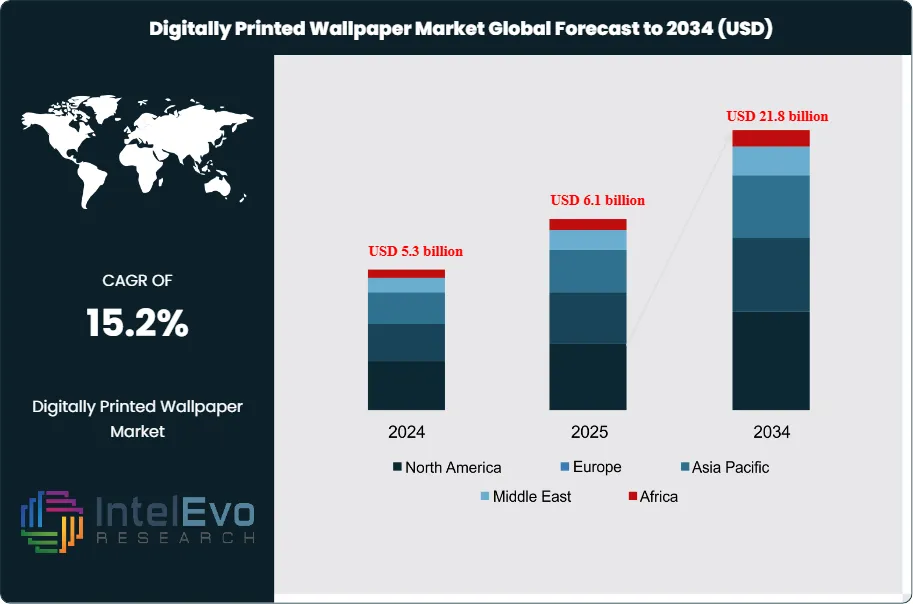
The Digitally Printed Wallpaper Market is estimated at USD 5.3 billion in 2024 and is projected to reach approximately USD 21.8 billion by 2034, registering a robust compound annual growth rate (CAGR) of about 15.2% during 2025–2034. This sustained expansion is driven by rising demand for customized interior décor, rapid adoption of digital inkjet printing technologies, and growing use of wallpapers in residential, commercial, and hospitality spaces. Design flexibility, shorter production cycles, and increasing preference for eco-friendly, low-VOC printing solutions are further accelerating adoption. As urbanization and renovation activities intensify globally, digitally printed wallpapers are becoming a preferred choice for premium, personalized wall décor solutions.
Get More Information about this report -
Request Free Sample ReportThis rapid expansion reflects a structural shift in the wallcoverings industry, where digital printing has enabled new levels of customization, speed, and design flexibility. The market has grown from a niche segment into a mainstream choice for both residential and commercial interiors, supported by advances in print technology and changing consumer preferences.
Historically, wallpaper demand was constrained by limited design options and lengthy production cycles. Digital printing has removed these barriers by allowing high-resolution images to be applied directly to paper, vinyl, or fabric substrates with minimal setup time. This has reduced costs, shortened lead times, and opened the door to personalized design at scale. By 2024, residential applications account for more than 55% of global demand, as homeowners increasingly seek tailored interiors. Commercial adoption is also accelerating, particularly in hospitality and retail, where distinctive wall designs are used to enhance brand identity and customer experience.
Several demand-side drivers underpin this growth. Rising disposable incomes and urbanization are fueling investment in interior design, while businesses are prioritizing cost-effective methods to refresh spaces without full renovations. On the supply side, manufacturers benefit from lower waste and reduced water and energy consumption compared with traditional printing, aligning with sustainability targets. However, challenges remain. High equipment costs and the need for skilled operators can limit adoption in smaller markets, while fluctuations in raw material prices pose risks to margins.
Technology continues to shape the competitive landscape. Modern printers now deliver resolutions exceeding 1,200 dpi and can handle a wide range of substrates, expanding creative possibilities. Integration with AI-based design tools and automation in production workflows is further improving efficiency and customization. Eco-friendly inks and recyclable substrates are gaining traction, appealing to both regulators and environmentally conscious buyers.
Regionally, Europe leads the market with over 35% share in 2024, driven by strong design culture and early adoption of sustainable materials. Asia-Pacific is the fastest-growing region, projected to expand at more than 20% CAGR, supported by rapid urban development in China and India. North America remains an attractive investment hotspot, with demand concentrated in commercial real estate and hospitality projects. For investors, the combination of high growth rates, expanding applications, and sustainability alignment positions digitally printed wallpaper as a compelling opportunity through 2032.

Key Takeaways
- Market Growth: The global digitally printed wallpaper market is valued at USD 5.3 billion in 2024 and is projected to reach USD 21.8 billion by 2034, expanding at a CAGR of 15.2%. Growth is driven by rising demand for personalized interiors, cost-efficient digital printing, and adoption of sustainable substrates.
- Substrate: Vinyl accounts for 37% of global revenue in 2024 due to its durability, waterproof properties, and ease of installation. Nonwoven substrates are gaining traction as eco-friendly alternatives, particularly in Europe.
- Printing Technology: Inkjet technology holds 62% of the market, supported by its ability to deliver high-resolution prints at lower costs. Electrophotography remains a niche but is favored for premium applications requiring precise detailing.
- Driver: Customization is the strongest demand driver, with more than 55% of residential buyers in 2024 preferring wallpapers tailored to specific design themes. Hospitality and retail sectors are also accelerating adoption to enhance customer experience.
- Restraint: High capital investment for advanced digital printers, often exceeding USD 250,000 per unit, limits adoption among small-scale manufacturers. Volatility in raw material prices further pressures margins.
- Opportunity: Asia-Pacific presents the strongest growth potential, projected to expand at over 20% CAGR through 2032. Rapid urbanization in China and India, coupled with rising disposable incomes, is creating significant demand for personalized wallcoverings.
- Trend: Sustainability is reshaping production, with eco-friendly inks and recyclable substrates gaining share. Companies such as Graham & Brown and A.S. Création are investing in water-based inks and low-emission processes to align with regulatory and consumer expectations.
- Regional Analysis: Europe leads with 35% of global revenue in 2024, supported by strong design culture and early adoption of sustainable materials. North America follows, driven by commercial real estate and hospitality projects. Asia-Pacific is the fastest-growing region, while the Middle East is emerging as a niche market for luxury applications.
Substrate Analysis
The digitally printed wallpaper market in 2025 continues to be segmented by nonwoven, vinyl, paper, and other substrates. Vinyl remains the leading material, accounting for approximately 37% of global demand. Its durability, scratch resistance, and waterproof properties make it particularly suitable for high-moisture environments such as kitchens and bathrooms. This resilience has positioned vinyl as the preferred choice for both residential and commercial projects where longevity and ease of maintenance are critical.
Nonwoven substrates are gaining wider adoption, particularly in Europe, due to their breathability and ease of installation. These wallpapers allow moisture to escape, reducing the risk of mold and mildew, which is a growing concern in urban housing markets. Their ability to conceal wall imperfections also makes them attractive for renovation projects. Paper substrates, while still popular for their affordability and wide design range, are losing share as consumers increasingly prioritize durability and sustainability. Paper-based wallpapers face challenges in terms of maintenance and shorter lifecycle, limiting their appeal in premium applications.
Looking ahead, eco-friendly substrates are expected to capture greater market share. Manufacturers are investing in recyclable and biodegradable materials to align with tightening environmental regulations and consumer demand for sustainable interior solutions. This shift is likely to reshape substrate preferences over the next decade.
Printing Technology Analysis
Inkjet printing dominates the market with a share of around 62% in 2025. Its ability to deliver high-resolution images with vivid colors at relatively low cost has made it the standard technology for digitally printed wallpaper. Inkjet systems are highly adaptable, capable of printing on a wide range of substrates, and are increasingly integrated with automation and AI-based design tools to streamline production.
Electrophotography, also known as digital laser printing, holds a smaller share but remains relevant in premium applications. This method produces sharp, detailed images using toner-based processes, making it suitable for high-end commercial interiors where precision and consistency are essential. However, higher equipment costs and slower production speeds compared with inkjet limit its broader adoption.
The outlook for printing technologies points toward further efficiency gains. Advances in ink formulations, including water-based and eco-friendly options, are expected to reduce environmental impact while maintaining print quality. As sustainability becomes a competitive differentiator, technology providers are likely to focus on reducing energy consumption and waste in production.
End-Use Analysis
Commercial applications account for roughly 60% of global demand in 2025, making this the dominant end-use segment. Businesses across hospitality, retail, and corporate offices are increasingly using digitally printed wallpaper to create branded environments and immersive customer experiences. Hotels, for example, deploy scenic or thematic designs to enhance guest satisfaction, while restaurants use customized imagery to reinforce brand identity and ambiance.
The residential segment is expanding steadily, supported by rising consumer interest in personalized interiors. Homeowners are using digitally printed wallpaper for accent walls, murals, and bespoke designs that reflect individual style preferences. The availability of online customization platforms has further accelerated adoption, allowing consumers to design and order wallpapers tailored to their spaces.
Industrial applications remain limited but are emerging in niche areas such as workplace branding and institutional interiors. As production costs decline and customization becomes more accessible, demand from smaller businesses and residential users is expected to grow, narrowing the gap between commercial and household adoption.
Regional Analysis
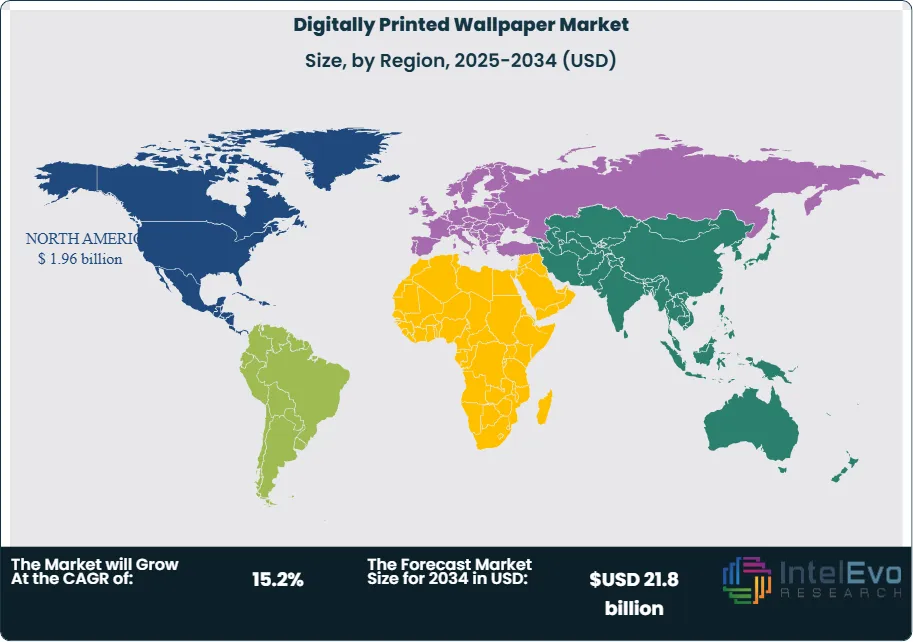
North America holds approximately 37% of the global market in 2025, supported by strong demand from commercial real estate and hospitality sectors. The region benefits from established supply chains and a high level of consumer awareness regarding personalized décor. Europe follows closely, with significant uptake driven by design-conscious consumers and regulatory emphasis on sustainable materials. Countries such as Germany, the UK, and France are leading adopters of eco-friendly substrates and water-based inks.
Asia Pacific is the fastest-growing region, projected to expand at a CAGR exceeding 20% through 2032. Rapid urbanization in China and India, coupled with rising disposable incomes, is fueling demand for customized interiors in both residential and commercial spaces. Local manufacturers are scaling up production capacity to meet this demand, while international players are investing in regional partnerships to strengthen distribution networks.
Latin America, the Middle East, and Africa represent emerging markets with rising consumer awareness and improving retail infrastructure. Growth in these regions is supported by expanding middle-class populations and increasing exposure to global design trends. While market penetration remains lower compared with developed economies, the long-term outlook is positive, particularly as supply chains mature and affordability improves.
Get More Information about this report -
Request Free Sample ReportKey Market Segments
By Substrate
- Nonwoven
- Vinyl
- Paper
- Others
By Printing Technology
- Inkjet
- Electrophotography
By Type of Wallpaper
- Wildlife
- Scenic Beauty
- Lifestyle
- Architectural
- Portrait
- Wedding
- Fashion
- Abstract
- Others
By End-User
- Residential
- Commercial
Regions
- North America
- Latin America
- East Asia And Pacific
- Sea And South Asia
- Eastern Europe
- Western Europe
- Middle East & Africa
| Report Attribute | Details |
| Market size (2024) | USD 5.3 B |
| Forecast Revenue (2034) | USD 21.8 B |
| CAGR (2024-2034) | 15.2% |
| Historical data | 2020-2023 |
| Base Year For Estimation | 2024 |
| Forecast Period | 2025-2034 |
| Report coverage | Revenue Forecast, Competitive Landscape, Market Dynamics, Growth Factors, Trends and Recent Developments |
| Segments covered | By Substrate (Nonwoven, Vinyl, Paper, Others, By Printing Technology, Inkjet, Electrophotography), By Type of Wallpaper (Wildlife, Scenic Beauty, Lifestyle, Architectural, Portrait, Wedding, Fashion, Abstract, Others), By End-User (Residential, Commercial) |
| Research Methodology |
|
| Regional scope |
|
| Competitive Landscape | Momentum Textiles & Wallcovering, YO2 Designs, MX Display Ltd, ELITIS, JOHNMARK LTD, Londonart, A S Creation Tapeten AG, Glamora Srl, DAISY JAMES, Moonavoor Sisustus, Graham and Brown Ltd, Syndikat4, Flavor Paper, Inkiostro Bianco PI, Arte International, Astek, Tecnografica, Grandeco Wallfashion Group Belgium NV, MINDTHEGAP, Other Key Players |
| Customization Scope | Customization for segments, region/country-level will be provided. Moreover, additional customization can be done based on the requirements. |
| Pricing and Purchase Options | Avail customized purchase options to meet your exact research needs. We have three licenses to opt for: Single User License, Multi-User License (Up to 5 Users), Corporate Use License (Unlimited User and Printable PDF). |


Frequently Asked Questions
How big is the Digitally Printed Wallpaper Market?
The digitally printed wallpaper market is valued at USD 5.3 billion in 2024 and is projected to reach USD 21.8 billion by 2034, growing at a 15.2% CAGR during 2025–2034. Growth is driven by rising demand for customized interior décor, digital inkjet printing adoption, eco-friendly wallpapers, and expanding residential and commercial renovation activities worldwide.
Who are the major players in the Digitally Printed Wallpaper Market?
Momentum Textiles & Wallcovering, YO2 Designs, MX Display Ltd, ELITIS, JOHNMARK LTD, Londonart, A S Creation Tapeten AG, Glamora Srl, DAISY JAMES, Moonavoor Sisustus, Graham and Brown Ltd, Syndikat4, Flavor Paper, Inkiostro Bianco PI, Arte International, Astek, Tecnografica, Grandeco Wallfashion Group Belgium NV, MINDTHEGAP, Other Key Players
Which segments covered the Digitally Printed Wallpaper Market?
By Substrate (Nonwoven, Vinyl, Paper, Others, By Printing Technology, Inkjet, Electrophotography), By Type of Wallpaper (Wildlife, Scenic Beauty, Lifestyle, Architectural, Portrait, Wedding, Fashion, Abstract, Others), By End-User (Residential, Commercial)
How can this market research report help my business make strategic decisions?
Our market research reports provide actionable intelligence, including verified market size data, CAGR projections, competitive benchmarking, and segment-level opportunity analysis. These insights support strategic planning, investment decisions, product development, and market entry strategies for enterprises and startups alike.
How frequently is the data updated?
We continuously monitor industry developments and update our reports to reflect regulatory changes, technological advancements, and macroeconomic shifts. Updated editions ensure you receive the latest market intelligence.

Select Licence Type
Connect with our sales team

Digitally Printed Wallpaper Market
Published Date : 03 Jan 2026 | Formats :Why IntelEvoResearch
100%
Customer
Satisfaction
24x7+
Availability - we are always
there when you need us
200+
Fortune 50 Companies trust
IntelEvoResearch
80%
of our reports are exclusive
and first in the industry
100%
more data
and analysis
1000+
reports published
till date