

- Home
- Industries
 Aerospace And Defence
 Agriculture
 Automotive And Transportation
 Banking And Finance
 Business
 Chemicals And Materials
 Consumer And Retail
 Electronics And Semiconductors
 Food And Beverages
 Machinery & Equipments
 Manufacturing And Construction
 Medical Devices
 Others
 Pharmaceuticals And Healthcare
 Power And Energy
 Sports
 Technology
- Services
- News Room
- About us
- Contact Us
-
Global DNA Data Storage Market Size, Share & Forecast | CAGR 53.4%
Global DNA Data Storage Market Size, Share, Analysis By Storage Type (Archival DNA Data Storage, Cold DNA Data Storage, Long-Term Preservation Storage, Active DNA Data Storage, Hybrid DNA Data Storage Systems), By Technology (DNA Synthesis, DNA Sequencing, PCR-Based Technologies, Enzymatic DNA Synthesis, NGS, Nanopore Sequencing), By Application, By End-User, Industry Trends, Market Dynamics & Forecast 2026-2034

Report Overview
| Market Size (2025) | Forecast Value (2034) | CAGR (2026-2034) | Largest Region (2025) |
|---|---|---|---|
| USD 145.00 Million | USD 6,800.00 Million | 53.4% | North America, 55.0% |
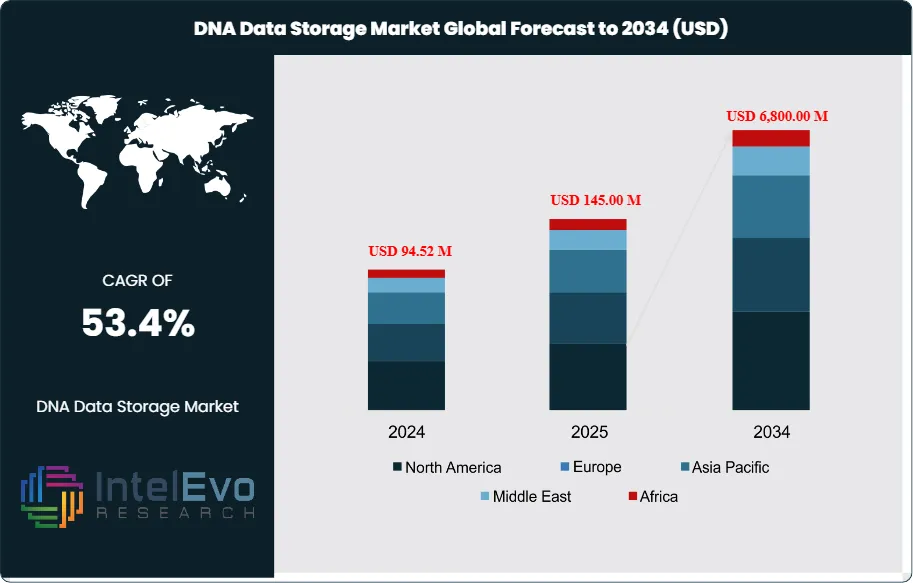
The DNA Data Storage Market was valued at approximately USD 94.52 Million in 2024 and reached USD 145.00 Million in 2025. The market is projected to surge to USD 6,800.00 Million by 2034, expanding at a remarkable CAGR of 53.4% during the forecast period from 2026 to 2034. This represents an absolute dollar opportunity of USD 6,655.00 Million over the analysis period. The DNA Data Storage Market covers commercial products and services that encode binary digital information into synthetic DNA nucleotide sequences for ultra-dense archival storage, including DNA synthesis hardware, sequencing readout systems, encoding and decoding algorithms, molecular storage vessels, and integrated write-store-retrieve platforms delivered to enterprise, government, and research end-users.
Get More Information about this report -
Request Free Sample ReportDemand growth is anchored in three structural shifts. First, International Data Corporation (IDC) projects global data generation exceeding 180 zettabytes by year-end 2025, with legacy magnetic tape, hard disk drives, and optical media reaching physical and cost-efficiency limits. Second, DNA offers approximately 215 petabytes of storage capacity per gram with stability exceeding several thousand years under proper conditions per Imburgia and Nivala 2024 research, compared with magnetic hard drives requiring replacement every 10 years. Third, regulatory compliance requirements under the Sarbanes-Oxley Act, HIPAA, GDPR, Dodd-Frank, Basel III, and Payment Card Industry Data Security Standard (PCI DSS) mandate decades-long data retention for finance, healthcare, and government sectors, creating structural demand for long-life archival media.
Major commercial and research developments accelerated through 2024-2025. On 5 May 2025 Twist Bioscience Corporation announced the spin-out of its DNA data storage unit into an independent company named Atlas Data Storage, supported by approximately USD 155 million in seed financing with Twist retaining a minority stake. In January 2025 DNA Script SAS announced a breakthrough in enzymatic oligonucleotide synthesis technology enabling custom DNA sequences up to 500 nucleotides long, addressing the limitations of conventional phosphoramidite chemistry. In April 2025 the European MI-DNA Disc initiative, funded through the Horizon Europe EIC Pathfinder Challenges programme, unveiled the first in-vivo system capable of writing, editing, storing, and retrieving DNA-based data using living bacterial cells. In March 2025 IBM secured a patent for 4D printing technology using machine learning for molecular-scale material control.
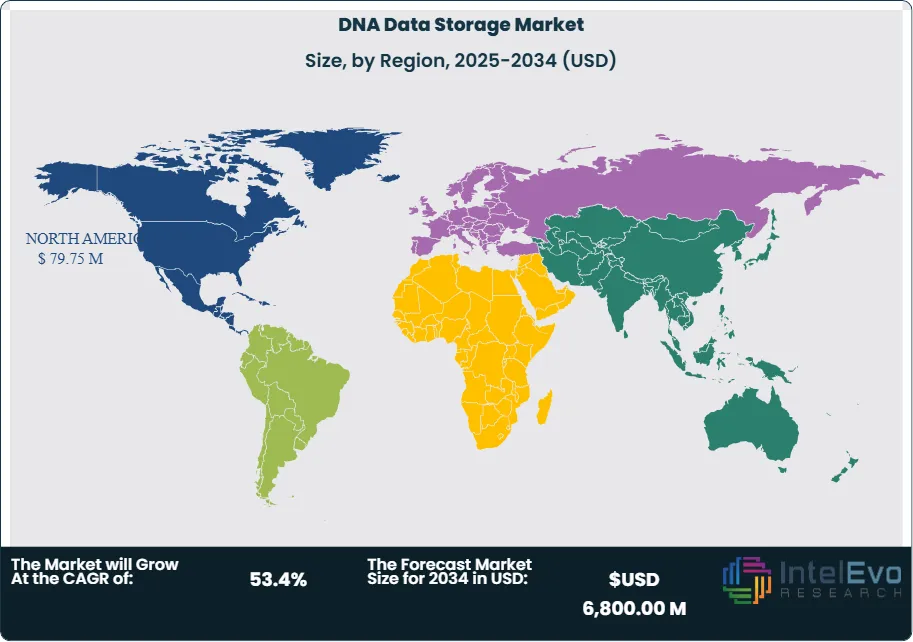
North America held approximately 55.0% of global DNA Data Storage Market revenue in 2025, equivalent to USD 79.75 Million, anchored by Twist Bioscience, Atlas Data Storage, Microsoft, Catalog Technologies, Iridia, Molecular Assemblies, and Illumina operations alongside substantial U.S. government funding. Europe captured approximately 27% share at USD 39.15 Million, led by DNA Script (France), Evonetix (United Kingdom), Biomemory (France), and the European Commission's Horizon Europe research infrastructure. Asia Pacific held 13% share at USD 18.85 Million, anchored by Peking University's 2024 epi-bit technology breakthrough and emerging Chinese and Japanese research programs. Latin America and Middle East & Africa collectively held the remaining 5% share.
Forward visibility through 2034 rests on three catalysts. First, DNA synthesis cost reduction is the critical commercialization threshold, with current costs of approximately USD 3,500 per megabyte required to fall below USD 10 per terabyte for archival storage viability. Second, the National Biotechnology Initiative Act introduced in the U.S. Congress on 11 April 2025 proposes USD 132 million in federal biotechnology funding over five years, signaling sustained government support. Third, the DNA Data Storage Alliance founded by Microsoft, Twist Bioscience, Illumina, and Western Digital in 2020 continues standardizing specifications for interoperable DNA storage systems. These forces together support the 53.4% forecast CAGR in the DNA Data Storage Market through 2034, though commercial deployment at hyperscale data center tier remains approximately 5 to 10 years distant based on current cost trajectories.
Market Definition & Scope
The DNA Data Storage Market is defined as the commercial space for hardware, software, and services that encode, store, and retrieve digital information using synthetic DNA molecules as the storage medium. The market encompasses four core technology layers: DNA writing (phosphoramidite chemical synthesis and emerging enzymatic synthesis platforms), DNA storage vessels (silica encapsulation, lyophilization, and fluid systems), DNA reading (Illumina short-read sequencing, Oxford Nanopore long-read sequencing), and encoding-decoding algorithms (error correction, random access, indexing).
This analysis includes synthetic DNA storage systems, natural DNA-based storage using bacterial cells and plasmids, sequencing readout infrastructure dedicated to data storage applications, encoding and decoding algorithm platforms, and enterprise archival storage services using DNA as the medium. The scope explicitly excludes DNA sequencing for genomic research or clinical diagnostics without data storage context, traditional silicon-based storage (magnetic tape, HDD, SSD, optical), synthetic biology research platforms without storage applications, and broader biotechnology research tools. The parent enterprise data storage market reached approximately USD 330 billion in 2025 per industry analysis, with the DNA Data Storage Market representing the emerging molecular storage frontier at less than 0.05% of parent category in 2025, projected to approach 2% share by 2034 under aggressive scale-up scenarios.

Key Takeaways
- Market Growth: The DNA Data Storage Market grew from USD 145.00 Million in 2025 to a projected USD 6,800.00 Million in 2034, expanding at a 53.4% CAGR.
- Segment Dominance (By Storage Type): Synthetic DNA storage dominated 2025 revenue share, anchored by phosphoramidite chemistry platforms from Twist Bioscience, Atlas Data Storage, and Agilent Technologies.
- Segment Dominance (By End-User): Biotechnology and healthcare captured 38.6% market share in 2023 per SNS Insider, driven by genomics data retention requirements under HIPAA and 21 CFR Part 11.
- Driver: A single gram of DNA can store 215,000 terabytes per Imburgia and Nivala 2024 research, with potential persistence exceeding 500,000 years versus approximately 10 years for magnetic hard drives.
- Restraint: DNA synthesis costs remain approximately USD 3,500 per megabyte in 2025 against a commercial viability threshold below USD 10 per terabyte, creating a 350-million-fold cost reduction requirement.
- Opportunity: The U.S. National Biotechnology Initiative Act introduced on 11 April 2025 proposes USD 132 million in federal funding over five years to maintain U.S. biotechnology competitiveness over China.
- Trend: Twist Bioscience spun out its DNA data storage unit as Atlas Data Storage on 5 May 2025 with approximately USD 155 million in seed financing, representing the largest dedicated DNA storage capitalization event to date.
- Regional: North America held approximately 55.0% revenue share in 2025 at USD 79.75 Million, anchored by Twist Bioscience, Atlas Data Storage, Microsoft, Catalog Technologies, and Illumina operations.
Key Insights Summary
- Twist Bioscience Corporation spun out its DNA data storage unit into an independent company named Atlas Data Storage on 5 May 2025, supported by approximately USD 155 million in seed financing with Twist retaining a minority stake.
- DNA Script SAS announced a breakthrough in enzymatic oligonucleotide synthesis technology in January 2025, enabling creation of custom DNA sequences up to 500 nucleotides long with unmatched sequence complexity.
- The European MI-DNA Disc research initiative, funded through the Horizon Europe EIC Pathfinder Challenges programme, unveiled the first in-vivo DNA storage system using living bacterial cells in April 2025.
- A single gram of DNA can store 215,000 terabytes per Imburgia and Nivala 2024 research, with DNA persistence exceeding 500,000 years under proper conditions compared with approximately 10 years for magnetic hard drives.
- Global data generation is expected to exceed 180 zettabytes by year-end 2025 per International Data Corporation (IDC) estimates, with China alone producing 32.85 zettabytes in 2023 per official statistics.
- The DNA Data Storage Alliance founded by Microsoft, Twist Bioscience, Illumina, and Western Digital in 2020 continues setting interoperability standards for DNA storage systems across synthesis, sequencing, and encoding layers.
- Peking University researchers developed epi-bit technology in 2024 that encodes information through selective methylation of DNA base pairs, representing a new encoding paradigm beyond conventional nucleotide sequence encoding.
Competitive Landscape Overview
The DNA Data Storage Market is highly fragmented with the top four companies including Twist Bioscience, Atlas Data Storage, Microsoft, and Catalog Technologies collectively holding an estimated 55 to 65% of global revenue in 2025. Competition is structured across three tiers: DNA synthesis infrastructure providers including Twist Bioscience, Atlas Data Storage, DNA Script, Molecular Assemblies, Evonetix, and Ansa Biotechnologies supplying the write layer; integrated platform developers including Catalog Technologies, Iridia, and Biomemory building end-to-end storage systems; and hyperscale research partners including Microsoft, Western Digital, and Illumina providing sequencing infrastructure and cloud integration.
The competitive environment shifted sharply through 2024-2025 toward purpose-built DNA storage companies rather than broader synthetic biology platforms adding storage as an adjacent capability. The Twist Bioscience spin-out of Atlas Data Storage on 5 May 2025 represents the most significant strategic reconfiguration, creating a focused pure-play entity while Twist continues supplying oligos. Catalog Technologies published the first DNA-based book in 2024-2025, a technically symbolic milestone alongside continued Seagate partnership for DNA-based computing platforms. DNA Script's enzymatic synthesis breakthrough positions the French company as an alternative to silicon-based phosphoramidite chemistry. Iridia pursues molecular electronics chip architecture integrating DNA writing and reading on semiconductor substrates. European competition intensifies through Biomemory commercial storage cards and Evonetix thermal synthesis arrays, supported by Horizon Europe funding including the MI-DNA Disc in-vivo bacterial storage initiative.
Competitive Landscape Matrix
| Company | HQ | Position | Key Platform | Geographic Strength | Recent Strategic Move |
|---|---|---|---|---|---|
| Atlas Data Storage, Inc. | South San Francisco, CA, USA | Leader (Pure-Play) | Silicon-integrated DNA synthesis and storage platform | United States | Spun out from Twist Bioscience in May 2025 with USD 155 million seed financing; Twist retains minority stake |
| Twist Bioscience Corporation | South San Francisco, CA, USA | Leader (Synthesis) | Twist silicon-based DNA synthesis; Twist Oligo Pools | United States, Global | Spun out DNA data storage unit as independent Atlas Data Storage entity with USD 155M seed in May 2025 |
| Microsoft Corporation | Redmond, WA, USA | Leader (Research) | Microsoft Project Silica adjacent DNA storage research; Azure integration | Global | Continued DNA Data Storage Alliance founding member participation; partnerships with Illumina and Twist 2025 |
| Catalog Technologies, Inc. | Boston, MA, USA | Leader (Computing) | Shannon platform enzymatic DNA storage; Shannon computing | United States | Published the first DNA-based book in 2024-2025 demonstrating symbolic milestone; Seagate partnership continues |
| DNA Script SAS | Paris, France / South San Francisco, CA | Challenger | SYNTAX enzymatic DNA synthesis benchtop system | Europe, North America | Announced breakthrough in January 2025 with enzymatic oligonucleotide synthesis up to 500 nucleotides |
| Illumina, Inc. | San Diego, CA, USA | Leader (Sequencing) | NovaSeq X Plus; NextSeq 1000/2000 sequencing platforms | Global | Continued DNA Data Storage Alliance participation; provided sequencing infrastructure for DNA storage ecosystem 2025 |
| Iridia, Inc. | Carlsbad, CA, USA | Niche (Nanopore) | Molecular electronics DNA storage chip | United States | Continued development of semiconductor-integrated DNA writing and reading chip architecture through 2025 |
| Evonetix Ltd. | Cambridge, United Kingdom | Niche (Synthesis) | Thermal DNA synthesis platform; silicon chip arrays | Europe, Global | Continued development of high-throughput thermally controlled DNA synthesis platform targeting cost reduction 2025 |
| Biomemory SAS | Paris, France | Niche | Biomemory storage cards; commercial DNA archival storage | Europe | Continued commercial DNA storage card product expansion for enterprise archival customers through 2025 |
| Molecular Assemblies, Inc. | San Diego, CA, USA | Niche (Enzymatic) | Fully Enzymatic Synthesis (FES) technology | United States | Continued enzymatic DNA synthesis technology development targeting cost-competitive on-demand writing 2025 |
Segmentation Analysis
The DNA Data Storage Market segments across storage type, technology, application, end-user, and deployment. Procurement leaders at enterprise archival storage teams and research institutions building a DNA data storage procurement checklist should benchmark providers on cost per gigabyte written, encoding throughput (megabits per hour), error rate after retrieval, archival shelf-life guarantees, compatibility with standard sequencing platforms, and integration with existing hierarchical storage management systems across each segmentation dimension.
By Storage Type
Synthetic DNA storage led the DNA Data Storage Market with approximately 92% revenue share in 2025, equivalent to USD 133.40 Million, anchored by phosphoramidite chemistry-based DNA synthesis platforms from Twist Bioscience, Atlas Data Storage, and Agilent Technologies alongside emerging enzymatic synthesis platforms from DNA Script, Molecular Assemblies, and Ansa Biotechnologies. Synthetic DNA storage dominates because it enables controlled, encoded data writing without biological host organism variability. Natural DNA-based storage captured the remaining 8% share at approximately USD 11.60 Million, led by the European MI-DNA Disc initiative using living bacterial cells as in-vivo storage hosts. Natural storage approaches benefit from self-replication and energy-free maintenance but face throughput and reliability challenges compared with synthetic approaches.
By Technology
DNA synthesis (phosphoramidite chemistry) led the DNA Data Storage Market with approximately 48% revenue share in 2025, reflecting its status as the most mature commercial solution for producing synthetic DNA at scale. Phosphoramidite chemistry requires toxic solvents and specialized infrastructure but delivers reliable write quality. DNA sequencing and reading technologies captured 28% share, dominated by Illumina short-read sequencing (NovaSeq X Plus, NextSeq 2000) and Oxford Nanopore Technologies long-read sequencing devices. Data encoding and decoding algorithms held 14% share, including error correction codes, Huffman encoding, Reed-Solomon codes, and specialized DNA-specific compression algorithms. Enzymatic DNA synthesis captured the remaining 10% share as an emerging technology, led by DNA Script's SYNTAX platform producing custom DNA up to 500 nucleotides in January 2025 and Molecular Assemblies' Fully Enzymatic Synthesis (FES) technology.
By Application
Archival storage led the DNA Data Storage Market with approximately 64% revenue share in 2025, equivalent to USD 92.80 Million, reflecting DNA's natural fit for cold storage applications requiring decades-to-centuries retention with infrequent access. Archival applications include healthcare genomics data under HIPAA retention, financial transaction records under Sarbanes-Oxley, government archives under the U.S. National Archives and Records Administration (NARA), and cultural heritage preservation. Research and academic applications captured 22% share, anchored by university and national laboratory research. Cloud storage services held 9% share, growing under Microsoft Azure DNA storage research and Seagate-Catalog Technologies partnerships. Active data storage and retrieval captured the remaining 5% share as an emerging segment targeting faster-access use cases. Implementation timelines range from 3 to 6 months for proof-of-concept deployments to 24 to 36 months for integrated enterprise archival systems.
By End-User
Healthcare and life sciences led the DNA Data Storage Market with 38.6% revenue share in 2023 per SNS Insider, equivalent to approximately USD 56.00 Million in 2025, reflecting concentrated demand from pharmaceutical, genomics, and clinical research organizations generating petabyte-scale datasets. Major healthcare buyers include the National Institutes of Health (NIH), the UK Biobank, the All of Us Research Program, and pharmaceutical giants with extensive clinical trial archives. Government and defense agencies captured 24% share at USD 34.80 Million and are projected to grow fastest in the 2025-2034 period, driven by national data sovereignty concerns and multi-decade retention requirements. IT and cloud service providers held 18% share, anchored by Microsoft, Amazon Web Services (AWS), and Google Cloud research partnerships. Enterprises and corporates held 12% share, and research institutes and academia captured the remaining 8%.
Regional Analysis
The DNA Data Storage Market divides across North America, Europe, Asia Pacific, Latin America, and Middle East & Africa, with North America leading in 2025 and Asia Pacific projected to grow fastest through 2034.
North America
North America held 55.0% of global DNA Data Storage Market revenue in 2025, equivalent to USD 79.75 Million. The United States contributed 92% of regional revenue, Canada at 7%, and Mexico at 1%. The U.S. National Institute of Standards and Technology (NIST) coordinates measurement standards for DNA synthesis and sequencing. The Defense Advanced Research Projects Agency (DARPA) Molecular Informatics program funds foundational research. The National Biotechnology Initiative Act introduced on 11 April 2025 proposes USD 132 million in federal biotechnology funding over five years. The Intelligence Advanced Research Projects Activity (IARPA) Molecular Information Storage program funds DNA storage at national security tier. Major U.S. players include Twist Bioscience, Atlas Data Storage, Microsoft, Catalog Technologies, Iridia, Molecular Assemblies, Illumina, Oxford Nanopore (UK-US operations), and Western Digital. Major U.S. buyers include NIH, NARA, and major cloud hyperscalers.
Europe
Europe captured 27.0% share in 2025 at approximately USD 39.15 Million, with France, the United Kingdom, Germany, and Switzerland leading. The European Commission Horizon Europe programme includes the EIC Pathfinder Challenges which funded the MI-DNA Disc in-vivo bacterial DNA storage initiative unveiled in April 2025. The European Research Council (ERC) Advanced Grants support DNA storage fundamental research at the EMBL Heidelberg, the Max Planck Institute for Molecular Genetics, and the Wellcome Sanger Institute. The UK Biotechnology and Biological Sciences Research Council (BBSRC) funds UK-based research. Germany's Federal Ministry of Education and Research (BMBF) supports Fraunhofer Institute work. Major European players include DNA Script (France), Evonetix (UK), Biomemory (France), and F. Hoffmann-La Roche (Switzerland). The European Data Protection Regulation (GDPR) Article 17 right to erasure creates regulatory complexity for non-rewritable DNA storage media.
Asia Pacific
Asia Pacific captured 13.0% share in 2025 at approximately USD 18.85 Million and is projected to grow fastest at approximately 57% CAGR through 2034. China leads regional adoption with Peking University researchers developing epi-bit technology in 2024 encoding information through selective methylation of DNA base pairs. Chinese Academy of Sciences (CAS) Institute of Microbiology coordinates national research. The 14th Five-Year Plan for Biotechnology allocated substantial funding. Japan's National Institute of Advanced Industrial Science and Technology (AIST) and RIKEN operate DNA storage research programs. South Korea's Ministry of Science and ICT funds domestic research through the Korea Research Institute of Standards and Science (KRISS). Singapore's Agency for Science, Technology and Research (A*STAR) supports regional research. India's Department of Biotechnology (DBT) coordinates national initiatives. GenScript Biotech Corporation (Nanjing, China, U.S. listed) operates the world's largest non-Western DNA synthesis capacity.
Latin America
Latin America held 2.5% share in 2025 at approximately USD 3.63 Million, led by Brazil, Argentina, and Mexico. Brazil's Instituto Butantan and Oswaldo Cruz Foundation (Fiocruz) operate life sciences infrastructure supporting early-stage DNA storage research. Argentina's CONICET National Scientific and Technical Research Council coordinates research under the Ministry of Science, Technology and Innovation. Mexico's CONACYT National Council for Science and Technology supports molecular biology initiatives. Regional growth is constrained by limited DNA synthesis infrastructure and high import costs for specialized reagents. Universities including the University of Sao Paulo (USP), University of Buenos Aires (UBA), and Universidad Nacional Autonoma de Mexico (UNAM) conduct foundational research. Commercial deployment remains minimal with most regional demand served by U.S.-based suppliers.
Middle East & Africa
The Middle East & Africa region held 2.5% share in 2025 at approximately USD 3.63 Million. Israel anchors regional innovation with the Weizmann Institute of Science Professor Ehud Shapiro conducting pioneering DNA storage research and the Israel Innovation Authority supporting early-stage biotech startups. The United Arab Emirates operates the Mohammed Bin Rashid Al Maktoum Knowledge Foundation supporting biotechnology initiatives under the UAE National Strategy for Advanced Sciences 2031. Saudi Arabia's King Abdullah University of Science and Technology (KAUST) Bioscience Program conducts research. Egypt's Academy of Scientific Research and Technology supports life sciences. South Africa's National Research Foundation (NRF) and the Council for Scientific and Industrial Research (CSIR) coordinate African research. Regional market remains nascent with minimal commercial deployment, though sovereign wealth fund investment from Gulf states supports emerging biotech venture formation.
Country Analysis
The DNA Data Storage Market concentrates in four national markets that together contribute more than 80% of 2025 global revenue: the United States, France, the United Kingdom, and China.
United States
The United States generated approximately USD 73.37 Million in DNA Data Storage Market revenue in 2025, with a country CAGR of 54.0% through 2034. The Defense Advanced Research Projects Agency (DARPA) Molecular Informatics program funds foundational research including Microsoft, University of Washington, and University of Texas at Austin partnerships. The Intelligence Advanced Research Projects Activity (IARPA) Molecular Information Storage (MIST) program targets petabyte-scale DNA storage. The National Biotechnology Initiative Act introduced on 11 April 2025 proposes USD 132 million in federal funding over five years to maintain U.S. biotechnology competitiveness. Major U.S. players include Twist Bioscience (South San Francisco), Atlas Data Storage (spun out May 2025 with USD 155 million seed), Microsoft Research (Redmond), Catalog Technologies (Boston), Iridia (Carlsbad), Molecular Assemblies (San Diego), Illumina (San Diego), and Western Digital (San Jose). Major U.S. buyers include the National Institutes of Health (NIH), the National Archives and Records Administration (NARA), the U.S. Department of Defense, and cloud hyperscalers Microsoft, Amazon, and Google.
France
France contributed approximately USD 15.95 Million in DNA Data Storage Market revenue in 2025, with a country CAGR of 55.0% through 2034. France anchors European DNA storage innovation through DNA Script SAS (Paris, U.S. operations in South San Francisco) and Biomemory SAS (Paris). DNA Script announced a breakthrough in enzymatic oligonucleotide synthesis technology in January 2025 enabling custom DNA sequences up to 500 nucleotides long. The Centre National de la Recherche Scientifique (CNRS) coordinates national research alongside the Institut Pasteur, CEA (French Alternative Energies and Atomic Energy Commission), and INRAE agricultural research. The France 2030 plan committed EUR 3 billion to health innovation including biotech storage applications. The EIC Pathfinder Challenges programme funded French participation in the MI-DNA Disc in-vivo bacterial storage initiative. Major French buyers include the Bibliotheque Nationale de France (BnF) for cultural heritage preservation applications.
United Kingdom
The United Kingdom contributed approximately USD 9.79 Million in DNA Data Storage Market revenue in 2025, with a country CAGR of 53.5% through 2034. Major UK players include Evonetix Ltd. (Cambridge) developing thermal DNA synthesis silicon arrays and Oxford Nanopore Technologies providing portable long-read sequencing. The Wellcome Sanger Institute, European Bioinformatics Institute (EMBL-EBI), and University of Cambridge operate major research infrastructure. The Biotechnology and Biological Sciences Research Council (BBSRC) and UK Research and Innovation (UKRI) coordinate national funding. The UK Science and Technology Framework 2023 positioned engineering biology as a critical technology. The Francis Crick Institute conducts fundamental molecular research. Major UK buyers include the British Library for cultural heritage preservation and the UK National Archives. Post-Brexit regulatory divergence enables separate UK biotech regulatory pathways under the Medicines and Healthcare products Regulatory Agency (MHRA) framework.
China
China contributed approximately USD 10.15 Million in DNA Data Storage Market revenue in 2025, with a country CAGR of 58.0% through 2034, the fastest among major markets. Peking University researchers developed epi-bit technology in 2024 that encodes information through selective methylation of DNA base pairs, representing an alternative encoding paradigm beyond conventional nucleotide sequence encoding. The Chinese Academy of Sciences (CAS) Institute of Microbiology and the Beijing Institute of Genomics coordinate national research. The 14th Five-Year Plan for Biotechnology allocated substantial funding to foundational research. GenScript Biotech Corporation (Nanjing, listed on Hong Kong Stock Exchange) operates the world's largest non-Western DNA synthesis capacity supporting both research and emerging storage applications. BGI Genomics provides sequencing infrastructure. U.S. export controls under the BIS Entity List and the CHIPS and Science Act restrict cross-border collaboration and technology transfer. Chinese Ministry of Science and Technology (MOST) supports domestic capability building under the Made in China 2025 framework.
Get More Information about this report -
Request Free Sample ReportKey Market Segment
By Storage Type
- Archival DNA Data Storage
- Cold DNA Data Storage
- Long-Term Preservation Storage
- Active DNA Data Storage
- Hybrid DNA Data Storage Systems
By Technology
- DNA Synthesis Technologies
- DNA Sequencing Technologies
- Polymerase Chain Reaction (PCR)-Based Technologies
- Enzymatic DNA Synthesis
- Microarray-Based DNA Synthesis
- Nanopore Sequencing
- Next-Generation Sequencing (NGS)
- DNA Encoding and Decoding Software
- Error Correction and Data Retrieval Technologies
By Application
- Data Archiving and Backup
- Cloud and Hyperscale Data Center Storage
- Government and Defense Data Preservation
- Healthcare and Genomic Data Storage
- Scientific Research Data Management
- Media and Entertainment Content Archiving
- Financial Records and Compliance Storage
- Cultural and Historical Data Preservation
- Enterprise Information Management
- Blockchain and Digital Ledger Archiving
By End-User
- Healthcare and Life Sciences Organizations
- Research Institutes and Academic Institutions
- Government and Defense Agencies
- Cloud Service Providers and Data Centers
- Banking, Financial Services, and Insurance (BFSI)
- Media and Entertainment Companies
- IT and Telecommunications Companies
- Biotechnology Companies
- Enterprise Organizations
- Others (Libraries, Museums, and Archival Institutions)
By Regional Coverage
- North America
- Latin America
- East Asia And Pacific
- Sea And South Asia
- Eastern Europe
- Western Europe
- Middle East & Africa
| Report Attribute | Details |
| Market size (2025) | USD 145.00 M |
| Forecast Revenue (2034) | USD 6,800.00 M |
| CAGR (2025-2034) | 53.4% |
| Historical data | 2021-2024 |
| Base Year For Estimation | 2025 |
| Forecast Period | 2026-2034 |
| Report coverage | Revenue Forecast, Competitive Landscape, Market Dynamics, Growth Factors, Trends and Recent Developments |
| Segments covered | By Storage Type, (Archival DNA Data Storage, Cold DNA Data Storage, Long-Term Preservation Storage, Active DNA Data Storage, Hybrid DNA Data Storage Systems), By Technology, (DNA Synthesis Technologies, DNA Sequencing Technologies, Polymerase Chain Reaction (PCR)-Based Technologies, Enzymatic DNA Synthesis, Microarray-Based DNA Synthesis, Nanopore Sequencing, Next-Generation Sequencing (NGS), DNA Encoding and Decoding Software, Error Correction and Data Retrieval Technologies), By Application, (Data Archiving and Backup, Cloud and Hyperscale Data Center Storage, Government and Defense Data Preservation, Healthcare and Genomic Data Storage, Scientific Research Data Management, Media and Entertainment Content Archiving, Financial Records and Compliance Storage, Cultural and Historical Data Preservation, Enterprise Information Management, Blockchain and Digital Ledger Archiving), By End-User, (Healthcare and Life Sciences Organizations, Research Institutes and Academic Institutions, Government and Defense Agencies, Cloud Service Providers and Data Centers, Banking, Financial Services, and Insurance (BFSI), Media and Entertainment Companies, IT and Telecommunications Companies, Biotechnology Companies, Enterprise Organizations, Others (Libraries, Museums, and Archival Institutions)) |
| Research Methodology |
|
| Regional scope |
|
| Competitive Landscape | ATLAS DATA STORAGE, INC., TWIST BIOSCIENCE CORPORATION, MICROSOFT CORPORATION, CATALOG TECHNOLOGIES, INC., DNA SCRIPT SAS, ILLUMINA, INC., IRIDIA, INC., EVONETIX LTD., BIOMEMORY SAS, MOLECULAR ASSEMBLIES, INC., ANSA BIOTECHNOLOGIES, INC., WESTERN DIGITAL CORPORATION, QUANTUM CORPORATION, AGILENT TECHNOLOGIES, INC., F. HOFFMANN-LA ROCHE LTD., GENSCRIPT BIOTECH CORPORATION, IMEC (INTERUNIVERSITY MICROELECTRONICS CENTRE), INSCRIPTA, INC., IBM CORPORATION, OXFORD NANOPORE TECHNOLOGIES PLC, SEAGATE TECHNOLOGY HOLDINGS PLC, Others |
| Customization Scope | Customization for segments, region/country-level will be provided. Moreover, additional customization can be done based on the requirements. |
| Pricing and Purchase Options | Avail customized purchase options to meet your exact research needs. We have three licenses to opt for: Single User License, Multi-User License (Up to 5 Users), Corporate Use License (Unlimited User and Printable PDF). |


Frequently Asked Questions
How big is the DNA Data Storage Market?
The Global DNA Data Storage Market was valued at USD 94.52 Million in 2024 and is projected to reach USD 6,800.00 Million by 2034, growing at a CAGR of 53.4% from 2026 to 2034. Growth is driven by exponential data generation, increasing demand for ultra-high-density and long-term archival solutions, advancements in DNA synthesis and sequencing technologies, and rising adoption across healthcare, government, research, and hyperscale data center applications for sustainable digital preservation.
Who are the major players in the DNA Data Storage Market?
ATLAS DATA STORAGE, INC., TWIST BIOSCIENCE CORPORATION, MICROSOFT CORPORATION, CATALOG TECHNOLOGIES, INC., DNA SCRIPT SAS, ILLUMINA, INC., IRIDIA, INC., EVONETIX LTD., BIOMEMORY SAS, MOLECULAR ASSEMBLIES, INC., ANSA BIOTECHNOLOGIES, INC., WESTERN DIGITAL CORPORATION, QUANTUM CORPORATION, AGILENT TECHNOLOGIES, INC., F. HOFFMANN-LA ROCHE LTD., GENSCRIPT BIOTECH CORPORATION, IMEC (INTERUNIVERSITY MICROELECTRONICS CENTRE), INSCRIPTA, INC., IBM CORPORATION, OXFORD NANOPORE TECHNOLOGIES PLC, SEAGATE TECHNOLOGY HOLDINGS PLC, Others
Which segments covered the DNA Data Storage Market?
By Storage Type, (Archival DNA Data Storage, Cold DNA Data Storage, Long-Term Preservation Storage, Active DNA Data Storage, Hybrid DNA Data Storage Systems), By Technology, (DNA Synthesis Technologies, DNA Sequencing Technologies, Polymerase Chain Reaction (PCR)-Based Technologies, Enzymatic DNA Synthesis, Microarray-Based DNA Synthesis, Nanopore Sequencing, Next-Generation Sequencing (NGS), DNA Encoding and Decoding Software, Error Correction and Data Retrieval Technologies), By Application, (Data Archiving and Backup, Cloud and Hyperscale Data Center Storage, Government and Defense Data Preservation, Healthcare and Genomic Data Storage, Scientific Research Data Management, Media and Entertainment Content Archiving, Financial Records and Compliance Storage, Cultural and Historical Data Preservation, Enterprise Information Management, Blockchain and Digital Ledger Archiving), By End-User, (Healthcare and Life Sciences Organizations, Research Institutes and Academic Institutions, Government and Defense Agencies, Cloud Service Providers and Data Centers, Banking, Financial Services, and Insurance (BFSI), Media and Entertainment Companies, IT and Telecommunications Companies, Biotechnology Companies, Enterprise Organizations, Others (Libraries, Museums, and Archival Institutions))
How can this market research report help my business make strategic decisions?
Our market research reports provide actionable intelligence, including verified market size data, CAGR projections, competitive benchmarking, and segment-level opportunity analysis. These insights support strategic planning, investment decisions, product development, and market entry strategies for enterprises and startups alike.
How frequently is the data updated?
We continuously monitor industry developments and update our reports to reflect regulatory changes, technological advancements, and macroeconomic shifts. Updated editions ensure you receive the latest market intelligence.

Select Licence Type
Connect with our sales team

Why IntelEvoResearch
100%
Customer
Satisfaction
24x7+
Availability - we are always
there when you need us
200+
Fortune 50 Companies trust
IntelEvoResearch
80%
of our reports are exclusive
and first in the industry
100%
more data
and analysis
1000+
reports published
till date