
The Global Drone-Assisted Smart Agriculture Market size is expected to be worth around USD 20,250.8 million by 2034, from USD 5,650.4 million in 2024, growing at a CAGR of 14.5% during the forecast period from 2024 to 2034. The rising adoption of precision farming, AI-driven crop monitoring, and government support for agri-tech innovations are fueling this growth. Drones are transforming agriculture by enhancing efficiency, reducing operational costs, and enabling real-time data-driven decision-making, making them a game-changer for sustainable farming worldwide.
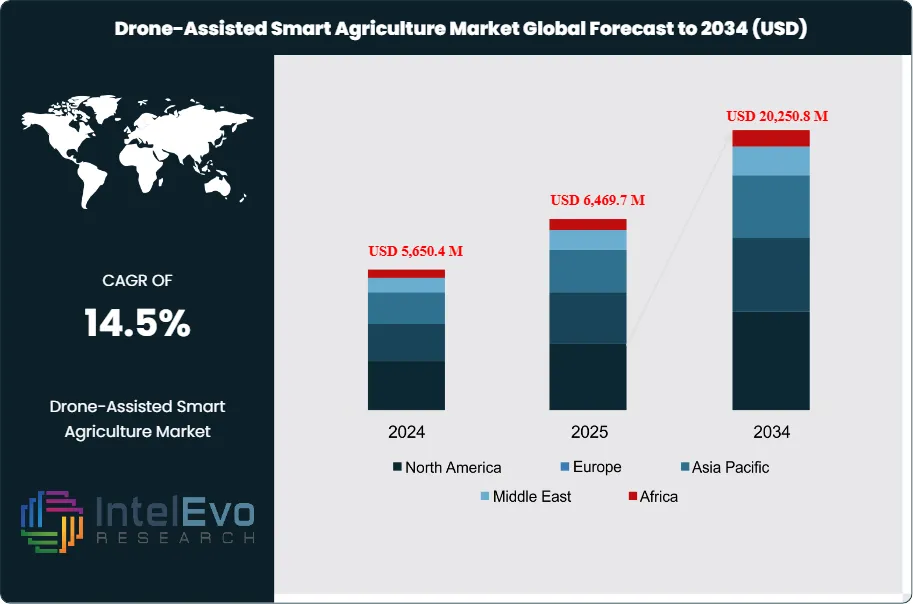
The Global Market for Smart Agriculture using Drones includes a variety of unmanned aerial vehicles used in farming to improve productivity, efficiency, and sustainability. Farmers use drones for tasks like monitoring crops, spraying pesticides accurately, and analyzing soil to help them make decisions based on data. The present market is marked by fast technological progress, like enhanced sensors and AI integration, making drone operations more efficient and attainable. With the rise of technology in agriculture, the need for drone-assisted solutions has increased, highlighting the benefits they bring in enhancing resource efficiency and boosting crop production.
The market's expansion is driven by various important factors, such as the rising use of precision farming methods to optimize agricultural production and reduce resource inefficiency. The demand for drone technology is driven by factors like the requirement for better crop health monitoring, pest control, and effective irrigation practices. Furthermore, the increasing attention on sustainable farming, driven by environmental issues and government benefits, has also boosted market expansion. Expectations point to increased market potential in the future due to investments in drone research and development, as well as the growth of service providers offering drone-related agricultural services. Moreover, the lower cost of drones and the accessibility of specialized software are set to draw in a wider variety of users.
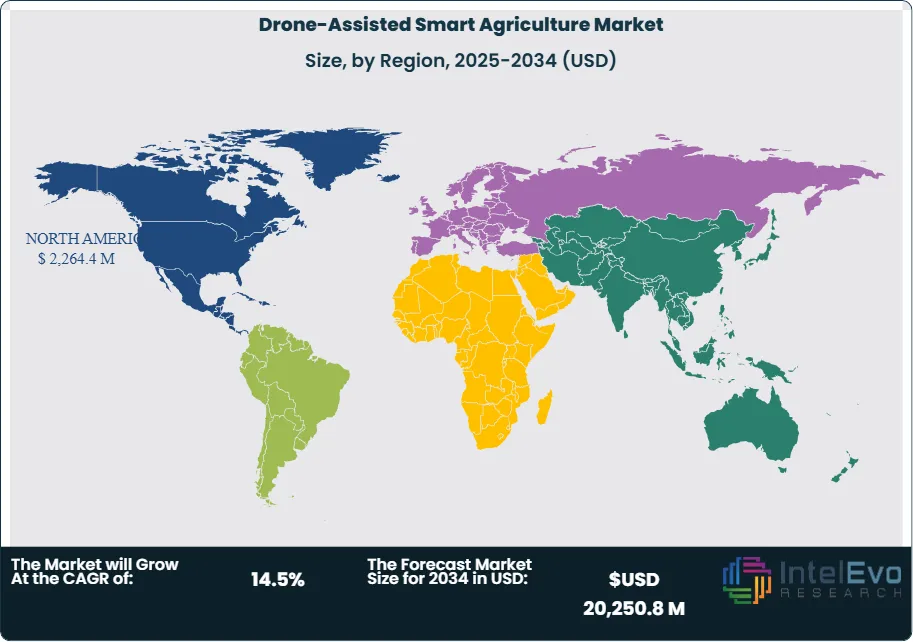
North America is the top in the drone-supported smart farming sector due to high-tech agricultural methods and substantial tech funding. The United States has seen widespread use of drones by farmers because of favorable regulations and a focus on innovation, in particular. Europe, including nations such as Germany and France, actively supports precision agriculture programs. At the same time, the Asia-Pacific area is expected to see rapid growth because of rising agricultural needs, especially in nations like China and India, where the use of technology in farming is increasing. This diversification in the region provides chances for market participants to enter developing markets.
The drone-assisted smart agriculture market has been significantly affected by the various aspects of the COVID-19 pandemic. Supply chain interruptions initially caused a lack of drones and related technologies, but the pandemic highlighted the need for effective agricultural practices to guarantee food security. Farmers are more and more using technology like drones to remotely monitor crops and reduce their reliance on labor. Furthermore, the pandemic expedited the acceptance of digital solutions in agriculture, leading to a continued transition towards automation and data-based farming methods. Therefore, the market is ready for strong recovery and expansion as stakeholders adopt new technologies in the post-pandemic environment.
Key Takeaways
Market Growth: The drone-assisted smart agriculture market is projected to reach USD 19,545.5 million by 2034, growing at a robust CAGR of 14.0%, indicating strong market expansion driven by technological advancements and increasing adoption among farmers.
Type Segment Analysis: Fixed-wing drones dominate the market due to their longer flight time and ability to cover larger areas efficiently. They are particularly useful for crop monitoring and mapping applications, enhancing operational efficiency in agriculture.
Application Segment Analysis: Crop monitoring holds the largest share within the application segment. Drones enable real-time monitoring of crop health, allowing farmers to make data-driven decisions and optimize resource allocation, significantly improving yield.
Driver: The increasing need for precision agriculture is a key driver for market growth, as farmers seek efficient solutions to enhance productivity and reduce resource waste, responding to rising food demand and environmental sustainability pressures.
Restraint: High initial investment costs and regulatory challenges in drone operations may hinder market growth. Farmers may be deterred by the financial barrier associated with adopting drone technology, especially in developing regions.
Opportunity: The rising trend of digital agriculture in emerging markets presents significant growth opportunities. As farmers adopt technology for improved crop management, the demand for drone services and solutions is expected to increase substantially.
Trend: Integration of AI and machine learning in drone technology is becoming prevalent, enhancing data analytics capabilities for better decision-making in agricultural practices.
Regional Analysis: North America is currently the leading region, driven by advanced agricultural practices and supportive regulations. However, Asia-Pacific is anticipated to witness the fastest growth, fueled by increasing agricultural demands and technology adoption in countries like China and India.
Type:
The smart agriculture market aided by drones is mainly divided into fixed-wing, rotary-wing, and hybrid drones. Fixed-wing drones are recognized for their extended flight durations and capability to efficiently cover vast areas, making them well-suited for activities like crop mapping and surveillance. They are usually utilized in bigger farms that require wide-ranging coverage. Quadcopters, also known as rotary-wing drones, provide increased agility and are ideal for tasks that demand accuracy, like precise crop spraying and targeted crop inspections. Hybrid drones mix attributes from both kinds, offering flexibility for different farming duties. The various requirements of the agricultural industry fuel the need for these distinct types of drones, each created to fulfill specific operational needs.
Application:
Drone technology in agriculture can be used for monitoring crops, spraying with precision, analyzing soil, monitoring livestock, and assessing crop health. Crop monitoring is a major use case, enabling farmers to collect up-to-date information on crop status, enabling prompt actions. Precision spraying improves the effectiveness of applying pesticides and fertilizers, decreasing both wastage and environmental harm. Examining soil with drones can assist in comprehending soil makeup and condition, leading to improved land management techniques. Livestock surveillance offers understanding of animal well-being and actions, allowing for improved herd overseeing. Every application highlights the usefulness of drones in enhancing operational efficiency and decision-making, ultimately boosting agricultural productivity.
Component:
The market is divided into segments based on elements such as hardware, software, and services. Hardware includes the drones themselves, along with a variety of sensors and imaging technologies that are necessary for agricultural activities. The software component consists of tools for analyzing and managing data gathered by drones, enabling farmers to make informed decisions through analytics. Services such as training, maintenance, and support are provided to help users effectively deploy and manage drone technologies in their agricultural practices. This part is important because it shows the comprehensive approach required to incorporate drones into current agricultural practices, highlighting the significance of both technology and service elements in order to achieve successful adoption.
Farm Size:
Farm size classification comprises of small-scale, medium-scale, and large-scale farms. Small farms with few resources are more and more using drones to improve efficiency and increase productivity. Medium-sized farms take advantage of drones to enhance crop management and monitoring efficiency. Big farms use drone technology extensively for thorough monitoring and management over wide areas, allowing accurate application of resources. With the changing landscape of agriculture, the use of drones differs depending on the size of the farm, aligning with the unique demands and capabilities of different farming activities. Drone solutions are versatile and can be used on farms of all sizes, leading to their widespread use in agriculture.
Region Analysis:
North America Leads With Significant Market Share in Drone-Assisted Smart Agriculture: North America holds the largest share of the drone-assisted smart agriculture market, accounting for approximately 35% of the total market. This dominance can be attributed to several factors, including advanced technological infrastructure, significant investments in agricultural R&D, and a strong emphasis on precision agriculture. The United States, in particular, is at the forefront of adopting drone technology for farming, leveraging its vast agricultural landscape and innovative farming techniques. The presence of major drone manufacturers and service providers further enhances the market landscape, driving competition and technological advancements. Additionally, supportive government regulations and initiatives aimed at promoting sustainable farming practices contribute to the region's market leadership, making it a key player in the global drone-assisted smart agriculture landscape.
Asia-Pacific is rapidly becoming the fastest-growing region in the drone-assisted smart agriculture market, with a projected growth rate exceeding 16% CAGR during the forecast period. This growth is fueled by increasing agricultural demands driven by population growth, the need for enhanced productivity, and the adoption of modern farming practices in countries like China and India. The region's diverse agricultural landscape offers significant opportunities for drone applications, ranging from crop monitoring to precision spraying. Moreover, the rise of digital agriculture initiatives and government support for technology adoption are key drivers behind this growth. In contrast, Europe and Latin America are witnessing steady growth, focusing on sustainable agriculture practices, while the Middle East and Africa are gradually adopting drone technology to address unique agricultural challenges and enhance food security in their respective regions.
Customization for segments, region/country-level will be provided. Moreover, additional customization can be done based on the requirements.
Pricing and Purchase Options
Avail customized purchase options to meet your exact research needs. We have three licenses to opt for: Single User License, Multi-User License (Up to 5 Users), Corporate Use License (Unlimited User and Printable PDF).
TABLE OF CONTENTS
1. EXECUTIVE SUMMARY
1.1. MARKET SNAPSHOT
1.2. KEY FINDINGS & INSIGHTS
1.3. ANALYST RECOMMENDATIONS
1.4. FUTURE OUTLOOK
2. RESEARCH METHODOLOGY
2.1. MARKET DEFINITION & SCOPE
2.2. RESEARCH OBJECTIVES: PRIMARY & SECONDARY DATA SOURCES
2.3. DATA COLLECTION SOURCES
2.3.1. COVERAGE OF 100+ PRIMARY RESEARCH/CONSULTATION CALLS WITH INDUSTRY STAKEHOLDERS
FIGURE 17 NORTH AMERICA DRONE-ASSISTED SMART AGRICULTURE CURRENT AND FUTURE TYPE ANALYSIS, 2025–2034, (USD MILLION)
FIGURE 18 NORTH AMERICA DRONE-ASSISTED SMART AGRICULTURE CURRENT AND FUTURE END USER ANALYSIS, 2025–2034, (USD MILLION)
FIGURE 19 MARKET SHARE BY COUNTRY
FIGURE 20 LATIN AMERICA DRONE-ASSISTED SMART AGRICULTURE CURRENT AND FUTURE TYPE ANALYSIS, 2025–2034, (USD MILLION)
FIGURE 21 LATIN AMERICA DRONE-ASSISTED SMART AGRICULTURE CURRENT AND FUTURE END USER ANALYSIS, 2025–2034, (USD MILLION)
FIGURE 22 MARKET SHARE BY COUNTRY
FIGURE 23 EASTERN EUROPE DRONE-ASSISTED SMART AGRICULTURE CURRENT AND FUTURE TYPE ANALYSIS, 2025–2034, (USD MILLION)
FIGURE 24 EASTERN EUROPE DRONE-ASSISTED SMART AGRICULTURE CURRENT AND FUTURE END USER ANALYSIS, 2025–2034, (USD MILLION)
FIGURE 25 MARKET SHARE BY COUNTRY
FIGURE 26 WESTERN EUROPE DRONE-ASSISTED SMART AGRICULTURE CURRENT AND FUTURE TYPE ANALYSIS, 2025–2034, (USD MILLION)
FIGURE 27 WESTERN EUROPE DRONE-ASSISTED SMART AGRICULTURE CURRENT AND FUTURE END USER ANALYSIS, 2025–2034, (USD MILLION)
FIGURE 28 MARKET SHARE BY COUNTRY
FIGURE 29 EAST ASIA AND PACIFIC DRONE-ASSISTED SMART AGRICULTURE CURRENT AND FUTURE TYPE ANALYSIS, 2025–2034, (USD MILLION)
FIGURE 30 EAST ASIA AND PACIFIC DRONE-ASSISTED SMART AGRICULTURE CURRENT AND FUTURE END USER ANALYSIS, 2025–2034, (USD MILLION)
FIGURE 31 MARKET SHARE BY COUNTRY
FIGURE 32 SEA AND SOUTH ASIA DRONE-ASSISTED SMART AGRICULTURE CURRENT AND FUTURE TYPE ANALYSIS, 2025–2034, (USD MILLION)
FIGURE 33 SEA AND SOUTH ASIA DRONE-ASSISTED SMART AGRICULTURE CURRENT AND FUTURE END USER ANALYSIS, 2025–2034, (USD MILLION)
FIGURE 34 MARKET SHARE BY COUNTRY
FIGURE 35 MIDDLE EAST AND AFRICA DRONE-ASSISTED SMART AGRICULTURE CURRENT AND FUTURE TYPE ANALYSIS, 2025–2034, (USD MILLION)
FIGURE 36 MIDDLE EAST AND AFRICA DRONE-ASSISTED SMART AGRICULTURE CURRENT AND FUTURE END USER ANALYSIS, 2025–2034, (USD MILLION)
FIGURE 37 NORTH AMERICA DRONE-ASSISTED SMART AGRICULTURE CURRENT AND FUTURE MARKET VOLUME SHARE REGIONAL ANALYSIS, 2025–2034, (USD MILLION)
FIGURE 38 U.S. DRONE-ASSISTED SMART AGRICULTURE CURRENT AND FUTURE TYPE ANALYSIS, 2025–2034, (USD MILLION)
FIGURE 39 U.S. DRONE-ASSISTED SMART AGRICULTURE CURRENT AND FUTURE END USER ANALYSIS, 2025–2034, (USD MILLION)
FIGURE 40 CANADA DRONE-ASSISTED SMART AGRICULTURE CURRENT AND FUTURE TYPE ANALYSIS, 2025–2034, (USD MILLION)
FIGURE 41 CANADA DRONE-ASSISTED SMART AGRICULTURE CURRENT AND FUTURE END USER ANALYSIS, 2025–2034, (USD MILLION)
FIGURE 42 LATIN AMERICA DRONE-ASSISTED SMART AGRICULTURE CURRENT AND FUTURE MARKET VOLUME SHARE REGIONAL ANALYSIS, 2025–2034, (USD MILLION)
FIGURE 43 MEXICO DRONE-ASSISTED SMART AGRICULTURE CURRENT AND FUTURE TYPE ANALYSIS, 2025–2034, (USD MILLION)
FIGURE 44 MEXICO DRONE-ASSISTED SMART AGRICULTURE CURRENT AND FUTURE END USER ANALYSIS, 2025–2034, (USD MILLION)
FIGURE 45 BRAZIL DRONE-ASSISTED SMART AGRICULTURE CURRENT AND FUTURE TYPE ANALYSIS, 2025–2034, (USD MILLION)
FIGURE 46 BRAZIL DRONE-ASSISTED SMART AGRICULTURE CURRENT AND FUTURE END USER ANALYSIS, 2025–2034, (USD MILLION)
FIGURE 47 ARGENTINA DRONE-ASSISTED SMART AGRICULTURE CURRENT AND FUTURE TYPE ANALYSIS, 2025–2034, (USD MILLION)
FIGURE 48 ARGENTINA DRONE-ASSISTED SMART AGRICULTURE CURRENT AND FUTURE END USER ANALYSIS, 2025–2034, (USD MILLION)
FIGURE 49 COLUMBIA DRONE-ASSISTED SMART AGRICULTURE CURRENT AND FUTURE TYPE ANALYSIS, 2025–2034, (USD MILLION)
FIGURE 50 COLUMBIA DRONE-ASSISTED SMART AGRICULTURE CURRENT AND FUTURE END USER ANALYSIS, 2025–2034, (USD MILLION)
FIGURE 51 REST OF LATIN AMERICA DRONE-ASSISTED SMART AGRICULTURE CURRENT AND FUTURE TYPE ANALYSIS, 2025–2034, (USD MILLION)
FIGURE 52 REST OF LATIN AMERICA DRONE-ASSISTED SMART AGRICULTURE CURRENT AND FUTURE END USER ANALYSIS, 2025–2034, (USD MILLION)
FIGURE 53 EASTERN EUROPE DRONE-ASSISTED SMART AGRICULTURE CURRENT AND FUTURE MARKET VOLUME SHARE REGIONAL ANALYSIS, 2025–2034, (USD MILLION)
FIGURE 54 POLAND DRONE-ASSISTED SMART AGRICULTURE CURRENT AND FUTURE TYPE ANALYSIS, 2025–2034, (USD MILLION)
FIGURE 55 POLAND DRONE-ASSISTED SMART AGRICULTURE CURRENT AND FUTURE END USER ANALYSIS, 2025–2034, (USD MILLION)
FIGURE 56 RUSSIA DRONE-ASSISTED SMART AGRICULTURE CURRENT AND FUTURE TYPE ANALYSIS, 2025–2034, (USD MILLION)
FIGURE 57 RUSSIA DRONE-ASSISTED SMART AGRICULTURE CURRENT AND FUTURE END USER ANALYSIS, 2025–2034, (USD MILLION)
FIGURE 58 CZECH REPUBLIC DRONE-ASSISTED SMART AGRICULTURE CURRENT AND FUTURE TYPE ANALYSIS, 2025–2034, (USD MILLION)
FIGURE 59 CZECH REPUBLIC DRONE-ASSISTED SMART AGRICULTURE CURRENT AND FUTURE END USER ANALYSIS, 2025–2034, (USD MILLION)
FIGURE 60 ROMANIA DRONE-ASSISTED SMART AGRICULTURE CURRENT AND FUTURE TYPE ANALYSIS, 2025–2034, (USD MILLION)
FIGURE 61 ROMANIA DRONE-ASSISTED SMART AGRICULTURE CURRENT AND FUTURE END USER ANALYSIS, 2025–2034, (USD MILLION)
FIGURE 62 REST OF EASTERN EUROPE DRONE-ASSISTED SMART AGRICULTURE CURRENT AND FUTURE TYPE ANALYSIS, 2025–2034, (USD MILLION)
FIGURE 63 REST OF EASTERN EUROPE DRONE-ASSISTED SMART AGRICULTURE CURRENT AND FUTURE END USER ANALYSIS, 2025–2034, (USD MILLION)
FIGURE 64 WESTERN EUROPE DRONE-ASSISTED SMART AGRICULTURE CURRENT AND FUTURE MARKET VOLUME SHARE REGIONAL ANALYSIS, 2025–2034, (USD MILLION)
FIGURE 65 GERMANY DRONE-ASSISTED SMART AGRICULTURE CURRENT AND FUTURE TYPE ANALYSIS, 2025–2034, (USD MILLION)
FIGURE 66 GERMANY DRONE-ASSISTED SMART AGRICULTURE CURRENT AND FUTURE END USER ANALYSIS, 2025–2034, (USD MILLION)
FIGURE 67 FRANCE DRONE-ASSISTED SMART AGRICULTURE CURRENT AND FUTURE TYPE ANALYSIS, 2025–2034, (USD MILLION)
FIGURE 68 FRANCE DRONE-ASSISTED SMART AGRICULTURE CURRENT AND FUTURE END USER ANALYSIS, 2025–2034, (USD MILLION)
FIGURE 69 UK DRONE-ASSISTED SMART AGRICULTURE CURRENT AND FUTURE TYPE ANALYSIS, 2025–2034, (USD MILLION)
FIGURE 70 UK DRONE-ASSISTED SMART AGRICULTURE CURRENT AND FUTURE END USER ANALYSIS, 2025–2034, (USD MILLION)
FIGURE 71 SPAIN DRONE-ASSISTED SMART AGRICULTURE CURRENT AND FUTURE TYPE ANALYSIS, 2025–2034, (USD MILLION)
FIGURE 72 SPAIN DRONE-ASSISTED SMART AGRICULTURE CURRENT AND FUTURE END USER ANALYSIS, 2025–2034, (USD MILLION)
FIGURE 73 ITALY DRONE-ASSISTED SMART AGRICULTURE CURRENT AND FUTURE TYPE ANALYSIS, 2025–2034, (USD MILLION)
FIGURE 74 ITALY DRONE-ASSISTED SMART AGRICULTURE CURRENT AND FUTURE END USER ANALYSIS, 2025–2034, (USD MILLION)
FIGURE 75 REST OF WESTERN EUROPE DRONE-ASSISTED SMART AGRICULTURE CURRENT AND FUTURE TYPE ANALYSIS, 2025–2034, (USD MILLION)
FIGURE 76 REST OF WESTERN EUROPE DRONE-ASSISTED SMART AGRICULTURE CURRENT AND FUTURE END USER ANALYSIS, 2025–2034, (USD MILLION)
FIGURE 77 EAST ASIA AND PACIFIC DRONE-ASSISTED SMART AGRICULTURE CURRENT AND FUTURE MARKET VOLUME SHARE REGIONAL ANALYSIS, 2025–2034, (USD MILLION)
FIGURE 78 CHINA DRONE-ASSISTED SMART AGRICULTURE CURRENT AND FUTURE TYPE ANALYSIS, 2025–2034, (USD MILLION)
FIGURE 79 CHINA DRONE-ASSISTED SMART AGRICULTURE CURRENT AND FUTURE END USER ANALYSIS, 2025–2034, (USD MILLION)
FIGURE 80 JAPAN DRONE-ASSISTED SMART AGRICULTURE CURRENT AND FUTURE TYPE ANALYSIS, 2025–2034, (USD MILLION)
FIGURE 81 JAPAN DRONE-ASSISTED SMART AGRICULTURE CURRENT AND FUTURE END USER ANALYSIS, 2025–2034, (USD MILLION)
FIGURE 82 AUSTRALIA DRONE-ASSISTED SMART AGRICULTURE CURRENT AND FUTURE TYPE ANALYSIS, 2025–2034, (USD MILLION)
FIGURE 83 AUSTRALIA DRONE-ASSISTED SMART AGRICULTURE CURRENT AND FUTURE END USER ANALYSIS, 2025–2034, (USD MILLION)
FIGURE 84 CAMBODIA DRONE-ASSISTED SMART AGRICULTURE CURRENT AND FUTURE TYPE ANALYSIS, 2025–2034, (USD MILLION)
FIGURE 85 CAMBODIA DRONE-ASSISTED SMART AGRICULTURE CURRENT AND FUTURE END USER ANALYSIS, 2025–2034, (USD MILLION)
FIGURE 86 FIJI DRONE-ASSISTED SMART AGRICULTURE CURRENT AND FUTURE TYPE ANALYSIS, 2025–2034, (USD MILLION)
FIGURE 87 FIJI DRONE-ASSISTED SMART AGRICULTURE CURRENT AND FUTURE END USER ANALYSIS, 2025–2034, (USD MILLION)
FIGURE 88 INDONESIA DRONE-ASSISTED SMART AGRICULTURE CURRENT AND FUTURE TYPE ANALYSIS, 2025–2034, (USD MILLION)
FIGURE 89 INDONESIA DRONE-ASSISTED SMART AGRICULTURE CURRENT AND FUTURE END USER ANALYSIS, 2025–2034, (USD MILLION)
FIGURE 90 SOUTH KOREA DRONE-ASSISTED SMART AGRICULTURE CURRENT AND FUTURE TYPE ANALYSIS, 2025–2034, (USD MILLION)
FIGURE 91 SOUTH KOREA DRONE-ASSISTED SMART AGRICULTURE CURRENT AND FUTURE END USER ANALYSIS, 2025–2034, (USD MILLION)
FIGURE 92 REST OF EAST ASIA AND PACIFIC DRONE-ASSISTED SMART AGRICULTURE CURRENT AND FUTURE TYPE ANALYSIS, 2025–2034, (USD MILLION)
FIGURE 93 REST OF EAST ASIA AND PACIFIC DRONE-ASSISTED SMART AGRICULTURE CURRENT AND FUTURE END USER ANALYSIS, 2025–2034, (USD MILLION)
FIGURE 94 SEA AND SOUTH ASIA DRONE-ASSISTED SMART AGRICULTURE CURRENT AND FUTURE MARKET VOLUME SHARE REGIONAL ANALYSIS, 2025–2034, (USD MILLION)
FIGURE 95 BANGLADESH DRONE-ASSISTED SMART AGRICULTURE CURRENT AND FUTURE TYPE ANALYSIS, 2025–2034, (USD MILLION)
FIGURE 96 BANGLADESH DRONE-ASSISTED SMART AGRICULTURE CURRENT AND FUTURE END USER ANALYSIS, 2025–2034, (USD MILLION)
FIGURE 97 NEW ZEALAND DRONE-ASSISTED SMART AGRICULTURE CURRENT AND FUTURE TYPE ANALYSIS, 2025–2034, (USD MILLION)
FIGURE 98 NEW ZEALAND DRONE-ASSISTED SMART AGRICULTURE CURRENT AND FUTURE END USER ANALYSIS, 2025–2034, (USD MILLION)
FIGURE 99 INDIA DRONE-ASSISTED SMART AGRICULTURE CURRENT AND FUTURE TYPE ANALYSIS, 2025–2034, (USD MILLION)
FIGURE 100 INDIA DRONE-ASSISTED SMART AGRICULTURE CURRENT AND FUTURE END USER ANALYSIS, 2025–2034, (USD MILLION)
FIGURE 101 SINGAPORE DRONE-ASSISTED SMART AGRICULTURE CURRENT AND FUTURE TYPE ANALYSIS, 2025–2034, (USD MILLION)
FIGURE 102 SINGAPORE DRONE-ASSISTED SMART AGRICULTURE CURRENT AND FUTURE END USER ANALYSIS, 2025–2034, (USD MILLION)
FIGURE 103 THAILAND DRONE-ASSISTED SMART AGRICULTURE CURRENT AND FUTURE TYPE ANALYSIS, 2025–2034, (USD MILLION)
FIGURE 104 THAILAND DRONE-ASSISTED SMART AGRICULTURE CURRENT AND FUTURE END USER ANALYSIS, 2025–2034, (USD MILLION)
FIGURE 105 TAIWAN DRONE-ASSISTED SMART AGRICULTURE CURRENT AND FUTURE TYPE ANALYSIS, 2025–2034, (USD MILLION)
FIGURE 106 TAIWAN DRONE-ASSISTED SMART AGRICULTURE CURRENT AND FUTURE END USER ANALYSIS, 2025–2034, (USD MILLION)
FIGURE 107 MALAYSIA DRONE-ASSISTED SMART AGRICULTURE CURRENT AND FUTURE TYPE ANALYSIS, 2025–2034, (USD MILLION)
FIGURE 108 MALAYSIA DRONE-ASSISTED SMART AGRICULTURE CURRENT AND FUTURE END USER ANALYSIS, 2025–2034, (USD MILLION)
FIGURE 109 REST OF SEA AND SOUTH ASIA DRONE-ASSISTED SMART AGRICULTURE CURRENT AND FUTURE TYPE ANALYSIS, 2025–2034, (USD MILLION)
FIGURE 110 REST OF SEA AND SOUTH ASIA DRONE-ASSISTED SMART AGRICULTURE CURRENT AND FUTURE END USER ANALYSIS, 2025–2034, (USD MILLION)
FIGURE 111 MIDDLE EAST AND AFRICA DRONE-ASSISTED SMART AGRICULTURE CURRENT AND FUTURE MARKET VOLUME SHARE REGIONAL ANALYSIS, 2025–2034, (USD MILLION)
FIGURE 112 GCC COUNTRIES DRONE-ASSISTED SMART AGRICULTURE CURRENT AND FUTURE TYPE ANALYSIS, 2025–2034, (USD MILLION)
FIGURE 113 GCC COUNTRIES DRONE-ASSISTED SMART AGRICULTURE CURRENT AND FUTURE END USER ANALYSIS, 2025–2034, (USD MILLION)
FIGURE 114 SAUDI ARABIA DRONE-ASSISTED SMART AGRICULTURE CURRENT AND FUTURE TYPE ANALYSIS, 2025–2034, (USD MILLION)
FIGURE 115 SAUDI ARABIA DRONE-ASSISTED SMART AGRICULTURE CURRENT AND FUTURE END USER ANALYSIS, 2025–2034, (USD MILLION)
FIGURE 116 UAE DRONE-ASSISTED SMART AGRICULTURE CURRENT AND FUTURE TYPE ANALYSIS, 2025–2034, (USD MILLION)
FIGURE 117 UAE DRONE-ASSISTED SMART AGRICULTURE CURRENT AND FUTURE END USER ANALYSIS, 2025–2034, (USD MILLION)
FIGURE 118 BAHRAIN DRONE-ASSISTED SMART AGRICULTURE CURRENT AND FUTURE TYPE ANALYSIS, 2025–2034, (USD MILLION)
FIGURE 119 BAHRAIN DRONE-ASSISTED SMART AGRICULTURE CURRENT AND FUTURE END USER ANALYSIS, 2025–2034, (USD MILLION)
FIGURE 120 KUWAIT DRONE-ASSISTED SMART AGRICULTURE CURRENT AND FUTURE TYPE ANALYSIS, 2025–2034, (USD MILLION)
FIGURE 121 KUWAIT DRONE-ASSISTED SMART AGRICULTURE CURRENT AND FUTURE END USER ANALYSIS, 2025–2034, (USD MILLION)
FIGURE 122 OMAN DRONE-ASSISTED SMART AGRICULTURE CURRENT AND FUTURE TYPE ANALYSIS, 2025–2034, (USD MILLION)
FIGURE 123 OMAN DRONE-ASSISTED SMART AGRICULTURE CURRENT AND FUTURE END USER ANALYSIS, 2025–2034, (USD MILLION)
FIGURE 124 QATAR DRONE-ASSISTED SMART AGRICULTURE CURRENT AND FUTURE TYPE ANALYSIS, 2025–2034, (USD MILLION)
FIGURE 125 QATAR DRONE-ASSISTED SMART AGRICULTURE CURRENT AND FUTURE END USER ANALYSIS, 2025–2034, (USD MILLION)
FIGURE 126 EGYPT DRONE-ASSISTED SMART AGRICULTURE CURRENT AND FUTURE TYPE ANALYSIS, 2025–2034, (USD MILLION)
FIGURE 127 EGYPT DRONE-ASSISTED SMART AGRICULTURE CURRENT AND FUTURE END USER ANALYSIS, 2025–2034, (USD MILLION)
FIGURE 128 NIGERIA DRONE-ASSISTED SMART AGRICULTURE CURRENT AND FUTURE TYPE ANALYSIS, 2025–2034, (USD MILLION)
FIGURE 129 NIGERIA DRONE-ASSISTED SMART AGRICULTURE CURRENT AND FUTURE END USER ANALYSIS, 2025–2034, (USD MILLION)
FIGURE 130 SOUTH AFRICA DRONE-ASSISTED SMART AGRICULTURE CURRENT AND FUTURE TYPE ANALYSIS, 2025–2034, (USD MILLION)
FIGURE 131 SOUTH AFRICA DRONE-ASSISTED SMART AGRICULTURE CURRENT AND FUTURE END USER ANALYSIS, 2025–2034, (USD MILLION)
FIGURE 132 ISRAEL DRONE-ASSISTED SMART AGRICULTURE CURRENT AND FUTURE TYPE ANALYSIS, 2025–2034, (USD MILLION)
FIGURE 133 ISRAEL DRONE-ASSISTED SMART AGRICULTURE CURRENT AND FUTURE END USER ANALYSIS, 2025–2034, (USD MILLION)
FIGURE 134 REST OF MEA DRONE-ASSISTED SMART AGRICULTURE CURRENT AND FUTURE TYPE ANALYSIS, 2025–2034, (USD MILLION)
FIGURE 135 REST OF MEA DRONE-ASSISTED SMART AGRICULTURE CURRENT AND FUTURE END USER ANALYSIS, 2025–2034, (USD MILLION)
FIGURE 136 U. S. MARKET SHARE ANALYSIS BY TYPE (2024)
FIGURE 137 U. S. MARKET SHARE ANALYSIS BY END USER (2024)
FIGURE 138 CANADA MARKET SHARE ANALYSIS BY TYPE (2024)
FIGURE 139 CANADA MARKET SHARE ANALYSIS BY END USER (2024)
FIGURE 140 MEXICO MARKET SHARE ANALYSIS BY TYPE (2024)
FIGURE 141 MEXICO MARKET SHARE ANALYSIS BY END USER (2024)
FIGURE 142 CHINA MARKET SHARE ANALYSIS BY TYPE (2024)
FIGURE 143 CHINA MARKET SHARE ANALYSIS BY END USER (2024)
FIGURE 144 JAPAN MARKET SHARE ANALYSIS BY TYPE (2024)
FIGURE 145 JAPAN MARKET SHARE ANALYSIS BY END USER (2024)
FIGURE 146 INDIA MARKET SHARE ANALYSIS BY TYPE (2024)
FIGURE 147 INDIA MARKET SHARE ANALYSIS BY END USER (2024)
FIGURE 148 SOUTH KOREA MARKET SHARE ANALYSIS BY TYPE (2024)
FIGURE 149 SOUTH KOREA MARKET SHARE ANALYSIS BY END USER (2024)
FIGURE 150 SAUDI ARABIA MARKET SHARE ANALYSIS BY TYPE (2024)
FIGURE 151 SAUDI ARABIA MARKET SHARE ANALYSIS BY END USER (2024)
FIGURE 152 UAE MARKET SHARE ANALYSIS BY TYPE (2024)
FIGURE 153 UAE MARKET SHARE ANALYSIS BY END USER (2024)
FIGURE 154 EGYPT MARKET SHARE ANALYSIS BY TYPE (2024)
FIGURE 155 EGYPT MARKET SHARE ANALYSIS BY END USER (2024)
FIGURE 156 NIGERIA MARKET SHARE ANALYSIS BY TYPE (2024)
FIGURE 157 NIGERIA MARKET SHARE ANALYSIS BY END USER (2024)
FIGURE 158 SOUTH AFRICA MARKET SHARE ANALYSIS BY TYPE (2024)
FIGURE 159 SOUTH AFRICA MARKET SHARE ANALYSIS BY END USER (2024)
FIGURE 160 GERMANY MARKET SHARE ANALYSIS BY TYPE (2024)
FIGURE 161 GERMANY MARKET SHARE ANALYSIS BY END USER (2024)
FIGURE 162 FRANCE MARKET SHARE ANALYSIS BY TYPE (2024)
FIGURE 163 FRANCE MARKET SHARE ANALYSIS BY END USER (2024)
FIGURE 164 UK MARKET SHARE ANALYSIS BY TYPE (2024)
FIGURE 165 UK MARKET SHARE ANALYSIS BY END USER (2024)
FIGURE 166 SPAIN MARKET SHARE ANALYSIS BY TYPE (2024)
FIGURE 167 SPAIN MARKET SHARE ANALYSIS BY END USER (2024)
FIGURE 168 ITALY MARKET SHARE ANALYSIS BY TYPE (2024)
FIGURE 169 ITALY MARKET SHARE ANALYSIS BY END USER (2024)
FIGURE 170 BRAZIL MARKET SHARE ANALYSIS BY TYPE (2024)
FIGURE 171 BRAZIL MARKET SHARE ANALYSIS BY END USER (2024)
FIGURE 172 ARGENTINA MARKET SHARE ANALYSIS BY TYPE (2024)
FIGURE 173 ARGENTINA MARKET SHARE ANALYSIS BY END USER (2024)
FIGURE 174 COLUMBIA MARKET SHARE ANALYSIS BY TYPE (2024)
FIGURE 175 COLUMBIA MARKET SHARE ANALYSIS BY END USER (2024)
FIGURE 176 GLOBAL DRONE-ASSISTED SMART AGRICULTURE CURRENT AND FUTURE MARKET KEY COUNTRY LEVEL ANALYSIS, 2024–2034, (USD MILLION)
FIGURE 177 FINANCIAL OVERVIEW:
Key Players Analysis:
Deere & Company: Deere is renowned for its agricultural machinery and has incorporated drone technology into its Precision Agriculture suite. Their products feature advanced tractors equipped with machine learning capabilities aimed at enhancing planting and harvesting efficiency. Deere focuses on leveraging data analytics and automation to improve crop yields and operational efficiency, with a strong presence in North America and Europe.
Trimble Inc.: Trimble specializes in precision farming solutions, offering GPS guidance and real-time data analytics. Their Trimble GFX-750 Display enhances farm management through automation and connectivity. The company's strategy revolves around integrating advanced technology across agriculture and construction sectors, maintaining a significant presence in North America and Europe.
Raven Industries: Raven is a leader in precision agriculture technology, providing field management systems and automated steering solutions. Their Raven Viper 4+ display enhances real-time field monitoring and data collection. The company aims to increase productivity and sustainability in farming, primarily operating in North America but targeting global markets for expansion.
Topcon Positioning Systems: Topcon delivers digital farming solutions, including GPS and data management tools. Their Topcon X25 Console improves precision farming capabilities and operational efficiency. The company focuses on enhancing agricultural productivity and expanding its global reach, particularly in North America and Asia.
Autonomous Solutions, Inc.: This Company specializes in developing autonomous vehicles for agriculture, such as driverless tractors and harvesters. Their AS-Cart product enhances operational efficiency and reduces labor costs. Autonomous Solutions aims to increase productivity through automation, primarily serving clients in North America and other global markets.
DeLaval Inc.: DeLaval provides advanced dairy farming solutions, including robotic milking systems. Their VMS V300 system optimizes milk production through automation, focusing on animal welfare and farm efficiency. DeLaval has a significant presence in Europe and North America, supporting dairy farmers with innovative technologies.
Farmers Edge Inc.: Farmers Edge offers precision agriculture solutions that integrate satellite imagery and IoT sensors. Their data management platform enhances decision-making related to crop yields. The company focuses on sustainability and productivity, primarily serving clients in North America and expanding into international markets.
BouMatic Robotic B.V.: BouMatic specializes in robotic milking systems designed to improve efficiency and animal welfare in dairy farming. Their Lely Astronaut A5 system is a key offering. BouMatic emphasizes innovation in dairy automation and operates mainly in Europe and North America.
AgJunction, Inc.: AgJunction provides precision agriculture technologies, including autopilot solutions and data management tools. Their DCM 600 communication module enhances connectivity in farming practices. The company targets optimizing farming operations through technological integration, primarily focusing on the North American market.
AGCO Corporation: AGCO offers a range of smart agriculture solutions, including the Fendt IDEAL Combine, which incorporates advanced automation for improved harvesting. Their strategy emphasizes innovation in machinery and data management to support modern farming practices, with a strong global presence.
Market Key Players
Deere & Company
Trimble Inc.
Raven Industries
Topcon Positioning Systems
Autonomous Solutions, Inc.
DeLaval Inc.
Farmers Edge Inc.
BouMatic Robotic B.V.
AgJunction, Inc.
AGCO Corporation
DroneDeploy
PrecisionHawk
Yamaha Motor Corporation
senseFly (Parrot Drones)
AeroVironment
Skycatch
Terra Drone Corporation
Pictometry International Corp.
Groupe ADP
DNV GL
Driver:
Increased Demand for Precision Agriculture
The growing need for precision agriculture is a significant driver of the drone-assisted smart agriculture market. Farmers are under pressure to improve crop yields and optimize resource usage amid rising food demand. Drones equipped with advanced sensors and imaging technology enable farmers to monitor crop health, assess soil conditions, and manage resources more efficiently. By providing real-time data, drones allow for timely interventions, reducing waste and enhancing productivity. This technology also supports sustainable farming practices by minimizing chemical inputs and improving water management. As more farmers recognize the benefits of data-driven decision-making, the adoption of drones in agriculture is expected to increase, driving market growth.
Technological Advancements in Drone Technology
Technological advancements in drone technology are propelling the growth of the drone-assisted smart agriculture market. Innovations in sensor technology, data analytics, and machine learning have significantly enhanced the capabilities of agricultural drones. Modern drones can now capture high-resolution images, perform multispectral analysis, and provide insights that were previously unattainable. This evolution enables farmers to make better-informed decisions regarding crop health, irrigation needs, and pest management. Furthermore, advancements in battery life and flight duration have improved the operational efficiency of drones, allowing them to cover larger areas without frequent recharging. As technology continues to advance, the agricultural sector is likely to see an increasing integration of drones, further driving market expansion.
Government Support and Regulatory Framework
Government support and favorable regulatory frameworks are crucial drivers of the drone-assisted smart agriculture market. Many governments are promoting the adoption of drone technology to enhance agricultural productivity and sustainability. Initiatives such as grants, subsidies, and training programs encourage farmers to integrate drones into their operations. Additionally, the establishment of clear regulatory guidelines for drone usage helps alleviate concerns related to safety and privacy, fostering a conducive environment for adoption. In countries like the United States and those in Europe, regulatory bodies are actively working to streamline the approval processes for agricultural drones, making it easier for farmers to leverage this technology. This supportive ecosystem is expected to boost market growth.
Restraints
High Initial Investment Costs
One of the significant restraints in the drone-assisted smart agriculture market is the high initial investment costs associated with purchasing and deploying drone technology. Although prices have decreased over time, high-quality agricultural drones, along with the necessary sensors and software, can still represent a substantial financial commitment for farmers, particularly those operating small to medium-sized farms. This cost barrier may deter many potential users from adopting drone technology, limiting the overall market growth. Additionally, ongoing maintenance and operational costs can further strain the budgets of farmers, particularly in regions with limited financial resources. Until more affordable options become widely available, high initial costs will continue to pose a challenge.
Regulatory Challenges and Operational Restrictions
Regulatory challenges and operational restrictions can hinder the growth of the drone-assisted smart agriculture market. Different countries and regions have varying regulations regarding drone usage, including restrictions on flight altitudes, no-fly zones, and licensing requirements. These regulations can complicate operations for farmers who wish to utilize drones for agricultural purposes. Furthermore, concerns over privacy and safety often lead to stringent regulations that may limit where and how drones can be deployed. As a result, farmers may face difficulties in fully integrating drone technology into their operations, which can stifle market growth. Addressing these regulatory barriers will be crucial for promoting widespread adoption.
Opportunities
Expansion of Drone Services and Solutions
The expansion of drone services and solutions presents a significant opportunity for growth in the drone-assisted smart agriculture market. As farmers increasingly recognize the benefits of drone technology, there is a growing demand for specialized services, including aerial imaging, crop mapping, and precision spraying. Companies that offer comprehensive drone services, along with data analytics and reporting, can tap into this burgeoning market. Furthermore, partnerships between drone manufacturers and agricultural service providers can enhance the adoption of drones in farming. This collaboration can lead to the development of tailored solutions that meet specific agricultural needs, driving both service adoption and overall market growth.
Integration of AI and Data Analytics
The integration of artificial intelligence (AI) and advanced data analytics into drone technology offers another promising opportunity for the market. As AI technologies evolve, they can significantly enhance the capabilities of drones, allowing for better data interpretation and decision-making in agriculture. Farmers can leverage AI algorithms to analyze crop health, predict yields, and optimize resource allocation based on real-time data. This level of precision can lead to improved crop management and reduced operational costs. As demand for smart farming solutions grows, companies that develop AI-integrated drone systems will likely see increased opportunities for growth and market penetration.
Trend
Rise of Autonomous Drones in Agriculture
A notable trend in the drone-assisted smart agriculture market is the rise of autonomous drones. These drones are equipped with advanced navigation systems and AI algorithms that allow them to operate without direct human control. They can perform various tasks such as crop monitoring, soil analysis, and spraying with minimal supervision. This autonomy not only increases operational efficiency but also reduces labor costs for farmers, making it a highly attractive option. As technology continues to advance, more farmers are expected to adopt autonomous drones, further driving innovation and growth within the agricultural sector. This trend reflects the broader move towards automation and smart technologies in agriculture, emphasizing efficiency and productivity.
Recent Development
In October 2024: XAG Co Ltd, a prominent agricultural drone manufacturer in China, unveiled a new range of smart agricultural products during its annual technology conference. This launch includes advanced drones like the P150 and P60, which feature significant upgrades in autonomous driving and structural design. These innovations aim to enhance operational efficiency and reduce costs for farmers, addressing challenges such as labor shortages in agriculture. The P150 drone, for example, boasts a maximum payload of 70 kg and is designed for versatile applications including spraying and sowing
In September 2024: DJI, a major player in the drone market, launched a new crop-spraying drone aimed at enhancing precision agriculture. This drone features advanced sensors and AI technology, allowing for more efficient pesticide application. The introduction of such technology reflects an ongoing trend of integrating AI with drone capabilities to optimize agricultural practices and increase yields.
