
The Global Edge Computing in Autonomous Vehicles Market is projected to reach USD 5,295.6 Million by 2034, up from USD 445.7 Million in 2024, growing at a CAGR of 28.4% during the forecast period from 2024 to 2034. The growth is driven by the increasing adoption of autonomous vehicles, demand for real-time data processing, and low-latency AI analytics at the network edge. Edge computing enables faster decision-making, enhanced vehicle safety, and efficient traffic management, positioning it as a crucial technology for the future of smart mobility worldwide.
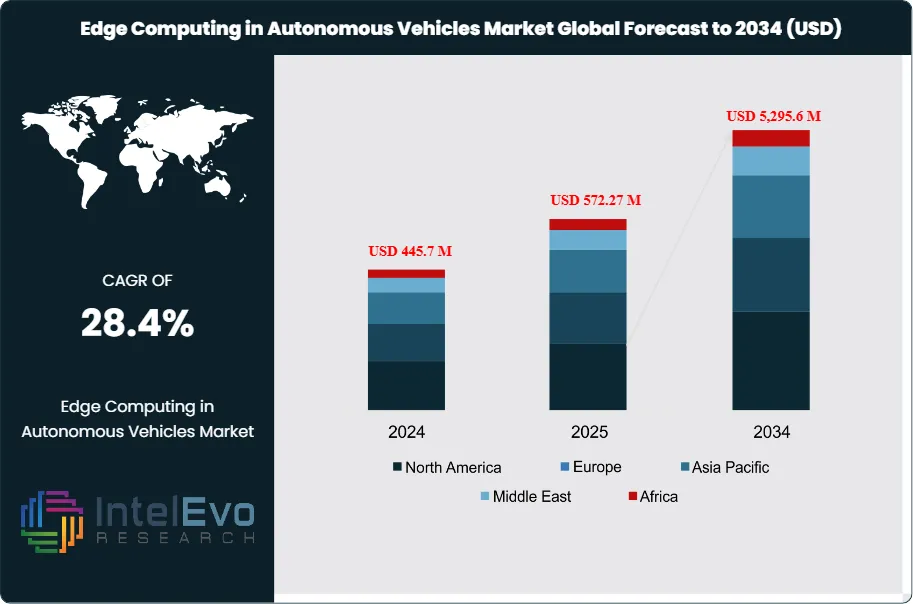
The Edge Computing in Autonomous Vehicles Market comprises technologies that facilitate real-time data processing and analysis in autonomous vehicles. By analyzing data from onboard sensors and external sources, these solutions help to improve vehicle safety and operational efficiency, enabling quicker decision-making. By 2024, the market is expected to reach a value of around USD 432.94 million. The present environment is defined by fast technological progress, regulatory backing for self-driving projects, and an increasing incorporation of IoT gadgets, all contributing to market expansion.
There are various essential growth factors impacting the Market for Edge Computing in Autonomous Vehicles. The growing need for self-driving technology comes from urban growth, environmental worries, and a worldwide drive for more intelligent transportation networks. The growth is greatly attributed to the emergence of 5G technology, which enables quicker and more dependable communication between vehicles and edge servers, crucial for making real-time decisions. Moreover, by integrating artificial intelligence and machine learning into edge computing systems, automotive manufacturers can improve their data analysis abilities, giving them a competitive edge. Consequently, it is forecasted that the market will experience a compound annual growth rate (CAGR) of 28% between 2024 and 2034.
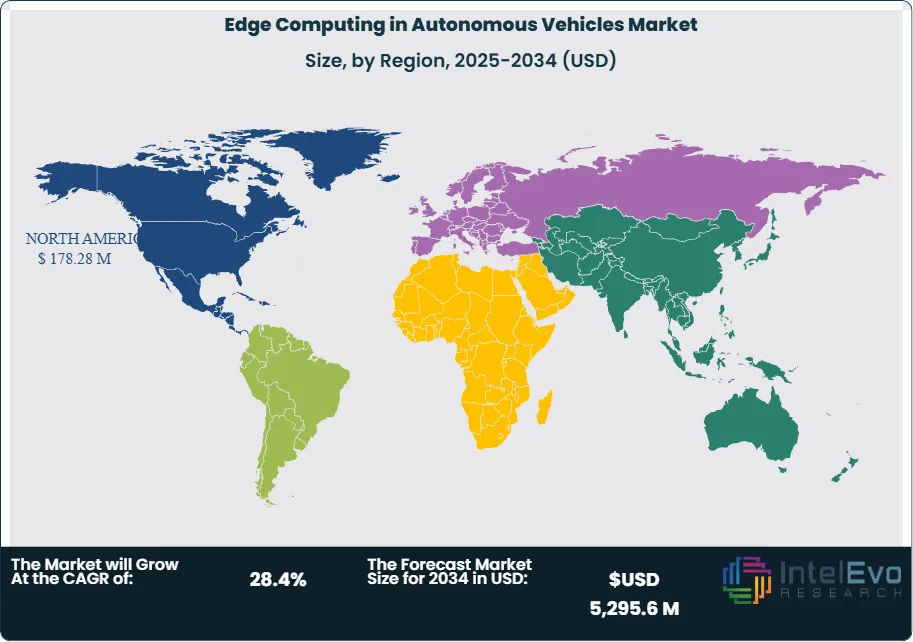
North America is expected to lead the Edge Computing in Autonomous Vehicles Market due to a strong automotive sector, significant investments in autonomous technologies, and the existence of major technology companies. The United States is especially dedicated to the advancement of vehicle-to-everything (V2X) communication systems, crucial for autonomous vehicle functionality. At the same time, the Asia-Pacific region is projected to experience the most rapid expansion, driven by fast urbanization, growing investments in smart city projects, and a thriving automotive industry, particularly in nations such as China and Japan.
The Edge Computing in Autonomous Vehicles Market has been greatly affected by the COVID-19 pandemic. At first, it caused interruptions in supply chains and postponed project schedules because of lockdown restrictions. Nevertheless, the pandemic sped up the integration of digital technologies such as edge computing, as businesses aimed to enhance operational efficiencies and adjust to new obstacles. The rise in remote work and telecommuting has led to a higher need for improved connectivity and data processing abilities, highlighting the significance of edge computing in the automotive sector.
Key Takeaways
Market Growth: The Edge Computing in Autonomous Vehicles Market is expected to reach USD 5,295.6 million by 2034, growing at a robust CAGR of 28.4%, indicating strong market expansion driven by technological advancements and increasing demand for autonomous vehicles.
Component Analysis: The hardware segment is anticipated to dominate the market due to the growing need for robust processing units and storage devices that facilitate real-time data handling and enhance overall vehicle performance.
Application Analysis: Vehicle-to-Everything (V2X) communication is poised to be a key application area, enabling seamless interaction between vehicles and infrastructure, which is crucial for improving traffic management and ensuring safety in autonomous driving.
Driver: The rising demand for smart transportation solutions and the proliferation of autonomous vehicle technologies are driving market growth. These advancements enhance operational efficiency and safety, making edge computing indispensable for real-time data processing.
Restraint: The high costs associated with implementing edge computing infrastructure may limit market accessibility for smaller players. Additionally, concerns regarding data privacy and security can hinder adoption, especially in sensitive applications like autonomous driving.
Opportunity: The integration of artificial intelligence and machine learning with edge computing presents significant growth opportunities. Companies can leverage these technologies to improve data analytics and operational efficiencies in autonomous vehicles.
Trend: Increasing investments in smart city initiatives and advancements in 5G technology are driving trends in edge computing, enhancing connectivity and data processing capabilities for autonomous vehicles.
Regional Analysis: North America is expected to hold the largest market share, driven by substantial investments in autonomous technologies and the presence of leading automotive and technology firms. The Asia-Pacific region is also emerging rapidly due to urbanization and increased automotive demand.
Component
The Edge Computing in Autonomous Vehicles Market is segmented into three primary components: hardware, software, and services. The hardware segment includes processing units, storage devices, and networking equipment, which are essential for real-time data handling and connectivity. As autonomous vehicles rely heavily on data for navigation and decision-making, high-performance hardware is crucial. The software segment encompasses the platforms and applications that facilitate data analysis, management, and communication between various vehicle systems. Finally, the services segment includes installation, maintenance, and consulting services, which support the integration of edge computing technologies into existing vehicle architectures. This multi-faceted approach ensures that all aspects of edge computing are addressed, driving market growth and innovation.
Application
Edge computing applications in autonomous vehicles include autonomous driving, ADAS (Advanced Driver Assistance Systems), fleet management, traffic monitoring, and infotainment systems. Autonomous driving uses on-board processing for instant decision-making and safe navigation. ADAS systems utilize edge-based AI for avoiding collisions, detecting lanes, and enabling emergency braking. Fleet management and traffic monitoring depend on off-board edge processing for real-time analytics and predictive insights, improving efficiency and reducing congestion. Infotainment systems combine hybrid edge computing to offer personalized, fast experiences for passengers. The rising demand for safety, efficiency, and data-driven vehicle operations is driving the broad use of edge computing applications throughout the autonomous vehicle ecosystem.
Edge Computing Type
The Edge Computing segment in autonomous vehicles is mainly divided into On-Board, Off-Board, and Hybrid Edge Computing. On-Board Edge Computing means processing data locally within the vehicle. This allows for real-time decision-making for important functions like collision avoidance, ADAS, and autonomous navigation. Off-Board Edge Computing uses external edge servers or cloud resources to manage extensive data analytics, monitor traffic, and handle fleet management tasks. The Hybrid Edge Computing model merges both on-board and off-board capabilities. This ensures low-latency processing while also taking advantage of scalable computing power for complex AI and machine learning algorithms. The growing use of connected vehicles and the need for better safety, efficiency, and real-time insights are fueling growth in all types of edge computing in autonomous mobility.
Vehicle Type
The autonomous vehicle market that uses edge computing is divided into passenger vehicles, commercial vehicles, and specialty vehicles. Passenger vehicles use edge computing to improve real-time safety systems, navigation, and infotainment, creating smooth autonomous driving experiences. Commercial vehicles, like trucks and buses, gain from edge-enabled fleet management, predictive maintenance, and route optimization, boosting operational efficiency and cutting downtime. Specialty vehicles, such as delivery robots and industrial machines, depend on edge computing for precise task execution, sensor integration, and awareness of their surroundings. The increasing use of autonomous mobility solutions across all vehicle types, along with the demand for quick decision-making and better AI-driven analytics, is driving market growth worldwide.
End-user
The end-user segment of the Edge Computing in Autonomous Vehicles Market includes automotive manufacturers, technology providers, and fleet operators. Automotive manufacturers are the primary drivers of market growth, as they seek to integrate edge computing technologies into their vehicles to enhance safety and performance. Technology providers develop the necessary hardware and software solutions that enable effective data processing and communication. Fleet operators utilize edge computing to optimize their operations, improve vehicle maintenance, and enhance route planning. By addressing the specific needs of these end users, the market can facilitate advancements in autonomous vehicle technologies, leading to safer and more efficient transportation solutions.
Region Analysis
North America Leads With 40% Market Share in Edge Computing in Autonomous Vehicles Market: North America is the leading region in the Edge Computing in Autonomous Vehicles Market, commanding approximately 40% of the global market share. Several factors contribute to this dominance, including the presence of major automotive manufacturers and technology firms that are actively investing in autonomous vehicle technologies. The region has a well-established infrastructure for testing and deploying advanced automotive solutions, bolstered by significant governmental support for research and development in smart transportation. Additionally, the rapid adoption of connected vehicles and IoT technologies enhances the need for edge computing, which facilitates real-time data processing and communication. This focus on innovation and safety, combined with a consumer base that is increasingly receptive to autonomous driving technologies, positions North America as a robust market leader.
Asia-Pacific is recognized as the fastest-growing region in the Edge Computing in Autonomous Vehicles Market, with a projected growth rate of over 30% during the forecast period. This growth is driven by rapid urbanization and increasing automotive production, particularly in countries like China, Japan, and India. The rising demand for smart city initiatives and advancements in 5G technology are also significant contributors, as they facilitate the deployment of connected vehicle technologies. Furthermore, government initiatives aimed at promoting electric and autonomous vehicles are creating a conducive environment for edge computing solutions. Meanwhile, Europe maintains a strong market presence due to stringent regulations on vehicle safety and emissions, supporting the growth of edge computing applications. Latin America and the Middle East & Africa are gradually catching up, focusing on enhancing transportation systems and infrastructure to accommodate the evolving demands of autonomous vehicles.
By Vehicle Type (Passenger Vehicles, Commercial Vehicles, Specialty Vehicles), By Edge Computing Type (On-Board Edge Computing, Off-Board Edge Computing, Hybrid Edge Computing), By Component (Hardware (Sensors, Processors, GPUs), Software (AI & Analytics Platforms, Middleware), Services (Deployment, Maintenance, Support)), By End-user (Automotive Manufacturers, Technology Providers, Fleet Operators), By Application (Autonomous Driving, ADAS (Advanced Driver Assistance Systems), Fleet Management & Telematics, Traffic & Road Safety Monitoring, Infotainment Systems)
Research Methodology
Primary Research- 100 Interviews of Stakeholders
Secondary Research
Desk Research
Regional scope
North America (United States, Canada, Mexico)
Latin America (Brazil, Argentina, Columbia)
East Asia And Pacific (China, Japan, South Korea, Australia, Cambodia, Fiji, Indonesia)
Sea And South Asia (India, Singapore, Thailand, Taiwan, Malaysia)
Eastern Europe (Poland, Russia, Czech Republic, Romania)
Western Europe (Germany, U.K., France, Spain, Itlay)
Middle East & Africa (GCC Countries, Egypt, Nigeria, South Africa, Israel)
Competitive Landscape
NVIDIA, Waymo, Motional, Aurora Innovation, Embark Trucks, Cavnue, Nauto, WeRide, Toyota, Magna International, Intel, Tesla, Bosch, Qualcomm, IBM, Microsoft, Amazon Web Services (AWS), Pivotal, HPE (Hewlett Packard Enterprise), IBM Watson
Customization Scope
Customization for segments, region/country-level will be provided. Moreover, additional customization can be done based on the requirements.
Pricing and Purchase Options
Avail customized purchase options to meet your exact research needs. We have three licenses to opt for: Single User License, Multi-User License (Up to 5 Users), Corporate Use License (Unlimited User and Printable PDF).
TABLE OF CONTENTS
1. EXECUTIVE SUMMARY
1.1. MARKET SNAPSHOT
1.2. KEY FINDINGS & INSIGHTS
1.3. ANALYST RECOMMENDATIONS
1.4. FUTURE OUTLOOK
2. RESEARCH METHODOLOGY
2.1. MARKET DEFINITION & SCOPE
2.2. RESEARCH OBJECTIVES: PRIMARY & SECONDARY DATA SOURCES
2.3. DATA COLLECTION SOURCES
2.3.1. COVERAGE OF 100+ PRIMARY RESEARCH/CONSULTATION CALLS WITH INDUSTRY STAKEHOLDERS
FIGURE 17 NORTH AMERICA EDGE COMPUTING IN AUTONOMOUS VEHICLES CURRENT AND FUTURE TYPE ANALYSIS, 2025–2034, (USD MILLION)
FIGURE 18 NORTH AMERICA EDGE COMPUTING IN AUTONOMOUS VEHICLES CURRENT AND FUTURE END USER ANALYSIS, 2025–2034, (USD MILLION)
FIGURE 19 MARKET SHARE BY COUNTRY
FIGURE 20 LATIN AMERICA EDGE COMPUTING IN AUTONOMOUS VEHICLES CURRENT AND FUTURE TYPE ANALYSIS, 2025–2034, (USD MILLION)
FIGURE 21 LATIN AMERICA EDGE COMPUTING IN AUTONOMOUS VEHICLES CURRENT AND FUTURE END USER ANALYSIS, 2025–2034, (USD MILLION)
FIGURE 22 MARKET SHARE BY COUNTRY
FIGURE 23 EASTERN EUROPE EDGE COMPUTING IN AUTONOMOUS VEHICLES CURRENT AND FUTURE TYPE ANALYSIS, 2025–2034, (USD MILLION)
FIGURE 24 EASTERN EUROPE EDGE COMPUTING IN AUTONOMOUS VEHICLES CURRENT AND FUTURE END USER ANALYSIS, 2025–2034, (USD MILLION)
FIGURE 25 MARKET SHARE BY COUNTRY
FIGURE 26 WESTERN EUROPE EDGE COMPUTING IN AUTONOMOUS VEHICLES CURRENT AND FUTURE TYPE ANALYSIS, 2025–2034, (USD MILLION)
FIGURE 27 WESTERN EUROPE EDGE COMPUTING IN AUTONOMOUS VEHICLES CURRENT AND FUTURE END USER ANALYSIS, 2025–2034, (USD MILLION)
FIGURE 28 MARKET SHARE BY COUNTRY
FIGURE 29 EAST ASIA AND PACIFIC EDGE COMPUTING IN AUTONOMOUS VEHICLES CURRENT AND FUTURE TYPE ANALYSIS, 2025–2034, (USD MILLION)
FIGURE 30 EAST ASIA AND PACIFIC EDGE COMPUTING IN AUTONOMOUS VEHICLES CURRENT AND FUTURE END USER ANALYSIS, 2025–2034, (USD MILLION)
FIGURE 31 MARKET SHARE BY COUNTRY
FIGURE 32 SEA AND SOUTH ASIA EDGE COMPUTING IN AUTONOMOUS VEHICLES CURRENT AND FUTURE TYPE ANALYSIS, 2025–2034, (USD MILLION)
FIGURE 33 SEA AND SOUTH ASIA EDGE COMPUTING IN AUTONOMOUS VEHICLES CURRENT AND FUTURE END USER ANALYSIS, 2025–2034, (USD MILLION)
FIGURE 34 MARKET SHARE BY COUNTRY
FIGURE 35 MIDDLE EAST AND AFRICA EDGE COMPUTING IN AUTONOMOUS VEHICLES CURRENT AND FUTURE TYPE ANALYSIS, 2025–2034, (USD MILLION)
FIGURE 36 MIDDLE EAST AND AFRICA EDGE COMPUTING IN AUTONOMOUS VEHICLES CURRENT AND FUTURE END USER ANALYSIS, 2025–2034, (USD MILLION)
FIGURE 37 NORTH AMERICA EDGE COMPUTING IN AUTONOMOUS VEHICLES CURRENT AND FUTURE MARKET VOLUME SHARE REGIONAL ANALYSIS, 2025–2034, (USD MILLION)
FIGURE 38 U.S. EDGE COMPUTING IN AUTONOMOUS VEHICLES CURRENT AND FUTURE TYPE ANALYSIS, 2025–2034, (USD MILLION)
FIGURE 39 U.S. EDGE COMPUTING IN AUTONOMOUS VEHICLES CURRENT AND FUTURE END USER ANALYSIS, 2025–2034, (USD MILLION)
FIGURE 40 CANADA EDGE COMPUTING IN AUTONOMOUS VEHICLES CURRENT AND FUTURE TYPE ANALYSIS, 2025–2034, (USD MILLION)
FIGURE 41 CANADA EDGE COMPUTING IN AUTONOMOUS VEHICLES CURRENT AND FUTURE END USER ANALYSIS, 2025–2034, (USD MILLION)
FIGURE 42 LATIN AMERICA EDGE COMPUTING IN AUTONOMOUS VEHICLES CURRENT AND FUTURE MARKET VOLUME SHARE REGIONAL ANALYSIS, 2025–2034, (USD MILLION)
FIGURE 43 MEXICO EDGE COMPUTING IN AUTONOMOUS VEHICLES CURRENT AND FUTURE TYPE ANALYSIS, 2025–2034, (USD MILLION)
FIGURE 44 MEXICO EDGE COMPUTING IN AUTONOMOUS VEHICLES CURRENT AND FUTURE END USER ANALYSIS, 2025–2034, (USD MILLION)
FIGURE 45 BRAZIL EDGE COMPUTING IN AUTONOMOUS VEHICLES CURRENT AND FUTURE TYPE ANALYSIS, 2025–2034, (USD MILLION)
FIGURE 46 BRAZIL EDGE COMPUTING IN AUTONOMOUS VEHICLES CURRENT AND FUTURE END USER ANALYSIS, 2025–2034, (USD MILLION)
FIGURE 47 ARGENTINA EDGE COMPUTING IN AUTONOMOUS VEHICLES CURRENT AND FUTURE TYPE ANALYSIS, 2025–2034, (USD MILLION)
FIGURE 48 ARGENTINA EDGE COMPUTING IN AUTONOMOUS VEHICLES CURRENT AND FUTURE END USER ANALYSIS, 2025–2034, (USD MILLION)
FIGURE 49 COLUMBIA EDGE COMPUTING IN AUTONOMOUS VEHICLES CURRENT AND FUTURE TYPE ANALYSIS, 2025–2034, (USD MILLION)
FIGURE 50 COLUMBIA EDGE COMPUTING IN AUTONOMOUS VEHICLES CURRENT AND FUTURE END USER ANALYSIS, 2025–2034, (USD MILLION)
FIGURE 51 REST OF LATIN AMERICA EDGE COMPUTING IN AUTONOMOUS VEHICLES CURRENT AND FUTURE TYPE ANALYSIS, 2025–2034, (USD MILLION)
FIGURE 52 REST OF LATIN AMERICA EDGE COMPUTING IN AUTONOMOUS VEHICLES CURRENT AND FUTURE END USER ANALYSIS, 2025–2034, (USD MILLION)
FIGURE 53 EASTERN EUROPE EDGE COMPUTING IN AUTONOMOUS VEHICLES CURRENT AND FUTURE MARKET VOLUME SHARE REGIONAL ANALYSIS, 2025–2034, (USD MILLION)
FIGURE 54 POLAND EDGE COMPUTING IN AUTONOMOUS VEHICLES CURRENT AND FUTURE TYPE ANALYSIS, 2025–2034, (USD MILLION)
FIGURE 55 POLAND EDGE COMPUTING IN AUTONOMOUS VEHICLES CURRENT AND FUTURE END USER ANALYSIS, 2025–2034, (USD MILLION)
FIGURE 56 RUSSIA EDGE COMPUTING IN AUTONOMOUS VEHICLES CURRENT AND FUTURE TYPE ANALYSIS, 2025–2034, (USD MILLION)
FIGURE 57 RUSSIA EDGE COMPUTING IN AUTONOMOUS VEHICLES CURRENT AND FUTURE END USER ANALYSIS, 2025–2034, (USD MILLION)
FIGURE 58 CZECH REPUBLIC EDGE COMPUTING IN AUTONOMOUS VEHICLES CURRENT AND FUTURE TYPE ANALYSIS, 2025–2034, (USD MILLION)
FIGURE 59 CZECH REPUBLIC EDGE COMPUTING IN AUTONOMOUS VEHICLES CURRENT AND FUTURE END USER ANALYSIS, 2025–2034, (USD MILLION)
FIGURE 60 ROMANIA EDGE COMPUTING IN AUTONOMOUS VEHICLES CURRENT AND FUTURE TYPE ANALYSIS, 2025–2034, (USD MILLION)
FIGURE 61 ROMANIA EDGE COMPUTING IN AUTONOMOUS VEHICLES CURRENT AND FUTURE END USER ANALYSIS, 2025–2034, (USD MILLION)
FIGURE 62 REST OF EASTERN EUROPE EDGE COMPUTING IN AUTONOMOUS VEHICLES CURRENT AND FUTURE TYPE ANALYSIS, 2025–2034, (USD MILLION)
FIGURE 63 REST OF EASTERN EUROPE EDGE COMPUTING IN AUTONOMOUS VEHICLES CURRENT AND FUTURE END USER ANALYSIS, 2025–2034, (USD MILLION)
FIGURE 64 WESTERN EUROPE EDGE COMPUTING IN AUTONOMOUS VEHICLES CURRENT AND FUTURE MARKET VOLUME SHARE REGIONAL ANALYSIS, 2025–2034, (USD MILLION)
FIGURE 65 GERMANY EDGE COMPUTING IN AUTONOMOUS VEHICLES CURRENT AND FUTURE TYPE ANALYSIS, 2025–2034, (USD MILLION)
FIGURE 66 GERMANY EDGE COMPUTING IN AUTONOMOUS VEHICLES CURRENT AND FUTURE END USER ANALYSIS, 2025–2034, (USD MILLION)
FIGURE 67 FRANCE EDGE COMPUTING IN AUTONOMOUS VEHICLES CURRENT AND FUTURE TYPE ANALYSIS, 2025–2034, (USD MILLION)
FIGURE 68 FRANCE EDGE COMPUTING IN AUTONOMOUS VEHICLES CURRENT AND FUTURE END USER ANALYSIS, 2025–2034, (USD MILLION)
FIGURE 69 UK EDGE COMPUTING IN AUTONOMOUS VEHICLES CURRENT AND FUTURE TYPE ANALYSIS, 2025–2034, (USD MILLION)
FIGURE 70 UK EDGE COMPUTING IN AUTONOMOUS VEHICLES CURRENT AND FUTURE END USER ANALYSIS, 2025–2034, (USD MILLION)
FIGURE 71 SPAIN EDGE COMPUTING IN AUTONOMOUS VEHICLES CURRENT AND FUTURE TYPE ANALYSIS, 2025–2034, (USD MILLION)
FIGURE 72 SPAIN EDGE COMPUTING IN AUTONOMOUS VEHICLES CURRENT AND FUTURE END USER ANALYSIS, 2025–2034, (USD MILLION)
FIGURE 73 ITALY EDGE COMPUTING IN AUTONOMOUS VEHICLES CURRENT AND FUTURE TYPE ANALYSIS, 2025–2034, (USD MILLION)
FIGURE 74 ITALY EDGE COMPUTING IN AUTONOMOUS VEHICLES CURRENT AND FUTURE END USER ANALYSIS, 2025–2034, (USD MILLION)
FIGURE 75 REST OF WESTERN EUROPE EDGE COMPUTING IN AUTONOMOUS VEHICLES CURRENT AND FUTURE TYPE ANALYSIS, 2025–2034, (USD MILLION)
FIGURE 76 REST OF WESTERN EUROPE EDGE COMPUTING IN AUTONOMOUS VEHICLES CURRENT AND FUTURE END USER ANALYSIS, 2025–2034, (USD MILLION)
FIGURE 77 EAST ASIA AND PACIFIC EDGE COMPUTING IN AUTONOMOUS VEHICLES CURRENT AND FUTURE MARKET VOLUME SHARE REGIONAL ANALYSIS, 2025–2034, (USD MILLION)
FIGURE 78 CHINA EDGE COMPUTING IN AUTONOMOUS VEHICLES CURRENT AND FUTURE TYPE ANALYSIS, 2025–2034, (USD MILLION)
FIGURE 79 CHINA EDGE COMPUTING IN AUTONOMOUS VEHICLES CURRENT AND FUTURE END USER ANALYSIS, 2025–2034, (USD MILLION)
FIGURE 80 JAPAN EDGE COMPUTING IN AUTONOMOUS VEHICLES CURRENT AND FUTURE TYPE ANALYSIS, 2025–2034, (USD MILLION)
FIGURE 81 JAPAN EDGE COMPUTING IN AUTONOMOUS VEHICLES CURRENT AND FUTURE END USER ANALYSIS, 2025–2034, (USD MILLION)
FIGURE 82 AUSTRALIA EDGE COMPUTING IN AUTONOMOUS VEHICLES CURRENT AND FUTURE TYPE ANALYSIS, 2025–2034, (USD MILLION)
FIGURE 83 AUSTRALIA EDGE COMPUTING IN AUTONOMOUS VEHICLES CURRENT AND FUTURE END USER ANALYSIS, 2025–2034, (USD MILLION)
FIGURE 84 CAMBODIA EDGE COMPUTING IN AUTONOMOUS VEHICLES CURRENT AND FUTURE TYPE ANALYSIS, 2025–2034, (USD MILLION)
FIGURE 85 CAMBODIA EDGE COMPUTING IN AUTONOMOUS VEHICLES CURRENT AND FUTURE END USER ANALYSIS, 2025–2034, (USD MILLION)
FIGURE 86 FIJI EDGE COMPUTING IN AUTONOMOUS VEHICLES CURRENT AND FUTURE TYPE ANALYSIS, 2025–2034, (USD MILLION)
FIGURE 87 FIJI EDGE COMPUTING IN AUTONOMOUS VEHICLES CURRENT AND FUTURE END USER ANALYSIS, 2025–2034, (USD MILLION)
FIGURE 88 INDONESIA EDGE COMPUTING IN AUTONOMOUS VEHICLES CURRENT AND FUTURE TYPE ANALYSIS, 2025–2034, (USD MILLION)
FIGURE 89 INDONESIA EDGE COMPUTING IN AUTONOMOUS VEHICLES CURRENT AND FUTURE END USER ANALYSIS, 2025–2034, (USD MILLION)
FIGURE 90 SOUTH KOREA EDGE COMPUTING IN AUTONOMOUS VEHICLES CURRENT AND FUTURE TYPE ANALYSIS, 2025–2034, (USD MILLION)
FIGURE 91 SOUTH KOREA EDGE COMPUTING IN AUTONOMOUS VEHICLES CURRENT AND FUTURE END USER ANALYSIS, 2025–2034, (USD MILLION)
FIGURE 92 REST OF EAST ASIA AND PACIFIC EDGE COMPUTING IN AUTONOMOUS VEHICLES CURRENT AND FUTURE TYPE ANALYSIS, 2025–2034, (USD MILLION)
FIGURE 93 REST OF EAST ASIA AND PACIFIC EDGE COMPUTING IN AUTONOMOUS VEHICLES CURRENT AND FUTURE END USER ANALYSIS, 2025–2034, (USD MILLION)
FIGURE 94 SEA AND SOUTH ASIA EDGE COMPUTING IN AUTONOMOUS VEHICLES CURRENT AND FUTURE MARKET VOLUME SHARE REGIONAL ANALYSIS, 2025–2034, (USD MILLION)
FIGURE 95 BANGLADESH EDGE COMPUTING IN AUTONOMOUS VEHICLES CURRENT AND FUTURE TYPE ANALYSIS, 2025–2034, (USD MILLION)
FIGURE 96 BANGLADESH EDGE COMPUTING IN AUTONOMOUS VEHICLES CURRENT AND FUTURE END USER ANALYSIS, 2025–2034, (USD MILLION)
FIGURE 97 NEW ZEALAND EDGE COMPUTING IN AUTONOMOUS VEHICLES CURRENT AND FUTURE TYPE ANALYSIS, 2025–2034, (USD MILLION)
FIGURE 98 NEW ZEALAND EDGE COMPUTING IN AUTONOMOUS VEHICLES CURRENT AND FUTURE END USER ANALYSIS, 2025–2034, (USD MILLION)
FIGURE 99 INDIA EDGE COMPUTING IN AUTONOMOUS VEHICLES CURRENT AND FUTURE TYPE ANALYSIS, 2025–2034, (USD MILLION)
FIGURE 100 INDIA EDGE COMPUTING IN AUTONOMOUS VEHICLES CURRENT AND FUTURE END USER ANALYSIS, 2025–2034, (USD MILLION)
FIGURE 101 SINGAPORE EDGE COMPUTING IN AUTONOMOUS VEHICLES CURRENT AND FUTURE TYPE ANALYSIS, 2025–2034, (USD MILLION)
FIGURE 102 SINGAPORE EDGE COMPUTING IN AUTONOMOUS VEHICLES CURRENT AND FUTURE END USER ANALYSIS, 2025–2034, (USD MILLION)
FIGURE 103 THAILAND EDGE COMPUTING IN AUTONOMOUS VEHICLES CURRENT AND FUTURE TYPE ANALYSIS, 2025–2034, (USD MILLION)
FIGURE 104 THAILAND EDGE COMPUTING IN AUTONOMOUS VEHICLES CURRENT AND FUTURE END USER ANALYSIS, 2025–2034, (USD MILLION)
FIGURE 105 TAIWAN EDGE COMPUTING IN AUTONOMOUS VEHICLES CURRENT AND FUTURE TYPE ANALYSIS, 2025–2034, (USD MILLION)
FIGURE 106 TAIWAN EDGE COMPUTING IN AUTONOMOUS VEHICLES CURRENT AND FUTURE END USER ANALYSIS, 2025–2034, (USD MILLION)
FIGURE 107 MALAYSIA EDGE COMPUTING IN AUTONOMOUS VEHICLES CURRENT AND FUTURE TYPE ANALYSIS, 2025–2034, (USD MILLION)
FIGURE 108 MALAYSIA EDGE COMPUTING IN AUTONOMOUS VEHICLES CURRENT AND FUTURE END USER ANALYSIS, 2025–2034, (USD MILLION)
FIGURE 109 REST OF SEA AND SOUTH ASIA EDGE COMPUTING IN AUTONOMOUS VEHICLES CURRENT AND FUTURE TYPE ANALYSIS, 2025–2034, (USD MILLION)
FIGURE 110 REST OF SEA AND SOUTH ASIA EDGE COMPUTING IN AUTONOMOUS VEHICLES CURRENT AND FUTURE END USER ANALYSIS, 2025–2034, (USD MILLION)
FIGURE 111 MIDDLE EAST AND AFRICA EDGE COMPUTING IN AUTONOMOUS VEHICLES CURRENT AND FUTURE MARKET VOLUME SHARE REGIONAL ANALYSIS, 2025–2034, (USD MILLION)
FIGURE 112 GCC COUNTRIES EDGE COMPUTING IN AUTONOMOUS VEHICLES CURRENT AND FUTURE TYPE ANALYSIS, 2025–2034, (USD MILLION)
FIGURE 113 GCC COUNTRIES EDGE COMPUTING IN AUTONOMOUS VEHICLES CURRENT AND FUTURE END USER ANALYSIS, 2025–2034, (USD MILLION)
FIGURE 114 SAUDI ARABIA EDGE COMPUTING IN AUTONOMOUS VEHICLES CURRENT AND FUTURE TYPE ANALYSIS, 2025–2034, (USD MILLION)
FIGURE 115 SAUDI ARABIA EDGE COMPUTING IN AUTONOMOUS VEHICLES CURRENT AND FUTURE END USER ANALYSIS, 2025–2034, (USD MILLION)
FIGURE 116 UAE EDGE COMPUTING IN AUTONOMOUS VEHICLES CURRENT AND FUTURE TYPE ANALYSIS, 2025–2034, (USD MILLION)
FIGURE 117 UAE EDGE COMPUTING IN AUTONOMOUS VEHICLES CURRENT AND FUTURE END USER ANALYSIS, 2025–2034, (USD MILLION)
FIGURE 118 BAHRAIN EDGE COMPUTING IN AUTONOMOUS VEHICLES CURRENT AND FUTURE TYPE ANALYSIS, 2025–2034, (USD MILLION)
FIGURE 119 BAHRAIN EDGE COMPUTING IN AUTONOMOUS VEHICLES CURRENT AND FUTURE END USER ANALYSIS, 2025–2034, (USD MILLION)
FIGURE 120 KUWAIT EDGE COMPUTING IN AUTONOMOUS VEHICLES CURRENT AND FUTURE TYPE ANALYSIS, 2025–2034, (USD MILLION)
FIGURE 121 KUWAIT EDGE COMPUTING IN AUTONOMOUS VEHICLES CURRENT AND FUTURE END USER ANALYSIS, 2025–2034, (USD MILLION)
FIGURE 122 OMAN EDGE COMPUTING IN AUTONOMOUS VEHICLES CURRENT AND FUTURE TYPE ANALYSIS, 2025–2034, (USD MILLION)
FIGURE 123 OMAN EDGE COMPUTING IN AUTONOMOUS VEHICLES CURRENT AND FUTURE END USER ANALYSIS, 2025–2034, (USD MILLION)
FIGURE 124 QATAR EDGE COMPUTING IN AUTONOMOUS VEHICLES CURRENT AND FUTURE TYPE ANALYSIS, 2025–2034, (USD MILLION)
FIGURE 125 QATAR EDGE COMPUTING IN AUTONOMOUS VEHICLES CURRENT AND FUTURE END USER ANALYSIS, 2025–2034, (USD MILLION)
FIGURE 126 EGYPT EDGE COMPUTING IN AUTONOMOUS VEHICLES CURRENT AND FUTURE TYPE ANALYSIS, 2025–2034, (USD MILLION)
FIGURE 127 EGYPT EDGE COMPUTING IN AUTONOMOUS VEHICLES CURRENT AND FUTURE END USER ANALYSIS, 2025–2034, (USD MILLION)
FIGURE 128 NIGERIA EDGE COMPUTING IN AUTONOMOUS VEHICLES CURRENT AND FUTURE TYPE ANALYSIS, 2025–2034, (USD MILLION)
FIGURE 129 NIGERIA EDGE COMPUTING IN AUTONOMOUS VEHICLES CURRENT AND FUTURE END USER ANALYSIS, 2025–2034, (USD MILLION)
FIGURE 130 SOUTH AFRICA EDGE COMPUTING IN AUTONOMOUS VEHICLES CURRENT AND FUTURE TYPE ANALYSIS, 2025–2034, (USD MILLION)
FIGURE 131 SOUTH AFRICA EDGE COMPUTING IN AUTONOMOUS VEHICLES CURRENT AND FUTURE END USER ANALYSIS, 2025–2034, (USD MILLION)
FIGURE 132 ISRAEL EDGE COMPUTING IN AUTONOMOUS VEHICLES CURRENT AND FUTURE TYPE ANALYSIS, 2025–2034, (USD MILLION)
FIGURE 133 ISRAEL EDGE COMPUTING IN AUTONOMOUS VEHICLES CURRENT AND FUTURE END USER ANALYSIS, 2025–2034, (USD MILLION)
FIGURE 134 REST OF MEA EDGE COMPUTING IN AUTONOMOUS VEHICLES CURRENT AND FUTURE TYPE ANALYSIS, 2025–2034, (USD MILLION)
FIGURE 135 REST OF MEA EDGE COMPUTING IN AUTONOMOUS VEHICLES CURRENT AND FUTURE END USER ANALYSIS, 2025–2034, (USD MILLION)
FIGURE 136 U. S. MARKET SHARE ANALYSIS BY TYPE (2024)
FIGURE 137 U. S. MARKET SHARE ANALYSIS BY END USER (2024)
FIGURE 138 CANADA MARKET SHARE ANALYSIS BY TYPE (2024)
FIGURE 139 CANADA MARKET SHARE ANALYSIS BY END USER (2024)
FIGURE 140 MEXICO MARKET SHARE ANALYSIS BY TYPE (2024)
FIGURE 141 MEXICO MARKET SHARE ANALYSIS BY END USER (2024)
FIGURE 142 CHINA MARKET SHARE ANALYSIS BY TYPE (2024)
FIGURE 143 CHINA MARKET SHARE ANALYSIS BY END USER (2024)
FIGURE 144 JAPAN MARKET SHARE ANALYSIS BY TYPE (2024)
FIGURE 145 JAPAN MARKET SHARE ANALYSIS BY END USER (2024)
FIGURE 146 INDIA MARKET SHARE ANALYSIS BY TYPE (2024)
FIGURE 147 INDIA MARKET SHARE ANALYSIS BY END USER (2024)
FIGURE 148 SOUTH KOREA MARKET SHARE ANALYSIS BY TYPE (2024)
FIGURE 149 SOUTH KOREA MARKET SHARE ANALYSIS BY END USER (2024)
FIGURE 150 SAUDI ARABIA MARKET SHARE ANALYSIS BY TYPE (2024)
FIGURE 151 SAUDI ARABIA MARKET SHARE ANALYSIS BY END USER (2024)
FIGURE 152 UAE MARKET SHARE ANALYSIS BY TYPE (2024)
FIGURE 153 UAE MARKET SHARE ANALYSIS BY END USER (2024)
FIGURE 154 EGYPT MARKET SHARE ANALYSIS BY TYPE (2024)
FIGURE 155 EGYPT MARKET SHARE ANALYSIS BY END USER (2024)
FIGURE 156 NIGERIA MARKET SHARE ANALYSIS BY TYPE (2024)
FIGURE 157 NIGERIA MARKET SHARE ANALYSIS BY END USER (2024)
FIGURE 158 SOUTH AFRICA MARKET SHARE ANALYSIS BY TYPE (2024)
FIGURE 159 SOUTH AFRICA MARKET SHARE ANALYSIS BY END USER (2024)
FIGURE 160 GERMANY MARKET SHARE ANALYSIS BY TYPE (2024)
FIGURE 161 GERMANY MARKET SHARE ANALYSIS BY END USER (2024)
FIGURE 162 FRANCE MARKET SHARE ANALYSIS BY TYPE (2024)
FIGURE 163 FRANCE MARKET SHARE ANALYSIS BY END USER (2024)
FIGURE 164 UK MARKET SHARE ANALYSIS BY TYPE (2024)
FIGURE 165 UK MARKET SHARE ANALYSIS BY END USER (2024)
FIGURE 166 SPAIN MARKET SHARE ANALYSIS BY TYPE (2024)
FIGURE 167 SPAIN MARKET SHARE ANALYSIS BY END USER (2024)
FIGURE 168 ITALY MARKET SHARE ANALYSIS BY TYPE (2024)
FIGURE 169 ITALY MARKET SHARE ANALYSIS BY END USER (2024)
FIGURE 170 BRAZIL MARKET SHARE ANALYSIS BY TYPE (2024)
FIGURE 171 BRAZIL MARKET SHARE ANALYSIS BY END USER (2024)
FIGURE 172 ARGENTINA MARKET SHARE ANALYSIS BY TYPE (2024)
FIGURE 173 ARGENTINA MARKET SHARE ANALYSIS BY END USER (2024)
FIGURE 174 COLUMBIA MARKET SHARE ANALYSIS BY TYPE (2024)
FIGURE 175 COLUMBIA MARKET SHARE ANALYSIS BY END USER (2024)
FIGURE 176 GLOBAL EDGE COMPUTING IN AUTONOMOUS VEHICLES CURRENT AND FUTURE MARKET KEY COUNTRY LEVEL ANALYSIS, 2024–2034, (USD MILLION)
FIGURE 177 FINANCIAL OVERVIEW:
Key Players Analysis:
NVIDIA: Based in Santa Clara, California, NVIDIA is renowned for its powerful GPU technologies and the NVIDIA DRIVE platform, designed for autonomous vehicles. This platform allows for real-time data processing and AI training, making it a cornerstone for developers in self-driving technology. NVIDIA's strategy focuses on partnerships with OEMs and tech firms to create a comprehensive ecosystem for autonomous vehicle development.
Motional: Located in Santa Monica, California, Motional develops advanced autonomous vehicles equipped with lidar and multi-sensor systems for comprehensive situational awareness. Their collaboration with rideshare companies like Uber and Lyft aims to revolutionize ride-hailing through driverless technology. Motional's strategy is centered on leveraging partnerships to expedite the deployment of autonomous taxis.
Waymo: A subsidiary of Alphabet Inc., Waymo is headquartered in Mountain View, California. It specializes in developing fully autonomous vehicles, focusing on passenger and goods transportation. Waymo’s strategic partnerships with automotive manufacturers and tech companies enable it to expand its self-driving technology across various applications and markets.
Aurora Innovation: Based in San Francisco, California, Aurora focuses on creating the Aurora Driver, a platform for various vehicles, including passenger cars and commercial trucks. Their strategy emphasizes strategic partnerships with leading automotive and technology companies, allowing for collaborative development and deployment of self-driving technologies.
Embark Trucks: Headquartered in San Francisco, Embark is dedicated to autonomous truck transportation. Their proprietary technology, the Embark Driver, utilizes advanced mapping and sensor integration for safe logistics. Embark's strategy revolves around developing partnerships with major trucking companies to streamline the adoption of their technology in the logistics sector.
Cavnue: Operating from Arlington, Virginia, Cavnue is pioneering infrastructure for connected and automated vehicles. The company is notably working on projects like the Michigan Project to create smart road systems. Cavnue’s strategy focuses on collaboration with state departments and industry partners to develop ecosystems that facilitate automated vehicle deployment.
Nauto: Based in Palo Alto, California, Nauto leverages AI for fleet safety and driver behavior optimization. They offer a suite of products, including an AI dash cam and a fleet safety platform. Nauto's business strategy is to partner with vehicle manufacturers and fleet operators to enhance safety and efficiency through their technology.
WeRide: Located in San Jose, California, WeRide develops self-driving technology across various vehicle types, including robotaxis and robobuses. Their platform utilizes deep learning algorithms for real-time decision-making. WeRide’s strategy focuses on expanding its fleet and partnerships to enhance the accessibility of autonomous transport.
Toyota: With a significant presence in the automotive industry, Toyota's Woven Planet subsidiary is dedicated to advancing autonomous driving technology. They employ AI and machine learning to enhance their driver assistance systems. Toyota's strategy emphasizes innovation through research and collaboration within the automotive ecosystem.
Magna International: Located in Troy, Michigan, Magna provides advanced driver-assistance systems (ADAS) that integrate seamlessly into various vehicles. Their strategy focuses on modular solutions that can be adapted without redesigning the vehicle, allowing for broader adoption of safety technologies across different car models.
Market Key Players
NVIDIA Corporation
Intel Corporation
Qualcomm Technologies, Inc.
Aptiv PLC
Continental AG
Bosch Mobility Solutions
Renesas Electronics Corporation
Ambarella, Inc.
NXP Semiconductors
Mobileye (Intel Company)
Hitachi Automotive Systems
EdgeConneX Inc.
Baidu, Inc.
Autotalks Ltd.
HARMAN International
Waymo
Motional
Aurora Innovation
Embark Trucks
Cavnue
Nauto
WeRide
Toyota
Magna International
Tesla
IBM
Microsoft
Amazon Web Services (AWS)
Pivotal
HPE (Hewlett Packard Enterprise)
Driver
Increasing Demand for Real-Time Data Processing
As autonomous vehicles become more prevalent, the need for real-time data processing is intensifying. Edge computing facilitates rapid data analysis by processing information closer to the source, reducing latency significantly. This capability is crucial for the effective functioning of autonomous systems that rely on data from various sensors, cameras, and GPS devices. Real-time insights enable vehicles to make immediate decisions based on their environment, enhancing safety and operational efficiency. Additionally, the integration of edge computing allows for better vehicle-to-everything (V2X) communication, enabling autonomous vehicles to interact seamlessly with infrastructure and other vehicles. As the automotive industry continues to innovate, the push for advanced technologies that ensure safety and performance is driving growth in the edge computing market.
Growth in Smart City Initiatives
The rise of smart city initiatives worldwide is another significant driver of the Edge Computing in Autonomous Vehicles Market. Governments are investing heavily in infrastructure to create intelligent transportation systems that improve traffic management and enhance urban mobility. Edge computing plays a vital role in these initiatives by facilitating the exchange of data between vehicles and city infrastructure, such as traffic lights and surveillance systems. This connectivity not only optimizes traffic flow but also contributes to reducing congestion and emissions in urban areas. As cities embrace digital transformation and implement technologies like IoT, the demand for edge computing solutions to support autonomous vehicles and smart city applications is expected to grow, fostering market expansion.
Technological Advancements in Autonomous Vehicles
Rapid technological advancements in autonomous vehicle capabilities are significantly driving the demand for edge computing solutions. Innovations in artificial intelligence, machine learning, and sensor technologies enable vehicles to process complex datasets efficiently and make informed decisions in real time. The increasing complexity of autonomous systems necessitates robust data processing capabilities to ensure safety and reliability. Furthermore, advancements in 5G technology are enhancing connectivity, enabling faster data transmission and facilitating more sophisticated edge computing applications. As manufacturers continue to develop higher levels of automation, including Level 4 and Level 5 autonomous vehicles, the reliance on edge computing for data processing, analysis, and decision-making will become increasingly critical, thereby driving market growth.
Restraints
High Implementation Costs
One of the primary restraints hindering the growth of the Edge Computing in Autonomous Vehicles Market is the high implementation costs associated with deploying edge computing technologies. Integrating edge computing systems requires significant investment in advanced hardware, software, and network infrastructure. For many automotive manufacturers and technology providers, the capital expenditure for such systems can be substantial, particularly for small to medium-sized enterprises. Additionally, the ongoing maintenance and upgrading of edge infrastructure can further strain budgets. This financial barrier may lead to slower adoption rates, especially in regions with less established automotive industries or limited access to funding for technological advancements. As a result, the overall growth of the market may be impeded by these cost-related challenges.
Data Security Concerns
Data security and privacy concerns pose another significant restraint in the Edge Computing in Autonomous Vehicles Market. Autonomous vehicles generate and process vast amounts of sensitive data, including location information and user preferences. Ensuring the security of this data against cyber threats is crucial, as any breach could compromise vehicle safety and user privacy. The decentralized nature of edge computing can also make it more challenging to implement comprehensive security measures compared to centralized systems. As the industry grapples with the need to protect data while providing real-time insights, regulatory frameworks and standards will need to evolve to address these concerns. This heightened focus on data security could slow down the adoption of edge computing solutions in autonomous vehicles.
Opportunities
Expansion of Electric and Autonomous Vehicles
The growing trend toward electric and autonomous vehicles presents significant opportunities for edge computing solutions. As the automotive industry increasingly shifts towards sustainability, the demand for electric vehicles (EVs) is on the rise, and many manufacturers are integrating autonomous features into these vehicles. Edge computing can enhance the performance and efficiency of EVs by enabling real-time data processing for battery management, navigation, and vehicle control systems. This synergy between electric and autonomous technologies creates a ripe environment for edge computing applications, driving innovation and market growth. Furthermore, as more consumers adopt EVs, the infrastructure supporting them—such as charging stations and smart grids—will also benefit from edge computing solutions, fostering overall industry expansion.
Collaborations and Partnerships
Strategic collaborations and partnerships among automotive manufacturers, technology providers, and telecommunications companies represent another growth opportunity in the Edge Computing in Autonomous Vehicles Market. By working together, stakeholders can leverage each other's strengths to develop innovative solutions that enhance the capabilities of autonomous vehicles. For instance, partnerships between automakers and tech firms can result in advanced edge computing platforms that integrate seamlessly with vehicle systems. Similarly, collaborations with telecom providers can enhance connectivity through 5G networks, facilitating faster data processing and communication. Such alliances not only accelerate the development and deployment of edge computing technologies but also create new revenue streams and market opportunities for all involved parties, driving overall market growth.
Trend
Increased Adoption of 5G Technology
A prominent trend shaping the Edge Computing in Autonomous Vehicles Market is the increased adoption of 5G technology. The rollout of 5G networks is significantly enhancing the connectivity and speed of data transmission between vehicles and their environments. This advancement is critical for the effective functioning of autonomous vehicles, which rely on real-time data for navigation and safety. 5G technology reduces latency, allowing for immediate data processing and decision-making at the edge. Furthermore, it supports the proliferation of connected vehicles, enabling seamless communication with infrastructure and other road users. As 5G becomes more widespread, the synergy between edge computing and next-generation connectivity will drive innovation and growth in the autonomous vehicle sector, further solidifying edge computing's role in this evolving landscape.
Recent Development
In October 2024: Zella DC has unveiled the Zella Outback, an innovative outdoor micro data center designed to enhance edge computing capabilities. This new product is tailored for various environments and emphasizes sustainability while providing efficient local data processing and storage solutions. The introduction of the Zella Outback represents Zella DC's commitment to addressing the growing demand for flexible and reliable edge computing infrastructure.
In September 2024: Researchers at Yokohama National University have successfully developed a prototype spin-wave reservoir chip, which they believe could revolutionize edge computing technology. This chip aims to facilitate advanced applications such as biomedical imaging and autonomous vehicles by enabling efficient real-time data processing. The project's ultimate goal is to implement this technology into devices for broader use.
