
Global EdTech Regulatory Compliance Market Size, Share & Strategic Growth Outlook – By Component (Solutions, Services), By Solution Type (LMS Compliance Tools, Data Privacy & Protection Software, Accessibility Management Platforms, Cybersecurity Compliance Systems), By Deployment Mode (Cloud-Based, On-Premises), By End User (K-12, Higher Education, Corporate Institutions), By Region, Industry Trends, Competitive Landscape & Forecast 2025–2034
The Global EdTech Regulatory Compliance Market was valued at approximately USD 4.7 billion in 2024 and is projected to reach nearly USD 17.7 billion by 2034, driven by increasing data privacy mandates, cross-border education regulations, and the growing adoption of digital learning platforms. Based on the established growth trajectory, the market size for 2025 is estimated at approximately USD 5.37 billion. From 2026 onward, the market is expected to expand at a compound annual growth rate (CAGR) of approximately 14.2% during 2026–2034, ultimately reaching around USD 17.7 billion by 2034.
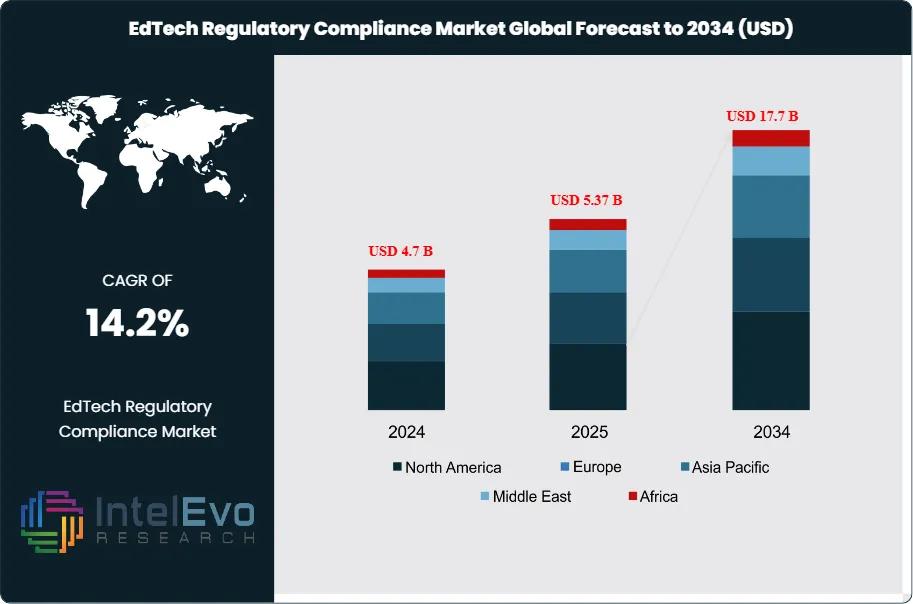
Rapid digitalization of learning environments, expanding data footprints, and tighter oversight of online education models drive sustained demand for compliance solutions and services across K–12, higher education, and lifelong learning segments.
EdTech regulatory compliance spans data protection, child privacy, content governance, accessibility, and consumer safeguards. Education providers and technology vendors increasingly depend on specialized consulting, audits, and software platforms to interpret complex rules, monitor adherence, and document controls in real time. As global EdTech spending is projected to rise from about USD 220.5 billion in 2023 to more than USD 810 billion by 2033, compliance budgets scale in parallel as institutions embed risk management into digital learning strategies.
Demand-side momentum strengthens as stakeholders react to misuse of student data and opaque subscription practices. A recent survey indicates that roughly two-thirds of respondents believe EdTech platforms require formal regulation, while over 90% endorse structured codes of conduct for pricing and service terms. These views translate into reputational and regulatory risk for non-compliant providers, pushing boards and investors to prioritize governance, transparency, and independent verification of compliance claims.
On the supply side, vendors integrate artificial intelligence, machine learning, and workflow automation into compliance suites. These tools classify sensitive data, flag jurisdiction-specific risks, and generate auditable reporting, which reduces manual effort and shortens response times to policy changes. However, reliance on AI also introduces model-governance and algorithmic-bias risks, prompting demand for explainable systems and strong oversight frameworks.
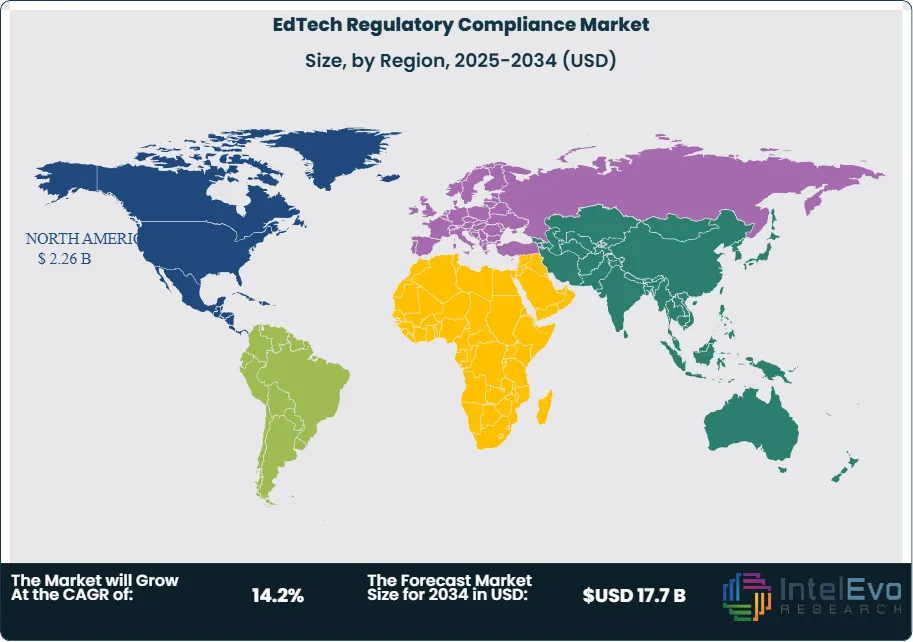
Regulation acts as both a growth catalyst and a constraint. Under the EU’s data protection regime, penalties can reach up to 4% of global revenue, while non-compliance with child privacy rules in the United States can trigger fines exceeding USD 40,000 per violation. Such exposure strengthens the business case for proactive compliance investment. North America currently represents around 42% of global EdTech regulatory compliance revenues, supported by mature digital infrastructure and stringent rules, while emerging opportunities build in Asia, where large student populations in markets such as India, combined with ambitious skilling agendas, accelerate adoption of compliant digital learning ecosystems.
Key Takeaways
Market Growth: The global EdTech regulatory compliance market stands at 4.7 billion USD, 2024 and is projected to reach 17.7 billion USD, 2034, implying a 14.2% CAGR, 2024-2034.
Segment Dominance: The Solution segment leads the offering mix with 64.7% share, 2024 of total market revenues and anchors an estimated: 3.0 billion USD, 2024 in compliance-focused platforms and tools.
Segment Dominance: Within functional categories, the Data Privacy and Protection segment accounts for 30.2% share, 2024, reflecting estimated: 1.4 billion USD, 2024 in spend on safeguarding learner data.
Driver: Strong adoption in K-12 Education, which holds 46.0% share, 2024 of end-user demand, acts as a primary growth driver as school systems scale digital platforms toward 2034, creating an estimated: 9.0 billion USD, 2034 addressable market.
Restraint: Dependence on legacy on-premises deployments, representing 58.4% share, 2024 of implementations, constrains agility and raises upgrade costs, with an estimated: 1.5 billion USD, 2024 in projects delayed by integration complexity.
Opportunity: Vendors can capture upside by accelerating migration from on-premises models, 58.4% share, 2024, to more scalable cloud-native compliance solutions, targeting an estimated: 8.0 billion USD, 2034 revenue pool as hybrid deployment gains traction.
Trend: Institutions increasingly favor automated compliance solutions, led by the Solution segment at 64.7% share, 2024, while AI-enabled monitoring and reporting tools are expected to grow at an estimated: 18.0% CAGR, 2024-2034.
Regional Analysis: North America commands 42.0% share, 2024 of global EdTech regulatory compliance revenues at 1.9 billion USD, 2024, with the United States alone contributing 1.58 billion USD, 2024 and expanding at a 15.3% CAGR, 2024-2034.
By Component
The Solution segment continues to hold a central position in the EdTech regulatory compliance landscape in 2025. It accounted for more than 64.7 percent of global demand in 2024 and remains the primary category driving institutional investment. You see this strength reflected in rising adoption of LMS compliance tools, data privacy platforms, and audit automation software. Institutions depend on these systems to manage rising content volumes, validate curriculum alignment, and meet cross-border standards. Increased scrutiny around student data handling pushes your team to adopt applications capable of meeting frameworks such as GDPR, FERPA, and regional privacy codes in Asia and Latin America.
Learning environments now operate across multiple devices and platforms, which requires LMS tools that support SCORM and similar interoperability requirements. Administrators are adopting compliance dashboards that help you track policy updates, manage digital content, and maintain records for audits. Providers are expanding their product suites to include automated reporting, risk scoring, and secure data vaults. These tools are becoming standard as regulatory demands grow more complex.
Service providers also gain traction as institutions request strategy guidance, system configuration, and external audits to reduce compliance exposure. The combination of software and advisory services creates a more complete compliance ecosystem, which strengthens the position of the Solution segment as institutions expand their digital footprint.
By Deployment Mode
On-premises deployments held more than 58.4 percent of the market in 2024 and remain widely used in 2025. Institutions prefer this model when you require full control of data storage, access protocols, and internal security. Markets with strict data sovereignty expectations continue to favor on-premises systems because administrators maintain direct oversight of sensitive records. This model also supports high customization, which benefits institutions with legacy infrastructure or unique workflow needs.
Reliability plays an important role. On-premises installations operate independently of internet connectivity, reducing the risk of system downtime during instruction or assessments. Many schools and universities still rely on campus-based networks to maintain operational continuity.
While cloud-based compliance platforms grow at a faster rate through 2030, on-premises deployments maintain relevance where security and control remain top priorities. Most institutions pursue hybrid adoption strategies that allow you to preserve sensitive datasets locally while shifting non-critical workflows to the cloud.
By Compliance Type
Data Privacy and Protection represented more than 30.2 percent of the global market in 2024 and remains the leading compliance priority in 2025. Governments in Europe, North America, and Asia continue to tighten oversight of how institutions collect, store, and share learner information. Your teams now face mandatory reporting obligations, breach notification rules, and consent management requirements. This strengthens demand for encryption tools, access governance software, and automated monitoring applications.
Growth in AI-driven learning tools increases the need for more rigorous controls. AI models require large datasets, which intensifies risk around data exposure. Institutions now assess AI workflows for compliance alignment before permitting adoption. Vendors respond by incorporating privacy-preserving architectures, synthetic data tools, and real-time auditing features.
Content and curriculum requirements, accessibility standards, and cybersecurity regulations also expand. The shift toward digital material in assessments and instruction pushes institutions to ensure content accuracy, accessibility compliance, and secure delivery. This broadens the overall compliance scope and raises total spending on specialized regulatory systems.
By End User
K–12 education accounted for more than 46 percent of market demand in 2024 and remains the most active adopter in 2025. Districts continue to expand device programs, online learning modules, and student information systems. This growth requires strong compliance controls to protect minors’ data, ensure platform safety, and maintain instructional quality. You see rising adoption of privacy tools, monitoring systems, and parent consent management applications in this segment.
Higher education institutions expand compliance investments as they scale hybrid programs and cross-border partnerships. Universities store large volumes of academic records, research data, and learner analytics, which increases regulatory exposure. Business institutions, including training and professional development providers, adopt compliance systems to meet ISO, workforce development, and national data standards.
Across all end users, the shift toward digital credentialing, remote assessments, and AI-driven instruction heightens interest in consistent compliance governance. Institutions seek unified systems that help you monitor risk, maintain audit trails, and support long-term data integrity.
By Region
North America accounted for more than 42 percent of global revenue in 2024 and continues to lead the market in 2025 with strong demand in the United States and Canada. Institutions in this region operate under strict privacy laws, including state-level regulations that extend beyond federal requirements. Vendors headquartered in North America continue to expand their compliance portfolios to meet these expectations. Strong investment from public agencies and private equity firms further supports market growth.
Europe follows closely due to the enforcement strength of GDPR and ongoing updates to digital education directives. Institutions across Germany, France, the Nordics, and the UK invest in tools that support strict accountability and reporting standards. Asia Pacific represents the fastest-growing region as India, Japan, China, and Southeast Asian economies expand digital learning capacity. Large student populations and new data protection laws create strong demand for compliance frameworks tailored to local conditions.
Latin America and the Middle East & Africa expand at a steady rate as connectivity improves and governments introduce national digital education strategies. These regions represent rising opportunities for providers that can deliver compliance systems suited to emerging regulatory models and budget constraints.
By Component (Solution, Services), By Deployment Mode (Cloud-Based, On-Premises), By Compliance Type (Data Privacy and Protection, Accessibility Standards, Content and Curriculum Compliance, Cybersecurity Regulations, Ethical Compliance, Others), By End User (K-12 Education, Higher Education, Business Institutions)
Research Methodology
Primary Research- 100 Interviews of Stakeholders
Secondary Research
Desk Research
Regional scope
North America (United States, Canada, Mexico)
Latin America (Brazil, Argentina, Columbia)
East Asia And Pacific (China, Japan, South Korea, Australia, Cambodia, Fiji, Indonesia)
Sea And South Asia (India, Singapore, Thailand, Taiwan, Malaysia)
Eastern Europe (Poland, Russia, Czech Republic, Romania)
Western Europe (Germany, U.K., France, Spain, Itlay)
Middle East & Africa (GCC Countries, Egypt, Nigeria, South Africa, Israel)
Competitive Landscape
Workday, Inc., Ellucian Company LLC, PowerSchool, Anthology Inc., Securly, Inc., Blackboard Inc., Microsoft Corporation, Instructure, Inc., Sai Global, OneTrust, LLC, Others
Customization Scope
Customization for segments, region/country-level will be provided. Moreover, additional customization can be done based on the requirements.
Pricing and Purchase Options
Avail customized purchase options to meet your exact research needs. We have three licenses to opt for: Single User License, Multi-User License (Up to 5 Users), Corporate Use License (Unlimited User and Printable PDF).
TABLE OF CONTENTS
1. EXECUTIVE SUMMARY
1.1. MARKET SNAPSHOT
1.2. KEY FINDINGS & INSIGHTS
1.3. ANALYST RECOMMENDATIONS
1.4. FUTURE OUTLOOK
2. RESEARCH METHODOLOGY
2.1. MARKET DEFINITION & SCOPE
2.2. RESEARCH OBJECTIVES: PRIMARY & SECONDARY DATA SOURCES
2.3. DATA COLLECTION SOURCES
2.3.1. COVERAGE OF 100+ PRIMARY RESEARCH/CONSULTATION CALLS WITH INDUSTRY STAKEHOLDERS
FIGURE 17 NORTH AMERICA EDTECH REGULATORY COMPLIANCECURRENT AND FUTURE TYPE ANALYSIS, 2025–2034, (USD MILLION)
FIGURE 18 NORTH AMERICA EDTECH REGULATORY COMPLIANCECURRENT AND FUTURE END USER ANALYSIS, 2025–2034, (USD MILLION)
FIGURE 19 MARKET SHARE BY COUNTRY
FIGURE 20 LATIN AMERICA EDTECH REGULATORY COMPLIANCECURRENT AND FUTURE TYPE ANALYSIS, 2025–2034, (USD MILLION)
FIGURE 21 LATIN AMERICA EDTECH REGULATORY COMPLIANCECURRENT AND FUTURE END USER ANALYSIS, 2025–2034, (USD MILLION)
FIGURE 22 MARKET SHARE BY COUNTRY
FIGURE 23 EASTERN EUROPE EDTECH REGULATORY COMPLIANCECURRENT AND FUTURE TYPE ANALYSIS, 2025–2034, (USD MILLION)
FIGURE 24 EASTERN EUROPE EDTECH REGULATORY COMPLIANCECURRENT AND FUTURE END USER ANALYSIS, 2025–2034, (USD MILLION)
FIGURE 25 MARKET SHARE BY COUNTRY
FIGURE 26 WESTERN EUROPE EDTECH REGULATORY COMPLIANCECURRENT AND FUTURE TYPE ANALYSIS, 2025–2034, (USD MILLION)
FIGURE 27 WESTERN EUROPE EDTECH REGULATORY COMPLIANCECURRENT AND FUTURE END USER ANALYSIS, 2025–2034, (USD MILLION)
FIGURE 28 MARKET SHARE BY COUNTRY
FIGURE 29 EAST ASIA AND PACIFIC EDTECH REGULATORY COMPLIANCECURRENT AND FUTURE TYPE ANALYSIS, 2025–2034, (USD MILLION)
FIGURE 30 EAST ASIA AND PACIFIC EDTECH REGULATORY COMPLIANCECURRENT AND FUTURE END USER ANALYSIS, 2025–2034, (USD MILLION)
FIGURE 31 MARKET SHARE BY COUNTRY
FIGURE 32 SEA AND SOUTH ASIA EDTECH REGULATORY COMPLIANCECURRENT AND FUTURE TYPE ANALYSIS, 2025–2034, (USD MILLION)
FIGURE 33 SEA AND SOUTH ASIA EDTECH REGULATORY COMPLIANCECURRENT AND FUTURE END USER ANALYSIS, 2025–2034, (USD MILLION)
FIGURE 34 MARKET SHARE BY COUNTRY
FIGURE 35 MIDDLE EAST AND AFRICA EDTECH REGULATORY COMPLIANCECURRENT AND FUTURE TYPE ANALYSIS, 2025–2034, (USD MILLION)
FIGURE 36 MIDDLE EAST AND AFRICA EDTECH REGULATORY COMPLIANCECURRENT AND FUTURE END USER ANALYSIS, 2025–2034, (USD MILLION)
FIGURE 37 NORTH AMERICA EDTECH REGULATORY COMPLIANCECURRENT AND FUTURE MARKET VOLUME SHARE REGIONAL ANALYSIS, 2025–2034, (USD MILLION)
FIGURE 38 U.S. EDTECH REGULATORY COMPLIANCECURRENT AND FUTURE TYPE ANALYSIS, 2025–2034, (USD MILLION)
FIGURE 39 U.S. EDTECH REGULATORY COMPLIANCECURRENT AND FUTURE END USER ANALYSIS, 2025–2034, (USD MILLION)
FIGURE 40 CANADA EDTECH REGULATORY COMPLIANCECURRENT AND FUTURE TYPE ANALYSIS, 2025–2034, (USD MILLION)
FIGURE 41 CANADA EDTECH REGULATORY COMPLIANCECURRENT AND FUTURE END USER ANALYSIS, 2025–2034, (USD MILLION)
FIGURE 42 LATIN AMERICA EDTECH REGULATORY COMPLIANCECURRENT AND FUTURE MARKET VOLUME SHARE REGIONAL ANALYSIS, 2025–2034, (USD MILLION)
FIGURE 43 MEXICO EDTECH REGULATORY COMPLIANCECURRENT AND FUTURE TYPE ANALYSIS, 2025–2034, (USD MILLION)
FIGURE 44 MEXICO EDTECH REGULATORY COMPLIANCECURRENT AND FUTURE END USER ANALYSIS, 2025–2034, (USD MILLION)
FIGURE 45 BRAZIL EDTECH REGULATORY COMPLIANCECURRENT AND FUTURE TYPE ANALYSIS, 2025–2034, (USD MILLION)
FIGURE 46 BRAZIL EDTECH REGULATORY COMPLIANCECURRENT AND FUTURE END USER ANALYSIS, 2025–2034, (USD MILLION)
FIGURE 47 ARGENTINA EDTECH REGULATORY COMPLIANCECURRENT AND FUTURE TYPE ANALYSIS, 2025–2034, (USD MILLION)
FIGURE 48 ARGENTINA EDTECH REGULATORY COMPLIANCECURRENT AND FUTURE END USER ANALYSIS, 2025–2034, (USD MILLION)
FIGURE 49 COLUMBIA EDTECH REGULATORY COMPLIANCECURRENT AND FUTURE TYPE ANALYSIS, 2025–2034, (USD MILLION)
FIGURE 50 COLUMBIA EDTECH REGULATORY COMPLIANCECURRENT AND FUTURE END USER ANALYSIS, 2025–2034, (USD MILLION)
FIGURE 51 REST OF LATIN AMERICA EDTECH REGULATORY COMPLIANCECURRENT AND FUTURE TYPE ANALYSIS, 2025–2034, (USD MILLION)
FIGURE 52 REST OF LATIN AMERICA EDTECH REGULATORY COMPLIANCECURRENT AND FUTURE END USER ANALYSIS, 2025–2034, (USD MILLION)
FIGURE 53 EASTERN EUROPE EDTECH REGULATORY COMPLIANCECURRENT AND FUTURE MARKET VOLUME SHARE REGIONAL ANALYSIS, 2025–2034, (USD MILLION)
FIGURE 54 POLAND EDTECH REGULATORY COMPLIANCECURRENT AND FUTURE TYPE ANALYSIS, 2025–2034, (USD MILLION)
FIGURE 55 POLAND EDTECH REGULATORY COMPLIANCECURRENT AND FUTURE END USER ANALYSIS, 2025–2034, (USD MILLION)
FIGURE 56 RUSSIA EDTECH REGULATORY COMPLIANCECURRENT AND FUTURE TYPE ANALYSIS, 2025–2034, (USD MILLION)
FIGURE 57 RUSSIA EDTECH REGULATORY COMPLIANCECURRENT AND FUTURE END USER ANALYSIS, 2025–2034, (USD MILLION)
FIGURE 58 CZECH REPUBLIC EDTECH REGULATORY COMPLIANCECURRENT AND FUTURE TYPE ANALYSIS, 2025–2034, (USD MILLION)
FIGURE 59 CZECH REPUBLIC EDTECH REGULATORY COMPLIANCECURRENT AND FUTURE END USER ANALYSIS, 2025–2034, (USD MILLION)
FIGURE 60 ROMANIA EDTECH REGULATORY COMPLIANCECURRENT AND FUTURE TYPE ANALYSIS, 2025–2034, (USD MILLION)
FIGURE 61 ROMANIA EDTECH REGULATORY COMPLIANCECURRENT AND FUTURE END USER ANALYSIS, 2025–2034, (USD MILLION)
FIGURE 62 REST OF EASTERN EUROPE EDTECH REGULATORY COMPLIANCECURRENT AND FUTURE TYPE ANALYSIS, 2025–2034, (USD MILLION)
FIGURE 63 REST OF EASTERN EUROPE EDTECH REGULATORY COMPLIANCECURRENT AND FUTURE END USER ANALYSIS, 2025–2034, (USD MILLION)
FIGURE 64 WESTERN EUROPE EDTECH REGULATORY COMPLIANCECURRENT AND FUTURE MARKET VOLUME SHARE REGIONAL ANALYSIS, 2025–2034, (USD MILLION)
FIGURE 65 GERMANY EDTECH REGULATORY COMPLIANCECURRENT AND FUTURE TYPE ANALYSIS, 2025–2034, (USD MILLION)
FIGURE 66 GERMANY EDTECH REGULATORY COMPLIANCECURRENT AND FUTURE END USER ANALYSIS, 2025–2034, (USD MILLION)
FIGURE 67 FRANCE EDTECH REGULATORY COMPLIANCECURRENT AND FUTURE TYPE ANALYSIS, 2025–2034, (USD MILLION)
FIGURE 68 FRANCE EDTECH REGULATORY COMPLIANCECURRENT AND FUTURE END USER ANALYSIS, 2025–2034, (USD MILLION)
FIGURE 69 UK EDTECH REGULATORY COMPLIANCECURRENT AND FUTURE TYPE ANALYSIS, 2025–2034, (USD MILLION)
FIGURE 70 UK EDTECH REGULATORY COMPLIANCECURRENT AND FUTURE END USER ANALYSIS, 2025–2034, (USD MILLION)
FIGURE 71 SPAIN EDTECH REGULATORY COMPLIANCECURRENT AND FUTURE TYPE ANALYSIS, 2025–2034, (USD MILLION)
FIGURE 72 SPAIN EDTECH REGULATORY COMPLIANCECURRENT AND FUTURE END USER ANALYSIS, 2025–2034, (USD MILLION)
FIGURE 73 ITALY EDTECH REGULATORY COMPLIANCECURRENT AND FUTURE TYPE ANALYSIS, 2025–2034, (USD MILLION)
FIGURE 74 ITALY EDTECH REGULATORY COMPLIANCECURRENT AND FUTURE END USER ANALYSIS, 2025–2034, (USD MILLION)
FIGURE 75 REST OF WESTERN EUROPE EDTECH REGULATORY COMPLIANCECURRENT AND FUTURE TYPE ANALYSIS, 2025–2034, (USD MILLION)
FIGURE 76 REST OF WESTERN EUROPE EDTECH REGULATORY COMPLIANCECURRENT AND FUTURE END USER ANALYSIS, 2025–2034, (USD MILLION)
FIGURE 77 EAST ASIA AND PACIFIC EDTECH REGULATORY COMPLIANCECURRENT AND FUTURE MARKET VOLUME SHARE REGIONAL ANALYSIS, 2025–2034, (USD MILLION)
FIGURE 78 CHINA EDTECH REGULATORY COMPLIANCECURRENT AND FUTURE TYPE ANALYSIS, 2025–2034, (USD MILLION)
FIGURE 79 CHINA EDTECH REGULATORY COMPLIANCECURRENT AND FUTURE END USER ANALYSIS, 2025–2034, (USD MILLION)
FIGURE 80 JAPAN EDTECH REGULATORY COMPLIANCECURRENT AND FUTURE TYPE ANALYSIS, 2025–2034, (USD MILLION)
FIGURE 81 JAPAN EDTECH REGULATORY COMPLIANCECURRENT AND FUTURE END USER ANALYSIS, 2025–2034, (USD MILLION)
FIGURE 82 AUSTRALIA EDTECH REGULATORY COMPLIANCECURRENT AND FUTURE TYPE ANALYSIS, 2025–2034, (USD MILLION)
FIGURE 83 AUSTRALIA EDTECH REGULATORY COMPLIANCECURRENT AND FUTURE END USER ANALYSIS, 2025–2034, (USD MILLION)
FIGURE 84 CAMBODIA EDTECH REGULATORY COMPLIANCECURRENT AND FUTURE TYPE ANALYSIS, 2025–2034, (USD MILLION)
FIGURE 85 CAMBODIA EDTECH REGULATORY COMPLIANCECURRENT AND FUTURE END USER ANALYSIS, 2025–2034, (USD MILLION)
FIGURE 86 FIJI EDTECH REGULATORY COMPLIANCECURRENT AND FUTURE TYPE ANALYSIS, 2025–2034, (USD MILLION)
FIGURE 87 FIJI EDTECH REGULATORY COMPLIANCECURRENT AND FUTURE END USER ANALYSIS, 2025–2034, (USD MILLION)
FIGURE 88 INDONESIA EDTECH REGULATORY COMPLIANCECURRENT AND FUTURE TYPE ANALYSIS, 2025–2034, (USD MILLION)
FIGURE 89 INDONESIA EDTECH REGULATORY COMPLIANCECURRENT AND FUTURE END USER ANALYSIS, 2025–2034, (USD MILLION)
FIGURE 90 SOUTH KOREA EDTECH REGULATORY COMPLIANCECURRENT AND FUTURE TYPE ANALYSIS, 2025–2034, (USD MILLION)
FIGURE 91 SOUTH KOREA EDTECH REGULATORY COMPLIANCECURRENT AND FUTURE END USER ANALYSIS, 2025–2034, (USD MILLION)
FIGURE 92 REST OF EAST ASIA AND PACIFIC EDTECH REGULATORY COMPLIANCECURRENT AND FUTURE TYPE ANALYSIS, 2025–2034, (USD MILLION)
FIGURE 93 REST OF EAST ASIA AND PACIFIC EDTECH REGULATORY COMPLIANCECURRENT AND FUTURE END USER ANALYSIS, 2025–2034, (USD MILLION)
FIGURE 94 SEA AND SOUTH ASIA EDTECH REGULATORY COMPLIANCECURRENT AND FUTURE MARKET VOLUME SHARE REGIONAL ANALYSIS, 2025–2034, (USD MILLION)
FIGURE 95 BANGLADESH EDTECH REGULATORY COMPLIANCECURRENT AND FUTURE TYPE ANALYSIS, 2025–2034, (USD MILLION)
FIGURE 96 BANGLADESH EDTECH REGULATORY COMPLIANCECURRENT AND FUTURE END USER ANALYSIS, 2025–2034, (USD MILLION)
FIGURE 97 NEW ZEALAND EDTECH REGULATORY COMPLIANCECURRENT AND FUTURE TYPE ANALYSIS, 2025–2034, (USD MILLION)
FIGURE 98 NEW ZEALAND EDTECH REGULATORY COMPLIANCECURRENT AND FUTURE END USER ANALYSIS, 2025–2034, (USD MILLION)
FIGURE 99 INDIA EDTECH REGULATORY COMPLIANCECURRENT AND FUTURE TYPE ANALYSIS, 2025–2034, (USD MILLION)
FIGURE 100 INDIA EDTECH REGULATORY COMPLIANCECURRENT AND FUTURE END USER ANALYSIS, 2025–2034, (USD MILLION)
FIGURE 101 SINGAPORE EDTECH REGULATORY COMPLIANCECURRENT AND FUTURE TYPE ANALYSIS, 2025–2034, (USD MILLION)
FIGURE 102 SINGAPORE EDTECH REGULATORY COMPLIANCECURRENT AND FUTURE END USER ANALYSIS, 2025–2034, (USD MILLION)
FIGURE 103 THAILAND EDTECH REGULATORY COMPLIANCECURRENT AND FUTURE TYPE ANALYSIS, 2025–2034, (USD MILLION)
FIGURE 104 THAILAND EDTECH REGULATORY COMPLIANCECURRENT AND FUTURE END USER ANALYSIS, 2025–2034, (USD MILLION)
FIGURE 105 TAIWAN EDTECH REGULATORY COMPLIANCECURRENT AND FUTURE TYPE ANALYSIS, 2025–2034, (USD MILLION)
FIGURE 106 TAIWAN EDTECH REGULATORY COMPLIANCECURRENT AND FUTURE END USER ANALYSIS, 2025–2034, (USD MILLION)
FIGURE 107 MALAYSIA EDTECH REGULATORY COMPLIANCECURRENT AND FUTURE TYPE ANALYSIS, 2025–2034, (USD MILLION)
FIGURE 108 MALAYSIA EDTECH REGULATORY COMPLIANCECURRENT AND FUTURE END USER ANALYSIS, 2025–2034, (USD MILLION)
FIGURE 109 REST OF SEA AND SOUTH ASIA EDTECH REGULATORY COMPLIANCECURRENT AND FUTURE TYPE ANALYSIS, 2025–2034, (USD MILLION)
FIGURE 110 REST OF SEA AND SOUTH ASIA EDTECH REGULATORY COMPLIANCECURRENT AND FUTURE END USER ANALYSIS, 2025–2034, (USD MILLION)
FIGURE 111 MIDDLE EAST AND AFRICA EDTECH REGULATORY COMPLIANCECURRENT AND FUTURE MARKET VOLUME SHARE REGIONAL ANALYSIS, 2025–2034, (USD MILLION)
FIGURE 112 GCC COUNTRIES EDTECH REGULATORY COMPLIANCECURRENT AND FUTURE TYPE ANALYSIS, 2025–2034, (USD MILLION)
FIGURE 113 GCC COUNTRIES EDTECH REGULATORY COMPLIANCECURRENT AND FUTURE END USER ANALYSIS, 2025–2034, (USD MILLION)
FIGURE 114 SAUDI ARABIA EDTECH REGULATORY COMPLIANCECURRENT AND FUTURE TYPE ANALYSIS, 2025–2034, (USD MILLION)
FIGURE 115 SAUDI ARABIA EDTECH REGULATORY COMPLIANCECURRENT AND FUTURE END USER ANALYSIS, 2025–2034, (USD MILLION)
FIGURE 116 UAE EDTECH REGULATORY COMPLIANCECURRENT AND FUTURE TYPE ANALYSIS, 2025–2034, (USD MILLION)
FIGURE 117 UAE EDTECH REGULATORY COMPLIANCECURRENT AND FUTURE END USER ANALYSIS, 2025–2034, (USD MILLION)
FIGURE 118 BAHRAIN EDTECH REGULATORY COMPLIANCECURRENT AND FUTURE TYPE ANALYSIS, 2025–2034, (USD MILLION)
FIGURE 119 BAHRAIN EDTECH REGULATORY COMPLIANCECURRENT AND FUTURE END USER ANALYSIS, 2025–2034, (USD MILLION)
FIGURE 120 KUWAIT EDTECH REGULATORY COMPLIANCECURRENT AND FUTURE TYPE ANALYSIS, 2025–2034, (USD MILLION)
FIGURE 121 KUWAIT EDTECH REGULATORY COMPLIANCECURRENT AND FUTURE END USER ANALYSIS, 2025–2034, (USD MILLION)
FIGURE 122 OMAN EDTECH REGULATORY COMPLIANCECURRENT AND FUTURE TYPE ANALYSIS, 2025–2034, (USD MILLION)
FIGURE 123 OMAN EDTECH REGULATORY COMPLIANCECURRENT AND FUTURE END USER ANALYSIS, 2025–2034, (USD MILLION)
FIGURE 124 QATAR EDTECH REGULATORY COMPLIANCECURRENT AND FUTURE TYPE ANALYSIS, 2025–2034, (USD MILLION)
FIGURE 125 QATAR EDTECH REGULATORY COMPLIANCECURRENT AND FUTURE END USER ANALYSIS, 2025–2034, (USD MILLION)
FIGURE 126 EGYPT EDTECH REGULATORY COMPLIANCECURRENT AND FUTURE TYPE ANALYSIS, 2025–2034, (USD MILLION)
FIGURE 127 EGYPT EDTECH REGULATORY COMPLIANCECURRENT AND FUTURE END USER ANALYSIS, 2025–2034, (USD MILLION)
FIGURE 128 NIGERIA EDTECH REGULATORY COMPLIANCECURRENT AND FUTURE TYPE ANALYSIS, 2025–2034, (USD MILLION)
FIGURE 129 NIGERIA EDTECH REGULATORY COMPLIANCECURRENT AND FUTURE END USER ANALYSIS, 2025–2034, (USD MILLION)
FIGURE 130 SOUTH AFRICA EDTECH REGULATORY COMPLIANCECURRENT AND FUTURE TYPE ANALYSIS, 2025–2034, (USD MILLION)
FIGURE 131 SOUTH AFRICA EDTECH REGULATORY COMPLIANCECURRENT AND FUTURE END USER ANALYSIS, 2025–2034, (USD MILLION)
FIGURE 132 ISRAEL EDTECH REGULATORY COMPLIANCECURRENT AND FUTURE TYPE ANALYSIS, 2025–2034, (USD MILLION)
FIGURE 133 ISRAEL EDTECH REGULATORY COMPLIANCECURRENT AND FUTURE END USER ANALYSIS, 2025–2034, (USD MILLION)
FIGURE 134 REST OF MEA EDTECH REGULATORY COMPLIANCECURRENT AND FUTURE TYPE ANALYSIS, 2025–2034, (USD MILLION)
FIGURE 135 REST OF MEA EDTECH REGULATORY COMPLIANCECURRENT AND FUTURE END USER ANALYSIS, 2025–2034, (USD MILLION)
FIGURE 136 U. S. MARKET SHARE ANALYSIS BY TYPE (2024)
FIGURE 137 U. S. MARKET SHARE ANALYSIS BY END USER (2024)
FIGURE 138 CANADA MARKET SHARE ANALYSIS BY TYPE (2024)
FIGURE 139 CANADA MARKET SHARE ANALYSIS BY END USER (2024)
FIGURE 140 MEXICO MARKET SHARE ANALYSIS BY TYPE (2024)
FIGURE 141 MEXICO MARKET SHARE ANALYSIS BY END USER (2024)
FIGURE 142 CHINA MARKET SHARE ANALYSIS BY TYPE (2024)
FIGURE 143 CHINA MARKET SHARE ANALYSIS BY END USER (2024)
FIGURE 144 JAPAN MARKET SHARE ANALYSIS BY TYPE (2024)
FIGURE 145 JAPAN MARKET SHARE ANALYSIS BY END USER (2024)
FIGURE 146 INDIA MARKET SHARE ANALYSIS BY TYPE (2024)
FIGURE 147 INDIA MARKET SHARE ANALYSIS BY END USER (2024)
FIGURE 148 SOUTH KOREA MARKET SHARE ANALYSIS BY TYPE (2024)
FIGURE 149 SOUTH KOREA MARKET SHARE ANALYSIS BY END USER (2024)
FIGURE 150 SAUDI ARABIA MARKET SHARE ANALYSIS BY TYPE (2024)
FIGURE 151 SAUDI ARABIA MARKET SHARE ANALYSIS BY END USER (2024)
FIGURE 152 UAE MARKET SHARE ANALYSIS BY TYPE (2024)
FIGURE 153 UAE MARKET SHARE ANALYSIS BY END USER (2024)
FIGURE 154 EGYPT MARKET SHARE ANALYSIS BY TYPE (2024)
FIGURE 155 EGYPT MARKET SHARE ANALYSIS BY END USER (2024)
FIGURE 156 NIGERIA MARKET SHARE ANALYSIS BY TYPE (2024)
FIGURE 157 NIGERIA MARKET SHARE ANALYSIS BY END USER (2024)
FIGURE 158 SOUTH AFRICA MARKET SHARE ANALYSIS BY TYPE (2024)
FIGURE 159 SOUTH AFRICA MARKET SHARE ANALYSIS BY END USER (2024)
FIGURE 160 GERMANY MARKET SHARE ANALYSIS BY TYPE (2024)
FIGURE 161 GERMANY MARKET SHARE ANALYSIS BY END USER (2024)
FIGURE 162 FRANCE MARKET SHARE ANALYSIS BY TYPE (2024)
FIGURE 163 FRANCE MARKET SHARE ANALYSIS BY END USER (2024)
FIGURE 164 UK MARKET SHARE ANALYSIS BY TYPE (2024)
FIGURE 165 UK MARKET SHARE ANALYSIS BY END USER (2024)
FIGURE 166 SPAIN MARKET SHARE ANALYSIS BY TYPE (2024)
FIGURE 167 SPAIN MARKET SHARE ANALYSIS BY END USER (2024)
FIGURE 168 ITALY MARKET SHARE ANALYSIS BY TYPE (2024)
FIGURE 169 ITALY MARKET SHARE ANALYSIS BY END USER (2024)
FIGURE 170 BRAZIL MARKET SHARE ANALYSIS BY TYPE (2024)
FIGURE 171 BRAZIL MARKET SHARE ANALYSIS BY END USER (2024)
FIGURE 172 ARGENTINA MARKET SHARE ANALYSIS BY TYPE (2024)
FIGURE 173 ARGENTINA MARKET SHARE ANALYSIS BY END USER (2024)
FIGURE 174 COLUMBIA MARKET SHARE ANALYSIS BY TYPE (2024)
FIGURE 175 COLUMBIA MARKET SHARE ANALYSIS BY END USER (2024)
FIGURE 176 GLOBAL EDTECH REGULATORY COMPLIANCECURRENT AND FUTURE MARKET KEY COUNTRY LEVEL ANALYSIS, 2024–2034, (USD MILLION)
FIGURE 177 FINANCIAL OVERVIEW:
Key Player Analysis
ApTap Ltd.: ApTap Ltd. positions itself as a challenger in the EdTech regulatory compliance market with a focus on automated data governance tools and integrated compliance dashboards. The company supports education providers with systems that monitor privacy obligations, consent workflows, and content governance. ApTap strengthened its position in 2025 by expanding its cloud compliance suite into Europe, where GDPR enforcement continues to tighten. The firm invests in AI-driven monitoring tools that track anomalies in student data usage and provide real-time alerts to administrators. This capability differentiates ApTap in markets where institutions need transparent reporting to meet strict audit cycles. The company maintains momentum through targeted partnerships with LMS vendors that allow its compliance modules to be embedded into existing platforms, improving adoption rates and driving subscription growth across mid-sized institutions.
Axio Digital Pvt. Ltd.: Axio Digital Pvt. Ltd. acts as a niche player with a strong presence in South Asia, where demand for compliance systems accelerates as governments update data protection legislation. The company delivers privacy management tools and student information governance software tailored for large school networks and higher education institutions. Axio Digital expanded its portfolio in 2025 by adding automated risk scoring features that help institutions assess gaps in compliance readiness before deploying new EdTech applications. The firm also collaborates with regional telecom operators to support secure data transfer frameworks that meet national storage mandates. Axio Digital differentiates itself through competitive pricing and localized implementation support, which positions it well in markets with budget-sensitive buyers. Its customer base continues to grow at double digit rates as digital adoption increases across India and Southeast Asia.
Bill.com LLC: Bill.com LLC operates as an emergent participant in the EdTech regulatory compliance space through its expansion into secure workflow automation for educational institutions. While known for financial process automation, the company extends its capabilities to support compliance documentation, audit trails, and secure data-sharing protocols that align with education sector requirements. Bill.com enhances its market position by integrating compliance rule sets into its existing workflow engine, allowing institutions to control access to sensitive documents and maintain verifiable process logs. This approach appeals to universities and training centers that manage large volumes of administrative records. In 2025, the firm strengthened its platform through API integrations with LMS and SIS providers, improving interoperability and expanding addressable revenue opportunities. Bill.com's established presence in financial workflow management gives it a strong foundation as compliance expectations grow more complex across education systems.
Market Key Players
Workday, Inc.
Ellucian Company LLC
PowerSchool
Anthology Inc.
Securly, Inc.
Blackboard Inc.
Microsoft Corporation
Instructure, Inc.
Sai Global
OneTrust, LLC
Others
Driver:
AI Integration and Data Dependency
By 2025, educational institutions are redefining instruction through the integration of AI, machine learning, and cloud-based analytics. These technologies enable personalized content delivery and help administrators achieve measurable improvements in learning efficiency and student record management. However, as AI models rely more on large datasets, they also increase an institution's regulatory exposure. This makes strong data governance essential in today’s classrooms.
The Rise of Verifiable Compliance
This technological change is creating a strong demand for specialized compliance software and automated audit systems in K-12 schools, higher education, and corporate training. As privacy, transparency, and accessibility requirements grow, institutions are looking for vendors that can ensure secure data flows and prove ethical AI usage. Organizations that focus on these "trust-based" features gain a competitive edge as schools speed up their digital adoption.
Restraint:
Barriers to Scalable Adoption
Significant barriers still exist in areas where digital readiness varies, leading to a noticeable divide in educational quality. Many schools and training centers hesitate to adopt new systems due to a lack of technical staff and a strong distrust of automated decision-making tools. These human and technical limitations greatly restrict the ability to implement compliance technology on a large scale, often forcing institutions to use outdated, manual processes.
Fragmentation and Budgetary Constraints
This results in a fragmented market where progress is uneven: rapid adoption occurs in well-funded districts while smaller, budget-constrained institutions lag behind. This financial gap slows overall regulatory compliance modernization through 2028, as the cost of moving from old systems remains too high for many. For vendors, this means they must work in a landscape where the middle market often moves slowly, requiring flexible pricing and implementation options.
Opportunity:
The Global EdTech Frontier
Global expansion offers the biggest growth opportunity for compliance vendors as EdTech spending rises in Asia, the Middle East, and Latin America. In regions with growing internet access and large student populations, online learning tools are seeing double-digit adoption rates. As regional governments strengthen their digital education policies, there is a significant demand for compliance systems that can manage the complexities of data privacy and cross-border interoperability.
Revenue Growth through Localization
This expansion is creating new revenue opportunities for vendors that can provide multilingual compliance solutions and meet region-specific regulations. The global EdTech regulatory compliance market is expected to exceed USD 17 billion by 2034, driven by strong growth in emerging economies. Vendors who can adjust their platforms to comply with local standards, such as specific data residency laws, will be well-positioned to win these long-term, high-volume contracts.
Trend:
AR, VR, and New Compliance Metrics
By 2025, mobile learning and immersive formats like Augmented Reality (AR) and Virtual Reality (VR) will shift from novelty to necessity, especially in science, engineering, and vocational training. These engaging formats create new compliance challenges, requiring checks for the accuracy of 3D content, tracking physiological data, and ensuring virtual accessibility standards. As these tools gain traction, the definition of educational compliance will expand to include the safety and quality of the virtual environment.
The Hybrid Instruction Standard
Hybrid instruction has become the standard for modern education. Institutions are combining in-person classes with advanced online modules for greater flexibility. This change has increased the need for centralized systems that can verify content quality and maintain detailed audit trails across varied learning environments. The trend is moving toward unified compliance, where data sharing is tracked in real-time, ensuring that students have a secure and consistent experience whether they are on campus or learning from home.
Recent Developments
Dec 2024 - Anthology: Anthology launched a compliance-focused upgrade to its LMS suite, adding automated FERPA and GDPR checks for course content and assessment workflows, targeting over 5,000 institutions worldwide. The move strengthens its position as a core platform provider for institutions that want integrated compliance controls rather than stand-alone tools.
Feb 2025 - Microsoft Education: Microsoft Education introduced an AI-driven compliance cockpit for its education cloud customers, providing real-time alerts on data residency, consent status, and policy violations across Microsoft 365 and linked LMS environments, priced as an add-on subscription expected to reach more than 20 percent of its education tenant base by 2027. This reinforces Microsoft’s role as a key infrastructure partner for compliance-intensive education systems.
Apr 2025 - Instructure (Canvas): Instructure acquired a specialized EdTech compliance vendor for an estimated USD 140 million to integrate automated accessibility and content compliance checks directly into the Canvas workflow. The acquisition expands Canvas beyond instruction delivery into end-to-end compliance management, improving retention among large districts and university systems.
Jul 2025 - PowerSchool: PowerSchool announced a strategic partnership with a leading privacy consultancy to co-develop pre-configured compliance templates for U.S. state-level privacy laws and international regulations, aimed at its base of more than 50 million student records. This partnership positions PowerSchool as a preferred choice for districts that seek standardized yet configurable compliance frameworks.
Sep 2025 - Google for Education: Google for Education rolled out region-specific data controls and audit APIs for its Workspace for Education customers, with early adoption reported across more than 15 countries in Europe, Asia, and Latin America. This step broadens Google’s addressability in markets with strict data residency and audit requirements and intensifies competition in the global EdTech regulatory compliance stack.
