
The Global Electric Vertical Take-off and Landing (eVTOL) Aircraft Market size is projected to reach approximately USD 53.6 billion by 2034, up from USD 14.9 billion in 2024, growing at a CAGR of 15.2% during the forecast period from 2025 to 2034. The eVTOL market is gaining momentum as advancements in battery technology, autonomous flight systems, and sustainable air mobility initiatives reshape the future of urban transportation. Governments and aerospace leaders are heavily investing in air taxi networks and regional mobility corridors. With growing emphasis on zero-emission transport and smart city integration, eVTOL aircraft are expected to redefine the global aviation landscape by the next decade.
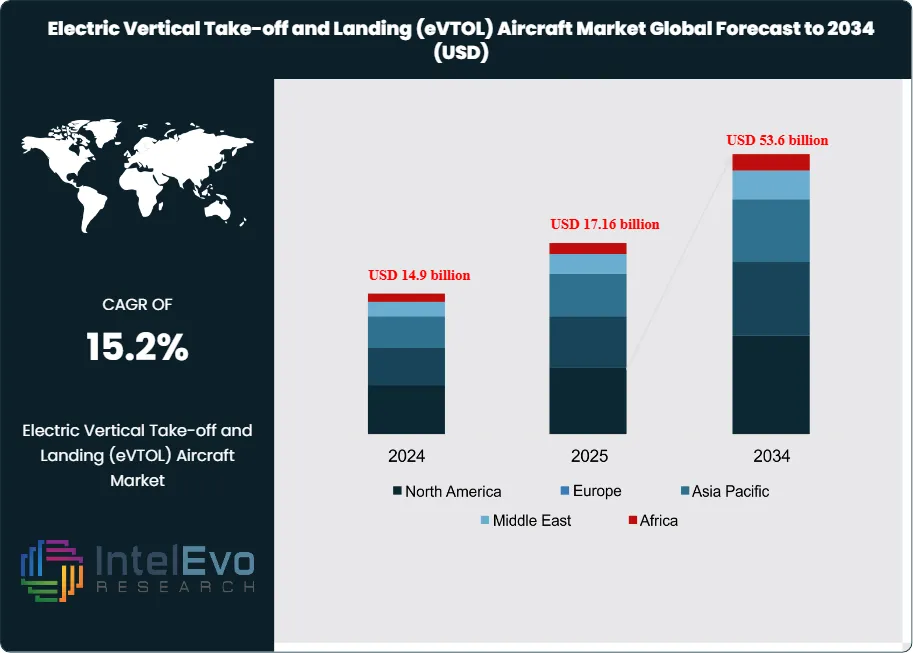
The Electric Vertical Take-off and Landing (eVTOL) aircraft market represents a revolutionary segment within the aviation sector, focusing on urban air mobility solutions. eVTOLs are designed for vertical take-off and landing, utilizing electric propulsion systems that make them suitable for congested urban environments. The current market is marked by significant technological advancements, increased investment in sustainable transport solutions, and a surge in interest from both public and private sectors. As of 2024, the market is valued at approximately USD 14.9 billion, driven by innovations in eVTOL designs, including hybrid-electric and fully electric models. This transformation is aimed at addressing the challenges of urban congestion and environmental concerns.
The growth dynamics of the eVTOL market are propelled by several key factors. One of the primary drivers is the rising urban congestion, which amplifies the demand for alternative transportation solutions capable of bypassing road traffic. Furthermore, advancements in battery technology are enhancing eVTOL efficiency and operational range, making them more commercially viable. Additionally, supportive government policies and investments in urban air mobility infrastructure are expediting the integration of eVTOLs into existing transport systems. Industry leaders like Joby Aviation, Archer, and Lilium are at the forefront of this innovation, developing prototypes that promise to reshape urban commuting and air travel.
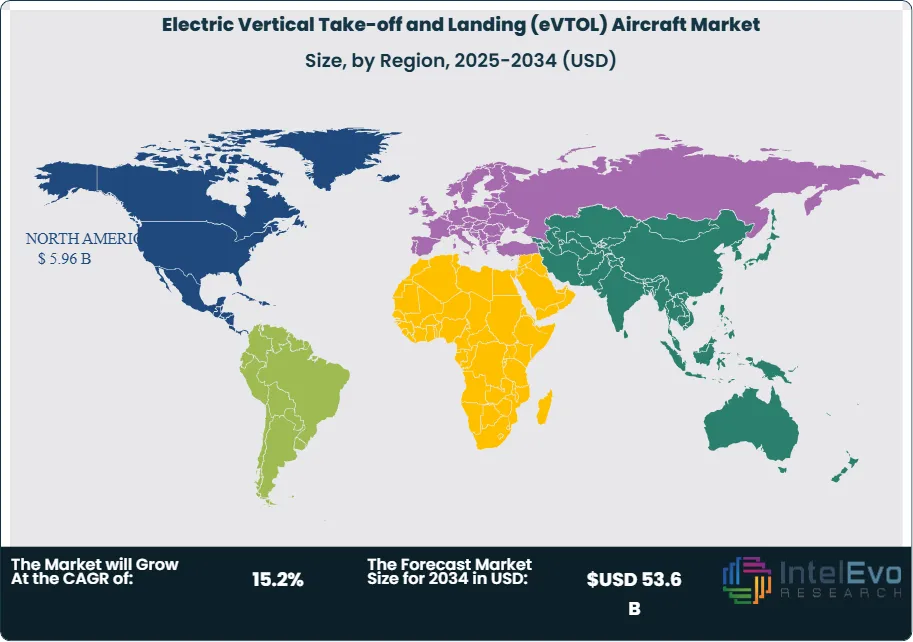
North America is the leading market for eVTOLs, thanks to its advanced aerospace industry and substantial investment in research and development. The United States, in particular, hosts numerous eVTOL startups and established aerospace manufacturers. However, the Asia-Pacific region is anticipated to experience the fastest growth rate, driven by rapid urbanization, an expanding middle class, and increasing government initiatives focused on sustainable transportation solutions. Countries such as China and India are significantly investing in urban air mobility to mitigate growing traffic issues and improve transportation efficiency.
The COVID-19 pandemic had a mixed impact on the eVTOL market. Initially, the crisis disrupted supply chains and delayed development timelines due to restrictions on travel and gatherings. However, it also underscored the necessity for innovative transport solutions that enhance public health safety and alleviate congestion. As cities seek to recover and adapt to post-pandemic realities, there is renewed interest in eVTOLs as clean and efficient alternatives to traditional transportation. This shift in public perception could further accelerate market growth in the coming years.
Key Takeaways:
Market Growth: The Electric Vertical Take-off and Landing (eVTOL) aircraft market is expected to reach USD 53.6 billion by 2034, growing at a robust CAGR of 15.2%, indicating strong market expansion.
Technology Segment Analysis: The multirotor technology segment is anticipated to dominate the eVTOL market due to its operational versatility and efficiency in urban environments, catering to both passenger and cargo applications.
Propulsion Type Analysis: The battery electric propulsion type is likely to hold the largest market share, driven by advancements in battery technology and increasing focus on sustainable aviation solutions.
Driver: Urban congestion is a primary driver for eVTOL market growth, as cities seek efficient alternatives to traditional ground transport to improve mobility and reduce traffic-related issues
Restraint: Regulatory challenges and certification processes for eVTOL aircraft remain significant restraints, as achieving compliance with aviation safety standards can be lengthy and complex.
Opportunity: The increasing investment in urban air mobility infrastructure presents significant opportunities for market players, as governments and private sectors collaborate to enhance eVTOL adoption and operational feasibility.
Trend: The trend towards sustainable and efficient transportation solutions is gaining momentum, with eVTOLs positioned as key players in the future of urban mobility.
Regional Analysis: North America is currently the leading region for eVTOL development, but the Asia-Pacific region is projected to experience the fastest growth due to rapid urbanization and supportive government initiatives.
Technology:
The technology segment of the eVTOL market comprises three main types: multirotor, vectored thrust, and lift + cruise designs. Multirotor aircraft utilize multiple rotors to achieve vertical lift and are popular for their simplicity and versatility, making them ideal for urban environments. Vectored thrust designs use tilt-rotor technology to transition between vertical and horizontal flight, offering increased speed and efficiency. Lift + cruise eVTOLs combine fixed-wing designs with separate rotors, providing optimal lift during take-off and efficient cruising capabilities. As cities increasingly seek sustainable transportation solutions, the demand for advanced eVTOL technologies is anticipated to rise, spurring innovation and competition among manufacturers.
Propulsion Type:
The propulsion type segment plays a crucial role in the eVTOL market, categorized into battery electric, hybrid electric, and hydrogen electric systems. Battery electric propulsion is currently the most prevalent, driven by advancements in energy density and charging technology that enhance operational range and reduce emissions. Hybrid electric systems combine traditional fuel engines with electric propulsion, offering extended range and flexibility, making them suitable for longer urban routes. Hydrogen electric systems, though still in the early stages of development, present a promising alternative for zero-emission flight, appealing to environmental concerns. As battery technology continues to evolve, the market will likely see a shift towards cleaner and more efficient propulsion methods.
Maximum Take-off Weight (MTOW):
The maximum take-off weight (MTOW) segment categorizes eVTOLs into three groups: below 2,000 lbs, 2,000 to 5,000 lbs, and above 5,000 lbs. eVTOLs weighing less than 2,000 lbs are generally designed for short-range air taxi services and are more agile in urban environments. The 2,000 to 5,000 lbs category typically includes larger passenger aircraft capable of carrying multiple individuals or cargo over longer distances, making them ideal for regional transport. Aircraft exceeding 5,000 lbs usually target specialized markets, such as emergency services or freight transport. As urban air mobility grows, understanding the MTOW capabilities will be essential for aligning aircraft designs with market demands.
Application:
The application segment of the eVTOL market includes air taxi services, cargo transport, emergency medical services (EMS), and military applications. Air taxis represent the most prominent application, targeting urban commuters seeking efficient and time-saving transport options. Cargo transport is also gaining traction, particularly for last-mile deliveries, as eVTOLs can bypass congested roadways. EMS applications leverage eVTOLs for rapid patient transport in emergency situations, significantly improving response times. Additionally, military applications utilize eVTOL technology for logistics, surveillance, and search and rescue missions. Each application is driving innovations in eVTOL design and technology, catering to specific operational needs and enhancing overall market growth.
Region Analysis:
North America Leads With 40% Market Share In eVTOL Aircraft Market: North America is poised to dominate the eVTOL aircraft market, accounting for approximately 40% of the total market share. This leadership position is primarily due to the region's robust aerospace and aviation industry, supported by substantial investments in research and development from both private and public sectors. Major players, including established aerospace firms and numerous startups, are actively engaged in advancing eVTOL technology. Furthermore, favorable regulatory frameworks, such as the Federal Aviation Administration's (FAA) support for urban air mobility initiatives, foster innovation and expedite certification processes. The high demand for air taxi services in congested urban areas, coupled with increasing investments in related infrastructure, is also contributing to North America's market dominance. This combination of factors makes the region a global hub for eVTOL development.
In contrast, the Asia-Pacific region is emerging as the fastest-growing market for eVTOL aircraft, projected to witness significant growth driven by rapid urbanization and rising demand for innovative transportation solutions. Countries like China, Japan, and Singapore are investing heavily in urban air mobility initiatives, creating favorable conditions for eVTOL adoption. Government support, particularly in regulatory advancements and infrastructure development, is pivotal in accelerating market growth. The increasing population density in major cities is compelling governments and private companies to seek alternatives to traditional ground transportation, enhancing the appeal of eVTOLs. Partnerships between local startups and global aerospace firms are fostering technological advancements and driving market penetration. As a result, the Asia-Pacific region presents immense growth potential, positioning itself as a key player in the evolving eVTOL landscape.
By Lift Technology (Multirotor, Lift Plus Cruise, Vectored Thrust), By Mode of Operation (Piloted, Autonomous), By Range (<50 km, 50–200 km, >200 km), By Maximum Take-off Weight (MTOW) (Below 2,000 lbs, 2,000 to 5,000 lbs, Above 5,000 lbs), By Application (Air Taxis, Cargo Transport, Military and Defense, Emergency Medical Services, Private and Recreational), By Propulsion Type (Fully Electric, Hybrid Electric, Hydrogen Fuel Cell)
Research Methodology
Primary Research- 100 Interviews of Stakeholders
Secondary Research
Desk Research
Regional scope
North America (United States, Canada, Mexico)
Latin America (Brazil, Argentina, Columbia)
East Asia And Pacific (China, Japan, South Korea, Australia, Cambodia, Fiji, Indonesia)
Sea And South Asia (India, Singapore, Thailand, Taiwan, Malaysia)
Eastern Europe (Poland, Russia, Czech Republic, Romania)
Western Europe (Germany, U.K., France, Spain, Itlay)
Middle East & Africa (GCC Countries, Egypt, Nigeria, South Africa, Israel)
Customization for segments, region/country-level will be provided. Moreover, additional customization can be done based on the requirements.
Pricing and Purchase Options
Avail customized purchase options to meet your exact research needs. We have three licenses to opt for: Single User License, Multi-User License (Up to 5 Users), Corporate Use License (Unlimited User and Printable PDF).
TABLE OF CONTENTS
1. EXECUTIVE SUMMARY
1.1. MARKET SNAPSHOT
1.2. KEY FINDINGS & INSIGHTS
1.3. ANALYST RECOMMENDATIONS
1.4. FUTURE OUTLOOK
2. RESEARCH METHODOLOGY
2.1. MARKET DEFINITION & SCOPE
2.2. RESEARCH OBJECTIVES: PRIMARY & SECONDARY DATA SOURCES
2.3. DATA COLLECTION SOURCES
2.3.1. COVERAGE OF 100+ PRIMARY RESEARCH/CONSULTATION CALLS WITH INDUSTRY STAKEHOLDERS
FIGURE 17 NORTH AMERICA ELECTRIC VERTICAL TAKE-OFF AND LANDING AIRCRAFT CURRENT AND FUTURE TYPE ANALYSIS, 2025–2034, (USD MILLION)
FIGURE 18 NORTH AMERICA ELECTRIC VERTICAL TAKE-OFF AND LANDING AIRCRAFT CURRENT AND FUTURE END USER ANALYSIS, 2025–2034, (USD MILLION)
FIGURE 19 MARKET SHARE BY COUNTRY
FIGURE 20 LATIN AMERICA ELECTRIC VERTICAL TAKE-OFF AND LANDING AIRCRAFT CURRENT AND FUTURE TYPE ANALYSIS, 2025–2034, (USD MILLION)
FIGURE 21 LATIN AMERICA ELECTRIC VERTICAL TAKE-OFF AND LANDING AIRCRAFT CURRENT AND FUTURE END USER ANALYSIS, 2025–2034, (USD MILLION)
FIGURE 22 MARKET SHARE BY COUNTRY
FIGURE 23 EASTERN EUROPE ELECTRIC VERTICAL TAKE-OFF AND LANDING AIRCRAFT CURRENT AND FUTURE TYPE ANALYSIS, 2025–2034, (USD MILLION)
FIGURE 24 EASTERN EUROPE ELECTRIC VERTICAL TAKE-OFF AND LANDING AIRCRAFT CURRENT AND FUTURE END USER ANALYSIS, 2025–2034, (USD MILLION)
FIGURE 25 MARKET SHARE BY COUNTRY
FIGURE 26 WESTERN EUROPE ELECTRIC VERTICAL TAKE-OFF AND LANDING AIRCRAFT CURRENT AND FUTURE TYPE ANALYSIS, 2025–2034, (USD MILLION)
FIGURE 27 WESTERN EUROPE ELECTRIC VERTICAL TAKE-OFF AND LANDING AIRCRAFT CURRENT AND FUTURE END USER ANALYSIS, 2025–2034, (USD MILLION)
FIGURE 28 MARKET SHARE BY COUNTRY
FIGURE 29 EAST ASIA AND PACIFIC ELECTRIC VERTICAL TAKE-OFF AND LANDING AIRCRAFT CURRENT AND FUTURE TYPE ANALYSIS, 2025–2034, (USD MILLION)
FIGURE 30 EAST ASIA AND PACIFIC ELECTRIC VERTICAL TAKE-OFF AND LANDING AIRCRAFT CURRENT AND FUTURE END USER ANALYSIS, 2025–2034, (USD MILLION)
FIGURE 31 MARKET SHARE BY COUNTRY
FIGURE 32 SEA AND SOUTH ASIA ELECTRIC VERTICAL TAKE-OFF AND LANDING AIRCRAFT CURRENT AND FUTURE TYPE ANALYSIS, 2025–2034, (USD MILLION)
FIGURE 33 SEA AND SOUTH ASIA ELECTRIC VERTICAL TAKE-OFF AND LANDING AIRCRAFT CURRENT AND FUTURE END USER ANALYSIS, 2025–2034, (USD MILLION)
FIGURE 34 MARKET SHARE BY COUNTRY
FIGURE 35 MIDDLE EAST AND AFRICA ELECTRIC VERTICAL TAKE-OFF AND LANDING AIRCRAFT CURRENT AND FUTURE TYPE ANALYSIS, 2025–2034, (USD MILLION)
FIGURE 36 MIDDLE EAST AND AFRICA ELECTRIC VERTICAL TAKE-OFF AND LANDING AIRCRAFT CURRENT AND FUTURE END USER ANALYSIS, 2025–2034, (USD MILLION)
FIGURE 37 NORTH AMERICA ELECTRIC VERTICAL TAKE-OFF AND LANDING AIRCRAFT CURRENT AND FUTURE MARKET VOLUME SHARE REGIONAL ANALYSIS, 2025–2034, (USD MILLION)
FIGURE 38 U.S. ELECTRIC VERTICAL TAKE-OFF AND LANDING AIRCRAFT CURRENT AND FUTURE TYPE ANALYSIS, 2025–2034, (USD MILLION)
FIGURE 39 U.S. ELECTRIC VERTICAL TAKE-OFF AND LANDING AIRCRAFT CURRENT AND FUTURE END USER ANALYSIS, 2025–2034, (USD MILLION)
FIGURE 40 CANADA ELECTRIC VERTICAL TAKE-OFF AND LANDING AIRCRAFT CURRENT AND FUTURE TYPE ANALYSIS, 2025–2034, (USD MILLION)
FIGURE 41 CANADA ELECTRIC VERTICAL TAKE-OFF AND LANDING AIRCRAFT CURRENT AND FUTURE END USER ANALYSIS, 2025–2034, (USD MILLION)
FIGURE 42 LATIN AMERICA ELECTRIC VERTICAL TAKE-OFF AND LANDING AIRCRAFT CURRENT AND FUTURE MARKET VOLUME SHARE REGIONAL ANALYSIS, 2025–2034, (USD MILLION)
FIGURE 43 MEXICO ELECTRIC VERTICAL TAKE-OFF AND LANDING AIRCRAFT CURRENT AND FUTURE TYPE ANALYSIS, 2025–2034, (USD MILLION)
FIGURE 44 MEXICO ELECTRIC VERTICAL TAKE-OFF AND LANDING AIRCRAFT CURRENT AND FUTURE END USER ANALYSIS, 2025–2034, (USD MILLION)
FIGURE 45 BRAZIL ELECTRIC VERTICAL TAKE-OFF AND LANDING AIRCRAFT CURRENT AND FUTURE TYPE ANALYSIS, 2025–2034, (USD MILLION)
FIGURE 46 BRAZIL ELECTRIC VERTICAL TAKE-OFF AND LANDING AIRCRAFT CURRENT AND FUTURE END USER ANALYSIS, 2025–2034, (USD MILLION)
FIGURE 47 ARGENTINA ELECTRIC VERTICAL TAKE-OFF AND LANDING AIRCRAFT CURRENT AND FUTURE TYPE ANALYSIS, 2025–2034, (USD MILLION)
FIGURE 48 ARGENTINA ELECTRIC VERTICAL TAKE-OFF AND LANDING AIRCRAFT CURRENT AND FUTURE END USER ANALYSIS, 2025–2034, (USD MILLION)
FIGURE 49 COLUMBIA ELECTRIC VERTICAL TAKE-OFF AND LANDING AIRCRAFT CURRENT AND FUTURE TYPE ANALYSIS, 2025–2034, (USD MILLION)
FIGURE 50 COLUMBIA ELECTRIC VERTICAL TAKE-OFF AND LANDING AIRCRAFT CURRENT AND FUTURE END USER ANALYSIS, 2025–2034, (USD MILLION)
FIGURE 51 REST OF LATIN AMERICA ELECTRIC VERTICAL TAKE-OFF AND LANDING AIRCRAFT CURRENT AND FUTURE TYPE ANALYSIS, 2025–2034, (USD MILLION)
FIGURE 52 REST OF LATIN AMERICA ELECTRIC VERTICAL TAKE-OFF AND LANDING AIRCRAFT CURRENT AND FUTURE END USER ANALYSIS, 2025–2034, (USD MILLION)
FIGURE 53 EASTERN EUROPE ELECTRIC VERTICAL TAKE-OFF AND LANDING AIRCRAFT CURRENT AND FUTURE MARKET VOLUME SHARE REGIONAL ANALYSIS, 2025–2034, (USD MILLION)
FIGURE 54 POLAND ELECTRIC VERTICAL TAKE-OFF AND LANDING AIRCRAFT CURRENT AND FUTURE TYPE ANALYSIS, 2025–2034, (USD MILLION)
FIGURE 55 POLAND ELECTRIC VERTICAL TAKE-OFF AND LANDING AIRCRAFT CURRENT AND FUTURE END USER ANALYSIS, 2025–2034, (USD MILLION)
FIGURE 56 RUSSIA ELECTRIC VERTICAL TAKE-OFF AND LANDING AIRCRAFT CURRENT AND FUTURE TYPE ANALYSIS, 2025–2034, (USD MILLION)
FIGURE 57 RUSSIA ELECTRIC VERTICAL TAKE-OFF AND LANDING AIRCRAFT CURRENT AND FUTURE END USER ANALYSIS, 2025–2034, (USD MILLION)
FIGURE 58 CZECH REPUBLIC ELECTRIC VERTICAL TAKE-OFF AND LANDING AIRCRAFT CURRENT AND FUTURE TYPE ANALYSIS, 2025–2034, (USD MILLION)
FIGURE 59 CZECH REPUBLIC ELECTRIC VERTICAL TAKE-OFF AND LANDING AIRCRAFT CURRENT AND FUTURE END USER ANALYSIS, 2025–2034, (USD MILLION)
FIGURE 60 ROMANIA ELECTRIC VERTICAL TAKE-OFF AND LANDING AIRCRAFT CURRENT AND FUTURE TYPE ANALYSIS, 2025–2034, (USD MILLION)
FIGURE 61 ROMANIA ELECTRIC VERTICAL TAKE-OFF AND LANDING AIRCRAFT CURRENT AND FUTURE END USER ANALYSIS, 2025–2034, (USD MILLION)
FIGURE 62 REST OF EASTERN EUROPE ELECTRIC VERTICAL TAKE-OFF AND LANDING AIRCRAFT CURRENT AND FUTURE TYPE ANALYSIS, 2025–2034, (USD MILLION)
FIGURE 63 REST OF EASTERN EUROPE ELECTRIC VERTICAL TAKE-OFF AND LANDING AIRCRAFT CURRENT AND FUTURE END USER ANALYSIS, 2025–2034, (USD MILLION)
FIGURE 64 WESTERN EUROPE ELECTRIC VERTICAL TAKE-OFF AND LANDING AIRCRAFT CURRENT AND FUTURE MARKET VOLUME SHARE REGIONAL ANALYSIS, 2025–2034, (USD MILLION)
FIGURE 65 GERMANY ELECTRIC VERTICAL TAKE-OFF AND LANDING AIRCRAFT CURRENT AND FUTURE TYPE ANALYSIS, 2025–2034, (USD MILLION)
FIGURE 66 GERMANY ELECTRIC VERTICAL TAKE-OFF AND LANDING AIRCRAFT CURRENT AND FUTURE END USER ANALYSIS, 2025–2034, (USD MILLION)
FIGURE 67 FRANCE ELECTRIC VERTICAL TAKE-OFF AND LANDING AIRCRAFT CURRENT AND FUTURE TYPE ANALYSIS, 2025–2034, (USD MILLION)
FIGURE 68 FRANCE ELECTRIC VERTICAL TAKE-OFF AND LANDING AIRCRAFT CURRENT AND FUTURE END USER ANALYSIS, 2025–2034, (USD MILLION)
FIGURE 69 UK ELECTRIC VERTICAL TAKE-OFF AND LANDING AIRCRAFT CURRENT AND FUTURE TYPE ANALYSIS, 2025–2034, (USD MILLION)
FIGURE 70 UK ELECTRIC VERTICAL TAKE-OFF AND LANDING AIRCRAFT CURRENT AND FUTURE END USER ANALYSIS, 2025–2034, (USD MILLION)
FIGURE 71 SPAIN ELECTRIC VERTICAL TAKE-OFF AND LANDING AIRCRAFT CURRENT AND FUTURE TYPE ANALYSIS, 2025–2034, (USD MILLION)
FIGURE 72 SPAIN ELECTRIC VERTICAL TAKE-OFF AND LANDING AIRCRAFT CURRENT AND FUTURE END USER ANALYSIS, 2025–2034, (USD MILLION)
FIGURE 73 ITALY ELECTRIC VERTICAL TAKE-OFF AND LANDING AIRCRAFT CURRENT AND FUTURE TYPE ANALYSIS, 2025–2034, (USD MILLION)
FIGURE 74 ITALY ELECTRIC VERTICAL TAKE-OFF AND LANDING AIRCRAFT CURRENT AND FUTURE END USER ANALYSIS, 2025–2034, (USD MILLION)
FIGURE 75 REST OF WESTERN EUROPE ELECTRIC VERTICAL TAKE-OFF AND LANDING AIRCRAFT CURRENT AND FUTURE TYPE ANALYSIS, 2025–2034, (USD MILLION)
FIGURE 76 REST OF WESTERN EUROPE ELECTRIC VERTICAL TAKE-OFF AND LANDING AIRCRAFT CURRENT AND FUTURE END USER ANALYSIS, 2025–2034, (USD MILLION)
FIGURE 77 EAST ASIA AND PACIFIC ELECTRIC VERTICAL TAKE-OFF AND LANDING AIRCRAFT CURRENT AND FUTURE MARKET VOLUME SHARE REGIONAL ANALYSIS, 2025–2034, (USD MILLION)
FIGURE 78 CHINA ELECTRIC VERTICAL TAKE-OFF AND LANDING AIRCRAFT CURRENT AND FUTURE TYPE ANALYSIS, 2025–2034, (USD MILLION)
FIGURE 79 CHINA ELECTRIC VERTICAL TAKE-OFF AND LANDING AIRCRAFT CURRENT AND FUTURE END USER ANALYSIS, 2025–2034, (USD MILLION)
FIGURE 80 JAPAN ELECTRIC VERTICAL TAKE-OFF AND LANDING AIRCRAFT CURRENT AND FUTURE TYPE ANALYSIS, 2025–2034, (USD MILLION)
FIGURE 81 JAPAN ELECTRIC VERTICAL TAKE-OFF AND LANDING AIRCRAFT CURRENT AND FUTURE END USER ANALYSIS, 2025–2034, (USD MILLION)
FIGURE 82 AUSTRALIA ELECTRIC VERTICAL TAKE-OFF AND LANDING AIRCRAFT CURRENT AND FUTURE TYPE ANALYSIS, 2025–2034, (USD MILLION)
FIGURE 83 AUSTRALIA ELECTRIC VERTICAL TAKE-OFF AND LANDING AIRCRAFT CURRENT AND FUTURE END USER ANALYSIS, 2025–2034, (USD MILLION)
FIGURE 84 CAMBODIA ELECTRIC VERTICAL TAKE-OFF AND LANDING AIRCRAFT CURRENT AND FUTURE TYPE ANALYSIS, 2025–2034, (USD MILLION)
FIGURE 85 CAMBODIA ELECTRIC VERTICAL TAKE-OFF AND LANDING AIRCRAFT CURRENT AND FUTURE END USER ANALYSIS, 2025–2034, (USD MILLION)
FIGURE 86 FIJI ELECTRIC VERTICAL TAKE-OFF AND LANDING AIRCRAFT CURRENT AND FUTURE TYPE ANALYSIS, 2025–2034, (USD MILLION)
FIGURE 87 FIJI ELECTRIC VERTICAL TAKE-OFF AND LANDING AIRCRAFT CURRENT AND FUTURE END USER ANALYSIS, 2025–2034, (USD MILLION)
FIGURE 88 INDONESIA ELECTRIC VERTICAL TAKE-OFF AND LANDING AIRCRAFT CURRENT AND FUTURE TYPE ANALYSIS, 2025–2034, (USD MILLION)
FIGURE 89 INDONESIA ELECTRIC VERTICAL TAKE-OFF AND LANDING AIRCRAFT CURRENT AND FUTURE END USER ANALYSIS, 2025–2034, (USD MILLION)
FIGURE 90 SOUTH KOREA ELECTRIC VERTICAL TAKE-OFF AND LANDING AIRCRAFT CURRENT AND FUTURE TYPE ANALYSIS, 2025–2034, (USD MILLION)
FIGURE 91 SOUTH KOREA ELECTRIC VERTICAL TAKE-OFF AND LANDING AIRCRAFT CURRENT AND FUTURE END USER ANALYSIS, 2025–2034, (USD MILLION)
FIGURE 92 REST OF EAST ASIA AND PACIFIC ELECTRIC VERTICAL TAKE-OFF AND LANDING AIRCRAFT CURRENT AND FUTURE TYPE ANALYSIS, 2025–2034, (USD MILLION)
FIGURE 93 REST OF EAST ASIA AND PACIFIC ELECTRIC VERTICAL TAKE-OFF AND LANDING AIRCRAFT CURRENT AND FUTURE END USER ANALYSIS, 2025–2034, (USD MILLION)
FIGURE 94 SEA AND SOUTH ASIA ELECTRIC VERTICAL TAKE-OFF AND LANDING AIRCRAFT CURRENT AND FUTURE MARKET VOLUME SHARE REGIONAL ANALYSIS, 2025–2034, (USD MILLION)
FIGURE 95 BANGLADESH ELECTRIC VERTICAL TAKE-OFF AND LANDING AIRCRAFT CURRENT AND FUTURE TYPE ANALYSIS, 2025–2034, (USD MILLION)
FIGURE 96 BANGLADESH ELECTRIC VERTICAL TAKE-OFF AND LANDING AIRCRAFT CURRENT AND FUTURE END USER ANALYSIS, 2025–2034, (USD MILLION)
FIGURE 97 NEW ZEALAND ELECTRIC VERTICAL TAKE-OFF AND LANDING AIRCRAFT CURRENT AND FUTURE TYPE ANALYSIS, 2025–2034, (USD MILLION)
FIGURE 98 NEW ZEALAND ELECTRIC VERTICAL TAKE-OFF AND LANDING AIRCRAFT CURRENT AND FUTURE END USER ANALYSIS, 2025–2034, (USD MILLION)
FIGURE 99 INDIA ELECTRIC VERTICAL TAKE-OFF AND LANDING AIRCRAFT CURRENT AND FUTURE TYPE ANALYSIS, 2025–2034, (USD MILLION)
FIGURE 100 INDIA ELECTRIC VERTICAL TAKE-OFF AND LANDING AIRCRAFT CURRENT AND FUTURE END USER ANALYSIS, 2025–2034, (USD MILLION)
FIGURE 101 SINGAPORE ELECTRIC VERTICAL TAKE-OFF AND LANDING AIRCRAFT CURRENT AND FUTURE TYPE ANALYSIS, 2025–2034, (USD MILLION)
FIGURE 102 SINGAPORE ELECTRIC VERTICAL TAKE-OFF AND LANDING AIRCRAFT CURRENT AND FUTURE END USER ANALYSIS, 2025–2034, (USD MILLION)
FIGURE 103 THAILAND ELECTRIC VERTICAL TAKE-OFF AND LANDING AIRCRAFT CURRENT AND FUTURE TYPE ANALYSIS, 2025–2034, (USD MILLION)
FIGURE 104 THAILAND ELECTRIC VERTICAL TAKE-OFF AND LANDING AIRCRAFT CURRENT AND FUTURE END USER ANALYSIS, 2025–2034, (USD MILLION)
FIGURE 105 TAIWAN ELECTRIC VERTICAL TAKE-OFF AND LANDING AIRCRAFT CURRENT AND FUTURE TYPE ANALYSIS, 2025–2034, (USD MILLION)
FIGURE 106 TAIWAN ELECTRIC VERTICAL TAKE-OFF AND LANDING AIRCRAFT CURRENT AND FUTURE END USER ANALYSIS, 2025–2034, (USD MILLION)
FIGURE 107 MALAYSIA ELECTRIC VERTICAL TAKE-OFF AND LANDING AIRCRAFT CURRENT AND FUTURE TYPE ANALYSIS, 2025–2034, (USD MILLION)
FIGURE 108 MALAYSIA ELECTRIC VERTICAL TAKE-OFF AND LANDING AIRCRAFT CURRENT AND FUTURE END USER ANALYSIS, 2025–2034, (USD MILLION)
FIGURE 109 REST OF SEA AND SOUTH ASIA ELECTRIC VERTICAL TAKE-OFF AND LANDING AIRCRAFT CURRENT AND FUTURE TYPE ANALYSIS, 2025–2034, (USD MILLION)
FIGURE 110 REST OF SEA AND SOUTH ASIA ELECTRIC VERTICAL TAKE-OFF AND LANDING AIRCRAFT CURRENT AND FUTURE END USER ANALYSIS, 2025–2034, (USD MILLION)
FIGURE 111 MIDDLE EAST AND AFRICA ELECTRIC VERTICAL TAKE-OFF AND LANDING AIRCRAFT CURRENT AND FUTURE MARKET VOLUME SHARE REGIONAL ANALYSIS, 2025–2034, (USD MILLION)
FIGURE 112 GCC COUNTRIES ELECTRIC VERTICAL TAKE-OFF AND LANDING AIRCRAFT CURRENT AND FUTURE TYPE ANALYSIS, 2025–2034, (USD MILLION)
FIGURE 113 GCC COUNTRIES ELECTRIC VERTICAL TAKE-OFF AND LANDING AIRCRAFT CURRENT AND FUTURE END USER ANALYSIS, 2025–2034, (USD MILLION)
FIGURE 114 SAUDI ARABIA ELECTRIC VERTICAL TAKE-OFF AND LANDING AIRCRAFT CURRENT AND FUTURE TYPE ANALYSIS, 2025–2034, (USD MILLION)
FIGURE 115 SAUDI ARABIA ELECTRIC VERTICAL TAKE-OFF AND LANDING AIRCRAFT CURRENT AND FUTURE END USER ANALYSIS, 2025–2034, (USD MILLION)
FIGURE 116 UAE ELECTRIC VERTICAL TAKE-OFF AND LANDING AIRCRAFT CURRENT AND FUTURE TYPE ANALYSIS, 2025–2034, (USD MILLION)
FIGURE 117 UAE ELECTRIC VERTICAL TAKE-OFF AND LANDING AIRCRAFT CURRENT AND FUTURE END USER ANALYSIS, 2025–2034, (USD MILLION)
FIGURE 118 BAHRAIN ELECTRIC VERTICAL TAKE-OFF AND LANDING AIRCRAFT CURRENT AND FUTURE TYPE ANALYSIS, 2025–2034, (USD MILLION)
FIGURE 119 BAHRAIN ELECTRIC VERTICAL TAKE-OFF AND LANDING AIRCRAFT CURRENT AND FUTURE END USER ANALYSIS, 2025–2034, (USD MILLION)
FIGURE 120 KUWAIT ELECTRIC VERTICAL TAKE-OFF AND LANDING AIRCRAFT CURRENT AND FUTURE TYPE ANALYSIS, 2025–2034, (USD MILLION)
FIGURE 121 KUWAIT ELECTRIC VERTICAL TAKE-OFF AND LANDING AIRCRAFT CURRENT AND FUTURE END USER ANALYSIS, 2025–2034, (USD MILLION)
FIGURE 122 OMAN ELECTRIC VERTICAL TAKE-OFF AND LANDING AIRCRAFT CURRENT AND FUTURE TYPE ANALYSIS, 2025–2034, (USD MILLION)
FIGURE 123 OMAN ELECTRIC VERTICAL TAKE-OFF AND LANDING AIRCRAFT CURRENT AND FUTURE END USER ANALYSIS, 2025–2034, (USD MILLION)
FIGURE 124 QATAR ELECTRIC VERTICAL TAKE-OFF AND LANDING AIRCRAFT CURRENT AND FUTURE TYPE ANALYSIS, 2025–2034, (USD MILLION)
FIGURE 125 QATAR ELECTRIC VERTICAL TAKE-OFF AND LANDING AIRCRAFT CURRENT AND FUTURE END USER ANALYSIS, 2025–2034, (USD MILLION)
FIGURE 126 EGYPT ELECTRIC VERTICAL TAKE-OFF AND LANDING AIRCRAFT CURRENT AND FUTURE TYPE ANALYSIS, 2025–2034, (USD MILLION)
FIGURE 127 EGYPT ELECTRIC VERTICAL TAKE-OFF AND LANDING AIRCRAFT CURRENT AND FUTURE END USER ANALYSIS, 2025–2034, (USD MILLION)
FIGURE 128 NIGERIA ELECTRIC VERTICAL TAKE-OFF AND LANDING AIRCRAFT CURRENT AND FUTURE TYPE ANALYSIS, 2025–2034, (USD MILLION)
FIGURE 129 NIGERIA ELECTRIC VERTICAL TAKE-OFF AND LANDING AIRCRAFT CURRENT AND FUTURE END USER ANALYSIS, 2025–2034, (USD MILLION)
FIGURE 130 SOUTH AFRICA ELECTRIC VERTICAL TAKE-OFF AND LANDING AIRCRAFT CURRENT AND FUTURE TYPE ANALYSIS, 2025–2034, (USD MILLION)
FIGURE 131 SOUTH AFRICA ELECTRIC VERTICAL TAKE-OFF AND LANDING AIRCRAFT CURRENT AND FUTURE END USER ANALYSIS, 2025–2034, (USD MILLION)
FIGURE 132 ISRAEL ELECTRIC VERTICAL TAKE-OFF AND LANDING AIRCRAFT CURRENT AND FUTURE TYPE ANALYSIS, 2025–2034, (USD MILLION)
FIGURE 133 ISRAEL ELECTRIC VERTICAL TAKE-OFF AND LANDING AIRCRAFT CURRENT AND FUTURE END USER ANALYSIS, 2025–2034, (USD MILLION)
FIGURE 134 REST OF MEA ELECTRIC VERTICAL TAKE-OFF AND LANDING AIRCRAFT CURRENT AND FUTURE TYPE ANALYSIS, 2025–2034, (USD MILLION)
FIGURE 135 REST OF MEA ELECTRIC VERTICAL TAKE-OFF AND LANDING AIRCRAFT CURRENT AND FUTURE END USER ANALYSIS, 2025–2034, (USD MILLION)
FIGURE 136 U. S. MARKET SHARE ANALYSIS BY TYPE (2024)
FIGURE 137 U. S. MARKET SHARE ANALYSIS BY END USER (2024)
FIGURE 138 CANADA MARKET SHARE ANALYSIS BY TYPE (2024)
FIGURE 139 CANADA MARKET SHARE ANALYSIS BY END USER (2024)
FIGURE 140 MEXICO MARKET SHARE ANALYSIS BY TYPE (2024)
FIGURE 141 MEXICO MARKET SHARE ANALYSIS BY END USER (2024)
FIGURE 142 CHINA MARKET SHARE ANALYSIS BY TYPE (2024)
FIGURE 143 CHINA MARKET SHARE ANALYSIS BY END USER (2024)
FIGURE 144 JAPAN MARKET SHARE ANALYSIS BY TYPE (2024)
FIGURE 145 JAPAN MARKET SHARE ANALYSIS BY END USER (2024)
FIGURE 146 INDIA MARKET SHARE ANALYSIS BY TYPE (2024)
FIGURE 147 INDIA MARKET SHARE ANALYSIS BY END USER (2024)
FIGURE 148 SOUTH KOREA MARKET SHARE ANALYSIS BY TYPE (2024)
FIGURE 149 SOUTH KOREA MARKET SHARE ANALYSIS BY END USER (2024)
FIGURE 150 SAUDI ARABIA MARKET SHARE ANALYSIS BY TYPE (2024)
FIGURE 151 SAUDI ARABIA MARKET SHARE ANALYSIS BY END USER (2024)
FIGURE 152 UAE MARKET SHARE ANALYSIS BY TYPE (2024)
FIGURE 153 UAE MARKET SHARE ANALYSIS BY END USER (2024)
FIGURE 154 EGYPT MARKET SHARE ANALYSIS BY TYPE (2024)
FIGURE 155 EGYPT MARKET SHARE ANALYSIS BY END USER (2024)
FIGURE 156 NIGERIA MARKET SHARE ANALYSIS BY TYPE (2024)
FIGURE 157 NIGERIA MARKET SHARE ANALYSIS BY END USER (2024)
FIGURE 158 SOUTH AFRICA MARKET SHARE ANALYSIS BY TYPE (2024)
FIGURE 159 SOUTH AFRICA MARKET SHARE ANALYSIS BY END USER (2024)
FIGURE 160 GERMANY MARKET SHARE ANALYSIS BY TYPE (2024)
FIGURE 161 GERMANY MARKET SHARE ANALYSIS BY END USER (2024)
FIGURE 162 FRANCE MARKET SHARE ANALYSIS BY TYPE (2024)
FIGURE 163 FRANCE MARKET SHARE ANALYSIS BY END USER (2024)
FIGURE 164 UK MARKET SHARE ANALYSIS BY TYPE (2024)
FIGURE 165 UK MARKET SHARE ANALYSIS BY END USER (2024)
FIGURE 166 SPAIN MARKET SHARE ANALYSIS BY TYPE (2024)
FIGURE 167 SPAIN MARKET SHARE ANALYSIS BY END USER (2024)
FIGURE 168 ITALY MARKET SHARE ANALYSIS BY TYPE (2024)
FIGURE 169 ITALY MARKET SHARE ANALYSIS BY END USER (2024)
FIGURE 170 BRAZIL MARKET SHARE ANALYSIS BY TYPE (2024)
FIGURE 171 BRAZIL MARKET SHARE ANALYSIS BY END USER (2024)
FIGURE 172 ARGENTINA MARKET SHARE ANALYSIS BY TYPE (2024)
FIGURE 173 ARGENTINA MARKET SHARE ANALYSIS BY END USER (2024)
FIGURE 174 COLUMBIA MARKET SHARE ANALYSIS BY TYPE (2024)
FIGURE 175 COLUMBIA MARKET SHARE ANALYSIS BY END USER (2024)
FIGURE 176 GLOBAL ELECTRIC VERTICAL TAKE-OFF AND LANDING AIRCRAFT CURRENT AND FUTURE MARKET KEY COUNTRY LEVEL ANALYSIS, 2024–2034, (USD MILLION)
FIGURE 177 FINANCIAL OVERVIEW:
Key Players Analysis:
Joby Aviation: Joby Aviation is a California-based company focused on developing an all-electric eVTOL aircraft designed for air taxi services. Its aircraft features a range of over 150 miles and can carry four passengers. Joby’s strategy involves partnering with existing transportation services and securing regulatory approval to launch air taxi operations in urban areas.
Volocopter: Volocopter, headquartered in Germany, is a pioneer in the eVTOL sector, known for its electric multicopter design. The company's VoloCity aircraft aims to provide air taxi services in urban environments. Volocopter’s strategy includes collaborations with city planners and regulatory bodies to create vertiports and integrate air mobility into public transport systems.
Lilium: Based in Munich, Germany, Lilium is developing the Lilium Jet, a five-seater eVTOL aircraft with a unique design that incorporates ducted fan technology. The company aims to revolutionize urban air mobility. Lilium’s strategy focuses on building a network of regional air mobility services, collaborating with governments for infrastructure development.
Archer Aviation: Archer Aviation, located in California, focuses on creating electric air taxis for urban environments, specifically their eVTOL aircraft called Maker. The company emphasizes sustainability and low noise levels. Archer’s strategy includes partnerships with airlines and municipalities to facilitate the deployment of their aircraft in urban air mobility ecosystems.
EHang: EHang, based in China, is notable for its autonomous aerial vehicles, including the EHang 216, designed for cargo and passenger transport. The company is advancing air mobility solutions with a strong focus on autonomous operations. EHang’s strategy is centered around establishing an ecosystem for air logistics and passenger services in densely populated areas.
Bell Textron: Bell Textron, a well-established aerospace company in Texas, is venturing into the eVTOL market with its Bell Nexus aircraft. This hybrid-electric vehicle is designed for urban air taxi services. Bell’s strategy involves leveraging its extensive experience in rotorcraft design while collaborating with urban developers to integrate their aircraft into smart city plans.
Airbus: Airbus, a global aerospace leader, is exploring urban air mobility through its Vahana and CityAirbus projects. These eVTOL prototypes aim to address urban congestion. Airbus’s strategy includes investing in R&D and forming partnerships to establish regulatory frameworks and operational networks for future air mobility solutions.
Hyundai Urban Air Mobility: Hyundai has entered the eVTOL market with its S-A1 aircraft, designed for urban air taxi services. Based in South Korea, the company aims to promote eco-friendly transportation. Hyundai’s strategy involves collaboration with urban planners and tech companies to develop a comprehensive ecosystem for urban air mobility solutions.
Karem Aircraft: Karem Aircraft, located in California, is known for its distinctive eVTOL aircraft designs, particularly the ARROW. The company emphasizes high efficiency and low noise. Karem’s strategy focuses on partnerships for developing advanced air mobility services, aiming to become a leader in the future air transport market.
Pipistrel: Pipistrel, based in Slovenia, is recognized for its electric aircraft technology, including the Nuuva eVTOL for cargo transport. The company aims to revolutionize light aviation. Pipistrel’s strategy revolves around sustainability and innovation, with a focus on developing environmentally friendly solutions for urban and regional air mobility.
Market Key Players
Joby Aviation
Volocopter
Lilium
Archer Aviation
EHang
Bell Textron
Airbus
Hyundai
Karem Aircraft
Pipistrel
Aurora Flight Sciences (a Boeing subsidiary)
Vertical Aerospace
Nexter Aerospace
Urban Aeronautics
Electra Aero
Beta Technologies
Zunum Aero
Pipistrel Aircraft
Skydrive
Wisk Aero
Drivers:
Urban Air Mobility Demand
The increasing demand for urban air mobility (UAM) is a key driver of the eVTOL aircraft market. As urban populations grow and traffic congestion becomes more pronounced, the need for efficient and rapid transportation solutions is more urgent than ever. eVTOL aircraft are seen as a viable option to alleviate ground traffic, offering quick, on-demand air travel over congested cities. Cities like Los Angeles and Singapore are exploring eVTOL services to reduce travel times and improve accessibility. Additionally, advancements in technology and infrastructure are facilitating the integration of eVTOLs into existing transportation networks. This growing acceptance and enthusiasm for air taxis and urban air travel significantly fuel the market's expansion.
Technological Advancements
Rapid technological advancements are significantly contributing to the growth of the eVTOL aircraft market. Innovations in electric propulsion systems, battery technologies, and automation are making eVTOL aircraft more efficient, safer, and cost-effective. Improved energy density in batteries is allowing for longer flight ranges and reduced charging times, essential for commercial viability. Furthermore, advancements in autonomous flight technology are paving the way for pilotless eVTOLs, reducing operational costs and enhancing safety through advanced monitoring systems. These technological breakthroughs not only make eVTOLs more appealing to potential operators and investors but also foster confidence among regulatory bodies, further facilitating market growth and acceptance.
Regulatory Support and Infrastructure Development
Regulatory support and ongoing infrastructure development are pivotal drivers of the eVTOL market. Governments and aviation authorities worldwide are increasingly recognizing the need for new air transportation systems and are actively working on creating regulatory frameworks to facilitate the safe integration of eVTOLs into the airspace. Initiatives such as the FAA's Urban Air Mobility program in the United States and EASA’s regulatory advancements in Europe are instrumental in establishing safety standards and operational guidelines. Additionally, investments in vertiports and air traffic management systems are crucial to support the operational requirements of eVTOLs. This collaborative approach among stakeholders is essential to ensure a seamless transition to urban air mobility.
Restraints:
High Development and Operational Costs
One of the primary restraints in the eVTOL aircraft market is the high development and operational costs associated with these advanced vehicles. Developing eVTOL technology involves significant financial investment in research, testing, and certification processes. Many companies are facing challenges in securing the necessary funding to bring their prototypes to market, as the return on investment remains uncertain in the early stages of adoption. Furthermore, the operational costs related to maintenance, pilot training, and the establishment of necessary infrastructure can be substantial. These high costs can hinder widespread adoption, especially in regions with limited financial resources or where traditional transport methods are more economical.
Safety and Regulatory Challenges
Safety concerns and regulatory challenges are significant restraints in the eVTOL aircraft market. Although technological advancements are improving safety features, public perception of safety remains a crucial factor that could impede acceptance. High-profile accidents or failures during testing phases can lead to increased scrutiny from regulators and the public, creating barriers to entry for new players. Additionally, regulatory authorities are still developing comprehensive frameworks to address the unique challenges presented by eVTOL operations, such as air traffic management, noise pollution, and emergency response protocols. These unresolved issues can lead to delays in certification processes and market entry, further limiting the growth potential of the eVTOL sector.
Opportunities:
Expansion into Emerging Markets
The eVTOL aircraft market presents substantial opportunities for expansion into emerging markets, particularly in Asia-Pacific and Latin America. Rapid urbanization in these regions is creating significant demand for efficient transportation solutions to address increasing congestion and inadequate public transport systems. As governments prioritize urban mobility and invest in infrastructure, eVTOLs can play a critical role in enhancing connectivity and accessibility. Local startups and international companies can capitalize on this opportunity by developing region-specific eVTOL solutions that cater to unique urban challenges. This growing interest in urban air mobility offers a pathway for innovative players to establish a foothold in untapped markets, driving growth and adoption.
Integration with Smart City Initiatives
Another promising opportunity lies in the integration of eVTOL aircraft into smart city initiatives. As cities worldwide are increasingly adopting smart technologies to optimize urban living, eVTOLs can complement existing transportation networks and contribute to sustainability goals. By integrating eVTOL operations with smart traffic management systems, cities can streamline urban air mobility services, enhance operational efficiency, and reduce environmental impact. Collaborations between eVTOL manufacturers and smart city planners can foster the development of seamless multimodal transportation systems, allowing residents to transition smoothly between ground and air travel. This synergy not only supports the growth of the eVTOL market but also contributes to broader urban sustainability initiatives.
Market Trend:
Sustainable Aviation Initiatives
A significant trend in the eVTOL aircraft market is the growing emphasis on sustainable aviation initiatives. As environmental concerns become increasingly paramount, there is a heightened focus on developing electric and hybrid-electric propulsion systems that significantly reduce emissions compared to traditional aircraft. The shift towards sustainable aviation aligns with global climate goals, prompting manufacturers to prioritize eco-friendly designs and operations. Additionally, collaborations among industry stakeholders are emerging to establish standards for sustainability in aviation, promoting innovations that can minimize noise pollution and improve energy efficiency. This trend is not only influencing design choices but also shaping regulatory frameworks and public perception, ultimately paving the way for greater acceptance and integration of eVTOL technologies into the aviation landscape.
Recent Development:
In October 2024, Joby Aviation and Atlantic Aviation partnered to prepare for electric air taxi operations. They plan to install charging stations at the East 34th Street Heliport in NYC, which will feature Joby's Global Electric Aviation Charging System (GEACS) for safe and efficient electric aircraft operations.
In October 2024, Eve Air Mobility secured funding from Brazil’s National Development Bank (BNDES) to support the development of its manufacturing facility in São Paulo. This funding is crucial for advancing Eve's eVTOL production capabilities and enhancing its position in the urban air mobility market.
