

- Home
- Industries
 Aerospace And Defence
 Agriculture
 Automotive And Transportation
 Banking And Finance
 Business
 Chemicals And Materials
 Consumer And Retail
 Electronics And Semiconductors
 Food And Beverages
 Machinery & Equipments
 Manufacturing And Construction
 Medical Devices
 Others
 Pharmaceuticals And Healthcare
 Power And Energy
 Sports
 Technology
- Services
- News Room
- About us
- Contact Us
-
Flight Tracking System Market Size & Safety Trends| 6.9% CAGR
Global Flight Tracking System Market Size, Share & Analysis By System (ADS-B, FANS, PFTS), By End-Use (General Aviation, Civil Aviation, Military Aircraft), Regulatory Mandates, Digital Aviation Trends & Forecast 2025–2034

Report Overview
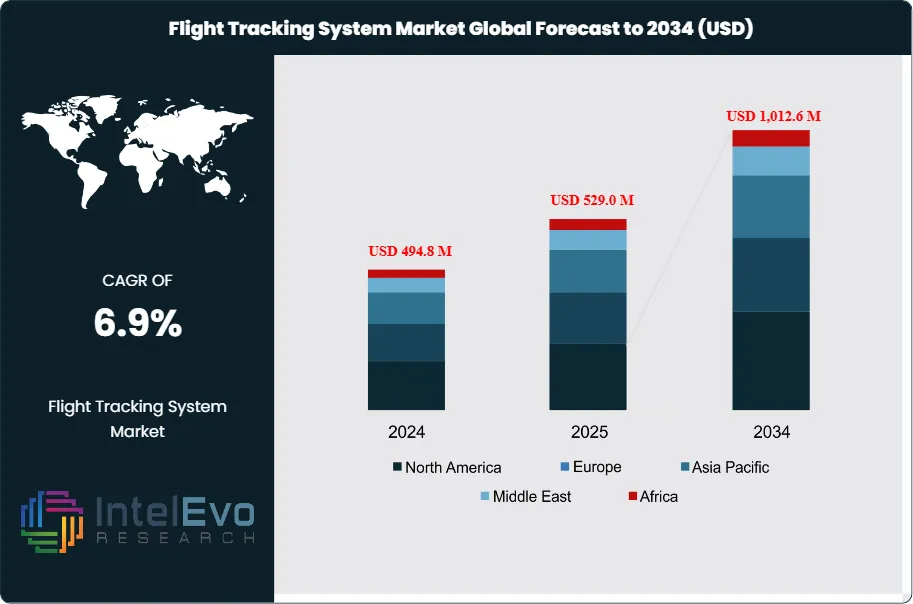
The Flight Tracking System Market was valued at approximately USD 494.8 Million in 2024 and is projected to reach nearly USD 1,012.6 Million by 2034, growing at an estimated CAGR of around 6.9% from 2025 to 2034. Rising aviation safety mandates, ICAO compliance requirements, and the rapid shift toward satellite-based ADS-B technologies are accelerating global adoption. With airlines prioritizing real-time situational awareness, predictive analytics, and cloud-native surveillance platforms, flight tracking systems are becoming a core component of modern digital aviation infrastructure. The next decade will see strong momentum driven by fleet modernization and expanding global air traffic.
Get More Information about this report -
Request Free Sample ReportRising traffic and tighter safety mandates are expanding a market that has steadily shifted from radar-centric oversight to continuous, data-rich surveillance. The addressable base is large and active: flight-tracking platforms monitor about 156,613 flights daily on average, with roughly 10,412 aircraft airborne at any given moment; within this activity, 10,855 business flights and 3,942 cargo flights per day underscore resilient corporate travel and freight corridors even amid an 8% year-on-year dip in overall volumes. Against this backdrop, revenues continue to migrate toward solutions that ensure global coverage, high update rates, and seamless integration with airline operations.
Demand-side drivers center on safety, regulatory compliance, and passenger transparency. Aviation authorities, including ICAO, are pressing for more frequent position reporting and end-to-end visibility, catalyzing fleetwide upgrades. Airlines also seek operational gains—shorter disruption windows, faster turnarounds, and better irregular-operations management—through real-time alerts and automated workflows. On the supply side, vendors are bundling hardware-agnostic software, APIs, and cloud-native analytics to shorten deployment cycles and improve total cost of ownership. Key challenges include integration with legacy avionics, cybersecurity and data governance, bandwidth costs for high-latency links over oceanic routes, and uneven airport/ANSP digital maturity that can slow multi-stakeholder rollouts.
Technology is the market’s fulcrum. Satellite-based ADS-B, multilateration, and multi-source data fusion now enable minute-by-minute tracking over remote and oceanic regions previously invisible to primary radar. Next-wave upgrades emphasize edge processing for faster exception detection, AI for anomaly and conformance monitoring, predictive maintenance signals derived from trajectory and environmental data, and automation that pushes contextual alerts directly into OCC tools, EFBs, and passenger apps. Regionally, North America led in 2024 with over 40% share and about USD 187.8 million in revenue, supported by large fleets, robust compliance budgets, and a dense vendor ecosystem. Asia–Pacific is emerging as the growth pacesetter on the back of fleet expansion and ATM modernization, while the Middle East’s long-haul hubs and select Latin American and African corridors are becoming investment hotspots as satellite coverage fills historical gaps and public–private programs accelerate adoption.

Key Takeaways
- Market Growth: The Global Flight Tracking System Market is set to rise from USD 494.8 Million (2024) to USD 1,012.6 Million by 2034 at a 6.90% CAGR, adding ~USD 324.9 million in incremental revenue; growth is anchored by safety mandates, real-time operational visibility, and expanding global coverage.
- Technology (ADS-B): ADS-B led in 2024 with >54% share (~USD 253.5 million), reflecting regulatory adoption and superior coverage versus radar; if the share sustains, ADS-B revenues would scale to ~USD 429.0 million by 2034.
- End Use (Civil Aviation): Civil aviation captured >57% share (~USD 267.6 million) in 2024, driven by compliance requirements and fleetwide operations control; at steady share, the segment would approach ~USD 452.8 million by 2034.
- Driver: Regulatory and operational imperatives are intensifying demand—flight-tracking platforms monitor ~156,613 flights daily on average with ~10,412 aircraft simultaneously airborne, pushing airlines to invest in continuous, high-fidelity tracking and passenger transparency.
- Restraint: Near-term spending is tempered by softer traffic and integration complexity—global flight activity was down ~8% year over year, and multi-stakeholder, legacy-system integrations extend rollout timelines and raise program risk.
- Opportunity: Remote/oceanic coverage and emerging-market airspace modernization present outsized upside; a 2-percentage-point regional share gain equates to ~USD 15.9 million in 2034 market value, with cargo corridors (~3,942 flights/day) offering monetizable use cases for premium tracking.
- Trend: Minute-by-minute global tracking via satellite-based ADS-B and multi-source data fusion is becoming standard, with AI-enabled conformance monitoring and anomaly detection increasingly embedded in OCC tools and EFB workflows.
- Regional Analysis: North America led in 2024 with >40% share (~USD 187.8 million) on the back of large fleets and robust compliance budgets; Asia–Pacific is emerging as the growth pacesetter as fleets expand and ATM systems modernize, likely outpacing the global 6.40% CAGR.
System Analysis
As of 2025, ADS-B remains the backbone of flight tracking, accounting for well over half of global revenues and an estimated ~USD 282 million in sales this year out of a ~USD 522 million market. Sustained regulatory enforcement in North America and Europe, expanding space-based coverage, and integration into airline operations centers (OCC), electronic flight bags (EFB), and air traffic management (ATM) toolchains underpin its lead. If ADS-B’s share holds through the decade, segment revenues would approach ~USD 366 million by 2030 (vs. a total market of ~USD 679 million at a 5.4% CAGR), supported by higher update rates, multilateration fusion, and anomaly/conformance monitoring increasingly embedded by vendors such as Aireon, FlightAware, Collins Aerospace, and Honeywell.
FANS (Future Air Navigation System) is gaining relevance across long-haul and oceanic routes where controller–pilot data link communications (CPDLC) and reduced separation standards translate directly into fuel and time savings. Airlines upgrading wide-body fleets are prioritizing dual-stack deployments (ADS-B + FANS) to ensure continuity over remote airspace; as a result, FANS is growing slightly faster than the overall market (≈100–150 bps above headline CAGR) as transoceanic sectors normalize and new aircraft deliveries resume.
Portable/plug-and-play flight tracking solutions (PFTS) serve general and business aviation, charter, and small carriers that require global visibility without full avionics retrofits. Leveraging compact GNSS/Iridium devices and cloud APIs, PFTS typically sit at a low-teens revenue share in 2025 (~USD 60–75 million) but are the fastest-expanding system category, buoyed by subscription pricing, rapid installation cycles, and bundled alerting/SAR features that compress time-to-value for lean operations teams.
End-Use Analysis
Civil aviation remains the demand anchor in 2025 with >57% share—equivalent to roughly USD 297 million—driven by compliance mandates, dense network operations, and passenger transparency requirements. Multi-source tracking (satellite ADS-B + terrestrial feeds) and AI-assisted disruption management are becoming standard in large carriers, improving route conformance and irregular operations response while lowering diversions and delay minutes.
General aviation—including business jets, air taxis, and charter—continues to scale adoption as operators monetize punctuality, safety credentials, and live flight status for customers. Activity levels exceeding 10,000 business flights per day globally support a resilient upgrade cycle; here, PFTS and hybrid data-as-a-service bundles are growing above the market average, aided by minimal downtime for installation and fleet-wide visibility via mobile first interfaces.
Military aircraft uptake is more selective due to operational security, encrypted communications, and platform diversity. Nevertheless, defense users are expanding use of secure, policy-controlled tracking for search-and-rescue (SAR), training airspace management, and humanitarian missions. Growth trails civil segments in percentage terms, but modernization programs and dual-use collaborations (civil ATC interfaces with military corridors) are widening the installed base through 2030.
Regional Analysis
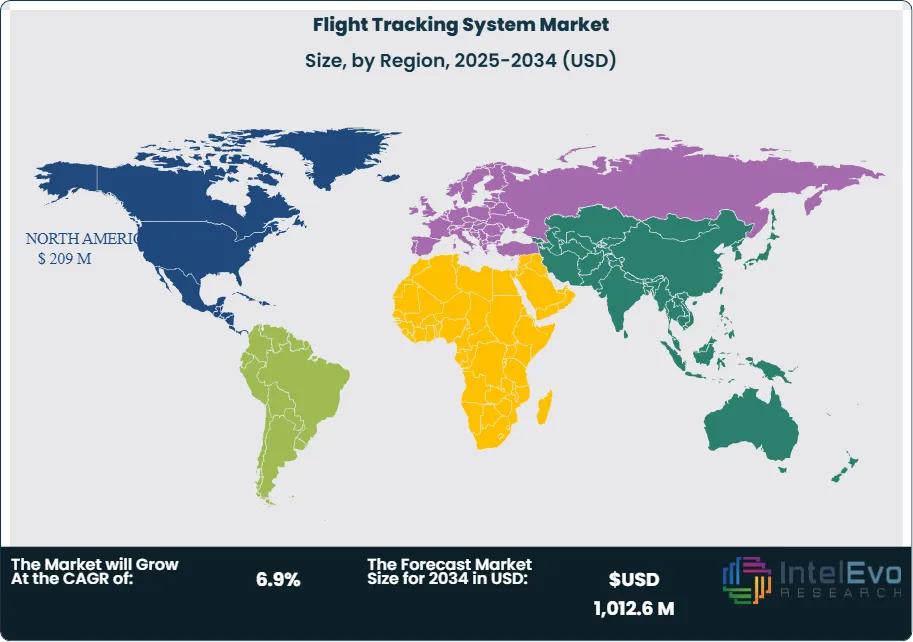
North America retains the largest regional position in 2025 at ~USD 209 million (≈40% share), supported by one of the world’s busiest airspaces, mature ADS-B equipage, and a concentrated vendor ecosystem that accelerates feature rollout and interoperability with FAA systems. Europe follows with high equipage across core markets and continued investment in cross-border ATM harmonization, sustaining a high-20s to low-30s share.
Asia Pacific is the growth pacesetter through 2030, propelled by fleet additions in India and Southeast Asia, wide-body deliveries resuming on long-haul corridors, and ATM modernization that extends space-based surveillance over oceanic routes. Regional growth is expected to exceed the global 5.4% CAGR by ~150–250 bps; every 1-point share gain in 2030 equates to roughly USD 6.8 million in additional regional revenue.
Latin America and the Middle East & Africa are expanding from a smaller base as satellite-enabled coverage reduces historical surveillance gaps and hub carriers in the Gulf drive higher standards for long-haul tracking. Public–private programs, donor-backed ATM upgrades, and the spread of subscription PFTS in secondary markets collectively lift adoption, with corridor-specific projects (cargo and humanitarian routes) creating targeted demand “hotspots” across the decade.
Get More Information about this report -
Request Free Sample ReportMarket Key Segments
By System
- ADS-B
- FANS
- PFTS
By End-Use
- General Aviation
- Civil Aviation
- Military Aircraft
By Regions
- North America
- Latin America
- East Asia And Pacific
- Sea And South Asia
- Eastern Europe
- Western Europe
- Middle East & Africa
| Report Attribute | Details |
| Market size (2024) | USD 494.8 M |
| Forecast Revenue (2034) | USD 1,012.6 M |
| CAGR (2024-2034) | 6.9% |
| Historical data | 2020-2023 |
| Base Year For Estimation | 2024 |
| Forecast Period | 2025-2034 |
| Report coverage | Revenue Forecast, Competitive Landscape, Market Dynamics, Growth Factors, Trends and Recent Developments |
| Segments covered | By System (ADS-B, FANS, PFTS), By End-Use (General Aviation, Civil Aviation, Military Aircraft) |
| Research Methodology |
|
| Regional scope |
|
| Competitive Landscape | Airbus SAS (NAVBLUE), ACR Electronics Inc., Aireon, Garmin Ltd., SITA, Raytheon Technologies Corporation, Spider Tracks Limited, Lufthansa Systems, Honeywell International Inc., IBM Corporation, Blue Sky Network, Sabre, FLYHT Aerospace Solutions Ltd., Other Key Players |
| Customization Scope | Customization for segments, region/country-level will be provided. Moreover, additional customization can be done based on the requirements. |
| Pricing and Purchase Options | Avail customized purchase options to meet your exact research needs. We have three licenses to opt for: Single User License, Multi-User License (Up to 5 Users), Corporate Use License (Unlimited User and Printable PDF). |


Frequently Asked Questions
How big is the Flight Tracking System Market?
The Flight Tracking System Market will grow from USD 494.8M in 2024 to USD 1.01B by 2034, driven by ICAO mandates, satellite ADS-B adoption, and rising global aviation safety needs.
Who are the major players in the Flight Tracking System Market?
Airbus SAS (NAVBLUE), ACR Electronics Inc., Aireon, Garmin Ltd., SITA, Raytheon Technologies Corporation, Spider Tracks Limited, Lufthansa Systems, Honeywell International Inc., IBM Corporation, Blue Sky Network, Sabre, FLYHT Aerospace Solutions Ltd., Other Key Players
Which segments covered the Flight Tracking System Market?
By System (ADS-B, FANS, PFTS), By End-Use (General Aviation, Civil Aviation, Military Aircraft)
How can this market research report help my business make strategic decisions?
Our market research reports provide actionable intelligence, including verified market size data, CAGR projections, competitive benchmarking, and segment-level opportunity analysis. These insights support strategic planning, investment decisions, product development, and market entry strategies for enterprises and startups alike.
How frequently is the data updated?
We continuously monitor industry developments and update our reports to reflect regulatory changes, technological advancements, and macroeconomic shifts. Updated editions ensure you receive the latest market intelligence.

Select Licence Type
Connect with our sales team

Flight Tracking System Market
Published Date : 21 Nov 2025 | Formats :Why IntelEvoResearch
100%
Customer
Satisfaction
24x7+
Availability - we are always
there when you need us
200+
Fortune 50 Companies trust
IntelEvoResearch
80%
of our reports are exclusive
and first in the industry
100%
more data
and analysis
1000+
reports published
till date
