

- Home
- Industries
 Aerospace And Defence
 Agriculture
 Automotive And Transportation
 Banking And Finance
 Business
 Chemicals And Materials
 Consumer And Retail
 Electronics And Semiconductors
 Food And Beverages
 Machinery & Equipments
 Manufacturing And Construction
 Medical Devices
 Others
 Pharmaceuticals And Healthcare
 Power And Energy
 Sports
 Technology
- Services
- News Room
- About us
- Contact Us
-
Global Gene Silencing Therapy Market Size, Share | CAGR of 12.2%
Global Gene Silencing Therapy Market Size, Share & Growth Analysis Report By Modality (RNAi, Antisense Oligonucleotides, miRNA), By Delivery Technology (LNPs, Viral Vectors, Conjugates), By Application (Genetic Disorders, Oncology, Infectious Diseases), By End-User (Hospitals, Pharma & Biotech, Academic Institutes, CROs): Regional Segment Overview, Market Dynamics, Competitive Landscape, Emerging Technologies, Investment Trends & Forecast 2026–2034

Report Overview
| Market Size (2025) | Forecast Value (2034) | CAGR (2026-2034) | Largest Region (2025) |
| USD 8.70 Billion | USD 24.50 Billion | 12.2% | North America, 41.2% |
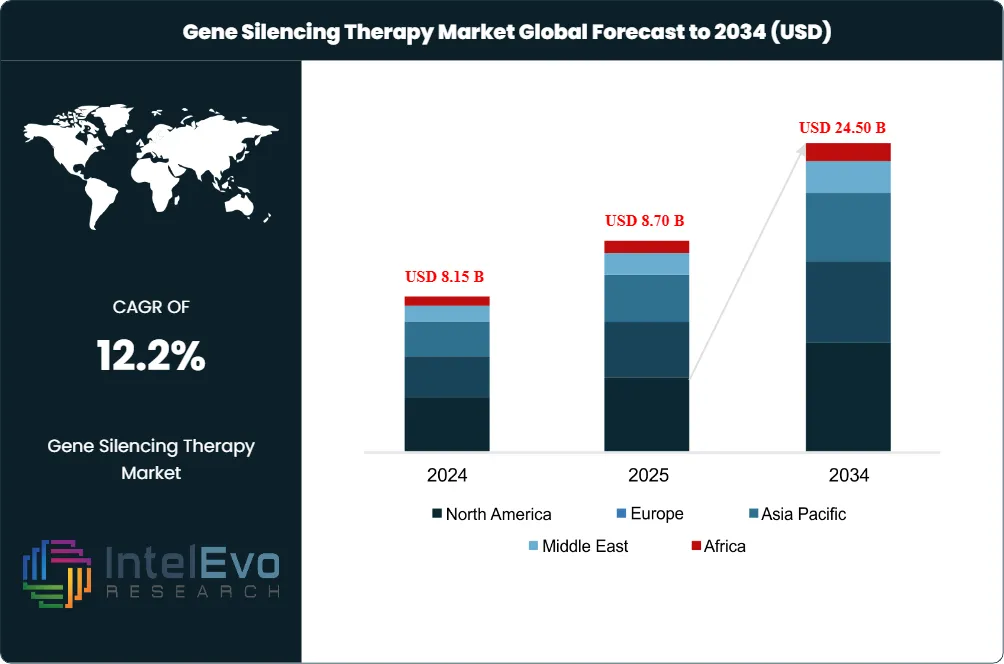
The Gene Silencing Therapy Market was valued at USD 8.15 Billion in 2024 and reached USD 8.70 Billion in 2025. The market is projected to reach USD 24.50 Billion by 2034, expanding at a CAGR of 12.2% during the forecast period from 2026 to 2034. This represents an absolute dollar opportunity of USD 15.80 Billion across the analysis horizon.
Get More Information about this report -
Request Free Sample ReportThree forces drive demand. Commercial proof of concept has accumulated as 2025 marked the first profitable year for Alnylam Pharmaceuticals, with combined product revenue rising 81% to USD 3.0 Billion. Regulatory acceptance has widened: the FDA approved Amvuttra (vutrisiran) for ATTR cardiomyopathy in March 2025, expanding Alnylam's addressable patient population to over 300,000 globally; Arrowhead won its first commercial approval in November 2025 with Redemplo (plozasiran) for familial chylomicronemia syndrome; and Ionis Pharmaceuticals secured Dawnzera (donidalorsen) approval in August 2025 as the first RNA-targeted prophylactic treatment for hereditary angioedema. The category is also moving into mass-market cardiovascular indications, with Novartis's Leqvio (inclisiran) reaching USD 1.2 Billion in 2025 sales (up 57% at constant currency) after the FDA cleared its monotherapy label in July 2025.
Capital flows have intensified. Novartis announced its USD 12.0 Billion acquisition of Avidity Biosciences on October 26, 2025, valuing the antibody-oligonucleotide conjugate specialist at USD 72 per share and closing in February 2026. Arrowhead Pharmaceuticals secured a USD 200 million upfront and up to USD 2.0 Billion in milestones from Novartis in November 2025 for its alpha-synuclein siRNA program. Sarepta Therapeutics paid Arrowhead USD 300 million in milestones during fiscal 2025 against a USD 825 million collaboration framework.
Geographic concentration is heavy at the top end. North America accounted for 41.2% of 2025 revenue, anchored by U.S. patient demand for Amvuttra, Spinraza, and Leqvio. Asia Pacific, expanding at 14.8% expected CAGR through 2034, represented 24.5% of the 2025 market as Chinese pharma adopted RNA platforms and Japan secured Amvuttra approval for ATTR-CM during 2025. By 2034, the market is expected to broaden out from rare-disease anchor indications into cardiovascular prevention and metabolic health, with subcutaneous siRNA candidates targeting INHBE for obesity and Lp(a) for cardiovascular risk reduction.
Market Definition & Scope
The gene silencing therapy market is defined as the segment of pharmaceutical sales and clinical-stage development covering RNA-based therapies that suppress, degrade, or modify expression of disease-causing genes. The market encompasses small interfering RNA (siRNA) therapeutics, antisense oligonucleotides (ASOs), microRNA-based therapeutics, and antibody-oligonucleotide conjugates (AOCs). Mechanisms of action include post-transcriptional silencing via the RNA-induced silencing complex, RNase H-mediated mRNA cleavage, exon skipping, and translational arrest.
In scope are net product revenues for approved gene silencing therapies, royalty revenue tied to siRNA and ASO products, and partnered milestone payments where a gene silencing asset is the underlying deliverable. Out of scope are research-grade siRNA reagents and kits sold for laboratory use, gene replacement therapies (such as Zolgensma and Elevidys), CRISPR-based gene editing therapeutics, and mRNA vaccines. The parent market is the broader gene therapy industry; gene silencing therapeutics represent the largest revenue segment within that parent in 2025.

Key Takeaways
- Market Growth: Sized at USD 8.70 Billion in 2025 and projected to reach USD 24.50 Billion by 2034 at a 12.2% CAGR.
- Segment Dominance (By Modality): The siRNA sub-segment captured 58.4% of 2025 revenue, driven by Alnylam's TTR franchise (Amvuttra plus Onpattro at USD 2.5 Billion) and Novartis's Leqvio (USD 1.2 Billion).
- Segment Dominance (By Application): Rare genetic diseases held 49.7% share in 2025, reflecting the historical anchor indications of hereditary ATTR amyloidosis, spinal muscular atrophy, and familial chylomicronemia syndrome.
- Driver: Per-patient pricing of USD 200,000 to USD 500,000 annually for ATTR and rare disease products supports premium revenue capture from a relatively concentrated patient population.
- Restraint: Delivery beyond the liver remains technically constrained, with central nervous system, lung, and kidney targets dependent on intrathecal delivery or aerosol formulations that limit patient acceptability.
- Opportunity: USD 15.80 Billion of absolute dollar opportunity exists between 2025 and 2034, with cardiovascular indications driving the next leg of growth as Leqvio entered first-line monotherapy use following the July 2025 FDA label update.
- Trend: Antibody-oligonucleotide conjugates emerged as a strategic category in 2025 with Novartis's USD 12 Billion acquisition of Avidity Biosciences for late-stage neuromuscular AOCs.
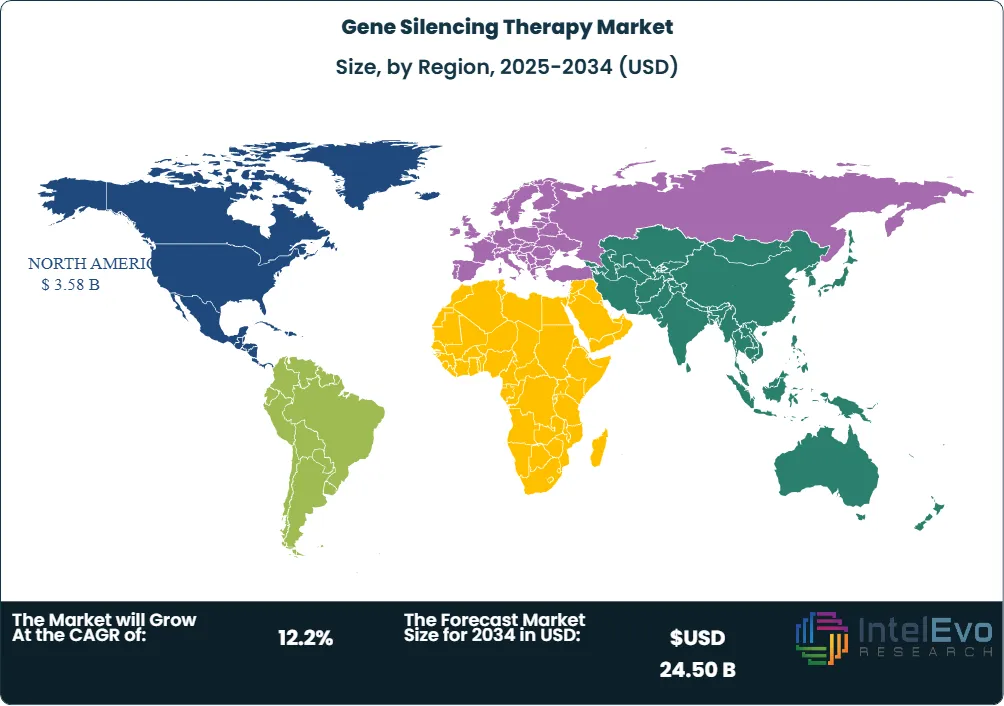
- Regional: North America held the largest share at 41.2%, equivalent to USD 3.58 Billion in 2025.
Key Insights Summary
- Alnylam Pharmaceuticals reported full-year 2025 product revenue of USD 3.0 Billion (up 81% year on year), with the TTR franchise (Amvuttra plus Onpattro) reaching USD 2.5 Billion or 83% of total product sales.
- Amvuttra (vutrisiran) revenue grew 138% to USD 2.3 Billion following its March 2025 FDA approval for ATTR cardiomyopathy, with Q3 2025 net product revenue alone reaching USD 685 million.
- Novartis's Leqvio (inclisiran) generated USD 1.2 Billion in 2025 (up 57% at constant currency); on July 31, 2025 the FDA approved its monotherapy label for hypercholesterolemia, removing the prior statin-combination requirement.
- Ionis Pharmaceuticals reported full-year 2025 revenue of USD 944 million; Tryngolza (olezarsen) delivered USD 108 million in its first full year on the market for familial chylomicronemia syndrome.
- On August 21, 2025, the FDA approved Ionis's Dawnzera (donidalorsen) as the only RNA-based prophylactic medicine cleared for hereditary angioedema in patients aged 12 and older.
- Arrowhead Pharmaceuticals received its first commercial approval on November 18, 2025, when Redemplo (plozasiran) won FDA clearance for familial chylomicronemia syndrome; Phase 3 results showed an 80% reduction in triglycerides from baseline.
- Wave Life Sciences's WVE-003 demonstrated a 46% reduction in mutant huntingtin protein at week 24 in cerebrospinal fluid in the SELECT-HD Phase 1b/2a trial, the first allele-selective lowering reported clinically in Huntington's disease.
Competitive Landscape Overview
The gene silencing therapy market is concentrated. Combined revenue share of the top four commercial players reached an estimated 64.5% in 2025, with Alnylam Pharmaceuticals at 34.5%, the Sarepta Therapeutics PMO franchise at 11.1%, Novartis (Leqvio) at 13.8%, and Ionis Pharmaceuticals (independent revenue plus royalties from partnered products) at 5.1%. The remaining 35.5% spreads across Arrowhead Pharmaceuticals (commercial-stage from November 2025), Biogen (Spinraza royalty payer), Wave Life Sciences, Silence Therapeutics, Arcturus Therapeutics, Moderna, and a long tail of clinical-stage challengers.
Three competitive dynamics defined 2025. First, Alnylam consolidated its TTR leadership, with Amvuttra ATTR-CM patient demand approximately doubling between Q2 and Q3 of 2025. Second, Novartis bought into the antibody-oligonucleotide conjugate category with the Avidity acquisition (signed October 26, 2025; closed February 27, 2026), positioning del-zota for Duchenne muscular dystrophy and a broader neuromuscular pipeline. Third, Ionis transitioned from a royalty-heavy business model to direct commercial scale, with three independent launches (Tryngolza, Dawnzera, and the upcoming olezarsen severe hypertriglyceridemia indication) underway. Sarepta Therapeutics faced a difficult year, with Elevidys gene therapy shipments suspended for non-ambulatory patients in June 2025 (a decision separate from its ASO-based PMO franchise, which generated USD 965.6 million in 2025).
Competitive Landscape Matrix
| Company | HQ | Position | Lead Product/Pipeline | Geographic Strength | Recent Strategic Move |
| Alnylam Pharmaceuticals, Inc. | USA | Leader | Amvuttra, Onpattro, Givlaari, Oxlumo, Leqvio (royalty) | North America, Europe, Asia | Reached its first profitable year in 2025 with product revenue rising 81% to USD 3.0 Billion; launched the Alnylam 2030 strategy on January 11, 2026. |
| Novartis AG | Switzerland | Leader | Leqvio (inclisiran), del-zota (post-Avidity) | Global | Bought Avidity Biosciences for USD 12.0 Billion (announced October 26, 2025; closed February 27, 2026); won FDA monotherapy label for Leqvio on July 31, 2025. |
| Sarepta Therapeutics, Inc. | USA | Leader | Exondys 51, Vyondys 53, Amondys 45 (PMO ASOs) | North America | PMO product revenue reached USD 965.6 million in 2025; secured USD 825 million siRNA collaboration framework with Arrowhead from late 2024. |
| Ionis Pharmaceuticals, Inc. | USA | Leader | Spinraza (royalty), Wainua, Tryngolza, Dawnzera | North America, Europe | Posted full-year 2025 revenue of USD 944 million; launched two independent commercial products in 2025 (Tryngolza in January, Dawnzera in August). |
| Arrowhead Pharmaceuticals, Inc. | USA | Challenger | Redemplo (plozasiran), TRiM siRNA pipeline | North America | Won first commercial approval (Redemplo for FCS) on November 18, 2025; banked USD 200 million upfront from Novartis on November 25, 2025. |
| Wave Life Sciences Ltd. | Singapore/USA | Challenger | WVE-003 (HD), WVE-007 (obesity), WVE-N531 (DMD) | North America | Reported first clinical allele-selective mutant huntingtin lowering data on March 19, 2026; on track to file an NDA for WVE-N531 in 2026. |
| Silence Therapeutics plc | UK | Challenger | Zerlasiran (Lp(a)), divesiran (PV) | Europe, North America | Reported positive Phase 2 ALPACAR-360 data on October 28, 2024 showing 95.3% Lp(a) reduction at 60 weeks. |
| Moderna, Inc. | USA | Niche Player | siRNA pipeline early-stage | North America | Continued shifting toward LNP-enabled discovery against rare metabolic targets through 2025. |
| Arcturus Therapeutics | USA | Niche Player | ARCT-810 (OTC deficiency), self-amplifying RNA | North America, Asia | Advanced ARCT-810 into Phase 2 in ornithine transcarbamylase deficiency in 2025. |
Segmentation Analysis
The gene silencing therapy market segments across four dimensions: by modality, by delivery technology, by application, and by end-user. Each axis carries distinct growth dynamics.
By Modality
By modality, the market splits into siRNA, antisense oligonucleotides, microRNA therapeutics, and antibody-oligonucleotide conjugates. siRNA dominated 2025 with 58.4% of revenue, anchored by Alnylam's TTR franchise (USD 2.5 Billion) and Novartis's Leqvio (USD 1.2 Billion). The siRNA category benefits from GalNAc conjugation chemistry, which delivers durable hepatocyte-targeted silencing with quarterly or semi-annual dosing schedules.
Antisense oligonucleotides held 36.4% of 2025 revenue, anchored by Spinraza (intrathecal nusinersen for spinal muscular atrophy with global sales above USD 1.7 Billion in 2025) and Sarepta's exon-skipping PMO franchise (USD 965.6 million). New ASO entrants in 2025 included Wainua (eplontersen) for ATTRv-PN, Tryngolza (olezarsen) for FCS, and Dawnzera (donidalorsen) for HAE. AOCs accounted for 4.2% in 2025 but become a strategic priority following the Novartis-Avidity transaction. MicroRNA therapeutics held 1.0%, with no broadly approved products yet.
By Delivery Technology
By delivery technology, GalNAc-conjugated siRNA captured 41.5% of 2025 revenue, up from 32% in 2023. The technology enables highly specific liver delivery and supports quarterly subcutaneous dosing. Lipid nanoparticles held 21.2% of revenue, anchored by Onpattro (the first approved RNAi therapy, with declining revenue as patients switched to Amvuttra) and a wider group of mRNA-derived products. Phosphorothioate-modified ASOs represented 28.6%, including Spinraza, Wainua, and the Sarepta PMOs. Antibody conjugates held 4.2%, and other technologies including peptide conjugates and gymnotic uptake covered 4.5%.
LNP and GalNAc both expand at double-digit CAGRs through 2034. The Towards Healthcare RNA interference therapy report from April 2026 placed LNP share of the U.S. RNAi therapy market at 52% in 2025. Bicycle Therapeutics, Dyne Therapeutics, and the post-merger Avidity unit are advancing peptide-conjugated and antibody-conjugated formats targeting muscle, central nervous system, and cardiac tissues.
By Application
By application, rare genetic diseases captured 49.7% of 2025 revenue, the largest sub-segment. Within this category, transthyretin-mediated amyloidosis led with USD 2.5 Billion in combined Alnylam and Ionis revenue; SMA, hereditary angioedema, familial chylomicronemia syndrome, and acute hepatic porphyria followed. Cardiovascular and metabolic indications captured 24.6% in 2025, anchored by Leqvio's hypercholesterolemia franchise. Oncology represented 11.6% of 2025 revenue, with Towards Healthcare's April 2026 analysis placing oncology at 34% of the broader U.S. RNAi therapy spend.
Neurological diseases held 13.4% of revenue, anchored by Spinraza for SMA. Wave Life Sciences's WVE-003 for Huntington's disease, Ionis's zilganersen for Alexander disease, and ION582 for Angelman syndrome are advancing in registrational programs. Other applications including infectious diseases and ophthalmology accounted for 0.7% of 2025 revenue.
By End-User
Hospitals and specialty clinics represented 51.2% of 2025 revenue, reflecting the prevalence of HCP-administered injection schedules for Amvuttra (quarterly), Leqvio (semi-annual), and Spinraza (intrathecal every four months after loading). Specialty pharmacies and home healthcare accounted for 28.7%, supporting subcutaneous self-administration of Wainua, Tryngolza, and Dawnzera. Academic medical centers held 14.8%, supporting clinical trials and rare-disease management. Other end-users including research institutes accounted for 5.3% of 2025 revenue.
Regional Analysis
The gene silencing therapy market spans five regions, with North America leading at 41.2% revenue share, equivalent to USD 3.58 Billion in 2025.
North America
North America held 41.2% of 2025 revenue at USD 3.58 Billion, anchored by U.S. patient demand and a network of specialty centers managing rare-disease populations. Alnylam recorded the majority of Amvuttra ATTR-CM volume in the U.S. during 2025, with broad payer coverage and most patients paying USD 0 in out-of-pocket costs. The FDA accelerated multiple gene silencing therapy approvals during 2025: Amvuttra ATTR-CM (March), Dawnzera HAE (August), Leqvio monotherapy label (July 31), and Redemplo FCS (November 18). Canada contributes through Health Canada cross-listings and McGill University clinical trial centers; the U.S. is forecast to reach USD 11.1 Billion by 2034 in U.S.-specific market data.
Europe
Europe captured 27.6% of 2025 revenue. The European Medicines Agency (EMA) approved Amvuttra for ATTR-CM in Q3 2025, following a positive CHMP opinion in Q1; Tryngolza secured EU approval in 2025 and Donidalorsen reached EU market in January 2026. Germany, France, the United Kingdom, and Italy led prescribing volume, with Spinraza and Onpattro both available across major EU markets. The UK biopharmaceutical industry hosts Silence Therapeutics, anchoring Phase 3 development of zerlasiran for elevated lipoprotein(a). National pricing reviews in Germany (G-BA) and the UK (NICE) compress headline prices but support broad reimbursement once accepted.
Asia Pacific
Asia Pacific held 24.5% of 2025 revenue and is the fastest-growing region at a 14.8% expected CAGR through 2034. Japan's PMDA approved Amvuttra for ATTR-CM in Q2 2025, broadening Alnylam's TTR launch into the country with the world's third-largest pharmaceutical market. China's National Medical Products Administration approved Leqvio in August 2023, and Novartis is scaling commercial deployment through 2025-2026. Sirnaomics, headquartered in Suzhou with U.S. operations, advances RNAi candidates in oncology and fibrosis. India and South Korea drive academic research; Samsung Biologics is expanding contract development services for siRNA programs.
Latin America
Latin America held 4.2% of 2025 revenue. Brazil leads regional spending, with ANVISA approving Amvuttra for ATTR-CM during Q1 2025. Mexico, Argentina, and Colombia provide secondary markets through specialty distribution arrangements. Average per-patient list prices remain compressed compared to U.S. levels, with payer-led negotiations shaping access. Brazil's Pharmaceutical Industries Association reported R&D spending at approximately BRL 4.2 Billion in 2024.
Middle East & Africa
Middle East and Africa held 2.5% of 2025 revenue. The Gulf Cooperation Council countries (Saudi Arabia, UAE, Qatar) provide the bulk of regional revenue through high-net-worth medical tourism programs and sovereign-funded national health insurance access for rare-disease populations. Israel hosts active RNA therapy clinical trials, and South Africa anchors sub-Saharan distribution. The region remains import-dependent for commercial gene silencing products.
Country Analysis
United States
The U.S. gene silencing therapy market reached approximately USD 3.30 Billion in 2025 and is projected to expand at a country-specific CAGR of 11.4% through 2034. Three FDA actions reshaped the U.S. market in 2025: Amvuttra's ATTR-CM approval (March 20, 2025), Leqvio's monotherapy label expansion (July 31, 2025), and Redemplo's FCS approval (November 18, 2025). Alnylam and Ionis both reported broad payer coverage and most patients paying minimal out-of-pocket costs for new launches. The U.S. captures approximately 78% of global Amvuttra revenue based on 2025 disclosures.
Germany
Germany's gene silencing therapy market reached USD 320 million in 2025 with a country-specific CAGR of 11.6% through 2034. Germany leads European Spinraza prescribing volumes, supported by statutory health insurance coverage under the G-BA process. Onpattro and Amvuttra received reimbursement in 2018 and 2022 respectively; ATTR-CM expansion is rolling out through 2025-2026. The Federal Joint Committee classifies orphan rare-disease products at premium reimbursement tiers, supporting siRNA and ASO launch economics.
Japan
Japan's gene silencing therapy market reached USD 580 million in 2025 with a country-specific CAGR of 12.8% through 2034. The PMDA approved Amvuttra for ATTR-CM in Q2 2025 based on HELIOS-B data, and Spinraza retains a strong franchise in Japanese SMA care. Sumitomo Pharma and other Japanese partners support distribution; Alnylam holds direct commercial operations in Tokyo. The Sakigake designation allows expedited PMDA review for first-in-class therapies.
United Kingdom
The U.K. gene silencing therapy market reached USD 220 million in 2025 with a country-specific CAGR of 12.0% through 2034. Silence Therapeutics, headquartered in London, anchors a domestic Phase 3 pipeline for Lp(a) lowering with zerlasiran. NHS England commissioning and NICE technology appraisals shape reimbursement timelines, with Spinraza, Onpattro, and Leqvio all secured through managed access agreements. The UK Research and Innovation funding agency directed GBP 100 million to AI-life-sciences programs through its Engineering Biology Mission Fund in 2024, supporting RNA platform development.
Get More Information about this report -
Request Free Sample ReportKey Market Segment
By Modality
- RNA Interference (RNAi)
- Antisense Oligonucleotides (ASOs)
- MicroRNA (miRNA)
- Other Gene Silencing Modalities
By Delivery Technology
- Lipid Nanoparticles (LNPs)
- Viral Vectors
- Conjugate-Based Delivery
- Other Delivery Technologies
By Application
- Genetic Disorders
- Oncology
- Infectious Diseases
- Other Applications
By End-User
- Hospitals & Specialty Clinics
- Pharmaceutical & Biotechnology Companies
- Academic & Research Institutes
- Contract Research Organizations (CROs)
By Regional Coverage
- North America
- Latin America
- East Asia And Pacific
- Sea And South Asia
- Eastern Europe
- Western Europe
- Middle East & Africa
| Report Attribute | Details |
| Market size (2025) | USD 8.70 B |
| Forecast Revenue (2034) | USD 24.50 B |
| CAGR (2025-2034) | 12.2% |
| Historical data | 2021-2025 |
| Base Year For Estimation | 2025 |
| Forecast Period | 2026-2034 |
| Report coverage | Revenue Forecast, Competitive Landscape, Market Dynamics, Growth Factors, Trends and Recent Developments |
| Segments covered | By Modality, (RNA Interference (RNAi), Antisense Oligonucleotides (ASOs), MicroRNA (miRNA), Other Gene Silencing Modalities), By Delivery Technology, (Lipid Nanoparticles (LNPs), Viral Vectors, Conjugate-Based Delivery, Other Delivery Technologies), By Application, (Genetic Disorders, Oncology, Infectious Diseases, Other Applications), By End-User, (Hospitals & Specialty Clinics, Pharmaceutical & Biotechnology Companies, Academic & Research Institutes, Contract Research Organizations (CROs)), |
| Research Methodology |
|
| Regional scope |
|
| Competitive Landscape | ALNYLAM PHARMACEUTICALS, INC., IONIS PHARMACEUTICALS, INC., NOVARTIS AG, ARROWHEAD PHARMACEUTICALS, INC., SAREPTA THERAPEUTICS, INC., BIOGEN INC., WAVE LIFE SCIENCES LTD., SILENCE THERAPEUTICS PLC, ARCTURUS THERAPEUTICS HOLDINGS INC., MODERNA, INC., BIONTECH SE, ARBUTUS BIOPHARMA CORPORATION, DICERNA PHARMACEUTICALS (NOVO NORDISK), SIRNAOMICS, INC., AVIDITY BIOSCIENCES (NOVARTIS SUBSIDIARY), DYNE THERAPEUTICS, INC., PROQR THERAPEUTICS, STOKE THERAPEUTICS, INC., REGULUS THERAPEUTICS INC., Others |
| Customization Scope | Customization for segments, region/country-level will be provided. Moreover, additional customization can be done based on the requirements. |
| Pricing and Purchase Options | Avail customized purchase options to meet your exact research needs. We have three licenses to opt for: Single User License, Multi-User License (Up to 5 Users), Corporate Use License (Unlimited User and Printable PDF). |


Frequently Asked Questions
How big is the Gene Silencing Therapy Market?
The Global Gene Silencing Therapy Market was valued at USD 8.15 Billion in 2024 and is projected to reach USD 24.50 Billion by 2034, growing at a CAGR of 12.2% during the forecast period 2026–2034.
Who are the major players in the Gene Silencing Therapy Market?
ALNYLAM PHARMACEUTICALS, INC., IONIS PHARMACEUTICALS, INC., NOVARTIS AG, ARROWHEAD PHARMACEUTICALS, INC., SAREPTA THERAPEUTICS, INC., BIOGEN INC., WAVE LIFE SCIENCES LTD., SILENCE THERAPEUTICS PLC, ARCTURUS THERAPEUTICS HOLDINGS INC., MODERNA, INC., BIONTECH SE, ARBUTUS BIOPHARMA CORPORATION, DICERNA PHARMACEUTICALS (NOVO NORDISK), SIRNAOMICS, INC., AVIDITY BIOSCIENCES (NOVARTIS SUBSIDIARY), DYNE THERAPEUTICS, INC., PROQR THERAPEUTICS, STOKE THERAPEUTICS, INC., REGULUS THERAPEUTICS INC., Others
Which segments covered the Gene Silencing Therapy Market?
By Modality, (RNA Interference (RNAi), Antisense Oligonucleotides (ASOs), MicroRNA (miRNA), Other Gene Silencing Modalities), By Delivery Technology, (Lipid Nanoparticles (LNPs), Viral Vectors, Conjugate-Based Delivery, Other Delivery Technologies), By Application, (Genetic Disorders, Oncology, Infectious Diseases, Other Applications), By End-User, (Hospitals & Specialty Clinics, Pharmaceutical & Biotechnology Companies, Academic & Research Institutes, Contract Research Organizations (CROs)),
How can this market research report help my business make strategic decisions?
Our market research reports provide actionable intelligence, including verified market size data, CAGR projections, competitive benchmarking, and segment-level opportunity analysis. These insights support strategic planning, investment decisions, product development, and market entry strategies for enterprises and startups alike.
How frequently is the data updated?
We continuously monitor industry developments and update our reports to reflect regulatory changes, technological advancements, and macroeconomic shifts. Updated editions ensure you receive the latest market intelligence.

Select Licence Type
Connect with our sales team

Gene Silencing Therapy Market
Published Date : 25 Jul 2026 | Formats :Why IntelEvoResearch
100%
Customer
Satisfaction
24x7+
Availability - we are always
there when you need us
200+
Fortune 50 Companies trust
IntelEvoResearch
80%
of our reports are exclusive
and first in the industry
100%
more data
and analysis
1000+
reports published
till date