
Generative AI in Media & Entertainment Market Size 2025–2034 | CAGR 27.1%
Global Generative AI in Media and Entertainment Market Size, Share, Growth & Analysis By Type (Text-to-Image, Image-to-Image, Video Generation, Music Generation, 3D Modeling & Animation), By Deployment Mode (Cloud-Based, On-Premise), By Application (Gaming, Film & Television, Advertising & Marketing, Music Production, VR & AR), By Region & Key Players – Industry Overview, Market Dynamics, Competitive Strategies, Emerging Trends & Forecast 2025–2034
The Generative AI in Media and Entertainment Market is estimated to reach approximately USD 2.05 billion in 2025 and is projected to surge to around USD 19.8 billion by 2034, registering an accelerated compound annual growth rate (CAGR) of about 27.1% during the forecast period from 2026 to 2034. This rapid expansion is driven by increasing adoption of AI-powered content creation tools across film, television, gaming, music, and digital advertising platforms. Media companies are leveraging generative AI for scriptwriting, visual effects, animation, personalized content, and virtual production to reduce production costs and shorten development timelines. Additionally, rising demand for immersive experiences, real-time personalization, and scalable content generation is positioning generative AI as a transformative force reshaping creative workflows and monetization models across the global entertainment ecosystem.
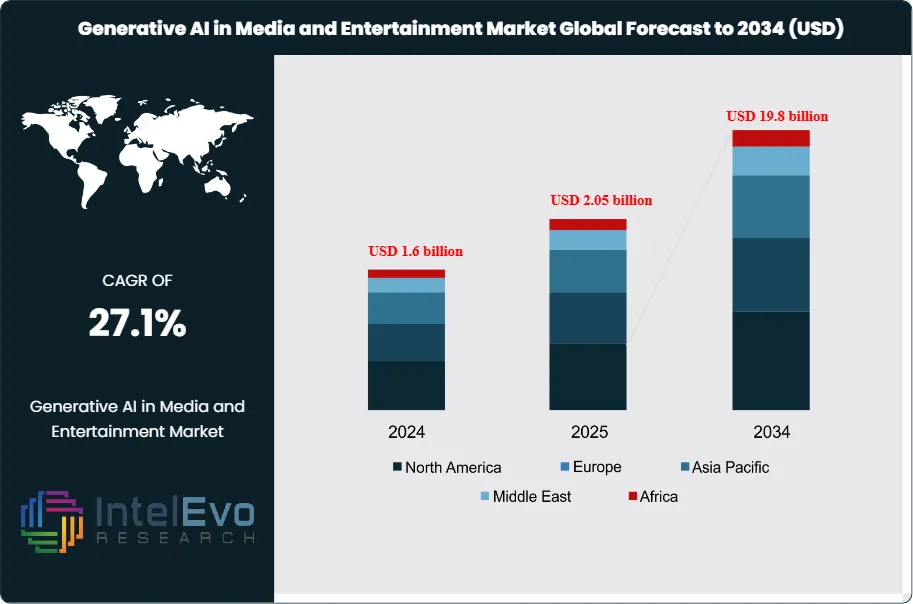
Advances in deep learning, transformer models, and multimodal architectures are changing how content is conceived, produced, and distributed. Studios, streaming platforms, gaming companies, and advertisers adopt generative AI to automate asset creation, compress production cycles, and deliver personalized experiences. In 2024, content creation and enhancement solutions account for an estimated 55% of global revenues, driven by script assistance, synthetic performers, and virtual production. Service providers, including consulting, integration, and managed AI operations, contribute roughly 30%, as enterprises seek guidance on model selection, workflow redesign, and risk management.
On the demand side, the shift to direct-to-consumer streaming, short-form video, and interactive formats increases pressure to release more content at lower marginal cost. Generative AI reduces post-production time by 20–40% in early deployments and allows marketing assets to be produced in minutes rather than days. On the supply side, hyperscale cloud platforms and specialized GPU infrastructure lower entry barriers for smaller studios and independent creators, while model vendors and startups compete to offer media-tuned tools. Talent gaps in AI engineering and data governance, together with rising compute costs, remain limiting factors.
Regulation and governance form a critical shaping force. Emerging rules on copyright, synthetic media disclosure, and child protection in digital content introduce new compliance requirements, particularly in North America and Europe, which represent around 60% of current market revenue. Providers implement consent management, watermarking, and content provenance controls, creating opportunities for assurance and monitoring services but increasing operational complexity. Intellectual property disputes and reputational exposure from misuse of generative tools are key constraints to faster adoption.
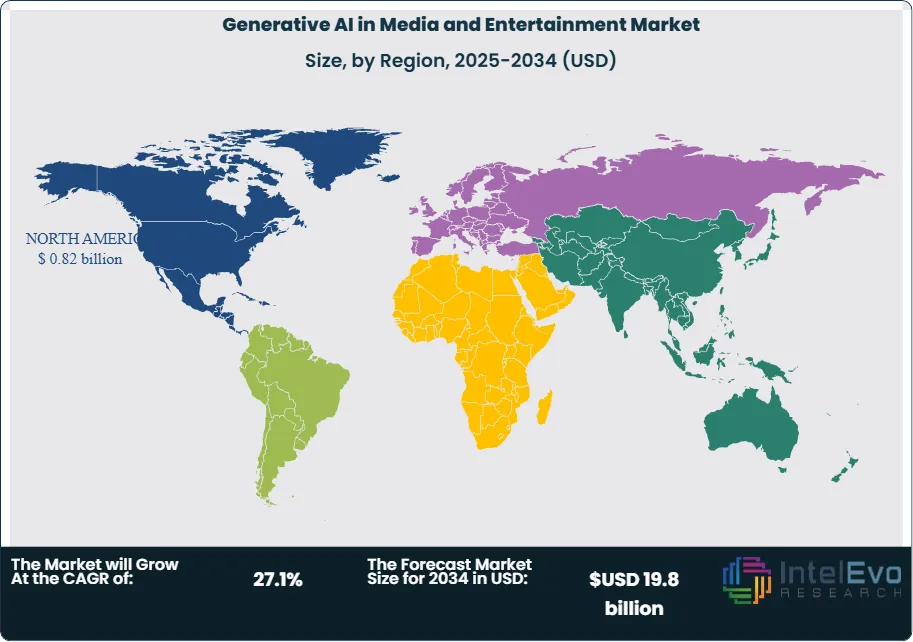
Regionally, North America holds an estimated 38% share in 2024, supported by major film studios, digital platforms, and advertising budgets. Europe follows with approximately 24%, influenced by public-service media and data-protection frameworks. Asia Pacific is the fastest-growing region, with a projected CAGR above 30%, underpinned by mobile-first consumers and local streaming platforms. Capital flows concentrate in virtual production, AI-assisted animation, real-time localization, and dynamic in-game content, positioning generative AI as a core capability in media and entertainment value creation.
Market Growth: The generative AI in media and entertainment market will reach USD 19.8 billion by 2034, supported by a high CAGR of 27.1%, 2026 to 2034, from an estimated USD 2.05 billion in 2025 base.
Segment Dominance: In deployment mode, cloud-based solutions hold a leading 52.7%, 2023 share because media enterprises prioritize scalability, flexibility, and cost efficiency for workloads valued at estimated: 1.5 billion USD, 2023.
Segment Dominance: Within solution types, text-to-image generation grows from 299.3 million USD, 2022 to 2,644.9 million USD, 2032. Gaming use cases expand from 477.7 million USD, 2022 to 4,817.2 million USD, 2032, reinforcing their role as anchor segments.
Driver: Demand for personalized, dynamic content and VR/AR experiences drives spending, with personalized media expected to represent estimated: 45.0% of generative AI project budgets, 2025 and overall adoption supporting a CAGR of 26.3%, 2024-2034.
Restraint: Data privacy, security concerns, and authenticity risks limit rollout, with an estimated: 30.0% of media organizations, 2024 citing regulatory uncertainty and high initial deployment costs near estimated: 1.0 million USD per large-scale implementation, 2024.
Opportunity: Vendors unlock upside by expanding into emerging markets expected to contribute estimated: 35.0% of global revenues, 2030 and by forming cross-industry alliances that can add estimated: 2.0 billion USD, 2034 in incremental value through education, training, and immersive formats.
Trend: Key trends include adoption of generative AI in advertising and AI-driven animation, with NLP-enhanced campaigns projected to lift engagement rates by estimated: 15.0%, 2026 and AI-based graphics tools potentially supporting 40.0% of new interactive media projects, 2028.
Regional Analysis: North America maintains leadership with a 40.6%, 2023 share of market revenue, while Europe holds an estimated: 25.0% share, 2023 and Asia Pacific accelerates toward an estimated: 30.0% share, 2034 as infrastructure investment and content innovation scale.
Deployment Mode
Cloud deployment continues to set the pace in 2025. Media and entertainment companies use cloud platforms to run generative AI workloads that rely on large datasets and high computational demand. Cloud environments captured more than 52 percent of global deployment in 2023 and are expected to hold a larger share through 2028 as studios, streaming platforms, and gaming firms shift more production tasks to remote pipelines. You gain access to pretrained models, scalable processing, and continuous updates without carrying the cost of in-house infrastructure. This matters for firms managing unpredictable workloads or operating on tight production cycles.
Cloud systems also support distributed teams. Production units in different countries can work on the same AI-generated assets in real time, which has become essential as remote collaboration remains part of the industry’s operating model. Cloud platforms now integrate AI-native rendering tools, real-time animation engines, and workflow orchestration systems that shorten delivery timelines across film, gaming, advertising, and post-production.
On-premise deployment maintains relevance for organizations that require strict control of sensitive assets. In 2025, large film studios, broadcasters, and security-focused enterprises continue to run proprietary models on local servers. These setups allow tighter control of high-value creative material and meet compliance requirements governing confidential or unreleased content. However, they also carry higher fixed costs and limited flexibility. As more organizations blend workloads across environments, hybrid models are gaining traction as a preferred configuration for companies that require both security and rapid scaling.
Type
Text-to-image tools continue to gain acceptance across production workflows. The segment grew from USD 299 million in 2022 and is expected to exceed USD 2.5 billion by 2032, supported by demand from advertising, digital publishing, and pre-visualization in film. Studios use these tools to create storyboards, concept art, and early-stage design assets in minutes rather than weeks. This improves creative throughput and reduces dependence on manual rendering during early phases of production.
Image-to-image generation remains essential in visual effects, animation, and digital art. Teams use these systems to refine textures, alter visual styles, and produce alternate scenes. Adoption rates continue to rise as creators shift repetitive editing and asset variations to automated tools. Music generation also advances quickly. Platforms use AI to produce background scores, thematic tracks, and adaptive soundscapes for games and streaming libraries. You see broader use among independent creators and production studios that require large volumes of audio assets.
Video generation and 3D modeling represent some of the fastest-growing categories. AI-based video tools support rapid creation of trailers, explainer clips, and short-form content, reducing production time and widening accessibility for marketing teams. In 3D modeling, AI enhances motion capture, scene building, and asset optimization used in gaming, animation, and mixed-reality applications. These tools reduce manual workload and speed up asset delivery for large-scale productions.
Application
Gaming remains the largest application area. The category grew from USD 477 million in 2022 to an expected multi-billion-dollar value by 2032 as developers use AI to build responsive environments, adaptive gameplay, and procedural assets. Generative AI supports character design, narrative branching, and content variations that enhance player engagement. You also see AI engines integrated into mobile, PC, and console titles as publishers aim to increase retention and accelerate content production.
Film and television continue to integrate AI across scripting, scene generation, localization, and visual effects. Production teams apply AI to automate rotoscoping, lighting adjustments, texture creation, and dialogue enhancement. The rise of global streaming heightens demand for faster post-production cycles and multilingual content, making AI-supported pipelines increasingly common. Advertising and marketing teams use generative AI to build large volumes of personalized assets. Brands rely on AI-driven images, videos, and audio creatives to adjust campaigns in real time.
Music and sound production benefit from AI tools that support composition, mixing, and automated mastering. These systems supply rapid variations of mood-based tracks for games, podcasts, and advertisements. VR and AR applications also grow as companies use AI to create immersive settings, responsive avatars, and training simulations. Additional uses in education, digital art, and interactive media highlight the expanding footprint of generative tools across creative sectors.
End-Use
Residential, commercial, and industrial environments across the entertainment ecosystem increasingly adopt generative AI as production processes shift to digital formats. Residential creators, including independent designers, streamers, and small studios, use text-to-image and AI video tools to scale content output at lower cost. Adoption rises among online creators as platforms prioritize short-form and personalized media.
Commercial end-users show the strongest growth. Studios, broadcasters, streaming services, and marketing agencies use generative models to reduce production times and expand multi-format content libraries. These organizations invest heavily in AI-supported editing, animation, dubbing, and automated advertising content. Industrial users, including large gaming publishers and high-budget film studios, rely on generative systems for advanced 3D modeling, environment design, and high-volume rendering tasks that require consistent output quality and strict workflow control.
Region
North America remains the leading market in 2025 with more than 40 percent share. The region benefits from strong investment in AI research, major cloud providers, and large entertainment ecosystems. US-based studios and streaming platforms adopt generative tools to accelerate production and personalization. Canada contributes growth through gaming and VFX clusters.
Europe follows with consistent expansion supported by active R&D programs in the UK, Germany, France, and the Nordics. Strict data-governance frameworks shape corporate adoption, while regional studios use AI to support localization, animation, and digital content distribution. Asia Pacific shows the fastest rise. Markets such as China, India, Japan, and South Korea increase usage across mobile entertainment, gaming, and e-commerce content. Wider internet access, growing creator economies, and investment in digital production hubs lift regional demand.
Latin America gains momentum as smartphone adoption and local content platforms increase the need for AI-supported creative tools. The Middle East and Africa continue to expand through investments in digital media, public-sector innovation programs, and emerging creator communities. The region sees rising interest in AI-generated content for marketing, entertainment, and virtual experiences.
By Deployment Mode (Cloud-Based, On-Premise), By Type (Text-to-Image Generation, Image-to-Image Generation, Music Generation, Video Generation, 3D Modeling and Animation), By Application (Gaming, Film & Television, Advertising & Marketing, Music & Sound Production, Virtual Reality (VR) and Augmented Reality (AR), Other Applications)
Research Methodology
Primary Research- 100 Interviews of Stakeholders
Secondary Research
Desk Research
Regional scope
North America (United States, Canada, Mexico)
Latin America (Brazil, Argentina, Columbia)
East Asia And Pacific (China, Japan, South Korea, Australia, Cambodia, Fiji, Indonesia)
Sea And South Asia (India, Singapore, Thailand, Taiwan, Malaysia)
Eastern Europe (Poland, Russia, Czech Republic, Romania)
Western Europe (Germany, U.K., France, Spain, Itlay)
Middle East & Africa (GCC Countries, Egypt, Nigeria, South Africa, Israel)
Customization for segments, region/country-level will be provided. Moreover, additional customization can be done based on the requirements.
Pricing and Purchase Options
Avail customized purchase options to meet your exact research needs. We have three licenses to opt for: Single User License, Multi-User License (Up to 5 Users), Corporate Use License (Unlimited User and Printable PDF).
TABLE OF CONTENTS
1. EXECUTIVE SUMMARY
1.1. MARKET SNAPSHOT
1.2. KEY FINDINGS & INSIGHTS
1.3. ANALYST RECOMMENDATIONS
1.4. FUTURE OUTLOOK
2. RESEARCH METHODOLOGY
2.1. MARKET DEFINITION & SCOPE
2.2. RESEARCH OBJECTIVES: PRIMARY & SECONDARY DATA SOURCES
2.3. DATA COLLECTION SOURCES
2.3.1. COVERAGE OF 100+ PRIMARY RESEARCH/CONSULTATION CALLS WITH INDUSTRY STAKEHOLDERS
FIGURE 17 NORTH AMERICA GENERATIVE AI IN MEDIA AND ENTERTAINMENT CURRENT AND FUTURE TYPE ANALYSIS, 2025–2034, (USD MILLION)
FIGURE 18 NORTH AMERICA GENERATIVE AI IN MEDIA AND ENTERTAINMENT CURRENT AND FUTURE END USER ANALYSIS, 2025–2034, (USD MILLION)
FIGURE 19 MARKET SHARE BY COUNTRY
FIGURE 20 LATIN AMERICA GENERATIVE AI IN MEDIA AND ENTERTAINMENT CURRENT AND FUTURE TYPE ANALYSIS, 2025–2034, (USD MILLION)
FIGURE 21 LATIN AMERICA GENERATIVE AI IN MEDIA AND ENTERTAINMENT CURRENT AND FUTURE END USER ANALYSIS, 2025–2034, (USD MILLION)
FIGURE 22 MARKET SHARE BY COUNTRY
FIGURE 23 EASTERN EUROPE GENERATIVE AI IN MEDIA AND ENTERTAINMENT CURRENT AND FUTURE TYPE ANALYSIS, 2025–2034, (USD MILLION)
FIGURE 24 EASTERN EUROPE GENERATIVE AI IN MEDIA AND ENTERTAINMENT CURRENT AND FUTURE END USER ANALYSIS, 2025–2034, (USD MILLION)
FIGURE 25 MARKET SHARE BY COUNTRY
FIGURE 26 WESTERN EUROPE GENERATIVE AI IN MEDIA AND ENTERTAINMENT CURRENT AND FUTURE TYPE ANALYSIS, 2025–2034, (USD MILLION)
FIGURE 27 WESTERN EUROPE GENERATIVE AI IN MEDIA AND ENTERTAINMENT CURRENT AND FUTURE END USER ANALYSIS, 2025–2034, (USD MILLION)
FIGURE 28 MARKET SHARE BY COUNTRY
FIGURE 29 EAST ASIA AND PACIFIC GENERATIVE AI IN MEDIA AND ENTERTAINMENT CURRENT AND FUTURE TYPE ANALYSIS, 2025–2034, (USD MILLION)
FIGURE 30 EAST ASIA AND PACIFIC GENERATIVE AI IN MEDIA AND ENTERTAINMENT CURRENT AND FUTURE END USER ANALYSIS, 2025–2034, (USD MILLION)
FIGURE 31 MARKET SHARE BY COUNTRY
FIGURE 32 SEA AND SOUTH ASIA GENERATIVE AI IN MEDIA AND ENTERTAINMENT CURRENT AND FUTURE TYPE ANALYSIS, 2025–2034, (USD MILLION)
FIGURE 33 SEA AND SOUTH ASIA GENERATIVE AI IN MEDIA AND ENTERTAINMENT CURRENT AND FUTURE END USER ANALYSIS, 2025–2034, (USD MILLION)
FIGURE 34 MARKET SHARE BY COUNTRY
FIGURE 35 MIDDLE EAST AND AFRICA GENERATIVE AI IN MEDIA AND ENTERTAINMENT CURRENT AND FUTURE TYPE ANALYSIS, 2025–2034, (USD MILLION)
FIGURE 36 MIDDLE EAST AND AFRICA GENERATIVE AI IN MEDIA AND ENTERTAINMENT CURRENT AND FUTURE END USER ANALYSIS, 2025–2034, (USD MILLION)
FIGURE 37 NORTH AMERICA GENERATIVE AI IN MEDIA AND ENTERTAINMENT CURRENT AND FUTURE MARKET VOLUME SHARE REGIONAL ANALYSIS, 2025–2034, (USD MILLION)
FIGURE 38 U.S. GENERATIVE AI IN MEDIA AND ENTERTAINMENT CURRENT AND FUTURE TYPE ANALYSIS, 2025–2034, (USD MILLION)
FIGURE 39 U.S. GENERATIVE AI IN MEDIA AND ENTERTAINMENT CURRENT AND FUTURE END USER ANALYSIS, 2025–2034, (USD MILLION)
FIGURE 40 CANADA GENERATIVE AI IN MEDIA AND ENTERTAINMENT CURRENT AND FUTURE TYPE ANALYSIS, 2025–2034, (USD MILLION)
FIGURE 41 CANADA GENERATIVE AI IN MEDIA AND ENTERTAINMENT CURRENT AND FUTURE END USER ANALYSIS, 2025–2034, (USD MILLION)
FIGURE 42 LATIN AMERICA GENERATIVE AI IN MEDIA AND ENTERTAINMENT CURRENT AND FUTURE MARKET VOLUME SHARE REGIONAL ANALYSIS, 2025–2034, (USD MILLION)
FIGURE 43 MEXICO GENERATIVE AI IN MEDIA AND ENTERTAINMENT CURRENT AND FUTURE TYPE ANALYSIS, 2025–2034, (USD MILLION)
FIGURE 44 MEXICO GENERATIVE AI IN MEDIA AND ENTERTAINMENT CURRENT AND FUTURE END USER ANALYSIS, 2025–2034, (USD MILLION)
FIGURE 45 BRAZIL GENERATIVE AI IN MEDIA AND ENTERTAINMENT CURRENT AND FUTURE TYPE ANALYSIS, 2025–2034, (USD MILLION)
FIGURE 46 BRAZIL GENERATIVE AI IN MEDIA AND ENTERTAINMENT CURRENT AND FUTURE END USER ANALYSIS, 2025–2034, (USD MILLION)
FIGURE 47 ARGENTINA GENERATIVE AI IN MEDIA AND ENTERTAINMENT CURRENT AND FUTURE TYPE ANALYSIS, 2025–2034, (USD MILLION)
FIGURE 48 ARGENTINA GENERATIVE AI IN MEDIA AND ENTERTAINMENT CURRENT AND FUTURE END USER ANALYSIS, 2025–2034, (USD MILLION)
FIGURE 49 COLUMBIA GENERATIVE AI IN MEDIA AND ENTERTAINMENT CURRENT AND FUTURE TYPE ANALYSIS, 2025–2034, (USD MILLION)
FIGURE 50 COLUMBIA GENERATIVE AI IN MEDIA AND ENTERTAINMENT CURRENT AND FUTURE END USER ANALYSIS, 2025–2034, (USD MILLION)
FIGURE 51 REST OF LATIN AMERICA GENERATIVE AI IN MEDIA AND ENTERTAINMENT CURRENT AND FUTURE TYPE ANALYSIS, 2025–2034, (USD MILLION)
FIGURE 52 REST OF LATIN AMERICA GENERATIVE AI IN MEDIA AND ENTERTAINMENT CURRENT AND FUTURE END USER ANALYSIS, 2025–2034, (USD MILLION)
FIGURE 53 EASTERN EUROPE GENERATIVE AI IN MEDIA AND ENTERTAINMENT CURRENT AND FUTURE MARKET VOLUME SHARE REGIONAL ANALYSIS, 2025–2034, (USD MILLION)
FIGURE 54 POLAND GENERATIVE AI IN MEDIA AND ENTERTAINMENT CURRENT AND FUTURE TYPE ANALYSIS, 2025–2034, (USD MILLION)
FIGURE 55 POLAND GENERATIVE AI IN MEDIA AND ENTERTAINMENT CURRENT AND FUTURE END USER ANALYSIS, 2025–2034, (USD MILLION)
FIGURE 56 RUSSIA GENERATIVE AI IN MEDIA AND ENTERTAINMENT CURRENT AND FUTURE TYPE ANALYSIS, 2025–2034, (USD MILLION)
FIGURE 57 RUSSIA GENERATIVE AI IN MEDIA AND ENTERTAINMENT CURRENT AND FUTURE END USER ANALYSIS, 2025–2034, (USD MILLION)
FIGURE 58 CZECH REPUBLIC GENERATIVE AI IN MEDIA AND ENTERTAINMENT CURRENT AND FUTURE TYPE ANALYSIS, 2025–2034, (USD MILLION)
FIGURE 59 CZECH REPUBLIC GENERATIVE AI IN MEDIA AND ENTERTAINMENT CURRENT AND FUTURE END USER ANALYSIS, 2025–2034, (USD MILLION)
FIGURE 60 ROMANIA GENERATIVE AI IN MEDIA AND ENTERTAINMENT CURRENT AND FUTURE TYPE ANALYSIS, 2025–2034, (USD MILLION)
FIGURE 61 ROMANIA GENERATIVE AI IN MEDIA AND ENTERTAINMENT CURRENT AND FUTURE END USER ANALYSIS, 2025–2034, (USD MILLION)
FIGURE 62 REST OF EASTERN EUROPE GENERATIVE AI IN MEDIA AND ENTERTAINMENT CURRENT AND FUTURE TYPE ANALYSIS, 2025–2034, (USD MILLION)
FIGURE 63 REST OF EASTERN EUROPE GENERATIVE AI IN MEDIA AND ENTERTAINMENT CURRENT AND FUTURE END USER ANALYSIS, 2025–2034, (USD MILLION)
FIGURE 64 WESTERN EUROPE GENERATIVE AI IN MEDIA AND ENTERTAINMENT CURRENT AND FUTURE MARKET VOLUME SHARE REGIONAL ANALYSIS, 2025–2034, (USD MILLION)
FIGURE 65 GERMANY GENERATIVE AI IN MEDIA AND ENTERTAINMENT CURRENT AND FUTURE TYPE ANALYSIS, 2025–2034, (USD MILLION)
FIGURE 66 GERMANY GENERATIVE AI IN MEDIA AND ENTERTAINMENT CURRENT AND FUTURE END USER ANALYSIS, 2025–2034, (USD MILLION)
FIGURE 67 FRANCE GENERATIVE AI IN MEDIA AND ENTERTAINMENT CURRENT AND FUTURE TYPE ANALYSIS, 2025–2034, (USD MILLION)
FIGURE 68 FRANCE GENERATIVE AI IN MEDIA AND ENTERTAINMENT CURRENT AND FUTURE END USER ANALYSIS, 2025–2034, (USD MILLION)
FIGURE 69 UK GENERATIVE AI IN MEDIA AND ENTERTAINMENT CURRENT AND FUTURE TYPE ANALYSIS, 2025–2034, (USD MILLION)
FIGURE 70 UK GENERATIVE AI IN MEDIA AND ENTERTAINMENT CURRENT AND FUTURE END USER ANALYSIS, 2025–2034, (USD MILLION)
FIGURE 71 SPAIN GENERATIVE AI IN MEDIA AND ENTERTAINMENT CURRENT AND FUTURE TYPE ANALYSIS, 2025–2034, (USD MILLION)
FIGURE 72 SPAIN GENERATIVE AI IN MEDIA AND ENTERTAINMENT CURRENT AND FUTURE END USER ANALYSIS, 2025–2034, (USD MILLION)
FIGURE 73 ITALY GENERATIVE AI IN MEDIA AND ENTERTAINMENT CURRENT AND FUTURE TYPE ANALYSIS, 2025–2034, (USD MILLION)
FIGURE 74 ITALY GENERATIVE AI IN MEDIA AND ENTERTAINMENT CURRENT AND FUTURE END USER ANALYSIS, 2025–2034, (USD MILLION)
FIGURE 75 REST OF WESTERN EUROPE GENERATIVE AI IN MEDIA AND ENTERTAINMENT CURRENT AND FUTURE TYPE ANALYSIS, 2025–2034, (USD MILLION)
FIGURE 76 REST OF WESTERN EUROPE GENERATIVE AI IN MEDIA AND ENTERTAINMENT CURRENT AND FUTURE END USER ANALYSIS, 2025–2034, (USD MILLION)
FIGURE 77 EAST ASIA AND PACIFIC GENERATIVE AI IN MEDIA AND ENTERTAINMENT CURRENT AND FUTURE MARKET VOLUME SHARE REGIONAL ANALYSIS, 2025–2034, (USD MILLION)
FIGURE 78 CHINA GENERATIVE AI IN MEDIA AND ENTERTAINMENT CURRENT AND FUTURE TYPE ANALYSIS, 2025–2034, (USD MILLION)
FIGURE 79 CHINA GENERATIVE AI IN MEDIA AND ENTERTAINMENT CURRENT AND FUTURE END USER ANALYSIS, 2025–2034, (USD MILLION)
FIGURE 80 JAPAN GENERATIVE AI IN MEDIA AND ENTERTAINMENT CURRENT AND FUTURE TYPE ANALYSIS, 2025–2034, (USD MILLION)
FIGURE 81 JAPAN GENERATIVE AI IN MEDIA AND ENTERTAINMENT CURRENT AND FUTURE END USER ANALYSIS, 2025–2034, (USD MILLION)
FIGURE 82 AUSTRALIA GENERATIVE AI IN MEDIA AND ENTERTAINMENT CURRENT AND FUTURE TYPE ANALYSIS, 2025–2034, (USD MILLION)
FIGURE 83 AUSTRALIA GENERATIVE AI IN MEDIA AND ENTERTAINMENT CURRENT AND FUTURE END USER ANALYSIS, 2025–2034, (USD MILLION)
FIGURE 84 CAMBODIA GENERATIVE AI IN MEDIA AND ENTERTAINMENT CURRENT AND FUTURE TYPE ANALYSIS, 2025–2034, (USD MILLION)
FIGURE 85 CAMBODIA GENERATIVE AI IN MEDIA AND ENTERTAINMENT CURRENT AND FUTURE END USER ANALYSIS, 2025–2034, (USD MILLION)
FIGURE 86 FIJI GENERATIVE AI IN MEDIA AND ENTERTAINMENT CURRENT AND FUTURE TYPE ANALYSIS, 2025–2034, (USD MILLION)
FIGURE 87 FIJI GENERATIVE AI IN MEDIA AND ENTERTAINMENT CURRENT AND FUTURE END USER ANALYSIS, 2025–2034, (USD MILLION)
FIGURE 88 INDONESIA GENERATIVE AI IN MEDIA AND ENTERTAINMENT CURRENT AND FUTURE TYPE ANALYSIS, 2025–2034, (USD MILLION)
FIGURE 89 INDONESIA GENERATIVE AI IN MEDIA AND ENTERTAINMENT CURRENT AND FUTURE END USER ANALYSIS, 2025–2034, (USD MILLION)
FIGURE 90 SOUTH KOREA GENERATIVE AI IN MEDIA AND ENTERTAINMENT CURRENT AND FUTURE TYPE ANALYSIS, 2025–2034, (USD MILLION)
FIGURE 91 SOUTH KOREA GENERATIVE AI IN MEDIA AND ENTERTAINMENT CURRENT AND FUTURE END USER ANALYSIS, 2025–2034, (USD MILLION)
FIGURE 92 REST OF EAST ASIA AND PACIFIC GENERATIVE AI IN MEDIA AND ENTERTAINMENT CURRENT AND FUTURE TYPE ANALYSIS, 2025–2034, (USD MILLION)
FIGURE 93 REST OF EAST ASIA AND PACIFIC GENERATIVE AI IN MEDIA AND ENTERTAINMENT CURRENT AND FUTURE END USER ANALYSIS, 2025–2034, (USD MILLION)
FIGURE 94 SEA AND SOUTH ASIA GENERATIVE AI IN MEDIA AND ENTERTAINMENT CURRENT AND FUTURE MARKET VOLUME SHARE REGIONAL ANALYSIS, 2025–2034, (USD MILLION)
FIGURE 95 BANGLADESH GENERATIVE AI IN MEDIA AND ENTERTAINMENT CURRENT AND FUTURE TYPE ANALYSIS, 2025–2034, (USD MILLION)
FIGURE 96 BANGLADESH GENERATIVE AI IN MEDIA AND ENTERTAINMENT CURRENT AND FUTURE END USER ANALYSIS, 2025–2034, (USD MILLION)
FIGURE 97 NEW ZEALAND GENERATIVE AI IN MEDIA AND ENTERTAINMENT CURRENT AND FUTURE TYPE ANALYSIS, 2025–2034, (USD MILLION)
FIGURE 98 NEW ZEALAND GENERATIVE AI IN MEDIA AND ENTERTAINMENT CURRENT AND FUTURE END USER ANALYSIS, 2025–2034, (USD MILLION)
FIGURE 99 INDIA GENERATIVE AI IN MEDIA AND ENTERTAINMENT CURRENT AND FUTURE TYPE ANALYSIS, 2025–2034, (USD MILLION)
FIGURE 100 INDIA GENERATIVE AI IN MEDIA AND ENTERTAINMENT CURRENT AND FUTURE END USER ANALYSIS, 2025–2034, (USD MILLION)
FIGURE 101 SINGAPORE GENERATIVE AI IN MEDIA AND ENTERTAINMENT CURRENT AND FUTURE TYPE ANALYSIS, 2025–2034, (USD MILLION)
FIGURE 102 SINGAPORE GENERATIVE AI IN MEDIA AND ENTERTAINMENT CURRENT AND FUTURE END USER ANALYSIS, 2025–2034, (USD MILLION)
FIGURE 103 THAILAND GENERATIVE AI IN MEDIA AND ENTERTAINMENT CURRENT AND FUTURE TYPE ANALYSIS, 2025–2034, (USD MILLION)
FIGURE 104 THAILAND GENERATIVE AI IN MEDIA AND ENTERTAINMENT CURRENT AND FUTURE END USER ANALYSIS, 2025–2034, (USD MILLION)
FIGURE 105 TAIWAN GENERATIVE AI IN MEDIA AND ENTERTAINMENT CURRENT AND FUTURE TYPE ANALYSIS, 2025–2034, (USD MILLION)
FIGURE 106 TAIWAN GENERATIVE AI IN MEDIA AND ENTERTAINMENT CURRENT AND FUTURE END USER ANALYSIS, 2025–2034, (USD MILLION)
FIGURE 107 MALAYSIA GENERATIVE AI IN MEDIA AND ENTERTAINMENT CURRENT AND FUTURE TYPE ANALYSIS, 2025–2034, (USD MILLION)
FIGURE 108 MALAYSIA GENERATIVE AI IN MEDIA AND ENTERTAINMENT CURRENT AND FUTURE END USER ANALYSIS, 2025–2034, (USD MILLION)
FIGURE 109 REST OF SEA AND SOUTH ASIA GENERATIVE AI IN MEDIA AND ENTERTAINMENT CURRENT AND FUTURE TYPE ANALYSIS, 2025–2034, (USD MILLION)
FIGURE 110 REST OF SEA AND SOUTH ASIA GENERATIVE AI IN MEDIA AND ENTERTAINMENT CURRENT AND FUTURE END USER ANALYSIS, 2025–2034, (USD MILLION)
FIGURE 111 MIDDLE EAST AND AFRICA GENERATIVE AI IN MEDIA AND ENTERTAINMENT CURRENT AND FUTURE MARKET VOLUME SHARE REGIONAL ANALYSIS, 2025–2034, (USD MILLION)
FIGURE 112 GCC COUNTRIES GENERATIVE AI IN MEDIA AND ENTERTAINMENT CURRENT AND FUTURE TYPE ANALYSIS, 2025–2034, (USD MILLION)
FIGURE 113 GCC COUNTRIES GENERATIVE AI IN MEDIA AND ENTERTAINMENT CURRENT AND FUTURE END USER ANALYSIS, 2025–2034, (USD MILLION)
FIGURE 114 SAUDI ARABIA GENERATIVE AI IN MEDIA AND ENTERTAINMENT CURRENT AND FUTURE TYPE ANALYSIS, 2025–2034, (USD MILLION)
FIGURE 115 SAUDI ARABIA GENERATIVE AI IN MEDIA AND ENTERTAINMENT CURRENT AND FUTURE END USER ANALYSIS, 2025–2034, (USD MILLION)
FIGURE 116 UAE GENERATIVE AI IN MEDIA AND ENTERTAINMENT CURRENT AND FUTURE TYPE ANALYSIS, 2025–2034, (USD MILLION)
FIGURE 117 UAE GENERATIVE AI IN MEDIA AND ENTERTAINMENT CURRENT AND FUTURE END USER ANALYSIS, 2025–2034, (USD MILLION)
FIGURE 118 BAHRAIN GENERATIVE AI IN MEDIA AND ENTERTAINMENT CURRENT AND FUTURE TYPE ANALYSIS, 2025–2034, (USD MILLION)
FIGURE 119 BAHRAIN GENERATIVE AI IN MEDIA AND ENTERTAINMENT CURRENT AND FUTURE END USER ANALYSIS, 2025–2034, (USD MILLION)
FIGURE 120 KUWAIT GENERATIVE AI IN MEDIA AND ENTERTAINMENT CURRENT AND FUTURE TYPE ANALYSIS, 2025–2034, (USD MILLION)
FIGURE 121 KUWAIT GENERATIVE AI IN MEDIA AND ENTERTAINMENT CURRENT AND FUTURE END USER ANALYSIS, 2025–2034, (USD MILLION)
FIGURE 122 OMAN GENERATIVE AI IN MEDIA AND ENTERTAINMENT CURRENT AND FUTURE TYPE ANALYSIS, 2025–2034, (USD MILLION)
FIGURE 123 OMAN GENERATIVE AI IN MEDIA AND ENTERTAINMENT CURRENT AND FUTURE END USER ANALYSIS, 2025–2034, (USD MILLION)
FIGURE 124 QATAR GENERATIVE AI IN MEDIA AND ENTERTAINMENT CURRENT AND FUTURE TYPE ANALYSIS, 2025–2034, (USD MILLION)
FIGURE 125 QATAR GENERATIVE AI IN MEDIA AND ENTERTAINMENT CURRENT AND FUTURE END USER ANALYSIS, 2025–2034, (USD MILLION)
FIGURE 126 EGYPT GENERATIVE AI IN MEDIA AND ENTERTAINMENT CURRENT AND FUTURE TYPE ANALYSIS, 2025–2034, (USD MILLION)
FIGURE 127 EGYPT GENERATIVE AI IN MEDIA AND ENTERTAINMENT CURRENT AND FUTURE END USER ANALYSIS, 2025–2034, (USD MILLION)
FIGURE 128 NIGERIA GENERATIVE AI IN MEDIA AND ENTERTAINMENT CURRENT AND FUTURE TYPE ANALYSIS, 2025–2034, (USD MILLION)
FIGURE 129 NIGERIA GENERATIVE AI IN MEDIA AND ENTERTAINMENT CURRENT AND FUTURE END USER ANALYSIS, 2025–2034, (USD MILLION)
FIGURE 130 SOUTH AFRICA GENERATIVE AI IN MEDIA AND ENTERTAINMENT CURRENT AND FUTURE TYPE ANALYSIS, 2025–2034, (USD MILLION)
FIGURE 131 SOUTH AFRICA GENERATIVE AI IN MEDIA AND ENTERTAINMENT CURRENT AND FUTURE END USER ANALYSIS, 2025–2034, (USD MILLION)
FIGURE 132 ISRAEL GENERATIVE AI IN MEDIA AND ENTERTAINMENT CURRENT AND FUTURE TYPE ANALYSIS, 2025–2034, (USD MILLION)
FIGURE 133 ISRAEL GENERATIVE AI IN MEDIA AND ENTERTAINMENT CURRENT AND FUTURE END USER ANALYSIS, 2025–2034, (USD MILLION)
FIGURE 134 REST OF MEA GENERATIVE AI IN MEDIA AND ENTERTAINMENT CURRENT AND FUTURE TYPE ANALYSIS, 2025–2034, (USD MILLION)
FIGURE 135 REST OF MEA GENERATIVE AI IN MEDIA AND ENTERTAINMENT CURRENT AND FUTURE END USER ANALYSIS, 2025–2034, (USD MILLION)
FIGURE 136 U. S. MARKET SHARE ANALYSIS BY TYPE (2024)
FIGURE 137 U. S. MARKET SHARE ANALYSIS BY END USER (2024)
FIGURE 138 CANADA MARKET SHARE ANALYSIS BY TYPE (2024)
FIGURE 139 CANADA MARKET SHARE ANALYSIS BY END USER (2024)
FIGURE 140 MEXICO MARKET SHARE ANALYSIS BY TYPE (2024)
FIGURE 141 MEXICO MARKET SHARE ANALYSIS BY END USER (2024)
FIGURE 142 CHINA MARKET SHARE ANALYSIS BY TYPE (2024)
FIGURE 143 CHINA MARKET SHARE ANALYSIS BY END USER (2024)
FIGURE 144 JAPAN MARKET SHARE ANALYSIS BY TYPE (2024)
FIGURE 145 JAPAN MARKET SHARE ANALYSIS BY END USER (2024)
FIGURE 146 INDIA MARKET SHARE ANALYSIS BY TYPE (2024)
FIGURE 147 INDIA MARKET SHARE ANALYSIS BY END USER (2024)
FIGURE 148 SOUTH KOREA MARKET SHARE ANALYSIS BY TYPE (2024)
FIGURE 149 SOUTH KOREA MARKET SHARE ANALYSIS BY END USER (2024)
FIGURE 150 SAUDI ARABIA MARKET SHARE ANALYSIS BY TYPE (2024)
FIGURE 151 SAUDI ARABIA MARKET SHARE ANALYSIS BY END USER (2024)
FIGURE 152 UAE MARKET SHARE ANALYSIS BY TYPE (2024)
FIGURE 153 UAE MARKET SHARE ANALYSIS BY END USER (2024)
FIGURE 154 EGYPT MARKET SHARE ANALYSIS BY TYPE (2024)
FIGURE 155 EGYPT MARKET SHARE ANALYSIS BY END USER (2024)
FIGURE 156 NIGERIA MARKET SHARE ANALYSIS BY TYPE (2024)
FIGURE 157 NIGERIA MARKET SHARE ANALYSIS BY END USER (2024)
FIGURE 158 SOUTH AFRICA MARKET SHARE ANALYSIS BY TYPE (2024)
FIGURE 159 SOUTH AFRICA MARKET SHARE ANALYSIS BY END USER (2024)
FIGURE 160 GERMANY MARKET SHARE ANALYSIS BY TYPE (2024)
FIGURE 161 GERMANY MARKET SHARE ANALYSIS BY END USER (2024)
FIGURE 162 FRANCE MARKET SHARE ANALYSIS BY TYPE (2024)
FIGURE 163 FRANCE MARKET SHARE ANALYSIS BY END USER (2024)
FIGURE 164 UK MARKET SHARE ANALYSIS BY TYPE (2024)
FIGURE 165 UK MARKET SHARE ANALYSIS BY END USER (2024)
FIGURE 166 SPAIN MARKET SHARE ANALYSIS BY TYPE (2024)
FIGURE 167 SPAIN MARKET SHARE ANALYSIS BY END USER (2024)
FIGURE 168 ITALY MARKET SHARE ANALYSIS BY TYPE (2024)
FIGURE 169 ITALY MARKET SHARE ANALYSIS BY END USER (2024)
FIGURE 170 BRAZIL MARKET SHARE ANALYSIS BY TYPE (2024)
FIGURE 171 BRAZIL MARKET SHARE ANALYSIS BY END USER (2024)
FIGURE 172 ARGENTINA MARKET SHARE ANALYSIS BY TYPE (2024)
FIGURE 173 ARGENTINA MARKET SHARE ANALYSIS BY END USER (2024)
FIGURE 174 COLUMBIA MARKET SHARE ANALYSIS BY TYPE (2024)
FIGURE 175 COLUMBIA MARKET SHARE ANALYSIS BY END USER (2024)
FIGURE 176 GLOBAL GENERATIVE AI IN MEDIA AND ENTERTAINMENT CURRENT AND FUTURE MARKET KEY COUNTRY LEVEL ANALYSIS, 2024–2034, (USD MILLION)
FIGURE 177 FINANCIAL OVERVIEW:
Key Player Analysis
IBM Corporation: IBM positions itself as a leader in enterprise-grade generative AI for media and entertainment. The company expands the use of its Watsonx platform to support content production, metadata generation, localization, and automated quality checks. In 2025, IBM increases its share of AI-related revenue as more broadcasters and studios integrate Watsonx into workflow automation. You see IBM focus on secure deployment models, which appeals to enterprises managing sensitive or high-value creative assets. Its hybrid-cloud architecture gives clients flexibility to run AI models on private environments while still accessing large-scale compute on IBM Cloud.
IBM strengthens its market reach through partnerships with production houses and cloud providers. The company invests heavily in R&D for responsible AI and content authentication. Its work on watermarking and model governance differentiates IBM in a market where accuracy and safety are critical. IBM’s large client base in telecommunications and media distribution also helps drive adoption across adjacent industries seeking AI-led transformation.
Nvidia Corporation: Nvidia acts as the dominant technology enabler in the generative AI ecosystem. Its GPUs power a large share of training and inference for media workloads. In 2025, Nvidia continues to expand its AI software suite, including Omniverse, which supports real-time simulation, 3D content creation, and advanced rendering. Many studios adopt Omniverse-based workflows to speed previsualization and asset generation. Nvidia reports growth in enterprise GPU deployments, driven by the rise of video generation, 3D modeling, and virtual production pipelines.
The company strengthens relationships with major film studios, game developers, and cloud platforms. Its acquisitions in AI software and edge computing broaden its influence in on-premise and cloud domains. Nvidia differentiates itself with integrated hardware and software stacks that reduce production times and increase rendering accuracy. Its global partner ecosystem and strong presence in North America, Europe, and Asia Pacific ensure steady adoption across multiple creative segments.
Adobe Inc.: Adobe positions itself as a leading provider of generative AI creation tools for professional and consumer markets. The company integrates AI into its Creative Cloud suite through its Firefly model family. By 2025, Firefly tools support image generation, video editing assistance, content expansion, and brand-aligned assets. Adobe reports strong subscription growth as creators and studios adopt AI-enhanced workflows. You see Adobe advance its model training strategy by using licensed and proprietary datasets to address copyright concerns.
Adobe invests in partnerships with broadcasters, marketing agencies, and digital commerce platforms. These collaborations support large-scale deployment of AI for advertising, personalization, and automated content production. Adobe’s differentiator lies in its user-friendly interface and deep integration across creative software. Its global footprint and strong network of creative professionals help sustain leadership as generative AI becomes standard in content creation environments.
Market Key Players
Unity Software Inc.
Adobe Inc.
Synthesis AI
Nvidia Corporation
Autodesk, Inc.
Alphabet Inc.
IBM Corporation
OpenAI, Inc.
Epic Games, Inc.
Microsoft Corporation
Other Key Players
Driver:
AI-Driven Personalization Accelerates Content Creation at Scale
By 2025, media and entertainment companies face rising demand for content that adapts to individual viewing habits. Generative AI now supports large-scale personalization across streaming, advertising, gaming, and music. Platforms use AI models to generate scenes, images, scripts, and soundtracks in real time. This shift accelerates as global streaming audiences exceed 1.7 billion users and expect on-demand customization. You benefit from shorter production cycles. Many teams report reductions of up to 40 percent in asset creation time when using AI-driven tools.
VR and AR Expansion Strengthens Demand for Generative Content
The expansion of VR and AR markets adds further momentum. Global VR and AR spending is projected to cross 60 billion USD by 2028, and generative AI now forms the core of content creation for virtual environments. Studios use AI to build synthetic worlds and adapt scenes instantly for immersive formats. The combination of personalization and faster creation cycles shapes the competitive edge for companies investing in generative AI.
Restraint:
Data Privacy and Regulatory Compliance Slow AI Deployment
Data privacy remains a central concern in 2025. Generative AI tools rely on broad datasets that often contain sensitive material, which forces companies to follow strict compliance requirements. You face growing scrutiny under US, EU, and Asia Pacific data regulations. This increases legal exposure and slows deployment timelines. Many firms now allocate more than 15 percent of AI budgets to governance and monitoring.
Talent Gaps, High Costs, and Authenticity Risks Constrain Adoption
Talent shortages also limit expansion. Only a small pool of professionals are trained to manage AI pipelines, evaluate model performance, and maintain quality control. Production houses that lack internal AI capability struggle to scale adoption. High upfront costs add to the challenge. Large studios absorb these expenses, but smaller firms often pause investment when deployment exceeds expected budgets. Authenticity concerns also influence decision-making. The inability to verify whether content is machine-generated or human-designed complicates brand trust and raises reputational risks.
Emerging markets present some of the strongest growth potential through 2030. Rising digital consumption in regions such as Southeast Asia, India, the Middle East, and Latin America positions these markets to add more than 25 percent of new global revenue for generative AI tools. As mobile streaming and social platforms expand, companies gain a chance to introduce AI-generated content at large scale.
Strategic Partnerships and New Use Cases Expand Market Scope
Cross-industry partnerships will strengthen the competitive landscape. Studios, cloud providers, and AI companies are forming joint development programs to build automated editing suites, multilingual production pipelines, and asset-generation systems. Integrating generative AI with blockchain and IoT will open precise tracking, auditability, and interactive user experiences. Education and training also form a rising segment. Many institutions now test AI-generated simulations for technical training, which could become a billion-dollar category before 2030.
Trend:
Generative AI Transforms Advertising and Real-Time Campaigns
Advertising teams adopt generative AI at rapid speed in 2025. Brands use AI to produce thousands of creative variations for targeted campaigns. Major advertising platforms report double-digit increases in engagement for AI-generated formats. You can now run campaigns that adjust visuals, scripts, and audio in real time based on user behavior.
NLP and AI-Powered Animation Redefine Creative Workflows
Advances in natural language processing reshape scriptwriting, voice creation, and narrative design. AI tools now generate production-ready text and multilingual dialogue, cutting writing time across media projects. AI-driven animation and graphics also continue to rise. Studios use AI tools to generate characters, scenes, and motion sequences at a fraction of past production costs. Interactive content formats gain traction as platforms push viewer-controlled stories and adaptive media experiences. These trends define the next stage of content creation and will guide investment decisions through the decade.
Recent Developments
Dec 2024 – Adobe: Adobe announced plans to add AI video generation capabilities to its Firefly platform, building on more than 16 billion pieces of AI-generated content created since launch and positioning Firefly as a core tool for video-centric workflows in 2025. For you as a content producer, this move signals faster, AI-assisted video creation across advertising, streaming, and social media formats.
Dec 2024 – OpenAI: OpenAI made its Sora video model broadly available to ChatGPT Plus and Pro subscribers, enabling users to generate high quality videos from text, images, and clips at consumer scale. This accelerates experimentation with AI-native video formats and pressures incumbent studios and platforms to update their content pipelines.
Jan 2025 – Nvidia: At CES 2025, Nvidia introduced new generative AI models and blueprints that extend Omniverse into physical and simulated environments, including advanced rendering for media and entertainment projects. The update tightens Nvidia’s grip on GPU-driven content production and supports studios that want real time 3D previsualization and virtual production.
Mar 2025 – Adobe: At Adobe Summit 2025, Adobe expanded its Firefly platform and GenStudio, embedding commercially safe generative AI and AI agents across creative and marketing workflows, and integrating with major ad and cloud partners such as AWS, Google Marketing Platform, LinkedIn, and TikTok. This strengthens Adobe’s role as a full-stack provider for AI-assisted content supply chains and gives you a more integrated route from asset creation to omnichannel delivery.
Oct 2025 – Spotify: Spotify announced a partnership with Sony, Universal, Warner, and other rights holders to build "responsible" AI products that use licensed catalogs and ensure artist consent and compensation. The initiative sets an industry reference point for compliant AI music features and pushes other streaming and social platforms to align with similar guardrails.
Nov 2025 – Klay Vision and Major Labels: AI music startup Klay Vision signed licensing agreements with Universal Music Group, Sony Music Entertainment, and Warner Music Group, becoming the first AI platform with access to all three major label catalogs for training its large music model. This move creates a new, fully licensed channel for AI-generated music experiences and intensifies competition for how audience time and royalties are shared across human and AI-assisted creation.
