
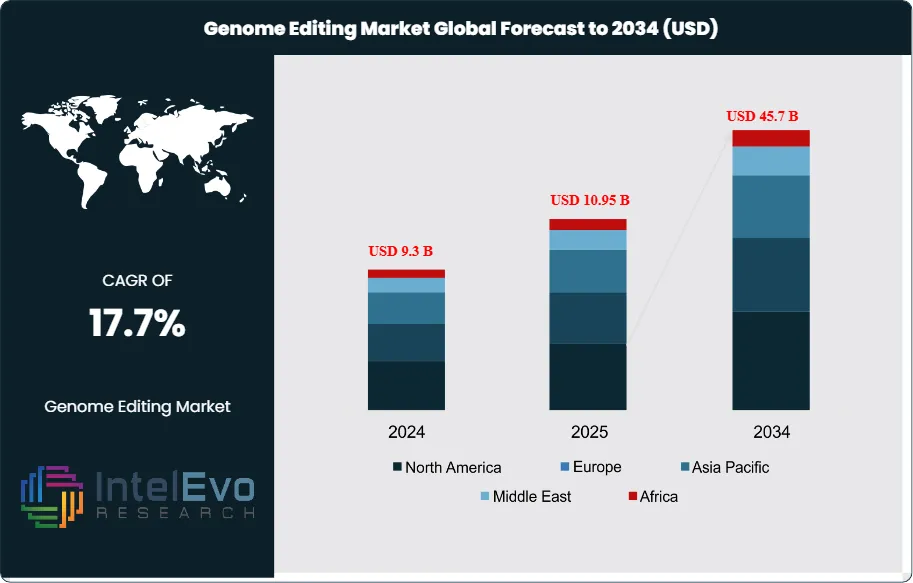
The genome editing market size is expected to be worth around USD 45.7 billion by 2034, from USD 9.3 billion in 2024, growing at a CAGR of 17.7% during the forecast period from 2025 to 2034. Genome editing is moving beyond its origins as a research tool to become a cornerstone of biotechnology, with applications spanning healthcare, agriculture, and industrial sciences. Breakthroughs in CRISPR-Cas9, TALENs, base editing, and prime editing are enabling researchers to precisely manipulate genes with higher efficiency and fewer errors. These advances are fueling adoption in therapeutic pipelines, crop engineering, and disease modeling as organizations seek targeted, cost-efficient solutions.
Healthcare remains the leading driver, as gene and cell therapies using genome editing enter late-stage clinical trials for rare genetic diseases, oncology, and chronic conditions. The ability to directly repair or replace faulty genes is improving treatment outcomes and lowering long-term care costs. Meanwhile, biotech and pharmaceutical companies are significantly scaling investments into genome editing R&D, signaling robust commercial potential.
Agriculture is emerging as a complementary growth engine, with editing tools being deployed to engineer climate-resilient, pest-resistant, and nutrient-rich crops. This is especially critical for Asia Pacific and Africa, where climate challenges and food security concerns are pressing. Collaborations between biotech firms and agricultural institutes are further accelerating adoption in this sector.
Challenges persist, including regulatory complexities, ethical concerns, and high costs of therapy development. Yet, improvements in precision editing, AI-enabled analytics, and favorable regulatory progress are helping to lower barriers and expand adoption.
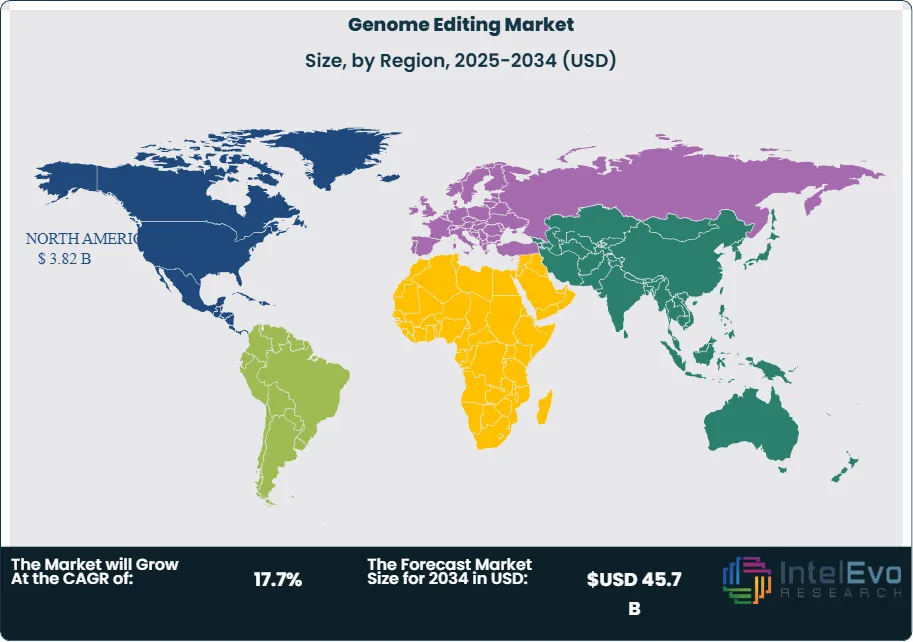
Regionally, North America continues to lead with just over 41% of revenues, supported by robust research infrastructure and early clinical approvals. Europe maintains steady momentum with policy-driven innovation clusters, while Asia Pacific is expected to record the fastest growth, underpinned by government-led genomics programs and agricultural biotechnology expansion.
Market Growth: The genome editing market generated USD 9.3 billion in 2024 and is projected to reach USD 45.7 billion by 2034, expanding at a CAGR of 17.7%. Growth is driven by rising demand for precision medicine, expanding agricultural biotechnology, and continuous improvements in editing platforms.
Delivery Method: Ex-vivo editing approaches dominated with 63.5% share in 2024, reflecting their established use in controlled laboratory and clinical environments, particularly in cell-based therapies where accuracy and safety are paramount.
Technology: CRISPR/Cas9 accounted for 55.3% of revenues in 2024, benefiting from its cost-effectiveness, versatility, and strong adoption across therapeutic development, agriculture, and academic research.
Application: Genetic engineering represented 72.6% of the market in 2024, supported by applications in crop enhancement, livestock genetics, and industrial biotechnology, alongside its growing role in basic research.
End Use: Biotechnology and pharmaceutical companies held the largest share at 60.1%, reflecting increasing reliance on genome editing for drug discovery, clinical trial pipelines, and advanced therapies.
Driver: Rising investments in personalized medicine and successful preclinical demonstrations of genome editing in rare disease therapies are reinforcing its role as a transformative pillar of modern healthcare.
Restraint: Ethical concerns, high R&D costs, and evolving regulatory hurdles—particularly surrounding germline modification—continue to delay widespread clinical adoption.
Opportunity: Expanding applications in agricultural biotechnology, including pest-resistant crops and climate-resilient varieties, offer significant growth potential amid global food security concerns.
Trend: Next-generation platforms such as base and prime editing are gaining momentum, with collaborations between biotech firms and AI-driven analytics providers accelerating innovation and reducing risk.
Regional Analysis: North America led with just over 41% market share in 2024, supported by strong research infrastructure and funding, while Asia Pacific is set to be the fastest-growing region through 2034 due to government-backed initiatives and agricultural adoption.
Delivery Method Analysis
Ex-vivo genome editing continues to dominate the market, accounting for 63.7% of revenues in 2024, and is expected to expand further through 2025 and beyond. This method enables the precise modification of patient-derived cells outside the body before reinfusion, ensuring greater control over editing accuracy and reducing the likelihood of adverse outcomes. Its proven effectiveness in areas such as oncology and rare genetic disorders is fueling demand, particularly in cell-based therapies like CAR-T and stem cell applications.
The rising emphasis on personalized medicine is a major driver of ex-vivo adoption. With more clinical trials targeting diseases such as sickle cell anemia and certain forms of cancer, pharmaceutical and biotech companies are prioritizing ex-vivo strategies due to their higher safety profile and ability to generate reproducible therapeutic results. Continuous improvements in delivery systems, including electroporation and viral vectors, are expected to further enhance the clinical viability of this approach.
Technology Analysis
CRISPR/Cas9 remains the leading genome editing technology, commanding 55.5% of the global market in 2024 and projected to strengthen its position through 2030. Its dominance is attributed to its unmatched efficiency, versatility, and relatively low cost compared with older methods such as zinc finger nucleases (ZFNs), TALENs/MegaTALs, and meganucleases. The ability to design CRISPR systems rapidly and target specific DNA sequences has made it the preferred tool for both research and therapeutic development.
As of 2025, advances in CRISPR delivery and specificity—such as base editing and prime editing—are addressing early limitations like off-target effects. This technological evolution is expected to accelerate clinical adoption in areas such as genetic disorder therapies, cancer treatment, and agricultural biotechnology. While CRISPR leads, niche demand persists for TALENs and ZFNs, particularly in applications requiring high precision or proprietary platforms, ensuring a competitive but CRISPR-driven landscape.
Application Analysis
Genetic engineering applications accounted for 72.8% of revenues in 2024, underscoring the widespread use of genome editing in agriculture, industrial biotechnology, and animal research. Plant genetic engineering is particularly prominent, as genome editing tools are being applied to develop drought-resistant, pest-tolerant, and nutritionally enhanced crops. Animal genetic engineering is also gaining traction, with applications in disease resistance and livestock improvement, reinforcing the segment’s strong position.
On the clinical side, genome editing is rapidly advancing toward therapeutic use. Improved precision and safety in CRISPR/Cas9 systems are enabling experimental treatments for inherited genetic disorders, oncology, and infectious diseases. With multiple therapies in late-stage clinical trials, the clinical application segment is projected to grow steadily, supported by increasing investments from pharmaceutical companies and growing regulatory clarity around gene-editing therapeutics.
End Use Analysis
Biotechnology and pharmaceutical companies dominate the market, representing 60.2% of revenues in 2024, and are expected to maintain leadership as gene-editing technologies move deeper into drug discovery and therapeutic pipelines. These companies are driving innovation in personalized medicine by developing curative therapies for conditions previously deemed untreatable. Notable investments in oncology, regenerative medicine, and rare disease treatment underscore the sector’s reliance on genome editing to accelerate drug development and clinical success rates.
Academic and government research institutes remain essential contributors to fundamental research, expanding the knowledge base and enabling early innovation in editing tools. Contract research organizations (CROs) are also playing a growing role by supporting biotech firms in clinical trial execution and specialized genome editing projects, helping to scale new therapies more efficiently.
Regional Analysis
North America continues to lead the global market, holding 41.1% of revenues in 2024 and maintaining its dominance in 2025. The region’s leadership stems from strong R&D infrastructure, significant public and private investment, and supportive regulatory pathways. Milestones such as Vertex Pharmaceuticals and CRISPR Therapeutics’ Biologics License Application submission to the U.S. FDA for a CRISPR-based therapy highlight the region’s pivotal role in advancing clinical applications.
Asia Pacific is emerging as the fastest-growing region, driven by increasing investments in life sciences, growing healthcare demand, and government-backed genomic initiatives. Countries such as China, Japan, and India are actively expanding their gene-editing capabilities, both in medical research and agricultural biotechnology. Local innovation, supported by strong policy backing and expanding biotech ecosystems, positions the region as a major growth engine for the global market.
Europe maintains steady growth, supported by strong ethical oversight, public funding programs, and active clinical research hubs in Germany, France, and the UK. Meanwhile, Latin America and the Middle East & Africa remain in earlier stages of adoption but show long-term potential as healthcare modernization and agricultural biotechnology gain momentum.
By Delivery Method (Ex-vivo, In-vivo), By Technology (CRISPR/Cas9, Meganuclease, TALENs/MegaTALs, ZFN, Others), By Application (Genetic Engineering, Clinical Applications), By End-use (Biotechnology & Pharmaceutical Companies, Academic & Government Research Institutes, Contract Research Organizations)
Research Methodology
Primary Research- 100 Interviews of Stakeholders
Secondary Research
Desk Research
Regional scope
North America (United States, Canada, Mexico)
Latin America (Brazil, Argentina, Columbia)
East Asia And Pacific (China, Japan, South Korea, Australia, Cambodia, Fiji, Indonesia)
Sea And South Asia (India, Singapore, Thailand, Taiwan, Malaysia)
Eastern Europe (Poland, Russia, Czech Republic, Romania)
Western Europe (Germany, U.K., France, Spain, Itlay)
Middle East & Africa (GCC Countries, Egypt, Nigeria, South Africa, Israel)
Customization for segments, region/country-level will be provided. Moreover, additional customization can be done based on the requirements.
Pricing and Purchase Options
Avail customized purchase options to meet your exact research needs. We have three licenses to opt for: Single User License, Multi-User License (Up to 5 Users), Corporate Use License (Unlimited User and Printable PDF).
TABLE OF CONTENTS
1. EXECUTIVE SUMMARY
1.1. MARKET SNAPSHOT
1.2. KEY FINDINGS & INSIGHTS
1.3. ANALYST RECOMMENDATIONS
1.4. FUTURE OUTLOOK
2. RESEARCH METHODOLOGY
2.1. MARKET DEFINITION & SCOPE
2.2. RESEARCH OBJECTIVES: PRIMARY & SECONDARY DATA SOURCES
2.3. DATA COLLECTION SOURCES
2.3.1. COVERAGE OF 100+ PRIMARY RESEARCH/CONSULTATION CALLS WITH INDUSTRY STAKEHOLDERS
FIGURE 17 NORTH AMERICA GENOME EDITING CURRENT AND FUTURE TYPE ANALYSIS, 2025–2034, (USD MILLION)
FIGURE 18 NORTH AMERICA GENOME EDITING CURRENT AND FUTURE END USER ANALYSIS, 2025–2034, (USD MILLION)
FIGURE 19 MARKET SHARE BY COUNTRY
FIGURE 20 LATIN AMERICA GENOME EDITING CURRENT AND FUTURE TYPE ANALYSIS, 2025–2034, (USD MILLION)
FIGURE 21 LATIN AMERICA GENOME EDITING CURRENT AND FUTURE END USER ANALYSIS, 2025–2034, (USD MILLION)
FIGURE 22 MARKET SHARE BY COUNTRY
FIGURE 23 EASTERN EUROPE GENOME EDITING CURRENT AND FUTURE TYPE ANALYSIS, 2025–2034, (USD MILLION)
FIGURE 24 EASTERN EUROPE GENOME EDITING CURRENT AND FUTURE END USER ANALYSIS, 2025–2034, (USD MILLION)
FIGURE 25 MARKET SHARE BY COUNTRY
FIGURE 26 WESTERN EUROPE GENOME EDITING CURRENT AND FUTURE TYPE ANALYSIS, 2025–2034, (USD MILLION)
FIGURE 27 WESTERN EUROPE GENOME EDITING CURRENT AND FUTURE END USER ANALYSIS, 2025–2034, (USD MILLION)
FIGURE 28 MARKET SHARE BY COUNTRY
FIGURE 29 EAST ASIA AND PACIFIC GENOME EDITING CURRENT AND FUTURE TYPE ANALYSIS, 2025–2034, (USD MILLION)
FIGURE 30 EAST ASIA AND PACIFIC GENOME EDITING CURRENT AND FUTURE END USER ANALYSIS, 2025–2034, (USD MILLION)
FIGURE 31 MARKET SHARE BY COUNTRY
FIGURE 32 SEA AND SOUTH ASIA GENOME EDITING CURRENT AND FUTURE TYPE ANALYSIS, 2025–2034, (USD MILLION)
FIGURE 33 SEA AND SOUTH ASIA GENOME EDITING CURRENT AND FUTURE END USER ANALYSIS, 2025–2034, (USD MILLION)
FIGURE 34 MARKET SHARE BY COUNTRY
FIGURE 35 MIDDLE EAST AND AFRICA GENOME EDITING CURRENT AND FUTURE TYPE ANALYSIS, 2025–2034, (USD MILLION)
FIGURE 36 MIDDLE EAST AND AFRICA GENOME EDITING CURRENT AND FUTURE END USER ANALYSIS, 2025–2034, (USD MILLION)
FIGURE 37 NORTH AMERICA GENOME EDITING CURRENT AND FUTURE MARKET VOLUME SHARE REGIONAL ANALYSIS, 2025–2034, (USD MILLION)
FIGURE 38 U.S. GENOME EDITING CURRENT AND FUTURE TYPE ANALYSIS, 2025–2034, (USD MILLION)
FIGURE 39 U.S. GENOME EDITING CURRENT AND FUTURE END USER ANALYSIS, 2025–2034, (USD MILLION)
FIGURE 40 CANADA GENOME EDITING CURRENT AND FUTURE TYPE ANALYSIS, 2025–2034, (USD MILLION)
FIGURE 41 CANADA GENOME EDITING CURRENT AND FUTURE END USER ANALYSIS, 2025–2034, (USD MILLION)
FIGURE 42 LATIN AMERICA GENOME EDITING CURRENT AND FUTURE MARKET VOLUME SHARE REGIONAL ANALYSIS, 2025–2034, (USD MILLION)
FIGURE 43 MEXICO GENOME EDITING CURRENT AND FUTURE TYPE ANALYSIS, 2025–2034, (USD MILLION)
FIGURE 44 MEXICO GENOME EDITING CURRENT AND FUTURE END USER ANALYSIS, 2025–2034, (USD MILLION)
FIGURE 45 BRAZIL GENOME EDITING CURRENT AND FUTURE TYPE ANALYSIS, 2025–2034, (USD MILLION)
FIGURE 46 BRAZIL GENOME EDITING CURRENT AND FUTURE END USER ANALYSIS, 2025–2034, (USD MILLION)
FIGURE 47 ARGENTINA GENOME EDITING CURRENT AND FUTURE TYPE ANALYSIS, 2025–2034, (USD MILLION)
FIGURE 48 ARGENTINA GENOME EDITING CURRENT AND FUTURE END USER ANALYSIS, 2025–2034, (USD MILLION)
FIGURE 49 COLUMBIA GENOME EDITING CURRENT AND FUTURE TYPE ANALYSIS, 2025–2034, (USD MILLION)
FIGURE 50 COLUMBIA GENOME EDITING CURRENT AND FUTURE END USER ANALYSIS, 2025–2034, (USD MILLION)
FIGURE 51 REST OF LATIN AMERICA GENOME EDITING CURRENT AND FUTURE TYPE ANALYSIS, 2025–2034, (USD MILLION)
FIGURE 52 REST OF LATIN AMERICA GENOME EDITING CURRENT AND FUTURE END USER ANALYSIS, 2025–2034, (USD MILLION)
FIGURE 53 EASTERN EUROPE GENOME EDITING CURRENT AND FUTURE MARKET VOLUME SHARE REGIONAL ANALYSIS, 2025–2034, (USD MILLION)
FIGURE 54 POLAND GENOME EDITING CURRENT AND FUTURE TYPE ANALYSIS, 2025–2034, (USD MILLION)
FIGURE 55 POLAND GENOME EDITING CURRENT AND FUTURE END USER ANALYSIS, 2025–2034, (USD MILLION)
FIGURE 56 RUSSIA GENOME EDITING CURRENT AND FUTURE TYPE ANALYSIS, 2025–2034, (USD MILLION)
FIGURE 57 RUSSIA GENOME EDITING CURRENT AND FUTURE END USER ANALYSIS, 2025–2034, (USD MILLION)
FIGURE 58 CZECH REPUBLIC GENOME EDITING CURRENT AND FUTURE TYPE ANALYSIS, 2025–2034, (USD MILLION)
FIGURE 59 CZECH REPUBLIC GENOME EDITING CURRENT AND FUTURE END USER ANALYSIS, 2025–2034, (USD MILLION)
FIGURE 60 ROMANIA GENOME EDITING CURRENT AND FUTURE TYPE ANALYSIS, 2025–2034, (USD MILLION)
FIGURE 61 ROMANIA GENOME EDITING CURRENT AND FUTURE END USER ANALYSIS, 2025–2034, (USD MILLION)
FIGURE 62 REST OF EASTERN EUROPE GENOME EDITING CURRENT AND FUTURE TYPE ANALYSIS, 2025–2034, (USD MILLION)
FIGURE 63 REST OF EASTERN EUROPE GENOME EDITING CURRENT AND FUTURE END USER ANALYSIS, 2025–2034, (USD MILLION)
FIGURE 64 WESTERN EUROPE GENOME EDITING CURRENT AND FUTURE MARKET VOLUME SHARE REGIONAL ANALYSIS, 2025–2034, (USD MILLION)
FIGURE 65 GERMANY GENOME EDITING CURRENT AND FUTURE TYPE ANALYSIS, 2025–2034, (USD MILLION)
FIGURE 66 GERMANY GENOME EDITING CURRENT AND FUTURE END USER ANALYSIS, 2025–2034, (USD MILLION)
FIGURE 67 FRANCE GENOME EDITING CURRENT AND FUTURE TYPE ANALYSIS, 2025–2034, (USD MILLION)
FIGURE 68 FRANCE GENOME EDITING CURRENT AND FUTURE END USER ANALYSIS, 2025–2034, (USD MILLION)
FIGURE 69 UK GENOME EDITING CURRENT AND FUTURE TYPE ANALYSIS, 2025–2034, (USD MILLION)
FIGURE 70 UK GENOME EDITING CURRENT AND FUTURE END USER ANALYSIS, 2025–2034, (USD MILLION)
FIGURE 71 SPAIN GENOME EDITING CURRENT AND FUTURE TYPE ANALYSIS, 2025–2034, (USD MILLION)
FIGURE 72 SPAIN GENOME EDITING CURRENT AND FUTURE END USER ANALYSIS, 2025–2034, (USD MILLION)
FIGURE 73 ITALY GENOME EDITING CURRENT AND FUTURE TYPE ANALYSIS, 2025–2034, (USD MILLION)
FIGURE 74 ITALY GENOME EDITING CURRENT AND FUTURE END USER ANALYSIS, 2025–2034, (USD MILLION)
FIGURE 75 REST OF WESTERN EUROPE GENOME EDITING CURRENT AND FUTURE TYPE ANALYSIS, 2025–2034, (USD MILLION)
FIGURE 76 REST OF WESTERN EUROPE GENOME EDITING CURRENT AND FUTURE END USER ANALYSIS, 2025–2034, (USD MILLION)
FIGURE 77 EAST ASIA AND PACIFIC GENOME EDITING CURRENT AND FUTURE MARKET VOLUME SHARE REGIONAL ANALYSIS, 2025–2034, (USD MILLION)
FIGURE 78 CHINA GENOME EDITING CURRENT AND FUTURE TYPE ANALYSIS, 2025–2034, (USD MILLION)
FIGURE 79 CHINA GENOME EDITING CURRENT AND FUTURE END USER ANALYSIS, 2025–2034, (USD MILLION)
FIGURE 80 JAPAN GENOME EDITING CURRENT AND FUTURE TYPE ANALYSIS, 2025–2034, (USD MILLION)
FIGURE 81 JAPAN GENOME EDITING CURRENT AND FUTURE END USER ANALYSIS, 2025–2034, (USD MILLION)
FIGURE 82 AUSTRALIA GENOME EDITING CURRENT AND FUTURE TYPE ANALYSIS, 2025–2034, (USD MILLION)
FIGURE 83 AUSTRALIA GENOME EDITING CURRENT AND FUTURE END USER ANALYSIS, 2025–2034, (USD MILLION)
FIGURE 84 CAMBODIA GENOME EDITING CURRENT AND FUTURE TYPE ANALYSIS, 2025–2034, (USD MILLION)
FIGURE 85 CAMBODIA GENOME EDITING CURRENT AND FUTURE END USER ANALYSIS, 2025–2034, (USD MILLION)
FIGURE 86 FIJI GENOME EDITING CURRENT AND FUTURE TYPE ANALYSIS, 2025–2034, (USD MILLION)
FIGURE 87 FIJI GENOME EDITING CURRENT AND FUTURE END USER ANALYSIS, 2025–2034, (USD MILLION)
FIGURE 88 INDONESIA GENOME EDITING CURRENT AND FUTURE TYPE ANALYSIS, 2025–2034, (USD MILLION)
FIGURE 89 INDONESIA GENOME EDITING CURRENT AND FUTURE END USER ANALYSIS, 2025–2034, (USD MILLION)
FIGURE 90 SOUTH KOREA GENOME EDITING CURRENT AND FUTURE TYPE ANALYSIS, 2025–2034, (USD MILLION)
FIGURE 91 SOUTH KOREA GENOME EDITING CURRENT AND FUTURE END USER ANALYSIS, 2025–2034, (USD MILLION)
FIGURE 92 REST OF EAST ASIA AND PACIFIC GENOME EDITING CURRENT AND FUTURE TYPE ANALYSIS, 2025–2034, (USD MILLION)
FIGURE 93 REST OF EAST ASIA AND PACIFIC GENOME EDITING CURRENT AND FUTURE END USER ANALYSIS, 2025–2034, (USD MILLION)
FIGURE 94 SEA AND SOUTH ASIA GENOME EDITING CURRENT AND FUTURE MARKET VOLUME SHARE REGIONAL ANALYSIS, 2025–2034, (USD MILLION)
FIGURE 95 BANGLADESH GENOME EDITING CURRENT AND FUTURE TYPE ANALYSIS, 2025–2034, (USD MILLION)
FIGURE 96 BANGLADESH GENOME EDITING CURRENT AND FUTURE END USER ANALYSIS, 2025–2034, (USD MILLION)
FIGURE 97 NEW ZEALAND GENOME EDITING CURRENT AND FUTURE TYPE ANALYSIS, 2025–2034, (USD MILLION)
FIGURE 98 NEW ZEALAND GENOME EDITING CURRENT AND FUTURE END USER ANALYSIS, 2025–2034, (USD MILLION)
FIGURE 99 INDIA GENOME EDITING CURRENT AND FUTURE TYPE ANALYSIS, 2025–2034, (USD MILLION)
FIGURE 100 INDIA GENOME EDITING CURRENT AND FUTURE END USER ANALYSIS, 2025–2034, (USD MILLION)
FIGURE 101 SINGAPORE GENOME EDITING CURRENT AND FUTURE TYPE ANALYSIS, 2025–2034, (USD MILLION)
FIGURE 102 SINGAPORE GENOME EDITING CURRENT AND FUTURE END USER ANALYSIS, 2025–2034, (USD MILLION)
FIGURE 103 THAILAND GENOME EDITING CURRENT AND FUTURE TYPE ANALYSIS, 2025–2034, (USD MILLION)
FIGURE 104 THAILAND GENOME EDITING CURRENT AND FUTURE END USER ANALYSIS, 2025–2034, (USD MILLION)
FIGURE 105 TAIWAN GENOME EDITING CURRENT AND FUTURE TYPE ANALYSIS, 2025–2034, (USD MILLION)
FIGURE 106 TAIWAN GENOME EDITING CURRENT AND FUTURE END USER ANALYSIS, 2025–2034, (USD MILLION)
FIGURE 107 MALAYSIA GENOME EDITING CURRENT AND FUTURE TYPE ANALYSIS, 2025–2034, (USD MILLION)
FIGURE 108 MALAYSIA GENOME EDITING CURRENT AND FUTURE END USER ANALYSIS, 2025–2034, (USD MILLION)
FIGURE 109 REST OF SEA AND SOUTH ASIA GENOME EDITING CURRENT AND FUTURE TYPE ANALYSIS, 2025–2034, (USD MILLION)
FIGURE 110 REST OF SEA AND SOUTH ASIA GENOME EDITING CURRENT AND FUTURE END USER ANALYSIS, 2025–2034, (USD MILLION)
FIGURE 111 MIDDLE EAST AND AFRICA GENOME EDITING CURRENT AND FUTURE MARKET VOLUME SHARE REGIONAL ANALYSIS, 2025–2034, (USD MILLION)
FIGURE 112 GCC COUNTRIES GENOME EDITING CURRENT AND FUTURE TYPE ANALYSIS, 2025–2034, (USD MILLION)
FIGURE 113 GCC COUNTRIES GENOME EDITING CURRENT AND FUTURE END USER ANALYSIS, 2025–2034, (USD MILLION)
FIGURE 114 SAUDI ARABIA GENOME EDITING CURRENT AND FUTURE TYPE ANALYSIS, 2025–2034, (USD MILLION)
FIGURE 115 SAUDI ARABIA GENOME EDITING CURRENT AND FUTURE END USER ANALYSIS, 2025–2034, (USD MILLION)
FIGURE 116 UAE GENOME EDITING CURRENT AND FUTURE TYPE ANALYSIS, 2025–2034, (USD MILLION)
FIGURE 117 UAE GENOME EDITING CURRENT AND FUTURE END USER ANALYSIS, 2025–2034, (USD MILLION)
FIGURE 118 BAHRAIN GENOME EDITING CURRENT AND FUTURE TYPE ANALYSIS, 2025–2034, (USD MILLION)
FIGURE 119 BAHRAIN GENOME EDITING CURRENT AND FUTURE END USER ANALYSIS, 2025–2034, (USD MILLION)
FIGURE 120 KUWAIT GENOME EDITING CURRENT AND FUTURE TYPE ANALYSIS, 2025–2034, (USD MILLION)
FIGURE 121 KUWAIT GENOME EDITING CURRENT AND FUTURE END USER ANALYSIS, 2025–2034, (USD MILLION)
FIGURE 122 OMAN GENOME EDITING CURRENT AND FUTURE TYPE ANALYSIS, 2025–2034, (USD MILLION)
FIGURE 123 OMAN GENOME EDITING CURRENT AND FUTURE END USER ANALYSIS, 2025–2034, (USD MILLION)
FIGURE 124 QATAR GENOME EDITING CURRENT AND FUTURE TYPE ANALYSIS, 2025–2034, (USD MILLION)
FIGURE 125 QATAR GENOME EDITING CURRENT AND FUTURE END USER ANALYSIS, 2025–2034, (USD MILLION)
FIGURE 126 EGYPT GENOME EDITING CURRENT AND FUTURE TYPE ANALYSIS, 2025–2034, (USD MILLION)
FIGURE 127 EGYPT GENOME EDITING CURRENT AND FUTURE END USER ANALYSIS, 2025–2034, (USD MILLION)
FIGURE 128 NIGERIA GENOME EDITING CURRENT AND FUTURE TYPE ANALYSIS, 2025–2034, (USD MILLION)
FIGURE 129 NIGERIA GENOME EDITING CURRENT AND FUTURE END USER ANALYSIS, 2025–2034, (USD MILLION)
FIGURE 130 SOUTH AFRICA GENOME EDITING CURRENT AND FUTURE TYPE ANALYSIS, 2025–2034, (USD MILLION)
FIGURE 131 SOUTH AFRICA GENOME EDITING CURRENT AND FUTURE END USER ANALYSIS, 2025–2034, (USD MILLION)
FIGURE 132 ISRAEL GENOME EDITING CURRENT AND FUTURE TYPE ANALYSIS, 2025–2034, (USD MILLION)
FIGURE 133 ISRAEL GENOME EDITING CURRENT AND FUTURE END USER ANALYSIS, 2025–2034, (USD MILLION)
FIGURE 134 REST OF MEA GENOME EDITING CURRENT AND FUTURE TYPE ANALYSIS, 2025–2034, (USD MILLION)
FIGURE 135 REST OF MEA GENOME EDITING CURRENT AND FUTURE END USER ANALYSIS, 2025–2034, (USD MILLION)
FIGURE 136 U. S. MARKET SHARE ANALYSIS BY TYPE (2024)
FIGURE 137 U. S. MARKET SHARE ANALYSIS BY END USER (2024)
FIGURE 138 CANADA MARKET SHARE ANALYSIS BY TYPE (2024)
FIGURE 139 CANADA MARKET SHARE ANALYSIS BY END USER (2024)
FIGURE 140 MEXICO MARKET SHARE ANALYSIS BY TYPE (2024)
FIGURE 141 MEXICO MARKET SHARE ANALYSIS BY END USER (2024)
FIGURE 142 CHINA MARKET SHARE ANALYSIS BY TYPE (2024)
FIGURE 143 CHINA MARKET SHARE ANALYSIS BY END USER (2024)
FIGURE 144 JAPAN MARKET SHARE ANALYSIS BY TYPE (2024)
FIGURE 145 JAPAN MARKET SHARE ANALYSIS BY END USER (2024)
FIGURE 146 INDIA MARKET SHARE ANALYSIS BY TYPE (2024)
FIGURE 147 INDIA MARKET SHARE ANALYSIS BY END USER (2024)
FIGURE 148 SOUTH KOREA MARKET SHARE ANALYSIS BY TYPE (2024)
FIGURE 149 SOUTH KOREA MARKET SHARE ANALYSIS BY END USER (2024)
FIGURE 150 SAUDI ARABIA MARKET SHARE ANALYSIS BY TYPE (2024)
FIGURE 151 SAUDI ARABIA MARKET SHARE ANALYSIS BY END USER (2024)
FIGURE 152 UAE MARKET SHARE ANALYSIS BY TYPE (2024)
FIGURE 153 UAE MARKET SHARE ANALYSIS BY END USER (2024)
FIGURE 154 EGYPT MARKET SHARE ANALYSIS BY TYPE (2024)
FIGURE 155 EGYPT MARKET SHARE ANALYSIS BY END USER (2024)
FIGURE 156 NIGERIA MARKET SHARE ANALYSIS BY TYPE (2024)
FIGURE 157 NIGERIA MARKET SHARE ANALYSIS BY END USER (2024)
FIGURE 158 SOUTH AFRICA MARKET SHARE ANALYSIS BY TYPE (2024)
FIGURE 159 SOUTH AFRICA MARKET SHARE ANALYSIS BY END USER (2024)
FIGURE 160 GERMANY MARKET SHARE ANALYSIS BY TYPE (2024)
FIGURE 161 GERMANY MARKET SHARE ANALYSIS BY END USER (2024)
FIGURE 162 FRANCE MARKET SHARE ANALYSIS BY TYPE (2024)
FIGURE 163 FRANCE MARKET SHARE ANALYSIS BY END USER (2024)
FIGURE 164 UK MARKET SHARE ANALYSIS BY TYPE (2024)
FIGURE 165 UK MARKET SHARE ANALYSIS BY END USER (2024)
FIGURE 166 SPAIN MARKET SHARE ANALYSIS BY TYPE (2024)
FIGURE 167 SPAIN MARKET SHARE ANALYSIS BY END USER (2024)
FIGURE 168 ITALY MARKET SHARE ANALYSIS BY TYPE (2024)
FIGURE 169 ITALY MARKET SHARE ANALYSIS BY END USER (2024)
FIGURE 170 BRAZIL MARKET SHARE ANALYSIS BY TYPE (2024)
FIGURE 171 BRAZIL MARKET SHARE ANALYSIS BY END USER (2024)
FIGURE 172 ARGENTINA MARKET SHARE ANALYSIS BY TYPE (2024)
FIGURE 173 ARGENTINA MARKET SHARE ANALYSIS BY END USER (2024)
FIGURE 174 COLUMBIA MARKET SHARE ANALYSIS BY TYPE (2024)
FIGURE 175 COLUMBIA MARKET SHARE ANALYSIS BY END USER (2024)
FIGURE 176 GLOBAL GENOME EDITING CURRENT AND FUTURE MARKET KEY COUNTRY LEVEL ANALYSIS, 2024–2034, (USD MILLION)
FIGURE 177 FINANCIAL OVERVIEW:
Key Player Analysis
Sangamo Therapeutics: Sangamo Therapeutics has positioned itself as a pioneer in the genome editing field, leveraging its proprietary zinc finger nuclease (ZFN) technology alongside newer editing approaches to advance gene therapy solutions. By 2025, the company continues to focus on therapeutic programs targeting rare genetic disorders, oncology, and central nervous system diseases. Sangamo’s early commitment to developing in-vivo editing platforms has distinguished it from competitors primarily centered on ex-vivo methods, allowing it to expand into novel indications where direct gene correction is critical.
What differentiates Sangamo is its integrated approach—combining gene editing, gene regulation, and cell therapy within a single R&D framework. Strategic collaborations with larger pharmaceutical partners, such as Novartis and Biogen in past years, have strengthened its clinical pipelines and broadened its commercial reach. In a competitive market increasingly dominated by CRISPR-based approaches, Sangamo remains a key player due to its alternative platforms, deep intellectual property portfolio, and focus on therapeutic niches underserved by mainstream technologies.
Recombinetics: Recombinetics has established itself as a disruptor in applying genome editing beyond human therapeutics, with a strong emphasis on agricultural and livestock genetic engineering. The company is widely recognized for its work in developing gene-edited animals for biomedical research, food production, and agricultural resilience. By 2025, Recombinetics is advancing its role in food security initiatives, using CRISPR and TALEN-based tools to engineer livestock with disease resistance, improved productivity, and reduced environmental footprint.
The company’s differentiator lies in its ability to bridge agriculture and healthcare. Recombinetics’ engineered animal models are increasingly being used in translational research for human disease, providing vital platforms for drug testing and precision medicine. Strategic collaborations with universities, agricultural cooperatives, and global food suppliers position the firm at the intersection of biotechnology and sustainability—an area of rising strategic importance in the genome editing market.
Precision BioSciences: Precision BioSciences is recognized as an innovator in the genome editing market, with its proprietary ARCUS technology providing a differentiated alternative to CRISPR-based systems. ARCUS, derived from a natural homing endonuclease, is designed for high specificity and efficient gene insertion or deletion, making it well-suited for both therapeutic and agricultural applications. By 2025, the company is advancing clinical trials for cancer immunotherapy and genetic disorder treatments, positioning ARCUS as a credible competitor in the therapeutic genome editing space.
Precision BioSciences also plays a dual role in agriculture, where its editing tools are used to develop improved crop varieties. Strategic alliances with global pharmaceutical companies and agricultural biotechnology firms underscore its versatility across verticals. Its ability to deliver scalable, precise, and flexible editing solutions sets it apart from CRISPR-heavy pipelines, positioning the company as a rising force capable of diversifying applications of genome editing well beyond human health.
LGC: LGC has carved out a niche as a critical enabler of genome editing through its robust portfolio of genomic tools, laboratory services, and quality assurance platforms. By 2025, the company has expanded its global presence as a provider of advanced reagents, assays, and analytical technologies that support genome editing workflows in both research and applied sectors. LGC’s offerings are increasingly being integrated into biotech and pharma pipelines, underpinning clinical research and ensuring data accuracy in regulatory submissions.
Unlike firms focused solely on therapeutics, LGC plays a cross-sector role by supplying essential technologies that enhance the reproducibility and reliability of genome editing experiments. Its investments in automation, high-throughput screening, and AI-driven analytics are helping researchers accelerate discoveries while maintaining stringent quality standards. This position as a trusted infrastructure provider makes LGC an indispensable player in the expanding genome editing ecosystem.
Market Key Players
Sangamo Therapeutics
Recombinetics
Precision BioSciences
LGC
Editas Medicine
CRISPR Therapeutics
Cellectis
AstraZeneca
Intellia Therapeutics
Beam Therapeutics
Caribou Biosciences
Thermo Fisher Scientific
Lonza Group
Merck KGaA
Horizon Discovery
Driver
Precision Medicine and Gene Therapies Drive 2025 Growth
As of 2025, the genome editing market is being propelled by increasing adoption of personalized medicine, where treatments are tailored to an individual’s genetic profile. Tools such as CRISPR/Cas9 and base editing technologies are enabling researchers to directly target and correct disease-causing mutations. This precision not only accelerates drug discovery but also improves treatment efficacy for complex conditions like rare genetic disorders and cancer. Growing clinical trial activity, coupled with strong investment in biotechnology pipelines, is reinforcing genome editing’s role as a transformative driver of healthcare innovation.
Restraint
High Costs and Regulatory Hurdles Limit Genome Editing Adoption
High costs, ethical debates, and regulatory complexity remain barriers to wider adoption. Despite rapid advancements, genome editing technologies face challenges in affordability and compliance. The high cost of developing and scaling therapies—often running into hundreds of millions of dollars—limits accessibility, particularly in low- and middle-income markets. In addition, ethical concerns surrounding germline editing and the potential for off-target effects have slowed regulatory approvals in several regions. As policymakers balance innovation with public safety, companies must navigate lengthy approval processes and strict oversight, which continue to restrain rapid commercialization.
Opportunity
Agricultural Biotechnology Expands Opportunities for Food Security
Agricultural biotechnology presents a high-growth opportunity for 2025 and beyond. Beyond medicine, genome editing is increasingly being applied to agriculture to enhance food security and climate resilience. CRISPR-based techniques are being used to develop crops resistant to pests, diseases, and drought while also improving nutritional content. With global demand for sustainable agriculture rising, particularly in Asia Pacific and Africa, genome editing offers a scalable solution to address food scarcity. Companies investing in plant genome editing and partnerships with agricultural research institutions are well-positioned to capture this expanding opportunity, particularly as regulatory frameworks for genetically edited crops become more favorable.
Trend
Next-Gen Editing Tools Boost Accuracy and Market Competitiveness
In 2025, the market is witnessing strong momentum in advanced tools such as base editing, prime editing, and epigenome editing. These innovations aim to reduce off-target risks and broaden the range of treatable conditions beyond what conventional CRISPR/Cas9 can achieve. At the same time, collaborations between biotech firms and AI-driven analytics companies are enabling more precise modeling of genetic modifications, accelerating research-to-clinic timelines. This convergence of genome editing with digital technologies is emerging as a defining trend, positioning next-generation platforms as the future standard for both therapeutic and agricultural applications.
Recent Developments
December 2024 – Editas Medicine: The company pivoted its focus toward in vivo gene editing by announcing plans to advance toward a human proof-of-concept demonstration within approximately two years. This positions Editas as a front-runner in direct, inside-the-body genome editing—a critical capability for scaling therapeutic applications.
February 2025 – Precision BioSciences: Presented multiple updates on its in vivo gene editing programs during the American Society of Gene and Cell Therapy (ASGCT) annual meeting. Showcasing progress at a leading scientific forum underscores the company’s ongoing investment in therapeutic applications and enhances its visibility among research and investor communities.
June 2025 – Eli Lilly: Announced a definitive agreement to acquire Verve Therapeutics—leveraging its CRISPR-based PCSK9 gene therapy—for up to USD 1.3 billion. The deal allows Lilly to bolster its gene-editing pipeline, aligning with growing industry interest in precision treatments for cardiovascular disease.
