
The Human Resources Management (HRM) Software Market is projected to reach approximately USD 61.2 billion by 2034, rising from USD 23.7 billion in 2024, and expanding at a CAGR of 10.1% during the forecast period from 2024 to 2034. This growth is fueled by rising adoption of cloud-based HR platforms, increasing focus on workforce analytics, and the need for streamlined talent acquisition, payroll, and performance management solutions. The integration of AI, automation, and employee experience tools is further transforming HR operations, enabling organizations to enhance productivity, compliance, and data-driven decision-making across global enterprises.
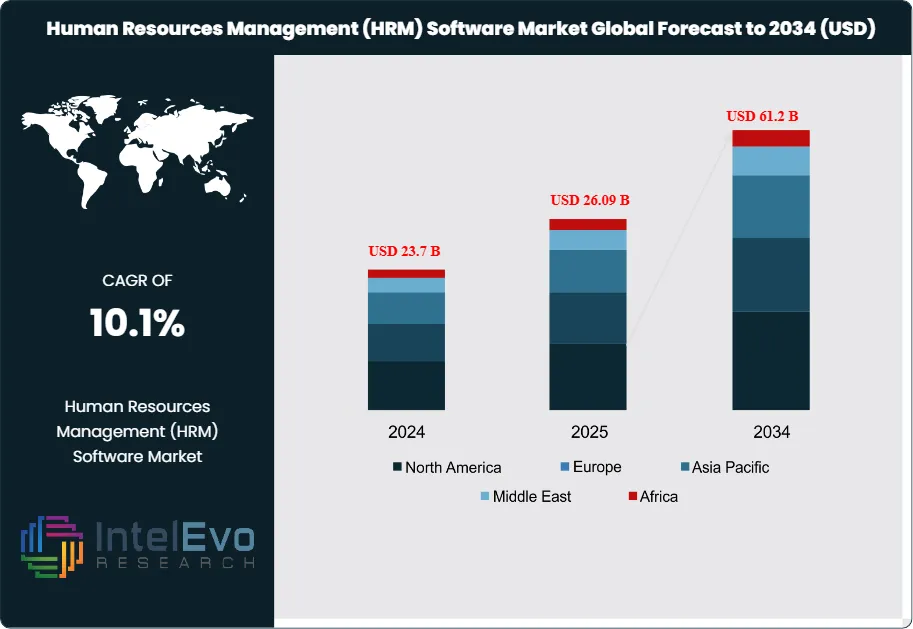
The HRM software market encompasses a broad ecosystem of digital solutions designed to streamline, automate, and optimize human resource functions across organizations of all sizes. This market includes core HR platforms, talent management suites, payroll and benefits administration, workforce analytics, recruitment and onboarding tools, performance management, and employee engagement solutions. HRM software serves a diverse range of end-users, from small and medium-sized enterprises (SMEs) to large multinational corporations, as well as public sector organizations, each with unique compliance, scalability, and integration requirements.
Market growth is being driven by the accelerating pace of digital transformation, the rise of remote and hybrid work models, and increasing demand for data-driven HR decision-making. Key growth catalysts include advancements in artificial intelligence (AI), machine learning, and cloud computing, which are enabling more personalized, predictive, and scalable HR solutions. The market is also benefiting from the growing emphasis on employee experience, diversity and inclusion initiatives, and regulatory compliance, which are prompting organizations to invest in modern HRM platforms.
North America leads the global HRM software market, underpinned by high technology adoption rates, a mature enterprise landscape, and significant investments in digital infrastructure. The Asia-Pacific region is the fastest-growing market, fueled by rapid economic development, expanding digitalization, and increasing awareness of the strategic value of HR technology. Europe maintains a strong market presence, supported by robust data privacy regulations and a focus on workforce productivity and compliance.
The COVID-19 pandemic accelerated the adoption of HRM software as organizations sought to manage distributed workforces, ensure business continuity, and support employee well-being. The crisis highlighted the importance of agile, cloud-based HR solutions and drove innovation in areas such as virtual onboarding, digital learning, and real-time workforce analytics.
Rising competition for talent, evolving workforce expectations, and the need for agile HR operations are reshaping market dynamics. Data security and privacy concerns, as well as integration challenges with legacy systems, remain key restraints. However, the ongoing shift toward cloud-based, mobile-first, and AI-powered HRM solutions is creating significant opportunities for vendors and end-users alike.
Market Growth: The HRM Software Market is expected to reach USD 61.2 Billion by 2034, driven by digital transformation, remote work trends, and the adoption of AI and cloud technologies.
Product Type Dominance: Core HR platforms and cloud-based HRM solutions lead the market, owing to their scalability, integration capabilities, and support for remote workforce management.
Deployment Type Dominance: Cloud-based deployment dominates due to lower upfront costs, ease of updates, and accessibility for distributed teams.
Application Type Dominance: Talent management and workforce analytics are the fastest-growing applications, reflecting the need for data-driven recruitment, retention, and performance optimization.
Driver: Key drivers include the shift to hybrid work, demand for real-time workforce insights, and regulatory compliance requirements.
Restraint: Growth is hindered by data privacy concerns, integration complexity with legacy systems, and high switching costs for large enterprises.
Opportunity: Opportunities abound in AI-powered HR analytics, mobile HR applications, and expansion into emerging markets with growing digital infrastructure.
Trend: Emerging trends include the integration of generative AI for recruitment and employee engagement, adoption of self-service HR portals, and the use of predictive analytics for workforce planning.
Regional Analysis: North America leads due to advanced digital infrastructure and high HR tech adoption. Asia-Pacific is the fastest-growing region, while Europe remains strong due to regulatory focus and workforce modernization.
Product Type Analysis
Core HR platforms and cloud-based HRM solutions have emerged as the backbone of modern human resources management. These platforms excel at centralizing employee data, automating routine administrative tasks such as attendance, leave management, and payroll, and ensuring compliance with ever-evolving labor regulations.
Their modular architecture allows seamless integration with talent management, payroll, and workforce analytics, creating a unified HR ecosystem that supports the entire employee lifecycle. The shift toward cloud-based HRM is especially pronounced among small and medium-sized enterprises (SMEs) and organizations with geographically dispersed teams. Cloud solutions offer unmatched scalability, cost efficiency, and the flexibility to access HR functions remotely, making them ideal for today’s dynamic and distributed work environments.
Deployment Type Analysis
Cloud-based deployment models now dominate the HRM software landscape, capturing the largest market share due to their inherent flexibility, lower upfront investment, and rapid implementation. These solutions allow organizations to scale resources up or down as needed, benefit from automatic updates, and ensure business continuity even in remote or hybrid work scenarios.
While on-premises solutions remain relevant for organizations with strict data security, privacy, or regulatory requirements—such as those in government or highly regulated industries—the overall market trend is decisively toward cloud adoption. Vendors are continuously enhancing the security and compliance features of their cloud offerings, further reducing barriers for organizations considering migration from legacy systems.
Application Type Analysis
Talent management and workforce analytics are the fastest-growing application segments within the HRM software market. As competition for skilled talent intensifies, organizations are increasingly leveraging AI and machine learning to automate candidate screening, personalize employee development, and predict workforce trends. These applications provide actionable insights that help HR teams attract, develop, and retain top talent, directly impacting organizational performance.
Payroll and benefits administration remain foundational to HR operations, but the market focus is shifting toward holistic employee experience and engagement. Modern HRM platforms now emphasize tools for continuous feedback, well-being, and career development, reflecting the evolving expectations of today’s workforce and the strategic role of HR in driving business success.
Region Analysis
North America leads the global HRM software market, driven by high technology adoption, a large base of enterprise customers, and ongoing investment in digital transformation. The region benefits from a mature vendor landscape and a strong focus on employee experience and compliance. Asia-Pacific is the fastest-growing region, propelled by rapid economic growth, digitalization, and increasing awareness of HR technology's strategic value. Countries such as China, India, and Southeast Asian nations are investing in HRM solutions to support expanding workforces and modernize HR operations.
Europe maintains a significant market presence, supported by strict data privacy regulations (such as GDPR), a focus on workforce productivity, and a tradition of strong labor protections. The region is characterized by demand for compliance-driven and multilingual HRM solutions. Latin America and Middle East & Africa are emerging markets with growing adoption, driven by economic development, workforce expansion, and increasing digital infrastructure.
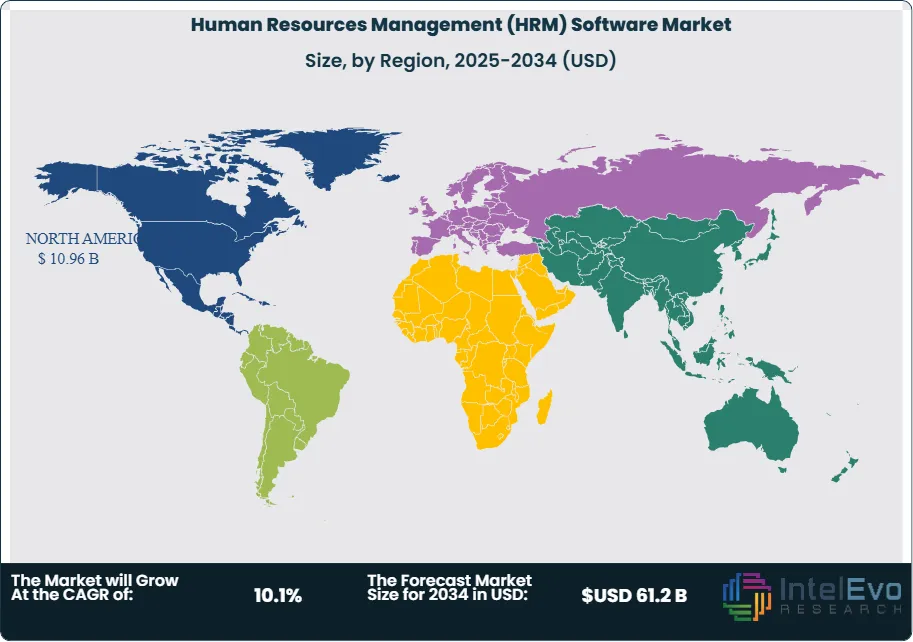
East Asia And Pacific (China, Japan, South Korea, Australia, Cambodia, Fiji, Indonesia)
Sea And South Asia (India, Singapore, Thailand, Taiwan, Malaysia)
Eastern Europe (Poland, Russia, Czech Republic, Romania)
Western Europe (Germany, U.K., France, Spain, Itlay)
Middle East & Africa (GCC Countries, Egypt, Nigeria, South Africa, Israel)
Competitive Landscape
SAP SE, UKG Inc. (Ultimate Kronos Group), Workday, Inc., ADP, Inc. (Automatic Data Processing), Oracle Corporation, Ceridian HCM Holding Inc., Gusto, Microsoft Corporation, IBM Corporation, Sage Group plc, Talentsoft, Kronos Incorporated, Cezanne HR, Accenture, Mercer, PricewaterhouseCoopers (PwC)
Customization Scope
Customization for segments, region/country-level will be provided. Moreover, additional customization can be done based on the requirements.
Pricing and Purchase Options
Avail customized purchase options to meet your exact research needs. We have three licenses to opt for: Single User License, Multi-User License (Up to 5 Users), Corporate Use License (Unlimited User and Printable PDF).
TABLE OF CONTENTS
1. EXECUTIVE SUMMARY
1.1. MARKET SNAPSHOT
1.2. KEY FINDINGS & INSIGHTS
1.3. ANALYST RECOMMENDATIONS
1.4. FUTURE OUTLOOK
2. RESEARCH METHODOLOGY
2.1. MARKET DEFINITION & SCOPE
2.2. RESEARCH OBJECTIVES: PRIMARY & SECONDARY DATA SOURCES
2.3. DATA COLLECTION SOURCES
2.3.1. COVERAGE OF 100+ PRIMARY RESEARCH/CONSULTATION CALLS WITH INDUSTRY STAKEHOLDERS
FIGURE 17 NORTH AMERICA HUMAN RESOURCES MANAGEMENT (HRM) SOFTWARE CURRENT AND FUTURE TYPE ANALYSIS, 2025–2034, (USD MILLION)
FIGURE 18 NORTH AMERICA HUMAN RESOURCES MANAGEMENT (HRM) SOFTWARE CURRENT AND FUTURE END USER ANALYSIS, 2025–2034, (USD MILLION)
FIGURE 19 MARKET SHARE BY COUNTRY
FIGURE 20 LATIN AMERICA HUMAN RESOURCES MANAGEMENT (HRM) SOFTWARE CURRENT AND FUTURE TYPE ANALYSIS, 2025–2034, (USD MILLION)
FIGURE 21 LATIN AMERICA HUMAN RESOURCES MANAGEMENT (HRM) SOFTWARE CURRENT AND FUTURE END USER ANALYSIS, 2025–2034, (USD MILLION)
FIGURE 22 MARKET SHARE BY COUNTRY
FIGURE 23 EASTERN EUROPE HUMAN RESOURCES MANAGEMENT (HRM) SOFTWARE CURRENT AND FUTURE TYPE ANALYSIS, 2025–2034, (USD MILLION)
FIGURE 24 EASTERN EUROPE HUMAN RESOURCES MANAGEMENT (HRM) SOFTWARE CURRENT AND FUTURE END USER ANALYSIS, 2025–2034, (USD MILLION)
FIGURE 25 MARKET SHARE BY COUNTRY
FIGURE 26 WESTERN EUROPE HUMAN RESOURCES MANAGEMENT (HRM) SOFTWARE CURRENT AND FUTURE TYPE ANALYSIS, 2025–2034, (USD MILLION)
FIGURE 27 WESTERN EUROPE HUMAN RESOURCES MANAGEMENT (HRM) SOFTWARE CURRENT AND FUTURE END USER ANALYSIS, 2025–2034, (USD MILLION)
FIGURE 28 MARKET SHARE BY COUNTRY
FIGURE 29 EAST ASIA AND PACIFIC HUMAN RESOURCES MANAGEMENT (HRM) SOFTWARE CURRENT AND FUTURE TYPE ANALYSIS, 2025–2034, (USD MILLION)
FIGURE 30 EAST ASIA AND PACIFIC HUMAN RESOURCES MANAGEMENT (HRM) SOFTWARE CURRENT AND FUTURE END USER ANALYSIS, 2025–2034, (USD MILLION)
FIGURE 31 MARKET SHARE BY COUNTRY
FIGURE 32 SEA AND SOUTH ASIA HUMAN RESOURCES MANAGEMENT (HRM) SOFTWARE CURRENT AND FUTURE TYPE ANALYSIS, 2025–2034, (USD MILLION)
FIGURE 33 SEA AND SOUTH ASIA HUMAN RESOURCES MANAGEMENT (HRM) SOFTWARE CURRENT AND FUTURE END USER ANALYSIS, 2025–2034, (USD MILLION)
FIGURE 34 MARKET SHARE BY COUNTRY
FIGURE 35 MIDDLE EAST AND AFRICA HUMAN RESOURCES MANAGEMENT (HRM) SOFTWARE CURRENT AND FUTURE TYPE ANALYSIS, 2025–2034, (USD MILLION)
FIGURE 36 MIDDLE EAST AND AFRICA HUMAN RESOURCES MANAGEMENT (HRM) SOFTWARE CURRENT AND FUTURE END USER ANALYSIS, 2025–2034, (USD MILLION)
FIGURE 37 NORTH AMERICA HUMAN RESOURCES MANAGEMENT (HRM) SOFTWARE CURRENT AND FUTURE MARKET VOLUME SHARE REGIONAL ANALYSIS, 2025–2034, (USD MILLION)
FIGURE 38 U.S. HUMAN RESOURCES MANAGEMENT (HRM) SOFTWARE CURRENT AND FUTURE TYPE ANALYSIS, 2025–2034, (USD MILLION)
FIGURE 39 U.S. HUMAN RESOURCES MANAGEMENT (HRM) SOFTWARE CURRENT AND FUTURE END USER ANALYSIS, 2025–2034, (USD MILLION)
FIGURE 40 CANADA HUMAN RESOURCES MANAGEMENT (HRM) SOFTWARE CURRENT AND FUTURE TYPE ANALYSIS, 2025–2034, (USD MILLION)
FIGURE 41 CANADA HUMAN RESOURCES MANAGEMENT (HRM) SOFTWARE CURRENT AND FUTURE END USER ANALYSIS, 2025–2034, (USD MILLION)
FIGURE 42 LATIN AMERICA HUMAN RESOURCES MANAGEMENT (HRM) SOFTWARE CURRENT AND FUTURE MARKET VOLUME SHARE REGIONAL ANALYSIS, 2025–2034, (USD MILLION)
FIGURE 43 MEXICO HUMAN RESOURCES MANAGEMENT (HRM) SOFTWARE CURRENT AND FUTURE TYPE ANALYSIS, 2025–2034, (USD MILLION)
FIGURE 44 MEXICO HUMAN RESOURCES MANAGEMENT (HRM) SOFTWARE CURRENT AND FUTURE END USER ANALYSIS, 2025–2034, (USD MILLION)
FIGURE 45 BRAZIL HUMAN RESOURCES MANAGEMENT (HRM) SOFTWARE CURRENT AND FUTURE TYPE ANALYSIS, 2025–2034, (USD MILLION)
FIGURE 46 BRAZIL HUMAN RESOURCES MANAGEMENT (HRM) SOFTWARE CURRENT AND FUTURE END USER ANALYSIS, 2025–2034, (USD MILLION)
FIGURE 47 ARGENTINA HUMAN RESOURCES MANAGEMENT (HRM) SOFTWARE CURRENT AND FUTURE TYPE ANALYSIS, 2025–2034, (USD MILLION)
FIGURE 48 ARGENTINA HUMAN RESOURCES MANAGEMENT (HRM) SOFTWARE CURRENT AND FUTURE END USER ANALYSIS, 2025–2034, (USD MILLION)
FIGURE 49 COLUMBIA HUMAN RESOURCES MANAGEMENT (HRM) SOFTWARE CURRENT AND FUTURE TYPE ANALYSIS, 2025–2034, (USD MILLION)
FIGURE 50 COLUMBIA HUMAN RESOURCES MANAGEMENT (HRM) SOFTWARE CURRENT AND FUTURE END USER ANALYSIS, 2025–2034, (USD MILLION)
FIGURE 51 REST OF LATIN AMERICA HUMAN RESOURCES MANAGEMENT (HRM) SOFTWARE CURRENT AND FUTURE TYPE ANALYSIS, 2025–2034, (USD MILLION)
FIGURE 52 REST OF LATIN AMERICA HUMAN RESOURCES MANAGEMENT (HRM) SOFTWARE CURRENT AND FUTURE END USER ANALYSIS, 2025–2034, (USD MILLION)
FIGURE 53 EASTERN EUROPE HUMAN RESOURCES MANAGEMENT (HRM) SOFTWARE CURRENT AND FUTURE MARKET VOLUME SHARE REGIONAL ANALYSIS, 2025–2034, (USD MILLION)
FIGURE 54 POLAND HUMAN RESOURCES MANAGEMENT (HRM) SOFTWARE CURRENT AND FUTURE TYPE ANALYSIS, 2025–2034, (USD MILLION)
FIGURE 55 POLAND HUMAN RESOURCES MANAGEMENT (HRM) SOFTWARE CURRENT AND FUTURE END USER ANALYSIS, 2025–2034, (USD MILLION)
FIGURE 56 RUSSIA HUMAN RESOURCES MANAGEMENT (HRM) SOFTWARE CURRENT AND FUTURE TYPE ANALYSIS, 2025–2034, (USD MILLION)
FIGURE 57 RUSSIA HUMAN RESOURCES MANAGEMENT (HRM) SOFTWARE CURRENT AND FUTURE END USER ANALYSIS, 2025–2034, (USD MILLION)
FIGURE 58 CZECH REPUBLIC HUMAN RESOURCES MANAGEMENT (HRM) SOFTWARE CURRENT AND FUTURE TYPE ANALYSIS, 2025–2034, (USD MILLION)
FIGURE 59 CZECH REPUBLIC HUMAN RESOURCES MANAGEMENT (HRM) SOFTWARE CURRENT AND FUTURE END USER ANALYSIS, 2025–2034, (USD MILLION)
FIGURE 60 ROMANIA HUMAN RESOURCES MANAGEMENT (HRM) SOFTWARE CURRENT AND FUTURE TYPE ANALYSIS, 2025–2034, (USD MILLION)
FIGURE 61 ROMANIA HUMAN RESOURCES MANAGEMENT (HRM) SOFTWARE CURRENT AND FUTURE END USER ANALYSIS, 2025–2034, (USD MILLION)
FIGURE 62 REST OF EASTERN EUROPE HUMAN RESOURCES MANAGEMENT (HRM) SOFTWARE CURRENT AND FUTURE TYPE ANALYSIS, 2025–2034, (USD MILLION)
FIGURE 63 REST OF EASTERN EUROPE HUMAN RESOURCES MANAGEMENT (HRM) SOFTWARE CURRENT AND FUTURE END USER ANALYSIS, 2025–2034, (USD MILLION)
FIGURE 64 WESTERN EUROPE HUMAN RESOURCES MANAGEMENT (HRM) SOFTWARE CURRENT AND FUTURE MARKET VOLUME SHARE REGIONAL ANALYSIS, 2025–2034, (USD MILLION)
FIGURE 65 GERMANY HUMAN RESOURCES MANAGEMENT (HRM) SOFTWARE CURRENT AND FUTURE TYPE ANALYSIS, 2025–2034, (USD MILLION)
FIGURE 66 GERMANY HUMAN RESOURCES MANAGEMENT (HRM) SOFTWARE CURRENT AND FUTURE END USER ANALYSIS, 2025–2034, (USD MILLION)
FIGURE 67 FRANCE HUMAN RESOURCES MANAGEMENT (HRM) SOFTWARE CURRENT AND FUTURE TYPE ANALYSIS, 2025–2034, (USD MILLION)
FIGURE 68 FRANCE HUMAN RESOURCES MANAGEMENT (HRM) SOFTWARE CURRENT AND FUTURE END USER ANALYSIS, 2025–2034, (USD MILLION)
FIGURE 69 UK HUMAN RESOURCES MANAGEMENT (HRM) SOFTWARE CURRENT AND FUTURE TYPE ANALYSIS, 2025–2034, (USD MILLION)
FIGURE 70 UK HUMAN RESOURCES MANAGEMENT (HRM) SOFTWARE CURRENT AND FUTURE END USER ANALYSIS, 2025–2034, (USD MILLION)
FIGURE 71 SPAIN HUMAN RESOURCES MANAGEMENT (HRM) SOFTWARE CURRENT AND FUTURE TYPE ANALYSIS, 2025–2034, (USD MILLION)
FIGURE 72 SPAIN HUMAN RESOURCES MANAGEMENT (HRM) SOFTWARE CURRENT AND FUTURE END USER ANALYSIS, 2025–2034, (USD MILLION)
FIGURE 73 ITALY HUMAN RESOURCES MANAGEMENT (HRM) SOFTWARE CURRENT AND FUTURE TYPE ANALYSIS, 2025–2034, (USD MILLION)
FIGURE 74 ITALY HUMAN RESOURCES MANAGEMENT (HRM) SOFTWARE CURRENT AND FUTURE END USER ANALYSIS, 2025–2034, (USD MILLION)
FIGURE 75 REST OF WESTERN EUROPE HUMAN RESOURCES MANAGEMENT (HRM) SOFTWARE CURRENT AND FUTURE TYPE ANALYSIS, 2025–2034, (USD MILLION)
FIGURE 76 REST OF WESTERN EUROPE HUMAN RESOURCES MANAGEMENT (HRM) SOFTWARE CURRENT AND FUTURE END USER ANALYSIS, 2025–2034, (USD MILLION)
FIGURE 77 EAST ASIA AND PACIFIC HUMAN RESOURCES MANAGEMENT (HRM) SOFTWARE CURRENT AND FUTURE MARKET VOLUME SHARE REGIONAL ANALYSIS, 2025–2034, (USD MILLION)
FIGURE 78 CHINA HUMAN RESOURCES MANAGEMENT (HRM) SOFTWARE CURRENT AND FUTURE TYPE ANALYSIS, 2025–2034, (USD MILLION)
FIGURE 79 CHINA HUMAN RESOURCES MANAGEMENT (HRM) SOFTWARE CURRENT AND FUTURE END USER ANALYSIS, 2025–2034, (USD MILLION)
FIGURE 80 JAPAN HUMAN RESOURCES MANAGEMENT (HRM) SOFTWARE CURRENT AND FUTURE TYPE ANALYSIS, 2025–2034, (USD MILLION)
FIGURE 81 JAPAN HUMAN RESOURCES MANAGEMENT (HRM) SOFTWARE CURRENT AND FUTURE END USER ANALYSIS, 2025–2034, (USD MILLION)
FIGURE 82 AUSTRALIA HUMAN RESOURCES MANAGEMENT (HRM) SOFTWARE CURRENT AND FUTURE TYPE ANALYSIS, 2025–2034, (USD MILLION)
FIGURE 83 AUSTRALIA HUMAN RESOURCES MANAGEMENT (HRM) SOFTWARE CURRENT AND FUTURE END USER ANALYSIS, 2025–2034, (USD MILLION)
FIGURE 84 CAMBODIA HUMAN RESOURCES MANAGEMENT (HRM) SOFTWARE CURRENT AND FUTURE TYPE ANALYSIS, 2025–2034, (USD MILLION)
FIGURE 85 CAMBODIA HUMAN RESOURCES MANAGEMENT (HRM) SOFTWARE CURRENT AND FUTURE END USER ANALYSIS, 2025–2034, (USD MILLION)
FIGURE 86 FIJI HUMAN RESOURCES MANAGEMENT (HRM) SOFTWARE CURRENT AND FUTURE TYPE ANALYSIS, 2025–2034, (USD MILLION)
FIGURE 87 FIJI HUMAN RESOURCES MANAGEMENT (HRM) SOFTWARE CURRENT AND FUTURE END USER ANALYSIS, 2025–2034, (USD MILLION)
FIGURE 88 INDONESIA HUMAN RESOURCES MANAGEMENT (HRM) SOFTWARE CURRENT AND FUTURE TYPE ANALYSIS, 2025–2034, (USD MILLION)
FIGURE 89 INDONESIA HUMAN RESOURCES MANAGEMENT (HRM) SOFTWARE CURRENT AND FUTURE END USER ANALYSIS, 2025–2034, (USD MILLION)
FIGURE 90 SOUTH KOREA HUMAN RESOURCES MANAGEMENT (HRM) SOFTWARE CURRENT AND FUTURE TYPE ANALYSIS, 2025–2034, (USD MILLION)
FIGURE 91 SOUTH KOREA HUMAN RESOURCES MANAGEMENT (HRM) SOFTWARE CURRENT AND FUTURE END USER ANALYSIS, 2025–2034, (USD MILLION)
FIGURE 92 REST OF EAST ASIA AND PACIFIC HUMAN RESOURCES MANAGEMENT (HRM) SOFTWARE CURRENT AND FUTURE TYPE ANALYSIS, 2025–2034, (USD MILLION)
FIGURE 93 REST OF EAST ASIA AND PACIFIC HUMAN RESOURCES MANAGEMENT (HRM) SOFTWARE CURRENT AND FUTURE END USER ANALYSIS, 2025–2034, (USD MILLION)
FIGURE 94 SEA AND SOUTH ASIA HUMAN RESOURCES MANAGEMENT (HRM) SOFTWARE CURRENT AND FUTURE MARKET VOLUME SHARE REGIONAL ANALYSIS, 2025–2034, (USD MILLION)
FIGURE 95 BANGLADESH HUMAN RESOURCES MANAGEMENT (HRM) SOFTWARE CURRENT AND FUTURE TYPE ANALYSIS, 2025–2034, (USD MILLION)
FIGURE 96 BANGLADESH HUMAN RESOURCES MANAGEMENT (HRM) SOFTWARE CURRENT AND FUTURE END USER ANALYSIS, 2025–2034, (USD MILLION)
FIGURE 97 NEW ZEALAND HUMAN RESOURCES MANAGEMENT (HRM) SOFTWARE CURRENT AND FUTURE TYPE ANALYSIS, 2025–2034, (USD MILLION)
FIGURE 98 NEW ZEALAND HUMAN RESOURCES MANAGEMENT (HRM) SOFTWARE CURRENT AND FUTURE END USER ANALYSIS, 2025–2034, (USD MILLION)
FIGURE 99 INDIA HUMAN RESOURCES MANAGEMENT (HRM) SOFTWARE CURRENT AND FUTURE TYPE ANALYSIS, 2025–2034, (USD MILLION)
FIGURE 100 INDIA HUMAN RESOURCES MANAGEMENT (HRM) SOFTWARE CURRENT AND FUTURE END USER ANALYSIS, 2025–2034, (USD MILLION)
FIGURE 101 SINGAPORE HUMAN RESOURCES MANAGEMENT (HRM) SOFTWARE CURRENT AND FUTURE TYPE ANALYSIS, 2025–2034, (USD MILLION)
FIGURE 102 SINGAPORE HUMAN RESOURCES MANAGEMENT (HRM) SOFTWARE CURRENT AND FUTURE END USER ANALYSIS, 2025–2034, (USD MILLION)
FIGURE 103 THAILAND HUMAN RESOURCES MANAGEMENT (HRM) SOFTWARE CURRENT AND FUTURE TYPE ANALYSIS, 2025–2034, (USD MILLION)
FIGURE 104 THAILAND HUMAN RESOURCES MANAGEMENT (HRM) SOFTWARE CURRENT AND FUTURE END USER ANALYSIS, 2025–2034, (USD MILLION)
FIGURE 105 TAIWAN HUMAN RESOURCES MANAGEMENT (HRM) SOFTWARE CURRENT AND FUTURE TYPE ANALYSIS, 2025–2034, (USD MILLION)
FIGURE 106 TAIWAN HUMAN RESOURCES MANAGEMENT (HRM) SOFTWARE CURRENT AND FUTURE END USER ANALYSIS, 2025–2034, (USD MILLION)
FIGURE 107 MALAYSIA HUMAN RESOURCES MANAGEMENT (HRM) SOFTWARE CURRENT AND FUTURE TYPE ANALYSIS, 2025–2034, (USD MILLION)
FIGURE 108 MALAYSIA HUMAN RESOURCES MANAGEMENT (HRM) SOFTWARE CURRENT AND FUTURE END USER ANALYSIS, 2025–2034, (USD MILLION)
FIGURE 109 REST OF SEA AND SOUTH ASIA HUMAN RESOURCES MANAGEMENT (HRM) SOFTWARE CURRENT AND FUTURE TYPE ANALYSIS, 2025–2034, (USD MILLION)
FIGURE 110 REST OF SEA AND SOUTH ASIA HUMAN RESOURCES MANAGEMENT (HRM) SOFTWARE CURRENT AND FUTURE END USER ANALYSIS, 2025–2034, (USD MILLION)
FIGURE 111 MIDDLE EAST AND AFRICA HUMAN RESOURCES MANAGEMENT (HRM) SOFTWARE CURRENT AND FUTURE MARKET VOLUME SHARE REGIONAL ANALYSIS, 2025–2034, (USD MILLION)
FIGURE 112 GCC COUNTRIES HUMAN RESOURCES MANAGEMENT (HRM) SOFTWARE CURRENT AND FUTURE TYPE ANALYSIS, 2025–2034, (USD MILLION)
FIGURE 113 GCC COUNTRIES HUMAN RESOURCES MANAGEMENT (HRM) SOFTWARE CURRENT AND FUTURE END USER ANALYSIS, 2025–2034, (USD MILLION)
FIGURE 114 SAUDI ARABIA HUMAN RESOURCES MANAGEMENT (HRM) SOFTWARE CURRENT AND FUTURE TYPE ANALYSIS, 2025–2034, (USD MILLION)
FIGURE 115 SAUDI ARABIA HUMAN RESOURCES MANAGEMENT (HRM) SOFTWARE CURRENT AND FUTURE END USER ANALYSIS, 2025–2034, (USD MILLION)
FIGURE 116 UAE HUMAN RESOURCES MANAGEMENT (HRM) SOFTWARE CURRENT AND FUTURE TYPE ANALYSIS, 2025–2034, (USD MILLION)
FIGURE 117 UAE HUMAN RESOURCES MANAGEMENT (HRM) SOFTWARE CURRENT AND FUTURE END USER ANALYSIS, 2025–2034, (USD MILLION)
FIGURE 118 BAHRAIN HUMAN RESOURCES MANAGEMENT (HRM) SOFTWARE CURRENT AND FUTURE TYPE ANALYSIS, 2025–2034, (USD MILLION)
FIGURE 119 BAHRAIN HUMAN RESOURCES MANAGEMENT (HRM) SOFTWARE CURRENT AND FUTURE END USER ANALYSIS, 2025–2034, (USD MILLION)
FIGURE 120 KUWAIT HUMAN RESOURCES MANAGEMENT (HRM) SOFTWARE CURRENT AND FUTURE TYPE ANALYSIS, 2025–2034, (USD MILLION)
FIGURE 121 KUWAIT HUMAN RESOURCES MANAGEMENT (HRM) SOFTWARE CURRENT AND FUTURE END USER ANALYSIS, 2025–2034, (USD MILLION)
FIGURE 122 OMAN HUMAN RESOURCES MANAGEMENT (HRM) SOFTWARE CURRENT AND FUTURE TYPE ANALYSIS, 2025–2034, (USD MILLION)
FIGURE 123 OMAN HUMAN RESOURCES MANAGEMENT (HRM) SOFTWARE CURRENT AND FUTURE END USER ANALYSIS, 2025–2034, (USD MILLION)
FIGURE 124 QATAR HUMAN RESOURCES MANAGEMENT (HRM) SOFTWARE CURRENT AND FUTURE TYPE ANALYSIS, 2025–2034, (USD MILLION)
FIGURE 125 QATAR HUMAN RESOURCES MANAGEMENT (HRM) SOFTWARE CURRENT AND FUTURE END USER ANALYSIS, 2025–2034, (USD MILLION)
FIGURE 126 EGYPT HUMAN RESOURCES MANAGEMENT (HRM) SOFTWARE CURRENT AND FUTURE TYPE ANALYSIS, 2025–2034, (USD MILLION)
FIGURE 127 EGYPT HUMAN RESOURCES MANAGEMENT (HRM) SOFTWARE CURRENT AND FUTURE END USER ANALYSIS, 2025–2034, (USD MILLION)
FIGURE 128 NIGERIA HUMAN RESOURCES MANAGEMENT (HRM) SOFTWARE CURRENT AND FUTURE TYPE ANALYSIS, 2025–2034, (USD MILLION)
FIGURE 129 NIGERIA HUMAN RESOURCES MANAGEMENT (HRM) SOFTWARE CURRENT AND FUTURE END USER ANALYSIS, 2025–2034, (USD MILLION)
FIGURE 130 SOUTH AFRICA HUMAN RESOURCES MANAGEMENT (HRM) SOFTWARE CURRENT AND FUTURE TYPE ANALYSIS, 2025–2034, (USD MILLION)
FIGURE 131 SOUTH AFRICA HUMAN RESOURCES MANAGEMENT (HRM) SOFTWARE CURRENT AND FUTURE END USER ANALYSIS, 2025–2034, (USD MILLION)
FIGURE 132 ISRAEL HUMAN RESOURCES MANAGEMENT (HRM) SOFTWARE CURRENT AND FUTURE TYPE ANALYSIS, 2025–2034, (USD MILLION)
FIGURE 133 ISRAEL HUMAN RESOURCES MANAGEMENT (HRM) SOFTWARE CURRENT AND FUTURE END USER ANALYSIS, 2025–2034, (USD MILLION)
FIGURE 134 REST OF MEA HUMAN RESOURCES MANAGEMENT (HRM) SOFTWARE CURRENT AND FUTURE TYPE ANALYSIS, 2025–2034, (USD MILLION)
FIGURE 135 REST OF MEA HUMAN RESOURCES MANAGEMENT (HRM) SOFTWARE CURRENT AND FUTURE END USER ANALYSIS, 2025–2034, (USD MILLION)
FIGURE 136 U. S. MARKET SHARE ANALYSIS BY TYPE (2024)
FIGURE 137 U. S. MARKET SHARE ANALYSIS BY END USER (2024)
FIGURE 138 CANADA MARKET SHARE ANALYSIS BY TYPE (2024)
FIGURE 139 CANADA MARKET SHARE ANALYSIS BY END USER (2024)
FIGURE 140 MEXICO MARKET SHARE ANALYSIS BY TYPE (2024)
FIGURE 141 MEXICO MARKET SHARE ANALYSIS BY END USER (2024)
FIGURE 142 CHINA MARKET SHARE ANALYSIS BY TYPE (2024)
FIGURE 143 CHINA MARKET SHARE ANALYSIS BY END USER (2024)
FIGURE 144 JAPAN MARKET SHARE ANALYSIS BY TYPE (2024)
FIGURE 145 JAPAN MARKET SHARE ANALYSIS BY END USER (2024)
FIGURE 146 INDIA MARKET SHARE ANALYSIS BY TYPE (2024)
FIGURE 147 INDIA MARKET SHARE ANALYSIS BY END USER (2024)
FIGURE 148 SOUTH KOREA MARKET SHARE ANALYSIS BY TYPE (2024)
FIGURE 149 SOUTH KOREA MARKET SHARE ANALYSIS BY END USER (2024)
FIGURE 150 SAUDI ARABIA MARKET SHARE ANALYSIS BY TYPE (2024)
FIGURE 151 SAUDI ARABIA MARKET SHARE ANALYSIS BY END USER (2024)
FIGURE 152 UAE MARKET SHARE ANALYSIS BY TYPE (2024)
FIGURE 153 UAE MARKET SHARE ANALYSIS BY END USER (2024)
FIGURE 154 EGYPT MARKET SHARE ANALYSIS BY TYPE (2024)
FIGURE 155 EGYPT MARKET SHARE ANALYSIS BY END USER (2024)
FIGURE 156 NIGERIA MARKET SHARE ANALYSIS BY TYPE (2024)
FIGURE 157 NIGERIA MARKET SHARE ANALYSIS BY END USER (2024)
FIGURE 158 SOUTH AFRICA MARKET SHARE ANALYSIS BY TYPE (2024)
FIGURE 159 SOUTH AFRICA MARKET SHARE ANALYSIS BY END USER (2024)
FIGURE 160 GERMANY MARKET SHARE ANALYSIS BY TYPE (2024)
FIGURE 161 GERMANY MARKET SHARE ANALYSIS BY END USER (2024)
FIGURE 162 FRANCE MARKET SHARE ANALYSIS BY TYPE (2024)
FIGURE 163 FRANCE MARKET SHARE ANALYSIS BY END USER (2024)
FIGURE 164 UK MARKET SHARE ANALYSIS BY TYPE (2024)
FIGURE 165 UK MARKET SHARE ANALYSIS BY END USER (2024)
FIGURE 166 SPAIN MARKET SHARE ANALYSIS BY TYPE (2024)
FIGURE 167 SPAIN MARKET SHARE ANALYSIS BY END USER (2024)
FIGURE 168 ITALY MARKET SHARE ANALYSIS BY TYPE (2024)
FIGURE 169 ITALY MARKET SHARE ANALYSIS BY END USER (2024)
FIGURE 170 BRAZIL MARKET SHARE ANALYSIS BY TYPE (2024)
FIGURE 171 BRAZIL MARKET SHARE ANALYSIS BY END USER (2024)
FIGURE 172 ARGENTINA MARKET SHARE ANALYSIS BY TYPE (2024)
FIGURE 173 ARGENTINA MARKET SHARE ANALYSIS BY END USER (2024)
FIGURE 174 COLUMBIA MARKET SHARE ANALYSIS BY TYPE (2024)
FIGURE 175 COLUMBIA MARKET SHARE ANALYSIS BY END USER (2024)
FIGURE 176 GLOBAL HUMAN RESOURCES MANAGEMENT (HRM) SOFTWARE CURRENT AND FUTURE MARKET KEY COUNTRY LEVEL ANALYSIS, 2024–2034, (USD MILLION)
FIGURE 177 FINANCIAL OVERVIEW:
Key Players Analysis
Workday, Inc.: Workday is a global leader in cloud-based HRM and financial management software, known for its unified platform, advanced analytics, and strong focus on user experience. The company’s competitive advantage lies in its scalability, continuous innovation, and robust integration capabilities.
SAP SuccessFactors: SAP SuccessFactors offers a comprehensive suite of cloud-based HR solutions, including core HR, talent management, and workforce analytics. Its global reach, deep integration with SAP’s enterprise ecosystem, and focus on compliance and localization drive its market leadership.
Oracle Corporation: Oracle’s Fusion Cloud HCM platform provides end-to-end HRM capabilities, leveraging AI and machine learning for talent management, workforce planning, and employee engagement. Oracle’s strength lies in its enterprise-grade security, scalability, and integration with other Oracle business applications.
ADP, LLC: ADP is a leading provider of payroll, HR, and workforce management solutions, serving organizations of all sizes. Its competitive edge comes from its extensive compliance expertise, global reach, and continuous investment in digital innovation.
Ceridian HCM, Inc.: Ceridian’s Dayforce platform is recognized for its unified approach to HR, payroll, and workforce management, with a strong emphasis on real-time data and user experience. The company’s focus on continuous pay, compliance, and mobile-first design supports its market growth.
Market Key Players
SAP SE
UKG Inc. (Ultimate Kronos Group)
Workday, Inc.
ADP, Inc. (Automatic Data Processing)
Oracle Corporation
Ceridian HCM Holding Inc.
Gusto
Microsoft Corporation
IBM Corporation
Sage Group plc
Talentsoft
Kronos Incorporated
Cezanne HR
Accenture
Mercer
PricewaterhouseCoopers (PwC)
Driver
Accelerating Digital Transformation in HR Operations
The quick shift to digital business models has become a main reason for HRM software adoption in many companies. Organizations are increasingly using cloud-based HR platforms to automate essential HR functions like payroll, attendance, recruitment, and compliance management. These digital solutions offer real-time visibility into the workforce, improve process accuracy, and lessen the administrative load. This allows HR teams to concentrate on strategic initiatives that promote business growth and employee optimization.
Rise of Remote and Hybrid Workforce Management
The widespread use of remote and hybrid work arrangements has created more demand for effective HRM software. Companies need centralized systems to manage employees in different locations, track productivity, ensure compliance with regulations, and support digital onboarding. Virtual collaboration tools and employee self-service platforms are essential for maintaining engagement and smooth operations, greatly improving the overall employee experience in distributed work settings.
Restraint
Data Security and Privacy Compliance Risks
Concerns about data privacy, cybersecurity, and meeting regulatory requirements are significant obstacles in adopting HRM software. Organizations manage sensitive employee data, including personal identifiers, payroll information, and performance records, making them vulnerable to data breaches and compliance issues. Following regulations like GDPR and CCPA adds complexity, especially for multinational companies operating in various regions.
Integration Complexity with Legacy Systems
Connecting modern HRM platforms with existing outdated systems poses serious technical and financial challenges. Large organizations often deal with complicated HR setups, making it hard to ensure system compatibility, data migration, and process alignment. High costs of switching systems, possible operational disruptions, and risks of data loss during migration can slow down adoption and discourage companies from fully moving to new HRM solutions.
Opportunity
AI-Driven Workforce Planning and Talent Management
Incorporating artificial intelligence and advanced analytics into HRM software offers significant growth opportunities. AI-powered tools help organizations in predictive workforce planning, allowing them to foresee talent needs, spot skill gaps, and refine recruitment strategies. These features support decisions based on data, enabling HR leaders to align talent strategies with long-term business goals more effectively.
Personalized and Intelligent HR Experiences
AI and analytics also allow for highly personalized employee experiences through smart recommendations, automated workflows, and immediate performance insights. HRM vendors that provide flexible, AI-driven platforms with smooth integration options are well-positioned to meet rising demand. Organizations increasingly look for intelligent solutions that boost productivity, improve employee retention, and enhance organizational flexibility.
Trend
Adoption of Generative AI in HR Functions
Generative AI is becoming a major trend in the HRM software market, especially in recruitment and onboarding. Companies are using generative AI to automate job descriptions, customize onboarding materials, and simplify candidate screening. These technologies greatly cut down on the time needed to hire while improving consistency and quality in HR processes.
Shift Toward Employee-Centric HR Platforms
Another important trend is the focus on employee experience and self-service HR models. Mobile-friendly platforms, AI-powered chatbots, and predictive analytics are enabling employees to manage their information, seek support, and engage with HR systems on their own. This change is turning HR from a transactional role into a strategic, data-driven partner focused on engagement, retention, and long-term workforce value creation.
Recent Developments
In June 2025: Workday launched Workday AI Talent Insights, a generative AI-powered module designed to transform how organizations approach talent acquisition and retention. This new solution leverages advanced AI to provide predictive analytics on hiring trends, candidate fit, and employee turnover risks. By analyzing vast amounts of workforce data, Workday AI Talent Insights helps HR teams identify the best candidates, forecast future talent needs, and proactively address retention challenges.
In March 2025: SAP SuccessFactors introduced a comprehensive suite of employee experience tools focused on supporting productivity and retention, especially in hybrid work environments. The new features include AI-driven onboarding processes that personalize the experience for each new hire, ensuring a smooth transition and faster integration into the company culture. Additionally, personalized learning pathways use AI to recommend relevant training and development opportunities based on individual skills, roles, and career aspirations.
In November 2024: Oracle completed the acquisition of a leading HR analytics startup, significantly enhancing its capabilities in predictive workforce planning and real-time employee sentiment analysis. This strategic move allows Oracle to integrate advanced analytics and AI-driven insights into its HRM suite, enabling organizations to better anticipate workforce trends, optimize staffing levels, and respond quickly to employee concerns. The acquisition also strengthens Oracle’s ability to provide real-time feedback on employee sentiment, helping companies identify engagement issues early and implement targeted interventions to improve workplace satisfaction and performance.
