

- Home
- Industries
 Aerospace And Defence
 Agriculture
 Automotive And Transportation
 Banking And Finance
 Business
 Chemicals And Materials
 Consumer And Retail
 Electronics And Semiconductors
 Food And Beverages
 Machinery & Equipments
 Manufacturing And Construction
 Medical Devices
 Others
 Pharmaceuticals And Healthcare
 Power And Energy
 Sports
 Technology
- Services
- News Room
- About us
- Contact Us
-
Global Insect-Based Animal Feed Market Size & Forecast 2034| CAGR 19.6%
Global Insect-Based Animal Feed Market Size, Share, Growth & Industry Analysis By Insect Species (Black Soldier Fly, Yellow Mealworm, House Cricket, Lesser Mealworm, Housefly), By End-Use Application (Aquaculture Feed, Poultry Feed, Swine Feed, Pet Food, Ruminant Feed), By Product Form (Insect Meal, Oils, Live Larvae, Whole Dried Insects, Chitin & Frass) Industry Trends, Sustainability Insights & Forecast 2026–2034

Report Overview
| Market Size (2025) | Forecast Value (2034) | CAGR (2026-2034) | Largest Region (2025) |
| USD 1.62 Billion | USD 8.14 Billion | 19.6% | Europe, 38.3% |
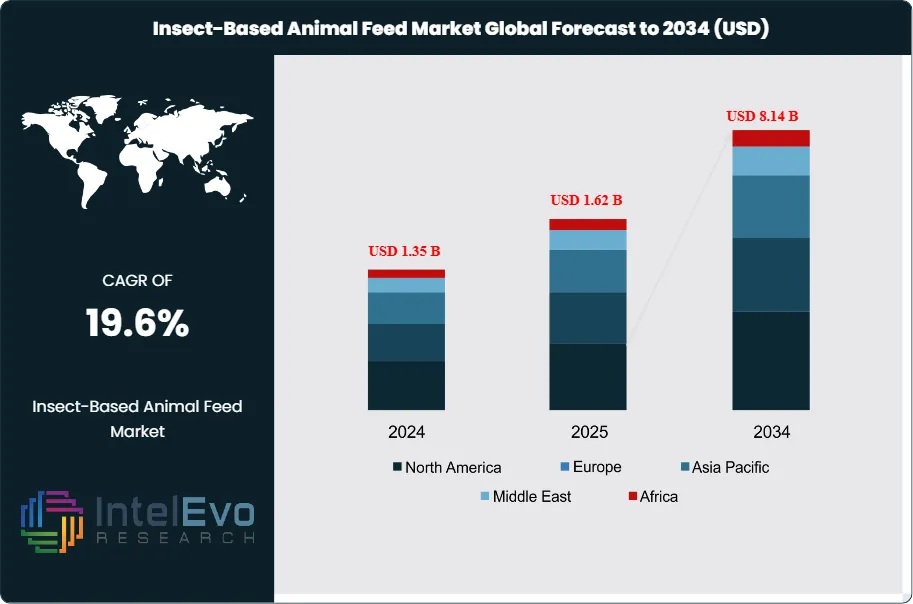
The Insect-Based Animal Feed Market was valued at approximately USD 1.35 Billion in 2024 and reached USD 1.62 Billion in 2025. The market is projected to grow to USD 8.14 Billion by 2034, expanding at a CAGR of 19.6% during the forecast period from 2026 to 2034. This represents an absolute dollar opportunity of USD 6.52 Billion over the analysis period, driven by accelerating regulatory approvals for insect-derived feed ingredients, a structural global protein deficit in conventional fishmeal supply, and mounting sustainability mandates from aquaculture, poultry, and livestock feed compounders seeking lower-carbon protein alternatives.
Get More Information about this report -
Request Free Sample ReportThe insect-based animal feed market encompasses protein meals, lipid fractions, live larvae, dried whole insects, chitin extracts, and insect frass fertilizer co-products derived from commercially farmed insect species. Black soldier fly (Hermetia illucens, BSF) larvae and pupae represent the dominant production species, followed by yellow mealworm (Tenebrio molitor), house cricket (Acheta domesticus), lesser mealworm (Alphitobius diaperinus), and common housefly (Musca domestica). These species convert low-value organic substrates including food processing waste, agricultural by-products, and pre-consumer food waste into high-quality protein and lipid ingredients with amino acid profiles suitable for aquaculture, poultry, swine, pet food, and ruminant feeding applications.
Several structural factors are accelerating commercial scale-up of the insect-based animal feed market. Global fishmeal production has remained constrained at approximately 5-6 Million metric tons annually for over a decade, with Peruvian anchovy harvest quotas limited by El Nino cycle impacts and ocean temperature variability, creating chronic price and supply volatility that encourages aquafeed formulators to diversify protein sources. The European Union's June 2021 regulatory approval of seven insect species as authorized novel feed ingredients under Regulation (EU) 2017/893, followed by expanded approvals covering poultry and swine in 2022, unlocked the world's largest premium feed compounding market for insect protein ingredients. Brazil's MAPA authorized insect meal in commercial feed in 2023, opening the world's largest poultry and swine producing nation to insect protein supply. The US FDA cleared processed BSF larvae for use in salmonid feeds in 2018 and has maintained a permissive stance for additional species and application expansions, with broader poultry applications under active review in 2025.
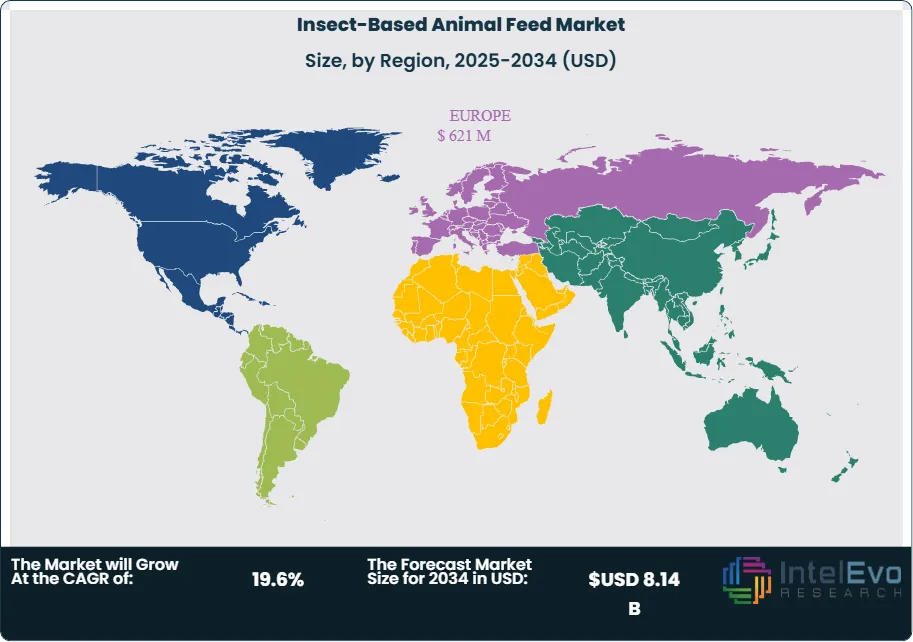
Europe leads the insect-based animal feed market with a 38.3% share in 2025, equivalent to USD 621 Million, driven by its advanced regulatory framework, dense cluster of commercial-scale insect protein producers, and strong aquaculture and premium poultry feed sectors. Asia Pacific is the second-largest and fastest-growing regional market at a projected CAGR of 22.4% through 2034. AI-optimized rearing environment control systems and automated sorting and processing equipment are reducing production costs, with leading producers targeting a production cost below USD 1.00 per kilogram of BSF protein by 2027.

Key Takeaways
- Market Growth: The global insect-based animal feed market was valued at USD 1.62 Billion in 2025 and is forecast to reach USD 8.14 Billion by 2034, registering a CAGR of 19.6% during the 2026-2034 forecast period.
- Segment Dominance: By insect species, black soldier fly held the largest share at 64.8% of the insect-based animal feed market in 2025, benefiting from its high feed conversion efficiency, wide substrate tolerance, and status as an EU-authorized feed ingredient across aquaculture, poultry, and swine applications.
- Segment Dominance: By end-use application, aquaculture feed accounted for 44.6% of the insect-based animal feed market in 2025, driven by fishmeal substitution demand in salmon, trout, shrimp, and tilapia diets and the high price premium for certified sustainable aquafeed ingredients.
- Driver: Chronic fishmeal supply constraints, with global production capped at approximately 5-6 Million metric tons annually and spot prices averaging USD 1,600-2,200 per metric ton in 2025, are compelling aquafeed and livestock feed compounders to adopt insect protein as a cost-stable alternative with a secure domestic supply chain.
- Restraint: Production costs for commercially farmed insect protein remained above USD 1.50-2.50 per kilogram in 2025 at all but the largest production facilities, compared to USD 1.20-1.80 per kilogram for South American fishmeal, constraining broad commercial adoption in cost-sensitive commodity feed segments.
- Opportunity: China's aquaculture sector, the world's largest by volume at approximately 60 Million metric tons annually, represents an insect protein addressable market estimated at USD 1.4 Billion annually by 2034 as domestic fishmeal alternatives become essential for the country's feed self-sufficiency strategy under its 14th Five-Year Plan for aquaculture.
- Trend: Automated black soldier fly rearing systems incorporating IoT-based environmental controls and AI-driven feeding optimization grew at approximately 24.8% annually in 2025, reducing per-unit labor costs by an estimated 35% and improving larval biomass yield per kilogram of substrate by 18-22%.
- Regional Analysis: Europe led the insect-based animal feed market with a 38.3% share, equivalent to USD 621 Million in 2025, supported by comprehensive EU regulatory approval across all major insect species and application categories, and a concentrated cluster of commercial-scale BSF and mealworm producers in the Netherlands, France, and Germany.
Competitive Landscape Overview
The insect-based animal feed market is moderately fragmented, with the top four producers — Protix, Hermetia International, Enterra Feed, and Ynsect — collectively accounting for approximately 44% of global market revenues in 2025. Competition centers on production scale, substrate sourcing efficiency, product quality consistency, and regulatory certification depth across target end-use markets. M&A activity has intensified since 2023, with InVivo's acquisition of both Hermetia International and Agriprotein creating the largest European insect protein group by production capacity. Capital investment exceeded USD 1.2 Billion across disclosed funding rounds in the insect-based feed sector between 2022 and 2025, reflecting strong institutional investor confidence in the sector's long-term commercial viability. New entrants from Asia Pacific are increasing competition in aquafeed ingredients, where price sensitivity is highest.
Competitive Landscape Matrix
| Company Name | Headquarters | Market Position | Key Product/Solution | Geographic Strength | Recent Strategic Move |
| Protix BV | Netherlands | Leader | Black Soldier Fly Meal & Lipid Feed Ingredients | Europe | Expanded BSF protein production facility to 25,000 MT/year capacity; Q1 2025. |
| Hermetia International (InVivo) | Germany | Leader | HermetiaPro BSF Protein & Larvae Meal | Europe | Signed long-term supply agreement with a major European aquafeed compounder; March 2025. |
| Enterra Feed Corporation | Canada | Leader | Enterra Black Soldier Fly Meal & Oil | North America | Received CFIA approval for BSF larvae in Canadian pet food; expanded to 4,000 MT/year; 2025. |
| Ynsect SA | France | Leader | Ymeal Mealworm Protein & Yoil Insect Lipid | Europe | Completed Phase 3 commercial scale-up of mealworm facility; targeting 100,000 MT/year by 2026. |
| Innovafeed | France | Challenger | Insect Meal & Oil for Aquafeed & Poultry | Europe | Launched new aquafeed-grade BSF protein line in partnership with a global salmon feed producer; Q2 2025. |
| Agriprotein (now part of InVivo) | South Africa | Challenger | MagMeal & MagOil BSF Feed Products | Africa & Europe | Expanded African production partnership under InVivo umbrella; scaling South African BSF facilities; 2025. |
| Beta Hatch | USA | Niche Player | Mealworm-Based Poultry & Aquafeed Ingredients | North America | Raised USD 28M Series B to expand mealworm farming capacity in Washington State; early 2025. |
| Entomo Farms | Canada | Niche Player | Cricket Protein Powder for Pet & Specialty Feed | North America | Launched certified organic cricket protein product for premium pet food market; Q3 2025. |
| Nutrition Technologies | Singapore | Niche Player | BSF-Derived Aquafeed & Probiotic Products | Asia Pacific | Expanded BSF facility capacity in Malaysia to serve Southeast Asian aquaculture sector; 2025. |
| Hexafly | Ireland | Niche Player | Black Soldier Fly Frass & Protein for Aquafeed | Europe | Commenced commercial supply of BSF frass fertilizer alongside BSF protein to Irish aquaculture; Jan 2026. |
By Insect Species
The insect-based animal feed market by insect species spans black soldier fly, yellow mealworm, house cricket, lesser mealworm, and housefly. Black soldier fly held the dominant species share at 64.8% of the insect-based animal feed market in 2025, equivalent to approximately USD 1.05 Billion. BSF occupies its dominant position because of several production-scale advantages: its larvae can consume a wide range of low-cost organic substrates including food waste, brewers' grains, and agricultural processing by-products; its rearing cycle from egg to harvest is completed in 14-18 days at commercial temperatures; and its larval biomass reaches 40-44% crude protein and 28-35% crude fat on a dry matter basis, matching or exceeding the nutritional profiles of conventional fishmeal and poultry meal. The EU's Regulation (EU) 2017/893 and subsequent amendments have authorized BSF in feed for farmed fish, poultry, pigs, and pets, providing the broadest regulatory coverage of any insect species in the largest premium feed market globally.
Yellow mealworm held a 18.6% share of the insect-based animal feed market by species in 2025. Ynsect's commercial-scale mealworm farming operation in France, the world's largest insect protein production facility by invested capital, anchors the yellow mealworm segment and has demonstrated automated vertical farming systems capable of achieving protein production costs competitive with BSF at large scale. House crickets represented 8.4% of the market in 2025, primarily serving the premium pet food and specialty aquafeed segments in North America and Europe. Lesser mealworm and housefly, while commercially important in specific regional and application contexts, collectively represented the remaining 8.2% of the insect species segment in 2025.
By End-Use Application
The insect-based animal feed market by end-use application covers aquaculture feed, poultry feed, swine feed, pet food, and ruminant and other specialty feeds. Aquaculture feed held the dominant application share at 44.6% of the insect-based animal feed market in 2025, equivalent to approximately USD 722 Million. Aquaculture represents the most commercially advanced and highest-margin application for insect protein, as premium salmon, trout, and marine fish feed formulators pay significant premiums for certified sustainable protein sources that reduce dependence on wild-capture fishmeal. Atlantic salmon feed trials published by the Norwegian Institute of Food, Fisheries and Aquaculture Research (Nofima) have demonstrated that BSF meal can substitute for up to 60% of fishmeal in salmon diets without compromising growth performance or fillet quality, providing the technical validation that aquafeed compounders need to justify ingredient transitions.
Poultry feed represented 28.3% of the insect-based animal feed market in 2025. Broiler and layer rations incorporating insect protein at 2-5% inclusion rates show improved feed conversion ratios, enhanced gut health through chitin's prebiotic effect on intestinal microbiome development, and reduced mortality in commercial flocks, providing producers with quantifiable economic benefits beyond protein sourcing diversification. Swine feed accounted for 12.6% of the market in 2025, with BSF meal authorized across all life stages in the EU since 2022 and gaining commercial traction in premium pork production chains in the Netherlands, Denmark, and France. Pet food applications held 8.4% of the insect-based animal feed market in 2025 and are the highest price-per-kilogram application segment, with cricket and mealworm-based dog and cat food products positioned as hypoallergenic alternatives to conventional meat proteins. Ruminant and other specialty feeds accounted for the remaining 6.1%.
By Product Form
The insect-based animal feed market by product form spans dried/defatted insect meal, insect lipid/oil, live and frozen larvae, whole dried insects, and chitin and frass co-products. Dried and defatted insect meal held the largest product form share at 58.3% of the insect-based animal feed market in 2025, equivalent to approximately USD 944 Million. This format offers the highest protein concentration, typically 55-70% crude protein on a dry matter basis after lipid extraction, optimal shelf life of 12-18 months under ambient storage, and the most straightforward integration into conventional feed compounding operations that use pellet mills, extruders, and dry ingredient blending systems. Insect lipid and oil, separated during the defatting process, represented 18.7% of the market in 2025 and commands premium pricing in aquafeed and pet food applications for its high lauric acid content, which provides antimicrobial benefits in fish gut health.
Live and frozen larvae, used in poultry systems as enrichment feeding and in backyard poultry and aquaculture applications, held a 12.4% share of the insect-based animal feed market by product form in 2025. Whole dried insects, consumed directly by poultry, reptiles, wild birds, and in some aquaculture pond systems, represented 6.8% of the market in 2025. Chitin extracts and frass fertilizer co-products, which capture additional revenue from the insect rearing process, collectively represented the remaining 3.8% of the insect-based animal feed product form market in 2025. Frass, the excrement and residual substrate material from insect rearing, is increasingly valued as an organic soil amendment and biostimulant, generating additional revenue streams that improve the overall economics of insect protein production.
By Livestock Type
The insect-based animal feed market by livestock type covers fish and shellfish (aquaculture), poultry, swine, companion animals, and ruminants. Fish and shellfish held the largest livestock type share at 44.6% in 2025, aligned with the dominant aquaculture application. Poultry represented 28.3% and swine 12.6% of the livestock-type market in 2025. Companion animals, encompassing dogs, cats, and small exotic pets fed insect-based commercial diets, accounted for 8.4% of the market and are growing at approximately 24.8% annually, the fastest growth rate of any livestock category within the insect-based animal feed market, as premium pet food brands adopt insect protein for hypoallergenic and sustainability-positioned product lines. Ruminants including cattle, sheep, and goats represented 6.1% of the market in 2025; regulatory approvals for insect meal in ruminant feeds remain limited in the EU under Transmissible Spongiform Encephalopathy (TSE) regulations that restrict processed animal protein use, constraining this segment's near-term growth.
Regional Analysis
Europe
Europe held the largest share of the insect-based animal feed market at 38.3% in 2025, generating approximately USD 621 Million in revenue. The EU's progressive regulatory framework for insect proteins in feed, built through Regulations (EU) 2017/893, 2021/1372, and 2022/16, has authorized seven insect species for use across all major livestock categories except ruminants, creating the broadest regulatory-enabled commercial market globally. The Netherlands is the European hub for insect protein production, home to Protix and hosting multiple processing facilities that supply BSF meal and lipid to European aquafeed and poultry feed compounders. France hosts Ynsect's flagship vertical mealworm farming facility and Innovafeed's BSF protein production center, with both companies targeting aquafeed and specialty nutrition markets. Germany represents a significant demand market through its large-scale poultry and swine feed compounding industry. Spain and Denmark are important aquafeed markets, with Norwegian salmon farming companies operating feed production facilities that incorporate insect protein into certified sustainable feed programs. The EU's Farm to Fork Strategy sustainability targets and the European Aquaculture Association's Aquaculture Improvement Program specifications both reference insect protein as a preferred fishmeal alternative, creating institutional pull demand across the supply chain.
Asia Pacific
Asia Pacific held approximately 28.6% of the global insect-based animal feed market in 2025, generating approximately USD 463 Million, and is the fastest-growing regional market at a projected CAGR of 22.4% through 2034. China is the largest and most strategically significant national market, where domestic BSF farming has expanded rapidly to serve the country's massive aquaculture, poultry, and swine industries. China's Ministry of Agriculture and Rural Affairs has included insect protein development in its 14th Five-Year Plan for sustainable agriculture, and domestic insect protein producers are growing rapidly on the back of government support for food waste valorization and fishmeal import reduction. The country consumes approximately 60 Million metric tons of aquaculture product annually, creating an insect protein substitution opportunity of substantial scale. Vietnam, Thailand, and Indonesia are active Southeast Asian markets for insect protein in aquaculture feed, with Nutrition Technologies' Malaysia-based BSF production facility serving regional aquafeed compounders. Australia and New Zealand are smaller but technically sophisticated markets, where environmental sustainability requirements in aquaculture certification programs are driving insect protein adoption in Atlantic salmon and barramundi farming operations.
North America
North America held approximately 18.4% of the insect-based animal feed market in 2025, generating approximately USD 298 Million. The United States represents the dominant national market, where FDA regulatory clearance for processed BSF larvae in salmonid feed under 21 CFR 573.218 and active review of broader poultry and swine applications are shaping commercial expansion. The USDA's Agricultural Marketing Service has developed organic certification standards that permit specified insect protein ingredients, creating a premium market channel for insect-fed poultry and aquaculture products. Canada's CFIA approval of BSF meal in pet food and certain aquaculture feeds supports Enterra Feed Corporation's commercial BSF protein production in Alberta, serving both domestic and US export markets. The US premium pet food market, which commands the highest per-kilogram pricing for insect protein globally, represents the most profitable near-term commercial opportunity for North American insect producers. Demand from specialty aquaculture operations producing premium trout, tilapia, and shrimp in controlled indoor systems is growing at approximately 18.6% annually in the US as these operations seek certified sustainable domestic protein sources.
Latin America
Latin America held approximately 9.4% of the insect-based animal feed market in 2025, generating approximately USD 152 Million. Brazil is the dominant regional market and a globally significant development hub, as the world's largest poultry and second-largest swine producing nation. Brazil's MAPA authorization of insect meal in commercial poultry and swine feed in 2023 opened a mass-market application channel in a country with over 6 Billion broiler chickens and 50 Million pigs produced annually. Several domestic insect protein producers have established BSF farming operations in Brazil's warm tropical climate, which is favorable for year-round outdoor and semi-controlled rearing environments. The availability of abundant low-cost organic substrates from Brazil's food processing and agricultural industries, including brewery waste, sugarcane bagasse derivatives, and soybean processing residues, provides favorable feedstock economics for domestic insect protein producers. Mexico and Colombia are secondary markets with growing poultry sectors and emerging regulatory frameworks for insect protein in feed. Chile is an important aquaculture-specific market, where insect protein offers Atlantic salmon feed producers a domestic South American fishmeal alternative as Peruvian anchovy supply volatility raises supply chain risk management concerns.
Middle East & Africa
The Middle East and Africa region held approximately 5.3% of the insect-based animal feed market in 2025, generating approximately USD 86 Million. South Africa is the most developed African insect protein market, home to Agriprotein's BSF operations and now integrated into InVivo's global insect protein strategy, with production supplying both domestic aquaculture and poultry feed and potential export channels to European compounders seeking geographic supply diversification. Kenya, Nigeria, and Ghana represent growing Sub-Saharan African markets where BSF farming at smaller commercial scales is being promoted by development organizations including the FAO and USAID as a feed protein solution that can valorize local organic waste streams while creating agricultural income. The UAE and Saudi Arabia represent Middle Eastern demand centers for premium insect protein ingredients in the pet food and specialty aquaculture segments, importing product from European and Asian suppliers given the absence of established domestic insect farming infrastructure. Regional insect protein sector development is supported by FAO's technical assistance programs on insect production for sustainable food and feed systems, which have trained over 200 insect farming operators across 15 African countries since 2020.
Get More Information about this report -
Request Free Sample ReportMarket Key Segments
By Insect Species
- Black Soldier Fly (Hermetia illucens)
- Yellow Mealworm (Tenebrio molitor)
- House Cricket (Acheta domesticus)
- Lesser Mealworm (Alphitobius diaperinus)
- Housefly (Musca domestica)
By End-Use Application
- Aquaculture Feed
- Poultry Feed
- Swine Feed
- Pet Food
- Ruminant & Specialty Feeds
By Product Form
- Dried & Defatted Insect Meal
- Insect Lipid & Oil
- Live & Frozen Larvae
- Whole Dried Insects
- Chitin Extracts & Frass Co-Products
By Livestock Type
- Fish & Shellfish (Aquaculture)
- Poultry
- Swine
- Companion Animals
- Ruminants
Regional Analysis and Coverage
- North America
- Latin America
- East Asia And Pacific
- Sea And South Asia
- Eastern Europe
- Western Europe
- Middle East & Africa
| Report Attribute | Details |
| Market size (2025) | USD 1.62 B |
| Forecast Revenue (2034) | USD 8.14 B |
| CAGR (2025-2034) | 19.6% |
| Historical data | 2021-2024 |
| Base Year For Estimation | 2025 |
| Forecast Period | 2026-2034 |
| Report coverage | Revenue Forecast, Competitive Landscape, Market Dynamics, Growth Factors, Trends and Recent Developments |
| Segments covered | By Insect Species, (Black Soldier Fly (Hermetia illucens), Yellow Mealworm (Tenebrio molitor), House Cricket (Acheta domesticus), Lesser Mealworm (Alphitobius diaperinus), Housefly (Musca domestica)), By End-Use Application, (Aquaculture Feed, Poultry Feed, Swine Feed, Pet Food, Ruminant & Specialty Feeds), By Product Form, (Dried & Defatted Insect Meal, Insect Lipid & Oil, Live & Frozen Larvae, Whole Dried Insects, Chitin Extracts & Frass Co-Products), By Livestock Type, (Fish & Shellfish (Aquaculture), Poultry, Swine, Companion Animals, Ruminants) |
| Research Methodology |
|
| Regional scope |
|
| Competitive Landscape | PROTIX BV, HERMETIA INTERNATIONAL (INVIVO), ENTERRA FEED CORPORATION, YNSECT SA, INNOVAFEED, AGRIPROTEIN (INVIVO), BETA HATCH, ENTOMO FARMS, NUTRITION TECHNOLOGIES, HEXAFLY, BÜHLER GROUP (PROCESSING EQUIPMENT), AGROPROTEIN, CIRCLE ORGANIC (BSF AFRICA), ENVIROFLIGHT LLC, DARLING INGREDIENTS (RENDERING SYNERGIES), OTHERS |
| Customization Scope | Customization for segments, region/country-level will be provided. Moreover, additional customization can be done based on the requirements. |
| Pricing and Purchase Options | Avail customized purchase options to meet your exact research needs. We have three licenses to opt for: Single User License, Multi-User License (Up to 5 Users), Corporate Use License (Unlimited User and Printable PDF). |


Frequently Asked Questions
How big is the Insect-Based Animal Feed Market?
Global Insect-based animal feed market valued at USD 1.35B in 2024, reaching USD 8.14B by 2034, growing at a CAGR of 19.6% from 2026–2034.
Who are the major players in the Insect-Based Animal Feed Market?
PROTIX BV, HERMETIA INTERNATIONAL (INVIVO), ENTERRA FEED CORPORATION, YNSECT SA, INNOVAFEED, AGRIPROTEIN (INVIVO), BETA HATCH, ENTOMO FARMS, NUTRITION TECHNOLOGIES, HEXAFLY, BÜHLER GROUP (PROCESSING EQUIPMENT), AGROPROTEIN, CIRCLE ORGANIC (BSF AFRICA), ENVIROFLIGHT LLC, DARLING INGREDIENTS (RENDERING SYNERGIES), OTHERS
Which segments covered the Insect-Based Animal Feed Market?
By Insect Species, (Black Soldier Fly (Hermetia illucens), Yellow Mealworm (Tenebrio molitor), House Cricket (Acheta domesticus), Lesser Mealworm (Alphitobius diaperinus), Housefly (Musca domestica)), By End-Use Application, (Aquaculture Feed, Poultry Feed, Swine Feed, Pet Food, Ruminant & Specialty Feeds), By Product Form, (Dried & Defatted Insect Meal, Insect Lipid & Oil, Live & Frozen Larvae, Whole Dried Insects, Chitin Extracts & Frass Co-Products), By Livestock Type, (Fish & Shellfish (Aquaculture), Poultry, Swine, Companion Animals, Ruminants)
How can this market research report help my business make strategic decisions?
Our market research reports provide actionable intelligence, including verified market size data, CAGR projections, competitive benchmarking, and segment-level opportunity analysis. These insights support strategic planning, investment decisions, product development, and market entry strategies for enterprises and startups alike.
How frequently is the data updated?
We continuously monitor industry developments and update our reports to reflect regulatory changes, technological advancements, and macroeconomic shifts. Updated editions ensure you receive the latest market intelligence.

Select Licence Type
Connect with our sales team

Insect-Based Animal Feed Market
Published Date : 20 Apr 2026 | Formats :Why IntelEvoResearch
100%
Customer
Satisfaction
24x7+
Availability - we are always
there when you need us
200+
Fortune 50 Companies trust
IntelEvoResearch
80%
of our reports are exclusive
and first in the industry
100%
more data
and analysis
1000+
reports published
till date