

- Home
- Industries
 Aerospace And Defence
 Agriculture
 Automotive And Transportation
 Banking And Finance
 Business
 Chemicals And Materials
 Consumer And Retail
 Electronics And Semiconductors
 Food And Beverages
 Machinery & Equipments
 Manufacturing And Construction
 Medical Devices
 Others
 Pharmaceuticals And Healthcare
 Power And Energy
 Sports
 Technology
- Services
- News Room
- About us
- Contact Us
-
Global Intelligent Payment Routing Market Size & Forecast | CAGR 14.0%
Global Intelligent Payment Routing Market Size, Share, Growth & Industry Analysis By Routing Intelligence Type (AI & Machine Learning Adaptive Routing, Rule-Based Routing, Cost-Optimized Routing, Real-Time Payment Rail Routing), By End-Use Vertical (Retail & E-Commerce, Travel & Hospitality, BFSI, SaaS, Marketplaces), By Deployment Model (API Orchestration, Embedded PSP, Merchant-Built Systems) Industry Trends & Forecast 2026–2034

Report Overview
| Market Size (2025) | Forecast Value (2034) | CAGR (2026-2034) | Largest Region (2025) |
| USD 3.46 Billion | USD 11.28 Billion | 14.0% | North America, 38.6% |
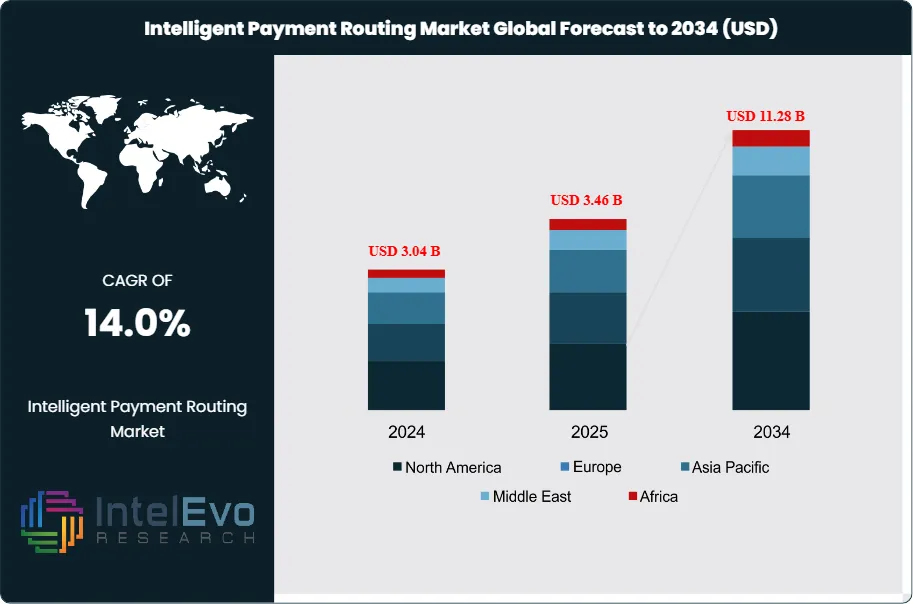
The Intelligent Payment Routing Market was valued at approximately USD 3.04 Billion in 2024 and reached USD 3.46 Billion in 2025. The market is projected to grow to USD 11.28 Billion by 2034, expanding at a CAGR of 14.0% during the forecast period from 2026 to 2034. This represents an absolute dollar opportunity of USD 7.82 Billion over the analysis period, driven by accelerating e-commerce transaction volumes, merchant demand for authorization rate maximization, interchange cost optimization, and the structural shift from single-acquirer payment architectures to multi-acquirer orchestration platforms that use machine learning to dynamically select the optimal transaction pathway.
Get More Information about this report -
Request Free Sample ReportIntelligent payment routing, also known as smart payment routing or ML-based payment orchestration, uses real-time data analysis of transaction attributes including card BIN range, issuing bank, transaction amount, currency, merchant category code, and historical acquirer performance to select the payment processing pathway most likely to achieve authorization at the lowest interchange cost with the lowest latency. Unlike traditional static routing that directs all transactions through a single acquiring bank or payment processor, intelligent payment routing platforms maintain live connections to multiple acquirers, alternative payment networks, and local payment methods, dynamically routing each transaction based on continuously updated performance models. The intelligent payment routing market encompasses stand-alone payment orchestration platforms, acquirer-embedded routing intelligence, and AI routing modules integrated within payment service providers' core processing infrastructure.
Several structural payment industry forces are compelling merchant adoption of intelligent payment routing. The global card-not-present payment fraud rate reached approximately 0.065% of transaction volume in 2025, concentrated disproportionately in cross-border e-commerce, and authorization declines attributable to issuer false-positive fraud detection represent a recoverable revenue opportunity estimated at 1.5-3.0% of total card payment volume for large merchants without optimized routing. PSD2's Strong Customer Authentication requirements in the European Economic Area have created complex authentication routing decisions that require intelligent systems to select the least-friction compliant authentication pathway for each transaction. The EU's Interchange Fee Regulation and US Durbin Amendment debit routing requirements create regulatory mandates for multi-network routing access that intelligent routing platforms are designed to exploit commercially.
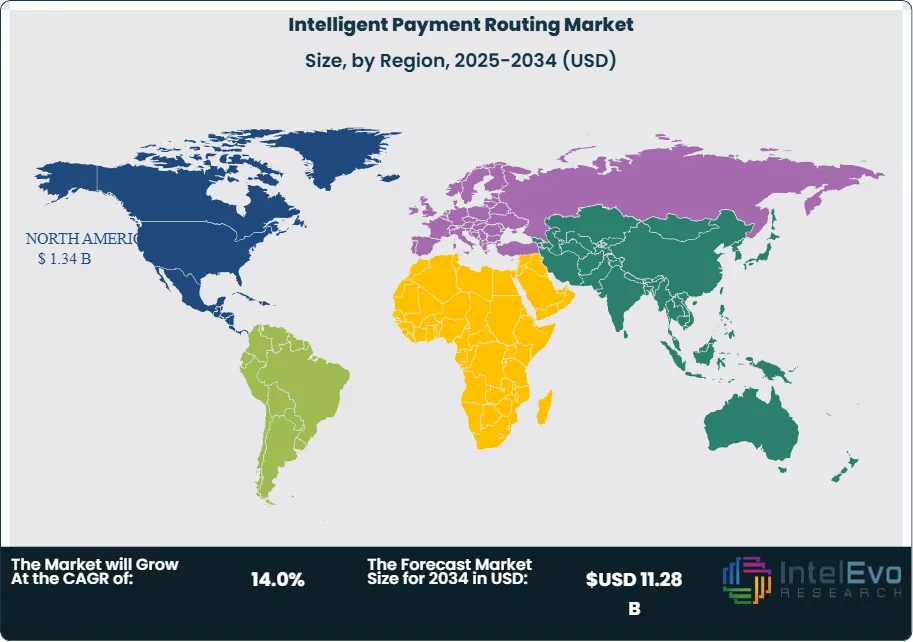
North America led the intelligent payment routing market with a 38.6% share in 2025, equivalent to USD 1.34 Billion, driven by the scale of US and Canadian e-commerce, the complexity of multi-acquirer routing optimization in the US regulated debit network environment, and a dense cluster of payment orchestration technology companies. Europe is the second-largest and fastest-growing developed region for intelligent payment routing, driven by PSD2 complexity and the fragmentation of European payment methods that requires sophisticated routing logic across card networks, real-time payment rails, and local digital payment systems across 27 EU member states.

Key Takeaways
- Market Growth: The global intelligent payment routing market was valued at USD 3.46 Billion in 2025 and is forecast to reach USD 11.28 Billion by 2034, registering a CAGR of 14.0% during the 2026-2034 forecast period.
- Segment Dominance: By routing intelligence type, AI and machine learning-based adaptive routing held the largest share at 56.4% of the intelligent payment routing market in 2025, reflecting enterprise merchants' shift from rule-based static routing to continuously self-updating ML models that improve authorization rates and reduce processing costs with each transaction cycle.
- Segment Dominance: By end-use vertical, retail and e-commerce accounted for 44.8% of the intelligent payment routing market in 2025, driven by high cross-border transaction volumes, authorization rate sensitivity, and the competitive pressure of global digital retail platforms that require sub-second payment processing latency.
- Driver: Global e-commerce transaction volume reached approximately USD 6.3 Trillion in 2025, with cross-border e-commerce growing at 18.2% annually, creating massive authorization rate and cost optimization opportunities that intelligent routing platforms capture by selecting the acquirer with the highest historical approval rate for each specific card BIN and transaction profile combination.
- Restraint: Integration complexity for merchants operating legacy payment stacks constrains intelligent routing adoption, with an estimated 42% of mid-market merchants citing API integration cost and PCI DSS scope expansion as the primary barriers to payment orchestration platform deployment.
- Opportunity: India's UPI-dominated payment infrastructure and the Indian government's National Payments Corporation of India expansion of UPI to 20+ countries through 2027 creates an intelligent routing addressable market estimated at USD 820 Million by 2034 as merchants require AI-driven routing across UPI, card networks, and alternative payment methods simultaneously.
- Trend: Real-time payment rail integration into intelligent routing platforms grew at approximately 38.6% annually in 2025, with routing engines now directing eligible transactions through SEPA Instant, FedNow, UPI, and PIX rails to reduce interchange costs by an estimated 0.6-1.2% of transaction value versus card processing.
- Regional Analysis: North America led the intelligent payment routing market with a 38.6% share, equivalent to USD 1.34 Billion in 2025, sustained by US debit network routing competition under the Durbin Amendment, large-scale e-commerce merchant demand for authorization rate optimization, and the highest concentration of payment orchestration technology vendors globally.
Competitive Landscape Overview
The intelligent payment routing market is moderately fragmented, with Stripe, Adyen, Checkout.com, and Spreedly collectively accounting for approximately 47% of global revenues in 2025. Competition centers on AI model accuracy for authorization rate prediction, breadth of acquirer and alternative payment method integrations, latency of routing decisions at scale, and the sophistication of cost optimization analytics provided to merchants. M&A activity has intensified, with Checkout.com's acquisition of ProcessOut integrating a specialist routing intelligence platform into its acquirer stack. New entrants including Payrails, Primer.io, and Acquired.com are gaining share among enterprise European merchants by offering payment orchestration-as-a-service models that avoid the merchant acquiring relationship complexity of incumbent PSP providers. Pricing competition is increasing as more vendors commoditize basic multi-acquirer routing.
Competitive Landscape Matrix
| Company Name | Headquarters | Market Position | Key Product/Solution | Geographic Strength | Recent Strategic Move |
| Stripe | USA | Leader | Stripe Adaptive Acceptance & Payment Routing | North America & Europe | Launched AI-powered adaptive acceptance with real-time network routing optimization; Q1 2025. |
| Adyen | Netherlands | Leader | Adyen RevenueAccelerate Intelligent Routing | Europe & Global | Expanded RevenueAccelerate with ML-based cross-border routing optimization; March 2025. |
| Checkout.com | UK | Leader | Checkout.com Payment Routing Optimization Platform | Europe & Asia Pacific | Launched real-time ML routing engine covering 45+ acquirers with sub-100ms routing decisions; Q2 2025. |
| Spreedly | USA | Leader | Spreedly Universal Payment Orchestration | North America & Europe | Integrated AI-powered cost optimization routing with real-time BIN analysis across 120+ gateways; 2025. |
| Payrails | Germany | Challenger | Payrails Payment Orchestration Platform | Europe | Raised USD 18M Series A to expand AI routing coverage across DACH and EU enterprise merchants; 2025. |
| Primer.io | UK | Challenger | Primer Universal Checkout & Routing | Europe & North America | Partnered with major BNPL providers to add AI-based BNPL routing optimization to its platform; Q3 2025. |
| Acquired.com | UK | Niche Player | Acquired Payment Orchestration Hub | Europe | Launched AI acquirer routing with real-time decline rescue and authorization retry logic; 2025. |
| ProcessOut (Checkoutcom) | USA | Niche Player | ProcessOut AI Payment Routing | North America | Launched ProcessOut v3 with reinforcement learning-based authorization rate optimization; Q1 2025. |
| Corefy | Ukraine/UK | Niche Player | Corefy Orchestration & Routing Engine | Europe & Middle East | Expanded smart routing to cover 200+ payment providers; focused on emerging market merchants; 2025. |
| Nuvei | Canada | Challenger | Nuvei Smart Routing & Orchestration | North America & Europe | Launched Nuvei Smart Routing with AI-driven interchange optimization for enterprise clients; Jan 2026. |
By Routing Intelligence Type
The intelligent payment routing market by routing intelligence type spans AI and machine learning-based adaptive routing, rule-based intelligent routing, cost-optimized routing, and real-time payment rail routing. AI and machine learning-based adaptive routing held the largest type share at 56.4% of the intelligent payment routing market in 2025, equivalent to approximately USD 1.95 Billion. These platforms use supervised learning models trained on merchant transaction histories, acquirer authorization response data, card BIN performance profiles, and issuer behavioral patterns to generate routing decisions with probability-weighted authorization outcome predictions. The models update continuously as new transaction outcomes are ingested, creating self-improving authorization rate optimization that widened the performance gap between AI routing and rule-based alternatives by an estimated 1.8 percentage points in authorization rate over the 2022-2025 period. Stripe's Adaptive Acceptance, Adyen's RevenueAccelerate, and Checkout.com's ML routing engine each compete in this category with different model architectures and training data volumes.
Rule-based intelligent routing, where merchants or payment service providers configure explicit routing logic based on transaction attributes including card type, amount thresholds, currency, and geography, held a 24.8% share of the intelligent payment routing market in 2025. These systems provide predictable, auditable routing behavior and remain preferred by certain regulated industries including insurance and healthcare billing where routing decision transparency is required for compliance documentation. Cost-optimized routing, which prioritizes interchange fee minimization through network and BIN-based routing decisions, accounted for 12.6% of the market in 2025, concentrated in high-volume low-margin transaction environments including supermarkets, fuel retail, and utility billing. Real-time payment rail routing, which incorporates FedNow, SEPA Instant, UPI, PIX, and equivalent instant payment infrastructure as alternative routing destinations for eligible transactions, held the remaining 6.2% of the intelligent payment routing market by type in 2025 but is the fastest-growing segment at an estimated CAGR of 28.4%.
By End-Use Vertical
The intelligent payment routing market by end-use vertical covers retail and e-commerce, travel and hospitality, financial services and BFSI, subscription and SaaS businesses, and marketplace platforms. Retail and e-commerce held the dominant vertical share at 44.8% of the intelligent payment routing market in 2025, equivalent to approximately USD 1.55 Billion. Large-volume e-commerce merchants face the most financially significant authorization rate and interchange cost optimization opportunities because each percentage point improvement in authorization rate translates directly into recovered revenue on declined transactions. For a merchant processing USD 1 Billion in annual card volume, a 1% improvement in authorization rate achieved through intelligent routing generates USD 10 Million in recovered transaction value annually, creating an ROI calculation that justifies enterprise payment orchestration platform investment even at monthly platform fees of USD 50,000-200,000. Cross-border e-commerce presents the most complex routing challenge and the largest optimization opportunity, as authorization rates for cross-border card-not-present transactions average 12-18% lower than domestic transaction rates without routing optimization.
Travel and hospitality accounted for 18.6% of the intelligent payment routing market in 2025, driven by the combination of high average transaction values that amplify per-transaction routing optimization value, complex multi-currency international transaction profiles, and high card-not-present fraud rates that create authorization decline exposure. Financial services and BFSI represented 14.4% of the market in 2025, where payment routing optimization in insurance premium collection, mortgage payment processing, and investment platform funding transactions reduces processing costs across high-frequency, high-value payment flows. Subscription and SaaS businesses held 13.6% of the market, where authorization rate optimization for recurring billing authorizations, combined with automatic payment method updating and intelligent retry logic, directly reduces involuntary customer churn attributable to failed payment processing. Marketplace platforms and other verticals collectively accounted for the remaining 8.6% of the intelligent payment routing market by vertical in 2025.
By Deployment Model
The intelligent payment routing market by deployment model covers API-based payment orchestration platform, embedded routing within payment service provider infrastructure, proprietary merchant-built routing, and Banking-as-a-Service routing integration. API-based payment orchestration platform deployment held the largest share at 46.8% of the intelligent payment routing market in 2025. This model, offered by pure-play orchestration vendors including Spreedly, Primer.io, and Payrails alongside PSP-native orchestration from Stripe and Adyen, provides merchants with a single API integration point that connects to multiple underlying acquirers, payment networks, and alternative payment methods while exposing intelligent routing controls through a unified dashboard. The model's commercial appeal lies in its separation of the routing intelligence layer from any single acquirer relationship, enabling merchants to add or remove acquirers without re-integrating payment infrastructure and providing negotiating leverage against incumbent acquirers by making acquirer switching costs near-zero.
Embedded routing within payment service provider infrastructure represented 34.6% of the intelligent payment routing market in 2025. This model is prevalent among merchants that have consolidated their payment processing relationship with a single large PSP including Adyen, Checkout.com, or Worldpay, where the PSP's internal routing intelligence selects the optimal network or acquirer route within its own acquiring network. Proprietary merchant-built routing, where large enterprise merchants develop internal payment routing intelligence systems, accounted for 12.4% of the market in 2025 and is concentrated among global retailers and platforms with payment processing volumes exceeding USD 5 Billion annually where internal development ROI justifies the investment. Banking-as-a-Service routing integration held the remaining 6.2% of the intelligent payment routing market by deployment model in 2025.
By Organization Size
The intelligent payment routing market by organization size segments into large enterprises, mid-market merchants, and small and medium-sized businesses. Large enterprises held the dominant share at 52.4% of the intelligent payment routing market in 2025, representing global retailers, travel platforms, financial services organizations, and marketplace operators with annual card payment volumes exceeding USD 100 Million. At this scale, the financial justification for enterprise payment orchestration investment is straightforward: a 1% authorization rate improvement on USD 500 Million annual volume generates USD 5 Million in recovered revenue, substantially exceeding typical annual platform licensing costs of USD 500,000-2 Million. Mid-market merchants with USD 10-100 Million annual payment volume represented 31.8% of the intelligent payment routing market in 2025, accessing intelligent routing primarily through SaaS-priced orchestration platform models that provide authorization rate analytics and multi-acquirer routing without requiring internal payment engineering teams. Small and medium businesses accounted for the remaining 15.8% of the intelligent payment routing market by organization size in 2025, accessing routing intelligence primarily through embedded features within payment processing providers' standard service offerings.
Regional Analysis
North America
North America intelligent payment routing market held a 38.6% share in 2025, generating approximately USD 1.34 Billion in revenue. The United States is the dominant national market, driven by the scale of US e-commerce, the regulatory framework of Durbin Amendment-mandated debit routing competition that requires merchant access to multiple debit networks, and a mature payment technology ecosystem that supports sophisticated multi-acquirer routing infrastructure. The Durbin Amendment's network routing requirements, enforced by the Federal Reserve's Regulation II, require debit card transactions to have access to at least two unaffiliated payment networks, creating a legally mandated multi-network routing environment where intelligent routing software optimizes network selection in real time. The US e-commerce market processed approximately USD 1.3 Trillion in transactions in 2025, with cross-border e-commerce growing at approximately 14% annually, sustaining strong demand for authorization rate optimization across diverse international card issuer profiles. Canada contributes through its large retail banking sector's digital payment expansion, with Interac instant payment integration into routing platforms representing a growing optimization opportunity. Mexico is an emerging market for intelligent payment routing as its digital payments infrastructure modernizes through SPEI real-time payment system integration and growing cross-border e-commerce with US merchants.
Europe
Europe held approximately 28.4% of the global intelligent payment routing market in 2025, generating approximately USD 983 Million. The European intelligent payment routing market is structurally more complex than North America due to the fragmentation of payment methods across 27 EU member states, where intelligent routing must cover not only card networks but also SEPA Credit Transfer, SEPA Instant Credit Transfer, iDEAL in the Netherlands, Bancontact in Belgium, Giropay in Germany, and dozens of other local payment systems. PSD2's Strong Customer Authentication requirements create an additional routing decision layer, as intelligent systems must select between 3DS2 authentication, transaction risk analysis exemptions, and merchant-initiated transaction exemptions for each transaction based on real-time risk scoring to minimize customer friction while maintaining fraud prevention. The UK's Financial Conduct Authority's Open Banking framework has created a routing optimization opportunity for account-to-account payment initiation that bypasses card interchange entirely, and intelligent routing platforms are increasingly integrating open banking payment initiation as a routing option for eligible UK merchants. Germany, France, and the Netherlands are the largest European individual national markets for intelligent payment routing, each with distinct local payment method requirements that amplify routing complexity.
Asia Pacific
Asia Pacific held approximately 22.6% of the global intelligent payment routing market in 2025, generating approximately USD 782 Million, and is the fastest-growing regional market at a projected CAGR of 17.4% through 2034. India is the fastest-growing individual national market within Asia Pacific, where the National Payments Corporation of India's UPI infrastructure processed over 131 Billion transactions in the fiscal year 2024-2025, creating an intelligent routing environment where merchants must dynamically select between UPI, card networks, netbanking, and wallet payment methods for each transaction based on real-time availability, cost, and customer preference signals. The NPCI's international UPI expansion program, targeting 20+ countries by 2027, adds cross-border routing complexity that intelligent payment routing platforms are specifically designed to manage. China's domestic payment routing market is dominated by Alipay and WeChat Pay, with international merchants requiring intelligent routing logic that manages currency conversion, local payment method availability, and cross-border settlement timing simultaneously. Singapore and Australia represent sophisticated Asia Pacific markets where card network routing optimization and real-time payment rail integration are both active intelligent routing application areas.
Latin America
Latin America held approximately 6.8% of the global intelligent payment routing market in 2025, generating approximately USD 235 Million. Brazil is the dominant and strategically most important Latin American market, where the Banco Central do Brasil's PIX instant payment system, launched in 2020 and reaching 170 Million users by 2025, has created a new intelligent routing decision dimension as merchants evaluate PIX versus card processing for eligible transactions. PIX offers zero interchange cost versus 1.5-2.5% for card transactions, creating direct financial incentive for intelligent routing systems that identify and redirect qualifying PIX-eligible transactions to the instant payment rail. Brazilian e-commerce processed approximately USD 80 Billion in transactions in 2025, with cross-border transactions from US and European merchants requiring routing intelligence that manages installment card payment authorization, which is structurally distinct from single-authorization card models used in other markets. Mexico is the second-largest Latin American market, where SPEI real-time payment system integration and growing Visa and Mastercard debit routing optimization drive intelligent payment routing demand among merchants and financial services providers. Colombia and Chile are secondary markets with growing digital payment infrastructure that creates emerging intelligent routing opportunities.
Middle East & Africa
The Middle East and Africa region held approximately 3.6% of the global intelligent payment routing market in 2025, generating approximately USD 125 Million. The UAE is the most commercially developed regional market for intelligent payment routing, where the intersection of high international card transaction volumes, tourism-driven multi-currency processing needs, and a growing e-commerce sector creates favorable conditions for routing optimization. UAE merchants processing high-value international card transactions from European and Asian cardholders face authorization rate challenges on cross-border card-not-present transactions that intelligent routing systems directly address through issuer-specific routing optimization. Saudi Arabia's Mada debit network and digital payment expansion under Vision 2030 create routing complexity for merchants managing Mada alongside international Visa and Mastercard card schemes. South Africa leads the African intelligent payment routing market through its most developed financial services infrastructure, card payment network, and growing e-commerce sector. Israel contributes disproportionately to the regional intelligent routing technology supply side through its concentration of payment technology development companies, with several payment orchestration platform vendors headquartered in the Israeli fintech hub.
Get More Information about this report -
Request Free Sample ReportMarket Key Segments
By Routing Intelligence Type
- AI & Machine Learning-Based Adaptive Routing
- Rule-Based Intelligent Routing
- Cost-Optimized Routing
- Real-Time Payment Rail Routing
By End-Use Vertical
- Retail & E-Commerce
- Travel & Hospitality
- Financial Services & BFSI
- Subscription & SaaS Businesses
- Marketplace Platforms & Others
By Deployment Model
- API-Based Payment Orchestration Platform
- Embedded Routing within PSP Infrastructure
- Proprietary Merchant-Built Routing
- Banking-as-a-Service Routing Integration
By Organization Size
- Large Enterprises (USD 100M+ Annual Card Volume)
- Mid-Market Merchants (USD 10M-100M Annual Volume)
- Small & Medium Businesses
By Regional Analysis and Coverage
- North America
- Latin America
- East Asia And Pacific
- Sea And South Asia
- Eastern Europe
- Western Europe
- Middle East & Africa
| Report Attribute | Details |
| Market size (2025) | USD 3.46 B |
| Forecast Revenue (2034) | USD 11.28 B |
| CAGR (2025-2034) | 14.0% |
| Historical data | 2021-2024 |
| Base Year For Estimation | 2025 |
| Forecast Period | 2026-2034 |
| Report coverage | Revenue Forecast, Competitive Landscape, Market Dynamics, Growth Factors, Trends and Recent Developments |
| Segments covered | By Routing Intelligence Type, (AI & Machine Learning-Based Adaptive Routing, Rule-Based Intelligent Routing, Cost-Optimized Routing, Real-Time Payment Rail Routing), By End-Use Vertical, (Retail & E-Commerce, Travel & Hospitality, Financial Services & BFSI, Subscription & SaaS Businesses, Marketplace Platforms & Others), By Deployment Model, (API-Based Payment Orchestration Platform, Embedded Routing within PSP Infrastructure, Proprietary Merchant-Built Routing, Banking-as-a-Service Routing Integration), By Organization Size, (Large Enterprises (USD 100M+ Annual Card Volume), Mid-Market Merchants (USD 10M-100M Annual Volume), Small & Medium Businesses) |
| Research Methodology |
|
| Regional scope |
|
| Competitive Landscape | STRIPE, ADYEN, CHECKOUT.COM, SPREEDLY, NUVEI, PRIMER.IO, PAYRAILS, PROCESSOUT (CHECKOUT.COM), ACQUIRED.COM, COREFY, PAYONEER, WORLDPAY (FIS), RAPYD, CHARGEAFTER (LENDING ROUTING), OTHERS |
| Customization Scope | Customization for segments, region/country-level will be provided. Moreover, additional customization can be done based on the requirements. |
| Pricing and Purchase Options | Avail customized purchase options to meet your exact research needs. We have three licenses to opt for: Single User License, Multi-User License (Up to 5 Users), Corporate Use License (Unlimited User and Printable PDF). |


Frequently Asked Questions
How big is the Intelligent Payment Routing Market?
Global Intelligent payment routing market valued at USD 3.04B in 2024, reaching USD 11.28B by 2034, growing at a CAGR of 14.0% from 2026–2034.
Who are the major players in the Intelligent Payment Routing Market?
STRIPE, ADYEN, CHECKOUT.COM, SPREEDLY, NUVEI, PRIMER.IO, PAYRAILS, PROCESSOUT (CHECKOUT.COM), ACQUIRED.COM, COREFY, PAYONEER, WORLDPAY (FIS), RAPYD, CHARGEAFTER (LENDING ROUTING), OTHERS
Which segments covered the Intelligent Payment Routing Market?
By Routing Intelligence Type, (AI & Machine Learning-Based Adaptive Routing, Rule-Based Intelligent Routing, Cost-Optimized Routing, Real-Time Payment Rail Routing), By End-Use Vertical, (Retail & E-Commerce, Travel & Hospitality, Financial Services & BFSI, Subscription & SaaS Businesses, Marketplace Platforms & Others), By Deployment Model, (API-Based Payment Orchestration Platform, Embedded Routing within PSP Infrastructure, Proprietary Merchant-Built Routing, Banking-as-a-Service Routing Integration), By Organization Size, (Large Enterprises (USD 100M+ Annual Card Volume), Mid-Market Merchants (USD 10M-100M Annual Volume), Small & Medium Businesses)
How can this market research report help my business make strategic decisions?
Our market research reports provide actionable intelligence, including verified market size data, CAGR projections, competitive benchmarking, and segment-level opportunity analysis. These insights support strategic planning, investment decisions, product development, and market entry strategies for enterprises and startups alike.
How frequently is the data updated?
We continuously monitor industry developments and update our reports to reflect regulatory changes, technological advancements, and macroeconomic shifts. Updated editions ensure you receive the latest market intelligence.

Select Licence Type
Connect with our sales team

Intelligent Payment Routing Market
Published Date : 23 Apr 2026 | Formats :Why IntelEvoResearch
100%
Customer
Satisfaction
24x7+
Availability - we are always
there when you need us
200+
Fortune 50 Companies trust
IntelEvoResearch
80%
of our reports are exclusive
and first in the industry
100%
more data
and analysis
1000+
reports published
till date