
The Joint Pain Injections Market was valued at US$ 5.7 Billion in 2024 and is projected to reach approximately US$ 13.2 Billion by 2034. The market is estimated to grow to around US$ 6.2 Billion in 2025. Based on projected growth from 2026 onward, the market is expected to expand at a compound annual growth rate (CAGR) of approximately 8.7% during the forecast period from 2026 to 2034.
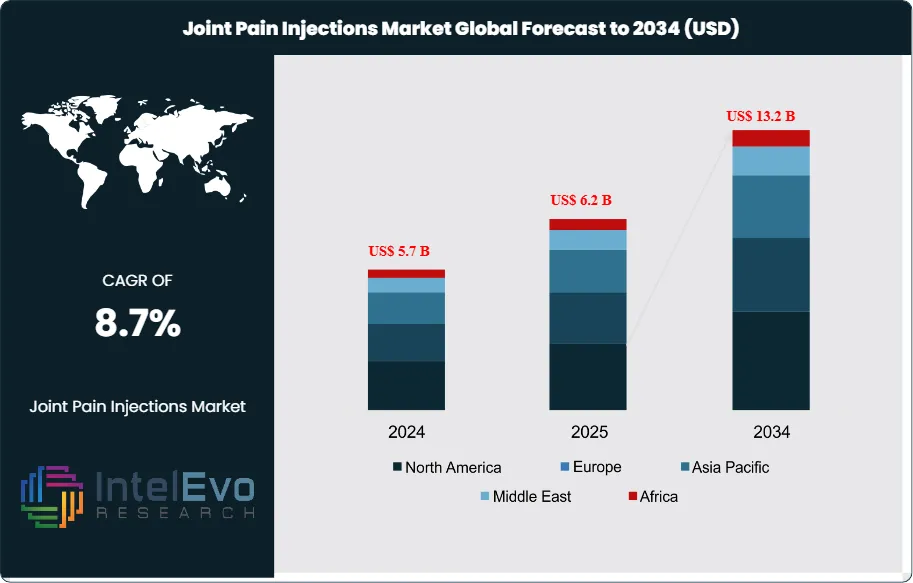
Expansion reflects a higher osteoarthritis burden, longer life expectancy, and improved diagnosis as imaging and specialist access widens. Clinicians use intra-articular injections to control pain, preserve mobility, and defer surgery for selected patients. Corticosteroid products contribute about 45% of 2024 revenue because they deliver rapid relief at low cost and align with established coverage rules. Hyaluronic acid products hold roughly 30% as providers target longer effect duration in mild-to-moderate disease. Orthobiologic options, including platelet-rich plasma and other regenerative approaches, represent an estimated 15%, supported by patient willingness to pay and expanding clinical evidence. The remaining share includes local anesthetics and adjunct formulations.
Supply conditions hinge on sterile manufacturing capacity, validated fill–finish lines, and steady access to needles, syringes, and medical-grade excipients. Concentration among compliant sites increases exposure to quality deviations and recalls, which can constrain availability and lift landed costs. Hospital outpatient departments generate about 55% of procedures in 2024, followed by ambulatory centers at roughly 30% and office-based orthopedic clinics near 15%. Providers adopt ultrasound-guided delivery at a faster rate to improve placement accuracy, reduce repeat procedures, and support performance-based contracting. Digitalization raises throughput via e-referrals, e-consent, and automated inventory controls.
Regulators enforce strict sterility assurance and post-market safety reporting, and they scrutinize particulate control and labeling claims. Biologic and combination-product classifications in the United States and Europe raise evidence thresholds and extend development timelines for premium offerings. Reimbursement shapes demand through step therapy and prior authorization, which compresses net prices for viscosupplementation and orthobiologics and rewards suppliers with real-world outcomes data. Risks include infection, flare reactions, variable durability of response, and competitive pressure from oral therapies, physical therapy pathways, and earlier surgical intervention.
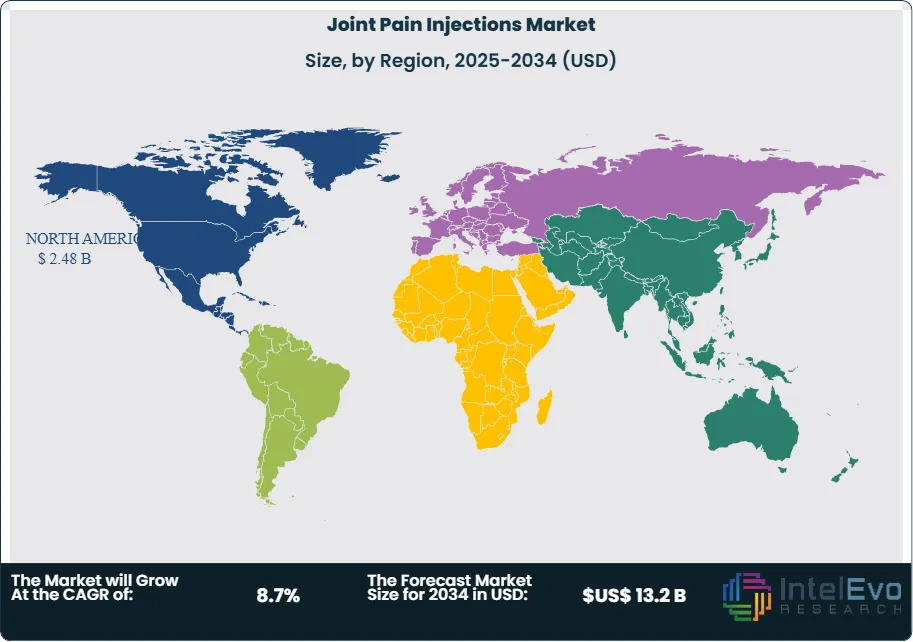
North America leads with about 38% of 2024 revenue, supported by procedure volume and payer depth. Europe follows at roughly 27%, driven by aging demographics and specialist density. Asia Pacific reaches around 24% and posts the fastest growth as China and India expand orthopedic capacity, ambulatory infrastructure, and private insurance penetration. Investment hotspots include AI-assisted imaging triage, digitally serialized kits that improve traceability, and automated aseptic production that reduces batch variability and supports cost control.
Key Takeaways
Market Growth: The market expands from 5.2 billion USD, 2024 to 12.1 billion USD, 2034 at 8.8%, 2024-2034.
Segment Dominance: Corticosteroid injections lead the product mix at 32.0%, 2024.
Segment Dominance: Knee joint injections dominate utilization at 35.0%, 2024.
Driver: Rising knee disorders among elderly and athletic populations increase procedure volume by estimated: 6.0%, 2024.
Restraint: Reimbursement controls and prior authorization pressure pricing by estimated: 3.0%, 2024.
Opportunity: Regenerative and premium injectables grow faster, expanding revenue by estimated: 1.1 billion USD, 2030.
Trend: Hospitals and clinics adopt image-guided delivery and digital workflows, improving accuracy and throughput by estimated: 12.0%, 2026.
Regional Analysis: North America leads with 40.0% share and 2.0 million USD, 2024.
By Product
Corticosteroid injections remain the largest product category as the market moves into 2025. They account for just over 30 percent of global revenue, supported by fast onset of pain relief and established clinical protocols. You see consistent use across osteoarthritis and inflammatory joint conditions, particularly in hospital and orthopedic clinic settings. Their low unit cost and broad reimbursement coverage sustain high procedure volumes despite growing competition from newer therapies.
Hyaluronic acid injections form the second-largest segment and continue to gain traction among patients seeking longer pain control cycles. Adoption is strongest in patients over 55, where viscosupplementation helps delay surgical intervention. Industry data indicates this segment grows at nearly 9 percent annually through 2030, driven by rising knee and hip procedures and expanded approvals across Asia Pacific and Europe.
Platelet rich plasma injections post faster growth, exceeding a 10 percent CAGR, as you see rising acceptance of autologous therapies. Clinics market PRP as a biologic option with fewer systemic effects. The Others category, including stem cell based formulations and synthetic biomaterials, remains below 10 percent share but attracts investment due to clinical trial activity and private-pay demand.
By Joint Type
The knee segment dominates demand, contributing more than 35 percent of total procedures in 2025. High obesity prevalence, sports injuries, and age-related degeneration drive repeat treatment cycles. You benefit from standardized injection techniques and imaging guidance, which improves outcomes and physician confidence.
Hip joint injections follow, supported by rising osteoarthritis incidence and limited non-surgical alternatives. Growth remains steady as minimally invasive pain management gains preference over early joint replacement. Hand and wrist injections expand faster than the market average due to higher diagnosis rates of carpal tunnel syndrome and inflammatory disorders.
Other joints such as shoulder and ankle account for the remaining share. These procedures increase as ultrasound guidance improves targeting accuracy and reduces complication risk.
By Distribution Channel
Hospital pharmacies lead distribution with over 45 percent share in 2025. You rely on them for immediate availability during outpatient and inpatient procedures. Integration with orthopedic departments ensures consistent volume and compliance with storage standards.
Retail pharmacies maintain strong coverage, especially for follow-up care and chronic management. Their role grows in suburban and rural regions where hospital access is limited. Online pharmacies expand at double-digit rates as patients seek convenience, prescription renewals, and discreet delivery. Regulatory oversight remains strict, which tempers rapid expansion but supports trust.
By Region
North America leads with over 40 percent market share, supported by high procedure rates and insurance coverage. The United States drives demand through aging demographics and strong adoption of image-guided injections. Europe follows, led by Germany, France, and the United Kingdom, where public healthcare systems support steady volumes.
Asia Pacific records the fastest growth, exceeding 10 percent annually. You see rising investment in orthopedic care across China, India, and South Korea. Latin America and the Middle East and Africa show gradual expansion as private healthcare spending increases and specialist access improves.
By Product (Corticosteroid Injections, Hyaluronic Acid Injections, Platelet Rich Plasma Injections, Others), By Joint Type (Knee, Hip, Hand & Wrist, Others), By Distribution Channel (Hospital Pharmacies, Retail Pharmacies, Online Pharmacies)
Research Methodology
Primary Research- 100 Interviews of Stakeholders
Secondary Research
Desk Research
Regional scope
North America (United States, Canada, Mexico)
Latin America (Brazil, Argentina, Columbia)
East Asia And Pacific (China, Japan, South Korea, Australia, Cambodia, Fiji, Indonesia)
Sea And South Asia (India, Singapore, Thailand, Taiwan, Malaysia)
Eastern Europe (Poland, Russia, Czech Republic, Romania)
Western Europe (Germany, U.K., France, Spain, Itlay)
Middle East & Africa (GCC Countries, Egypt, Nigeria, South Africa, Israel)
Customization for segments, region/country-level will be provided. Moreover, additional customization can be done based on the requirements.
Pricing and Purchase Options
Avail customized purchase options to meet your exact research needs. We have three licenses to opt for: Single User License, Multi-User License (Up to 5 Users), Corporate Use License (Unlimited User and Printable PDF).
TABLE OF CONTENTS
1. EXECUTIVE SUMMARY
1.1. MARKET SNAPSHOT
1.2. KEY FINDINGS & INSIGHTS
1.3. ANALYST RECOMMENDATIONS
1.4. FUTURE OUTLOOK
2. RESEARCH METHODOLOGY
2.1. MARKET DEFINITION & SCOPE
2.2. RESEARCH OBJECTIVES: PRIMARY & SECONDARY DATA SOURCES
2.3. DATA COLLECTION SOURCES
2.3.1. COVERAGE OF 100+ PRIMARY RESEARCH/CONSULTATION CALLS WITH INDUSTRY STAKEHOLDERS
FIGURE 17 NORTH AMERICA JOINT PAIN INJECTIONSCURRENT AND FUTURE TYPE ANALYSIS, 2025–2034, (USD MILLION)
FIGURE 18 NORTH AMERICA JOINT PAIN INJECTIONSCURRENT AND FUTURE END USER ANALYSIS, 2025–2034, (USD MILLION)
FIGURE 19 MARKET SHARE BY COUNTRY
FIGURE 20 LATIN AMERICA JOINT PAIN INJECTIONSCURRENT AND FUTURE TYPE ANALYSIS, 2025–2034, (USD MILLION)
FIGURE 21 LATIN AMERICA JOINT PAIN INJECTIONSCURRENT AND FUTURE END USER ANALYSIS, 2025–2034, (USD MILLION)
FIGURE 22 MARKET SHARE BY COUNTRY
FIGURE 23 EASTERN EUROPE JOINT PAIN INJECTIONSCURRENT AND FUTURE TYPE ANALYSIS, 2025–2034, (USD MILLION)
FIGURE 24 EASTERN EUROPE JOINT PAIN INJECTIONSCURRENT AND FUTURE END USER ANALYSIS, 2025–2034, (USD MILLION)
FIGURE 25 MARKET SHARE BY COUNTRY
FIGURE 26 WESTERN EUROPE JOINT PAIN INJECTIONSCURRENT AND FUTURE TYPE ANALYSIS, 2025–2034, (USD MILLION)
FIGURE 27 WESTERN EUROPE JOINT PAIN INJECTIONSCURRENT AND FUTURE END USER ANALYSIS, 2025–2034, (USD MILLION)
FIGURE 28 MARKET SHARE BY COUNTRY
FIGURE 29 EAST ASIA AND PACIFIC JOINT PAIN INJECTIONSCURRENT AND FUTURE TYPE ANALYSIS, 2025–2034, (USD MILLION)
FIGURE 30 EAST ASIA AND PACIFIC JOINT PAIN INJECTIONSCURRENT AND FUTURE END USER ANALYSIS, 2025–2034, (USD MILLION)
FIGURE 31 MARKET SHARE BY COUNTRY
FIGURE 32 SEA AND SOUTH ASIA JOINT PAIN INJECTIONSCURRENT AND FUTURE TYPE ANALYSIS, 2025–2034, (USD MILLION)
FIGURE 33 SEA AND SOUTH ASIA JOINT PAIN INJECTIONSCURRENT AND FUTURE END USER ANALYSIS, 2025–2034, (USD MILLION)
FIGURE 34 MARKET SHARE BY COUNTRY
FIGURE 35 MIDDLE EAST AND AFRICA JOINT PAIN INJECTIONSCURRENT AND FUTURE TYPE ANALYSIS, 2025–2034, (USD MILLION)
FIGURE 36 MIDDLE EAST AND AFRICA JOINT PAIN INJECTIONSCURRENT AND FUTURE END USER ANALYSIS, 2025–2034, (USD MILLION)
FIGURE 37 NORTH AMERICA JOINT PAIN INJECTIONSCURRENT AND FUTURE MARKET VOLUME SHARE REGIONAL ANALYSIS, 2025–2034, (USD MILLION)
FIGURE 38 U.S. JOINT PAIN INJECTIONSCURRENT AND FUTURE TYPE ANALYSIS, 2025–2034, (USD MILLION)
FIGURE 39 U.S. JOINT PAIN INJECTIONSCURRENT AND FUTURE END USER ANALYSIS, 2025–2034, (USD MILLION)
FIGURE 40 CANADA JOINT PAIN INJECTIONSCURRENT AND FUTURE TYPE ANALYSIS, 2025–2034, (USD MILLION)
FIGURE 41 CANADA JOINT PAIN INJECTIONSCURRENT AND FUTURE END USER ANALYSIS, 2025–2034, (USD MILLION)
FIGURE 42 LATIN AMERICA JOINT PAIN INJECTIONSCURRENT AND FUTURE MARKET VOLUME SHARE REGIONAL ANALYSIS, 2025–2034, (USD MILLION)
FIGURE 43 MEXICO JOINT PAIN INJECTIONSCURRENT AND FUTURE TYPE ANALYSIS, 2025–2034, (USD MILLION)
FIGURE 44 MEXICO JOINT PAIN INJECTIONSCURRENT AND FUTURE END USER ANALYSIS, 2025–2034, (USD MILLION)
FIGURE 45 BRAZIL JOINT PAIN INJECTIONSCURRENT AND FUTURE TYPE ANALYSIS, 2025–2034, (USD MILLION)
FIGURE 46 BRAZIL JOINT PAIN INJECTIONSCURRENT AND FUTURE END USER ANALYSIS, 2025–2034, (USD MILLION)
FIGURE 47 ARGENTINA JOINT PAIN INJECTIONSCURRENT AND FUTURE TYPE ANALYSIS, 2025–2034, (USD MILLION)
FIGURE 48 ARGENTINA JOINT PAIN INJECTIONSCURRENT AND FUTURE END USER ANALYSIS, 2025–2034, (USD MILLION)
FIGURE 49 COLUMBIA JOINT PAIN INJECTIONSCURRENT AND FUTURE TYPE ANALYSIS, 2025–2034, (USD MILLION)
FIGURE 50 COLUMBIA JOINT PAIN INJECTIONSCURRENT AND FUTURE END USER ANALYSIS, 2025–2034, (USD MILLION)
FIGURE 51 REST OF LATIN AMERICA JOINT PAIN INJECTIONSCURRENT AND FUTURE TYPE ANALYSIS, 2025–2034, (USD MILLION)
FIGURE 52 REST OF LATIN AMERICA JOINT PAIN INJECTIONSCURRENT AND FUTURE END USER ANALYSIS, 2025–2034, (USD MILLION)
FIGURE 53 EASTERN EUROPE JOINT PAIN INJECTIONSCURRENT AND FUTURE MARKET VOLUME SHARE REGIONAL ANALYSIS, 2025–2034, (USD MILLION)
FIGURE 54 POLAND JOINT PAIN INJECTIONSCURRENT AND FUTURE TYPE ANALYSIS, 2025–2034, (USD MILLION)
FIGURE 55 POLAND JOINT PAIN INJECTIONSCURRENT AND FUTURE END USER ANALYSIS, 2025–2034, (USD MILLION)
FIGURE 56 RUSSIA JOINT PAIN INJECTIONSCURRENT AND FUTURE TYPE ANALYSIS, 2025–2034, (USD MILLION)
FIGURE 57 RUSSIA JOINT PAIN INJECTIONSCURRENT AND FUTURE END USER ANALYSIS, 2025–2034, (USD MILLION)
FIGURE 58 CZECH REPUBLIC JOINT PAIN INJECTIONSCURRENT AND FUTURE TYPE ANALYSIS, 2025–2034, (USD MILLION)
FIGURE 59 CZECH REPUBLIC JOINT PAIN INJECTIONSCURRENT AND FUTURE END USER ANALYSIS, 2025–2034, (USD MILLION)
FIGURE 60 ROMANIA JOINT PAIN INJECTIONSCURRENT AND FUTURE TYPE ANALYSIS, 2025–2034, (USD MILLION)
FIGURE 61 ROMANIA JOINT PAIN INJECTIONSCURRENT AND FUTURE END USER ANALYSIS, 2025–2034, (USD MILLION)
FIGURE 62 REST OF EASTERN EUROPE JOINT PAIN INJECTIONSCURRENT AND FUTURE TYPE ANALYSIS, 2025–2034, (USD MILLION)
FIGURE 63 REST OF EASTERN EUROPE JOINT PAIN INJECTIONSCURRENT AND FUTURE END USER ANALYSIS, 2025–2034, (USD MILLION)
FIGURE 64 WESTERN EUROPE JOINT PAIN INJECTIONSCURRENT AND FUTURE MARKET VOLUME SHARE REGIONAL ANALYSIS, 2025–2034, (USD MILLION)
FIGURE 65 GERMANY JOINT PAIN INJECTIONSCURRENT AND FUTURE TYPE ANALYSIS, 2025–2034, (USD MILLION)
FIGURE 66 GERMANY JOINT PAIN INJECTIONSCURRENT AND FUTURE END USER ANALYSIS, 2025–2034, (USD MILLION)
FIGURE 67 FRANCE JOINT PAIN INJECTIONSCURRENT AND FUTURE TYPE ANALYSIS, 2025–2034, (USD MILLION)
FIGURE 68 FRANCE JOINT PAIN INJECTIONSCURRENT AND FUTURE END USER ANALYSIS, 2025–2034, (USD MILLION)
FIGURE 69 UK JOINT PAIN INJECTIONSCURRENT AND FUTURE TYPE ANALYSIS, 2025–2034, (USD MILLION)
FIGURE 70 UK JOINT PAIN INJECTIONSCURRENT AND FUTURE END USER ANALYSIS, 2025–2034, (USD MILLION)
FIGURE 71 SPAIN JOINT PAIN INJECTIONSCURRENT AND FUTURE TYPE ANALYSIS, 2025–2034, (USD MILLION)
FIGURE 72 SPAIN JOINT PAIN INJECTIONSCURRENT AND FUTURE END USER ANALYSIS, 2025–2034, (USD MILLION)
FIGURE 73 ITALY JOINT PAIN INJECTIONSCURRENT AND FUTURE TYPE ANALYSIS, 2025–2034, (USD MILLION)
FIGURE 74 ITALY JOINT PAIN INJECTIONSCURRENT AND FUTURE END USER ANALYSIS, 2025–2034, (USD MILLION)
FIGURE 75 REST OF WESTERN EUROPE JOINT PAIN INJECTIONSCURRENT AND FUTURE TYPE ANALYSIS, 2025–2034, (USD MILLION)
FIGURE 76 REST OF WESTERN EUROPE JOINT PAIN INJECTIONSCURRENT AND FUTURE END USER ANALYSIS, 2025–2034, (USD MILLION)
FIGURE 77 EAST ASIA AND PACIFIC JOINT PAIN INJECTIONSCURRENT AND FUTURE MARKET VOLUME SHARE REGIONAL ANALYSIS, 2025–2034, (USD MILLION)
FIGURE 78 CHINA JOINT PAIN INJECTIONSCURRENT AND FUTURE TYPE ANALYSIS, 2025–2034, (USD MILLION)
FIGURE 79 CHINA JOINT PAIN INJECTIONSCURRENT AND FUTURE END USER ANALYSIS, 2025–2034, (USD MILLION)
FIGURE 80 JAPAN JOINT PAIN INJECTIONSCURRENT AND FUTURE TYPE ANALYSIS, 2025–2034, (USD MILLION)
FIGURE 81 JAPAN JOINT PAIN INJECTIONSCURRENT AND FUTURE END USER ANALYSIS, 2025–2034, (USD MILLION)
FIGURE 82 AUSTRALIA JOINT PAIN INJECTIONSCURRENT AND FUTURE TYPE ANALYSIS, 2025–2034, (USD MILLION)
FIGURE 83 AUSTRALIA JOINT PAIN INJECTIONSCURRENT AND FUTURE END USER ANALYSIS, 2025–2034, (USD MILLION)
FIGURE 84 CAMBODIA JOINT PAIN INJECTIONSCURRENT AND FUTURE TYPE ANALYSIS, 2025–2034, (USD MILLION)
FIGURE 85 CAMBODIA JOINT PAIN INJECTIONSCURRENT AND FUTURE END USER ANALYSIS, 2025–2034, (USD MILLION)
FIGURE 86 FIJI JOINT PAIN INJECTIONSCURRENT AND FUTURE TYPE ANALYSIS, 2025–2034, (USD MILLION)
FIGURE 87 FIJI JOINT PAIN INJECTIONSCURRENT AND FUTURE END USER ANALYSIS, 2025–2034, (USD MILLION)
FIGURE 88 INDONESIA JOINT PAIN INJECTIONSCURRENT AND FUTURE TYPE ANALYSIS, 2025–2034, (USD MILLION)
FIGURE 89 INDONESIA JOINT PAIN INJECTIONSCURRENT AND FUTURE END USER ANALYSIS, 2025–2034, (USD MILLION)
FIGURE 90 SOUTH KOREA JOINT PAIN INJECTIONSCURRENT AND FUTURE TYPE ANALYSIS, 2025–2034, (USD MILLION)
FIGURE 91 SOUTH KOREA JOINT PAIN INJECTIONSCURRENT AND FUTURE END USER ANALYSIS, 2025–2034, (USD MILLION)
FIGURE 92 REST OF EAST ASIA AND PACIFIC JOINT PAIN INJECTIONSCURRENT AND FUTURE TYPE ANALYSIS, 2025–2034, (USD MILLION)
FIGURE 93 REST OF EAST ASIA AND PACIFIC JOINT PAIN INJECTIONSCURRENT AND FUTURE END USER ANALYSIS, 2025–2034, (USD MILLION)
FIGURE 94 SEA AND SOUTH ASIA JOINT PAIN INJECTIONSCURRENT AND FUTURE MARKET VOLUME SHARE REGIONAL ANALYSIS, 2025–2034, (USD MILLION)
FIGURE 95 BANGLADESH JOINT PAIN INJECTIONSCURRENT AND FUTURE TYPE ANALYSIS, 2025–2034, (USD MILLION)
FIGURE 96 BANGLADESH JOINT PAIN INJECTIONSCURRENT AND FUTURE END USER ANALYSIS, 2025–2034, (USD MILLION)
FIGURE 97 NEW ZEALAND JOINT PAIN INJECTIONSCURRENT AND FUTURE TYPE ANALYSIS, 2025–2034, (USD MILLION)
FIGURE 98 NEW ZEALAND JOINT PAIN INJECTIONSCURRENT AND FUTURE END USER ANALYSIS, 2025–2034, (USD MILLION)
FIGURE 99 INDIA JOINT PAIN INJECTIONSCURRENT AND FUTURE TYPE ANALYSIS, 2025–2034, (USD MILLION)
FIGURE 100 INDIA JOINT PAIN INJECTIONSCURRENT AND FUTURE END USER ANALYSIS, 2025–2034, (USD MILLION)
FIGURE 101 SINGAPORE JOINT PAIN INJECTIONSCURRENT AND FUTURE TYPE ANALYSIS, 2025–2034, (USD MILLION)
FIGURE 102 SINGAPORE JOINT PAIN INJECTIONSCURRENT AND FUTURE END USER ANALYSIS, 2025–2034, (USD MILLION)
FIGURE 103 THAILAND JOINT PAIN INJECTIONSCURRENT AND FUTURE TYPE ANALYSIS, 2025–2034, (USD MILLION)
FIGURE 104 THAILAND JOINT PAIN INJECTIONSCURRENT AND FUTURE END USER ANALYSIS, 2025–2034, (USD MILLION)
FIGURE 105 TAIWAN JOINT PAIN INJECTIONSCURRENT AND FUTURE TYPE ANALYSIS, 2025–2034, (USD MILLION)
FIGURE 106 TAIWAN JOINT PAIN INJECTIONSCURRENT AND FUTURE END USER ANALYSIS, 2025–2034, (USD MILLION)
FIGURE 107 MALAYSIA JOINT PAIN INJECTIONSCURRENT AND FUTURE TYPE ANALYSIS, 2025–2034, (USD MILLION)
FIGURE 108 MALAYSIA JOINT PAIN INJECTIONSCURRENT AND FUTURE END USER ANALYSIS, 2025–2034, (USD MILLION)
FIGURE 109 REST OF SEA AND SOUTH ASIA JOINT PAIN INJECTIONSCURRENT AND FUTURE TYPE ANALYSIS, 2025–2034, (USD MILLION)
FIGURE 110 REST OF SEA AND SOUTH ASIA JOINT PAIN INJECTIONSCURRENT AND FUTURE END USER ANALYSIS, 2025–2034, (USD MILLION)
FIGURE 111 MIDDLE EAST AND AFRICA JOINT PAIN INJECTIONSCURRENT AND FUTURE MARKET VOLUME SHARE REGIONAL ANALYSIS, 2025–2034, (USD MILLION)
FIGURE 112 GCC COUNTRIES JOINT PAIN INJECTIONSCURRENT AND FUTURE TYPE ANALYSIS, 2025–2034, (USD MILLION)
FIGURE 113 GCC COUNTRIES JOINT PAIN INJECTIONSCURRENT AND FUTURE END USER ANALYSIS, 2025–2034, (USD MILLION)
FIGURE 114 SAUDI ARABIA JOINT PAIN INJECTIONSCURRENT AND FUTURE TYPE ANALYSIS, 2025–2034, (USD MILLION)
FIGURE 115 SAUDI ARABIA JOINT PAIN INJECTIONSCURRENT AND FUTURE END USER ANALYSIS, 2025–2034, (USD MILLION)
FIGURE 116 UAE JOINT PAIN INJECTIONSCURRENT AND FUTURE TYPE ANALYSIS, 2025–2034, (USD MILLION)
FIGURE 117 UAE JOINT PAIN INJECTIONSCURRENT AND FUTURE END USER ANALYSIS, 2025–2034, (USD MILLION)
FIGURE 118 BAHRAIN JOINT PAIN INJECTIONSCURRENT AND FUTURE TYPE ANALYSIS, 2025–2034, (USD MILLION)
FIGURE 119 BAHRAIN JOINT PAIN INJECTIONSCURRENT AND FUTURE END USER ANALYSIS, 2025–2034, (USD MILLION)
FIGURE 120 KUWAIT JOINT PAIN INJECTIONSCURRENT AND FUTURE TYPE ANALYSIS, 2025–2034, (USD MILLION)
FIGURE 121 KUWAIT JOINT PAIN INJECTIONSCURRENT AND FUTURE END USER ANALYSIS, 2025–2034, (USD MILLION)
FIGURE 122 OMAN JOINT PAIN INJECTIONSCURRENT AND FUTURE TYPE ANALYSIS, 2025–2034, (USD MILLION)
FIGURE 123 OMAN JOINT PAIN INJECTIONSCURRENT AND FUTURE END USER ANALYSIS, 2025–2034, (USD MILLION)
FIGURE 124 QATAR JOINT PAIN INJECTIONSCURRENT AND FUTURE TYPE ANALYSIS, 2025–2034, (USD MILLION)
FIGURE 125 QATAR JOINT PAIN INJECTIONSCURRENT AND FUTURE END USER ANALYSIS, 2025–2034, (USD MILLION)
FIGURE 126 EGYPT JOINT PAIN INJECTIONSCURRENT AND FUTURE TYPE ANALYSIS, 2025–2034, (USD MILLION)
FIGURE 127 EGYPT JOINT PAIN INJECTIONSCURRENT AND FUTURE END USER ANALYSIS, 2025–2034, (USD MILLION)
FIGURE 128 NIGERIA JOINT PAIN INJECTIONSCURRENT AND FUTURE TYPE ANALYSIS, 2025–2034, (USD MILLION)
FIGURE 129 NIGERIA JOINT PAIN INJECTIONSCURRENT AND FUTURE END USER ANALYSIS, 2025–2034, (USD MILLION)
FIGURE 130 SOUTH AFRICA JOINT PAIN INJECTIONSCURRENT AND FUTURE TYPE ANALYSIS, 2025–2034, (USD MILLION)
FIGURE 131 SOUTH AFRICA JOINT PAIN INJECTIONSCURRENT AND FUTURE END USER ANALYSIS, 2025–2034, (USD MILLION)
FIGURE 132 ISRAEL JOINT PAIN INJECTIONSCURRENT AND FUTURE TYPE ANALYSIS, 2025–2034, (USD MILLION)
FIGURE 133 ISRAEL JOINT PAIN INJECTIONSCURRENT AND FUTURE END USER ANALYSIS, 2025–2034, (USD MILLION)
FIGURE 134 REST OF MEA JOINT PAIN INJECTIONSCURRENT AND FUTURE TYPE ANALYSIS, 2025–2034, (USD MILLION)
FIGURE 135 REST OF MEA JOINT PAIN INJECTIONSCURRENT AND FUTURE END USER ANALYSIS, 2025–2034, (USD MILLION)
FIGURE 136 U. S. MARKET SHARE ANALYSIS BY TYPE (2024)
FIGURE 137 U. S. MARKET SHARE ANALYSIS BY END USER (2024)
FIGURE 138 CANADA MARKET SHARE ANALYSIS BY TYPE (2024)
FIGURE 139 CANADA MARKET SHARE ANALYSIS BY END USER (2024)
FIGURE 140 MEXICO MARKET SHARE ANALYSIS BY TYPE (2024)
FIGURE 141 MEXICO MARKET SHARE ANALYSIS BY END USER (2024)
FIGURE 142 CHINA MARKET SHARE ANALYSIS BY TYPE (2024)
FIGURE 143 CHINA MARKET SHARE ANALYSIS BY END USER (2024)
FIGURE 144 JAPAN MARKET SHARE ANALYSIS BY TYPE (2024)
FIGURE 145 JAPAN MARKET SHARE ANALYSIS BY END USER (2024)
FIGURE 146 INDIA MARKET SHARE ANALYSIS BY TYPE (2024)
FIGURE 147 INDIA MARKET SHARE ANALYSIS BY END USER (2024)
FIGURE 148 SOUTH KOREA MARKET SHARE ANALYSIS BY TYPE (2024)
FIGURE 149 SOUTH KOREA MARKET SHARE ANALYSIS BY END USER (2024)
FIGURE 150 SAUDI ARABIA MARKET SHARE ANALYSIS BY TYPE (2024)
FIGURE 151 SAUDI ARABIA MARKET SHARE ANALYSIS BY END USER (2024)
FIGURE 152 UAE MARKET SHARE ANALYSIS BY TYPE (2024)
FIGURE 153 UAE MARKET SHARE ANALYSIS BY END USER (2024)
FIGURE 154 EGYPT MARKET SHARE ANALYSIS BY TYPE (2024)
FIGURE 155 EGYPT MARKET SHARE ANALYSIS BY END USER (2024)
FIGURE 156 NIGERIA MARKET SHARE ANALYSIS BY TYPE (2024)
FIGURE 157 NIGERIA MARKET SHARE ANALYSIS BY END USER (2024)
FIGURE 158 SOUTH AFRICA MARKET SHARE ANALYSIS BY TYPE (2024)
FIGURE 159 SOUTH AFRICA MARKET SHARE ANALYSIS BY END USER (2024)
FIGURE 160 GERMANY MARKET SHARE ANALYSIS BY TYPE (2024)
FIGURE 161 GERMANY MARKET SHARE ANALYSIS BY END USER (2024)
FIGURE 162 FRANCE MARKET SHARE ANALYSIS BY TYPE (2024)
FIGURE 163 FRANCE MARKET SHARE ANALYSIS BY END USER (2024)
FIGURE 164 UK MARKET SHARE ANALYSIS BY TYPE (2024)
FIGURE 165 UK MARKET SHARE ANALYSIS BY END USER (2024)
FIGURE 166 SPAIN MARKET SHARE ANALYSIS BY TYPE (2024)
FIGURE 167 SPAIN MARKET SHARE ANALYSIS BY END USER (2024)
FIGURE 168 ITALY MARKET SHARE ANALYSIS BY TYPE (2024)
FIGURE 169 ITALY MARKET SHARE ANALYSIS BY END USER (2024)
FIGURE 170 BRAZIL MARKET SHARE ANALYSIS BY TYPE (2024)
FIGURE 171 BRAZIL MARKET SHARE ANALYSIS BY END USER (2024)
FIGURE 172 ARGENTINA MARKET SHARE ANALYSIS BY TYPE (2024)
FIGURE 173 ARGENTINA MARKET SHARE ANALYSIS BY END USER (2024)
FIGURE 174 COLUMBIA MARKET SHARE ANALYSIS BY TYPE (2024)
FIGURE 175 COLUMBIA MARKET SHARE ANALYSIS BY END USER (2024)
FIGURE 176 GLOBAL JOINT PAIN INJECTIONSCURRENT AND FUTURE MARKET KEY COUNTRY LEVEL ANALYSIS, 2024–2034, (USD MILLION)
FIGURE 177 FINANCIAL OVERVIEW:
Key Player Analysis
Zimmer Biomet: Zimmer Biomet holds a leadership position in the joint pain injections market through its strong presence in orthopedics and sports medicine. The company benefits from deep relationships with hospitals and ambulatory surgery centers, which drive bundled adoption of injectable therapies alongside implants and surgical tools. Its injectable portfolio supports pain management pathways for knee and hip conditions, which together account for more than 55 percent of global injection demand in 2025. Orthopedic-related products represent over 45 percent of Zimmer Biomet’s total revenue, reinforcing its influence on clinical protocols.
Strategically, Zimmer Biomet continues to expand procedure-based solutions rather than standalone products. It invests heavily in clinical data, surgeon training, and digital workflow integration to strengthen standard-of-care positioning. Geographic strength in North America and Western Europe provides pricing stability, while expansion across Asia Pacific supports mid-single-digit volume growth. The company differentiates through scale, surgeon loyalty, and integration across the full joint care continuum.
Sanofi: Sanofi operates as a major challenger in joint pain injections, supported by its global pharmaceutical footprint and established pain and inflammation franchise. The company maintains a strong presence in corticosteroid and anti-inflammatory injectables, which continue to account for more than 30 percent of total market revenue in 2025. Sanofi’s reach across public and private healthcare systems positions it well in cost-sensitive markets where reimbursement dictates therapy choice.
The company prioritizes lifecycle management and geographic expansion over rapid portfolio shifts. Ongoing investment in manufacturing efficiency and regulatory alignment supports consistent supply across Europe, Latin America, and parts of Asia. Sanofi differentiates through pricing discipline, distribution scale, and strong payer access. This strategy allows it to defend share despite rising competition from biologic and autologous therapies.
Pacira BioSciences Inc.: Pacira BioSciences positions itself as an innovator within non-opioid pain management and localized injection therapies. Its focus on extended-release formulations addresses demand for longer-lasting pain control in orthopedic and musculoskeletal procedures. In 2025, the company derives more than 60 percent of revenue from injectable pain solutions used in surgical and post-procedural settings, with joint-related applications representing a growing share.
Pacira invests heavily in R&D and clinical trials to expand labeled indications and strengthen physician adoption. Partnerships with hospital systems and outpatient centers support procedure-driven growth, particularly in the United States. The company differentiates through formulation science, duration of effect, and alignment with opioid-reduction policies. This positioning supports above-market revenue growth and strengthens its role in advanced pain management pathways.
Market Key Players
Bioventus
Dr. Reddy’s Laboratories Ltd.
SEIKAGAKU CORPORATION
Pacira BioSciences Inc.
Ferring B.V.
Zimmer Biomet
Teva Pharmaceutical Industries Ltd.
Anika Therapeutics Inc.
Sanofi
Driver:
Aging Population Accelerating Injection Demand
As of 2025, population aging acts as the primary demand engine for joint pain injections. Adults aged 60 and above now represent more than 15 percent of the global population, and osteoarthritis prevalence exceeds 30 percent within this cohort. You see direct impact on procedure volumes, particularly in knee and hip injections, as patients delay or avoid surgical intervention. Joint pain injections offer rapid symptom control and functional improvement, which aligns with clinical guidelines favoring conservative care before surgery.
Healthcare systems increasingly integrate corticosteroid and hyaluronic acid injections into standard pain pathways. Adoption rates in orthopedic and rheumatology clinics exceed 65 percent for eligible patients. This clinical normalization supports stable demand growth and underpins a market CAGR close to 9 percent through 2032. For manufacturers and investors, aging demographics create predictable volume expansion and long product life cycles.
Restraint:
High Treatment Costs and Reimbursement Gaps
Treatment affordability remains a structural constraint in 2025. Average per-injection costs range from 300 to 1,200 USD depending on formulation and geography. Advanced biologic options such as platelet rich plasma often exceed 1,500 USD per cycle. You face uneven reimbursement coverage, especially outside North America and Western Europe, where public payers restrict usage or cap annual volumes.
Margin Pressure in Cost-Sensitive Markets
Out-of-pocket exposure reduces patient uptake by an estimated 20 to 25 percent in cost-sensitive markets. This pressure slows penetration of premium products and limits repeat treatment frequency. For suppliers, pricing resistance compresses margins and shifts growth reliance toward private-pay segments and high-income regions.
Opportunity:
Expansion of Image-Guided Injection Technologies
Advances in injection delivery technology create a clear expansion path beyond 2025. Image-guided systems using ultrasound or fluoroscopy now support more than 40 percent of hospital-based joint injections, up from roughly 25 percent five years ago. You gain higher placement accuracy, fewer repeat procedures, and improved patient outcomes, which strengthens provider preference.
Premium Positioning Through Integrated Solutions
This shift supports premium pricing and drives equipment and consumables revenue alongside injectables. The image-guided segment is projected to grow at over 10 percent annually through 2033. Companies investing in integrated kits and training programs stand to capture higher share within orthopedic and sports medicine practices.
Trend:
Growing Preference for Minimally Invasive Therapies
Patient and provider preference continues to move toward minimally invasive care. In 2025, more than 70 percent of patients with moderate joint pain choose injection-based therapy before considering surgery. You benefit from shorter recovery times, lower complication rates, and reduced hospital stays, which align with payer cost-control priorities.
Technology progress reinforces this shift. Improved imaging, refined needle designs, and better formulation stability increase treatment confidence. As outcomes approach those of early surgical intervention for selected patients, minimally invasive joint injections strengthen their role as a first-line and repeatable solution across multiple joint indications.
Recent Developments
Dec 2024 – Taiwan Bio Therapeutics: The company signed a cooperation agreement with Singapore-based Senectus that set an option for exclusive Asia Pacific rights to develop and commercialize Chondrochymal, a cell therapy positioned for knee osteoarthritis injection-led care pathways.
Feb 2025 – Contura Orthopedics: Contura expanded Arthrosamid (iPAAG hydrogel) into Canada following Health Canada approval, moving the product closer to broader North American access for non-surgical knee osteoarthritis management.
Apr 2025 – Sun Pharma and Moebius Medical: The companies announced dual publications and congress data for MM-II, a single-injection, non-opioid knee osteoarthritis therapy supported by a Phase 2b study enrolling 397 patients across the US, Europe, and Asia, with reported pain relief through 26 weeks. The update strengthens late-stage credibility in a segment where estimated: 6.5% CAGR, symptomatic knee osteoarthritis injectables, 2025-2033.
Jul 2025 – Johnson & Johnson MedTech and Pacira BioSciences: Johnson & Johnson MedTech signed a strategic co-promotion agreement with Pacira to expand its Early Intervention portfolio with ZILRETTA, an extended-release intra-articular corticosteroid for knee osteoarthritis pain.
Sep 2025 – Contura Orthopedics: Contura launched a clinician-facing personalized video rehabilitation tool to complement Arthrosamid care pathways for knee osteoarthritis patients.
