Global LGBTQ Tourism Market Size, Share, and Growth Analysis by Travel Type (Leisure, Business, Luxury & Experiential Travel), By Service Type (Accommodation, Transportation, Events & Cruises), By Booking Channel (Online Platforms, Travel Agencies, Direct Bookings), By Demographics (Millennials, Gen Z, Couples, Solo Travelers), By Destination Type (Urban, Beach, Cultural & Pride Destinations), Regional Insights, Market Dynamics, Inclusive Tourism Policies, Key Players, Emerging Trends, and Forecast 2025–2034
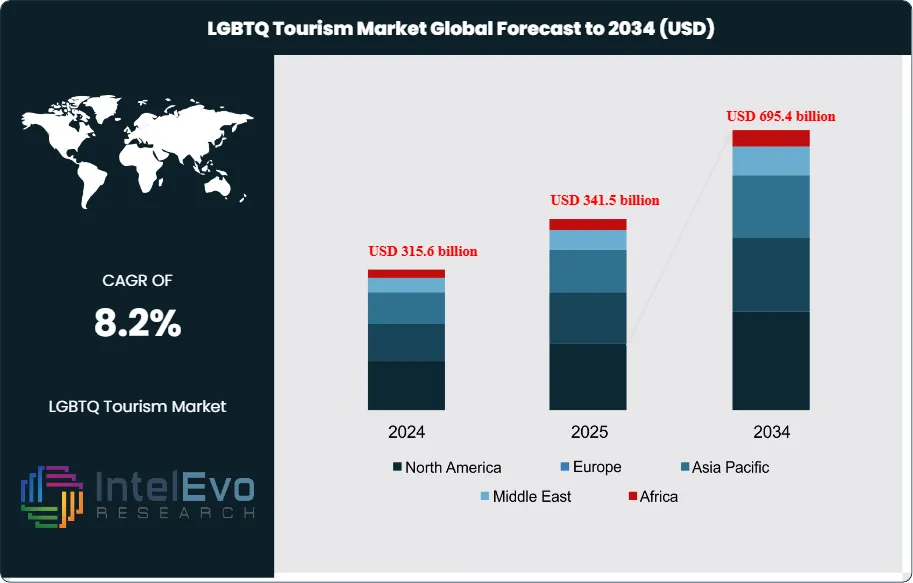
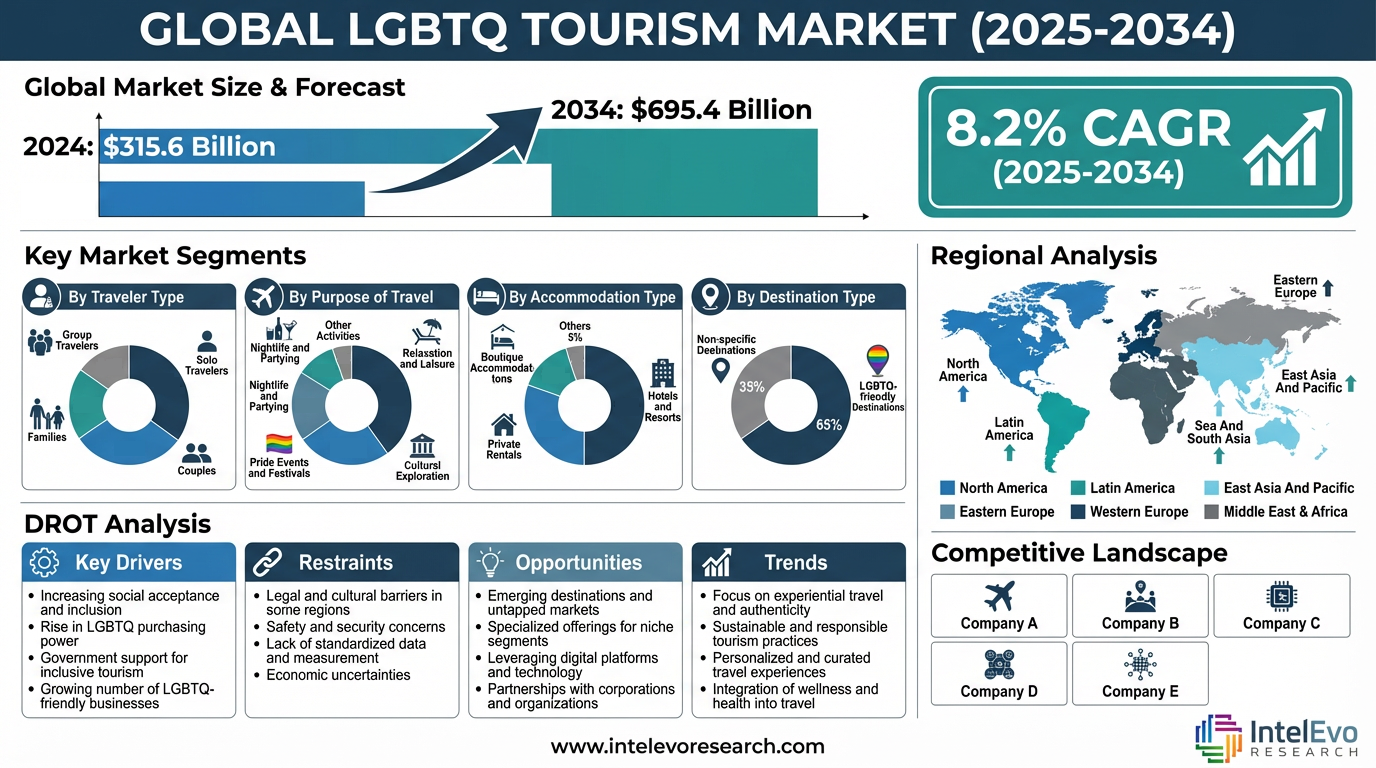
The LGBTQ Tourism Market is estimated at approximately USD 315.6 billion in 2024 and is projected to reach around USD 695.4 billion by 2034, registering a compound annual growth rate (CAGR) of 8.2% over the forecast period of 2025–2034. This growth is driven by rising social acceptance, expanding LGBTQ-friendly destinations, and increasing disposable incomes among LGBTQ travelers worldwide. Governments and tourism boards are actively promoting inclusive travel policies, while airlines, hotels, and digital booking platforms are tailoring offerings to this high-value segment. The growing influence of Pride events, destination weddings, and experiential travel is further strengthening year-round demand, positioning LGBTQ tourism as one of the most resilient and premium segments within the global travel industry.
This growth reflects a steady expansion of inclusive travel services, rising societal acceptance, and the increasing visibility of LGBTQ communities worldwide. Over the past decade, the market has shifted from niche offerings to a mainstream segment, supported by broader legal recognition and consumer demand for safe and welcoming destinations.
The market’s trajectory is shaped by both demand-side and supply-side factors. On the demand side, 7.6% of U.S. adults now identify as LGBTQ+, representing a significant traveler base. Globally, 37 countries have legalized same-sex marriage, expanding the number of destinations that actively attract LGBTQ tourists. On the supply side, specialized travel agencies, LGBTQ-friendly hotels, and event organizers are scaling their offerings to meet rising expectations. At the same time, risks remain. Political instability, inconsistent enforcement of anti-discrimination laws, and uneven regional acceptance continue to limit growth in certain markets.
Technology is reshaping the sector. Digital platforms enable personalized travel planning, while AI-driven tools enhance customer engagement and safety. Social media campaigns and inclusive advertising are proving effective, with research showing that 70% of Gen Z consumers trust diverse brands and 59% prefer inclusive ads. These trends are not only driving bookings but also influencing brand loyalty. Companies that align with inclusivity see measurable returns, with inclusive campaigns boosting purchase intent by more than 20 percentage points.
Regional dynamics highlight clear investment hotspots. North America and Western Europe remain the largest contributors, supported by strong legal protections and established LGBTQ-friendly infrastructure. Asia-Pacific is emerging as a high-growth region, with rising middle-class incomes and gradual policy shifts in markets such as Thailand and Taiwan. Latin America also presents opportunities, particularly in destinations like Mexico and Brazil, where tourism boards are actively promoting inclusivity.
Government support is reinforcing market confidence. Policies that safeguard LGBTQ rights and promote inclusive tourism are attracting greater international arrivals. According to GLAAD, regulatory backing not only ensures traveler safety but also encourages sustainable practices across the industry. For investors and operators, the combination of expanding demand, favorable regulations, and digital adoption positions LGBTQ tourism as one of the most resilient and high-potential segments of the global travel economy.
Key Takeaways
Market Growth: The LGBTQ Tourism Market was valued at USD 315.6 billion in 2024 and is projected to reach USD 695.4 billion by 2034, expanding at a CAGR of 8.2%. Growth is supported by rising societal acceptance, inclusive policies, and targeted marketing strategies.
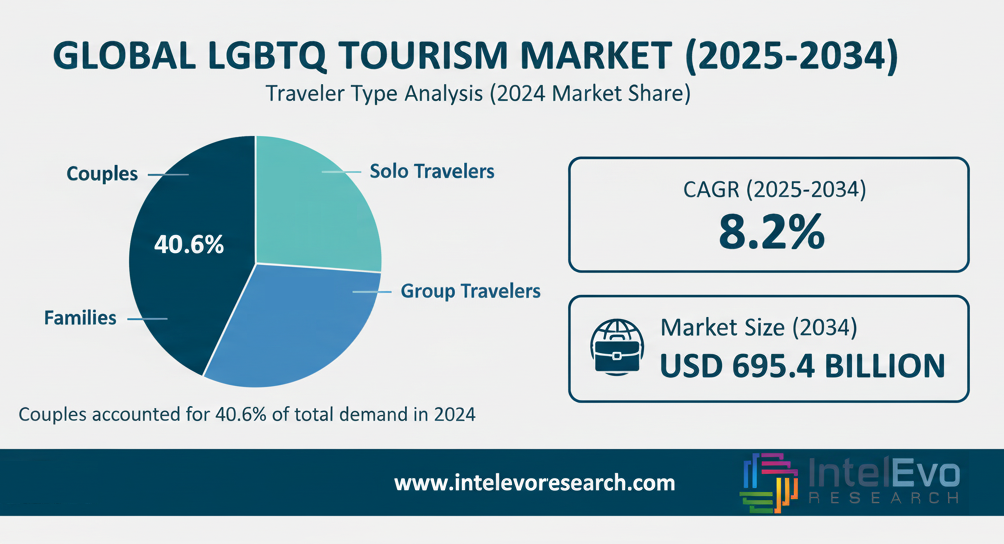
Traveler Type: Couples accounted for 40.6% of the market in 2023, reflecting the strong demand for joint travel experiences and destination packages tailored to shared leisure and cultural activities.
Purpose of Travel: Nightlife and Partying represented 38.2% of travel purposes in 2023, highlighting the importance of entertainment-driven tourism and the role of LGBTQ-friendly events and festivals in attracting international visitors.
Accommodation Type: Hotels and Resorts captured 39.2% of the accommodation segment in 2023, supported by the expansion of LGBTQ-certified properties and global hospitality brands promoting inclusive guest experiences.
Driver: Expanding legal recognition of LGBTQ rights is fueling demand. With 37 countries legalizing same-sex marriage and 84% of non-LGBTQ Americans supporting equal rights, the market benefits from a broader base of safe and welcoming destinations.
Restraint: Uneven regional acceptance and restrictive laws in parts of the Middle East, Africa, and Asia limit market penetration, constraining potential revenue streams despite global growth.
Opportunity: Asia-Pacific is emerging as a high-growth region, with Thailand, Taiwan, and Japan showing increasing openness. The region is expected to post double-digit CAGR through 2033, driven by rising middle-class incomes and government-backed tourism campaigns.
Trend: Inclusive advertising is shaping consumer behavior. Studies show 70% of Gen Z trust diverse brands, while inclusive campaigns increase purchase intent by 23 percentage points, making brand positioning a decisive factor in market share.
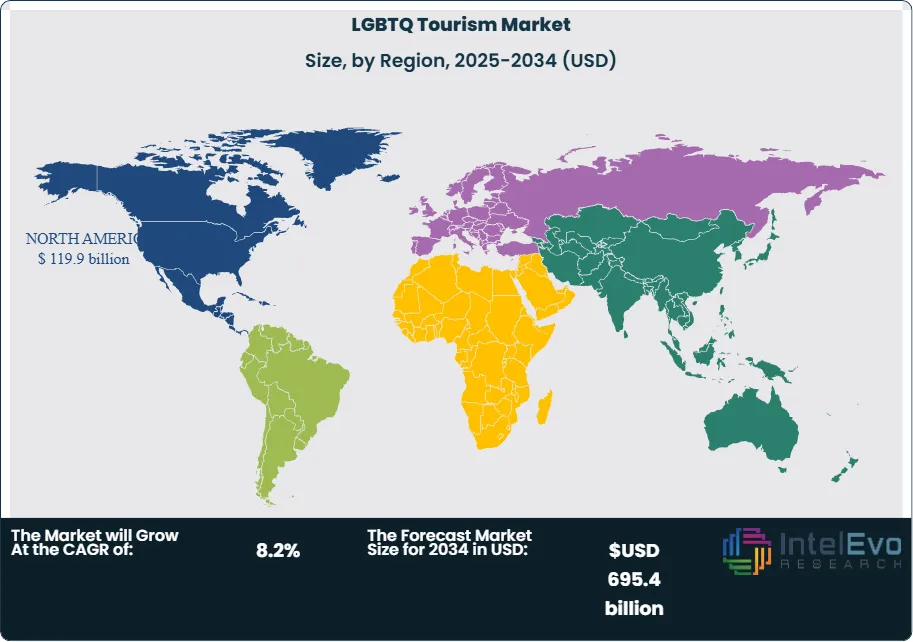
Regional Analysis: North America led the market in 2023 with 40.4% share, valued at USD 119.91 billion, supported by strong legal protections and established LGBTQ-friendly infrastructure. Western Europe follows closely, while Latin America and Asia-Pacific are positioned as the fastest-growing regions through 2033.
Traveler Type Analysis
Couples remain the largest traveler group in the LGBTQ tourism market, accounting for 40.6% of total demand in 2024 and expected to maintain dominance through 2030. This segment is driven by strong interest in romantic getaways, destination weddings, and anniversary travel packages that emphasize inclusivity and safety. Destinations that combine cultural acceptance with tailored hospitality services continue to attract repeat visits from this demographic.
Solo travelers represent a growing segment, particularly among younger LGBTQ individuals seeking independence and social connection. Safety, community events, and opportunities to meet like-minded travelers are critical factors influencing destination choice. Families are also expanding their presence in the market, with demand for child-friendly, inclusive destinations rising steadily. Group travelers, often organized around festivals, advocacy events, or shared interests, contribute significantly to seasonal spikes in demand, particularly during Pride celebrations and cultural gatherings.
Purpose of Travel Analysis
Nightlife and Partying accounted for 38.2% of LGBTQ travel purposes in 2024, reflecting the strong pull of inclusive entertainment venues, festivals, and nightlife districts. This segment is expected to remain a key driver, supported by global events such as Pride parades and LGBTQ cultural festivals that attract international visitors.
Pride events and festivals continue to expand their economic impact, drawing millions of attendees annually and generating significant tourism revenue for host cities. Cultural exploration is also gaining traction, with travelers seeking destinations that highlight LGBTQ history, art, and heritage. Meanwhile, relaxation and leisure travel is increasingly important, with LGBTQ tourists prioritizing destinations that combine scenic appeal with inclusive hospitality. Adventure travel, culinary tours, and wellness retreats are emerging as niche but fast-growing categories.
Accommodation Type Analysis
Hotels and Resorts held 39.2% of the LGBTQ accommodation market in 2024, supported by global hospitality brands that actively promote inclusivity and train staff in culturally competent service. This segment benefits from established infrastructure, luxury amenities, and strong brand recognition, making it the preferred choice for couples and international travelers.
Private rentals are gaining popularity, particularly among younger travelers and families seeking privacy and flexibility. Boutique accommodations appeal to those looking for unique, intimate experiences in progressive destinations. Budget-conscious travelers continue to rely on hostels and guest houses, which are increasingly adapting their services to LGBTQ guests. The diversification of lodging options reflects the community’s varied preferences and spending power.
Regional Analysis
North America led the global LGBTQ tourism market in 2024 with a 40.4% share, valued at USD 119.9 billion. The region’s dominance is supported by strong legal protections, established LGBTQ-friendly infrastructure, and major events in cities such as New York, San Francisco, and Toronto. Europe follows closely, with Spain, Portugal, and Malta ranking among the top destinations in the Gay Travel Index.
Asia Pacific is emerging as a high-growth region, with Thailand, Taiwan, and Japan positioning themselves as inclusive destinations. Thailand’s “Pink Plus Economy” initiative and Taiwan’s recognition of same-sex marriage are expected to drive double-digit growth in the region through 2030. Latin America, led by Brazil and Mexico, is also expanding its LGBTQ tourism offerings, while the Middle East and Africa remain constrained by restrictive laws, though select markets such as South Africa show potential.
By Traveler Type, (Solo Travelers, Couples, Families, Group Travelers), By Purpose of Travel, (Nightlife and Partying, Pride Events and Festivals, Cultural Exploration, Relaxation and Leisure, Other Activities), By Accommodation Type, (Hotels and Resorts, Private Rentals, Boutique Accommodations, Others), By Destination Type, (LGBTQ-friendly Destinations, Non-specific Destinations)
Research Methodology
Primary Research- 100 Interviews of Stakeholders
Secondary Research
Desk Research
Regional scope
North America (United States, Canada, Mexico)
Latin America (Brazil, Argentina, Columbia)
East Asia And Pacific (China, Japan, South Korea, Australia, Cambodia, Fiji, Indonesia)
Sea And South Asia (India, Singapore, Thailand, Taiwan, Malaysia)
Eastern Europe (Poland, Russia, Czech Republic, Romania)
Western Europe (Germany, U.K., France, Spain, Itlay)
Middle East & Africa (GCC Countries, Egypt, Nigeria, South Africa, Israel)
Competitive Landscape
Atlantis Events, Out & About Travel, Olivia Travel, Misterb&b, R Family Vacations, Purple Roofs, HE Travel, GayCities, ManAboutWorld, VACAYA, Out Adventures, RSVP Vacations, International LGBTQ+ Travel Association (IGLTA)
Customization Scope
Customization for segments, region/country-level will be provided. Moreover, additional customization can be done based on the requirements.
Pricing and Purchase Options
Avail customized purchase options to meet your exact research needs. We have three licenses to opt for: Single User License, Multi-User License (Up to 5 Users), Corporate Use License (Unlimited User and Printable PDF).
TABLE OF CONTENTS
1. EXECUTIVE SUMMARY
1.1. MARKET SNAPSHOT
1.2. KEY FINDINGS & INSIGHTS
1.3. ANALYST RECOMMENDATIONS
1.4. FUTURE OUTLOOK
2. RESEARCH METHODOLOGY
2.1. MARKET DEFINITION & SCOPE
2.2. RESEARCH OBJECTIVES: PRIMARY & SECONDARY DATA SOURCES
2.3. DATA COLLECTION SOURCES
2.3.1. COVERAGE OF 100+ PRIMARY RESEARCH/CONSULTATION CALLS WITH INDUSTRY STAKEHOLDERS
FIGURE 17 NORTH AMERICA LGBTQ TOURISM CURRENT AND FUTURE TYPE ANALYSIS, 2025–2034, (USD MILLION)
FIGURE 18 NORTH AMERICA LGBTQ TOURISM CURRENT AND FUTURE END USER ANALYSIS, 2025–2034, (USD MILLION)
FIGURE 19 MARKET SHARE BY COUNTRY
FIGURE 20 LATIN AMERICA LGBTQ TOURISM CURRENT AND FUTURE TYPE ANALYSIS, 2025–2034, (USD MILLION)
FIGURE 21 LATIN AMERICA LGBTQ TOURISM CURRENT AND FUTURE END USER ANALYSIS, 2025–2034, (USD MILLION)
FIGURE 22 MARKET SHARE BY COUNTRY
FIGURE 23 EASTERN EUROPE LGBTQ TOURISM CURRENT AND FUTURE TYPE ANALYSIS, 2025–2034, (USD MILLION)
FIGURE 24 EASTERN EUROPE LGBTQ TOURISM CURRENT AND FUTURE END USER ANALYSIS, 2025–2034, (USD MILLION)
FIGURE 25 MARKET SHARE BY COUNTRY
FIGURE 26 WESTERN EUROPE LGBTQ TOURISM CURRENT AND FUTURE TYPE ANALYSIS, 2025–2034, (USD MILLION)
FIGURE 27 WESTERN EUROPE LGBTQ TOURISM CURRENT AND FUTURE END USER ANALYSIS, 2025–2034, (USD MILLION)
FIGURE 28 MARKET SHARE BY COUNTRY
FIGURE 29 EAST ASIA AND PACIFIC LGBTQ TOURISM CURRENT AND FUTURE TYPE ANALYSIS, 2025–2034, (USD MILLION)
FIGURE 30 EAST ASIA AND PACIFIC LGBTQ TOURISM CURRENT AND FUTURE END USER ANALYSIS, 2025–2034, (USD MILLION)
FIGURE 31 MARKET SHARE BY COUNTRY
FIGURE 32 SEA AND SOUTH ASIA LGBTQ TOURISM CURRENT AND FUTURE TYPE ANALYSIS, 2025–2034, (USD MILLION)
FIGURE 33 SEA AND SOUTH ASIA LGBTQ TOURISM CURRENT AND FUTURE END USER ANALYSIS, 2025–2034, (USD MILLION)
FIGURE 34 MARKET SHARE BY COUNTRY
FIGURE 35 MIDDLE EAST AND AFRICA LGBTQ TOURISM CURRENT AND FUTURE TYPE ANALYSIS, 2025–2034, (USD MILLION)
FIGURE 36 MIDDLE EAST AND AFRICA LGBTQ TOURISM CURRENT AND FUTURE END USER ANALYSIS, 2025–2034, (USD MILLION)
FIGURE 37 NORTH AMERICA LGBTQ TOURISM CURRENT AND FUTURE MARKET VOLUME SHARE REGIONAL ANALYSIS, 2025–2034, (USD MILLION)
FIGURE 38 U.S. LGBTQ TOURISM CURRENT AND FUTURE TYPE ANALYSIS, 2025–2034, (USD MILLION)
FIGURE 39 U.S. LGBTQ TOURISM CURRENT AND FUTURE END USER ANALYSIS, 2025–2034, (USD MILLION)
FIGURE 40 CANADA LGBTQ TOURISM CURRENT AND FUTURE TYPE ANALYSIS, 2025–2034, (USD MILLION)
FIGURE 41 CANADA LGBTQ TOURISM CURRENT AND FUTURE END USER ANALYSIS, 2025–2034, (USD MILLION)
FIGURE 42 LATIN AMERICA LGBTQ TOURISM CURRENT AND FUTURE MARKET VOLUME SHARE REGIONAL ANALYSIS, 2025–2034, (USD MILLION)
FIGURE 43 MEXICO LGBTQ TOURISM CURRENT AND FUTURE TYPE ANALYSIS, 2025–2034, (USD MILLION)
FIGURE 44 MEXICO LGBTQ TOURISM CURRENT AND FUTURE END USER ANALYSIS, 2025–2034, (USD MILLION)
FIGURE 45 BRAZIL LGBTQ TOURISM CURRENT AND FUTURE TYPE ANALYSIS, 2025–2034, (USD MILLION)
FIGURE 46 BRAZIL LGBTQ TOURISM CURRENT AND FUTURE END USER ANALYSIS, 2025–2034, (USD MILLION)
FIGURE 47 ARGENTINA LGBTQ TOURISM CURRENT AND FUTURE TYPE ANALYSIS, 2025–2034, (USD MILLION)
FIGURE 48 ARGENTINA LGBTQ TOURISM CURRENT AND FUTURE END USER ANALYSIS, 2025–2034, (USD MILLION)
FIGURE 49 COLUMBIA LGBTQ TOURISM CURRENT AND FUTURE TYPE ANALYSIS, 2025–2034, (USD MILLION)
FIGURE 50 COLUMBIA LGBTQ TOURISM CURRENT AND FUTURE END USER ANALYSIS, 2025–2034, (USD MILLION)
FIGURE 51 REST OF LATIN AMERICA LGBTQ TOURISM CURRENT AND FUTURE TYPE ANALYSIS, 2025–2034, (USD MILLION)
FIGURE 52 REST OF LATIN AMERICA LGBTQ TOURISM CURRENT AND FUTURE END USER ANALYSIS, 2025–2034, (USD MILLION)
FIGURE 53 EASTERN EUROPE LGBTQ TOURISM CURRENT AND FUTURE MARKET VOLUME SHARE REGIONAL ANALYSIS, 2025–2034, (USD MILLION)
FIGURE 54 POLAND LGBTQ TOURISM CURRENT AND FUTURE TYPE ANALYSIS, 2025–2034, (USD MILLION)
FIGURE 55 POLAND LGBTQ TOURISM CURRENT AND FUTURE END USER ANALYSIS, 2025–2034, (USD MILLION)
FIGURE 56 RUSSIA LGBTQ TOURISM CURRENT AND FUTURE TYPE ANALYSIS, 2025–2034, (USD MILLION)
FIGURE 57 RUSSIA LGBTQ TOURISM CURRENT AND FUTURE END USER ANALYSIS, 2025–2034, (USD MILLION)
FIGURE 58 CZECH REPUBLIC LGBTQ TOURISM CURRENT AND FUTURE TYPE ANALYSIS, 2025–2034, (USD MILLION)
FIGURE 59 CZECH REPUBLIC LGBTQ TOURISM CURRENT AND FUTURE END USER ANALYSIS, 2025–2034, (USD MILLION)
FIGURE 60 ROMANIA LGBTQ TOURISM CURRENT AND FUTURE TYPE ANALYSIS, 2025–2034, (USD MILLION)
FIGURE 61 ROMANIA LGBTQ TOURISM CURRENT AND FUTURE END USER ANALYSIS, 2025–2034, (USD MILLION)
FIGURE 62 REST OF EASTERN EUROPE LGBTQ TOURISM CURRENT AND FUTURE TYPE ANALYSIS, 2025–2034, (USD MILLION)
FIGURE 63 REST OF EASTERN EUROPE LGBTQ TOURISM CURRENT AND FUTURE END USER ANALYSIS, 2025–2034, (USD MILLION)
FIGURE 64 WESTERN EUROPE LGBTQ TOURISM CURRENT AND FUTURE MARKET VOLUME SHARE REGIONAL ANALYSIS, 2025–2034, (USD MILLION)
FIGURE 65 GERMANY LGBTQ TOURISM CURRENT AND FUTURE TYPE ANALYSIS, 2025–2034, (USD MILLION)
FIGURE 66 GERMANY LGBTQ TOURISM CURRENT AND FUTURE END USER ANALYSIS, 2025–2034, (USD MILLION)
FIGURE 67 FRANCE LGBTQ TOURISM CURRENT AND FUTURE TYPE ANALYSIS, 2025–2034, (USD MILLION)
FIGURE 68 FRANCE LGBTQ TOURISM CURRENT AND FUTURE END USER ANALYSIS, 2025–2034, (USD MILLION)
FIGURE 69 UK LGBTQ TOURISM CURRENT AND FUTURE TYPE ANALYSIS, 2025–2034, (USD MILLION)
FIGURE 70 UK LGBTQ TOURISM CURRENT AND FUTURE END USER ANALYSIS, 2025–2034, (USD MILLION)
FIGURE 71 SPAIN LGBTQ TOURISM CURRENT AND FUTURE TYPE ANALYSIS, 2025–2034, (USD MILLION)
FIGURE 72 SPAIN LGBTQ TOURISM CURRENT AND FUTURE END USER ANALYSIS, 2025–2034, (USD MILLION)
FIGURE 73 ITALY LGBTQ TOURISM CURRENT AND FUTURE TYPE ANALYSIS, 2025–2034, (USD MILLION)
FIGURE 74 ITALY LGBTQ TOURISM CURRENT AND FUTURE END USER ANALYSIS, 2025–2034, (USD MILLION)
FIGURE 75 REST OF WESTERN EUROPE LGBTQ TOURISM CURRENT AND FUTURE TYPE ANALYSIS, 2025–2034, (USD MILLION)
FIGURE 76 REST OF WESTERN EUROPE LGBTQ TOURISM CURRENT AND FUTURE END USER ANALYSIS, 2025–2034, (USD MILLION)
FIGURE 77 EAST ASIA AND PACIFIC LGBTQ TOURISM CURRENT AND FUTURE MARKET VOLUME SHARE REGIONAL ANALYSIS, 2025–2034, (USD MILLION)
FIGURE 78 CHINA LGBTQ TOURISM CURRENT AND FUTURE TYPE ANALYSIS, 2025–2034, (USD MILLION)
FIGURE 79 CHINA LGBTQ TOURISM CURRENT AND FUTURE END USER ANALYSIS, 2025–2034, (USD MILLION)
FIGURE 80 JAPAN LGBTQ TOURISM CURRENT AND FUTURE TYPE ANALYSIS, 2025–2034, (USD MILLION)
FIGURE 81 JAPAN LGBTQ TOURISM CURRENT AND FUTURE END USER ANALYSIS, 2025–2034, (USD MILLION)
FIGURE 82 AUSTRALIA LGBTQ TOURISM CURRENT AND FUTURE TYPE ANALYSIS, 2025–2034, (USD MILLION)
FIGURE 83 AUSTRALIA LGBTQ TOURISM CURRENT AND FUTURE END USER ANALYSIS, 2025–2034, (USD MILLION)
FIGURE 84 CAMBODIA LGBTQ TOURISM CURRENT AND FUTURE TYPE ANALYSIS, 2025–2034, (USD MILLION)
FIGURE 85 CAMBODIA LGBTQ TOURISM CURRENT AND FUTURE END USER ANALYSIS, 2025–2034, (USD MILLION)
FIGURE 86 FIJI LGBTQ TOURISM CURRENT AND FUTURE TYPE ANALYSIS, 2025–2034, (USD MILLION)
FIGURE 87 FIJI LGBTQ TOURISM CURRENT AND FUTURE END USER ANALYSIS, 2025–2034, (USD MILLION)
FIGURE 88 INDONESIA LGBTQ TOURISM CURRENT AND FUTURE TYPE ANALYSIS, 2025–2034, (USD MILLION)
FIGURE 89 INDONESIA LGBTQ TOURISM CURRENT AND FUTURE END USER ANALYSIS, 2025–2034, (USD MILLION)
FIGURE 90 SOUTH KOREA LGBTQ TOURISM CURRENT AND FUTURE TYPE ANALYSIS, 2025–2034, (USD MILLION)
FIGURE 91 SOUTH KOREA LGBTQ TOURISM CURRENT AND FUTURE END USER ANALYSIS, 2025–2034, (USD MILLION)
FIGURE 92 REST OF EAST ASIA AND PACIFIC LGBTQ TOURISM CURRENT AND FUTURE TYPE ANALYSIS, 2025–2034, (USD MILLION)
FIGURE 93 REST OF EAST ASIA AND PACIFIC LGBTQ TOURISM CURRENT AND FUTURE END USER ANALYSIS, 2025–2034, (USD MILLION)
FIGURE 94 SEA AND SOUTH ASIA LGBTQ TOURISM CURRENT AND FUTURE MARKET VOLUME SHARE REGIONAL ANALYSIS, 2025–2034, (USD MILLION)
FIGURE 95 BANGLADESH LGBTQ TOURISM CURRENT AND FUTURE TYPE ANALYSIS, 2025–2034, (USD MILLION)
FIGURE 96 BANGLADESH LGBTQ TOURISM CURRENT AND FUTURE END USER ANALYSIS, 2025–2034, (USD MILLION)
FIGURE 97 NEW ZEALAND LGBTQ TOURISM CURRENT AND FUTURE TYPE ANALYSIS, 2025–2034, (USD MILLION)
FIGURE 98 NEW ZEALAND LGBTQ TOURISM CURRENT AND FUTURE END USER ANALYSIS, 2025–2034, (USD MILLION)
FIGURE 99 INDIA LGBTQ TOURISM CURRENT AND FUTURE TYPE ANALYSIS, 2025–2034, (USD MILLION)
FIGURE 100 INDIA LGBTQ TOURISM CURRENT AND FUTURE END USER ANALYSIS, 2025–2034, (USD MILLION)
FIGURE 101 SINGAPORE LGBTQ TOURISM CURRENT AND FUTURE TYPE ANALYSIS, 2025–2034, (USD MILLION)
FIGURE 102 SINGAPORE LGBTQ TOURISM CURRENT AND FUTURE END USER ANALYSIS, 2025–2034, (USD MILLION)
FIGURE 103 THAILAND LGBTQ TOURISM CURRENT AND FUTURE TYPE ANALYSIS, 2025–2034, (USD MILLION)
FIGURE 104 THAILAND LGBTQ TOURISM CURRENT AND FUTURE END USER ANALYSIS, 2025–2034, (USD MILLION)
FIGURE 105 TAIWAN LGBTQ TOURISM CURRENT AND FUTURE TYPE ANALYSIS, 2025–2034, (USD MILLION)
FIGURE 106 TAIWAN LGBTQ TOURISM CURRENT AND FUTURE END USER ANALYSIS, 2025–2034, (USD MILLION)
FIGURE 107 MALAYSIA LGBTQ TOURISM CURRENT AND FUTURE TYPE ANALYSIS, 2025–2034, (USD MILLION)
FIGURE 108 MALAYSIA LGBTQ TOURISM CURRENT AND FUTURE END USER ANALYSIS, 2025–2034, (USD MILLION)
FIGURE 109 REST OF SEA AND SOUTH ASIA LGBTQ TOURISM CURRENT AND FUTURE TYPE ANALYSIS, 2025–2034, (USD MILLION)
FIGURE 110 REST OF SEA AND SOUTH ASIA LGBTQ TOURISM CURRENT AND FUTURE END USER ANALYSIS, 2025–2034, (USD MILLION)
FIGURE 111 MIDDLE EAST AND AFRICA LGBTQ TOURISM CURRENT AND FUTURE MARKET VOLUME SHARE REGIONAL ANALYSIS, 2025–2034, (USD MILLION)
FIGURE 112 GCC COUNTRIES LGBTQ TOURISM CURRENT AND FUTURE TYPE ANALYSIS, 2025–2034, (USD MILLION)
FIGURE 113 GCC COUNTRIES LGBTQ TOURISM CURRENT AND FUTURE END USER ANALYSIS, 2025–2034, (USD MILLION)
FIGURE 114 SAUDI ARABIA LGBTQ TOURISM CURRENT AND FUTURE TYPE ANALYSIS, 2025–2034, (USD MILLION)
FIGURE 115 SAUDI ARABIA LGBTQ TOURISM CURRENT AND FUTURE END USER ANALYSIS, 2025–2034, (USD MILLION)
FIGURE 116 UAE LGBTQ TOURISM CURRENT AND FUTURE TYPE ANALYSIS, 2025–2034, (USD MILLION)
FIGURE 117 UAE LGBTQ TOURISM CURRENT AND FUTURE END USER ANALYSIS, 2025–2034, (USD MILLION)
FIGURE 118 BAHRAIN LGBTQ TOURISM CURRENT AND FUTURE TYPE ANALYSIS, 2025–2034, (USD MILLION)
FIGURE 119 BAHRAIN LGBTQ TOURISM CURRENT AND FUTURE END USER ANALYSIS, 2025–2034, (USD MILLION)
FIGURE 120 KUWAIT LGBTQ TOURISM CURRENT AND FUTURE TYPE ANALYSIS, 2025–2034, (USD MILLION)
FIGURE 121 KUWAIT LGBTQ TOURISM CURRENT AND FUTURE END USER ANALYSIS, 2025–2034, (USD MILLION)
FIGURE 122 OMAN LGBTQ TOURISM CURRENT AND FUTURE TYPE ANALYSIS, 2025–2034, (USD MILLION)
FIGURE 123 OMAN LGBTQ TOURISM CURRENT AND FUTURE END USER ANALYSIS, 2025–2034, (USD MILLION)
FIGURE 124 QATAR LGBTQ TOURISM CURRENT AND FUTURE TYPE ANALYSIS, 2025–2034, (USD MILLION)
FIGURE 125 QATAR LGBTQ TOURISM CURRENT AND FUTURE END USER ANALYSIS, 2025–2034, (USD MILLION)
FIGURE 126 EGYPT LGBTQ TOURISM CURRENT AND FUTURE TYPE ANALYSIS, 2025–2034, (USD MILLION)
FIGURE 127 EGYPT LGBTQ TOURISM CURRENT AND FUTURE END USER ANALYSIS, 2025–2034, (USD MILLION)
FIGURE 128 NIGERIA LGBTQ TOURISM CURRENT AND FUTURE TYPE ANALYSIS, 2025–2034, (USD MILLION)
FIGURE 129 NIGERIA LGBTQ TOURISM CURRENT AND FUTURE END USER ANALYSIS, 2025–2034, (USD MILLION)
FIGURE 130 SOUTH AFRICA LGBTQ TOURISM CURRENT AND FUTURE TYPE ANALYSIS, 2025–2034, (USD MILLION)
FIGURE 131 SOUTH AFRICA LGBTQ TOURISM CURRENT AND FUTURE END USER ANALYSIS, 2025–2034, (USD MILLION)
FIGURE 132 ISRAEL LGBTQ TOURISM CURRENT AND FUTURE TYPE ANALYSIS, 2025–2034, (USD MILLION)
FIGURE 133 ISRAEL LGBTQ TOURISM CURRENT AND FUTURE END USER ANALYSIS, 2025–2034, (USD MILLION)
FIGURE 134 REST OF MEA LGBTQ TOURISM CURRENT AND FUTURE TYPE ANALYSIS, 2025–2034, (USD MILLION)
FIGURE 135 REST OF MEA LGBTQ TOURISM CURRENT AND FUTURE END USER ANALYSIS, 2025–2034, (USD MILLION)
FIGURE 136 U. S. MARKET SHARE ANALYSIS BY TYPE (2024)
FIGURE 137 U. S. MARKET SHARE ANALYSIS BY END USER (2024)
FIGURE 138 CANADA MARKET SHARE ANALYSIS BY TYPE (2024)
FIGURE 139 CANADA MARKET SHARE ANALYSIS BY END USER (2024)
FIGURE 140 MEXICO MARKET SHARE ANALYSIS BY TYPE (2024)
FIGURE 141 MEXICO MARKET SHARE ANALYSIS BY END USER (2024)
FIGURE 142 CHINA MARKET SHARE ANALYSIS BY TYPE (2024)
FIGURE 143 CHINA MARKET SHARE ANALYSIS BY END USER (2024)
FIGURE 144 JAPAN MARKET SHARE ANALYSIS BY TYPE (2024)
FIGURE 145 JAPAN MARKET SHARE ANALYSIS BY END USER (2024)
FIGURE 146 INDIA MARKET SHARE ANALYSIS BY TYPE (2024)
FIGURE 147 INDIA MARKET SHARE ANALYSIS BY END USER (2024)
FIGURE 148 SOUTH KOREA MARKET SHARE ANALYSIS BY TYPE (2024)
FIGURE 149 SOUTH KOREA MARKET SHARE ANALYSIS BY END USER (2024)
FIGURE 150 SAUDI ARABIA MARKET SHARE ANALYSIS BY TYPE (2024)
FIGURE 151 SAUDI ARABIA MARKET SHARE ANALYSIS BY END USER (2024)
FIGURE 152 UAE MARKET SHARE ANALYSIS BY TYPE (2024)
FIGURE 153 UAE MARKET SHARE ANALYSIS BY END USER (2024)
FIGURE 154 EGYPT MARKET SHARE ANALYSIS BY TYPE (2024)
FIGURE 155 EGYPT MARKET SHARE ANALYSIS BY END USER (2024)
FIGURE 156 NIGERIA MARKET SHARE ANALYSIS BY TYPE (2024)
FIGURE 157 NIGERIA MARKET SHARE ANALYSIS BY END USER (2024)
FIGURE 158 SOUTH AFRICA MARKET SHARE ANALYSIS BY TYPE (2024)
FIGURE 159 SOUTH AFRICA MARKET SHARE ANALYSIS BY END USER (2024)
FIGURE 160 GERMANY MARKET SHARE ANALYSIS BY TYPE (2024)
FIGURE 161 GERMANY MARKET SHARE ANALYSIS BY END USER (2024)
FIGURE 162 FRANCE MARKET SHARE ANALYSIS BY TYPE (2024)
FIGURE 163 FRANCE MARKET SHARE ANALYSIS BY END USER (2024)
FIGURE 164 UK MARKET SHARE ANALYSIS BY TYPE (2024)
FIGURE 165 UK MARKET SHARE ANALYSIS BY END USER (2024)
FIGURE 166 SPAIN MARKET SHARE ANALYSIS BY TYPE (2024)
FIGURE 167 SPAIN MARKET SHARE ANALYSIS BY END USER (2024)
FIGURE 168 ITALY MARKET SHARE ANALYSIS BY TYPE (2024)
FIGURE 169 ITALY MARKET SHARE ANALYSIS BY END USER (2024)
FIGURE 170 BRAZIL MARKET SHARE ANALYSIS BY TYPE (2024)
FIGURE 171 BRAZIL MARKET SHARE ANALYSIS BY END USER (2024)
FIGURE 172 ARGENTINA MARKET SHARE ANALYSIS BY TYPE (2024)
FIGURE 173 ARGENTINA MARKET SHARE ANALYSIS BY END USER (2024)
FIGURE 174 COLUMBIA MARKET SHARE ANALYSIS BY TYPE (2024)
FIGURE 175 COLUMBIA MARKET SHARE ANALYSIS BY END USER (2024)
FIGURE 176 GLOBAL LGBTQ TOURISM CURRENT AND FUTURE MARKET KEY COUNTRY LEVEL ANALYSIS, 2024–2034, (USD MILLION)
FIGURE 177 FINANCIAL OVERVIEW:
Key Player Analysis
Olivia Travel: Olivia Travel positions as a leader in women-focused LGBTQ tourism. The company’s core offering centers on charter cruises and resort programs tailored for lesbian travelers, with curated entertainment, wellness, and community programming. Olivia has expanded digital engagement with app-based itineraries and AI-enabled service chat to streamline pre-trip planning and onboard support. The brand’s differentiator is its exclusive focus on women and long-standing event curation that produces high repeat rates and premium yields. In a market expected to reach USD 357 billion in 2025 and USD 604 billion by 2032, Olivia’s niche leadership in women-centric experiences remains resilient and price-accretive for partners and sponsors.
Atlantis Events: Atlantis Events operates as a leader and scale player in LGBTQ cruises and resort weeks, focused primarily on gay men. The company runs large charter itineraries across the Caribbean, Mediterranean, and Pacific, pairing entertainment with destination experiences. Strategic initiatives include deeper partnerships with global cruise lines and data-driven pricing that calibrates cabin mix and onboard spend. Its differentiators are production scale, exclusive artist lineups, and loyal repeat guests, which support strong occupancy and ancillary revenue. With the LGBTQ tourism market projected to grow at 6.8–7.9% CAGR through 2032, Atlantis benefits from high seasonality alignment and capacity access on major vessels.
R Family Vacations: R Family Vacations is a niche leader in LGBTQ family travel. The company’s core portfolio includes cruises, resort stays, and land tours designed for LGBTQ parents and children, emphasizing safety, kids’ programming, and inclusive staff training. Strategically, R Family partners with mainstream hospitality brands to secure family-friendly inventory and invests in accessibility standards and child-focused activities that reduce friction for multigenerational travel. Differentiation comes from a community-first approach and curated family services that improve conversion and satisfaction. The segment’s growth aligns with broader market expansion, as inclusive marketing and legal protections increase family travel participation across North America and Europe.
HE Travel: HE Travel is positioned as an innovator in LGBTQ adventure and cultural tours. The company offers small-group itineraries spanning cycling, trekking, archaeology, and culinary immersion, supported by expert guides and safety protocols. Strategic moves include expanding premium adventure routes, integrating VR previews of difficult terrains, and adopting AI to personalize pre-trip recommendations and risk screening. Differentiation lies in high-touch curation, diversified destinations, and the ability to scale bespoke experiences at sustainable margins. As specialized packages gain share and digital planning accelerates, HE Travel’s focus on experiential depth targets a growing slice of the market through 2032.
Market Key Players
Atlantis Events
Out & About Travel
Olivia Travel
Misterb&b
R Family Vacations
Purple Roofs
HE Travel
GayCities
ManAboutWorld
VACAYA
Out Adventures
RSVP Vacations
International LGBTQ+ Travel Association (IGLTA)
Driver
Inclusive Branding and Representation as a Demand Multiplier
By 2025, inclusive marketing will be a powerful growth factor for the LGBTQ tourism market, which is expected to grow at a rate of 7.9% annually through 2033. Brands and destinations that genuinely represent LGBTQ travelers through images of same-sex couples, Pride-related campaigns, and inclusive messaging experience higher engagement and conversion rates. Studies show that nearly 70% of Gen Z and millennial travelers prefer brands that show diversity and social responsibility. This preference directly impacts their choices about where to travel and how to book.
Policy Alignment and Social Acceptance Driving Destination Choice
Progressive laws and visible social acceptance strengthen this growth factor. Countries like Canada, Spain, New Zealand, and parts of Western Europe continue to attract a large share of inbound LGBTQ tourism due to strong anti-discrimination laws and inclusive public policies. Government-supported Pride events, inclusive tourism certifications, and marketing partnerships increase traveler confidence. For investors and operators, this connection between policy, marketing, and consumer values offers a solid base for long-term demand growth.
Restraint
Safety Risks and Legal Barriers Limiting Market Reach
Despite steady growth, safety concerns and legal restrictions remain significant hurdles. As of 2025, more than 60 countries criminalize same-sex relationships, greatly restricting travel to these areas. Reports of harassment, discrimination, and violence in parts of Southeast Asia, Eastern Europe, and Africa continue to drive away LGBTQ travelers. This situation limits the market and focuses demand on a small number of “safe” destinations.
Economic Volatility and Uneven Accessibility
Macroeconomic instability adds to these challenges. Currency depreciation, inflation, and lower disposable incomes in places like Brazil, Turkey, and parts of Latin America have made inbound tourism less affordable. Additionally, inconsistent enforcement of anti-discrimination laws erodes traveler confidence, even in areas that have some legal protections. Without broader legal consistency and visible safety assurances, these obstacles will keep market growth in check and slow the diversification of global LGBTQ travel destinations.
Opportunity
Rise of Curated and Experience-Driven LGBTQ Travel
The biggest growth opportunities lie in specialized and experience-oriented travel options. LGBTQ-themed cruises, wellness retreats, destination weddings, and cultural heritage tours are becoming more popular, bolstered by major events like Sydney Mardi Gras, Madrid Pride, and Amsterdam Canal Pride. These events draw hundreds of thousands of international visitors each year, resulting in high spending on accommodations, entertainment, and premium services.
Partnerships, Personalization, and Premium Margins
By 2030, niche and curated LGBTQ travel packages are projected to make up more than 20% of total segment revenues, driven by demand for personalization and safe, community-focused experiences. Collaborations with influencers, LGBTQ advocacy groups, and local tourism boards enhance credibility and outreach. For tour operators and hospitality providers, customized itineraries that focus on verified safe spaces and exclusive events offer higher profits and stronger brand loyalty, increasing the likelihood of repeat visitors.
Trend
Digital-First Planning and Inclusive Travel Platforms
Technology is changing how LGBTQ travelers research, plan, and book trips. Specialized platforms that offer LGBTQ-friendly accommodations, experiences, and reviews are quickly gaining popularity, reducing the need for generic booking sites. By 2025, over 40% of LGBTQ travelers report using these niche or inclusive travel platforms to ensure safety and acceptance before they book. This shift indicates a movement toward trust-based digital ecosystems.
AI, Social Media, and Immersive Travel Discovery
Social media and immersive technologies are reinforcing this digital trend. Hashtags such as #LGBTQTravel and #QueerTravel generate millions of impressions each year, influencing how people perceive destinations and make peer recommendations. Virtual reality previews and AI-driven itinerary personalization are increasingly used to assess inclusivity and customize experiences. For industry stakeholders, incorporating AI, VR, and community-focused content is essential to compete in a market where digital trust and representation heavily impact purchase decisions.
Recent Developments
Dec 2024 – Tourism Authority of Thailand: The agency launched a global partnership with major Pride event organizers to internationally promote its annual pride festivals. This move is central to Thailand's "Pink Plus Economy" initiative, aimed at establishing the nation as a premier, welcoming destination for LGBTQ+ travelers through tailored services and events.
Feb 2025 – ITB Berlin: The world’s largest travel trade show announced a significant expansion of its LGBTQ+ Tourism Pavilion for its March 2025 convention, adding new exhibitors such as Visit Florida Keys, Miami CVB, and Japan's ACE Hotel Kyoto. This expansion signals the segment's growing economic importance and dedicated interest from global tourism boards and brands
Mar 2025 – Greater Miami Convention & Visitors Bureau: The bureau initiated a targeted campaign to attract LGBTQ+ tourists from India, identifying it as a key emerging source market. This strategy aims to diversify Miami's visitor base and capitalize on the growing outbound travel from the Indian market.
May 2025 – Coherent Market Insights: The market research firm released a report valuing the global LGBT tourism market at $357 billion for 2025, with a forecast to reach over $604 billion by 2032. This robust growth projection provides C-suite executives and investors with a clear, data-backed view of the segment's significant commercial potential.
Jul 2025 – IGLTA Foundation & European LGBTQ+ Travel Alliance (ELTA): The two organizations signed a formal partnership to enhance LGBTQ+ tourism safety and inclusion, with a strategic focus on Eastern Europe. This collaboration will concentrate on developing educational resources and research to support travelers in regions where equality remains a concern, reinforcing the industry’s commitment to safety and advocacy.
Frequently Asked Questions
How big is the LGBTQ Tourism Market?
Global LGBTQ Tourism Market valued at USD 315.6B in 2024, projected to reach USD 695.4B by 2034 at 8.2% CAGR. Trends, regions, and growth outlook.
Who are the major players in the LGBTQ Tourism Market?
Atlantis Events, Out & About Travel, Olivia Travel, Misterb&b, R Family Vacations, Purple Roofs, HE Travel, GayCities, ManAboutWorld, VACAYA, Out Adventures, RSVP Vacations, International LGBTQ+ Travel Association (IGLTA)
Which segments covered the LGBTQ Tourism Market?
By Traveler Type, (Solo Travelers, Couples, Families, Group Travelers), By Purpose of Travel, (Nightlife and Partying, Pride Events and Festivals, Cultural Exploration, Relaxation and Leisure, Other Activities), By Accommodation Type, (Hotels and Resorts, Private Rentals, Boutique Accommodations, Others), By Destination Type, (LGBTQ-friendly Destinations, Non-specific Destinations)
How can this market research report help my business make strategic decisions?
Our market research reports provide actionable intelligence, including verified market size data, CAGR projections, competitive benchmarking, and segment-level opportunity analysis. These insights support strategic planning, investment decisions, product development, and market entry strategies for enterprises and startups alike.
How frequently is the data updated?
We continuously monitor industry developments and update our reports to reflect regulatory changes, technological advancements, and macroeconomic shifts. Updated editions ensure you receive the latest market intelligence.


 Aerospace And Defence
 Agriculture
 Automotive And Transportation
 Banking And Finance
 Business
 Chemicals And Materials
 Consumer And Retail
 Electronics And Semiconductors
 Food And Beverages
 Machinery & Equipments
 Manufacturing And Construction
 Medical Devices
 Others
 Pharmaceuticals And Healthcare
 Power And Energy
 Sports
 Technology