

- Home
- Industries
 Aerospace And Defence
 Agriculture
 Automotive And Transportation
 Banking And Finance
 Business
 Chemicals And Materials
 Consumer And Retail
 Electronics And Semiconductors
 Food And Beverages
 Machinery & Equipments
 Manufacturing And Construction
 Medical Devices
 Others
 Pharmaceuticals And Healthcare
 Power And Energy
 Sports
 Technology
- Services
- News Room
- About us
- Contact Us
-
Global Liquid Biopsy Market Size, Share & Forecast | CAGR of 14.1%
Global Liquid Biopsy Market Size, Share, Industry Analysis By Circulating Biomarker (ctDNA, CTCs, cfDNA, EVs & Exosomes), By Technology (NGS, PCR, FISH, Immunoassays), By Sample Type (Blood, Urine, Saliva, CSF), By Clinical Application (Cancer Screening, Therapy Selection, Monitoring), By End User (Hospitals, Diagnostic Labs, Research Institutes, Pharma & Biotech), Region & Key Players - Overview, Market Dynamics, Emerging Technologies, Forecast 2026-2034

Report Overview
| Market Size (2025) | Forecast Value (2034) | CAGR (2026-2034) | Largest Region (2025) |
|---|---|---|---|
| USD 7.10 Billion | USD 23.20 Billion | 14.1% | North America, 46.8% |
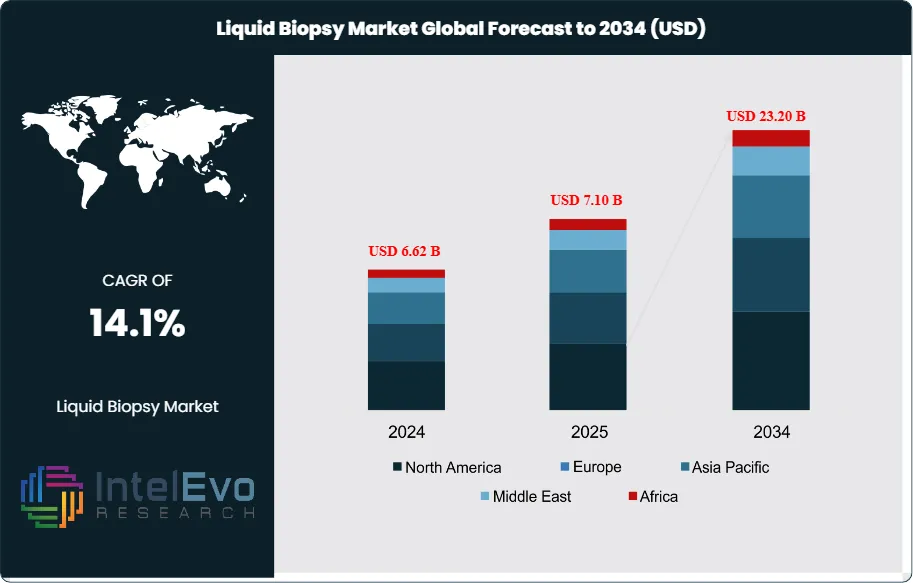
The Liquid Biopsy Market was valued at USD 6.62 Billion in 2024 and reached USD 7.10 Billion in 2025. The market is projected to reach USD 23.20 Billion by 2034, expanding at a CAGR of 14.1% during the forecast period from 2026 to 2034. This represents an absolute dollar opportunity of USD 16.10 Billion over the analysis period.
Get More Information about this report -
Request Free Sample ReportDemand for the liquid biopsy market is anchored in clinical economics that tissue biopsy cannot match: serial sampling without surgical risk, turnaround in days rather than weeks, and access to inter-tumoral heterogeneity that single-site needle biopsies miss. Oncology accounts for approximately 86% of revenue in 2025, with non-oncology applications across non-invasive prenatal testing, transplant rejection monitoring, and infectious disease surveillance contributing the remainder. North America dominates revenue at 46.8% share because the United States hosts the deepest reimbursement infrastructure, with Centers for Medicare and Medicaid Services Local Coverage Determinations now extending Medicare to molecular residual disease testing in colorectal, breast, and bladder cancer.
Regulation drives the liquid biopsy market more than technology drives it. The May 1, 2026 FDA approval of Guardant360 CDx as a companion diagnostic for vepdegestrant in ER-positive, HER2-negative ESR1-mutated breast cancer marks Guardant's third ESR1 companion diagnostic clearance and demonstrates how PROTAC-class therapies are pulling liquid biopsy testing into mandatory biomarker gating. Across the Atlantic, EU In Vitro Diagnostic Regulation 2017/746 imposes a more stringent conformity-assessment regime than the predecessor IVD Directive, lengthening time-to-market for European launches and concentrating commercial activity around firms with established notified-body relationships. China's National Medical Products Administration approved its first companion diagnostic ctDNA assay in 2024, opening a registration pathway local players are now using to scale at home.
Technology direction has consolidated around three deposition routes. NGS multi-gene panel assays hold the leading technology position at approximately 67% of 2025 revenue, anchored by Roche's FoundationOne Liquid CDx 324-gene panel, Guardant360 CDx 74-gene panel, and the Roche AVENIO Tumor Tissue 335-gene panel aligned to FoundationOne CDx. Single-gene PCR microarrays retain a roughly 24% niche led by Bio-Rad and QIAGEN. The third route, ctDNA fragmentomics combined with methylation profiling, underpins Exact Sciences' Cancerguard MCED test commercialized in September 2025 and GeneCentric's GenomicsNext platform.
Forward outlook through 2034 hinges on three calibrated forces. First, multi-cancer early detection (MCED) tests scaling out of laboratory-developed test status into FDA premarket approval, led by Guardant Shield MCD (FDA Breakthrough Device Designation, June 2025) and Exact Sciences Cancerguard (Falcon registry enrolling 25,000 participants under FDA Investigational Device Exemption). Second, molecular residual disease testing becoming standard of care in stage II and III solid tumors, with Natera processing approximately 202,000 clinical Signatera tests in Q3 2025 alone. Third, payer coverage extending beyond Medicare into commercial plans, supporting a sustained 14.1% CAGR through 2034.
Market Definition & Scope
The liquid biopsy market is defined as the development, manufacture, and sale of non-invasive diagnostic tests that analyze circulating biomarkers extracted from blood, urine, saliva, or cerebrospinal fluid for cancer detection, treatment selection, recurrence monitoring, and select non-oncology indications. The market encompasses kits and consumables, instruments, software and bioinformatics, and laboratory-developed and FDA-approved test services across circulating tumor DNA, cell-free DNA, circulating tumor cells, exosomes and extracellular vesicles, and circulating cell-free RNA.
Scope coverage includes oncology applications (early detection, therapy selection, treatment monitoring, prognosis and recurrence detection) and non-oncology applications (non-invasive prenatal testing, organ transplant rejection, infectious disease surveillance). The analysis excludes traditional tissue biopsies, cytology-only testing without molecular analysis, and pre-clinical research-only assays without clinical or commercial deployment. Liquid biopsy represents approximately 4% of the broader USD 178 Billion in vitro diagnostics parent market and captures the highest-growth precision oncology tier of that market.

Key Takeaways
- Market Growth: The global liquid biopsy market grows from USD 7.10 Billion in 2025 to USD 23.20 Billion in 2034, a CAGR of 14.1%.
- Segment Dominance (Biomarker): Circulating tumor DNA and cell-free DNA hold the leading biomarker position at 47.5% revenue share in 2025, anchored by ctDNA's primacy in companion diagnostic and MRD applications.
- Segment Dominance (Application): Oncology applications account for 86.5% of liquid biopsy revenue in 2025, with therapy selection at 33.7% the largest clinical application sub-segment.
- Driver: Approximately 2.0 million new cancer cases projected in the United States in 2025 are pulling liquid biopsy adoption at a 13.8% CAGR through 2030, supported by NCCN guideline inclusion of Shield and Signatera in colorectal cancer screening.
- Restraint: Medicare reimbursement gaps for early detection tests outside FDA-approved indications constrain adoption; Cancerguard's USD 689 list price falls largely on patients until coverage expands.
- Opportunity: Multi-cancer early detection represents a USD 5.4 Billion incremental opportunity by 2034 if Shield MCD and Cancerguard secure broad Medicare coverage following Vanguard and Falcon study readouts.
- Trend: AI-enabled ctDNA fragmentomics combined with methylation profiling reached an estimated 28% of new commercial assays launched in 2025, up from 11% in 2022, displacing single-marker mutation panels.
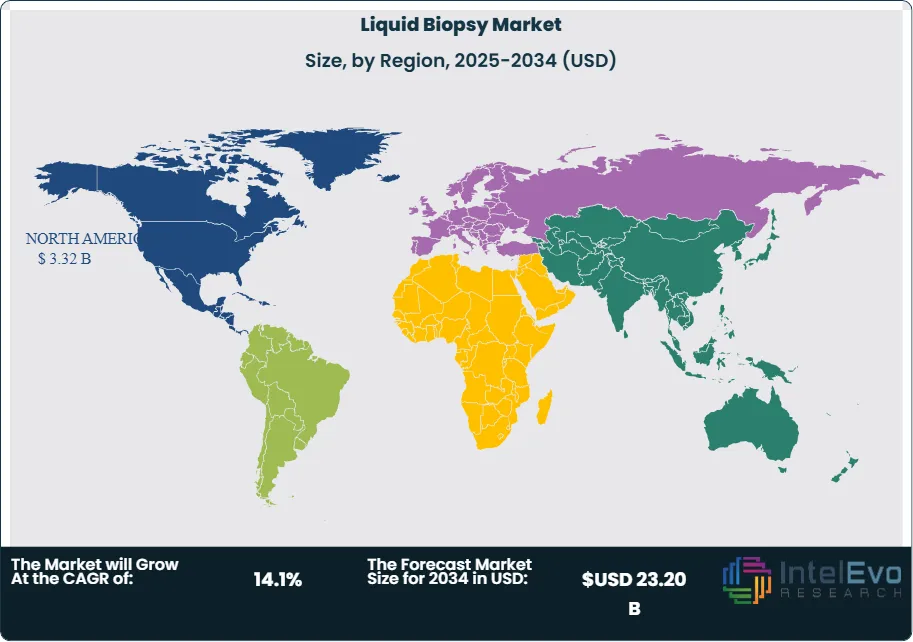
- Regional: North America leads the liquid biopsy market with 46.8% share and USD 3.32 Billion in revenue in 2025, propelled by FDA companion diagnostic approvals and CMS reimbursement infrastructure.
Key Insights Summary
- On May 1, 2026, the FDA approved Guardant360 CDx as a companion diagnostic for vepdegestrant (Veppanu, jointly developed by Arvinas and Pfizer) in ER-positive, HER2-negative, ESR1-mutated advanced or metastatic breast cancer, marking Guardant's third ESR1 companion diagnostic clearance.
- Natera reported FY2025 total revenue of USD 2,306.1 million, a 35.9% increase over FY2024, with Q4 2025 revenue of USD 665.5 million and 2025 cash inflow of approximately USD 107.6 million.
- During Q3 2025, Guardant Health posted USD 265.2 million in revenue with Shield screening volume reaching approximately 24,000 tests in the quarter and 2025 guidance raised to USD 965-970 million.
- According to data from the Centers for Medicare and Medicaid Services, Guardant Shield received Advanced Diagnostic Laboratory Test status with Medicare pricing established at USD 1,495 per test, lifting per-test economics by approximately 67% versus the prior reimbursement.
- Exact Sciences brought Cancerguard, an MCED laboratory-developed test detecting more than 50 cancer types at USD 689 list price, to the United States on September 10, 2025 through Quest Diagnostics' approximately 7,000 patient access locations.
- The FDA awarded Breakthrough Device Designation to Guardant Shield Multi-Cancer Detection in June 2025, and the National Cancer Institute Vanguard study began enrolling participants to validate Shield MCD performance across ten cancer types at 60% overall sensitivity and 98.5% specificity.
- According to the European Investment Bank, Universal DX, a Spanish liquid biopsy startup, secured EUR 20 million in venture debt in February 2025 to scale early cancer detection assays, the largest single non-dilutive financing into a European liquid biopsy company in the trailing 12 months.
Competitive Landscape Overview
The liquid biopsy market is moderately concentrated at the top, with Natera, Guardant Health, F. Hoffmann-La Roche (through Foundation Medicine), and Illumina holding an estimated combined 38% to 42% revenue share in 2025, while the top ten players collectively control roughly 24% of cancer-diagnostics revenue based on 2023 baselines that have since tilted further toward the top four. Competition has shifted from instrument-driven sales to test-service delivery and reimbursement-driven economics, where ADLT pricing, Medicare coverage decisions, and NCCN guideline inclusion determine quarterly volume more than analytical sensitivity does. Specialist scale-ups including Exact Sciences (with the September 2025 Cancerguard MCED launch) and NeoGenomics (with the July 2025 NEO PanTracer LBx introduction) are pulling share from incumbent tissue diagnostic suppliers as oncologists transition serial monitoring to plasma. Privately held entrants Aqtual, Hedera Dx, Phase Scientific, and Universal DX are scaling adjacent biomarker categories (active chromatin cfDNA, urine ctDNA, methylation panels) that the diversified incumbents do not yet field commercially.
Competitive Landscape Matrix
| Company | Headquarters | Market Position | Key Product / Solution | Geographic Strength | Recent Strategic Move |
|---|---|---|---|---|---|
| Natera, Inc. | United States | Leader | Signatera MRD assay; Panorama NIPT; Prospera transplant test | North America, Europe | Reported FY2025 revenue of USD 2.31 Billion, with Q3 2025 alone delivering 202,000 clinical MRD tests |
| Guardant Health | United States | Leader | Guardant360 CDx; Shield CRC screening; Reveal MRD | North America, Asia Pacific | Secured FDA approval of Guardant360 CDx as companion diagnostic for vepdegestrant on May 1, 2026 |
| F. Hoffmann-La Roche | Switzerland | Leader | FoundationOne Liquid CDx; AVENIO ctDNA Kits | Europe, North America, Asia Pacific | Rolled out AVENIO Edge automated CGP system in Q1 2025, and AVENIO Tumor Tissue 335-gene kit with HRDsig |
| Illumina, Inc. | United States | Leader | NovaSeq sequencing platform; TruSight Oncology 500 ctDNA | Global | Brought TruSight Oncology 500 ctDNA v2 to market; reabsorbed GRAIL exposure following 2024 separation |
| Exact Sciences | United States | Challenger | Cancerguard MCED; Oncodetect MRD; Cologuard | North America | Brought Cancerguard MCED to commercial launch on September 10, 2025 at USD 689 list price |
| Myriad Genetics | United States | Challenger | Precise MRD; hereditary cancer panels | North America | Inked September 2025 collaboration with SOPHiA Genetics to co-develop CDx tests for biopharma partners |
| QIAGEN N.V. | Netherlands | Challenger | QIAseq cfDNA workflow; therascreen single-gene panels | Europe, North America | Brought new ctDNA extraction kit for QIAseq workflows to market in January 2025 |
| Thermo Fisher Scientific | United States | Challenger | Oncomine ctDNA; Applied Biosystems digital PCR assays | Global | Scaled Oncomine Comprehensive Assay Plus deployment across pharma trial-matching workflows |
| Bio-Rad Laboratories | United States | Niche Player | QX600 Droplet Digital PCR; ddPLEX ctDNA assays | North America, Europe | Released the QX Continuum digital PCR system in 2025 |
| GRAIL, Inc. | United States | Niche Player | Galleri MCED test | North America, United Kingdom | Inked partnership with athenahealth in May 2025 to streamline EHR-based Galleri ordering |
Segmentation Analysis
The liquid biopsy market segments along five axes that procurement and clinical leadership use to evaluate vendors: by biomarker, by technology, by sample type, by clinical application, and by end user. Each axis maps to a different commercial decision and therefore a different competitive set, which is why integrated platforms (Natera, Guardant, Roche) outperform single-axis specialists in cross-sell economics and total contract value.
By Circulating Biomarker
Circulating tumor DNA and cell-free DNA together hold the leading biomarker position at 47.5% revenue share and approximately USD 3.37 Billion in 2025, supported by their primacy in companion diagnostic, MRD, and early detection workflows. Roche's FoundationOne Liquid CDx 324-gene panel and Guardant360 CDx 74-gene panel anchor the FDA-approved tier, while Signatera's tumor-informed ctDNA approach drives MRD growth at approximately 56% year-over-year volume in 2025. Cell-free DNA assays grew faster than the headline market by roughly 460 basis points in 2025.
Circulating tumor cells (CTCs) account for 21.6% of revenue at USD 1.53 Billion in 2025, anchored by Menarini Silicon Biosystems' CellSearch platform, the only FDA-cleared CTC system, and QCDx's CTC detection technology, which raised USD 7 million in May 2025 to support breast cancer clinical validation. CTC growth runs at approximately 11% CAGR, slower than ctDNA, because single-cell capture economics remain unfavorable below USD 1,500 per test.
Exosomes and extracellular vesicles capture 15.8% share at USD 1.12 Billion in 2025 and represent the fastest-growing biomarker class at approximately 19% CAGR through 2034. Bio-Techne's ExoDx Prostate IntelliScore secured CMS reimbursement approval in July 2024, opening commercial channels for exosome-based diagnostics. Other circulating biomarkers including cfRNA and circular RNA hold the residual 14.7% share at USD 1.04 Billion, with Aqtual's USD 31 million Series B (July 2025) and Circular Genomics' Alzheimer's Drug Discovery Foundation grant (July 2025) signaling investor appetite for next-wave biomarkers.
By Technology
Multi-gene parallel analysis using NGS leads the technology axis at 67.4% share and USD 4.79 Billion in 2025, anchored by Illumina NovaSeq, Roche AVENIO Edge, and Thermo Fisher Ion Torrent platforms. NGS held a 65% to 76% share across published 2024 baselines and continues to grow at the fastest rate among technology categories at approximately 16% CAGR. Single-gene analysis using PCR microarrays accounts for 24.3% at USD 1.73 Billion, anchored by Bio-Rad QX600 Droplet Digital PCR and QIAGEN therascreen single-gene panels for EGFR, KRAS, and BRAF. The residual category covering FISH, mass spectrometry, and emerging fragmentomics platforms holds 8.3% share at USD 0.59 Billion.
By Sample Type
Blood-based assays dominate at 71.5% revenue share and USD 5.08 Billion in 2025, since plasma collection is the most clinically standardized sample type and supports the highest-volume reimbursement codes. Urine-based liquid biopsies hold 12.8% share at USD 0.91 Billion, anchored by Bio-Techne's ExoDx Prostate IntelliScore and Phase Scientific's Phasify HPV technology, which secured USD 34 million in Series A funding in May 2025. Saliva, cerebrospinal fluid, and other sample types divide the residual 15.7% across niche applications, with CSF-based testing concentrated in central nervous system tumors and saliva-based assays in early-stage screening programs.
By Clinical Application
Therapy selection dominates clinical application revenue at 33.7% share and USD 2.39 Billion in 2025, driven by FDA companion diagnostic approvals for FoundationOne Liquid CDx, Guardant360 CDx, and Agilent Resolution ctDx FIRST. The May 1, 2026 Guardant360 CDx vepdegestrant approval extended the addressable label population by an estimated 18,000 patients per year. Treatment monitoring holds 28.4% share at USD 2.02 Billion. Prognosis and recurrence monitoring (MRD) accounts for 22.9% at USD 1.63 Billion and represents the fastest-growing clinical application at approximately 22% CAGR, anchored by Signatera, Reveal, and Pathlight MRD. Early detection and screening hold 15.0% share at USD 1.06 Billion, lifted by Shield CRC, Galleri, and Cancerguard.
By End User
Hospitals and laboratories capture 42.7% revenue share at USD 3.03 Billion in 2025, since centralized lab services consolidate sample logistics, instrumentation, and result reporting under single contract structures. Specialty reference laboratories such as Quest Diagnostics, Labcorp, and NeoGenomics hold 27.4% share at USD 1.95 Billion and serve as the distribution backbone for Cancerguard, Galleri, and Shield. Academic and research institutions account for 18.6% at USD 1.32 Billion. Pharmaceutical and biotechnology companies, which procure liquid biopsy testing for clinical trial patient stratification, hold 11.3% at USD 0.80 Billion and represent the highest-margin end-user category.
Regional Analysis
North America commands 46.8% of the liquid biopsy market at USD 3.32 Billion in 2025. The United States contributes the bulk through CMS reimbursement infrastructure, with Medicare ADLT pricing for Shield set at USD 1,495 and Guardant360 Tissue average selling price reaching approximately USD 2,000 in Q2 2025 (achieving the company's 2028 target three years ahead of schedule). Canada anchors regional research through the New Brunswick Department of Health's USD 175,000 liquid biopsy testing allocation and Ontario Health technology assessments for ctDNA in colorectal cancer. Mexico is emerging as a clinical trial site for liquid biopsy validation studies, lifted by USMCA harmonization with FDA standards. NIH's 2025 Liquid Biopsy Consortium and Quad Cancer Moonshot Initiative are catalyzing federal funding through the National Cancer Institute and BARDA.
Asia Pacific holds 21.3% share at USD 1.51 Billion in 2025 and will grow at the fastest regional CAGR of approximately 17.1%, supported by cancer incidence concentration, rising healthcare expenditure, and government-backed precision medicine programs. China dominates the regional total through state-funded Cancer Genome Project initiatives and domestic players Burning Rock Biotech, Geneseeq, and AmoyDx. Japan contributes through the Ministry of Health, Labor and Welfare's marketing approval for ctDNA molecular testing in colorectal cancer and Mirxes Japan's nationwide gastric cancer screening initiative. South Korea and Singapore anchor antimicrobial-style innovation, with Lucence Health, Inocras, and IMBdx scaling whole-genome cfDNA monitoring. India's market grew to approximately USD 192 million in 2025 from USD 168 million in 2024, with Tvaster Genkalp securing USD 1.25 million in pre-Series A funding (April 2025) for its Episcreen Liver methylation-based assay.
Europe accounts for 23.1% at USD 1.64 Billion in 2025, with Germany, France, the United Kingdom, the Netherlands, Sweden, and Switzerland providing the bulk. Germany hosts Roche's diagnostics division and Foundation Medicine's European clinical operations. France advances through the France Médecine Génomique 2025 plan, which targets up to 200,000 patients per year for genomic profiling. The United Kingdom benefits from NHS Genomic Medicine Service collaborations including Illumina's November 2024 multi-cancer screening partnership. Spain anchors innovation through Universal DX's EUR 20 million European Investment Bank financing in February 2025. EU IVDR 2017/746 has compressed time-to-market by an estimated 6 to 9 months versus the prior IVD Directive but concentrates new launches among players with established notified-body relationships.
Latin America holds 5.6% share at USD 0.40 Billion in 2025, anchored by Brazil's collaboration between Fleury Group and Roche Diagnostics for lung cancer liquid biopsy access and Mexico's growing cancer-center network. Argentina, Chile, and Colombia contribute incremental volume through hospital-based diagnostic labs in metropolitan regions. Regional CAGR runs between 8% and 11% through 2030. Public-private partnerships with São Paulo and Rio de Janeiro premium cancer centers are leading adoption.
Middle East and Africa account for 3.2% of the liquid biopsy market at USD 0.23 Billion in 2025. The United Arab Emirates and Saudi Arabia drive demand through Vision 2030 health-spending priorities, with Guardant Shield selected for an Abu Dhabi government-funded population-scale screening program. Israel anchors regional R&D through Technion-affiliated startups and clinical trials. South Africa supports sub-Saharan demand through Wits University and Stellenbosch genomics programs. Regional CAGR runs at approximately 16.4%, supported by sovereign-fund healthcare allocations and partnerships with U.S. and European technology owners.
Country Analysis
The United States is the single largest country market for liquid biopsy at USD 2.85 Billion in 2025, growing at 13.8% CAGR. Federal program support includes the NIH Liquid Biopsy Consortium funding academic-industry collaboration on ctDNA early detection, BARDA oncology diagnostics investment, and the Quad Cancer Moonshot Initiative prioritizing next-wave MCED deployment. CMS extended Medicare ADLT pricing for Shield to USD 1,495 per test, while NCCN colorectal cancer screening guidelines were updated in 2025 to include Shield. The FDA's May 1, 2026 vepdegestrant approval brought Guardant360 CDx to its third ESR1 companion diagnostic indication. Domestic R&D concentrates around Boston, Palo Alto, San Diego, and Madison.
China holds the second-largest country position at USD 0.66 Billion in 2025, growing at 18.7% CAGR. Demand is propelled by approximately 4.5 million new cancer cases annually (per ICMR-equivalent NCC China estimates), the densest sequencing instrument installed base outside the United States, and state procurement of liquid biopsy testing for select hospital tenders. NMPA approved its first companion diagnostic ctDNA assay in 2024, opening a registration pathway used by Burning Rock Biotech, Geneseeq, and AmoyDx. Geneseeq published a pancreatic cancer EDx assay in Nature Medicine demonstrating 97.3% sensitivity and 95.2% specificity. Domestic players are scaling alongside multinational producers.
Germany is the largest European country market at USD 0.41 Billion in 2025, growing at 11.4% CAGR. Strength concentrates around Roche Diagnostics' Penzberg facility, Foundation Medicine's European hub, and SOPHiA Genetics partnerships with Charité Berlin and Heidelberg University Hospital. Germany's Statutory Health Insurance system has expanded coverage for ctDNA in lung and breast cancer, while the Federal Joint Committee evaluates MRD testing for inclusion in oncology guidelines. Domestic startups including Hedera Dx (USD 15 million Series A in May 2025) anchor innovation flows.
Japan ranks as the third-largest country market for liquid biopsy at USD 0.32 Billion in 2025, growing at 13.6% CAGR. Ministry of Health, Labor and Welfare reimbursement for ctDNA molecular testing in colorectal cancer was extended to NSCLC in 2024 and 2025. Mirxes Japan launched a nationwide gastric cancer screening initiative co-developed with Nagawa Pharmaceutical. HaploX established a Japanese subsidiary in February 2025 to expand transomics analysis services. Domestic clinical demand is anchored by the National Cancer Center Hospital East and Osaka International Cancer Institute.
Get More Information about this report -
Request Free Sample ReportKey Market Segment
By Circulating Biomarker
- Circulating Tumor DNA (ctDNA)
- Circulating Tumor Cells (CTCs)
- Cell-Free DNA (cfDNA)
- Extracellular Vesicles (EVs) & Exosomes
- Others
By Technology
- Next-Generation Sequencing (NGS)
- Polymerase Chain Reaction (PCR)
- Fluorescence In Situ Hybridization (FISH)
- Immunoassays
- Others
By Sample Type
- Blood
- Urine
- Saliva
- Cerebrospinal Fluid (CSF)
- Others
By Clinical Application
- Cancer Screening & Early Detection
- Therapy Selection
- Treatment Monitoring
- Recurrence Monitoring
- Others
By End User
- Hospitals & Clinics
- Diagnostic Laboratories
- Academic & Research Institutes
- Pharmaceutical & Biotechnology Companies
By Regional Coverage
- North America
- Latin America
- East Asia And Pacific
- Sea And South Asia
- Eastern Europe
- Western Europe
- Middle East & Africa
| Report Attribute | Details |
| Market size (2025) | USD 7.10 B |
| Forecast Revenue (2034) | USD 23.20 B |
| CAGR (2025-2034) | 14.1% |
| Historical data | 2021-2025 |
| Base Year For Estimation | 2025 |
| Forecast Period | 2026-2034 |
| Report coverage | Revenue Forecast, Competitive Landscape, Market Dynamics, Growth Factors, Trends and Recent Developments |
| Segments covered | By Circulating Biomarker, (Circulating Tumor DNA (ctDNA), Circulating Tumor Cells (CTCs), Cell-Free DNA (cfDNA), Extracellular Vesicles (EVs) & Exosomes, Others), By Technology, (Next-Generation Sequencing (NGS), Polymerase Chain Reaction (PCR), Fluorescence In Situ Hybridization (FISH), Immunoassays, Others), By Sample Type, (Blood, Urine, Saliva, Cerebrospinal Fluid (CSF), Others), By Clinical Application, (Cancer Screening & Early Detection, Therapy Selection, Treatment Monitoring, Recurrence Monitoring, Others), By End User, (Hospitals & Clinics, Diagnostic Laboratories, Academic & Research Institutes, Pharmaceutical & Biotechnology Companies), |
| Research Methodology |
|
| Regional scope |
|
| Competitive Landscape | NATERA, INC., GUARDANT HEALTH, INC., F. HOFFMANN-LA ROCHE LTD., ILLUMINA, INC., EXACT SCIENCES CORPORATION, MYRIAD GENETICS, INC., QIAGEN N.V., THERMO FISHER SCIENTIFIC INC., BIO-RAD LABORATORIES, INC., GRAIL, INC., FOUNDATION MEDICINE, INC., AGILENT TECHNOLOGIES, INC., NEOGENOMICS LABORATORIES, INC., CARIS LIFE SCIENCES, INC., TEMPUS AI, INC., PERSONALIS, INC., SYSMEX CORPORATION, JOHNSON & JOHNSON, BIO-TECHNE CORPORATION, LABCORP HOLDINGS INC., MENARINI SILICON BIOSYSTEMS, BURNING ROCK BIOTECH, LUCENCE HEALTH, Others |
| Customization Scope | Customization for segments, region/country-level will be provided. Moreover, additional customization can be done based on the requirements. |
| Pricing and Purchase Options | Avail customized purchase options to meet your exact research needs. We have three licenses to opt for: Single User License, Multi-User License (Up to 5 Users), Corporate Use License (Unlimited User and Printable PDF). |


Frequently Asked Questions
How big is the Liquid Biopsy Market?
The Global Liquid Biopsy Market was valued at USD 6.62 Billion in 2024 and is projected to reach USD 23.20 Billion by 2034, growing at a CAGR of 14.1% during the forecast period 2026–2034.
Who are the major players in the Liquid Biopsy Market?
NATERA, INC., GUARDANT HEALTH, INC., F. HOFFMANN-LA ROCHE LTD., ILLUMINA, INC., EXACT SCIENCES CORPORATION, MYRIAD GENETICS, INC., QIAGEN N.V., THERMO FISHER SCIENTIFIC INC., BIO-RAD LABORATORIES, INC., GRAIL, INC., FOUNDATION MEDICINE, INC., AGILENT TECHNOLOGIES, INC., NEOGENOMICS LABORATORIES, INC., CARIS LIFE SCIENCES, INC., TEMPUS AI, INC., PERSONALIS, INC., SYSMEX CORPORATION, JOHNSON & JOHNSON, BIO-TECHNE CORPORATION, LABCORP HOLDINGS INC., MENARINI SILICON BIOSYSTEMS, BURNING ROCK BIOTECH, LUCENCE HEALTH, Others
Which segments covered the Liquid Biopsy Market?
By Circulating Biomarker, (Circulating Tumor DNA (ctDNA), Circulating Tumor Cells (CTCs), Cell-Free DNA (cfDNA), Extracellular Vesicles (EVs) & Exosomes, Others), By Technology, (Next-Generation Sequencing (NGS), Polymerase Chain Reaction (PCR), Fluorescence In Situ Hybridization (FISH), Immunoassays, Others), By Sample Type, (Blood, Urine, Saliva, Cerebrospinal Fluid (CSF), Others), By Clinical Application, (Cancer Screening & Early Detection, Therapy Selection, Treatment Monitoring, Recurrence Monitoring, Others), By End User, (Hospitals & Clinics, Diagnostic Laboratories, Academic & Research Institutes, Pharmaceutical & Biotechnology Companies),
How can this market research report help my business make strategic decisions?
Our market research reports provide actionable intelligence, including verified market size data, CAGR projections, competitive benchmarking, and segment-level opportunity analysis. These insights support strategic planning, investment decisions, product development, and market entry strategies for enterprises and startups alike.
How frequently is the data updated?
We continuously monitor industry developments and update our reports to reflect regulatory changes, technological advancements, and macroeconomic shifts. Updated editions ensure you receive the latest market intelligence.

Select Licence Type
Connect with our sales team

Why IntelEvoResearch
100%
Customer
Satisfaction
24x7+
Availability - we are always
there when you need us
200+
Fortune 50 Companies trust
IntelEvoResearch
80%
of our reports are exclusive
and first in the industry
100%
more data
and analysis
1000+
reports published
till date