

- Home
- Industries
 Aerospace And Defence
 Agriculture
 Automotive And Transportation
 Banking And Finance
 Business
 Chemicals And Materials
 Consumer And Retail
 Electronics And Semiconductors
 Food And Beverages
 Machinery & Equipments
 Manufacturing And Construction
 Medical Devices
 Others
 Pharmaceuticals And Healthcare
 Power And Energy
 Sports
 Technology
- Services
- News Room
- About us
- Contact Us
-
Long Read Sequencing Market Size, Share & Forecast | CAGR 31.1%
Global Long Read Sequencing Market Size, Share, Analysis By Product (Consumables, Instruments, Services), By Technology (Nanopore Sequencing, Single Molecule Real-Time Sequencing, Others), By Workflow (Pre-Sequencing, Sequencing, Data Analysis), By Application (Whole Genome Sequencing, Targeted Sequencing, RNA Sequencing, Epigenetics, Metagenomics), By End-User, Industry Overview, Market Dynamics, Competitive Landscape & Forecast 2026–2034

Report Overview
| Market Size (2025) | Forecast Value (2034) | CAGR (2026–2034) | Largest Region (2025) |
| USD 0.9 Billion | USD 10.5 Billion | 31.1% | North America, 43.4% |
The Long Read Sequencing Market is estimated at USD 0.7 Billion in 2024 and is on track to reach roughly USD 10.5 Billion by 2034, The market is further estimated to reach approximately USD 0.9 Billion in 2025, and is expected to expand at a compound annual growth rate (CAGR) of around 31.1% during the forecast period from 2026 to 2034. Growth is driven by increasing demand for high-accuracy genomic analysis, rising adoption of long-read sequencing technologies in complex genome mapping, and expanding applications in structural variant detection, epigenomics, and rare disease research. Additionally, advancements in nanopore and single-molecule sequencing platforms, along with declining costs and improved throughput, are further accelerating market expansion globally.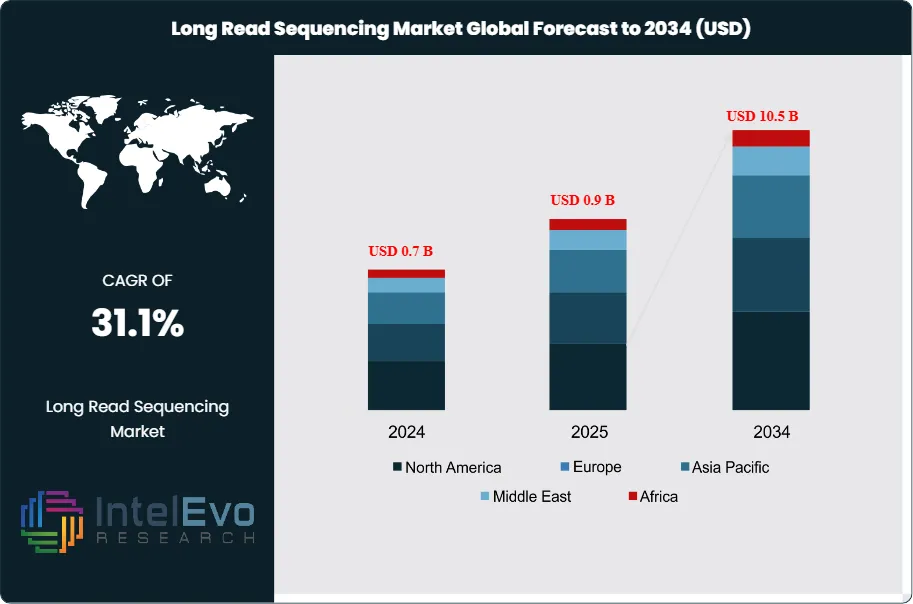
Get More Information about this report -
Request Free Sample ReportGrowth tracks a shift in genomic workflows toward longer, higher-fidelity reads that resolve repetitive regions, haplotypes, and structural variants that short-read methods often miss. Demand strengthens in de novo assembly, complex disease research, oncology, and inherited disorder testing, where read length and phasing improve interpretability and reduce confirmatory work. In 2024, research and translational programs account for about 65% of revenue, supported by public funding and biopharma discovery budgets, while clinical applications represent roughly 35% and rise as laboratories expand rare-disease and hereditary cancer panels using long-read methods.
Supply-side momentum comes from faster chemistries, improved accuracy, and falling cost per usable gigabase, alongside broader availability of compact instruments and higher-throughput systems. Consumables remain the primary revenue engine, estimated near 55% of 2024 sales, reflecting recurring flow cells, reagents, and library-prep kits. Bioinformatics capacity acts as a gating factor, so vendors and service providers increasingly bundle workflows with cloud pipelines and turnkey analysis. AI-assisted basecalling, variant detection, and automated quality control shorten cycle time and raise usable yield, while robotics and digital sample tracking reduce hands-on steps and contamination risk in high-volume laboratories.
Regulatory and policy forces shape adoption in diagnostics. In the United States, CLIA validation expectations and FDA oversight for certain tests increase documentation burden but also support clinical confidence. In Europe, IVDR implementation pushes laboratories to strengthen evidence, traceability, and post-market processes, which can slow near-term rollouts yet favor platforms with mature quality systems. Data governance rules, including GDPR-aligned requirements, raise compliance costs and influence choices around on-premise versus cloud processing.
Regionally, North America holds an estimated 40% share in 2024 due to installed sequencing capacity and reimbursement pathways that support genetic testing. Europe follows at roughly 25%, led by national genomics programs. Asia-Pacific approaches 28% and posts the fastest growth, with investment clustering in China, Japan, South Korea, Singapore, and India as clinical genetics scales and domestic manufacturing expands. The Middle East shows early momentum, supported by precision-medicine initiatives and infrastructure buildouts, including Gulf-based research hubs. Major risks include price compression, platform switching, consumable supply constraints, and variability in clinical reimbursement, alongside ongoing needs to standardize accuracy, interpretation, and data security across sites.

Key Takeaways
- Market Growth: The market generated 0.7 billion USD, 2024 and is projected to reach 10.5 billion USD, 2034 at 31.1%, 2026-2034.
- Segment Dominance : Consumables led the product mix at 58.2%, 2024 and continued to anchor recurring revenue at estimated: 6.1 billion USD, 2034.
- Segment Dominance: Nanopore sequencing held 54.7%, 2024 while the sequencing workflow captured 56.9%, 2024, reinforcing platform and throughput-led adoption at estimated: 5.9 billion USD, 2034.
- Driver: Clinical and research demand for whole genome sequencing lifted share to 53.4%, 2024 and expanded long-read utilization at estimated: 5.6 billion USD, 2034.
- Restraint: High instrument and compute costs constrain scaling at estimated: 0.2 billion USD, 2024 and delay broader deployment to estimated: 1.0 billion USD, 2026.
- Opportunity: Pharma and biotech adoption accelerates beyond academic settings at estimated: 2.8 billion USD, 2034, supported by precision medicine pipelines at estimated: 31.1%, 2024-2034.
- Trend: Automation and AI-driven basecalling and analysis compress turnaround time to estimated: 24.0 hours, 2024 and improve usable yield to estimated: 15.0%, 2025.
- Regional Analysis: North America led with 43.4%, 2024 and is positioned to generate estimated: 4.6 billion USD, 2034 as capacity expands across 2024-2034.
Competitive Landscape
The Global Long Read Sequencing Market is moderately concentrated, with the top three players accounting for an estimated 70.0%–78.0% of 2025 market revenue. Competition is highly technology-driven, where read length, accuracy (HiFi vs nanopore), throughput, and bioinformatics integration define market share more than pricing. Competitive intensity increased in 2025–2026 as vendors scaled high-throughput platforms, improved accuracy metrics, and expanded clinical validation programs, positioning long-read sequencing as a core component of next-generation genomics.
| Company | HQ | Position | Key Offering | Geo Strength | Recent Strategic Move |
| PACIFIC BIOSCIENCES (PACBIO) | US | Leader | HiFi long-read sequencing systems (Sequel IIe, Revio) | North America, Europe | Expanded high-throughput Revio platform adoption and clinical research partnerships in 2025. |
| OXFORD NANOPORE TECHNOLOGIES | UK | Leader | Nanopore sequencing platforms (PromethION, MinION) | Europe, North America, Asia | Advanced ultra-long read sequencing and real-time analysis capabilities in 2025. |
| ILLUMINA | US | Challenger | Short-read platforms with integrated long-read capabilities (via partnerships) | North America, Global | Strengthened multi-omics and long-read integration strategies in 2025. |
| BGI GROUP | China | Challenger | Genomics services and sequencing platforms | Asia-Pacific, Global | Expanded sequencing service infrastructure and multi-platform integration in 2025. |
| THERMO FISHER SCIENTIFIC | US | Challenger | Genomic workflows and sequencing ecosystem tools | North America, Europe | Strengthened sequencing workflow integration and clinical applications in 2025. |
| QIAGEN | Netherlands | Niche Player | Sample prep and bioinformatics for long-read workflows | Europe, Global | Expanded bioinformatics solutions supporting long-read data analysis in 2025. |
| AGILENT TECHNOLOGIES | US | Niche Player | Target enrichment and sample preparation solutions | North America, Global | Strengthened NGS and long-read workflow product portfolio in 2025. |
| 10X GENOMICS | US | Niche Player | Linked-read and spatial genomics technologies | North America, Europe | Expanded single-cell and spatial genomics solutions complementing long-read sequencing in 2025. |
| PARTEK INC. | US | Niche Player | Genomic data analysis and bioinformatics software | North America | Enhanced software platforms for large-scale genomic data interpretation in 2025. |
| DOVETAIL GENOMICS | US | Niche Player | Genome assembly and scaffolding solutions | North America | Expanded genome assembly tools supporting long-read sequencing workflows in 2025. |
Summary Insight:
The market is dominated by core platform innovators, with PacBio and Oxford Nanopore leading due to distinct technology architectures (HiFi vs nanopore). Competitive advantage is increasingly defined by accuracy, throughput, and clinical validation, while ecosystem players compete through workflow integration and bioinformatics capabilities. Strategic positioning will depend on clinical adoption, large-scale genomics projects, and consumables-driven revenue models through 2034.
By Type
Consumables continue to represent the largest revenue-generating category within the long read sequencing market as the industry moves into 2025. In 2024, consumables accounted for approximately 58.2 percent of total market revenue, driven by sustained demand for reagents, flow cells, library preparation kits, and sample handling components. These inputs remain essential for maintaining data accuracy, read consistency, and throughput across research and clinical workflows. As long read sequencing adoption expands beyond pilot studies into routine use, repeat purchasing of consumables supports a stable and recurring revenue base.
Ongoing reductions in per-sample sequencing costs have increased instrument placements across hospitals, diagnostic laboratories, and academic centers. This trend directly translates into higher consumable utilization per installed system. Precision medicine programs and population genomics initiatives further reinforce demand, as studies increasingly require deeper coverage and repeated sequencing runs. As of 2025, consumables are expected to maintain a leading position as platforms scale and throughput increases across both centralized and decentralized laboratories.
By Application
Whole genome sequencing remains the primary application for long read technologies, contributing an estimated 53.4 percent of total market revenue in 2024. Long read approaches enable accurate detection of structural variants, repeat expansions, and haplotype phasing, which are critical for complex disease analysis and rare disorder diagnostics. Adoption continues to rise across oncology research, inherited disease screening, and reference genome construction as data quality requirements increase.
Targeted sequencing, RNA sequencing, metagenomics, and epigenetics represent fast-growing secondary applications. These segments benefit from improvements in read accuracy and throughput that support transcript isoform resolution and microbial genome assembly. As sequencing costs decline and analysis pipelines mature, broader application coverage is expected to support sustained demand growth through 2030 and beyond.
By End-Use
Academic and research institutes remain the dominant end users, accounting for roughly 60.3 percent of market revenue in 2024. Universities and public research organizations continue to drive innovation in genomics, transcriptomics, and epigenetics, supported by government funding and international research collaborations. Long read sequencing plays a central role in exploratory research where genome completeness and structural resolution are priorities.
Hospitals and pharmaceutical and biotechnology companies are expanding adoption at a steady pace. Clinical laboratories increasingly integrate long read platforms into rare disease diagnostics and oncology workflows, while biopharma firms use these systems for target validation and biomarker discovery. Continued collaboration between academic centers and industry partners supports technology transfer and accelerates clinical translation.
By Region
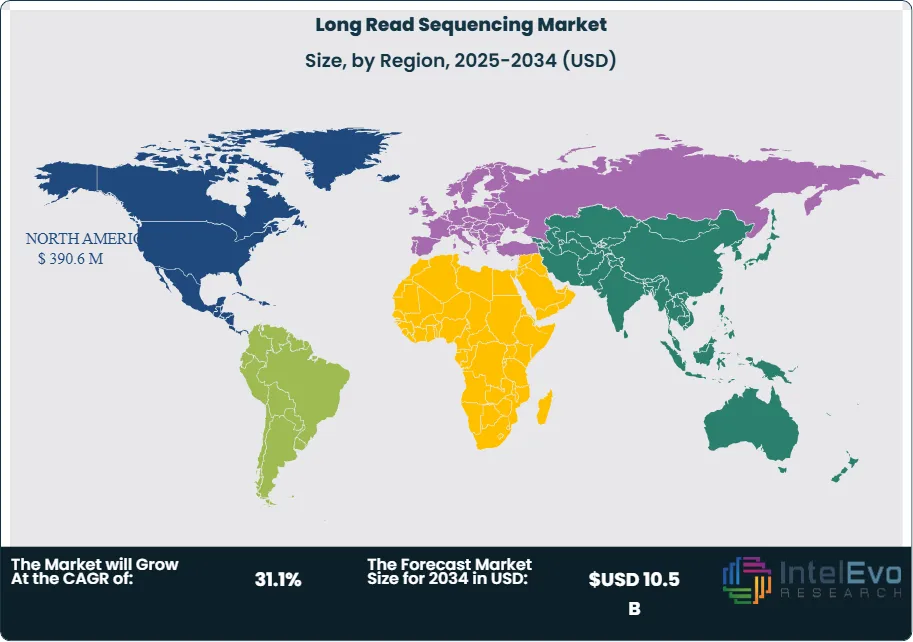
North America remains the leading regional market, holding approximately 43.4 percent of global revenue in 2024. Strong funding for large-scale genomics initiatives, high instrument penetration, and early adoption of high-throughput platforms support regional dominance. Increased placements of advanced long read systems across the United States and Canada have driven parallel growth in consumable demand and service utilization.
Asia Pacific is projected to record the fastest growth rate through the forecast period. Government-backed precision medicine programs, expanding healthcare infrastructure, and rising investment in life sciences are accelerating adoption. Countries such as China, Japan, South Korea, and India continue to scale national genomics efforts, creating sustained demand for technologies capable of generating long and accurate sequencing reads.
Get More Information about this report -
Request Free Sample ReportMarket Key Segments
By Product
- Consumables
- Services
- Instruments
By Technology
- Nanopore Sequencing
- Single Molecule Real Time Sequencing
- Others
By Workflow
- Sequencing
- Data Analysis
- Pre-Sequencing
By Application
- Whole Genome Sequencing
- Targeted Sequencing
- RNA Sequencing
- Metagenomics
- Epigenetics
- Others
By End-Use
- Academic & Research Institutes
- Hospitals & Clinics
- Pharmaceutical & Biotechnology Companies
- Others
Regions
- North America
- Latin America
- East Asia And Pacific
- Sea And South Asia
- Eastern Europe
- Western Europe
- Middle East & Africa
| Report Attribute | Details |
| Market size (2025) | USD 0.9 B |
| Forecast Revenue (2034) | USD 10.5 B |
| CAGR (2025-2034) | 31.1% |
| Historical data | 2021-2024 |
| Base Year For Estimation | 2025 |
| Forecast Period | 2026-2034 |
| Report coverage | Revenue Forecast, Competitive Landscape, Market Dynamics, Growth Factors, Trends and Recent Developments |
| Segments covered | By Product, (Consumables, Services, Instruments), By Technology, (Nanopore Sequencing, Single Molecule Real Time Sequencing, Others), By Workflow, (Sequencing, Data Analysis, Pre-Sequencing), By Application, (Whole Genome Sequencing, Targeted Sequencing, RNA Sequencing, Metagenomics, Epigenetics, Others), By End-Use, (Academic & Research Institutes, Hospitals & Clinics, Pharmaceutical & Biotechnology Companies, Others) |
| Research Methodology |
|
| Regional scope |
|
| Competitive Landscape | Eurofins Genomics, Pacific Biosciences, Element Biosciences, MicrobesNG, BGI Genomics, Oxford Nanopore Technologies Limited, New England Biolabs, NextOmics |
| Customization Scope | Customization for segments, region/country-level will be provided. Moreover, additional customization can be done based on the requirements. |
| Pricing and Purchase Options | Avail customized purchase options to meet your exact research needs. We have three licenses to opt for: Single User License, Multi-User License (Up to 5 Users), Corporate Use License (Unlimited User and Printable PDF). |


Frequently Asked Questions
How big is the Long Read Sequencing Market?
The Global Long Read Sequencing Market was valued at USD 0.9 Billion in 2025, projected to hit USD 10.5 Billion by 2034, growing at a CAGR of 31.1% from 2026–2034, driven by advancements in nanopore sequencing, structural variant analysis, and precision genomics applications.
Who are the major players in the Long Read Sequencing Market?
Eurofins Genomics, Pacific Biosciences, Element Biosciences, MicrobesNG, BGI Genomics, Oxford Nanopore Technologies Limited, New England Biolabs, NextOmics
Which segments covered the Long Read Sequencing Market?
By Product, (Consumables, Services, Instruments), By Technology, (Nanopore Sequencing, Single Molecule Real Time Sequencing, Others), By Workflow, (Sequencing, Data Analysis, Pre-Sequencing), By Application, (Whole Genome Sequencing, Targeted Sequencing, RNA Sequencing, Metagenomics, Epigenetics, Others), By End-Use, (Academic & Research Institutes, Hospitals & Clinics, Pharmaceutical & Biotechnology Companies, Others)
How can this market research report help my business make strategic decisions?
Our market research reports provide actionable intelligence, including verified market size data, CAGR projections, competitive benchmarking, and segment-level opportunity analysis. These insights support strategic planning, investment decisions, product development, and market entry strategies for enterprises and startups alike.
How frequently is the data updated?
We continuously monitor industry developments and update our reports to reflect regulatory changes, technological advancements, and macroeconomic shifts. Updated editions ensure you receive the latest market intelligence.

Select Licence Type
Connect with our sales team

Why IntelEvoResearch
100%
Customer
Satisfaction
24x7+
Availability - we are always
there when you need us
200+
Fortune 50 Companies trust
IntelEvoResearch
80%
of our reports are exclusive
and first in the industry
100%
more data
and analysis
1000+
reports published
till date
