
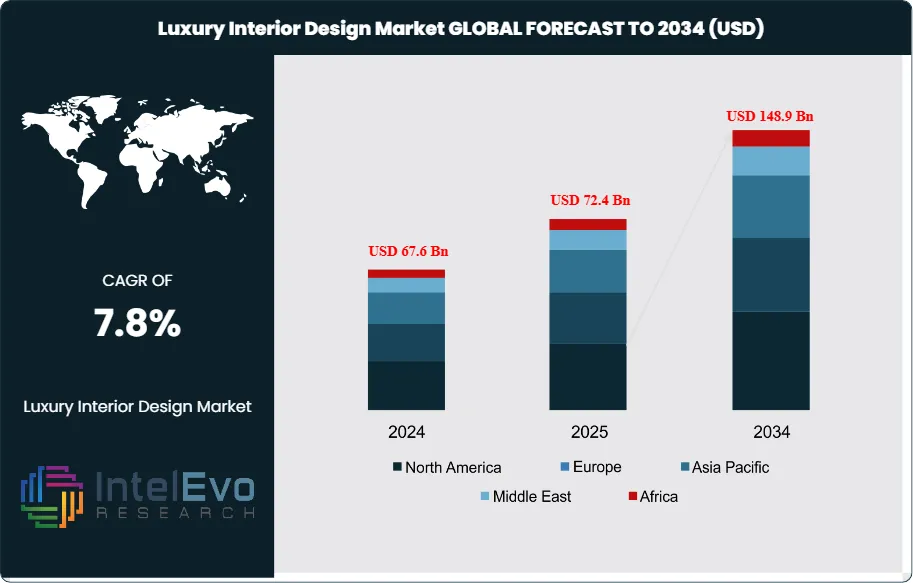
The Luxury Interior Design Market is estimated to reach approximately USD 72.4 billion in 2025 and is projected to grow to around USD 148.9 billion by 2034, registering a healthy compound annual growth rate (CAGR) of about 7.8% during the forecast period from 2026 to 2034. Market growth is supported by rising investments in high-end residential projects, luxury hospitality, and premium commercial spaces, particularly across urban centers and affluent regions. Increasing demand for customized interiors, smart luxury homes, and sustainable yet premium materials is further driving design spending. Additionally, the influence of global lifestyle trends, luxury real estate development, and digitally enabled design visualization tools continues to elevate client expectations, strengthening long-term market momentum and online engagement across platforms.
The market revolves around tailored interiors that rely on premium materials, custom furnishings, and skilled craftsmanship across residential and commercial spaces. Growing numbers of high-net-worth individuals and an expanding affluent middle class sustain demand for personalized environments. Increasing disposable incomes support higher spending on renovation and professional design, with residential projects accounting for an estimated 55% of global revenue and commercial applications in hospitality, retail, and offices generating the remaining 45%.
Demand is shifting toward interiors that combine visual impact with functionality. Survey data indicate that around 66% of homeowners prioritize targeted upgrades rather than full remodels, encouraging design concepts that maximize space, natural light, and adaptability. At the upper tier, clients seek distinctive aesthetics and curated material palettes, which stimulates growth in artisanal finishes, custom joinery, and limited-edition furnishings. This trend reinforces an ecosystem of designers, suppliers, contractors, and artisans.
Technology is reshaping project delivery. AI-enabled design tools, 3D visualization, and virtual walk-throughs shorten decision cycles and reduce revisions. Digital platforms streamline procurement and connect designers to global supply networks. Automation in manufacturing improves consistency for customized components, while sustainability tools help firms align with green building codes and certification schemes. These advances raise productivity but require investment in software, skills, and secure workflows, which can pressure smaller studios.
Labor markets and regulation shape the supply side. Forecasts indicate interior designer employment will expand by about 4% by 2032, underscoring the need to retain talent in high-value segments. Building safety rules, environmental regulations, and product standards influence material selection and timelines, adding compliance demands but also raising barriers to entry and supporting quality.
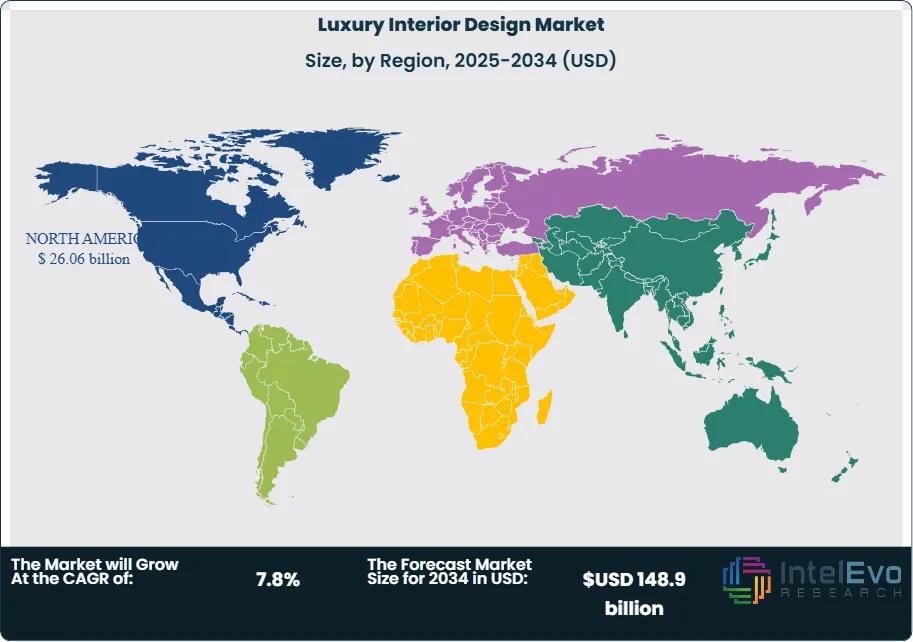
Regionally, North America and Europe together account for nearly 60% of revenue. Asia Pacific is the fastest-growing region, with estimated growth above 9% driven by urbanization, luxury residential towers, and hospitality investment. Renovation budgets averaging USD 12,000 per project and furnishings outlays near USD 5,000 reinforce links to construction materials, premium furniture, and related services. In parallel, restaurant sales approaching USD 1 trillion in leading markets signal persistent demand for distinctive interiors in dining.
Market Growth: The Luxury Interior Design Market is valued at USD 72.4 billion in 2025 and is projected to reach USD 148.9 billion by 2034, implying a CAGR of 7.8% over 2026-2034.
Segment Dominance: Residential Interior Design led the design type segment with a 40.0% share, 2023 and continues to anchor market demand as premium home projects expand by an estimated: 7.0% annually, 2024.
Segment Dominance: Individual Homeowners dominated the end-user segment with a 50.0% share, 2023, while Contemporary Style and Space Planning together influenced more than an estimated: 70.0% of project specifications, 2024.
Driver: Rising investments by individual homeowners, who held a 50.0% share, 2023, sustain demand for tailored residential interiors. Strong upgrade cycles in high-income households support an estimated: 8.0% annual increase in luxury interior spending, 2024.
Restraint: High upfront costs and complex project coordination limit penetration in mid-income segments, as luxury schemes can carry an estimated: 20.0% higher average project cost than standard interiors, 2024.
Opportunity: Space Planning accounted for a 45.0% share of service demand, 2023, creating scope to bundle advanced layout optimization and smart-home integration. This segment could generate estimated: 2.5 billion USD incremental revenue, 2024 through value-added consulting and design fees.
Trend: Contemporary Style captured a 35.0% share, 2023 and increasingly shapes demand for modern, minimalist, and functional spaces. Projects using contemporary-led concepts are expected to post estimated: 9.0% annual growth, 2024 as clients seek clean lines and adaptable layouts.
Regional Analysis: Europe dominated the market with estimated: 35.0% revenue share, 2023 supported by high-end design firms and mature luxury infrastructure. Asia-based projects are poised for catch-up, with premium interior investments forecast to grow at an estimated: 9.5% CAGR, 2024-2034 driven by urbanization and rising wealth.
By Design Type
Residential interior design continues to hold the largest share of the luxury interior design market in 2025. Rising household wealth, especially among high-income buyers, supports sustained demand for custom living environments that reflect personal style and functional priorities. Many homeowners treat interiors as long-term assets, which encourages higher spending on premium materials, curated decor, and tailored layouts. Developers targeting the luxury segment report that interior quality increasingly influences sales cycles and resale premiums, particularly in urban markets.
Commercial and hospitality projects also register steady growth. Corporate clients seek refined interiors that reinforce brand presence and improve workplace comfort; this demand has strengthened as companies review their post-pandemic space strategies. Hospitality groups continue to invest in premium finishes and distinct design identities to support rate premiums and guest loyalty. Retail operators apply luxury design to improve in-store engagement as physical stores shift toward high-value experiential formats.
Healthcare and specialty environments maintain a smaller share yet attract interest as operators invest in patient comfort and high-end aesthetics. Clinics and wellness centers adopt warmer palettes, contemporary furnishings, and natural materials to differentiate services and increase client retention. These sectors will expand gradually as premium healthcare chains scale in major cities.
By Style
Contemporary style remains the most widely adopted approach in 2025. Its clean lines, open layouts, and neutral palettes align with functional preferences across residential and commercial environments. The style adapts easily to varied floor plans and supports integration of digital systems used for lighting, climate, and security. Designers report that contemporary interiors allow faster project cycles due to consistent material availability and straightforward detailing.
Modern, classical, and minimalist styles retain defined audiences. Modern interiors appeal to clients who prefer structured geometry and polished finishes. Classical and traditional styles attract luxury buyers seeking ornamental detailing and heritage elements, especially in select European and Middle Eastern markets. Minimalist interiors gain traction among younger high-income consumers who value simplicity and efficient use of space. These styles collectively broaden the competitive landscape and give firms flexibility to serve different customer profiles.
Demand for hybrid design styles increases as buyers blend contemporary foundations with cultural motifs or artisanal work. This trend encourages designers to work more closely with specialized suppliers and craft studios across key markets.
By Service Type
Space planning remains the most requested service in 2025 because it directly affects how clients experience a space. Proper layout planning supports comfort, efficient movement, and stronger visual presentation. In residential settings, clients show particular interest in improved kitchen layouts, integrated storage, and multi-use living zones. In commercial environments, companies prioritize layouts that support collaboration, wellness, and brand clarity.
Other service categories play important roles. Concept development guides the overall design direction and ensures alignment with the client’s objectives. Custom furniture and decor services grow steadily as buyers seek exclusive pieces that reinforce personalization. Lighting design also gains importance as clients expect adjustable illumination for productivity, ambience, and energy efficiency. These service segments together strengthen the value chain for luxury interior firms.
Premium installation, procurement management, and post-completion styling increasingly influence project budgets. Firms that manage multiple stages of delivery report higher client retention and smoother project execution.
By End-Use
Individual homeowners continue to lead overall demand for luxury interiors in 2025. Rising homeownership among affluent buyers and increased investment in lifestyle-focused upgrades support stronger spending patterns. Clients expect tailored interiors that reflect their preferences while improving daily living. Requests for custom cabinetry, signature lighting solutions, and smart-home integration remain high across major cities.
Commercial clients, including corporate offices and luxury retail, represent a steady secondary demand base. These groups pursue interior design to improve brand visibility and customer or employee experience. Hospitality operators invest heavily in visual identity and comfort to strengthen competitive differentiation as travel volumes improve.
Developers also influence market growth. High-end real estate projects increasingly bundle premium interiors into presale strategies to accelerate bookings and attract global investors. Industrial facilities hold a smaller share, although some operators invest in premium interiors for executive areas or client-facing spaces.
By Region
Europe holds a substantial share of the luxury interior design market in 2025. The region benefits from long-standing design institutions, a skilled workforce, and strong consumer appreciation for craftsmanship. Major cities such as Milan, Paris, and London remain global reference points for luxury design, premium materials, and bespoke furniture production. Continued investment in upscale residences, urban redevelopment, and boutique hospitality projects supports market stability.
North America follows with strong demand from residential remodels and commercial tenants adjusting workspace layouts. Asia Pacific records the fastest expansion due to rapid urban development, rising household income, and increased construction of luxury housing in China, India, Singapore, and South Korea. Developers in the region frequently integrate premium interiors as a core selling feature.
Latin America and the Middle East and Africa show selective but steady growth. Wealth concentration in major cities such as Dubai, Riyadh, São Paulo, and Mexico City stimulates demand for bespoke design services. Infrastructure investments and high-net-worth population growth will reinforce the regional outlook over the next decade.
By Design Type (Residential Interior Design, Commercial Interior Design, Hospitality Interior Design, Retail Interior Design, Healthcare Interior Design), By Style (Contemporary, Modern, Classical/Traditional, Minimalist, Industrial, Rustic, Eclectic), By Service Type (Space Planning, Concept and Theme Development, Custom Furniture and Decor Design, Lighting Design, Artwork Curation, Renovation and Remodeling), By End-User (Individual Homeowners, Real Estate Developers, Corporate and Business Entities, Luxury Hospitality Providers, Retail Establishments)
Research Methodology
Primary Research- 100 Interviews of Stakeholders
Secondary Research
Desk Research
Regional scope
North America (United States, Canada, Mexico)
Latin America (Brazil, Argentina, Columbia)
East Asia And Pacific (China, Japan, South Korea, Australia, Cambodia, Fiji, Indonesia)
Sea And South Asia (India, Singapore, Thailand, Taiwan, Malaysia)
Eastern Europe (Poland, Russia, Czech Republic, Romania)
Western Europe (Germany, U.K., France, Spain, Itlay)
Middle East & Africa (GCC Countries, Egypt, Nigeria, South Africa, Israel)
Customization for segments, region/country-level will be provided. Moreover, additional customization can be done based on the requirements.
Pricing and Purchase Options
Avail customized purchase options to meet your exact research needs. We have three licenses to opt for: Single User License, Multi-User License (Up to 5 Users), Corporate Use License (Unlimited User and Printable PDF).
TABLE OF CONTENTS
1. EXECUTIVE SUMMARY
1.1. MARKET SNAPSHOT
1.2. KEY FINDINGS & INSIGHTS
1.3. ANALYST RECOMMENDATIONS
1.4. FUTURE OUTLOOK
2. RESEARCH METHODOLOGY
2.1. MARKET DEFINITION & SCOPE
2.2. RESEARCH OBJECTIVES: PRIMARY & SECONDARY DATA SOURCES
2.3. DATA COLLECTION SOURCES
2.3.1. COVERAGE OF 100+ PRIMARY RESEARCH/CONSULTATION CALLS WITH INDUSTRY STAKEHOLDERS
FIGURE 17 NORTH AMERICA LUXURY INTERIOR DESIGN CURRENT AND FUTURE TYPE ANALYSIS, 2025–2034, (USD MILLION)
FIGURE 18 NORTH AMERICA LUXURY INTERIOR DESIGN CURRENT AND FUTURE END USER ANALYSIS, 2025–2034, (USD MILLION)
FIGURE 19 MARKET SHARE BY COUNTRY
FIGURE 20 LATIN AMERICA LUXURY INTERIOR DESIGN CURRENT AND FUTURE TYPE ANALYSIS, 2025–2034, (USD MILLION)
FIGURE 21 LATIN AMERICA LUXURY INTERIOR DESIGN CURRENT AND FUTURE END USER ANALYSIS, 2025–2034, (USD MILLION)
FIGURE 22 MARKET SHARE BY COUNTRY
FIGURE 23 EASTERN EUROPE LUXURY INTERIOR DESIGN CURRENT AND FUTURE TYPE ANALYSIS, 2025–2034, (USD MILLION)
FIGURE 24 EASTERN EUROPE LUXURY INTERIOR DESIGN CURRENT AND FUTURE END USER ANALYSIS, 2025–2034, (USD MILLION)
FIGURE 25 MARKET SHARE BY COUNTRY
FIGURE 26 WESTERN EUROPE LUXURY INTERIOR DESIGN CURRENT AND FUTURE TYPE ANALYSIS, 2025–2034, (USD MILLION)
FIGURE 27 WESTERN EUROPE LUXURY INTERIOR DESIGN CURRENT AND FUTURE END USER ANALYSIS, 2025–2034, (USD MILLION)
FIGURE 28 MARKET SHARE BY COUNTRY
FIGURE 29 EAST ASIA AND PACIFIC LUXURY INTERIOR DESIGN CURRENT AND FUTURE TYPE ANALYSIS, 2025–2034, (USD MILLION)
FIGURE 30 EAST ASIA AND PACIFIC LUXURY INTERIOR DESIGN CURRENT AND FUTURE END USER ANALYSIS, 2025–2034, (USD MILLION)
FIGURE 31 MARKET SHARE BY COUNTRY
FIGURE 32 SEA AND SOUTH ASIA LUXURY INTERIOR DESIGN CURRENT AND FUTURE TYPE ANALYSIS, 2025–2034, (USD MILLION)
FIGURE 33 SEA AND SOUTH ASIA LUXURY INTERIOR DESIGN CURRENT AND FUTURE END USER ANALYSIS, 2025–2034, (USD MILLION)
FIGURE 34 MARKET SHARE BY COUNTRY
FIGURE 35 MIDDLE EAST AND AFRICA LUXURY INTERIOR DESIGN CURRENT AND FUTURE TYPE ANALYSIS, 2025–2034, (USD MILLION)
FIGURE 36 MIDDLE EAST AND AFRICA LUXURY INTERIOR DESIGN CURRENT AND FUTURE END USER ANALYSIS, 2025–2034, (USD MILLION)
FIGURE 37 NORTH AMERICA LUXURY INTERIOR DESIGN CURRENT AND FUTURE MARKET VOLUME SHARE REGIONAL ANALYSIS, 2025–2034, (USD MILLION)
FIGURE 38 U.S. LUXURY INTERIOR DESIGN CURRENT AND FUTURE TYPE ANALYSIS, 2025–2034, (USD MILLION)
FIGURE 39 U.S. LUXURY INTERIOR DESIGN CURRENT AND FUTURE END USER ANALYSIS, 2025–2034, (USD MILLION)
FIGURE 40 CANADA LUXURY INTERIOR DESIGN CURRENT AND FUTURE TYPE ANALYSIS, 2025–2034, (USD MILLION)
FIGURE 41 CANADA LUXURY INTERIOR DESIGN CURRENT AND FUTURE END USER ANALYSIS, 2025–2034, (USD MILLION)
FIGURE 42 LATIN AMERICA LUXURY INTERIOR DESIGN CURRENT AND FUTURE MARKET VOLUME SHARE REGIONAL ANALYSIS, 2025–2034, (USD MILLION)
FIGURE 43 MEXICO LUXURY INTERIOR DESIGN CURRENT AND FUTURE TYPE ANALYSIS, 2025–2034, (USD MILLION)
FIGURE 44 MEXICO LUXURY INTERIOR DESIGN CURRENT AND FUTURE END USER ANALYSIS, 2025–2034, (USD MILLION)
FIGURE 45 BRAZIL LUXURY INTERIOR DESIGN CURRENT AND FUTURE TYPE ANALYSIS, 2025–2034, (USD MILLION)
FIGURE 46 BRAZIL LUXURY INTERIOR DESIGN CURRENT AND FUTURE END USER ANALYSIS, 2025–2034, (USD MILLION)
FIGURE 47 ARGENTINA LUXURY INTERIOR DESIGN CURRENT AND FUTURE TYPE ANALYSIS, 2025–2034, (USD MILLION)
FIGURE 48 ARGENTINA LUXURY INTERIOR DESIGN CURRENT AND FUTURE END USER ANALYSIS, 2025–2034, (USD MILLION)
FIGURE 49 COLUMBIA LUXURY INTERIOR DESIGN CURRENT AND FUTURE TYPE ANALYSIS, 2025–2034, (USD MILLION)
FIGURE 50 COLUMBIA LUXURY INTERIOR DESIGN CURRENT AND FUTURE END USER ANALYSIS, 2025–2034, (USD MILLION)
FIGURE 51 REST OF LATIN AMERICA LUXURY INTERIOR DESIGN CURRENT AND FUTURE TYPE ANALYSIS, 2025–2034, (USD MILLION)
FIGURE 52 REST OF LATIN AMERICA LUXURY INTERIOR DESIGN CURRENT AND FUTURE END USER ANALYSIS, 2025–2034, (USD MILLION)
FIGURE 53 EASTERN EUROPE LUXURY INTERIOR DESIGN CURRENT AND FUTURE MARKET VOLUME SHARE REGIONAL ANALYSIS, 2025–2034, (USD MILLION)
FIGURE 54 POLAND LUXURY INTERIOR DESIGN CURRENT AND FUTURE TYPE ANALYSIS, 2025–2034, (USD MILLION)
FIGURE 55 POLAND LUXURY INTERIOR DESIGN CURRENT AND FUTURE END USER ANALYSIS, 2025–2034, (USD MILLION)
FIGURE 56 RUSSIA LUXURY INTERIOR DESIGN CURRENT AND FUTURE TYPE ANALYSIS, 2025–2034, (USD MILLION)
FIGURE 57 RUSSIA LUXURY INTERIOR DESIGN CURRENT AND FUTURE END USER ANALYSIS, 2025–2034, (USD MILLION)
FIGURE 58 CZECH REPUBLIC LUXURY INTERIOR DESIGN CURRENT AND FUTURE TYPE ANALYSIS, 2025–2034, (USD MILLION)
FIGURE 59 CZECH REPUBLIC LUXURY INTERIOR DESIGN CURRENT AND FUTURE END USER ANALYSIS, 2025–2034, (USD MILLION)
FIGURE 60 ROMANIA LUXURY INTERIOR DESIGN CURRENT AND FUTURE TYPE ANALYSIS, 2025–2034, (USD MILLION)
FIGURE 61 ROMANIA LUXURY INTERIOR DESIGN CURRENT AND FUTURE END USER ANALYSIS, 2025–2034, (USD MILLION)
FIGURE 62 REST OF EASTERN EUROPE LUXURY INTERIOR DESIGN CURRENT AND FUTURE TYPE ANALYSIS, 2025–2034, (USD MILLION)
FIGURE 63 REST OF EASTERN EUROPE LUXURY INTERIOR DESIGN CURRENT AND FUTURE END USER ANALYSIS, 2025–2034, (USD MILLION)
FIGURE 64 WESTERN EUROPE LUXURY INTERIOR DESIGN CURRENT AND FUTURE MARKET VOLUME SHARE REGIONAL ANALYSIS, 2025–2034, (USD MILLION)
FIGURE 65 GERMANY LUXURY INTERIOR DESIGN CURRENT AND FUTURE TYPE ANALYSIS, 2025–2034, (USD MILLION)
FIGURE 66 GERMANY LUXURY INTERIOR DESIGN CURRENT AND FUTURE END USER ANALYSIS, 2025–2034, (USD MILLION)
FIGURE 67 FRANCE LUXURY INTERIOR DESIGN CURRENT AND FUTURE TYPE ANALYSIS, 2025–2034, (USD MILLION)
FIGURE 68 FRANCE LUXURY INTERIOR DESIGN CURRENT AND FUTURE END USER ANALYSIS, 2025–2034, (USD MILLION)
FIGURE 69 UK LUXURY INTERIOR DESIGN CURRENT AND FUTURE TYPE ANALYSIS, 2025–2034, (USD MILLION)
FIGURE 70 UK LUXURY INTERIOR DESIGN CURRENT AND FUTURE END USER ANALYSIS, 2025–2034, (USD MILLION)
FIGURE 71 SPAIN LUXURY INTERIOR DESIGN CURRENT AND FUTURE TYPE ANALYSIS, 2025–2034, (USD MILLION)
FIGURE 72 SPAIN LUXURY INTERIOR DESIGN CURRENT AND FUTURE END USER ANALYSIS, 2025–2034, (USD MILLION)
FIGURE 73 ITALY LUXURY INTERIOR DESIGN CURRENT AND FUTURE TYPE ANALYSIS, 2025–2034, (USD MILLION)
FIGURE 74 ITALY LUXURY INTERIOR DESIGN CURRENT AND FUTURE END USER ANALYSIS, 2025–2034, (USD MILLION)
FIGURE 75 REST OF WESTERN EUROPE LUXURY INTERIOR DESIGN CURRENT AND FUTURE TYPE ANALYSIS, 2025–2034, (USD MILLION)
FIGURE 76 REST OF WESTERN EUROPE LUXURY INTERIOR DESIGN CURRENT AND FUTURE END USER ANALYSIS, 2025–2034, (USD MILLION)
FIGURE 77 EAST ASIA AND PACIFIC LUXURY INTERIOR DESIGN CURRENT AND FUTURE MARKET VOLUME SHARE REGIONAL ANALYSIS, 2025–2034, (USD MILLION)
FIGURE 78 CHINA LUXURY INTERIOR DESIGN CURRENT AND FUTURE TYPE ANALYSIS, 2025–2034, (USD MILLION)
FIGURE 79 CHINA LUXURY INTERIOR DESIGN CURRENT AND FUTURE END USER ANALYSIS, 2025–2034, (USD MILLION)
FIGURE 80 JAPAN LUXURY INTERIOR DESIGN CURRENT AND FUTURE TYPE ANALYSIS, 2025–2034, (USD MILLION)
FIGURE 81 JAPAN LUXURY INTERIOR DESIGN CURRENT AND FUTURE END USER ANALYSIS, 2025–2034, (USD MILLION)
FIGURE 82 AUSTRALIA LUXURY INTERIOR DESIGN CURRENT AND FUTURE TYPE ANALYSIS, 2025–2034, (USD MILLION)
FIGURE 83 AUSTRALIA LUXURY INTERIOR DESIGN CURRENT AND FUTURE END USER ANALYSIS, 2025–2034, (USD MILLION)
FIGURE 84 CAMBODIA LUXURY INTERIOR DESIGN CURRENT AND FUTURE TYPE ANALYSIS, 2025–2034, (USD MILLION)
FIGURE 85 CAMBODIA LUXURY INTERIOR DESIGN CURRENT AND FUTURE END USER ANALYSIS, 2025–2034, (USD MILLION)
FIGURE 86 FIJI LUXURY INTERIOR DESIGN CURRENT AND FUTURE TYPE ANALYSIS, 2025–2034, (USD MILLION)
FIGURE 87 FIJI LUXURY INTERIOR DESIGN CURRENT AND FUTURE END USER ANALYSIS, 2025–2034, (USD MILLION)
FIGURE 88 INDONESIA LUXURY INTERIOR DESIGN CURRENT AND FUTURE TYPE ANALYSIS, 2025–2034, (USD MILLION)
FIGURE 89 INDONESIA LUXURY INTERIOR DESIGN CURRENT AND FUTURE END USER ANALYSIS, 2025–2034, (USD MILLION)
FIGURE 90 SOUTH KOREA LUXURY INTERIOR DESIGN CURRENT AND FUTURE TYPE ANALYSIS, 2025–2034, (USD MILLION)
FIGURE 91 SOUTH KOREA LUXURY INTERIOR DESIGN CURRENT AND FUTURE END USER ANALYSIS, 2025–2034, (USD MILLION)
FIGURE 92 REST OF EAST ASIA AND PACIFIC LUXURY INTERIOR DESIGN CURRENT AND FUTURE TYPE ANALYSIS, 2025–2034, (USD MILLION)
FIGURE 93 REST OF EAST ASIA AND PACIFIC LUXURY INTERIOR DESIGN CURRENT AND FUTURE END USER ANALYSIS, 2025–2034, (USD MILLION)
FIGURE 94 SEA AND SOUTH ASIA LUXURY INTERIOR DESIGN CURRENT AND FUTURE MARKET VOLUME SHARE REGIONAL ANALYSIS, 2025–2034, (USD MILLION)
FIGURE 95 BANGLADESH LUXURY INTERIOR DESIGN CURRENT AND FUTURE TYPE ANALYSIS, 2025–2034, (USD MILLION)
FIGURE 96 BANGLADESH LUXURY INTERIOR DESIGN CURRENT AND FUTURE END USER ANALYSIS, 2025–2034, (USD MILLION)
FIGURE 97 NEW ZEALAND LUXURY INTERIOR DESIGN CURRENT AND FUTURE TYPE ANALYSIS, 2025–2034, (USD MILLION)
FIGURE 98 NEW ZEALAND LUXURY INTERIOR DESIGN CURRENT AND FUTURE END USER ANALYSIS, 2025–2034, (USD MILLION)
FIGURE 99 INDIA LUXURY INTERIOR DESIGN CURRENT AND FUTURE TYPE ANALYSIS, 2025–2034, (USD MILLION)
FIGURE 100 INDIA LUXURY INTERIOR DESIGN CURRENT AND FUTURE END USER ANALYSIS, 2025–2034, (USD MILLION)
FIGURE 101 SINGAPORE LUXURY INTERIOR DESIGN CURRENT AND FUTURE TYPE ANALYSIS, 2025–2034, (USD MILLION)
FIGURE 102 SINGAPORE LUXURY INTERIOR DESIGN CURRENT AND FUTURE END USER ANALYSIS, 2025–2034, (USD MILLION)
FIGURE 103 THAILAND LUXURY INTERIOR DESIGN CURRENT AND FUTURE TYPE ANALYSIS, 2025–2034, (USD MILLION)
FIGURE 104 THAILAND LUXURY INTERIOR DESIGN CURRENT AND FUTURE END USER ANALYSIS, 2025–2034, (USD MILLION)
FIGURE 105 TAIWAN LUXURY INTERIOR DESIGN CURRENT AND FUTURE TYPE ANALYSIS, 2025–2034, (USD MILLION)
FIGURE 106 TAIWAN LUXURY INTERIOR DESIGN CURRENT AND FUTURE END USER ANALYSIS, 2025–2034, (USD MILLION)
FIGURE 107 MALAYSIA LUXURY INTERIOR DESIGN CURRENT AND FUTURE TYPE ANALYSIS, 2025–2034, (USD MILLION)
FIGURE 108 MALAYSIA LUXURY INTERIOR DESIGN CURRENT AND FUTURE END USER ANALYSIS, 2025–2034, (USD MILLION)
FIGURE 109 REST OF SEA AND SOUTH ASIA LUXURY INTERIOR DESIGN CURRENT AND FUTURE TYPE ANALYSIS, 2025–2034, (USD MILLION)
FIGURE 110 REST OF SEA AND SOUTH ASIA LUXURY INTERIOR DESIGN CURRENT AND FUTURE END USER ANALYSIS, 2025–2034, (USD MILLION)
FIGURE 111 MIDDLE EAST AND AFRICA LUXURY INTERIOR DESIGN CURRENT AND FUTURE MARKET VOLUME SHARE REGIONAL ANALYSIS, 2025–2034, (USD MILLION)
FIGURE 112 GCC COUNTRIES LUXURY INTERIOR DESIGN CURRENT AND FUTURE TYPE ANALYSIS, 2025–2034, (USD MILLION)
FIGURE 113 GCC COUNTRIES LUXURY INTERIOR DESIGN CURRENT AND FUTURE END USER ANALYSIS, 2025–2034, (USD MILLION)
FIGURE 114 SAUDI ARABIA LUXURY INTERIOR DESIGN CURRENT AND FUTURE TYPE ANALYSIS, 2025–2034, (USD MILLION)
FIGURE 115 SAUDI ARABIA LUXURY INTERIOR DESIGN CURRENT AND FUTURE END USER ANALYSIS, 2025–2034, (USD MILLION)
FIGURE 116 UAE LUXURY INTERIOR DESIGN CURRENT AND FUTURE TYPE ANALYSIS, 2025–2034, (USD MILLION)
FIGURE 117 UAE LUXURY INTERIOR DESIGN CURRENT AND FUTURE END USER ANALYSIS, 2025–2034, (USD MILLION)
FIGURE 118 BAHRAIN LUXURY INTERIOR DESIGN CURRENT AND FUTURE TYPE ANALYSIS, 2025–2034, (USD MILLION)
FIGURE 119 BAHRAIN LUXURY INTERIOR DESIGN CURRENT AND FUTURE END USER ANALYSIS, 2025–2034, (USD MILLION)
FIGURE 120 KUWAIT LUXURY INTERIOR DESIGN CURRENT AND FUTURE TYPE ANALYSIS, 2025–2034, (USD MILLION)
FIGURE 121 KUWAIT LUXURY INTERIOR DESIGN CURRENT AND FUTURE END USER ANALYSIS, 2025–2034, (USD MILLION)
FIGURE 122 OMAN LUXURY INTERIOR DESIGN CURRENT AND FUTURE TYPE ANALYSIS, 2025–2034, (USD MILLION)
FIGURE 123 OMAN LUXURY INTERIOR DESIGN CURRENT AND FUTURE END USER ANALYSIS, 2025–2034, (USD MILLION)
FIGURE 124 QATAR LUXURY INTERIOR DESIGN CURRENT AND FUTURE TYPE ANALYSIS, 2025–2034, (USD MILLION)
FIGURE 125 QATAR LUXURY INTERIOR DESIGN CURRENT AND FUTURE END USER ANALYSIS, 2025–2034, (USD MILLION)
FIGURE 126 EGYPT LUXURY INTERIOR DESIGN CURRENT AND FUTURE TYPE ANALYSIS, 2025–2034, (USD MILLION)
FIGURE 127 EGYPT LUXURY INTERIOR DESIGN CURRENT AND FUTURE END USER ANALYSIS, 2025–2034, (USD MILLION)
FIGURE 128 NIGERIA LUXURY INTERIOR DESIGN CURRENT AND FUTURE TYPE ANALYSIS, 2025–2034, (USD MILLION)
FIGURE 129 NIGERIA LUXURY INTERIOR DESIGN CURRENT AND FUTURE END USER ANALYSIS, 2025–2034, (USD MILLION)
FIGURE 130 SOUTH AFRICA LUXURY INTERIOR DESIGN CURRENT AND FUTURE TYPE ANALYSIS, 2025–2034, (USD MILLION)
FIGURE 131 SOUTH AFRICA LUXURY INTERIOR DESIGN CURRENT AND FUTURE END USER ANALYSIS, 2025–2034, (USD MILLION)
FIGURE 132 ISRAEL LUXURY INTERIOR DESIGN CURRENT AND FUTURE TYPE ANALYSIS, 2025–2034, (USD MILLION)
FIGURE 133 ISRAEL LUXURY INTERIOR DESIGN CURRENT AND FUTURE END USER ANALYSIS, 2025–2034, (USD MILLION)
FIGURE 134 REST OF MEA LUXURY INTERIOR DESIGN CURRENT AND FUTURE TYPE ANALYSIS, 2025–2034, (USD MILLION)
FIGURE 135 REST OF MEA LUXURY INTERIOR DESIGN CURRENT AND FUTURE END USER ANALYSIS, 2025–2034, (USD MILLION)
FIGURE 136 U. S. MARKET SHARE ANALYSIS BY TYPE (2024)
FIGURE 137 U. S. MARKET SHARE ANALYSIS BY END USER (2024)
FIGURE 138 CANADA MARKET SHARE ANALYSIS BY TYPE (2024)
FIGURE 139 CANADA MARKET SHARE ANALYSIS BY END USER (2024)
FIGURE 140 MEXICO MARKET SHARE ANALYSIS BY TYPE (2024)
FIGURE 141 MEXICO MARKET SHARE ANALYSIS BY END USER (2024)
FIGURE 142 CHINA MARKET SHARE ANALYSIS BY TYPE (2024)
FIGURE 143 CHINA MARKET SHARE ANALYSIS BY END USER (2024)
FIGURE 144 JAPAN MARKET SHARE ANALYSIS BY TYPE (2024)
FIGURE 145 JAPAN MARKET SHARE ANALYSIS BY END USER (2024)
FIGURE 146 INDIA MARKET SHARE ANALYSIS BY TYPE (2024)
FIGURE 147 INDIA MARKET SHARE ANALYSIS BY END USER (2024)
FIGURE 148 SOUTH KOREA MARKET SHARE ANALYSIS BY TYPE (2024)
FIGURE 149 SOUTH KOREA MARKET SHARE ANALYSIS BY END USER (2024)
FIGURE 150 SAUDI ARABIA MARKET SHARE ANALYSIS BY TYPE (2024)
FIGURE 151 SAUDI ARABIA MARKET SHARE ANALYSIS BY END USER (2024)
FIGURE 152 UAE MARKET SHARE ANALYSIS BY TYPE (2024)
FIGURE 153 UAE MARKET SHARE ANALYSIS BY END USER (2024)
FIGURE 154 EGYPT MARKET SHARE ANALYSIS BY TYPE (2024)
FIGURE 155 EGYPT MARKET SHARE ANALYSIS BY END USER (2024)
FIGURE 156 NIGERIA MARKET SHARE ANALYSIS BY TYPE (2024)
FIGURE 157 NIGERIA MARKET SHARE ANALYSIS BY END USER (2024)
FIGURE 158 SOUTH AFRICA MARKET SHARE ANALYSIS BY TYPE (2024)
FIGURE 159 SOUTH AFRICA MARKET SHARE ANALYSIS BY END USER (2024)
FIGURE 160 GERMANY MARKET SHARE ANALYSIS BY TYPE (2024)
FIGURE 161 GERMANY MARKET SHARE ANALYSIS BY END USER (2024)
FIGURE 162 FRANCE MARKET SHARE ANALYSIS BY TYPE (2024)
FIGURE 163 FRANCE MARKET SHARE ANALYSIS BY END USER (2024)
FIGURE 164 UK MARKET SHARE ANALYSIS BY TYPE (2024)
FIGURE 165 UK MARKET SHARE ANALYSIS BY END USER (2024)
FIGURE 166 SPAIN MARKET SHARE ANALYSIS BY TYPE (2024)
FIGURE 167 SPAIN MARKET SHARE ANALYSIS BY END USER (2024)
FIGURE 168 ITALY MARKET SHARE ANALYSIS BY TYPE (2024)
FIGURE 169 ITALY MARKET SHARE ANALYSIS BY END USER (2024)
FIGURE 170 BRAZIL MARKET SHARE ANALYSIS BY TYPE (2024)
FIGURE 171 BRAZIL MARKET SHARE ANALYSIS BY END USER (2024)
FIGURE 172 ARGENTINA MARKET SHARE ANALYSIS BY TYPE (2024)
FIGURE 173 ARGENTINA MARKET SHARE ANALYSIS BY END USER (2024)
FIGURE 174 COLUMBIA MARKET SHARE ANALYSIS BY TYPE (2024)
FIGURE 175 COLUMBIA MARKET SHARE ANALYSIS BY END USER (2024)
FIGURE 176 GLOBAL LUXURY INTERIOR DESIGN CURRENT AND FUTURE MARKET KEY COUNTRY LEVEL ANALYSIS, 2024–2034, (USD MILLION)
FIGURE 177 FINANCIAL OVERVIEW:
Key Player Analysis
Perkins+Will: Perkins+Will acts as a global leader in architecture and interior design with strong exposure to premium commercial and residential interiors. The firm ranks near the top of major architecture revenue tables, reporting architecture revenue of about 720 million USD based on 2024 data, and maintains more than 20 offices across North America, Europe, the Middle East, and Asia Pacific. For luxury interior design, it positions itself on large corporate campuses, mixed-use developments, and high-end residential towers, where interior quality links directly to asset value and tenant retention.
The firm invests in digital design platforms, BIM, and AI-aided planning tools to shorten design cycles and test multiple interior configurations before build-out. It has a clear focus on sustainability, using health and wellness standards such as LEED and WELL on a high share of projects, which aligns with investor expectations around ESG screening. For you as an asset owner, Perkins+Will tends to compete on its ability to deliver integrated architecture and interior schemes that support premium rents and long-term operating efficiency.
HBA (Hirsch Bedner Associates): HBA operates as a leading specialist in luxury hospitality interior design and acts as a key reference point for five-star hotels, branded residences, and resorts. The firm employs about 1,500 professionals across roughly 23–25 offices and serves clients in more than 80 countries, giving it one of the broadest footprints in hospitality design worldwide. Its portfolio includes luxury hotels, spas, casinos, and high-end residential schemes, where interior narrative and guest experience sit at the center of brand positioning.
Strategically, HBA expands through specialized studios such as Studio HBA and dedicated lighting and art units, which allow it to address both flagship luxury assets and upper-midscale concepts for global hotel groups. The firm integrates digital visualization, VR walk-throughs, and data-driven guest-experience studies into its design process, which helps owners test programming choices before committing capital. For your hospitality or branded-residence portfolio, HBA’s differentiator lies in its deep sector focus, its track record with leading hotel brands, and its ability to tailor interiors to local cultural expectations while meeting global brand standards.
Foster + Partners: Foster + Partners positions itself as a global architecture and design leader with a strong presence in high-profile civic, transport, commercial, and mixed-use projects that include sophisticated interior environments. Founded in 1967 and headquartered in London, the practice now operates project offices in more than 20 countries, with marquee work ranging from airports and headquarters to cultural landmarks. In luxury interior design, its influence is most visible in large integrated projects where interiors, structure, and urban context must align, such as major airport terminals, financial centers, and high-end residential towers.
The firm invests heavily in research, digital twins, parametric tools, and sustainable design, and it uses these capabilities on flagship schemes such as King Salman International Airport in Riyadh, which targets 100 million passengers a year by 2030 and includes extensive premium retail and hospitality space. For investors and developers, Foster + Partners offers strong differentiation on complex, multi-phase projects where interior design is integral to passenger flow, customer spending, and brand perception across decades of asset life.
Market Key Players
Rockwell Group
Studio MK27
HBA (Hirsch Bedner Associates)
Kelly Hoppen Interiors
Foster + Partners
Gensler
Richmond International
Alidad Interiors
Perkins+Will
Zaha Hadid Architects
Candy & Candy
Pierre-Yves Rochon (PYR)
HOK
Driver
Rising Wealth Fuels Demand for Premium Interior Projects
The Luxury Interior Design Market heads into 2025 with strong momentum, fueled by increasing personal wealth and ongoing growth in upscale residential and hospitality developments. Higher disposable incomes in key markets, along with an expected 7 to 8 percent annual increase in luxury home spending, encourage clients to invest in tailored interior solutions. Hospitality operators are also boosting design budgets as they compete for high-value travelers and unique dining experiences.
Personalization and Visualization Tools Strengthen Project Pipelines
As client expectations change, personalization becomes a key factor in purchasing decisions for residential, retail, and hospitality interiors. Designers are using advanced visualization and 3D rendering tools more often to produce customized concepts quickly and accurately. These technologies improve decision-making, minimize design revisions, and maintain steady project pipelines, boosting demand for high-end interior design services.
Restraint
Increasing Material Costs Pressure Client Budgets
High material costs continue to be a major challenge in 2025. Premium stone, wood, lighting systems, and imported furnishings are all seeing price increases of 5 to 12 percent. These rising costs put pressure on fixed project budgets, limit spending among mid-tier luxury clients, and slow renovation work during economic uncertainty.
Labor Shortages Extend Timelines and Raise Costs
Shortages of skilled interior designers and specialized craftsmen create further challenges. Firms are experiencing longer project timelines and higher labor costs, which can impact client satisfaction and lower conversion rates. Together, rising material costs and labor issues limit market access and highlight the need for careful cost control and project planning.
Opportunity
Luxury Home Upgrades Drive Long-Term Revenue Growth
The growing demand for luxury home upgrades presents a strong revenue opportunity through 2030. Wealthy homeowners are increasingly investing in kitchen renovations, living spaces, and private suites, supporting a projected 8 to 9 percent compound annual growth rate for premium residential interiors. This trend benefits firms that provide complete services and consistently deliver high-quality, customized results.
Design-Build and Sustainability Expand Value Capture
There is additional growth potential in design-build models, custom furniture development, and integrated project management services. Commercial clients also offer opportunities as offices and retail spaces update their interiors to enhance brand presence and customer experience. The rising interest in sustainable materials and wellness-focused designs allows for differentiation and supports long-term client retention efforts.
Trend
Minimalist and Biophilic Designs Shape Aesthetic Preferences
In 2025, design preferences are shifting towards minimalist layouts, biophilic elements, and balanced spatial planning. Clients are increasingly choosing interiors that feature natural materials, optimized daylight, and uncluttered designs that promote comfort and functionality. These preferences are affecting both residential and hospitality design strategies.
Smart Technology and Sustainability Redefine Luxury Standards
Smart-home integration is speeding up, with smart lighting adoption growing at an estimated 15 percent each year as clients look for adaptable spaces for work, leisure, and hospitality. Modular and custom furniture is becoming more popular for its flexibility and efficiency, while sustainability remains a critical trend. Eco-friendly finishes and energy-efficient systems are increasingly guiding material choices, design processes, and investment priorities in the luxury interior design sector.
Recent Developments
Dec 2024 - Aliph Capital & Sanipex Group: Aliph Capital acquired a 25 percent stake in Sanipex Group, a GCC-based supplier of premium bathroom, kitchen, surface, lighting, and outdoor solutions, in a deal with an undisclosed value but clear growth ambitions.The move strengthens the supply chain for high-spec fixtures and fittings used in luxury interior projects across the Middle East and gives you a clearer private-equity entry point into the region’s high-end fit-out ecosystem.
Jul 2025 - Luxury Living Group & Fendi Casa: Luxury Living Group, part of the Haworth Lifestyle portfolio, assumed global production and distribution of Fendi Casa furniture and home accessories effective July 1, 2025. This reshapes the branded luxury furniture segment and allows developers and designers to source Fendi Casa collections through a single globally coordinated platform, improving consistency for your high-end residential and hospitality schemes.
Aug 2025 - HBA (Hirsch Bedner Associates): HBA retained the number one position on Interior Design magazine’s 2025 Hospitality Giants list, which tracks the largest firms by hospitality design fees within a Top 100 cohort that generated about 6.3 billion USD in total interior design fees.This reinforces HBA’s influence over luxury hotel and resort interiors and signals to you that the firm remains a preferred partner for flagship hospitality pipelines across EMEA, Asia, and the Americas.
Sep 2025 - Luxury Living Group: During Paris Design Week 2025, Luxury Living Group staged a large-format exhibition at its 800-square-meter, three-floor store on Avenue George V, showcasing new collections from brands such as Bentley Home, Dolce & Gabbana Casa, and Versace Home. The event strengthened the group’s position in European luxury furniture retail and gave interior designers and investors a concentrated view of coordinated furniture lines suitable for top-tier residential and hospitality projects.
Sep 2025 - Zillow Group: Zillow launched an AI-powered Virtual Staging feature on premium Showcase listings, allowing users to restyle rooms digitally into themes such as modern, Scandinavian, or luxury. This step brings AI visualization into mainstream property search and will influence how you evaluate pre-furnished or under-furnished assets in prime residential and mixed-use developments.
Nov 2025 - Virtual Staging AI: Virtual Staging AI, a Harvard Innovation Lab–backed startup offering AI-based staging at about 1 USD per image, reported total funding of 250,000 USD and a team of eight employees as of late November 2025. Its low-cost, rapid-turnaround model pressures traditional staging services and gives brokers, developers, and designers an accessible digital tool to support luxury property marketing at scale.
